This paper presents a technique called Clustered Shading for deferred and forward rendering. In Clustered Shading, samples from the view are grouped into clusters based on their 3D position and normal, rather than just 2D position as in tiled shading. This creates a better mapping of lights to samples, reducing lighting computations. Clustered Shading also enables back-face culling of lights per cluster. The technique results in significantly fewer lighting computations than tiled shading. It allows real-time rendering of scenes with thousands more lights than previously possible.
![High Performance Graphics (2012), pp. 1–10
C. Dachsbacher, J. Munkberg, and J. Pantaleoni (Editors)
Clustered Deferred and Forward Shading
Ola Olsson, Markus Billeter, and Ulf Assarsson
Chalmers University of Technology
Figure 1: Clustered Shading groups samples from a view (left image) into clusters (show in blue in the top center image). For
shading, each cluster is assigned lights that affect the cluster. Since the clusters are small in comparison to volumes created by
e.g. screen space tiling (shown in red in the bottom center image), the number of lighting computations per pixel is kept low (top
right image) when compared to Tiled Shading (bottom right image). The colors indicate the number of lighting computations
per pixel, ranging from less than 50 for blue pixels, to in excess of 300 for white pixels. The scene contains around 2400 light
sources, and is rendered in 17ms by our method (2.3ms for clustering, 1.5ms for light assignment and 5.6 ms for shading;
remaining frame time is dominated by rendering to G-buffers and, here, visualizing light sources with glutSolidSphere()),
compared to 26ms for the Tiled Shading implementation (1.0ms for light assignment and 17.7ms for shading).
Abstract
This paper presents and investigates Clustered Shading for deferred and forward rendering. In Clustered Shading,
view samples with similar properties (e.g. 3D-position and/or normal) are grouped into clusters. This is compara-
ble to tiled shading, where view samples are grouped into tiles based on 2D-position only. We show that Clustered
Shading creates a better mapping of light sources to view samples than tiled shading, resulting in a significant
reduction of lighting computations during shading. Additionally, Clustered Shading enables using normal infor-
mation to perform per-cluster back-face culling of lights, again reducing the number of lighting computations. We
also show that Clustered Shading not only outperforms tiled shading in many scenes, but also exhibits better worst
case behaviour under tricky conditions (e.g. when looking at high-frequency geometry with large discontinuities
in depth). Additionally, Clustered Shading enables real-time scenes with two to three orders of magnitudes more
lights than previously feasible (up to around one million light sources).
Categories and Subject Descriptors (according to ACM CCS): I.3.7 [Computer Graphics]: Three-Dimensional
Graphics and Realism—Color, shading, shadowing, and texture
1. Introduction
In recent years, Tiled Shading [OA11] in various forms has
been gathering increased attention in the games develop-
ment community. The most popular form is Tiled Deferred
Shading, which has been implemented on both the Sony
PlayStation 3 and Microsoft XBox 360 console, as well
submitted to High Performance Graphics (2012)](https://image.slidesharecdn.com/clustereddeferedandforwardshading-210909085135/85/Clustered-defered-and-forward-shading-1-320.jpg)
![High Performance Graphics (2012), pp. 1–10
C. Dachsbacher, J. Munkberg, and J. Pantaleoni (Editors)
Clustered Deferred and Forward Shading
Ola Olsson, Markus Billeter, and Ulf Assarsson
Chalmers University of Technology
Figure 1: Clustered Shading groups samples from a view (left image) into clusters (show in blue in the top center image). For
shading, each cluster is assigned lights that affect the cluster. Since the clusters are small in comparison to volumes created by
e.g. screen space tiling (shown in red in the bottom center image), the number of lighting computations per pixel is kept low (top
right image) when compared to Tiled Shading (bottom right image). The colors indicate the number of lighting computations
per pixel, ranging from less than 50 for blue pixels, to in excess of 300 for white pixels. The scene contains around 2400 light
sources, and is rendered in 17ms by our method (2.3ms for clustering, 1.5ms for light assignment and 5.6 ms for shading;
remaining frame time is dominated by rendering to G-buffers and, here, visualizing light sources with glutSolidSphere()),
compared to 26ms for the Tiled Shading implementation (1.0ms for light assignment and 17.7ms for shading).
Abstract
This paper presents and investigates Clustered Shading for deferred and forward rendering. In Clustered Shading,
view samples with similar properties (e.g. 3D-position and/or normal) are grouped into clusters. This is compara-
ble to tiled shading, where view samples are grouped into tiles based on 2D-position only. We show that Clustered
Shading creates a better mapping of light sources to view samples than tiled shading, resulting in a significant
reduction of lighting computations during shading. Additionally, Clustered Shading enables using normal infor-
mation to perform per-cluster back-face culling of lights, again reducing the number of lighting computations. We
also show that Clustered Shading not only outperforms tiled shading in many scenes, but also exhibits better worst
case behaviour under tricky conditions (e.g. when looking at high-frequency geometry with large discontinuities
in depth). Additionally, Clustered Shading enables real-time scenes with two to three orders of magnitudes more
lights than previously feasible (up to around one million light sources).
Categories and Subject Descriptors (according to ACM CCS): I.3.7 [Computer Graphics]: Three-Dimensional
Graphics and Realism—Color, shading, shadowing, and texture
1. Introduction
In recent years, Tiled Shading [OA11] in various forms has
been gathering increased attention in the games develop-
ment community. The most popular form is Tiled Deferred
Shading, which has been implemented on both the Sony
PlayStation 3 and Microsoft XBox 360 console, as well
submitted to High Performance Graphics (2012)](https://image.slidesharecdn.com/clustereddeferedandforwardshading-210909085135/75/Clustered-defered-and-forward-shading-1-2048.jpg)
![2 Ola Olsson, Markus Billeter & Ulf Assarsson / Clustered Deferred and Forward Shading
as PC [BE08, And09, Swo09, Lau10, Cof11]. More recently
Tiled Forward Shading, has also gained attention [McK12].
Tiled deferred shading removes the bandwidth bottleneck
from deferred shading, instead making the technique com-
pute bound. This enables efficient usage of devices with a
high compute-to-bandwidth ratio, such as modern consoles
and GPUs. Modern high-end games are using tiled deferred
shading to allow for thousands of lights, which are required
to push the limits of visual fidelity [FC11]. With large num-
bers of lights, GI effects can be produced that affect dynamic
as well as static geometry.
Tiled shading groups samples in rectangular screen-space
tiles, using the min and max depth within each tile to define
sub frustums. Thus, tiles which contain depth values that are
close together, e.g. from a single surface, will be represented
with small bounding volumes. However, for tiles where one
or more depth discontinuities occur, the depth bounds of the
tile must encompass all the empty space between the sample
groups (illustrated in Figure 1). This reduces light culling
efficiency, in the worst case degenerating to a pure 2D test.
This results in a strong dependency between view and per-
formance, which highly is undesirable in real-time applica-
tions, as it becomes difficult to guarantee consistent render-
ing performance at all times.
We introduce Clustered Shading, where we explore higher
dimensional tiles, which we collectively call clusters. Each
cluster has a fixed maximum 3D extent, which means that
there is no degenerate case depending on the view. Each
sample can at worst be over-represented by a fixed volume,
and empty space is ignored.
We show how clustered shading can be implemented ef-
ficiently on the GPU, supporting both deferred and forward
shading implementations. Our implementation shows much
less view-dependent performance, and is much faster for
some cases that are challenging for tiled shading. We also
extend beyond 3D clusters and also use normal information.
This is used to implement light back-face culling on a per-
cluster basis, discarding lights that affect no samples. To ro-
bustly support large numbers of lights, we also implement
a hierarchical light assignment approach, which is shown to
enable real-time performance for up to 1M lights.
2. Previous Work
Deferred shading was first introduced in a hardware design
in 1988 [DWS∗
88], with a more general purpose method
using full screen Geometry Buffers (G-Buffers) following
in 1990 [ST90]. Deferred shading decouples geometry and
light processing, making it relatively simple to manage large
numbers of light sources. It has become mainstream only in
recent years, as hardware has become more powerful and
raising the bar on visual fidelity requires more and more
lights.
Tiled shading is a relatively recent development that
builds upon deferred shading. Aimed primarily at address-
ing the memory bandwidth bottleneck in deferred shading,
it has been implemented in many modern computer games.
Since game consoles are highly bandwidth constrained de-
vices, tiled deferred shading has quickly become an impor-
tant algorithm for high-profile games [BE08,And09,Swo09,
Lau10, Cof11, McK12]. The trend for computational power
to increase faster than memory bandwidth is also present in
consumer GPUs. Tiled shading has been shown to scale well
with successive GPU generations [OA11].
2.1. Cluster Determination
To enable efficient processing of clusters, we need some way
of determining what clusters are present in a given frame. In
a deferred shading setting, this requires analysis of the whole
frame buffer, which must be done efficiently on the GPU to
minimize data transfers and synchronization. Determining a
grouping of samples that goes beyond simple 2D tiling is a
fairly common problem in GPU rendering algorithms.
Resolution Matched Shadow Maps (RMSM), must deter-
mine which shadow pages are used by the view samples
[LSO07]. The method achieves this by first exploiting screen
space coherency to reduce duplicate requests from adjacent
pixels in screen space. Globally unique requests are then de-
termined by sorting and compacting the remaining requests.
Garanzha et al. [GL10] present a similar technique that
they call Compress-Sort-Decompress (CSD). Their goal is
to find 3D (or 5D) clusters in a frame buffer, which are
used to form ray packets. The main differences are that
Garanzha et al. treat the frame buffer as a 1D sequence and
use run length encoding (RLE) to reduce duplicates before
sorting. They expand the result after the sorting.
The approaches in both RMSMs and CSD rely on the
presence of coherency between adjacent input elements, in
2D and 1D respectively. In many cases, this is a reasonable
assumption. However, techniques such as multi sampling
anti aliasing (MSAA) with alpha-to-coverage, or stochas-
tic transparency [ESSL10], invalidate this assumption. Co-
herency is still present in the frame buffer, but not between
adjacent samples. For scenes with low coherence between
adjacent samples, both of these methods degenerate to sort-
ing the entire frame buffer.
Virtual textures face a very similar problem as RMSMs,
having to determine the used pages in a virtual texture.
Mayer [May10] surveys several techniques for solving this
problem, all of which are very similar to the above methods.
Hollemeersch et al. [HPLdW10] describe a different solu-
tion, which instead directly sets a flag in the virtual page
table, to indicate that a page is needed. Next the page table
is compacted, producing the unique pages needed.
Flagging and compacting page tables does not need to use
adjacency to reduce work. All samples requiring the same
submitted to High Performance Graphics (2012)](https://image.slidesharecdn.com/clustereddeferedandforwardshading-210909085135/85/Clustered-defered-and-forward-shading-2-320.jpg)
![Ola Olsson, Markus Billeter & Ulf Assarsson / Clustered Deferred and Forward Shading 3
page will set the same flag, regardless of their position in the
frame buffer, eliminating duplicate requests. This method
should therefore be more robust with respect to incoherent
frame buffers. However, as direct indexing is used, there
must be relatively few possible indices (in this case pages).
Liktor and Dashsbacher [LD12] determine and allocate
unique shading samples using a related technique. However,
because of the high number of unique shading sample iden-
tifiers, a direct mapping is not feasible. Also, as they need
to allocate space for the samples during the process, they
use a more compact hash table to track which samples ex-
ist. Space for the samples is allocated in a continuous array,
further complicating the process.
3. Clustered Deferred Shading Algorithm
Our algorithm consists of the following basic steps, each of
which will be described in more detail in the following sec-
tions.
1. Render scene to G-Buffers.
2. Cluster assignment.
3. Find unique clusters.
4. Assign lights to clusters.
5. Shade samples.
The first step, rendering the model to populate the G-Buffers,
does not differ from traditional deferred shading or from
tiled deferred shading. The second step computes for each
pixel which cluster it belongs to according to its position
(and possibly normal). In the third step, we reduce this into
a list of unique clusters. The fourth step, assigning lights to
clusters, consists of efficiently finding which lights influence
which of the unique clusters and produce a list of lights for
each cluster. Finally, for each sample, these light lists are
accessed to compute the sample’s shading.
3.1. Cluster Assignment
The goal of the cluster assignment is to compute an integer
cluster key for a given view sample from the information
available in the G-Buffers. We make use of the position and,
optionally, the normal.
There is a potentially limitless number of ways to group
view samples. Fundamentally, we desire samples that are
close to each other to be grouped together, as they are likely
to be affected by the same set of lights. There are many dy-
namic clustering algorithms available, e.g. k-means cluster-
ing, but none of these perform well enough on the millions
of samples required to be of interest. Consequently, we em-
ploy a regular subdivision, or quantization, of the sample po-
sitions, as this is both fast and provides predictable cluster
sizes.
The way in which we chose to quantize positions is impor-
tant in several ways. We desire the clusters to be small, such
(a) Uniform NDC. (b) Uni. view space. (c) Exp. view space.
Figure 2: Depth subdivision schemes: (a), uniform subdivi-
sion of normalized device coordinates; (b), uniform subdi-
vision in view space; and (c), exponential spacing in view
space.
that as few lights as possible affect each, but, conversely,
they should contain as many samples as possible to keep the
light assignment and shading efficient. We also desire the
number of bits required to encode the cluster key to be small
and predictable.
A common method is to simply use a world space (virtual)
uniform grid [GL10]. This method provides quick cluster
key computation, and all clusters are the same size. However,
selecting the proper grid cell size requires manual tweaking
for each scene, and, depending on scene size, may require a
very large number of bits to represent the key. Furthermore,
as the grid is viewed under projection, far-away clusters be-
come small on screen. Thus, in large scenes, it is possible to
encounter views where many of the clusters are pixel sized,
causing poor performance.
We therefore explored an alternative approach, based on
the observation that we are only interested in points within
the view frustum. Starting with the uniform screen space
tiling used in tiled deferred shading, we extend this by also
subdividing along the z-axis in view space (or normalized
device coordinates), in a manner similar to [HM08]. Viewed
in world space, this produces small sub-frustums partition-
ing the view frustum, see Figure 2.
hk
dk=hk
Z
Y
neark fark
near far
Figure 3: Exponential spacing in view space. For a given
partition k, the near and far planes, as well as cell height
and depth are shown.
The simplest way to perform the z subdivision is to parti-
tion the depth range in normalized device coordinates into a
set of uniform segments. However, because of the non-linear
nature of normalized device coordinates, such a quantization
leads to very uneven cluster dimensions. Clusters close to the
near plane become very thin, whereas those towards the far
submitted to High Performance Graphics (2012)](https://image.slidesharecdn.com/clustereddeferedandforwardshading-210909085135/85/Clustered-defered-and-forward-shading-3-320.jpg)
![4 Ola Olsson, Markus Billeter & Ulf Assarsson / Clustered Deferred and Forward Shading
Figure 4: Quantization of normal directions on the unit
cube, using 3 × 3 subdivisions on each face, and the recon-
structed normal cone for one subdivision.
plane become very long (Figure 2(a)). Uniform subdivision
in view space produces the opposite artifact, where clusters
near the view point are long and narrow, and those far away
are wide and flat (Figure 2(b)).
We therefore choose to perform the subdivision in view
space, by spacing the divisions exponentially to achieve self-
similar subdivisions [LTYM06], such that the clusters be-
come as cubical as possible (Figures 2(c) and 3).
In Figure 3, we illustrate the subdivisions of a frustum.
The number of subdivisions in the Y direction (Sy) is given
in screen space (e.g. to form tiles of 32×32 pixels). The near
plane for a division k, neark, can be calculated from
neark = neark−1 +hk−1.
For the first subdivision, near0 = near, i.e. the near viewing
plane. For a given field of view of 2θ, we find that
h0 =
2near tanθ
Sy
.
It follows that neark can be computed using the following
expression:
neark = near
1+
2 tanθ
Sy
k
. (1)
Solving Equation 1 for k, we find that
k =
log(−zvs/near)
log
1+ 2 tanθ
Sy
. (2)
Using Equation 2, we can now compute the cluster
key tuple (i, j,k) from screen-space coordinates (xss,yss)
and the view-space depth zvs. Coordinates (i, j) are the
screen space tile indices, i.e. for tile size (tx,ty), (i, j) =
(bxss/txc,byss/tyc).
Using our more dynamic definition of a cluster opens up
for the ability to use attributes other than the position to de-
fine the cluster key. We extend the cluster key with a number
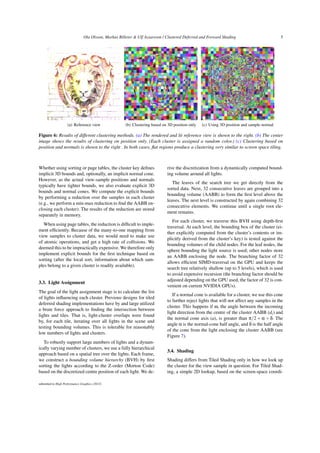
of bits that encode a quantized normal direction (Figure 6).
We quantize normals by cube face and a discrete 2D grid
over each face, as illustrated in Figure 4. Clustering on nor-
mals improves culling of lights (see Section 3.3).
Compacted
Sorted Key Buffer
Key Buffer (pixels)
Figure 5: Sorting and compacting the key buffer to find
unique clusters. The cluster keys in the key buffer are sorted
and then compacted, to find the list of unique clusters. The
sorting is, for instance, based on the view sample’s depth
and normal direction.
3.2. Finding Unique Clusters
We will here present two different options that we use for
identifying unique clusters: with sorting and with page ta-
bles.
The perhaps most obvious method to find the unique clus-
ters in parallel is to simply sort the cluster keys, and then
perform a compaction step that removes any with an identi-
cal neighbour (see Figure 5). Both sorting and compaction
are relatively efficient and readily available GPU building
blocks [HB10, BOA09]. However, despite steady progress,
sorting remains an expensive operation, and we therefore ex-
plore better performing alternatives.
As noted in Section 2, methods that rely on adjacent
screen-space coherency are not robust, especially with re-
spect to stochastic frame buffers. We therefore focus on tech-
niques that do not suffer from this weakness.
3.2.0.1. Local Sorting In our first technique, we sort sam-
ples in each screen space tile locally. This allows us to per-
form the sorting operation in on-chip shared memory, and
use local (and therefore smaller) indices to link back to the
source pixel. We extract unique clusters from each tile using
a parallel compaction. From this, we get the globally unique
list of clusters. During the compaction, we also compute and
store a link from each sample to its associated cluster.
3.2.0.2. Page Tables The second technique is similar to
the page table approach used by virtual textures (Section 2).
However, as the range of possible cluster keys is very large,
we cannot use a direct mapping between cluster key and
physical storage location for the cluster data; it simply would
typically not fit into GPU memory. Instead we use a vir-
tual mapping, and allocate physical pages where any actual
keys needs storage. Lefohn et.al. [LSK∗
06] provide details
on software GPU implementation of virtual address transla-
tion. We exploit the fact that all physical pages are allocated
in a compact range, and we can therefore compact that range
to find the unique clusters.
submitted to High Performance Graphics (2012)](https://image.slidesharecdn.com/clustereddeferedandforwardshading-210909085135/85/Clustered-defered-and-forward-shading-4-320.jpg)
![6 Ola Olsson, Markus Billeter Ulf Assarsson / Clustered Deferred and Forward Shading
α a
ω
δ
dl
Figure 7: Back-face culling of lights against clusters. A nor-
mal cone (blue), with the opening angle α is derived from or
stored with the cluster. The normals of the samples contained
in this cluster are all within this cone. The cone originating
at the light source and enclosing the cluster (dashed grey –
geometrically equivalent to the red cone) gives the angle δ.
If the angle between the incoming light and the axis of the
normal cone (ω) is greater than π/2+α+δ, the light faces
the back of all samples in the cluster, and can therefore be
ignored.
nates, is sufficient to retrieve light-list offset and count. How-
ever, for clustered approaches, there no longer exists a direct
mapping between the cluster key and the index into the list
of unique clusters.
In the sorting approach, we explicitly store this index for
each pixel. This is achieved by tracking references back to
the originating pixel, and, when the unique cluster list is
established, storing the index to the correct pixel in a full
screen buffer.
When using page tables, after the unique clusters are
found, we store the cluster index back to the physical mem-
ory location used to store the cluster key earlier (using the
same page table as before). This means that a virtual lookup
for the cluster key will yield the cluster index. Thus, each
sample can look up the cluster index using the cluster key
computed earlier (or re-computed).
4. Implementation and Evaluation
We implemented several variants of the new algorithm using
OpenGL and CUDA. The variants are as follows (suffixes
used are documented in Table 1):
• ClusteredDeferred[Nk][En][Eb][Pt] – clustered deferred
shading.
• ClusteredForward – clustered forward shading. Clustered
forward shading requires a pre-z pass to prime the depth
buffer, which is used for clustering. Currently only imple-
mented with page tables.
Additionally, we implemented the following methods for
comparison, as described in [OA11]:
• Deferred, traditional deferred shading, with stencil opti-
Table 1: Suffixes identifying variations of the clustered
methods.
Suffix Meaning
Nk[X] Clustering based on normal, using X ×
X subdivisions to a cube face.
En Explicit normals cones are derived and
used.
Eb Explicit Bounds (3D AABB) are de-
rived and used.
Pt Page Tables are used to find the unique
clusters
mization. This means that light assignment will be exact
per sample using a stencil test [AA03].
• TiledDeferred, standard tiled deferred shading.
• TiledDeferredEn, tiled deferred shading with explicit nor-
mal cones computed per tile.
• TiledForward, standard tiled forward shading, with a
depth pre-pass, to enable min-max culling of lights.
4.1. Cluster Key Packing
For maximum performance when using sorting or page ta-
bles, we wish to pack the cluster key into as few bits as
possible. We allocate 8 bits to each i and j components,
which identify the screen-space tile the cluster belongs to.
This allows up to 8192×8192 size render targets (assuming
screen-space tile size of 32 × 32 pixels). The depth index k
is determined from settings for the near and far planes and
Equation 2. In our scenes, we found 10 bits to be sufficient.
This leaves up to 6 bits for the optional normal clustering.
Using 6 bits, we can for instance support a resolution up to
3 × 3 subdivisions on each cube face (3 × 3 × 6 = 54 and
dlog2 54e = 6). For more restricted environments, the data
could be packed more aggressively, saving both time and
space.
4.2. Tile Sorting
To the cluster key (between 10 and 16 bits wide) we attach an
additional 10 bits of meta-data, which identifies the sample’s
original position relative to its tile. We then perform a tile-
local sort of the cluster keys and the associated meta-data.
The sort only considers the up-to 16 bits of the cluster key;
the meta-data is used as a link back to the original sample af-
ter sorting. In each tile, we count the number of unique clus-
ter keys. Using a prefix operation over the counts from each
tile, we find the total number of unique cluster keys and as-
sign each cluster a unique ID in the range [0...numClusters).
We write the unique ID back to each pixel that is a mem-
ber of the cluster. The unique ID also serves as an offset in
memory to where the cluster’s data is stored.
Bounding volumes (AABB and normal cone) can be re-
constructed from the cluster keys, in which case each cluster
submitted to High Performance Graphics (2012)](https://image.slidesharecdn.com/clustereddeferedandforwardshading-210909085135/85/Clustered-defered-and-forward-shading-6-320.jpg)
![Ola Olsson, Markus Billeter Ulf Assarsson / Clustered Deferred and Forward Shading 7
Figure 8: A view of the Crytek Sponza scene, with 10k lights
randomly placed. The tree branches cause discontinuities in
the depth buffer, making it more challenging for tiled de-
ferred shading.
only needs to store its cluster key. For explicit bounding vol-
umes, we additionally store the AABB and/or normal cone.
The explicit bounding volumes are computed using a reduc-
tion operation: for instance, AABBs can be found using a
min- and a max-reduction operation on the sample positions.
The meta-data from the locally sorted cluster keys gives us
information on which samples belong to a given cluster.
4.3. Page Tables
We implemented a single level page table using a two pass
approach. First the required pages are flagged in the table.
Then, the physical pages are allocated using a parallel prefix
sum, and finally the keys are stored into the physical pages.
Performing the physical page allocation on the fly in a single
pass was more than 2 times slower, but could still be viable
on hardware with faster atomic operations.
4.4. Light Assignment
As described in Section 3.3, we construct a search tree over
the lights each frame. Construction relies on efficient sort-
ing functions; here we use the sorting function provided by
Thrust [HB10]. To construct the upper levels of the tree, we
launch a CUDA warp (32 threads) for each node to be con-
structed. The warp performs an in-warp parallel reduction
over the children’s bounding volumes.
For traversal, we again take advantage of the 32-wide fan-
out of the search tree. For each cluster we allocated a warp
that traverses the tree in depth-first order. Each thread in the
warp tests the 32 bounding volumes of the children in paral-
lel. By providing unrolled implementations for trees of depth
up to 5, we can avoid expensive recursion in CUDA. With a
depth of 5, we can support up to 32 million lights, which we
deemed to be sufficient (it is trivial to expand this).
5. Results and Discussion
We measured performance for the algorithm and variants de-
scribed in the previous section, and measurements are per-
0
5
10
15
20
25
30
0 200 400
Lighting
Comps.
(Millions)
Frame
Deferred
Clustered
Clustered
Nk3EbEn
0
1
2
3
4
5
0 100 200 300 400
Frame
Figure 9: (left) Millions of lighting computations performed
along a fly-through of the Necropolis scene. (right) Same
data, normalized to the Deferred method.
formed on an NVIDIA GTX 480 GPU, unless otherwise in-
dicated. We used the set of scenes listed below.
• Necropolis. Scene from the Unreal Development
Kit [Epi11] (Figure 1). The scene contains 653 lights,
with bounded ranges. The majority are spot lights.
However we treat all lights as point lights (this is a
limitations in our implementation). The scene contains
around 2M triangles and is normal mapped. We created
a camera animation covering the length of the map (see
supplemental video). To bring the number of lights up
further, we added several cannon towers to the scene
which shoot out colourful spheres, bringing the total
number of lights up to around 2500 during the animation.
• Sponza. We used the version of sponza made available
by Crytek [Cry10] (Figure 8). To make the scene more
challenging, with more discontinuities, we injected a set
of bare trees. We generated 10k random lights within the
scene AABB.
5.1. Performance Analysis
The main advantage of clustered shading over tiled shading
is the reduced view dependence. By avoiding empty space,
efficiency should be similar to that of deferred shading with
stencil optimization and less variable than tiled shading. This
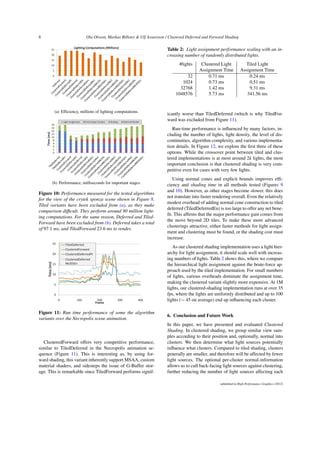
is shown in Figures 9 and 10(a), which both adopt the light-
ing computations metric from [OA11].
Since clustering and light assignment introduce over-
heads, it is expected that tiled shading performs better when
there are fewer lights, or few discontinuities. Clustered shad-
ing is still expected to have less view-dependent variability
in frame times. Figure 11 confirms that this is the case for
the necropolis scene, which has relatively few discontinu-
ities and lights. Even the most complex clustered algorithm
tested (ClusteredNk3EbEn), offers worst case performance
comparable to tiled deferred. This is also the case for the
more challenging scene shown in Figure 10(b), with many
discontinuities and lights, indicating greater robustness for
clustered shading. We also see that the best performing clus-
tered variant (ClusteredDeferredPt) is around 50% faster in
the worst case on the necropolis animation.
submitted to High Performance Graphics (2012)](https://image.slidesharecdn.com/clustereddeferedandforwardshading-210909085135/85/Clustered-defered-and-forward-shading-7-320.jpg)
![Ola Olsson, Markus Billeter Ulf Assarsson / Clustered Deferred and Forward Shading 9
0
2
4
6
8
10
12
0 2000 4000 6000 8000 10000
Time
(ms)
Number of Lights
(a) Sponza, no trees.
0
2
4
6
8
10
12
14
16
18
0 2000 4000 6000 8000 10000
Time
(ms)
Number of Lights
(b) Sponza, with trees.
0
10
20
30
40
50
0 2000 4000 6000 8000 10000
Time
(ms)
Number of Lights
Nk3EbEn
(c) Sponza, no trees, 2x light radius.
Figure 12: Crossover points for various algorithms and numbers of lights for the view of Sponza seen in Figure 8. Note that (a)
and (c) use the same view, but without trees, and therefore contain fewer discontinuities.
cluster. We have shown that efficiency is indeed superior,
and that performance is more robust with respect to chang-
ing viewing conditions. Our implementation shows that both
clustered deferred and forward shading offer real-time per-
formance and can scale up to 1M lights. In addition, over-
head for the clustering is low, making it competitive even for
few lights.
In the future, we would like to explore approximative
lighting, where a heuristic is used to determine if all view
samples in a cluster are affected approximately equally by a
certain light. If so, the lighting for that light source is evalu-
ated once and re-used for all samples in the cluster. In some
initial tests, we have observed an up to around 20% reduction
in lighting computations, at very little computational cost.
(However, this produced some subtle visual discrepancies,
which we have been unable to work around at this point.)
We believe that it is possible to produce high quality ap-
proximations. These approximations may require additional
per-cluster data, such as average shininess for specular com-
putations. A better heuristic for determining when approxi-
mation is possible would also have to be developed.
It would also be interesting to investigate how clustered
shading interacts with more complex shading, e.g. switch-
ing due to type of material. Since clustered shading has a
much smaller shading cost than tiled shading, we expect bet-
ter scaling with shader complexity.
References
[AA03] ARVO J., AILA T.: Optimized shadow mapping using
the stencil buffer. journal of graphics, gpu, and game tools 8, 3
(2003), 23–32. 6
[And09] ANDERSSON J.: Parallel graphics in frostbite - current
future. SIGGRAPH Course: Beyond Programmable Shading,
2009. URL: http://s09.idav.ucdavis.edu/talks/
04-JAndersson-ParallelFrostbite-Siggraph09.
pdf. 2
[BE08] BALESTRA C., ENGSTAD P.-K.: The technology
of uncharted: Drake’s fortune. Game Developer Confer-
ence, 2008. URL: http://www.naughtydog.com/docs/
Naughty-Dog-GDC08-UNCHARTED-Tech.pdf. 2
[BOA09] BILLETER M., OLSSON O., ASSARSSON U.: Efficient
stream compaction on wide simd many-core architectures. In
HPG ’09: Proceedings of the Conference on High Performance
Graphics 2009 (New York, NY, USA, 2009), ACM, pp. 159–
166. doi:http://doi.acm.org/10.1145/1572769.
1572795. 4
[Cof11] COFFIN C.: Spu-based deferred shading in bat-
tlefield 3 for playstation 3. GDC 2011, 2011. URL:
http://www.slideshare.net/DICEStudio/
spubased-deferred-shading-in-battlefield.
-3-for-playstation-3. 2
[Cry10] Cryengine3 | crytek | sponza model, 2010. URL:
http://www.crytek.com/cryengine/cryengine3/
downloads. 7
[DWS∗88] DEERING M., WINNER S., SCHEDIWY B., DUFFY
C., HUNT N.: The triangle processor and normal vector shader: a
vlsi system for high performance graphics. SIGGRAPH Comput.
Graph. 22, 4 (1988), 21–30. doi:http://doi.acm.org/
10.1145/378456.378468. 2
[Epi11] EPIC GAMES: Unreal development kit, 2011. URL:
http://www.udk.com/. 7
[ESSL10] ENDERTON E., SINTORN E., SHIRLEY P., LUE-
BKE D.: Stochastic transparency. In I3D ’10: Proceed-
ings of the 2010 ACM SIGGRAPH symposium on Interactive
3D Graphics and Games (New York, NY, USA, 2010), ACM,
pp. 157–164. doi:http://doi.acm.org.proxy.lib.
chalmers.se/10.1145/1730804.1730830. 2
[FC11] FERRIER A., COFFIN C.: Deferred shading techniques
using frostbite in battlefield 3 and need for speed the run.
In ACM SIGGRAPH 2011 Talks (New York, NY, USA, 2011),
SIGGRAPH ’11, ACM, pp. 33:1–33:1. doi:10.1145/
2037826.2037869. 2
[GL10] GARANZHA K., LOOP C.: Fast ray sorting and breadth-
first packet traversal for gpu ray tracing. Computer Graphics Fo-
rum 29, 2 (2010), 289–298. doi:10.1111/j.1467-8659.
2009.01598.x. 2, 3
[HB10] HOBEROCK J., BELL N.: Thrust: A parallel tem-
plate library, 2010. Version 1.3.0. URL: http://www.
meganewtons.com/. 4, 7
[HM08] HUNT W., MARK W. R.: Ray-specialized acceleration
structures for ray tracing. In IEEE/EG Symposium on Interactive
Ray Tracing 2008 (Aug 2008), IEEE/EG, pp. 3–10. 3
submitted to High Performance Graphics (2012)](https://image.slidesharecdn.com/clustereddeferedandforwardshading-210909085135/85/Clustered-defered-and-forward-shading-9-320.jpg)
![10 Ola Olsson, Markus Billeter Ulf Assarsson / Clustered Deferred and Forward Shading
[HPLdW10] HOLLEMEERSCH C.-F., PIETERS B., LAMBERT P.,
DE WALLE R. V.: Accelerating virtual texturing using cuda. In
GPU Pro, Engel W., (Ed.). A K Peters, 2010, pp. 623–642. 2
[Lau10] LAURITZEN A.: Deferred rendering for current
and future rendering pipelines. SIGGRAPH Course: Be-
yond Programmable Shading, 2010. URL: http://
bps10.idav.ucdavis.edu/talks/12-lauritzen_
DeferredShading_BPS_SIGGRAPH2010.pdf. 2
[LD12] LIKTOR G., DACHSBACHER C.: Decoupled deferred
shading for hardware rasterization. In Proceedings of the ACM
SIGGRAPH Symposium on Interactive 3D Graphics and Games
(New York, NY, USA, 2012), I3D ’12, ACM, pp. 143–150.
doi:10.1145/2159616.2159640. 3
[LSK∗06] LEFOHN A. E., SENGUPTA S., KNISS J., STR-
ZODKA R., OWENS J. D.: Glift: Generic, efficient, random-
access gpu data structures. ACM Trans. Graph. 25, 1 (Jan.
2006), 60–99. URL: http://doi.acm.org.proxy.lib.
chalmers.se/10.1145/1122501.1122505, doi:10.
1145/1122501.1122505. 4
[LSO07] LEFOHN A. E., SENGUPTA S., OWENS J. D.:
Resolution-matched shadow maps. ACM Trans. Graph. 26,
4 (2007), 20. doi:http://doi.acm.org/10.1145/
1289603.1289611. 2
[LTYM06] LLOYD D. B., TUFT D., YOON S.-E., MANOCHA
D.: Warping and partitioning for low error shadow maps. In Pro-
ceedings of the Eurographics Workshop/Symposium on Render-
ing, EGSR (June 2006), Eurographics Association, pp. 215–226.
4
[May10] MAYER A. J.: Virtual Texturing. Master’s
thesis, Institute of Computer Graphics and Algorithms,
Vienna University of Technology, Oct. 2010. URL:
http://www.cg.tuwien.ac.at/research/
publications/2010/Mayer-2010-VT/. 2
[McK12] MCKEE J.: Technology behind amd’s leo
demo. Game Developers Conference, 2012. URL:
http://developer.amd.com/gpu_assets/AMD_
Demos_LeoDemoGDC2012.ppsx. 2
[OA11] OLSSON O., ASSARSSON U.: Tiled shading. Journal of
Graphics, GPU, and Game Tools 15, 4 (2011), 235–251. doi:
10.1080/2151237X.2011.621761. 1, 2, 6, 7
[ST90] SAITO T., TAKAHASHI T.: Comprehensible render-
ing of 3-d shapes. SIGGRAPH Comput. Graph. 24, 4
(1990), 197–206. doi:http://doi.acm.org/10.1145/
97880.97901. 2
[Swo09] SWOBODA M.: Deferred lighting and post
processing on playstation 3. Game Developer Con-
ference, 2009. URL: http://www.technology.
scee.net/files/presentations/gdc2009/
DeferredLightingandPostProcessingonPS3.ppt.
2
submitted to High Performance Graphics (2012)](https://image.slidesharecdn.com/clustereddeferedandforwardshading-210909085135/85/Clustered-defered-and-forward-shading-10-320.jpg)


![Deferred rendering in_leadwerks_engine[1]](https://cdn.slidesharecdn.com/ss_thumbnails/deferredrenderinginleadwerksengine1-100826205754-phpapp02-thumbnail.jpg?width=640&height=640&fit=bounds)


