CloudStack Identity and Access
Management (IAM)
Min Chen
 
Prachi Damle"
Citrix
Agenda
•  Background
•  Our Design Goal
•  Architecture
•  Implementation
•  Use Cases
•  Next Steps
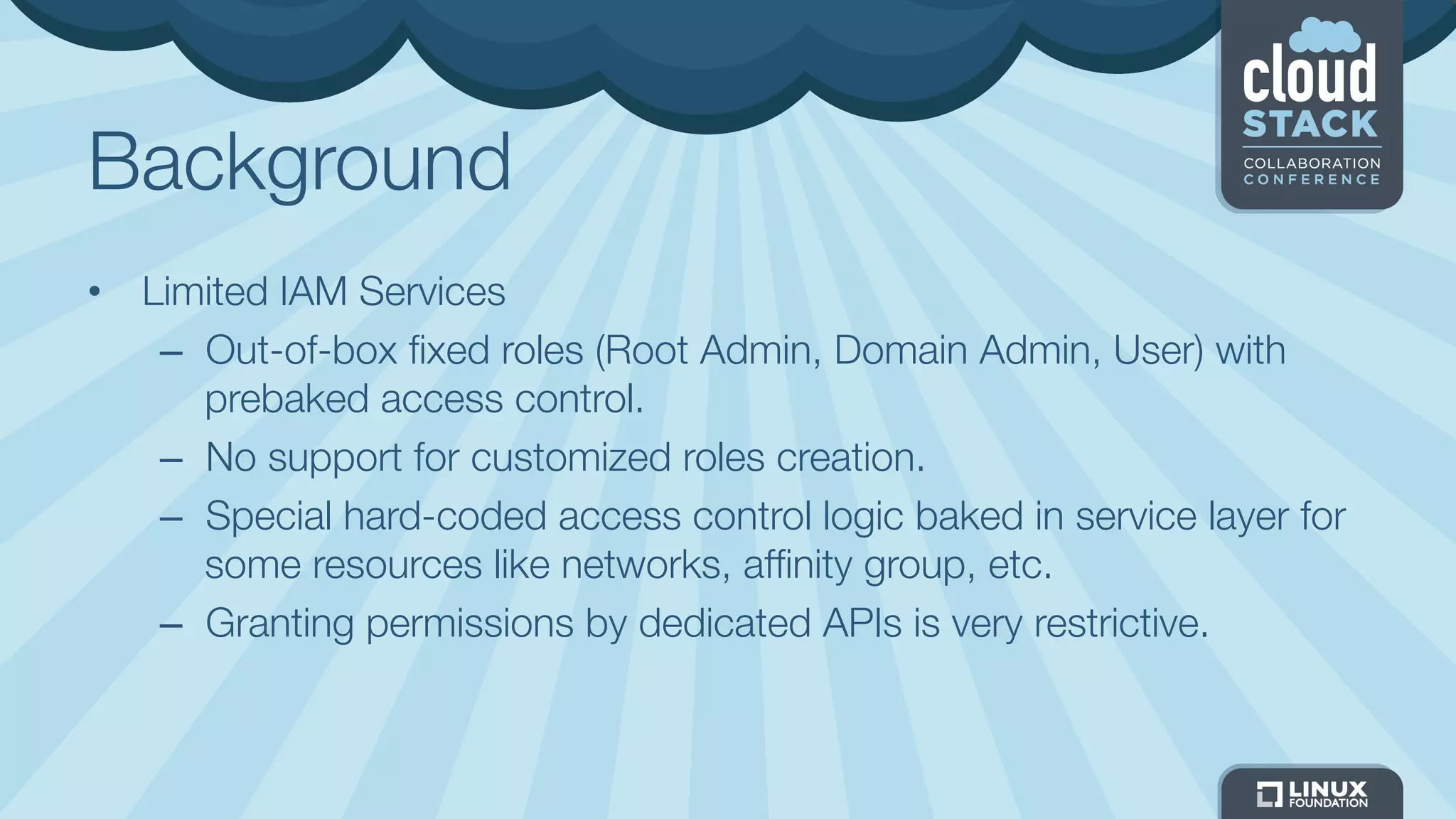
Background
•  Limited IAM Services
–  Out-of-box fixed roles (Root Admin, Domain Admin, User) with
prebaked access control.
–  No support for customized roles creation.
–  Special hard-coded access control logic baked in service layer for
some resources like networks, affinity group, etc.
–  Granting permissions by dedicated APIs is very restrictive.
Our Goal


Provide True Pluggable IAM Service
Our Goal


Provide True Pluggable IAM Service
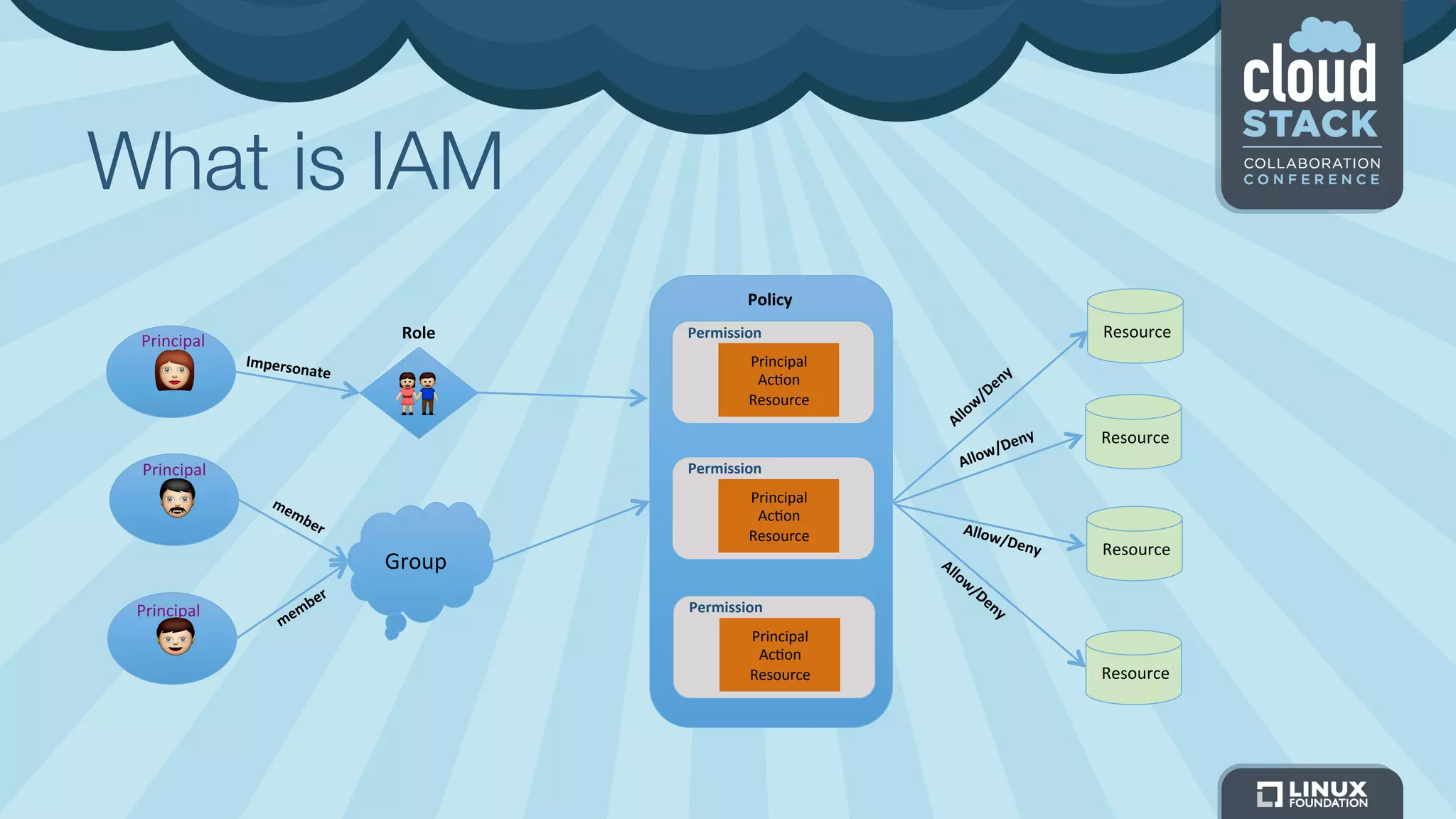
What is IAM"
"

 👩	
  	
  
👨	
  	
  
👦	
  	
  
Permission	
  
Principal	
  
Ac+on	
  
Resource	
  
Permission	
  
Principal	
  
Ac+on	
  
Resource	
  
Permission	
  
Principal	
  
Ac+on	
  
Resource	
  
Policy	
  
Group	
  
Resource	
  
Resource	
  
Resource	
  
Resource	
  
Principal	
  
Principal	
  
Principal	
  
👫	
  
Role	
  
Impersonate	
  
Allow/Deny	
  
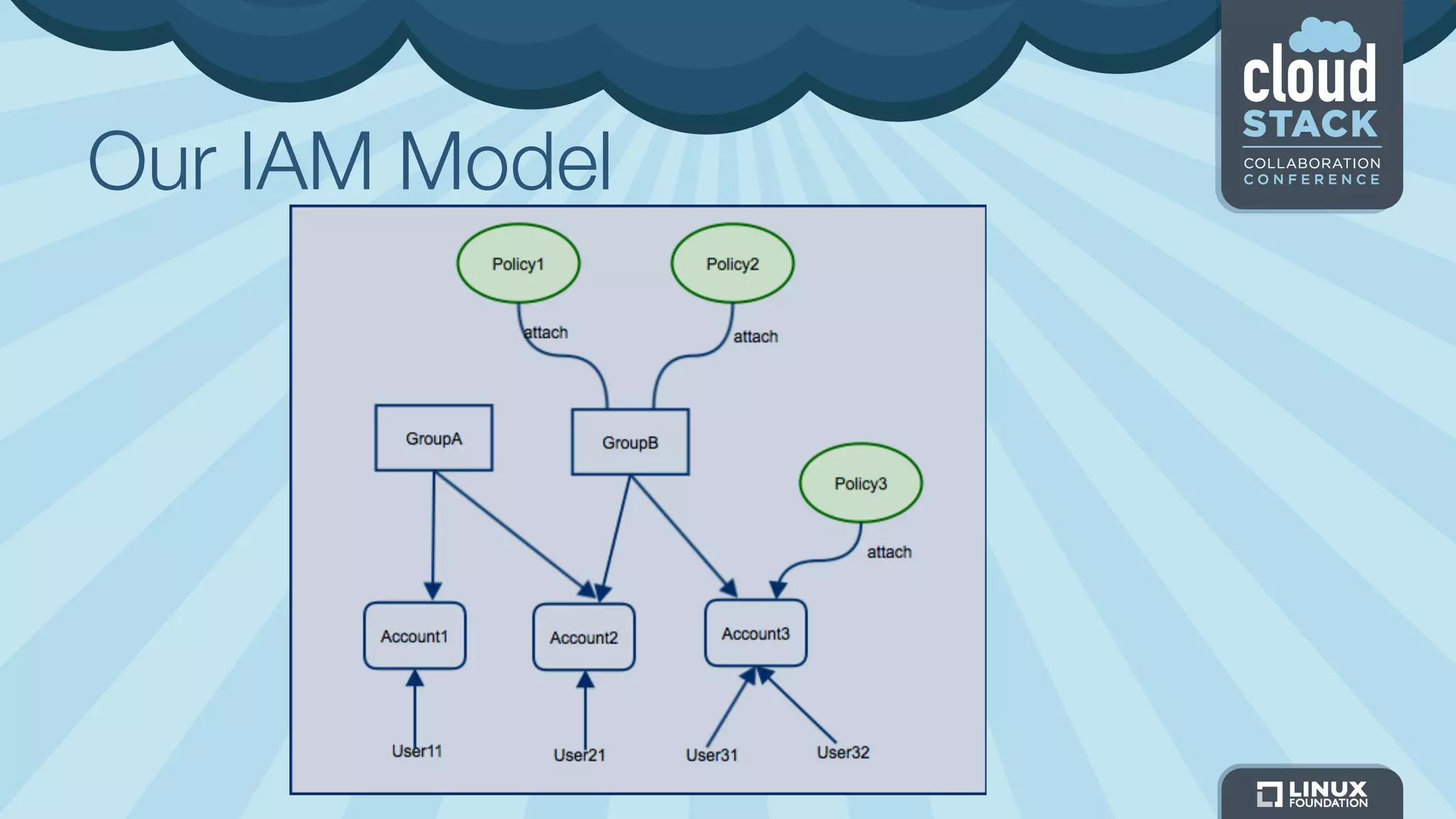
Our IAM Model
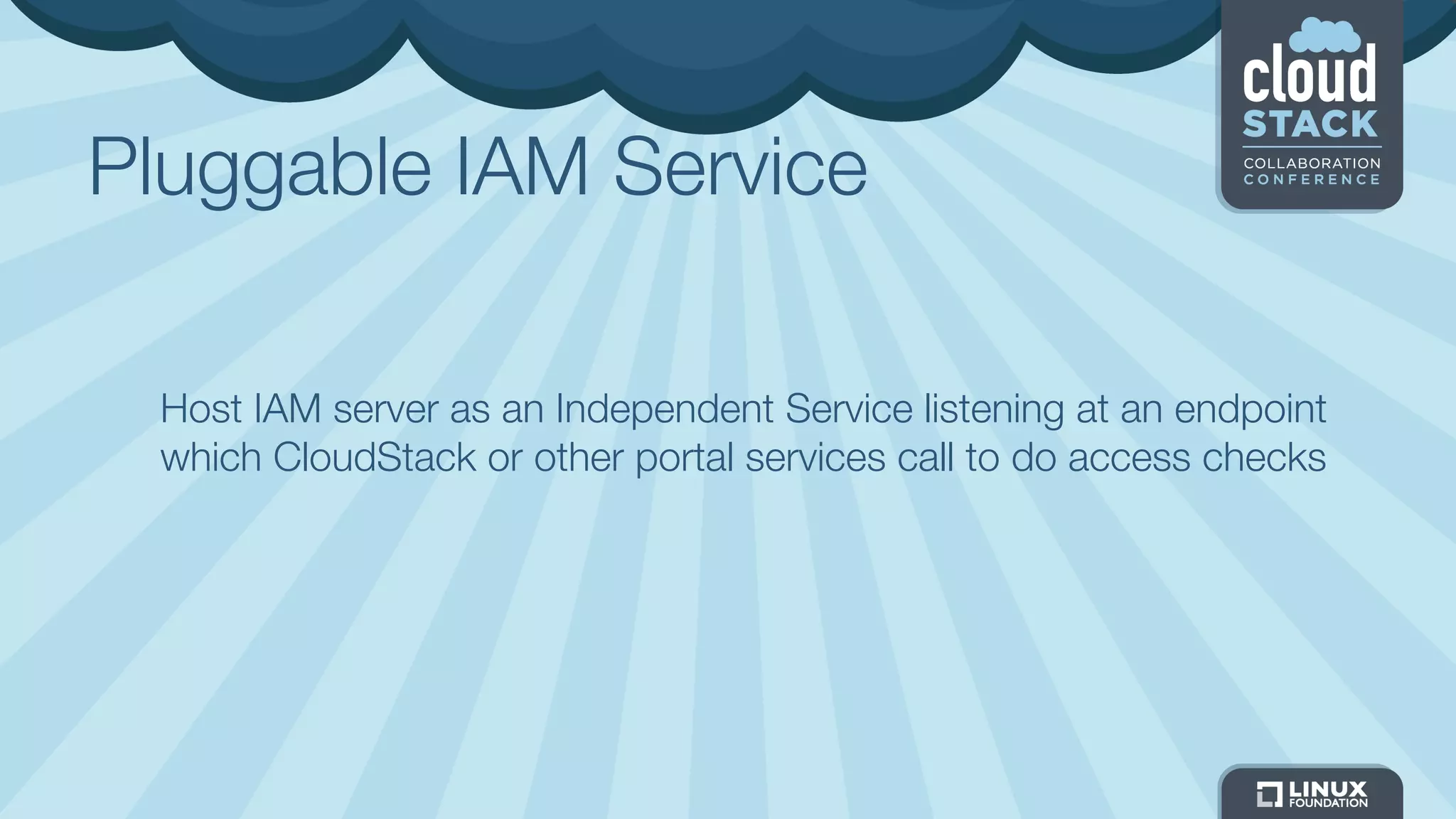
Pluggable IAM Service"


Host IAM server as an Independent Service listening at an endpoint
which CloudStack or other portal services call to do access checks
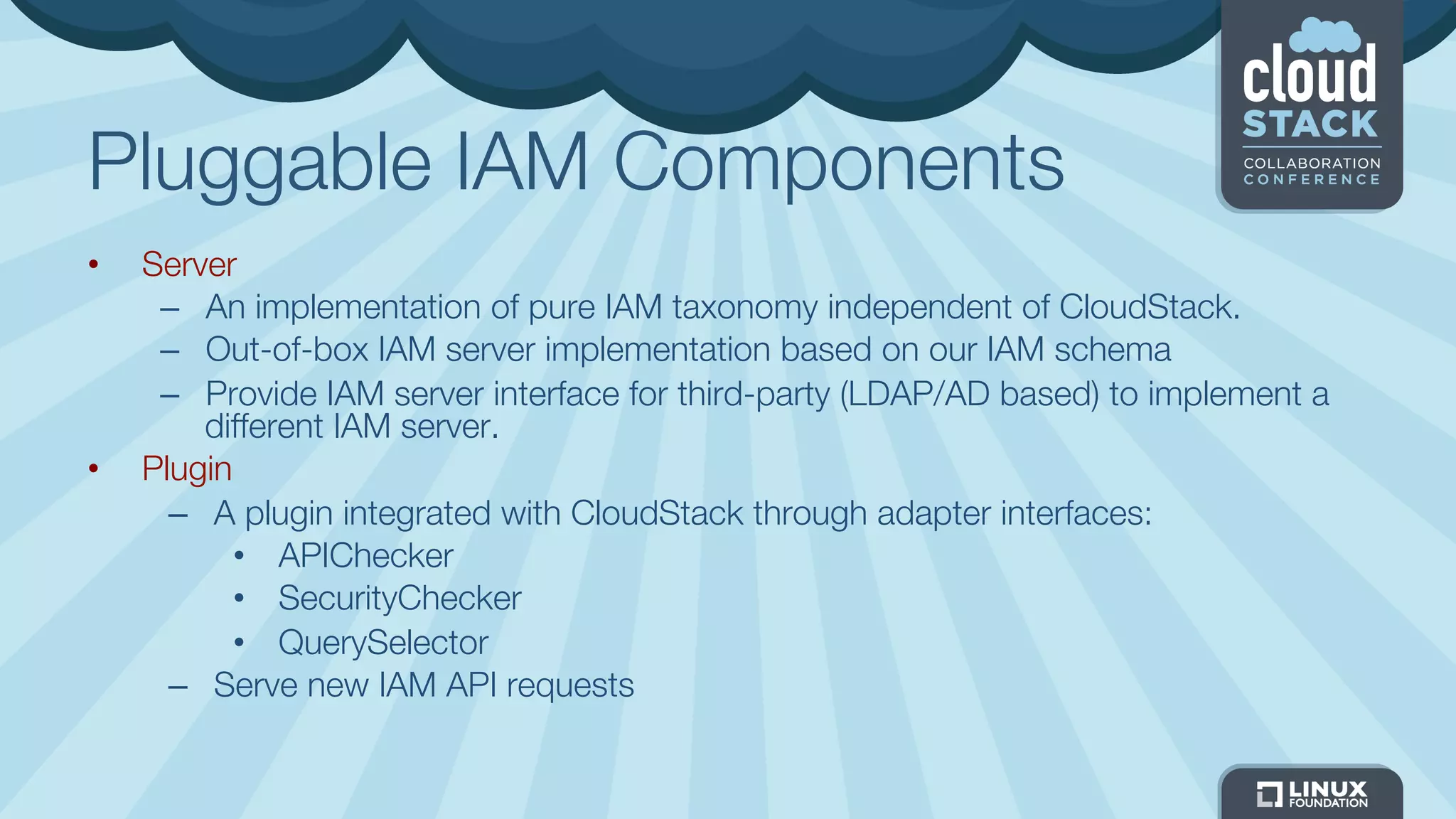
Pluggable IAM Components"

•  Server
–  An implementation of pure IAM taxonomy independent of CloudStack.
–  Out-of-box IAM server implementation based on our IAM schema 
–  Provide IAM server interface for third-party (LDAP/AD based) to implement a
different IAM server.
•  Plugin
–  A plugin integrated with CloudStack through adapter interfaces:
•  APIChecker
•  SecurityChecker
•  QuerySelector
–  Serve new IAM API requests
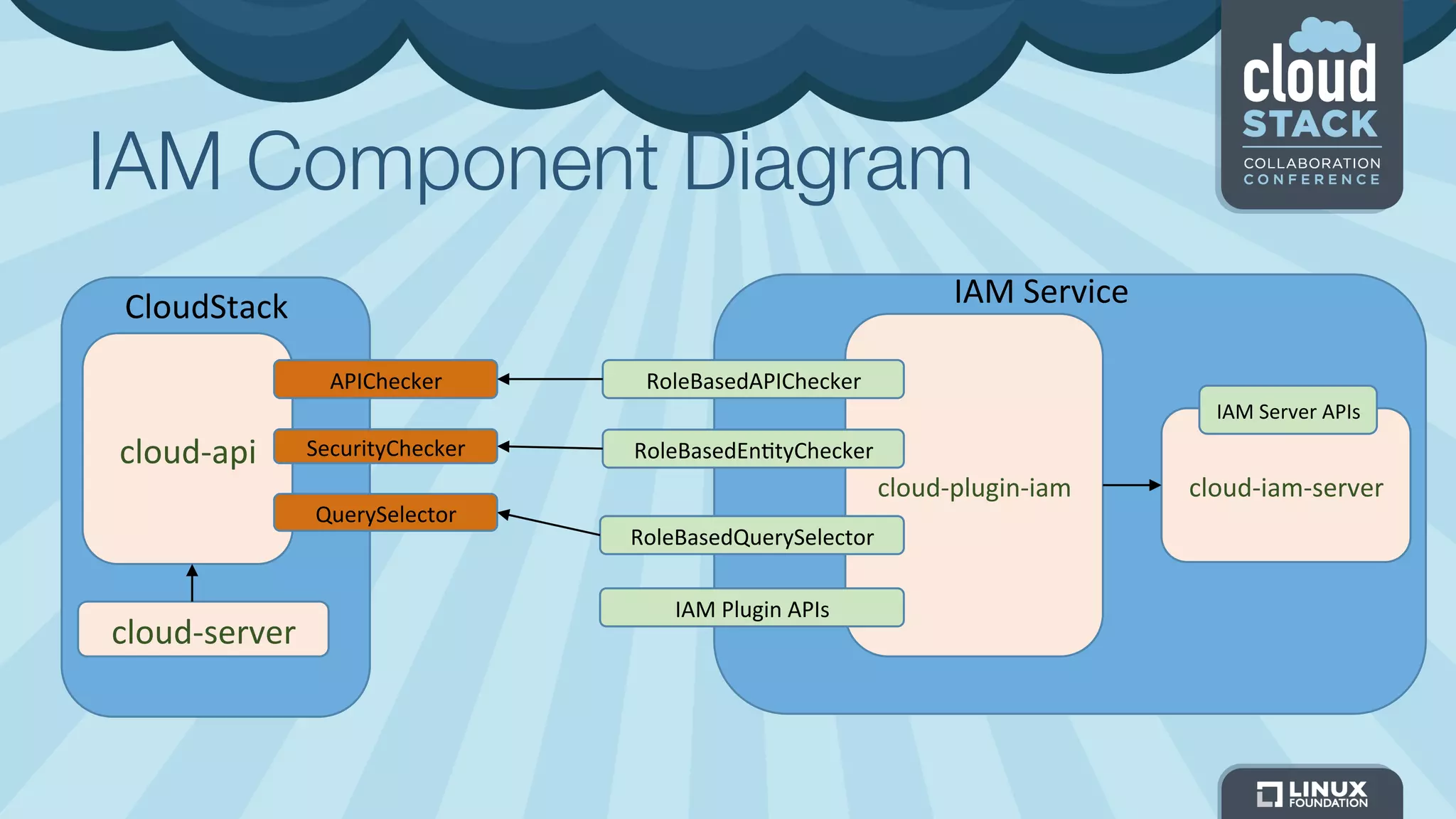
IAM Component Diagram
CloudStack	
  
cloud-­‐api	
  
cloud-­‐server	
  
IAM	
  Service	
  
cloud-­‐plugin-­‐iam	
  
APIChecker	
  
SecurityChecker	
  
QuerySelector	
  
RoleBasedAPIChecker	
  
RoleBasedEn+tyChecker	
  
RoleBasedQuerySelector	
  
IAM	
  Plugin	
  APIs	
  
cloud-­‐iam-­‐server	
  
IAM	
  Server	
  APIs	
  
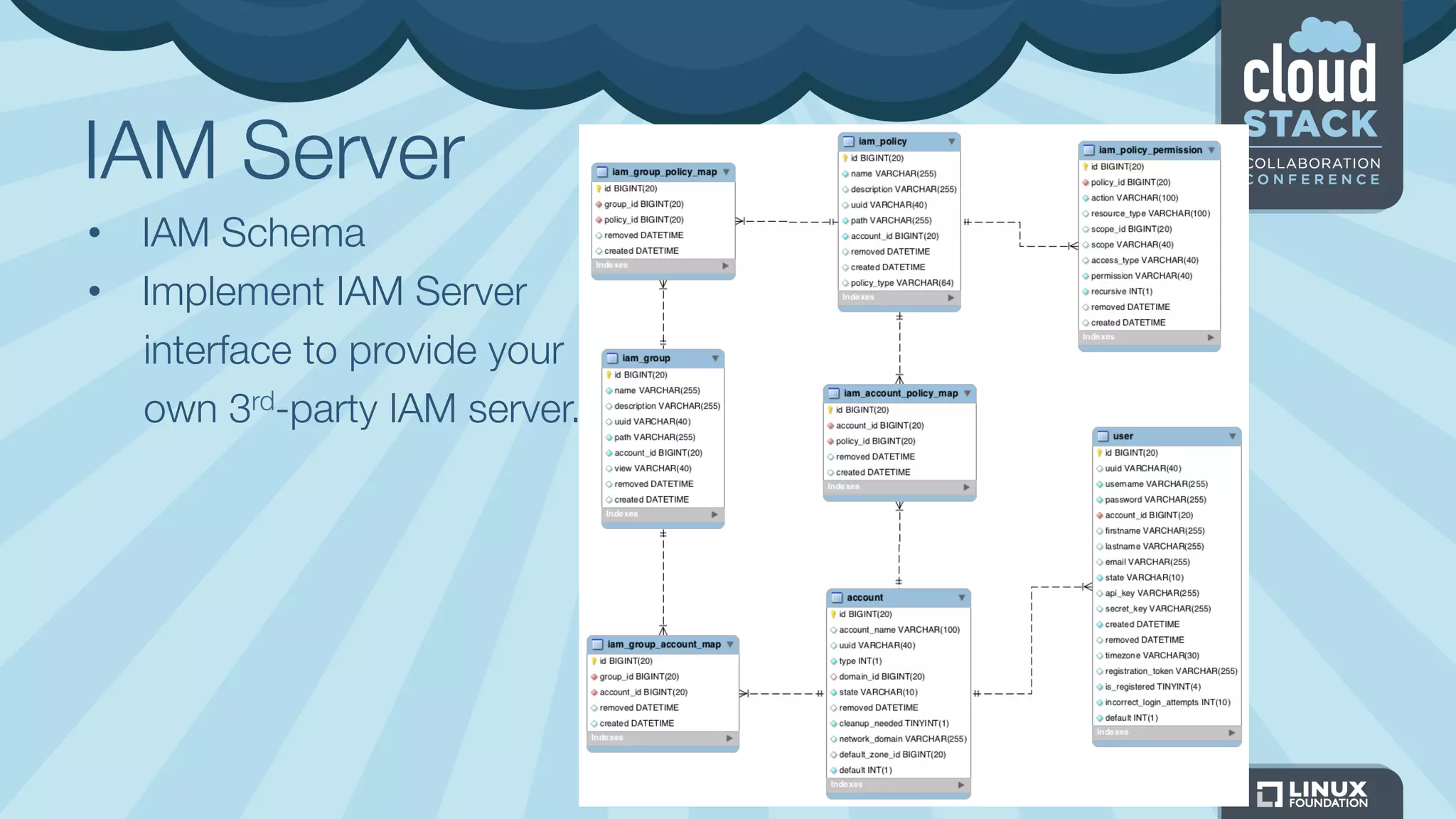
IAM Server
•  IAM Schema
•  Implement IAM Server
interface to provide your 
own 3rd-party IAM server.
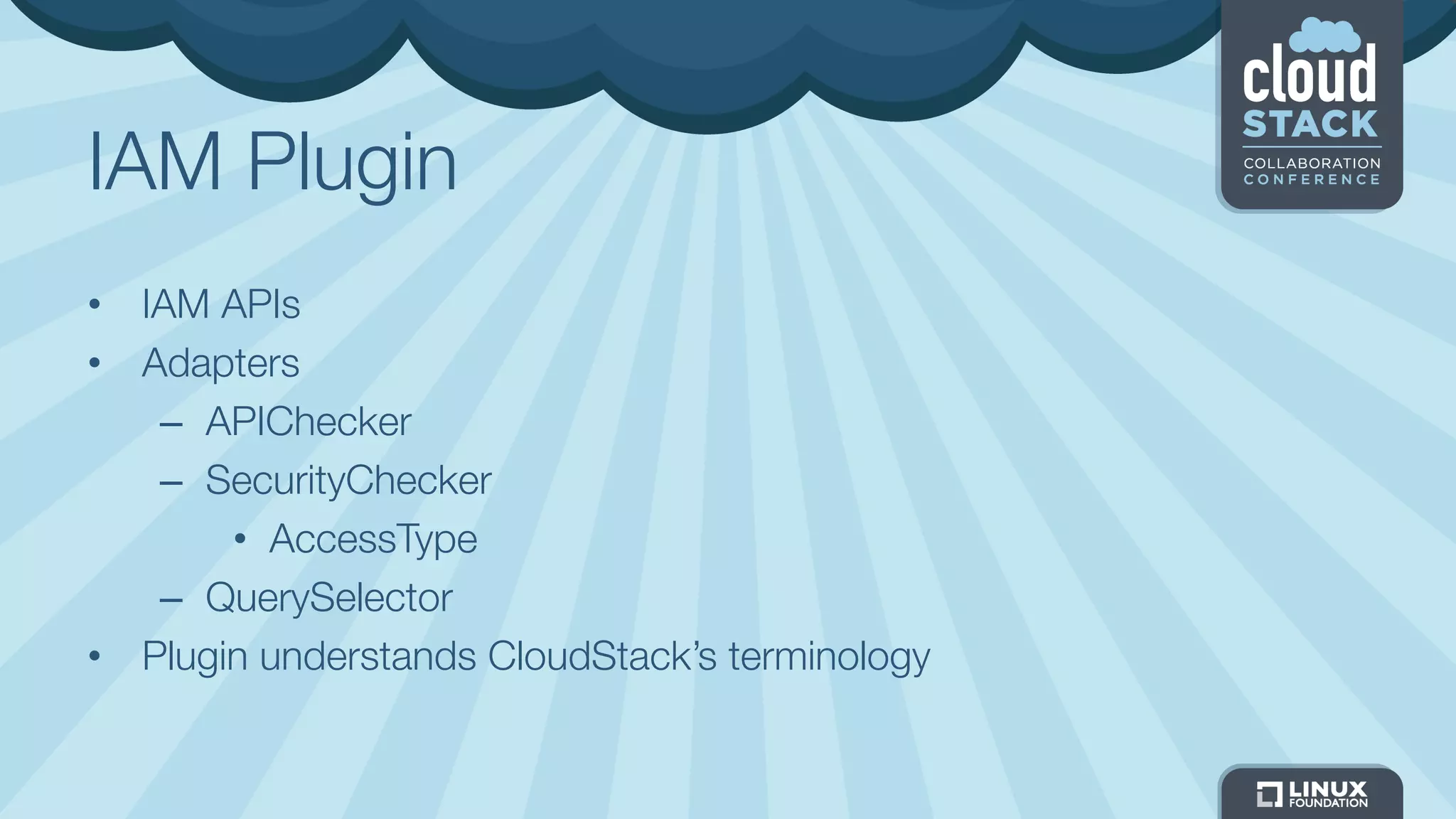
IAM Plugin
•  IAM APIs 
•  Adapters
–  APIChecker
–  SecurityChecker
•  AccessType
–  QuerySelector
•  Plugin understands CloudStack’s terminology
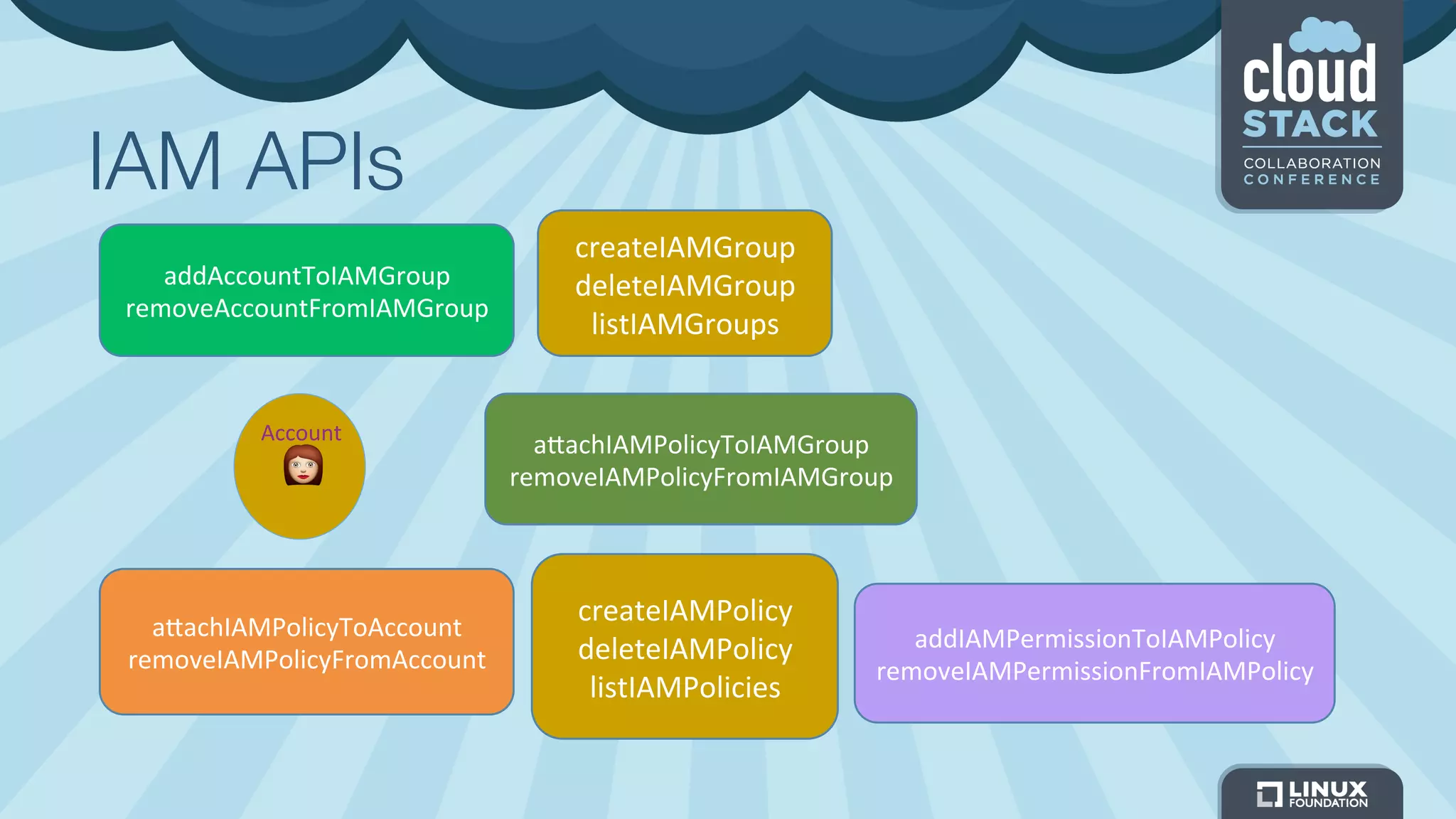
IAM APIs
createIAMGroup	
  
deleteIAMGroup	
  
listIAMGroups	
  
createIAMPolicy	
  
deleteIAMPolicy	
  
listIAMPolicies	
  
addIAMPermissionToIAMPolicy	
  
removeIAMPermissionFromIAMPolicy	
  
addAccountToIAMGroup	
  
removeAccountFromIAMGroup	
  
aDachIAMPolicyToAccount	
  
removeIAMPolicyFromAccount	
  
aDachIAMPolicyToIAMGroup	
  
removeIAMPolicyFromIAMGroup	
  👩	


  Account	
  
APIChecker
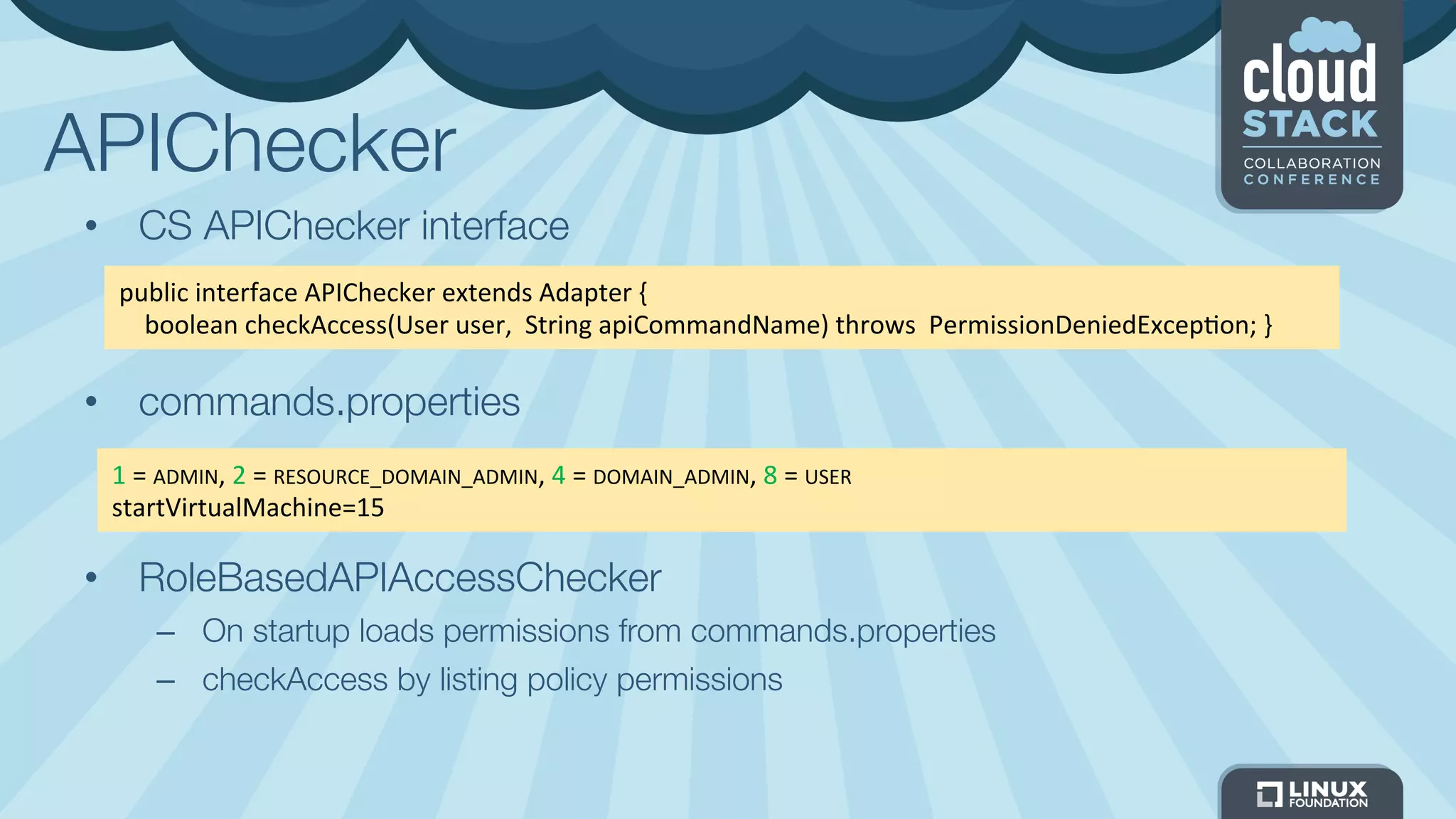
•  CS APIChecker interface
•  commands.properties 

•  RoleBasedAPIAccessChecker
–  On startup loads permissions from commands.properties 
–  checkAccess by listing policy permissions

public	
  interface	
  APIChecker	
  extends	
  Adapter	
  {	


  boolean	
  checkAccess(User	
  user,	
  	
  String	
  apiCommandName)	
  throws	
  	
  PermissionDeniedExcep+on;	
  }	
  
1	
  =	
  ADMIN,	
  2	
  =	
  RESOURCE_DOMAIN_ADMIN,	
  4	
  =	
  DOMAIN_ADMIN,	
  8	
  =	
  USER	
  
startVirtualMachine=15	
  
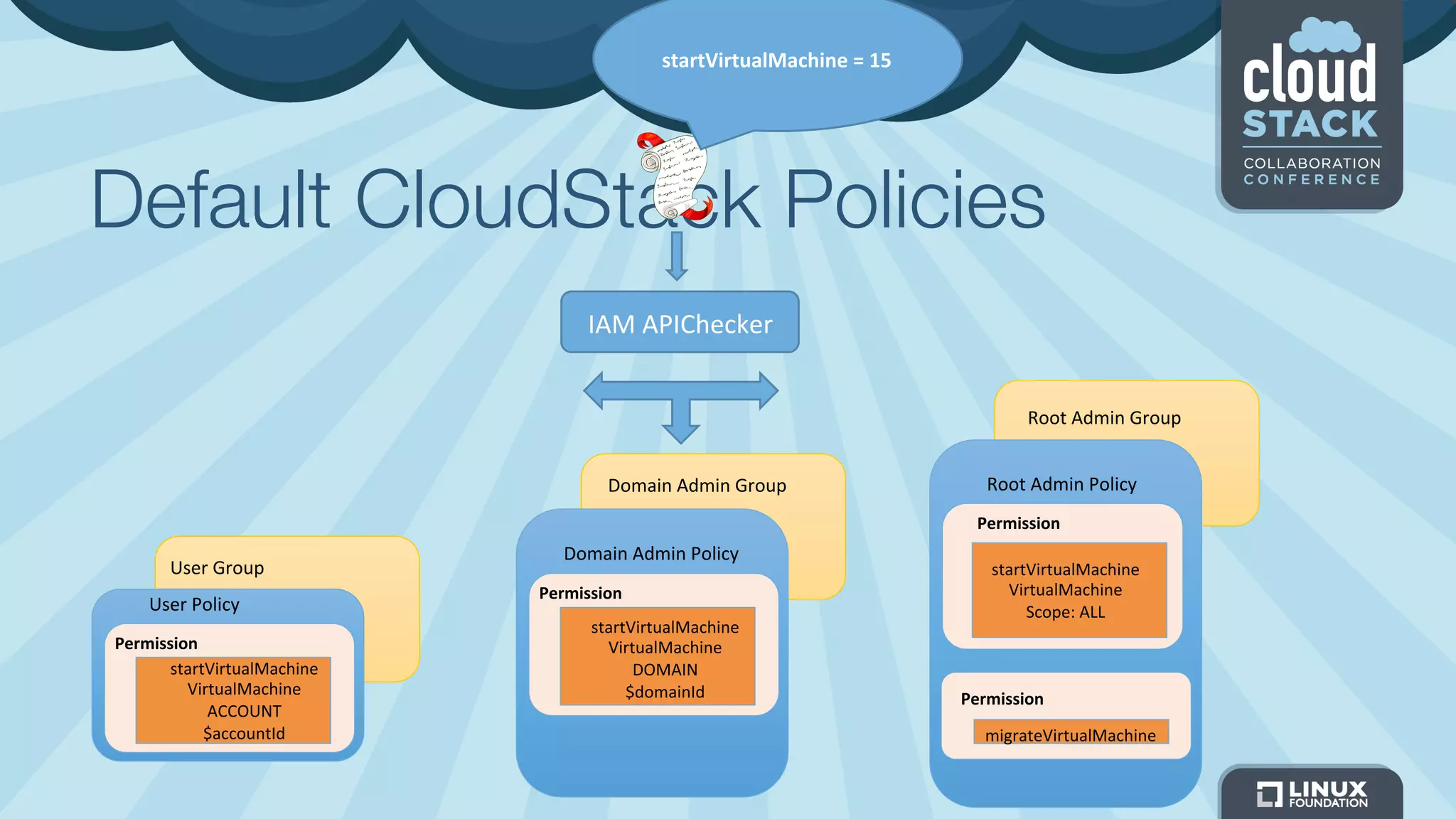
Default CloudStack Policies


User	
  Policy	
  
startVirtualMachine	
  
VirtualMachine	
  
ACCOUNT	
  
$accountId	
  
Permission	
  
User	
  Group	
  
Domain	
  Admin	
  Policy	
  
startVirtualMachine	
  
VirtualMachine	
  
DOMAIN	
  
$domainId	
  
Permission	
  
Domain	
  Admin	
  Group	
   Root	
  Admin	
  Policy	
  
startVirtualMachine	
  
VirtualMachine	
  
Scope:	
  ALL	
  
Permission	
  
migrateVirtualMachine	
  
Permission	
  
Root	
  Admin	
  Group	
  
IAM	
  APIChecker	
  
startVirtualMachine	
  =	
  15	
  
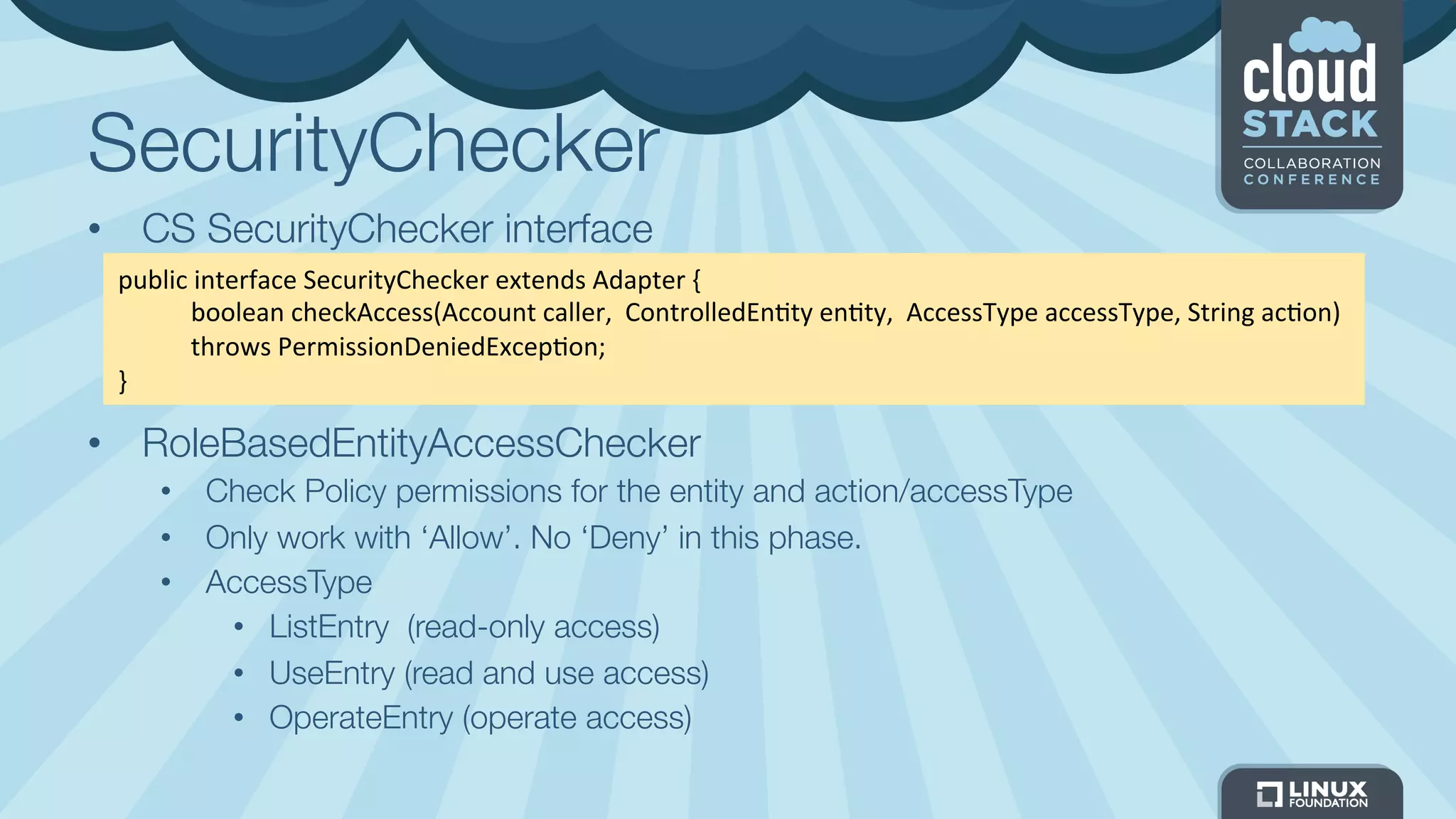
SecurityChecker
•  CS SecurityChecker interface
•  RoleBasedEntityAccessChecker
•  Check Policy permissions for the entity and action/accessType
•  Only work with ‘Allow’. No ‘Deny’ in this phase.
•  AccessType
•  ListEntry (read-only access)
•  UseEntry (read and use access)
•  OperateEntry (operate access)
public	
  interface	
  SecurityChecker	
  extends	
  Adapter	
  {	
  
boolean	
  checkAccess(Account	
  caller,	
  	
  ControlledEn+ty	
  en+ty,	
  	
  AccessType	
  accessType,	
  String	
  ac+on)	
  
throws	
  PermissionDeniedExcep+on;	
  
}	
  
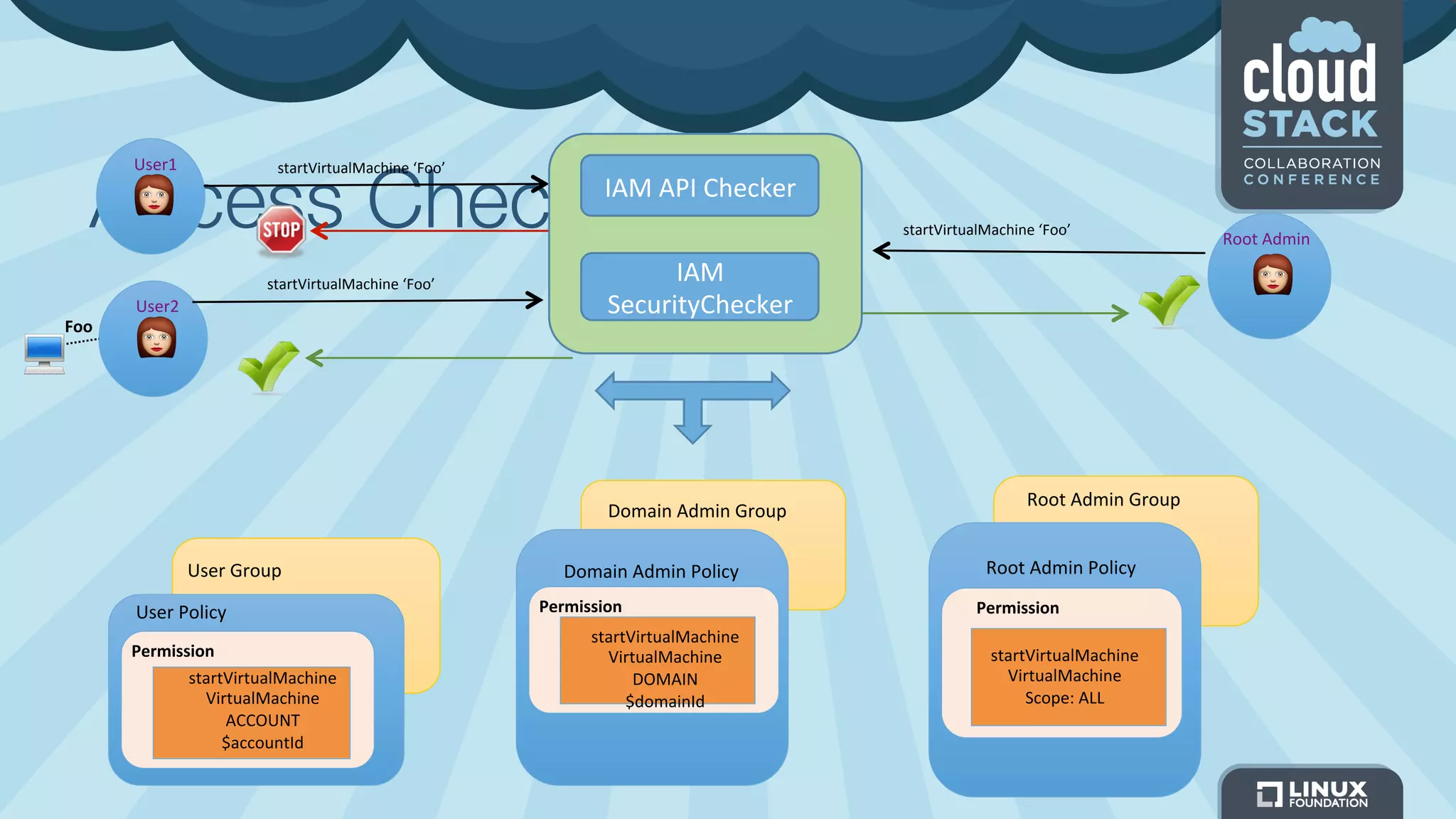
Access Check Flow


👩	
  	
  
User1	
   startVirtualMachine	
  ‘Foo’	
  
👩	
  	
  
User2	
  
💻	
  
Foo	
  
IAM	
  API	
  Checker	
  
IAM	
  
SecurityChecker	
  
User	
  Policy	
  
startVirtualMachine	
  
VirtualMachine	
  
ACCOUNT	
  
$accountId	
  
Permission	
  
User	
  Group	
   Domain	
  Admin	
  Policy	
  
startVirtualMachine	
  
VirtualMachine	
  
DOMAIN	
  
$domainId	
  
Permission	
  
Domain	
  Admin	
  Group	
  
Root	
  Admin	
  Policy	
  
startVirtualMachine	
  
VirtualMachine	
  
Scope:	
  ALL	
  
Permission	
  
Root	
  Admin	
  Group	
  
startVirtualMachine	
  ‘Foo’	
   👩	
  	
  
Root	
  Admin	
  
startVirtualMachine	
  ‘Foo’	
  
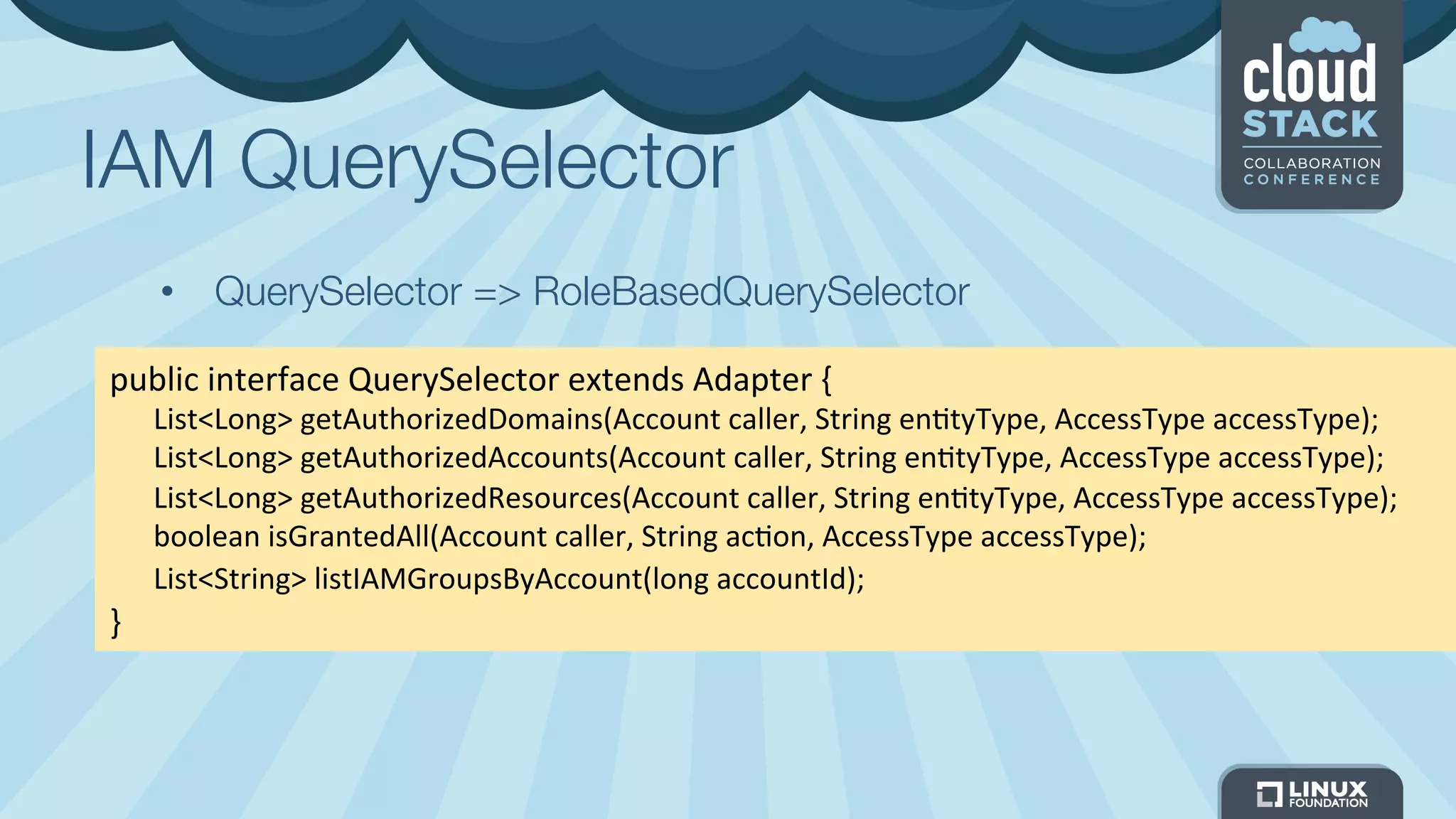
IAM QuerySelector
•  QuerySelector => RoleBasedQuerySelector
public	
  interface	
  QuerySelector	
  extends	
  Adapter	
  {	


  List<Long>	
  getAuthorizedDomains(Account	
  caller,	
  String	
  en+tyType,	
  AccessType	
  accessType);	


  List<Long>	
  getAuthorizedAccounts(Account	
  caller,	
  String	
  en+tyType,	
  AccessType	
  accessType);	


  List<Long>	
  getAuthorizedResources(Account	
  caller,	
  String	
  en+tyType,	
  AccessType	
  accessType);	


  boolean	
  isGrantedAll(Account	
  caller,	
  String	
  ac+on,	
  AccessType	
  accessType);	


  List<String>	
  listIAMGroupsByAccount(long	
  accountId);	
  	
  
}	


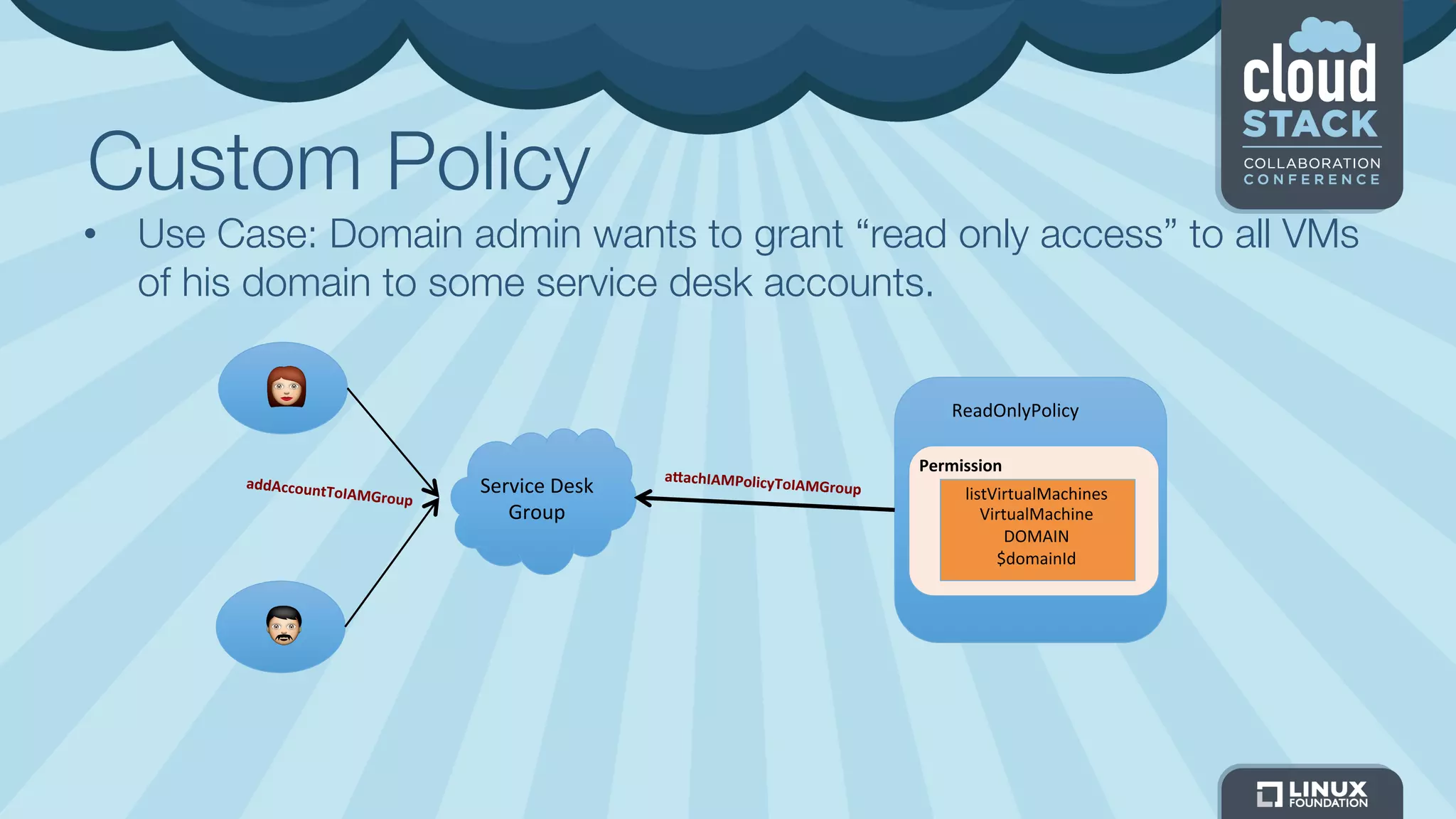
Custom Policy
•  Use Case: Domain admin wants to grant “read only access” to all VMs
of his domain to some service desk accounts.
Service	
  Desk	
  
Group	
  
ReadOnlyPolicy	
  
listVirtualMachines	
  
VirtualMachine	
  
DOMAIN	
  
$domainId	
  
Permission	
  
👩	
  	
  
👨	
  	
  
addAccountToIAMGroup	
  
aAachIAMPolicyToIAMGroup	
  
VMOpPolicy	
  
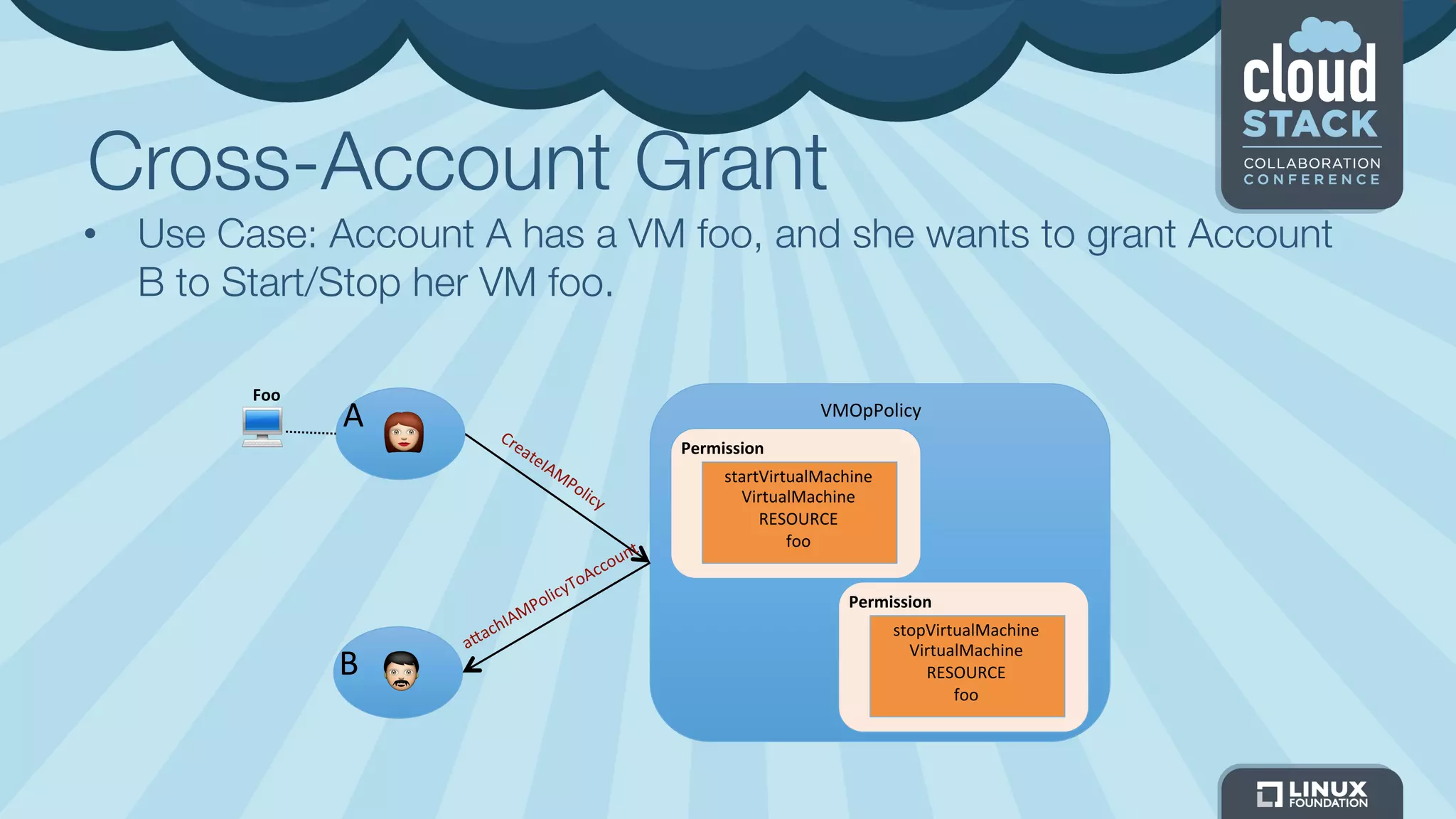
Cross-Account Grant
•  Use Case: Account A has a VM foo, and she wants to grant Account
B to Start/Stop her VM foo.
startVirtualMachine	
  
VirtualMachine	
  
RESOURCE	
  
foo	
  
Permission	
  
stopVirtualMachine	
  
VirtualMachine	
  
RESOURCE	
  
foo	
  
Permission	
  
👩	
  	
  
👨	
  	
  
A	
  
B	
  
💻	
  
Foo	
  
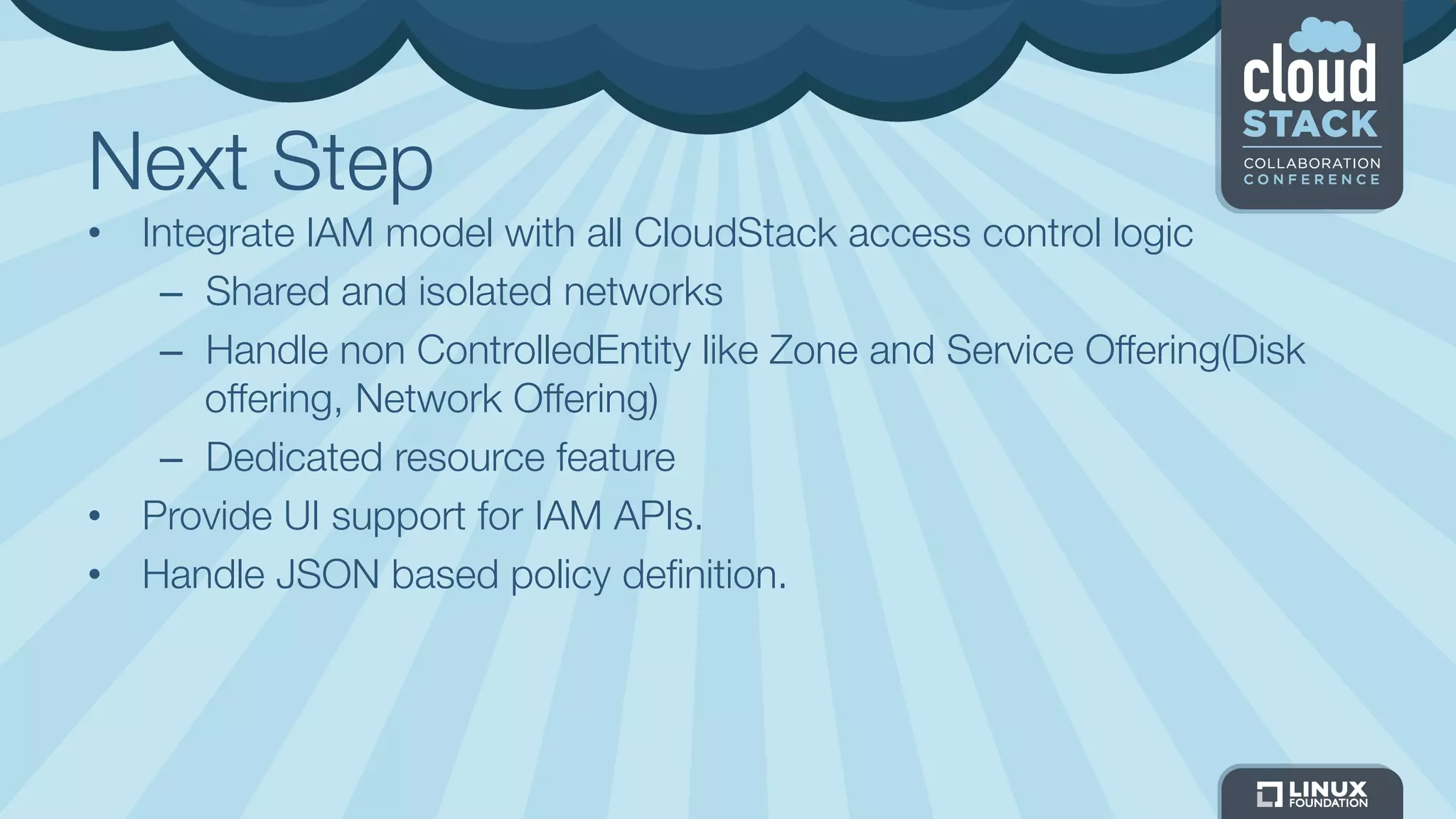
Next Step
•  Integrate IAM model with all CloudStack access control logic
–  Shared and isolated networks
–  Handle non ControlledEntity like Zone and Service Offering(Disk
offering, Network Offering)
–  Dedicated resource feature 
•  Provide UI support for IAM APIs.
•  Handle JSON based policy definition.
References
•  Functional Spec:
https://cwiki.apache.org/confluence/display/CLOUDSTACK/CloudStack
+IAM+guidelines+for+API+and+Service+Layer
•  Guidelines for Developers:
https://cwiki.apache.org/confluence/display/CLOUDSTACK/CloudStack
+IAM+guidelines+for+API+and+Service+Layer

CloudStack Identity and Access Management (IAM)

  • 1.
    CloudStack Identity andAccess Management (IAM) Min Chen Prachi Damle" Citrix
  • 2.
    Agenda •  Background •  OurDesign Goal •  Architecture •  Implementation •  Use Cases •  Next Steps
  • 3.
    Background •  Limited IAMServices –  Out-of-box fixed roles (Root Admin, Domain Admin, User) with prebaked access control. –  No support for customized roles creation. –  Special hard-coded access control logic baked in service layer for some resources like networks, affinity group, etc. –  Granting permissions by dedicated APIs is very restrictive.
  • 4.
    Our Goal ProvideTrue Pluggable IAM Service
  • 5.
    Our Goal ProvideTrue Pluggable IAM Service
  • 6.
    What is IAM" " 👩     👨     👦     Permission   Principal   Ac+on   Resource   Permission   Principal   Ac+on   Resource   Permission   Principal   Ac+on   Resource   Policy   Group   Resource   Resource   Resource   Resource   Principal   Principal   Principal   👫   Role   Impersonate   Allow/Deny  
  • 7.
  • 8.
    Pluggable IAM Service" HostIAM server as an Independent Service listening at an endpoint which CloudStack or other portal services call to do access checks
  • 9.
    Pluggable IAM Components" • Server –  An implementation of pure IAM taxonomy independent of CloudStack. –  Out-of-box IAM server implementation based on our IAM schema –  Provide IAM server interface for third-party (LDAP/AD based) to implement a different IAM server. •  Plugin –  A plugin integrated with CloudStack through adapter interfaces: •  APIChecker •  SecurityChecker •  QuerySelector –  Serve new IAM API requests
  • 10.
    IAM Component Diagram CloudStack   cloud-­‐api   cloud-­‐server   IAM  Service   cloud-­‐plugin-­‐iam   APIChecker   SecurityChecker   QuerySelector   RoleBasedAPIChecker   RoleBasedEn+tyChecker   RoleBasedQuerySelector   IAM  Plugin  APIs   cloud-­‐iam-­‐server   IAM  Server  APIs  
  • 11.
    IAM Server •  IAMSchema •  Implement IAM Server interface to provide your own 3rd-party IAM server.
  • 12.
    IAM Plugin •  IAMAPIs •  Adapters –  APIChecker –  SecurityChecker •  AccessType –  QuerySelector •  Plugin understands CloudStack’s terminology
  • 13.
    IAM APIs createIAMGroup   deleteIAMGroup   listIAMGroups   createIAMPolicy   deleteIAMPolicy   listIAMPolicies   addIAMPermissionToIAMPolicy   removeIAMPermissionFromIAMPolicy   addAccountToIAMGroup   removeAccountFromIAMGroup   aDachIAMPolicyToAccount   removeIAMPolicyFromAccount   aDachIAMPolicyToIAMGroup   removeIAMPolicyFromIAMGroup  👩      Account  
  • 14.
    APIChecker •  CS APICheckerinterface •  commands.properties •  RoleBasedAPIAccessChecker –  On startup loads permissions from commands.properties –  checkAccess by listing policy permissions public  interface  APIChecker  extends  Adapter  {          boolean  checkAccess(User  user,    String  apiCommandName)  throws    PermissionDeniedExcep+on;  }   1  =  ADMIN,  2  =  RESOURCE_DOMAIN_ADMIN,  4  =  DOMAIN_ADMIN,  8  =  USER   startVirtualMachine=15  
  • 15.
    Default CloudStack Policies User  Policy   startVirtualMachine   VirtualMachine   ACCOUNT   $accountId   Permission   User  Group   Domain  Admin  Policy   startVirtualMachine   VirtualMachine   DOMAIN   $domainId   Permission   Domain  Admin  Group   Root  Admin  Policy   startVirtualMachine   VirtualMachine   Scope:  ALL   Permission   migrateVirtualMachine   Permission   Root  Admin  Group   IAM  APIChecker   startVirtualMachine  =  15  
  • 16.
    SecurityChecker •  CS SecurityCheckerinterface •  RoleBasedEntityAccessChecker •  Check Policy permissions for the entity and action/accessType •  Only work with ‘Allow’. No ‘Deny’ in this phase. •  AccessType •  ListEntry (read-only access) •  UseEntry (read and use access) •  OperateEntry (operate access) public  interface  SecurityChecker  extends  Adapter  {   boolean  checkAccess(Account  caller,    ControlledEn+ty  en+ty,    AccessType  accessType,  String  ac+on)   throws  PermissionDeniedExcep+on;   }  
  • 17.
    Access Check Flow 👩     User1   startVirtualMachine  ‘Foo’   👩     User2   💻   Foo   IAM  API  Checker   IAM   SecurityChecker   User  Policy   startVirtualMachine   VirtualMachine   ACCOUNT   $accountId   Permission   User  Group   Domain  Admin  Policy   startVirtualMachine   VirtualMachine   DOMAIN   $domainId   Permission   Domain  Admin  Group   Root  Admin  Policy   startVirtualMachine   VirtualMachine   Scope:  ALL   Permission   Root  Admin  Group   startVirtualMachine  ‘Foo’   👩     Root  Admin   startVirtualMachine  ‘Foo’  
  • 18.
    IAM QuerySelector •  QuerySelector=> RoleBasedQuerySelector public  interface  QuerySelector  extends  Adapter  {              List<Long>  getAuthorizedDomains(Account  caller,  String  en+tyType,  AccessType  accessType);              List<Long>  getAuthorizedAccounts(Account  caller,  String  en+tyType,  AccessType  accessType);              List<Long>  getAuthorizedResources(Account  caller,  String  en+tyType,  AccessType  accessType);              boolean  isGrantedAll(Account  caller,  String  ac+on,  AccessType  accessType);              List<String>  listIAMGroupsByAccount(long  accountId);     }      
  • 19.
    Custom Policy •  UseCase: Domain admin wants to grant “read only access” to all VMs of his domain to some service desk accounts. Service  Desk   Group   ReadOnlyPolicy   listVirtualMachines   VirtualMachine   DOMAIN   $domainId   Permission   👩     👨     addAccountToIAMGroup   aAachIAMPolicyToIAMGroup  
  • 20.
    VMOpPolicy   Cross-Account Grant • Use Case: Account A has a VM foo, and she wants to grant Account B to Start/Stop her VM foo. startVirtualMachine   VirtualMachine   RESOURCE   foo   Permission   stopVirtualMachine   VirtualMachine   RESOURCE   foo   Permission   👩     👨     A   B   💻   Foo  
  • 21.
    Next Step •  IntegrateIAM model with all CloudStack access control logic –  Shared and isolated networks –  Handle non ControlledEntity like Zone and Service Offering(Disk offering, Network Offering) –  Dedicated resource feature •  Provide UI support for IAM APIs. •  Handle JSON based policy definition.
  • 22.
    References •  Functional Spec: https://cwiki.apache.org/confluence/display/CLOUDSTACK/CloudStack +IAM+guidelines+for+API+and+Service+Layer • Guidelines for Developers: https://cwiki.apache.org/confluence/display/CLOUDSTACK/CloudStack +IAM+guidelines+for+API+and+Service+Layer