Discovering the Value of API Management – 
Introduction and Product Overview 
Mike Burkett 
Wetumpka, Alabama 
August 28, 2014
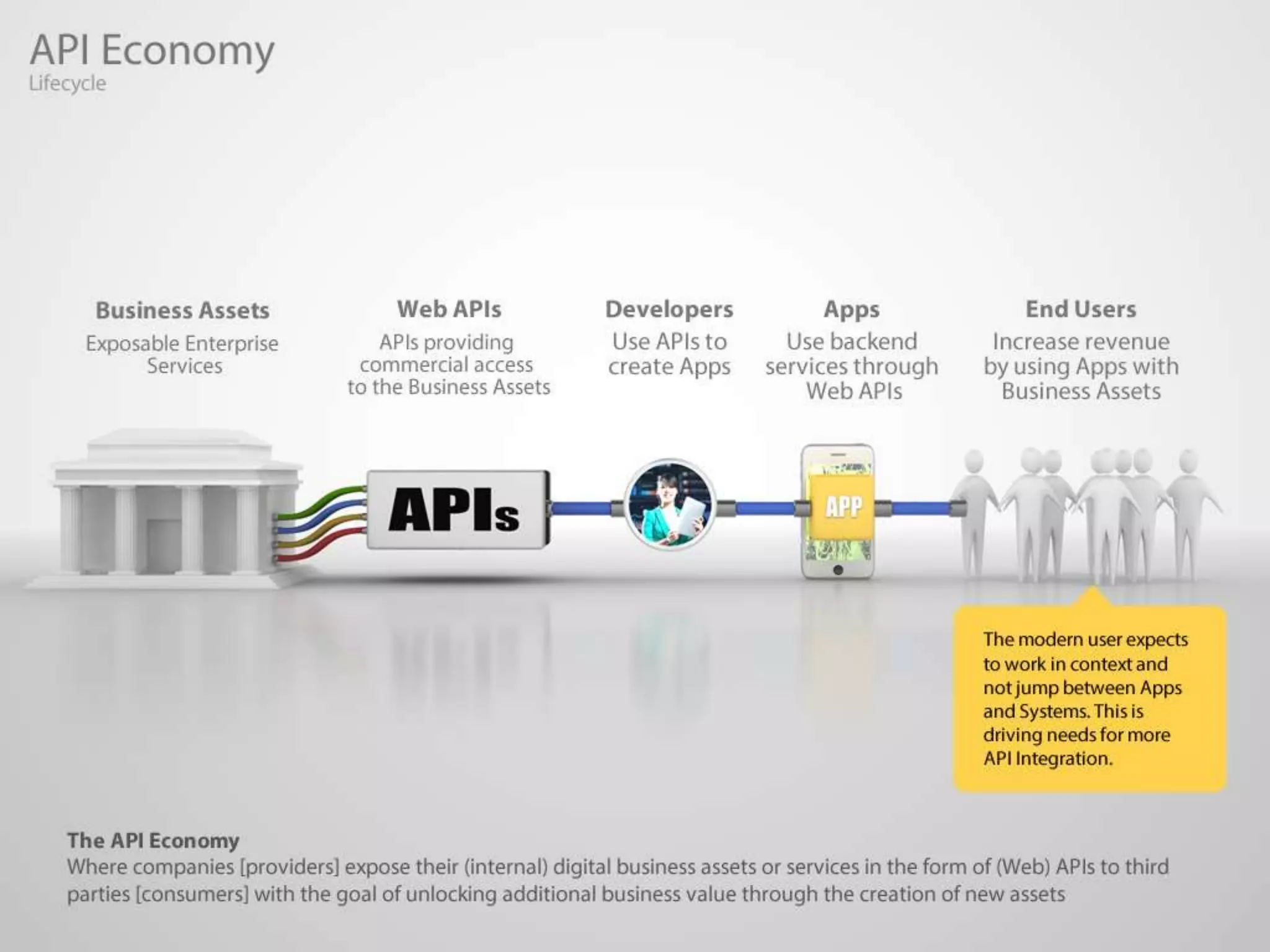
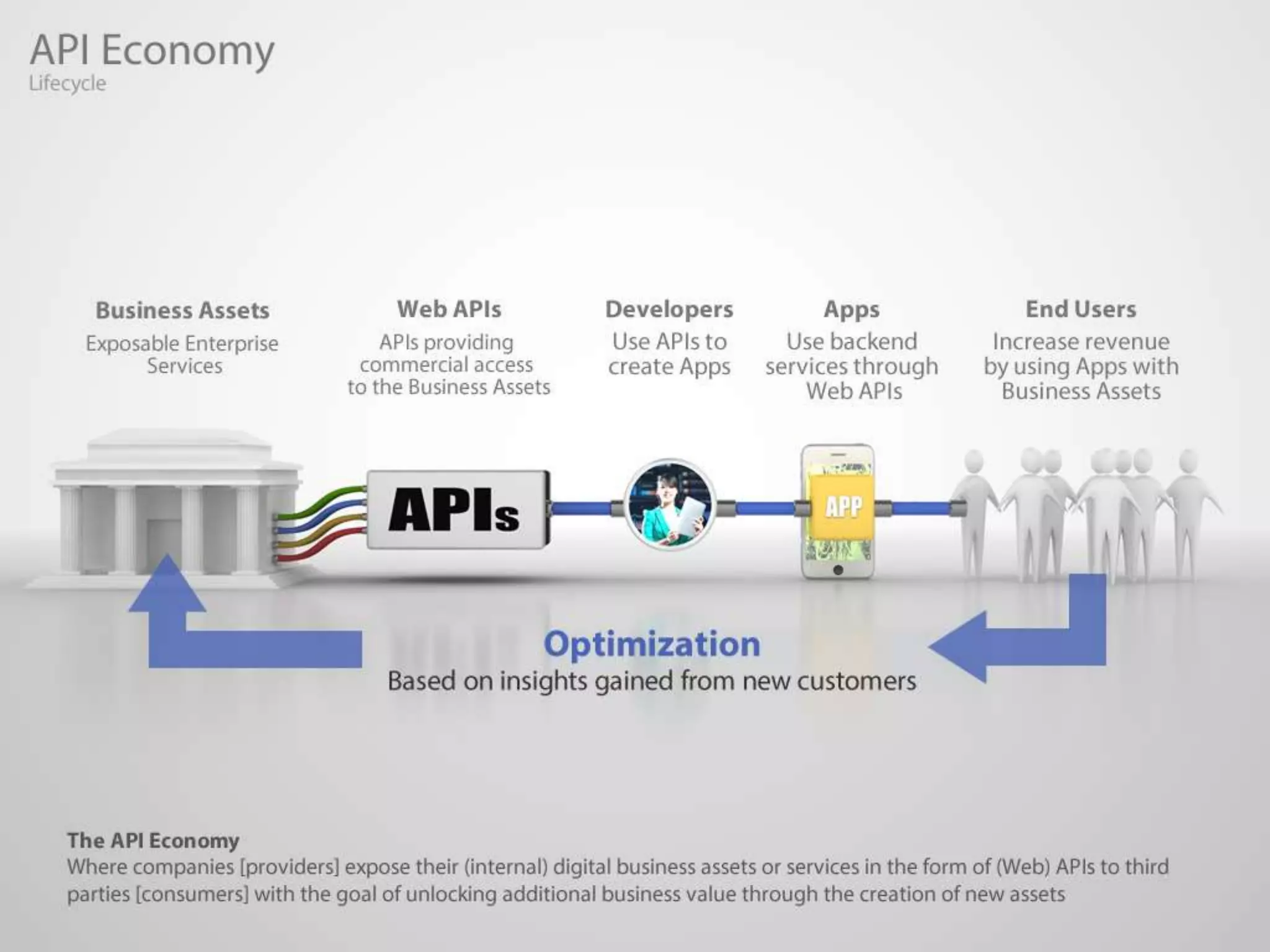
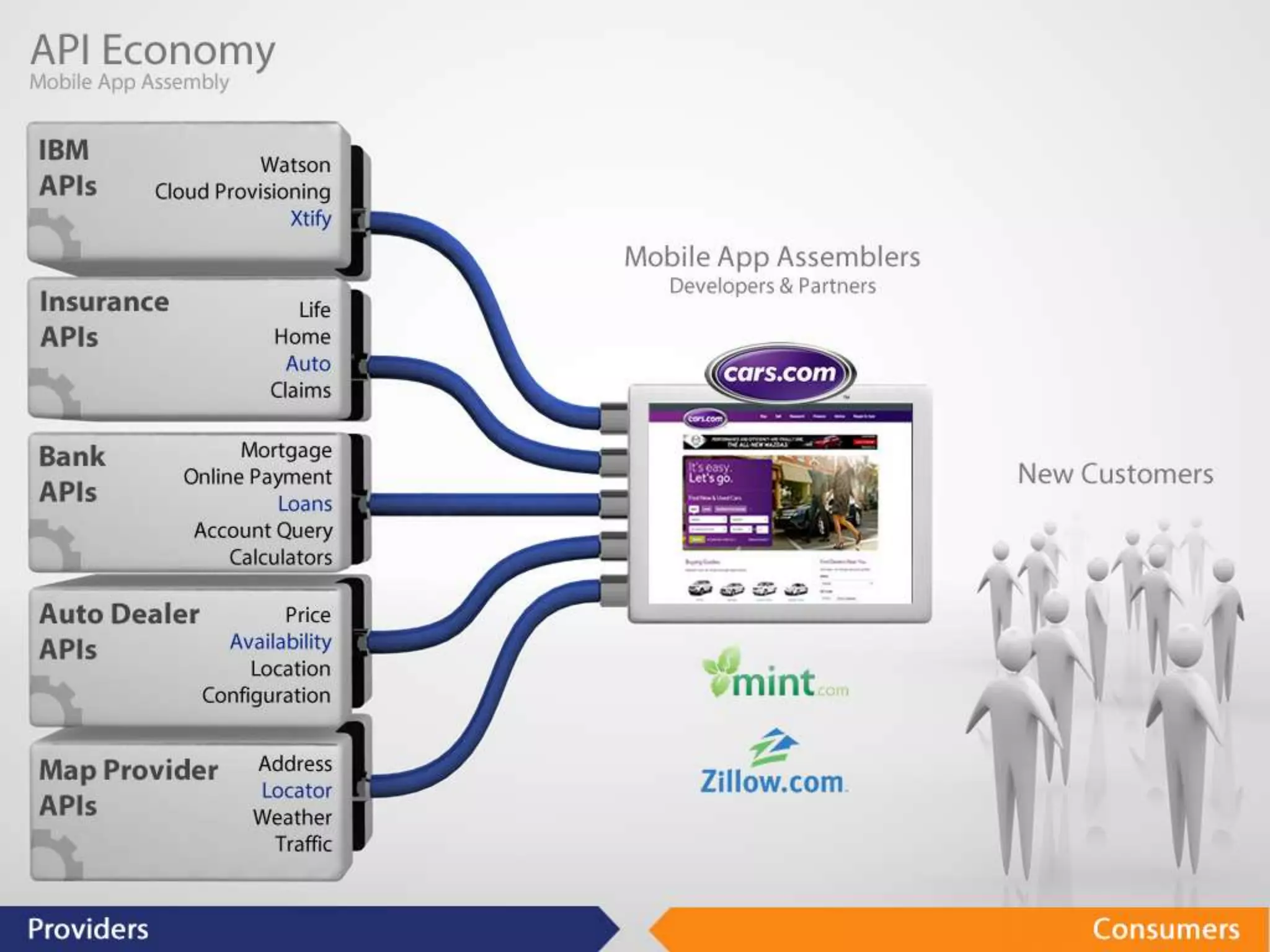
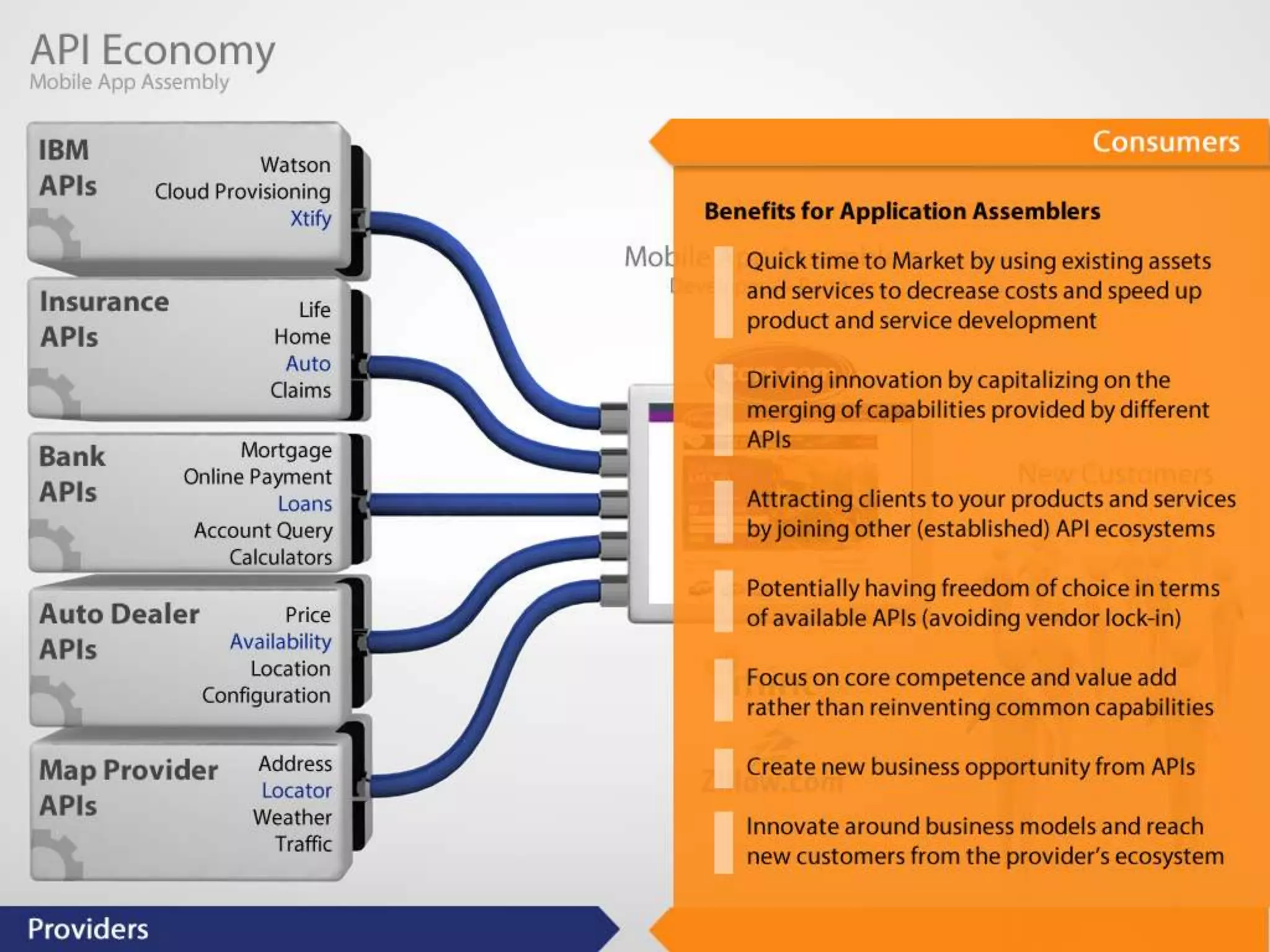
API Economy Overview 
Mike Burkett 
ITS, IBM WebSphere Connectivity 
Great Lakes / Southeast Region 
Wetumpka, Alabama
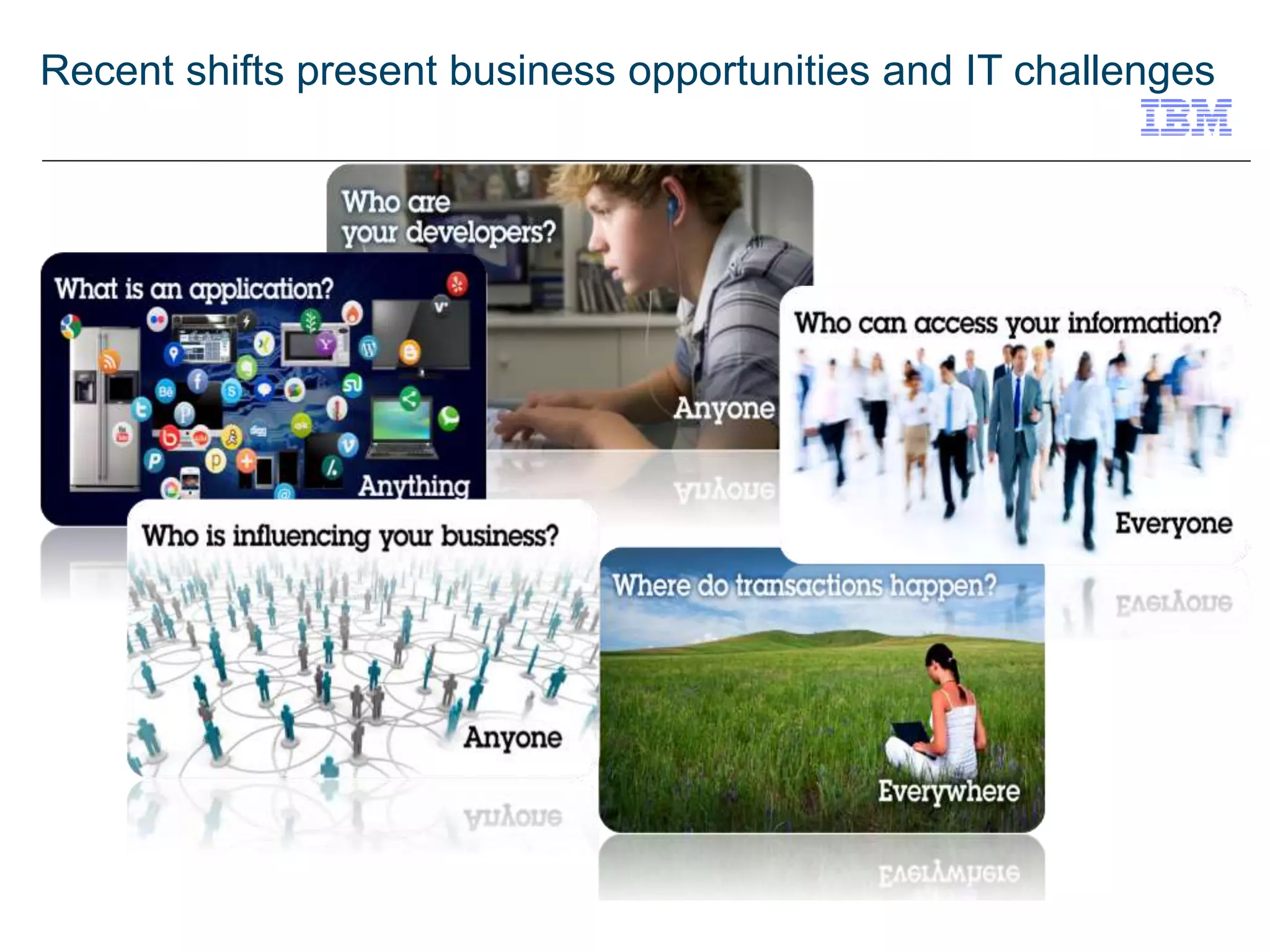
Recent shifts present business opportunities and IT challenges
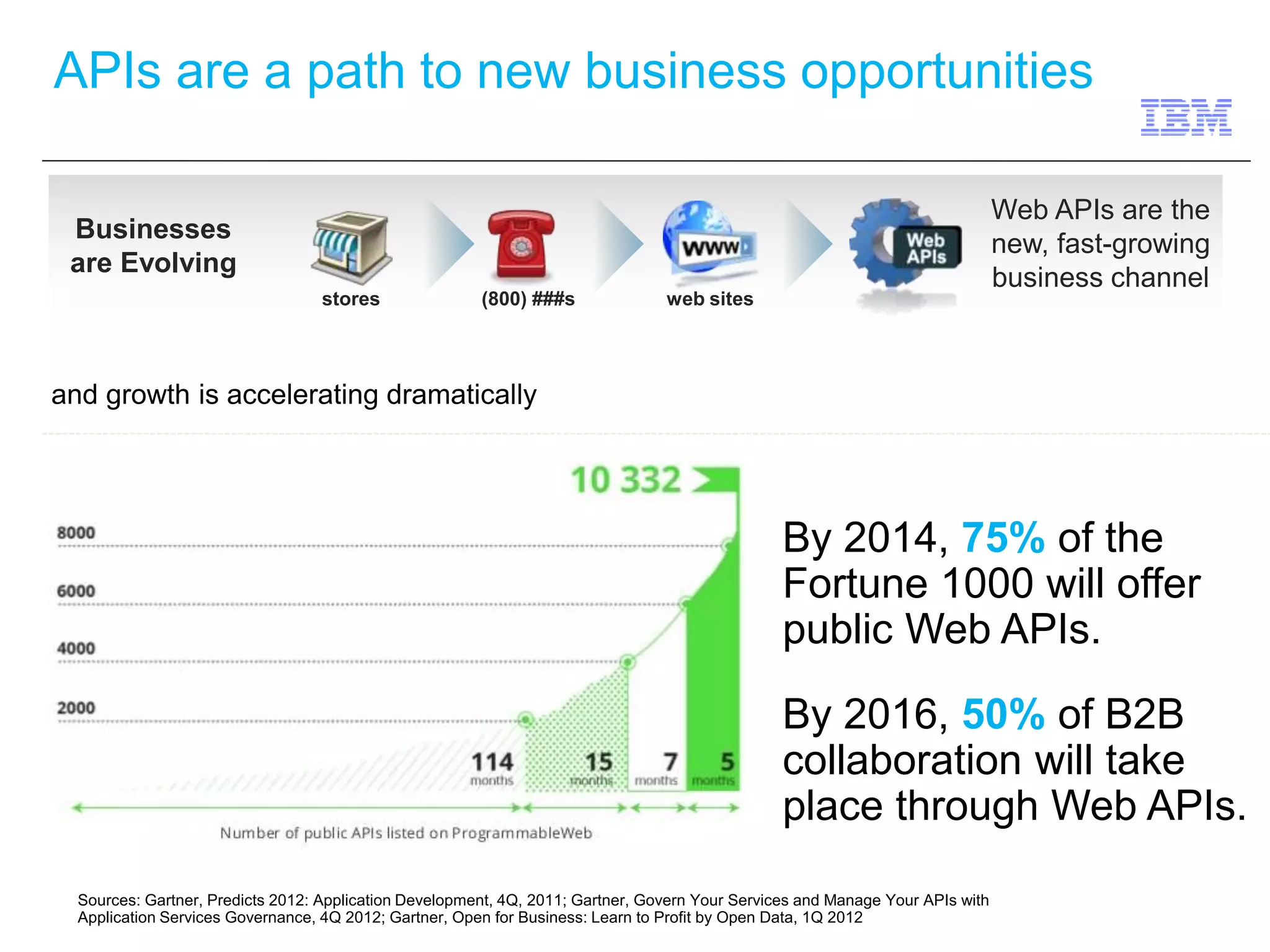
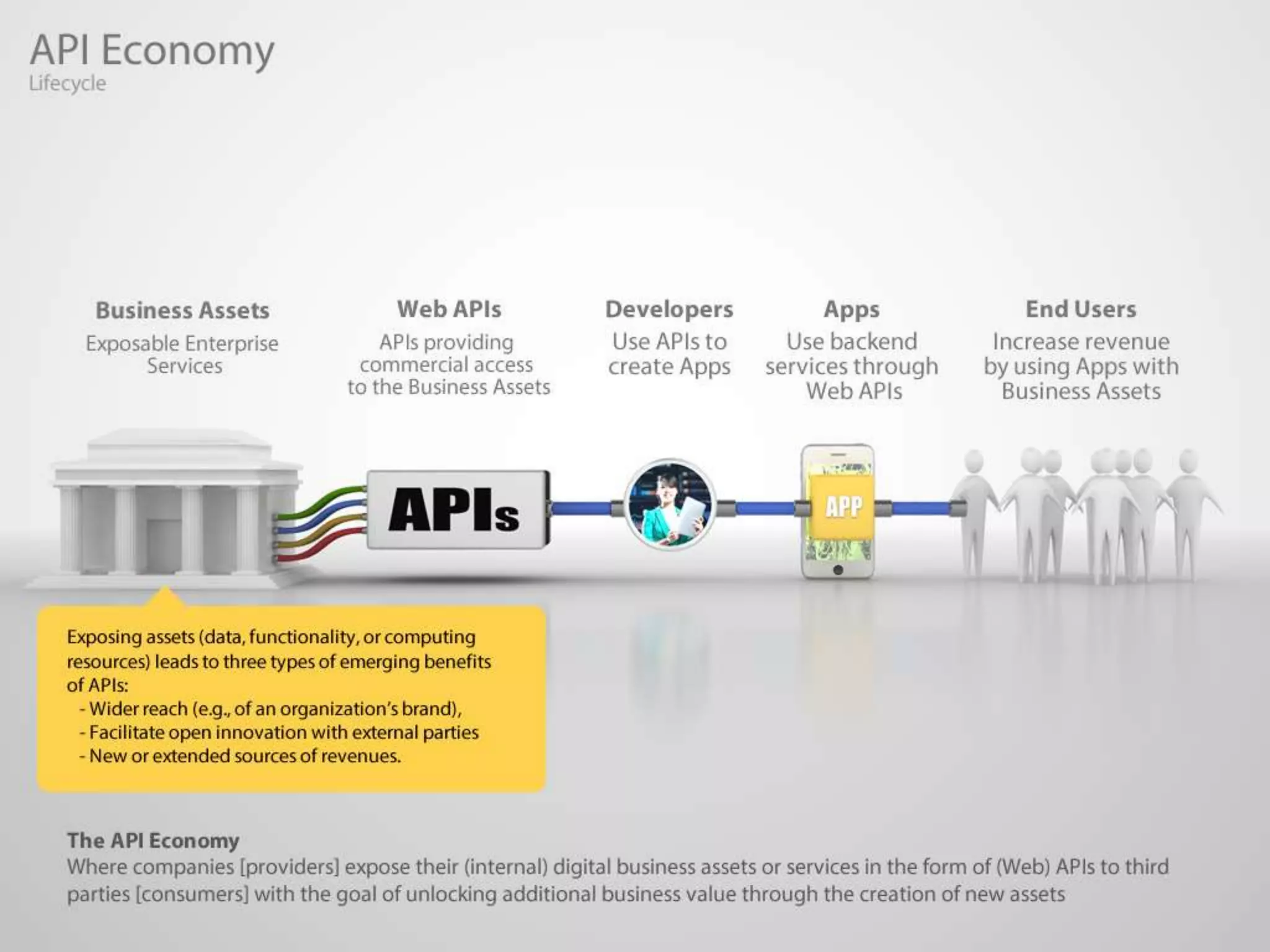
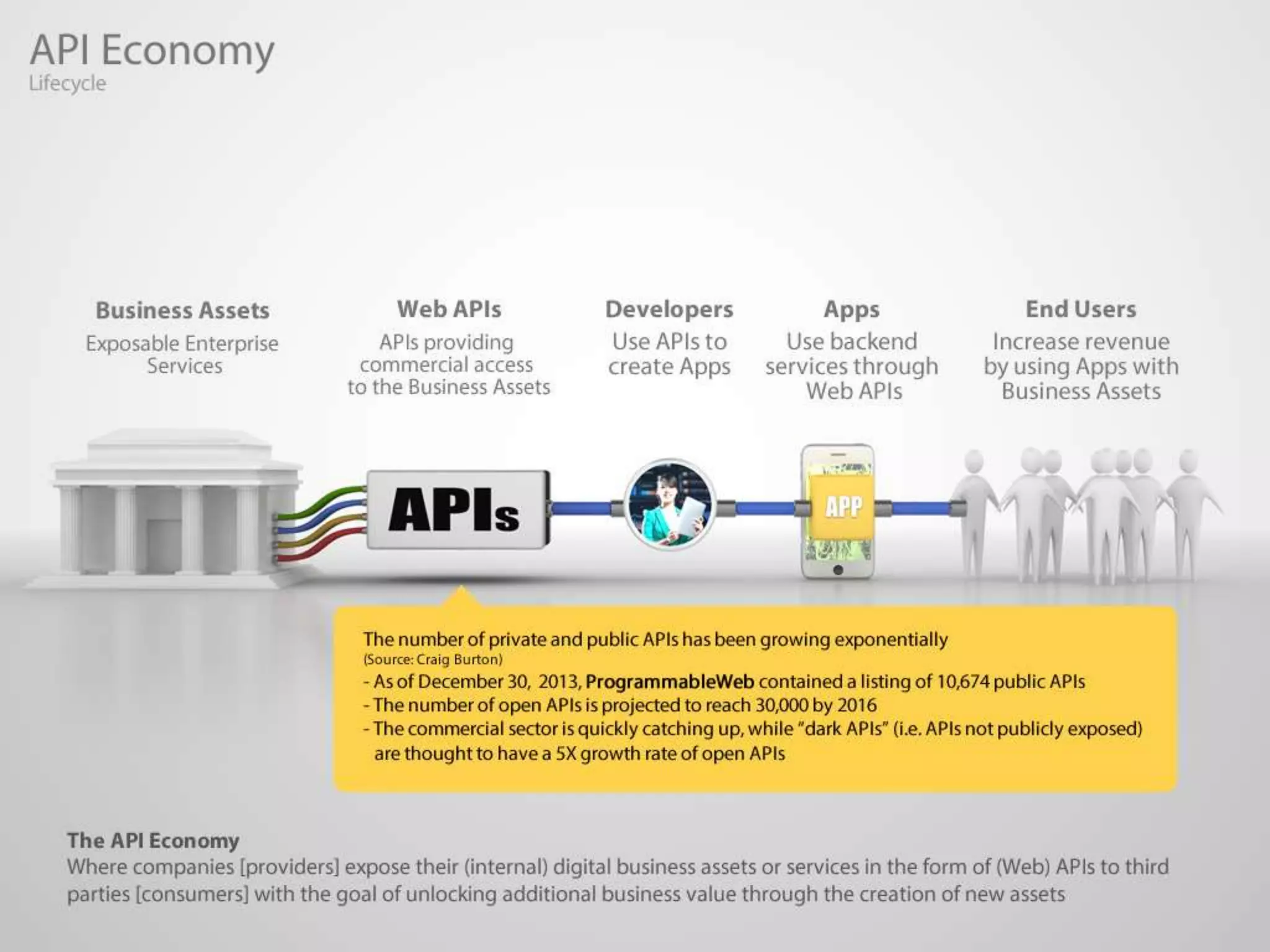
APIs are a path to new business opportunities 
and growth is accelerating dramatically 
By 2014, 75% of the 
Fortune 1000 will offer 
public Web APIs. 
By 2016, 50% of B2B 
collaboration will take 
place through Web APIs. 
Sources: Gartner, Predicts 2012: Application Development, 4Q, 2011; Gartner, Govern Your Services and Manage Your APIs with 
Application Services Governance, 4Q 2012; Gartner, Open for Business: Learn to Profit by Open Data, 1Q 2012 
Web APIs are the 
new, fast-growing 
business channel 
Businesses 
are Evolving 
stores (800) ###s web sites
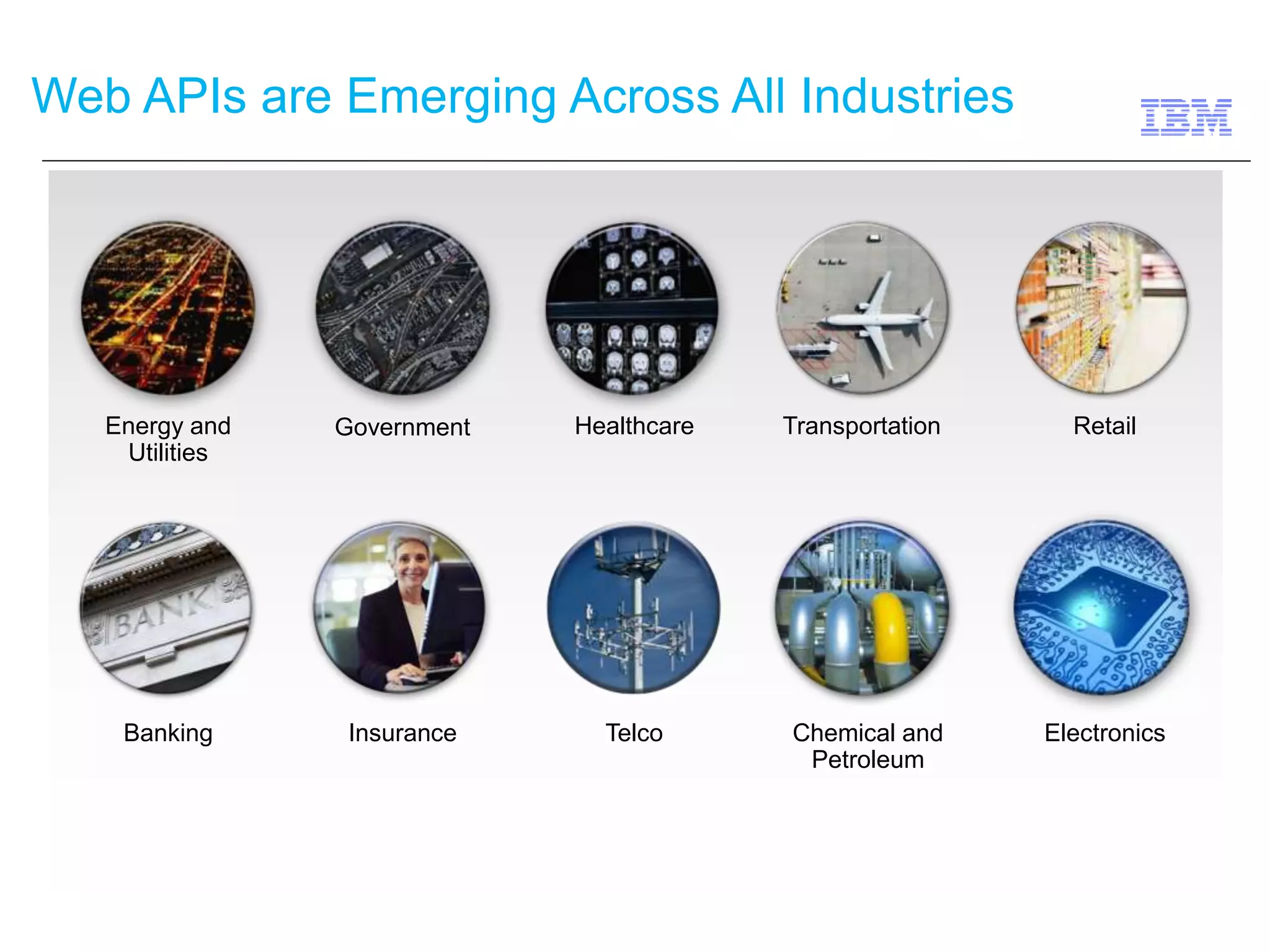
Web APIs are Emerging Across All Industries 
Energy and 
Utilities 
Government Healthcare Transportation Retail 
Banking Insurance Telco Chemical and 
Petroleum 
Electronics
Banking 
Types of APIs Comments 
APIs are available in a 
sandbox environment 
Some hold contest to see to 
who can develop the best 
app a modest reward 
Some charge for use of 
apps 
 Customer API 
 Account API 
 Transaction API 
 Branch Locations 
Drivers 
 Banks are having challenges in the marketing 
ability to create, test and evolve new services 
and adapt better to the needs of the users in 
the changing of their uses. 
 Need to deliver multiple focus apps on many 
different devices. 
Examples of Apps 
 Financial Overview 
 Financial Timelines 
 Mapping Financial 
Relationships 
 Added Valued Services such 
as loyalty, couponing and 
target marketing
Insurance 
Types of APIs Comments 
 Policy API 
APIs are available in a 
sandbox environment 
Some hold contest to see to 
who can develop the best 
app a modest reward 
Some charge for use of apps 
 Customer API 
 Account API 
Drivers 
 Business trend to leverage partnerships and 
decentralize the business value chain 
 Pressing need to become more agile 
 Business flexibility to try new things to drive revenue 
 Increase need to improve effectiveness of working 
with external partners in delivery of business solutions
Retail 
Types of APIs Comments 
 Products APIs are typically 
open 
 Some APIs require further 
approvals to use 
 Products API 
 Store Locator API 
 Deals of the Day API 
 Reviews API 
 Top Sellars API 
 Categories API 
Drivers 
 Shifts in buying patterns customers 
 Need to be where customers are purchasing 
– mobile devices 
 Capitalize on every small channel that is 
created. 
Examples of Apps 
 Milo.com – searches for best 
prices 
 Gazaro – deal finder 
 GetGlue – social network for 
movie tv shows 
 eBay Gifts Nearby -
The Market Pressure 
The explosion of devices and channels 
• How do you support delivery of your services and products 
on all of these devices? 
Applications are smaller, more focused, and come and go very fast 
• How do you keep up with the rate of change? 
Competitive pressure forcing the need for faster innovation 
• How do you foster innovation to beat out competition? 
Partnerships need to be established quicker and connected quicker 
• How do you create new partnership fast which our outside 
of your normal interactions? 
Brand loyalty is always under attack 
• How do you get and maintain brand loyalty?
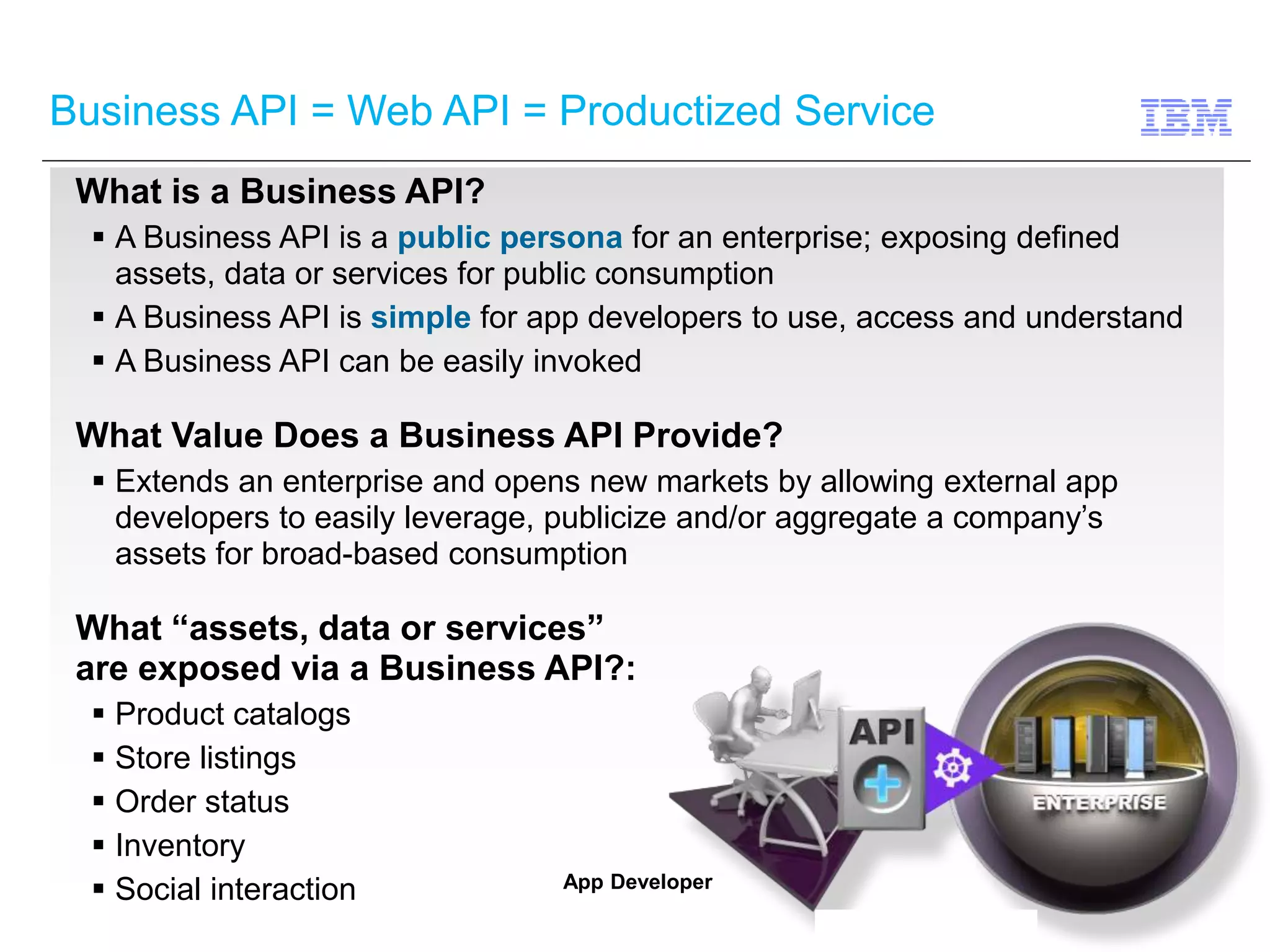
Business API = Web API = Productized Service 
What is a Business API? 
 A Business API is a public persona for an enterprise; exposing defined 
assets, data or services for public consumption 
 A Business API is simple for app developers to use, access and understand 
 A Business API can be easily invoked 
What Value Does a Business API Provide? 
 Extends an enterprise and opens new markets by allowing external app 
developers to easily leverage, publicize and/or aggregate a company’s 
assets for broad-based consumption 
What “assets, data or services” 
are exposed via a Business API?: 
 Product catalogs 
 Store listings 
 Order status 
 Inventory 
 Social interaction 
App Developer
© 2014 IBM Corporation
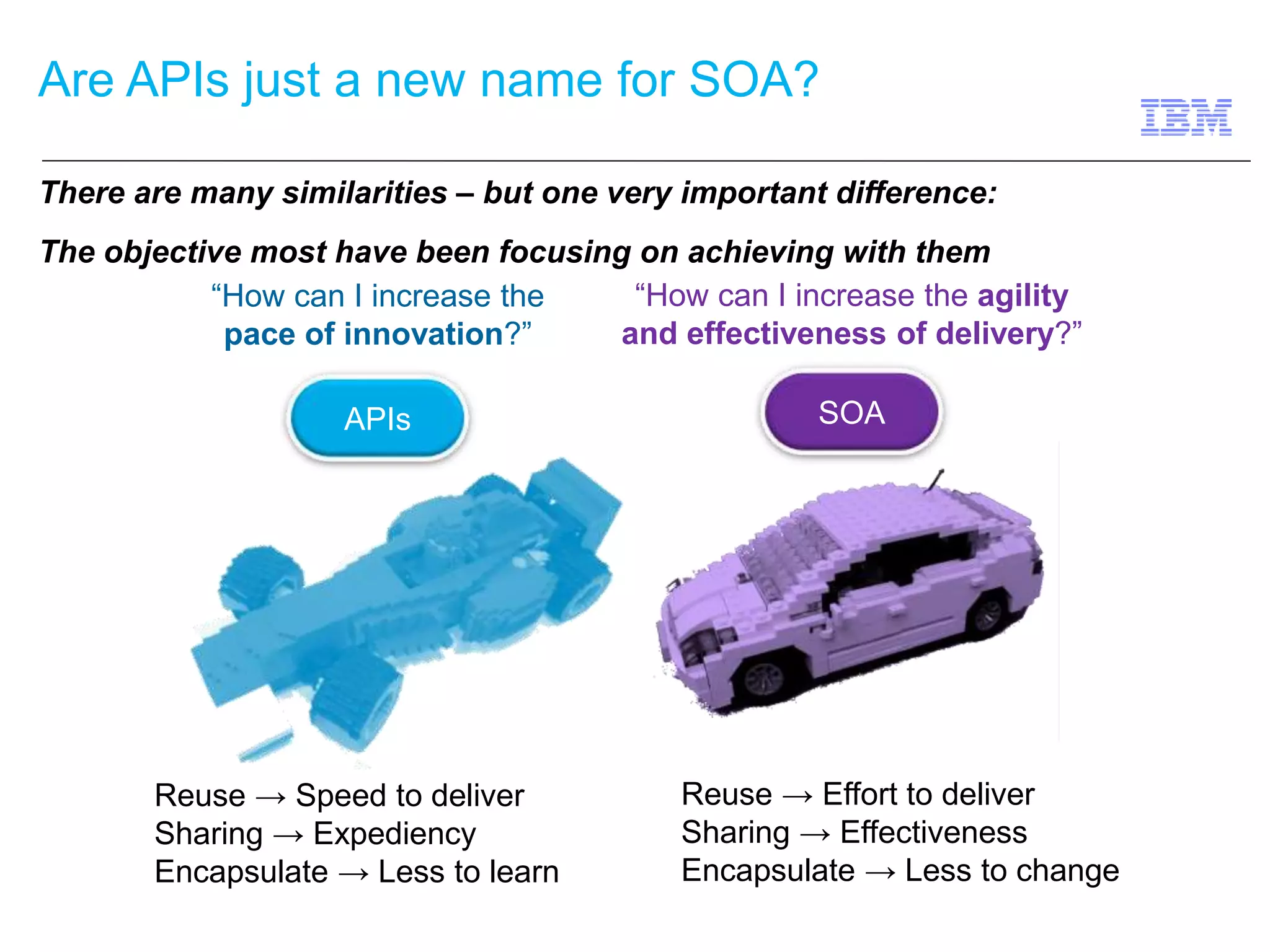
Are APIs just a new name for SOA? 
There are many similarities – but one very important difference: 
The objective most have been focusing on achieving with them 
“How can I increase the 
pace of innovation?” 
“How can I increase the agility 
and effectiveness of delivery?” 
APIs SOA 
Reuse → Speed to deliver 
Sharing → Expediency 
Encapsulate → Less to learn 
Reuse → Effort to deliver 
Sharing → Effectiveness 
Encapsulate → Less to change
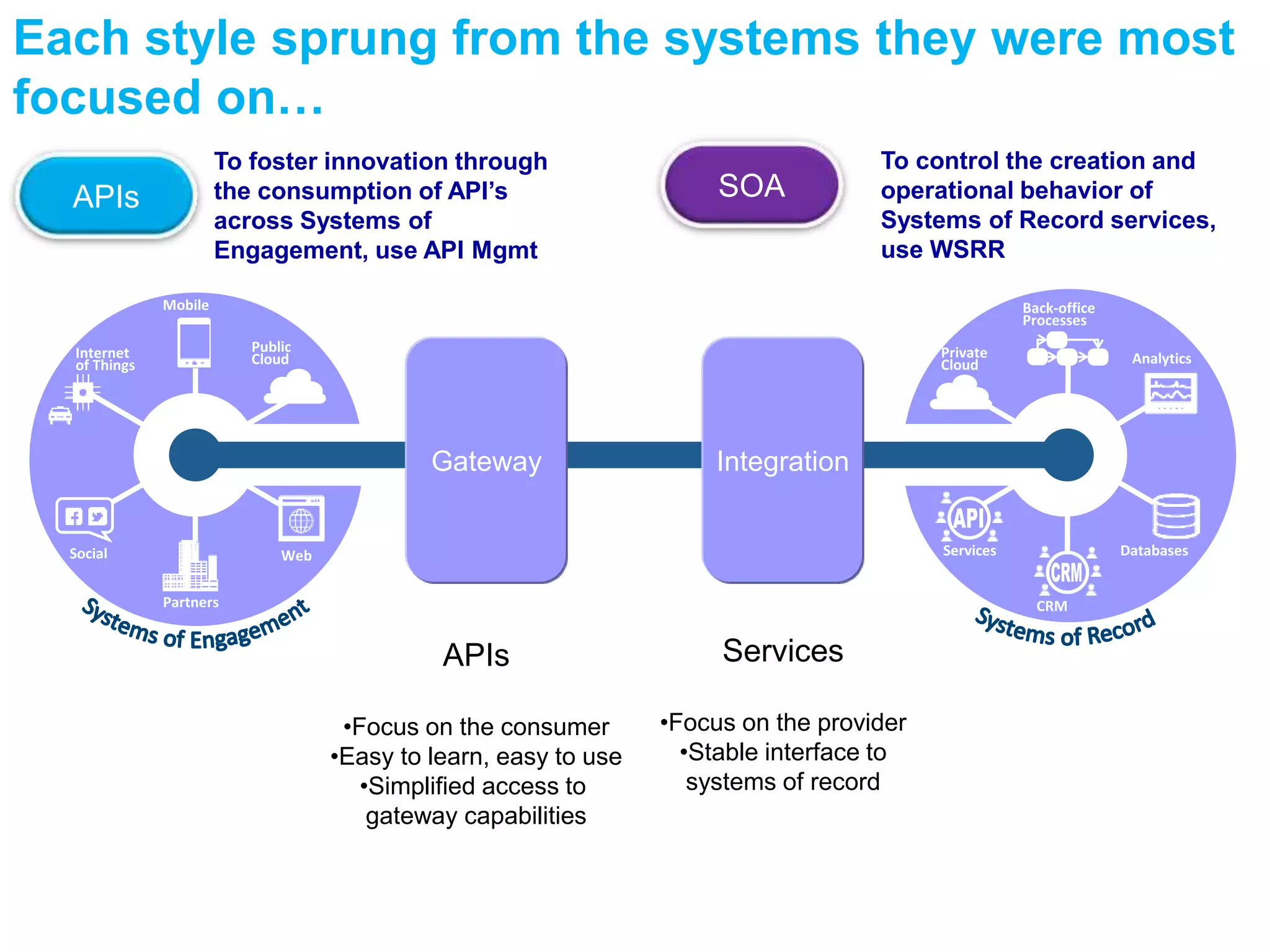
Each style sprung from the systems they were most 
focused on… 
APIs SOA 
To control the creation and 
operational behavior of 
Systems of Record services, 
use WSRR 
To foster innovation through 
the consumption of API’s 
across Systems of 
Engagement, use API Mgmt 
Services 
•Focus on the provider 
•Stable interface to 
systems of record 
APIs 
•Focus on the consumer 
•Easy to learn, easy to use 
•Simplified access to 
gateway capabilities 
Private 
Cloud 
Back-office 
Processes 
Analytics 
Services Databases 
CRM 
Internet 
of Things 
Mobile 
Public 
Cloud 
Social Web 
Partners 
Gateway Integration
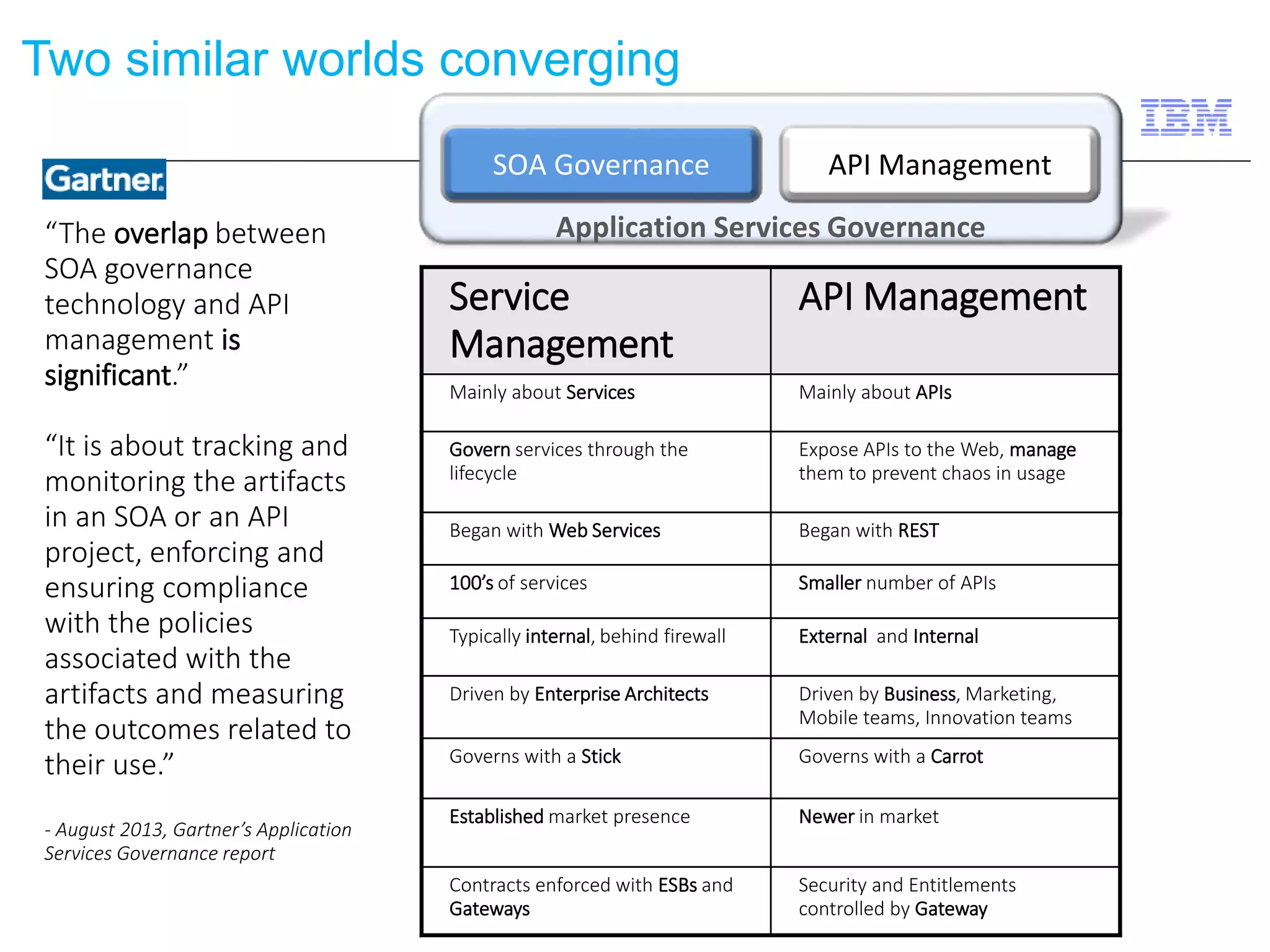
Two similar worlds converging 
SOA Governance API Management 
Service 
Management 
API Management 
Mainly about Services Mainly about APIs 
Govern services through the 
lifecycle 
Expose APIs to the Web, manage 
them to prevent chaos in usage 
Began with Web Services Began with REST 
100’s of services Smaller number of APIs 
Typically internal, behind firewall External and Internal 
Driven by Enterprise Architects Driven by Business, Marketing, 
Mobile teams, Innovation teams 
Governs with a Stick Governs with a Carrot 
Established market presence Newer in market 
Contracts enforced with ESBs and 
Gateways 
Security and Entitlements 
controlled by Gateway 
“The overlap between 
SOA governance 
technology and API 
management is 
significant.” 
“It is about tracking and 
monitoring the artifacts 
in an SOA or an API 
project, enforcing and 
ensuring compliance 
with the policies 
associated with the 
artifacts and measuring 
the outcomes related to 
their use.” 
- August 2013, Gartner’s Application 
Services Governance report 
Application Services Governance
Introduction to APIs and API 
Management
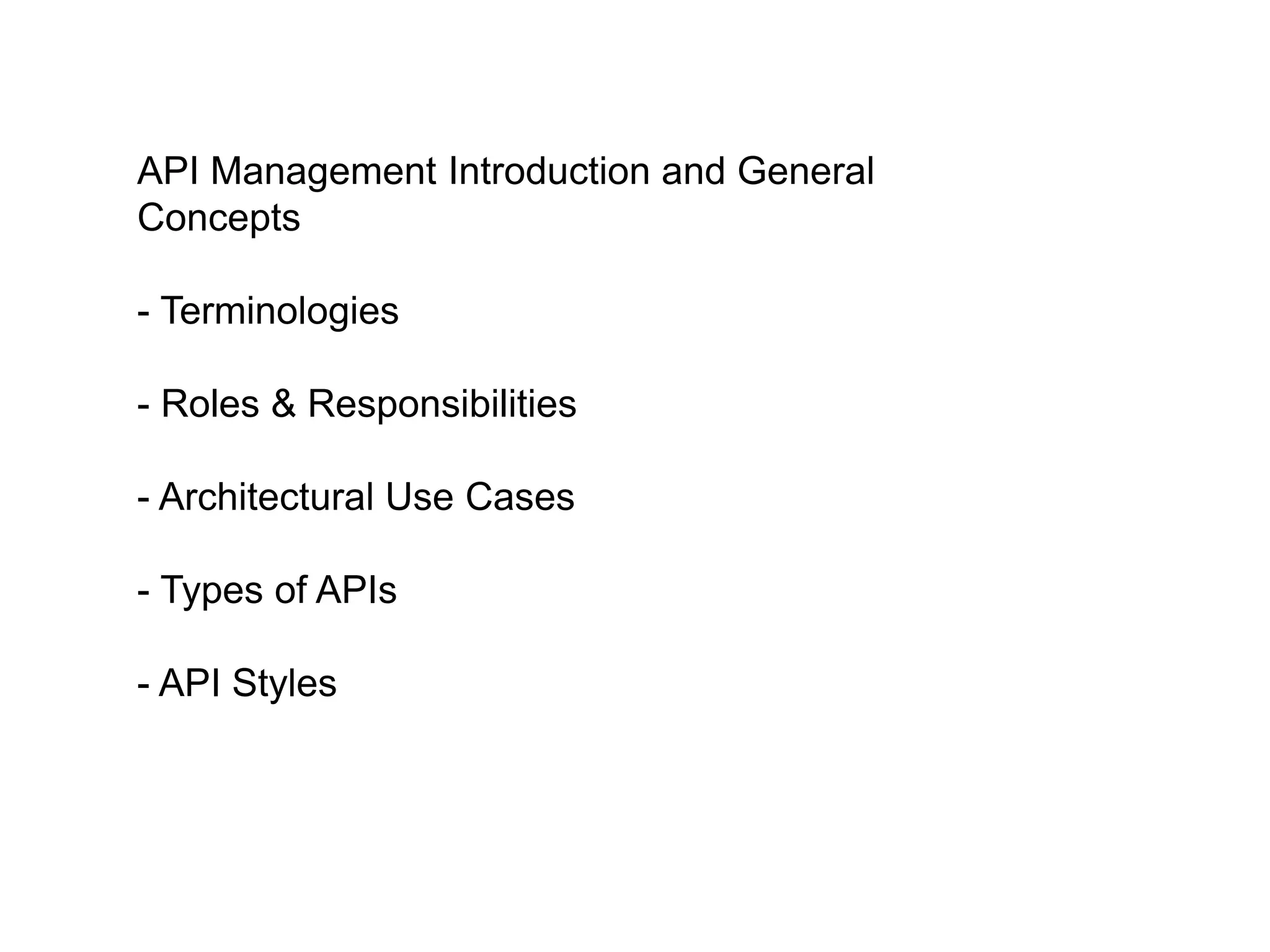
API Management Introduction and General 
Concepts 
- Terminologies 
- Roles & Responsibilities 
- Architectural Use Cases 
- Types of APIs 
- API Styles
Terminologies: Web APIs, Mashups, Apps 
Web API 
• A defined set of HTTP request messages along with a definition of the 
structure of response messages, typically expressed in JSON or XML 
Web App 
• A web application or web app is any application software that runs in a 
web browser or is created in a browser-supported programming 
language (such as the combination of JavaScript, HTML and CSS) and 
relies on a common web browser to render the application 
Mashup 
• A web page, or web application, that uses Web APIs to combine data, 
presentation or functionality from two or more sources to create new 
services.
Terminologies: Web APIs, Mashups, Apps 
API Key 
• A code passed in by computer programs calling an API 
• Identifies the calling program, its developer, or its user to 
the Web site. 
• Used to track and control how the API is being used, for 
example to prevent malicious use or abuse of the API (as 
defined perhaps by terms of service). 
OAuth 
• OAuth is an open standard for authorization 
• OAuth provides client applications a 'secure delegated 
access' to server resources on behalf of a resource owner
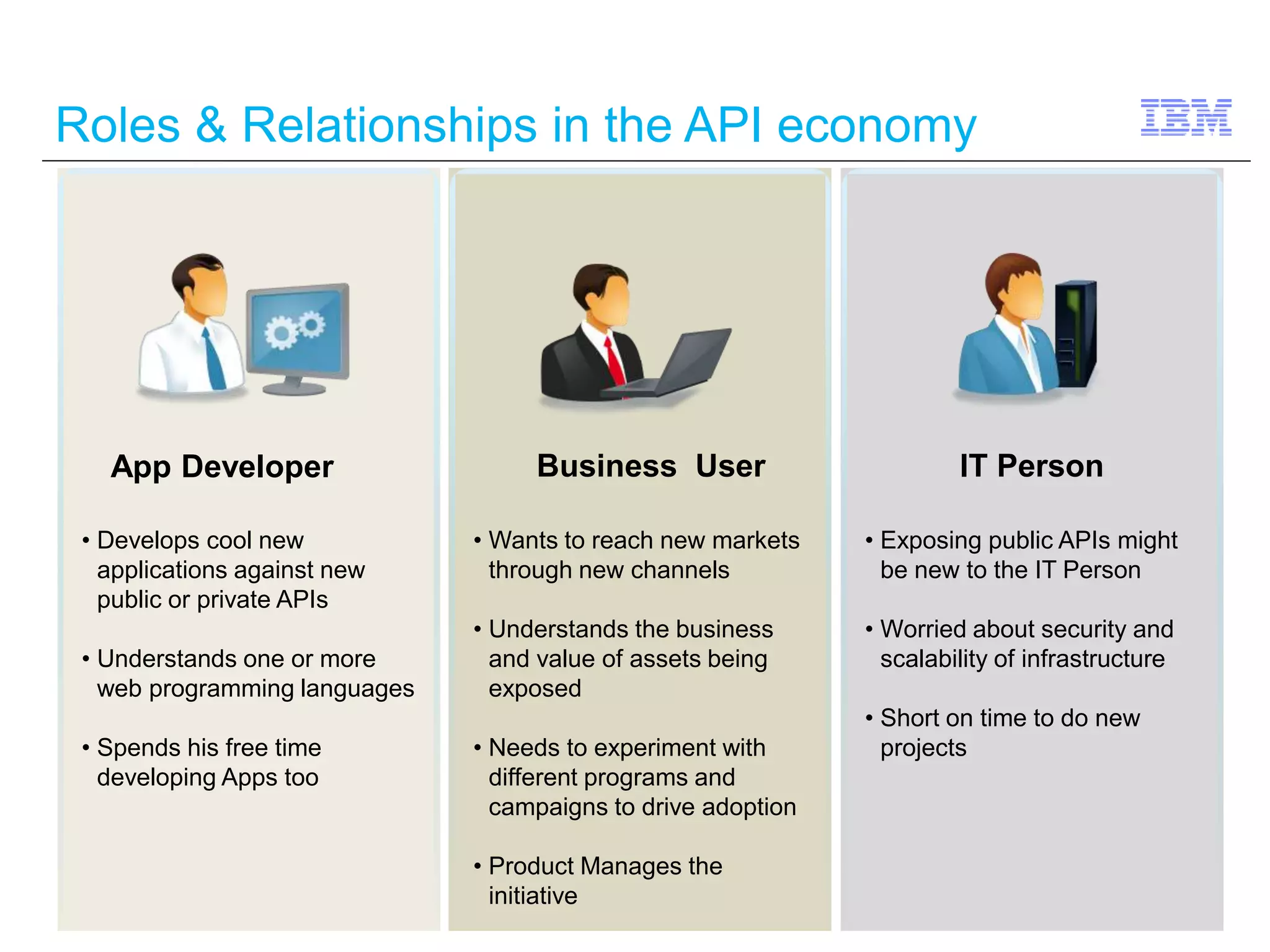
Roles & Relationships in the API economy 
App Developer Business User IT Person 
• Develops cool new 
applications against new 
public or private APIs 
• Understands one or more 
web programming languages 
• Spends his free time 
developing Apps too 
• Wants to reach new markets 
through new channels 
• Understands the business 
and value of assets being 
exposed 
• Needs to experiment with 
different programs and 
campaigns to drive adoption 
• Product Manages the 
initiative 
• Exposing public APIs might 
be new to the IT Person 
• Worried about security and 
scalability of infrastructure 
• Short on time to do new 
projects
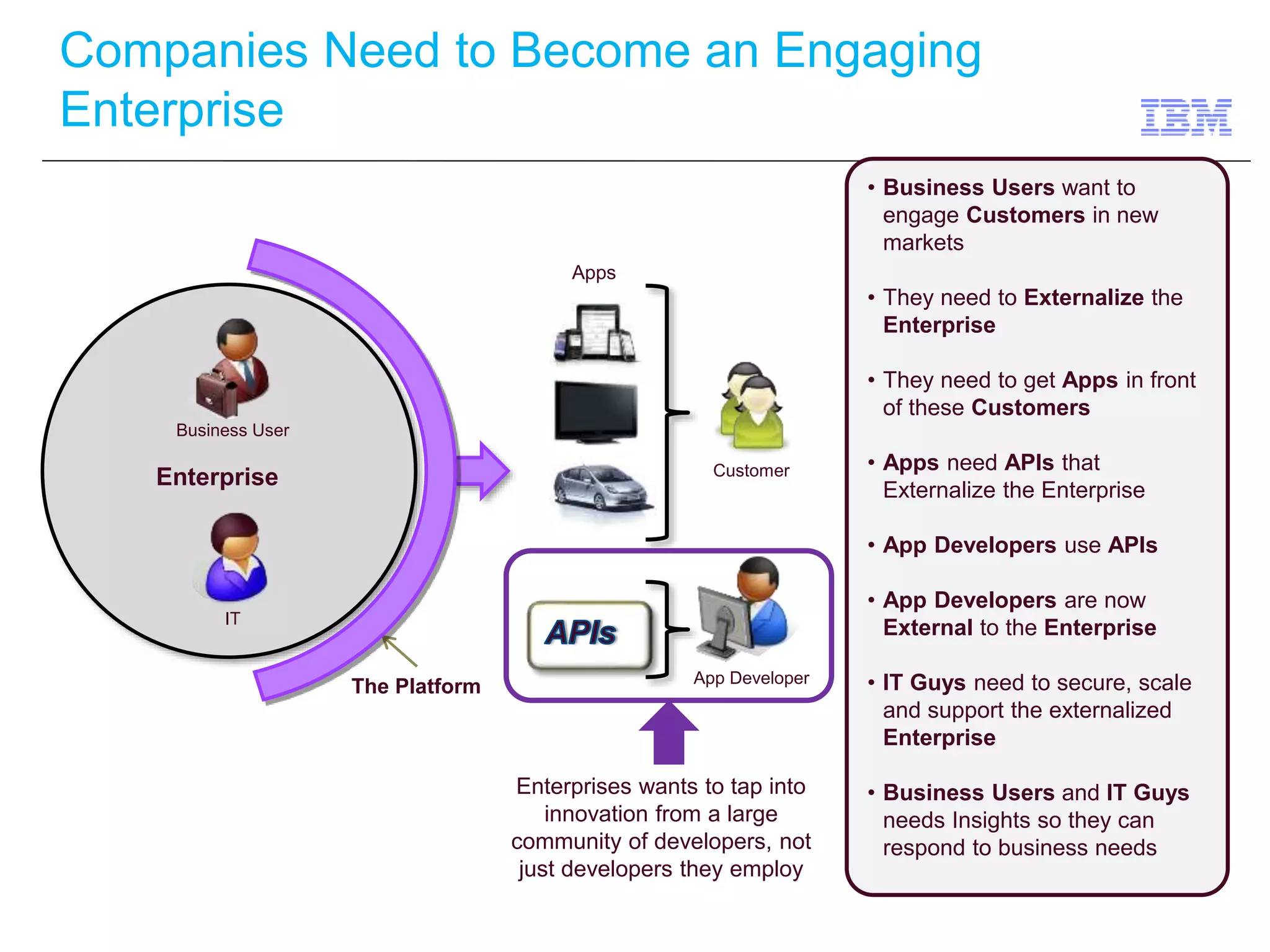
Companies Need to Become an Engaging 
Enterprise 
Apps 
Customer 
Business User 
Enterprise 
IT 
App Developer 
• Business Users want to 
engage Customers in new 
markets 
• They need to Externalize the 
Enterprise 
• They need to get Apps in front 
of these Customers 
• Apps need APIs that 
Externalize the Enterprise 
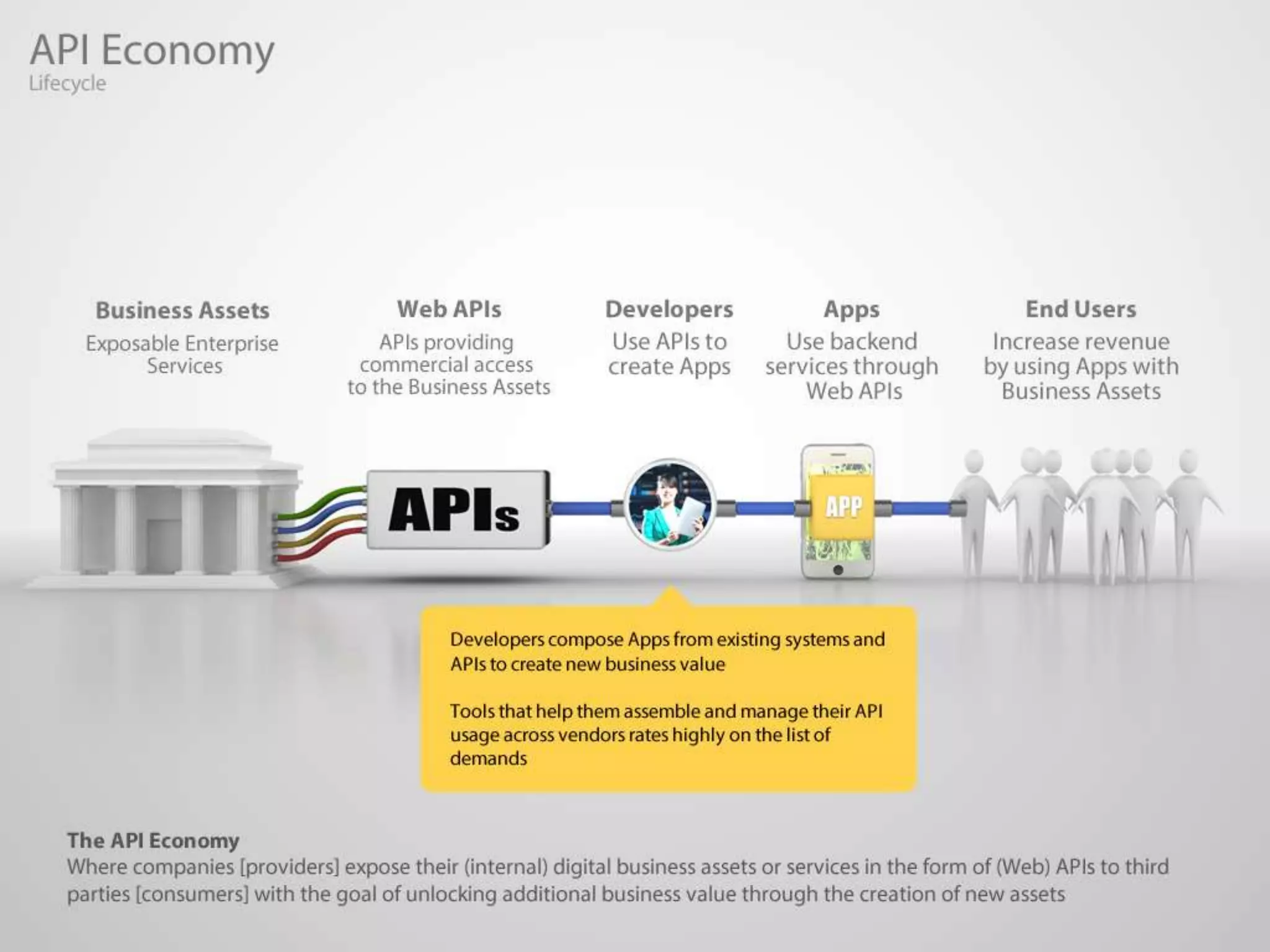
• App Developers use APIs 
• App Developers are now 
External to the Enterprise 
• IT Guys need to secure, scale 
and support the externalized 
Enterprise 
• Business Users and IT Guys 
needs Insights so they can 
respond to business needs 
The Platform 
Enterprises wants to tap into 
innovation from a large 
community of developers, not 
just developers they employ
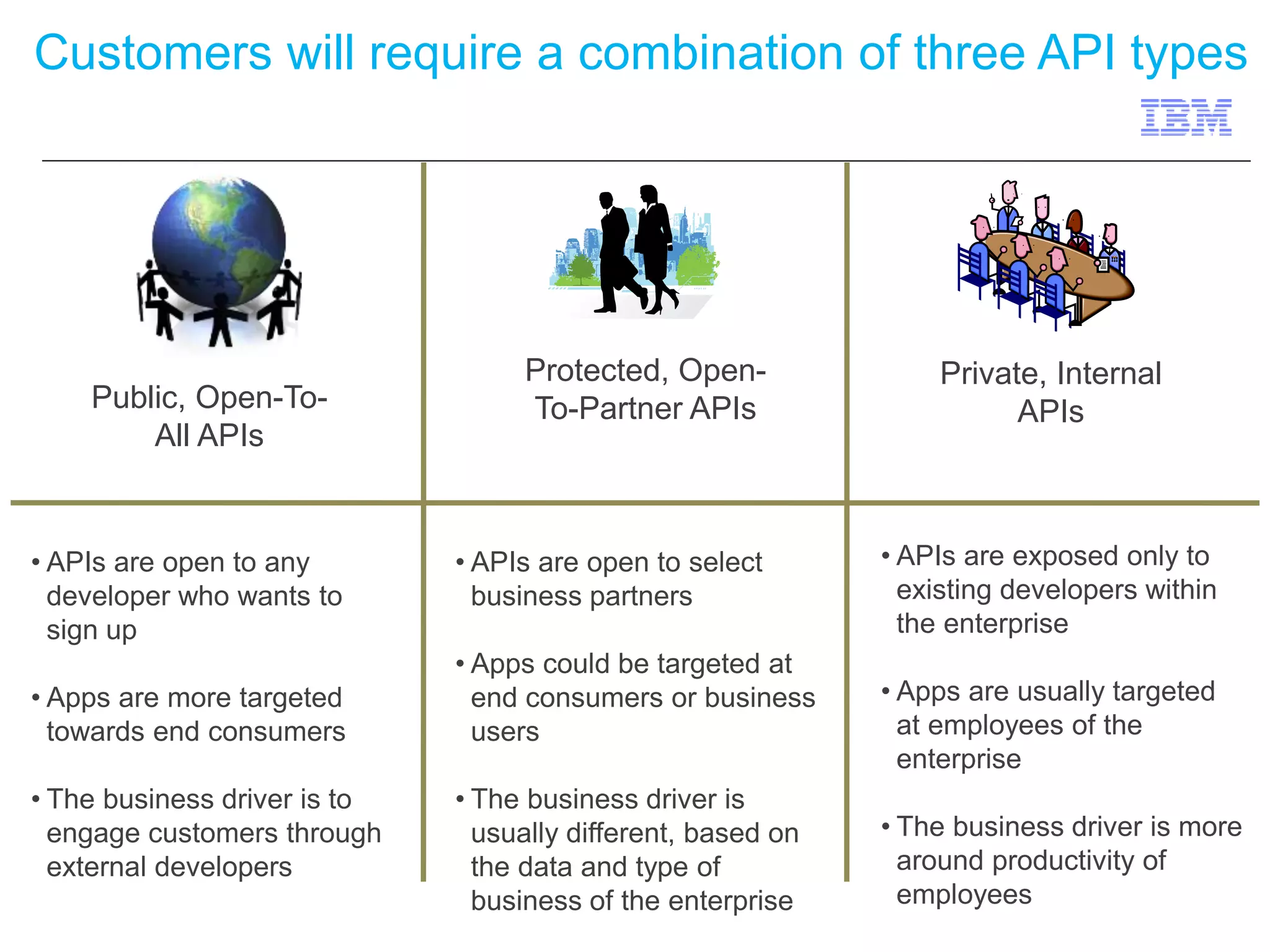
Customers will require a combination of three API types 
Public, Open-To- 
All APIs 
Protected, Open- 
To-Partner APIs 
Private, Internal 
APIs 
• APIs are open to any 
developer who wants to 
sign up 
• Apps are more targeted 
towards end consumers 
• The business driver is to 
engage customers through 
external developers 
• APIs are open to select 
business partners 
• Apps could be targeted at 
end consumers or business 
users 
• The business driver is 
usually different, based on 
the data and type of 
business of the enterprise 
• APIs are exposed only to 
existing developers within 
the enterprise 
• Apps are usually targeted 
at employees of the 
enterprise 
• The business driver is more 
around productivity of 
employees
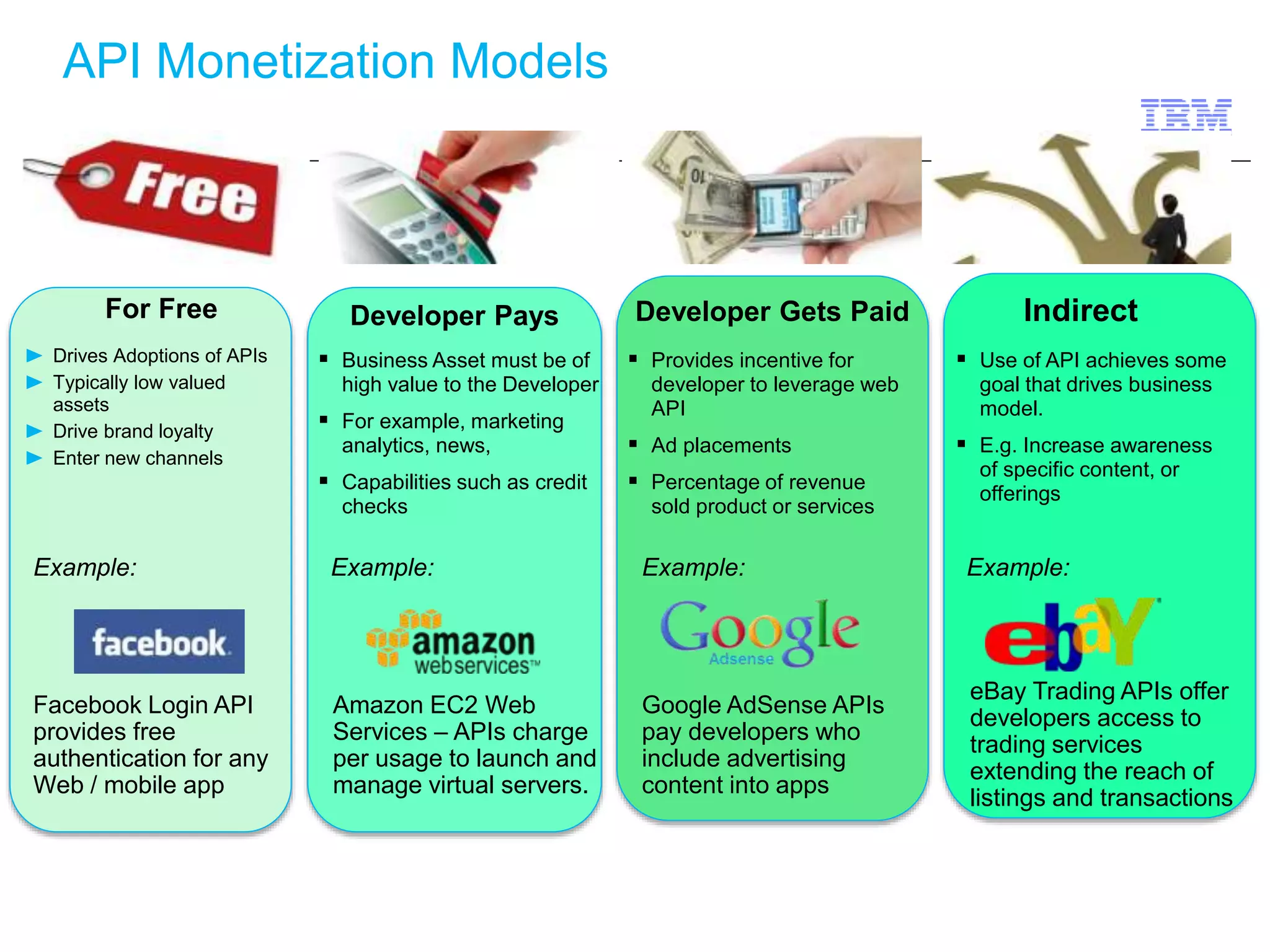
For Free 
Drives Adoptions of APIs 
Typically low valued 
assets 
Drive brand loyalty 
Enter new channels 
Example: 
Facebook Login API 
provides free 
authentication for any 
Web / mobile app 
Developer Pays 
 Business Asset must be of 
high value to the Developer 
 For example, marketing 
analytics, news, 
 Capabilities such as credit 
checks 
Example: 
Amazon EC2 Web 
Services – APIs charge 
per usage to launch and 
manage virtual servers. 
Developer Gets Paid 
 Provides incentive for 
developer to leverage web 
API 
 Ad placements 
 Percentage of revenue 
sold product or services 
Example: 
Google AdSense APIs 
pay developers who 
include advertising 
content into apps 
Indirect 
 Use of API achieves some 
goal that drives business 
model. 
 E.g. Increase awareness 
of specific content, or 
offerings 
Example: 
eBay Trading APIs offer 
developers access to 
trading services 
extending the reach of 
listings and transactions 
API Monetization Models
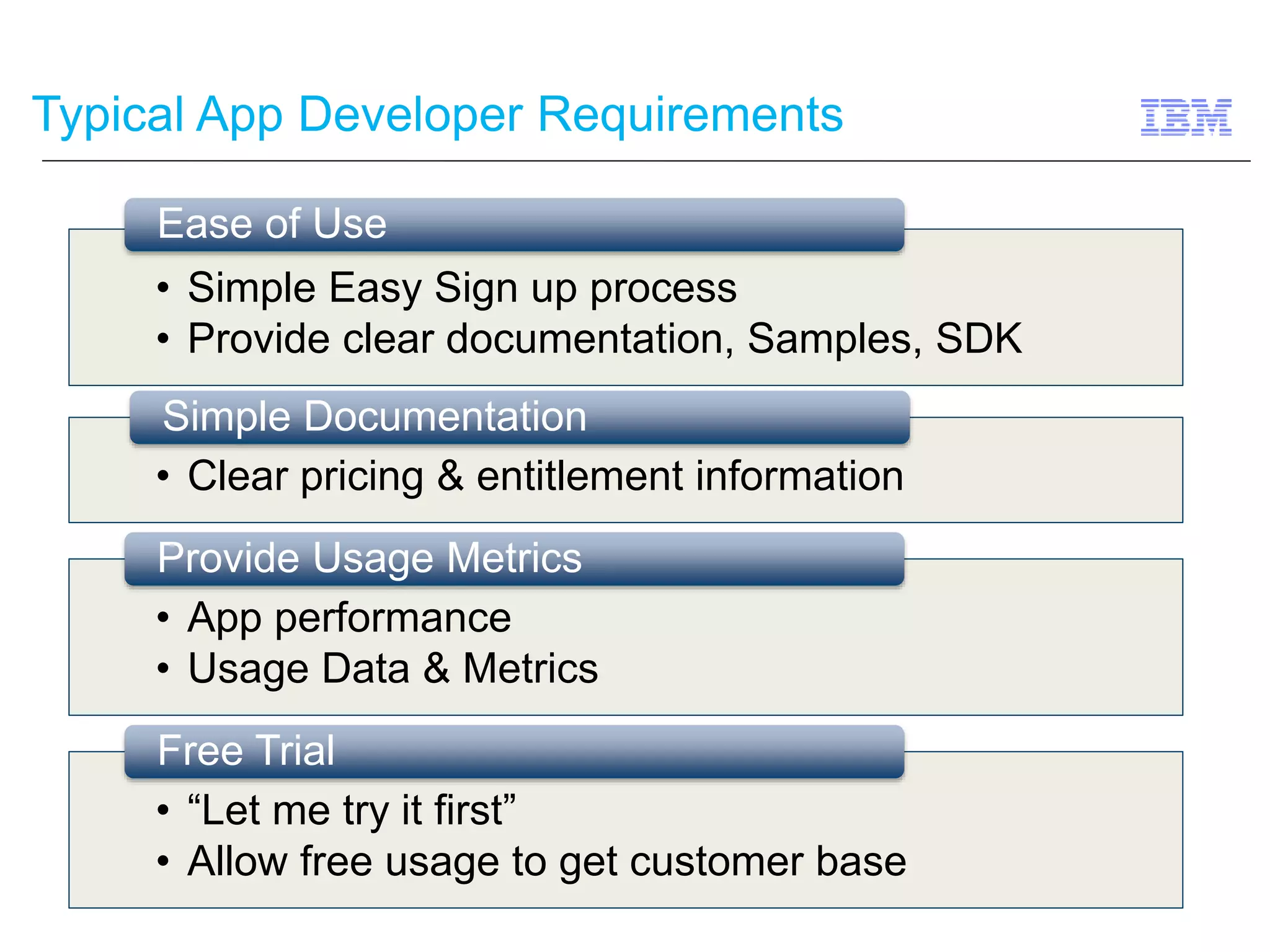
Typical App Developer Requirements 
Ease of Use 
• Simple Easy Sign up process 
• Provide clear documentation, Samples, SDK 
Simple Documentation 
• Clear pricing & entitlement information 
Provide Usage Metrics 
• App performance 
• Usage Data & Metrics 
Free Trial 
• “Let me try it first” 
• Allow free usage to get customer base
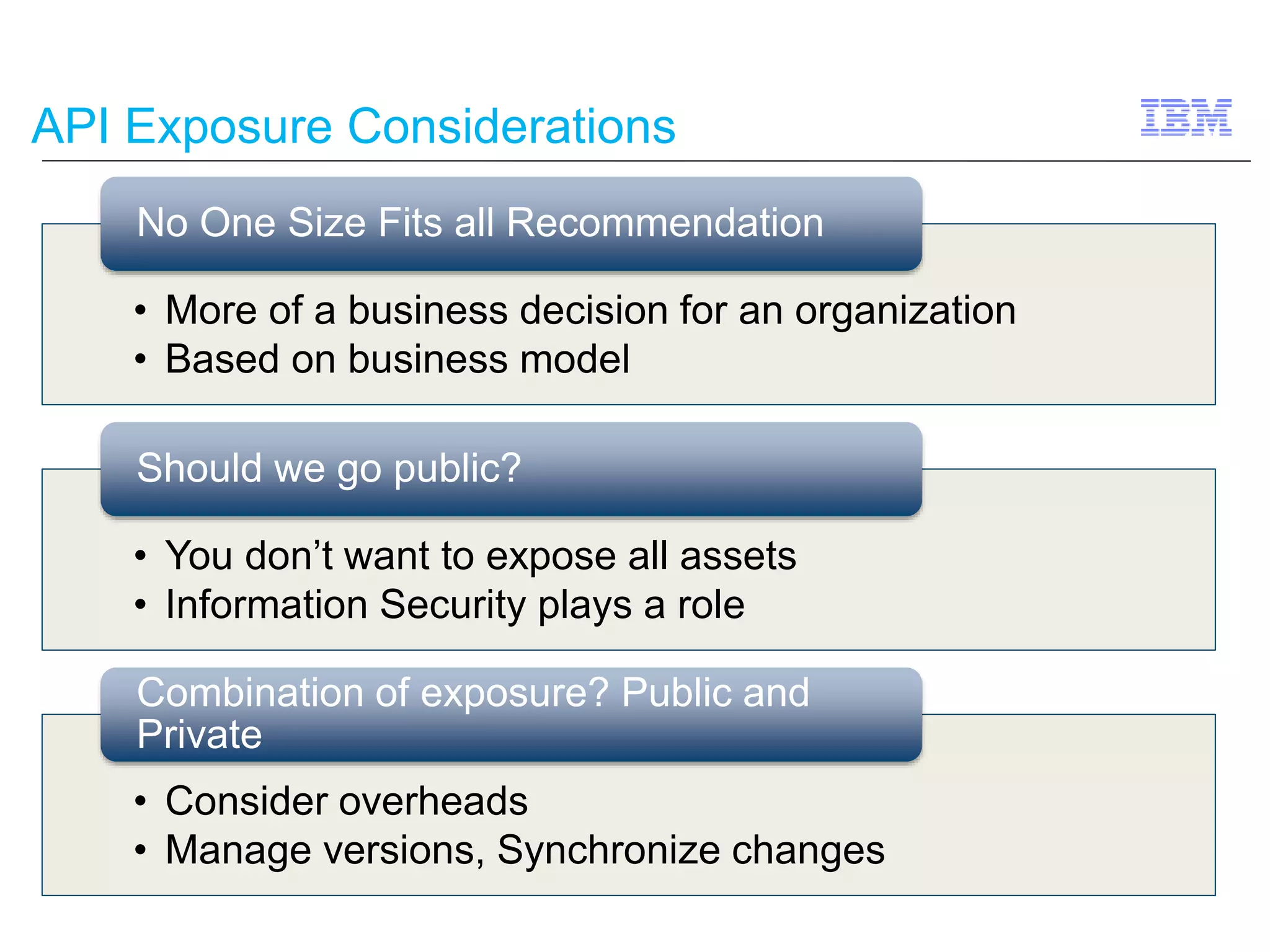
API Exposure Considerations 
No One Size Fits all Recommendation 
• More of a business decision for an organization 
• Based on business model 
Should we go public? 
• You don’t want to expose all assets 
• Information Security plays a role 
Combination of exposure? Public and 
Private 
• Consider overheads 
• Manage versions, Synchronize changes
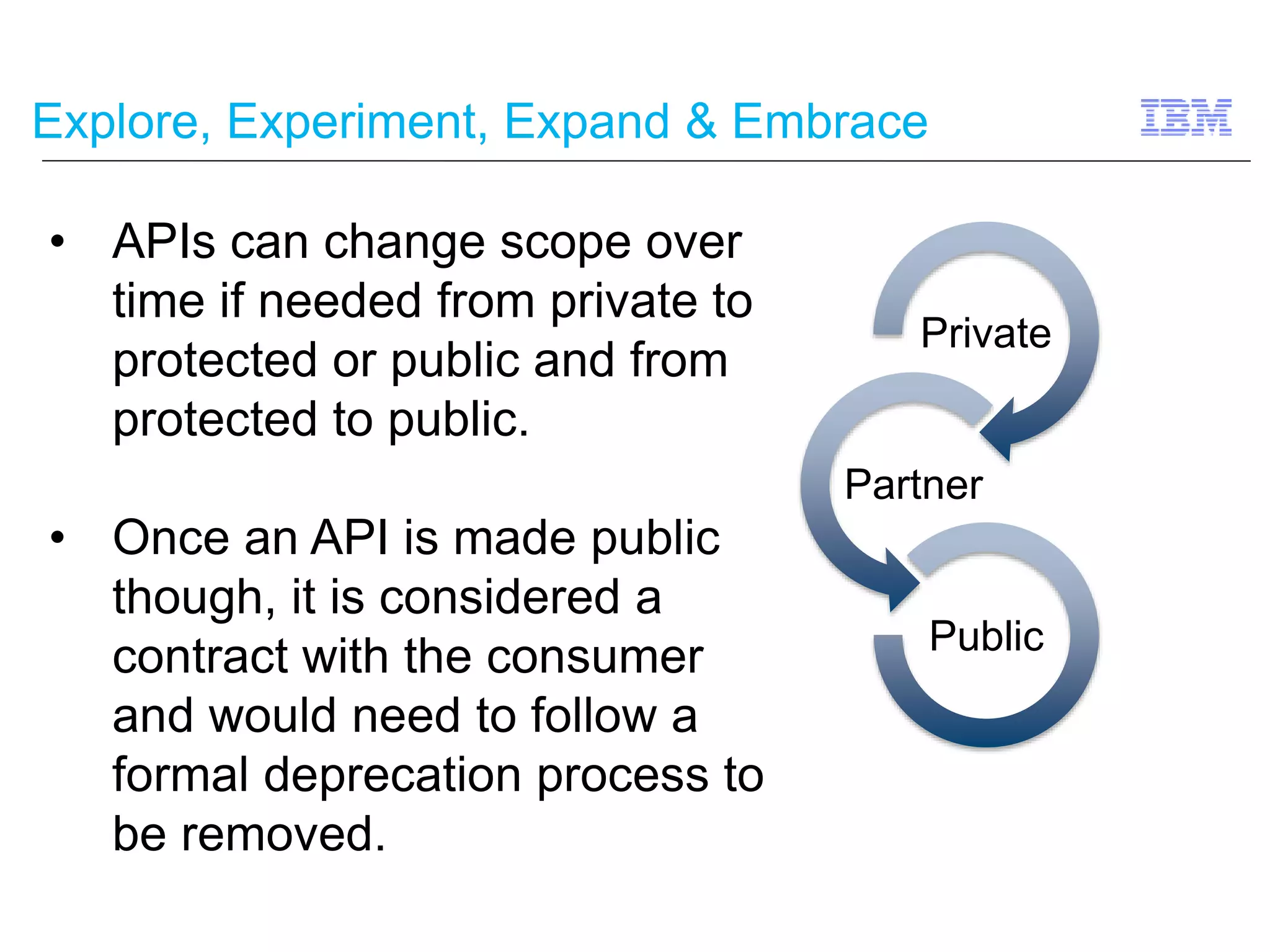
Explore, Experiment, Expand & Embrace 
• APIs can change scope over 
time if needed from private to 
protected or public and from 
protected to public. 
• Once an API is made public 
though, it is considered a 
contract with the consumer 
and would need to follow a 
formal deprecation process to 
be removed. 
Private 
Partner 
Public
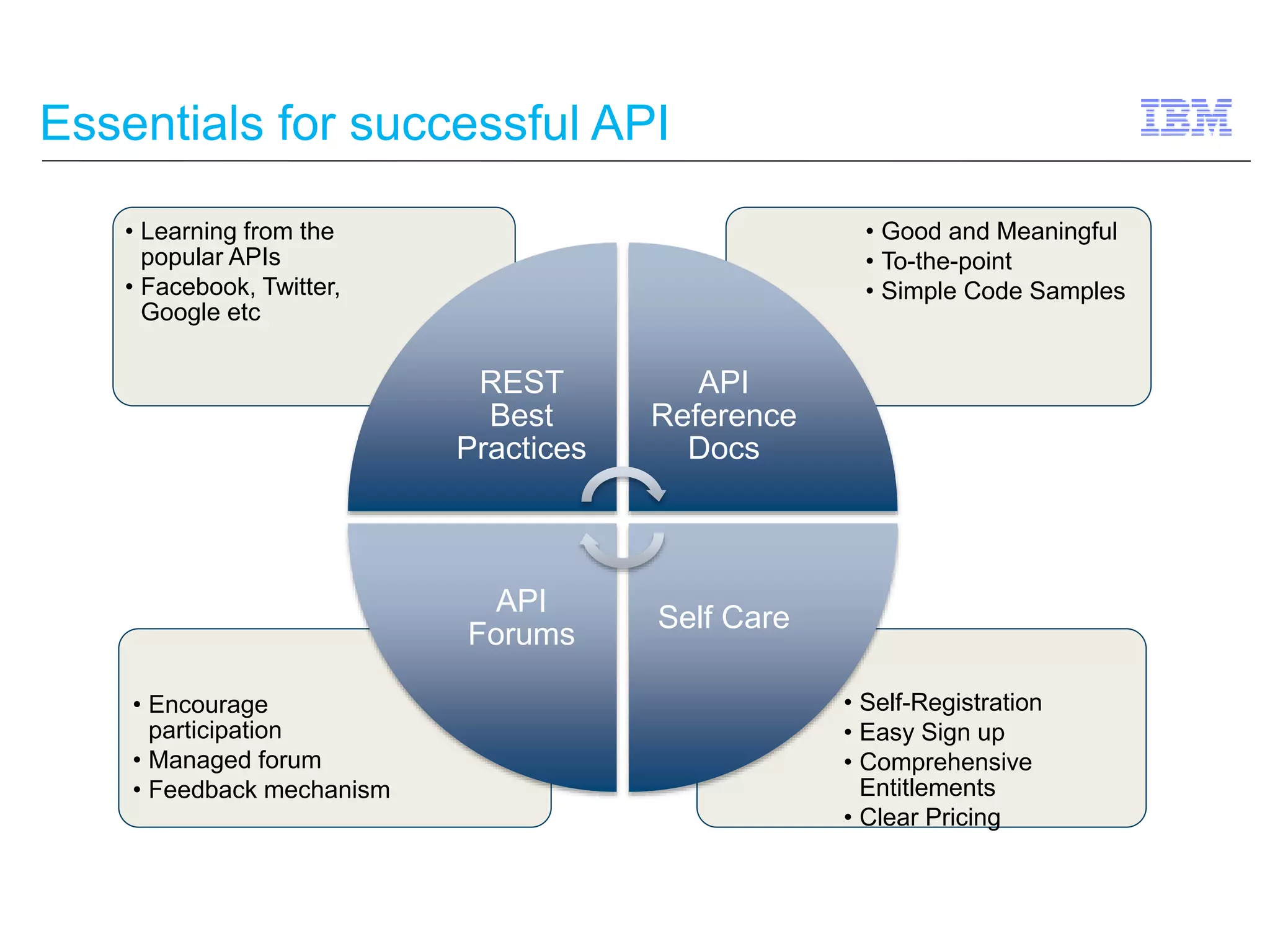
Essentials for successful API 
• Self-Registration 
• Easy Sign up 
• Comprehensive 
Entitlements 
• Clear Pricing 
• Encourage 
participation 
• Managed forum 
• Feedback mechanism 
• Good and Meaningful 
• To-the-point 
• Simple Code Samples 
• Learning from the 
popular APIs 
• Facebook, Twitter, 
Google etc 
REST 
Best 
Practices 
API 
Reference 
Docs 
Self Care 
API 
Forums
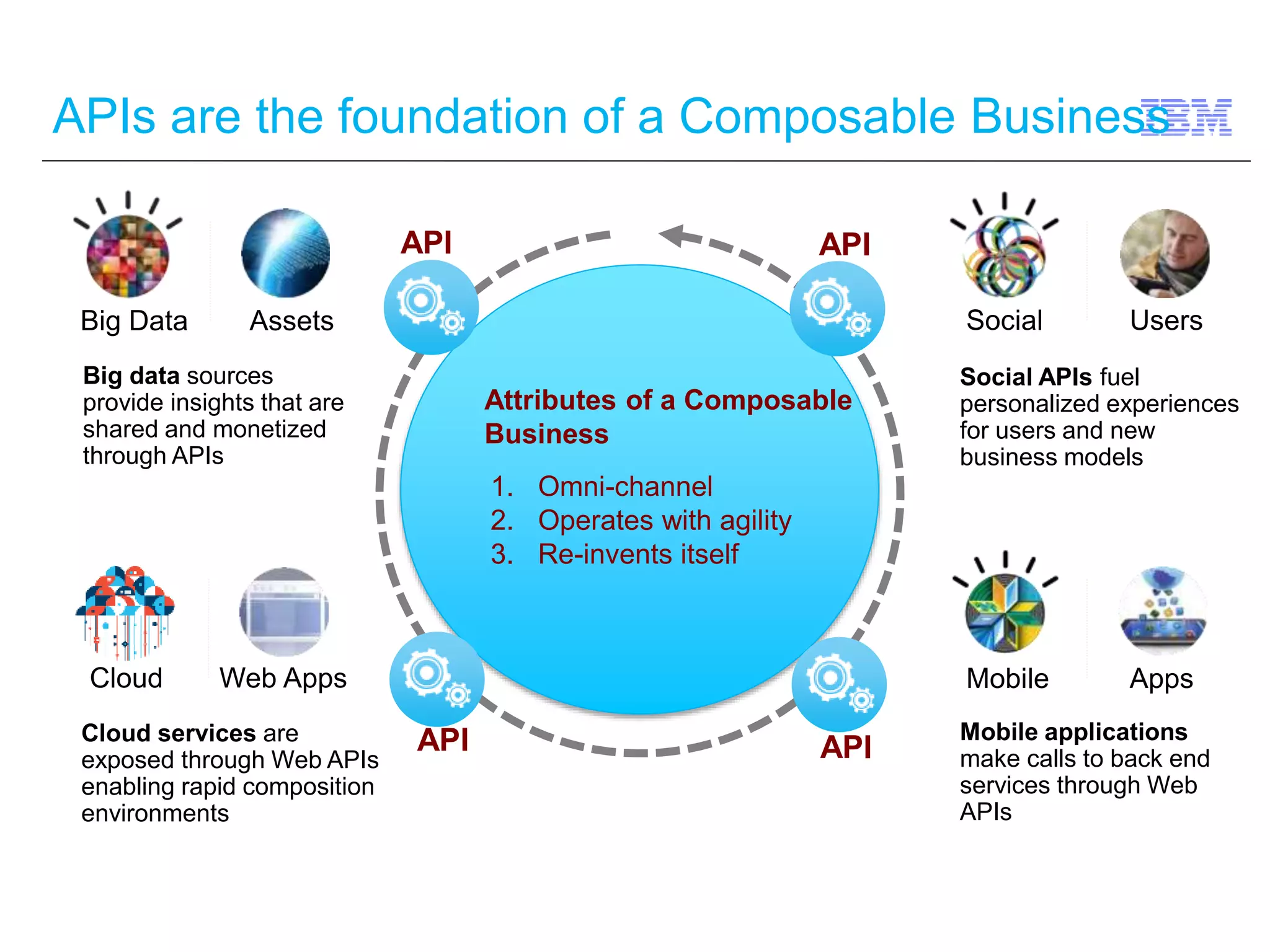
APIs are the foundation of a Composable Business 
Big Data Assets 
Big data sources 
provide insights that are 
shared and monetized 
through APIs 
Social Users 
Social APIs fuel 
personalized experiences 
for users and new 
business models 
Cloud Web Apps 
Cloud services are 
exposed through Web APIs 
enabling rapid composition 
environments 
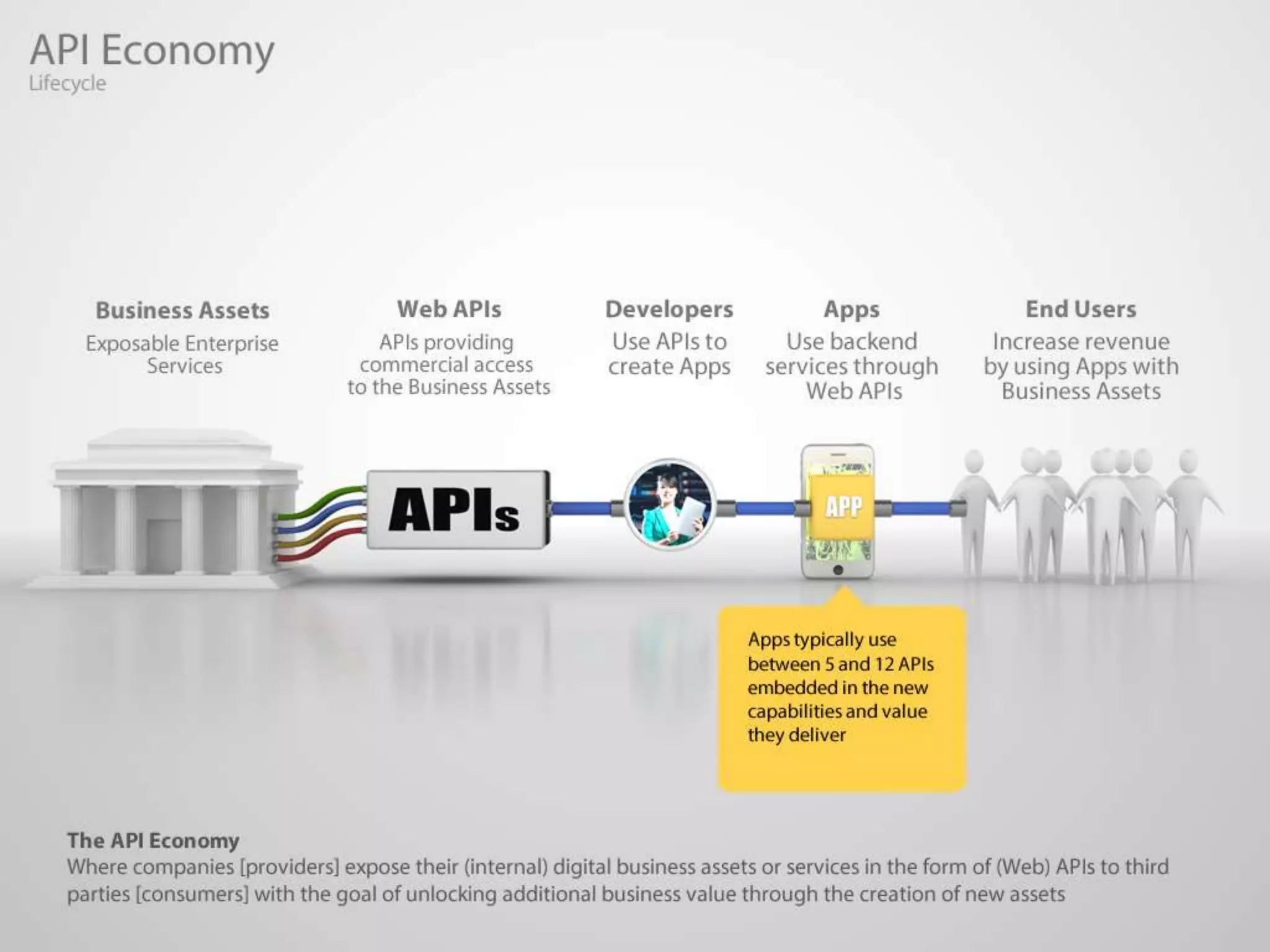
Mobile Apps 
Mobile applications 
make calls to back end 
services through Web 
APIs 
API API 
Attributes of a Composable 
Business 
1. Omni-channel 
2. Operates with agility 
3. Re-invents itself 
API API
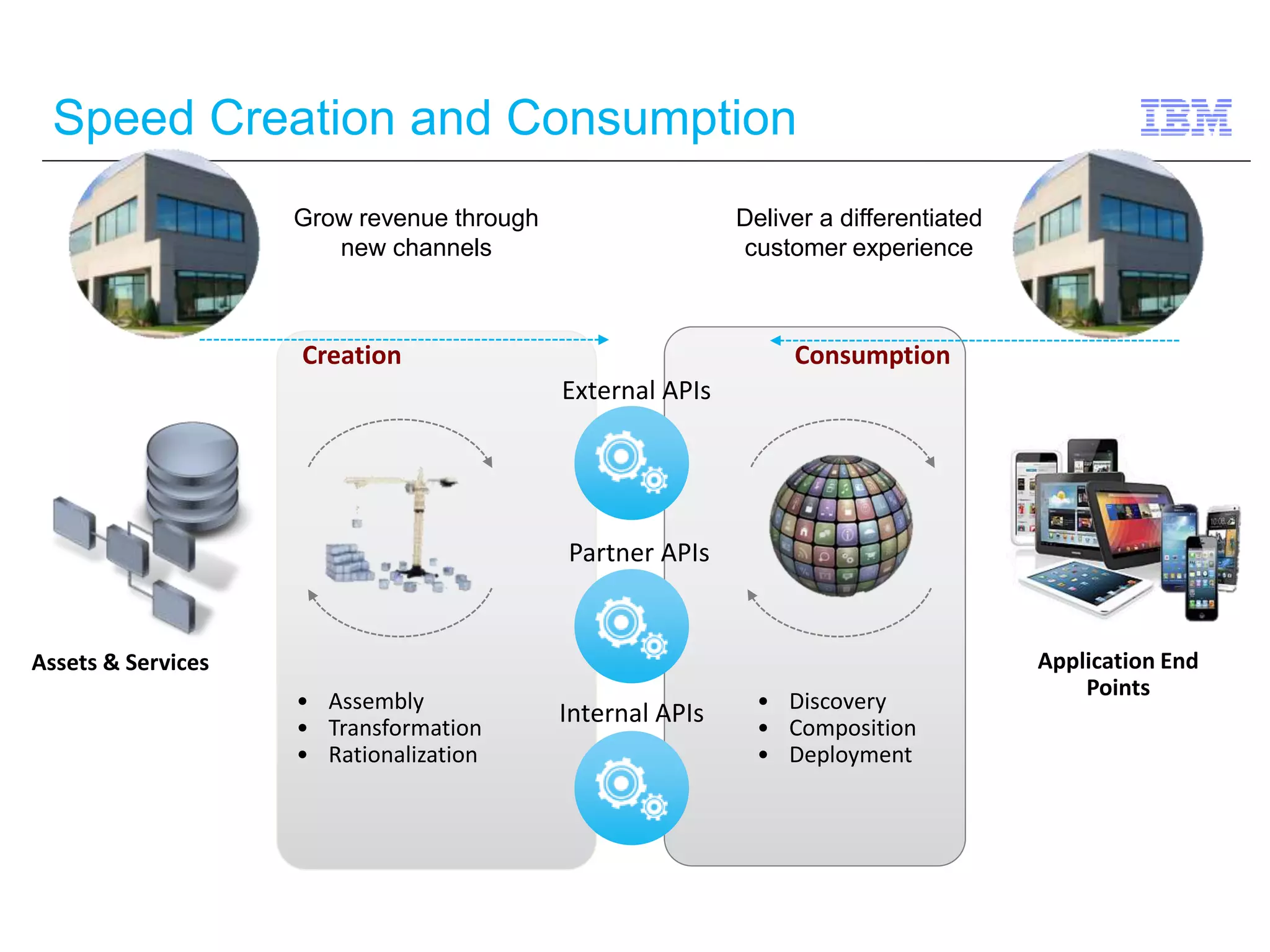
Speed Creation and Consumption 
Creation Consumption 
Assets & Services Application End 
• Assembly 
• Transformation 
• Rationalization 
• Discovery 
• Composition 
• Deployment 
Points 
Grow revenue through 
new channels 
Deliver a differentiated 
customer experience 
External APIs 
Partner APIs 
Internal APIs
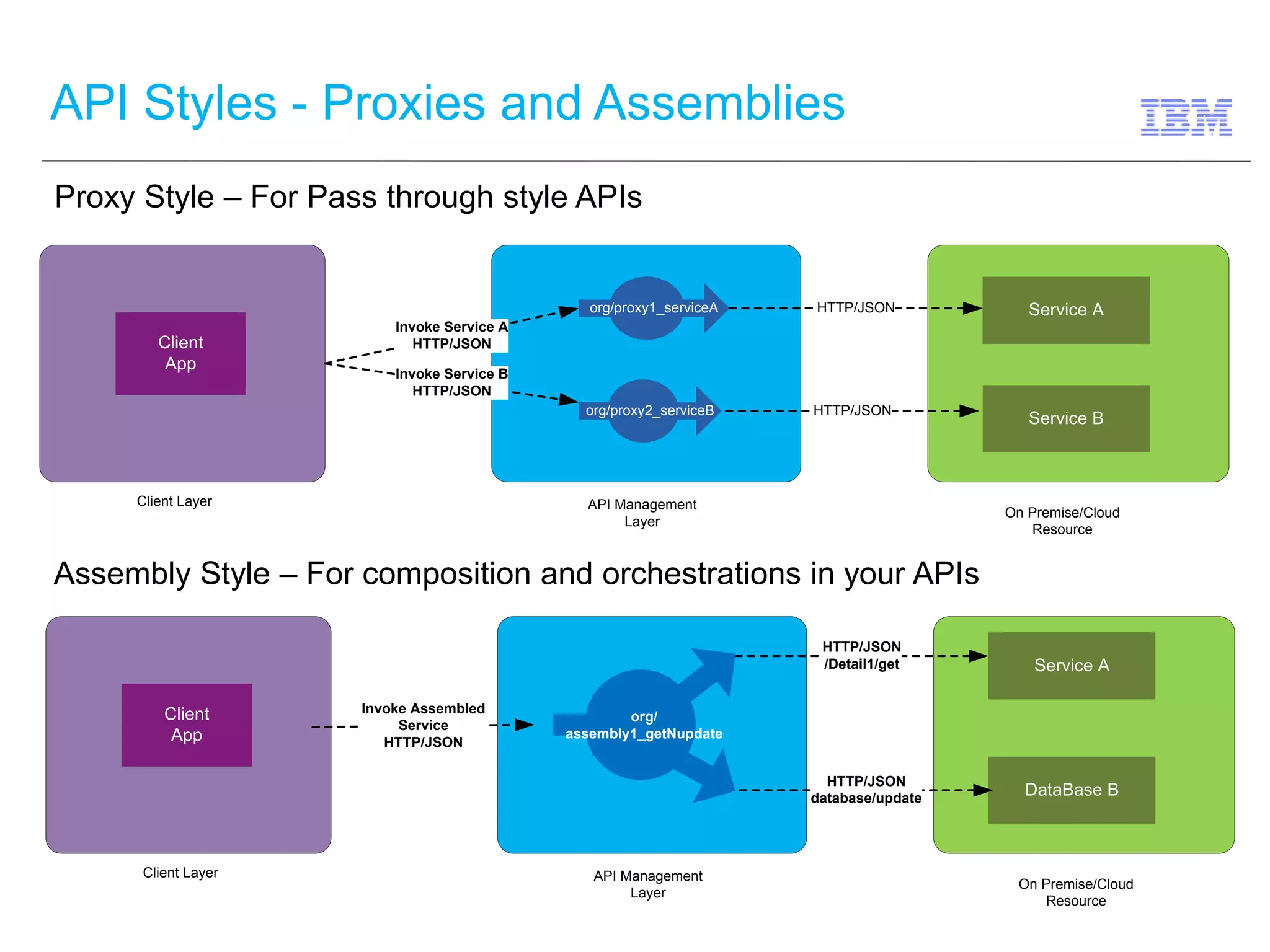
API Styles - Proxies and Assemblies 
Proxy Style – For Pass through style APIs 
org/proxy1_serviceA Service A 
org/proxy2_serviceB Service B 
Invoke Service A 
HTTP/JSON 
Invoke Service B 
HTTP/JSON 
HTTP/JSON 
HTTP/JSON 
Client 
App 
Client Layer API Management 
Layer 
On Premise/Cloud 
Resource 
Service A 
DataBase B 
Assembly Style – For composition and orchestrations in your APIs 
Invoke Assembled 
Service 
HTTP/JSON 
HTTP/JSON 
/Detail1/get 
HTTP/JSON 
database/update 
Client 
App 
Client Layer API Management 
Layer 
On Premise/Cloud 
Resource 
org/ 
assembly1_getNupdate
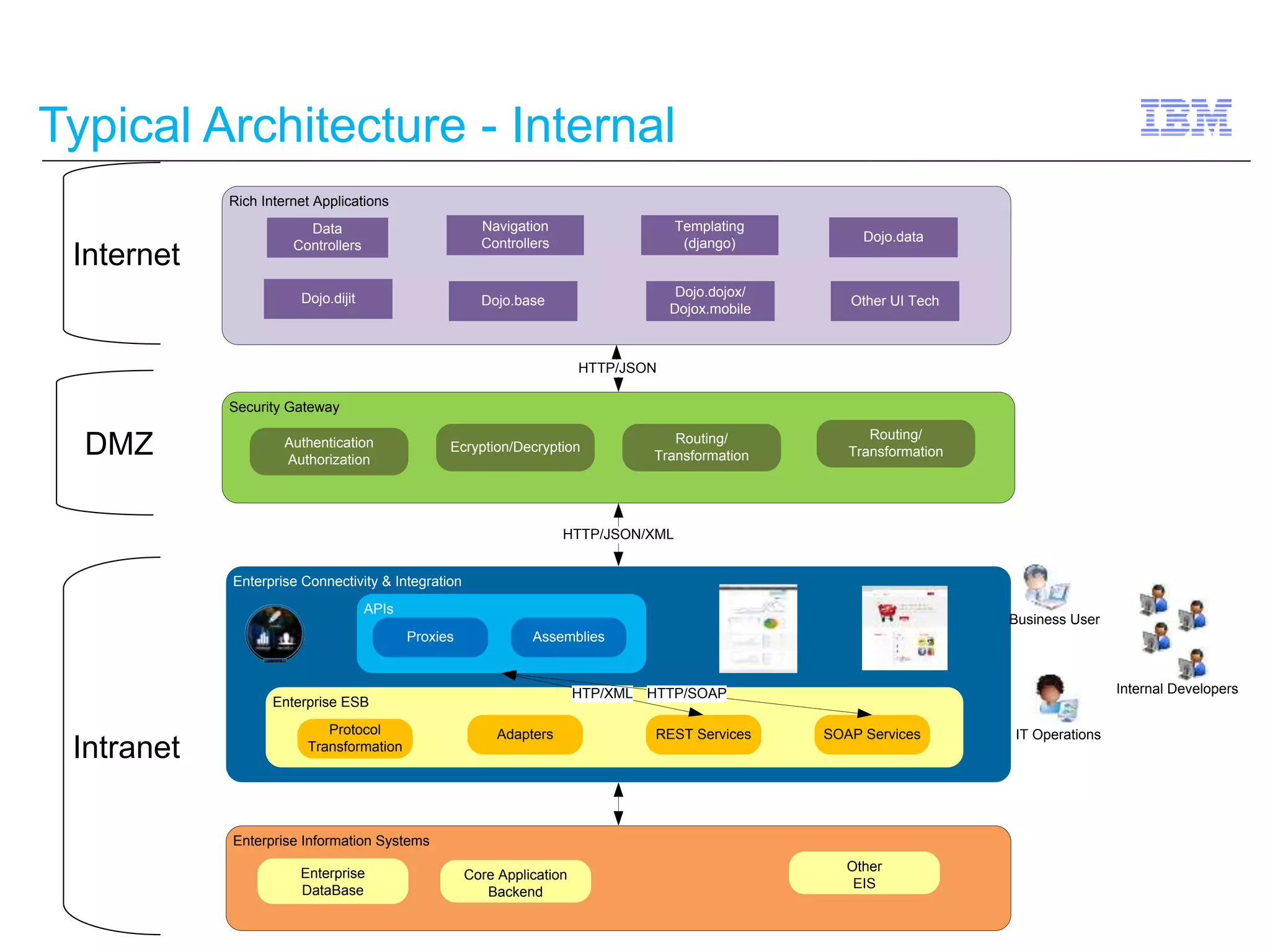
Typical Architecture - Internal 
Internet 
DMZ 
Rich Internet Applications 
Data 
Controllers 
Dojo.dijit Dojo.base 
Security Gateway 
Dojo.dojox/ 
Dojox.mobile 
Dojo.data 
Navigation 
Controllers 
Templating 
(django) 
Other UI Tech 
Authentication 
Authorization 
Routing/ 
HTTP/JSON 
Transformation 
Ecryption/Decryption 
Routing/ 
Transformation 
Enterprise Connectivity & Integration 
APIs 
Proxies Assemblies 
Internal Developers 
Business User 
IT Operations 
Enterprise Information Systems 
Enterprise 
DataBase 
Core Application 
Backend 
Enterprise ESB 
Protocol 
Transformation 
HTP/XML HTTP/SOAP 
Adapters REST Services SOAP Services 
Other 
EIS 
HTTP/JSON/XML 
Intranet
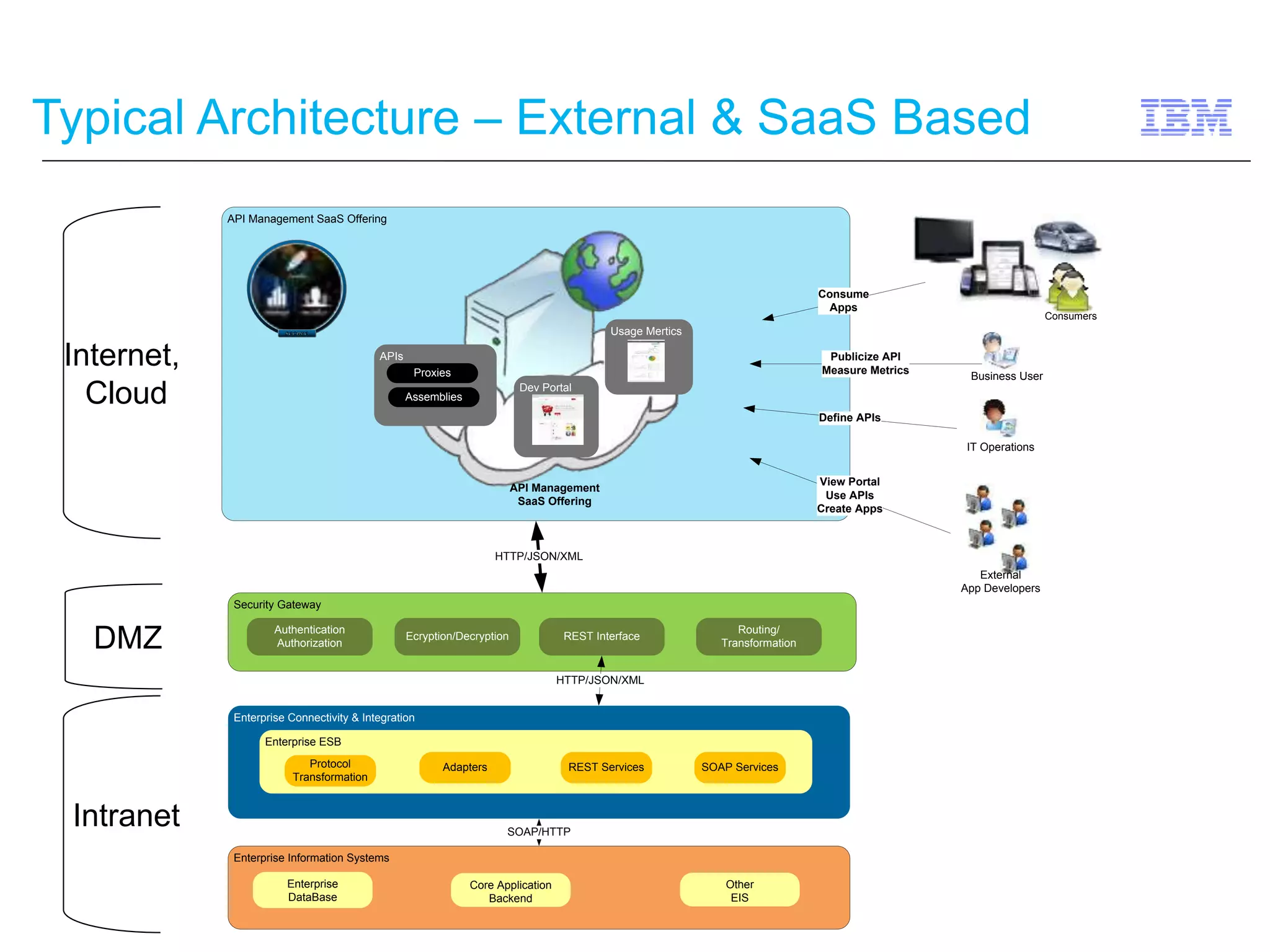
Typical Architecture – External & SaaS Based 
Internet, 
Cloud 
DMZ 
Intranet 
API Management SaaS Offering 
Security Gateway 
Authentication 
Authorization 
Proxies 
Ecryption/Decryption REST Interface 
Routing/ 
Transformation 
Enterprise Connectivity & Integration 
Enterprise Information Systems 
Enterprise 
DataBase 
Core Application 
Backend 
Enterprise ESB 
Protocol 
Transformation 
Adapters REST Services SOAP Services 
SOAP/HTTP 
Other 
EIS 
HTTP/JSON/XML 
APIs 
Assemblies 
Dev Portal 
Usage Mertics 
API Management 
SaaS Offering 
Consumers 
Business User 
IT Operations 
Publicize API 
Measure Metrics 
Define APIs 
View Portal 
Use APIs 
Create Apps 
HTTP/JSON/XML 
External 
App Developers 
Consume 
Apps

Api management introduction and product overview v1.0 2014.08.28

  • 1.
    Discovering the Valueof API Management – Introduction and Product Overview Mike Burkett Wetumpka, Alabama August 28, 2014
  • 2.
    API Economy Overview Mike Burkett ITS, IBM WebSphere Connectivity Great Lakes / Southeast Region Wetumpka, Alabama
  • 3.
    Recent shifts presentbusiness opportunities and IT challenges
  • 4.
    APIs are apath to new business opportunities and growth is accelerating dramatically By 2014, 75% of the Fortune 1000 will offer public Web APIs. By 2016, 50% of B2B collaboration will take place through Web APIs. Sources: Gartner, Predicts 2012: Application Development, 4Q, 2011; Gartner, Govern Your Services and Manage Your APIs with Application Services Governance, 4Q 2012; Gartner, Open for Business: Learn to Profit by Open Data, 1Q 2012 Web APIs are the new, fast-growing business channel Businesses are Evolving stores (800) ###s web sites
  • 5.
    Web APIs areEmerging Across All Industries Energy and Utilities Government Healthcare Transportation Retail Banking Insurance Telco Chemical and Petroleum Electronics
  • 6.
    Banking Types ofAPIs Comments APIs are available in a sandbox environment Some hold contest to see to who can develop the best app a modest reward Some charge for use of apps  Customer API  Account API  Transaction API  Branch Locations Drivers  Banks are having challenges in the marketing ability to create, test and evolve new services and adapt better to the needs of the users in the changing of their uses.  Need to deliver multiple focus apps on many different devices. Examples of Apps  Financial Overview  Financial Timelines  Mapping Financial Relationships  Added Valued Services such as loyalty, couponing and target marketing
  • 7.
    Insurance Types ofAPIs Comments  Policy API APIs are available in a sandbox environment Some hold contest to see to who can develop the best app a modest reward Some charge for use of apps  Customer API  Account API Drivers  Business trend to leverage partnerships and decentralize the business value chain  Pressing need to become more agile  Business flexibility to try new things to drive revenue  Increase need to improve effectiveness of working with external partners in delivery of business solutions
  • 8.
    Retail Types ofAPIs Comments  Products APIs are typically open  Some APIs require further approvals to use  Products API  Store Locator API  Deals of the Day API  Reviews API  Top Sellars API  Categories API Drivers  Shifts in buying patterns customers  Need to be where customers are purchasing – mobile devices  Capitalize on every small channel that is created. Examples of Apps  Milo.com – searches for best prices  Gazaro – deal finder  GetGlue – social network for movie tv shows  eBay Gifts Nearby -
  • 9.
    The Market Pressure The explosion of devices and channels • How do you support delivery of your services and products on all of these devices? Applications are smaller, more focused, and come and go very fast • How do you keep up with the rate of change? Competitive pressure forcing the need for faster innovation • How do you foster innovation to beat out competition? Partnerships need to be established quicker and connected quicker • How do you create new partnership fast which our outside of your normal interactions? Brand loyalty is always under attack • How do you get and maintain brand loyalty?
  • 10.
    Business API =Web API = Productized Service What is a Business API?  A Business API is a public persona for an enterprise; exposing defined assets, data or services for public consumption  A Business API is simple for app developers to use, access and understand  A Business API can be easily invoked What Value Does a Business API Provide?  Extends an enterprise and opens new markets by allowing external app developers to easily leverage, publicize and/or aggregate a company’s assets for broad-based consumption What “assets, data or services” are exposed via a Business API?:  Product catalogs  Store listings  Order status  Inventory  Social interaction App Developer
  • 11.
    © 2014 IBMCorporation
  • 13.
    © 2014 IBMCorporation
  • 24.
    Are APIs justa new name for SOA? There are many similarities – but one very important difference: The objective most have been focusing on achieving with them “How can I increase the pace of innovation?” “How can I increase the agility and effectiveness of delivery?” APIs SOA Reuse → Speed to deliver Sharing → Expediency Encapsulate → Less to learn Reuse → Effort to deliver Sharing → Effectiveness Encapsulate → Less to change
  • 25.
    Each style sprungfrom the systems they were most focused on… APIs SOA To control the creation and operational behavior of Systems of Record services, use WSRR To foster innovation through the consumption of API’s across Systems of Engagement, use API Mgmt Services •Focus on the provider •Stable interface to systems of record APIs •Focus on the consumer •Easy to learn, easy to use •Simplified access to gateway capabilities Private Cloud Back-office Processes Analytics Services Databases CRM Internet of Things Mobile Public Cloud Social Web Partners Gateway Integration
  • 26.
    Two similar worldsconverging SOA Governance API Management Service Management API Management Mainly about Services Mainly about APIs Govern services through the lifecycle Expose APIs to the Web, manage them to prevent chaos in usage Began with Web Services Began with REST 100’s of services Smaller number of APIs Typically internal, behind firewall External and Internal Driven by Enterprise Architects Driven by Business, Marketing, Mobile teams, Innovation teams Governs with a Stick Governs with a Carrot Established market presence Newer in market Contracts enforced with ESBs and Gateways Security and Entitlements controlled by Gateway “The overlap between SOA governance technology and API management is significant.” “It is about tracking and monitoring the artifacts in an SOA or an API project, enforcing and ensuring compliance with the policies associated with the artifacts and measuring the outcomes related to their use.” - August 2013, Gartner’s Application Services Governance report Application Services Governance
  • 27.
    Introduction to APIsand API Management
  • 28.
    API Management Introductionand General Concepts - Terminologies - Roles & Responsibilities - Architectural Use Cases - Types of APIs - API Styles
  • 29.
    Terminologies: Web APIs,Mashups, Apps Web API • A defined set of HTTP request messages along with a definition of the structure of response messages, typically expressed in JSON or XML Web App • A web application or web app is any application software that runs in a web browser or is created in a browser-supported programming language (such as the combination of JavaScript, HTML and CSS) and relies on a common web browser to render the application Mashup • A web page, or web application, that uses Web APIs to combine data, presentation or functionality from two or more sources to create new services.
  • 30.
    Terminologies: Web APIs,Mashups, Apps API Key • A code passed in by computer programs calling an API • Identifies the calling program, its developer, or its user to the Web site. • Used to track and control how the API is being used, for example to prevent malicious use or abuse of the API (as defined perhaps by terms of service). OAuth • OAuth is an open standard for authorization • OAuth provides client applications a 'secure delegated access' to server resources on behalf of a resource owner
  • 31.
    Roles & Relationshipsin the API economy App Developer Business User IT Person • Develops cool new applications against new public or private APIs • Understands one or more web programming languages • Spends his free time developing Apps too • Wants to reach new markets through new channels • Understands the business and value of assets being exposed • Needs to experiment with different programs and campaigns to drive adoption • Product Manages the initiative • Exposing public APIs might be new to the IT Person • Worried about security and scalability of infrastructure • Short on time to do new projects
  • 32.
    Companies Need toBecome an Engaging Enterprise Apps Customer Business User Enterprise IT App Developer • Business Users want to engage Customers in new markets • They need to Externalize the Enterprise • They need to get Apps in front of these Customers • Apps need APIs that Externalize the Enterprise • App Developers use APIs • App Developers are now External to the Enterprise • IT Guys need to secure, scale and support the externalized Enterprise • Business Users and IT Guys needs Insights so they can respond to business needs The Platform Enterprises wants to tap into innovation from a large community of developers, not just developers they employ
  • 33.
    Customers will requirea combination of three API types Public, Open-To- All APIs Protected, Open- To-Partner APIs Private, Internal APIs • APIs are open to any developer who wants to sign up • Apps are more targeted towards end consumers • The business driver is to engage customers through external developers • APIs are open to select business partners • Apps could be targeted at end consumers or business users • The business driver is usually different, based on the data and type of business of the enterprise • APIs are exposed only to existing developers within the enterprise • Apps are usually targeted at employees of the enterprise • The business driver is more around productivity of employees
  • 34.
    For Free DrivesAdoptions of APIs Typically low valued assets Drive brand loyalty Enter new channels Example: Facebook Login API provides free authentication for any Web / mobile app Developer Pays  Business Asset must be of high value to the Developer  For example, marketing analytics, news,  Capabilities such as credit checks Example: Amazon EC2 Web Services – APIs charge per usage to launch and manage virtual servers. Developer Gets Paid  Provides incentive for developer to leverage web API  Ad placements  Percentage of revenue sold product or services Example: Google AdSense APIs pay developers who include advertising content into apps Indirect  Use of API achieves some goal that drives business model.  E.g. Increase awareness of specific content, or offerings Example: eBay Trading APIs offer developers access to trading services extending the reach of listings and transactions API Monetization Models
  • 35.
    Typical App DeveloperRequirements Ease of Use • Simple Easy Sign up process • Provide clear documentation, Samples, SDK Simple Documentation • Clear pricing & entitlement information Provide Usage Metrics • App performance • Usage Data & Metrics Free Trial • “Let me try it first” • Allow free usage to get customer base
  • 36.
    API Exposure Considerations No One Size Fits all Recommendation • More of a business decision for an organization • Based on business model Should we go public? • You don’t want to expose all assets • Information Security plays a role Combination of exposure? Public and Private • Consider overheads • Manage versions, Synchronize changes
  • 37.
    Explore, Experiment, Expand& Embrace • APIs can change scope over time if needed from private to protected or public and from protected to public. • Once an API is made public though, it is considered a contract with the consumer and would need to follow a formal deprecation process to be removed. Private Partner Public
  • 38.
    Essentials for successfulAPI • Self-Registration • Easy Sign up • Comprehensive Entitlements • Clear Pricing • Encourage participation • Managed forum • Feedback mechanism • Good and Meaningful • To-the-point • Simple Code Samples • Learning from the popular APIs • Facebook, Twitter, Google etc REST Best Practices API Reference Docs Self Care API Forums
  • 39.
    APIs are thefoundation of a Composable Business Big Data Assets Big data sources provide insights that are shared and monetized through APIs Social Users Social APIs fuel personalized experiences for users and new business models Cloud Web Apps Cloud services are exposed through Web APIs enabling rapid composition environments Mobile Apps Mobile applications make calls to back end services through Web APIs API API Attributes of a Composable Business 1. Omni-channel 2. Operates with agility 3. Re-invents itself API API
  • 40.
    Speed Creation andConsumption Creation Consumption Assets & Services Application End • Assembly • Transformation • Rationalization • Discovery • Composition • Deployment Points Grow revenue through new channels Deliver a differentiated customer experience External APIs Partner APIs Internal APIs
  • 41.
    API Styles -Proxies and Assemblies Proxy Style – For Pass through style APIs org/proxy1_serviceA Service A org/proxy2_serviceB Service B Invoke Service A HTTP/JSON Invoke Service B HTTP/JSON HTTP/JSON HTTP/JSON Client App Client Layer API Management Layer On Premise/Cloud Resource Service A DataBase B Assembly Style – For composition and orchestrations in your APIs Invoke Assembled Service HTTP/JSON HTTP/JSON /Detail1/get HTTP/JSON database/update Client App Client Layer API Management Layer On Premise/Cloud Resource org/ assembly1_getNupdate
  • 42.
    Typical Architecture -Internal Internet DMZ Rich Internet Applications Data Controllers Dojo.dijit Dojo.base Security Gateway Dojo.dojox/ Dojox.mobile Dojo.data Navigation Controllers Templating (django) Other UI Tech Authentication Authorization Routing/ HTTP/JSON Transformation Ecryption/Decryption Routing/ Transformation Enterprise Connectivity & Integration APIs Proxies Assemblies Internal Developers Business User IT Operations Enterprise Information Systems Enterprise DataBase Core Application Backend Enterprise ESB Protocol Transformation HTP/XML HTTP/SOAP Adapters REST Services SOAP Services Other EIS HTTP/JSON/XML Intranet
  • 43.
    Typical Architecture –External & SaaS Based Internet, Cloud DMZ Intranet API Management SaaS Offering Security Gateway Authentication Authorization Proxies Ecryption/Decryption REST Interface Routing/ Transformation Enterprise Connectivity & Integration Enterprise Information Systems Enterprise DataBase Core Application Backend Enterprise ESB Protocol Transformation Adapters REST Services SOAP Services SOAP/HTTP Other EIS HTTP/JSON/XML APIs Assemblies Dev Portal Usage Mertics API Management SaaS Offering Consumers Business User IT Operations Publicize API Measure Metrics Define APIs View Portal Use APIs Create Apps HTTP/JSON/XML External App Developers Consume Apps