API Security in the Digital Age
Subra Kumaraswamy, Apigee &
Jason Kobus, Silicon Valley Bank
youtube.com/apigee
slideshare.net/apigee
@Subrak
Subra Kumaraswamy
Jason Kobus
Silicon Valley Bank
Agenda
• API Security 101
• Launching an API Platform for a regulated company
• Key Takeaways
5
Apigee
Managemen
t
Develope
r
API Team
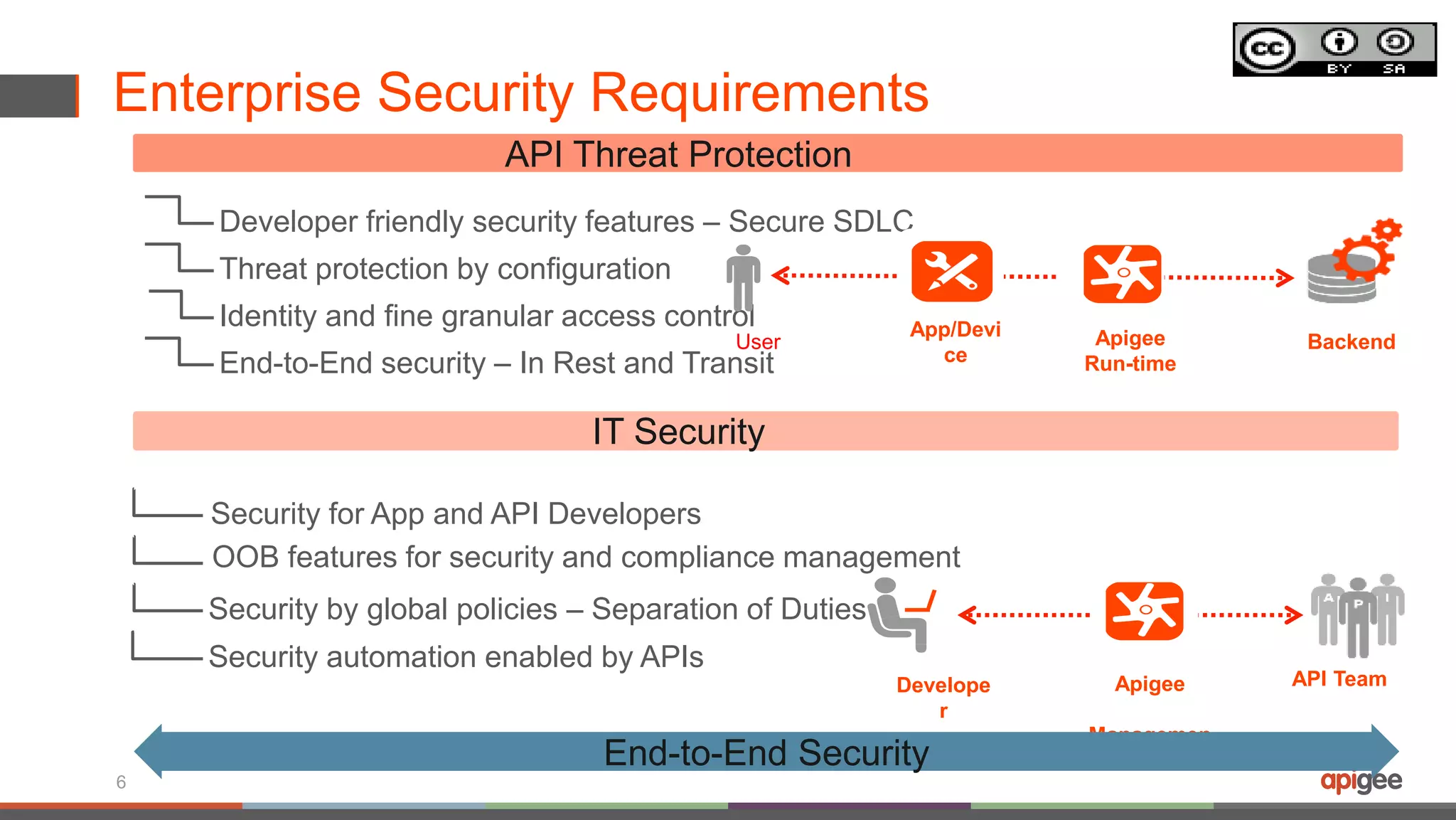
Enterprise Security Requirements
6
API Threat Protection
IT Security
Developer friendly security features – Secure SDLC
Threat protection by configuration
Identity and fine granular access control
Security for App and API Developers
Security by global policies – Separation of Duties
Security automation enabled by APIs
End-to-End security – In Rest and Transit
OOB features for security and compliance management
End-to-End Security
User Apigee
Run-time
App/Devi
ce
Backend
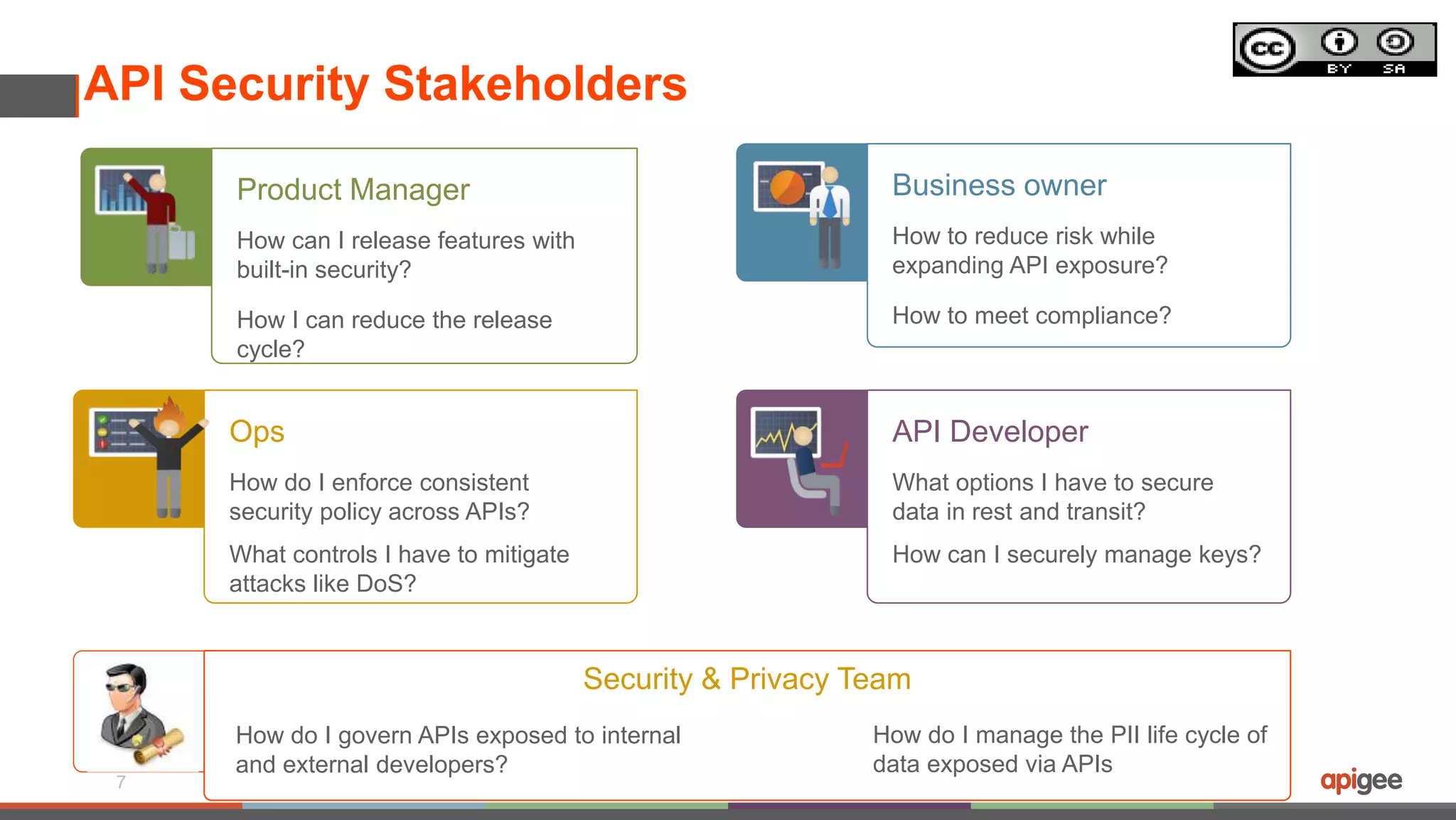
API Security Stakeholders
7
Product Manager
How can I release features with
built-in security?
How I can reduce the release
cycle?
Business owner
How to reduce risk while
expanding API exposure?
How to meet compliance?
Ops
How do I enforce consistent
security policy across APIs?
What controls I have to mitigate
attacks like DoS?
API Developer
What options I have to secure
data in rest and transit?
How can I securely manage keys?
Security & Privacy Team
How do I manage the PII life cycle of
data exposed via APIs
How do I govern APIs exposed to internal
and external developers?
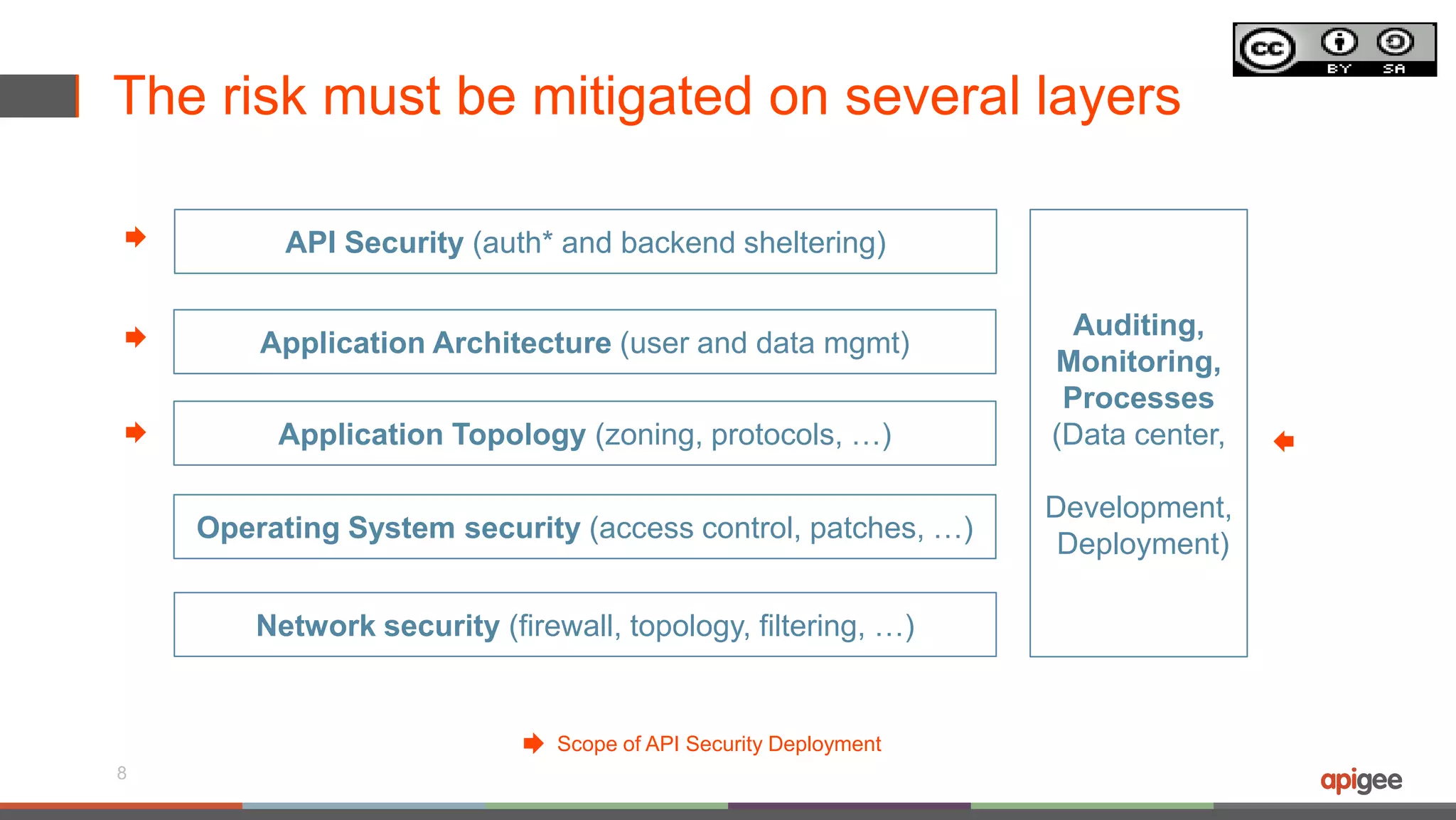
The risk must be mitigated on several layers
8
Application Architecture (user and data mgmt)
Application Topology (zoning, protocols, …)
Operating System security (access control, patches, …)
Network security (firewall, topology, filtering, …)
API Security (auth* and backend sheltering)
Auditing,
Monitoring,
Processes
(Data center,
Development,
Deployment)
Scope of API Security Deployment
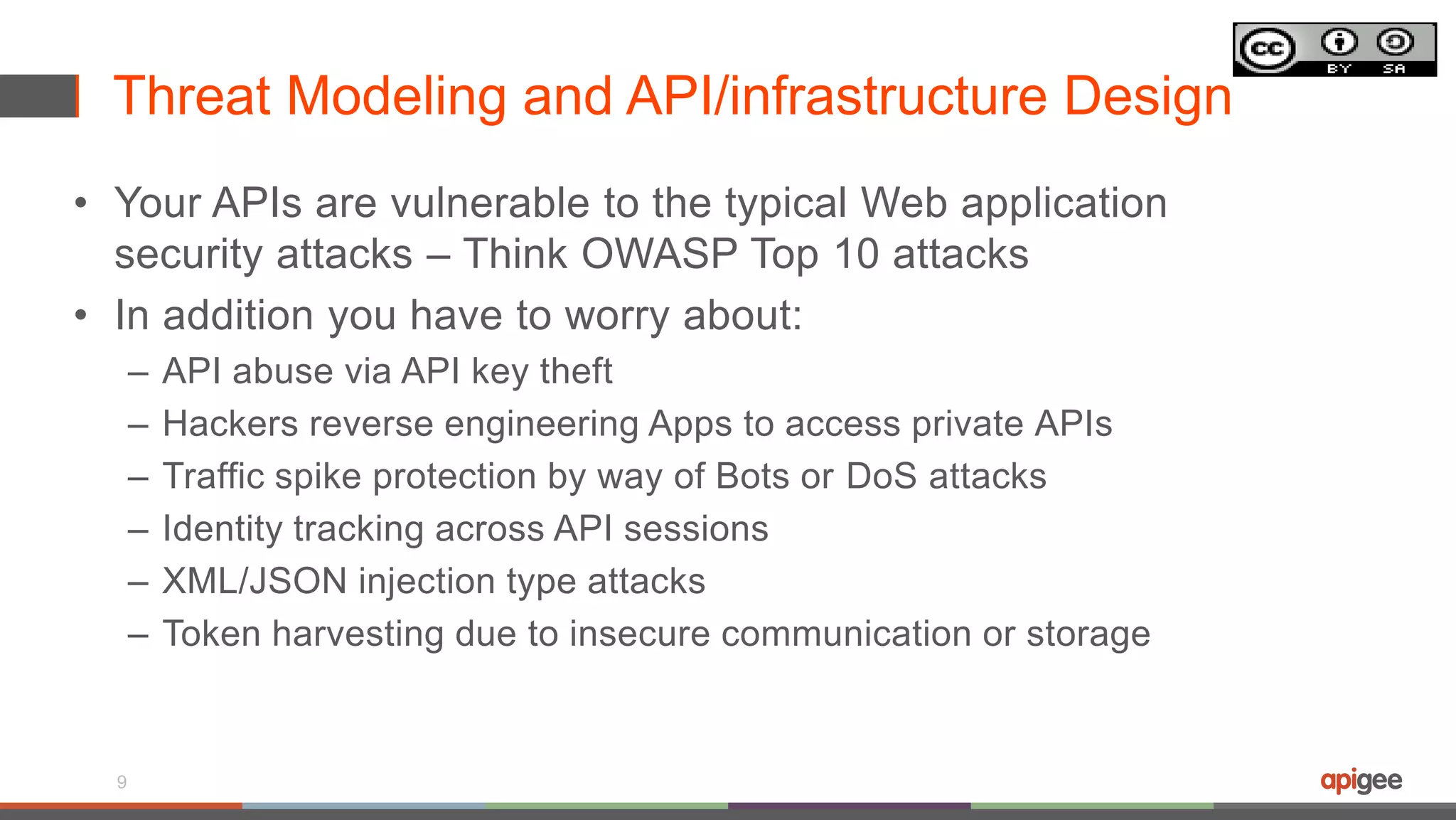
Threat Modeling and API/infrastructure Design
• Your APIs are vulnerable to the typical Web application
security attacks – Think OWASP Top 10 attacks
• In addition you have to worry about:
– API abuse via API key theft
– Hackers reverse engineering Apps to access private APIs
– Traffic spike protection by way of Bots or DoS attacks
– Identity tracking across API sessions
– XML/JSON injection type attacks
– Token harvesting due to insecure communication or storage
9
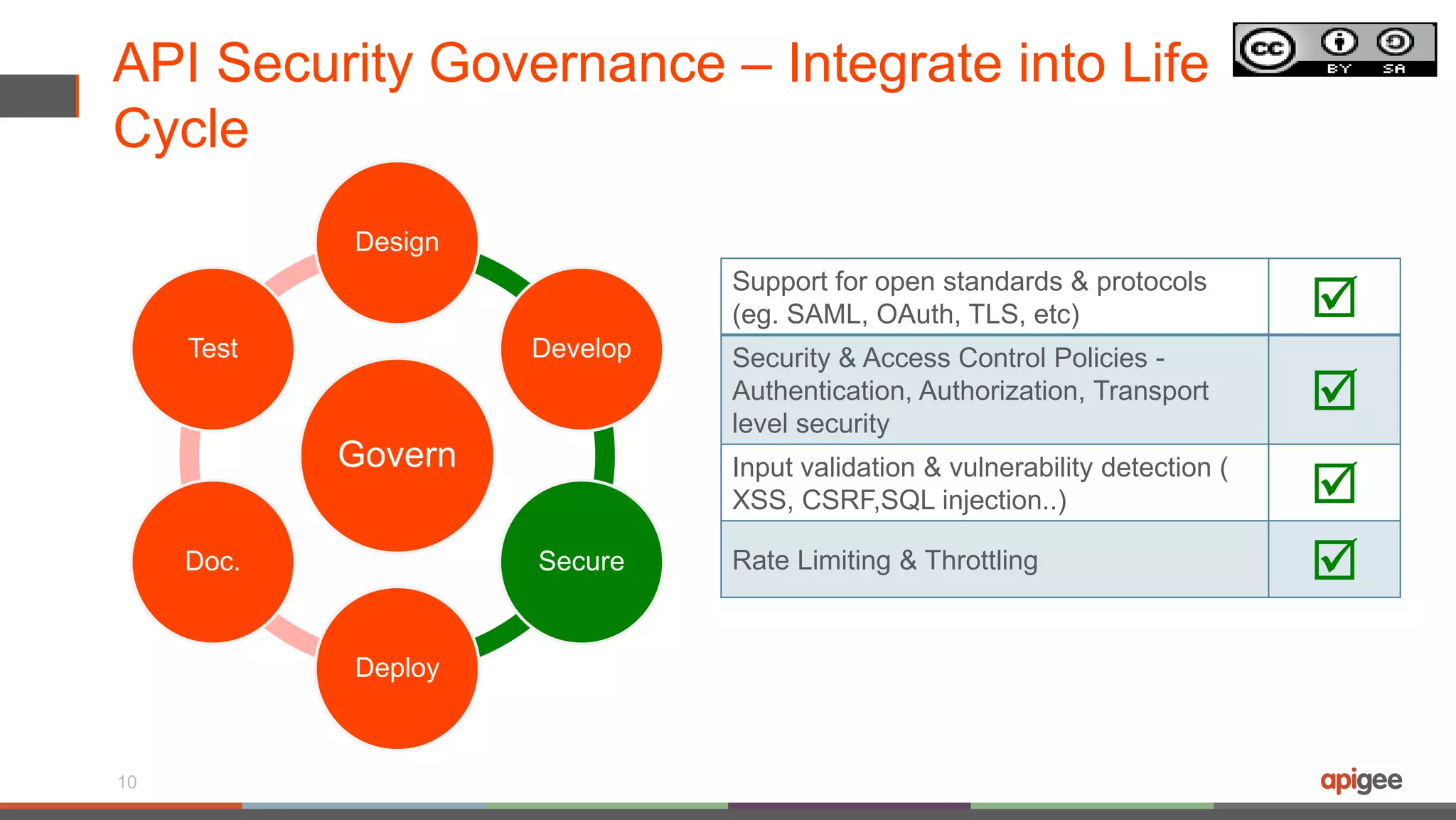
API Security Governance – Integrate into Life
Cycle
Govern
Design
Develop
Secure
Deploy
Doc.
Test
10
Support for open standards & protocols
(eg. SAML, OAuth, TLS, etc) 
Security & Access Control Policies -
Authentication, Authorization, Transport
level security

Input validation & vulnerability detection (
XSS, CSRF,SQL injection..) 
Rate Limiting & Throttling 
Launching an API Platform for a regulated
company
{
“Jason Kobus”: {
“role”: “Director API Banking / Fintech Integration”,
“company”: “Silicon Valley Bank”,
“credentials”: {“current”: [“CSPO”, “CISSP”, “CISA”]}, {“former”: [“CIA”, “CISM”, “CIPP, “Series 7”, “PMP”, “ISO 27001 LI”]},
“mission”: “Deliver secure financial APIs to make clients happy and extend reach / increase revenue”
}
}
September 29, 2015
DISCLAIMER: The content on this site, and comments made during the presentation, are my own and don't necessarily represent the positions,
strategies, or opinions of Silicon Valley Bank.
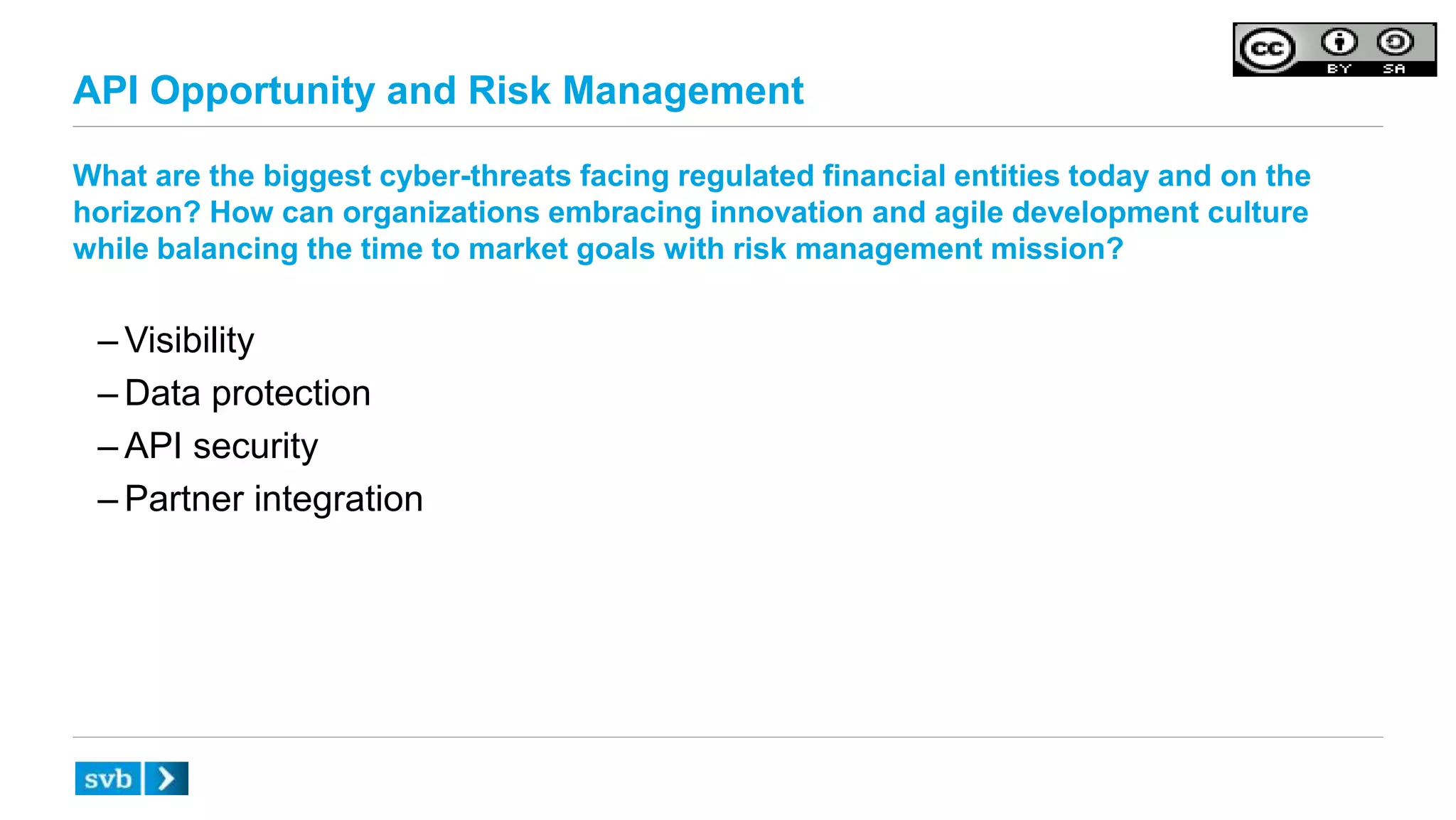
API Opportunity and Risk Management
What are the biggest cyber-threats facing regulated financial entities today and on the
horizon? How can organizations embracing innovation and agile development culture
while balancing the time to market goals with risk management mission?
– Visibility
– Data protection
– API security
– Partner integration
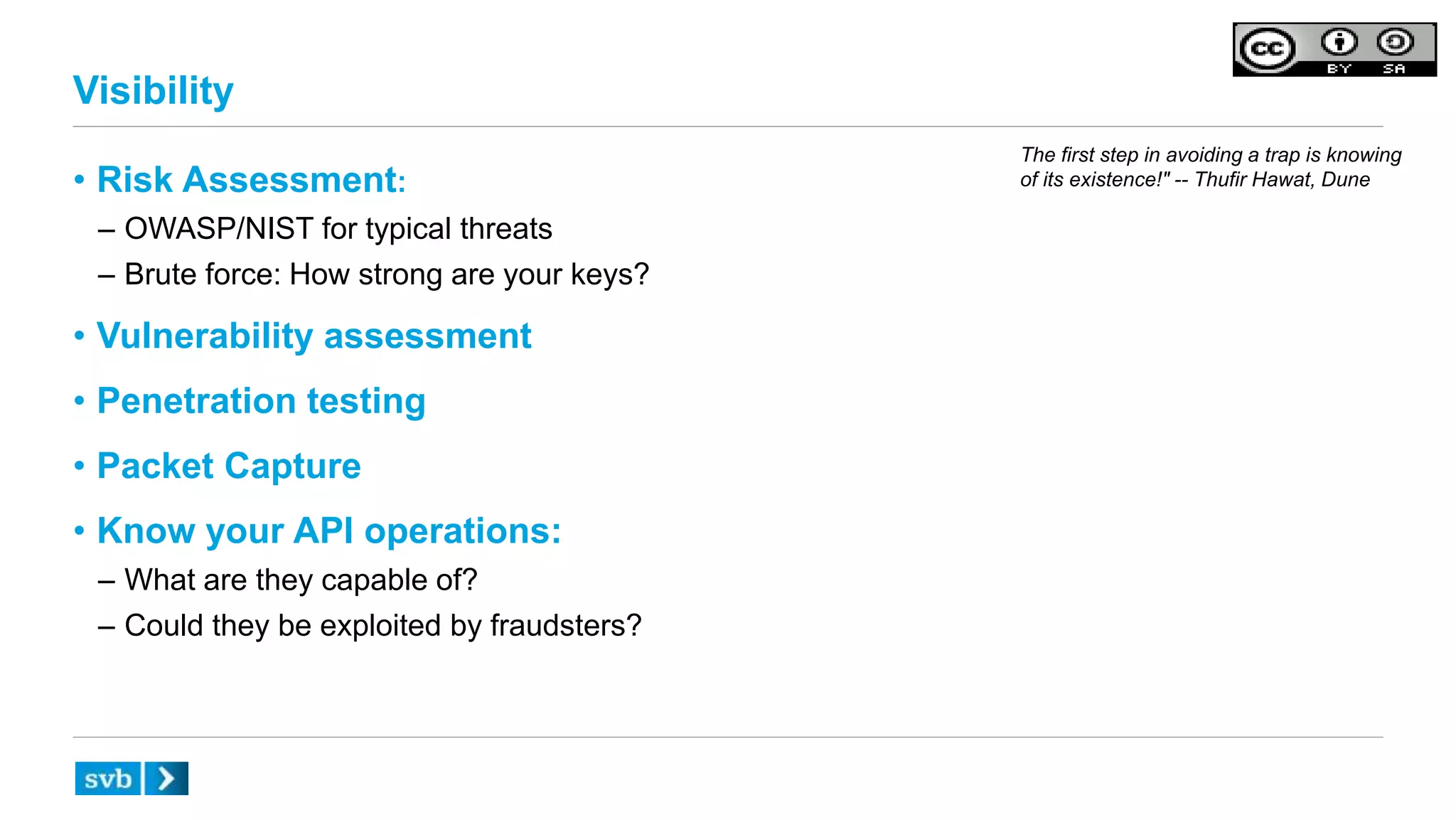
Visibility
• Risk Assessment:
– OWASP/NIST for typical threats
– Brute force: How strong are your keys?
• Vulnerability assessment
• Penetration testing
• Packet Capture
• Know your API operations:
– What are they capable of?
– Could they be exploited by fraudsters?
The first step in avoiding a trap is knowing
of its existence!" -- Thufir Hawat, Dune
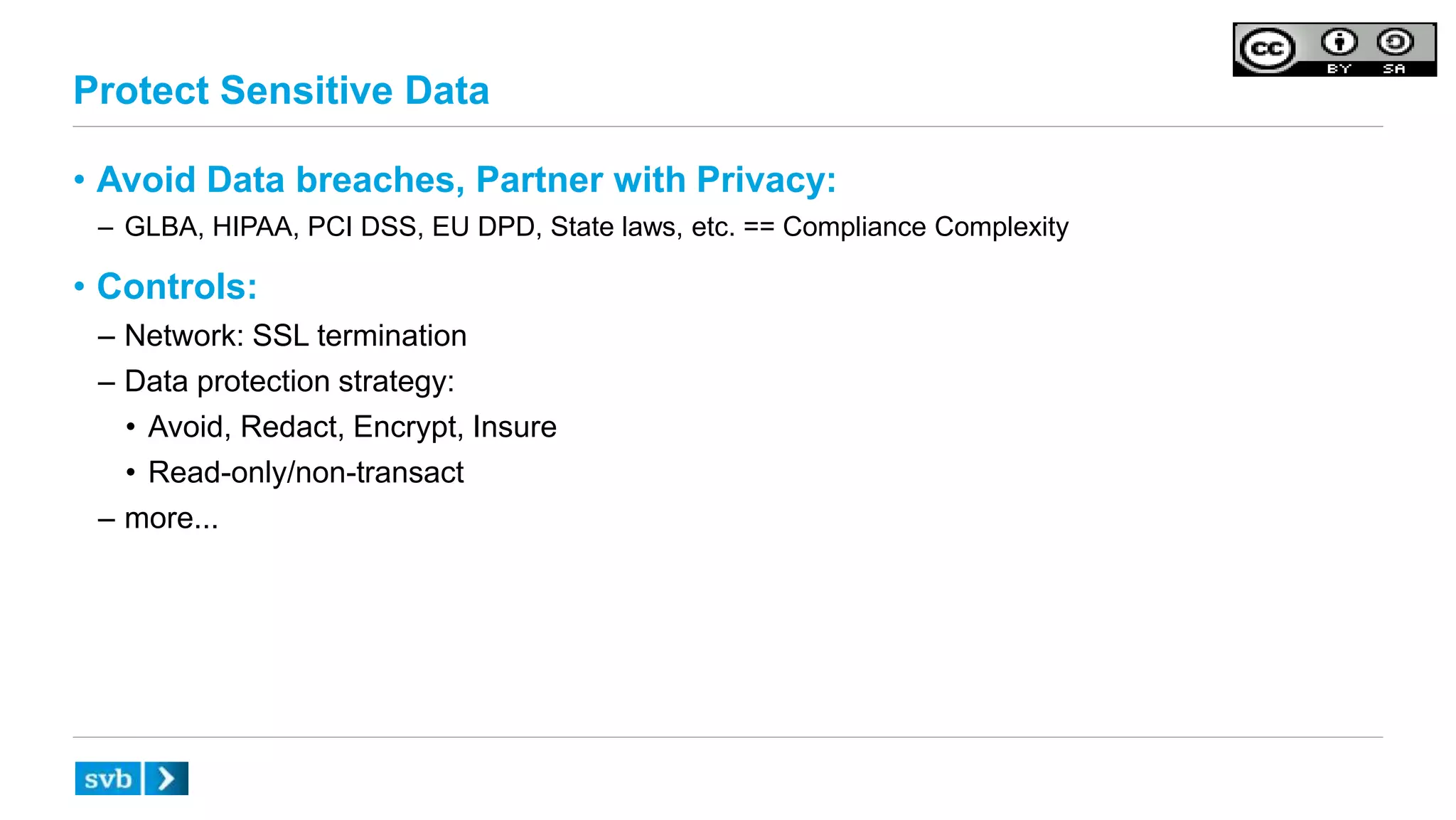
Protect Sensitive Data
• Avoid Data breaches, Partner with Privacy:
– GLBA, HIPAA, PCI DSS, EU DPD, State laws, etc. == Compliance Complexity
• Controls:
– Network: SSL termination
– Data protection strategy:
• Avoid, Redact, Encrypt, Insure
• Read-only/non-transact
– more...
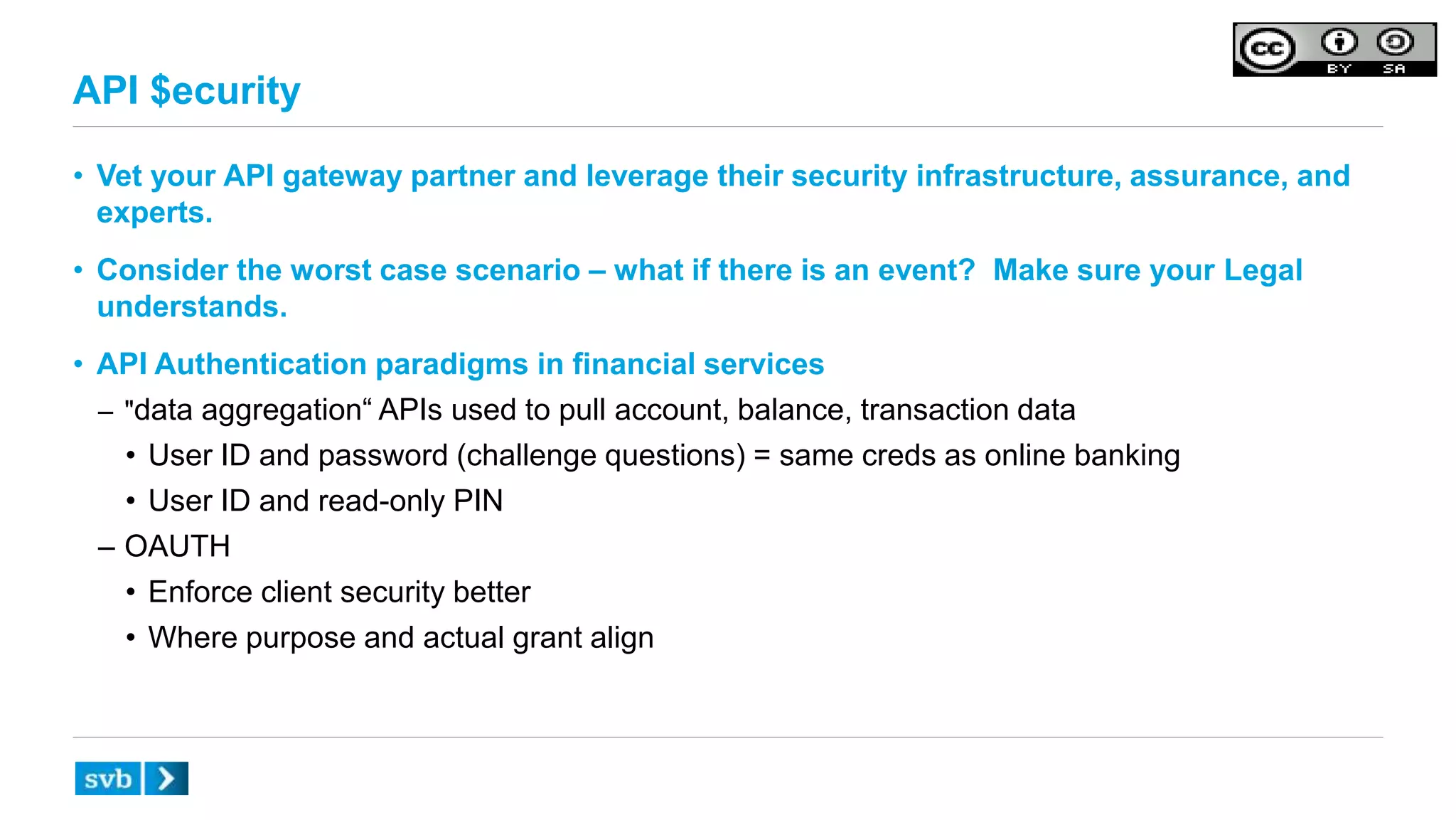
API $ecurity
• Vet your API gateway partner and leverage their security infrastructure, assurance, and
experts.
• Consider the worst case scenario – what if there is an event? Make sure your Legal
understands.
• API Authentication paradigms in financial services
– "data aggregation“ APIs used to pull account, balance, transaction data
• User ID and password (challenge questions) = same creds as online banking
• User ID and read-only PIN
– OAUTH
• Enforce client security better
• Where purpose and actual grant align
Partner Integration
• How to “Trust” your API partners:
– Good vendor management – financials / SOC-2
– Data sharing agreements
– Work with partners to ensure end users get clear and unambiguous notice
to customers before they authorize the access
UK report "Data sharing and open data in banking":
https://www.gov.uk/government/uploads/system/uploads/attachment_data/file/413766/PU1793_Open_data_re
sponse.pdf
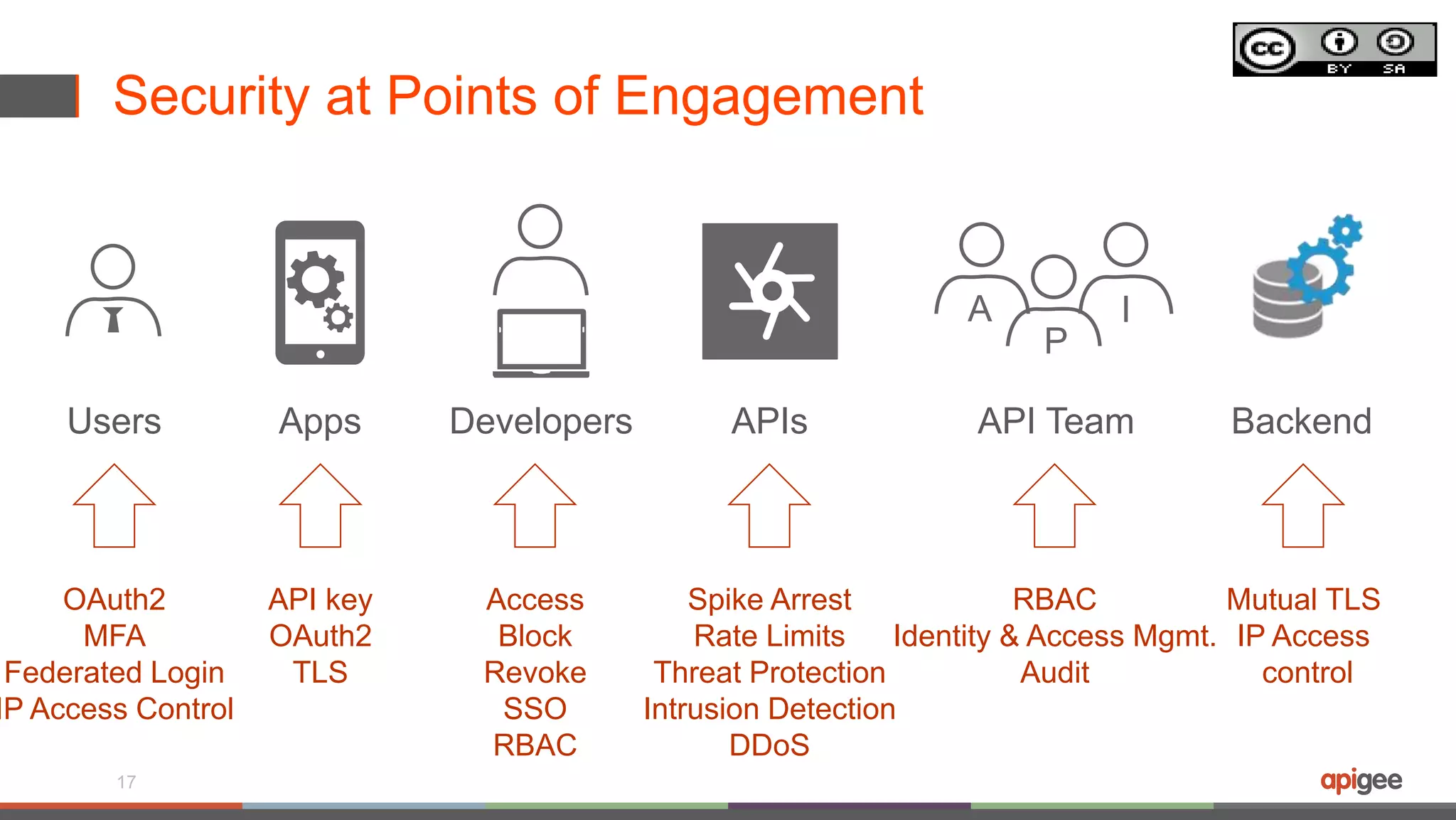
Security at Points of Engagement
17
P
A I
Users Apps Developers APIs API Team Backend
Mutual TLS
IP Access
control
RBAC
Identity & Access Mgmt.
Audit
Spike Arrest
Rate Limits
Threat Protection
Intrusion Detection
DDoS
Access
Block
Revoke
SSO
RBAC
API key
OAuth2
TLS
OAuth2
MFA
Federated Login
IP Access Control
Key Takeaways
• Follow API Threat Model and build API security into your API
products
• Ensure identity and security controls at every points of API
lifecycle and integrate best practice into SDLC
• Gain visibility into API security risks, data sensitivity prior to
deployment
• Protect sensitive data – In transit and at rest
• Layered Protection is key
18
Thank you

Deep-Dive: API Security in the Digital Age

  • 1.
    API Security inthe Digital Age Subra Kumaraswamy, Apigee & Jason Kobus, Silicon Valley Bank
  • 2.
  • 3.
  • 4.
  • 5.
    Agenda • API Security101 • Launching an API Platform for a regulated company • Key Takeaways 5
  • 6.
    Apigee Managemen t Develope r API Team Enterprise SecurityRequirements 6 API Threat Protection IT Security Developer friendly security features – Secure SDLC Threat protection by configuration Identity and fine granular access control Security for App and API Developers Security by global policies – Separation of Duties Security automation enabled by APIs End-to-End security – In Rest and Transit OOB features for security and compliance management End-to-End Security User Apigee Run-time App/Devi ce Backend
  • 7.
    API Security Stakeholders 7 ProductManager How can I release features with built-in security? How I can reduce the release cycle? Business owner How to reduce risk while expanding API exposure? How to meet compliance? Ops How do I enforce consistent security policy across APIs? What controls I have to mitigate attacks like DoS? API Developer What options I have to secure data in rest and transit? How can I securely manage keys? Security & Privacy Team How do I manage the PII life cycle of data exposed via APIs How do I govern APIs exposed to internal and external developers?
  • 8.
    The risk mustbe mitigated on several layers 8 Application Architecture (user and data mgmt) Application Topology (zoning, protocols, …) Operating System security (access control, patches, …) Network security (firewall, topology, filtering, …) API Security (auth* and backend sheltering) Auditing, Monitoring, Processes (Data center, Development, Deployment) Scope of API Security Deployment
  • 9.
    Threat Modeling andAPI/infrastructure Design • Your APIs are vulnerable to the typical Web application security attacks – Think OWASP Top 10 attacks • In addition you have to worry about: – API abuse via API key theft – Hackers reverse engineering Apps to access private APIs – Traffic spike protection by way of Bots or DoS attacks – Identity tracking across API sessions – XML/JSON injection type attacks – Token harvesting due to insecure communication or storage 9
  • 10.
    API Security Governance– Integrate into Life Cycle Govern Design Develop Secure Deploy Doc. Test 10 Support for open standards & protocols (eg. SAML, OAuth, TLS, etc)  Security & Access Control Policies - Authentication, Authorization, Transport level security  Input validation & vulnerability detection ( XSS, CSRF,SQL injection..)  Rate Limiting & Throttling 
  • 11.
    Launching an APIPlatform for a regulated company { “Jason Kobus”: { “role”: “Director API Banking / Fintech Integration”, “company”: “Silicon Valley Bank”, “credentials”: {“current”: [“CSPO”, “CISSP”, “CISA”]}, {“former”: [“CIA”, “CISM”, “CIPP, “Series 7”, “PMP”, “ISO 27001 LI”]}, “mission”: “Deliver secure financial APIs to make clients happy and extend reach / increase revenue” } } September 29, 2015 DISCLAIMER: The content on this site, and comments made during the presentation, are my own and don't necessarily represent the positions, strategies, or opinions of Silicon Valley Bank.
  • 12.
    API Opportunity andRisk Management What are the biggest cyber-threats facing regulated financial entities today and on the horizon? How can organizations embracing innovation and agile development culture while balancing the time to market goals with risk management mission? – Visibility – Data protection – API security – Partner integration
  • 13.
    Visibility • Risk Assessment: –OWASP/NIST for typical threats – Brute force: How strong are your keys? • Vulnerability assessment • Penetration testing • Packet Capture • Know your API operations: – What are they capable of? – Could they be exploited by fraudsters? The first step in avoiding a trap is knowing of its existence!" -- Thufir Hawat, Dune
  • 14.
    Protect Sensitive Data •Avoid Data breaches, Partner with Privacy: – GLBA, HIPAA, PCI DSS, EU DPD, State laws, etc. == Compliance Complexity • Controls: – Network: SSL termination – Data protection strategy: • Avoid, Redact, Encrypt, Insure • Read-only/non-transact – more...
  • 15.
    API $ecurity • Vetyour API gateway partner and leverage their security infrastructure, assurance, and experts. • Consider the worst case scenario – what if there is an event? Make sure your Legal understands. • API Authentication paradigms in financial services – "data aggregation“ APIs used to pull account, balance, transaction data • User ID and password (challenge questions) = same creds as online banking • User ID and read-only PIN – OAUTH • Enforce client security better • Where purpose and actual grant align
  • 16.
    Partner Integration • Howto “Trust” your API partners: – Good vendor management – financials / SOC-2 – Data sharing agreements – Work with partners to ensure end users get clear and unambiguous notice to customers before they authorize the access UK report "Data sharing and open data in banking": https://www.gov.uk/government/uploads/system/uploads/attachment_data/file/413766/PU1793_Open_data_re sponse.pdf
  • 17.
    Security at Pointsof Engagement 17 P A I Users Apps Developers APIs API Team Backend Mutual TLS IP Access control RBAC Identity & Access Mgmt. Audit Spike Arrest Rate Limits Threat Protection Intrusion Detection DDoS Access Block Revoke SSO RBAC API key OAuth2 TLS OAuth2 MFA Federated Login IP Access Control
  • 18.
    Key Takeaways • FollowAPI Threat Model and build API security into your API products • Ensure identity and security controls at every points of API lifecycle and integrate best practice into SDLC • Gain visibility into API security risks, data sensitivity prior to deployment • Protect sensitive data – In transit and at rest • Layered Protection is key 18
  • 19.

Editor's Notes

  • #3 Presenter: Numerous videos about APIs on our YouTube channel
  • #4 Presenter: Numerous presentations about APIs available on SlideShare
  • #5 Presenter: - Subra – ‘Tell our audience’ something about your background / experience, and your role here at Apigee -
  • #8 Main Points: Turning insight into action Sequential Story: Now What is (D) or What will be (U): U Analytical or Emotional connection: A Script: A cross functional API team has information needs relative to each role. API product managers are looking to understand program adoption and how API use can be improved. Business owners want to understand where to invest and how the program is effecting bottom line revenue. Operations needs to monitor the health and operation of the APIs as they are used by apps and developers Lastly app developers need to know how their apps are performing, the impact of the API on the app and what changes might help them. ISO New England is an independent, not-for-profit corporation responsible for keeping electricity flowing across the six New England states and ensuring that the region has reliable, competitively priced wholesale electricity. They are responsible for high voltage grid operation, whole sale energy market administration, and power system planning. For them, understanding where ISO is using analytics virtual dimensions which use analytics intelligence to derive ‘city’ to view by city where their API traffic is originating from. ISO To Go App that puts real-time wholesale electricity pricing and power grid information in the the hands of decision makers We did not have the ability to do so in analytics and gave them the usual run down of our geo-map feature. The day after this discussion, we announced the "virtual dimensions" feature which brought with it the native ability to run reports by city. Get the idea? Background Info: Apigee
  • #18 Traditional security model is based on locking down access to backend systems But, in the world of APIs, those backend systems have to be available all the time. So, instead of blocking access to internal systems, API security must: Protect the endpoints and all points of engagement along the value chain Integrate with existing corporate security standards and systems