CLOUD COMPUTING


KRISHNENDU ROY
SUBHADIP MONDAL
SWARNENDU MUKHERJEE
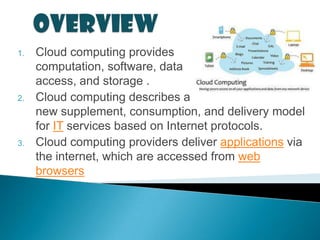
1.   Cloud computing provides
     computation, software, data
     access, and storage .
2.   Cloud computing describes a
     new supplement, consumption, and delivery model
     for IT services based on Internet protocols.
3.   Cloud computing providers deliver applications via
     the internet, which are accessed from web
     browsers
   Massive, abstracted infrastructure
    ◦ Components decided for you
   Dynamic allocation, scaling, movement of
    applications
   Pay per use
   No long-term commitments
   OS, application architecture independent
   No hardware or software to install
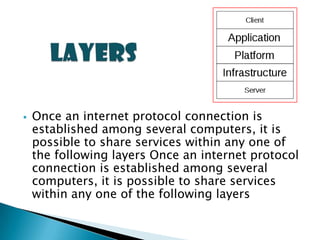
   Once an internet protocol connection is
    established among several computers, it is
    possible to share services within any one of
    the following layers Once an internet protocol
    connection is established among several
    computers, it is possible to share services
    within any one of the following layers
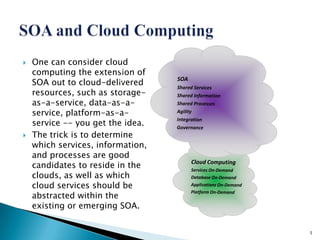
   One can consider cloud
    computing the extension of
    SOA out to cloud-delivered
    resources, such as storage-
    as-a-service, data-as-a-
    service, platform-as-a-
    service -- you get the idea.
   The trick is to determine
    which services, information,
    and processes are good
    candidates to reside in the
    clouds, as well as which
    cloud services should be
    abstracted within the
    existing or emerging SOA.


                                   5
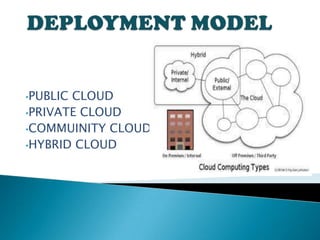
•PUBLICCLOUD
•PRIVATE CLOUD
•COMMUINITY CLOUD
•HYBRID CLOUD
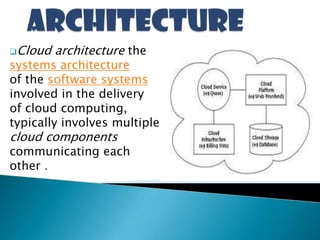
Cloud   architecture the
systems architecture
of the software systems
involved in the delivery
of cloud computing,
typically involves multiple
cloud components
communicating each
other .
   Startups
    ◦ Web-based business, SaaS, collaboration services,
      widget providers, mobile services, social
      networking
   Small businesses
    ◦ Online businesses, online presence, collaboration,
      enterprise integration
   Enterprises
    ◦ R&D projects, quick promotions, widgets, online
      collaboration, partner integration, social
      networking, new business ventures
   Reduced Cost
    Cloud technology is paid incrementally, saving
    organizations money.

   Increased Storage
    Organizations can store more data than on private
    computer systems.
   Highly Automated
    No longer do IT personnel need to worry about
    keeping software up to date.
   Flexibility
    Cloud computing offers much more flexibility than
    past computing methods.
   More Mobility
    Employees can access information wherever they
    are, rather than having to remain at their desks.
1.   Privacy
2.   Compliance
3.   Legal
4.   Open source
5.   Open standards
6.   Security
7.    Sustainability
   When the processes, applications, and data are
    largely independent.
   When the points of integration are well defined.
   When a lower level of security will work just
    fine.
   When the core internal enterprise architecture
    is healthy.
   When the Web is the desired platform.
   When cost is an issue.
   When the applications are new.


                                                       11
   When the processes, applications, and data are
    largely coupled.
   When the points of integration are not well
    defined.
   When a high level of security is required.
   When the core internal enterprise architecture
    needs work.
   When the application requires a native
    interface.
   When cost is an issue.
   When the application is legacy.


                                                     12
Cloud  computing is the delivery of computing as
a service rather than a product.
As cloud computing is achieving increased
popularity, concerns are being voiced about the
security issues
Many universities, vendors and government
organisations are investing in research around the
topic of cloud computing:[91]
Cloud.ppt

Cloud.ppt

  • 1.
    CLOUD COMPUTING KRISHNENDU ROY SUBHADIPMONDAL SWARNENDU MUKHERJEE
  • 2.
    1. Cloud computing provides computation, software, data access, and storage . 2. Cloud computing describes a new supplement, consumption, and delivery model for IT services based on Internet protocols. 3. Cloud computing providers deliver applications via the internet, which are accessed from web browsers
  • 3.
    Massive, abstracted infrastructure ◦ Components decided for you  Dynamic allocation, scaling, movement of applications  Pay per use  No long-term commitments  OS, application architecture independent  No hardware or software to install
  • 4.
    Once an internet protocol connection is established among several computers, it is possible to share services within any one of the following layers Once an internet protocol connection is established among several computers, it is possible to share services within any one of the following layers
  • 5.
    One can consider cloud computing the extension of SOA out to cloud-delivered resources, such as storage- as-a-service, data-as-a- service, platform-as-a- service -- you get the idea.  The trick is to determine which services, information, and processes are good candidates to reside in the clouds, as well as which cloud services should be abstracted within the existing or emerging SOA. 5
  • 6.
  • 7.
    Cloud architecture the systems architecture of the software systems involved in the delivery of cloud computing, typically involves multiple cloud components communicating each other .
  • 8.
    Startups ◦ Web-based business, SaaS, collaboration services, widget providers, mobile services, social networking  Small businesses ◦ Online businesses, online presence, collaboration, enterprise integration  Enterprises ◦ R&D projects, quick promotions, widgets, online collaboration, partner integration, social networking, new business ventures
  • 9.
    Reduced Cost Cloud technology is paid incrementally, saving organizations money.  Increased Storage Organizations can store more data than on private computer systems.  Highly Automated No longer do IT personnel need to worry about keeping software up to date.  Flexibility Cloud computing offers much more flexibility than past computing methods.  More Mobility Employees can access information wherever they are, rather than having to remain at their desks.
  • 10.
    1. Privacy 2. Compliance 3. Legal 4. Open source 5. Open standards 6. Security 7. Sustainability
  • 11.
    When the processes, applications, and data are largely independent.  When the points of integration are well defined.  When a lower level of security will work just fine.  When the core internal enterprise architecture is healthy.  When the Web is the desired platform.  When cost is an issue.  When the applications are new. 11
  • 12.
    When the processes, applications, and data are largely coupled.  When the points of integration are not well defined.  When a high level of security is required.  When the core internal enterprise architecture needs work.  When the application requires a native interface.  When cost is an issue.  When the application is legacy. 12
  • 13.
    Cloud computingis the delivery of computing as a service rather than a product. As cloud computing is achieving increased popularity, concerns are being voiced about the security issues Many universities, vendors and government organisations are investing in research around the topic of cloud computing:[91]