1.HISTORY OF CLOUD COMPUTING
2.INTRODUCTION TO CLOUD COMPUTING
3.TYPES OF CLOUD COMPUTING
4.USES AND EXAMPLES OF CLOUD COMPUTING
5.CHARACTERISTICS OF CLOUD COMPUTING
6.GOALS OF CLOUD COMPUTING
7.ADVANTAGE OF CLOUD COMPUTING
8.DISADVANTAGES OF CLOUD COMPUTING
9.SKILLS REQUIRED TO DEVELOP CLOUD COMPUTING
10.CLOUD COMPUTING CAREER
11.CONCLUSION AND REFERENCES
History of cloud computing
At around in 1961, John Macchary, it was suggested in a speech at MIT that computing can be sold
like a utility, just like a water or electricity. It was a brilliant idea, but like all brilliant ideas, it was
ahead if its time, as for the next few decades, despite interest in the model, the technology simply
was not ready for it.
But of course time has passed and the technology caught that idea and after few years we
mentioned that:
In 1999, salesforce.com started delivering of applications to users using a simple websites. The
applications were delivered to enterprises over the internet, and this way the dream of computing
sold as utility were true.
In 2002, Amazon started Amazon Web Services, providing services like storage, computation and
even human intelligence. However, only starting with launch of the elastic compute cloud in 2006 a
truly commercial service open to everybody existed.
In 2009, Google Apps also started to provide cloud computing enterprise applications.
In 2009, Microsoft launched windows azure, and companies like oracle and HP have all joined the
game. This proves that today, cloud computing has become mainstream..
INTRODUCTION
• IN 21st Century, cloud computing is one of the most
demanding skill in this world in the field of IT sector.
• The practice of using a network of remote servers hosted
on the internet to store, manage, process data ,rather than
a local server or a personal computer is known as cloud
computing.
• In other words, It means computing through the delivery
of services and resources using the internet as a medium.
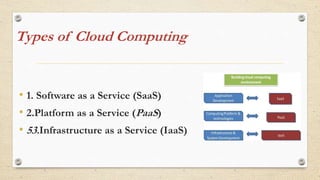
Types of Cloud Computing
• 1. Software as a Service (SaaS)
• 2.Platform as a Service (PaaS)
• 53.Infrastructure as a Service (IaaS)
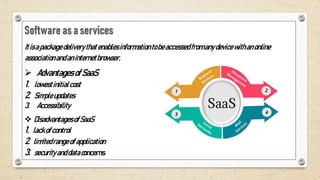
Itisapackagedeliverythatenablesinformationtobeaccessedfromanydevicewithanonline
associationandaninternetbrowser.
 AdvantagesofSaaS
1. lowestinitialcost
2. Simpleupdates
3. Accessibility
 DisadvantagesofSaaS
1. lackofcontrol
2. limitedrangeofapplication
3. securityanddataconcerns
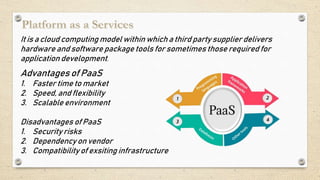
It is a cloud computing model within which a third party supplier delivers
hardware and software package tools for sometimes those required for
application development.
Advantages of PaaS
1. Faster time to market
2. Speed, and flexibility
3. Scalable environment
Disadvantages of PaaS
1. Security risks
2. Dependency on vendor
3. Compatibility of exsiting infrastructure
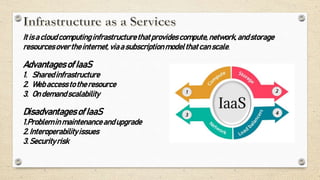
It isa cloudcomputinginfrastructurethatprovidescompute,network,andstorage
resourcesovertheinternet,viaa subscriptionmodelthatcanscale.
Advantagesof IaaS
1. Sharedinfrastructure
2. Webaccessto theresource
3. Ondemandscalability
Disadvantagesof IaaS
1.Probleminmaintenanceandupgrade
2.Interoperabilityissues
3.Securityrisk
Uses of Cloud Computing
 E-Learning
 E-governance
 File storage
 Disaster recovery
 Resolve downtime problem
 Test and development
Examples of Cloud Computing
 Microsoft Azure
 Google cloud
 Dropbox
 Public cloud
 Google drive
 Zoom
 Ondemandselfservices
Thecloudcomputingservicesdoesnotrequireanyhumanadministration,monitorandmanagecomputingresourcesas
needed.
Broadnetworkaccess
Thecomputingservicesaregenerallyprovidedoverstandardnetworksandheterogeneousdevices.
Rapidelasticity
ThecomputerservicesshouldhaveITresourcesthatareabletoscaleoutandinquicklyandonasneededbasisofusers.
Multi-tenancy
Cloudcomputingproviderscansupportmultiple tenentsonasinglesetofsharedresources.
Security
Cloudprovidersinvestheavilyinsecuritymeasurestoprotecttheirusersdataandensuretheprivacyofsensitive
information.
Goals of Cloud Computing
 Reduced spending on technology infrastructure
Moving to cloud computing may reduce the cost of managing and maintaining your IT
systems. Rather than purchasing expensive systems and equipment for your business,
you can reduce your costs by using the resources of your cloud computing service
provider.
 Globalizing workspace
Globalizing your workspace or system may add additional agility and effectiveness to your
system. For example, you have the ability to access data from home, on holiday, or via
the commute to and from work.
 Better resource utilization
Using technologies such as virtualization and distributed computing, computing resources
can be used fully up to their potentials.
 Backup and disaster recovery
Since all your data is stored in the cloud, backing it up and restoring the same is
relatively much easier than storing the same on a physical device.
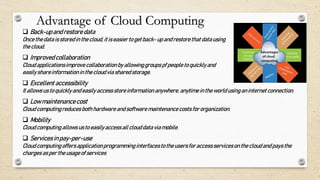
Advantage of Cloud Computing
 Back-upandrestoredata
Once thedataisstored inthe cloud, itiseasierto getback-up and restore thatdatausing
thecloud.
 Improvedcollaboration
Cloud applicationsimprove collaboration by allowinggroups pf peopleto quicklyand
easilyshareinformationinthe cloudviasharedstorage.
 Excellent accessibility
Itallowsus to quicklyandeasilyaccessstore information anywhere, anytimeinthe world usinganinternetconnection.
 Lowmaintenancecost
Cloud computingreducesboth hardware and softwaremaintenancecosts for organization.
 Mobility
Cloud computingallows usto easilyaccessallcloud dataviamobile.
 Servicesinpay-per-use
Cloud computingoffers applicationprogramming interfacesto theusersfor accessserviceson the cloudand pays the
chargesasper theusageof services
 Unlimited storage capacity
Cloud offers us a huge amount of storing capacity for storing our important data such as
documents, images, audio, video, etc. in one place
 Data security
It is one of the biggest advantages of cloud computing. Cloud offers many advanced
features related to security
and ensures that data is securely stored and handled
 Internetconnectivity
Incloudcomputing, everydata isstoredonthecloud,andweaccessthesedata through thecloudbyusingtheinternetconnection.ifyou do
nothavegoodinternetconnection,you cannotaccessthesedata.
 Vendorlock-in
Vendorlock-inisthebiggest disadvantage ofcloudcomputing.Organizations mayfaceproblemswhentransferringtheirservices fromone
vendortoanother.Asdifferentvendorsprovide differentplatforms, thatcancausedifficultymovingfromonecloudto another.
 Limitedcontrol
Asweknow, cloudinfrastructureis completelyowned,managedandmonitoredbytheserviceprovider, sothecloudusershave lesscontrol
overthefunctionandexecution ofserviceswithin acloudinfrastructure.
 Security
Although cloudserviceproviders implementthebestsecuritystandards to storeimportant information.Butwhilesendingthe data onthe
cloud,theremaybeachancethat yourorganizations information is hackedbyhackers.
Skills Required To Build Career In Cloud Computing
1. Database skills
Invest in learning a database querying language and database platform. Learning
languages like MySQL and Hadoop can be really helpful.
2.Programming skills
Proficiency in programming languages like Php, Java, .NET are essential.
Programming languages such as Python and Ruby are also in demand.
3.Linux
It is an open- source operating system and can be used to build technologies
without going through the hassles of permission. Cloud engineering who can
architect, administer, and maintain linux-based servers are increasing.
4.Networking skills
Network integration with cloud services is essential. Cloud networking fundamentals are a must in cloud
computing. Knowledge of virtual networks and focus on making the process easier for end-users is
necessary
5.Cloud services providers
To thrive in the cloud domain, an understanding offering of cloud service providers is essential. Familiarize
with cloud services such as AWS, Microsoft Azure, and OpenStack.
6.Web Services and APLs
cloud architects work on the foundation of APLs and web services. Open web services such as XML,
SOAP, UDDI, and WSDI are used to tag, transfer, and describe data. APLs complete and deploy the
integration on the respective platforms.
7.Information security
Organizations are placing more emphasis on protecting data and applications. Tracking the current security
state and adopting preventive measures are important in cloud computing. Learning cybersecurity and
earning a credential will give you an edge.
Cloud computing career
Cloud computing has become one of the fastest-growing fields in the tech industry, offering a wide
range of career opportunities. Some of the top cloud computing careers are as below:-
 Cloud architect
Cloud architects design and implement cloud computing solutions for organizations.
 Cloud engineer
Cloud engineers are responsible for deploying, managing, and supporting cloud-based infrastructures and
services.
 Cloud consultants
Cloud consultants work with clients to plan and implement cloud strategies.
 UI developer
UI developers specialize in building the user interface of web applications.
Cloud computing will affect large part of computer industry including software companies,
internet service providers. Cloud computing makes it very easy for companies to provide
their products to end-user without worrying about hardware configurations and other
requirements of servers. The cloud computing and virtualization are distinguished by the
fact that all of the control plane activities that center around creation, management, and
maintenance of the virtual environment, are outsourced to an automated layer that is called
as an APLs.
1. Cloudcomputing:Concepts,andTechnologybyThomasEri
2. Cloudcomputing:AhandsonapproachbyArshdeepBaghaandVijayMadisetti
cloud computing

cloud computing

  • 2.
    1.HISTORY OF CLOUDCOMPUTING 2.INTRODUCTION TO CLOUD COMPUTING 3.TYPES OF CLOUD COMPUTING 4.USES AND EXAMPLES OF CLOUD COMPUTING 5.CHARACTERISTICS OF CLOUD COMPUTING 6.GOALS OF CLOUD COMPUTING 7.ADVANTAGE OF CLOUD COMPUTING 8.DISADVANTAGES OF CLOUD COMPUTING 9.SKILLS REQUIRED TO DEVELOP CLOUD COMPUTING 10.CLOUD COMPUTING CAREER 11.CONCLUSION AND REFERENCES
  • 3.
    History of cloudcomputing At around in 1961, John Macchary, it was suggested in a speech at MIT that computing can be sold like a utility, just like a water or electricity. It was a brilliant idea, but like all brilliant ideas, it was ahead if its time, as for the next few decades, despite interest in the model, the technology simply was not ready for it. But of course time has passed and the technology caught that idea and after few years we mentioned that: In 1999, salesforce.com started delivering of applications to users using a simple websites. The applications were delivered to enterprises over the internet, and this way the dream of computing sold as utility were true. In 2002, Amazon started Amazon Web Services, providing services like storage, computation and even human intelligence. However, only starting with launch of the elastic compute cloud in 2006 a truly commercial service open to everybody existed. In 2009, Google Apps also started to provide cloud computing enterprise applications. In 2009, Microsoft launched windows azure, and companies like oracle and HP have all joined the game. This proves that today, cloud computing has become mainstream..
  • 4.
    INTRODUCTION • IN 21stCentury, cloud computing is one of the most demanding skill in this world in the field of IT sector. • The practice of using a network of remote servers hosted on the internet to store, manage, process data ,rather than a local server or a personal computer is known as cloud computing. • In other words, It means computing through the delivery of services and resources using the internet as a medium.
  • 5.
    Types of CloudComputing • 1. Software as a Service (SaaS) • 2.Platform as a Service (PaaS) • 53.Infrastructure as a Service (IaaS)
  • 6.
    Itisapackagedeliverythatenablesinformationtobeaccessedfromanydevicewithanonline associationandaninternetbrowser.  AdvantagesofSaaS 1. lowestinitialcost 2.Simpleupdates 3. Accessibility  DisadvantagesofSaaS 1. lackofcontrol 2. limitedrangeofapplication 3. securityanddataconcerns
  • 7.
    It is acloud computing model within which a third party supplier delivers hardware and software package tools for sometimes those required for application development. Advantages of PaaS 1. Faster time to market 2. Speed, and flexibility 3. Scalable environment Disadvantages of PaaS 1. Security risks 2. Dependency on vendor 3. Compatibility of exsiting infrastructure
  • 8.
    It isa cloudcomputinginfrastructurethatprovidescompute,network,andstorage resourcesovertheinternet,viaasubscriptionmodelthatcanscale. Advantagesof IaaS 1. Sharedinfrastructure 2. Webaccessto theresource 3. Ondemandscalability Disadvantagesof IaaS 1.Probleminmaintenanceandupgrade 2.Interoperabilityissues 3.Securityrisk
  • 9.
    Uses of CloudComputing  E-Learning  E-governance  File storage  Disaster recovery  Resolve downtime problem  Test and development Examples of Cloud Computing  Microsoft Azure  Google cloud  Dropbox  Public cloud  Google drive  Zoom
  • 10.
  • 11.
    Goals of CloudComputing  Reduced spending on technology infrastructure Moving to cloud computing may reduce the cost of managing and maintaining your IT systems. Rather than purchasing expensive systems and equipment for your business, you can reduce your costs by using the resources of your cloud computing service provider.  Globalizing workspace Globalizing your workspace or system may add additional agility and effectiveness to your system. For example, you have the ability to access data from home, on holiday, or via the commute to and from work.  Better resource utilization Using technologies such as virtualization and distributed computing, computing resources can be used fully up to their potentials.  Backup and disaster recovery Since all your data is stored in the cloud, backing it up and restoring the same is relatively much easier than storing the same on a physical device.
  • 12.
    Advantage of CloudComputing  Back-upandrestoredata Once thedataisstored inthe cloud, itiseasierto getback-up and restore thatdatausing thecloud.  Improvedcollaboration Cloud applicationsimprove collaboration by allowinggroups pf peopleto quicklyand easilyshareinformationinthe cloudviasharedstorage.  Excellent accessibility Itallowsus to quicklyandeasilyaccessstore information anywhere, anytimeinthe world usinganinternetconnection.  Lowmaintenancecost Cloud computingreducesboth hardware and softwaremaintenancecosts for organization.  Mobility Cloud computingallows usto easilyaccessallcloud dataviamobile.  Servicesinpay-per-use Cloud computingoffers applicationprogramming interfacesto theusersfor accessserviceson the cloudand pays the chargesasper theusageof services
  • 13.
     Unlimited storagecapacity Cloud offers us a huge amount of storing capacity for storing our important data such as documents, images, audio, video, etc. in one place  Data security It is one of the biggest advantages of cloud computing. Cloud offers many advanced features related to security and ensures that data is securely stored and handled
  • 14.
     Internetconnectivity Incloudcomputing, everydataisstoredonthecloud,andweaccessthesedata through thecloudbyusingtheinternetconnection.ifyou do nothavegoodinternetconnection,you cannotaccessthesedata.  Vendorlock-in Vendorlock-inisthebiggest disadvantage ofcloudcomputing.Organizations mayfaceproblemswhentransferringtheirservices fromone vendortoanother.Asdifferentvendorsprovide differentplatforms, thatcancausedifficultymovingfromonecloudto another.  Limitedcontrol Asweknow, cloudinfrastructureis completelyowned,managedandmonitoredbytheserviceprovider, sothecloudusershave lesscontrol overthefunctionandexecution ofserviceswithin acloudinfrastructure.  Security Although cloudserviceproviders implementthebestsecuritystandards to storeimportant information.Butwhilesendingthe data onthe cloud,theremaybeachancethat yourorganizations information is hackedbyhackers.
  • 15.
    Skills Required ToBuild Career In Cloud Computing 1. Database skills Invest in learning a database querying language and database platform. Learning languages like MySQL and Hadoop can be really helpful. 2.Programming skills Proficiency in programming languages like Php, Java, .NET are essential. Programming languages such as Python and Ruby are also in demand. 3.Linux It is an open- source operating system and can be used to build technologies without going through the hassles of permission. Cloud engineering who can architect, administer, and maintain linux-based servers are increasing.
  • 16.
    4.Networking skills Network integrationwith cloud services is essential. Cloud networking fundamentals are a must in cloud computing. Knowledge of virtual networks and focus on making the process easier for end-users is necessary 5.Cloud services providers To thrive in the cloud domain, an understanding offering of cloud service providers is essential. Familiarize with cloud services such as AWS, Microsoft Azure, and OpenStack. 6.Web Services and APLs cloud architects work on the foundation of APLs and web services. Open web services such as XML, SOAP, UDDI, and WSDI are used to tag, transfer, and describe data. APLs complete and deploy the integration on the respective platforms. 7.Information security Organizations are placing more emphasis on protecting data and applications. Tracking the current security state and adopting preventive measures are important in cloud computing. Learning cybersecurity and earning a credential will give you an edge.
  • 17.
    Cloud computing career Cloudcomputing has become one of the fastest-growing fields in the tech industry, offering a wide range of career opportunities. Some of the top cloud computing careers are as below:-  Cloud architect Cloud architects design and implement cloud computing solutions for organizations.  Cloud engineer Cloud engineers are responsible for deploying, managing, and supporting cloud-based infrastructures and services.  Cloud consultants Cloud consultants work with clients to plan and implement cloud strategies.  UI developer UI developers specialize in building the user interface of web applications.
  • 18.
    Cloud computing willaffect large part of computer industry including software companies, internet service providers. Cloud computing makes it very easy for companies to provide their products to end-user without worrying about hardware configurations and other requirements of servers. The cloud computing and virtualization are distinguished by the fact that all of the control plane activities that center around creation, management, and maintenance of the virtual environment, are outsourced to an automated layer that is called as an APLs. 1. Cloudcomputing:Concepts,andTechnologybyThomasEri 2. Cloudcomputing:AhandsonapproachbyArshdeepBaghaandVijayMadisetti