Computing in the clouds while
 wearing a good service level
         agreement

               By
       Cade Zvavanjanja
              CISO
  Gainful Information Security
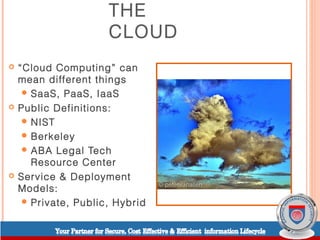
THE
                      CLOUD
   “Cloud Computing” can
    mean different things
      SaaS, PaaS, IaaS
   Public Definitions:
      NIST
      Berkeley
      ABA Legal Tech
       Resource Center
   Service & Deployment
    Models:
      Private, Public, Hybrid
DIFFERENT THAN BOXES
STORED AT IRON
MOUNTAIN?
HOW CLOUD DIFFERS


 Access

 Data  Location
 Greater Custody
  and
  Control
  Differentiation
 Multi-Tenancy
  Capability
CLOUDY QUESTIONS

   Location issues
   Operation issues
   Legislative/Regulatory
    issues
   3rd party contractual
    limitations
   Security/Privacy issues
   Litigation/Investigative
    issues
   Authenticity/Admissibility
    issues
CLOUD:
WHEN BAD THINGS HAPPEN TO GOOD
EVIDENCE

   General Considerations
   Potential Liability for
    Spoliation
      Minimize Risk by
       Addressing Up Front
       the Need to Preserve
       and Produce ESI
   Remedies for Spoliation
HOW DO YOU CONDUCT A
FORENSIC EXAMINATION IN
THE CLOUD?
CLOUD COMPUTING
SERVICE LEVEL AGREEMENT
CONSIDERATIONS
   Use of data/Security
   Location of data
   No change of terms
   Destruction
   Ownership
    (assignment)
   Subpoena response
   Regulatory
    requirements
   Insurance/Indemnity
   Audits
SERVICE LEVEL AGREEMENT
(SLA)
SLA should contain:

   The list of services the provider will deliver and a complete definition
    of each service.
   Metrics to determine whether the provider is delivering the service
    as promised
   Auditing mechanism to monitor the service.
   Responsibilities of the provider and the consumer
   Remedies available to both provider and client if the terms of the
    SLA are not met.
   A description of how the SLA will change over time.
SERVICE LEVEL AGREEMENT
    (SLA)
   Security: Client and CSP must understand security requirements.
   Data encryption: Data must be encrypted while it is in motion and while it is at
    rest. The details of the encryption algorithms and access control policies should
    be specified.
   Privacy: Basic privacy concerns are addressed by requirements such as data
    encryption, retention, and deletion. An SLA should make it clear how the cloud
    provider isolates data and applications in a multi-tenant environment.
   Data retention/deletion: How does CSP prove they comply with retention laws
    and deletion policies?
   Hardware erasure/ destruction: Same as #4.
   Regulatory compliance: If regulations must be enforced because of the type of
    data, CSP must be able to prove compliance.
   Transparency: For critical data and applications CSP must be proactive in
    notifying client when the terms of the SLA are breached including infrastructure
    issues like outages and performance problems as well as security incidents.
(SLA)
   Certification: CSP should be responsible for proving required certification
    and keeping it current.
   Performance definitions: Defining terminology such as uptime and other
    contractual metric terms (i.e. – uptime could mean all servers on continent
    are available or only one designated server is available.)
   Monitoring: Responsible party for monitoring including identification of any
    third-party organization designated to monitor performance of the provider.
   Audit Rights: To monitor for any data breaches including loss of data and
    availability issues. SLA should clarify when and how the audits will take
    place.
   Metrics: to be monitored in real-time and audited after occurence. Metrics of
    an SLA must be objectively and unambiguously defined.
   Human interaction: On-demand self-service is one of the basic
    characteristics of cloud computing, but SLA should provide customer
    service when needed.

    Review and summary of cloud service level agreements, From "Cloud Computing Use Cases
    Whitepaper" Version 4.0,
REALITY – CONTRACT ISSUE
 Currently,  the standard contracts offered by cloud
  computing providers are one-sided and service
  provider-friendly, with little opportunity to change
  terms.
 Few offer meaningful service levels or assume any
  responsibility for legal compliance, security or data
  protection. Many permit suspension of service or
  unilateral termination, and disclaim all or most of the
  provider's potential liability.
 In addition, some cloud computing providers
  emphasize low cost offerings, which leave little room
  for robust contractual commitments or customer
  requirements.
BEFORE YOU GO “TO THE
CLOUD!”
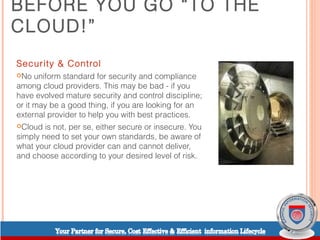
Security & Control
No   uniform standard for security and compliance
among cloud providers. This may be bad - if you
have evolved mature security and control discipline;
or it may be a good thing, if you are looking for an
external provider to help you with best practices.
Cloud  is not, per se, either secure or insecure. You
simply need to set your own standards, be aware of
what your cloud provider can and cannot deliver,
and choose according to your desired level of risk.
BEFORE YOU GO “TO THE
CLOUD!”
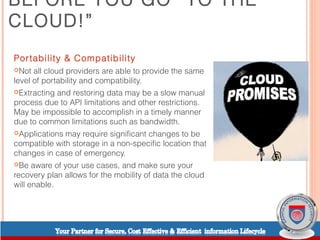
Por tability & Compatibility
Not  all cloud providers are able to provide the same
level of portability and compatibility.
Extractingand restoring data may be a slow manual
process due to API limitations and other restrictions.
May be impossible to accomplish in a timely manner
due to common limitations such as bandwidth.
Applications may require significant changes to be
compatible with storage in a non-specific location that
changes in case of emergency.
Be   aware of your use cases, and make sure your
recovery plan allows for the mobility of data the cloud
will enable.
BEFORE YOU GO “TO THE
CLOUD!”
Longevity & Accessibility
Consider    and verify the longevity of CSP
to ensure data will be accessible when and
how, needed before committing to CSP as
sole source for data recovery.
During an analyst keynote speech at the
2010 CA InfoXchange event in Malaysia,
the speaker estimated that a substantial
number of current cloud providers will be
out of business within 2 years.
CSPs talked about 99.999 per cent
uptime, or the equivalent of five minutes'
downtime per year. This is the Holy Grail of
cloud computing but achieving it requires
multi million-dollar investments in redundant
infrastructure.
BEFORE YOU GO “TO THE
CLOUD!”
Where does your data reside?
 EU Data Privacy Concerns

 Which laws apply, country of origin or country
  where data resides?
ESSENTIAL POWER CONTRACTS TO RETAIN
   Realtime feed from data intrusion detection systems to permit
    monitoring of the security systems performance.

   Performance standards mandating maximum downtime and
    platform stability.

   Auditing rights – access to monitoring dashboard to see metrics
    on function of the system. Also onsite visits to provider.

   Remediation power – including monetary penalties for downtime,
    termination in the event of security violations and notice of any
    breach.
ESSENTIAL CONTRACT POWERS TO
RETAIN
   Freedom to Move – contract must make it clear that the data
    owner retains all ownership of the data as well as access to
    the data. There should be a defined time frame for giving
    back all the data once request has been made as well as
    definition of the format for the data if it is to be moved or
    returned to the client to avoid any additional cost to reformat
    data to be moved to a new provider.

   Preservation of metadata – what metadata will be maintained
    and any impact of the system upon that metadata.

   Access to information for e-discovery – how accessible the
    data will be including time to extract.
Thank You

Tel: +236 733 782 490
     +263 773 796 365
     +263 -4- 733 117

Eml: info@gis.co.zw
   cade@gis.co.zw

Web: www.gis.co.zw

Cloud computing & service level agreements

  • 1.
    Computing in theclouds while wearing a good service level agreement By Cade Zvavanjanja CISO Gainful Information Security
  • 2.
    THE CLOUD  “Cloud Computing” can mean different things  SaaS, PaaS, IaaS  Public Definitions:  NIST  Berkeley  ABA Legal Tech Resource Center  Service & Deployment Models:  Private, Public, Hybrid
  • 3.
    DIFFERENT THAN BOXES STOREDAT IRON MOUNTAIN?
  • 4.
    HOW CLOUD DIFFERS Access  Data Location  Greater Custody and Control Differentiation  Multi-Tenancy Capability
  • 5.
    CLOUDY QUESTIONS  Location issues  Operation issues  Legislative/Regulatory issues  3rd party contractual limitations  Security/Privacy issues  Litigation/Investigative issues  Authenticity/Admissibility issues
  • 6.
    CLOUD: WHEN BAD THINGSHAPPEN TO GOOD EVIDENCE  General Considerations  Potential Liability for Spoliation  Minimize Risk by Addressing Up Front the Need to Preserve and Produce ESI  Remedies for Spoliation
  • 7.
    HOW DO YOUCONDUCT A FORENSIC EXAMINATION IN THE CLOUD?
  • 8.
    CLOUD COMPUTING SERVICE LEVELAGREEMENT CONSIDERATIONS  Use of data/Security  Location of data  No change of terms  Destruction  Ownership (assignment)  Subpoena response  Regulatory requirements  Insurance/Indemnity  Audits
  • 9.
    SERVICE LEVEL AGREEMENT (SLA) SLAshould contain:  The list of services the provider will deliver and a complete definition of each service.  Metrics to determine whether the provider is delivering the service as promised  Auditing mechanism to monitor the service.  Responsibilities of the provider and the consumer  Remedies available to both provider and client if the terms of the SLA are not met.  A description of how the SLA will change over time.
  • 10.
    SERVICE LEVEL AGREEMENT (SLA)  Security: Client and CSP must understand security requirements.  Data encryption: Data must be encrypted while it is in motion and while it is at rest. The details of the encryption algorithms and access control policies should be specified.  Privacy: Basic privacy concerns are addressed by requirements such as data encryption, retention, and deletion. An SLA should make it clear how the cloud provider isolates data and applications in a multi-tenant environment.  Data retention/deletion: How does CSP prove they comply with retention laws and deletion policies?  Hardware erasure/ destruction: Same as #4.  Regulatory compliance: If regulations must be enforced because of the type of data, CSP must be able to prove compliance.  Transparency: For critical data and applications CSP must be proactive in notifying client when the terms of the SLA are breached including infrastructure issues like outages and performance problems as well as security incidents.
  • 11.
    (SLA)  Certification: CSP should be responsible for proving required certification and keeping it current.  Performance definitions: Defining terminology such as uptime and other contractual metric terms (i.e. – uptime could mean all servers on continent are available or only one designated server is available.)  Monitoring: Responsible party for monitoring including identification of any third-party organization designated to monitor performance of the provider.  Audit Rights: To monitor for any data breaches including loss of data and availability issues. SLA should clarify when and how the audits will take place.  Metrics: to be monitored in real-time and audited after occurence. Metrics of an SLA must be objectively and unambiguously defined.  Human interaction: On-demand self-service is one of the basic characteristics of cloud computing, but SLA should provide customer service when needed. Review and summary of cloud service level agreements, From "Cloud Computing Use Cases Whitepaper" Version 4.0,
  • 12.
    REALITY – CONTRACTISSUE  Currently, the standard contracts offered by cloud computing providers are one-sided and service provider-friendly, with little opportunity to change terms.  Few offer meaningful service levels or assume any responsibility for legal compliance, security or data protection. Many permit suspension of service or unilateral termination, and disclaim all or most of the provider's potential liability.  In addition, some cloud computing providers emphasize low cost offerings, which leave little room for robust contractual commitments or customer requirements.
  • 13.
    BEFORE YOU GO“TO THE CLOUD!” Security & Control No uniform standard for security and compliance among cloud providers. This may be bad - if you have evolved mature security and control discipline; or it may be a good thing, if you are looking for an external provider to help you with best practices. Cloud is not, per se, either secure or insecure. You simply need to set your own standards, be aware of what your cloud provider can and cannot deliver, and choose according to your desired level of risk.
  • 14.
    BEFORE YOU GO“TO THE CLOUD!” Por tability & Compatibility Not all cloud providers are able to provide the same level of portability and compatibility. Extractingand restoring data may be a slow manual process due to API limitations and other restrictions. May be impossible to accomplish in a timely manner due to common limitations such as bandwidth. Applications may require significant changes to be compatible with storage in a non-specific location that changes in case of emergency. Be aware of your use cases, and make sure your recovery plan allows for the mobility of data the cloud will enable.
  • 15.
    BEFORE YOU GO“TO THE CLOUD!” Longevity & Accessibility Consider and verify the longevity of CSP to ensure data will be accessible when and how, needed before committing to CSP as sole source for data recovery. During an analyst keynote speech at the 2010 CA InfoXchange event in Malaysia, the speaker estimated that a substantial number of current cloud providers will be out of business within 2 years. CSPs talked about 99.999 per cent uptime, or the equivalent of five minutes' downtime per year. This is the Holy Grail of cloud computing but achieving it requires multi million-dollar investments in redundant infrastructure.
  • 16.
    BEFORE YOU GO“TO THE CLOUD!” Where does your data reside?  EU Data Privacy Concerns  Which laws apply, country of origin or country where data resides?
  • 17.
    ESSENTIAL POWER CONTRACTSTO RETAIN  Realtime feed from data intrusion detection systems to permit monitoring of the security systems performance.  Performance standards mandating maximum downtime and platform stability.  Auditing rights – access to monitoring dashboard to see metrics on function of the system. Also onsite visits to provider.  Remediation power – including monetary penalties for downtime, termination in the event of security violations and notice of any breach.
  • 18.
    ESSENTIAL CONTRACT POWERSTO RETAIN  Freedom to Move – contract must make it clear that the data owner retains all ownership of the data as well as access to the data. There should be a defined time frame for giving back all the data once request has been made as well as definition of the format for the data if it is to be moved or returned to the client to avoid any additional cost to reformat data to be moved to a new provider.  Preservation of metadata – what metadata will be maintained and any impact of the system upon that metadata.  Access to information for e-discovery – how accessible the data will be including time to extract.
  • 19.
    Thank You Tel: +236733 782 490 +263 773 796 365 +263 -4- 733 117 Eml: info@gis.co.zw cade@gis.co.zw Web: www.gis.co.zw