How secure is
your data in the
Clouds?
About the presenter
Senior IT security at a global utility company
Worked in IT infrastructure and consultancy roles for
twenty five years
Involved with security related roles and projects for the
last ten years.
Assessing the security of cloud solutions for the last five
years.
Scope
 This presentation will mainly discuss the issues around
adoption of Cloud services and data security, and the
approach of a multi-national utility company to cloud
service adoption.
 We will look at the issues, and the assessment and
selection of cloud service providers.
 How to minimise some of the loopholes with contracts
Recap - What is Cloud?
NIST – National Institute for Standards and Technology
The NIST Definition of Cloud Computing
Cloud computing is a model for enabling
ubiquitous, convenient, on-demand network access
to a shared pool of configurable computing
resources (e.g., networks, servers, storage,
applications, and services) that can be rapidly
provisioned and released with minimal
management effort or service provider interaction.
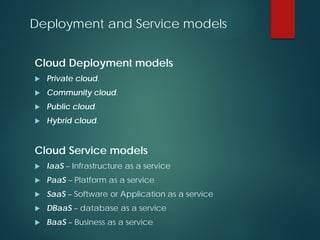
Deployment and Service models
Cloud Deployment models
 Private cloud.
 Community cloud.
 Public cloud.
 Hybrid cloud.
Cloud Service models
 IaaS – Infrastructure as a service
 PaaS – Platform as a service
 SaaS – Software or Application as a service
 DBaaS – database as a service
 BaaS – Business as a service
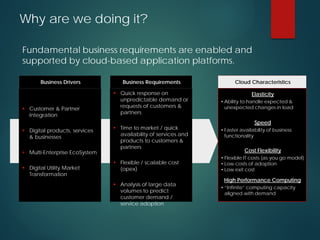
Fundamental business requirements are enabled and
supported by cloud-based application platforms.
 Customer & Partner
Integration
 Digital products, services
& businesses
 Multi-Enterprise EcoSystem
 Digital Utility Market
Transformation
Business Drivers
 Quick response on
unpredictable demand or
requests of customers &
partners
 Time to market / quick
availability of services and
products to customers &
partners
 Flexible / scalable cost
(opex)
 Analysis of large data
volumes to predict
customer demand /
service adoption
Business Requirements Cloud Characteristics
Elasticity
• Ability to handle expected &
unexpected changes in load
High Performance Computing
• “Infinite” computing capacity
aligned with demand
Cost Flexibility
• Flexible IT costs (as you go model)
• Low costs of adoption
• Low exit cost
Speed
• Faster availability of business
functionality
Why are we doing it?
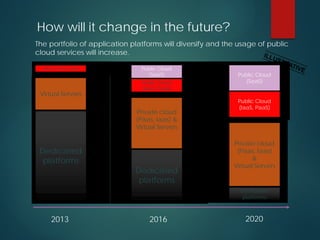
The portfolio of application platforms will diversify and the usage of public
cloud services will increase.
Dedicated
platforms
Virtual Servers
Dedicated
platforms
Private cloud
(Paas, Iaas) &
Virtual Servers
Public Cloud
(SaaS)
Dedicated
platforms
Private cloud
(Paas, Iaas)
&
Virtual Servers
Public Cloud
(SaaS)
2013 2016 2020
Others (Cloud, SaaS)
Public Cloud
(IaaS, PaaS)
Public Cloud
(IaaS, PaaS)
How will it change in the future?
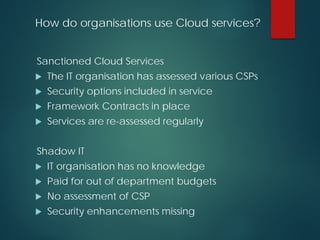
How do organisations use Cloud services?
Sanctioned Cloud Services
 The IT organisation has assessed various CSPs
 Security options included in service
 Framework Contracts in place
 Services are re-assessed regularly
Shadow IT
 IT organisation has no knowledge
 Paid for out of department budgets
 No assessment of CSP
 Security enhancements missing
The Challenge
To assess the abilities of Cloud Service Providers
and their offerings to provide adequate
security for the data and applications that will
entrusted to them.
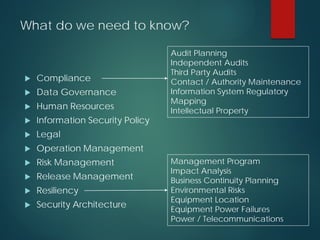
What do we need to know?
 Compliance
 Data Governance
 Human Resources
 Information Security Policy
 Legal
 Operation Management
 Risk Management
 Release Management
 Resiliency
 Security Architecture
Audit Planning
Independent Audits
Third Party Audits
Contact / Authority Maintenance
Information System Regulatory
Mapping
Intellectual Property
Management Program
Impact Analysis
Business Continuity Planning
Environmental Risks
Equipment Location
Equipment Power Failures
Power / Telecommunications
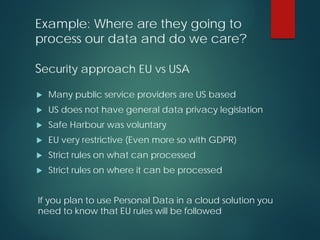
Example: Where are they going to
process our data and do we care?
Security approach EU vs USA
 Many public service providers are US based
 US does not have general data privacy legislation
 Safe Harbour was voluntary
 EU very restrictive (Even more so with GDPR)
 Strict rules on what can processed
 Strict rules on where it can be processed
If you plan to use Personal Data in a cloud solution you
need to know that EU rules will be followed
Sanctioned Cloud Services
How can you assess CSPs
and their service
offerings?
CSP selection - Issues and approach
 Traditional approach, compare third party
service offering with in house service hosting
 Cloud providers will not provide information
about their internal hosting and processes
 Unable to compare CSPs infrastructure model
directly
 Need to discover what we can from what
they publish
 Need to trust intermediary to verify security
measures not visible to us.
 Need to trust information sources.
Assessment Processes for Sanctioned
Services
What can you do for yourselves?
 CSA attestation (Cloud Security Alliance)
 Self Certified
 Audited once
 Ongoing auditing
 Custom assessment questionnaires
 What do you cover?
 ISO Accreditation
 SOC Audits
CSA - https://cloudsecurityalliance.org
 The Cloud Security Alliance (CSA) is the world’s leading
organization dedicated to defining and raising
awareness of best practices to help ensure a secure
cloud computing environment.
 Star Attestation is based on type 2 SOC attestations
supplemented by the criteria in the Cloud Controls
Matrix (CCM).
 Is based on a mature attest standard
 Does not require the use of any criteria that were not
designed for, or readily accepted by cloud providers
 Provides for robust reporting on the service provider’s
description of its system and on the service provider’s
controls, including a description of the service auditor’s
tests
Use of CSA Attestation
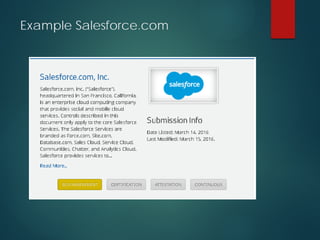
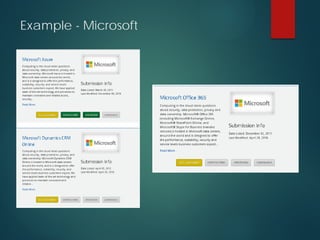
Where a CSP has filed a STAR attestation this can
be used as the basis for evaluation
 CSA 3.0.1 Link
This requires expertise to evaluate
Example Salesforce.com
Example - Microsoft
Custom assessment questionnaire
This can be used where there is no existing CSA
attestation or to tailor the information gathered.
 We created Cloud Risks and Controls Analysis
 This was based on CSA 1.3
 This highlighted areas we were particularly
concerned about
 We deleted topic areas about which we
were not concerned
 Process intensive, takes a lot of effort to keep
up to date
 Takes skill to operate
 Tools needs frequent updates
What should be covered by Contract?
There are a number of topics which may require
specific references in contracts with CSPs, some
examples:
 Location of processing of data
 Regular production of Audit reports, SOC2, etc.
 Regular report of results of pen testing
 Incident management process
 Change management process
Warning: Do not Expect CSPs do modify their service
to suit you!
Assessment Processes
What can you do if you don’t write your own
tool and the CSP is not CSA registered?
 Cloud Access Security Broker services
 Subscription services
 Monitor thousands of CSPs
 Regularly update compliance status
 Add new CSPs and services as they
become available
 Alert if CSP status changes
Shadow IT - Background
Shadow IT, also known as stealth IT, describes IT systems or solutions used
within an organisation without the approval, or often even the knowledge, of
corporate IT.
According to the customers of a major vendor of Cloud Service
Management Systems:
• 80% of employees admit to using unsanctioned SaaS
• Software-as-a-Service (SaaS) growing at 199%
• Infrastructure-as-a-Service (IaaS) growing at 122%
The intentions behind this practise are often good, but what appears to
employees to be a great solution, being cheap to buy, agile, and aiding
productivity, can be a huge downside to the company.
Shadow IT opens dangerous security holes that expose the corporate
network and the systems and data within it, to theft, malware, or loss.
There is no central co-ordination of procurement often leading to licensing,
technical and security issues.
How can the risks be mitigated?
Organisations which have an established security infrastructure can
monitor internet breakout and manually screen for unsanctioned cloud
service use.
This may be laborious and requires considerable house keeping effort to
keep up to date.
The use of a subscription service is probably going to be more secure
and cost effective, back to CASB services.
There are many tools and products available to evaluate what is
happening in the network.
Most have multi-functionality such as :
 Cloud service discovery
 Broker service
 Policy enforcement
Careful selection of functionality enables the creation of a service fit for
your purpose.
The Objective should be to help the business by helping them to
embrace the cloud service model and realise the benefits while guiding
them towards the more secure solutions.
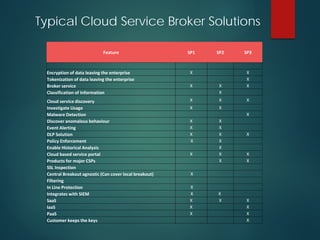
Typical Cloud Service Broker Solutions
Feature SP1 SP2 SP3
Encryption of data leaving the enterprise X X
Tokenization of data leaving the enterprise X
Broker service X X X
Classification of Information X
Cloud service discovery X X X
Investigate Usage X X
Malware Detection X
Discover anomalous behaviour X X
Event Alerting X X
DLP Solution X X X
Policy Enforcement X X
Enable Historical Analysis X
Cloud based service portal X X X
Products for major CSPs X X
SSL Inspection
Central Breakout agnostic (Can cover local breakout) X
Filtering
In Line Protection X
Integrates with SIEM X X
SaaS X X X
IaaS X X
PaaS X X
Customer keeps the keys X
Summary
 To operate securely in the cloud care must be taken to
select the right cloud service provider.
 Information a CSP will provide directly to the consumer
is limited.
 They may provide more information via the CSA or to
broker services.
 Contract clauses should cover specific important
areas of compliance
 Maintaining you own tools requires a lot of effort and
knowledge.
 Broker services may be appropriate, particularly if it is
intended to use many different CSPs.
Questions?

Cloud services and it security

  • 1.
    How secure is yourdata in the Clouds?
  • 2.
    About the presenter SeniorIT security at a global utility company Worked in IT infrastructure and consultancy roles for twenty five years Involved with security related roles and projects for the last ten years. Assessing the security of cloud solutions for the last five years.
  • 3.
    Scope  This presentationwill mainly discuss the issues around adoption of Cloud services and data security, and the approach of a multi-national utility company to cloud service adoption.  We will look at the issues, and the assessment and selection of cloud service providers.  How to minimise some of the loopholes with contracts
  • 4.
    Recap - Whatis Cloud? NIST – National Institute for Standards and Technology The NIST Definition of Cloud Computing Cloud computing is a model for enabling ubiquitous, convenient, on-demand network access to a shared pool of configurable computing resources (e.g., networks, servers, storage, applications, and services) that can be rapidly provisioned and released with minimal management effort or service provider interaction.
  • 5.
    Deployment and Servicemodels Cloud Deployment models  Private cloud.  Community cloud.  Public cloud.  Hybrid cloud. Cloud Service models  IaaS – Infrastructure as a service  PaaS – Platform as a service  SaaS – Software or Application as a service  DBaaS – database as a service  BaaS – Business as a service
  • 6.
    Fundamental business requirementsare enabled and supported by cloud-based application platforms.  Customer & Partner Integration  Digital products, services & businesses  Multi-Enterprise EcoSystem  Digital Utility Market Transformation Business Drivers  Quick response on unpredictable demand or requests of customers & partners  Time to market / quick availability of services and products to customers & partners  Flexible / scalable cost (opex)  Analysis of large data volumes to predict customer demand / service adoption Business Requirements Cloud Characteristics Elasticity • Ability to handle expected & unexpected changes in load High Performance Computing • “Infinite” computing capacity aligned with demand Cost Flexibility • Flexible IT costs (as you go model) • Low costs of adoption • Low exit cost Speed • Faster availability of business functionality Why are we doing it?
  • 7.
    The portfolio ofapplication platforms will diversify and the usage of public cloud services will increase. Dedicated platforms Virtual Servers Dedicated platforms Private cloud (Paas, Iaas) & Virtual Servers Public Cloud (SaaS) Dedicated platforms Private cloud (Paas, Iaas) & Virtual Servers Public Cloud (SaaS) 2013 2016 2020 Others (Cloud, SaaS) Public Cloud (IaaS, PaaS) Public Cloud (IaaS, PaaS) How will it change in the future?
  • 8.
    How do organisationsuse Cloud services? Sanctioned Cloud Services  The IT organisation has assessed various CSPs  Security options included in service  Framework Contracts in place  Services are re-assessed regularly Shadow IT  IT organisation has no knowledge  Paid for out of department budgets  No assessment of CSP  Security enhancements missing
  • 9.
    The Challenge To assessthe abilities of Cloud Service Providers and their offerings to provide adequate security for the data and applications that will entrusted to them.
  • 10.
    What do weneed to know?  Compliance  Data Governance  Human Resources  Information Security Policy  Legal  Operation Management  Risk Management  Release Management  Resiliency  Security Architecture Audit Planning Independent Audits Third Party Audits Contact / Authority Maintenance Information System Regulatory Mapping Intellectual Property Management Program Impact Analysis Business Continuity Planning Environmental Risks Equipment Location Equipment Power Failures Power / Telecommunications
  • 11.
    Example: Where arethey going to process our data and do we care? Security approach EU vs USA  Many public service providers are US based  US does not have general data privacy legislation  Safe Harbour was voluntary  EU very restrictive (Even more so with GDPR)  Strict rules on what can processed  Strict rules on where it can be processed If you plan to use Personal Data in a cloud solution you need to know that EU rules will be followed
  • 12.
    Sanctioned Cloud Services Howcan you assess CSPs and their service offerings?
  • 13.
    CSP selection -Issues and approach  Traditional approach, compare third party service offering with in house service hosting  Cloud providers will not provide information about their internal hosting and processes  Unable to compare CSPs infrastructure model directly  Need to discover what we can from what they publish  Need to trust intermediary to verify security measures not visible to us.  Need to trust information sources.
  • 14.
    Assessment Processes forSanctioned Services What can you do for yourselves?  CSA attestation (Cloud Security Alliance)  Self Certified  Audited once  Ongoing auditing  Custom assessment questionnaires  What do you cover?  ISO Accreditation  SOC Audits
  • 15.
    CSA - https://cloudsecurityalliance.org The Cloud Security Alliance (CSA) is the world’s leading organization dedicated to defining and raising awareness of best practices to help ensure a secure cloud computing environment.  Star Attestation is based on type 2 SOC attestations supplemented by the criteria in the Cloud Controls Matrix (CCM).  Is based on a mature attest standard  Does not require the use of any criteria that were not designed for, or readily accepted by cloud providers  Provides for robust reporting on the service provider’s description of its system and on the service provider’s controls, including a description of the service auditor’s tests
  • 16.
    Use of CSAAttestation Where a CSP has filed a STAR attestation this can be used as the basis for evaluation  CSA 3.0.1 Link This requires expertise to evaluate
  • 17.
  • 18.
  • 19.
    Custom assessment questionnaire Thiscan be used where there is no existing CSA attestation or to tailor the information gathered.  We created Cloud Risks and Controls Analysis  This was based on CSA 1.3  This highlighted areas we were particularly concerned about  We deleted topic areas about which we were not concerned  Process intensive, takes a lot of effort to keep up to date  Takes skill to operate  Tools needs frequent updates
  • 20.
    What should becovered by Contract? There are a number of topics which may require specific references in contracts with CSPs, some examples:  Location of processing of data  Regular production of Audit reports, SOC2, etc.  Regular report of results of pen testing  Incident management process  Change management process Warning: Do not Expect CSPs do modify their service to suit you!
  • 21.
    Assessment Processes What canyou do if you don’t write your own tool and the CSP is not CSA registered?  Cloud Access Security Broker services  Subscription services  Monitor thousands of CSPs  Regularly update compliance status  Add new CSPs and services as they become available  Alert if CSP status changes
  • 22.
    Shadow IT -Background Shadow IT, also known as stealth IT, describes IT systems or solutions used within an organisation without the approval, or often even the knowledge, of corporate IT. According to the customers of a major vendor of Cloud Service Management Systems: • 80% of employees admit to using unsanctioned SaaS • Software-as-a-Service (SaaS) growing at 199% • Infrastructure-as-a-Service (IaaS) growing at 122% The intentions behind this practise are often good, but what appears to employees to be a great solution, being cheap to buy, agile, and aiding productivity, can be a huge downside to the company. Shadow IT opens dangerous security holes that expose the corporate network and the systems and data within it, to theft, malware, or loss. There is no central co-ordination of procurement often leading to licensing, technical and security issues.
  • 23.
    How can therisks be mitigated? Organisations which have an established security infrastructure can monitor internet breakout and manually screen for unsanctioned cloud service use. This may be laborious and requires considerable house keeping effort to keep up to date. The use of a subscription service is probably going to be more secure and cost effective, back to CASB services. There are many tools and products available to evaluate what is happening in the network. Most have multi-functionality such as :  Cloud service discovery  Broker service  Policy enforcement Careful selection of functionality enables the creation of a service fit for your purpose. The Objective should be to help the business by helping them to embrace the cloud service model and realise the benefits while guiding them towards the more secure solutions.
  • 24.
    Typical Cloud ServiceBroker Solutions Feature SP1 SP2 SP3 Encryption of data leaving the enterprise X X Tokenization of data leaving the enterprise X Broker service X X X Classification of Information X Cloud service discovery X X X Investigate Usage X X Malware Detection X Discover anomalous behaviour X X Event Alerting X X DLP Solution X X X Policy Enforcement X X Enable Historical Analysis X Cloud based service portal X X X Products for major CSPs X X SSL Inspection Central Breakout agnostic (Can cover local breakout) X Filtering In Line Protection X Integrates with SIEM X X SaaS X X X IaaS X X PaaS X X Customer keeps the keys X
  • 25.
    Summary  To operatesecurely in the cloud care must be taken to select the right cloud service provider.  Information a CSP will provide directly to the consumer is limited.  They may provide more information via the CSA or to broker services.  Contract clauses should cover specific important areas of compliance  Maintaining you own tools requires a lot of effort and knowledge.  Broker services may be appropriate, particularly if it is intended to use many different CSPs.
  • 26.