
Cloud computing and self-service; Are they the way ahead? WithMalcolm Fry“Someone told me long time agoThere’s a calm before the stormI know. And it’s been coming for some timeWhen it’s over so they sayIt’ll bring a sunny dayI know, shining down like waterI wanna know, have you ever seen the rain?I wanna know, have you ever seen the rain?Coming down on a sunny day?”- John Fogerty
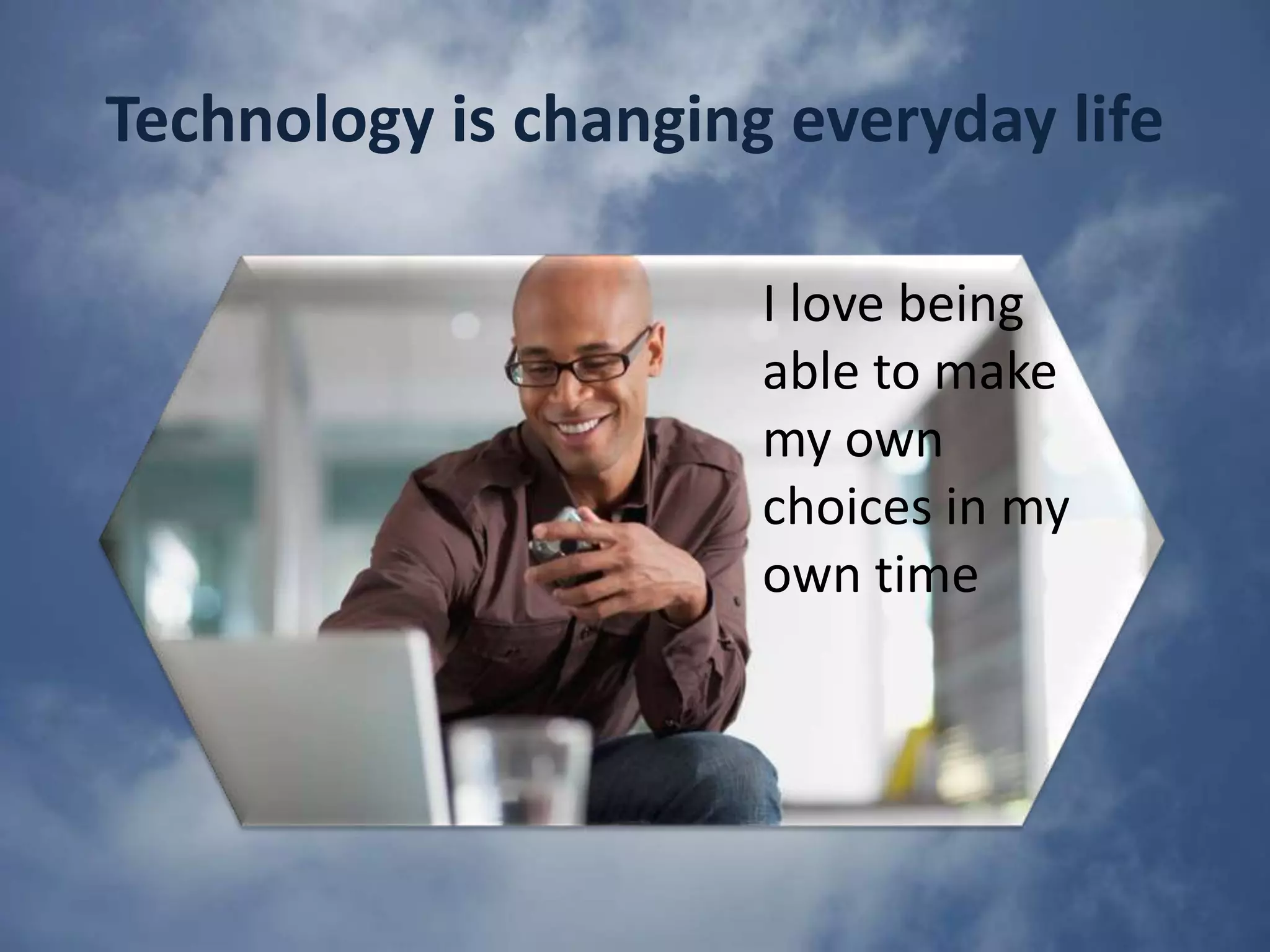
Technology is changing everyday lifeI love being able to make my own choices in my own time
Life is now about…….Making your own decisionsDeregulationMaking your own choicesSmall world big optionsNo waitingPortable technologyStraight to the product
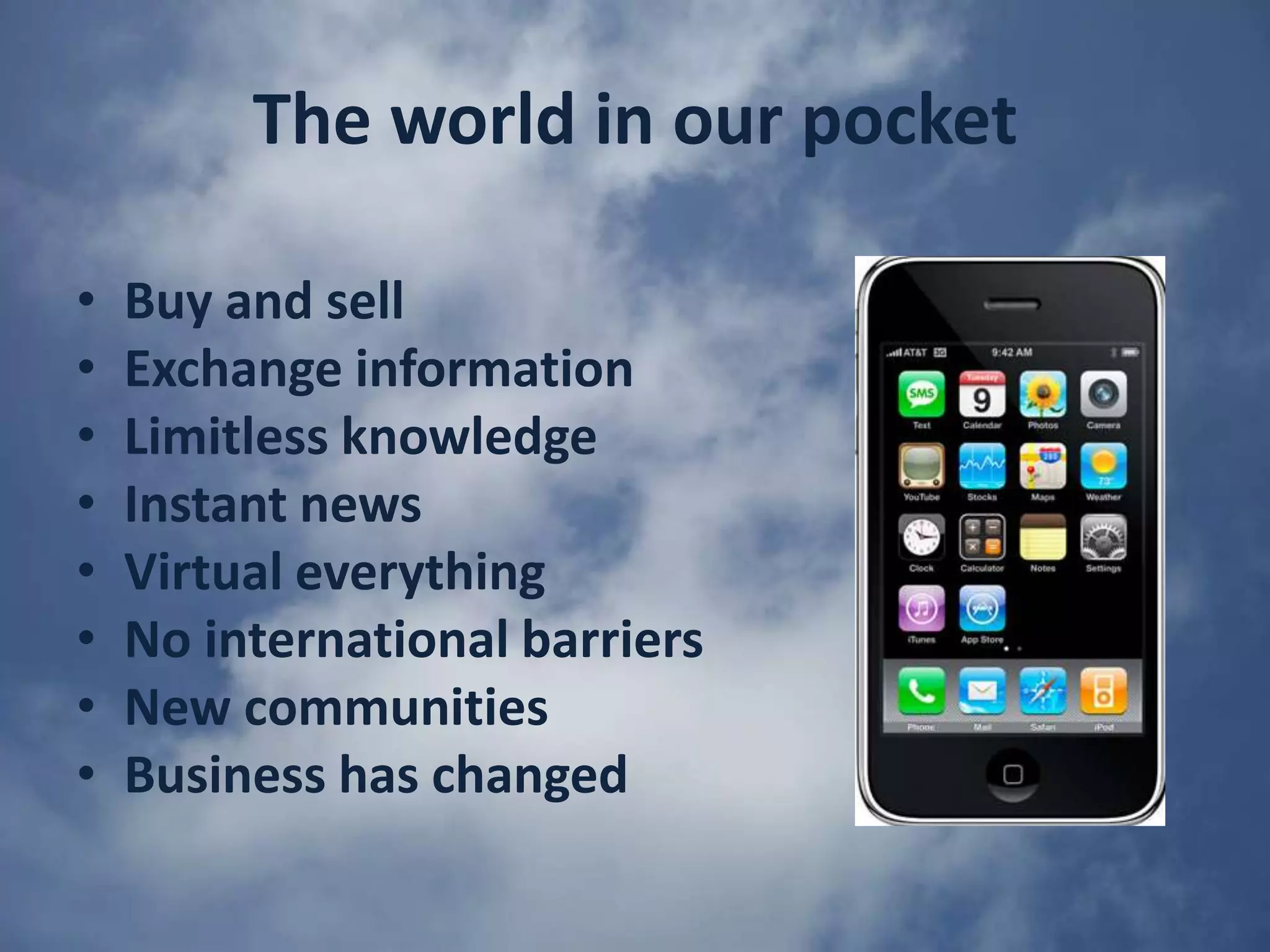
The world in our pocketBuy and sellExchange informationLimitless knowledgeInstant newsVirtual everythingNo international barriersNew communitiesBusiness has changed
Child’s eye viewIcons that no longer exist – DiskettePlasma/LED televisionsCamera telephones capture everythingElectronic home work submissionTechno tool taught at school e.g. PowerPointMaps?  When you have Google earth?Just an extension of the Kindergarten
Not just childrenDirect to the Customer (DttC) services make life easyIT engages in a huge amount of work and deploys significant resources to make things seem so easyIt is not just children - according to IMRG in December 2010 of £6.8 billion, equivalent to an average spend of £111 (approximately US$170) for every person in the UK.
SaaS needs Common rule setsThe cloud and SaaS servicesITIL evolutionDe facto ITSM standardITSM already supports SaaSETOM has ITIL compatibilityHybrid’s
Speaking a Common Languagehttp://csrc.nist.gov/publications/drafts/800-145/Draft-SP-800-145_cloud-definition.pdf8
NIST Cloud definition“Cloud computing is a model for enabling ubiquitous, convenient, on-demand network access to a shared pool of configurable computing resources (e.g., networks, servers, storage, applications, and services) that can be rapidly provisioned and released with minimal management effort or service provider interaction.This cloud model promotes availability and is composed of; five essential characteristics, three service models, and four deployment models.”
Deploymentmodels?private cloudcommunity cloudpublic cloudhybrid cloud10
11ServiceModels?SaaSPaaSIaaS
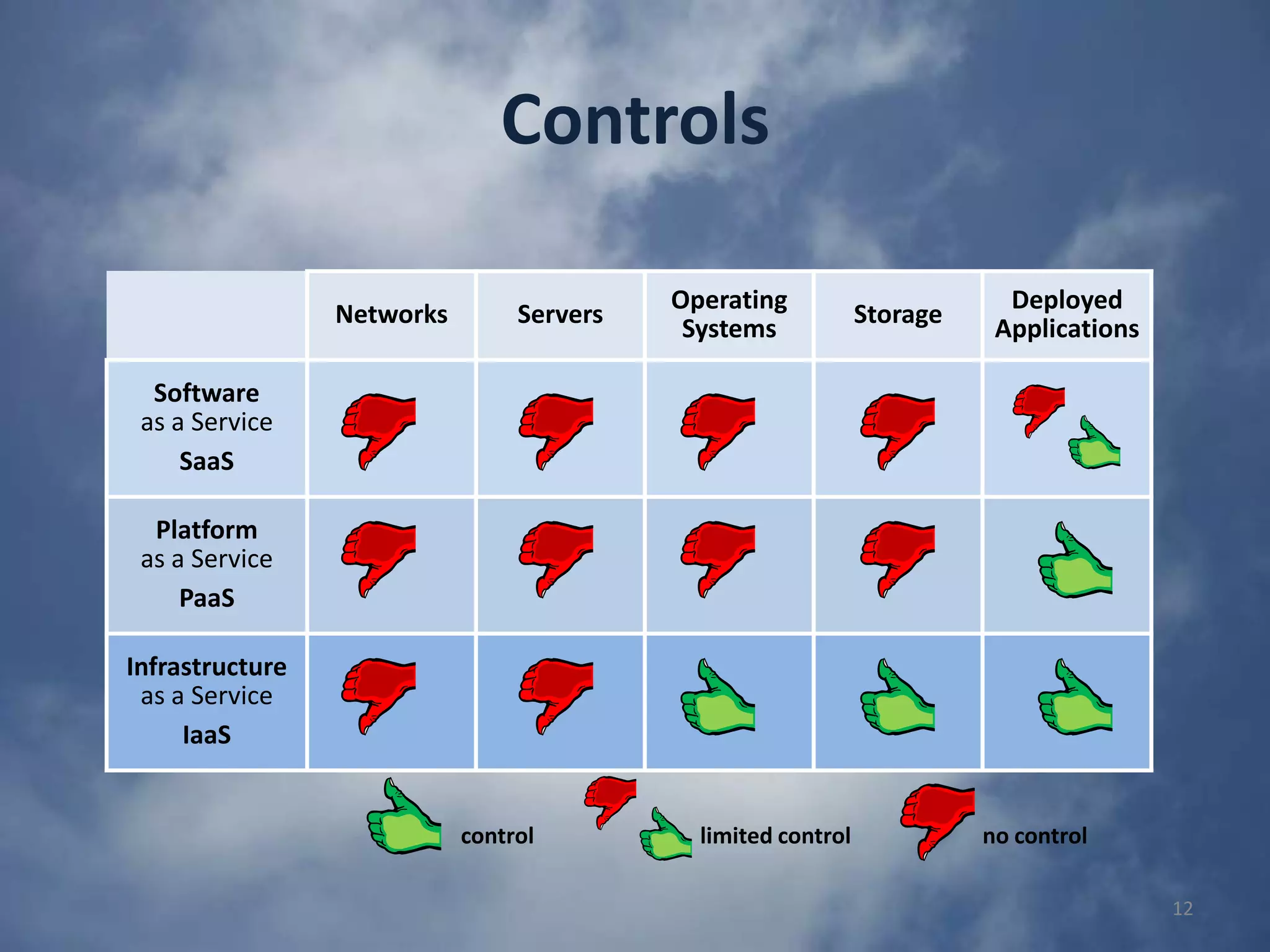
Controls12controllimited controlno control
Supporting and ServicingSaaS is a double edged sword
ITIL v3 a logical approachITIL v2 concentrated on Service Support and Service Delivery
ITIL v3 has a life cycle approach
There is an emphasis shift from retro fitting
 To get it right first time
Selecting a SaaS tool is a scienceRole changingTwo party approach to IT Service Management and cloud?Mind set and platform changesThe invisible and inaccessible? It is very difficult to leave SaaS?
5The five key ITIL phases
ITILService - strategy
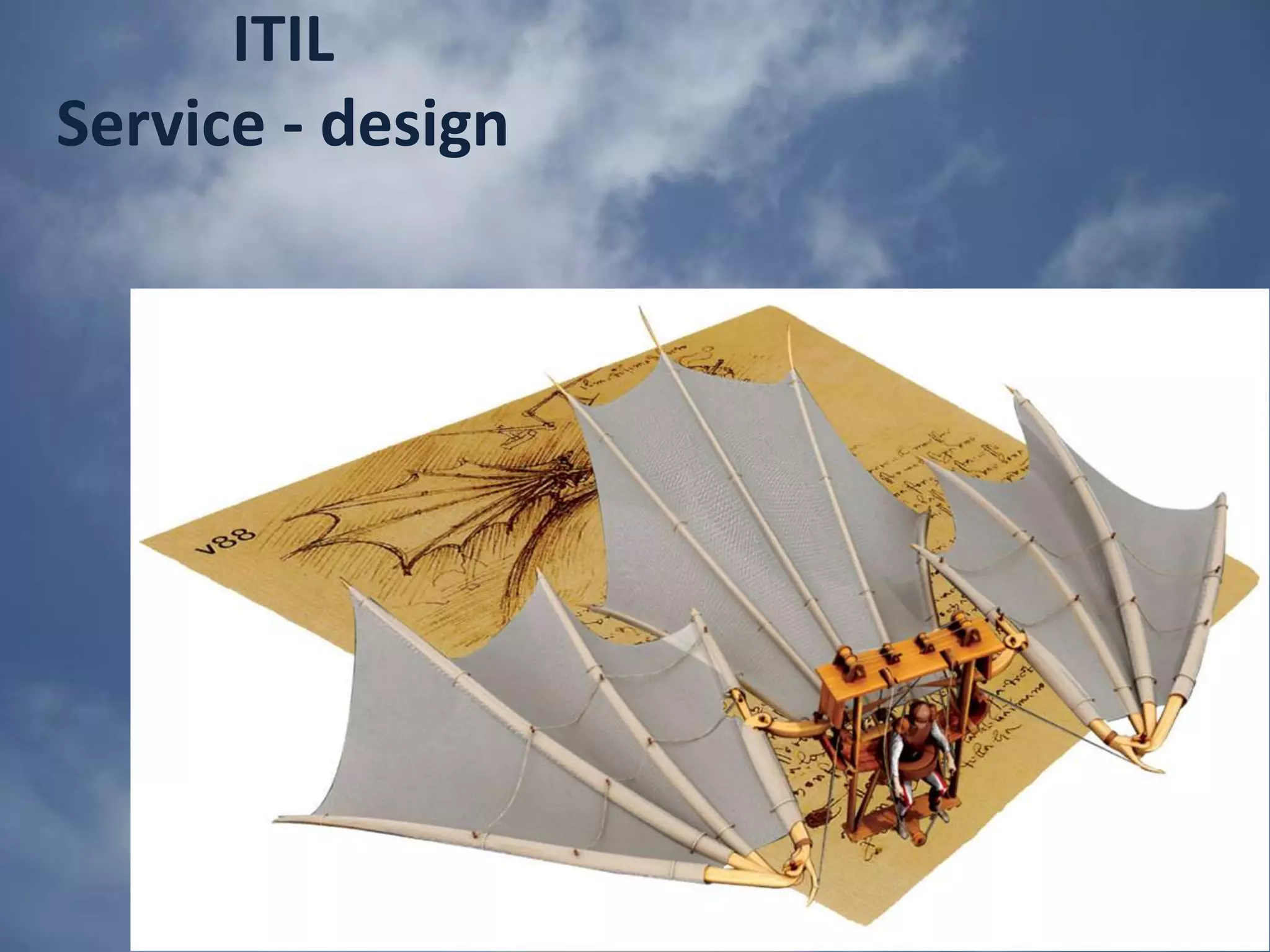
ITILService - design
ITILService - transition
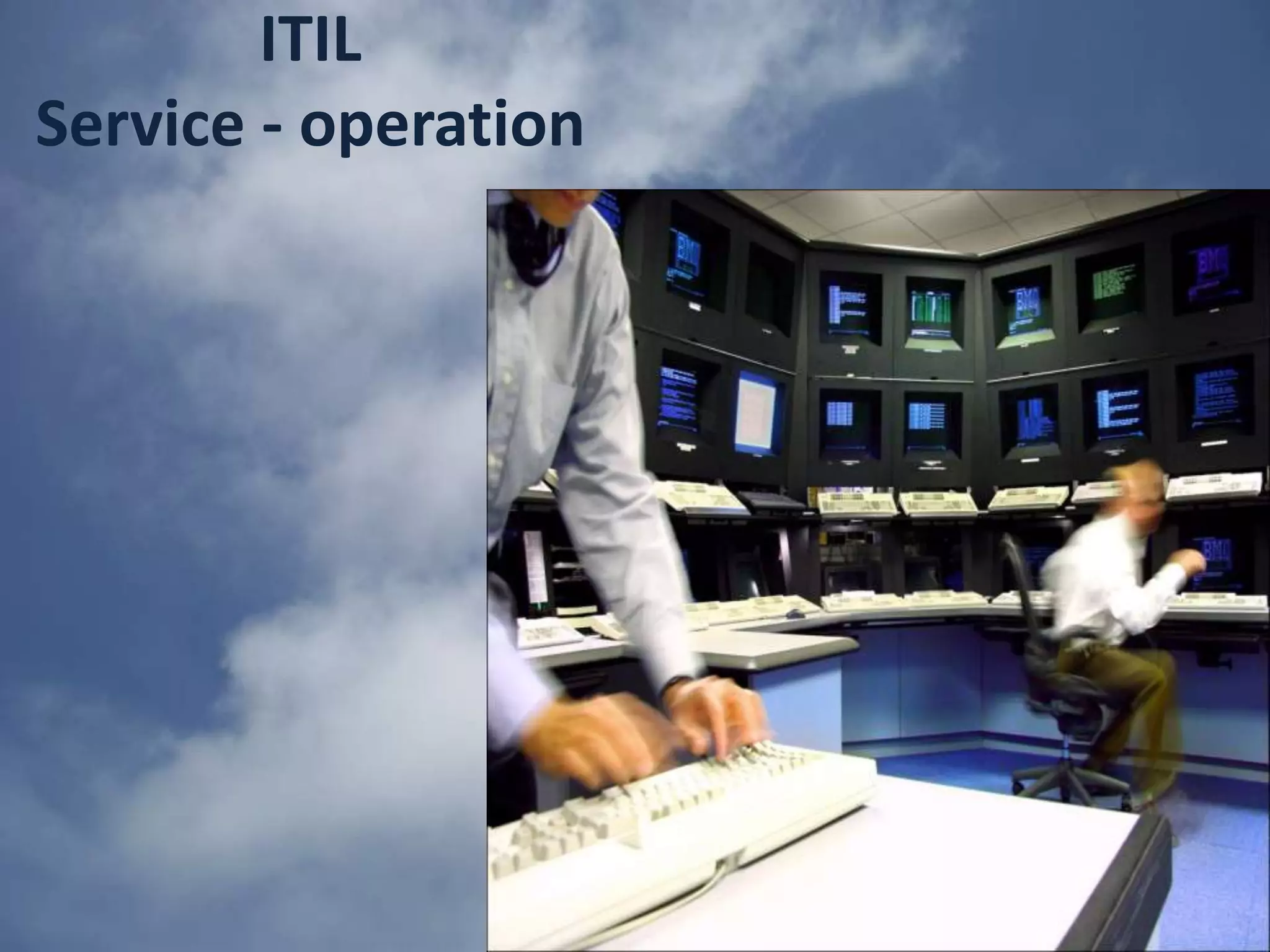
ITILService - operation
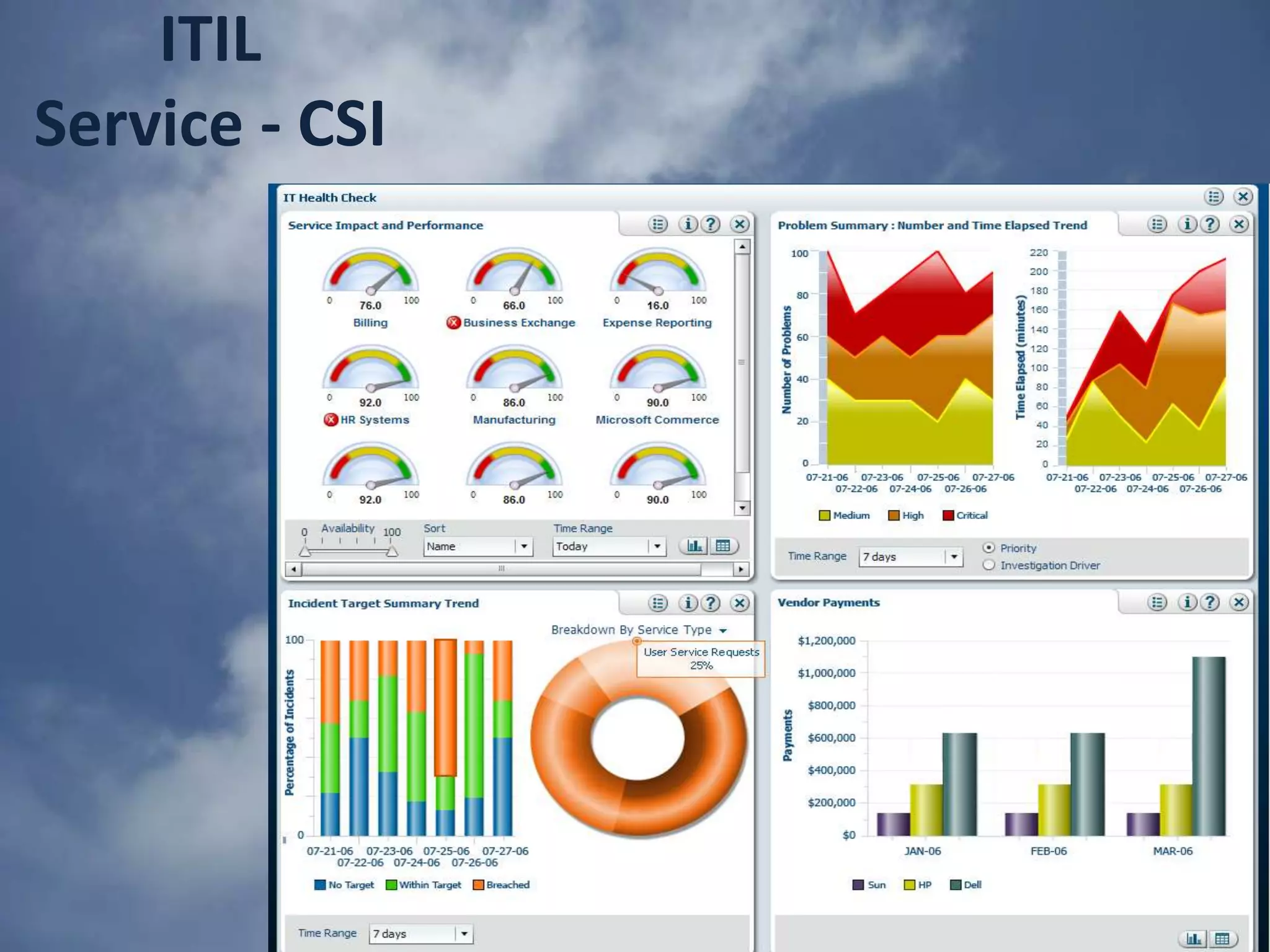
ITILService - CSI
Should ITSM use SaaS products?Yes because these are the NIST essential characteristics work better if ITIL is employed:on-demand self-servicebroad network accessresource poolingrapid elasticitymeasured serviceIt also easier to support a service that you understandIdeal if both SaaS supplier and ITSM are ITIL compliant
SaaS and ITILSaaS maybe a current trend but old processes never dieOr will SaaS eliminateChangesIncidentsAvailabilityCapacityetc?
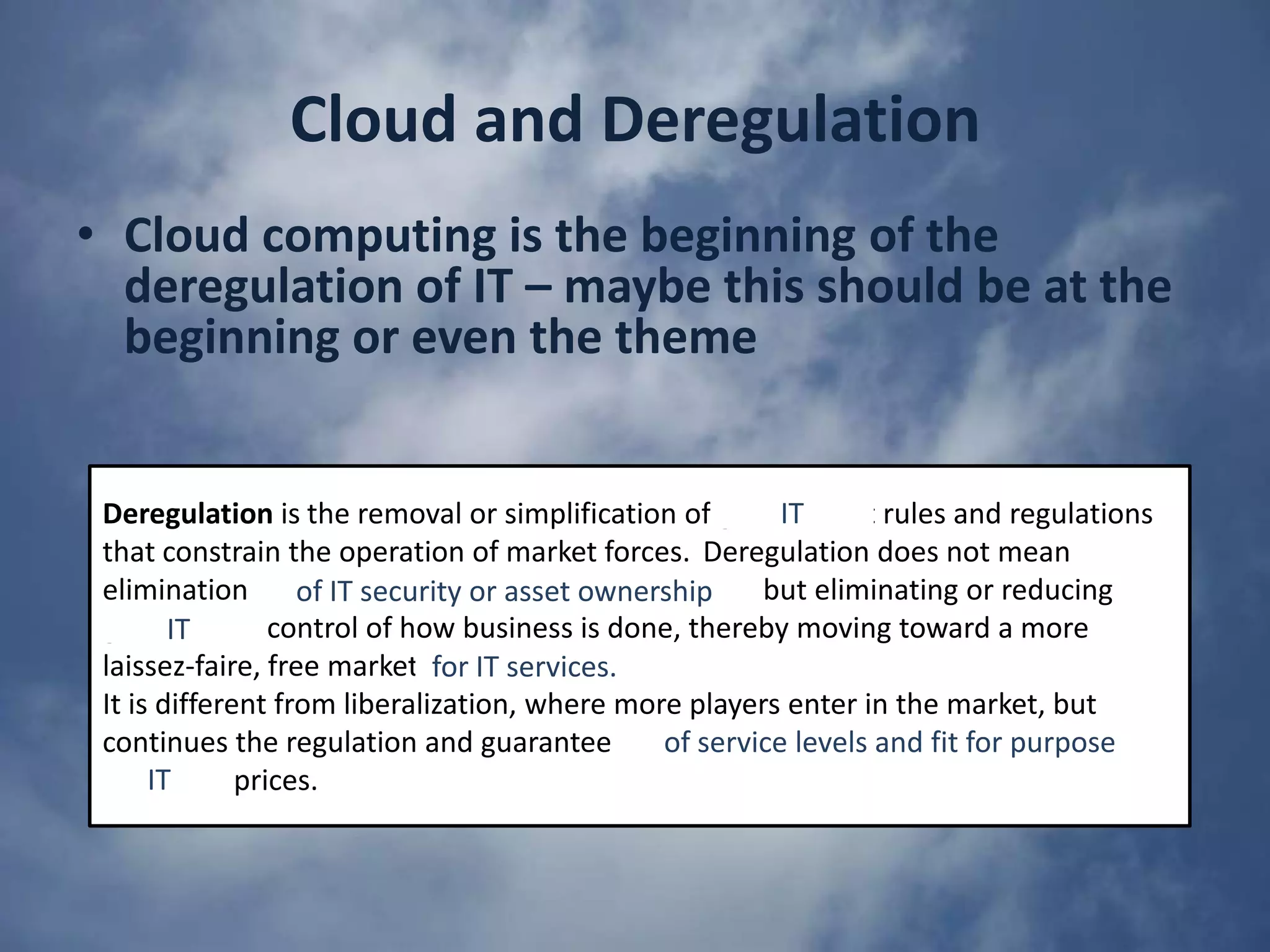
Deregulation is the removal or simplification of government rules and regulations that constrain the operation of market forces. Deregulation does not mean elimination of laws against fraud or property rights but eliminating or reducing government control of how business is done, thereby moving toward a more laissez-faire, free market.It is different from liberalization, where more players enter in the market, but continues the regulation and guarantee of consumer rights and maximum and minimum prices.Cloud and DeregulationCloud computing is the beginning of the deregulation of IT – maybe this should be at the beginning or even the themeITof IT security or asset ownershipITfor IT services.of service levels and fit for purpose IT
8 Key Questions
1. Why should organizations that are moving to SaaS care about ITIL?ITIL compliance is now de facto standard - a perfect yardstickAll of the components of ITIL will still exist but the roles will changeCommon ground and common terminology with SaaS suppliersWhy would you not make your SaaS offering ITIL compliant?Exclusively SaaS?  No?  Then you will need to integrate old and new
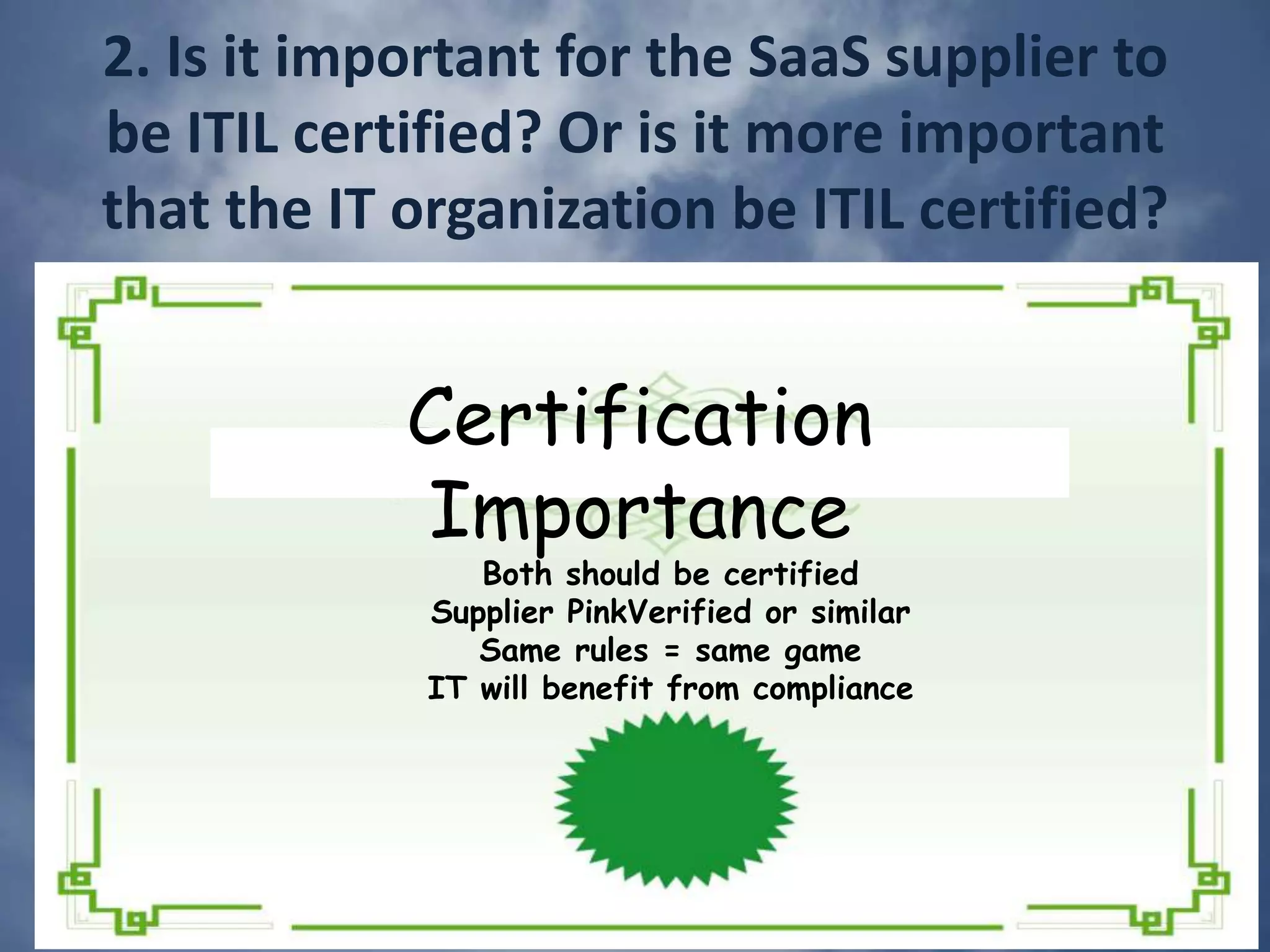
2. Is it important for the SaaS supplier to be ITIL certified? Or is it more important that the IT organization be ITIL certified?Certification AwardCertification ImportanceBoth should be certifiedSupplier PinkVerified or similarSame rules = same gameIT will benefit from complianceSubjectIs it important for the SaaS supplier to be ITIL certified?Or is it more important that the IT organization be ITIL certified?
3. How do you respond to comments that “ITIL just gets in the way of the agility of a SaaS platform”? Agility without discipline is dangerousAgility must be channelled to avoid circumventions
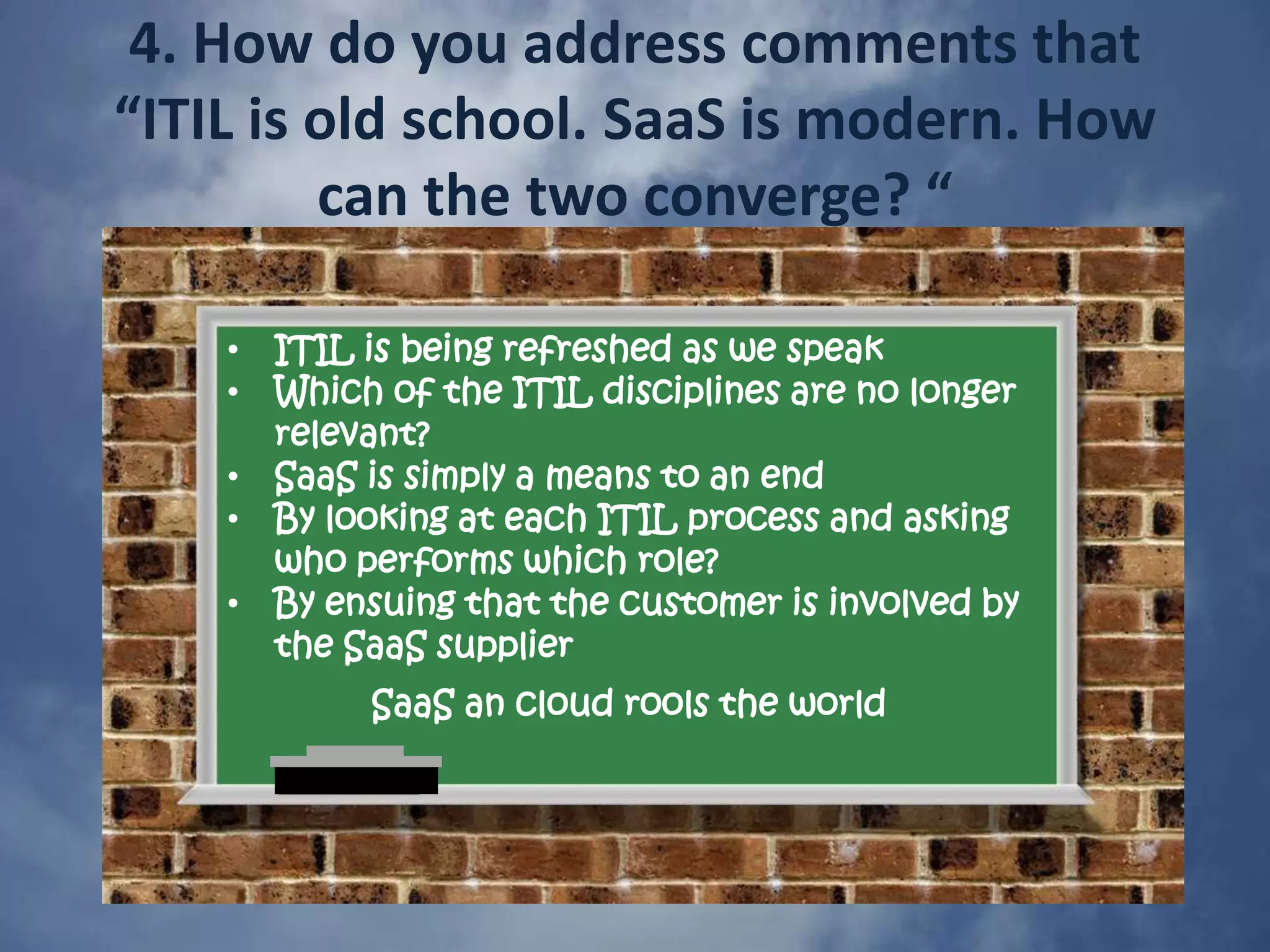
4. How do you address comments that “ITIL is old school. SaaS is modern. How can the two converge? “ITIL is being refreshed as we speakWhich of the ITIL disciplines are no longer relevant?SaaS is simply a means to an endBy looking at each ITIL process and asking who performs which role?By ensuing that the customer is involved by the SaaS supplierSaaS an cloud rools the world
5. What should IT organizations look for in regards to ITIL with a SaaS supplier?IMSDPMCMCO N F I G A SS E T M A V A I L MC A P M S L A P O R T F O L I O MI  W  I  L  L  B  U  Y  M  A  L  C  O  L  M  A  B  E  E  R
6. What are the biggest challenges IT organizations face with ITIL and  SaaS?Especially when BM is SaaS customerGetting SaaS supplier on boardGetting local management buy-inAgreeing lines of responsibilitySynchronising SaaS & Premises
7. How can IT organizations best address these challenges?It’s a Team GameGet a contact point for ITIL fromthe SaaS supplierJointly identify the key commonITIL componentsProduce/alter  processes as appropriateEstablish regular communicationsITSM can be Customer and UserAppoint an ITIL/SaaS co-ordinator
8. What are some key observations?SaaS ITIL compliance = commitment to Service ManagementService Catalogs and Service portfolios are essential because they remove obstaclesITIL/SaaS needs a clear sponsorDo not let ITIL become an obsession SaaS service for business are best served with SaaS based ITSM toolsITIL and SaaS are compatible
A new dichotomySome companies are now competing internally for the same customersFor example, it was reported that sales from the on-line Next Directory retail catalogue and Internet arm rose 15.3%While like-for-like store sales fell by 7.5%Here, we have two sales-driven divisions vying for the same customersWhere would you invest?
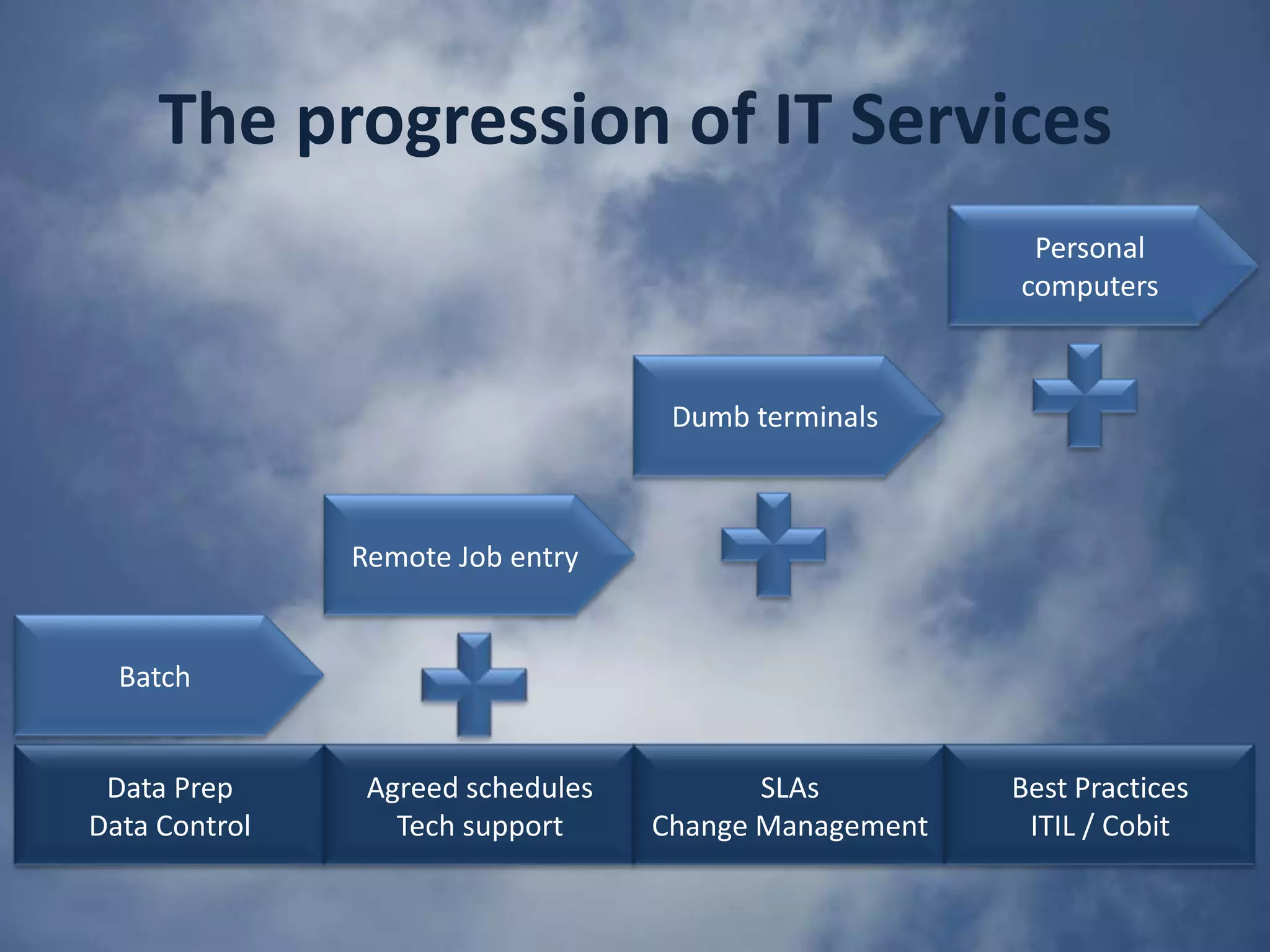
The progression of IT ServicesPersonal computersDumb terminalsRemote Job entryBatchData PrepData ControlAgreed schedulesTech supportSLAsChange ManagementBest PracticesITIL / Cobit
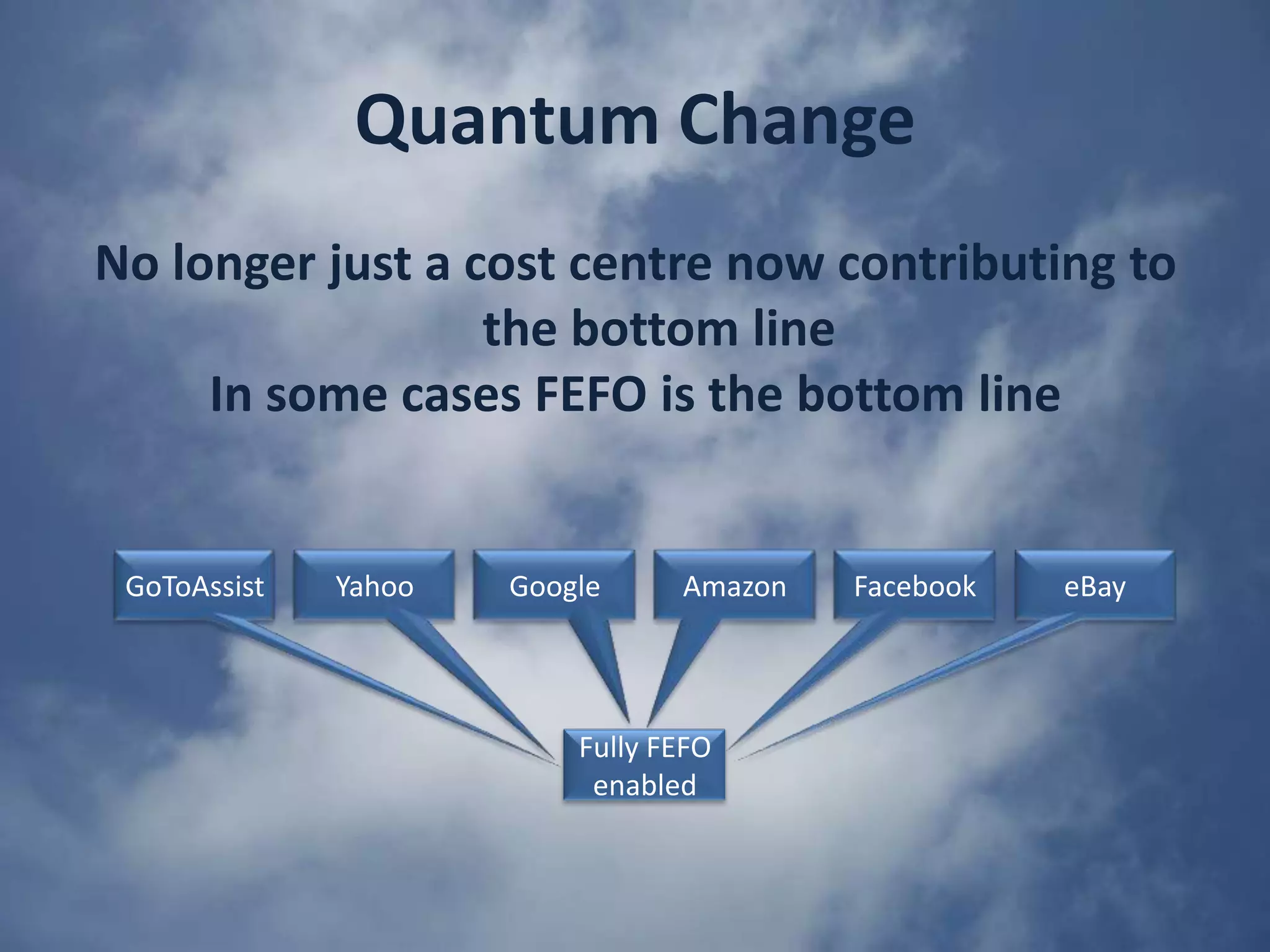
Quantum ChangeNo longer just a cost centre now contributing to the bottom lineIn some cases FEFO is the bottom lineGoToAssistYahooGoogleAmazonFacebookeBayFully FEFO enabled
The new ROI functionNow, it is not just Return On Investment but also Return On InsuranceThe aim is investing to avoid any potential service interruption to the customer, rather than saving revenue by reducing Service Management costsThe question is not what does ITSM cost but what happens if we don’t investment in ITSMIt is not until a major DttC application failure occurs that the full extent of the damage can be assessedThe key is to identify DttC applications and make them as resistant and resilient as possible as possible to avoid unplanned downtimeIT needs to both closely monitor key DttC services and protect against potential unplanned outages.
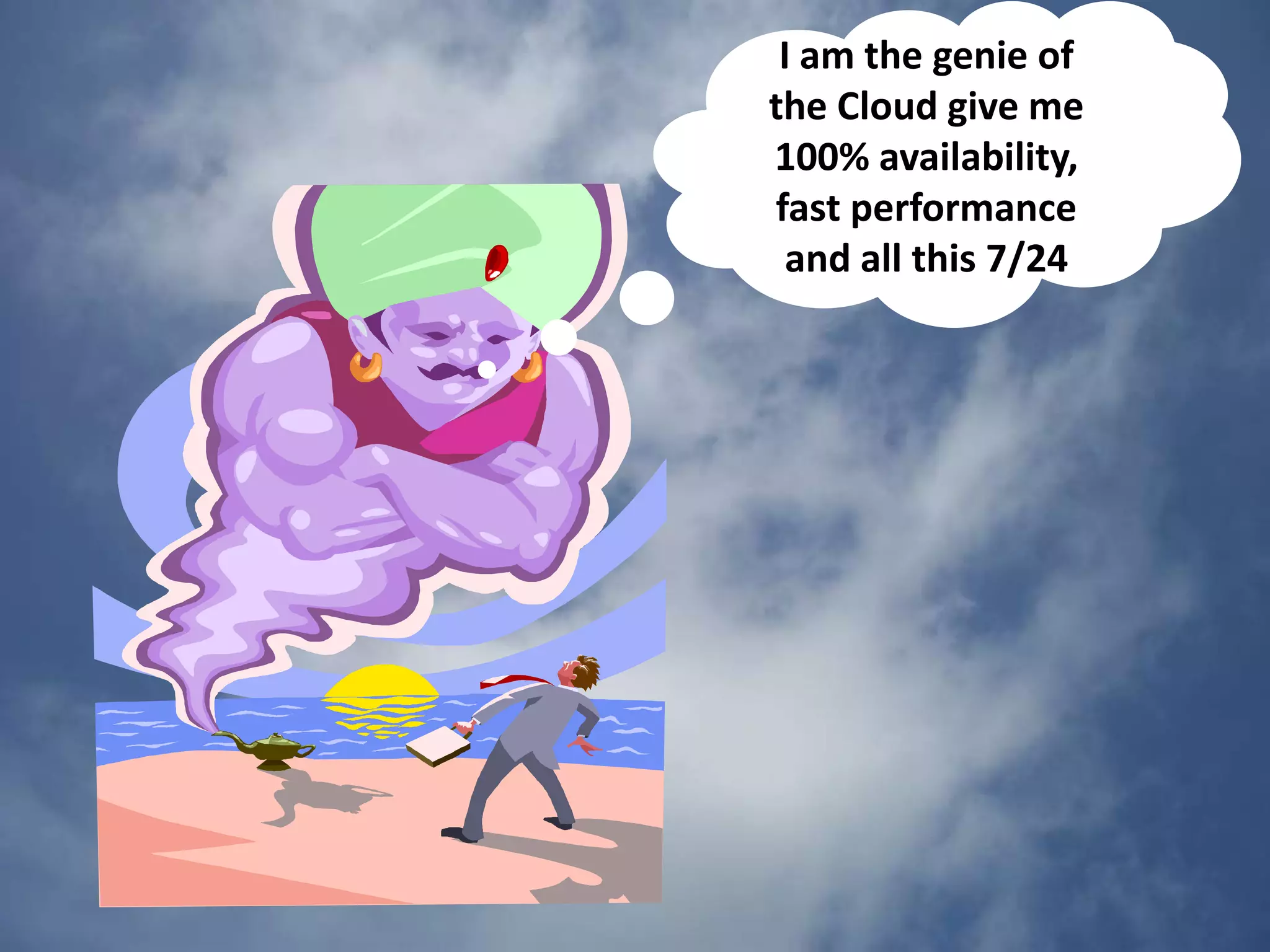
I am the genie of the Cloud give me 100% availability, fast performance and all this 7/24
Changing the IT mindsetIt is obvious that traditional approaches to supporting IT services have to changeIT can no longer work to targets that tolerate failure or complacencyIT must adopting a 100% target for high FEFO ratingsWhenever 100% is not hit IT should launch an investigation to find out why and stop this defect from occurring again or at least minimizing the risk.
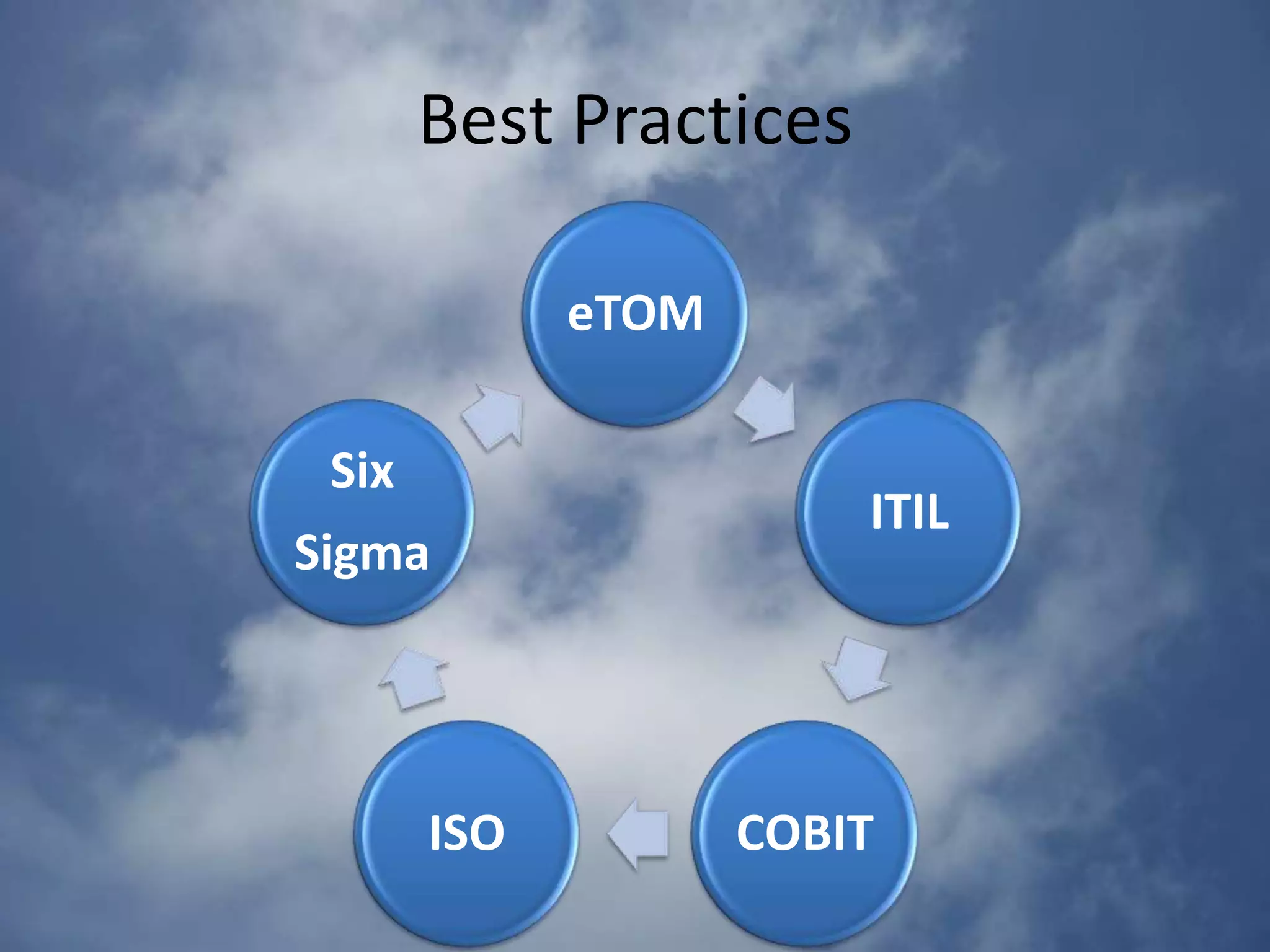
Best PracticeseTOMITILSixSigmaCOBITISO
Blurring of Responsibilities
Blurring of ResponsibilitiesThere were clear lines of demarcationBut what happens when FEFO kicks in and DttC services start to proliferate?Who does the external customer contact IT or a corporate customer service point?Who owns local support?The key point here is to identify those areas where FEFO services are providing DttC support, identify the blur points, work with the business units to establish where responsibilities lies and then adopt those responsibilities.
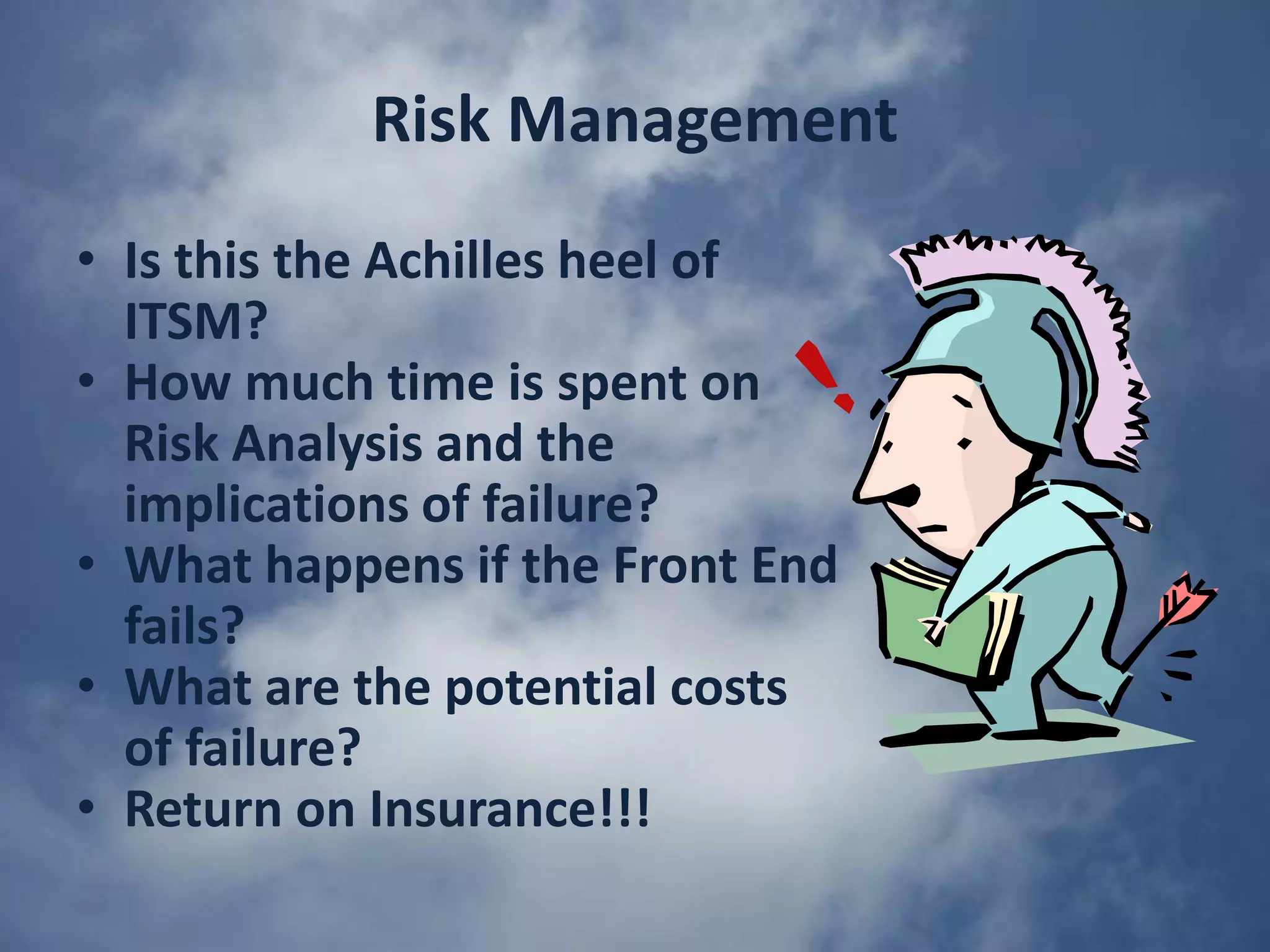
Risk ManagementIs this the Achilles heel of ITSM?How much time is spent on Risk Analysis and the implications of failure?What happens if the Front End fails?What are the potential costs of failure?Return on Insurance!!!
MorphingMorphing from – to:From to Action to Strategy and Design
IT Back Office to IT Front Office

Cloud Computing and Self-Service

  • 1.
    Cloud computing andself-service; Are they the way ahead? WithMalcolm Fry“Someone told me long time agoThere’s a calm before the stormI know. And it’s been coming for some timeWhen it’s over so they sayIt’ll bring a sunny dayI know, shining down like waterI wanna know, have you ever seen the rain?I wanna know, have you ever seen the rain?Coming down on a sunny day?”- John Fogerty
  • 2.
    Technology is changingeveryday lifeI love being able to make my own choices in my own time
  • 3.
    Life is nowabout…….Making your own decisionsDeregulationMaking your own choicesSmall world big optionsNo waitingPortable technologyStraight to the product
  • 4.
    The world inour pocketBuy and sellExchange informationLimitless knowledgeInstant newsVirtual everythingNo international barriersNew communitiesBusiness has changed
  • 5.
    Child’s eye viewIconsthat no longer exist – DiskettePlasma/LED televisionsCamera telephones capture everythingElectronic home work submissionTechno tool taught at school e.g. PowerPointMaps? When you have Google earth?Just an extension of the Kindergarten
  • 6.
    Not just childrenDirectto the Customer (DttC) services make life easyIT engages in a huge amount of work and deploys significant resources to make things seem so easyIt is not just children - according to IMRG in December 2010 of £6.8 billion, equivalent to an average spend of £111 (approximately US$170) for every person in the UK.
  • 7.
    SaaS needs Commonrule setsThe cloud and SaaS servicesITIL evolutionDe facto ITSM standardITSM already supports SaaSETOM has ITIL compatibilityHybrid’s
  • 8.
    Speaking a CommonLanguagehttp://csrc.nist.gov/publications/drafts/800-145/Draft-SP-800-145_cloud-definition.pdf8
  • 9.
    NIST Cloud definition“Cloudcomputing is a model for enabling ubiquitous, convenient, on-demand network access to a shared pool of configurable computing resources (e.g., networks, servers, storage, applications, and services) that can be rapidly provisioned and released with minimal management effort or service provider interaction.This cloud model promotes availability and is composed of; five essential characteristics, three service models, and four deployment models.”
  • 10.
  • 11.
  • 12.
  • 13.
    Supporting and ServicingSaaSis a double edged sword
  • 14.
    ITIL v3 alogical approachITIL v2 concentrated on Service Support and Service Delivery
  • 15.
    ITIL v3 hasa life cycle approach
  • 16.
    There is anemphasis shift from retro fitting
  • 17.
    To getit right first time
  • 18.
    Selecting a SaaStool is a scienceRole changingTwo party approach to IT Service Management and cloud?Mind set and platform changesThe invisible and inaccessible? It is very difficult to leave SaaS?
  • 19.
    5The five keyITIL phases
  • 20.
  • 21.
  • 22.
  • 23.
  • 24.
  • 25.
    Should ITSM useSaaS products?Yes because these are the NIST essential characteristics work better if ITIL is employed:on-demand self-servicebroad network accessresource poolingrapid elasticitymeasured serviceIt also easier to support a service that you understandIdeal if both SaaS supplier and ITSM are ITIL compliant
  • 26.
    SaaS and ITILSaaSmaybe a current trend but old processes never dieOr will SaaS eliminateChangesIncidentsAvailabilityCapacityetc?
  • 27.
    Deregulation is theremoval or simplification of government rules and regulations that constrain the operation of market forces. Deregulation does not mean elimination of laws against fraud or property rights but eliminating or reducing government control of how business is done, thereby moving toward a more laissez-faire, free market.It is different from liberalization, where more players enter in the market, but continues the regulation and guarantee of consumer rights and maximum and minimum prices.Cloud and DeregulationCloud computing is the beginning of the deregulation of IT – maybe this should be at the beginning or even the themeITof IT security or asset ownershipITfor IT services.of service levels and fit for purpose IT
  • 28.
  • 29.
    1. Why should organizationsthat are moving to SaaS care about ITIL?ITIL compliance is now de facto standard - a perfect yardstickAll of the components of ITIL will still exist but the roles will changeCommon ground and common terminology with SaaS suppliersWhy would you not make your SaaS offering ITIL compliant?Exclusively SaaS? No? Then you will need to integrate old and new
  • 30.
    2. Is it importantfor the SaaS supplier to be ITIL certified? Or is it more important that the IT organization be ITIL certified?Certification AwardCertification ImportanceBoth should be certifiedSupplier PinkVerified or similarSame rules = same gameIT will benefit from complianceSubjectIs it important for the SaaS supplier to be ITIL certified?Or is it more important that the IT organization be ITIL certified?
  • 31.
    3. How do yourespond to comments that “ITIL just gets in the way of the agility of a SaaS platform”? Agility without discipline is dangerousAgility must be channelled to avoid circumventions
  • 32.
    4. How do youaddress comments that “ITIL is old school. SaaS is modern. How can the two converge? “ITIL is being refreshed as we speakWhich of the ITIL disciplines are no longer relevant?SaaS is simply a means to an endBy looking at each ITIL process and asking who performs which role?By ensuing that the customer is involved by the SaaS supplierSaaS an cloud rools the world
  • 33.
    5. What should ITorganizations look for in regards to ITIL with a SaaS supplier?IMSDPMCMCO N F I G A SS E T M A V A I L MC A P M S L A P O R T F O L I O MI W I L L B U Y M A L C O L M A B E E R
  • 34.
    6. What are thebiggest challenges IT organizations face with ITIL and  SaaS?Especially when BM is SaaS customerGetting SaaS supplier on boardGetting local management buy-inAgreeing lines of responsibilitySynchronising SaaS & Premises
  • 35.
    7. How can ITorganizations best address these challenges?It’s a Team GameGet a contact point for ITIL fromthe SaaS supplierJointly identify the key commonITIL componentsProduce/alter processes as appropriateEstablish regular communicationsITSM can be Customer and UserAppoint an ITIL/SaaS co-ordinator
  • 36.
    8. What are somekey observations?SaaS ITIL compliance = commitment to Service ManagementService Catalogs and Service portfolios are essential because they remove obstaclesITIL/SaaS needs a clear sponsorDo not let ITIL become an obsession SaaS service for business are best served with SaaS based ITSM toolsITIL and SaaS are compatible
  • 37.
    A new dichotomySomecompanies are now competing internally for the same customersFor example, it was reported that sales from the on-line Next Directory retail catalogue and Internet arm rose 15.3%While like-for-like store sales fell by 7.5%Here, we have two sales-driven divisions vying for the same customersWhere would you invest?
  • 38.
    The progression ofIT ServicesPersonal computersDumb terminalsRemote Job entryBatchData PrepData ControlAgreed schedulesTech supportSLAsChange ManagementBest PracticesITIL / Cobit
  • 39.
    Quantum ChangeNo longerjust a cost centre now contributing to the bottom lineIn some cases FEFO is the bottom lineGoToAssistYahooGoogleAmazonFacebookeBayFully FEFO enabled
  • 40.
    The new ROIfunctionNow, it is not just Return On Investment but also Return On InsuranceThe aim is investing to avoid any potential service interruption to the customer, rather than saving revenue by reducing Service Management costsThe question is not what does ITSM cost but what happens if we don’t investment in ITSMIt is not until a major DttC application failure occurs that the full extent of the damage can be assessedThe key is to identify DttC applications and make them as resistant and resilient as possible as possible to avoid unplanned downtimeIT needs to both closely monitor key DttC services and protect against potential unplanned outages.
  • 41.
    I am thegenie of the Cloud give me 100% availability, fast performance and all this 7/24
  • 42.
    Changing the ITmindsetIt is obvious that traditional approaches to supporting IT services have to changeIT can no longer work to targets that tolerate failure or complacencyIT must adopting a 100% target for high FEFO ratingsWhenever 100% is not hit IT should launch an investigation to find out why and stop this defect from occurring again or at least minimizing the risk.
  • 43.
  • 44.
  • 45.
    Blurring of ResponsibilitiesTherewere clear lines of demarcationBut what happens when FEFO kicks in and DttC services start to proliferate?Who does the external customer contact IT or a corporate customer service point?Who owns local support?The key point here is to identify those areas where FEFO services are providing DttC support, identify the blur points, work with the business units to establish where responsibilities lies and then adopt those responsibilities.
  • 46.
    Risk ManagementIs thisthe Achilles heel of ITSM?How much time is spent on Risk Analysis and the implications of failure?What happens if the Front End fails?What are the potential costs of failure?Return on Insurance!!!
  • 47.
    MorphingMorphing from –to:From to Action to Strategy and Design
  • 48.
    IT Back Officeto IT Front Office
  • 49.
    Performance reporting toStrategic reporting
  • 50.
    From Fixers toAvoidance Managers
  • 51.
    From never consultedto always consulted
  • 52.
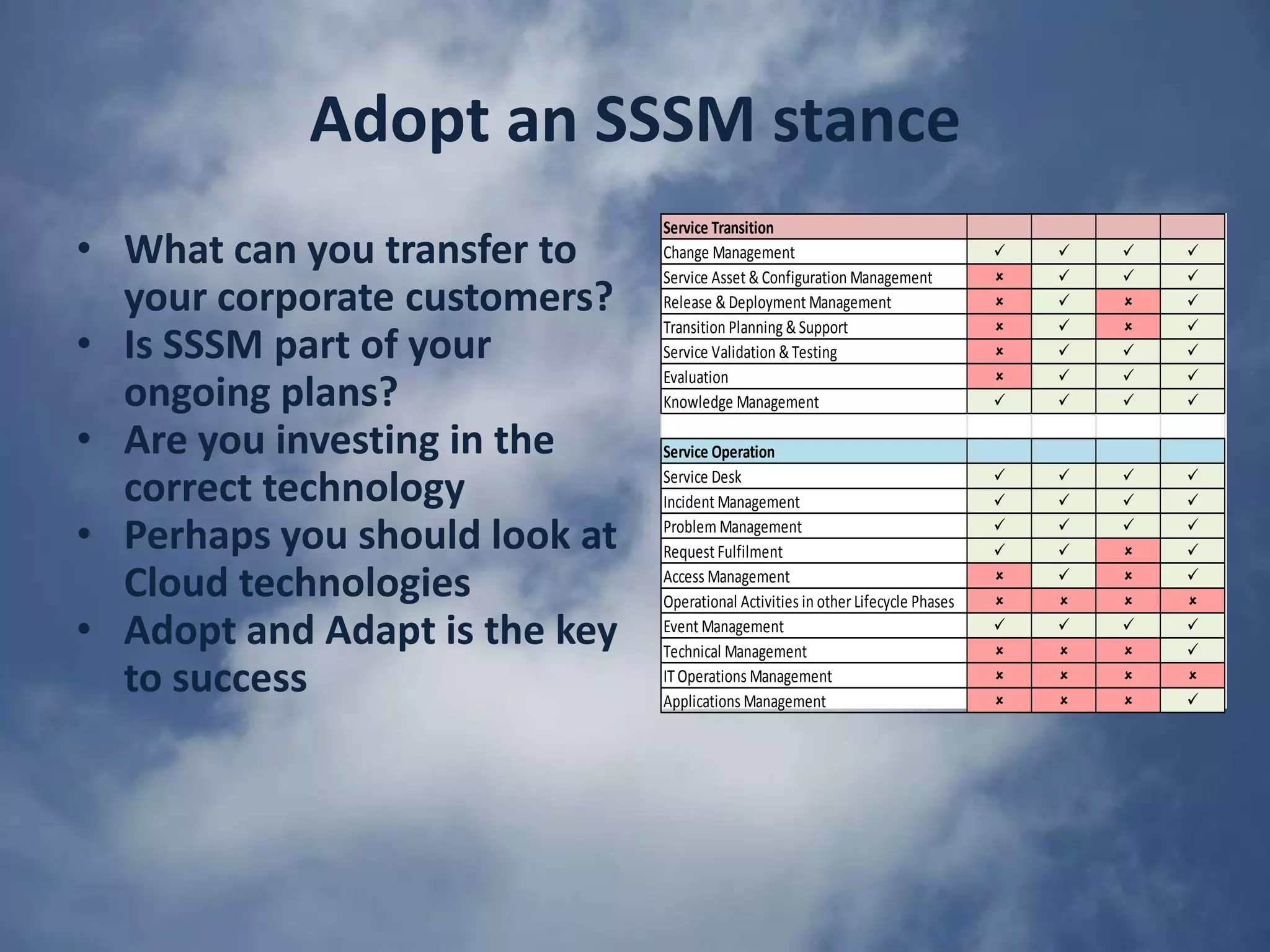
    From watching newservices to becoming key players in new services Adopt an SSSM stanceWhat can you transfer to your corporate customers?Is SSSM part of your ongoing plans?Are you investing in the correct technologyPerhaps you should look at Cloud technologiesAdopt and Adapt is the key to success
  • 53.
    Summary - 1Thereis little doubt that the future will be driven by DttCToo often, IT has been good but not good enough IT must step up to the big challenge that lies aheadIt is now an exciting time for IT Service Management (ITSM) to emerge from theThe business differentiators gained from implementing FEFO can only be successfully realized if ITSM steps up to the challenge. This is just one strategy to enable organizations to master the new wave of mobile support.
  • 54.
    Summary - 2Thevast majority of the DttC services discussed here will be provided through mobile support devices But to gauge the impact of poor ITSM what would happen if the technology failed? Close the facility?Who knows but one thing is certain ignoring the importance of FEFO will dramatically increase the possibility of that failure.
  • 55.
    The Endmalcolm@malcolmfry.comwww.TheITILLiteBook.comwww.TheITILLiteWorkshop.comThank youto BMC for their sponsorship and CITRIX for the use of some webinar slides

Editor's Notes

  • #8 The cloud and Saas services need common rulesITIL has been evolving since mid 80sIt is now regarded as de facto ITSM standardITSM have been supporting SaaS services for years – using ITILIf SaaS is not the single source then other platforms also need supporting
  • #9 The most widely used definitions for cloud computing are supplied by the National Institute of Standards and Technology (NIST). The NIST is the federal technology agency that works with industry to develop and apply technology, measurements, and standards.National Institute of Standards and Technology (NIST)Agency of US Department of CommerceCloud Standards for:essential characteristicsdeployment modelsservice modelshttp://csrc.nist.gov/publications/drafts/800-145/Draft-SP-800-145_cloud-definition.pd
  • #10 Essential Characteristics:On-demand self-service. A consumer can unilaterally provision computing capabilities, such as server time and network storage, as needed automatically without requiring human interaction with each service’s supplier. Broad network access. Capabilities are available over the network and accessed through standard mechanisms that promote use by heterogeneous thin or thick client platforms (e.g., mobile phones, laptops, and PDAs).Resource pooling. The supplier’s computing resources are pooled to serve multiple consumers using a multi-tenant model, with different physical and virtual resources dynamically assigned and reassigned according to consumer demand. There is a sense of location independence in that the customer generally has no control or knowledge over the exact location of the provided resources but may be able to specify location at a higher level of abstraction (e.g., country, state, or datacenter). Examples of resources include storage, processing, memory, network bandwidth, and virtual machines.Rapid elasticity. Capabilities can be rapidly and elastically provisioned, in some cases automatically, to quickly scale out and rapidly released to quickly scale in. To the consumer, the capabilities available for provisioning often appear to be unlimited and can be purchased in any quantity at any time.Measured Service. Cloud systems automatically control and optimize resource use by leveraging a metering capability at some level of abstraction appropriate to the type of service (e.g., storage, processing, bandwidth, and active user accounts). Resource usage can be monitored, controlled, and reported providing transparency for both the supplier and consumer of the utilized service.
  • #11 Private cloud. The cloud infrastructure is operated solely for an organization. It may be managed by the organization or a third party and may exist on premise or off premise.Community cloud. The cloud infrastructure is shared by several organizations and supports a specific community that has shared concerns (e.g., mission, security requirements, policy, and compliance considerations). It may be managed by the organizations or a third party and may exist on premise or off premise.Public cloud. The cloud infrastructure is made available to the general public or a large industry group and is owned by an organization selling cloud services.Hybrid cloud. The cloud infrastructure is a composition of two or more clouds (private, community, or public) that remain unique entities but are bound together by standardized or proprietary technology that enables data and application portability (e.g., cloud bursting for load-balancing between clouds).Cloud Software as a Service (SaaS). The capability provided to the consumer is to use the supplier’s applications running on a cloud infrastructure. The applications are accessible from various client devices through a thin client interface such as a web browser (e.g., web-based email). The consumer does not manage or control the underlying cloud infrastructure including network, servers, operating systems, storage, or even individual application capabilities, with the possible exception of limited user-specific application configuration settings.Cloud Platform as a Service (PaaS). The capability provided to the consumer is to deploy onto the cloud infrastructure consumer-created or acquired applications created using programming languages and tools supported by the supplier. The consumer does not manage or control the underlying cloud infrastructure including network, servers, operating systems, or storage, but has control over the deployed applications and possibly application hosting environment configurations.Cloud Infrastructure as a Service (IaaS). The capability provided to the consumer is to provision processing, storage, networks, and other fundamental computing resources where the consumer is able to deploy and run arbitrary software, which can include operating systems and applications. The consumer does not manage or control the underlying cloud infrastructure but has control over operating systems, storage, deployed applications, and possibly limited control of select networking components (e.g., host firewalls).
  • #12 Private cloud. The cloud infrastructure is operated solely for an organization. It may be managed by the organization or a third party and may exist on premise or off premise.Community cloud. The cloud infrastructure is shared by several organizations and supports a specific community that has shared concerns (e.g., mission, security requirements, policy, and compliance considerations). It may be managed by the organizations or a third party and may exist on premise or off premise.Public cloud. The cloud infrastructure is made available to the general public or a large industry group and is owned by an organization selling cloud services.Hybrid cloud. The cloud infrastructure is a composition of two or more clouds (private, community, or public) that remain unique entities but are bound together by standardized or proprietary technology that enables data and application portability (e.g., cloud bursting for load-balancing between clouds).Cloud Software as a Service (SaaS). The capability provided to the consumer is to use the supplier’s applications running on a cloud infrastructure. The applications are accessible from various client devices through a thin client interface such as a web browser (e.g., web-based email). The consumer does not manage or control the underlying cloud infrastructure including network, servers, operating systems, storage, or even individual application capabilities, with the possible exception of limited user-specific application configuration settings.Cloud Platform as a Service (PaaS). The capability provided to the consumer is to deploy onto the cloud infrastructure consumer-created or acquired applications created using programming languages and tools supported by the supplier. The consumer does not manage or control the underlying cloud infrastructure including network, servers, operating systems, or storage, but has control over the deployed applications and possibly application hosting environment configurations.Cloud Infrastructure as a Service (IaaS). The capability provided to the consumer is to provision processing, storage, networks, and other fundamental computing resources where the consumer is able to deploy and run arbitrary software, which can include operating systems and applications. The consumer does not manage or control the underlying cloud infrastructure but has control over operating systems, storage, deployed applications, and possibly limited control of select networking components (e.g., host firewalls).
  • #14 SaaS is a double edged swordBusiness applications & ITSM tool setIf ITSM uses ITIL then so should SaaS services providersITIL could be the differentiator between providersThe ITIL tool set still needs to be used e.g. change and incident
  • #15 ITIL v2 concentrated on Service Support and Service Deliver – good for the 90sITIL v3 has a life cycle approach which is ideal for SaaSThere is an emphasis shift from retro fitting to get it right first timeSelecting a SaaS tool is a science
  • #16 Two party approach to IT Service Management does not work for cloud computingMind set has change along with the platform changeIt is dealing with the invisible and inaccessible as opposed to the here and nowIt is very difficult to leave SaaS once you have adopted SaaS
  • #17 Each of the key ITIL phases has a role to play:StrategyDesignTransitionOperationContinual Service OperationFor both SaaS suppliers and Saas usersProcesses remain but the roles change
  • #18 Just choosing SaaS is a strategic decisionDeciding which strategy to choose is a vital decision – in this case SaaSChoosing the correct product is the key to successA glance at the components of ITIL Strategy shows why
  • #19 This is where the environment, infrastructure and security are all formedDesign turns the Strategy into realityA glance at the components of ITIL Design shows why
  • #20 This is the point of convergence between platformsWhere traditional meets newKey factor is service validationA glance at the components of ITIL Transition shows why
  • #21 This is where the SaaS product will be supported for the rest of its life cycleIncidents and problems will arise due to technology frictionIt is easier if ITSM is on the same platform as SaaSA glance at the components of ITIL Operation shows why
  • #22 This is where key communications are undertakenImportant to provide data to SaaS suppliersA glance at the components of ITIL CSI shows why
  • #27 Unless they are exclusively SaaS then they will need to integrate old and newITIL compliance is now de facto standard so it is a perfect yardstickAll of the components of ITIL still exist but the roles will changeCommon ground and common terminology with SaaS suppliersWhy would you not make your SaaS offering ITIL compliant?
  • #28 BothThe SaaS supplier should be Pinkverified or at least aiming for itSame rule set means we all play the same game – American football and rugbyIT org will benefit from ITIL/SaaS better if they are compliant
  • #29 Agility without discipline is a dangerous game to play – ask a Circus Trapeze artistAgility must be channelled often an excuse to avoid process such as change management
  • #30 ITIL is being refreshed as we speakWhich of the ITIL disciplines are no longer relevant?SaaS is a means to an end and not modernBy looking at each ITIL process and asking who performs which role?By ensuing that the customer is involved by the SaaS supplier
  • #31 That they have clearly defined operational and transitional processes in particularIncidentService deskProblemChangeAsset Availability/capacitySLAs
  • #32 Getting the SaaS supplier on boardAgreeing clear lines of responsibilitySynchronising SaaS supplier and internal ITIL implementationsGetting local management buy-in especially if the business customer is also the contact point for the SaaS suppler
  • #33 Appoint an ITIL/SaaS co-ordinatorThis is a team effort so get a contact point for ITIL from the SaaS supplierTogether identify the key common ITIL componentsProduce/alter processes as appropriateEstablish regular communications with SaaS/ITIL counterpartsUnderstand that ITSM can be both the customer and service manager for SaaS functions
  • #34 SaaS ITIL compliance shows commitment to Service ManagementService Catalogs and Service portfolios are essential because they remove obstaclesITIL/SaaS needs a clear sponsorDo not let ITIL become an obsession even if SaaS supplier is not ITIL focused you should still be soSaaS service for business are best served with SaaS based ITSM toolsITIL and SaaS are compatible