Company OverviewRobert HalfInternationalFounded in 1948Pioneer in specialized staffing servicesRanked number one in our industry in FORTUNE® magazine’s list of the “World’s Most Admired Companies” (March 22, 2010)Robert Half TechnologyProvides highly skilled IT professionals Conducts ongoing research on IT workplace trendsRespected resource on IT hiring and employment
3.
Today’s DiscussionThe ITHiring EnvironmentTechnical Skills in Demand2011 Salary TrendsThe Value of CertificationsSoft Skills in DemandRetention Strategies5 Signs It’s Time to HireThe Benefits of Flexible Staffing
4.
The 2011 SalaryGuideNational starting salary ranges for IT positions in the United States and CanadaTrends affecting IT hiringAreview of in-demand skills and attributesAdvice on building strong IT teams and maintaining employee moraleStaffing for success
5.
Sources of theDataInterim and full-time placements made throughout the year from our offices in the United States and CanadaLocal insight from our staffing and recruiting professionals throughout our branch networkExclusive workplace research we conduct among CIOs and other executivesAn analysis of the current hiring environment and an extrapolation of current trends into 2011
6.
The IT HiringEnvironment Solid IT teams are essential for firms to remain competitive64 percent of executives interviewed said understaffing was an issueFirms are adding to IT teams to support a number of initiativesCompanies remain highly selective when choosing candidatesMost IT hiring activity is in healthcare, manufacturing, nonprofits, oil and gas, and high tech
7.
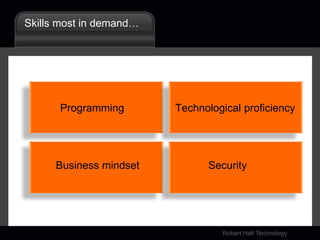
Skills most indemand…Programming Technological proficiencyBusiness mindsetSecurity
8.
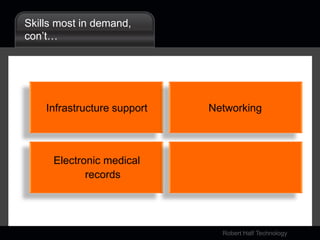
Skills most indemand, con’t…Infrastructure supportNetworkingElectronic medical records
9.
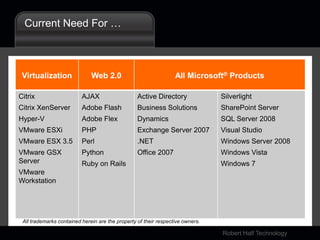
Current Need For…All trademarks contained herein are the property of their respective owners.
10.
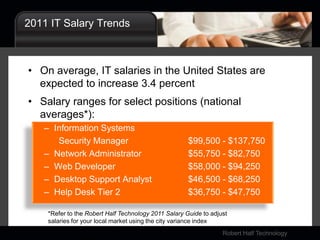
2011 IT SalaryTrendsOn average, IT salaries in the United States are expected to increase 3.4 percentSalary ranges for select positions (national averages*):Information Systems Security Manager $99,500 - $137,750Network Administrator $55,750 - $82,750Web Developer $58,000 - $94,250Desktop Support Analyst $46,500 - $68,250Help Desk Tier 2 $36,750 - $47,750*Refer to the Robert Half Technology 2011 Salary Guide to adjust salaries for your local market using the city variance index numbers provided in the guide.
11.
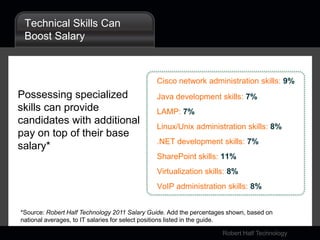
Technical Skills CanBoost SalaryCisco network administration skills: 9%Java development skills: 7%LAMP: 7%Linux/Unix administration skills: 8%.NET development skills: 7%SharePoint skills: 11%Virtualization skills: 8%VoIP administration skills: 8%Possessing specialized skills can provide candidates with additional pay on top of theirbase salary**Source: Robert Half Technology 2011 Salary Guide. Add the percentages shown, based on national averages, to IT salaries for select positions listed in the guide.
12.
The Value ofCertificationsProvides clear evidence of an individual’s knowledge of a particular technology or practiceDemonstrates candidate’s initiativeEssential to lifelong learningIn-demand certifications include:CiscoLinuxMicrosoft Project managementSecurity
13.
Soft Skills inDemandIt’s not just about the technologyLeadership abilitiesCustomer-service mindsetAbility to work under pressureWritten and verbal communication skillsAbility to align business and IT goals
14.
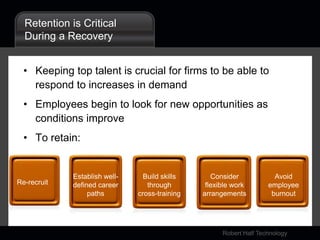
Retention is CriticalDuring a RecoveryKeeping top talent is crucial for firms to be able to respond to increases in demandEmployees begin to look for new opportunities as conditions improveTo retain:Establish well-defined career pathsBuild skills through cross-trainingConsider flexible work arrangementsAvoid employee burnoutRe-recruit
15.
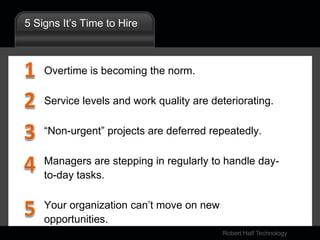
5 Signs It’sTime to HireOvertime is becoming the norm.Service levels and work quality are deteriorating.“Non-urgent” projects are deferred repeatedly.Managers are stepping in regularly to handle day-to-day tasks.Your organization can’t move on new opportunities.
16.
Hiring Plans inActionOutline clear skills requirements for the positionRemain actively involved throughout the recruitment processFocus on professional networking – both online and in personConduct phone interviews with applicantsWork with a specialized staffing firm
17.
Staffing Flexibility:A PerennialAdvantageEmploying a mix of project professionals and full-time staff creates a built-in buffer.Help avoid layoffsEasily staff upQuickly respond to changing demands and requirementsGive yourself protection from staffing mistakes
18.
Staffing Flexibility:A PerennialAdvantageStaffing flexibility requires a holistic view of both short- and long-term needsFirst, look internallyAdd full-time hires for long-term needs and contract professionals for shorter-term project roles or expertise you only need occasionally
19.
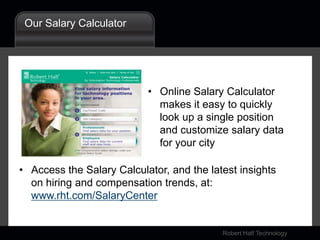
Our Salary CalculatorOnlineSalary Calculator makes it easy to quickly look up a single position and customize salary data for your city
20.
Access the SalaryCalculator, and the latest insights on hiring and compensation trends, at: www.rht.com/SalaryCenterHow We Can HelpRefine salary packages for your marketOffer additional information on local trendsProvide guidance on staffing strategicallyBenefits of working with Robert Half Technology:Industry-leading reputationFast and effective serviceIn-demand professionalsA global network
#5 Before we begin, I want to tell you a little BIT about our Salary Guide and how it’s put together each year, as I’ll be referencing it throughout the presentation.Then we’ll take a closer look at the compensation data and trend analysis it provides.The 2011 Salary Guide includes: [READ FROM SLIDE]
#6 Because of our parent company Robert Half International’s more than 60 years as the leader in specialized staffing, Robert Half Technology is a respected source of information on compensation and hiring trends for IT professionals.Our guide is widely used by private and public firms, media outlets, educational institutions and government agencies. In fact, the U.S. Bureau of Labor Statistics uses our Salary Guide in developing its Occupational Outlook Handbook.Our data and analysis are based on the thousands of interim and full-time placements we make during the year. We also interview our staffing and recruiting professionals throughout our branch networkWe also conduct research on workplace trends that could impact salaries, and WE survey chief information officers (CIOs) about their hiring plans.We review actual starting salaries from 2010.And we extrapolate current trends into 2011.
#8 Demand is growing for application developers, .NET developers, and systems administrators, to name a few. In fact, IT may experience a skills-driven rebound as previously deferred projects are implemented. While the most-sought after skills vary greatly across industries and geographies, expertise in several areas remains consistently in demand:Programming – Knowledge of .NET, Java, mySQL, PHP, Silverlight, Flex and portal technologies like SharePoint is in demand.Business mindset – Firms are seeking IT professionals with business analysis and project management skills, as well as an ability to understand how technology supports broader business objectives.Technological proficiency – Individuals with knowledge of one or more of the major ERP packages and related packages are in demand.Security – To prevent fraud AND network breaches and comply with new regulations, companies are hiring individuals with security expertise.[Continued on next page …]
#9 Infrastructure support – As companies upgrade operating systems and add employees in nontechnical divisions, they are hiring help desk and desktop support professionals and PC technicians, primarily on a project basis.Networking – To manage the increasing complexity of networks and the challenges of virtualization, cloud computing, Software as a Service and convergence technologies, firms are seeking IT professionals with a blend of server, software and networking skills.Electronic medical records – In many areas of the United States, there is a growing need among healthcare organizations for IT professionals with the expertise to install and support medical records software.
#10 Among our clients, some of the skills most in demand include Virtualization, Web 2.0, AND all MS products (e.g., .NET, SharePoint). The primary virtualization tools companies are using include: [READ FROM SLIDE].Companies are looking to harness Web 2.0 to drive revenue growth. Many are implementing strategic initiatives to generate a better user experience for their customers.Virtually all Microsoft skills are needed [READ EXAMPLES FROM SLIDE].
#11 So what can we expect for IT salaries in 2011?Overall salaries are expected to increase by an average of 3.4%, Here are a few examples of the 2011 salary ranges for various positions [READ FROM SLIDE].Keep in mind these are national averages. Salaries need to be adjusted for your local market.Our list of local variances in this year’s guide is more comprehensive than ever. It now features more than 130 U.S. cities.
#12 According to the Robert Half Technology 2011 Salary Guide, those with certain skills can expect THEIR starting compensation TO BE 4 to 11 percent higher than average in the United States. Here’s a snapshot of some specialized skills that can lead to higher base compensation for IT professionals: [READ LIST FROM SLIDE]
#13 Certifications are ALSO an important consideration for managers hiring technology professionals. The value placed on them depends on the needs of the IT department.They provide many benefits [READ FROM SLIDE].While there are numerous IT certifications across a wide range of job categories, the following are examples of some that are in demand by employers:Cisco certifications – Cisco Certified Network Associate (CCNA) Linux certifications – Red Hat Certified Engineer (RHCE) Microsoft certifications – Microsoft Certified Applications Developer (MCAD), Microsoft Certified IT Professional (MCITP), Microsoft Certified Systems Engineer (MCSE) and Microsoft Certified Technology Specialist (MCTS) Project management certifications – Project Management Professional (PMP)Security certifications – Certified Information Systems Security Professional (CISSP), Check Point Certified Security Administrator (CCSA) and Check Point Certified Security Expert (CCSE)
#15 Now that we’ve discussed the IT hiring environment, let’s shift gears and talk about retention. Keeping your top talent should be a crucial focus area. Just as businesses look for new opportunities when conditions improve, so do employees. Your most valuable players may have been biding their time during the recession.Here are some tips for retaining your best and brightest:Re-recruit. Before your competitors can woo your top workers away, re-recruit them yourself. This means selling them all over again on the advantages of working for your company, particularly if you had to make unpopular cuts in employee benefits and perks during the recession. If you’re not yet able to offer new perks (or reinstate old ones), take a different tack. Highlight what’s unique and special about your company. Establish well-defined career paths. While you should avoid making pie-in-the-sky promises, you can help staff members envision tangible rewards on the horizon, including promotions, raises, performance bonuses, company-sponsored training programs or profit-sharing opportunities. Build skills. Why be a training ground for talented employees who then move on, taking their skills to the competition? Offer cross-training so your staff can grow professionally. Your employees will appreciate the opportunity to expand their skills and competencies. Consider flexible work arrangements. A strategy best reserved for top performers, flexible work options can help you hold on to valued employees who might otherwise be tempted to leave. Avoid burnout. Staff members who are consistently overloaded can easily become burned out and seek other opportunities. Bring in help, either full-time or temporary, when necessary. In fact, let’s talk about some signs that it’s time to hire …
#16 How do you know when it’s time to hire? Beyond an intuitive sense that your team may need additional support, here are five telltale signs:Overtime is becoming the norm. If working overtime is the only way your team can avoid falling behind, this is a clear sign you need to add staff. Asking your team members to continually burn the midnight oil can deplete employee morale and lead to turnover.Service levels and work quality are deteriorating. Your workers may be overloaded and feel rushed to complete projects if you’re experiencing an unusual amount of returned items or customers are complaining about how they’re treated by staff. Be careful, because poor service can quickly hurt your reputation. “Non-urgent” projects are deferred repeatedly. If deliverables are chronically postponed, due dates constantly revised, or projects completely thrown off schedule or scrapped entirely, your organization is likely short-staffed.Managers are stepping in regularly to handle day-to-day tasks. If the absence of just one staff member due to illness or other work commitments negatively impacts the entire team, it’s time to hire.Your organization can’t move on new opportunities or take on more clients. Is your organization turning away new business? Is it unable to act on strategic initiatives that could create a competitive advantage simply because there aren’t enough professionals on staff? If so, you may be staring at the biggest red flag of all. The company’s future success may be at risk, so now is the time to think seriously about adding employees.
#17 If you do decide it’s time to hire additional employees, here are some tips:Outline clear skills requirements for the position you are filling so that you can create a targeted job description that can be used in the employment ad and throughout the hiring process.Remain actively involved throughout the recruitment process. Because you have the most accurate understanding of what the position demands, your direct participation is essential.Focus on professional networking, both online and in person. Staying active with industry associations also can help you reach your target candidate base.Conduct phone interviews with applicants whose resumes draw your interest to determine whether they are qualified for the job and possess strong communication skills. This will narrow the list of applicants you invite for in-person interviews.Work with a specialized staffing firm that can locate and identify the strongest IT candidates, including those who may not be actively looking for new jobs but are open to the right opportunity. These firms also can provide skilled professionals you can assess firsthand on a project basis before extending a full-time offer.While we’re on the topic, let’s talk a little more about the advantages of using project professionals as part of a flexible staffing strategy…
#18 Employing a mix of temporary and full-time professionals creates a built-in buffer that helps firms avoid large-scale layoffs during a downturn and easily staff up as business needs shift.Technical experts can be brought in quickly, and for however long you need them, when the knowledge doesn’t exist in house -- for one-time, labor-intensive projects such as a systems conversion, for example.Augmenting the ranks of full-time employees with project professionals also prevents staffing mistakes. You can evaluate an applicant’s skills and work style firsthand and determine whether he or she is likely to match your needs over the long term.How do you implement a flexible staffing strategy? Here are some tips …
#19 Staffing flexibility requires you to assess both your short- and long-term needs.First, look internally.Can you reprioritize projects and temporarily reassign some staff members to more pressing matters?Add full-time hires for positions where you expect to have long-term needs, and augment core staff with contract professionals for shorter-term, project roles or expertise you may need only occasionally.
#21 Staffing managers in your [YOUR AREA] location(s) have the staffing expertise, technical knowledge and resources to help enhance your firm’s efforts in hiring highly experienced professionals.Whether it’s providing insight on staffing more strategically, identifying local hiring trends, or helping you refine salary packages for new hires, we are ready to HELP YOU assess YOUR NEEDS and achieve your hiring goals.There are many benefits of working with Robert Half Technology, including:Industry-leading reputation. Robert Half International was ranked by FORTUNE® magazine (March 22, 2011) as the World’s Most Admired Company in the temporary help sector. Nine out of 10 of our clients and candidates say they would recommend us to their colleagues.Fast and effective service. We have access to more than 900,000 experienced IT professionals through our proprietary database. And we personally interview, evaluate skills and check selected references for every individual we place. Our professionals can start right away, and help you get the job done.In-demand professionals. Robert Half Technology attracts highly skilled job candidates in the IT field because we support their professional development and career advancement. That means we can find a skilled person to meet your business’s unique requirements.A global network. RHT has a deep network of skilled professionals around the world, with more than 100 global offices. Our alliances with top organizations, including Microsoft, HDI, Oracle, Association of Information Technology Professionals and Technology Councils of North America.