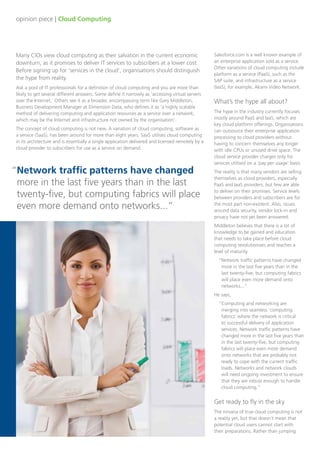
The journey begins
Cloud Computing
opinion piece
opinion piece | Cloud Computing
Many CIOs view cloud computing as their salvation in the current economic
downturn, as it promises to deliver IT services to subscribers at a lower cost.
Before signing up for ‘services in the cloud’, organisations should distinguish
the hype from reality.
Ask a pool of IT professionals for a definition of cloud computing and you are more than
likely to get several different answers. Some define it narrowly as ‘accessing virtual servers
over the Internet.’ Others see it as a broader, encompassing term like Gary Middleton,
Business Development Manager at Dimension Data, who defines it as ‘a highly scalable
method of delivering computing and application resources as a service over a network,
which may be the Internet and infrastructure not owned by the organisation’.
The concept of cloud computing is not new. A variation of cloud computing, software as
a service (SaaS), has been around for more than eight years. SaaS utilises cloud computing
in its architecture and is essentially a single application delivered and licensed remotely by a
cloud provider to subscribers for use as a service on demand.
Salesforce.com is a well known example of
an enterprise application sold as a service.
Other variations of cloud computing include
platform as a service (PaaS), such as the
SAP suite, and infrastructure as a service
(IaaS), for example, Akami Video Network.
What’s the hype all about?
The hype in the industry currently focuses
mostly around PaaS and IaaS, which are
key cloud platform offerings. Organisations
can outsource their enterprise application
processing to cloud providers without
having to concern themselves any longer
with idle CPUs or unused drive space. The
cloud service provider charges only for
services utilised on a ‘pay per usage’ basis.
The reality is that many vendors are selling
themselves as cloud providers, especially
PaaS and IaaS providers, but few are able
to deliver on their promises. Service levels
between providers and subscribers are for
the most part non-existent. Also, issues
around data security, vendor lock-in and
privacy have not yet been answered.
Middleton believes that there is a lot of
knowledge to be gained and education
that needs to take place before cloud
computing revolutionises and reaches a
level of maturity.
“Network traffic patterns have changed
more in the last five years than in the
last twenty-five, but computing fabrics
will place even more demand onto
networks...”
He says,
“Computing and networking are
merging into seamless ‘computing
fabrics’ where the network is critical
to successful delivery of application
services. Network traffic patterns have
changed more in the last five years than
in the last twenty-five, but computing
fabrics will place even more demand
onto networks that are probably not
ready to cope with the current traffic
loads. Networks and network clouds
will need ongoing investment to ensure
that they are robust enough to handle
cloud computing.”
Get ready to fly in the sky
The nirvana of true cloud computing is not
a reality yet, but that doesn’t mean that
potential cloud users cannot start with
their preparations. Rather than jumping
“Network traffic patterns have changed
more in the last five years than in the last
twenty-five, but computing fabrics will place
even more demand onto networks...”
opinion piece | Cloud Computing
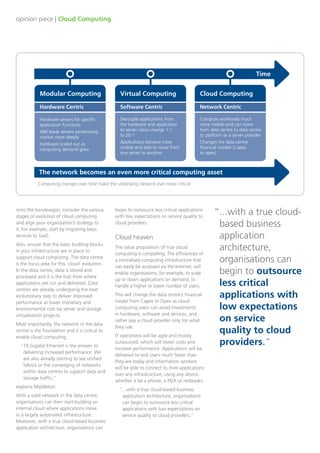
Modular Computing
Hardware Centric
Hardware servers for specific
application functions
X86 blade servers penetrating
market more deeply
Hardware scaled out as
computing demand grew
Virtual Computing
Software Centric
Decouple applications from
the hardware and application
to server ratios change 1:1
to 20:1
Applications become more
mobile and able to move from
one server to another
Cloud Computing
Network Centric
Compute workloads much
more mobile and can move
from data centre to data centre
to platform as a server provider
Changes the data centre
financial models (Capex
to opex)
The network becomes an even more critical computing asset
Computing changes over time make the underlying network ever more critical
onto the bandwagon, consider the various
stages of evolution of cloud computing
and align your organisation’s strategy to
it. For example, start by migrating basic
services to SaaS.
Also, ensure that the basic building blocks
in your infrastructure are in place to
support cloud computing. The data centre
is the focus area for this ‘cloud’ evolution.
In the data centre, data is stored and
processed and it is the hub from where
applications are run and delivered. Data
centres are already undergoing the next
evolutionary step to deliver improved
performance at lower monetary and
environmental cost via server and storage
virtualisation projects.
Most importantly, the network in the data
centre is the foundation and it is critical to
enable cloud computing.
“10 Gigabit Ethernet is the answer to
delivering increased performance. We
are also already starting to see unified
fabrics or the converging of networks
within data centres to support data and
storage traffic,”
explains Middleton.
With a solid network in the data centre,
organisations can then start building an
internal cloud where applications move
in a largely automated infrastructure.
Moreover, with a true cloud-based business
application architecture, organisations can
begin to outsource less critical applications
with low expectations on service quality to
cloud providers.
Cloud heaven
The value proposition of true cloud
computing is compelling. The efficiencies of
a centralised computing infrastructure that
can easily be accessed via the Internet, will
enable organisations, for example, to scale
up or down applications on demand, to
handle a higher or lower number of users.
This will change the data centre’s financial
model from Capex to Opex as cloud
computing users can avoid investments
in hardware, software and services, and
rather pay a cloud provider only for what
they use.
IT operations will be agile and mostly
outsourced, which will lower costs and
increase performance. Applications will be
delivered to end users much faster than
they are today and information workers
will be able to connect to their applications
over any infrastructure, using any device,
whether it be a phone, a PDA or netbooks.
“...with a true cloud-based business
application architecture, organisations
can begin to outsource less critical
applications with low expectations on
service quality to cloud providers.”
“...with a true cloud-
based business
application
architecture,
organisations can
begin to outsource
less critical
applications with
low expectations
on service
quality to cloud
providers.”
Time
opinion piece | Cloud Computing
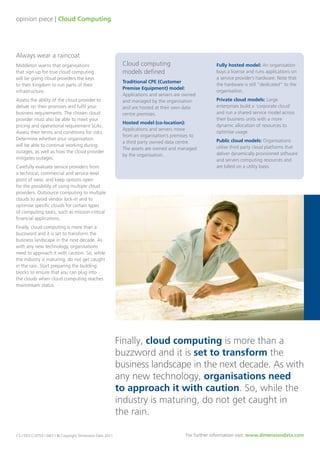
Always wear a raincoat
Middleton warns that organisations
that sign up for true cloud computing
will be giving cloud providers the keys
to their kingdom to run parts of their
infrastructure.
Assess the ability of the cloud provider to
deliver on their promises and fulfil your
business requirements. The chosen cloud
provider must also be able to meet your
pricing and operational requirement SLAs.
Assess their terms and conditions for risks.
Determine whether your organisation
will be able to continue working during
outages, as well as how the cloud provider
mitigates outages.
Carefully evaluate service providers from
a technical, commercial and service level
point of view, and keep options open
for the possibility of using multiple cloud
providers. Outsource computing to multiple
clouds to avoid vendor lock-in and to
optimise specific clouds for certain types
of computing tasks, such as mission-critical
financial applications.
Finally, cloud computing is more than a
buzzword and it is set to transform the
business landscape in the next decade. As
with any new technology, organisations
need to approach it with caution. So, while
the industry is maturing, do not get caught
in the rain. Start preparing the building
blocks to ensure that you can plug into
the clouds when cloud computing reaches
mainstream status.
Cloud computing
models defined
Traditional CPE (Customer
Premise Equipment) model:
Applications and servers are owned
and managed by the organisation
and are hosted at their own data
centre premises.
Hosted model (co-location):
Applications and servers move
from an organisation’s premises to
a third party owned data centre.
The assets are owned and managed
by the organisation.
Fully hosted model: An organisation
buys a license and runs applications on
a service provider’s hardware. Note that
the hardware is still “dedicated” to the
organisation.
Private cloud models: Large
enterprises build a ‘corporate cloud’
and run a shared service model across
their business units with a more
dynamic allocation of resources to
optimise usage.
Public cloud models: Organisations
utilise third party cloud platforms that
deliver dynamically provisioned software
and servers computing resources and
are billed on a utility basis.
Finally, cloud computing is more than a
buzzword and it is set to transform the
business landscape in the next decade. As with
any new technology, organisations need
to approach it with caution. So, while the
industry is maturing, do not get caught in
the rain.
CS / DDCC-0753 / 04/11 © Copyright Dimension Data 2011 For further information visit: www.dimensiondata.com
Middle East  Africa
ALGERIA · ANGOLA
BOTSWANA · GHANA · KENYA
MOROCCO · NAMIBIA · NIGERIA
SAUDI ARABIA · SOUTH AFRICA
TANZANIA · UGANDA
UNITED ARAB EMIRATES
Asia
CHINA · HONG KONG
INDIA · INDONESIA · JAPAN
KOREA · MALAYSIA
NEW ZEALAND · PHILIPPINES
SINGAPORE · TAIWAN
THAILAND · VIETNAM
Australia
AUSTRALIAN CAPITAL TERRITORY
NEW SOUTH WALES · QUEENSLAND
SOUTH AUSTRALIA · VICTORIA
WESTERN AUSTRALIA
Europe
BELGIUM · CZECH REPUBLIC
FRANCE · GERMANY
ITALY · LUXEMBOURG
NETHERLANDS · SPAIN
SWITZERLAND · UNITED KINGDOM
Americas
BRAZIL · CANADA · CHILE
MEXICO · UNITED STATES
For contact details in your region please visit www.dimensiondata.com/globalpresence

Cloud Computing | Dimension Data Europe

  • 1.
    The journey begins CloudComputing opinion piece
  • 2.
    opinion piece |Cloud Computing Many CIOs view cloud computing as their salvation in the current economic downturn, as it promises to deliver IT services to subscribers at a lower cost. Before signing up for ‘services in the cloud’, organisations should distinguish the hype from reality. Ask a pool of IT professionals for a definition of cloud computing and you are more than likely to get several different answers. Some define it narrowly as ‘accessing virtual servers over the Internet.’ Others see it as a broader, encompassing term like Gary Middleton, Business Development Manager at Dimension Data, who defines it as ‘a highly scalable method of delivering computing and application resources as a service over a network, which may be the Internet and infrastructure not owned by the organisation’. The concept of cloud computing is not new. A variation of cloud computing, software as a service (SaaS), has been around for more than eight years. SaaS utilises cloud computing in its architecture and is essentially a single application delivered and licensed remotely by a cloud provider to subscribers for use as a service on demand. Salesforce.com is a well known example of an enterprise application sold as a service. Other variations of cloud computing include platform as a service (PaaS), such as the SAP suite, and infrastructure as a service (IaaS), for example, Akami Video Network. What’s the hype all about? The hype in the industry currently focuses mostly around PaaS and IaaS, which are key cloud platform offerings. Organisations can outsource their enterprise application processing to cloud providers without having to concern themselves any longer with idle CPUs or unused drive space. The cloud service provider charges only for services utilised on a ‘pay per usage’ basis. The reality is that many vendors are selling themselves as cloud providers, especially PaaS and IaaS providers, but few are able to deliver on their promises. Service levels between providers and subscribers are for the most part non-existent. Also, issues around data security, vendor lock-in and privacy have not yet been answered. Middleton believes that there is a lot of knowledge to be gained and education that needs to take place before cloud computing revolutionises and reaches a level of maturity. “Network traffic patterns have changed more in the last five years than in the last twenty-five, but computing fabrics will place even more demand onto networks...” He says, “Computing and networking are merging into seamless ‘computing fabrics’ where the network is critical to successful delivery of application services. Network traffic patterns have changed more in the last five years than in the last twenty-five, but computing fabrics will place even more demand onto networks that are probably not ready to cope with the current traffic loads. Networks and network clouds will need ongoing investment to ensure that they are robust enough to handle cloud computing.” Get ready to fly in the sky The nirvana of true cloud computing is not a reality yet, but that doesn’t mean that potential cloud users cannot start with their preparations. Rather than jumping “Network traffic patterns have changed more in the last five years than in the last twenty-five, but computing fabrics will place even more demand onto networks...”
  • 3.
    opinion piece |Cloud Computing Modular Computing Hardware Centric Hardware servers for specific application functions X86 blade servers penetrating market more deeply Hardware scaled out as computing demand grew Virtual Computing Software Centric Decouple applications from the hardware and application to server ratios change 1:1 to 20:1 Applications become more mobile and able to move from one server to another Cloud Computing Network Centric Compute workloads much more mobile and can move from data centre to data centre to platform as a server provider Changes the data centre financial models (Capex to opex) The network becomes an even more critical computing asset Computing changes over time make the underlying network ever more critical onto the bandwagon, consider the various stages of evolution of cloud computing and align your organisation’s strategy to it. For example, start by migrating basic services to SaaS. Also, ensure that the basic building blocks in your infrastructure are in place to support cloud computing. The data centre is the focus area for this ‘cloud’ evolution. In the data centre, data is stored and processed and it is the hub from where applications are run and delivered. Data centres are already undergoing the next evolutionary step to deliver improved performance at lower monetary and environmental cost via server and storage virtualisation projects. Most importantly, the network in the data centre is the foundation and it is critical to enable cloud computing. “10 Gigabit Ethernet is the answer to delivering increased performance. We are also already starting to see unified fabrics or the converging of networks within data centres to support data and storage traffic,” explains Middleton. With a solid network in the data centre, organisations can then start building an internal cloud where applications move in a largely automated infrastructure. Moreover, with a true cloud-based business application architecture, organisations can begin to outsource less critical applications with low expectations on service quality to cloud providers. Cloud heaven The value proposition of true cloud computing is compelling. The efficiencies of a centralised computing infrastructure that can easily be accessed via the Internet, will enable organisations, for example, to scale up or down applications on demand, to handle a higher or lower number of users. This will change the data centre’s financial model from Capex to Opex as cloud computing users can avoid investments in hardware, software and services, and rather pay a cloud provider only for what they use. IT operations will be agile and mostly outsourced, which will lower costs and increase performance. Applications will be delivered to end users much faster than they are today and information workers will be able to connect to their applications over any infrastructure, using any device, whether it be a phone, a PDA or netbooks. “...with a true cloud-based business application architecture, organisations can begin to outsource less critical applications with low expectations on service quality to cloud providers.” “...with a true cloud- based business application architecture, organisations can begin to outsource less critical applications with low expectations on service quality to cloud providers.” Time
  • 4.
    opinion piece |Cloud Computing Always wear a raincoat Middleton warns that organisations that sign up for true cloud computing will be giving cloud providers the keys to their kingdom to run parts of their infrastructure. Assess the ability of the cloud provider to deliver on their promises and fulfil your business requirements. The chosen cloud provider must also be able to meet your pricing and operational requirement SLAs. Assess their terms and conditions for risks. Determine whether your organisation will be able to continue working during outages, as well as how the cloud provider mitigates outages. Carefully evaluate service providers from a technical, commercial and service level point of view, and keep options open for the possibility of using multiple cloud providers. Outsource computing to multiple clouds to avoid vendor lock-in and to optimise specific clouds for certain types of computing tasks, such as mission-critical financial applications. Finally, cloud computing is more than a buzzword and it is set to transform the business landscape in the next decade. As with any new technology, organisations need to approach it with caution. So, while the industry is maturing, do not get caught in the rain. Start preparing the building blocks to ensure that you can plug into the clouds when cloud computing reaches mainstream status. Cloud computing models defined Traditional CPE (Customer Premise Equipment) model: Applications and servers are owned and managed by the organisation and are hosted at their own data centre premises. Hosted model (co-location): Applications and servers move from an organisation’s premises to a third party owned data centre. The assets are owned and managed by the organisation. Fully hosted model: An organisation buys a license and runs applications on a service provider’s hardware. Note that the hardware is still “dedicated” to the organisation. Private cloud models: Large enterprises build a ‘corporate cloud’ and run a shared service model across their business units with a more dynamic allocation of resources to optimise usage. Public cloud models: Organisations utilise third party cloud platforms that deliver dynamically provisioned software and servers computing resources and are billed on a utility basis. Finally, cloud computing is more than a buzzword and it is set to transform the business landscape in the next decade. As with any new technology, organisations need to approach it with caution. So, while the industry is maturing, do not get caught in the rain. CS / DDCC-0753 / 04/11 © Copyright Dimension Data 2011 For further information visit: www.dimensiondata.com
  • 5.
    Middle East Africa ALGERIA · ANGOLA BOTSWANA · GHANA · KENYA MOROCCO · NAMIBIA · NIGERIA SAUDI ARABIA · SOUTH AFRICA TANZANIA · UGANDA UNITED ARAB EMIRATES Asia CHINA · HONG KONG INDIA · INDONESIA · JAPAN KOREA · MALAYSIA NEW ZEALAND · PHILIPPINES SINGAPORE · TAIWAN THAILAND · VIETNAM Australia AUSTRALIAN CAPITAL TERRITORY NEW SOUTH WALES · QUEENSLAND SOUTH AUSTRALIA · VICTORIA WESTERN AUSTRALIA Europe BELGIUM · CZECH REPUBLIC FRANCE · GERMANY ITALY · LUXEMBOURG NETHERLANDS · SPAIN SWITZERLAND · UNITED KINGDOM Americas BRAZIL · CANADA · CHILE MEXICO · UNITED STATES For contact details in your region please visit www.dimensiondata.com/globalpresence