Cloud Computing: 8
Cloud Service Models
Prof Neeraj Bhargava
Vaibhav Khanna
Department of Computer Science
School of Engineering and Systems Sciences
Maharshi Dayanand Saraswati University Ajmer
Cloud Service Models
• SaaS – Software as a Service
• IaaS – Infrastructure as a Service
• PaaS – Platform as a Service
• DaaS – Desktop as a Service
What is Software as a Service? (SaaS)
• SaaS is a software delivery methodology
that provides licensed multi-tenant access
to software and its functions remotely as a
Web-based service.
– Usually billed based on usage
– Usually multi tenant environment
– Highly scalable architecture
SaaS is not ASP 2.0
– The ASP model concentrated on providing an
organization with the ability to move certain
application processing duties to leased third-
party managed servers.
– ASPs were not necessarily concerned about
providing shared services to multiple tenants, but
rather hosting a dedicated application on behalf
of the customer.
– Most ASPs did not possess the required amount
of application and business knowledge regarding
the applications they were running.
SaaS Examples
Infrastructure as a Service (IaaS)
• IaaS is the delivery of technology
infrastructure as an on demand scalable
service
– Usually billed based on usage
– Usually multi tenant virtualized
environment
– Can be coupled with Managed Services for
OS and application support
IaaS is not Managed Hosting
• Traditional managed hosting is a form of
web hosting where a user chooses to lease
entire server(s) housed in an off-site data
center.
– Term based contracts based on projected
resource requirements
IaaS Examples
Platform as a Service (PaaS)
• PaaS provides all of the facilities required to
support the complete life cycle of building
and delivering web applications and services
entirely from the Internet.
– Typically applications must be developed with
a particular platform in mind
– Multi tenant environments
– Highly scalable multi tier architecture
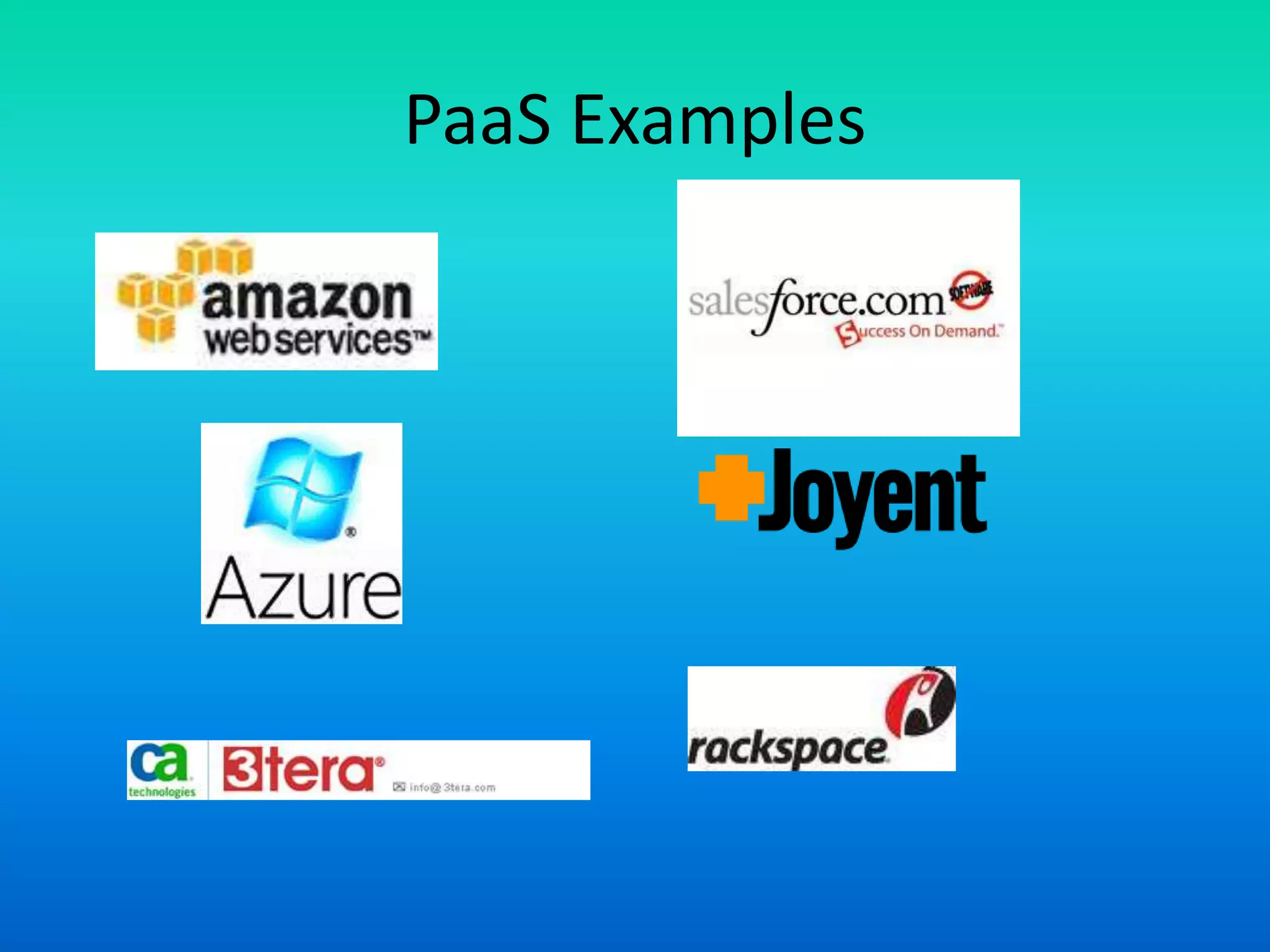
PaaS Examples
Deployment Models
Public cloud
• Public cloud (off-site and remote) describes cloud computing where resources are dynamically
provisioned on an on-demand, self-service basis over the Internet, via web applications/web
services, open API, from a third-party provider who bills on a utility computing basis.
Private cloud
• A private cloud environment is often the first step for a corporation prior to adopting a public cloud
initiative. Corporations have discovered the benefits of consolidating shared services on virtualized
hardware deployed from a primary datacenter to serve local and remote users.
Hybrid cloud
• A hybrid cloud environment consists of some portion of computing resources on-site (on premise)
and off-site (public cloud). By integrating public cloud services, users can leverage cloud solutions
for specific functions that are too costly to maintain on-premise such as virtual server disaster
recovery, backups and test/development environments.
Community cloud
• A community cloud is formed when several organizations with similar requirements share common
infrastructure. Costs are spread over fewer users than a public cloud but more than a single tenant.
Where is the Cloud Going?
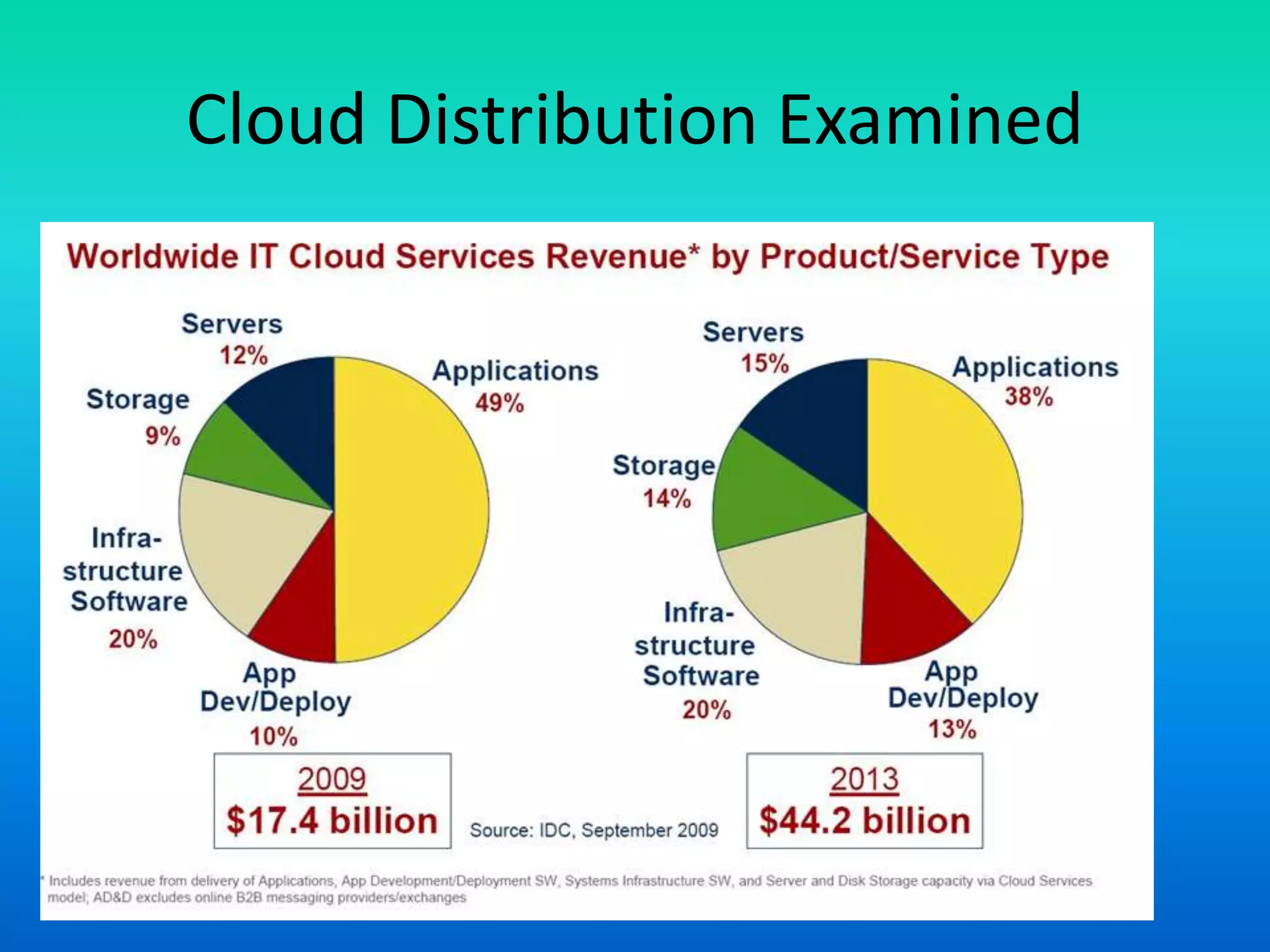
• IDC's updated IT Cloud Services Forecast predicts
that public cloud computing will grow from $17.4
billion worth of IT spend in 2009 to $44 billion by
2013. 1
• Additionally, Federal CIO Vivek Kundra has vowed
to spend $19 billion of U.S. government's $70
billion IT budget on cloud computing.
• The five year growth outlook remains strong,
with a five-year annual growth rate of 26% – over
six times the rate of traditional IT offerings.1
Public Cloud Only
Cloud Distribution Examined
Why Now?
• The acceptance and proliferation of hardware
virtualization and multi-tenant applications
• The Internet has become ubiquitous and an accepted
method of connecting providers with consumers
• ISPs/Telcos are offering robust, redundant and
managed corporate internet service enabling service
consolidation efficiencies.
• The cost verses risk equation has tipped toward shared
solutions
• Computing capabilities are being seen as a ongoing
service rather than an internal capital expense
Assignment
• Describe the Cloud Service Models

Cloud computing 8 cloud service models

  • 1.
    Cloud Computing: 8 CloudService Models Prof Neeraj Bhargava Vaibhav Khanna Department of Computer Science School of Engineering and Systems Sciences Maharshi Dayanand Saraswati University Ajmer
  • 2.
    Cloud Service Models •SaaS – Software as a Service • IaaS – Infrastructure as a Service • PaaS – Platform as a Service • DaaS – Desktop as a Service
  • 3.
    What is Softwareas a Service? (SaaS) • SaaS is a software delivery methodology that provides licensed multi-tenant access to software and its functions remotely as a Web-based service. – Usually billed based on usage – Usually multi tenant environment – Highly scalable architecture
  • 4.
    SaaS is notASP 2.0 – The ASP model concentrated on providing an organization with the ability to move certain application processing duties to leased third- party managed servers. – ASPs were not necessarily concerned about providing shared services to multiple tenants, but rather hosting a dedicated application on behalf of the customer. – Most ASPs did not possess the required amount of application and business knowledge regarding the applications they were running.
  • 5.
  • 6.
    Infrastructure as aService (IaaS) • IaaS is the delivery of technology infrastructure as an on demand scalable service – Usually billed based on usage – Usually multi tenant virtualized environment – Can be coupled with Managed Services for OS and application support
  • 7.
    IaaS is notManaged Hosting • Traditional managed hosting is a form of web hosting where a user chooses to lease entire server(s) housed in an off-site data center. – Term based contracts based on projected resource requirements
  • 8.
  • 9.
    Platform as aService (PaaS) • PaaS provides all of the facilities required to support the complete life cycle of building and delivering web applications and services entirely from the Internet. – Typically applications must be developed with a particular platform in mind – Multi tenant environments – Highly scalable multi tier architecture
  • 10.
  • 11.
    Deployment Models Public cloud •Public cloud (off-site and remote) describes cloud computing where resources are dynamically provisioned on an on-demand, self-service basis over the Internet, via web applications/web services, open API, from a third-party provider who bills on a utility computing basis. Private cloud • A private cloud environment is often the first step for a corporation prior to adopting a public cloud initiative. Corporations have discovered the benefits of consolidating shared services on virtualized hardware deployed from a primary datacenter to serve local and remote users. Hybrid cloud • A hybrid cloud environment consists of some portion of computing resources on-site (on premise) and off-site (public cloud). By integrating public cloud services, users can leverage cloud solutions for specific functions that are too costly to maintain on-premise such as virtual server disaster recovery, backups and test/development environments. Community cloud • A community cloud is formed when several organizations with similar requirements share common infrastructure. Costs are spread over fewer users than a public cloud but more than a single tenant.
  • 12.
    Where is theCloud Going? • IDC's updated IT Cloud Services Forecast predicts that public cloud computing will grow from $17.4 billion worth of IT spend in 2009 to $44 billion by 2013. 1 • Additionally, Federal CIO Vivek Kundra has vowed to spend $19 billion of U.S. government's $70 billion IT budget on cloud computing. • The five year growth outlook remains strong, with a five-year annual growth rate of 26% – over six times the rate of traditional IT offerings.1 Public Cloud Only
  • 13.
  • 14.
    Why Now? • Theacceptance and proliferation of hardware virtualization and multi-tenant applications • The Internet has become ubiquitous and an accepted method of connecting providers with consumers • ISPs/Telcos are offering robust, redundant and managed corporate internet service enabling service consolidation efficiencies. • The cost verses risk equation has tipped toward shared solutions • Computing capabilities are being seen as a ongoing service rather than an internal capital expense
  • 15.
    Assignment • Describe theCloud Service Models