Presenting by
k.Vemalamma
ECE-B
3rd year
The new age of computing
Cloud computing
-the new age of computing
Presented by
M.Hima bindu.
Outlines:
 Introduction
 What is cloud computing?
 Why cloud computing?
 History
 cloud components
 service models
 applications
 advantages
 disadvantages
Cloud computing, with broad-
ranging effects across IT,
Information Architecture,
Business, Software Engineering,
and Data Storage
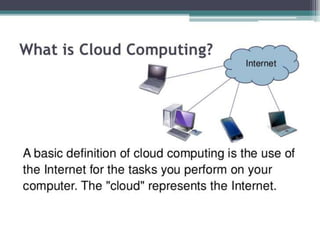
Cloud computing refers to the
delivery of computing resources
over the Internet.
Why cloudcomputing ???...
Cloud computing is user-centric
 Cloud computing is task-centric
 Cloud computing is powerful
 Cloud computing is accessible
 Cloud computing is intelligent
 Cloud computing is programmable
HISTORY
Concept evolved in 1950 (IBM) called RJE (Remote Job Entry
process)
In 2006 Amazon provided first public cloud AWS (Amazon Web
Service)
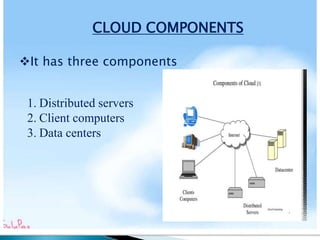
CLOUD COMPONENTS
It has three components
1. Distributed servers
2. Client computers
3. Data centers
CLIENTS
Clients are the devices that the end user interact with
cloud.
Three types of clients
i. Mobile
ii. Thick
iii. Thin( most popular)
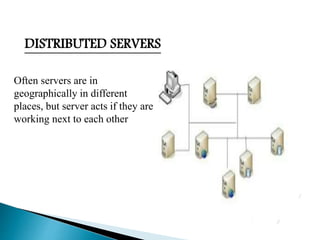
DISTRIBUTED SERVERS
Often servers are in
geographically in different
places, but server acts if they are
working next to each other
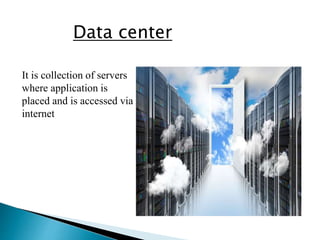
Data center
It is collection of servers
where application is
placed and is accessed via
internet
Service models
 SaaS ( Software as a Service) : Required software,
operating system & network is provided
PaaS( Platform as Service): Operating system and
network is provided
IaaS( Infrastructure as a service): Just network is
provided.
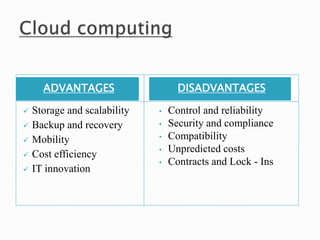
ADVANTAGES DISADVANTAGES
 Storage and scalability
 Backup and recovery
 Mobility
 Cost efficiency
 IT innovation
• Control and reliability
• Security and compliance
• Compatibility
• Unpredicted costs
• Contracts and Lock - Ins
Cloud computing

Cloud computing

  • 1.
    Presenting by k.Vemalamma ECE-B 3rd year Thenew age of computing Cloud computing -the new age of computing Presented by M.Hima bindu.
  • 2.
    Outlines:  Introduction  Whatis cloud computing?  Why cloud computing?  History  cloud components  service models  applications  advantages  disadvantages
  • 3.
    Cloud computing, withbroad- ranging effects across IT, Information Architecture, Business, Software Engineering, and Data Storage Cloud computing refers to the delivery of computing resources over the Internet.
  • 5.
    Why cloudcomputing ???... Cloudcomputing is user-centric  Cloud computing is task-centric  Cloud computing is powerful  Cloud computing is accessible  Cloud computing is intelligent  Cloud computing is programmable
  • 6.
    HISTORY Concept evolved in1950 (IBM) called RJE (Remote Job Entry process) In 2006 Amazon provided first public cloud AWS (Amazon Web Service)
  • 7.
    CLOUD COMPONENTS It hasthree components 1. Distributed servers 2. Client computers 3. Data centers
  • 8.
    CLIENTS Clients are thedevices that the end user interact with cloud. Three types of clients i. Mobile ii. Thick iii. Thin( most popular)
  • 9.
    DISTRIBUTED SERVERS Often serversare in geographically in different places, but server acts if they are working next to each other
  • 10.
    Data center It iscollection of servers where application is placed and is accessed via internet
  • 11.
    Service models  SaaS( Software as a Service) : Required software, operating system & network is provided PaaS( Platform as Service): Operating system and network is provided IaaS( Infrastructure as a service): Just network is provided.
  • 13.
    ADVANTAGES DISADVANTAGES  Storageand scalability  Backup and recovery  Mobility  Cost efficiency  IT innovation • Control and reliability • Security and compliance • Compatibility • Unpredicted costs • Contracts and Lock - Ins