The term "cloud" refers to the network or the internet,
which is located at a remote location.
The cloud provides services over networks,
including both :
• public networks (like the internet) and
• private networks (such as WANs, LANs, or VPNs).
Various applications(services that run in the cloud), such
as :
• e-mail,
• web conferencing, and
• customer relationship management (CRM).
Introductio
n
• Cloud computing has embarked a revolution in accessing,
provisioning and consumption of information and
computing in the ICT industry.
• Cloud computing is a novel paradigm of high-
performance and large-scale computing.
• It involves the relocation of computing and data from
desktops and personal computers to big data centers.
• Cloud is a construct (infrastructure) that allows to access
an application that actually resides at a remote location
of another internet-connected device, most often, this
will be a distant data center.
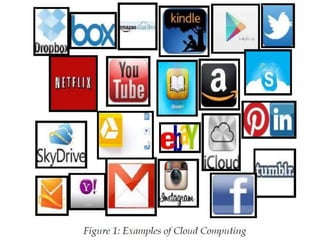
• Cloud computing takes the technology, services, and
applications that are similar to those on the Internet and
turns them into a self-service utility (Figure 1).
What is Cloud
Computing?
What is Cloud
Computing?
• Cloud computing enables ubiquitous, convenient, and
on-demand network access to a shared pool of
configurable computer resources.
• These resources include networks, servers, storage,
applications, and services.
- Ubiquitous Access: Users can access cloud resources
from anywhere with an internet connection.
- Convenience: Cloud services are easily accessible and
provide a user-friendly experience.
- On-Demand Provisioning: Resources can be quickly
provisioned and scaled up or down as needed.
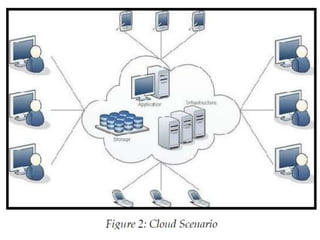
• Cloud computing minimizes the need for extensive
management and maintenance by users. (Figure 2).
What is Cloud
Computing?
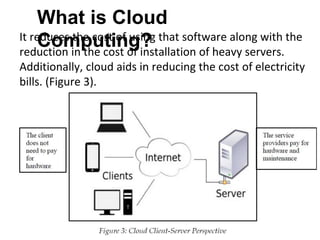
It reduces the cost of using that software along with the
reduction in the cost of installation of heavy servers.
Additionally, cloud aids in reducing the cost of electricity
bills. (Figure 3).
Cloud Computing Collaboration
• With the growth of the Internet, there was no need to limit group
collaboration to a single enterprise’s network environment.
• The users from multiple locations within a corporation, and from
multiple organizations, desired to collaborate on projects that
crossed company and geographic boundaries.
• Projects had to be housed in the “cloud” of the Internet, and
accessed from any Internet-enabled location.
• The concept of cloud-based documents and services took wing with
the development of large server farms, such as those run by Google
and other search companies.
• Cloud collaboration is also termed as Internet-based group
collaboration.
History of Cloud Computing
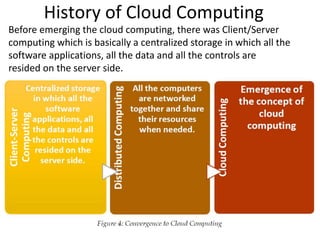
Before emerging the cloud computing, there was Client/Server
computing which is basically a centralized storage in which all the
software applications, all the data and all the controls are
resided on the server side.
History of Cloud Computing
• an American Psychologist and Computer Scientist(J.C.R Licklider )
gave an introduction to cloud computing technique which we all
know today. in 1960
• At around in 1961, John MacCharty suggested in a speech at MIT
that computing can be sold like a utility, just like a water or
electricity.
• In 1999, Salesforce.com started delivering of applications to users
using a simple website.
• In 2002, Amazon started Amazon Web Services, providing services
like storage, computation and even human intelligence.
• in 2006 starting Amazon with the launch of the Elastic Compute
Cloud a truly commercial service open to everybody existed.
History of Cloud Computing
• By 2008, Google too introduced its beta version of the search engine.
• In 2009, Google Apps also started to provide cloud computing
enterprise applications.
• Earlier announced by Microsoft in the year 2008, it released its cloud
computing service named Microsoft Azure for testing, deployment
and managing applications and services.
• In the year 2012, Google Compute Engine was released but was
rolled to the public.
• By the end of Dec 2013, Oracle introduced Oracle Cloud with three
primary services for business (IaaS, PaaS and SaaS). Currently, as per
records, Linux and Microsoft Azure share most of their work parallel.
Cloud Properties: Google’s Perspective
• Cloud computing is user-centric:
• Cloud computing is task-centric:
• Cloud computing is powerful:
• Cloud computing is intelligent:
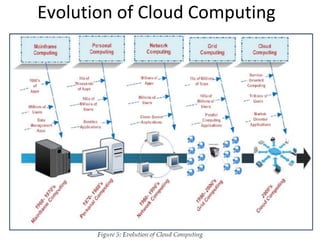
Evolution of Cloud Computing
• Growth of cloud computing is not an instantaneous task but has
transited from several intermediate stages.
• Beginning from an era of mainframe computing where huge
and powerful mainframe systems supported many users
connected through dummy terminals and running data
management applications.
• There exist five intermediary stages from mainframe
Evolution of Cloud Computing
• The development of grid computing followed by the rise of
cloud computing and is characterized as:
 Development of grid computing offered sharing of
computing power and resources spread across multiple
geographical domains.
 The recent stage involves rise of cloud computing where
service-oriented, market-based computing applications are
predominant.
 Virtualization meets the Internet.
Essential Cloud Computing
Concepts
Cloud” makes reference to the two essential concepts:
• Abstraction:
- abstracts the details of system implementation from
users and developers.
- Applications run on physical systems that aren't
specified,
- data is stored into cations that are unknown,
- administration of systems is outsourced to others, and
- access by users is ubiquitous (Present or found
everywhere).
Essential Cloud Computing
Concepts
• Virtualization:
- virtualizes systems by pooling and sharing resources.
- Systems and storage can be provisioned as needed
from a centralized infrastructure,
- costs are assessed on a metered basis,
- multi-tenancy is enabled, and
- resources are scalable with agility.
Who Benefits from Cloud
Computing?
• Collaborators.
• Road Warriors.
• Cost-Conscious Users : Another.
• Cost-Conscious IT Departments.
• Users with Increasing Needs.
Advantages of Cloud Computing
• Cost Efficiency:
• High speed:
• Excellent Accessibility:
• Back-up and Restore data:
• Manageability.
• Sporadic Batch Processing
• Strategic Edge
Disadvantages of Cloud
Computing:
• Vulnerability to Attacks
• Network Connectivity Dependency
• Downtime
• Vendor Lock-In
• Limited Control
Components of Cloud Computing
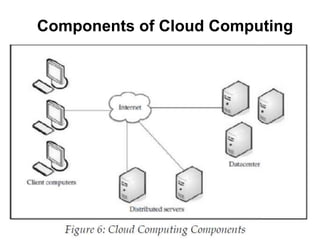
Cloud computing is made up of several elements and these
elements make up the three components of a cloud computing
solution (Figure 6).
a. Clients
b. The data center, and
c. Distributed servers.
Components of Cloud Computing
Thank You
By Dr. A.Rahman 23

chapter one 1 cloudcomputing .pptx someone

  • 2.
    The term "cloud"refers to the network or the internet, which is located at a remote location. The cloud provides services over networks, including both : • public networks (like the internet) and • private networks (such as WANs, LANs, or VPNs). Various applications(services that run in the cloud), such as : • e-mail, • web conferencing, and • customer relationship management (CRM). Introductio n
  • 4.
    • Cloud computinghas embarked a revolution in accessing, provisioning and consumption of information and computing in the ICT industry. • Cloud computing is a novel paradigm of high- performance and large-scale computing. • It involves the relocation of computing and data from desktops and personal computers to big data centers. • Cloud is a construct (infrastructure) that allows to access an application that actually resides at a remote location of another internet-connected device, most often, this will be a distant data center. • Cloud computing takes the technology, services, and applications that are similar to those on the Internet and turns them into a self-service utility (Figure 1). What is Cloud Computing?
  • 5.
    What is Cloud Computing? •Cloud computing enables ubiquitous, convenient, and on-demand network access to a shared pool of configurable computer resources. • These resources include networks, servers, storage, applications, and services. - Ubiquitous Access: Users can access cloud resources from anywhere with an internet connection. - Convenience: Cloud services are easily accessible and provide a user-friendly experience. - On-Demand Provisioning: Resources can be quickly provisioned and scaled up or down as needed. • Cloud computing minimizes the need for extensive management and maintenance by users. (Figure 2).
  • 7.
    What is Cloud Computing? Itreduces the cost of using that software along with the reduction in the cost of installation of heavy servers. Additionally, cloud aids in reducing the cost of electricity bills. (Figure 3).
  • 8.
    Cloud Computing Collaboration •With the growth of the Internet, there was no need to limit group collaboration to a single enterprise’s network environment. • The users from multiple locations within a corporation, and from multiple organizations, desired to collaborate on projects that crossed company and geographic boundaries. • Projects had to be housed in the “cloud” of the Internet, and accessed from any Internet-enabled location. • The concept of cloud-based documents and services took wing with the development of large server farms, such as those run by Google and other search companies. • Cloud collaboration is also termed as Internet-based group collaboration.
  • 9.
    History of CloudComputing Before emerging the cloud computing, there was Client/Server computing which is basically a centralized storage in which all the software applications, all the data and all the controls are resided on the server side.
  • 10.
    History of CloudComputing • an American Psychologist and Computer Scientist(J.C.R Licklider ) gave an introduction to cloud computing technique which we all know today. in 1960 • At around in 1961, John MacCharty suggested in a speech at MIT that computing can be sold like a utility, just like a water or electricity. • In 1999, Salesforce.com started delivering of applications to users using a simple website. • In 2002, Amazon started Amazon Web Services, providing services like storage, computation and even human intelligence. • in 2006 starting Amazon with the launch of the Elastic Compute Cloud a truly commercial service open to everybody existed.
  • 11.
    History of CloudComputing • By 2008, Google too introduced its beta version of the search engine. • In 2009, Google Apps also started to provide cloud computing enterprise applications. • Earlier announced by Microsoft in the year 2008, it released its cloud computing service named Microsoft Azure for testing, deployment and managing applications and services. • In the year 2012, Google Compute Engine was released but was rolled to the public. • By the end of Dec 2013, Oracle introduced Oracle Cloud with three primary services for business (IaaS, PaaS and SaaS). Currently, as per records, Linux and Microsoft Azure share most of their work parallel.
  • 12.
    Cloud Properties: Google’sPerspective • Cloud computing is user-centric: • Cloud computing is task-centric: • Cloud computing is powerful: • Cloud computing is intelligent:
  • 13.
    Evolution of CloudComputing • Growth of cloud computing is not an instantaneous task but has transited from several intermediate stages. • Beginning from an era of mainframe computing where huge and powerful mainframe systems supported many users connected through dummy terminals and running data management applications. • There exist five intermediary stages from mainframe
  • 14.
  • 15.
    Evolution of CloudComputing • The development of grid computing followed by the rise of cloud computing and is characterized as:  Development of grid computing offered sharing of computing power and resources spread across multiple geographical domains.  The recent stage involves rise of cloud computing where service-oriented, market-based computing applications are predominant.  Virtualization meets the Internet.
  • 16.
    Essential Cloud Computing Concepts Cloud”makes reference to the two essential concepts: • Abstraction: - abstracts the details of system implementation from users and developers. - Applications run on physical systems that aren't specified, - data is stored into cations that are unknown, - administration of systems is outsourced to others, and - access by users is ubiquitous (Present or found everywhere).
  • 17.
    Essential Cloud Computing Concepts •Virtualization: - virtualizes systems by pooling and sharing resources. - Systems and storage can be provisioned as needed from a centralized infrastructure, - costs are assessed on a metered basis, - multi-tenancy is enabled, and - resources are scalable with agility.
  • 18.
    Who Benefits fromCloud Computing? • Collaborators. • Road Warriors. • Cost-Conscious Users : Another. • Cost-Conscious IT Departments. • Users with Increasing Needs.
  • 19.
    Advantages of CloudComputing • Cost Efficiency: • High speed: • Excellent Accessibility: • Back-up and Restore data: • Manageability. • Sporadic Batch Processing • Strategic Edge
  • 20.
    Disadvantages of Cloud Computing: •Vulnerability to Attacks • Network Connectivity Dependency • Downtime • Vendor Lock-In • Limited Control
  • 21.
    Components of CloudComputing Cloud computing is made up of several elements and these elements make up the three components of a cloud computing solution (Figure 6). a. Clients b. The data center, and c. Distributed servers.
  • 22.
  • 23.
    Thank You By Dr.A.Rahman 23

Editor's Notes

  • #3 يشير مصطلح "السحابة" إلى الشبكة أو الإنترنت الموجود في مكان بعيد.ت وفر السحابة الخدمات عبر الشبكات، بما في ذلك كل من: الشبكات العامة (مثل الإنترنت) والشبكات الخاصة (مثل شبكات WAN، أو شبكات LAN، أو شبكات VPN). التطبيقات المختلفة (الخدمات التي تعمل في السحابة)، مثل:بريد إلكتروني، مؤتمرات الويب، وإدارة علاقات العملاء CRM))
  • #5 بدأت الحوسبة السحابية ثورة في الوصول إلى المعلومات والحوسبة وتوفيرها واستهلاكها في صناعة تكنولوجيا المعلومات والاتصالات. الحوسبة السحابية هي نموذج جديد للحوسبة عالية الأداء وواسعة النطاق. وهو ينطوي على نقل الحوسبة والبيانات من أجهزة الكمبيوتر المكتبية وأجهزة الكمبيوتر الشخصية إلى مراكز البيانات الكبيرة. السحابة عبارة عن بنية (بنية تحتية) تسمح بالوصول إلى تطبيق موجود فعليًا في موقع بعيد لجهاز آخر متصل بالإنترنت، وفي أغلب الأحيان، سيكون هذا مركز بيانات بعيدًا.تأخذ الحوسبة السحابية التكنولوجيا والخدمات والتطبيقات المشابهة لتلك الموجودة على الإنترنت وتحولها إلى أداة مساعدة للخدمة الذاتية (الشكل 1).
  • #6 تتيح الحوسبة السحابية الوصول إلى الشبكة في كل مكان ومريح وعند الطلب إلى مجموعة مشتركة من موارد الكمبيوتر القابلة للتكوين. تتضمن هذه الموارد الشبكات والخوادم والتخزين والتطبيقات والخدمات. الوصول في كل مكان: يمكن للمستخدمين الوصول إلى الموارد السحابية من أي مكان متصل بالإنترنت. الملاءمة: يمكن الوصول بسهولة إلى الخدمات السحابية وتوفر تجربة سهلة الاستخدام. التزويد عند الطلب: يمكن توفير الموارد بسرعة وتوسيع نطاقها أو تقليلها حسب الحاجة. تعمل الحوسبة السحابية على تقليل الحاجة إلى الإدارة والصيانة الشاملة من قبل المستخدمين.
  • #9 التعاون في مجال الحوسبة السحابيةومع نمو الإنترنت، لم تكن هناك حاجة إلى قصر التعاون الجماعي على بيئة شبكة مؤسسة واحدة. كان المستخدمون من مواقع متعددة داخل الشركة، ومن مؤسسات متعددة، يرغبون في التعاون في المشاريع التي تتجاوز حدود الشركة والحدود الجغرافية.وكان لا بد من وضع المشاريع في "سحابة" الإنترنت، ويمكن الوصول إليها من أي موقع متصل بالإنترنت. لقد ظهر مفهوم المستندات والخدمات المستندة إلى السحابة مع تطور مزارع الخوادم الكبيرة، مثل تلك التي تديرها شركة Google وشركات البحث الأخرى. يُطلق على التعاون السحابي أيضًا اسم التعاون الجماعي القائم على الإنترنت.
  • #16 أعقب تطور الحوسبة الشبكية ظهور الحوسبة السحابية وتتميز بما يلي:  أتاح تطوير الحوسبة الشبكية تقاسم قوة الحوسبة والموارد المنتشرة عبر مجالات جغرافية متعددة.  تتضمن المرحلة الأخيرة ظهور الحوسبة السحابية حيث تهيمن تطبيقات الحوسبة الموجهة نحو الخدمات والقائمة على السوق.  المحاكاة الافتراضية تلتقي بالإنترنت.
  • #17 مفاهيم الحوسبة السحابية الأساسية "السحابة" تشير إلى المفهومين الأساسيين :التجريد: - يلخص تفاصيل تنفيذ النظام من المستخدمين والمطورين. - تعمل التطبيقات على الأنظمة المادية التي لم يتم تحديدها، - يتم تخزين البيانات في أماكن غير معروفة، - يتم الاستعانة بمصادر خارجية لإدارة الأنظمة للآخرين، و - وصول المستخدمين موجود في كل مكان (موجود أو موجود في كل مكان).
  • #18 المحاكاة الافتراضية: - محاكاة الأنظمة عن طريق تجميع الموارد ومشاركتها. - يمكن توفير الأنظمة والتخزين حسب الحاجة من خلال بنية تحتية مركزية، - يتم تقييم التكاليف على أساس مقنن، - تم تمكين الإيجار المتعدد، و - الموارد قابلة للتطوير بسرعة.
  • #19 من يستفيد من الحوسبة السحابية؟ فعالية التكلفة السرعه العاليه النسخ الاحتياطي واستعادة البيانات سهولة الإدارة معالجة الدفعات المتفرقة الحافة الاستراتيجية
  • #20 عيوب الحوسبة السحابية: التعرض للهجمات تبعية اتصال الشبكة التوقف قبضة الباعة في تحكم محدود
  • #21 عيوب الحوسبة السحابية: التعرض للهجمات تبعية اتصال الشبكة التوقف قبضة الباعة في تحكم محدود
  • #22 مكونات الحوسبة السحابية: تتكون الحوسبة السحابية من عدة عناصر وتشكل هذه العناصر المكونات الثلاثة لحل الحوسبة السحابية (الشكل 6).
  • #23 مكونات الحوسبة السحابية: تتكون الحوسبة السحابية من عدة عناصر وتشكل هذه العناصر المكونات الثلاثة لحل الحوسبة السحابية (الشكل 6).