Presented by : 
Saket Sourav 
Electronics and Telecomm
Outlines : 
• What is cloud computing? 
• A brief history of cloud computing 
• Types of cloud computing 
• Cloud Service Models 
• Advantages of cloud computing 
• Disadvantages of cloud computing 
• Conclusion..
What is cloud computing? 
• In cloud computing, the word “cloud” is used as a 
metaphor for "the Internet," so the phrase cloud 
computing means "a type of Internet-based 
computing," where different services such as 
servers, storage and applications are delivered to 
an organization's computers and devices through 
the Internet.
A Brief history 
• 1960 – John McCarthy (Software engineer) opined that 
“computation may someday organized as a public utility”. 
• Early 1990s – The term cloud comes to commercial use 
referring to large networks and the advancement of the 
Internet. 
• 2001 – IBM details the Saas concept 
in their “Autonomic Computing Manifesto” 
• 2005 - Amazon provides access to their 
web.
•2007 – Google, IBM, various 
Universities embark on a large scale 
cloud computing research project. 
•2009 - Microsoft’s enter into cloud 
computing with the launch of 
Windows Azure (cloud platform) in 
November. 
•2010 - Office 365 was initially 
announced in the autumn of 2010, 
and was made available to the public 
on June 28, 2011
Types of Cloud Computing 
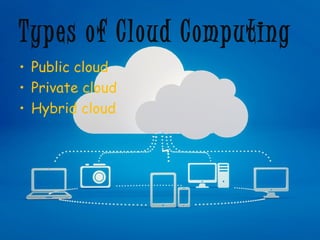
• Public cloud 
• Private cloud 
• Hybrid cloud
Public cloud 
(External cloud): 
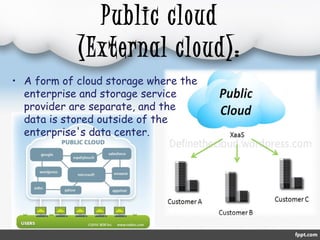
• A form of cloud storage where the 
enterprise and storage service 
provider are separate, and the 
data is stored outside of the 
enterprise's data center.
Private Cloud 
(Internal cloud): 
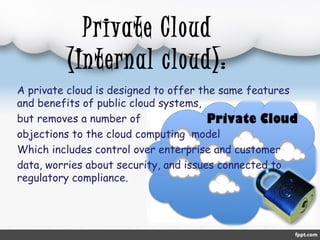
A private cloud is designed to offer the same features 
and benefits of public cloud systems, 
but removes a number of 
objections to the cloud computing model 
Which includes control over enterprise and customer 
data, worries about security, and issues connected to 
regulatory compliance.
Hybrid cloud 
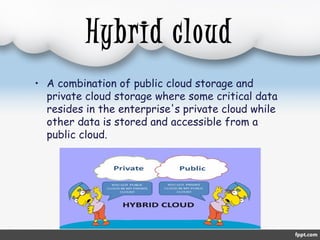
• A combination of public cloud storage and 
private cloud storage where some critical data 
resides in the enterprise's private cloud while 
other data is stored and accessible from a 
public cloud.
Clouds Service Models 
There are mainly three models service 
given as : 
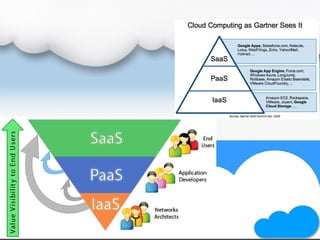
1.Infrastructure as a Service (Iaas) 
2.Platform as a Service (Paas) 
3.Software as a Service(Saas)
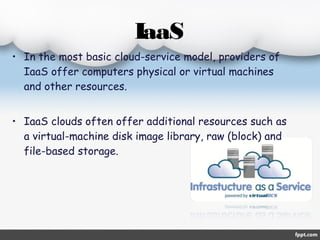
IaaS 
• In the most basic cloud-service model, providers of 
IaaS offer computers physical or virtual machines 
and other resources. 
• IaaS clouds often offer additional resources such as 
a virtual-machine disk image library, raw (block) and 
file-based storage.
Some examples are :
PaaS 
• In the PaaS model, cloud providers deliver a computing 
platform typically including operating system, programming 
language execution environment, database, and web server. 
• Application developers can develop and run their software 
solutions on a cloud platform without the cost and 
complexity of buying and managing the underlying 
hardware and software layers.
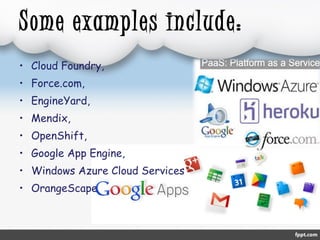
Some examples include: 
• Cloud Foundry, 
• Force.com, 
• EngineYard, 
• Mendix, 
• OpenShift, 
• Google App Engine, 
• Windows Azure Cloud Services 
• OrangeScape
SaaS 
• In the SaaS model, cloud users do not manage the 
cloud infrastructure and platform where the 
application runs. This eliminates the need to install 
and run the application on the cloud user's own 
computers , which simplifies maintenance and support.
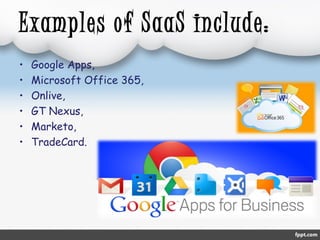
Examples of SaaS include: 
• Google Apps, 
• Microsoft Office 365, 
• Onlive, 
• GT Nexus, 
• Marketo, 
• TradeCard.
Advantages 
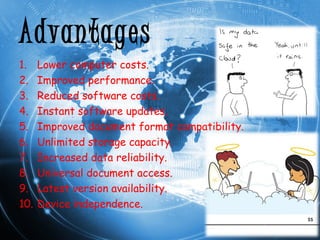
1. Lower computer costs. 
2. Improved performance. 
3. Reduced software costs. 
4. Instant software updates. 
5. Improved document format compatibility. 
6. Unlimited storage capacity. 
7. Increased data reliability. 
8. Universal document access. 
9. Latest version availability. 
10. Device independence.
Disadvantages 
1. Requires a constant and fast Internet 
connection. (VPN) 
2. Does not work well with low-speed 
connections.(KIIT-WIFI-NET) 
3. Features might be limited. 
4. Can be slow. 
5. Stored data might not be secure. 
6. Stored data can be lost.
Conclusion 
• Thus cloud computing provide a super-computing power. 
• It is a very cheap way of storage. 
• The applications and data served by the cloud are 
available to broad group of users, cross-enterprise and 
cross-platform.
TThhaannkkss

Cloud Computing

  • 1.
    Presented by : Saket Sourav Electronics and Telecomm
  • 2.
    Outlines : •What is cloud computing? • A brief history of cloud computing • Types of cloud computing • Cloud Service Models • Advantages of cloud computing • Disadvantages of cloud computing • Conclusion..
  • 3.
    What is cloudcomputing? • In cloud computing, the word “cloud” is used as a metaphor for "the Internet," so the phrase cloud computing means "a type of Internet-based computing," where different services such as servers, storage and applications are delivered to an organization's computers and devices through the Internet.
  • 4.
    A Brief history • 1960 – John McCarthy (Software engineer) opined that “computation may someday organized as a public utility”. • Early 1990s – The term cloud comes to commercial use referring to large networks and the advancement of the Internet. • 2001 – IBM details the Saas concept in their “Autonomic Computing Manifesto” • 2005 - Amazon provides access to their web.
  • 5.
    •2007 – Google,IBM, various Universities embark on a large scale cloud computing research project. •2009 - Microsoft’s enter into cloud computing with the launch of Windows Azure (cloud platform) in November. •2010 - Office 365 was initially announced in the autumn of 2010, and was made available to the public on June 28, 2011
  • 6.
    Types of CloudComputing • Public cloud • Private cloud • Hybrid cloud
  • 7.
    Public cloud (Externalcloud): • A form of cloud storage where the enterprise and storage service provider are separate, and the data is stored outside of the enterprise's data center.
  • 8.
    Private Cloud (Internalcloud): A private cloud is designed to offer the same features and benefits of public cloud systems, but removes a number of objections to the cloud computing model Which includes control over enterprise and customer data, worries about security, and issues connected to regulatory compliance.
  • 9.
    Hybrid cloud •A combination of public cloud storage and private cloud storage where some critical data resides in the enterprise's private cloud while other data is stored and accessible from a public cloud.
  • 10.
    Clouds Service Models There are mainly three models service given as : 1.Infrastructure as a Service (Iaas) 2.Platform as a Service (Paas) 3.Software as a Service(Saas)
  • 12.
    IaaS • Inthe most basic cloud-service model, providers of IaaS offer computers physical or virtual machines and other resources. • IaaS clouds often offer additional resources such as a virtual-machine disk image library, raw (block) and file-based storage.
  • 13.
  • 14.
    PaaS • Inthe PaaS model, cloud providers deliver a computing platform typically including operating system, programming language execution environment, database, and web server. • Application developers can develop and run their software solutions on a cloud platform without the cost and complexity of buying and managing the underlying hardware and software layers.
  • 15.
    Some examples include: • Cloud Foundry, • Force.com, • EngineYard, • Mendix, • OpenShift, • Google App Engine, • Windows Azure Cloud Services • OrangeScape
  • 16.
    SaaS • Inthe SaaS model, cloud users do not manage the cloud infrastructure and platform where the application runs. This eliminates the need to install and run the application on the cloud user's own computers , which simplifies maintenance and support.
  • 17.
    Examples of SaaSinclude: • Google Apps, • Microsoft Office 365, • Onlive, • GT Nexus, • Marketo, • TradeCard.
  • 18.
    Advantages 1. Lowercomputer costs. 2. Improved performance. 3. Reduced software costs. 4. Instant software updates. 5. Improved document format compatibility. 6. Unlimited storage capacity. 7. Increased data reliability. 8. Universal document access. 9. Latest version availability. 10. Device independence.
  • 19.
    Disadvantages 1. Requiresa constant and fast Internet connection. (VPN) 2. Does not work well with low-speed connections.(KIIT-WIFI-NET) 3. Features might be limited. 4. Can be slow. 5. Stored data might not be secure. 6. Stored data can be lost.
  • 20.
    Conclusion • Thuscloud computing provide a super-computing power. • It is a very cheap way of storage. • The applications and data served by the cloud are available to broad group of users, cross-enterprise and cross-platform.
  • 21.