

CLOUD COMPUTING


By
B.DUSHYANTH REDDY
O8TE1A0508
•   “Cloud” is actually a metaphor for the Internet.


•   Cloud computing is a paradigm in which information is
    permanently stored in servers on the Internet.
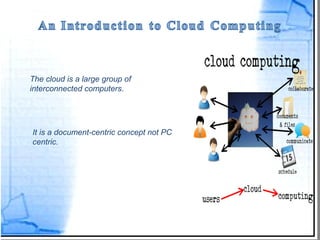
The cloud is a large group of
interconnected computers.


It is a document-centric concept not PC
centric.
History of Cloud Computing

 Concept dating back to the 1960’s by John McCarthy, a
computer scientist, brought up the idea that "computation may
someday be organized as a public utility”

 Idea that revolutionized Cloud Computing: Moving from
clustering computing to grid computing
   –Clustering
   –Grid


“In some ways, the cloud is a natural next step from the grid-
utility model,” said Frank Gens, an analyst at the research firm
IDC
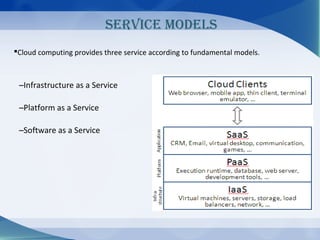
SERVICE MODELS
Cloud computing provides three service according to fundamental models.


 –Infrastructure as a Service

 –Platform as a Service

 –Software as a Service
IaaS- Infrastructure as a Service

Defined as delivery of computer infrastructure as a service
   Fully outsourced service so businesses do not have to purchase servers,
   software or equipment

Infrastructure providers can dynamically allocate
resources for service providers
   Service providers offer this service to end users
   Allows cost savings for the service providers, since they do not need to
   operate their own datacenter
PaaS- Platform as a Service

Provides all the facilities necessary to support the
complete process of building and delivering web applications
and services, all available over the internet

Infrastructure providers can transparently alter the
platforms for their customers’ unique needs
SaaS- Software as a Service
Defined as service-on-demand, where a provider will
license software tailored

Infrastructure providers can allow customers’ to run
applications off their infrastructure, but transparent to the
end user
   Customers can utilize greater computing power while saving on the
   following
           –Cost
           –Space
           –Power Consumption
           –Facility
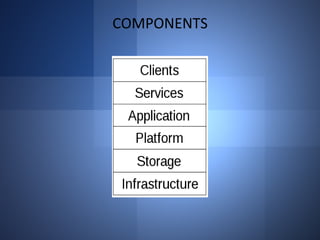
COMPONENTS
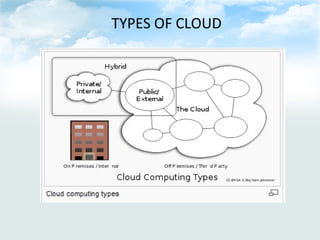
TYPES OF CLOUD
PUBLIC CLOUD

Applications, storage, and other resources are made available to the general public by
a service provider. Public cloud services may be free or offered on a pay-per-usage
model.


PRIVATE CLOUD

Private cloud is infrastructure operated solely for a single organization, whether
managed internally or by a third-party and hosted internally or externally


HYBRID CLOUD

Hybrid cloud is a composition of two or more clouds (private, public etc.) that remain
unique entities but are bound together, offering the benefits of multiple deployment
models.
ROLES
Provider
A cloud computing provider or cloud computing
service provider owns and operates live cloud
computing systems to deliver service to third
parties.


User
A user is a consumer of cloud computing


Vendor
A vendor sells products and services that facilitate the delivery, adoption and
use of cloud computing.
Conclusion
Cloud Computing Brings Possibilities……..

Increases business responsiveness
Accelerates creation of new services via rapid prototyping capabilities
Reduces energy consumption
Handles new and emerging workloads
Scales to extreme workloads quickly and easily
Simplifies IT management
Platform for collaboration and innovation
Cultivates skills for next generation workforce
FUTURE ENHANCEMENTS
Security is a major concern for cloud computing, as it is for any new technology

organizations need to take the time to properly identify the data and workloads
that require a higher degree of resiliency, isolation and control.

The external nature of public clouds brings additional concerns about loss of
control and sharing data outside the firewall.
Cloud computing
Cloud computing

Cloud computing

  • 1.
  • 2.
    “Cloud” is actually a metaphor for the Internet. • Cloud computing is a paradigm in which information is permanently stored in servers on the Internet.
  • 3.
    The cloud isa large group of interconnected computers. It is a document-centric concept not PC centric.
  • 4.
    History of CloudComputing  Concept dating back to the 1960’s by John McCarthy, a computer scientist, brought up the idea that "computation may someday be organized as a public utility”  Idea that revolutionized Cloud Computing: Moving from clustering computing to grid computing –Clustering –Grid “In some ways, the cloud is a natural next step from the grid- utility model,” said Frank Gens, an analyst at the research firm IDC
  • 5.
    SERVICE MODELS Cloud computingprovides three service according to fundamental models. –Infrastructure as a Service –Platform as a Service –Software as a Service
  • 6.
    IaaS- Infrastructure asa Service Defined as delivery of computer infrastructure as a service Fully outsourced service so businesses do not have to purchase servers, software or equipment Infrastructure providers can dynamically allocate resources for service providers Service providers offer this service to end users Allows cost savings for the service providers, since they do not need to operate their own datacenter
  • 7.
    PaaS- Platform asa Service Provides all the facilities necessary to support the complete process of building and delivering web applications and services, all available over the internet Infrastructure providers can transparently alter the platforms for their customers’ unique needs
  • 8.
    SaaS- Software asa Service Defined as service-on-demand, where a provider will license software tailored Infrastructure providers can allow customers’ to run applications off their infrastructure, but transparent to the end user Customers can utilize greater computing power while saving on the following –Cost –Space –Power Consumption –Facility
  • 9.
  • 10.
  • 11.
    PUBLIC CLOUD Applications, storage,and other resources are made available to the general public by a service provider. Public cloud services may be free or offered on a pay-per-usage model. PRIVATE CLOUD Private cloud is infrastructure operated solely for a single organization, whether managed internally or by a third-party and hosted internally or externally HYBRID CLOUD Hybrid cloud is a composition of two or more clouds (private, public etc.) that remain unique entities but are bound together, offering the benefits of multiple deployment models.
  • 12.
    ROLES Provider A cloud computingprovider or cloud computing service provider owns and operates live cloud computing systems to deliver service to third parties. User A user is a consumer of cloud computing Vendor A vendor sells products and services that facilitate the delivery, adoption and use of cloud computing.
  • 13.
    Conclusion Cloud Computing BringsPossibilities…….. Increases business responsiveness Accelerates creation of new services via rapid prototyping capabilities Reduces energy consumption Handles new and emerging workloads Scales to extreme workloads quickly and easily Simplifies IT management Platform for collaboration and innovation Cultivates skills for next generation workforce
  • 14.
    FUTURE ENHANCEMENTS Security isa major concern for cloud computing, as it is for any new technology organizations need to take the time to properly identify the data and workloads that require a higher degree of resiliency, isolation and control. The external nature of public clouds brings additional concerns about loss of control and sharing data outside the firewall.