Done by: Fatima Danash
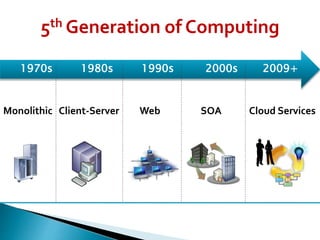
Monolithic Client-Server Web SOA Cloud Services
1970s 1980s 1990s 2000s 2009+
5th Generation of Computing
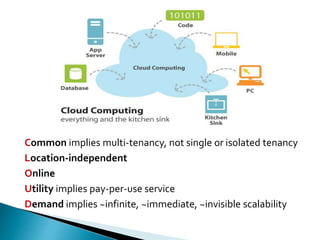
Common implies multi-tenancy, not single or isolated tenancy
Location-independent
Online
Utility implies pay-per-use service
Demand implies ~infinite, ~immediate, ~invisible scalability
• Cloud computing is a type of computing that relies on sharing
computing resources rather than having local servers or
personal devices to handle applications.
• In cloud computing, the word cloud (also phrased as "the cloud")
is used as a metaphor for "the Internet," so the phrase cloud
computing means "a type of Internet-based computing" where
different services such as servers, storage and applications are
delivered to an organization's computers and devices through
the Internet.
• So Cloud Computing is where software applications due to data
storage and processing power capacity are accessed over the
internet using cloud servers instead of dedicated servers.
1. What is Cloud Computing?
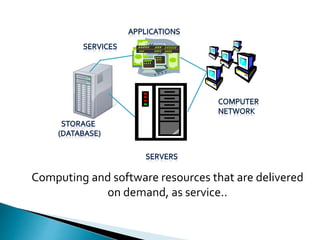
Computing and software resources that are delivered
on demand, as service..
2. Cloud Architecture
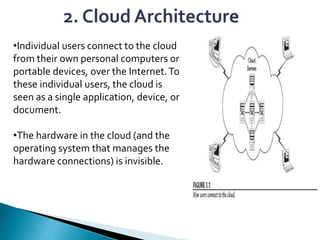
•Individual users connect to the cloud
from their own personal computers or
portable devices, over the Internet.To
these individual users, the cloud is
seen as a single application, device, or
document.
•The hardware in the cloud (and the
operating system that manages the
hardware connections) is invisible.
Hybrid
Cloud Connectivity
(Network Access)
SME
SME
SME
Enterprise
Enterprise
Public Cloud
Private Cloud
The Cloud Provider
The Cloud Provider
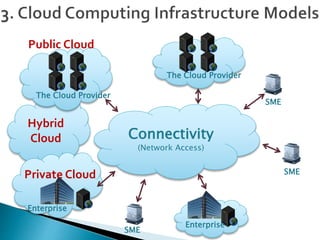
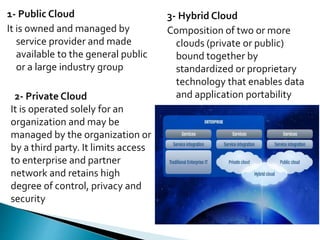
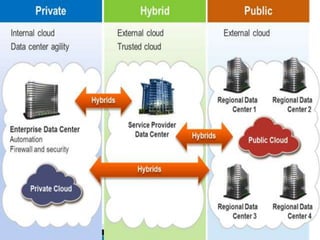
1- Public Cloud
It is owned and managed by
service provider and made
available to the general public
or a large industry group
2- Private Cloud
It is operated solely for an
organization and may be
managed by the organization or
by a third party. It limits access
to enterprise and partner
network and retains high
degree of control, privacy and
security
3- Hybrid Cloud
Composition of two or more
clouds (private or public)
bound together by
standardized or proprietary
technology that enables data
and application portability
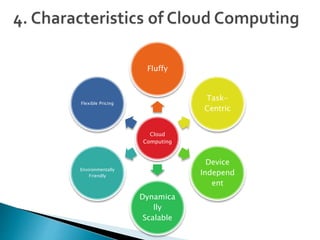
Cloud
Computing
Fluffy
Task-
Centric
Device
Independ
ent
Dynamica
lly
Scalable
Environmentally
Friendly
Flexible Pricing
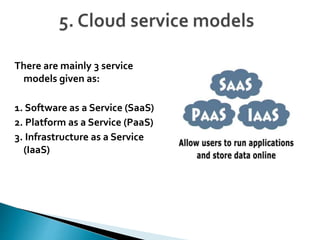
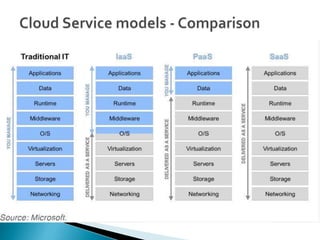
There are mainly 3 service
models given as:
1. Software as a Service (SaaS)
2. Platform as a Service (PaaS)
3. Infrastructure as a Service
(IaaS)
Architectural Layers of Cloud Computing
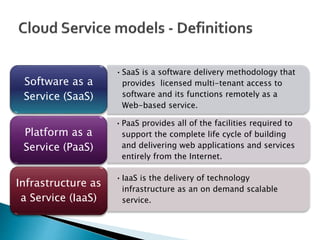
•SaaS is a software delivery methodology that
provides licensed multi-tenant access to
software and its functions remotely as a
Web-based service.
Software as a
Service (SaaS)
•PaaS provides all of the facilities required to
support the complete life cycle of building
and delivering web applications and services
entirely from the Internet.
Platform as a
Service (PaaS)
•IaaS is the delivery of technology
infrastructure as an on demand scalable
service.
Infrastructure as
a Service (IaaS)
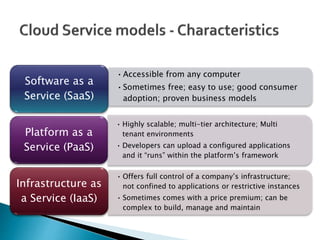
•Accessible from any computer
•Sometimes free; easy to use; good consumer
adoption; proven business models
Software as a
Service (SaaS)
• Highly scalable; multi-tier architecture; Multi
tenant environments
• Developers can upload a configured applications
and it “runs” within the platform’s framework
Platform as a
Service (PaaS)
• Offers full control of a company’s infrastructure;
not confined to applications or restrictive instances
• Sometimes comes with a price premium; can be
complex to build, manage and maintain
Infrastructure as
a Service (IaaS)
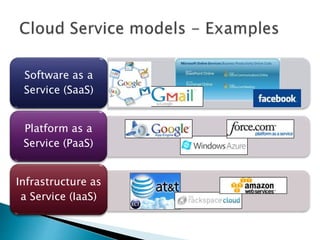
Software as a
Service (SaaS)
Platform as a
Service (PaaS)
Infrastructure as
a Service (IaaS)
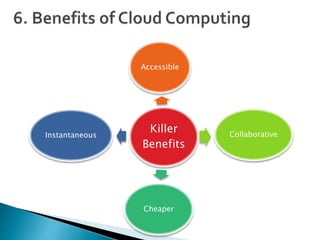
Killer
Benefits
Accessible
Collaborative
Cheaper
Instantaneous
Cloud Computing is the fastest growing part of
network based computing . It Provides tremendous
benefits to customers of all sizes: simple users,
developers, enterprises and all types of organizations.
ThankYou!
Fatima Kassem Danash

Cloud computing

  • 1.
  • 2.
    Monolithic Client-Server WebSOA Cloud Services 1970s 1980s 1990s 2000s 2009+ 5th Generation of Computing
  • 3.
    Common implies multi-tenancy,not single or isolated tenancy Location-independent Online Utility implies pay-per-use service Demand implies ~infinite, ~immediate, ~invisible scalability
  • 4.
    • Cloud computingis a type of computing that relies on sharing computing resources rather than having local servers or personal devices to handle applications. • In cloud computing, the word cloud (also phrased as "the cloud") is used as a metaphor for "the Internet," so the phrase cloud computing means "a type of Internet-based computing" where different services such as servers, storage and applications are delivered to an organization's computers and devices through the Internet. • So Cloud Computing is where software applications due to data storage and processing power capacity are accessed over the internet using cloud servers instead of dedicated servers. 1. What is Cloud Computing?
  • 5.
    Computing and softwareresources that are delivered on demand, as service..
  • 6.
    2. Cloud Architecture •Individualusers connect to the cloud from their own personal computers or portable devices, over the Internet.To these individual users, the cloud is seen as a single application, device, or document. •The hardware in the cloud (and the operating system that manages the hardware connections) is invisible.
  • 7.
    Hybrid Cloud Connectivity (Network Access) SME SME SME Enterprise Enterprise PublicCloud Private Cloud The Cloud Provider The Cloud Provider
  • 8.
    1- Public Cloud Itis owned and managed by service provider and made available to the general public or a large industry group 2- Private Cloud It is operated solely for an organization and may be managed by the organization or by a third party. It limits access to enterprise and partner network and retains high degree of control, privacy and security 3- Hybrid Cloud Composition of two or more clouds (private or public) bound together by standardized or proprietary technology that enables data and application portability
  • 10.
  • 11.
    There are mainly3 service models given as: 1. Software as a Service (SaaS) 2. Platform as a Service (PaaS) 3. Infrastructure as a Service (IaaS)
  • 12.
    Architectural Layers ofCloud Computing
  • 13.
    •SaaS is asoftware delivery methodology that provides licensed multi-tenant access to software and its functions remotely as a Web-based service. Software as a Service (SaaS) •PaaS provides all of the facilities required to support the complete life cycle of building and delivering web applications and services entirely from the Internet. Platform as a Service (PaaS) •IaaS is the delivery of technology infrastructure as an on demand scalable service. Infrastructure as a Service (IaaS)
  • 14.
    •Accessible from anycomputer •Sometimes free; easy to use; good consumer adoption; proven business models Software as a Service (SaaS) • Highly scalable; multi-tier architecture; Multi tenant environments • Developers can upload a configured applications and it “runs” within the platform’s framework Platform as a Service (PaaS) • Offers full control of a company’s infrastructure; not confined to applications or restrictive instances • Sometimes comes with a price premium; can be complex to build, manage and maintain Infrastructure as a Service (IaaS)
  • 15.
    Software as a Service(SaaS) Platform as a Service (PaaS) Infrastructure as a Service (IaaS)
  • 17.
  • 18.
    Cloud Computing isthe fastest growing part of network based computing . It Provides tremendous benefits to customers of all sizes: simple users, developers, enterprises and all types of organizations.
  • 19.

Editor's Notes

  • #3 Cloud Computing is the 5th generation of computing, after monolithic, client-server, web, service-oriented architecture and now it’s cloud service.