Suggested Course
Outline
Cloud Computing
Bahga & Madisetti, © 2014Book website: www.cloudcomputingbook.info
Objectives
• Understanding of Cloud Computing Technologies, Computation Models &
Applications.
• Technical analysis & use of commercial cloud offerings – Amazon, Google &
Microsoft
• Design Methodologies for Cloud Applications
• Use of Cloud-based Languages and Tools in developing advanced applications on
Amazon, Google & Microsoft cloud platforms.
• Advanced case studies and team-based design & implementation on Amazon,
Google & Microsoft platforms in the classroom
• Advanced topics – benchmarking, security, multimedia, big data with
implementations
[Student Pre-requisites: A couple of programming courses (e.g., C++/Java) at the
college-level]
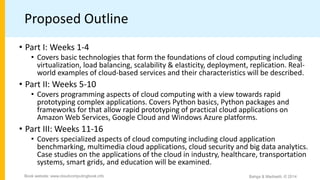
Proposed Outline
• Part I: Weeks 1-4
• Covers basic technologies that form the foundations of cloud computing including
virtualization, load balancing, scalability & elasticity, deployment, replication. Real-
world examples of cloud-based services and their characteristics will be described.
• Part II: Weeks 5-10
• Covers programming aspects of cloud computing with a view towards rapid
prototyping complex applications. Covers Python basics, Python packages and
frameworks for that allow rapid prototyping of practical cloud applications on
Amazon Web Services, Google Cloud and Windows Azure platforms.
• Part III: Weeks 11-16
• Covers specialized aspects of cloud computing including cloud application
benchmarking, multimedia cloud applications, cloud security and big data analytics.
Case studies on the applications of the cloud in industry, healthcare, transportation
systems, smart grids, and education will be examined.
Bahga & Madisetti, © 2014Book website: www.cloudcomputingbook.info
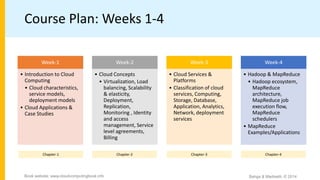
Course Plan: Weeks 1-4
Bahga & Madisetti, © 2014Book website: www.cloudcomputingbook.info
Week-1
• Introduction to Cloud
Computing
• Cloud characteristics,
service models,
deployment models
• Cloud Applications &
Case Studies
Week-2
• Cloud Concepts
• Virtualization, Load
balancing, Scalability
& elasticity,
Deployment,
Replication,
Monitoring , Identity
and access
management, Service
level agreements,
Billing
Week-3
• Cloud Services &
Platforms
• Classification of cloud
services, Computing,
Storage, Database,
Application, Analytics,
Network, deployment
services
Week-4
• Hadoop & MapReduce
• Hadoop ecosystem,
MapReduce
architecture,
MapReduce job
execution flow,
MapReduce
schedulers
• MapReduce
Examples/Applications
Chapter-1 Chapter-2 Chapter-3 Chapter-4
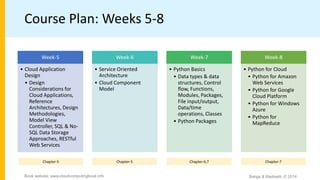
Course Plan: Weeks 5-8
Bahga & Madisetti, © 2014Book website: www.cloudcomputingbook.info
Week-5
• Cloud Application
Design
• Design
Considerations for
Cloud Applications,
Reference
Architectures, Design
Methodologies,
Model View
Controller, SQL & No-
SQL Data Storage
Approaches, RESTful
Web Services
Week-6
• Service Oriented
Architecture
• Cloud Component
Model
Week-7
• Python Basics
• Data types & data
structures, Control
flow, Functions,
Modules, Packages,
File input/output,
Data/time
operations, Classes
• Python Packages
Week-8
• Python for Cloud
• Python for Amazon
Web Services
• Python for Google
Cloud Platform
• Python for Windows
Azure
• Python for
MapReduce
Chapter-5 Chapter-5 Chapter-6,7 Chapter-7
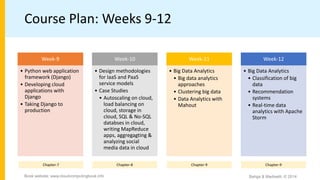
Course Plan: Weeks 9-12
Bahga & Madisetti, © 2014Book website: www.cloudcomputingbook.info
Week-9
• Python web application
framework (Django)
• Developing cloud
applications with
Django
• Taking Django to
production
Week-10
• Design methodologies
for IaaS and PaaS
service models
• Case Studies
• Autoscaling on cloud,
load balancing on
cloud, storage in
cloud, SQL & No-SQL
databses in cloud,
writing MapReduce
apps, aggregagting &
analyzing social
media data in cloud
Week-11
• Big Data Analytics
• Big data analytics
approaches
• Clustering big data
• Data Analytics with
Mahout
Week-12
• Big Data Analytics
• Classification of big
data
• Recommendation
systems
• Real-time data
analytics with Apache
Storm
Chapter-7 Chapter-8 Chapter-9 Chapter-9
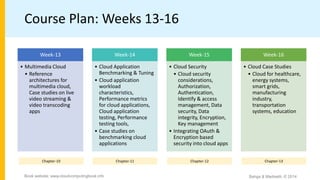
Course Plan: Weeks 13-16
Bahga & Madisetti, © 2014Book website: www.cloudcomputingbook.info
Week-13
• Multimedia Cloud
• Reference
architectures for
multimedia cloud,
Case studies on live
video streaming &
video transcoding
apps
Week-14
• Cloud Application
Benchmarking & Tuning
• Cloud application
workload
characteristics,
Performance metrics
for cloud applications,
Cloud application
testing, Performance
testing tools,
• Case studies on
benchmarking cloud
applications
Week-15
• Cloud Security
• Cloud security
considerations,
Authorization,
Authentication,
Identify & access
management, Data
security, Data
integrity, Encryption,
Key management
• Integrating OAuth &
Encryption based
security into cloud apps
Week-16
• Cloud Case Studies
• Cloud for healthcare,
energy systems,
smart grids,
manufacturing
industry,
transportation
systems, education
Chapter-10 Chapter-11 Chapter-12 Chapter-13
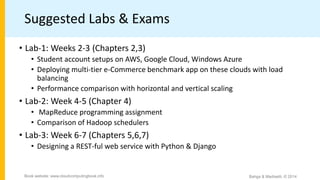
Suggested Labs & Exams
• Lab-1: Weeks 2-3 (Chapters 2,3)
• Student account setups on AWS, Google Cloud, Windows Azure
• Deploying multi-tier e-Commerce benchmark app on these clouds with load
balancing
• Performance comparison with horizontal and vertical scaling
• Lab-2: Week 4-5 (Chapter 4)
• MapReduce programming assignment
• Comparison of Hadoop schedulers
• Lab-3: Week 6-7 (Chapters 5,6,7)
• Designing a REST-ful web service with Python & Django
Bahga & Madisetti, © 2014Book website: www.cloudcomputingbook.info
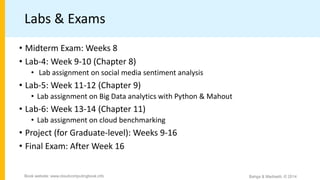
Labs & Exams
• Midterm Exam: Weeks 8
• Lab-4: Week 9-10 (Chapter 8)
• Lab assignment on social media sentiment analysis
• Lab-5: Week 11-12 (Chapter 9)
• Lab assignment on Big Data analytics with Python & Mahout
• Lab-6: Week 13-14 (Chapter 11)
• Lab assignment on cloud benchmarking
• Project (for Graduate-level): Weeks 9-16
• Final Exam: After Week 16
Bahga & Madisetti, © 2014Book website: www.cloudcomputingbook.info
Suggested Grading Scheme
Bahga & Madisetti, © 2014Book website: www.cloudcomputingbook.info
• Undergraduate-level
• Lab assignments – 40%
• Midterm – 30%
• Final – 30%
• Graduate-level
• Lab assignments – 25%
• Midterm – 25%
• Project – 25%
• Final – 25%
New labs, exercises and additional information will be updated to support instruction
at http://www.cloudcomputingbook.info

Cloud Computing Course

  • 1.
    Suggested Course Outline Cloud Computing Bahga& Madisetti, © 2014Book website: www.cloudcomputingbook.info
  • 2.
    Objectives • Understanding ofCloud Computing Technologies, Computation Models & Applications. • Technical analysis & use of commercial cloud offerings – Amazon, Google & Microsoft • Design Methodologies for Cloud Applications • Use of Cloud-based Languages and Tools in developing advanced applications on Amazon, Google & Microsoft cloud platforms. • Advanced case studies and team-based design & implementation on Amazon, Google & Microsoft platforms in the classroom • Advanced topics – benchmarking, security, multimedia, big data with implementations [Student Pre-requisites: A couple of programming courses (e.g., C++/Java) at the college-level]
  • 3.
    Proposed Outline • PartI: Weeks 1-4 • Covers basic technologies that form the foundations of cloud computing including virtualization, load balancing, scalability & elasticity, deployment, replication. Real- world examples of cloud-based services and their characteristics will be described. • Part II: Weeks 5-10 • Covers programming aspects of cloud computing with a view towards rapid prototyping complex applications. Covers Python basics, Python packages and frameworks for that allow rapid prototyping of practical cloud applications on Amazon Web Services, Google Cloud and Windows Azure platforms. • Part III: Weeks 11-16 • Covers specialized aspects of cloud computing including cloud application benchmarking, multimedia cloud applications, cloud security and big data analytics. Case studies on the applications of the cloud in industry, healthcare, transportation systems, smart grids, and education will be examined. Bahga & Madisetti, © 2014Book website: www.cloudcomputingbook.info
  • 4.
    Course Plan: Weeks1-4 Bahga & Madisetti, © 2014Book website: www.cloudcomputingbook.info Week-1 • Introduction to Cloud Computing • Cloud characteristics, service models, deployment models • Cloud Applications & Case Studies Week-2 • Cloud Concepts • Virtualization, Load balancing, Scalability & elasticity, Deployment, Replication, Monitoring , Identity and access management, Service level agreements, Billing Week-3 • Cloud Services & Platforms • Classification of cloud services, Computing, Storage, Database, Application, Analytics, Network, deployment services Week-4 • Hadoop & MapReduce • Hadoop ecosystem, MapReduce architecture, MapReduce job execution flow, MapReduce schedulers • MapReduce Examples/Applications Chapter-1 Chapter-2 Chapter-3 Chapter-4
  • 5.
    Course Plan: Weeks5-8 Bahga & Madisetti, © 2014Book website: www.cloudcomputingbook.info Week-5 • Cloud Application Design • Design Considerations for Cloud Applications, Reference Architectures, Design Methodologies, Model View Controller, SQL & No- SQL Data Storage Approaches, RESTful Web Services Week-6 • Service Oriented Architecture • Cloud Component Model Week-7 • Python Basics • Data types & data structures, Control flow, Functions, Modules, Packages, File input/output, Data/time operations, Classes • Python Packages Week-8 • Python for Cloud • Python for Amazon Web Services • Python for Google Cloud Platform • Python for Windows Azure • Python for MapReduce Chapter-5 Chapter-5 Chapter-6,7 Chapter-7
  • 6.
    Course Plan: Weeks9-12 Bahga & Madisetti, © 2014Book website: www.cloudcomputingbook.info Week-9 • Python web application framework (Django) • Developing cloud applications with Django • Taking Django to production Week-10 • Design methodologies for IaaS and PaaS service models • Case Studies • Autoscaling on cloud, load balancing on cloud, storage in cloud, SQL & No-SQL databses in cloud, writing MapReduce apps, aggregagting & analyzing social media data in cloud Week-11 • Big Data Analytics • Big data analytics approaches • Clustering big data • Data Analytics with Mahout Week-12 • Big Data Analytics • Classification of big data • Recommendation systems • Real-time data analytics with Apache Storm Chapter-7 Chapter-8 Chapter-9 Chapter-9
  • 7.
    Course Plan: Weeks13-16 Bahga & Madisetti, © 2014Book website: www.cloudcomputingbook.info Week-13 • Multimedia Cloud • Reference architectures for multimedia cloud, Case studies on live video streaming & video transcoding apps Week-14 • Cloud Application Benchmarking & Tuning • Cloud application workload characteristics, Performance metrics for cloud applications, Cloud application testing, Performance testing tools, • Case studies on benchmarking cloud applications Week-15 • Cloud Security • Cloud security considerations, Authorization, Authentication, Identify & access management, Data security, Data integrity, Encryption, Key management • Integrating OAuth & Encryption based security into cloud apps Week-16 • Cloud Case Studies • Cloud for healthcare, energy systems, smart grids, manufacturing industry, transportation systems, education Chapter-10 Chapter-11 Chapter-12 Chapter-13
  • 8.
    Suggested Labs &Exams • Lab-1: Weeks 2-3 (Chapters 2,3) • Student account setups on AWS, Google Cloud, Windows Azure • Deploying multi-tier e-Commerce benchmark app on these clouds with load balancing • Performance comparison with horizontal and vertical scaling • Lab-2: Week 4-5 (Chapter 4) • MapReduce programming assignment • Comparison of Hadoop schedulers • Lab-3: Week 6-7 (Chapters 5,6,7) • Designing a REST-ful web service with Python & Django Bahga & Madisetti, © 2014Book website: www.cloudcomputingbook.info
  • 9.
    Labs & Exams •Midterm Exam: Weeks 8 • Lab-4: Week 9-10 (Chapter 8) • Lab assignment on social media sentiment analysis • Lab-5: Week 11-12 (Chapter 9) • Lab assignment on Big Data analytics with Python & Mahout • Lab-6: Week 13-14 (Chapter 11) • Lab assignment on cloud benchmarking • Project (for Graduate-level): Weeks 9-16 • Final Exam: After Week 16 Bahga & Madisetti, © 2014Book website: www.cloudcomputingbook.info
  • 10.
    Suggested Grading Scheme Bahga& Madisetti, © 2014Book website: www.cloudcomputingbook.info • Undergraduate-level • Lab assignments – 40% • Midterm – 30% • Final – 30% • Graduate-level • Lab assignments – 25% • Midterm – 25% • Project – 25% • Final – 25% New labs, exercises and additional information will be updated to support instruction at http://www.cloudcomputingbook.info