1
NETE4631
Network Information Systems :
Introduction to Cloud Computing
Lecture Notes #1
Background Brief
 Dr. Suronapee Phoomvuthisarn

PhD in CSE, University of New South Wales, 2011

National ICT Australia (2008 - 2011)
 Research interests in software architecture
 Service Economics, Cloud Computing
 Work History:
 Mahanakorn University of Technology (Since
2007)
 Position: รองคณบดีฝ่ายกิจการนักศึกษาและ
ประชาสัมพัน
 http://www.it.mut.ac.th/new/index.php/personal/view/9
 Email : suronape@mut.ac.th
2
3
Intro
 Class objectives
 Materials
 Text

Sosinsky, B., (2011), Cloud Computing Bible, Wiley.

Slides reproduced from the course offered by Assoc.
M.Babar, University of Copenhagen
 Grading policy (30/30/40)
 Exercises/Presentations/Group Discussions
 แผน ก.

Present selected papers

Criticize selected papers
 แผน ข.

Working with Cloud-based Applications as well as
Learning Outcome
 Describe different concepts and mechanisms
underpinning Cloud computing and its
potential impacts on businesses.
 Provide a detailed description of technologies
and approaches enabling Cloud computing
such as service-orientation, Internet
infrastructures, virtualization, time-sharing,
distributed computing, multi-tenancy,
resource provisioning techniques, and
protocols.
4
Learning Outcome (2)
 Evaluate and select an appropriate public
cloud provider by applying the theoretical
concepts and practical techniques from the
course.
 Analyse and explain key aspects of building
for and/or migrating systems to Cloud such as
costs involved, potential benefits, security
issues, regulatory concerns, and standards.
5
Articles
 Armbrust, M., et al., 2010, A View of Cloud Computing, ACM, 53(4), pp.
50-58.
 Papazoglou, M., Traverso, P., Dustdar, S., Leymann, F., 2007, Service-
Oriented Computing: State of the Art and Research Challenges, IEEE
Computer, 40(11), pp. 38-45.
 Durkee, D., 2010, Why Cloud Computing Will Never Be Free, IT
Professional, 53(5), pp. 62-69.
 Joshi, B.D.J, Takabi, H., Ahn, G., Security and Privacy Challenges in
Cloud Computing Environments, IEEE Security & Privacy, Nov/Dec,
2010.
 Ali Babar, M., Chauhan, M. A., A Tale of Migration to Cloud Computing
for Sharing Experiences and Observations, proceedings of the
Software Engineering for Cloud Computing Workshop (SECLOUD),
Collocated with ICSE 2011, Hawaii, USA.
6
Cloud-based Application Exp.
 Commercial
 Google App Engine
 Microsoft Azure
 Open Source
 Eucalyptas http://open.eucalyptus.com
7
Class Overview
 Introduction to Cloud computing and its impact on
organizations, businesses, and society
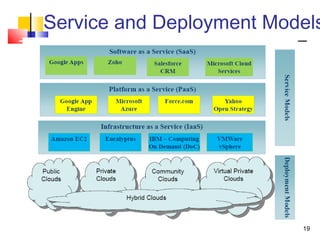
 Models of Cloud computing offerings (SaaS, PaaS,
IaaS) and deployment (public, private, hybrid)
 Strengthens and weaknesses of different types of
Clouds (public, private, hybrid) Approaches
 Foundation of Cloud systems’ architectures
 Patterns and tactics for designing Cloud-based
service oriented systems
8
Class Overview (2)
 Overview of Security and privacy challenges and
solutions for Cloud-based systems
 Designing and Assessing strategies for migration to
Clouds
 Managing, administering, monitoring, and supporting
Cloud-based systems
 Benefits, challenges, and risks of Cloud Computing
 Evaluation and Comparison of proprietary and Open
Source Cloud-based Solutions, e.g., EC2, Google
AppEngine, Azure, Eucalyptus, and Hadoop.
9
Course Administration
 E-Learning
 Contact
 suronape@mut.ac.th
10
Network Information Systems
 NIS is an information system for
managing networks.
 Examples
 Grid-based application
 telecommunications network
 Mail services, www
 Cloud-based application
11
12
What is Cloud Computing?
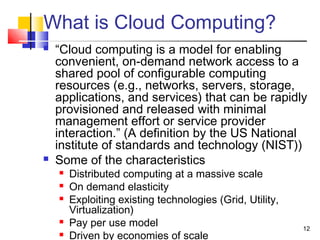
 “Cloud computing is a model for enabling
convenient, on-demand network access to a
shared pool of configurable computing
resources (e.g., networks, servers, storage,
applications, and services) that can be rapidly
provisioned and released with minimal
management effort or service provider
interaction.” (A definition by the US National
institute of standards and technology (NIST))
 Some of the characteristics
 Distributed computing at a massive scale
 On demand elasticity
 Exploiting existing technologies (Grid, Utility,
Virtualization)
 Pay per use model
 Driven by economies of scale
13
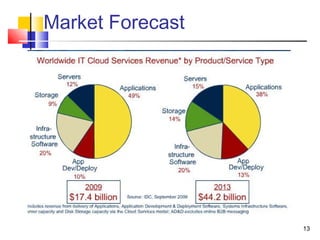
Market Forecast
14
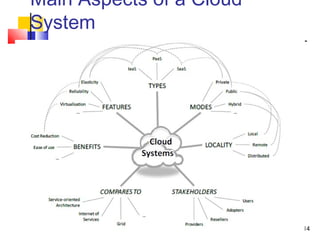
Main Aspects of a Cloud
System
15
What is different?
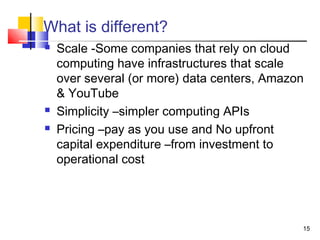
 Scale -Some companies that rely on cloud
computing have infrastructures that scale
over several (or more) data centers, Amazon
& YouTube
 Simplicity –simpler computing APIs
 Pricing –pay as you use and No upfront
capital expenditure –from investment to
operational cost
16
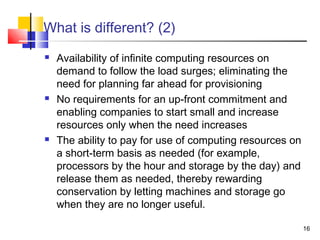
What is different? (2)
 Availability of infinite computing resources on
demand to follow the load surges; eliminating the
need for planning far ahead for provisioning
 No requirements for an up-front commitment and
enabling companies to start small and increase
resources only when the need increases
 The ability to pay for use of computing resources on
a short-term basis as needed (for example,
processors by the hour and storage by the day) and
release them as needed, thereby rewarding
conservation by letting machines and storage go
when they are no longer useful.
17
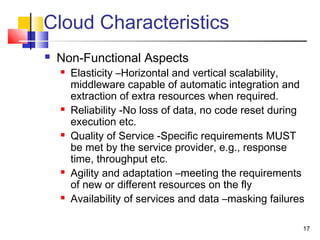
Cloud Characteristics
 Non-Functional Aspects
 Elasticity –Horizontal and vertical scalability,
middleware capable of automatic integration and
extraction of extra resources when required.
 Reliability -No loss of data, no code reset during
execution etc.
 Quality of Service -Specific requirements MUST
be met by the service provider, e.g., response
time, throughput etc.
 Agility and adaptation –meeting the requirements
of new or different resources on the fly
 Availability of services and data –masking failures
18
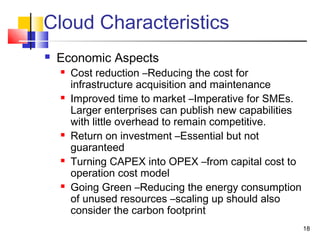
Cloud Characteristics
 Economic Aspects
 Cost reduction –Reducing the cost for
infrastructure acquisition and maintenance
 Improved time to market –Imperative for SMEs.
Larger enterprises can publish new capabilities
with little overhead to remain competitive.
 Return on investment –Essential but not
guaranteed
 Turning CAPEX into OPEX –from capital cost to
operation cost model
 Going Green –Reducing the energy consumption
of unused resources –scaling up should also
consider the carbon footprint
Service and Deployment Models
19
20
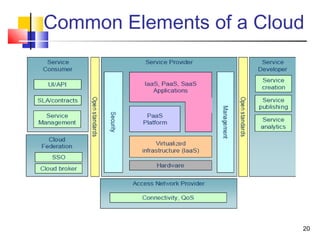
Common Elements of a Cloud
21
Is Cloud Computing for Me?
 For end users
 Cost reduction: From capital investment to operational
expense (pay-per-use)
 Ease of use via standardized mechanisms, e.g. Browser
 Flexibility and short time-to-result
 Services providers
 Reduction of the entrance barrier
 Reduction of time to market
 Private Cloud
 Maximize the utilisation of computing resources
 Minimize operational costs and the organisation keeps full
control of its data centres
22
Benefits of Cloud Computing
 On-demand self-service
 Broad network access
 Resource pooling
 Rapid elasticity
 Measured service
 Lower costs
 Ease of utilization
 Quality of Service
 Reliability
 Outsourced IT management
 Simplified maintenance and upgrade
 Low barrier to entry
23
Some of the Challenges!!!
 Security
 Would my data be more secure with Cloud provider?
 Interoperability
 Significant risk of vendor lock-in –Standardized interfaces not available, incompatible
programming models
 Reliability
 Use of commodity hardware, prone to failure ...Cloud 2.0
 Laws and regulations
 Privacy, security, and location of data storage
 Organizational changes
 Changing authorities of IT departments, compliance policies
 Cost
 Purchase vs. Lease, migration cost, models to design capital and operational budgets,
cost of cloud providers
24
Some Public Cloud Providers
 Amazon
 Google
 Azure Service Platform
 Salesfoce.com (CRM systems)
25
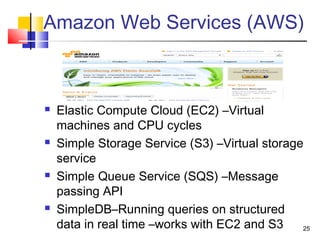
Amazon Web Services (AWS)
 Elastic Compute Cloud (EC2) –Virtual
machines and CPU cycles
 Simple Storage Service (S3) –Virtual storage
service
 Simple Queue Service (SQS) –Message
passing API
 SimpleDB–Running queries on structured
data in real time –works with EC2 and S3
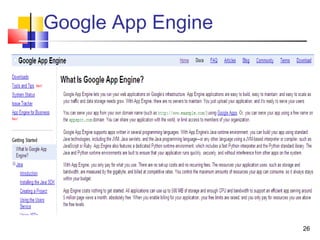
Google App Engine
26
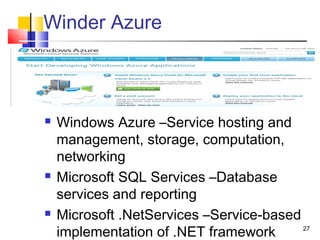
Winder Azure
 Windows Azure –Service hosting and
management, storage, computation,
networking
 Microsoft SQL Services –Database
services and reporting
 Microsoft .NetServices –Service-based
implementation of .NET framework 27
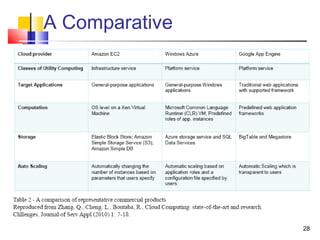
A Comparative
28
 THANK YOU!!!!!
29

cloud

  • 1.
    1 NETE4631 Network Information Systems: Introduction to Cloud Computing Lecture Notes #1
  • 2.
    Background Brief  Dr.Suronapee Phoomvuthisarn  PhD in CSE, University of New South Wales, 2011  National ICT Australia (2008 - 2011)  Research interests in software architecture  Service Economics, Cloud Computing  Work History:  Mahanakorn University of Technology (Since 2007)  Position: รองคณบดีฝ่ายกิจการนักศึกษาและ ประชาสัมพัน  http://www.it.mut.ac.th/new/index.php/personal/view/9  Email : suronape@mut.ac.th 2
  • 3.
    3 Intro  Class objectives Materials  Text  Sosinsky, B., (2011), Cloud Computing Bible, Wiley.  Slides reproduced from the course offered by Assoc. M.Babar, University of Copenhagen  Grading policy (30/30/40)  Exercises/Presentations/Group Discussions  แผน ก.  Present selected papers  Criticize selected papers  แผน ข.  Working with Cloud-based Applications as well as
  • 4.
    Learning Outcome  Describedifferent concepts and mechanisms underpinning Cloud computing and its potential impacts on businesses.  Provide a detailed description of technologies and approaches enabling Cloud computing such as service-orientation, Internet infrastructures, virtualization, time-sharing, distributed computing, multi-tenancy, resource provisioning techniques, and protocols. 4
  • 5.
    Learning Outcome (2) Evaluate and select an appropriate public cloud provider by applying the theoretical concepts and practical techniques from the course.  Analyse and explain key aspects of building for and/or migrating systems to Cloud such as costs involved, potential benefits, security issues, regulatory concerns, and standards. 5
  • 6.
    Articles  Armbrust, M.,et al., 2010, A View of Cloud Computing, ACM, 53(4), pp. 50-58.  Papazoglou, M., Traverso, P., Dustdar, S., Leymann, F., 2007, Service- Oriented Computing: State of the Art and Research Challenges, IEEE Computer, 40(11), pp. 38-45.  Durkee, D., 2010, Why Cloud Computing Will Never Be Free, IT Professional, 53(5), pp. 62-69.  Joshi, B.D.J, Takabi, H., Ahn, G., Security and Privacy Challenges in Cloud Computing Environments, IEEE Security & Privacy, Nov/Dec, 2010.  Ali Babar, M., Chauhan, M. A., A Tale of Migration to Cloud Computing for Sharing Experiences and Observations, proceedings of the Software Engineering for Cloud Computing Workshop (SECLOUD), Collocated with ICSE 2011, Hawaii, USA. 6
  • 7.
    Cloud-based Application Exp. Commercial  Google App Engine  Microsoft Azure  Open Source  Eucalyptas http://open.eucalyptus.com 7
  • 8.
    Class Overview  Introductionto Cloud computing and its impact on organizations, businesses, and society  Models of Cloud computing offerings (SaaS, PaaS, IaaS) and deployment (public, private, hybrid)  Strengthens and weaknesses of different types of Clouds (public, private, hybrid) Approaches  Foundation of Cloud systems’ architectures  Patterns and tactics for designing Cloud-based service oriented systems 8
  • 9.
    Class Overview (2) Overview of Security and privacy challenges and solutions for Cloud-based systems  Designing and Assessing strategies for migration to Clouds  Managing, administering, monitoring, and supporting Cloud-based systems  Benefits, challenges, and risks of Cloud Computing  Evaluation and Comparison of proprietary and Open Source Cloud-based Solutions, e.g., EC2, Google AppEngine, Azure, Eucalyptus, and Hadoop. 9
  • 10.
    Course Administration  E-Learning Contact  suronape@mut.ac.th 10
  • 11.
    Network Information Systems NIS is an information system for managing networks.  Examples  Grid-based application  telecommunications network  Mail services, www  Cloud-based application 11
  • 12.
    12 What is CloudComputing?  “Cloud computing is a model for enabling convenient, on-demand network access to a shared pool of configurable computing resources (e.g., networks, servers, storage, applications, and services) that can be rapidly provisioned and released with minimal management effort or service provider interaction.” (A definition by the US National institute of standards and technology (NIST))  Some of the characteristics  Distributed computing at a massive scale  On demand elasticity  Exploiting existing technologies (Grid, Utility, Virtualization)  Pay per use model  Driven by economies of scale
  • 13.
  • 14.
    14 Main Aspects ofa Cloud System
  • 15.
    15 What is different? Scale -Some companies that rely on cloud computing have infrastructures that scale over several (or more) data centers, Amazon & YouTube  Simplicity –simpler computing APIs  Pricing –pay as you use and No upfront capital expenditure –from investment to operational cost
  • 16.
    16 What is different?(2)  Availability of infinite computing resources on demand to follow the load surges; eliminating the need for planning far ahead for provisioning  No requirements for an up-front commitment and enabling companies to start small and increase resources only when the need increases  The ability to pay for use of computing resources on a short-term basis as needed (for example, processors by the hour and storage by the day) and release them as needed, thereby rewarding conservation by letting machines and storage go when they are no longer useful.
  • 17.
    17 Cloud Characteristics  Non-FunctionalAspects  Elasticity –Horizontal and vertical scalability, middleware capable of automatic integration and extraction of extra resources when required.  Reliability -No loss of data, no code reset during execution etc.  Quality of Service -Specific requirements MUST be met by the service provider, e.g., response time, throughput etc.  Agility and adaptation –meeting the requirements of new or different resources on the fly  Availability of services and data –masking failures
  • 18.
    18 Cloud Characteristics  EconomicAspects  Cost reduction –Reducing the cost for infrastructure acquisition and maintenance  Improved time to market –Imperative for SMEs. Larger enterprises can publish new capabilities with little overhead to remain competitive.  Return on investment –Essential but not guaranteed  Turning CAPEX into OPEX –from capital cost to operation cost model  Going Green –Reducing the energy consumption of unused resources –scaling up should also consider the carbon footprint
  • 19.
  • 20.
  • 21.
    21 Is Cloud Computingfor Me?  For end users  Cost reduction: From capital investment to operational expense (pay-per-use)  Ease of use via standardized mechanisms, e.g. Browser  Flexibility and short time-to-result  Services providers  Reduction of the entrance barrier  Reduction of time to market  Private Cloud  Maximize the utilisation of computing resources  Minimize operational costs and the organisation keeps full control of its data centres
  • 22.
    22 Benefits of CloudComputing  On-demand self-service  Broad network access  Resource pooling  Rapid elasticity  Measured service  Lower costs  Ease of utilization  Quality of Service  Reliability  Outsourced IT management  Simplified maintenance and upgrade  Low barrier to entry
  • 23.
    23 Some of theChallenges!!!  Security  Would my data be more secure with Cloud provider?  Interoperability  Significant risk of vendor lock-in –Standardized interfaces not available, incompatible programming models  Reliability  Use of commodity hardware, prone to failure ...Cloud 2.0  Laws and regulations  Privacy, security, and location of data storage  Organizational changes  Changing authorities of IT departments, compliance policies  Cost  Purchase vs. Lease, migration cost, models to design capital and operational budgets, cost of cloud providers
  • 24.
    24 Some Public CloudProviders  Amazon  Google  Azure Service Platform  Salesfoce.com (CRM systems)
  • 25.
    25 Amazon Web Services(AWS)  Elastic Compute Cloud (EC2) –Virtual machines and CPU cycles  Simple Storage Service (S3) –Virtual storage service  Simple Queue Service (SQS) –Message passing API  SimpleDB–Running queries on structured data in real time –works with EC2 and S3
  • 26.
  • 27.
    Winder Azure  WindowsAzure –Service hosting and management, storage, computation, networking  Microsoft SQL Services –Database services and reporting  Microsoft .NetServices –Service-based implementation of .NET framework 27
  • 28.
  • 29.

Editor's Notes

  • #12 ระบบที่สามารถ เก็บ สืบค้น ตลอดจนประมวลผลข้อมูลต่างๆ ผ่านระบบเครือข่าย ตัวอย่าง www – network application electricity network (smartgrid) -> cloud computing such as electricity network, water supply network, gas supply network, or telecommunications network. NIS may manage all data relevant to the network, e.g.- all components and their attributes, the connectivity between them and other information, relating to the operation, design and construction of such networks. NIS for electricity may manage any, some or all voltage levels- Extra High, High, Medium and low voltage. It may support only the distribution network or also the transmission network.