Principles of Information Security
Sixth Edition
Chapter 5
Risk
Management
Copyright © 2018 Cengage. May not be copied, scanned, or duplicated, in whole or in part, except for use as
permitted in a license distributed with a certain product or service or otherwise on a password-protected website
for classroom use.
Copyright © 2018 Cengage. May not be copied, scanned, or duplicated, in whole or in part, except for use as
permitted in a license distributed with a certain product or service or otherwise on a password-protected website
for classroom use.
Learning Objectives
• Upon completion of this material, you should be able to:
– Define risk management, risk identification, risk assessment,
and risk control
– Describe how risk is identified and assessed
– Assess risk based on probability of occurrence and likely
expected impact
– Explain the fundamental aspects of documenting risk via the
process of risk assessment
– Describe various options for a risk mitigation strategy
– Define risk appetite and explain how it relates to residual risk
– Discuss conceptual frameworks for evaluating risk controls and
formulate a cost-benefit analysis
Copyright © 2018 Cengage. May not be copied, scanned, or duplicated, in whole or in part, except for use as
permitted in a license distributed with a certain product or service or otherwise on a password-protected website
for classroom use.
Introduction (1 of 2)
• Organizations must design and create safe
environments in which business processes and
procedures can function.
• Risk assessment: A determination of the extent to
which an organization’s information assets are exposed
to risk.
• Risk control: The application of controls that reduce the
risks to an organization’s information assets to an
acceptable level.
Copyright © 2018 Cengage. May not be copied, scanned, or duplicated, in whole or in part, except for use as
permitted in a license distributed with a certain product or service or otherwise on a password-protected website
for classroom use.
Introduction (2 of 2)
• Risk identification: The recognition, enumeration, and
documentation of risks to an organization’s information
assets.
• Risk management: The process of identifying risk,
assessing its relative magnitude, and taking steps to
reduce it to an acceptable level.
Copyright © 2018 Cengage. May not be copied, scanned, or duplicated, in whole or in part, except for use as
permitted in a license distributed with a certain product or service or otherwise on a password-protected website
for classroom use.
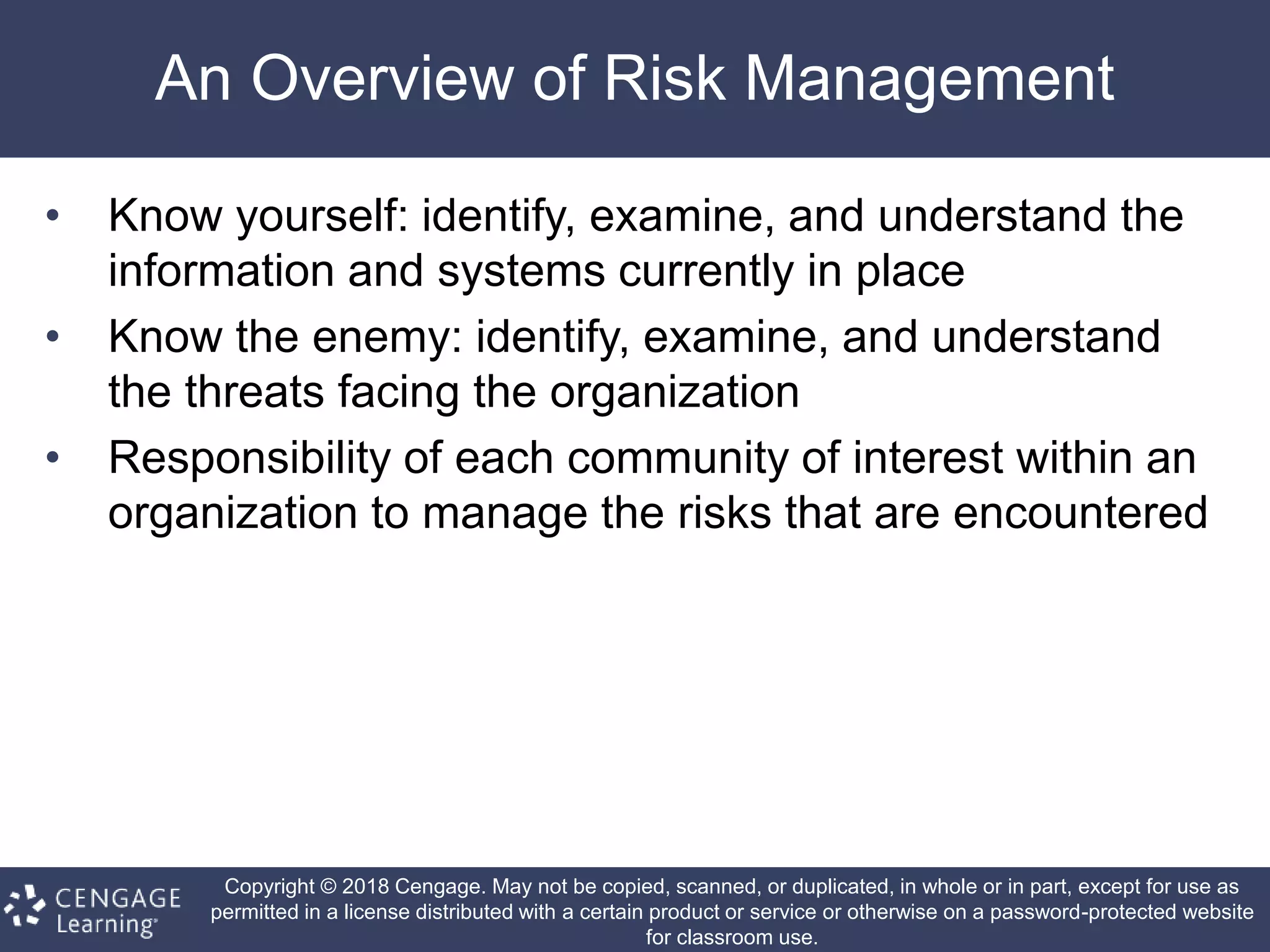
An Overview of Risk Management
• Know yourself: identify, examine, and understand the
information and systems currently in place
• Know the enemy: identify, examine, and understand
the threats facing the organization
• Responsibility of each community of interest within an
organization to manage the risks that are encountered
Copyright © 2018 Cengage. May not be copied, scanned, or duplicated, in whole or in part, except for use as
permitted in a license distributed with a certain product or service or otherwise on a password-protected website
for classroom use.
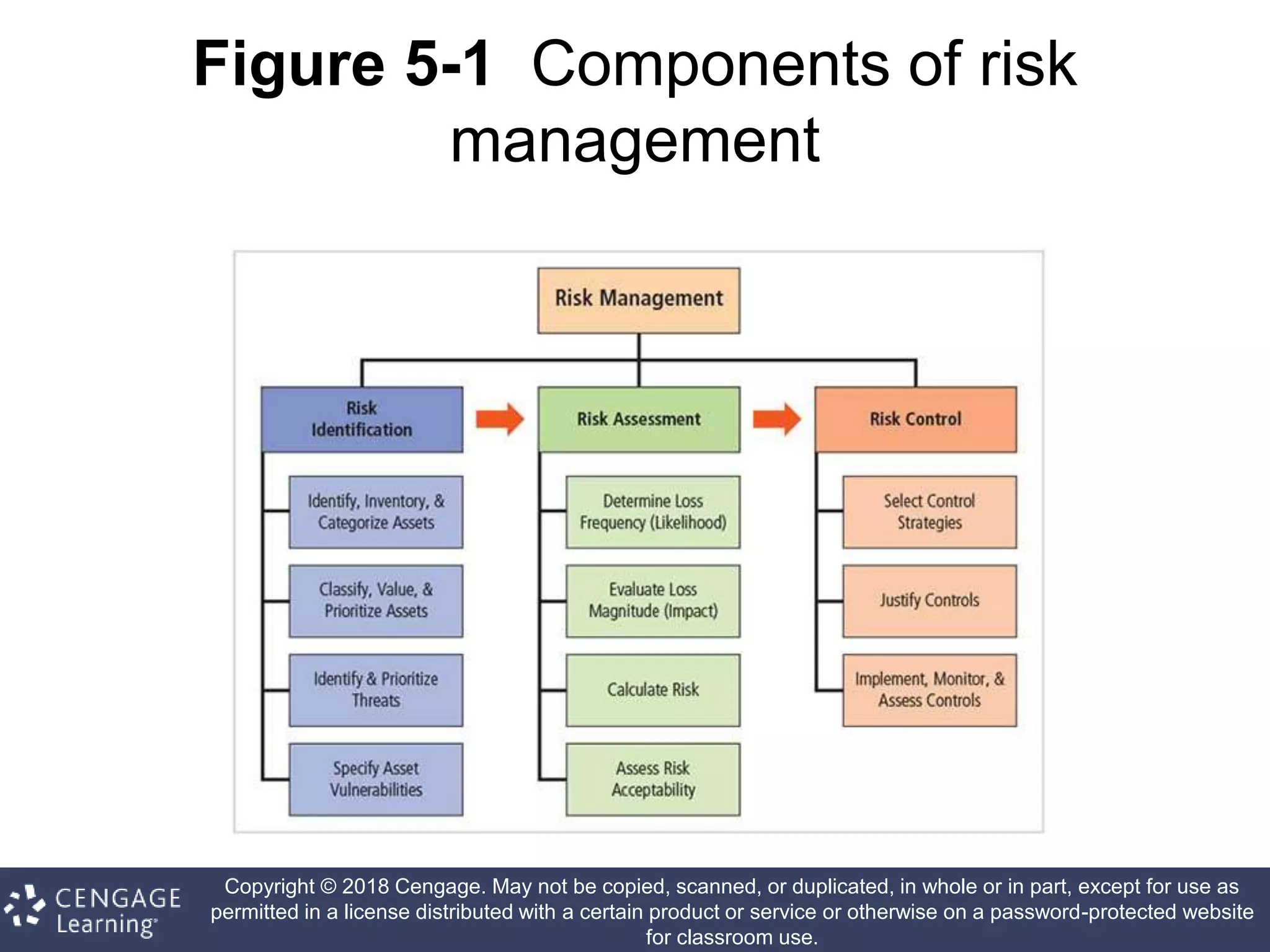
Figure 5-1 Components of risk
management
Copyright © 2018 Cengage. May not be copied, scanned, or duplicated, in whole or in part, except for use as
permitted in a license distributed with a certain product or service or otherwise on a password-protected website
for classroom use.
The Roles of the Communities of Interest
• Information security, management and users, and
information technology all must work together.
• Communities of interest are responsible for:
– Evaluating current and proposed risk controls
– Determining which control options are cost effective for
the organization
– Acquiring or installing the needed controls
– Ensuring that the controls remain effective
Copyright © 2018 Cengage. May not be copied, scanned, or duplicated, in whole or in part, except for use as
permitted in a license distributed with a certain product or service or otherwise on a password-protected website
for classroom use.
Risk Appetite and Residual Risk
• Risk appetite: The quantity and nature of risk that
organizations are willing to accept as they evaluate the
trade-offs between perfect security and unlimited
accessibility.
– Reasoned approach is one that balances the expense of
controlling vulnerabilities against possible losses if the
vulnerabilities are exploited.
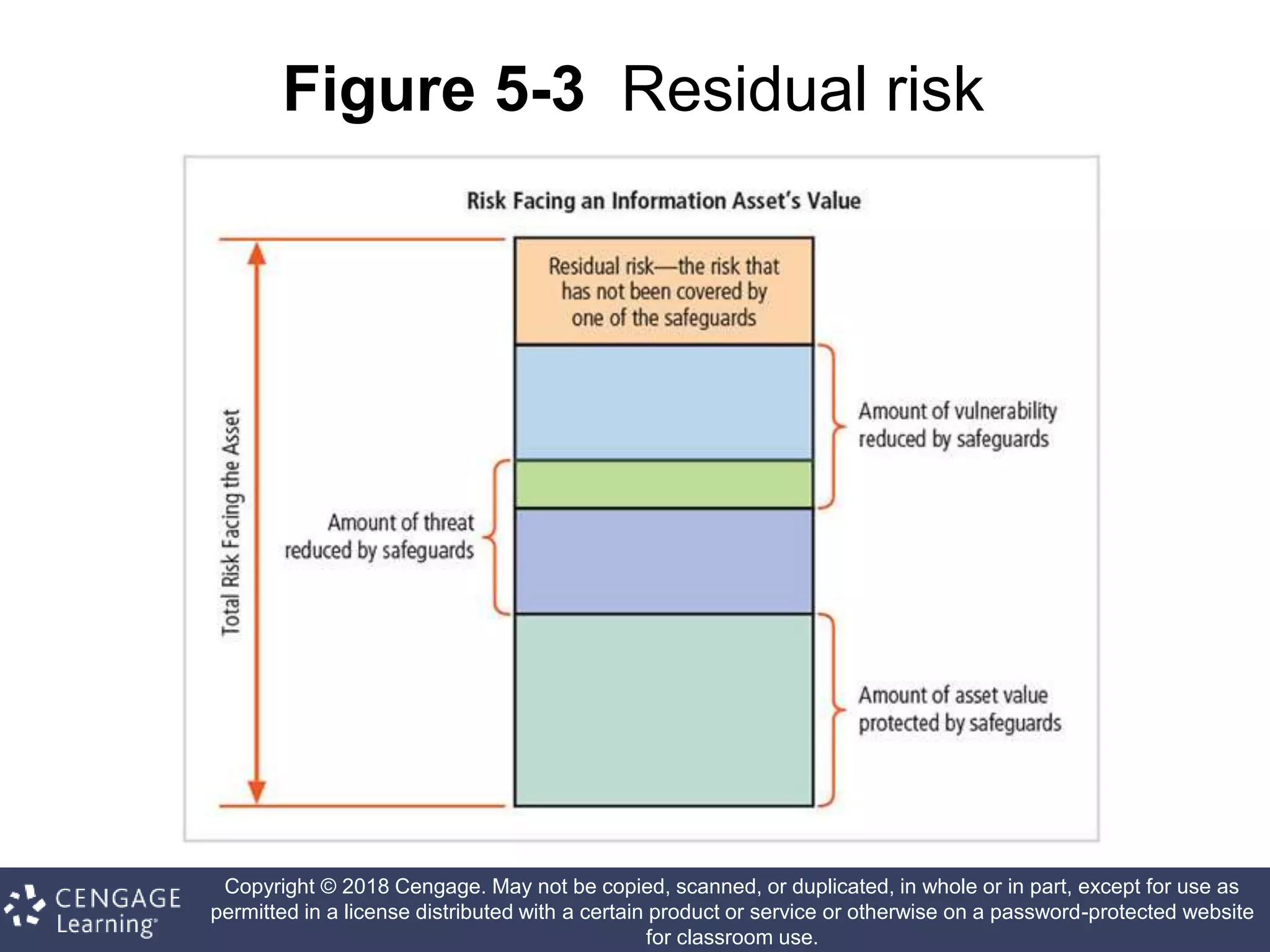
• Residual risk: The risk to information assets that
remains even after current controls have been applied.
• The goal of information security is to bring residual risk
into line with risk appetite.
Copyright © 2018 Cengage. May not be copied, scanned, or duplicated, in whole or in part, except for use as
permitted in a license distributed with a certain product or service or otherwise on a password-protected website
for classroom use.
Figure 5-3 Residual risk
Copyright © 2018 Cengage. May not be copied, scanned, or duplicated, in whole or in part, except for use as
permitted in a license distributed with a certain product or service or otherwise on a password-protected website
for classroom use.
Risk Identification
• Risk management requires that InfoSec professionals
know how to identify, classify, and prioritize an
organization’s information assets.
• A threat assessment process identifies and evaluates
the risks facing each asset
Copyright © 2018 Cengage. May not be copied, scanned, or duplicated, in whole or in part, except for use as
permitted in a license distributed with a certain product or service or otherwise on a password-protected website
for classroom use.
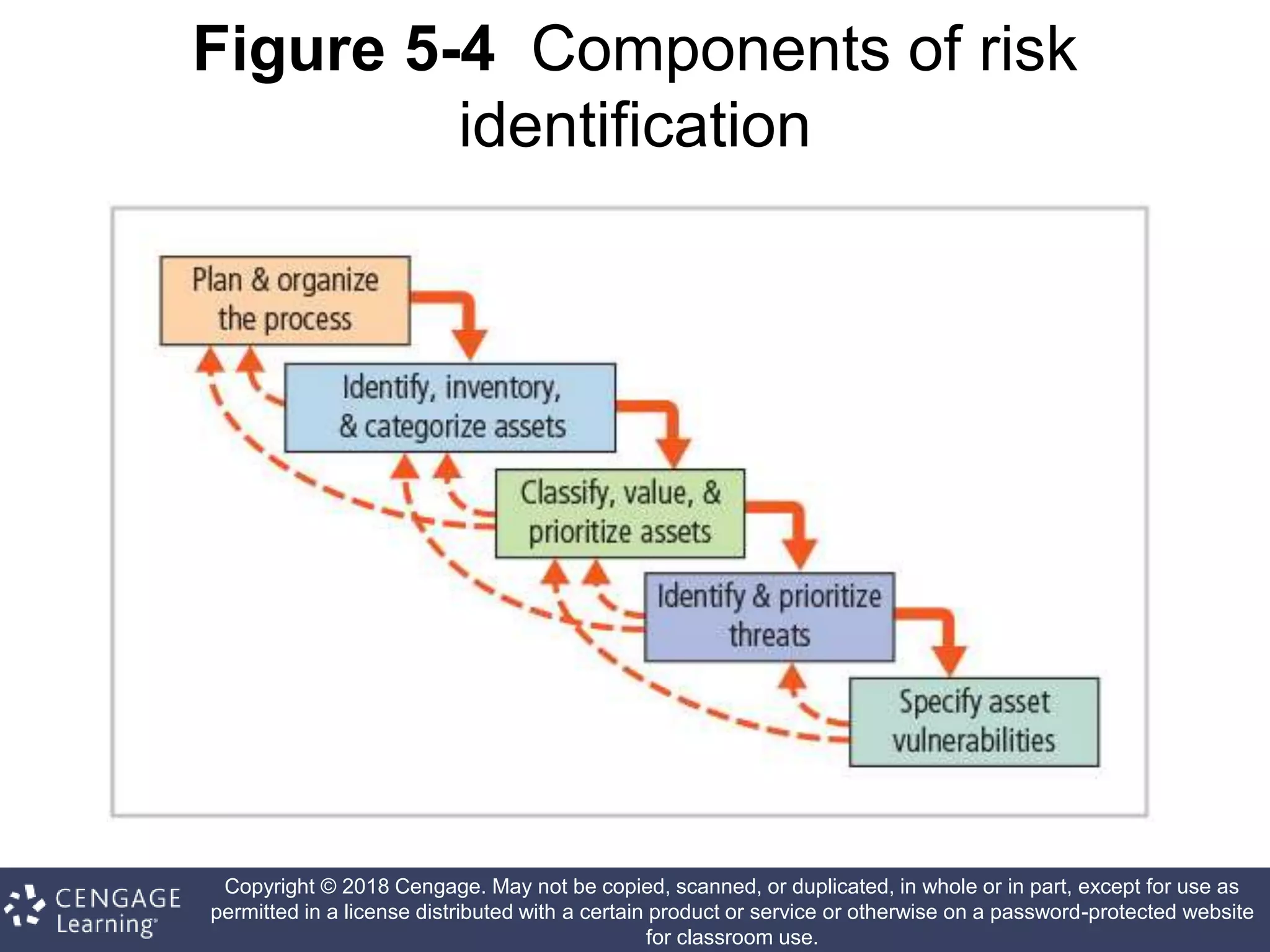
Figure 5-4 Components of risk
identification
Copyright © 2018 Cengage. May not be copied, scanned, or duplicated, in whole or in part, except for use as
permitted in a license distributed with a certain product or service or otherwise on a password-protected website
for classroom use.
Planning and Organizing the Process
• The first step in the risk identification process is to
follow your project management principles.
• Begin by organizing a team with representation across
all affected groups.
• The process must then be planned out.
– Periodic deliverables
– Reviews
– Presentations to management
• Tasks should be laid out, assignments made, and
timetables discussed.
Copyright © 2018 Cengage. May not be copied, scanned, or duplicated, in whole or in part, except for use as
permitted in a license distributed with a certain product or service or otherwise on a password-protected website
for classroom use.
Identifying, Inventorying, and Categorizing
Assets
• Iterative process: Begins with the identification and
inventory of assets, including all elements of an
organization’s system (people, procedures, data and
information, software, hardware, networking)
• Assets are then categorized
Copyright © 2018 Cengage. May not be copied, scanned, or duplicated, in whole or in part, except for use as
permitted in a license distributed with a certain product or service or otherwise on a password-protected website
for classroom use.
Table 5-1 categorization the components of
an information system
Traditional system
components
Information asset
components
Risk management system components
People Nonemployees Trusted employees other staff
Procedures People at trusted organizations strangers and
visitors
Procedures Information IT and business standard
IT and business-sensitive procedures
Data Software Transmission
Processing
Storage
Software System devices and
peripherals
Application
Operating system
Security components
Hardware System devices and
peripherals
System and peripherals
Security devices
Networking components Intranet components
Internet or DMZ components
Copyright © 2018 Cengage. May not be copied, scanned, or duplicated, in whole or in part, except for use as
permitted in a license distributed with a certain product or service or otherwise on a password-protected website
for classroom use.
People, Procedures, and Data Asset
Identification
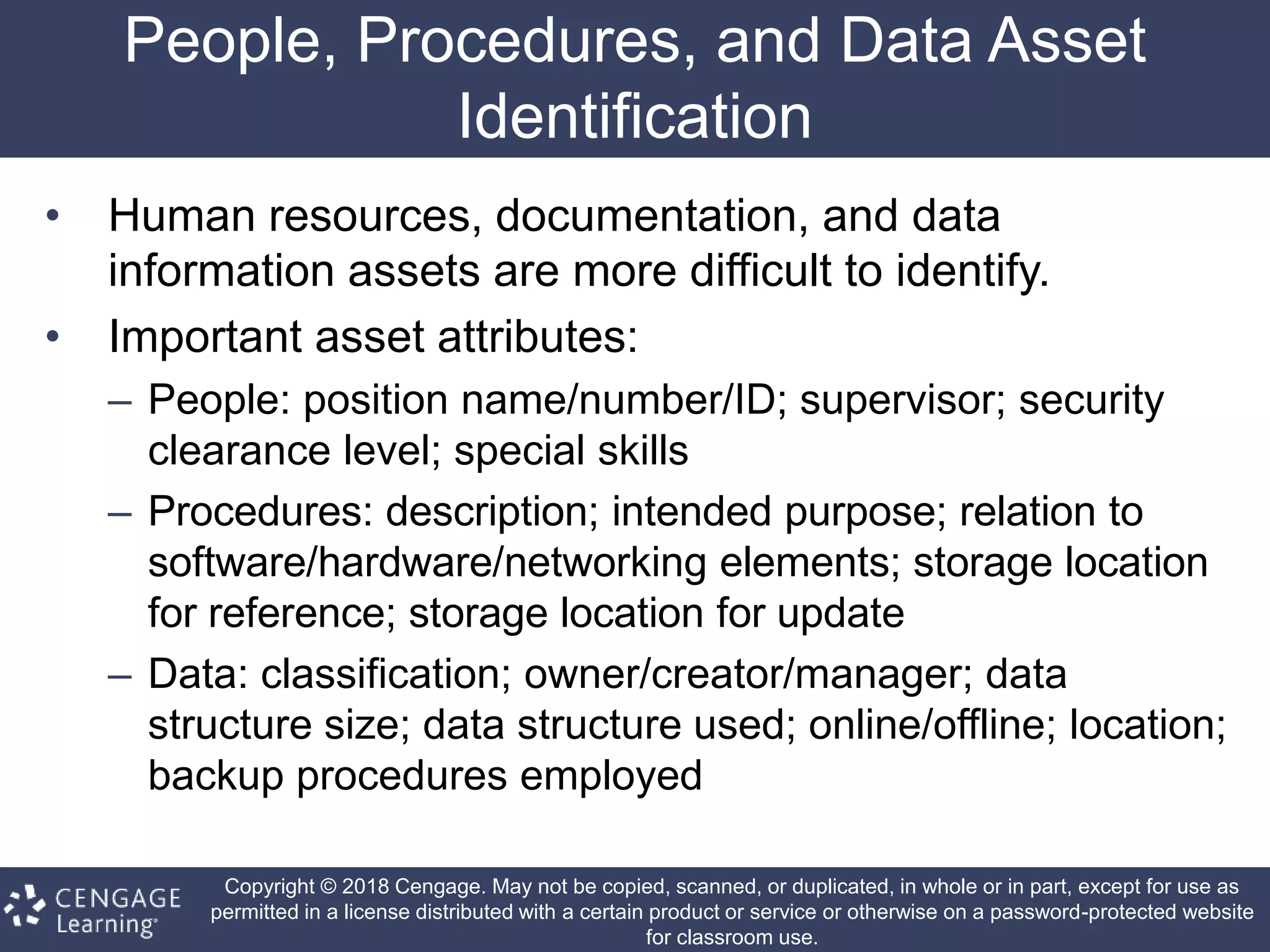
• Human resources, documentation, and data
information assets are more difficult to identify.
• Important asset attributes:
– People: position name/number/ID; supervisor; security
clearance level; special skills
– Procedures: description; intended purpose; relation to
software/hardware/networking elements; storage location
for reference; storage location for update
– Data: classification; owner/creator/manager; data
structure size; data structure used; online/offline; location;
backup procedures employed
Copyright © 2018 Cengage. May not be copied, scanned, or duplicated, in whole or in part, except for use as
permitted in a license distributed with a certain product or service or otherwise on a password-protected website
for classroom use.
Hardware, Software, and Network Asset
Identification
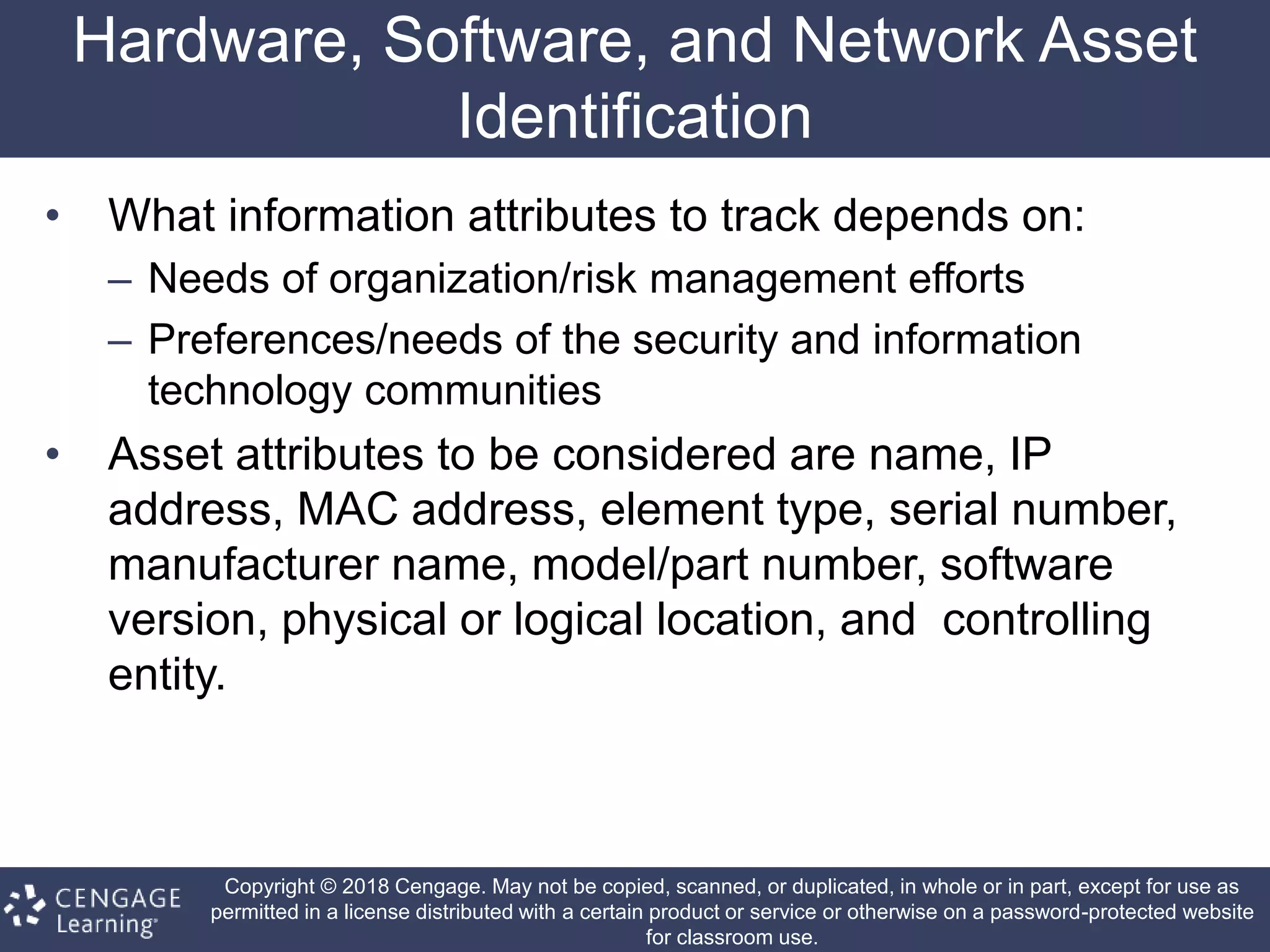
• What information attributes to track depends on:
– Needs of organization/risk management efforts
– Preferences/needs of the security and information
technology communities
• Asset attributes to be considered are name, IP
address, MAC address, element type, serial number,
manufacturer name, model/part number, software
version, physical or logical location, and controlling
entity.
Copyright © 2018 Cengage. May not be copied, scanned, or duplicated, in whole or in part, except for use as
permitted in a license distributed with a certain product or service or otherwise on a password-protected website
for classroom use.
Information Asset Inventory
• Unless information assets are identified and
inventoried, they cannot be effectively protected.
• Inventory process involves formalizing the identification
process in some form of organizational tool.
• Automated tools can sometimes identify the system
elements that make up hardware, software, and
network components.
Copyright © 2018 Cengage. May not be copied, scanned, or duplicated, in whole or in part, except for use as
permitted in a license distributed with a certain product or service or otherwise on a password-protected website
for classroom use.
Asset Categorization
• People comprise employees and nonemployees.
• Procedures either do not expose knowledge useful to a
potential attacker or are sensitive and could allow
adversary to gain advantage.
• Data components account for the management of
information in transmission, processing, and storage.
• Software components are applications, operating
systems, or security components.
• Hardware: either the usual system devices and
peripherals or part of information security control
systems.
Copyright © 2018 Cengage. May not be copied, scanned, or duplicated, in whole or in part, except for use as
permitted in a license distributed with a certain product or service or otherwise on a password-protected website
for classroom use.
Classifying, Valuing, and Prioritizing
Information Assets
• Many organizations have data classification schemes
(e.g., confidential, internal, public data).
• Classification of components must be specific enough
to enable the determination of priority levels.
• Categories must be comprehensive and mutually
exclusive.
Copyright © 2018 Cengage. May not be copied, scanned, or duplicated, in whole or in part, except for use as
permitted in a license distributed with a certain product or service or otherwise on a password-protected website
for classroom use.
Data Classification and Management
(1 of 2)
• Variety of classification schemes are used by corporate
and military organizations.
• Information owners are responsible for classifying their
information assets.
• Information classifications must be reviewed
periodically.
• Classifications include confidential, internal, and
external.
Copyright © 2018 Cengage. May not be copied, scanned, or duplicated, in whole or in part, except for use as
permitted in a license distributed with a certain product or service or otherwise on a password-protected website
for classroom use.
Data Classification and Management
(2 of 2)
• Security clearances
– Each data user must be assigned authorization level
indicating classification level.
– Before accessing specific set of data, the employee must
meet the need-to-know requirement.
• Management of classified data includes storage,
distribution, transportation, and destruction.
• Clean desk policy
• Dumpster diving
Copyright © 2018 Cengage. May not be copied, scanned, or duplicated, in whole or in part, except for use as
permitted in a license distributed with a certain product or service or otherwise on a password-protected website
for classroom use.
Information Asset Valuation (1 of 2)
• Questions help develop criteria for asset valuation.
• Which information asset:
– Is most critical to the organization’s success?
– Generates the most revenue/profitability?
– Plays the biggest role in generating revenue or delivering
services?
– Would be the most expensive to replace or protect?
– Would be the most embarrassing or cause greatest
liability if revealed?
Copyright © 2018 Cengage. May not be copied, scanned, or duplicated, in whole or in part, except for use as
permitted in a license distributed with a certain product or service or otherwise on a password-protected website
for classroom use.
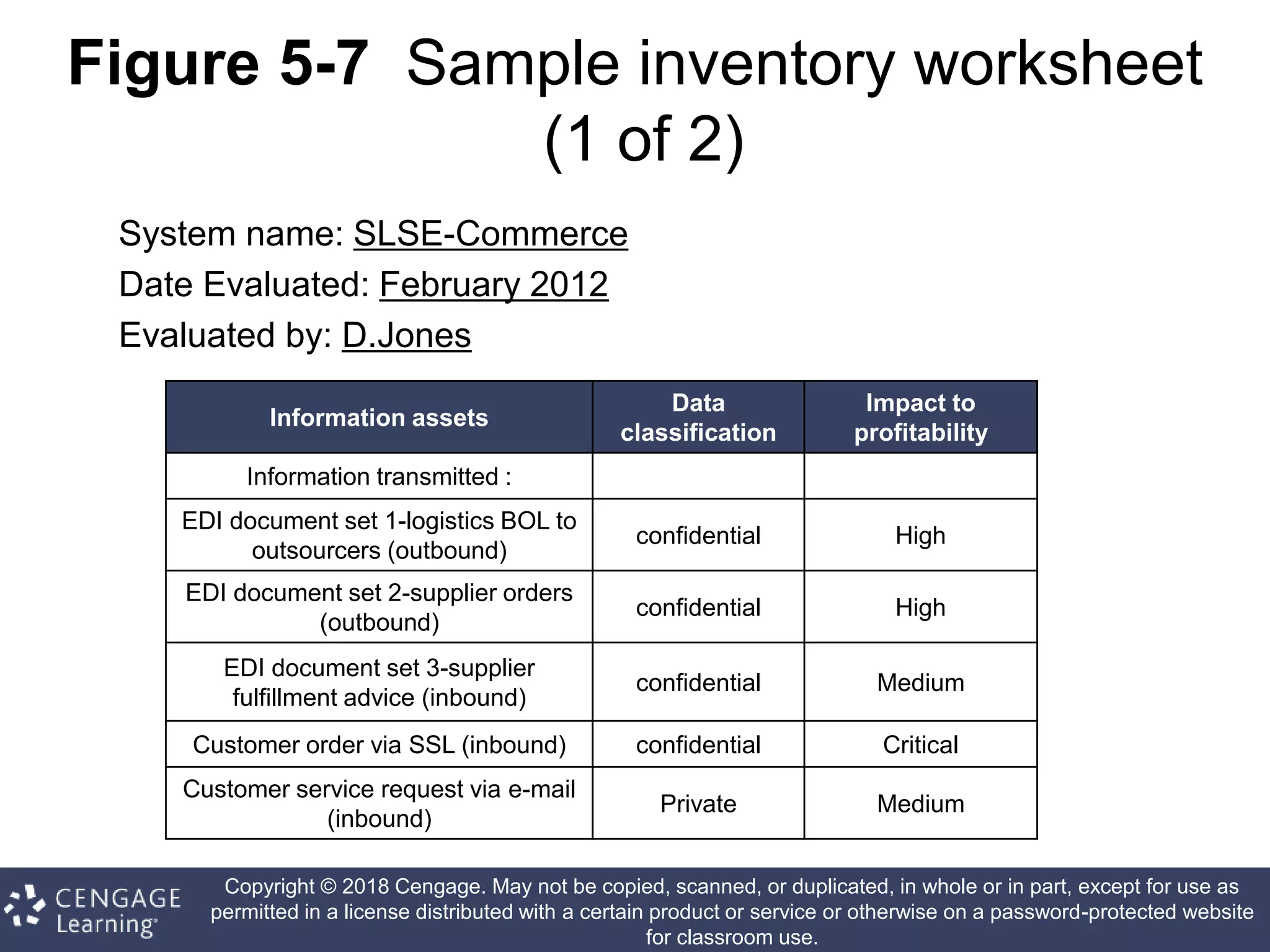
Figure 5-7 Sample inventory worksheet
(1 of 2)
System name: SLSE-Commerce
Date Evaluated: February 2012
Evaluated by: D.Jones
Information assets
Data
classification
Impact to
profitability
Information transmitted :
EDI document set 1-logistics BOL to
outsourcers (outbound)
confidential High
EDI document set 2-supplier orders
(outbound)
confidential High
EDI document set 3-supplier
fulfillment advice (inbound)
confidential Medium
Customer order via SSL (inbound) confidential Critical
Customer service request via e-mail
(inbound)
Private Medium
Copyright © 2018 Cengage. May not be copied, scanned, or duplicated, in whole or in part, except for use as
permitted in a license distributed with a certain product or service or otherwise on a password-protected website
for classroom use.
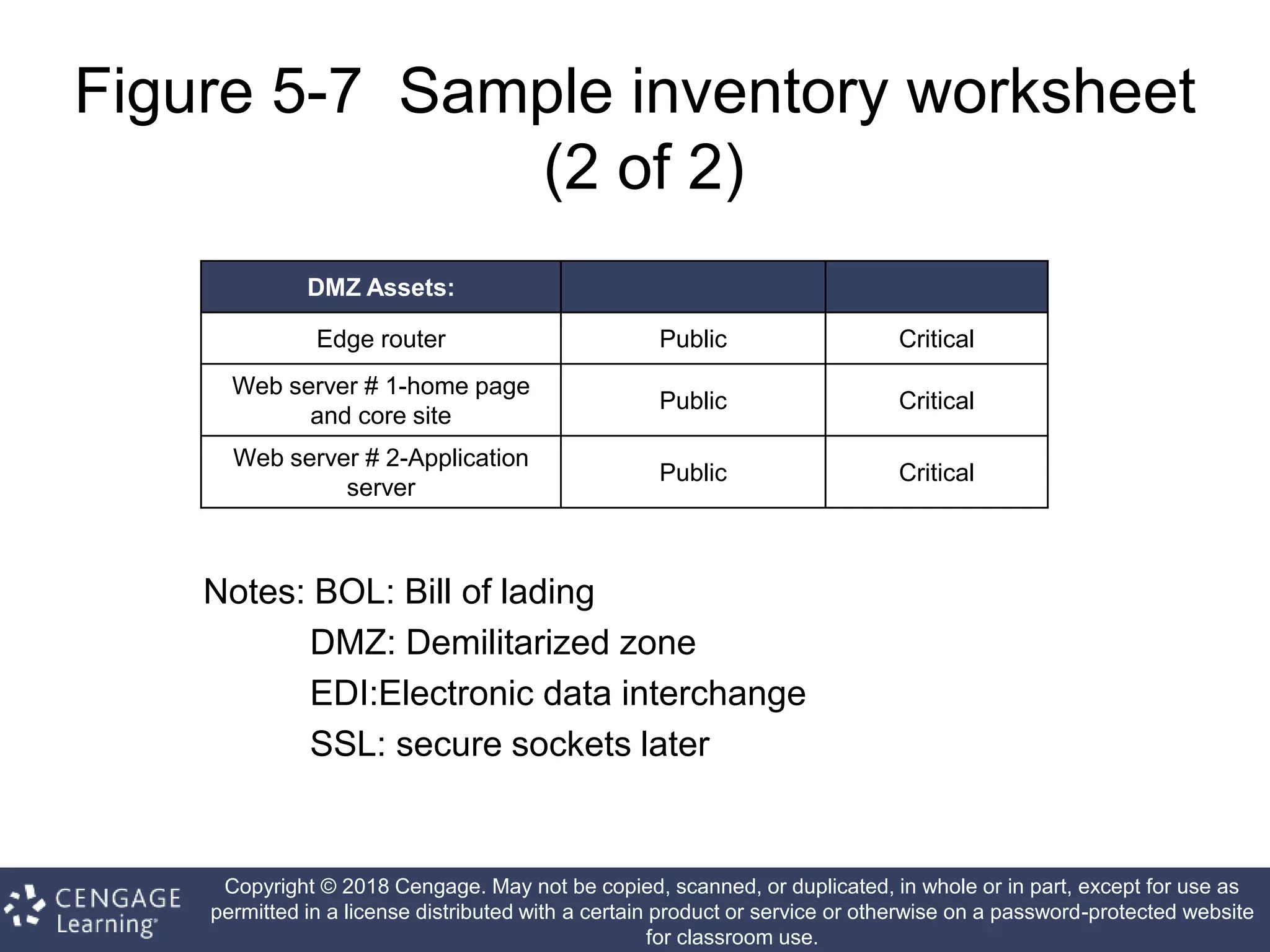
Figure 5-7 Sample inventory worksheet
(2 of 2)
DMZ Assets:
Edge router Public Critical
Web server # 1-home page
and core site
Public Critical
Web server # 2-Application
server
Public Critical
Notes: BOL: Bill of lading
DMZ: Demilitarized zone
EDI:Electronic data interchange
SSL: secure sockets later
Copyright © 2018 Cengage. May not be copied, scanned, or duplicated, in whole or in part, except for use as
permitted in a license distributed with a certain product or service or otherwise on a password-protected website
for classroom use.
Information Asset Valuation (2 of 2)
• Information asset prioritization
– Create weighting for each category based on the answers
to questions.
– Prioritize each asset using weighted factor analysis.
– List the assets in order of importance using a weighted
factor analysis worksheet.
Copyright © 2018 Cengage. May not be copied, scanned, or duplicated, in whole or in part, except for use as
permitted in a license distributed with a certain product or service or otherwise on a password-protected website
for classroom use.
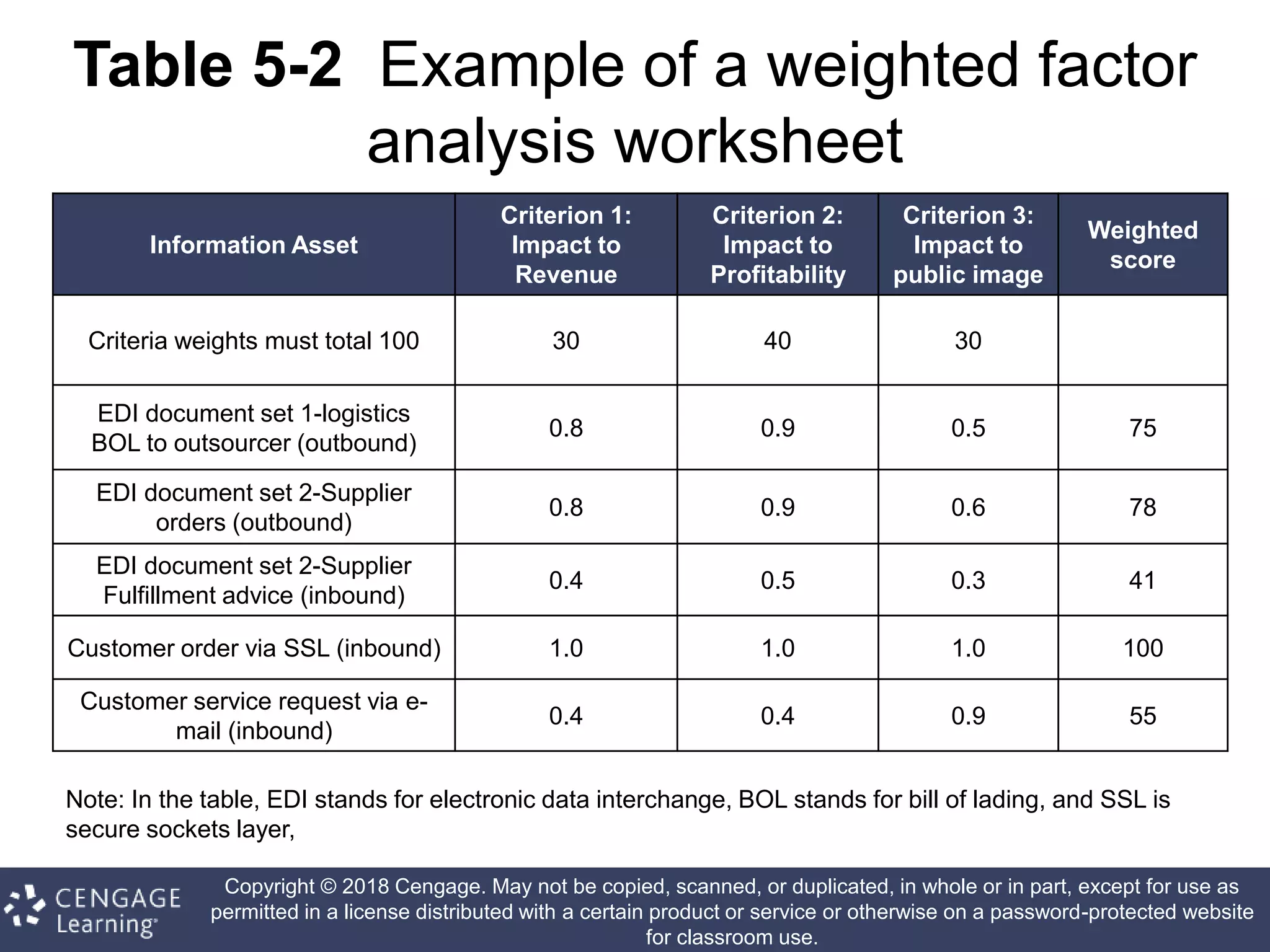
Table 5-2 Example of a weighted factor
analysis worksheet
Information Asset
Criterion 1:
Impact to
Revenue
Criterion 2:
Impact to
Profitability
Criterion 3:
Impact to
public image
Weighted
score
Criteria weights must total 100 30 40 30
EDI document set 1-logistics
BOL to outsourcer (outbound)
0.8 0.9 0.5 75
EDI document set 2-Supplier
orders (outbound)
0.8 0.9 0.6 78
EDI document set 2-Supplier
Fulfillment advice (inbound)
0.4 0.5 0.3 41
Customer order via SSL (inbound) 1.0 1.0 1.0 100
Customer service request via e-
mail (inbound)
0.4 0.4 0.9 55
Note: In the table, EDI stands for electronic data interchange, BOL stands for bill of lading, and SSL is
secure sockets layer,
Copyright © 2018 Cengage. May not be copied, scanned, or duplicated, in whole or in part, except for use as
permitted in a license distributed with a certain product or service or otherwise on a password-protected website
for classroom use.
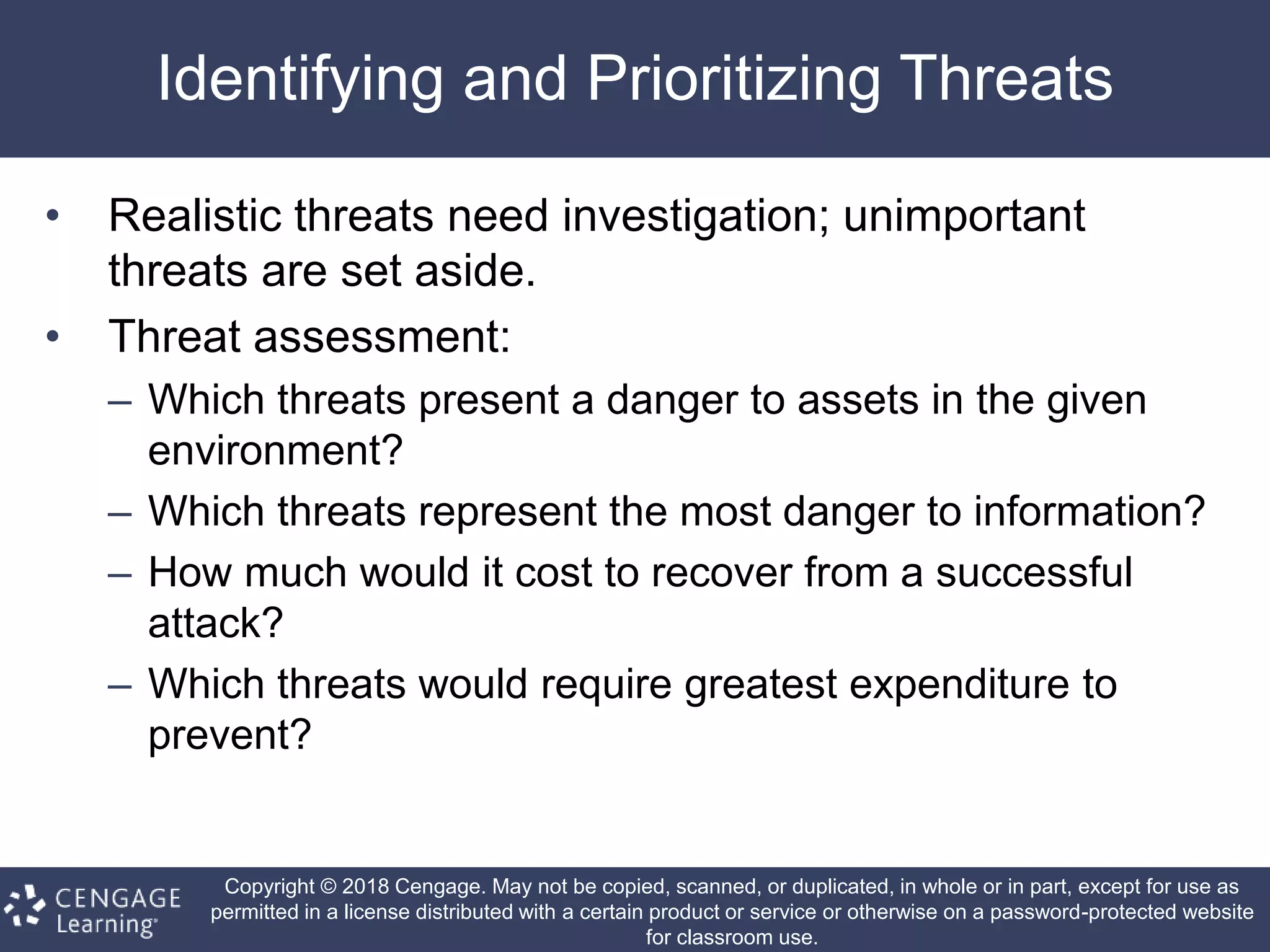
Identifying and Prioritizing Threats
• Realistic threats need investigation; unimportant
threats are set aside.
• Threat assessment:
– Which threats present a danger to assets in the given
environment?
– Which threats represent the most danger to information?
– How much would it cost to recover from a successful
attack?
– Which threats would require greatest expenditure to
prevent?
Copyright © 2018 Cengage. May not be copied, scanned, or duplicated, in whole or in part, except for use as
permitted in a license distributed with a certain product or service or otherwise on a password-protected website
for classroom use.
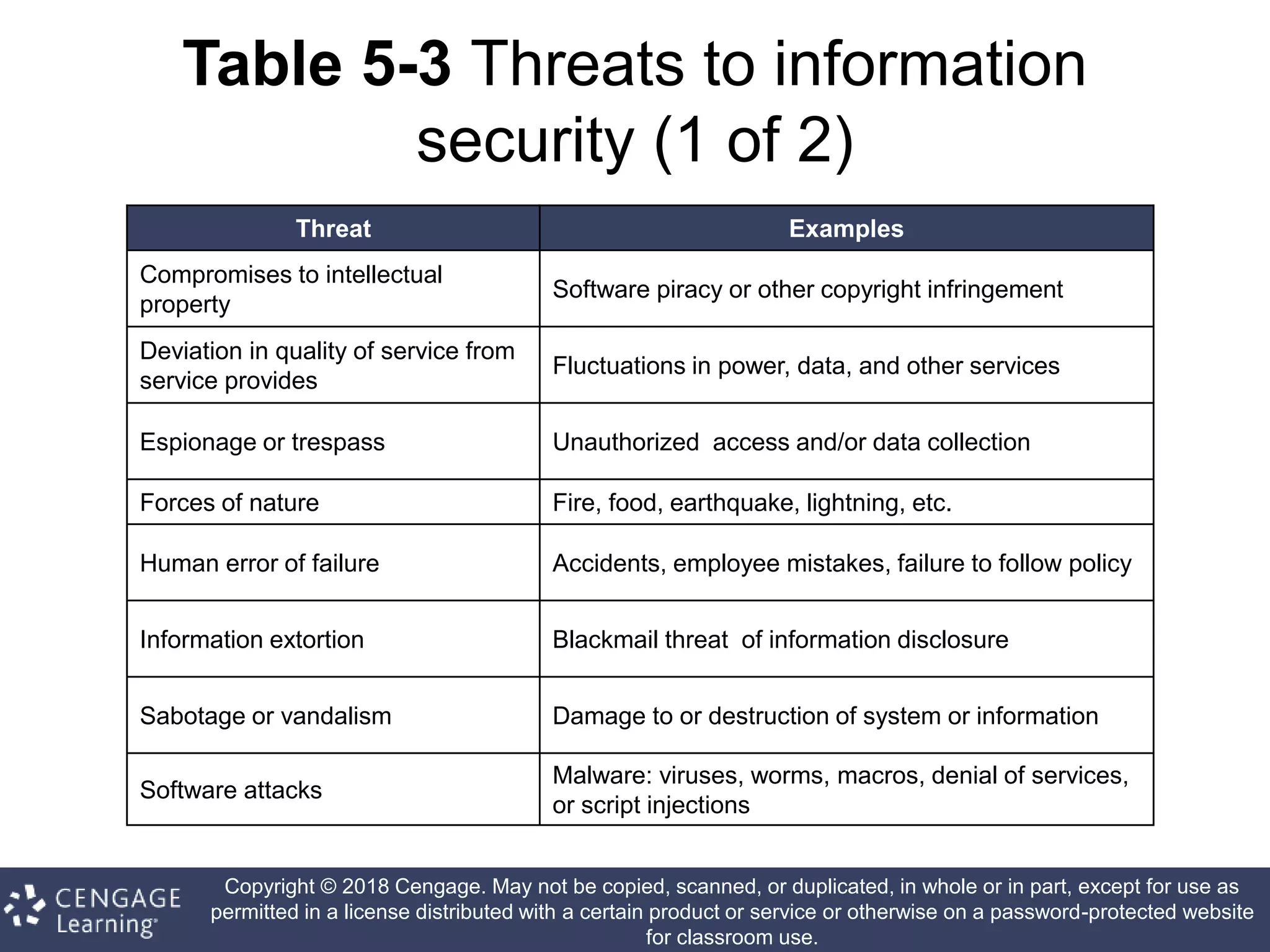
Table 5-3 Threats to information
security (1 of 2)
Threat Examples
Compromises to intellectual
property
Software piracy or other copyright infringement
Deviation in quality of service from
service provides
Fluctuations in power, data, and other services
Espionage or trespass Unauthorized access and/or data collection
Forces of nature Fire, food, earthquake, lightning, etc.
Human error of failure Accidents, employee mistakes, failure to follow policy
Information extortion Blackmail threat of information disclosure
Sabotage or vandalism Damage to or destruction of system or information
Software attacks
Malware: viruses, worms, macros, denial of services,
or script injections
Copyright © 2018 Cengage. May not be copied, scanned, or duplicated, in whole or in part, except for use as
permitted in a license distributed with a certain product or service or otherwise on a password-protected website
for classroom use.
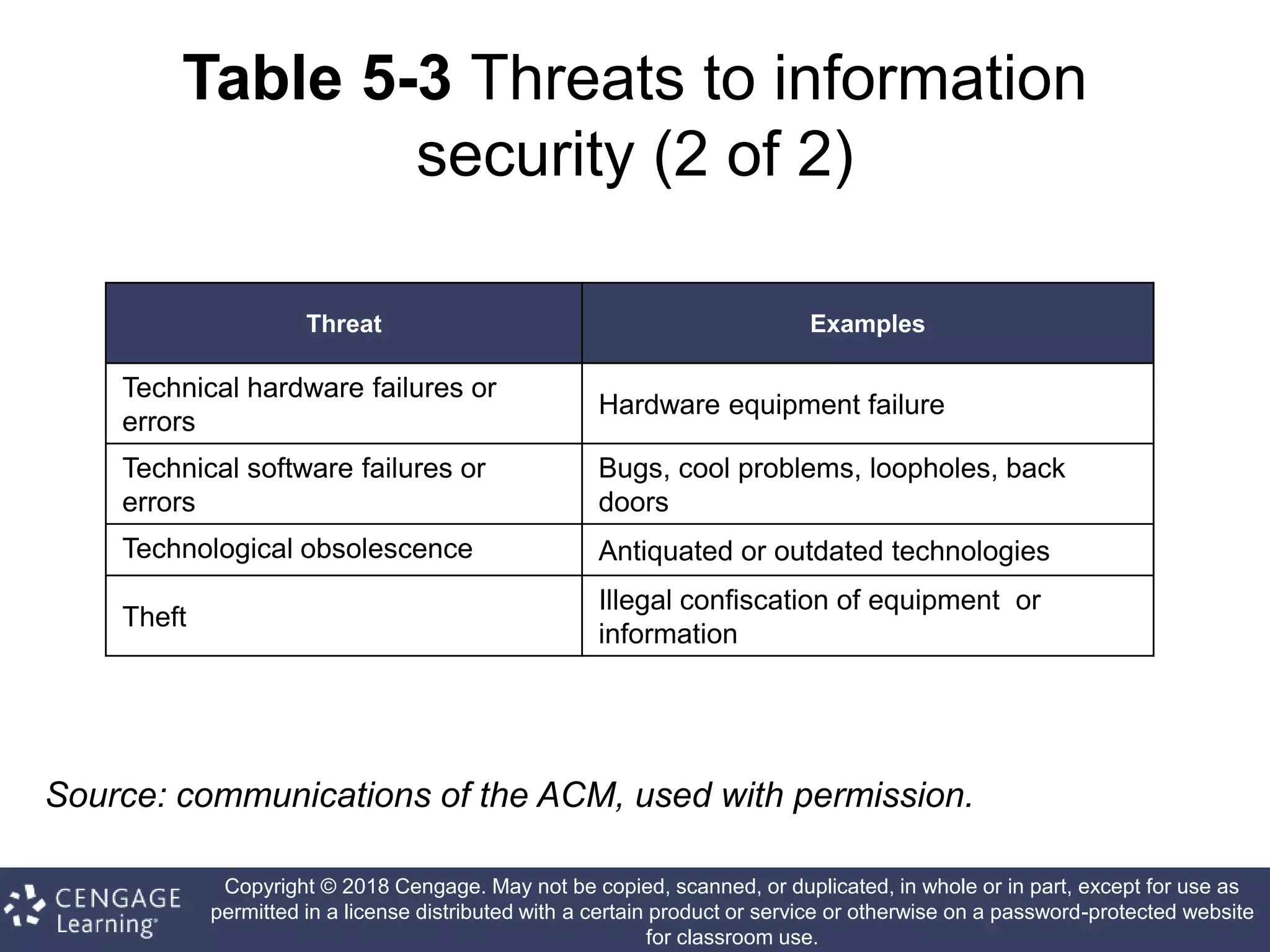
Table 5-3 Threats to information
security (2 of 2)
Threat Examples
Technical hardware failures or
errors
Hardware equipment failure
Technical software failures or
errors
Bugs, cool problems, loopholes, back
doors
Technological obsolescence Antiquated or outdated technologies
Theft
Illegal confiscation of equipment or
information
Source: communications of the ACM, used with permission.
Copyright © 2018 Cengage. May not be copied, scanned, or duplicated, in whole or in part, except for use as
permitted in a license distributed with a certain product or service or otherwise on a password-protected website
for classroom use.
Specifying Asset Vulnerabilities
• Specific avenues that threat agents can exploit to
attack an information asset are called vulnerabilities.
• Examine how each threat could be perpetrated and list
the organization’s assets and vulnerabilities.
• Process works best when people with diverse
backgrounds within organization work iteratively in a
series of brainstorming sessions.
• At the end of the risk identification process, prioritized
list of assets with their vulnerabilities is achieved.
– Can be combined with weighted list of threats to form
threats-vulnerabilities-assets (TVA) worksheet
Copyright © 2018 Cengage. May not be copied, scanned, or duplicated, in whole or in part, except for use as
permitted in a license distributed with a certain product or service or otherwise on a password-protected website
for classroom use.
Table 5-7 vulnerability assessment of a
hypothetical DMZ router (1 of 2)
Threat Possible vulnerabilities
Compromises to intellectual property • Copyrighted works developed in-house and stored on intranet servers can
be copied without permission unless the router is configured to limit
access from outsiders.
• Works copyrighted by others can be stolen: your organization is liable for
that loss to the copyright holder.
Espionage or trespass • This information asset (router) may have little intrinsic value, but other
assets protected by this device could be attacked if it does not perform
correctly or is compromised.
Forces of nature • All information assets in the organization are subject to forces of nature
unless suitable controls are provided.
Human error of failure • Employees or contractors may cause on outage if configuration errors are
made.
Information extortion • If attackers bypass the router or compromise it and then enter your
network, they may encrypt your data in place. They may not have stolen it,
but unless you pay them to acquire the encryption key, the data is inert
and no longer of value to you.
Deviation in quality of service • Power system failures are always possible. Unless suitable electrical
power conditioning is provided, failure is probable over time.
• ISP connectivity failures can interrupt internet bandwidth.
Copyright © 2018 Cengage. May not be copied, scanned, or duplicated, in whole or in part, except for use as
permitted in a license distributed with a certain product or service or otherwise on a password-protected website
for classroom use.
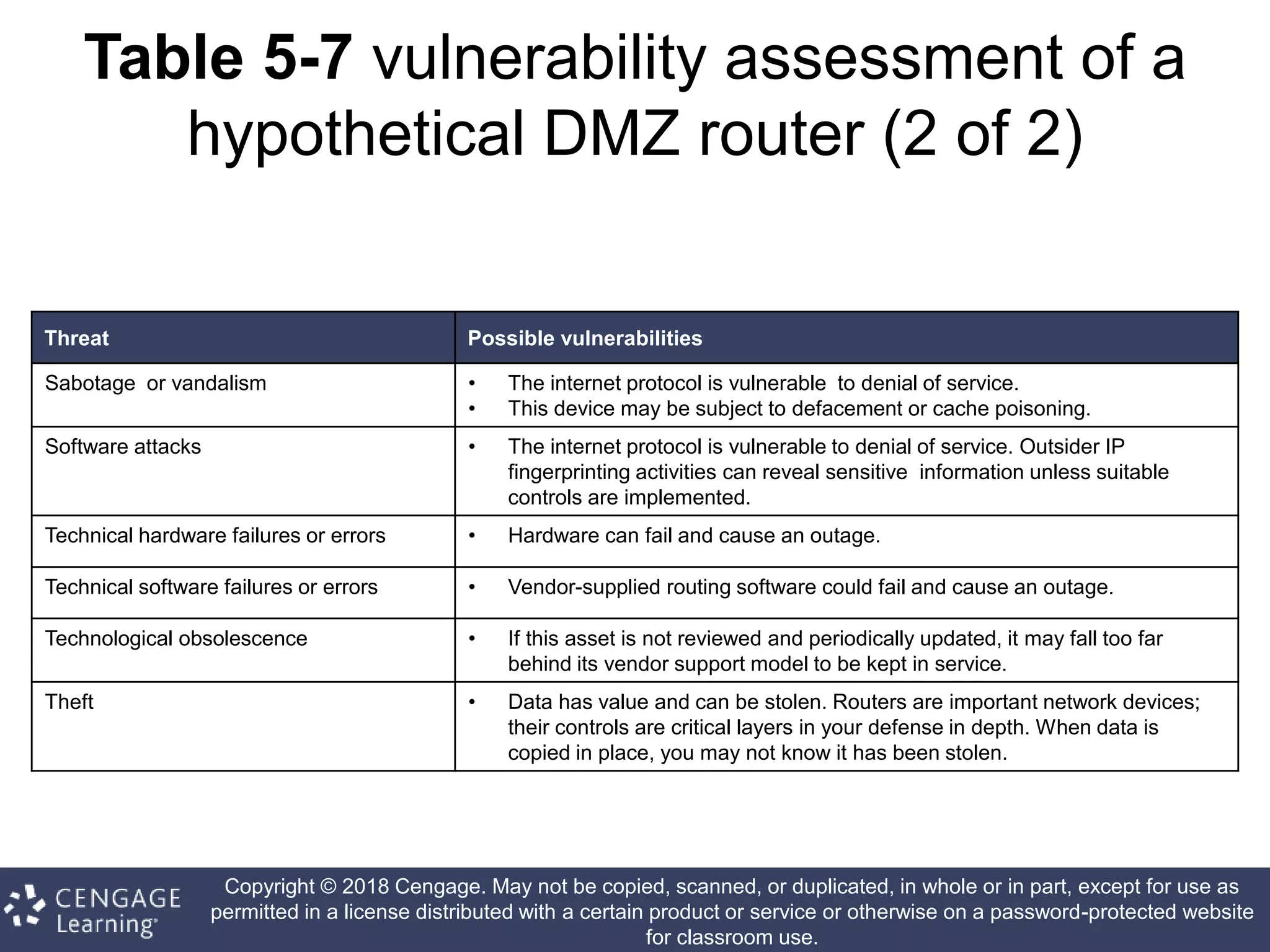
Table 5-7 vulnerability assessment of a
hypothetical DMZ router (2 of 2)
Threat Possible vulnerabilities
Sabotage or vandalism • The internet protocol is vulnerable to denial of service.
• This device may be subject to defacement or cache poisoning.
Software attacks • The internet protocol is vulnerable to denial of service. Outsider IP
fingerprinting activities can reveal sensitive information unless suitable
controls are implemented.
Technical hardware failures or errors • Hardware can fail and cause an outage.
Technical software failures or errors • Vendor-supplied routing software could fail and cause an outage.
Technological obsolescence • If this asset is not reviewed and periodically updated, it may fall too far
behind its vendor support model to be kept in service.
Theft • Data has value and can be stolen. Routers are important network devices;
their controls are critical layers in your defense in depth. When data is
copied in place, you may not know it has been stolen.
Copyright © 2018 Cengage. May not be copied, scanned, or duplicated, in whole or in part, except for use as
permitted in a license distributed with a certain product or service or otherwise on a password-protected website
for classroom use.
Table 5-8 Sample TVA Spreadsheet
Copyright © 2018 Cengage. May not be copied, scanned, or duplicated, in whole or in part, except for use as
permitted in a license distributed with a certain product or service or otherwise on a password-protected website
for classroom use.
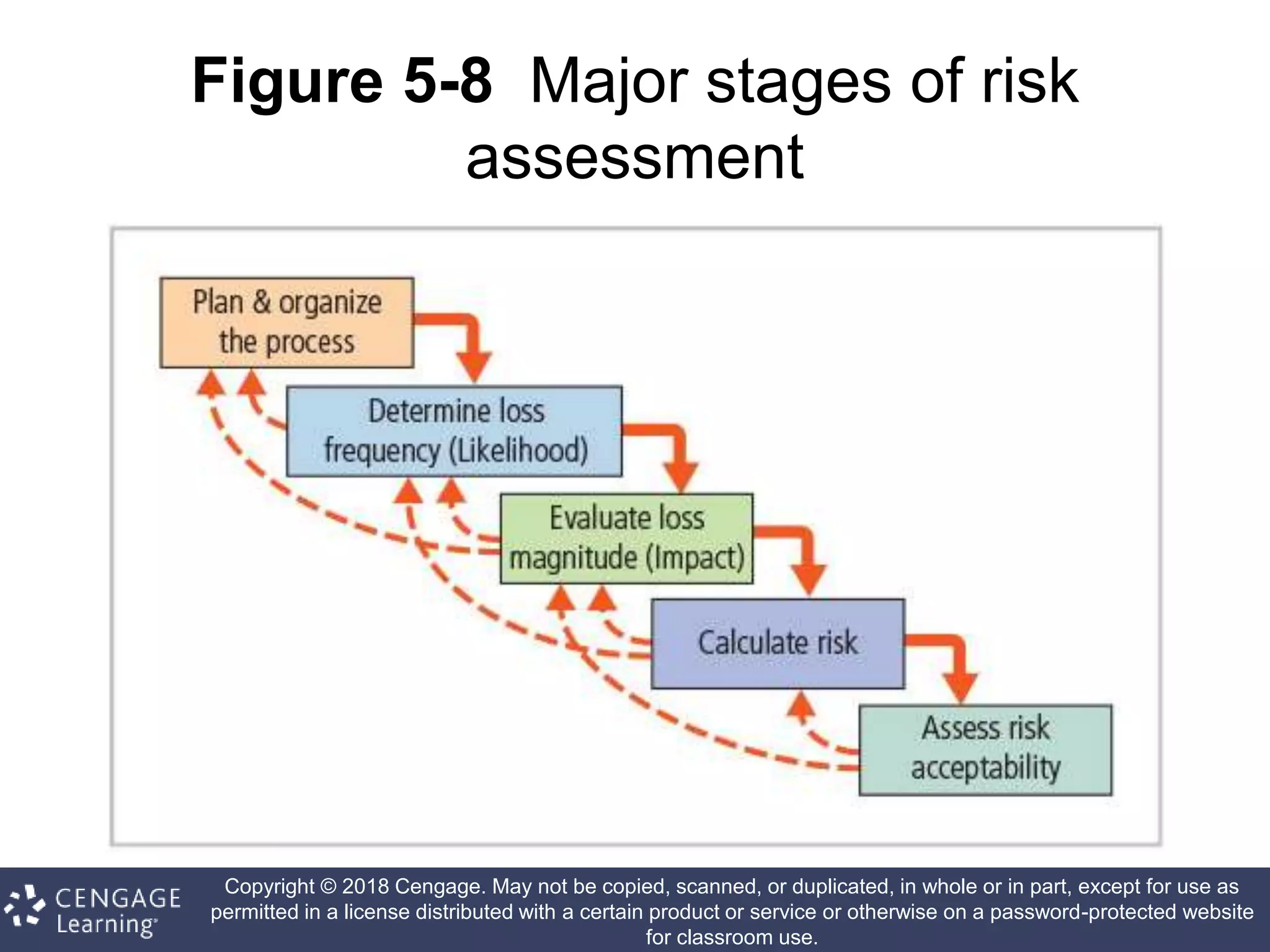
Risk Assessment
• Risk assessment evaluates the relative risk for each
vulnerability.
• It assigns a risk rating or score to each information
asset.
• Planning and organizing risk assessment
– The goal at this point is to create a method for evaluating
the relative risk of each listed vulnerability.
Copyright © 2018 Cengage. May not be copied, scanned, or duplicated, in whole or in part, except for use as
permitted in a license distributed with a certain product or service or otherwise on a password-protected website
for classroom use.
Figure 5-8 Major stages of risk
assessment
Copyright © 2018 Cengage. May not be copied, scanned, or duplicated, in whole or in part, except for use as
permitted in a license distributed with a certain product or service or otherwise on a password-protected website
for classroom use.
Determining the Loss Frequency
• It describes an assessment of the likelihood of an
attack combined with expected probability of success.
• Use external references for values that have been
reviewed/adjusted for your circumstances.
• Assign numeric value to likelihood, typically annual
value.
– Targeted by hackers once every five years
– Annualized likelihook of attack: 1/5, 20 percent
• Determining an attack’s success probability by
estimating a quantitative value (e.g., 10 percent) for the
likelihood of a successful attack; value subject to
uncertainty.
Copyright © 2018 Cengage. May not be copied, scanned, or duplicated, in whole or in part, except for use as
permitted in a license distributed with a certain product or service or otherwise on a password-protected website
for classroom use.
Evaluating Loss Magnitude
• The next step is to determine how much of an
information asset could be lost in a successful attack.
– Also known as loss magnitude or asset exposure
• Combines the value of information asset with the
percentage of asset lost in the event of a successful
attack.
• Difficulties involve:
– Valuating an information asset
– Estimating the percentage of information asset lost during
best-case, worst-case, and most likely scenarios
Copyright © 2018 Cengage. May not be copied, scanned, or duplicated, in whole or in part, except for use as
permitted in a license distributed with a certain product or service or otherwise on a password-protected website
for classroom use.
Calculating Risk
• For the purpose of relative risk assessment, risk
equals:
– Loss frequency TIMES loss magnitude
– MINUS the percentage of risk mitigated by current
controls
– PLUS an element of uncertainty
Copyright © 2018 Cengage. May not be copied, scanned, or duplicated, in whole or in part, except for use as
permitted in a license distributed with a certain product or service or otherwise on a password-protected website
for classroom use.
Figure 5-9 Factors of risk
Copyright © 2018 Cengage. May not be copied, scanned, or duplicated, in whole or in part, except for use as
permitted in a license distributed with a certain product or service or otherwise on a password-protected website
for classroom use.
Assessing Risk Acceptability
• For each threat and associated vulnerabilities that have
residual risk, create ranking of relative risk levels.
• Residual risk is the left-over risk after the organization
has done everything feasible to protect its assets.
• If risk appetite is less than the residual risk, it must look
for additional strategies to further reduce the risk.
– If risk appetite is greater than the residual risk, it must
proceed to the latter stages of risk control.
Copyright © 2018 Cengage. May not be copied, scanned, or duplicated, in whole or in part, except for use as
permitted in a license distributed with a certain product or service or otherwise on a password-protected website
for classroom use.
Documenting the Results of Risk
Assessment
• The final summarized document is the ranked
vulnerability risk worksheet.
• Worksheet describes asset, asset relative value,
vulnerability, loss frequency, and loss magnitude.
• Ranked vulnerability risk worksheet is the initial
working document for the next step in the risk
management process: assessing and controlling risk.
Copyright © 2018 Cengage. May not be copied, scanned, or duplicated, in whole or in part, except for use as
permitted in a license distributed with a certain product or service or otherwise on a password-protected website
for classroom use.
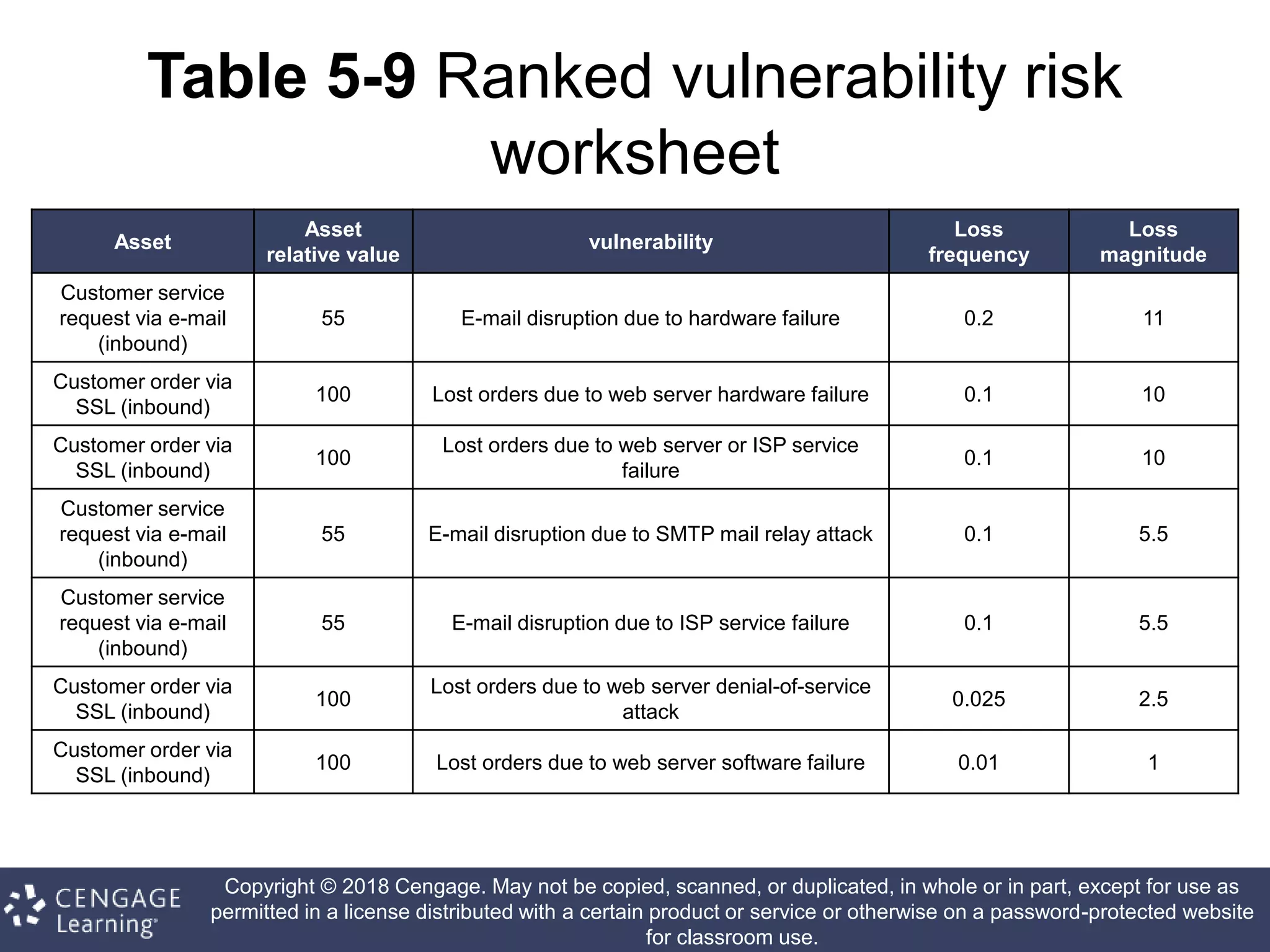
Table 5-9 Ranked vulnerability risk
worksheet
Asset
Asset
relative value
vulnerability
Loss
frequency
Loss
magnitude
Customer service
request via e-mail
(inbound)
55 E-mail disruption due to hardware failure 0.2 11
Customer order via
SSL (inbound)
100 Lost orders due to web server hardware failure 0.1 10
Customer order via
SSL (inbound)
100
Lost orders due to web server or ISP service
failure
0.1 10
Customer service
request via e-mail
(inbound)
55 E-mail disruption due to SMTP mail relay attack 0.1 5.5
Customer service
request via e-mail
(inbound)
55 E-mail disruption due to ISP service failure 0.1 5.5
Customer order via
SSL (inbound)
100
Lost orders due to web server denial-of-service
attack
0.025 2.5
Customer order via
SSL (inbound)
100 Lost orders due to web server software failure 0.01 1
Copyright © 2018 Cengage. May not be copied, scanned, or duplicated, in whole or in part, except for use as
permitted in a license distributed with a certain product or service or otherwise on a password-protected website
for classroom use.
Table 5-10 Risk identification and
Assessment Deliverables
Deliverable Purpose
Information asset classification
worksheet
Assembles information about information assets
and their value to the organization
Weighted criteria analysis worksheet
Assigns a ranked value or impact weight to each
information asset
Ranked vulnerability risk worksheet
Assigns a ranked value or risk rating for each
uncontrolled asset-vulnerability pair
Copyright © 2018 Cengage. May not be copied, scanned, or duplicated, in whole or in part, except for use as
permitted in a license distributed with a certain product or service or otherwise on a password-protected website
for classroom use.
The Open FAIR Approach to Risk
Assessment
• Identify scenario components
• Evaluate loss event frequency
• Evaluate probable loss magnitude
• Derive and articulate risk
Copyright © 2018 Cengage. May not be copied, scanned, or duplicated, in whole or in part, except for use as
permitted in a license distributed with a certain product or service or otherwise on a password-protected website
for classroom use.
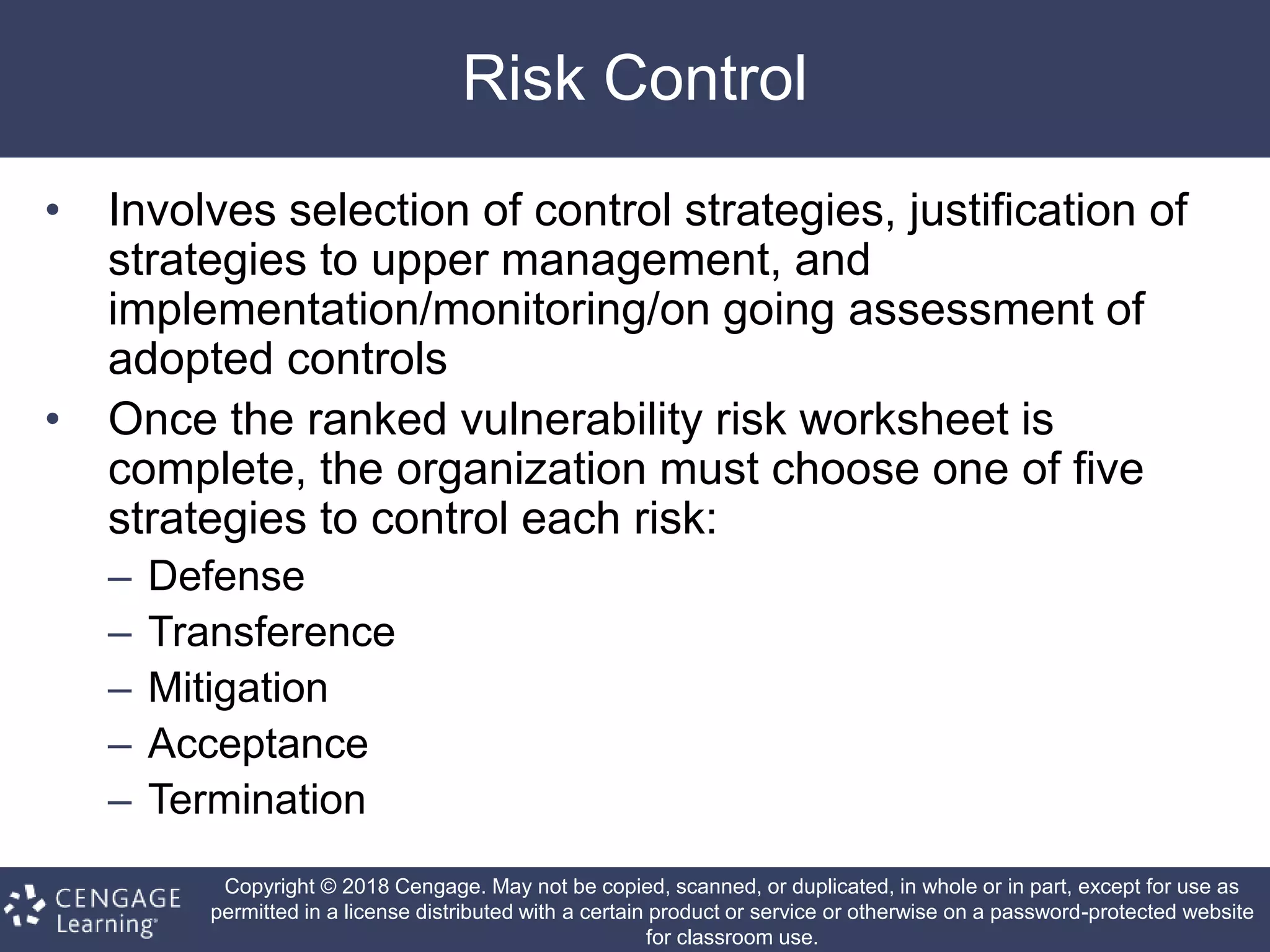
Risk Control
• Involves selection of control strategies, justification of
strategies to upper management, and
implementation/monitoring/on going assessment of
adopted controls
• Once the ranked vulnerability risk worksheet is
complete, the organization must choose one of five
strategies to control each risk:
– Defense
– Transference
– Mitigation
– Acceptance
– Termination
Copyright © 2018 Cengage. May not be copied, scanned, or duplicated, in whole or in part, except for use as
permitted in a license distributed with a certain product or service or otherwise on a password-protected website
for classroom use.
Defense
• Attempts to prevent exploitation of the vulnerability
• Preferred approach
• Accomplished through countering threats, removing
asset vulnerabilities, limiting asset access, and adding
protective safeguards
• Three common methods of risk avoidance:
– Application of policy
– Education and training
– Applying technology
Copyright © 2018 Cengage. May not be copied, scanned, or duplicated, in whole or in part, except for use as
permitted in a license distributed with a certain product or service or otherwise on a password-protected website
for classroom use.
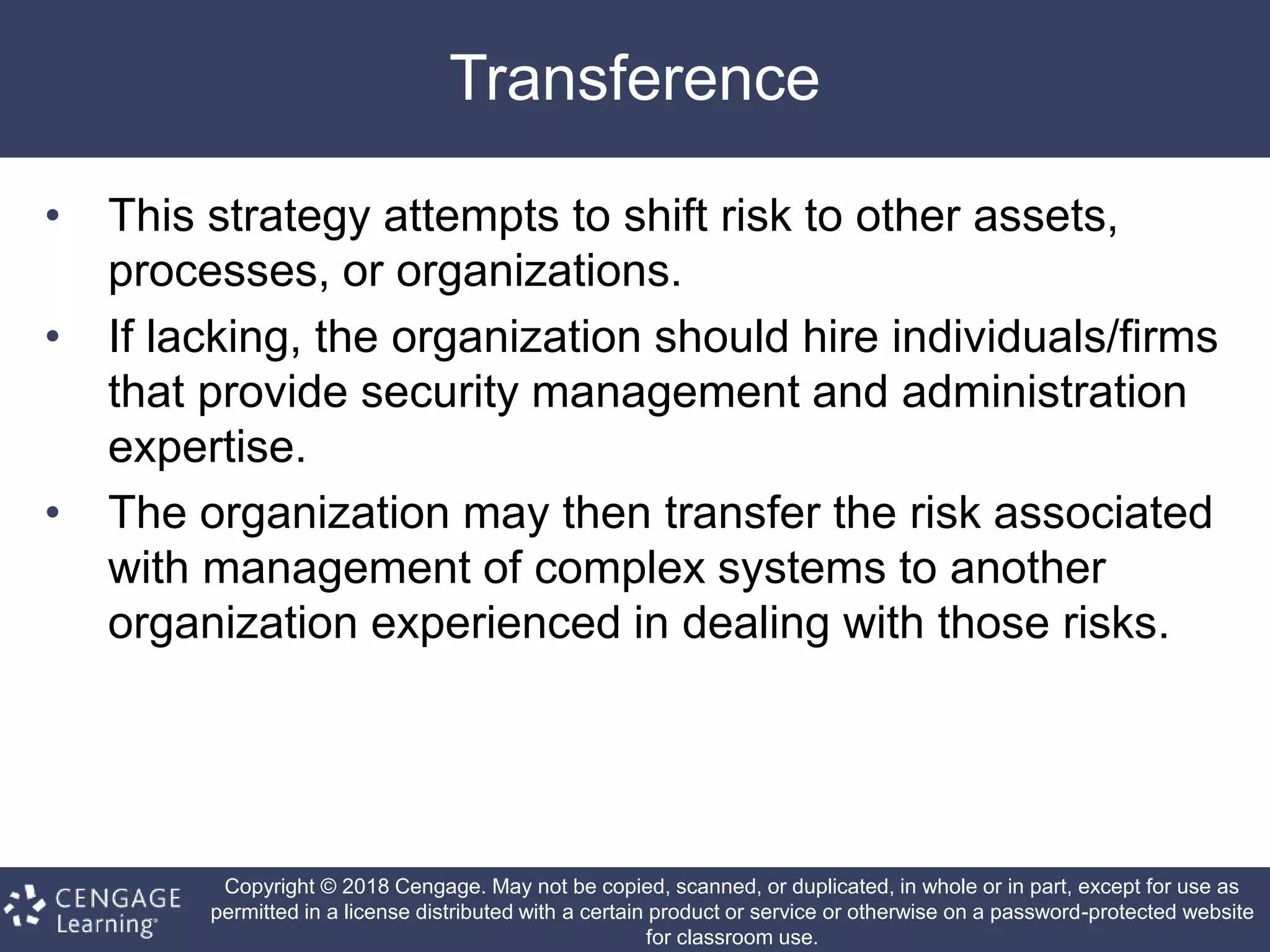
Transference
• This strategy attempts to shift risk to other assets,
processes, or organizations.
• If lacking, the organization should hire individuals/firms
that provide security management and administration
expertise.
• The organization may then transfer the risk associated
with management of complex systems to another
organization experienced in dealing with those risks.
Copyright © 2018 Cengage. May not be copied, scanned, or duplicated, in whole or in part, except for use as
permitted in a license distributed with a certain product or service or otherwise on a password-protected website
for classroom use.
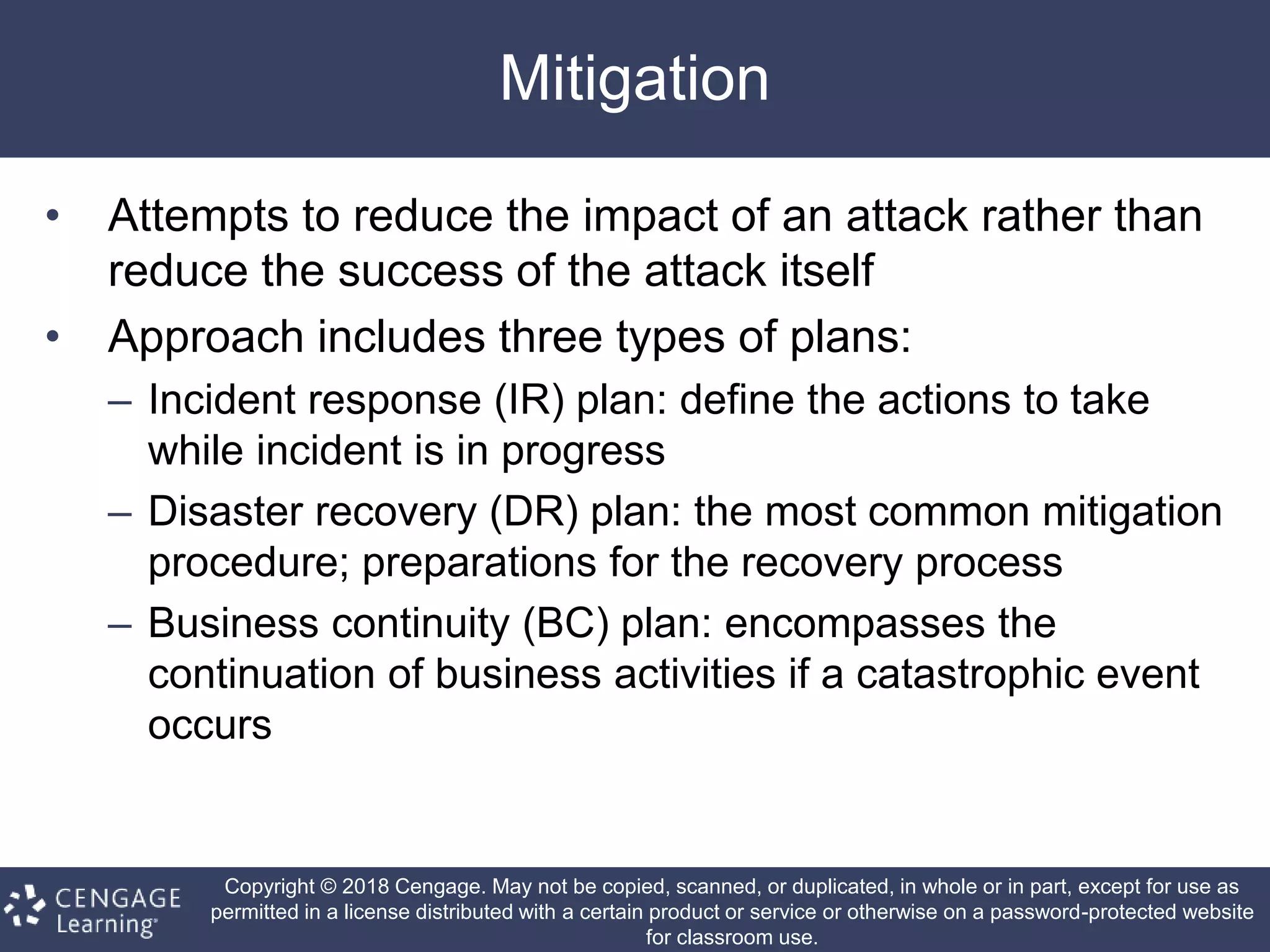
Mitigation
• Attempts to reduce the impact of an attack rather than
reduce the success of the attack itself
• Approach includes three types of plans:
– Incident response (IR) plan: define the actions to take
while incident is in progress
– Disaster recovery (DR) plan: the most common mitigation
procedure; preparations for the recovery process
– Business continuity (BC) plan: encompasses the
continuation of business activities if a catastrophic event
occurs
Copyright © 2018 Cengage. May not be copied, scanned, or duplicated, in whole or in part, except for use as
permitted in a license distributed with a certain product or service or otherwise on a password-protected website
for classroom use.
Acceptance and Termination
• Acceptance
– Doing nothing to protect a vulnerability and accepting the
outcome of its exploitation
– Valid only when the particular function, service,
information, or asset does not justify the cost of protection
• Termination
– Directs the organization to avoid business activities that
introduce uncontrollable risks
– May seek an alternate mechanism to meet the customer
needs
Copyright © 2018 Cengage. May not be copied, scanned, or duplicated, in whole or in part, except for use as
permitted in a license distributed with a certain product or service or otherwise on a password-protected website
for classroom use.
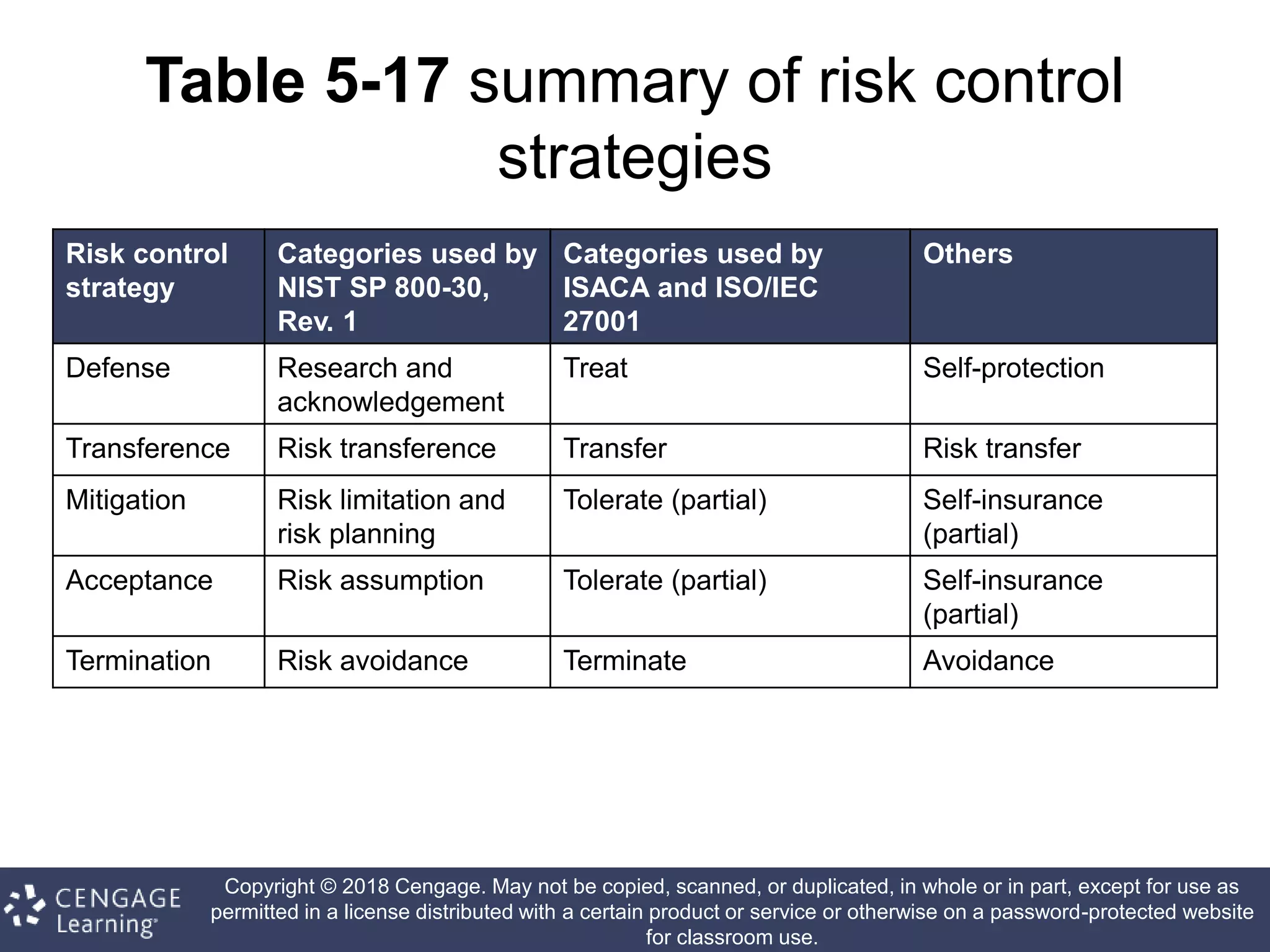
Table 5-17 summary of risk control
strategies
Risk control
strategy
Categories used by
NIST SP 800-30,
Rev. 1
Categories used by
ISACA and ISO/IEC
27001
Others
Defense Research and
acknowledgement
Treat Self-protection
Transference Risk transference Transfer Risk transfer
Mitigation Risk limitation and
risk planning
Tolerate (partial) Self-insurance
(partial)
Acceptance Risk assumption Tolerate (partial) Self-insurance
(partial)
Termination Risk avoidance Terminate Avoidance
Copyright © 2018 Cengage. May not be copied, scanned, or duplicated, in whole or in part, except for use as
permitted in a license distributed with a certain product or service or otherwise on a password-protected website
for classroom use.
Selecting a Risk Control Strategy
• Level of threat and value of asset should play a major
role in the selection of strategy.
• Rules of thumb on strategy selection can be applied:
– When a vulnerability exists
– When a vulnerability can be exploited
– When attacker’s cost is less than the potential gain
– When potential loss is substantial
Copyright © 2018 Cengage. May not be copied, scanned, or duplicated, in whole or in part, except for use as
permitted in a license distributed with a certain product or service or otherwise on a password-protected website
for classroom use.
Figure 5-12 Risk handling decision
points
Copyright © 2018 Cengage. May not be copied, scanned, or duplicated, in whole or in part, except for use as
permitted in a license distributed with a certain product or service or otherwise on a password-protected website
for classroom use.
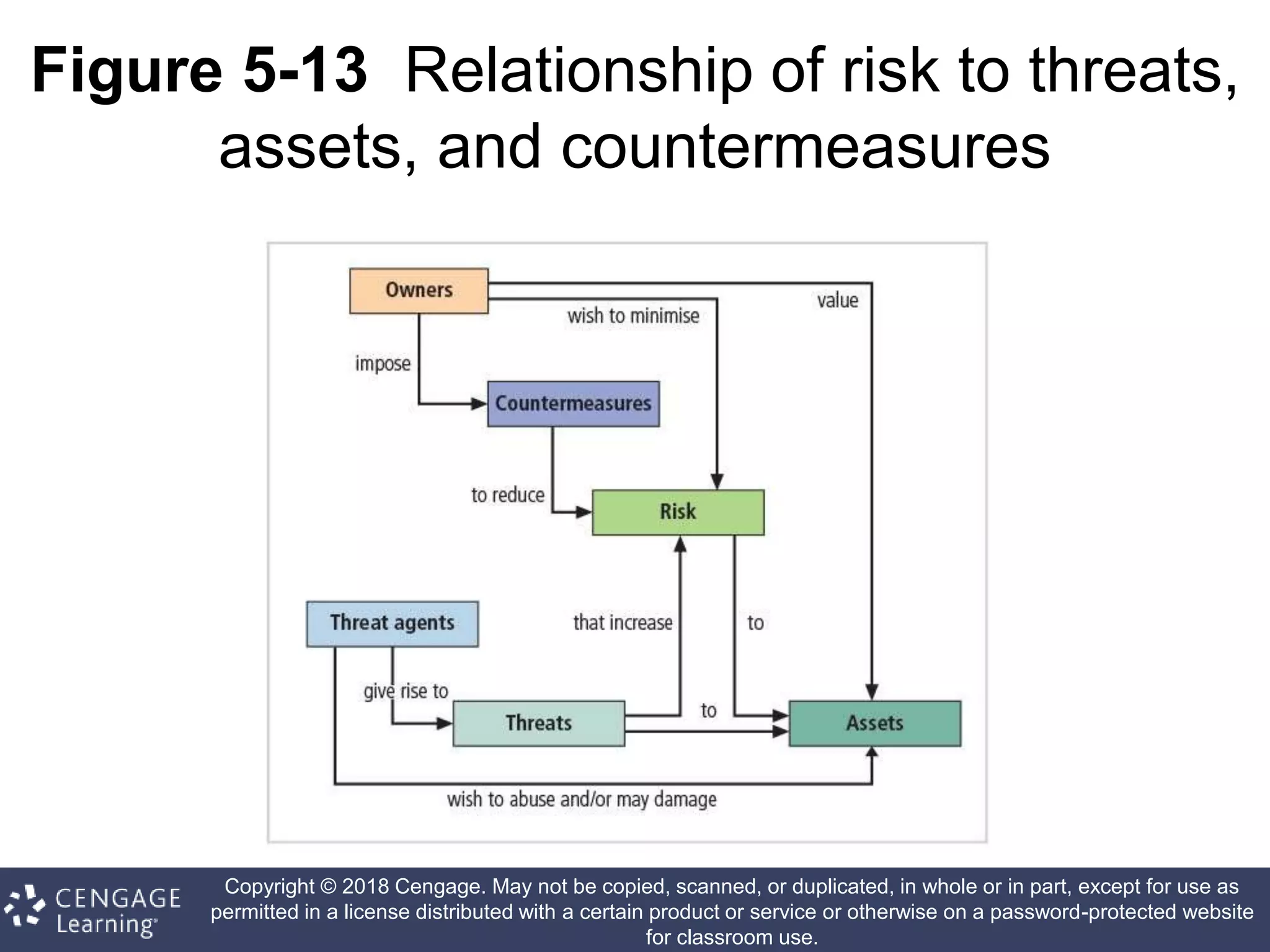
Figure 5-13 Relationship of risk to threats,
assets, and countermeasures
Copyright © 2018 Cengage. May not be copied, scanned, or duplicated, in whole or in part, except for use as
permitted in a license distributed with a certain product or service or otherwise on a password-protected website
for classroom use.
Justifying Controls (1 of 2)
• Before implementing one of the control strategies for a
specific vulnerability, the organization must explore all
consequences of vulnerability to information asset.
• There are several ways to determine the
advantages/disadvantages of a specific control.
• Items that affect cost of a control or safeguard include
cost of development or acquisition, training fees,
implementation cost, service costs, and cost of
maintenance.
Copyright © 2018 Cengage. May not be copied, scanned, or duplicated, in whole or in part, except for use as
permitted in a license distributed with a certain product or service or otherwise on a password-protected website
for classroom use.
Justifying Controls (2 of 2)
• Asset valuation involves estimating real/perceived
costs associated with design, development, installation,
maintenance, protection, recovery, and defense
against loss/litigation.
• Process result is the estimate of potential loss per risk.
• Expected loss per risk stated in the following equation:
– Annualized loss expectancy (ALE) =
single loss expectancy (SLE) ×
annualized rate of occurrence (ARO)
• SLE = asset value × exposure factor (EF)
Copyright © 2018 Cengage. May not be copied, scanned, or duplicated, in whole or in part, except for use as
permitted in a license distributed with a certain product or service or otherwise on a password-protected website
for classroom use.
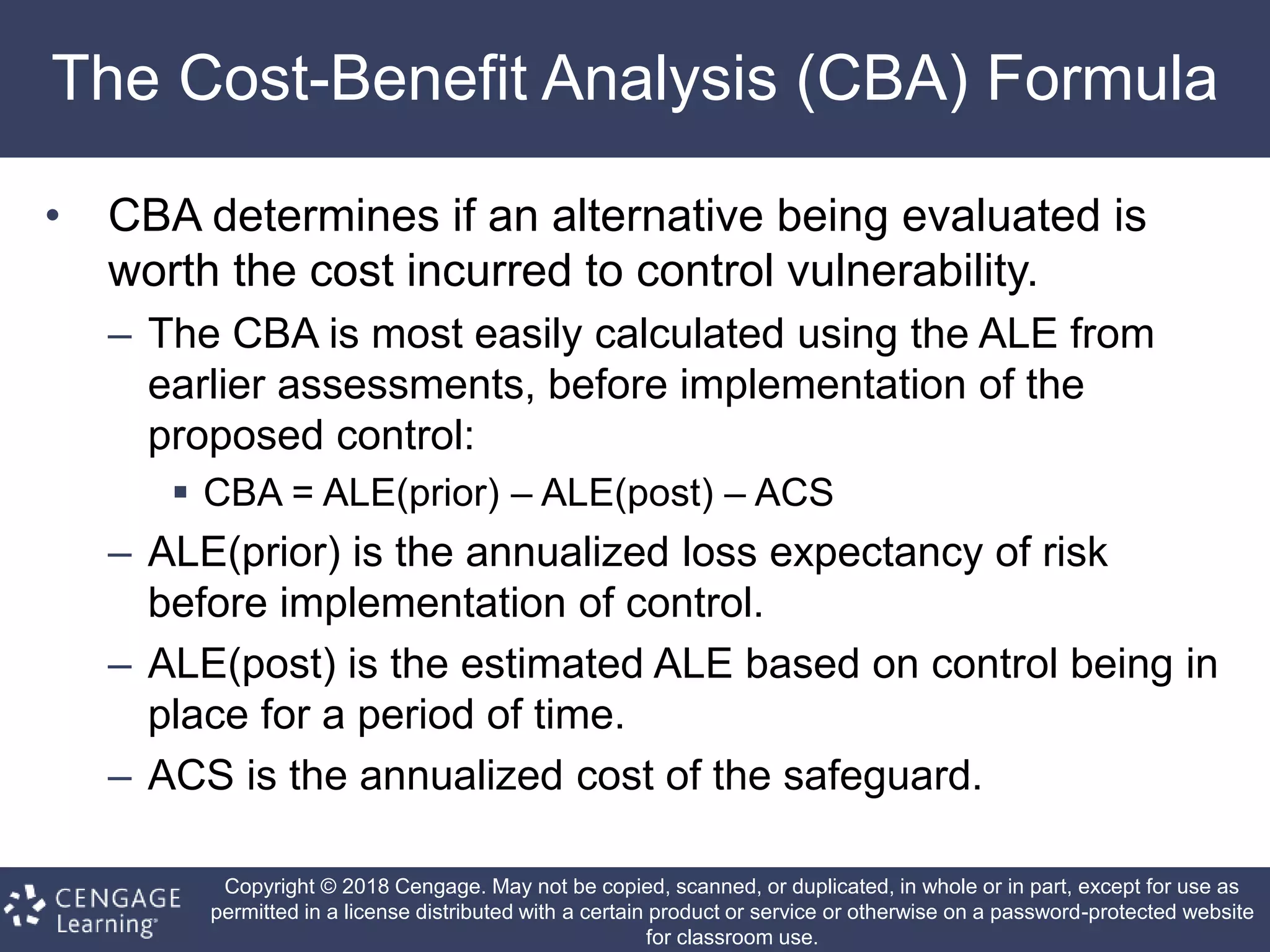
The Cost-Benefit Analysis (CBA) Formula
• CBA determines if an alternative being evaluated is
worth the cost incurred to control vulnerability.
– The CBA is most easily calculated using the ALE from
earlier assessments, before implementation of the
proposed control:
 CBA = ALE(prior) – ALE(post) – ACS
– ALE(prior) is the annualized loss expectancy of risk
before implementation of control.
– ALE(post) is the estimated ALE based on control being in
place for a period of time.
– ACS is the annualized cost of the safeguard.
Copyright © 2018 Cengage. May not be copied, scanned, or duplicated, in whole or in part, except for use as
permitted in a license distributed with a certain product or service or otherwise on a password-protected website
for classroom use.
Implementation, Monitoring, and
Assessment of Risk Controls
• The selection of the control strategy is not the end of a
process.
• Strategy and accompanying controls must be
implemented and monitored on on going basis to
determine effectiveness and accurately calculate the
estimated residual risk.
• Process continues as long as the organization continues
to function.
Copyright © 2018 Cengage. May not be copied, scanned, or duplicated, in whole or in part, except for use as
permitted in a license distributed with a certain product or service or otherwise on a password-protected website
for classroom use.
Figure 5-14 Risk control cycle
Copyright © 2018 Cengage. May not be copied, scanned, or duplicated, in whole or in part, except for use as
permitted in a license distributed with a certain product or service or otherwise on a password-protected website
for classroom use.
Quantitative Versus Qualitative Risk Control
Practices
• Performing the previous steps using actual values or
estimates is known as quantitative assessment.
• Possible to complete steps using an evaluation
process based on characteristics using nonnumerical
measures, called qualitative assessment.
• Utilizing scales rather than specific estimates relieves
the organization from the difficulty of determining exact
values.
Copyright © 2018 Cengage. May not be copied, scanned, or duplicated, in whole or in part, except for use as
permitted in a license distributed with a certain product or service or otherwise on a password-protected website
for classroom use.
Benchmarking and Best Practices (1 of 5)
• An alternative approach to risk management
• Benchmarking: process of seeking out and studying
practices in other organizations that one’s own
organization desires to duplicate
• One of two measures typically used to compare
practices:
– Metrics-based measures, based on numerical standards
– Process-based measures, more strategic and less
focused on numbers
Copyright © 2018 Cengage. May not be copied, scanned, or duplicated, in whole or in part, except for use as
permitted in a license distributed with a certain product or service or otherwise on a password-protected website
for classroom use.
Benchmarking and Best Practices (2 of 5)
• Standard of due care: when adopting levels of security
for a legal defense, the organization shows it has done
what any prudent organization would do in similar
circumstances.
• The application of controls at or above prescribed
levels and the maintenance of standards of due care
show due diligence on the organization’s part.
• Failure to support standard of due care or due
diligence can leave the organization open to legal
liability.
Copyright © 2018 Cengage. May not be copied, scanned, or duplicated, in whole or in part, except for use as
permitted in a license distributed with a certain product or service or otherwise on a password-protected website
for classroom use.
Benchmarking and Best Practices (3 of 5)
• Best business practices: security efforts that provide a
superior level of information protection
• When considering best practices for adoption in an
organization, consider:
– Does organization resemble identified target organization
with best practice?
– Are expendable resources similar?
– Is organization in a similar threat environment?
Copyright © 2018 Cengage. May not be copied, scanned, or duplicated, in whole or in part, except for use as
permitted in a license distributed with a certain product or service or otherwise on a password-protected website
for classroom use.
Benchmarking and Best Practices (4 of 5)
• Problems with the application of benchmarking and
best practices
– Organizations don’t talk to each other (biggest problem).
– No two organizations are identical.
– Best practices are a moving target.
– Researching information security benchmarks doesn’t
necessarily prepare a practitioner for what to do next.
Copyright © 2018 Cengage. May not be copied, scanned, or duplicated, in whole or in part, except for use as
permitted in a license distributed with a certain product or service or otherwise on a password-protected website
for classroom use.
Benchmarking and Best Practices (5 of 5)
• Baselining
– Performance value or metric used to compare changes in
the object being measured.
– In information security, baselining is the comparison of
past security activities and events against an
organization’s future performance.
– Useful during baselining to have a guide to the overall
process.
Copyright © 2018 Cengage. May not be copied, scanned, or duplicated, in whole or in part, except for use as
permitted in a license distributed with a certain product or service or otherwise on a password-protected website
for classroom use.
Other Feasibility Studies
• Organizational: Assesses how well the proposed IS
alternatives will contribute to an organization’s
efficiency, effectiveness, and overall operation
• Operational: Assesses user and management
acceptance and support, and the overall requirements
of the organization’s stakeholders
• Technical: Assesses if organization has or can acquire
the technology necessary to implement and support
proposed control
• Political: Defines what can/cannot occur based on the
consensus and relationships among communities of
interest
Copyright © 2018 Cengage. May not be copied, scanned, or duplicated, in whole or in part, except for use as
permitted in a license distributed with a certain product or service or otherwise on a password-protected website
for classroom use.
Recommended Risk Control Practices
• Convince budget authorities to spend up to the value of
an asset to protect it from identified threat.
• Chosen controls may be a balanced mixture that
provides greatest value to as many asset-threat pairs
as possible.
• Organizations looking to implement controls that don’t
involve such complex, inexact, and dynamic
calculations.
Copyright © 2018 Cengage. May not be copied, scanned, or duplicated, in whole or in part, except for use as
permitted in a license distributed with a certain product or service or otherwise on a password-protected website
for classroom use.
Documenting Results
• At minimum, each information asset-threat pair should
have documented control strategy clearly identifying
any remaining residual risk.
• Another option: Document the outcome of the control
strategy for each information asset-vulnerability pair as
an action plan.
• Risk assessment may be documented in a topic-
specific report.
Copyright © 2018 Cengage. May not be copied, scanned, or duplicated, in whole or in part, except for use as
permitted in a license distributed with a certain product or service or otherwise on a password-protected website
for classroom use.
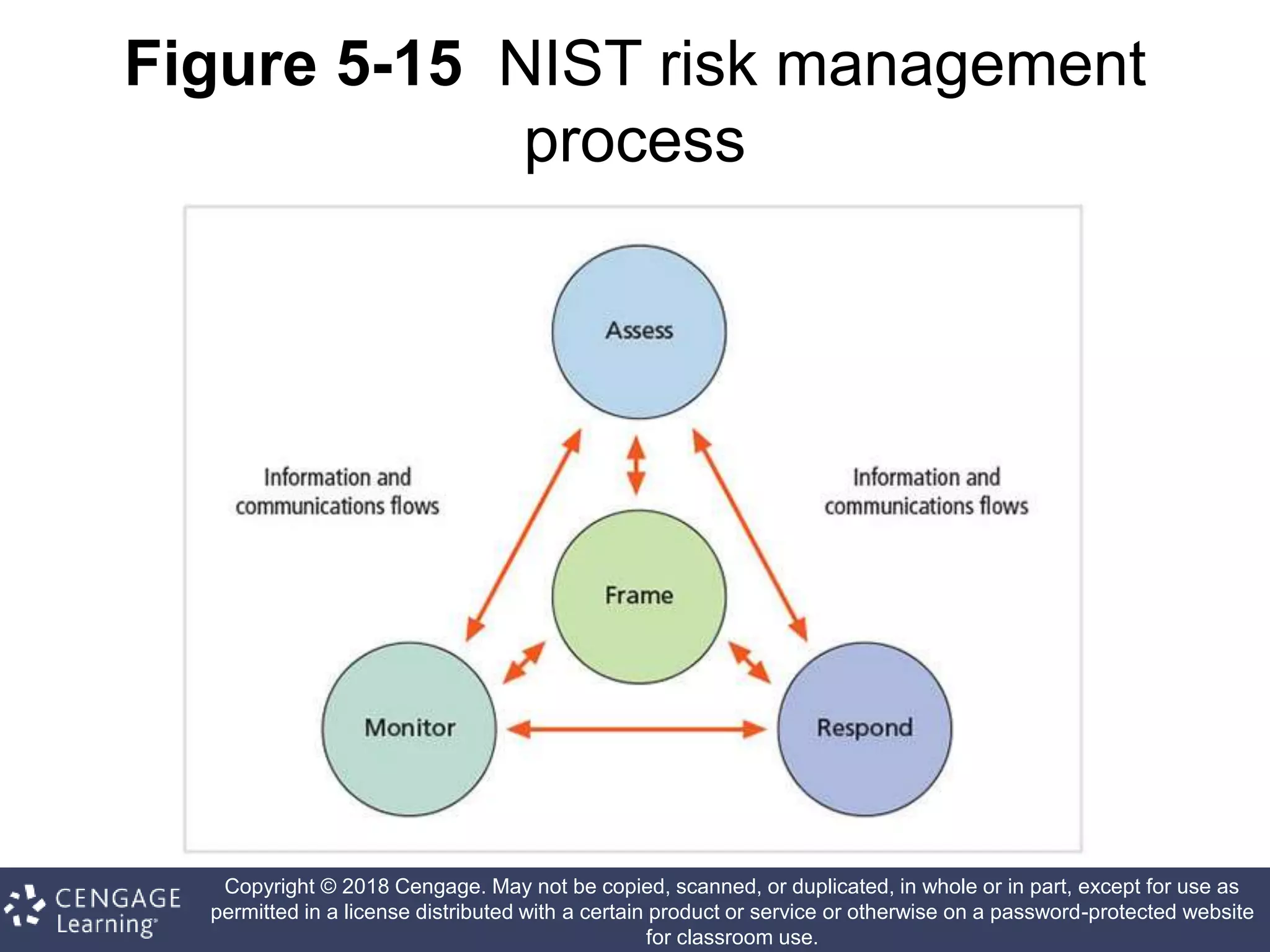
The NIST Risk Management Framework
• Describes risk management as a comprehensive
process requiring organizations to:
– Frame risk
– Assess risk
– Respond to determined risk
– Monitor risk on on going basis
Copyright © 2018 Cengage. May not be copied, scanned, or duplicated, in whole or in part, except for use as
permitted in a license distributed with a certain product or service or otherwise on a password-protected website
for classroom use.
Figure 5-15 NIST risk management
process
Copyright © 2018 Cengage. May not be copied, scanned, or duplicated, in whole or in part, except for use as
permitted in a license distributed with a certain product or service or otherwise on a password-protected website
for classroom use.
Summary (1 of 3)
• Risk identification: formal process of examining and
documenting risk in information systems
• Risk control: process of taking carefully reasoned steps
to ensure the confidentiality, integrity, and availability of
the components of an information system
• Risk identification
– A risk management strategy enables identification,
classification, and prioritization of organization’s
information assets
– Residual risk: risk remaining to the information asset even
after the existing control is applied
Copyright © 2018 Cengage. May not be copied, scanned, or duplicated, in whole or in part, except for use as
permitted in a license distributed with a certain product or service or otherwise on a password-protected website
for classroom use.
Summary (2 of 3)
• Risk control: Five strategies are used to control risks
that result from vulnerabilities:
– Defend
– Transference
– Mitigate
– Accept
– Terminate
• The economic feasibility study determines the costs
associated with protecting an asset. The formal
documentation process of feasibility is called a cost-
benefit analysis.
Copyright © 2018 Cengage. May not be copied, scanned, or duplicated, in whole or in part, except for use as
permitted in a license distributed with a certain product or service or otherwise on a password-protected website
for classroom use.
Summary (3 of 3)
• The economic feasibility study determines the costs
associated with protecting an asset. The formal
documentation process of feasibility is called a cost-
benefit analysis.
• Benchmarking is an alternative method to economic
feasibility analysis that seeks out and studies practices
used in other organizations to produce desired results
in one’s own organization.

Whitman_Ch05.pptx

  • 1.
    Principles of InformationSecurity Sixth Edition Chapter 5 Risk Management Copyright © 2018 Cengage. May not be copied, scanned, or duplicated, in whole or in part, except for use as permitted in a license distributed with a certain product or service or otherwise on a password-protected website for classroom use.
  • 2.
    Copyright © 2018Cengage. May not be copied, scanned, or duplicated, in whole or in part, except for use as permitted in a license distributed with a certain product or service or otherwise on a password-protected website for classroom use. Learning Objectives • Upon completion of this material, you should be able to: – Define risk management, risk identification, risk assessment, and risk control – Describe how risk is identified and assessed – Assess risk based on probability of occurrence and likely expected impact – Explain the fundamental aspects of documenting risk via the process of risk assessment – Describe various options for a risk mitigation strategy – Define risk appetite and explain how it relates to residual risk – Discuss conceptual frameworks for evaluating risk controls and formulate a cost-benefit analysis
  • 3.
    Copyright © 2018Cengage. May not be copied, scanned, or duplicated, in whole or in part, except for use as permitted in a license distributed with a certain product or service or otherwise on a password-protected website for classroom use. Introduction (1 of 2) • Organizations must design and create safe environments in which business processes and procedures can function. • Risk assessment: A determination of the extent to which an organization’s information assets are exposed to risk. • Risk control: The application of controls that reduce the risks to an organization’s information assets to an acceptable level.
  • 4.
    Copyright © 2018Cengage. May not be copied, scanned, or duplicated, in whole or in part, except for use as permitted in a license distributed with a certain product or service or otherwise on a password-protected website for classroom use. Introduction (2 of 2) • Risk identification: The recognition, enumeration, and documentation of risks to an organization’s information assets. • Risk management: The process of identifying risk, assessing its relative magnitude, and taking steps to reduce it to an acceptable level.
  • 5.
    Copyright © 2018Cengage. May not be copied, scanned, or duplicated, in whole or in part, except for use as permitted in a license distributed with a certain product or service or otherwise on a password-protected website for classroom use. An Overview of Risk Management • Know yourself: identify, examine, and understand the information and systems currently in place • Know the enemy: identify, examine, and understand the threats facing the organization • Responsibility of each community of interest within an organization to manage the risks that are encountered
  • 6.
    Copyright © 2018Cengage. May not be copied, scanned, or duplicated, in whole or in part, except for use as permitted in a license distributed with a certain product or service or otherwise on a password-protected website for classroom use. Figure 5-1 Components of risk management
  • 7.
    Copyright © 2018Cengage. May not be copied, scanned, or duplicated, in whole or in part, except for use as permitted in a license distributed with a certain product or service or otherwise on a password-protected website for classroom use. The Roles of the Communities of Interest • Information security, management and users, and information technology all must work together. • Communities of interest are responsible for: – Evaluating current and proposed risk controls – Determining which control options are cost effective for the organization – Acquiring or installing the needed controls – Ensuring that the controls remain effective
  • 8.
    Copyright © 2018Cengage. May not be copied, scanned, or duplicated, in whole or in part, except for use as permitted in a license distributed with a certain product or service or otherwise on a password-protected website for classroom use. Risk Appetite and Residual Risk • Risk appetite: The quantity and nature of risk that organizations are willing to accept as they evaluate the trade-offs between perfect security and unlimited accessibility. – Reasoned approach is one that balances the expense of controlling vulnerabilities against possible losses if the vulnerabilities are exploited. • Residual risk: The risk to information assets that remains even after current controls have been applied. • The goal of information security is to bring residual risk into line with risk appetite.
  • 9.
    Copyright © 2018Cengage. May not be copied, scanned, or duplicated, in whole or in part, except for use as permitted in a license distributed with a certain product or service or otherwise on a password-protected website for classroom use. Figure 5-3 Residual risk
  • 10.
    Copyright © 2018Cengage. May not be copied, scanned, or duplicated, in whole or in part, except for use as permitted in a license distributed with a certain product or service or otherwise on a password-protected website for classroom use. Risk Identification • Risk management requires that InfoSec professionals know how to identify, classify, and prioritize an organization’s information assets. • A threat assessment process identifies and evaluates the risks facing each asset
  • 11.
    Copyright © 2018Cengage. May not be copied, scanned, or duplicated, in whole or in part, except for use as permitted in a license distributed with a certain product or service or otherwise on a password-protected website for classroom use. Figure 5-4 Components of risk identification
  • 12.
    Copyright © 2018Cengage. May not be copied, scanned, or duplicated, in whole or in part, except for use as permitted in a license distributed with a certain product or service or otherwise on a password-protected website for classroom use. Planning and Organizing the Process • The first step in the risk identification process is to follow your project management principles. • Begin by organizing a team with representation across all affected groups. • The process must then be planned out. – Periodic deliverables – Reviews – Presentations to management • Tasks should be laid out, assignments made, and timetables discussed.
  • 13.
    Copyright © 2018Cengage. May not be copied, scanned, or duplicated, in whole or in part, except for use as permitted in a license distributed with a certain product or service or otherwise on a password-protected website for classroom use. Identifying, Inventorying, and Categorizing Assets • Iterative process: Begins with the identification and inventory of assets, including all elements of an organization’s system (people, procedures, data and information, software, hardware, networking) • Assets are then categorized
  • 14.
    Copyright © 2018Cengage. May not be copied, scanned, or duplicated, in whole or in part, except for use as permitted in a license distributed with a certain product or service or otherwise on a password-protected website for classroom use. Table 5-1 categorization the components of an information system Traditional system components Information asset components Risk management system components People Nonemployees Trusted employees other staff Procedures People at trusted organizations strangers and visitors Procedures Information IT and business standard IT and business-sensitive procedures Data Software Transmission Processing Storage Software System devices and peripherals Application Operating system Security components Hardware System devices and peripherals System and peripherals Security devices Networking components Intranet components Internet or DMZ components
  • 15.
    Copyright © 2018Cengage. May not be copied, scanned, or duplicated, in whole or in part, except for use as permitted in a license distributed with a certain product or service or otherwise on a password-protected website for classroom use. People, Procedures, and Data Asset Identification • Human resources, documentation, and data information assets are more difficult to identify. • Important asset attributes: – People: position name/number/ID; supervisor; security clearance level; special skills – Procedures: description; intended purpose; relation to software/hardware/networking elements; storage location for reference; storage location for update – Data: classification; owner/creator/manager; data structure size; data structure used; online/offline; location; backup procedures employed
  • 16.
    Copyright © 2018Cengage. May not be copied, scanned, or duplicated, in whole or in part, except for use as permitted in a license distributed with a certain product or service or otherwise on a password-protected website for classroom use. Hardware, Software, and Network Asset Identification • What information attributes to track depends on: – Needs of organization/risk management efforts – Preferences/needs of the security and information technology communities • Asset attributes to be considered are name, IP address, MAC address, element type, serial number, manufacturer name, model/part number, software version, physical or logical location, and controlling entity.
  • 17.
    Copyright © 2018Cengage. May not be copied, scanned, or duplicated, in whole or in part, except for use as permitted in a license distributed with a certain product or service or otherwise on a password-protected website for classroom use. Information Asset Inventory • Unless information assets are identified and inventoried, they cannot be effectively protected. • Inventory process involves formalizing the identification process in some form of organizational tool. • Automated tools can sometimes identify the system elements that make up hardware, software, and network components.
  • 18.
    Copyright © 2018Cengage. May not be copied, scanned, or duplicated, in whole or in part, except for use as permitted in a license distributed with a certain product or service or otherwise on a password-protected website for classroom use. Asset Categorization • People comprise employees and nonemployees. • Procedures either do not expose knowledge useful to a potential attacker or are sensitive and could allow adversary to gain advantage. • Data components account for the management of information in transmission, processing, and storage. • Software components are applications, operating systems, or security components. • Hardware: either the usual system devices and peripherals or part of information security control systems.
  • 19.
    Copyright © 2018Cengage. May not be copied, scanned, or duplicated, in whole or in part, except for use as permitted in a license distributed with a certain product or service or otherwise on a password-protected website for classroom use. Classifying, Valuing, and Prioritizing Information Assets • Many organizations have data classification schemes (e.g., confidential, internal, public data). • Classification of components must be specific enough to enable the determination of priority levels. • Categories must be comprehensive and mutually exclusive.
  • 20.
    Copyright © 2018Cengage. May not be copied, scanned, or duplicated, in whole or in part, except for use as permitted in a license distributed with a certain product or service or otherwise on a password-protected website for classroom use. Data Classification and Management (1 of 2) • Variety of classification schemes are used by corporate and military organizations. • Information owners are responsible for classifying their information assets. • Information classifications must be reviewed periodically. • Classifications include confidential, internal, and external.
  • 21.
    Copyright © 2018Cengage. May not be copied, scanned, or duplicated, in whole or in part, except for use as permitted in a license distributed with a certain product or service or otherwise on a password-protected website for classroom use. Data Classification and Management (2 of 2) • Security clearances – Each data user must be assigned authorization level indicating classification level. – Before accessing specific set of data, the employee must meet the need-to-know requirement. • Management of classified data includes storage, distribution, transportation, and destruction. • Clean desk policy • Dumpster diving
  • 22.
    Copyright © 2018Cengage. May not be copied, scanned, or duplicated, in whole or in part, except for use as permitted in a license distributed with a certain product or service or otherwise on a password-protected website for classroom use. Information Asset Valuation (1 of 2) • Questions help develop criteria for asset valuation. • Which information asset: – Is most critical to the organization’s success? – Generates the most revenue/profitability? – Plays the biggest role in generating revenue or delivering services? – Would be the most expensive to replace or protect? – Would be the most embarrassing or cause greatest liability if revealed?
  • 23.
    Copyright © 2018Cengage. May not be copied, scanned, or duplicated, in whole or in part, except for use as permitted in a license distributed with a certain product or service or otherwise on a password-protected website for classroom use. Figure 5-7 Sample inventory worksheet (1 of 2) System name: SLSE-Commerce Date Evaluated: February 2012 Evaluated by: D.Jones Information assets Data classification Impact to profitability Information transmitted : EDI document set 1-logistics BOL to outsourcers (outbound) confidential High EDI document set 2-supplier orders (outbound) confidential High EDI document set 3-supplier fulfillment advice (inbound) confidential Medium Customer order via SSL (inbound) confidential Critical Customer service request via e-mail (inbound) Private Medium
  • 24.
    Copyright © 2018Cengage. May not be copied, scanned, or duplicated, in whole or in part, except for use as permitted in a license distributed with a certain product or service or otherwise on a password-protected website for classroom use. Figure 5-7 Sample inventory worksheet (2 of 2) DMZ Assets: Edge router Public Critical Web server # 1-home page and core site Public Critical Web server # 2-Application server Public Critical Notes: BOL: Bill of lading DMZ: Demilitarized zone EDI:Electronic data interchange SSL: secure sockets later
  • 25.
    Copyright © 2018Cengage. May not be copied, scanned, or duplicated, in whole or in part, except for use as permitted in a license distributed with a certain product or service or otherwise on a password-protected website for classroom use. Information Asset Valuation (2 of 2) • Information asset prioritization – Create weighting for each category based on the answers to questions. – Prioritize each asset using weighted factor analysis. – List the assets in order of importance using a weighted factor analysis worksheet.
  • 26.
    Copyright © 2018Cengage. May not be copied, scanned, or duplicated, in whole or in part, except for use as permitted in a license distributed with a certain product or service or otherwise on a password-protected website for classroom use. Table 5-2 Example of a weighted factor analysis worksheet Information Asset Criterion 1: Impact to Revenue Criterion 2: Impact to Profitability Criterion 3: Impact to public image Weighted score Criteria weights must total 100 30 40 30 EDI document set 1-logistics BOL to outsourcer (outbound) 0.8 0.9 0.5 75 EDI document set 2-Supplier orders (outbound) 0.8 0.9 0.6 78 EDI document set 2-Supplier Fulfillment advice (inbound) 0.4 0.5 0.3 41 Customer order via SSL (inbound) 1.0 1.0 1.0 100 Customer service request via e- mail (inbound) 0.4 0.4 0.9 55 Note: In the table, EDI stands for electronic data interchange, BOL stands for bill of lading, and SSL is secure sockets layer,
  • 27.
    Copyright © 2018Cengage. May not be copied, scanned, or duplicated, in whole or in part, except for use as permitted in a license distributed with a certain product or service or otherwise on a password-protected website for classroom use. Identifying and Prioritizing Threats • Realistic threats need investigation; unimportant threats are set aside. • Threat assessment: – Which threats present a danger to assets in the given environment? – Which threats represent the most danger to information? – How much would it cost to recover from a successful attack? – Which threats would require greatest expenditure to prevent?
  • 28.
    Copyright © 2018Cengage. May not be copied, scanned, or duplicated, in whole or in part, except for use as permitted in a license distributed with a certain product or service or otherwise on a password-protected website for classroom use. Table 5-3 Threats to information security (1 of 2) Threat Examples Compromises to intellectual property Software piracy or other copyright infringement Deviation in quality of service from service provides Fluctuations in power, data, and other services Espionage or trespass Unauthorized access and/or data collection Forces of nature Fire, food, earthquake, lightning, etc. Human error of failure Accidents, employee mistakes, failure to follow policy Information extortion Blackmail threat of information disclosure Sabotage or vandalism Damage to or destruction of system or information Software attacks Malware: viruses, worms, macros, denial of services, or script injections
  • 29.
    Copyright © 2018Cengage. May not be copied, scanned, or duplicated, in whole or in part, except for use as permitted in a license distributed with a certain product or service or otherwise on a password-protected website for classroom use. Table 5-3 Threats to information security (2 of 2) Threat Examples Technical hardware failures or errors Hardware equipment failure Technical software failures or errors Bugs, cool problems, loopholes, back doors Technological obsolescence Antiquated or outdated technologies Theft Illegal confiscation of equipment or information Source: communications of the ACM, used with permission.
  • 30.
    Copyright © 2018Cengage. May not be copied, scanned, or duplicated, in whole or in part, except for use as permitted in a license distributed with a certain product or service or otherwise on a password-protected website for classroom use. Specifying Asset Vulnerabilities • Specific avenues that threat agents can exploit to attack an information asset are called vulnerabilities. • Examine how each threat could be perpetrated and list the organization’s assets and vulnerabilities. • Process works best when people with diverse backgrounds within organization work iteratively in a series of brainstorming sessions. • At the end of the risk identification process, prioritized list of assets with their vulnerabilities is achieved. – Can be combined with weighted list of threats to form threats-vulnerabilities-assets (TVA) worksheet
  • 31.
    Copyright © 2018Cengage. May not be copied, scanned, or duplicated, in whole or in part, except for use as permitted in a license distributed with a certain product or service or otherwise on a password-protected website for classroom use. Table 5-7 vulnerability assessment of a hypothetical DMZ router (1 of 2) Threat Possible vulnerabilities Compromises to intellectual property • Copyrighted works developed in-house and stored on intranet servers can be copied without permission unless the router is configured to limit access from outsiders. • Works copyrighted by others can be stolen: your organization is liable for that loss to the copyright holder. Espionage or trespass • This information asset (router) may have little intrinsic value, but other assets protected by this device could be attacked if it does not perform correctly or is compromised. Forces of nature • All information assets in the organization are subject to forces of nature unless suitable controls are provided. Human error of failure • Employees or contractors may cause on outage if configuration errors are made. Information extortion • If attackers bypass the router or compromise it and then enter your network, they may encrypt your data in place. They may not have stolen it, but unless you pay them to acquire the encryption key, the data is inert and no longer of value to you. Deviation in quality of service • Power system failures are always possible. Unless suitable electrical power conditioning is provided, failure is probable over time. • ISP connectivity failures can interrupt internet bandwidth.
  • 32.
    Copyright © 2018Cengage. May not be copied, scanned, or duplicated, in whole or in part, except for use as permitted in a license distributed with a certain product or service or otherwise on a password-protected website for classroom use. Table 5-7 vulnerability assessment of a hypothetical DMZ router (2 of 2) Threat Possible vulnerabilities Sabotage or vandalism • The internet protocol is vulnerable to denial of service. • This device may be subject to defacement or cache poisoning. Software attacks • The internet protocol is vulnerable to denial of service. Outsider IP fingerprinting activities can reveal sensitive information unless suitable controls are implemented. Technical hardware failures or errors • Hardware can fail and cause an outage. Technical software failures or errors • Vendor-supplied routing software could fail and cause an outage. Technological obsolescence • If this asset is not reviewed and periodically updated, it may fall too far behind its vendor support model to be kept in service. Theft • Data has value and can be stolen. Routers are important network devices; their controls are critical layers in your defense in depth. When data is copied in place, you may not know it has been stolen.
  • 33.
    Copyright © 2018Cengage. May not be copied, scanned, or duplicated, in whole or in part, except for use as permitted in a license distributed with a certain product or service or otherwise on a password-protected website for classroom use. Table 5-8 Sample TVA Spreadsheet
  • 34.
    Copyright © 2018Cengage. May not be copied, scanned, or duplicated, in whole or in part, except for use as permitted in a license distributed with a certain product or service or otherwise on a password-protected website for classroom use. Risk Assessment • Risk assessment evaluates the relative risk for each vulnerability. • It assigns a risk rating or score to each information asset. • Planning and organizing risk assessment – The goal at this point is to create a method for evaluating the relative risk of each listed vulnerability.
  • 35.
    Copyright © 2018Cengage. May not be copied, scanned, or duplicated, in whole or in part, except for use as permitted in a license distributed with a certain product or service or otherwise on a password-protected website for classroom use. Figure 5-8 Major stages of risk assessment
  • 36.
    Copyright © 2018Cengage. May not be copied, scanned, or duplicated, in whole or in part, except for use as permitted in a license distributed with a certain product or service or otherwise on a password-protected website for classroom use. Determining the Loss Frequency • It describes an assessment of the likelihood of an attack combined with expected probability of success. • Use external references for values that have been reviewed/adjusted for your circumstances. • Assign numeric value to likelihood, typically annual value. – Targeted by hackers once every five years – Annualized likelihook of attack: 1/5, 20 percent • Determining an attack’s success probability by estimating a quantitative value (e.g., 10 percent) for the likelihood of a successful attack; value subject to uncertainty.
  • 37.
    Copyright © 2018Cengage. May not be copied, scanned, or duplicated, in whole or in part, except for use as permitted in a license distributed with a certain product or service or otherwise on a password-protected website for classroom use. Evaluating Loss Magnitude • The next step is to determine how much of an information asset could be lost in a successful attack. – Also known as loss magnitude or asset exposure • Combines the value of information asset with the percentage of asset lost in the event of a successful attack. • Difficulties involve: – Valuating an information asset – Estimating the percentage of information asset lost during best-case, worst-case, and most likely scenarios
  • 38.
    Copyright © 2018Cengage. May not be copied, scanned, or duplicated, in whole or in part, except for use as permitted in a license distributed with a certain product or service or otherwise on a password-protected website for classroom use. Calculating Risk • For the purpose of relative risk assessment, risk equals: – Loss frequency TIMES loss magnitude – MINUS the percentage of risk mitigated by current controls – PLUS an element of uncertainty
  • 39.
    Copyright © 2018Cengage. May not be copied, scanned, or duplicated, in whole or in part, except for use as permitted in a license distributed with a certain product or service or otherwise on a password-protected website for classroom use. Figure 5-9 Factors of risk
  • 40.
    Copyright © 2018Cengage. May not be copied, scanned, or duplicated, in whole or in part, except for use as permitted in a license distributed with a certain product or service or otherwise on a password-protected website for classroom use. Assessing Risk Acceptability • For each threat and associated vulnerabilities that have residual risk, create ranking of relative risk levels. • Residual risk is the left-over risk after the organization has done everything feasible to protect its assets. • If risk appetite is less than the residual risk, it must look for additional strategies to further reduce the risk. – If risk appetite is greater than the residual risk, it must proceed to the latter stages of risk control.
  • 41.
    Copyright © 2018Cengage. May not be copied, scanned, or duplicated, in whole or in part, except for use as permitted in a license distributed with a certain product or service or otherwise on a password-protected website for classroom use. Documenting the Results of Risk Assessment • The final summarized document is the ranked vulnerability risk worksheet. • Worksheet describes asset, asset relative value, vulnerability, loss frequency, and loss magnitude. • Ranked vulnerability risk worksheet is the initial working document for the next step in the risk management process: assessing and controlling risk.
  • 42.
    Copyright © 2018Cengage. May not be copied, scanned, or duplicated, in whole or in part, except for use as permitted in a license distributed with a certain product or service or otherwise on a password-protected website for classroom use. Table 5-9 Ranked vulnerability risk worksheet Asset Asset relative value vulnerability Loss frequency Loss magnitude Customer service request via e-mail (inbound) 55 E-mail disruption due to hardware failure 0.2 11 Customer order via SSL (inbound) 100 Lost orders due to web server hardware failure 0.1 10 Customer order via SSL (inbound) 100 Lost orders due to web server or ISP service failure 0.1 10 Customer service request via e-mail (inbound) 55 E-mail disruption due to SMTP mail relay attack 0.1 5.5 Customer service request via e-mail (inbound) 55 E-mail disruption due to ISP service failure 0.1 5.5 Customer order via SSL (inbound) 100 Lost orders due to web server denial-of-service attack 0.025 2.5 Customer order via SSL (inbound) 100 Lost orders due to web server software failure 0.01 1
  • 43.
    Copyright © 2018Cengage. May not be copied, scanned, or duplicated, in whole or in part, except for use as permitted in a license distributed with a certain product or service or otherwise on a password-protected website for classroom use. Table 5-10 Risk identification and Assessment Deliverables Deliverable Purpose Information asset classification worksheet Assembles information about information assets and their value to the organization Weighted criteria analysis worksheet Assigns a ranked value or impact weight to each information asset Ranked vulnerability risk worksheet Assigns a ranked value or risk rating for each uncontrolled asset-vulnerability pair
  • 44.
    Copyright © 2018Cengage. May not be copied, scanned, or duplicated, in whole or in part, except for use as permitted in a license distributed with a certain product or service or otherwise on a password-protected website for classroom use. The Open FAIR Approach to Risk Assessment • Identify scenario components • Evaluate loss event frequency • Evaluate probable loss magnitude • Derive and articulate risk
  • 45.
    Copyright © 2018Cengage. May not be copied, scanned, or duplicated, in whole or in part, except for use as permitted in a license distributed with a certain product or service or otherwise on a password-protected website for classroom use. Risk Control • Involves selection of control strategies, justification of strategies to upper management, and implementation/monitoring/on going assessment of adopted controls • Once the ranked vulnerability risk worksheet is complete, the organization must choose one of five strategies to control each risk: – Defense – Transference – Mitigation – Acceptance – Termination
  • 46.
    Copyright © 2018Cengage. May not be copied, scanned, or duplicated, in whole or in part, except for use as permitted in a license distributed with a certain product or service or otherwise on a password-protected website for classroom use. Defense • Attempts to prevent exploitation of the vulnerability • Preferred approach • Accomplished through countering threats, removing asset vulnerabilities, limiting asset access, and adding protective safeguards • Three common methods of risk avoidance: – Application of policy – Education and training – Applying technology
  • 47.
    Copyright © 2018Cengage. May not be copied, scanned, or duplicated, in whole or in part, except for use as permitted in a license distributed with a certain product or service or otherwise on a password-protected website for classroom use. Transference • This strategy attempts to shift risk to other assets, processes, or organizations. • If lacking, the organization should hire individuals/firms that provide security management and administration expertise. • The organization may then transfer the risk associated with management of complex systems to another organization experienced in dealing with those risks.
  • 48.
    Copyright © 2018Cengage. May not be copied, scanned, or duplicated, in whole or in part, except for use as permitted in a license distributed with a certain product or service or otherwise on a password-protected website for classroom use. Mitigation • Attempts to reduce the impact of an attack rather than reduce the success of the attack itself • Approach includes three types of plans: – Incident response (IR) plan: define the actions to take while incident is in progress – Disaster recovery (DR) plan: the most common mitigation procedure; preparations for the recovery process – Business continuity (BC) plan: encompasses the continuation of business activities if a catastrophic event occurs
  • 49.
    Copyright © 2018Cengage. May not be copied, scanned, or duplicated, in whole or in part, except for use as permitted in a license distributed with a certain product or service or otherwise on a password-protected website for classroom use. Acceptance and Termination • Acceptance – Doing nothing to protect a vulnerability and accepting the outcome of its exploitation – Valid only when the particular function, service, information, or asset does not justify the cost of protection • Termination – Directs the organization to avoid business activities that introduce uncontrollable risks – May seek an alternate mechanism to meet the customer needs
  • 50.
    Copyright © 2018Cengage. May not be copied, scanned, or duplicated, in whole or in part, except for use as permitted in a license distributed with a certain product or service or otherwise on a password-protected website for classroom use. Table 5-17 summary of risk control strategies Risk control strategy Categories used by NIST SP 800-30, Rev. 1 Categories used by ISACA and ISO/IEC 27001 Others Defense Research and acknowledgement Treat Self-protection Transference Risk transference Transfer Risk transfer Mitigation Risk limitation and risk planning Tolerate (partial) Self-insurance (partial) Acceptance Risk assumption Tolerate (partial) Self-insurance (partial) Termination Risk avoidance Terminate Avoidance
  • 51.
    Copyright © 2018Cengage. May not be copied, scanned, or duplicated, in whole or in part, except for use as permitted in a license distributed with a certain product or service or otherwise on a password-protected website for classroom use. Selecting a Risk Control Strategy • Level of threat and value of asset should play a major role in the selection of strategy. • Rules of thumb on strategy selection can be applied: – When a vulnerability exists – When a vulnerability can be exploited – When attacker’s cost is less than the potential gain – When potential loss is substantial
  • 52.
    Copyright © 2018Cengage. May not be copied, scanned, or duplicated, in whole or in part, except for use as permitted in a license distributed with a certain product or service or otherwise on a password-protected website for classroom use. Figure 5-12 Risk handling decision points
  • 53.
    Copyright © 2018Cengage. May not be copied, scanned, or duplicated, in whole or in part, except for use as permitted in a license distributed with a certain product or service or otherwise on a password-protected website for classroom use. Figure 5-13 Relationship of risk to threats, assets, and countermeasures
  • 54.
    Copyright © 2018Cengage. May not be copied, scanned, or duplicated, in whole or in part, except for use as permitted in a license distributed with a certain product or service or otherwise on a password-protected website for classroom use. Justifying Controls (1 of 2) • Before implementing one of the control strategies for a specific vulnerability, the organization must explore all consequences of vulnerability to information asset. • There are several ways to determine the advantages/disadvantages of a specific control. • Items that affect cost of a control or safeguard include cost of development or acquisition, training fees, implementation cost, service costs, and cost of maintenance.
  • 55.
    Copyright © 2018Cengage. May not be copied, scanned, or duplicated, in whole or in part, except for use as permitted in a license distributed with a certain product or service or otherwise on a password-protected website for classroom use. Justifying Controls (2 of 2) • Asset valuation involves estimating real/perceived costs associated with design, development, installation, maintenance, protection, recovery, and defense against loss/litigation. • Process result is the estimate of potential loss per risk. • Expected loss per risk stated in the following equation: – Annualized loss expectancy (ALE) = single loss expectancy (SLE) × annualized rate of occurrence (ARO) • SLE = asset value × exposure factor (EF)
  • 56.
    Copyright © 2018Cengage. May not be copied, scanned, or duplicated, in whole or in part, except for use as permitted in a license distributed with a certain product or service or otherwise on a password-protected website for classroom use. The Cost-Benefit Analysis (CBA) Formula • CBA determines if an alternative being evaluated is worth the cost incurred to control vulnerability. – The CBA is most easily calculated using the ALE from earlier assessments, before implementation of the proposed control:  CBA = ALE(prior) – ALE(post) – ACS – ALE(prior) is the annualized loss expectancy of risk before implementation of control. – ALE(post) is the estimated ALE based on control being in place for a period of time. – ACS is the annualized cost of the safeguard.
  • 57.
    Copyright © 2018Cengage. May not be copied, scanned, or duplicated, in whole or in part, except for use as permitted in a license distributed with a certain product or service or otherwise on a password-protected website for classroom use. Implementation, Monitoring, and Assessment of Risk Controls • The selection of the control strategy is not the end of a process. • Strategy and accompanying controls must be implemented and monitored on on going basis to determine effectiveness and accurately calculate the estimated residual risk. • Process continues as long as the organization continues to function.
  • 58.
    Copyright © 2018Cengage. May not be copied, scanned, or duplicated, in whole or in part, except for use as permitted in a license distributed with a certain product or service or otherwise on a password-protected website for classroom use. Figure 5-14 Risk control cycle
  • 59.
    Copyright © 2018Cengage. May not be copied, scanned, or duplicated, in whole or in part, except for use as permitted in a license distributed with a certain product or service or otherwise on a password-protected website for classroom use. Quantitative Versus Qualitative Risk Control Practices • Performing the previous steps using actual values or estimates is known as quantitative assessment. • Possible to complete steps using an evaluation process based on characteristics using nonnumerical measures, called qualitative assessment. • Utilizing scales rather than specific estimates relieves the organization from the difficulty of determining exact values.
  • 60.
    Copyright © 2018Cengage. May not be copied, scanned, or duplicated, in whole or in part, except for use as permitted in a license distributed with a certain product or service or otherwise on a password-protected website for classroom use. Benchmarking and Best Practices (1 of 5) • An alternative approach to risk management • Benchmarking: process of seeking out and studying practices in other organizations that one’s own organization desires to duplicate • One of two measures typically used to compare practices: – Metrics-based measures, based on numerical standards – Process-based measures, more strategic and less focused on numbers
  • 61.
    Copyright © 2018Cengage. May not be copied, scanned, or duplicated, in whole or in part, except for use as permitted in a license distributed with a certain product or service or otherwise on a password-protected website for classroom use. Benchmarking and Best Practices (2 of 5) • Standard of due care: when adopting levels of security for a legal defense, the organization shows it has done what any prudent organization would do in similar circumstances. • The application of controls at or above prescribed levels and the maintenance of standards of due care show due diligence on the organization’s part. • Failure to support standard of due care or due diligence can leave the organization open to legal liability.
  • 62.
    Copyright © 2018Cengage. May not be copied, scanned, or duplicated, in whole or in part, except for use as permitted in a license distributed with a certain product or service or otherwise on a password-protected website for classroom use. Benchmarking and Best Practices (3 of 5) • Best business practices: security efforts that provide a superior level of information protection • When considering best practices for adoption in an organization, consider: – Does organization resemble identified target organization with best practice? – Are expendable resources similar? – Is organization in a similar threat environment?
  • 63.
    Copyright © 2018Cengage. May not be copied, scanned, or duplicated, in whole or in part, except for use as permitted in a license distributed with a certain product or service or otherwise on a password-protected website for classroom use. Benchmarking and Best Practices (4 of 5) • Problems with the application of benchmarking and best practices – Organizations don’t talk to each other (biggest problem). – No two organizations are identical. – Best practices are a moving target. – Researching information security benchmarks doesn’t necessarily prepare a practitioner for what to do next.
  • 64.
    Copyright © 2018Cengage. May not be copied, scanned, or duplicated, in whole or in part, except for use as permitted in a license distributed with a certain product or service or otherwise on a password-protected website for classroom use. Benchmarking and Best Practices (5 of 5) • Baselining – Performance value or metric used to compare changes in the object being measured. – In information security, baselining is the comparison of past security activities and events against an organization’s future performance. – Useful during baselining to have a guide to the overall process.
  • 65.
    Copyright © 2018Cengage. May not be copied, scanned, or duplicated, in whole or in part, except for use as permitted in a license distributed with a certain product or service or otherwise on a password-protected website for classroom use. Other Feasibility Studies • Organizational: Assesses how well the proposed IS alternatives will contribute to an organization’s efficiency, effectiveness, and overall operation • Operational: Assesses user and management acceptance and support, and the overall requirements of the organization’s stakeholders • Technical: Assesses if organization has or can acquire the technology necessary to implement and support proposed control • Political: Defines what can/cannot occur based on the consensus and relationships among communities of interest
  • 66.
    Copyright © 2018Cengage. May not be copied, scanned, or duplicated, in whole or in part, except for use as permitted in a license distributed with a certain product or service or otherwise on a password-protected website for classroom use. Recommended Risk Control Practices • Convince budget authorities to spend up to the value of an asset to protect it from identified threat. • Chosen controls may be a balanced mixture that provides greatest value to as many asset-threat pairs as possible. • Organizations looking to implement controls that don’t involve such complex, inexact, and dynamic calculations.
  • 67.
    Copyright © 2018Cengage. May not be copied, scanned, or duplicated, in whole or in part, except for use as permitted in a license distributed with a certain product or service or otherwise on a password-protected website for classroom use. Documenting Results • At minimum, each information asset-threat pair should have documented control strategy clearly identifying any remaining residual risk. • Another option: Document the outcome of the control strategy for each information asset-vulnerability pair as an action plan. • Risk assessment may be documented in a topic- specific report.
  • 68.
    Copyright © 2018Cengage. May not be copied, scanned, or duplicated, in whole or in part, except for use as permitted in a license distributed with a certain product or service or otherwise on a password-protected website for classroom use. The NIST Risk Management Framework • Describes risk management as a comprehensive process requiring organizations to: – Frame risk – Assess risk – Respond to determined risk – Monitor risk on on going basis
  • 69.
    Copyright © 2018Cengage. May not be copied, scanned, or duplicated, in whole or in part, except for use as permitted in a license distributed with a certain product or service or otherwise on a password-protected website for classroom use. Figure 5-15 NIST risk management process
  • 70.
    Copyright © 2018Cengage. May not be copied, scanned, or duplicated, in whole or in part, except for use as permitted in a license distributed with a certain product or service or otherwise on a password-protected website for classroom use. Summary (1 of 3) • Risk identification: formal process of examining and documenting risk in information systems • Risk control: process of taking carefully reasoned steps to ensure the confidentiality, integrity, and availability of the components of an information system • Risk identification – A risk management strategy enables identification, classification, and prioritization of organization’s information assets – Residual risk: risk remaining to the information asset even after the existing control is applied
  • 71.
    Copyright © 2018Cengage. May not be copied, scanned, or duplicated, in whole or in part, except for use as permitted in a license distributed with a certain product or service or otherwise on a password-protected website for classroom use. Summary (2 of 3) • Risk control: Five strategies are used to control risks that result from vulnerabilities: – Defend – Transference – Mitigate – Accept – Terminate • The economic feasibility study determines the costs associated with protecting an asset. The formal documentation process of feasibility is called a cost- benefit analysis.
  • 72.
    Copyright © 2018Cengage. May not be copied, scanned, or duplicated, in whole or in part, except for use as permitted in a license distributed with a certain product or service or otherwise on a password-protected website for classroom use. Summary (3 of 3) • The economic feasibility study determines the costs associated with protecting an asset. The formal documentation process of feasibility is called a cost- benefit analysis. • Benchmarking is an alternative method to economic feasibility analysis that seeks out and studies practices used in other organizations to produce desired results in one’s own organization.

Editor's Notes

  • #3 Learning Objectives Upon completion of this chapter you should be able to: Define risk management, risk identification, and risk control Describe how risk is identified and assessed Assess risk based on probability of occurrence and likely impact Explain the fundamental aspects of documenting risk via the process of risk assessment
  • #4 Introduction Organizations must design and create safe environments in which business processes and procedures can function Risk management: process of identifying, assessing, and reducing risks facing an organization Risk identification: enumeration and documentation of risks to organization’s information assets Risk control: application of controls that reduce risks to an organization’s assets to an acceptable level
  • #5 Introduction Organizations must design and create safe environments in which business processes and procedures can function Risk management: process of identifying, assessing, and reducing risks facing an organization Risk identification: enumeration and documentation of risks to organization’s information assets Risk control: application of controls that reduce risks to an organization’s assets to an acceptable level
  • #6 Know Ourselves Know yourself: identify, examine, and understand the information and systems currently in place Know the enemy: identify, examine, and understand threats facing the organization Responsibility of each community of interest within an organization to manage risks that are encountered
  • #8 Roles of Communities of Interest Information security, management and users, and information technology all must work together Communities of interest are responsible for: Evaluating the risk controls Determining which control options are cost effective for the organization Acquiring or installing the needed controls Ensuring that the controls remain effective
  • #11 Risk Identification Risk management involves identifying, classifying, and prioritizing an organization’s assets A threat assessment process identifies and quantifies the risks facing each asset
  • #13 Plan/Organize the Process First step in the Risk Identification process is to follow your project management principles Begin by organizing a team with representation across all affected groups The process must then be planned out Periodic deliverables Reviews Presentations to management Tasks laid out, assignments made and timetables discussed
  • #14 Asset Identification and Valuation This iterative process begins with the identification of assets, including all of the elements of an organization’s system: people, procedures, data and information, software, hardware, and networking elements. Then, we classify and categorize the assets adding details as we dig deeper into the analysis.
  • #16 People, Procedures, and Data Asset Identification Human resources, documentation, and data information assets are more difficult to identify Important asset attributes: People: position name/number/ID; supervisor; security clearance level; special skills Procedures: description; intended purpose; relation to software/hardware/networking elements; storage location for reference; storage location for update Data: classification; owner/creator/manager; data structure size; data structure used; online/offline; location; backup procedures employed
  • #17 Hardware, Software, and Network Asset Identification Automated tools can sometimes uncover the system elements that make up the hardware, software, and network components. Once created and stored, the inventory listing must be kept current, often through a tool that periodically refreshes the data.
  • #18 Asset Inventory Unless information assets are identified and inventoried, cannot be effectively protected Inventory process involves formalizing identification process in some form of organizational tool Automated tools can sometimes identify system elements that make up hardware, software, and network components
  • #19 Asset Categorization People comprise employees and nonemployees Procedures either do not expose knowledge useful to a potential attacker, or are sensitive and could allow adversary to gain advantage Data components account for management of information in transmission, processing, and storage Software components are applications, operating systems, or security components Hardware either usual system devices and peripherals, or part of information security control systems
  • #20 Information Asset Classification Many organizations have data classification schemes (e.g., confidential, internal, public data)‏ Classification of components must be specific enough to enable determination of priority levels Categories must be comprehensive and mutually exclusive
  • #21 Data Classification and Management A variety of classification schemes are used by corporate and military organizations. Information owners are responsible for classifying the information assets for which they are responsible. At least once a year, information owners must review information classifications to ensure the information is still classified correctly and the appropriate access controls are in place. The U.S. Military Classification Scheme has a more complex categorization system than required by most corporations. For most information, the military uses a five-level classification scheme: Unclassified, Sensitive But Unclassified (i.e., For Official Use Only), Confidential, Secret, and Top Secret. Most organizations do not need the detailed level of classification used by the military or federal agencies. A simple scheme will allow the organization to protect its sensitive information, such as: Public, For official use only, Sensitive, Classified.
  • #22 Security Clearances Security clearances Each data user assigned authorization level indicating classification level Before accessing specific set of data, employee must meet need-to-know requirement Management of Classified Data includes storage, distribution, transportation, and destruction Clean desk policy Dumpster diving
  • #23 Information Asset Valuation Questions help develop criteria for asset valuation Which information asset: Is most critical to organization’s success? Generates the most revenue/profitability? Plays biggest role in generating revenue or delivering services? Would be most expensive to replace or protect? Would be the most embarrassing or cause greatest liability if revealed?
  • #26 Information Asset Valuation (cont’d.) Information asset prioritization Create weighting for each category based on the answers to questions Prioritize each asset using weighted factor analysis List the assets in order of importance using a weighted factor analysis worksheet
  • #28 Threat Identification Each of these threats identified has the potential to attack any of the assets protected. If we assume every threat can and will attack every information asset, this will quickly become more complex and overwhelm the ability to plan. To make this part of the process manageable, each step in the threat identification and vulnerability identification process is managed separately and then coordinated at the end of the process.
  • #31 Vulnerability Identification Specific avenues threat agents can exploit to attack an information asset are called vulnerabilities Examine how each threat could be perpetrated and list organization’s assets and vulnerabilities Process works best when people with diverse backgrounds within organization work iteratively in a series of brainstorming sessions At end of risk identification process, prioritized list of assets with their vulnerabilities is achieved
  • #35 Risk Assessment Risk assessment evaluates the relative risk for each vulnerability Assigns a risk rating or score to each information asset Planning and organizing risk assessment The goal at this point: create a method for evaluating the relative risk of each listed vulnerability
  • #37 Determining the Loss Frequency Describes assessment of likelihood of attack combined with expected probability of success Use external references for values that have been reviewed/adjusted for your circumstances Assign numeric value to likelihood, typically annual value Targeted by hackers once every five years: 1/5, 20% Determining attack success probability by estimating quantitative value (ex. 10%) for likelihood of successful attack; value subject to uncertainty
  • #38 Evaluating Loss Magnitude Next step is to determine how much of an information asset could be lost in successful attack Also known as loss magnitude or asset exposure Combines value of information asset with percentage of asset lost in event of successful attack Difficulties involve: Valuating an information asset Estimating percentage of information asset lost during best-case, worst-case, and most likely scenarios
  • #39 Risk Determination For the purpose of relative risk assessment, risk equals: Loss frequency TIMES loss magnitude MINUS percentage of risk mitigated by current controls PLUS an element of uncertainty
  • #41 Identify Possible Controls For each threat and associated vulnerabilities that have residual risk, create ranking of relative risk levels Residual risk is left-over risk after organization has done everything feasible to protect assets If risk appetite less than residual risk, must look for additional strategies to further reduce the risk If appetite greater than residual risk, proceed to latter stages of risk control
  • #42 Documenting Results of Risk Assessment The goal of this process has been to identify the information assets of the organization that have specific vulnerabilities and create a list of them, ranked for focus on those most needing protection first. In preparing this list, we have collected and preserved a wealth of factual information about the assets, the threats they face, and the vulnerabilities they experience. We should also have collected some information about the controls that are already in place.
  • #46 Risk Control Strategies Involves selection of control strategies, justification of strategies to upper management, and implementation/monitoring/ongoing assessment of adopted controls Once ranked vulnerability risk worksheet complete, must choose one of five strategies to control each risk: Defense Transfer Mitigation Acceptance Termination
  • #47 Attempts to prevent exploitation of the vulnerability Preferred approach Accomplished through countering threats, removing asset vulnerabilities, limiting asset access, and adding protective safeguards Three common methods of risk avoidance: Application of policy Education and training Applying technology
  • #49 Mitigation Attempts to reduce impact of attack rather than reduce success of attack itself Approach includes three types of plans Incident response (IR) plan: define the actions to take while incident is in progress Disaster recovery (DR) plan: most common mitigation procedure; preparations for recovery process Business continuity (BC) plan: encompasses continuation of business activities if catastrophic event occurs
  • #50 Acceptance and Termination Acceptance Doing nothing to protect a vulnerability and accepting the outcome of its exploitation Valid only when the particular function, service, information, or asset does not justify cost of protection Termination Directs the organization to avoid business activities that introduce uncontrollable risks May seek an alternate mechanism to meet customer needs
  • #52 Mitigation Strategy Selection Level of threat and value of asset should play major role in selection of strategy Rules of thumb on strategy selection can be applied: When a vulnerability exists When a vulnerability can be exploited When attacker’s cost is less than potential gain When potential loss is substantial
  • #55 Justifying Controls Before implementing one of the control strategies for a specific vulnerability, organization must explore all consequences of vulnerability to information asset Several ways to determine advantages/disadvantages of a specific control Items that affect cost of a control or safeguard include: cost of development or acquisition; training fees; implementation cost; service costs; cost of maintenance
  • #56 Justifying Controls Asset valuation involves estimating real/perceived costs associated with design, development, installation, maintenance, protection, recovery, and defense against loss/litigation Process result is estimate of potential loss per risk Expected loss per risk stated in the following equation: Annualized loss expectancy (ALE) = single loss expectancy (SLE) × annualized rate of occurrence (ARO)‏ SLE = asset value × exposure factor (EF)‏
  • #57 CBA: Formula CBA determines if alternative being evaluated is worth cost incurred to control vulnerability CBA most easily calculated using ALE from earlier assessments, before implementation of proposed control: CBA = ALE(prior) – ALE(post) – ACS ALE(prior) is annualized loss expectancy of risk before implementation of control ALE(post) is estimated ALE based on control being in place for a period of time ACS is the annualized cost of the safeguard
  • #58 Implementation, Monitoring, and Assessment of Risk Controls Selection of control strategy is not end of process Strategy and accompanying controls must be implemented and monitored on ongoing basis to determine effectiveness and accurately calculate the estimated residual risk Process continues as long as organization continues to function
  • #60 Quantitative versus Qualitative Risk Control Practices Performing the previous steps using actual values or estimates is known as quantitative assessment Possible to complete steps using evaluation process based on characteristics using nonnumerical measures; called qualitative assessment Utilizing scales rather than specific estimates relieves organization from difficulty of determining exact values
  • #61 Benchmarking and Best Practices An alternative approach to risk management Benchmarking: process of seeking out and studying practices in other organizations that one’s own organization desires to duplicate One of two measures typically used to compare practices: Metrics-based measures; based on numerical standards Process-based measures; more strategic and less focused on numbers
  • #62 Benchmarking/Best Practices cont’d. Standard of due care: when adopting levels of security for a legal defense, organization shows it has done what any prudent organization would do in similar circumstances Application of controls at or above prescribed levels and maintenance of standards of due care show due diligence on organization’s part Failure to support standard of due care or due diligence can leave organization open to legal liability
  • #63 Best Business Practices Best business practices: security efforts that provide a superior level of information protection When considering best practices for adoption in an organization, consider: Does organization resemble identified target organization with best practice? Are expendable resources similar? Is organization in a similar threat environment?
  • #64 Problems with Benchmarking and Best Practices Problems with the application of benchmarking and best practices Organizations don’t talk to each other (biggest problem)‏ No two organizations are identical Best practices are a moving target Researching information security benchmarks doesn’t necessarily prepare practitioner for what to do next
  • #65 Baselining Baselining Performance value or metric used to compare changes in object being measured In information security, baselining is comparison of past security activities and events against an organization’s future performance Useful during baselining to have a guide to the overall process
  • #66 Organizational Feasibility Organizational: assesses how well proposed IS alternatives will contribute to organization’s efficiency, effectiveness, and overall operation Operational: assesses user and management acceptance and support, and the overall requirements of the organization’s stakeholders Technical: assesses if organization has or can acquire the technology necessary to implement and support proposed control Political: defines what can/cannot occur based on consensus and relationships among communities of interest
  • #67 Recommended Practices in Controlling Risk Convince budget authorities to spend up to value of asset to protect from identified threat Chosen controls may be a balanced mixture that provides greatest value to as many asset-threat pairs as possible Organizations looking to implement controls that don’t involve such complex, inexact, and dynamic calculations
  • #68 Documenting Results At minimum, each information asset-threat pair should have documented control strategy clearly identifying any remaining residual risk Another option: document outcome of control strategy for each information asset-vulnerability pair as an action plan Risk assessment may be documented in a topic-specific report
  • #69 NIST Risk Management Framework Describes risk management as comprehensive process requiring organizations to Frame risk Assess risk Respond to determined risk Monitor risk on ongoing basis
  • #71 Summary Risk identification: formal process of examining and documenting risk in information systems Risk control: process of taking carefully reasoned steps to ensure the confidentiality, integrity, and availability of components of an information system Risk identification A risk management strategy enables identification, classification, and prioritization of organization’s information assets Residual risk: risk remaining to the information asset even after the existing control is applied
  • #72 Summary Risk control: five strategies are used to control risks that result from vulnerabilities: Defend Transfer Mitigate Accept Terminate