Cloud computing
NAME:ALI MUHAMMAD ZARDARI
2k19 MBA university of Sindh
outline
 Introduction
 What is cloud computing
 How its work
 Advantages an disadvantages
 Types of cloud
 Types of cloud services
 Conclusion
Introduction
 cloud computing provide us a means by which we can
access the applications as utilities , over the internet.it
allows us to create ,configure and customize applications
online.
 with cloud computing users can access database
resources via the internet from from anywhere for as
long as they need without worrying about any
maintance or management of actual resources.
What is cloud computing ?
 cloud computing is the storing of
data and applications on remote
servers, and accessing them via the
internet rather then saving or
installing them on your personal or
office computer.
How its work
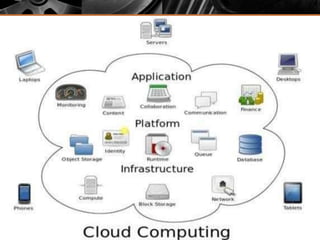
 Cloud can be divided into front-end and backend. The front end
enables a user to access data stored in the cloud using an internet
browser or a cloud computing software. However, the primary
component of cloud computing – responsible for securely storing data
and information – is the backend. It comprises servers, computers,
databases, and central servers.
 The central server facilitates operations by following a set of rules
known as protocols. It uses a software, middleware, to ensure
seamless connectivity between devices/computers linked via cloud
computing. Cloud computing service providers usually maintain
multiple copies of the data to mitigate instances of security threats,
data loss, data breach, etc.
Advantages
 Eliminate platform dependency service
 Lower capital cost
 No installation or maintains of hardware and software
 Optimized IT infrastructure ,which provide quick access to required
computing needs.
 Unlimited storage
Disadvantages
 Required a constant internet connection
 Stored data might not be secure
Types of cloud
 Public cloud : The public cloud allow systems and service to be easily accessible to
the general public. Public cloud may be less secure because of its openness, eg,e-
mail.
 Private cloud ; The cloud allows system and services to be accessible within an
organization .it offers increased security because of its private cloud .
 Community cloud : the community cloud allows system and service to be
accessible by group of organization.
 Hybrid cloud :The hybrid cloud is mixture of public and private
cloud.However,the critical activities are performed using private cloud while the no-
critical activities are performed using public cloud.
Service models
 Service model are the reference models on which the cloud
computing is based. These can be categorized into three basic
service models as listed below:
1.infrastructure as a service (IaaS)
 2.Platform as a service (PaaS)
 3.Software as a service (SaaS)
Infrastructure as service (IaaS)
 IaaS is the delivery of technology as an on demand scalable service.
 IaaS provides access to fundamental resources such as physical machines
,virtual machines ,virtual storage,etc.
Usually billed based on usage
usually multi tenant virtualized environment
Can be coupled with managed service for OS and
application support
Platform as a service (PaaS)
 Paas provides the run time environment for applications,
development& deployment tools,etc.
 PaaS prvoide all facilities required to support the complete life cycle
of building and delivering web applications and services entirely from
the internet.
 typically applications must be developed with a particular platform in
mind
 Multi tenant environments
 High scalable multi tier architecture
Software as a service (SaaS)
 SaaS model allow to use software applications as a service to end users.
 SaaS is a software delivery methodology that provides licensed multi-
tenant
Access to software and its function remotely as a Web-based service .
 usually billed based on usage
Usually multi tenant environment
Highly scalable architecture
Cloud computing

Cloud computing

  • 2.
    Cloud computing NAME:ALI MUHAMMADZARDARI 2k19 MBA university of Sindh
  • 3.
    outline  Introduction  Whatis cloud computing  How its work  Advantages an disadvantages  Types of cloud  Types of cloud services  Conclusion
  • 4.
    Introduction  cloud computingprovide us a means by which we can access the applications as utilities , over the internet.it allows us to create ,configure and customize applications online.  with cloud computing users can access database resources via the internet from from anywhere for as long as they need without worrying about any maintance or management of actual resources.
  • 5.
    What is cloudcomputing ?  cloud computing is the storing of data and applications on remote servers, and accessing them via the internet rather then saving or installing them on your personal or office computer.
  • 6.
    How its work Cloud can be divided into front-end and backend. The front end enables a user to access data stored in the cloud using an internet browser or a cloud computing software. However, the primary component of cloud computing – responsible for securely storing data and information – is the backend. It comprises servers, computers, databases, and central servers.  The central server facilitates operations by following a set of rules known as protocols. It uses a software, middleware, to ensure seamless connectivity between devices/computers linked via cloud computing. Cloud computing service providers usually maintain multiple copies of the data to mitigate instances of security threats, data loss, data breach, etc.
  • 8.
    Advantages  Eliminate platformdependency service  Lower capital cost  No installation or maintains of hardware and software  Optimized IT infrastructure ,which provide quick access to required computing needs.  Unlimited storage Disadvantages  Required a constant internet connection  Stored data might not be secure
  • 9.
    Types of cloud Public cloud : The public cloud allow systems and service to be easily accessible to the general public. Public cloud may be less secure because of its openness, eg,e- mail.  Private cloud ; The cloud allows system and services to be accessible within an organization .it offers increased security because of its private cloud .  Community cloud : the community cloud allows system and service to be accessible by group of organization.  Hybrid cloud :The hybrid cloud is mixture of public and private cloud.However,the critical activities are performed using private cloud while the no- critical activities are performed using public cloud.
  • 10.
    Service models  Servicemodel are the reference models on which the cloud computing is based. These can be categorized into three basic service models as listed below: 1.infrastructure as a service (IaaS)  2.Platform as a service (PaaS)  3.Software as a service (SaaS)
  • 11.
    Infrastructure as service(IaaS)  IaaS is the delivery of technology as an on demand scalable service.  IaaS provides access to fundamental resources such as physical machines ,virtual machines ,virtual storage,etc. Usually billed based on usage usually multi tenant virtualized environment Can be coupled with managed service for OS and application support
  • 12.
    Platform as aservice (PaaS)  Paas provides the run time environment for applications, development& deployment tools,etc.  PaaS prvoide all facilities required to support the complete life cycle of building and delivering web applications and services entirely from the internet.  typically applications must be developed with a particular platform in mind  Multi tenant environments  High scalable multi tier architecture
  • 13.
    Software as aservice (SaaS)  SaaS model allow to use software applications as a service to end users.  SaaS is a software delivery methodology that provides licensed multi- tenant Access to software and its function remotely as a Web-based service .  usually billed based on usage Usually multi tenant environment Highly scalable architecture