A
Presentation On
Presented by:-Nilesh Bandawane (SE)
Department of Instrumentation and Control Engineering
N.D.M.V.P’Samaj Adv. Karmveer Baburao Thakre College of Engineering,Nashik-13
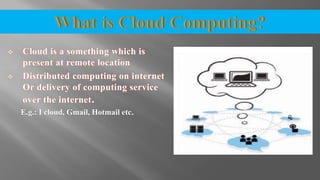
 Cloud is a something which is
present at remote location
 Distributed computing on internet
Or delivery of computing service
over the internet.
E.g.: I cloud, Gmail, Hotmail etc.
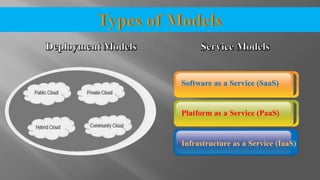
Software as a Service (SaaS)
Platform as a Service (PaaS)
Infrastructure as a Service (IaaS)
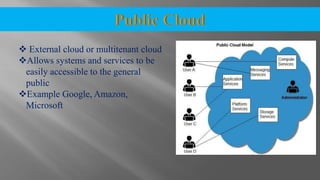
 External cloud or multitenant cloud
Allows systems and services to be
easily accessible to the general
public
Example Google, Amazon,
Microsoft
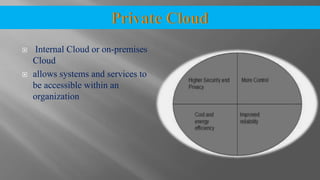
 Internal Cloud or on-premises
Cloud
 allows systems and services to
be accessible within an
organization
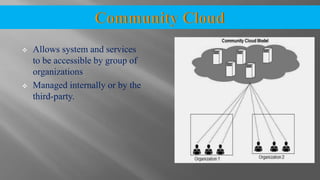
 Allows system and services
to be accessible by group of
organizations
 Managed internally or by the
third-party.
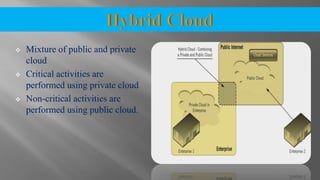
 Mixture of public and private
cloud
 Critical activities are
performed using private cloud
 Non-critical activities are
performed using public cloud.
 Infrastructure as a service (IaaS)
 Platform as a service (PaaS)
 Software as a service (SaaS)
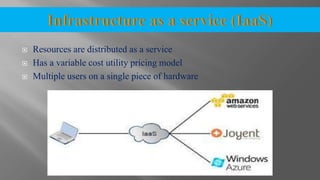
 Resources are distributed as a service
 Has a variable cost utility pricing model
 Multiple users on a single piece of hardware
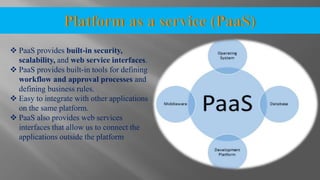
 PaaS provides built-in security,
scalability, and web service interfaces.
 PaaS provides built-in tools for defining
workflow and approval processes and
defining business rules.
 Easy to integrate with other applications
on the same platform.
 PaaS also provides web services
interfaces that allow us to connect the
applications outside the platform
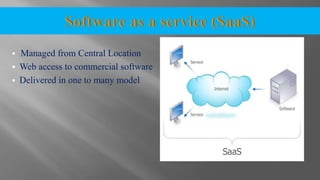
 Managed from Central Location
 Web access to commercial software
 Delivered in one to many model
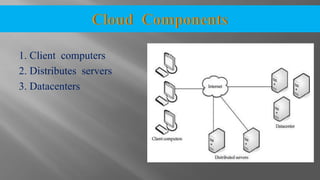
1. Client computers
2. Distributes servers
3. Datacenters
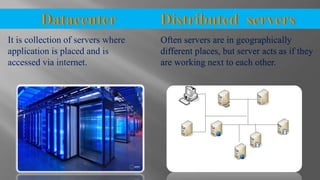
It is collection of servers where
application is placed and is
accessed via internet.
Often servers are in geographically
different places, but server acts as if they
are working next to each other.
 Social Networking sites.
 E-mail sites.
 Search Engines.
 Many more services OVER THE INTERNET.
 Unwarranted service charges.
 Adverse impact of mishandling of data.
 General security concerns.
 Data recovery and confidentiality problems.
 Financial or legal problems.
 On demand self service
 Cost effective
 No software required
 More Reliable
 Reduce the complexity of networks.
 Do not have to buy software licenses.
 Information at cloud are not easily lost.
References:-
1. https://en.wikipedia.org/wiki/Cloud_computing
2. http://www.elasticstack.com/cloud-platform/hardware-requirements
3. http://arxiv.org/ftp/arxiv/papers/0808/0808.3558.pdf
4. http://www.ijcsits.org/papers/Vol1no22011/13vol1no2.pdf

Ppt cloud computing

  • 1.
    A Presentation On Presented by:-NileshBandawane (SE) Department of Instrumentation and Control Engineering N.D.M.V.P’Samaj Adv. Karmveer Baburao Thakre College of Engineering,Nashik-13
  • 2.
     Cloud isa something which is present at remote location  Distributed computing on internet Or delivery of computing service over the internet. E.g.: I cloud, Gmail, Hotmail etc.
  • 3.
    Software as aService (SaaS) Platform as a Service (PaaS) Infrastructure as a Service (IaaS)
  • 4.
     External cloudor multitenant cloud Allows systems and services to be easily accessible to the general public Example Google, Amazon, Microsoft
  • 5.
     Internal Cloudor on-premises Cloud  allows systems and services to be accessible within an organization
  • 6.
     Allows systemand services to be accessible by group of organizations  Managed internally or by the third-party.
  • 7.
     Mixture ofpublic and private cloud  Critical activities are performed using private cloud  Non-critical activities are performed using public cloud.
  • 8.
     Infrastructure asa service (IaaS)  Platform as a service (PaaS)  Software as a service (SaaS)
  • 9.
     Resources aredistributed as a service  Has a variable cost utility pricing model  Multiple users on a single piece of hardware
  • 10.
     PaaS providesbuilt-in security, scalability, and web service interfaces.  PaaS provides built-in tools for defining workflow and approval processes and defining business rules.  Easy to integrate with other applications on the same platform.  PaaS also provides web services interfaces that allow us to connect the applications outside the platform
  • 11.
     Managed fromCentral Location  Web access to commercial software  Delivered in one to many model
  • 12.
    1. Client computers 2.Distributes servers 3. Datacenters
  • 13.
    It is collectionof servers where application is placed and is accessed via internet. Often servers are in geographically different places, but server acts as if they are working next to each other.
  • 14.
     Social Networkingsites.  E-mail sites.  Search Engines.  Many more services OVER THE INTERNET.
  • 15.
     Unwarranted servicecharges.  Adverse impact of mishandling of data.  General security concerns.  Data recovery and confidentiality problems.  Financial or legal problems.
  • 16.
     On demandself service  Cost effective  No software required  More Reliable
  • 17.
     Reduce thecomplexity of networks.  Do not have to buy software licenses.  Information at cloud are not easily lost.
  • 18.
    References:- 1. https://en.wikipedia.org/wiki/Cloud_computing 2. http://www.elasticstack.com/cloud-platform/hardware-requirements 3.http://arxiv.org/ftp/arxiv/papers/0808/0808.3558.pdf 4. http://www.ijcsits.org/papers/Vol1no22011/13vol1no2.pdf

Editor's Notes

  • #3 In computer networking , cloud computing is a phrase used to describe a variety of computing concepts. Distributed computing on internet.
  • #18 Scalability means Unlimited processes and storage capacity.