





Clothing Industry
Nnenna,
Moses,
Ayonni,
Dalvir,
Deia
Agenda
• Introduction & MFA
• Production Circuit & Global Shifts
• Labour & Technology
• Company and Regional Strategies & GAP
• Regionalizing production networks & Conclusion
The Clothing Industry
HIGHLIGHTS
● Second largest industry in the world worth
about $2.5 trillion - $3 trillion USD
● Second largest employer of labour
● Second largest polluter in the world after the
oil and gas
● The clothing industry is part of a larger
industry - textile industry
● Previously regulated by the Multi-fibre
Multi-Fibre Arrangement (MFA)
● A special international framework that regulated trade in clothing and
textile from 1973 to 1995
● Protected developed countries clothing and textile industry from developing
countries
● Imposed import quotas on developing countries
The Multi-Fibre Arrangement (MFA)
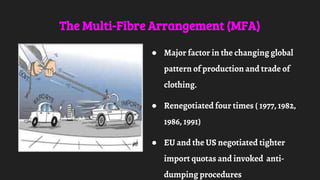
● Major factor in the changing global
pattern of production and trade of
clothing.
● Renegotiated four times ( 1977, 1982,
1986, 1991)
● EU and the US negotiated tighter
import quotas and invoked anti-
dumping procedures
The Role of the State
● Restructure and rationalization through
subsidies and adjustment programmes.
● Stimulate Offshore assembly and preferential
trading Agreements.
● Protect from competition from low-cost producers
in developing countries
The Multi-Fibre Arrangement (MFA)
Loopholes in the MFA
● Increased evasive actions
● Switch to other items
● False labelling
● Relocation to other countries
The Multi-Fibre Arrangement (MFA)
• 1995 -the regulation of trade in textiles and clothing was
incorporated into the WTO (World Trade Organization)
• MFA phased out over a 10-year period (1995–2004)
• US and the EU ‘integrated’ first those products which already
entered their markets freely. 70% of imports left to the end of the
transition period
• 2005- MFA eventually abolished
• 2008 – monitoring procedures and import quotas negotiated with
China
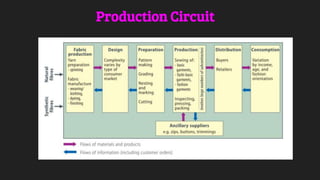
Production Circuit
Figure 14.1 The clothing production circuit
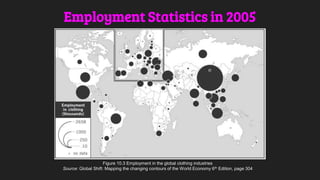
Employment Statistics in 2005
Figure 10.3 Employment in the global clothing industries
Source: Global Shift: Mapping the changing contours of the World Economy 6th Edition, page 304
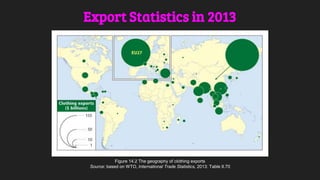
Export Statistics in 2013
Figure 14.2 The geography of clothing exports
Source: based on WTO, International Trade Statistics, 2013: Table II.70
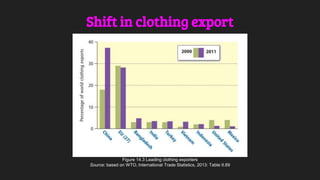
Shift in clothing export
Figure 14.3 Leading clothing exporters
Source: based on WTO, International Trade Statistics, 2013: Table II.69
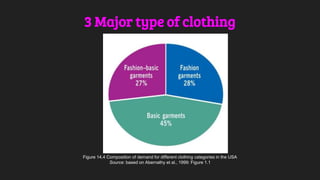
3 Major type of clothing
Figure 14.4 Composition of demand for different clothing categories in the USA
Source: based on Abernathy et al., 1999: Figure 1.1
Sweatshops Video
This video describes the benefit of Sweatshops in developing countries.
Points in favor of Sweatshops
● It is a bad idea to prohibit Sweatshop labor.
● The Exchange between Worker + Employer is mutually beneficial.
● It is better to do something to end the problem of global poverty than it is to do
nothing.
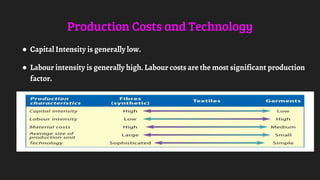
Production Costs and Technology
● Capital Intensity is generally low.
● Labour intensity is generally high. Labour costs are the most significant production
factor.
● Technology is relatively unsophisticated.
Production costs and technology
Two kinds of technological changes are important in clothing industry:
-Those that increase the speed with which a particular process can be carried out.
-Those that replace manual with mechanized and automated operation.
Current technology developments in the manufacture of clothing
Focused on three areas:
- Increasing the flexibility of machines.
- Addressing the problem of sequential operations.
- Developing the unit production system to deliver individual pieces of
work to the operator on a conveyor belt system.
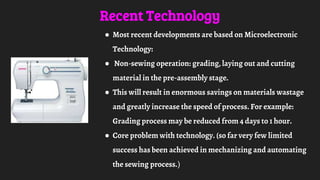
Recent Technology
● Most recent developments are based on Microelectronic
Technology:
● Non-sewing operation: grading, laying out and cutting
material in the pre-assembly stage.
● This will result in enormous savings on materials wastage
and greatly increase the speed of process. For example:
Grading process may be reduced from 4 days to 1 hour.
● Core problem with technology. (so far very few limited
success has been achieved in mechanizing and automating
the sewing process.)
Benefits of Technology developments
● The main benefit is the time savings that results from automated manufacture.
Time Savings leads to two major benefits:
-Speeding up the production cycle reduces the cost of working capital by increasing
the velocity of its use.
-It becomes possible for the manufacturer to respond more quickly to consumer
demand.
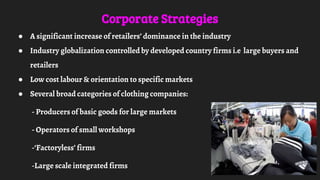
Corporate Strategies
● A significant increase of retailers’ dominance in the industry
● Industry globalization controlled by developed country firms i.e large buyers and
retailers
● Low cost labour & orientation to specific markets
● Several broad categories of clothing companies:
- Producers of basic goods for large markets
- Operators of small workshops
-‘Factoryless’ firms
-Large scale integrated firms
Offshore Production
● A recent shift balance between domestic sourcing and offshore sourcing by large
companies
● Lower labour costs in foreign locations (Asia)
● Large clothing firms in the world went completely offshore
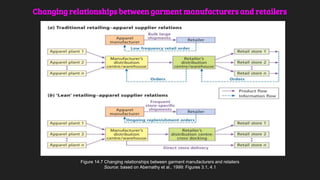
Changing relationships between garment manufacturers and retailers
Figure 14.7 Changing relationships between garment manufacturers and retailers
Source: based on Abernathy et al., 1999: Figures 3.1, 4.1
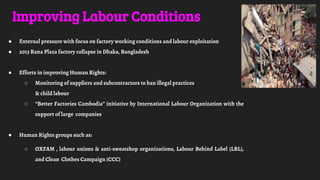
Improving Labour Conditions
● External pressure with focus on factory working conditions and labour exploitation
● 2013 Rana Plaza factory collapse in Dhaka, Bangladesh
● Efforts in improving Human Rights:
○ Monitoring of suppliers and subcontractors to ban illegal practices
& child labour
○ “Better Factories Cambodia” initiative by International Labour Organization with the
support of large companies
● Human Rights groups such as:
○ OXFAM , labour unions & anti-sweatshop organizations, Labour Behind Label (LBL),
and Clean Clothes Campaign (CCC)
About GAP
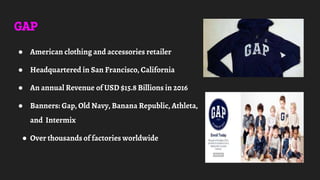
GAP
● American clothing and accessories retailer
● Headquartered in San Francisco, California
● An annual Revenue of USD $15.8 Billions in 2016
● Banners: Gap, Old Navy, Banana Republic, Athleta,
and Intermix
● Over thousands of factories worldwide
Issues
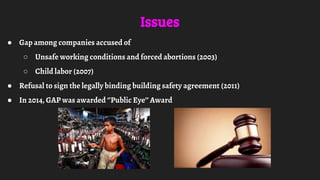
● Gap among companies accused of
○ Unsafe working conditions and forced abortions (2003)
○ Child labor (2007)
● Refusal to sign the legally binding building safety agreement (2011)
● In 2014, GAP was awarded ‘’Public Eye’’ Award
Corporate Social Responsibility (CSR)
● Partnership with “Better Work Program” to
protect workers’ rights
● Implementation of recycling programs
○ “Recycle your Blues”
○ Recycling of solid waste in stores
● Impact on environment through company’s
supply chain system
Labour Costs
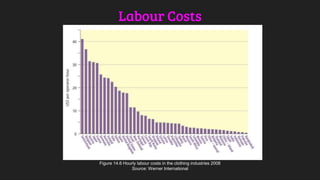
Figure 14.6 Hourly labour costs in the clothing industries 2008
Source: Werner International
Regionalizing Production Networks
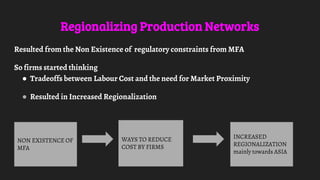
Resulted from the Non Existence of regulatory constraints from MFA
So firms started thinking
● Tradeoffs between Labour Cost and the need for Market Proximity
● Resulted in Increased Regionalization
NON EXISTENCE OF
MFA
WAYS TO REDUCE
COST BY FIRMS
INCREASED
REGIONALIZATION
mainly towards ASIA
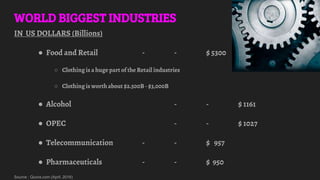
WORLD BIGGEST INDUSTRIES
IN US DOLLARS (Billions)
● Food and Retail - - $ 5300
○ Clothing is a huge part of the Retail industries
○ Clothing is worthabout $2.500B- $3,000B
● Alcohol - - $ 1161
● OPEC - - $ 1027
● Telecommunication - - $ 957
● Pharmaceuticals - - $ 950
Source : Quora.com (April, 2016)
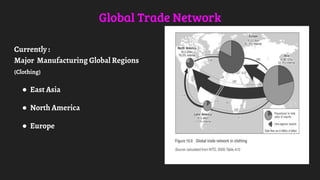
Global Trade Network
Currently :
Major Manufacturing Global Regions
(Clothing)
● East Asia
● North America
● Europe
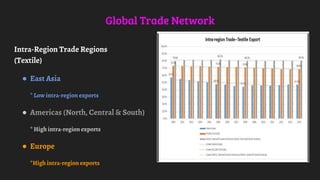
Global Trade Network
Intra-Region Trade Regions
(Textile)
● East Asia
* Low intra-region exports
● Americas (North, Central & South)
* High intra-region exports
● Europe
*High intra-region exports
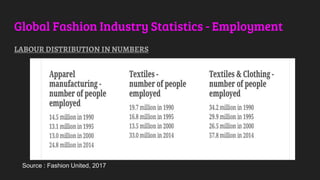
Global Fashion Industry Statistics - Employment
LABOUR DISTRIBUTION IN NUMBERS
Source : Fashion United, 2017
Asia
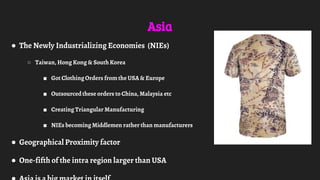
● The Newly Industrializing Economies (NIEs)
○ Taiwan, Hong Kong & SouthKorea
■ Got ClothingOrders from the USA & Europe
■ Outsourcedthese orders to China, Malaysia etc
■ Creating Triangular Manufacturing
■ NIEs becoming Middlemen rather than manufacturers
● Geographical Proximity factor
● One-fifth of the intra region larger than USA
China
● Population - 1.4 Billion
● Labour force - 816.6million
○ Unemployment - 4.1%
○ Fashion industry employs - 10 million people
● GDP - 8,358.4
Billion
● World’s Number-One in terms textile and garment export
● 225 Billion dollars Export in 2012
Bangladesh
● Mostly Exports to Europe and America
○ 60% goes to europe and 40% to America
○ Greatest strength is its greatest weakness
■ - High Labour but Low wages
■ - 4 million employed in the fashion industry
● 90% are women
● Destination target for most top brands e.g. GAP
○ RANA Plaza collapse killing thousandsof people majorly women in 2013
North America
● China is the leading supplier of clothing to North America
● The advent of NAFTA in 1994 reduced the leading effect of Chinese Exports
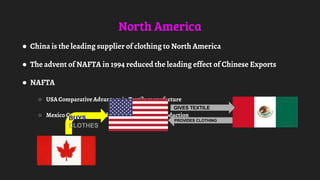
● NAFTA
○ USA Comparative Advantage in Textile manufacture
○ Mexico Comparative Advantage in Clothing production
GIVES TEXTILE
PROVIDES CLOTHINGBUYS
CLOTHES
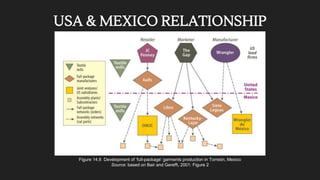
USA & MEXICO RELATIONSHIP
Figure 14.8 Development of ‘full-package’ garments production in Torreón, Mexico
Source: based on Bair and Gereffi, 2001: Figure 2
Europe
● Most highly integrated regional market in the world
● Key Manufacturers : France, Germany, Italy and UK
● Recent decline in cloth manufacturing because of Low cost factor in Asia
FRANCE
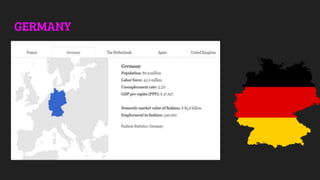
GERMANY
Clothing industry

Clothing industry

  • 1.
  • 2.
    Agenda • Introduction &MFA • Production Circuit & Global Shifts • Labour & Technology • Company and Regional Strategies & GAP • Regionalizing production networks & Conclusion
  • 3.
    The Clothing Industry HIGHLIGHTS ●Second largest industry in the world worth about $2.5 trillion - $3 trillion USD ● Second largest employer of labour ● Second largest polluter in the world after the oil and gas ● The clothing industry is part of a larger industry - textile industry ● Previously regulated by the Multi-fibre
  • 4.
    Multi-Fibre Arrangement (MFA) ●A special international framework that regulated trade in clothing and textile from 1973 to 1995 ● Protected developed countries clothing and textile industry from developing countries ● Imposed import quotas on developing countries
  • 5.
    The Multi-Fibre Arrangement(MFA) ● Major factor in the changing global pattern of production and trade of clothing. ● Renegotiated four times ( 1977, 1982, 1986, 1991) ● EU and the US negotiated tighter import quotas and invoked anti- dumping procedures
  • 6.
    The Role ofthe State ● Restructure and rationalization through subsidies and adjustment programmes. ● Stimulate Offshore assembly and preferential trading Agreements. ● Protect from competition from low-cost producers in developing countries
  • 7.
    The Multi-Fibre Arrangement(MFA) Loopholes in the MFA ● Increased evasive actions ● Switch to other items ● False labelling ● Relocation to other countries
  • 8.
    The Multi-Fibre Arrangement(MFA) • 1995 -the regulation of trade in textiles and clothing was incorporated into the WTO (World Trade Organization) • MFA phased out over a 10-year period (1995–2004) • US and the EU ‘integrated’ first those products which already entered their markets freely. 70% of imports left to the end of the transition period • 2005- MFA eventually abolished • 2008 – monitoring procedures and import quotas negotiated with China
  • 9.
    Production Circuit Figure 14.1The clothing production circuit
  • 10.
    Employment Statistics in2005 Figure 10.3 Employment in the global clothing industries Source: Global Shift: Mapping the changing contours of the World Economy 6th Edition, page 304
  • 11.
    Export Statistics in2013 Figure 14.2 The geography of clothing exports Source: based on WTO, International Trade Statistics, 2013: Table II.70
  • 12.
    Shift in clothingexport Figure 14.3 Leading clothing exporters Source: based on WTO, International Trade Statistics, 2013: Table II.69
  • 13.
    3 Major typeof clothing Figure 14.4 Composition of demand for different clothing categories in the USA Source: based on Abernathy et al., 1999: Figure 1.1
  • 14.
    Sweatshops Video This videodescribes the benefit of Sweatshops in developing countries.
  • 15.
    Points in favorof Sweatshops ● It is a bad idea to prohibit Sweatshop labor. ● The Exchange between Worker + Employer is mutually beneficial. ● It is better to do something to end the problem of global poverty than it is to do nothing.
  • 16.
    Production Costs andTechnology ● Capital Intensity is generally low. ● Labour intensity is generally high. Labour costs are the most significant production factor. ● Technology is relatively unsophisticated.
  • 17.
    Production costs andtechnology Two kinds of technological changes are important in clothing industry: -Those that increase the speed with which a particular process can be carried out. -Those that replace manual with mechanized and automated operation. Current technology developments in the manufacture of clothing Focused on three areas: - Increasing the flexibility of machines. - Addressing the problem of sequential operations. - Developing the unit production system to deliver individual pieces of work to the operator on a conveyor belt system.
  • 18.
    Recent Technology ● Mostrecent developments are based on Microelectronic Technology: ● Non-sewing operation: grading, laying out and cutting material in the pre-assembly stage. ● This will result in enormous savings on materials wastage and greatly increase the speed of process. For example: Grading process may be reduced from 4 days to 1 hour. ● Core problem with technology. (so far very few limited success has been achieved in mechanizing and automating the sewing process.)
  • 19.
    Benefits of Technologydevelopments ● The main benefit is the time savings that results from automated manufacture. Time Savings leads to two major benefits: -Speeding up the production cycle reduces the cost of working capital by increasing the velocity of its use. -It becomes possible for the manufacturer to respond more quickly to consumer demand.
  • 20.
    Corporate Strategies ● Asignificant increase of retailers’ dominance in the industry ● Industry globalization controlled by developed country firms i.e large buyers and retailers ● Low cost labour & orientation to specific markets ● Several broad categories of clothing companies: - Producers of basic goods for large markets - Operators of small workshops -‘Factoryless’ firms -Large scale integrated firms
  • 21.
    Offshore Production ● Arecent shift balance between domestic sourcing and offshore sourcing by large companies ● Lower labour costs in foreign locations (Asia) ● Large clothing firms in the world went completely offshore
  • 22.
    Changing relationships betweengarment manufacturers and retailers Figure 14.7 Changing relationships between garment manufacturers and retailers Source: based on Abernathy et al., 1999: Figures 3.1, 4.1
  • 23.
    Improving Labour Conditions ●External pressure with focus on factory working conditions and labour exploitation ● 2013 Rana Plaza factory collapse in Dhaka, Bangladesh ● Efforts in improving Human Rights: ○ Monitoring of suppliers and subcontractors to ban illegal practices & child labour ○ “Better Factories Cambodia” initiative by International Labour Organization with the support of large companies ● Human Rights groups such as: ○ OXFAM , labour unions & anti-sweatshop organizations, Labour Behind Label (LBL), and Clean Clothes Campaign (CCC)
  • 24.
  • 25.
    GAP ● American clothingand accessories retailer ● Headquartered in San Francisco, California ● An annual Revenue of USD $15.8 Billions in 2016 ● Banners: Gap, Old Navy, Banana Republic, Athleta, and Intermix ● Over thousands of factories worldwide
  • 26.
    Issues ● Gap amongcompanies accused of ○ Unsafe working conditions and forced abortions (2003) ○ Child labor (2007) ● Refusal to sign the legally binding building safety agreement (2011) ● In 2014, GAP was awarded ‘’Public Eye’’ Award
  • 27.
    Corporate Social Responsibility(CSR) ● Partnership with “Better Work Program” to protect workers’ rights ● Implementation of recycling programs ○ “Recycle your Blues” ○ Recycling of solid waste in stores ● Impact on environment through company’s supply chain system
  • 28.
    Labour Costs Figure 14.6Hourly labour costs in the clothing industries 2008 Source: Werner International
  • 29.
    Regionalizing Production Networks Resultedfrom the Non Existence of regulatory constraints from MFA So firms started thinking ● Tradeoffs between Labour Cost and the need for Market Proximity ● Resulted in Increased Regionalization NON EXISTENCE OF MFA WAYS TO REDUCE COST BY FIRMS INCREASED REGIONALIZATION mainly towards ASIA
  • 30.
    WORLD BIGGEST INDUSTRIES INUS DOLLARS (Billions) ● Food and Retail - - $ 5300 ○ Clothing is a huge part of the Retail industries ○ Clothing is worthabout $2.500B- $3,000B ● Alcohol - - $ 1161 ● OPEC - - $ 1027 ● Telecommunication - - $ 957 ● Pharmaceuticals - - $ 950 Source : Quora.com (April, 2016)
  • 31.
    Global Trade Network Currently: Major Manufacturing Global Regions (Clothing) ● East Asia ● North America ● Europe
  • 32.
    Global Trade Network Intra-RegionTrade Regions (Textile) ● East Asia * Low intra-region exports ● Americas (North, Central & South) * High intra-region exports ● Europe *High intra-region exports
  • 33.
    Global Fashion IndustryStatistics - Employment LABOUR DISTRIBUTION IN NUMBERS Source : Fashion United, 2017
  • 34.
    Asia ● The NewlyIndustrializing Economies (NIEs) ○ Taiwan, Hong Kong & SouthKorea ■ Got ClothingOrders from the USA & Europe ■ Outsourcedthese orders to China, Malaysia etc ■ Creating Triangular Manufacturing ■ NIEs becoming Middlemen rather than manufacturers ● Geographical Proximity factor ● One-fifth of the intra region larger than USA
  • 35.
    China ● Population -1.4 Billion ● Labour force - 816.6million ○ Unemployment - 4.1% ○ Fashion industry employs - 10 million people ● GDP - 8,358.4 Billion ● World’s Number-One in terms textile and garment export ● 225 Billion dollars Export in 2012
  • 36.
    Bangladesh ● Mostly Exportsto Europe and America ○ 60% goes to europe and 40% to America ○ Greatest strength is its greatest weakness ■ - High Labour but Low wages ■ - 4 million employed in the fashion industry ● 90% are women ● Destination target for most top brands e.g. GAP ○ RANA Plaza collapse killing thousandsof people majorly women in 2013
  • 37.
    North America ● Chinais the leading supplier of clothing to North America ● The advent of NAFTA in 1994 reduced the leading effect of Chinese Exports ● NAFTA ○ USA Comparative Advantage in Textile manufacture ○ Mexico Comparative Advantage in Clothing production GIVES TEXTILE PROVIDES CLOTHINGBUYS CLOTHES
  • 38.
    USA & MEXICORELATIONSHIP Figure 14.8 Development of ‘full-package’ garments production in Torreón, Mexico Source: based on Bair and Gereffi, 2001: Figure 2
  • 39.
    Europe ● Most highlyintegrated regional market in the world ● Key Manufacturers : France, Germany, Italy and UK ● Recent decline in cloth manufacturing because of Low cost factor in Asia
  • 40.
  • 41.