1
Clinical Teaching and Supervision
2
Objectives
At the of end this presentation we will be able to;
 Define clinical teaching and supervision.
 List of characteristic of effective clinical teacher.
 Discuss models of clinical teaching and supervision
 Evaluate clinical teaching
 Introduce to writing anecdotal notes, signing of checklist
 Introduce to pre and post conferences
 Discuss the role of nurse as educator and discuss its evolution
 Analyze the purpose of staff and patient education
3
Definition of clinical teaching and supervision
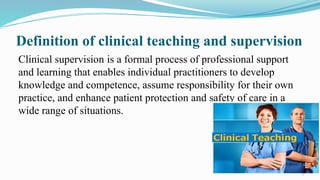
Clinical supervision is a formal process of professional support
and learning that enables individual practitioners to develop
knowledge and competence, assume responsibility for their own
practice, and enhance patient protection and safety of care in a
wide range of situations.
4
Characteristics of clinical teacher
 Teacher acts as facilitator, responsible to set a positive
climate for learning, clarifying the purpose of the learner,
organizing and making available learning resources.
 They are knowledge based (engaged in continuing medical
education), clinically competent (competent in patient
management issues) non-judgmental (provides
nonthreatening environment), good communication skills
with patients, well prepared for tutorials, lectures, ward
rounds, clinics, practices evidence based medicine, role
model (achieves a healthy.
5
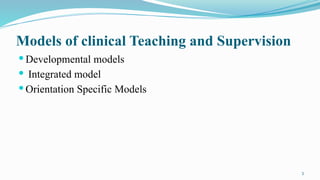
Models of clinical Teaching and Supervision
 Developmental models
 Integrated model
 Orientation Specific Models
6
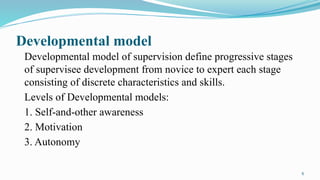
Developmental model
Developmental model of supervision define progressive stages
of supervisee development from novice to expert each stage
consisting of discrete characteristics and skills.
Levels of Developmental models:
1. Self-and-other awareness
2. Motivation
3. Autonomy
7
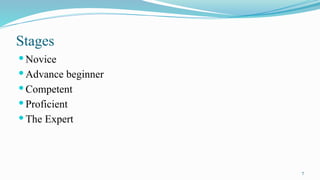
Stages
 Novice
 Advance beginner
 Competent
 Proficient
 The Expert
8
Cont..
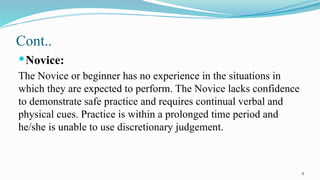
Novice:
The Novice or beginner has no experience in the situations in
which they are expected to perform. The Novice lacks confidence
to demonstrate safe practice and requires continual verbal and
physical cues. Practice is within a prolonged time period and
he/she is unable to use discretionary judgement.
9
Cont..
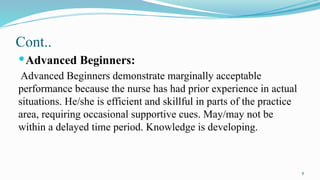
Advanced Beginners:
Advanced Beginners demonstrate marginally acceptable
performance because the nurse has had prior experience in actual
situations. He/she is efficient and skillful in parts of the practice
area, requiring occasional supportive cues. May/may not be
within a delayed time period. Knowledge is developing.
10
Cont..
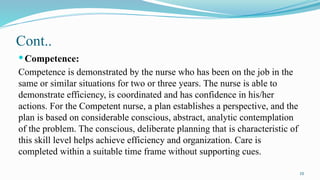
Competence:
Competence is demonstrated by the nurse who has been on the job in the
same or similar situations for two or three years. The nurse is able to
demonstrate efficiency, is coordinated and has confidence in his/her
actions. For the Competent nurse, a plan establishes a perspective, and the
plan is based on considerable conscious, abstract, analytic contemplation
of the problem. The conscious, deliberate planning that is characteristic of
this skill level helps achieve efficiency and organization. Care is
completed within a suitable time frame without supporting cues.
11
Cont..
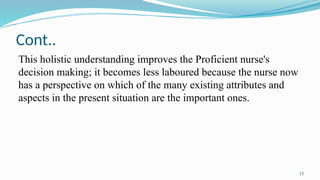
This holistic understanding improves the Proficient nurse's
decision making; it becomes less laboured because the nurse now
has a perspective on which of the many existing attributes and
aspects in the present situation are the important ones.
12
Cont..
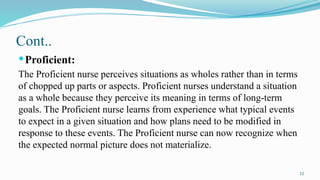
Proficient:
The Proficient nurse perceives situations as wholes rather than in terms
of chopped up parts or aspects. Proficient nurses understand a situation
as a whole because they perceive its meaning in terms of long-term
goals. The Proficient nurse learns from experience what typical events
to expect in a given situation and how plans need to be modified in
response to these events. The Proficient nurse can now recognize when
the expected normal picture does not materialize.
13
Cont..
The Expert:
The Expert nurse has an intuitive grasp of each situation and zeroes in
on the accurate region of the problem without wasteful consideration of
a large range of unfruitful, alternative diagnoses and solutions. The
Expert operates from a deep understanding of the total situation.
His/her performance becomes fluid and flexible and highly proficient.
Highly skilled analytic ability is necessary for those situations with
which the nurse has had no previous experience.
14
Integrated Model
 Bernard’s (Bernard & Goodyear, 1992) purports to be “a-
theoretical.It combines an attention to three Supervisory roles
with three areas of focus:
 1. Supervisor’s role as teacher
 2. Supervisor’s role as counselor
 3. Supervisor’s role as consultant
Bernard’s three areas of focus for skill building are process,
conceptualization, and personalization.
15
Cont..
 Process examines communication between supervisee and
client
 Conceptualization is the supervisee’s application of theory,
big picture overview, and reasons for next
 steps
 Personalization reviews the supervisee’s use of self in the
therapeutic process.
16
Orientation specific model
Orientation specific models use the same theoretic models used to
treat clients to work with supervisees, such as:
 Psychoanalytic supervision
 Behavioral supervision
 Rogerian supervision
 Systemic supervision
17
Cont..
Psychoanalytic Supervision:
It is a stage model.
 Opening stage: assessing each other and looking for weakness.
Supervisor wins.
 Middle stage: conflict, defensiveness, avoiding and attaching
 Resolution stage: it is the working stage of supervision. The
supervisor is mostly silent and encourages the supervisee
towards independence and autonomy.
18
Cont..
Behavioral Supervision:
It utilizes cognitive behavioral strategies. The problem is
identified and the appropriate technique to resolve the problem is
selected. Supervisor models the technique and selectively
reinforces the supervisee, utilizing behavioral rehearsal with the
supervisee.
19
Cont..
Rogerian Supervision:
In Rogerian Supervision, the therapist models the three primary
Rogerian interventions
 Empathy
 Genuineness
 Unconditional Positive Regard.
20
Cont..
Systemic Supervision
It is the supervision should closely follow the theory. For
structural supervision, clear boundaries between supervisor and
therapist must be maintained. For strategic supervisors, the
supervisor manipulates the supervisee’s behavior and once it is
altered, the supervisor discusses it with the goal of the supervisee
gaining insight.
21
Evaluate the clinical teaching
It is the process of examining a program or process to
determine what's working, what's not, and why. It determines
the value of learning and training programs and acts as
blueprints for judgment and improvement.
(Rossett, Sheldon, 2001)
The process of evaluation of clinical teaching for the
individual teacher and for the programme. Measurement
principles, including validity, reliability, efficiency and
feasibility, and methods to evaluate clinical teaching are
reviewed.
22
Cont..
Each perspective provides specific feedback on factors or
attributes of the clinical teacher's performance in the domains of
medical expert, professional, scholar, communicator, collaborator,
patient advocate and manager.
23
Writing anecdotal notes and checklist
 Anecdotal notes are used to record specific observations of
individual student behaviours, skills and attitudes as they
relate to the outcomes in the program of studies.
 Observing students as they solve problems, model skills to
others, interact with peers in different learning situations
provides insight into student learning and growth..
 Observation checklists allow teachers to record information
quickly about how students perform in relation to specific
outcomes from the program of studies.
24
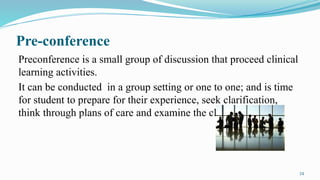
Pre-conference
Preconference is a small group of discussion that proceed clinical
learning activities.
It can be conducted in a group setting or one to one; and is time
for student to prepare for their experience, seek clarification,
think through plans of care and examine the clients problems.
25
Post-Conference
Post conference are held the conclusion of clinical learning
activates.
It is at time for discussion, sharing experience and emotion.
it looking over the day and analyzing the experience.
(Gaberson and Oermann,1999).
26
Role of Nurse as educators:
 A Clinical Nurse Educator is a registered professional nurse
with an advanced education, including advanced clinical and
educational training coupled with many years of expertise in a
healthcare specialty.
 Nurse educators design and evaluate academic and continuing
education programs for nurses and clinical staff.
 Nurse educators Create question and cases.
27
Cont..
 Nurse educators document the outcomes of educational
programs and guide staff, students and patients through the
learning process.
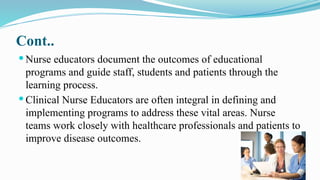
 Clinical Nurse Educators are often integral in defining and
implementing programs to address these vital areas. Nurse
teams work closely with healthcare professionals and patients to
improve disease outcomes.
28
Evolution
The Crimean War was a significant development in nursing
history when English nurse Florence Nightingale laid the
foundations of professional nursing with the principles
summarised in the book Notes on Nursing. Queen Victoria in
1860 ordered a hospital to be built to train Army nurses and
surgeons, the Royal Victoria Hospial.
It was first time nursing education defined. Her intention was
to train nurses to a qualified and specialized level, with the key
aim of learning to develop observation skills and sensitivity to
patient needs.
29
Cont..
Today nursing education attained at:
Associate degree levels
Bachelor degree levels
Master level students can specialize.
30
Purpose of staff and patient education
 Purpose of staff and patient education:
 Improved understanding of methods and means to manage
multiple aspects of medical condition.
 Patient Outcomes – Patients more likely to respond well to
their treatment plan – fewer complications.
 Improved understanding of medical condition, diagnosis,
disease, or disability
 Satisfaction and referrals – Patients more likely to stay with
your practice and refer other patients.
31
Cont..
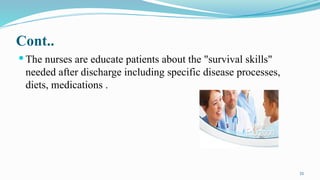
 The nurses are educate patients about the "survival skills"
needed after discharge including specific disease processes,
diets, medications .
32
References:
 Rossett, A., Sheldon, K. (2001). Beyond the Podium:
Delivering Training and Performance to a Digital World. San
Francisco: Jossey-Bass/Pfeiffer
 Saettler, P. (1990). The Evolution of American Educational
Technology. p350. Englewood, Colorado: Libraries Unlimited.
 Bernard, J. M. (1979). Supervisor training: A discrimination
model. Counselor Education and Supervision, 19, 60-68.
33
Cont..
 Haynes, R., Corey, G., & Moulton, P. (2003). Clinical supervision in the
helping professions: A practical guide. Pacific Grove, CA: Brooks/Cole.
 “Clinical supervision." A Dictionary of Nursing. 2008. Retrieved April
06, 2016 from Encyclopedia.com:
http://www.encyclopedia.com/doc/1O62-clinicalsupervision.html.
 Burns, Marilyn. "Looking at how students reason. " Educational
Leadership 63, 3 (2005), pp. 26–31.




34
Cont..
 Benner, P. (1984). From novice to expert: Excellence and
power in clinical nursing practice. Menlo Park: Addison-
Wesley, pp. 13-34.
35
36

lect1Clinical Teaching Supervision.pptx

  • 1.
  • 2.
    2 Objectives At the ofend this presentation we will be able to;  Define clinical teaching and supervision.  List of characteristic of effective clinical teacher.  Discuss models of clinical teaching and supervision  Evaluate clinical teaching  Introduce to writing anecdotal notes, signing of checklist  Introduce to pre and post conferences  Discuss the role of nurse as educator and discuss its evolution  Analyze the purpose of staff and patient education
  • 3.
    3 Definition of clinicalteaching and supervision Clinical supervision is a formal process of professional support and learning that enables individual practitioners to develop knowledge and competence, assume responsibility for their own practice, and enhance patient protection and safety of care in a wide range of situations.
  • 4.
    4 Characteristics of clinicalteacher  Teacher acts as facilitator, responsible to set a positive climate for learning, clarifying the purpose of the learner, organizing and making available learning resources.  They are knowledge based (engaged in continuing medical education), clinically competent (competent in patient management issues) non-judgmental (provides nonthreatening environment), good communication skills with patients, well prepared for tutorials, lectures, ward rounds, clinics, practices evidence based medicine, role model (achieves a healthy.
  • 5.
    5 Models of clinicalTeaching and Supervision  Developmental models  Integrated model  Orientation Specific Models
  • 6.
    6 Developmental model Developmental modelof supervision define progressive stages of supervisee development from novice to expert each stage consisting of discrete characteristics and skills. Levels of Developmental models: 1. Self-and-other awareness 2. Motivation 3. Autonomy
  • 7.
    7 Stages  Novice  Advancebeginner  Competent  Proficient  The Expert
  • 8.
    8 Cont.. Novice: The Novice orbeginner has no experience in the situations in which they are expected to perform. The Novice lacks confidence to demonstrate safe practice and requires continual verbal and physical cues. Practice is within a prolonged time period and he/she is unable to use discretionary judgement.
  • 9.
    9 Cont.. Advanced Beginners: Advanced Beginnersdemonstrate marginally acceptable performance because the nurse has had prior experience in actual situations. He/she is efficient and skillful in parts of the practice area, requiring occasional supportive cues. May/may not be within a delayed time period. Knowledge is developing.
  • 10.
    10 Cont.. Competence: Competence is demonstratedby the nurse who has been on the job in the same or similar situations for two or three years. The nurse is able to demonstrate efficiency, is coordinated and has confidence in his/her actions. For the Competent nurse, a plan establishes a perspective, and the plan is based on considerable conscious, abstract, analytic contemplation of the problem. The conscious, deliberate planning that is characteristic of this skill level helps achieve efficiency and organization. Care is completed within a suitable time frame without supporting cues.
  • 11.
    11 Cont.. This holistic understandingimproves the Proficient nurse's decision making; it becomes less laboured because the nurse now has a perspective on which of the many existing attributes and aspects in the present situation are the important ones.
  • 12.
    12 Cont.. Proficient: The Proficient nurseperceives situations as wholes rather than in terms of chopped up parts or aspects. Proficient nurses understand a situation as a whole because they perceive its meaning in terms of long-term goals. The Proficient nurse learns from experience what typical events to expect in a given situation and how plans need to be modified in response to these events. The Proficient nurse can now recognize when the expected normal picture does not materialize.
  • 13.
    13 Cont.. The Expert: The Expertnurse has an intuitive grasp of each situation and zeroes in on the accurate region of the problem without wasteful consideration of a large range of unfruitful, alternative diagnoses and solutions. The Expert operates from a deep understanding of the total situation. His/her performance becomes fluid and flexible and highly proficient. Highly skilled analytic ability is necessary for those situations with which the nurse has had no previous experience.
  • 14.
    14 Integrated Model  Bernard’s(Bernard & Goodyear, 1992) purports to be “a- theoretical.It combines an attention to three Supervisory roles with three areas of focus:  1. Supervisor’s role as teacher  2. Supervisor’s role as counselor  3. Supervisor’s role as consultant Bernard’s three areas of focus for skill building are process, conceptualization, and personalization.
  • 15.
    15 Cont..  Process examinescommunication between supervisee and client  Conceptualization is the supervisee’s application of theory, big picture overview, and reasons for next  steps  Personalization reviews the supervisee’s use of self in the therapeutic process.
  • 16.
    16 Orientation specific model Orientationspecific models use the same theoretic models used to treat clients to work with supervisees, such as:  Psychoanalytic supervision  Behavioral supervision  Rogerian supervision  Systemic supervision
  • 17.
    17 Cont.. Psychoanalytic Supervision: It isa stage model.  Opening stage: assessing each other and looking for weakness. Supervisor wins.  Middle stage: conflict, defensiveness, avoiding and attaching  Resolution stage: it is the working stage of supervision. The supervisor is mostly silent and encourages the supervisee towards independence and autonomy.
  • 18.
    18 Cont.. Behavioral Supervision: It utilizescognitive behavioral strategies. The problem is identified and the appropriate technique to resolve the problem is selected. Supervisor models the technique and selectively reinforces the supervisee, utilizing behavioral rehearsal with the supervisee.
  • 19.
    19 Cont.. Rogerian Supervision: In RogerianSupervision, the therapist models the three primary Rogerian interventions  Empathy  Genuineness  Unconditional Positive Regard.
  • 20.
    20 Cont.. Systemic Supervision It isthe supervision should closely follow the theory. For structural supervision, clear boundaries between supervisor and therapist must be maintained. For strategic supervisors, the supervisor manipulates the supervisee’s behavior and once it is altered, the supervisor discusses it with the goal of the supervisee gaining insight.
  • 21.
    21 Evaluate the clinicalteaching It is the process of examining a program or process to determine what's working, what's not, and why. It determines the value of learning and training programs and acts as blueprints for judgment and improvement. (Rossett, Sheldon, 2001) The process of evaluation of clinical teaching for the individual teacher and for the programme. Measurement principles, including validity, reliability, efficiency and feasibility, and methods to evaluate clinical teaching are reviewed.
  • 22.
    22 Cont.. Each perspective providesspecific feedback on factors or attributes of the clinical teacher's performance in the domains of medical expert, professional, scholar, communicator, collaborator, patient advocate and manager.
  • 23.
    23 Writing anecdotal notesand checklist  Anecdotal notes are used to record specific observations of individual student behaviours, skills and attitudes as they relate to the outcomes in the program of studies.  Observing students as they solve problems, model skills to others, interact with peers in different learning situations provides insight into student learning and growth..  Observation checklists allow teachers to record information quickly about how students perform in relation to specific outcomes from the program of studies.
  • 24.
    24 Pre-conference Preconference is asmall group of discussion that proceed clinical learning activities. It can be conducted in a group setting or one to one; and is time for student to prepare for their experience, seek clarification, think through plans of care and examine the clients problems.
  • 25.
    25 Post-Conference Post conference areheld the conclusion of clinical learning activates. It is at time for discussion, sharing experience and emotion. it looking over the day and analyzing the experience. (Gaberson and Oermann,1999).
  • 26.
    26 Role of Nurseas educators:  A Clinical Nurse Educator is a registered professional nurse with an advanced education, including advanced clinical and educational training coupled with many years of expertise in a healthcare specialty.  Nurse educators design and evaluate academic and continuing education programs for nurses and clinical staff.  Nurse educators Create question and cases.
  • 27.
    27 Cont..  Nurse educatorsdocument the outcomes of educational programs and guide staff, students and patients through the learning process.  Clinical Nurse Educators are often integral in defining and implementing programs to address these vital areas. Nurse teams work closely with healthcare professionals and patients to improve disease outcomes.
  • 28.
    28 Evolution The Crimean Warwas a significant development in nursing history when English nurse Florence Nightingale laid the foundations of professional nursing with the principles summarised in the book Notes on Nursing. Queen Victoria in 1860 ordered a hospital to be built to train Army nurses and surgeons, the Royal Victoria Hospial. It was first time nursing education defined. Her intention was to train nurses to a qualified and specialized level, with the key aim of learning to develop observation skills and sensitivity to patient needs.
  • 29.
    29 Cont.. Today nursing educationattained at: Associate degree levels Bachelor degree levels Master level students can specialize.
  • 30.
    30 Purpose of staffand patient education  Purpose of staff and patient education:  Improved understanding of methods and means to manage multiple aspects of medical condition.  Patient Outcomes – Patients more likely to respond well to their treatment plan – fewer complications.  Improved understanding of medical condition, diagnosis, disease, or disability  Satisfaction and referrals – Patients more likely to stay with your practice and refer other patients.
  • 31.
    31 Cont..  The nursesare educate patients about the "survival skills" needed after discharge including specific disease processes, diets, medications .
  • 32.
    32 References:  Rossett, A.,Sheldon, K. (2001). Beyond the Podium: Delivering Training and Performance to a Digital World. San Francisco: Jossey-Bass/Pfeiffer  Saettler, P. (1990). The Evolution of American Educational Technology. p350. Englewood, Colorado: Libraries Unlimited.  Bernard, J. M. (1979). Supervisor training: A discrimination model. Counselor Education and Supervision, 19, 60-68.
  • 33.
    33 Cont..  Haynes, R.,Corey, G., & Moulton, P. (2003). Clinical supervision in the helping professions: A practical guide. Pacific Grove, CA: Brooks/Cole.  “Clinical supervision." A Dictionary of Nursing. 2008. Retrieved April 06, 2016 from Encyclopedia.com: http://www.encyclopedia.com/doc/1O62-clinicalsupervision.html.  Burns, Marilyn. "Looking at how students reason. " Educational Leadership 63, 3 (2005), pp. 26–31.    
  • 34.
    34 Cont..  Benner, P.(1984). From novice to expert: Excellence and power in clinical nursing practice. Menlo Park: Addison- Wesley, pp. 13-34.
  • 35.
  • 36.