Shaping Tomorrow's
Medicine:
The Role of Clinical Research
● By Aarshiya S
Introduction
► Clinical research is the scientific investigation of new medical treatments and
therapies to enhance patient care.
► It involves systematic investigation to understand diseases, treatments, and their
impact on patients.
► Clinical research is vital for several reasons:
► Advancing Medical Knowledge: It expands our understanding of diseases, therapies,
and medical technologies.
► Improving Patient Care: Findings from clinical research lead to better treatments and
care protocols.
► Key Objectives:
► To identify new treatments and therapies.
► To enhance existing medical practices.
► To ensure patient safety and well-being.
Introduction
► Patient centric approach :
► Puts patients at the heart of healthcare progress.
► Patient participation shapes future treatments.
► Improves health outcomes through research.
► Collaboration and Innovation:
► Collaborative efforts among healthcare experts.
► Catalyst for medical innovation.
► Ethical Foundations:
► Ethical guidelines protect participant rights.
► Ensure the well-being of those involved.
► Ensures ethical integrity and transparency.
Clinical Trials & their phases
► Clinical trials are scientific studies of the safety and efficacy of a new medical drug or
other treatment, conducted on human volunteers.
► Clinical trials are typically divided into four phases, each serving a specific purpose in
the development process.
► Clinical trials consist of four main phases :
► Phase 1
► Phase 2
► Phase 3
► Phase 4
► Clinical trials progress through four phases, from initial safety assessment in Phase 1
to large-scale testing in Phase 3, and finally, ongoing monitoring in Phase 4.
Phase 1: Early Safety Evaluation
► Objectives:
Assess safety, dosage and side effects.
► Small Group:
Involves a small number of healthy volunteers or patients (typically 20-80).
For cytotoxic candidates(eg-anti cancer drugs),the phase 1 trials are conducted on
patients)
► Duration:
Several months.
► Outcomes:
Identifies the maximum tolerated dose and initial safety profile.
Phase 2: Efficacy and Side Effects
► Objectives:
Evaluate effectiveness and further assess safety.
► Larger Group:
Enrolls a larger group of patients (around 100-300).
► Duration:
Several months to two years.
► Outcomes:
Determines the drug's effectiveness, dosage and side effects.
Phase 3: Large-Scale Testing
► Objectives:
Confirm effectiveness, monitor side effects and compare to existing treatments.
► Large-Scale:
Involves a much larger patient population (often thousands).
► Duration:
Several years.
► Outcomes:
Provides robust data on safety and efficacy for regulatory approval.
Phase 4: Post-Market Surveillance
► Objectives:
Monitor long-term safety, efficacy, and less common side effects.
► After Approval:
Conducted after regulatory approval and market release.
► Duration:
Ongoing for as long as the drug or treatment is in use.
► Outcomes:
Continuously assesses the treatment's real-world performance.
Key Players
► Role: Lead the research study.
► Responsibilities:
► Designing the study protocol.
► Ensuring patient safety and care.
► Collecting and analyzing data.
► Interpreting results.
► Key Figure: Often a medical doctor or
principal investigator.
► Role: Ensure regulatory compliance.
► Responsibilities:
► Conduct site visits for quality
assurance.
► Verify data accuracy and
participant safety.
► Ensure adherence to study
protocols.
► Collaborate with investigators
and coordinators.
► Key Figure: Represents the sponsor or
regulatory agency.
Clinical investigators Clinical Research Associates
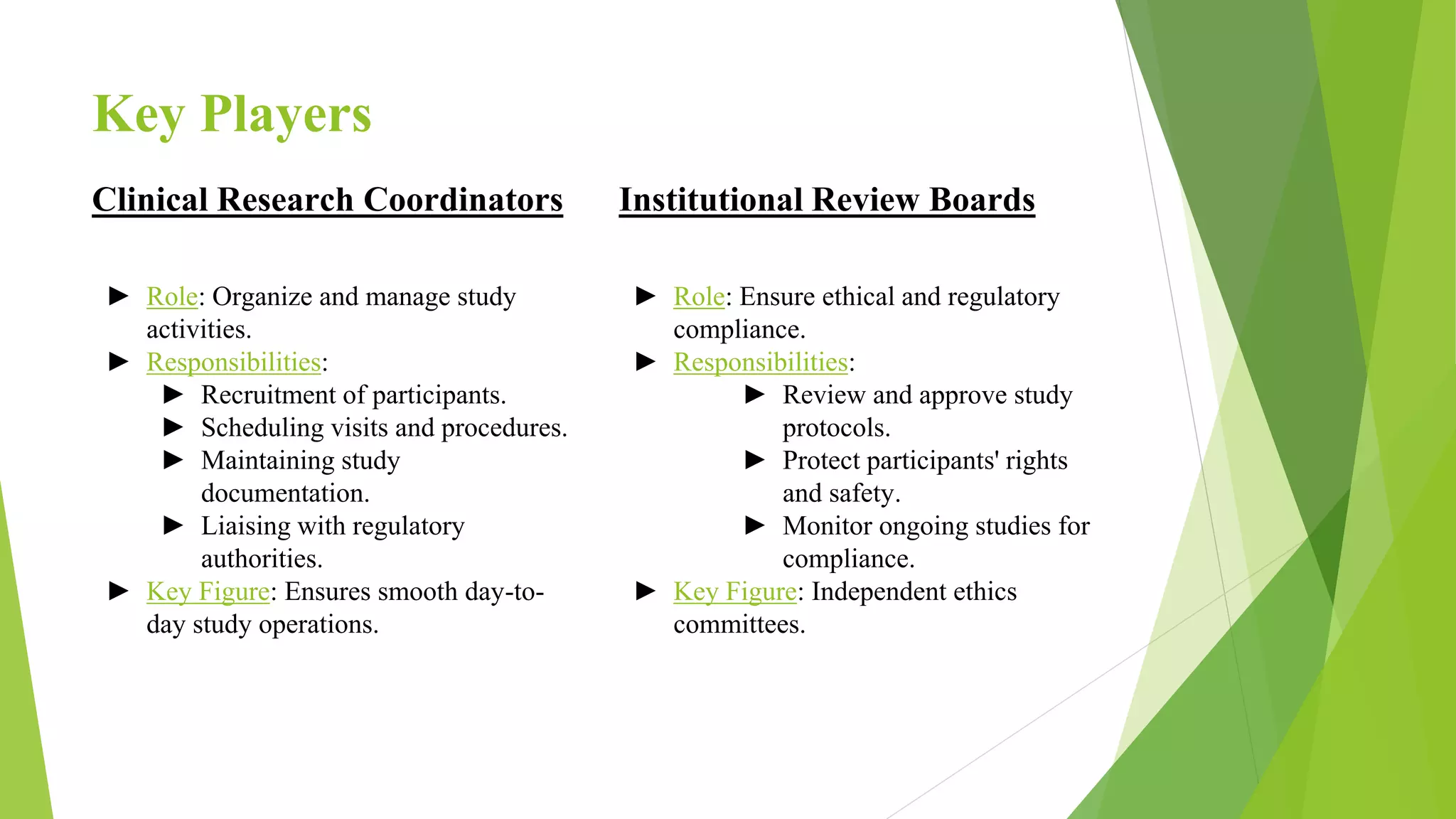
Key Players
► Role: Organize and manage study
activities.
► Responsibilities:
► Recruitment of participants.
► Scheduling visits and procedures.
► Maintaining study
documentation.
► Liaising with regulatory
authorities.
► Key Figure: Ensures smooth day-to-
day study operations.
► Role: Ensure ethical and regulatory
compliance.
► Responsibilities:
► Review and approve study
protocols.
► Protect participants' rights
and safety.
► Monitor ongoing studies for
compliance.
► Key Figure: Independent ethics
committees.
Clinical Research Coordinators Institutional Review Boards
Different stakeholders
in clinical research
► Sponsor
► Contract Research
Organization
► Investigators
► Ethics Committee
► Regulatory Agencies
► Clinical Research Coordinators
► Clinical Research Associates
► Data Manager
► Data Analyst
► Data Entry Operator
► Quality Assurance & Quality
Control Personnel
► Auditor
Documents Needed
► Purpose: To ensure participants
understand the study and
voluntarily agree.
► Content: Study objectives,
procedures, risks, benefits,
participant rights.
► Importance: Protects participant
rights and ensures ethical research.
► Purpose: Provides a structured
plan for the study.
► Content: Study objectives, design,
criteria, endpoints.
► Importance: Ensures consistent
study execution and clear
guidelines.
Informed Consent Forms (ICF) Protocol Documents
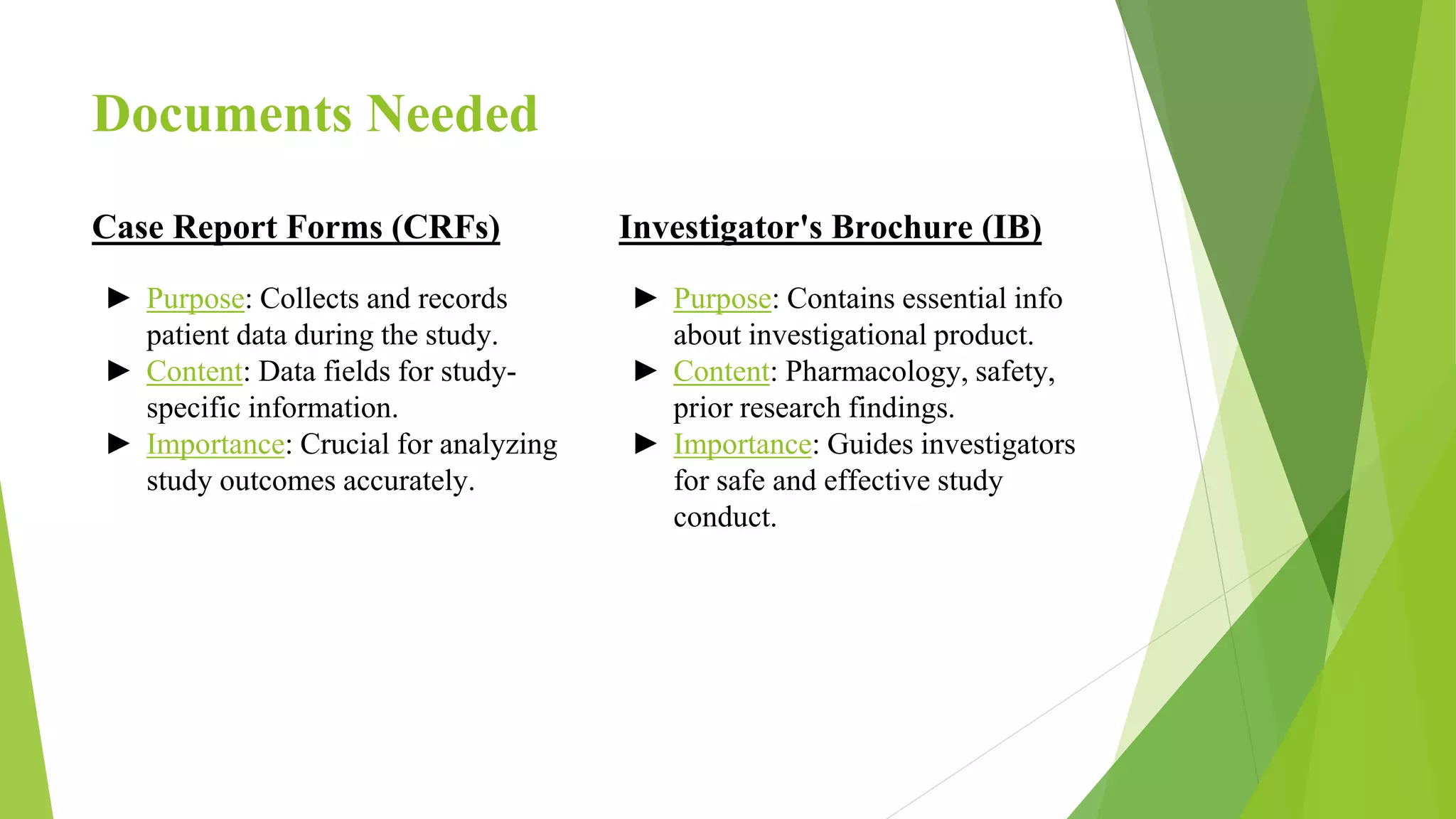
Documents Needed
► Purpose: Collects and records
patient data during the study.
► Content: Data fields for study-
specific information.
► Importance: Crucial for analyzing
study outcomes accurately.
► Purpose: Contains essential info
about investigational product.
► Content: Pharmacology, safety,
prior research findings.
► Importance: Guides investigators
for safe and effective study
conduct.
Case Report Forms (CRFs) Investigator's Brochure (IB)
Informed consent form
► Informed Consent Form: A document that explains a study and gets your
permission before you decide to participate.
► It includes key details of a research study such as its purpose, procedures,
potential risks, and benefits.
► Participants sign the form to indicate their understanding and voluntary
agreement to participate.
► Components of Informed Consent :
► Study Purpose: Clearly state the purpose of the research.
► Procedures: Describe the research procedures participants will undergo.
► Risks and Benefits: Outline potential risks and benefits.
► Voluntary Participation: Emphasize that participation is voluntary.
► Confidentiality: Explain how participant data will be handled.
► Contact Information: Provide researcher contact details for questions or
concerns.
Informed consent form
Informed Consent Process
► Discussion: Researchers must
engage in a meaningful dialogue
with participants.
► Comprehension: Ensure
participants understand the
information provided.
► Voluntary Agreement:
Participants should voluntarily
agree to participate without
coercion.
Ongoing Informed Consent
► Continuous Process: Consent is
not a one-time event; participants
should be informed of any
changes.
► Withdrawal: Participants have the
right to withdraw consent at any
time without consequences.
Data Collection
Methods for Data Collection
► Patient Interviews: Gathering information
directly from participants through structured
interviews.
► Medical Records Review: Extracting data
from patients' medical histories.
► Observational Studies: Observing
participants in real-life settings.
► Laboratory Tests: Collecting biological
samples for analysis.
► Surveys and Questionnaires: Administering
standardized forms to gather specific data.
► Electronic Health Records (EHRs): Utilizing
digital patient records for data extraction.
Tools for Data Collection
► Electronic Data Capture (EDC) Systems:
Streamlining data entry and storage.
► Mobile Apps: Enabling real-time data
input in remote locations.
► Wearable Devices: Monitoring patient
metrics continuously.
► Online Surveys: Efficiently collecting
responses from a geographically dispersed
group.
► Paper-Based Forms: Traditional method
when digital options aren't feasible.
Importance of Data Integrity
► Accurate Results: Ensures that research findings are reliable
and credible.
► Patient Safety: Inaccurate data can lead to incorrect medical
decisions.
► Regulatory Compliance: Maintaining data integrity is
essential for meeting regulatory requirements.
► Scientific Validity: Valid conclusions and contributions to
medical knowledge depend on data integrity.
Regulatory Compliance
Adherence to Guidelines
► Strict adherence to FDA (or
applicable regulatory authority)
guidelines is paramount.
► These guidelines ensure the
safety and ethical conduct of
clinical research.
Ethical Review Boards (ERBs)
► ERBs play a vital role in
participant safety.
► They review and approve
research protocols, ensuring
ethical standards are met.
► ERBs safeguard the rights and
well-being of study participants.
Challenges during research
► Patient Recruitment:
Challenge: Finding suitable participants can be difficult.
Importance: Adequate representation is crucial for study validity.
► Data Quality:
Challenge: Ensuring data accuracy and completeness is a constant effort.
Importance: Reliable data is essential for drawing valid conclusions.
► Regulatory Hurdles:
Challenge: Navigating complex regulations can be time-consuming.
Importance: Compliance is vital to ensure ethical and legal standards.
Benefits
Medical Advancements
► Research drives innovation in
medicine.
► New treatments and therapies
emerge.
► Life-saving drugs and
breakthroughs happen.
Improved Patient Care
► Research enhances the quality of
healthcare.
► Better understanding of diseases.
► Tailored treatments for
individual patients.
Clinical Research AS.pptx

Clinical Research AS.pptx

  • 1.
    Shaping Tomorrow's Medicine: The Roleof Clinical Research ● By Aarshiya S
  • 2.
    Introduction ► Clinical researchis the scientific investigation of new medical treatments and therapies to enhance patient care. ► It involves systematic investigation to understand diseases, treatments, and their impact on patients. ► Clinical research is vital for several reasons: ► Advancing Medical Knowledge: It expands our understanding of diseases, therapies, and medical technologies. ► Improving Patient Care: Findings from clinical research lead to better treatments and care protocols. ► Key Objectives: ► To identify new treatments and therapies. ► To enhance existing medical practices. ► To ensure patient safety and well-being.
  • 3.
    Introduction ► Patient centricapproach : ► Puts patients at the heart of healthcare progress. ► Patient participation shapes future treatments. ► Improves health outcomes through research. ► Collaboration and Innovation: ► Collaborative efforts among healthcare experts. ► Catalyst for medical innovation. ► Ethical Foundations: ► Ethical guidelines protect participant rights. ► Ensure the well-being of those involved. ► Ensures ethical integrity and transparency.
  • 4.
    Clinical Trials &their phases ► Clinical trials are scientific studies of the safety and efficacy of a new medical drug or other treatment, conducted on human volunteers. ► Clinical trials are typically divided into four phases, each serving a specific purpose in the development process. ► Clinical trials consist of four main phases : ► Phase 1 ► Phase 2 ► Phase 3 ► Phase 4 ► Clinical trials progress through four phases, from initial safety assessment in Phase 1 to large-scale testing in Phase 3, and finally, ongoing monitoring in Phase 4.
  • 5.
    Phase 1: EarlySafety Evaluation ► Objectives: Assess safety, dosage and side effects. ► Small Group: Involves a small number of healthy volunteers or patients (typically 20-80). For cytotoxic candidates(eg-anti cancer drugs),the phase 1 trials are conducted on patients) ► Duration: Several months. ► Outcomes: Identifies the maximum tolerated dose and initial safety profile.
  • 6.
    Phase 2: Efficacyand Side Effects ► Objectives: Evaluate effectiveness and further assess safety. ► Larger Group: Enrolls a larger group of patients (around 100-300). ► Duration: Several months to two years. ► Outcomes: Determines the drug's effectiveness, dosage and side effects.
  • 7.
    Phase 3: Large-ScaleTesting ► Objectives: Confirm effectiveness, monitor side effects and compare to existing treatments. ► Large-Scale: Involves a much larger patient population (often thousands). ► Duration: Several years. ► Outcomes: Provides robust data on safety and efficacy for regulatory approval.
  • 8.
    Phase 4: Post-MarketSurveillance ► Objectives: Monitor long-term safety, efficacy, and less common side effects. ► After Approval: Conducted after regulatory approval and market release. ► Duration: Ongoing for as long as the drug or treatment is in use. ► Outcomes: Continuously assesses the treatment's real-world performance.
  • 10.
    Key Players ► Role:Lead the research study. ► Responsibilities: ► Designing the study protocol. ► Ensuring patient safety and care. ► Collecting and analyzing data. ► Interpreting results. ► Key Figure: Often a medical doctor or principal investigator. ► Role: Ensure regulatory compliance. ► Responsibilities: ► Conduct site visits for quality assurance. ► Verify data accuracy and participant safety. ► Ensure adherence to study protocols. ► Collaborate with investigators and coordinators. ► Key Figure: Represents the sponsor or regulatory agency. Clinical investigators Clinical Research Associates
  • 11.
    Key Players ► Role:Organize and manage study activities. ► Responsibilities: ► Recruitment of participants. ► Scheduling visits and procedures. ► Maintaining study documentation. ► Liaising with regulatory authorities. ► Key Figure: Ensures smooth day-to- day study operations. ► Role: Ensure ethical and regulatory compliance. ► Responsibilities: ► Review and approve study protocols. ► Protect participants' rights and safety. ► Monitor ongoing studies for compliance. ► Key Figure: Independent ethics committees. Clinical Research Coordinators Institutional Review Boards
  • 12.
    Different stakeholders in clinicalresearch ► Sponsor ► Contract Research Organization ► Investigators ► Ethics Committee ► Regulatory Agencies ► Clinical Research Coordinators ► Clinical Research Associates ► Data Manager ► Data Analyst ► Data Entry Operator ► Quality Assurance & Quality Control Personnel ► Auditor
  • 13.
    Documents Needed ► Purpose:To ensure participants understand the study and voluntarily agree. ► Content: Study objectives, procedures, risks, benefits, participant rights. ► Importance: Protects participant rights and ensures ethical research. ► Purpose: Provides a structured plan for the study. ► Content: Study objectives, design, criteria, endpoints. ► Importance: Ensures consistent study execution and clear guidelines. Informed Consent Forms (ICF) Protocol Documents
  • 14.
    Documents Needed ► Purpose:Collects and records patient data during the study. ► Content: Data fields for study- specific information. ► Importance: Crucial for analyzing study outcomes accurately. ► Purpose: Contains essential info about investigational product. ► Content: Pharmacology, safety, prior research findings. ► Importance: Guides investigators for safe and effective study conduct. Case Report Forms (CRFs) Investigator's Brochure (IB)
  • 15.
    Informed consent form ►Informed Consent Form: A document that explains a study and gets your permission before you decide to participate. ► It includes key details of a research study such as its purpose, procedures, potential risks, and benefits. ► Participants sign the form to indicate their understanding and voluntary agreement to participate. ► Components of Informed Consent : ► Study Purpose: Clearly state the purpose of the research. ► Procedures: Describe the research procedures participants will undergo. ► Risks and Benefits: Outline potential risks and benefits. ► Voluntary Participation: Emphasize that participation is voluntary. ► Confidentiality: Explain how participant data will be handled. ► Contact Information: Provide researcher contact details for questions or concerns.
  • 16.
    Informed consent form InformedConsent Process ► Discussion: Researchers must engage in a meaningful dialogue with participants. ► Comprehension: Ensure participants understand the information provided. ► Voluntary Agreement: Participants should voluntarily agree to participate without coercion. Ongoing Informed Consent ► Continuous Process: Consent is not a one-time event; participants should be informed of any changes. ► Withdrawal: Participants have the right to withdraw consent at any time without consequences.
  • 17.
    Data Collection Methods forData Collection ► Patient Interviews: Gathering information directly from participants through structured interviews. ► Medical Records Review: Extracting data from patients' medical histories. ► Observational Studies: Observing participants in real-life settings. ► Laboratory Tests: Collecting biological samples for analysis. ► Surveys and Questionnaires: Administering standardized forms to gather specific data. ► Electronic Health Records (EHRs): Utilizing digital patient records for data extraction. Tools for Data Collection ► Electronic Data Capture (EDC) Systems: Streamlining data entry and storage. ► Mobile Apps: Enabling real-time data input in remote locations. ► Wearable Devices: Monitoring patient metrics continuously. ► Online Surveys: Efficiently collecting responses from a geographically dispersed group. ► Paper-Based Forms: Traditional method when digital options aren't feasible.
  • 18.
    Importance of DataIntegrity ► Accurate Results: Ensures that research findings are reliable and credible. ► Patient Safety: Inaccurate data can lead to incorrect medical decisions. ► Regulatory Compliance: Maintaining data integrity is essential for meeting regulatory requirements. ► Scientific Validity: Valid conclusions and contributions to medical knowledge depend on data integrity.
  • 19.
    Regulatory Compliance Adherence toGuidelines ► Strict adherence to FDA (or applicable regulatory authority) guidelines is paramount. ► These guidelines ensure the safety and ethical conduct of clinical research. Ethical Review Boards (ERBs) ► ERBs play a vital role in participant safety. ► They review and approve research protocols, ensuring ethical standards are met. ► ERBs safeguard the rights and well-being of study participants.
  • 20.
    Challenges during research ►Patient Recruitment: Challenge: Finding suitable participants can be difficult. Importance: Adequate representation is crucial for study validity. ► Data Quality: Challenge: Ensuring data accuracy and completeness is a constant effort. Importance: Reliable data is essential for drawing valid conclusions. ► Regulatory Hurdles: Challenge: Navigating complex regulations can be time-consuming. Importance: Compliance is vital to ensure ethical and legal standards.
  • 21.
    Benefits Medical Advancements ► Researchdrives innovation in medicine. ► New treatments and therapies emerge. ► Life-saving drugs and breakthroughs happen. Improved Patient Care ► Research enhances the quality of healthcare. ► Better understanding of diseases. ► Tailored treatments for individual patients.