PRESENTATION
ON
DEVELOPING CLINICAL TRIAL
PROTOCOL
Presented By:
Alisha Bansal
M.Pharm(pharmaceutics)
1st year
INTRODUCTION
• Every clinical investigation begins with the
development of a clinical protocol.
• The protocol is a document that describes how a
clinical trial will be conducted (the objective(s),
design, methodology, statistical considerations
and organization of a clinical trial,) and ensures
the safety of the trial subjects and integrity of the
data collected.
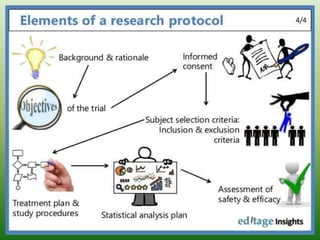
• A Research Protocol is a document that describes
the background, rationale, objectives, design,
methodology, statistical considerations, and
organization of a clinical research project.
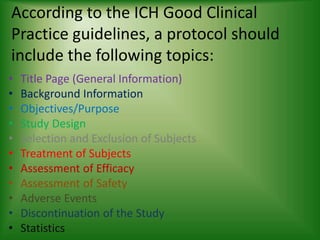
According to the ICH Good Clinical
Practice guidelines, a protocol should
include the following topics:
• Title Page (General Information)
• Background Information
• Objectives/Purpose
• Study Design
• Selection and Exclusion of Subjects
• Treatment of Subjects
• Assessment of Efficacy
• Assessment of Safety
• Adverse Events
• Discontinuation of the Study
• Statistics
Contd….
• Quality Control and Assurance
• Ethics
• Data handling and Recordkeeping
• Publication Policy
• Project Timetable/Flowchart
• References
• Supplements/Appendices
The NIH provides many resources for protocol
development to assist investigators in writing
and developing clinical research protocols that
are in compliance with regulatory/GCP
requirements. Some NIH institutes have a
mandatory requirement for using their protocol
template.
NIH: National Institutes Of Health
GENERAL INFORMATION
• Details of the protocol: Protocol title, protocol
identifying number, date, and any amendment(s).
• Details of the sponsor, investigator(s), and sponsor’s
medical expert.
• Details of the person(s) authorized to sign the
protocol.
• Details of the qualified physician who is responsible
for trial-site related medical decision (if other than
investigator).
• Details of the clinical laboratories and other medical
and technical departments and/or institutions involved
in the trial.
BACKGROUND INFORMATION
• Name and description of the investigational product(s).
• A summary of findings from nonclinical studies that potentially
have clinical significance and from clinical trials that are relevant
to the trial.
• Summary of the known and potential risks and benefits, if any,
to human subjects.
• Description of and justification for the route of administration,
dosage, dosage regimen, and treatment period(s).
• A statement that the trial will be conducted in compliance with
the protocol, GCP and the applicable regulatory requirement(s).
• Description of the population to be studied.
• References to literature and data that are relevant to the trial,
and that provide background for the trial.
OBJECTIVES/PURPOSE
• Provides detailed description of primary and
secondary objectives, and describe any other
assessments that will be performed in this study.
• The objectives-’to describe’, to measure, to
compare, to estimate: efficacy, safety,
immunogenicity, pharmacokinetics, dose
response, etc.
• Include the name(s) of the study drug(s), doses
or dose range to be studied, etc.
STUDY DESIGN AND END POINTS
• Description of the type/design of trial to be
conducted and a schematic diagram of trial
design, procedure, and stages.
• End-points of the study
• Measures taken to minimize or avoid bias.
• Description of the trial treatment(s)
• Duration of the participation.
• Discontinuation criteria.
STUDY DESIGN
• Parts of the study design section may include:
– Initial evaluation
– Screening tests
– Required lab tests
– Details of treatment or procedures
– Device specifications
– Dose scheduling and modifications
STUDY PROCEDURES AND SCHEDULE
• Name of the product to be used
• Dose and dosing schedule
• Route of administration
• Treatment period
• Medications/treatments permitted(including
rescue medication) and not permitted before
and/or during the trial
• Procedures for monitoring subject compliance
TRIAL DESIGN
• The scientific integrity of the trial and the credibility of the
data from the trial depend substantially on the trial design.
A description of the trial design, should include:
• A specific statement of the primary endpoints and the
secondary endpoints, if any, to be measured during the
trial.
• A description of the type/design of trial to be conducted
(e.g. double-blind, placebo-controlled, parallel design) and
a schematic diagram of trial design, procedures and stages.
• A description of the measures taken to minimize/avoid
bias, including: (a) Randomization. (b) Blinding.
• A description of the trial treatment(s) and the dosage and
dosage regimen of the investigational product(s). Also
include a description of the dosage form, packaging, and
labelling of the investigational product(s).
Contd…
• The expected duration of subject participation, and a
description of the sequence and duration of all trial
periods, including follow-up, if any.
• A description of the “stopping rules” or
“discontinuation criteria” for individual subjects, parts of
trial and entire trial.
• Accountability procedures for the investigational
product(s), including the placebo(s) and comparator(s),
if any.
• Maintenance of trial treatment randomization codes
and procedures for breaking codes.
• The identification of any data to be recorded directly on
the CRFs (i.e. no prior written or electronic record of
data), and to be considered to be source data.
ELIGIBILITY CRITERIA
• Inclusion and exclusion criteria are the
conditions that must be met in order to
participate in a clinical trial.
• The most important criteria used to determine
appropriates for clinical trial participation include
age, sex, the type and stage of a disease,
treatment history, and other medical conditions.
INCLUSION CRITERIA( EXAMPLE)
• 22 years of age or older
• Able to undergo the informed consent/assent
process
• Medically stable in the judgement of the
principal investigator
• Greater than 1 year since initial injury
• Willing to attend all scheduled appointments
EXCLUSION CRITERIA (EXAMPLE)
• All the mentally retarded and unconscious
patients
• Drugs addicts
• Patients unable to comply
WITHDRAWAL OF SUBJECTS
• Withdrawal criteria along with procedures
specifying:
– When and how to withdraw subjects from the
trial/investigational product treatment
– Type and timing of the data to be collected for
withdrawn subjects
– Whether and how subjects are to be replaced
– follow-up for subjects withdrawn from investigational
product treatment
TREATMENT OF SUBJECTS
• The treatment(s) to be administered, including the
name(s) of all the product(s), the dose(s), the
dosing schedule(s), the route/mode(s) of
administration, and the treatment period(s),
including the follow-up period(s) for subjects for
each investigational product treatment/trial
treatment group/arm of the trial.
• Medication(s)/treatment(s) permitted (including
rescue medication) and not permitted before
and/or during the trial.
• Procedures for monitoring subject compliance.
ASSESSMENT OF EFFICACY AND
SAFETY
• Specifications of efficacy and safety
parameters
• Methods and timings for assessing, recording,
and analyzing these parameters
• For safety:
– Procedures for eliciting reports of and for
recording and reporting adverse events
– Type and duration of the follow-up subjects after
adverse events
SAFETY
• Adverse effect and side effect are terms
commonly associated with drugs.
• They are used by nurses and doctors, to refer
to undesirable effects of a medication on a
patient.
• The safety (or adverse events)section should
include:
– Detailed information for reporting adverse events,
including reporting to the FDA and/or the sponsor
– Unblinding process
– Lists of expected adverse events.
STATISTICS
• A description of the statistical methods to be employed, including
timing of any planned interim analysis.
• The number of subjects planned to be enrolled. In multicentre
trials, the numbers of enrolled subjects projected for each trial site
should be specified. Reason for choice of sample size, including
reflections on (or calculations of) the power of the trial and clinical
justification.
• The level of significance to be used.
• Criteria for the termination of the trial.
• Procedure for accounting for missing, unused, and spurious data.
• Procedures for reporting any deviation(s) from the original
statistical plan (any deviation(s) from the original statistical plan
should be described and justified in protocol and/or in the final
report, as appropriate).
• The selection of subjects to be included in the analyses (e.g. all
randomized subjects, all dosed subjects, all eligible subjects,
evaluable subjects).
INFORMED CONSENT
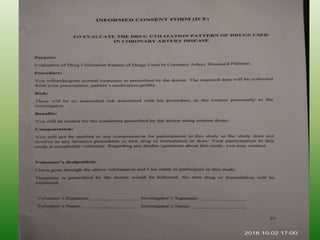
• Conventionally informed consent is thought to be
in terms of the documents signed and dated by
participants, setting forth the purpose, benefits,
risks and other study information necessary to
allow the participants to make an informed and
voluntary decision to participate in the clinical
study.
• Informed consent is an ethical and legal
requirement for research involving human
participants.
INFORMED CONSENT
• For a drug to get approved and enter into the market it
has to prove its safety and efficacy in clinical trials. As no
individual has right to infract fundamental rights of
another person for the sake of fulfilling his own purpose,
so an important tool called “informed consent” came
into existence.
• The informed consent is described in ethical codes and
regulations for human subject's research.
• The goal of the informed consent process is to provide
sufficient information to a potential participant, in a
language which is easily understood by him/her, so that
he/she can make the voluntary decision regarding “to”
or “not to” participate in the research study.
INFORMED CONSENT
• It is the process where a participant is informed about all aspects
of the trial, which are important for the participant to make a
decision and after studying all aspects of the trial the participant
voluntarily confirms his or her willingness to participate in a
particular clinical trial and significance of the research for
advancement of medical knowledge and social welfare.
• Informed consent is an inevitable requirement prior to every
research involving human being as subjects for study.
• Obtaining consent involves informing the subject about his or her
rights, the purpose of the study, procedures to be undertaken,
potential risks and benefits of participation, expected duration of
study, extent of confidentiality of personal identification and
demographic data, so that the participation of subjects in the
study is entirely voluntary.
Protocol development

Protocol development

  • 1.
    PRESENTATION ON DEVELOPING CLINICAL TRIAL PROTOCOL PresentedBy: Alisha Bansal M.Pharm(pharmaceutics) 1st year
  • 3.
    INTRODUCTION • Every clinicalinvestigation begins with the development of a clinical protocol. • The protocol is a document that describes how a clinical trial will be conducted (the objective(s), design, methodology, statistical considerations and organization of a clinical trial,) and ensures the safety of the trial subjects and integrity of the data collected. • A Research Protocol is a document that describes the background, rationale, objectives, design, methodology, statistical considerations, and organization of a clinical research project.
  • 4.
    According to theICH Good Clinical Practice guidelines, a protocol should include the following topics: • Title Page (General Information) • Background Information • Objectives/Purpose • Study Design • Selection and Exclusion of Subjects • Treatment of Subjects • Assessment of Efficacy • Assessment of Safety • Adverse Events • Discontinuation of the Study • Statistics
  • 5.
    Contd…. • Quality Controland Assurance • Ethics • Data handling and Recordkeeping • Publication Policy • Project Timetable/Flowchart • References • Supplements/Appendices
  • 7.
    The NIH providesmany resources for protocol development to assist investigators in writing and developing clinical research protocols that are in compliance with regulatory/GCP requirements. Some NIH institutes have a mandatory requirement for using their protocol template. NIH: National Institutes Of Health
  • 9.
    GENERAL INFORMATION • Detailsof the protocol: Protocol title, protocol identifying number, date, and any amendment(s). • Details of the sponsor, investigator(s), and sponsor’s medical expert. • Details of the person(s) authorized to sign the protocol. • Details of the qualified physician who is responsible for trial-site related medical decision (if other than investigator). • Details of the clinical laboratories and other medical and technical departments and/or institutions involved in the trial.
  • 10.
    BACKGROUND INFORMATION • Nameand description of the investigational product(s). • A summary of findings from nonclinical studies that potentially have clinical significance and from clinical trials that are relevant to the trial. • Summary of the known and potential risks and benefits, if any, to human subjects. • Description of and justification for the route of administration, dosage, dosage regimen, and treatment period(s). • A statement that the trial will be conducted in compliance with the protocol, GCP and the applicable regulatory requirement(s). • Description of the population to be studied. • References to literature and data that are relevant to the trial, and that provide background for the trial.
  • 11.
    OBJECTIVES/PURPOSE • Provides detaileddescription of primary and secondary objectives, and describe any other assessments that will be performed in this study. • The objectives-’to describe’, to measure, to compare, to estimate: efficacy, safety, immunogenicity, pharmacokinetics, dose response, etc. • Include the name(s) of the study drug(s), doses or dose range to be studied, etc.
  • 12.
    STUDY DESIGN ANDEND POINTS • Description of the type/design of trial to be conducted and a schematic diagram of trial design, procedure, and stages. • End-points of the study • Measures taken to minimize or avoid bias. • Description of the trial treatment(s) • Duration of the participation. • Discontinuation criteria.
  • 13.
    STUDY DESIGN • Partsof the study design section may include: – Initial evaluation – Screening tests – Required lab tests – Details of treatment or procedures – Device specifications – Dose scheduling and modifications
  • 14.
    STUDY PROCEDURES ANDSCHEDULE • Name of the product to be used • Dose and dosing schedule • Route of administration • Treatment period • Medications/treatments permitted(including rescue medication) and not permitted before and/or during the trial • Procedures for monitoring subject compliance
  • 15.
    TRIAL DESIGN • Thescientific integrity of the trial and the credibility of the data from the trial depend substantially on the trial design. A description of the trial design, should include: • A specific statement of the primary endpoints and the secondary endpoints, if any, to be measured during the trial. • A description of the type/design of trial to be conducted (e.g. double-blind, placebo-controlled, parallel design) and a schematic diagram of trial design, procedures and stages. • A description of the measures taken to minimize/avoid bias, including: (a) Randomization. (b) Blinding. • A description of the trial treatment(s) and the dosage and dosage regimen of the investigational product(s). Also include a description of the dosage form, packaging, and labelling of the investigational product(s).
  • 16.
    Contd… • The expectedduration of subject participation, and a description of the sequence and duration of all trial periods, including follow-up, if any. • A description of the “stopping rules” or “discontinuation criteria” for individual subjects, parts of trial and entire trial. • Accountability procedures for the investigational product(s), including the placebo(s) and comparator(s), if any. • Maintenance of trial treatment randomization codes and procedures for breaking codes. • The identification of any data to be recorded directly on the CRFs (i.e. no prior written or electronic record of data), and to be considered to be source data.
  • 17.
    ELIGIBILITY CRITERIA • Inclusionand exclusion criteria are the conditions that must be met in order to participate in a clinical trial. • The most important criteria used to determine appropriates for clinical trial participation include age, sex, the type and stage of a disease, treatment history, and other medical conditions.
  • 18.
    INCLUSION CRITERIA( EXAMPLE) •22 years of age or older • Able to undergo the informed consent/assent process • Medically stable in the judgement of the principal investigator • Greater than 1 year since initial injury • Willing to attend all scheduled appointments
  • 19.
    EXCLUSION CRITERIA (EXAMPLE) •All the mentally retarded and unconscious patients • Drugs addicts • Patients unable to comply
  • 20.
    WITHDRAWAL OF SUBJECTS •Withdrawal criteria along with procedures specifying: – When and how to withdraw subjects from the trial/investigational product treatment – Type and timing of the data to be collected for withdrawn subjects – Whether and how subjects are to be replaced – follow-up for subjects withdrawn from investigational product treatment
  • 21.
    TREATMENT OF SUBJECTS •The treatment(s) to be administered, including the name(s) of all the product(s), the dose(s), the dosing schedule(s), the route/mode(s) of administration, and the treatment period(s), including the follow-up period(s) for subjects for each investigational product treatment/trial treatment group/arm of the trial. • Medication(s)/treatment(s) permitted (including rescue medication) and not permitted before and/or during the trial. • Procedures for monitoring subject compliance.
  • 22.
    ASSESSMENT OF EFFICACYAND SAFETY • Specifications of efficacy and safety parameters • Methods and timings for assessing, recording, and analyzing these parameters • For safety: – Procedures for eliciting reports of and for recording and reporting adverse events – Type and duration of the follow-up subjects after adverse events
  • 23.
    SAFETY • Adverse effectand side effect are terms commonly associated with drugs. • They are used by nurses and doctors, to refer to undesirable effects of a medication on a patient. • The safety (or adverse events)section should include: – Detailed information for reporting adverse events, including reporting to the FDA and/or the sponsor – Unblinding process – Lists of expected adverse events.
  • 24.
    STATISTICS • A descriptionof the statistical methods to be employed, including timing of any planned interim analysis. • The number of subjects planned to be enrolled. In multicentre trials, the numbers of enrolled subjects projected for each trial site should be specified. Reason for choice of sample size, including reflections on (or calculations of) the power of the trial and clinical justification. • The level of significance to be used. • Criteria for the termination of the trial. • Procedure for accounting for missing, unused, and spurious data. • Procedures for reporting any deviation(s) from the original statistical plan (any deviation(s) from the original statistical plan should be described and justified in protocol and/or in the final report, as appropriate). • The selection of subjects to be included in the analyses (e.g. all randomized subjects, all dosed subjects, all eligible subjects, evaluable subjects).
  • 25.
    INFORMED CONSENT • Conventionallyinformed consent is thought to be in terms of the documents signed and dated by participants, setting forth the purpose, benefits, risks and other study information necessary to allow the participants to make an informed and voluntary decision to participate in the clinical study. • Informed consent is an ethical and legal requirement for research involving human participants.
  • 26.
    INFORMED CONSENT • Fora drug to get approved and enter into the market it has to prove its safety and efficacy in clinical trials. As no individual has right to infract fundamental rights of another person for the sake of fulfilling his own purpose, so an important tool called “informed consent” came into existence. • The informed consent is described in ethical codes and regulations for human subject's research. • The goal of the informed consent process is to provide sufficient information to a potential participant, in a language which is easily understood by him/her, so that he/she can make the voluntary decision regarding “to” or “not to” participate in the research study.
  • 27.
    INFORMED CONSENT • Itis the process where a participant is informed about all aspects of the trial, which are important for the participant to make a decision and after studying all aspects of the trial the participant voluntarily confirms his or her willingness to participate in a particular clinical trial and significance of the research for advancement of medical knowledge and social welfare. • Informed consent is an inevitable requirement prior to every research involving human being as subjects for study. • Obtaining consent involves informing the subject about his or her rights, the purpose of the study, procedures to be undertaken, potential risks and benefits of participation, expected duration of study, extent of confidentiality of personal identification and demographic data, so that the participation of subjects in the study is entirely voluntary.