Name:Amanda Meyers Patient Initials: H.T.         Date: 11/10/2011

                                CLINICAL PREPARATION WORKSHEET

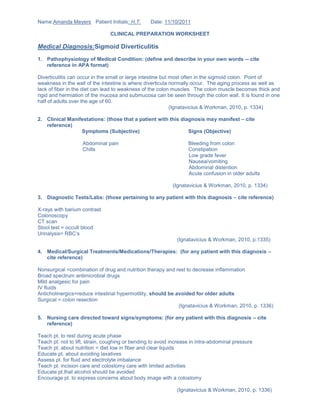
Medical Diagnosis:Sigmoid Diverticulitis
1. Pathophysiology of Medical Condition: (define and describe in your own words -- cite
   reference in APA format)

Diverticulitis can occur in the small or large intestine but most often in the sigmoid colon. Point of
weakness in the wall of the intestine is where diverticula normally occur. The aging process as well as
lack of fiber in the diet can lead to weakness of the colon muscles. The colon muscle becomes thick and
rigid and hermiation of the mucosa and submucosa can be seen through the colon wall. It is found in one
half of adults over the age of 60.
                                                             (Ignatavicius & Workman, 2010, p. 1334)

2. Clinical Manifestations: (those that a patient with this diagnosis may manifest – cite
   reference)
                 Symptoms (Subjective)                         Signs (Objective)

                    Abdominal pain                                 Bleeding from colon
                    Chills                                         Constipation
                                                                   Low grade fever
                                                                   Nausea/vomiting
                                                                   Abdominal distention
                                                                   Acute confusion in older adults

                                                            (Ignatavicius & Workman, 2010, p. 1334)

3. Diagnostic Tests/Labs: (those pertaining to any patient with this diagnosis – cite reference)

X-rays with barium contrast
Colonoscopy
CT scan
Stool test = occult blood
Urinalysis= RBC’s
                                                              (Ignatavicius & Workman, 2010, p.1335)

4. Medical/Surgical Treatments/Medications/Therapies: (for any patient with this diagnosis –
   cite reference)

Nonsurgical =combination of drug and nutrition therapy and rest to decrease inflammation
Broad spectrum antimicrobial drugs
Mild analgesic for pain
IV fluids
Anticholinergics=reduce intestinal hypermotility, should be avoided for older adults
Surgical = colon resection
                                                             (Ignatavicius & Workman, 2010, p. 1336)

5. Nursing care directed toward signs/symptoms: (for any patient with this diagnosis – cite
   reference)

Teach pt. to rest during acute phase
Teach pt. not to lift, strain, coughing or bending to avoid increase in intra-abdominal pressure
Teach pt. about nutrition = diet low in fiber and clear liquids
Educate pt. about avoiding laxatives
Assess pt. for fluid and electrolyte imbalance
Teach pt. incision care and colostomy care with limited activities
Educate pt.that alcohol should be avoided
Encourage pt. to express concerns about body image with a colostomy

                                                              (Ignatavicius & Workman, 2010, p. 1336)
Name:Amanda Meyers Patient Initials: H.T. Date: 11/10/2011

                       CLINICAL PREPARATION WORKSHEET


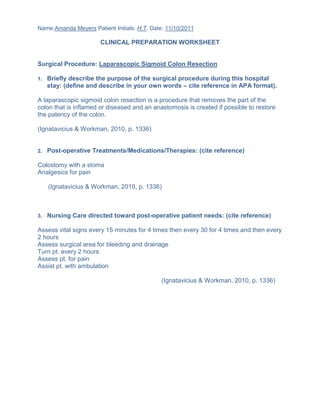
Surgical Procedure: Laparascopic Sigmoid Colon Resection

1.   Briefly describe the purpose of the surgical procedure during this hospital
     stay: (define and describe in your own words – cite reference in APA format).

A laparascopic sigmoid colon resection is a procedure that removes the part of the
colon that is inflamed or diseased and an anastomosis is created if possible to restore
the patency of the colon.

(Ignatavicius & Workman, 2010, p. 1336)


2.   Post-operative Treatments/Medications/Therapies: (cite reference)

Colostomy with a stoma
Analgesics for pain

     (Ignatavicius & Workman, 2010, p. 1336)


3.   Nursing Care directed toward post-operative patient needs: (cite reference)

Assess vital signs every 15 minutes for 4 times then every 30 for 4 times and then every
2 hours
Assess surgical area for bleeding and drainage
Turn pt. every 2 hours
Assess pt. for pain
Assist pt. with ambulation

                                             (Ignatavicius & Workman, 2010, p. 1336)

clinical prep diverticulitis

  • 1.
    Name:Amanda Meyers PatientInitials: H.T. Date: 11/10/2011 CLINICAL PREPARATION WORKSHEET Medical Diagnosis:Sigmoid Diverticulitis 1. Pathophysiology of Medical Condition: (define and describe in your own words -- cite reference in APA format) Diverticulitis can occur in the small or large intestine but most often in the sigmoid colon. Point of weakness in the wall of the intestine is where diverticula normally occur. The aging process as well as lack of fiber in the diet can lead to weakness of the colon muscles. The colon muscle becomes thick and rigid and hermiation of the mucosa and submucosa can be seen through the colon wall. It is found in one half of adults over the age of 60. (Ignatavicius & Workman, 2010, p. 1334) 2. Clinical Manifestations: (those that a patient with this diagnosis may manifest – cite reference) Symptoms (Subjective) Signs (Objective) Abdominal pain Bleeding from colon Chills Constipation Low grade fever Nausea/vomiting Abdominal distention Acute confusion in older adults (Ignatavicius & Workman, 2010, p. 1334) 3. Diagnostic Tests/Labs: (those pertaining to any patient with this diagnosis – cite reference) X-rays with barium contrast Colonoscopy CT scan Stool test = occult blood Urinalysis= RBC’s (Ignatavicius & Workman, 2010, p.1335) 4. Medical/Surgical Treatments/Medications/Therapies: (for any patient with this diagnosis – cite reference) Nonsurgical =combination of drug and nutrition therapy and rest to decrease inflammation Broad spectrum antimicrobial drugs Mild analgesic for pain IV fluids Anticholinergics=reduce intestinal hypermotility, should be avoided for older adults Surgical = colon resection (Ignatavicius & Workman, 2010, p. 1336) 5. Nursing care directed toward signs/symptoms: (for any patient with this diagnosis – cite reference) Teach pt. to rest during acute phase Teach pt. not to lift, strain, coughing or bending to avoid increase in intra-abdominal pressure Teach pt. about nutrition = diet low in fiber and clear liquids Educate pt. about avoiding laxatives Assess pt. for fluid and electrolyte imbalance Teach pt. incision care and colostomy care with limited activities Educate pt.that alcohol should be avoided Encourage pt. to express concerns about body image with a colostomy (Ignatavicius & Workman, 2010, p. 1336)
  • 2.
    Name:Amanda Meyers PatientInitials: H.T. Date: 11/10/2011 CLINICAL PREPARATION WORKSHEET Surgical Procedure: Laparascopic Sigmoid Colon Resection 1. Briefly describe the purpose of the surgical procedure during this hospital stay: (define and describe in your own words – cite reference in APA format). A laparascopic sigmoid colon resection is a procedure that removes the part of the colon that is inflamed or diseased and an anastomosis is created if possible to restore the patency of the colon. (Ignatavicius & Workman, 2010, p. 1336) 2. Post-operative Treatments/Medications/Therapies: (cite reference) Colostomy with a stoma Analgesics for pain (Ignatavicius & Workman, 2010, p. 1336) 3. Nursing Care directed toward post-operative patient needs: (cite reference) Assess vital signs every 15 minutes for 4 times then every 30 for 4 times and then every 2 hours Assess surgical area for bleeding and drainage Turn pt. every 2 hours Assess pt. for pain Assist pt. with ambulation (Ignatavicius & Workman, 2010, p. 1336)