chapter 64

Drugs Used in Oncologic Disorders
         Objectives
         AFTER STUDYING THIS CHAPTER, THE STUDENT WILL BE ABLE TO:

           1. Contrast normal and malignant cells.                   5. Describe pharmacologic and nonpharmacologic
           2. Describe major types of antineoplastic drugs              interventions to prevent or minimize adverse
              in terms of mechanism of action, indications              drug effects.
              for use, administration, and nursing process           6. Promote reduction of risk factors for develop-
              implications.                                             ment of cancer and early recognition of cancer
           3. Discuss the rationales for using chemotherapeu-           signs and symptoms.
              tic drugs in combination with each other, with         7. Manage or assist clients/caregivers in manag-
              surgical treatment, and with radiation therapy.           ing symptoms associated with chemotherapy
           4. Discuss common and potentially serious                    regimens.
              adverse drug effects.


         Critical Thinking Scenario
         Georgia Sommers, a 39 year-old mother of 4, is diagnosed with breast cancer that was detected by routine
         mammography. She is recovering from a modified radical mastectomy when she comes to the clinic to dis-
         cuss additional treatment with chemotherapy with the oncologist. He explains that she will receive combina-
         tion therapy with three drugs on a cycle of every 4 weeks.

         Reflect on:
           Possible reactions of Ms. Sommers to a diagnosis of cancer. What is the role of the nurse during the
           period of initial diagnosis?
           How will you assess Ms. Sommers concerns regarding chemotherapy?
           What are the benefits of combination (using more than one drug) therapy?
           What impact do you think chemotherapy might have on Ms. Sommers’ ability to function normally and
           meet normal demands of life?


    OVERVIEW                                                         met. The normal cell cycle is the interval between the “birth”
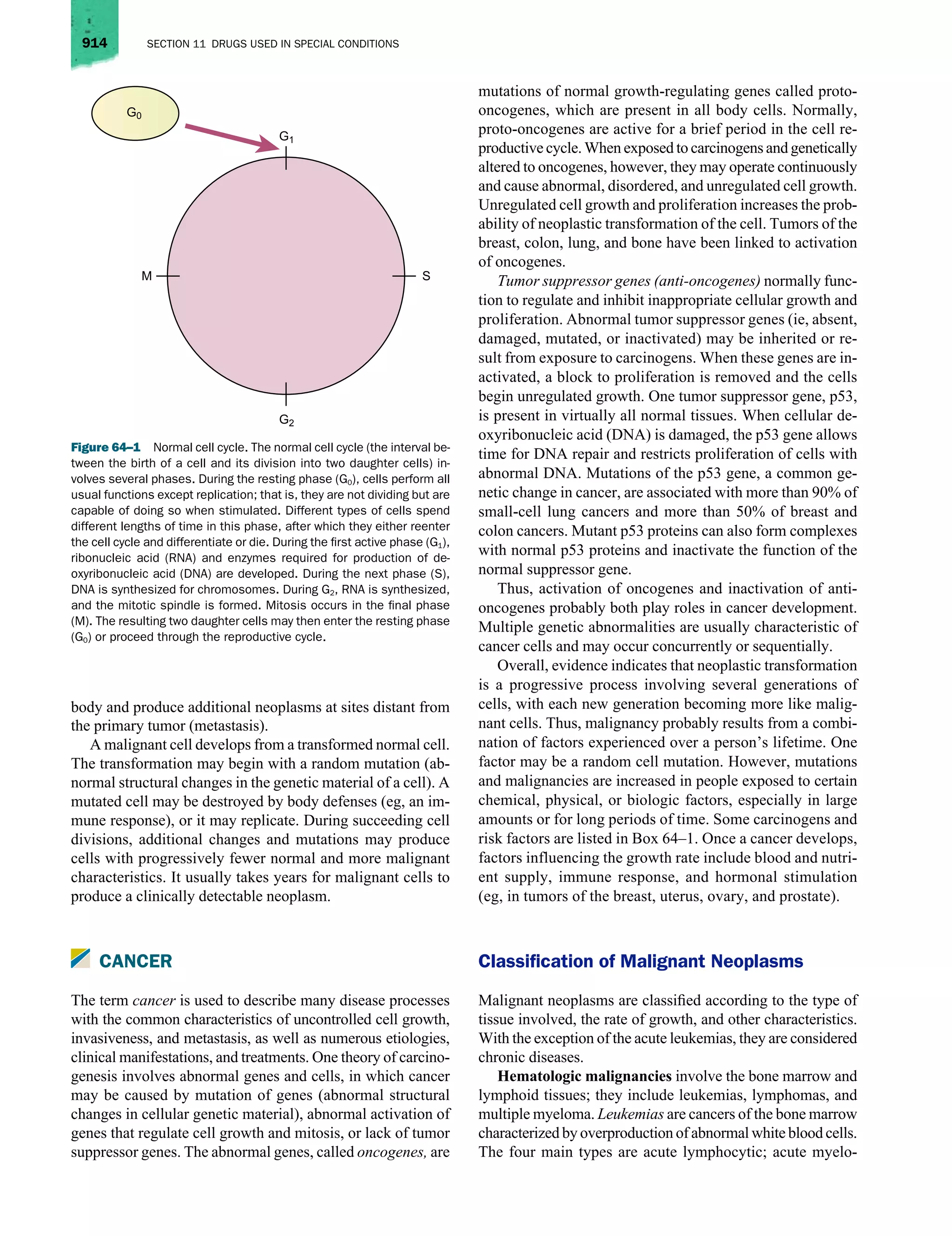
                                                                     of a cell and its division into two daughter cells (Fig. 64–1).
Oncology is the study of malignant neoplasms and their treat-        The daughter cells may then enter the resting phase (G0) or
ment. Drugs used in oncologic disorders include those used to        proceed through the reproductive cycle to form more new
kill, damage, or slow the growth of cancer cells, and those used     cells. Normal cells are also well differentiated in appearance
to prevent or treat adverse drug effects. Antineoplastic drug        and function and have a characteristic lifespan.
therapy, commonly called chemotherapy, is a major treat-                 Malignant cells serve no useful purpose in the body. In-
ment modality for cancer, along with surgery and radiation           stead, they occupy space and take blood and nutrients away
therapy. To aid understanding of chemotherapy, selected              from normal tissues. They grow in an uncontrolled fashion
characteristics of cancer are described below.                       and avoid the restraints (eg, contact with other cells) that stop
                                                                     the growth of normal cells. They are undifferentiated, which
                                                                     means they have lost the structural and functional character-
    NORMAL AND MALIGNANT CELLS                                       istics of the cells from which they originated. They are
                                                                     loosely connected, so that cells break off from the primary
Normal cells reproduce in response to a need for growth or           tumor and invade adjacent tissues. Loose cells also enter
tissue repair and stop reproduction when the need has been           blood and lymph vessels, by which they circulate through the
                                                                                                                                 913
914          SECTION 11 DRUGS USED IN SPECIAL CONDITIONS


                                                                              mutations of normal growth-regulating genes called proto-
          G0                                                                  oncogenes, which are present in all body cells. Normally,
                                         G1
                                                                              proto-oncogenes are active for a brief period in the cell re-
                                                                              productive cycle. When exposed to carcinogens and genetically
                                                                              altered to oncogenes, however, they may operate continuously
                                                                              and cause abnormal, disordered, and unregulated cell growth.
                                                                              Unregulated cell growth and proliferation increases the prob-
                                                                              ability of neoplastic transformation of the cell. Tumors of the
                                                                              breast, colon, lung, and bone have been linked to activation
                                                                              of oncogenes.
             M                                                       S            Tumor suppressor genes (anti-oncogenes) normally func-
                                                                              tion to regulate and inhibit inappropriate cellular growth and
                                                                              proliferation. Abnormal tumor suppressor genes (ie, absent,
                                                                              damaged, mutated, or inactivated) may be inherited or re-
                                                                              sult from exposure to carcinogens. When these genes are in-
                                                                              activated, a block to proliferation is removed and the cells
                                                                              begin unregulated growth. One tumor suppressor gene, p53,
                                         G2                                   is present in virtually all normal tissues. When cellular de-
                                                                              oxyribonucleic acid (DNA) is damaged, the p53 gene allows
Figure 64–1 Normal cell cycle. The normal cell cycle (the interval be-
                                                                              time for DNA repair and restricts proliferation of cells with
tween the birth of a cell and its division into two daughter cells) in-
volves several phases. During the resting phase (G0), cells perform all       abnormal DNA. Mutations of the p53 gene, a common ge-
usual functions except replication; that is, they are not dividing but are    netic change in cancer, are associated with more than 90% of
capable of doing so when stimulated. Different types of cells spend           small-cell lung cancers and more than 50% of breast and
different lengths of time in this phase, after which they either reenter      colon cancers. Mutant p53 proteins can also form complexes
the cell cycle and differentiate or die. During the first active phase (G1),
ribonucleic acid (RNA) and enzymes required for production of de-
                                                                              with normal p53 proteins and inactivate the function of the
oxyribonucleic acid (DNA) are developed. During the next phase (S),           normal suppressor gene.
DNA is synthesized for chromosomes. During G2, RNA is synthesized,                Thus, activation of oncogenes and inactivation of anti-
and the mitotic spindle is formed. Mitosis occurs in the final phase           oncogenes probably both play roles in cancer development.
(M). The resulting two daughter cells may then enter the resting phase
                                                                              Multiple genetic abnormalities are usually characteristic of
(G0) or proceed through the reproductive cycle.
                                                                              cancer cells and may occur concurrently or sequentially.
                                                                                  Overall, evidence indicates that neoplastic transformation
                                                                              is a progressive process involving several generations of
body and produce additional neoplasms at sites distant from                   cells, with each new generation becoming more like malig-
the primary tumor (metastasis).                                               nant cells. Thus, malignancy probably results from a combi-
   A malignant cell develops from a transformed normal cell.                  nation of factors experienced over a person’s lifetime. One
The transformation may begin with a random mutation (ab-                      factor may be a random cell mutation. However, mutations
normal structural changes in the genetic material of a cell). A               and malignancies are increased in people exposed to certain
mutated cell may be destroyed by body defenses (eg, an im-                    chemical, physical, or biologic factors, especially in large
mune response), or it may replicate. During succeeding cell                   amounts or for long periods of time. Some carcinogens and
divisions, additional changes and mutations may produce                       risk factors are listed in Box 64–1. Once a cancer develops,
cells with progressively fewer normal and more malignant                      factors influencing the growth rate include blood and nutri-
characteristics. It usually takes years for malignant cells to                ent supply, immune response, and hormonal stimulation
produce a clinically detectable neoplasm.                                     (eg, in tumors of the breast, uterus, ovary, and prostate).


     CANCER                                                                   Classification of Malignant Neoplasms

The term cancer is used to describe many disease processes                    Malignant neoplasms are classified according to the type of
with the common characteristics of uncontrolled cell growth,                  tissue involved, the rate of growth, and other characteristics.
invasiveness, and metastasis, as well as numerous etiologies,                 With the exception of the acute leukemias, they are considered
clinical manifestations, and treatments. One theory of carcino-               chronic diseases.
genesis involves abnormal genes and cells, in which cancer                        Hematologic malignancies involve the bone marrow and
may be caused by mutation of genes (abnormal structural                       lymphoid tissues; they include leukemias, lymphomas, and
changes in cellular genetic material), abnormal activation of                 multiple myeloma. Leukemias are cancers of the bone marrow
genes that regulate cell growth and mitosis, or lack of tumor                 characterized by overproduction of abnormal white blood cells.
suppressor genes. The abnormal genes, called oncogenes, are                   The four main types are acute lymphocytic; acute myelo-
CHAPTER 64 DRUGS USED IN ONCOLOGIC DISORDERS              915


BOX 64-1
                 CARCINOGENS AND RISK FACTORS
Despite extensive study, the cause of cancer is not clear. Because       women who took the drugs for menopausal symptoms. With breast
cancer is actually many diseases, many etiologic factors are proba-      cancer, endogenous estrogens are clearly causative, but the role of
bly involved. The factors that initiate the transformation of a single   exogenous estrogens is less clear. Oral contraceptives, most of
normal cell into a malignant cell and allow tumor growth are com-        which contain an estrogen and a progestin, have been related to en-
plex and overlapping, including the environmental and host factors       dometrial cancer and possibly to breast cancer. A progestin taken
described below.                                                         to prevent estrogen-induced endometrial cancer may increase risks
                                                                         of breast cancer. The antiestrogen tamoxifen, which is widely used
Environmental Carcinogens
                                                                         to prevent or treat breast cancer, is associated with endometrial can-
Biologic carcinogens include several infections, mainly viral.
                                                                         cer. Androgens and anabolic steroids, especially with high doses
Viruses linked to cancer include Epstein-Barr (Burkitt lymphoma,
                                                                         and prolonged use, have been associated with hepatic neoplasms.
Hodgkin’s disease); hepatitis B and C (liver cancer); herpes sim-
plex II (cancer of cervix and vulva); human papilloma (cancer of the     Host Factors
cervix, penis, oral cavity, esophagus, larynx); human immunodefi-           Age. Except for a few early childhood cancers, the risks of can-
ciency (Kaposi’s sarcoma); and human T-cell lymphotropic (T-cell               cer increase with age.
leukemia or lymphoma). In addition, Helicobacter pylori, the bac-          Alcohol use may make carcinogens more soluble or enhance
terium that causes most gastric and duodenal ulcers, is also associ-           their tissue penetration. Cancers associated with alcohol use
ated with gastric cancer and gastric lymphoma.                                 include those of the breast, head and neck, and liver.
    Radiation (eg, from sunlight and tanning beds) can damage              Diet. A high-fat diet is associated with breast, colon, and prostate
DNA and cause mutations by changing cell structure or causing                  cancer; a low-fiber diet may increase risks of colon cancer.
damage that interferes with transfer of genetic information during         Sex. Men are more likely to have leukemia and cancer of the
cell reproduction.                                                             urinary bladder, stomach, and pancreas; women are at risk
    Chemicals include numerous substances that can damage cel-                 of cancer of the breast, cervix, and endometrium. Lung and
lular structures and interfere with cell replication and regulation.           colon cancer occur equally in both sexes.
    Industrial carcinogens include benzene (bladder cancer),               Geography and ethnicity are more environmental than heredi-
hydrocarbons (lung and skin cancer), polyvinyl chloride (liver                 tary or racial. Immigrants who adopt dietary and lifestyle
cancer), and other substances used in the production of various                habits of natives have similar risks and people who live in
products. Workers who manufacture the products and people who                  cities have greater risks because of greater exposure to air
live in the plant vicinity are most likely to be affected. Tobacco             pollutants and other carcinogens. In the United States,
products contain numerous carcinogens and are associated with                  African Americans have higher rates of multiple myeloma
cancers of the lungs, mouth, pharynx, larynx, esophagus, and blad-             and cancers of the lung, prostate, esophagus, and pancreas
der. Chemicals in cigarette smoke cause most lung cancer, in                   than white people.
smokers and other people exposed to cigarette smoke. Children              Heredity. In some families, there is a strong tendency toward
                                                                               development of cancer. For example, close relatives of pre-
whose parents smoke have an increased risk of brain cancer, lym-
                                                                               menopausal women with breast cancer are at high risk for
phomas, and acute lymphocytic leukemia. Smokeless tobacco
                                                                               breast cancer.
products are also carcinogens.
                                                                           Immunosuppression, whether caused by disease or drug ther-
    Therapeutic drugs are associated with both hematologic and
                                                                               apy, is associated with an increased risk of cancer. For ex-
solid neoplasms. The alkylating antineoplastic drugs are associated
                                                                               ample, clients with acquired immunodeficiency syndrome
with leukemia, lymphoma, and other cancers. The drugs damage
                                                                               are at risk for Kaposi’s sarcoma, and clients who undergo
DNA and interfere with growth or replication of tumor cells. At the
                                                                               organ transplantation and receive immunosuppressant drugs
same time, they may damage the DNA of normal cells and trans-                  are at risk for lymphomas and skin cancers.
form some of them into malignant cells. Clients who are given              Obesity has been associated with increased risks of developing
these drugs and survive their illness have an increased risk of de-            cancer of the breast, colon, endometrium, esophagus, liver,
veloping leukemia for 15 to 20 years. Antineoplastic drugs that                pancreas, and prostate gland.
cause bone marrow suppression or immunosuppression may also                Previous cancer is associated with a higher risk of other cancers
lead to secondary cancer. Immunosuppressants (eg, azathioprine                 in those who are treated and survive (eg, children with
and corticosteroids in renal transplant recipients) are associated             leukemia may develop other cancers; women with cancer in
with an increased risk of non-Hodgkin’s lymphoma, which may                    one breast have a higher risk of cancer in the other breast; fe-
appear within months of transplantation, and for later skin cancer             male survivors of Hodgkin’s disease have a greater risk of de-
(eg, squamous cell carcinoma and malignant melanoma) and                       veloping breast cancer than the general population; patients
Kaposi’s sarcoma. Other clients on immunosuppressant drugs are                 who received radiation may develop bone and soft tissue sar-
at risk for lymphomas, squamous cell carcinoma of skin, and soft               comas; those who received radiation to the neck area may de-
tissue sarcomas, but at lower rates than transplant recipients. For            velop thyroid cancer; and patients who received radiation to
example, leukemia and solid tumors have been reported in clients               the head may develop brain tumors). Secondary cancers are
who took azathioprine for rheumatoid arthritis.                                usually attributed to treatments that damage DNA and even-
    Sex hormones are growth factors for certain cells. Estrogens are           tually transform normal cells into malignant cells.
associated with cancer of the vagina in daughters of women who             Tobacco use is a major lifestyle risk factor for cancers of the
took the drugs during pregnancy and with endometrial cancer in                 lung, esophagus, and head and neck.
916        SECTION 11 DRUGS USED IN SPECIAL CONDITIONS


genous; chronic lymphocytic; and chronic myelogenous.                  ANTINEOPLASTIC DRUGS
Lymphomas are tumors of lymphoid tissue characterized by
abnormal proliferation of the white blood cells normally           General Characteristics
found in lymphoid tissue. They usually develop within lymph
nodes and may occur anywhere, because virtually all body             1. Most drugs kill malignant cells by interfering with
tissues contain lymphoid structures. The two main types are             cell replication, with the supply and use of nutrients
Hodgkin’s disease and non-Hodgkin’s lymphoma. Multiple                  (eg, amino acids, purines, pyrimidines), or with the
myeloma is a tumor of the bone marrow in which abnormal                 genetic materials in the cell nucleus (DNA or RNA).
plasma cells proliferate. Because normal plasma cells pro-           2. The drugs act during the cell’s reproductive cycle
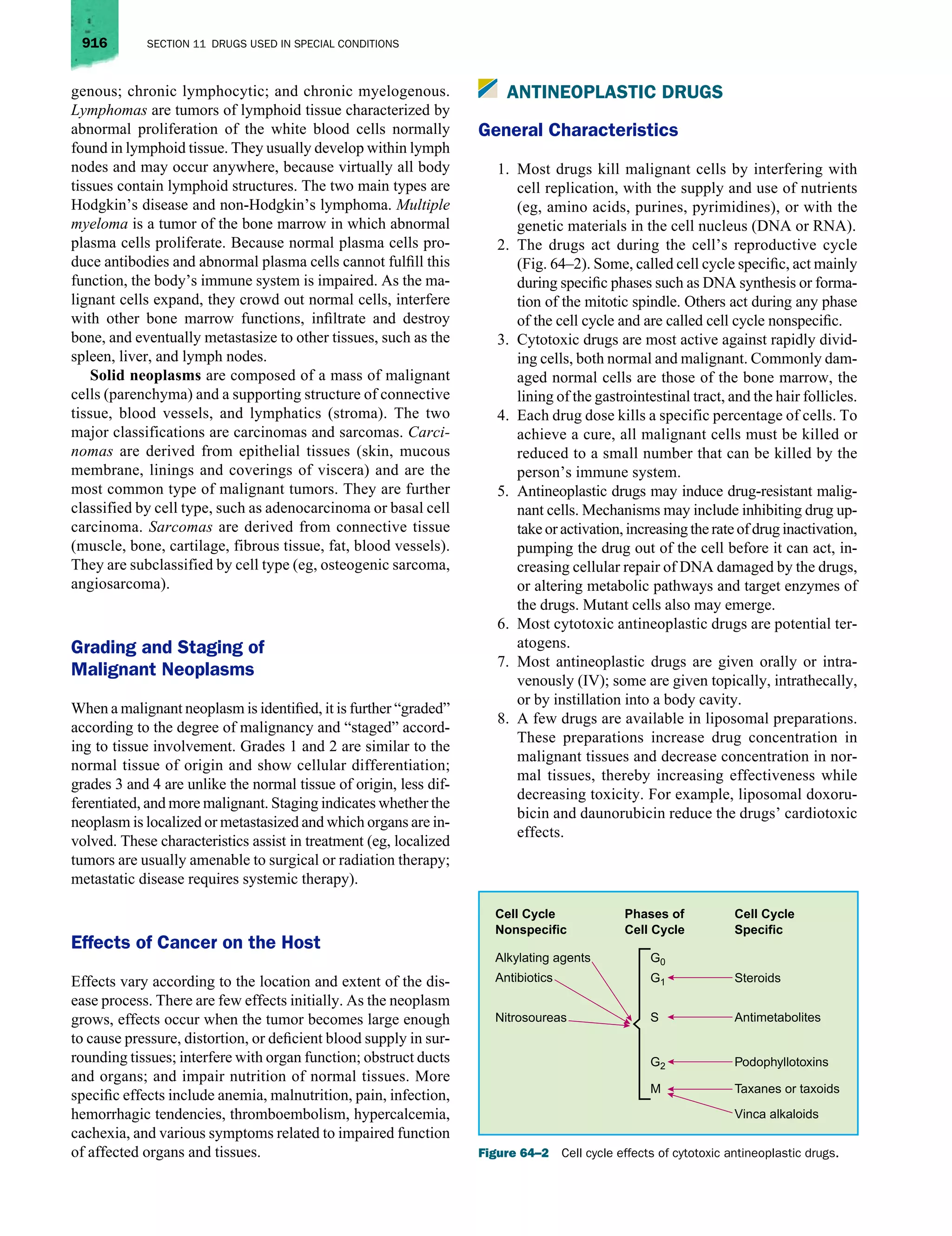
duce antibodies and abnormal plasma cells cannot fulfill this            (Fig. 64–2). Some, called cell cycle specific, act mainly
function, the body’s immune system is impaired. As the ma-              during specific phases such as DNA synthesis or forma-
lignant cells expand, they crowd out normal cells, interfere            tion of the mitotic spindle. Others act during any phase
with other bone marrow functions, infiltrate and destroy                 of the cell cycle and are called cell cycle nonspecific.
bone, and eventually metastasize to other tissues, such as the       3. Cytotoxic drugs are most active against rapidly divid-
spleen, liver, and lymph nodes.                                         ing cells, both normal and malignant. Commonly dam-
    Solid neoplasms are composed of a mass of malignant                 aged normal cells are those of the bone marrow, the
cells (parenchyma) and a supporting structure of connective             lining of the gastrointestinal tract, and the hair follicles.
tissue, blood vessels, and lymphatics (stroma). The two              4. Each drug dose kills a specific percentage of cells. To
major classifications are carcinomas and sarcomas. Carci-               achieve a cure, all malignant cells must be killed or
nomas are derived from epithelial tissues (skin, mucous                 reduced to a small number that can be killed by the
membrane, linings and coverings of viscera) and are the                 person’s immune system.
most common type of malignant tumors. They are further               5. Antineoplastic drugs may induce drug-resistant malig-
classified by cell type, such as adenocarcinoma or basal cell           nant cells. Mechanisms may include inhibiting drug up-
carcinoma. Sarcomas are derived from connective tissue                  take or activation, increasing the rate of drug inactivation,
(muscle, bone, cartilage, fibrous tissue, fat, blood vessels).          pumping the drug out of the cell before it can act, in-
They are subclassified by cell type (eg, osteogenic sarcoma,            creasing cellular repair of DNA damaged by the drugs,
angiosarcoma).                                                          or altering metabolic pathways and target enzymes of
                                                                        the drugs. Mutant cells also may emerge.
                                                                     6. Most cytotoxic antineoplastic drugs are potential ter-
Grading and Staging of                                                  atogens.
                                                                     7. Most antineoplastic drugs are given orally or intra-
Malignant Neoplasms
                                                                        venously (IV); some are given topically, intrathecally,
                                                                        or by instillation into a body cavity.
When a malignant neoplasm is identified, it is further “graded”
                                                                     8. A few drugs are available in liposomal preparations.
according to the degree of malignancy and “staged” accord-
                                                                        These preparations increase drug concentration in
ing to tissue involvement. Grades 1 and 2 are similar to the
                                                                        malignant tissues and decrease concentration in nor-
normal tissue of origin and show cellular differentiation;
                                                                        mal tissues, thereby increasing effectiveness while
grades 3 and 4 are unlike the normal tissue of origin, less dif-
                                                                        decreasing toxicity. For example, liposomal doxoru-
ferentiated, and more malignant. Staging indicates whether the
                                                                        bicin and daunorubicin reduce the drugs’ cardiotoxic
neoplasm is localized or metastasized and which organs are in-
                                                                        effects.
volved. These characteristics assist in treatment (eg, localized
tumors are usually amenable to surgical or radiation therapy;
metastatic disease requires systemic therapy).

                                                                     Cell Cycle                Phases of            Cell Cycle
                                                                     Nonspecific               Cell Cycle           Specific
Effects of Cancer on the Host
                                                                     Alkylating agents             G0
Effects vary according to the location and extent of the dis-        Antibiotics                   G1               Steroids
ease process. There are few effects initially. As the neoplasm
grows, effects occur when the tumor becomes large enough             Nitrosoureas                  S                Antimetabolites
to cause pressure, distortion, or deficient blood supply in sur-
rounding tissues; interfere with organ function; obstruct ducts                                    G2               Podophyllotoxins
and organs; and impair nutrition of normal tissues. More
                                                                                                   M                Taxanes or taxoids
specific effects include anemia, malnutrition, pain, infection,
hemorrhagic tendencies, thromboembolism, hypercalcemia,                                                             Vinca alkaloids
cachexia, and various symptoms related to impaired function
of affected organs and tissues.                                    Figure 64–2     Cell cycle effects of cytotoxic antineoplastic drugs.
CHAPTER 64 DRUGS USED IN ONCOLOGIC DISORDERS             917


Indications for Use                                                approved in 2002 for treatment of colorectal cancer in patients
                                                                   whose disease has recurred or worsened following standard
Cytotoxic antineoplastic drugs are used in the treatment of        therapy. It is used with 5-fluorouracil and leucovorin and given
malignant neoplasms to cure the disease, relieve symptoms,         every 2 weeks by injection. Adverse effects include peripheral
or induce or maintain remissions (symptom-free periods that        neuropathy, vomiting, diarrhea, and anemia.
last for varying lengths of time). Chemotherapy is the treatment
of choice for Hodgkin’s disease, leukemia, Wilms’ tumor, and
Ewing’s sarcoma, but it is less effective in cancers of the        Antimetabolites
lung, colon, and prostate gland.                                   Antimetabolites are substances that are structurally similar to
    In hematologic neoplasms, drug therapy is the treatment        normal metabolites. They are allowed to enter cancer cells
of choice because the disease is systemic rather than local-       because they are similar to nutrients needed by the cells for
ized. In solid tumors, drug therapy is often used before or        reproduction. Once inside the cell, the drugs may compete
after surgery or radiation therapy.                                with, replace, or antagonize the normal metabolite. These ac-
    Antineoplastic drugs are sometimes used in the treatment
                                                                   tions deprive the cell of substances needed for formation of
of nonmalignant conditions. For example, small doses of
                                                                   DNA or cause formation of abnormal DNA. The drugs are
methotrexate (MTX) are used for rheumatoid arthritis and
                                                                   cell cycle specific because they exert their cytotoxic effects
psoriasis.
                                                                   only during the S phase of the cell’s reproductive cycle, when
                                                                   DNA is being synthesized.
                                                                      This group includes a folic acid antagonist (eg, methotrex-
Classifications                                                     ate), purine antagonists (eg, mercaptopurine), and pyrimidine
                                                                   antagonists (eg, fluorouracil). These drugs have been used to
Cytotoxic antineoplastic drugs are usually classified in terms      treat many types of cancers, but they are most effective against
of their mechanisms of action (alkylating agents and anti-         rapidly growing tumors, and individual drugs vary in their
metabolites) or their sources (plant alkaloids, antibiotics).      effectiveness with different kinds of cancer. Toxic effects
Other drugs used in chemotherapy are immunostimulants (see         include bone marrow depression, mucositis and ulceration of
Chap. 44), hormones, hormone inhibitors, and cytoprotectants.      the GI tract, and hair loss (alopecia).


Alkylating Agents                                                  Antitumor Antibiotics
Alkylating agents include nitrogen mustard derivatives, ni-        These drugs (eg, doxorubicin) are active in all phases of the
trosoureas, and platinum compounds. Nitrogen mustard de-           cell cycle and their cytotoxic effects are similar to those of
rivatives (eg, cyclophosphamide) interfere with cell division      the alkylating agents. They bind to DNA so that DNA and
and the structure of DNA during all phases of the malignant        RNA transcription is blocked. Major toxicities are bone mar-
cell cycle. As a result, they have a broad spectrum of activ-      row depression and GI upset. Doxorubicin and related drugs
ity. They are most effective in hematologic malignancies but       also cause cardiotoxicity and tissue necrosis if extravasation
also are used to treat breast, lung, and ovarian tumors. All of    occurs. Bleomycin may cause significant pulmonary toxicity.
these drugs cause significant myelosuppression (bone mar-           All of these drugs except bleomycin must be given IV.
row depression).
    Nitrosoureas also interfere with DNA replication and RNA
synthesis and may inhibit essential enzymatic reactions of can-    Plant Alkaloids
cer cells. They are cell cycle nonspecific and have been used in
clients with gastrointestinal (GI), lung, and brain tumors. They   Plant alkaloids include derivatives of camptothecin (eg, topote-
are highly lipid soluble and therefore enter the brain and cere-   can), podophyllotoxin (eg, etoposide), taxanes (eg, pacli-
brospinal fluid more readily than other antineoplastic drugs.       taxel), and plants of the Vinca genus (eg, vincristine). These
They cause delayed bone marrow depression, with maximum            drugs vary in their characteristics and clinical uses.
leukopenia and thrombocytopenia occurring 5 to 6 weeks after
drug administration. As a result, the drugs are given less often
than other drugs, and complete blood counts (CBCs) are
needed weekly for at least 6 weeks after a dose.                    Nursing Notes: Apply Your Knowledge
    Platinum compounds are cell cycle–nonspecific agents that
inhibit DNA, RNA, and protein synthesis. Cisplatin is widely
used to treat both hematologic and solid cancers. Adverse           Your patient, Sally Moore is receiving an antineoplastic drug that
effects include severe nausea and vomiting, nephrotoxicity,         is known to cause bone marrow depression, with a nadir (lowest
and ototoxicity. Carboplatin is most often used to treat en-        point) 12 days after administration. Discuss the effects of bone
                                                                    marrow depression and appropriate nursing assessments. What
dometrial and ovarian carcinomas and it produces bone marrow
                                                                    teaching would be appropriate for this patient?
depression as a major adverse effect. Oxaliplatin (Eloxatin) was
918        SECTION 11 DRUGS USED IN SPECIAL CONDITIONS


    Camptothecins (also called DNA topoisomerase inhibitors)        It may cause severe bone marrow depression. Ibritumomab is
inhibit an enzyme required for DNA replication and repair.          a conjugated antibody used to treat non-Hodgkin’s lymphoma.
They have activity in several types of cancers, including col-      It is used with rituximab and may cause severe bone marrow
orectal, lung, and ovarian cancers. Dose-limiting toxicity is       depression and fatal infusion-related reactions. Rituximab is
myelosuppression.                                                   used to treat non-Hodgkin’s lymphoma. Common adverse
    Podophyllotoxins act mainly in the G2 phase of the cell         effects include infusion reactions (hypoxia, acute respiratory
cycle and prevent mitosis. Etoposide is used mainly to treat tes-   distress syndrome, myocardial infarction, ventricular dys-
ticular and small cell lung cancer; teniposide is used mainly for   rhythmias, cardiogenic shock) and lymphopenia.
childhood acute lymphocytic leukemia. Dose-limiting toxicity
is myelosuppression.
                                                                    Miscellaneous Cytotoxic Agents
    Taxanes inhibit cell division (antimitotic effects). They
are used mainly for advanced breast and ovarian cancers.            Miscellaneous agents vary in their sources, mechanisms of
Dose-limiting toxicity is neutropenia.                              action, indications for use, and toxic effects. L-Asparaginase
    Vinca alkaloids are cell cycle–specific agents that stop        (Elspar) is an enzyme that inhibits cellular protein synthesis
mitosis. These drugs have similar structures but different anti-    and reproduction by depriving cells of required amino acids.
neoplastic activities and adverse effects. Vincristine is used      It is used to treat acute lymphocytic leukemia and can cause
to treat Hodgkin’s disease, acute lymphoblastic leukemia,           allergic reactions, including anaphylaxis. Pegaspargase (On-
and non-Hodgkin’s lymphomas. Vinblastine is used to treat           caspar) is a modified formulation for people who are hyper-
Hodgkin’s disease and choriocarcinoma; vinorelbine is used          sensitive to Elspar. Hydroxyurea acts in the S phase of the cell
to treat non–small cell lung cancer. The drugs can cause se-        cycle to impair DNA synthesis. It is used to treat leukemia,
vere tissue damage with extravasation (leaking of medication        melanoma, and advanced ovarian cancer. A major adverse
into soft tissues around the venipuncture site). In addition,       effect is myelosuppression. Procarbazine inhibits DNA, RNA,
vinblastine and vinorelbine are more likely to cause bone           and protein synthesis. It is used to treat Hodgkin’s disease. It
marrow depression, and vincristine is more likely to cause          is a monoamine oxidase inhibitor and may cause hypertension
peripheral nerve toxicity.                                          if given with adrenergic drugs, tricyclic antidepressants, or
                                                                    foods with high tyramine content (see Chap. 10). Common
                                                                    adverse effects include leukopenia and thrombocytopenia.
Monoclonal Antibodies
                                                                        Miscellaneous biotherapy agents include interferons (see
Monoclonal antibodies (see Chap. 45) are produced from one          Chap. 44) and imatinib (Gleevec). Interferon alfa (Roferon-A,
cell line. For antitumor effects in cancer, they are designed to    Intron A) is used to treat hairy cell leukemia, chronic my-
combine with growth factor receptors on malignant cell sur-         elogenous leukemia, Kaposi’s sarcoma, and other cancers.
faces and inhibit tumor growth. Researchers also conjugate          Imatinib is a tyrosine kinase inhibitor that inhibits cell pro-
monoclonal antibodies with radioisotopes, toxins, chemother-        liferation and increases cell death in chronic myelogenous
apeutic agents, and drug-filled liposomes to increase their         leukemia. It is also used to treat a rare type of cancer called
effectiveness and deliver antineoplastic drugs to specific areas     gastrointestinal stromal tumor and is being investigated for
of the body.                                                        use in other cancers. It is given orally and its side effects
    Cancer cells have more growth factor receptors than healthy     include edema, cramps, nausea, and anemia.
cells. For example, 20% to 30% of women with breast cancer
have an excessive number of HER2 receptors. A monoclonal
                                                                    Hormones and Hormone Inhibitors
antibody, trastuzumab (Herceptin), was developed specifi-
cally to bind with HER2 receptors and inhibit malignant cell        Hormones interfere with protein synthesis and inhibit tumor
growth. This antibody is used with other antineoplastic drugs       growth in hormone-dependent tissues. The goal of therapy is
to improve response in women with metastatic breast can-            control of tumor growth and palliation of symptoms rather
cer. A major adverse effect is the development of congestive        than cure. Hormones are not cytotoxic and adverse effects are
heart failure. The drug should not be used with doxorubicin         usually mild.
or cyclophosphamide, because of increased risks of cardio-             Sex hormones (estrogens, progestins, androgens) are use-
vascular toxicity.                                                  ful in cancers of the breast, prostate gland, and other repro-
    Other monoclonal antibodies available for clinical use in-      ductive organs. Adrenal corticosteroids suppress formation
clude alemtuzumab (Campath IH), ibritumomab tiuxetan                and function of lymphocytes and therefore are most useful in
(Zevalin), gemtuzumab (Mylotarg), and rituximab (Rituxan).          the treatment of leukemia and lymphoma. They are also used
Alemtuzumab binds to molecules on T and B cells in lympho-          for complications of cancer (eg, brain metastases, hypercal-
cytic leukemia. Major adverse effects include allergic reac-        cemia) and with radiation therapy to reduce radiation-related
tions, leukopenia, and pancytopenia. Because of the high risk       edema in the mediastinum, brain, and spinal cord. Dexa-
of infection, patients are treated prophylactically with anti-      methasone is commonly used in neurologic disorders.
biotic, antifungal, and antiviral drugs during and for 3 months        Hormone inhibitors include aromatase inhibitors
after therapy. Gemtuzumab, an antibody conjugated with an           (eg, anastrozole) that inhibit estrogen synthesis, antiestrogens
antitumor antibiotic, is used to treat acute myeloid leukemia.      (eg, tamoxifen) that bind to estrogen receptors and block
CHAPTER 64 DRUGS USED IN ONCOLOGIC DISORDERS        919


estrogen action; aminoglutethimide, an adrenocorticosteroid-       mia, malnutrition, weight loss, pain, and infection; specific
inhibiting agent that produces a “medical adrenalectomy”;          manifestations depend on the organs affected.
and goserelin and leuprolide, which inhibit testosterone se-           Assess for other diseases and organ dysfunctions (eg, car-
cretion in advanced prostatic cancer and inhibit production of     diac, renal or hepatic) that influence response to chemo-
estrogen in advanced breast cancer.                                therapy.
                                                                       Assess emotional status, coping mechanisms, family
                                                                   relationships, and financial resources. Anxiety and depres-
    INDIVIDUAL DRUGS                                               sion are common features during cancer diagnosis and
                                                                   treatment.
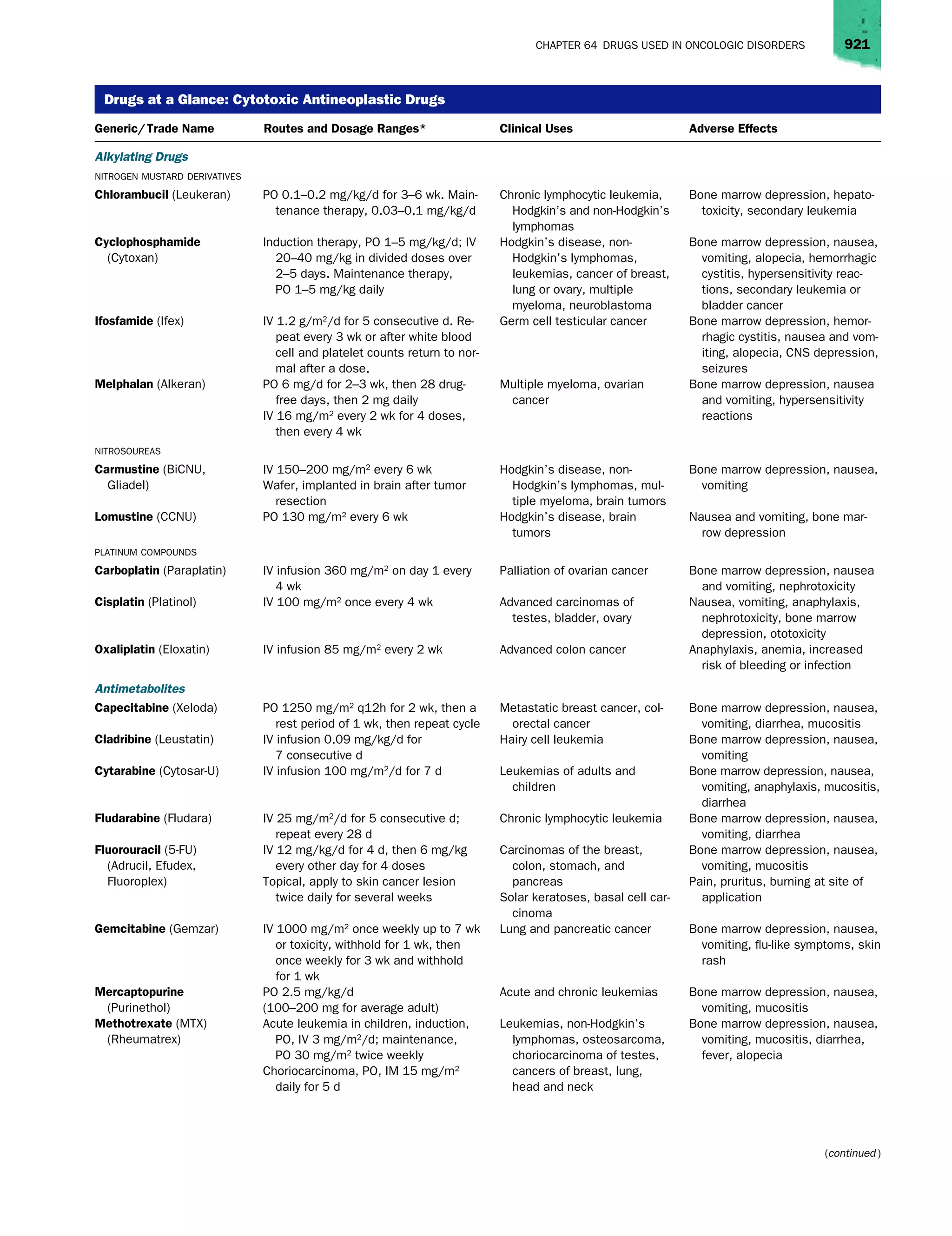
Cytotoxic antineoplastic drugs are listed in Drugs at a Glance:        Assess laboratory test results before chemotherapy to es-
Cytotoxic Antineoplastic Drugs; hormones and hormone in-           tablish baseline data and during chemotherapy to monitor
hibitors are listed in Drugs at a Glance: Antineoplastic Hor-      drug effects:
mones and Hormone Inhibitors.
                                                                   • Blood tests for tumor markers (tumor-specific antigens
                                                                      on cell surfaces). Alpha-fetoprotein is a fetal antigen nor-
    CYTOPROTECTANT DRUGS                                              mally present during intrauterine and early postnatal life
                                                                      but absent in adulthood. Increased amounts may indicate
Cytoprotectants reduce the adverse effects of cytotoxic drugs,        hepatic or testicular cancer. Carcinoembryonic antigen
which may be severe, debilitating, and life threatening               (CEA) is secreted by several types of malignant cells (eg,
(Box 64–2). Severe adverse effects may also limit drug                CEA is present in approximately 75% of people with
dosage or frequency of administration, thereby limiting the           colorectal cancer). A rising level may indicate tumor pro-
effectiveness of chemotherapy. Several cytoprotectants are            gression and levels that are elevated before surgery and
available to protect certain body tissues from one or more ad-        disappear after surgery indicate adequate tumor excision.
verse effects and allow a more optimal dose and schedule of           If CEA levels rise later, it probably indicates tumor re-
cytotoxic agents. To be effective, administration and sched-          currence. In chemotherapy, falling CEA levels indicate
uling must be precise in relation to administration of the            effectiveness. Other tumor markers are immunoglobulins
cytotoxic agent. A cytoprotective agent does not prevent or           (elevated levels may indicate multiple myeloma) and
treat all adverse effects of a particular cytotoxic agent and it      prostate-specific antigen (elevated levels may indicate
may have adverse effects of its own.                                  prostatic cancer).
    Amifostine produces a metabolite that combines with            • Complete blood cell count (CBC) to check for anemia,
cisplatin and ameliorates cisplatin-induced renal damage.             leukopenia, and thrombocytopenia because most cyto-
Dexrazoxane decreases cardiac toxicity of doxorubicin.                toxic antineoplastic drugs cause bone marrow depression.
Erythropoietin, filgrastim, oprelvekin, and sargramostim               A CBC and white blood cell differential are done before
are colony-stimulating factors (see Chap. 44) that stimulate          each cycle of chemotherapy to determine dosage and fre-
the bone marrow to produce blood cells. Erythropoietin stim-          quency of drug administration, to monitor bone marrow
ulates production of red blood cells and is used for anemia;          function so fatal bone marrow depression does not occur,
oprelvekin stimulates production of platelets and is used to          and to assist the nurse in planning care. For example, the
prevent thrombocytopenia; filgrastim and sargramostim stim-            client is very susceptible to infection when the leukocyte
ulate production of white blood cells and are used to reduce          count is low, and bleeding is likely when the platelet
neutropenia and the risk of severe infection. Leucovorin is           count is low.
used with high-dose MTX. Mesna is used with ifosfamide,            • Other tests. These include tests of kidney and liver func-
which produces a metabolite that causes hemorrhagic cysti-            tion, serum calcium, uric acid, and others, depending on
tis. Mesna combines with and inactivates the metabolite and           the organs affected by the cancer or its treatment.
thereby decreases cystitis. Dosages and routes of adminis-         Nursing Diagnoses
tration for these medications are listed in Drugs at a Glance:
                                                                   • Pain, nausea and vomiting, weakness, and activity intol-
Cytoprotective Agents.
                                                                     erance related to disease process or chemotherapy
                                                                   • Imbalanced Nutrition: Less Than Body Requirements re-
                                                                     lated to disease process or chemotherapy
                                                                   • Anxiety related to the disease, its possible progression,
 Nursing Process                                                     and its treatment
                                                                   • Ineffective Family Coping related to illness and treatment
 Assessment                                                          of a family member
 Assess the client’s condition before chemotherapy is started      • Deficient Fluid Volume related to chemotherapy-induced
 and often during treatment. Useful information includes the         nausea, vomiting, and diarrhea
 type, grade, and stage of the tumor as well as the signs and      • Risk for Injury: Infection related to drug-induced neu-
 symptoms of cancer. General manifestations include ane-             tropenia; bleeding related to drug-induced thrombo-
920       SECTION 11 DRUGS USED IN SPECIAL CONDITIONS


  cytopenia; stomatitis related to damage of GI mucosal          • Physiologic care includes pain management, comfort
  cells                                                            measures, and assistance with nutrition, hygiene, ambu-
• Deficient Knowledge about cancer chemotherapy and                 lation, and other activities of daily living as needed.
  managing adverse drug effects                                  • Psychological care includes allowing family members or
                                                                   significant others to be with the client and participate in
Planning/Goals                                                     care when desired, and keeping clients and families in-
The client will:                                                   formed.
• Receive assistance in coping with the diagnosis of cancer
                                                                 Evaluation
• Experience reduced anxiety and fear
• Receive chemotherapy accurately and safely                     • Monitor drug administration for accuracy.
• Experience reduction of tumor size, change of laboratory       • Observe and interview for therapeutic effects of chemo-
  values toward normal, or other therapeutic effects of            therapy.
  chemotherapy                                                   • Compare current laboratory reports with baseline values
• Experience minimal bleeding, infection, nausea and vom-          for changes toward normal values.
  iting, and other consequences of chemotherapy                  • Compare weight and nutritional status with baseline val-
• Maintain adequate food and fluid intake and body weight           ues for maintenance or improvement.
• Receive assistance in activities of daily living when          • Observe and interview for adverse drug effects and inter-
  needed                                                           ventions to prevent or manage them.
• Be informed about community resources for cancer care          • Observe and interview for adequate pain management
  (eg, hospice, Reach to Recovery, other support groups)           and other symptom control.

Interventions
Participate in and promote efforts to prevent cancer.
• Follow and promote the diet recommended by the                    PRINCIPLES OF THERAPY
   American Cancer Society (ie, decrease fat; eat five or
   more servings of fruits and vegetables daily; increase in-   Overview of Cancer Treatment
   take of dietary fiber; minimize intake of salt-cured or
   smoked foods).                                               Most cancer treatment involves surgery, radiation, and chemo-
• Promote weight control. Obesity may contribute to the         therapy. Optimal regimens maximize effectiveness (eg, attempt
   development of several cancers, including breast and en-     to eradicate tumor cells at primary, regional, and systemic
   dometrial cancer in women.                                   sites) and minimize morbidity (eg, pain and treatment-
• Identify cancer-causing agents and strategies to reduce       related toxicity).
   exposure to them when possible.                                  Surgery is used to excise small, localized tumors, which
• Strengthen host defenses by promoting a healthful             may be curative; to remove tumors that have been reduced in
   lifestyle (eg, good nutrition, adequate rest and exercise,   size by radiation therapy, chemotherapy, or both; and to treat
   stress management techniques, avoiding or minimizing         complications of cancer, such as bowel obstruction. Surgical
   alcohol and tobacco use).                                    risks are greater in clients who have received preoperative
• Avoid smoking cigarettes and being around smokers.            radiation therapy or chemotherapy.
   Passive smoking increases risk of lung cancer in spouses         Radiation therapy is used to treat most types of cancer.
   of smokers and risks of brain cancer, lymphomas, and         It may be used alone to cure some malignancies such as
   acute lymphogenous leukemia in children of smokers.          Hodgkin’s disease or cervical cancer. It may be used with
• Minimize exposure to sunlight, use sunscreens liber-          surgery to reduce the need for radical surgery (eg, in breast
   ally, and wear protective clothing to prevent skin cancer.   cancer, excision of small tumors plus radiation therapy is as
    Participate in and promote cancer screening tests in non-   effective as mastectomy). With soft tissue sarcomas of the
symptomatic people, especially those at high risk, to detect    limbs, wide excision plus radiation therapy can be used in-
cancer before signs and symptoms occur. These tests in-         stead of amputation. Radiation is also used to eliminate local
clude regular examination of breasts, testicles, and skin and   or regional malignant cells (eg, positive lymph nodes) that re-
tests for colon cancer such as hemoccult tests on stool and     main after surgery; with chemotherapy to cure or control
sigmoidoscopy. Early recognition of risk factors, premalig-     growth of tumors; and as a palliative treatment in metastatic
nant tissue changes (dysplasia), biochemical tumor mark-        disease, such as relieving symptoms in clients with bone or
ers, and beginning malignancies may be lifesaving; early
                                                                brain involvement.
treatment can greatly reduce the suffering and problems as-
                                                                    Cytotoxic chemotherapy is most effective when started be-
sociated with advanced cancer.
                                                                fore extensive tumor growth or when the tumor burden has
    For clients receiving cytotoxic anticancer drugs, try to
                                                                been reduced by surgical excision or radiation therapy. Once
prevent or minimize the incidence and severity of adverse
                                                                metastasized, solid tumors become systemic diseases and are
reactions (Box 64-2).
                                                                not accessible to surgical excision or radiation therapy.
    Provide supportive care to clients and families.
                                                                                                  (text continues on page 925)
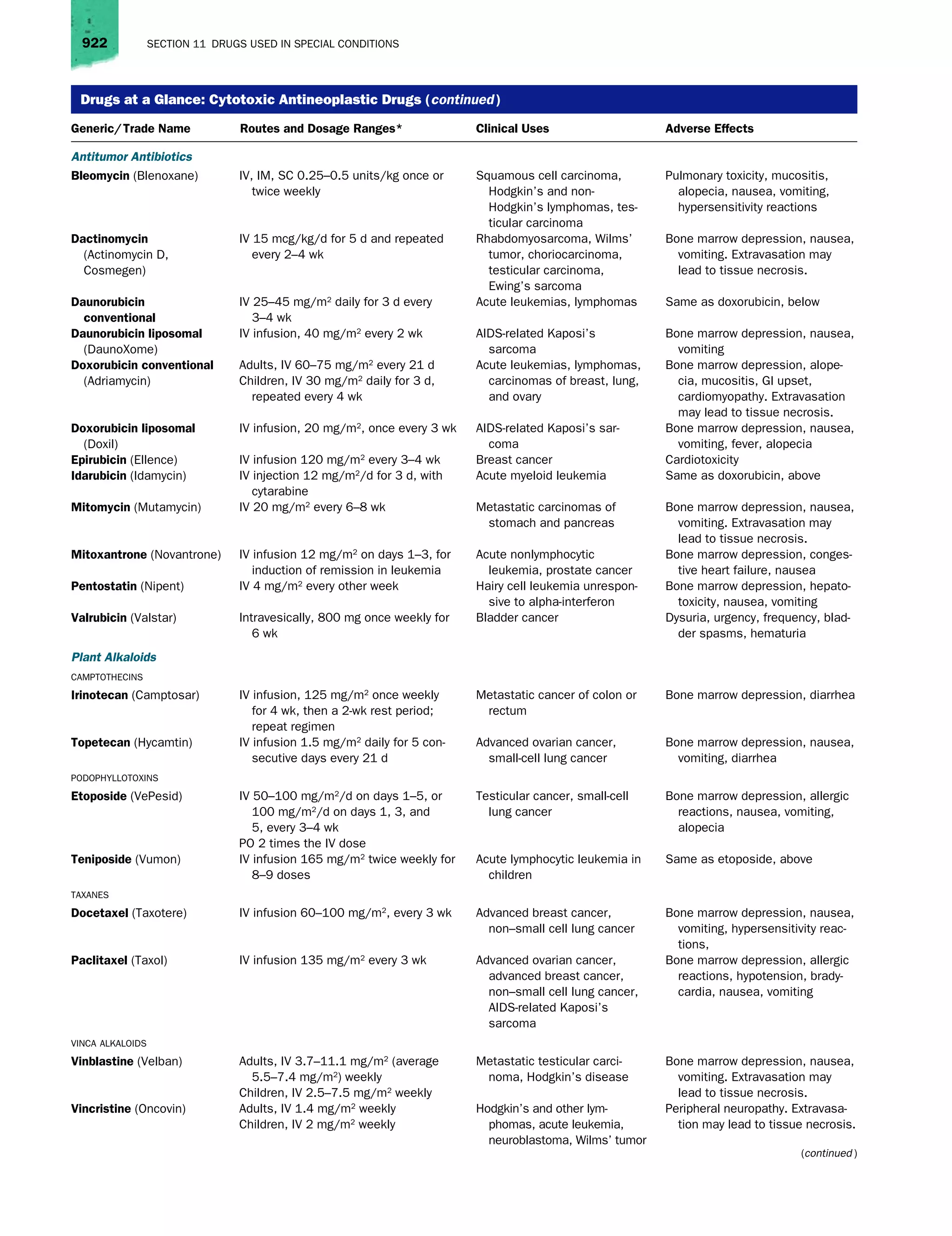
CHAPTER 64 DRUGS USED IN ONCOLOGIC DISORDERS             921


 Drugs at a Glance: Cytotoxic Antineoplastic Drugs

Generic/Trade Name             Routes and Dosage Ranges*                    Clinical Uses                      Adverse Effects

Alkylating Drugs
NITROGEN MUSTARD DERIVATIVES

Chlorambucil (Leukeran)        PO 0.1–0.2 mg/kg/d for 3–6 wk. Main-         Chronic lymphocytic leukemia,      Bone marrow depression, hepato-
                                 tenance therapy, 0.03–0.1 mg/kg/d            Hodgkin’s and non-Hodgkin’s        toxicity, secondary leukemia
                                                                              lymphomas
Cyclophosphamide               Induction therapy, PO 1–5 mg/kg/d; IV        Hodgkin’s disease, non-            Bone marrow depression, nausea,
  (Cytoxan)                      20–40 mg/kg in divided doses over            Hodgkin’s lymphomas,               vomiting, alopecia, hemorrhagic
                                 2–5 days. Maintenance therapy,               leukemias, cancer of breast,       cystitis, hypersensitivity reac-
                                 PO 1–5 mg/kg daily                           lung or ovary, multiple            tions, secondary leukemia or
                                                                              myeloma, neuroblastoma             bladder cancer
Ifosfamide (Ifex)              IV 1.2 g/m2/d for 5 consecutive d. Re-       Germ cell testicular cancer        Bone marrow depression, hemor-
                                  peat every 3 wk or after white blood                                           rhagic cystitis, nausea and vom-
                                  cell and platelet counts return to nor-                                        iting, alopecia, CNS depression,
                                  mal after a dose.                                                              seizures
Melphalan (Alkeran)            PO 6 mg/d for 2–3 wk, then 28 drug-          Multiple myeloma, ovarian          Bone marrow depression, nausea
                                  free days, then 2 mg daily                 cancer                              and vomiting, hypersensitivity
                               IV 16 mg/m2 every 2 wk for 4 doses,                                               reactions
                                  then every 4 wk
NITROSOUREAS

Carmustine (BiCNU,             IV 150–200 mg/m2 every 6 wk                  Hodgkin’s disease, non-            Bone marrow depression, nausea,
  Gliadel)                     Wafer, implanted in brain after tumor          Hodgkin’s lymphomas, mul-          vomiting
                                  resection                                   tiple myeloma, brain tumors
Lomustine (CCNU)               PO 130 mg/m2 every 6 wk                      Hodgkin’s disease, brain           Nausea and vomiting, bone mar-
                                                                              tumors                             row depression
PLATINUM COMPOUNDS

Carboplatin (Paraplatin)       IV infusion 360 mg/m2 on day 1 every         Palliation of ovarian cancer       Bone marrow depression, nausea
                                  4 wk                                                                           and vomiting, nephrotoxicity
Cisplatin (Platinol)           IV 100 mg/m2 once every 4 wk                 Advanced carcinomas of             Nausea, vomiting, anaphylaxis,
                                                                              testes, bladder, ovary             nephrotoxicity, bone marrow
                                                                                                                 depression, ototoxicity
Oxaliplatin (Eloxatin)         IV infusion 85 mg/m2 every 2 wk              Advanced colon cancer              Anaphylaxis, anemia, increased
                                                                                                                 risk of bleeding or infection
Antimetabolites
Capecitabine (Xeloda)          PO 1250 mg/m2 q12h for 2 wk, then a          Metastatic breast cancer, col-     Bone marrow depression, nausea,
                                  rest period of 1 wk, then repeat cycle      orectal cancer                     vomiting, diarrhea, mucositis
Cladribine (Leustatin)         IV infusion 0.09 mg/kg/d for                 Hairy cell leukemia                Bone marrow depression, nausea,
                                  7 consecutive d                                                                vomiting
Cytarabine (Cytosar-U)         IV infusion 100 mg/m2/d for 7 d              Leukemias of adults and            Bone marrow depression, nausea,
                                                                              children                           vomiting, anaphylaxis, mucositis,
                                                                                                                 diarrhea
Fludarabine (Fludara)          IV 25 mg/m2/d for 5 consecutive d;           Chronic lymphocytic leukemia       Bone marrow depression, nausea,
                                  repeat every 28 d                                                              vomiting, diarrhea
Fluorouracil (5-FU)            IV 12 mg/kg/d for 4 d, then 6 mg/kg          Carcinomas of the breast,          Bone marrow depression, nausea,
  (Adrucil, Efudex,               every other day for 4 doses                 colon, stomach, and                vomiting, mucositis
  Fluoroplex)                  Topical, apply to skin cancer lesion           pancreas                         Pain, pruritus, burning at site of
                                  twice daily for several weeks             Solar keratoses, basal cell car-     application
                                                                              cinoma
Gemcitabine (Gemzar)           IV 1000 mg/m2 once weekly up to 7 wk         Lung and pancreatic cancer         Bone marrow depression, nausea,
                                  or toxicity, withhold for 1 wk, then                                           vomiting, flu-like symptoms, skin
                                  once weekly for 3 wk and withhold                                              rash
                                  for 1 wk
Mercaptopurine                 PO 2.5 mg/kg/d                               Acute and chronic leukemias        Bone marrow depression, nausea,
 (Purinethol)                  (100–200 mg for average adult)                                                    vomiting, mucositis
Methotrexate (MTX)             Acute leukemia in children, induction,       Leukemias, non-Hodgkin’s           Bone marrow depression, nausea,
 (Rheumatrex)                     PO, IV 3 mg/m2/d; maintenance,              lymphomas, osteosarcoma,           vomiting, mucositis, diarrhea,
                                  PO 30 mg/m2 twice weekly                    choriocarcinoma of testes,         fever, alopecia
                               Choriocarcinoma, PO, IM 15 mg/m2               cancers of breast, lung,
                                  daily for 5 d                               head and neck


                                                                                                                                       (continued )
922             SECTION 11 DRUGS USED IN SPECIAL CONDITIONS


 Drugs at a Glance: Cytotoxic Antineoplastic Drugs (continued )

Generic/Trade Name               Routes and Dosage Ranges*                Clinical Uses                   Adverse Effects

Antitumor Antibiotics
Bleomycin (Blenoxane)            IV, IM, SC 0.25–0.5 units/kg once or     Squamous cell carcinoma,        Pulmonary toxicity, mucositis,
                                    twice weekly                            Hodgkin’s and non-              alopecia, nausea, vomiting,
                                                                            Hodgkin’s lymphomas, tes-       hypersensitivity reactions
                                                                            ticular carcinoma
Dactinomycin                     IV 15 mcg/kg/d for 5 d and repeated      Rhabdomyosarcoma, Wilms’        Bone marrow depression, nausea,
  (Actinomycin D,                   every 2–4 wk                            tumor, choriocarcinoma,         vomiting. Extravasation may
  Cosmegen)                                                                 testicular carcinoma,           lead to tissue necrosis.
                                                                            Ewing’s sarcoma
Daunorubicin                     IV 25–45 mg/m2 daily for 3 d every       Acute leukemias, lymphomas      Same as doxorubicin, below
  conventional                      3–4 wk
Daunorubicin liposomal           IV infusion, 40 mg/m2 every 2 wk         AIDS-related Kaposi’s           Bone marrow depression, nausea,
  (DaunoXome)                                                               sarcoma                         vomiting
Doxorubicin conventional         Adults, IV 60–75 mg/m2 every 21 d        Acute leukemias, lymphomas,     Bone marrow depression, alope-
  (Adriamycin)                   Children, IV 30 mg/m2 daily for 3 d,       carcinomas of breast, lung,     cia, mucositis, GI upset,
                                   repeated every 4 wk                      and ovary                       cardiomyopathy. Extravasation
                                                                                                            may lead to tissue necrosis.
Doxorubicin liposomal            IV infusion, 20 mg/m2, once every 3 wk   AIDS-related Kaposi’s sar-      Bone marrow depression, nausea,
  (Doxil)                                                                   coma                            vomiting, fever, alopecia
Epirubicin (Ellence)             IV infusion 120 mg/m2 every 3–4 wk       Breast cancer                   Cardiotoxicity
Idarubicin (Idamycin)            IV injection 12 mg/m2/d for 3 d, with    Acute myeloid leukemia          Same as doxorubicin, above
                                    cytarabine
Mitomycin (Mutamycin)            IV 20 mg/m2 every 6–8 wk                 Metastatic carcinomas of        Bone marrow depression, nausea,
                                                                           stomach and pancreas             vomiting. Extravasation may
                                                                                                            lead to tissue necrosis.
Mitoxantrone (Novantrone)        IV infusion 12 mg/m2 on days 1–3, for    Acute nonlymphocytic            Bone marrow depression, conges-
                                    induction of remission in leukemia      leukemia, prostate cancer       tive heart failure, nausea
Pentostatin (Nipent)             IV 4 mg/m2 every other week              Hairy cell leukemia unrespon-   Bone marrow depression, hepato-
                                                                            sive to alpha-interferon        toxicity, nausea, vomiting
Valrubicin (Valstar)             Intravesically, 800 mg once weekly for   Bladder cancer                  Dysuria, urgency, frequency, blad-
                                    6 wk                                                                    der spasms, hematuria
Plant Alkaloids
CAMPTOTHECINS

Irinotecan (Camptosar)           IV infusion, 125 mg/m2 once weekly       Metastatic cancer of colon or   Bone marrow depression, diarrhea
                                    for 4 wk, then a 2-wk rest period;     rectum
                                    repeat regimen
Topetecan (Hycamtin)             IV infusion 1.5 mg/m2 daily for 5 con-   Advanced ovarian cancer,        Bone marrow depression, nausea,
                                    secutive days every 21 d                small-cell lung cancer          vomiting, diarrhea
PODOPHYLLOTOXINS

Etoposide (VePesid)              IV 50–100 mg/m2/d on days 1–5, or        Testicular cancer, small-cell   Bone marrow depression, allergic
                                    100 mg/m2/d on days 1, 3, and           lung cancer                     reactions, nausea, vomiting,
                                    5, every 3–4 wk                                                         alopecia
                                 PO 2 times the IV dose
Teniposide (Vumon)               IV infusion 165 mg/m2 twice weekly for   Acute lymphocytic leukemia in   Same as etoposide, above
                                    8–9 doses                               children
TAXANES

Docetaxel (Taxotere)             IV infusion 60–100 mg/m2, every 3 wk     Advanced breast cancer,         Bone marrow depression, nausea,
                                                                            non–small cell lung cancer      vomiting, hypersensitivity reac-
                                                                                                            tions,
Paclitaxel (Taxol)               IV infusion 135 mg/m2 every 3 wk         Advanced ovarian cancer,        Bone marrow depression, allergic
                                                                            advanced breast cancer,         reactions, hypotension, brady-
                                                                            non–small cell lung cancer,     cardia, nausea, vomiting
                                                                            AIDS-related Kaposi’s
                                                                            sarcoma
VINCA ALKALOIDS

Vinblastine (Velban)             Adults, IV 3.7–11.1 mg/m2 (average       Metastatic testicular carci-    Bone marrow depression, nausea,
                                   5.5–7.4 mg/m2) weekly                   noma, Hodgkin’s disease          vomiting. Extravasation may
                                 Children, IV 2.5–7.5 mg/m2 weekly                                          lead to tissue necrosis.
Vincristine (Oncovin)            Adults, IV 1.4 mg/m2 weekly              Hodgkin’s and other lym-        Peripheral neuropathy. Extravasa-
                                 Children, IV 2 mg/m2 weekly                phomas, acute leukemia,         tion may lead to tissue necrosis.
                                                                            neuroblastoma, Wilms’ tumor
                                                                                                                                  (continued )
CHAPTER 64 DRUGS USED IN ONCOLOGIC DISORDERS                923


 Drugs at a Glance: Cytotoxic Antineoplastic Drugs (continued )

Generic/Trade Name                 Routes and Dosage Ranges*                        Clinical Uses                          Adverse Effects

Vinorelbine (Navelbine)                                    2
                                  IV injection 30 mg/m once weekly                  Non–small cell lung cancer             Bone marrow depression, periph-
                                                                                                                             eral neuropathy. Extravasation
                                                                                                                             may lead to tissue necrosis.
Monoclonal Antibodies
Gemtuzumab ozogamicin             IV infusion, 9 mg/m2, for 2 doses, 14 d           Acute myeloid leukemia                 Chills, fever, nausea, vomiting,
  (Mylotarg)                         apart                                                                                   diarrhea
Ibritumomab tiuxetan              See literature                                    Non-Hodgkin’s lymphoma, with           Severe or fatal infusion reaction,
  (Zevalin)                                                                           rituximab                              severe bone marrow depression
Rituximab (Rituxan)               IV infusion, 375 mg/m2 once weekly                Non-Hodgkin’s lymphoma                 Hypersensitivity reactions, cardiac
                                     for 4 doses                                                                             dysrhythmias
Trastuzumab (Herceptin)           IV infusion, 4 mg/kg, then 2 mg/kg                Metastatic breast cancer               Cardiotoxicity (dyspnea, edema,
                                     once weekly                                                                             heart failure)
Miscellaneous Agents
L-Asparaginase (Elspar)           IV 1000 IU/kg/d for 10 d                          Acute lymphocytic leukemia             Hypersensitivity reactions, includ-
                                                                                                                             ing anaphylaxis
Hydroxyurea (Hydrea)              PO 80 mg/kg as a single dose every                Chronic myelocytic leukemia,           Bone marrow depression, nausea,
                                    third day or 20–30 mg/kg as a single              melanoma, ovarian cancer,              vomiting, peripheral neuritis
                                    dose daily                                        head and neck cancer
Levamisole (Ergamisol)            PO 50 mg q8h for 3 d every 2 wk                   Colon cancer, with fluorouracil         Nausea, vomiting, diarrhea
Procarbazine (Matulane)           PO 2–4 mg/kg/d for 1 wk, then                     Hodgkin’s disease                      Bone marrow depression, mucosi-
                                    4–6 mg/kg/d                                                                              tis, CNS depression
Temozolomide (Temodar)            PO 150 mg/m2 once daily for 5 d, then             Brain tumors                           Bone marrow depression
                                    200 mg/m2 every 28 d

*Dosages may vary significantly or change often, according to use in different types of cancer and in different combinations.
AIDS, acquired immunodeficiency syndrome.


 Drugs at a Glance: Antineoplastic Hormones and Hormone Inhibitors

Generic/Trade Names             Routes and Dosage Ranges                       Clinical Uses                           Adverse Effects

Antiestrogens
Fulvestrant (Faslodex)          IM 250 mg once monthly (one 5-mL               Advanced breast cancer in               GI upset, hot flashes, injection site
                                  or two 2.5-mL injections)                      postmenopausal women                    reactions
Tamoxifen (Nolvadex)            PO 20 mg once or twice daily                   Breast cancer: after surgery or         Hot flashes, nausea, vomiting, vaginal
                                                                                 radiation; prophylaxis in               discharge, risk of endometrial can-
                                                                                 high-risk women; and treat-             cer in nonhysterectomized women
                                                                                 ment of metastatic disease
Toremifene (Fareston)           PO 60 mg once daily                            Metastatic breast cancer in             Hot flashes, nausea, hypercalcemia,
                                                                                 postmenopausal women                    tumor flare
Aromatase Inhibitors
Anastrazole (Arimidex)          PO 1 mg once daily                             Advanced breast cancer in               Nausea, hot flashes, edema
                                                                                 postmenopausal women
Exemestane (Aromasin)           PO 25 mg once daily                            Advanced breast cancer in               Hot flashes, nausea, depression, in-
                                                                                 postmenopausal women                    somnia, anxiety, dyspnea, pain
Letrozole (Femara)              PO 2.5 mg once daily                           Advanced breast cancer                  Nausea, hot flashes
Goserelin (Zoladex)             SC implant, 3.6 mg every 28 d or               Advanced prostatic or breast            Hot flashes, transient increase in
                                  10.8 mg every 12 wk                            cancer, endometriosis                   bone pain
Leuprolide (Eligard,            SC 7.5 mg/mo                                   Advanced prostatic cancer               Same as for goserelin, above
  Lupron, Viadur)               IM 7.5 mg/mo, 22.5 mg/3 mo, or
                                  30 mg/4 mo
                                IM implant 65 mg/12 mo
Triptorelin (Trelstar LA,       IM 3.75 mg/28 d or 11.25 mg/3 mo               Advanced prostatic cancer               Same as for goserelin and leuprolide,
  Trelstar Depot)                                                                                                        above
924         SECTION 11 DRUGS USED IN SPECIAL CONDITIONS


BOX 64-2
                  MANAGEMENT OF CHEMOTHERAPY COMPLICATIONS
Complications may range from minor to life threatening. System-                • Inspect the mouth daily for signs of inflammation and lesions.
atic efforts toward prevention or early detection and treatment are            • Give medications for pain. Local anesthetic solutions, such as
needed.                                                                          viscous lidocaine, can be taken a few minutes before meals.
• Nausea and vomiting commonly occur. They are usually treated                   Because the mouth and throat are anesthetized, swallowing and
   with antiemetics (see Chap. 63), which are most effective when                detecting the temperature of hot foods may be difficult, and
   started before chemotherapy and continued on a regular sched-                 aspiration or burns may occur. Doses should not exceed 15 mL
   ule for 24 to 48 hours afterward. An effective regimen is a sero-             every 3 hours or 120 mL in 24 hours. If systemic analgesics
   tonin receptor antagonist (eg, ondansetron) and a corticosteroid              are used, they should be taken 30 to 60 minutes before eating.
   (eg, dexamethasone), given orally or intravenously (IV). Other              • In oral infections resulting from mucositis, local or systemic
   measures include a benzodiazepine (eg, lorazepam) for anticipa-               antimicrobial drugs are used. Fungal infections with Candida
   tory nausea and vomiting and limiting oral intake for a few hours.            albicans can be treated with antifungal tablets, suspensions, or
• Anorexia interferes with nutrition. Well-balanced meals, with                  lozenges. Severe infections may require systemic antibiotics,
   foods the client is able and willing to eat, and nutritional supple-          depending on the causative organism as identified by cultures
   ments, to increase intake of protein and calories, are helpful.               of mouth lesions.
• Fatigue, which may be profound, is often caused or aggravated            •   Infection is common because the disease and its treatment lower
   by anemia and can be prevented or treated with administration of            host resistance to infection.
   erythropoietin. An adequate diet and light to moderate exercise,            • Help the client maintain a well-balanced diet. Oral hygiene
   as tolerated, may also be helpful.                                            and analgesics before meals may increase food intake. High-
• Alopecia occurs with several drugs, including cyclophospha-                    protein, high-calorie foods and fluids can be given between
   mide, doxorubicin, methotrexate, and vincristine. Complete hair               meals. Nutritional supplements can be taken with or between
   loss can be psychologically devastating, especially for women.                meals. Provide fluids with high nutritional value (eg, milk-
   Helpful measures include the following:                                       shakes or nutritional supplements) if the client can tolerate
   • Counsel clients that hair loss is likely but that it is temporary           them and has an adequate intake of water and other fluids.
      and that hair may grow back a different color and texture.               • Instruct the client to avoid exposure to infection by avoiding
   • Suggest the purchase of wigs, hats, and scarves before hair loss            crowds, anyone with a known infection, and contact with fresh
      is expected to occur.                                                      flowers, soil, animals, or animal excrement.
   • Suggest using a mild shampoo and avoiding rollers, hair dry-              • Frequent and thorough handwashing by the client and every-
      ers, permanent waves, hair coloring, and other treatments that             one involved in his or her care is necessary to reduce exposure
      damage the hair and may increase hair loss.                                to pathogenic microorganisms.
• Mucositis (also called stomatitis) occurs often with the anti-               • The client should take a bath daily and put on clean clothes. In
   metabolites, antibiotics, and plant alkaloids and usually lasts 7             addition, the perineal area should be washed with soap and
   to 10 days. It may interfere with nutrition; lead to oral ulcera-             water after each urination or defecation.
   tions, infections, and bleeding; and cause pain. Nurse or client            • When venous access devices are used, take care to prevent
   interventions to minimize or treat mucositis include:                         them from becoming sources of infection. For implanted
   • Brush the teeth after meals and at bedtime with a soft tooth-               catheters, inspect and cleanse around exit sites according
      brush and floss once daily with unwaxed floss. Stop brushing                 to agency policies and procedures. Use strict sterile technique
      and flossing if the platelet count drops below 20,000/mm3 be-               when changing dressings or flushing the catheters. For peri-
      cause gingival bleeding is likely. Teeth may then be cleaned               pheral venous lines, the same principles of care apply,
      with soft, sponge-tipped or cotton-tipped applicators.                     except that sites should be changed every 3 days or if signs of
   • Rinse the mouth several times daily, especially before meals                phlebitis occur.
      (to decrease unpleasant taste and increase appetite) and after           • Avoid indwelling urinary catheters when possible. When they
      meals (to remove food particles that promote growth of micro-              are necessary, cleanse the perineal area with soap and water
      organisms). One suggested solution is 1 tsp of table salt and              at least once daily and provide sufficient fluids to ensure an
      1 tsp of baking soda in 1 quart of water.                                  adequate urine output.
   • Encourage the client to drink fluids. Systemic dehydration and             • If fever occurs, especially in a neutropenic client, possible
      local dryness of the oral mucosa contribute to the development             sources of infection are usually cultured and antibiotics are
      and progression of mucositis. Pain and soreness contribute to              started immediately.
      dehydration. Fluids usually tolerated include tea, carbonated            • Severe neutropenia can be prevented or its extent and dura-
      beverages, ices (eg, popsicles), and plain gelatin desserts. Fruit         tion minimized by administering filgrastim or sargramostim
      juices may be diluted with water, ginger ale, Sprite, or 7-Up to           to stimulate the bone marrow to produce leukocytes. A pro-
      decrease pain, burning, and further tissue irritation. Drinking            tective environment may be needed to decrease exposure to
      fluids through a straw may be more comfortable, because this                pathogens.
      decreases contact of fluids with painful ulcerations.                 •   Bleeding may be caused by thrombocytopenia and may occur
   • Encourage the client to eat soft, bland, cold, nonacidic foods.           spontaneously or with minor trauma. Precautions should be insti-
      Although individual tolerances vary, it is usually better to             tuted if the platelet count drops to 50,000/mm3 or below. Mea-
      avoid highly spiced or rough foods.                                      sures to avoid bleeding include:
   • Remove dentures entirely or for at least 8 hours daily because            • Giving oprelvekin to stimulate platelet production and pre-
      they may irritate oral mucosa.                                             vent thrombocytopenia.
                                                                                                                                     (continued)
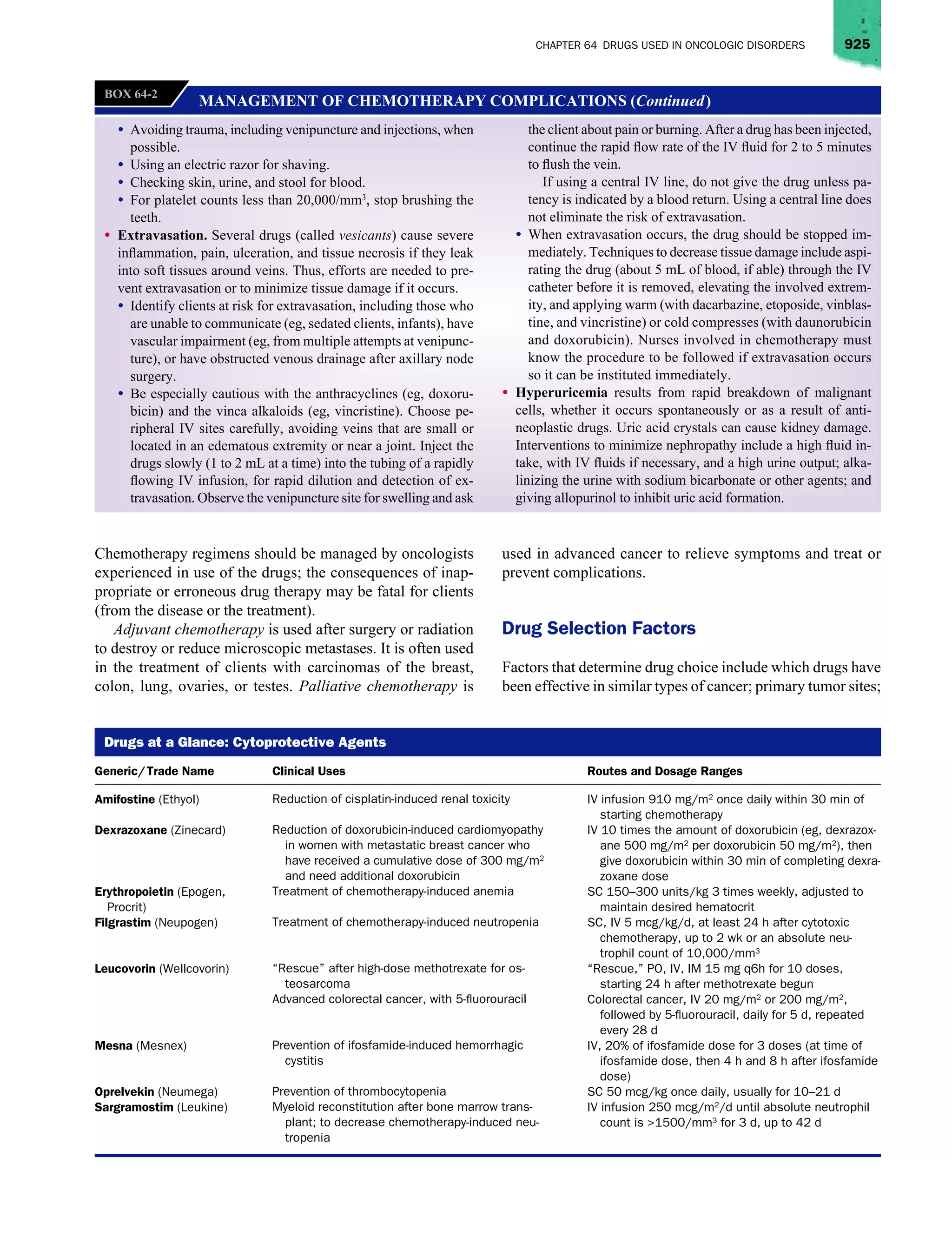
CHAPTER 64 DRUGS USED IN ONCOLOGIC DISORDERS               925


 BOX 64-2
                   MANAGEMENT OF CHEMOTHERAPY COMPLICATIONS (Continued)
     • Avoiding trauma, including venipuncture and injections, when                 the client about pain or burning. After a drug has been injected,
       possible.                                                                    continue the rapid flow rate of the IV fluid for 2 to 5 minutes
     • Using an electric razor for shaving.                                         to flush the vein.
     • Checking skin, urine, and stool for blood.                                      If using a central IV line, do not give the drug unless pa-
     • For platelet counts less than 20,000/mm3, stop brushing the                  tency is indicated by a blood return. Using a central line does
       teeth.                                                                       not eliminate the risk of extravasation.
 •   Extravasation. Several drugs (called vesicants) cause severe                • When extravasation occurs, the drug should be stopped im-
     inflammation, pain, ulceration, and tissue necrosis if they leak                mediately. Techniques to decrease tissue damage include aspi-
     into soft tissues around veins. Thus, efforts are needed to pre-               rating the drug (about 5 mL of blood, if able) through the IV
     vent extravasation or to minimize tissue damage if it occurs.                  catheter before it is removed, elevating the involved extrem-
     • Identify clients at risk for extravasation, including those who              ity, and applying warm (with dacarbazine, etoposide, vinblas-
       are unable to communicate (eg, sedated clients, infants), have               tine, and vincristine) or cold compresses (with daunorubicin
       vascular impairment (eg, from multiple attempts at venipunc-                 and doxorubicin). Nurses involved in chemotherapy must
       ture), or have obstructed venous drainage after axillary node                know the procedure to be followed if extravasation occurs
       surgery.                                                                     so it can be instituted immediately.
     • Be especially cautious with the anthracyclines (eg, doxoru-          •    Hyperuricemia results from rapid breakdown of malignant
       bicin) and the vinca alkaloids (eg, vincristine). Choose pe-              cells, whether it occurs spontaneously or as a result of anti-
       ripheral IV sites carefully, avoiding veins that are small or             neoplastic drugs. Uric acid crystals can cause kidney damage.
       located in an edematous extremity or near a joint. Inject the             Interventions to minimize nephropathy include a high fluid in-
       drugs slowly (1 to 2 mL at a time) into the tubing of a rapidly           take, with IV fluids if necessary, and a high urine output; alka-
       flowing IV infusion, for rapid dilution and detection of ex-               linizing the urine with sodium bicarbonate or other agents; and
       travasation. Observe the venipuncture site for swelling and ask           giving allopurinol to inhibit uric acid formation.


Chemotherapy regimens should be managed by oncologists                      used in advanced cancer to relieve symptoms and treat or
experienced in use of the drugs; the consequences of inap-                  prevent complications.
propriate or erroneous drug therapy may be fatal for clients
(from the disease or the treatment).
   Adjuvant chemotherapy is used after surgery or radiation                 Drug Selection Factors
to destroy or reduce microscopic metastases. It is often used
in the treatment of clients with carcinomas of the breast,                  Factors that determine drug choice include which drugs have
colon, lung, ovaries, or testes. Palliative chemotherapy is                 been effective in similar types of cancer; primary tumor sites;


 Drugs at a Glance: Cytoprotective Agents

Generic/Trade Name               Clinical Uses                                                Routes and Dosage Ranges

Amifostine (Ethyol)              Reduction of cisplatin-induced renal toxicity                IV infusion 910 mg/m2 once daily within 30 min of
                                                                                                 starting chemotherapy
Dexrazoxane (Zinecard)           Reduction of doxorubicin-induced cardiomyopathy              IV 10 times the amount of doxorubicin (eg, dexrazox-
                                   in women with metastatic breast cancer who                    ane 500 mg/m2 per doxorubicin 50 mg/m2), then
                                   have received a cumulative dose of 300 mg/m2                  give doxorubicin within 30 min of completing dexra-
                                   and need additional doxorubicin                               zoxane dose
Erythropoietin (Epogen,          Treatment of chemotherapy-induced anemia                     SC 150–300 units/kg 3 times weekly, adjusted to
   Procrit)                                                                                      maintain desired hematocrit
Filgrastim (Neupogen)            Treatment of chemotherapy-induced neutropenia                SC, IV 5 mcg/kg/d, at least 24 h after cytotoxic
                                                                                                 chemotherapy, up to 2 wk or an absolute neu-
                                                                                                 trophil count of 10,000/mm3
Leucovorin (Wellcovorin)         “Rescue” after high-dose methotrexate for os-                “Rescue,” PO, IV, IM 15 mg q6h for 10 doses,
                                   teosarcoma                                                    starting 24 h after methotrexate begun
                                 Advanced colorectal cancer, with 5-fluorouracil               Colorectal cancer, IV 20 mg/m2 or 200 mg/m2,
                                                                                                 followed by 5-fluorouracil, daily for 5 d, repeated
                                                                                                 every 28 d
Mesna (Mesnex)                   Prevention of ifosfamide-induced hemorrhagic                 IV, 20% of ifosfamide dose for 3 doses (at time of
                                   cystitis                                                      ifosfamide dose, then 4 h and 8 h after ifosfamide
                                                                                                 dose)
Oprelvekin (Neumega)             Prevention of thrombocytopenia                               SC 50 mcg/kg once daily, usually for 10–21 d
Sargramostim (Leukine)           Myeloid reconstitution after bone marrow trans-              IV infusion 250 mcg/m2/d until absolute neutrophil
                                   plant; to decrease chemotherapy-induced neu-                  count is >1500/mm3 for 3 d, up to 42 d
                                   tropenia
926         SECTION 11 DRUGS USED IN SPECIAL CONDITIONS


 CLIENT TEACHING GUIDELINES
 Managing Chemotherapy

 Most chemotherapy is given intravenously, in outpatient clin-        ✔ Inform any other physician, dentist, or health care provider
 ics, by nurses who are specially trained to administer the med-        that you are taking chemotherapy before any diagnostic
 ications and monitor your condition. The medications are               test or treatment is begun. Some procedures may be con-
 usually given in cycles such as every few weeks. There are             traindicated or require special precautions.
 many different chemotherapy drugs, and the ones used for a           ✔ If you are of childbearing age, effective contraceptive mea-
 particular client depend on the type of malignancy, its location,      sures should be carried out during and a few months after
 and other factors.                                                     chemotherapy.
     The goal of chemotherapy is to be as effective as possible       ✔ A few chemotherapy medications and medications to pre-
 with tolerable side effects. Particular side effects vary with the     vent or treat side effects are taken at home. Instructions
 medications used; some increase risks of infection, some               for taking the drugs should be followed exactly for the
 cause anemia, nausea, or hair loss. All of these can be man-           most beneficial effects.
 aged effectively, and several medications can help prevent or        ✔ Although specific instructions vary with the drugs you are
 minimize side effects. In addition, some helpful activities are        taking, the following are a few precautions with some
 listed below.                                                          commonly used drugs:
  ✔ Keep all appointments for chemotherapy, blood tests,                 ✔ With cyclophosphamide, take the tablets on an em-
      and check-ups. This is extremely important. Chemother-                 pty stomach. If severe stomach upset occurs, take
      apy effectiveness depends on its being given on time;                  with food. Also, drink 2 or 3 quarts of fluid daily, if
      blood tests help to determine when the drugs should be                 possible, and urinate often, especially at bedtime. If
      given and how the drugs affect your body tissues.                      blood is seen in the urine or signs of cystitis occur
  ✔ Do everything you can to avoid infection, such as avoid-                 (eg, burning with urination), report to a health care
      ing other people who have infections and washing your                  provider. The drug is irritating to the bladder lining
      hands frequently and thoroughly. If you have a fever,                  and may cause cystitis. High fluid intake and fre-
      chills, sore throat, or cough, notify your oncologist.                 quent emptying of the bladder help to decrease blad-
  ✔ Try to maintain or improve your intake of nutritious food                der damage.
      and fluids; this will help you feel better. A dietitian can be      ✔ With doxorubicin, the urine may turn red for 1 to 2 days
      helpful in designing a diet to meet your needs.                        after drug administration. This discoloration is harm-
  ✔ If your chemotherapy may cause bleeding, you can de-                     less; it does not indicate bleeding. Also, report to a
      crease the likelihood by shaving with an electric razor,               health care provider if you have edema, shortness of
      avoiding aspirin and other nonsteroidal anti-inflammatory               breath, and excessive fatigue. Doxorubicin may need
      drugs (including over-the-counter Advil, Aleve, and others),           to be stopped if these symptoms occur.
      and avoiding injections, cuts, and other injuries when pos-        ✔ With fluorouracil, drink plenty of liquids while taking.
      sible. If you notice excessive bruising, bleeding gums             ✔ With methotrexate, avoid alcohol, aspirin, and pro-
      when you brush your teeth, or blood in your urine or bowel             longed exposure to sunlight.
      movement, notify your oncologist immediately.                      ✔ With vincristine, eat high-fiber foods, such as raw
  ✔ If hair loss is expected with the medications you take, you              fruits and vegetables and whole cereal grains, if you
      can use wigs, scarves, and hats. These should be pur-                  are able, to prevent constipation. Also try to maintain
      chased before starting chemotherapy, if possible. Hair                 a high fluid intake. A stool softener or bulk laxative
      loss is temporary; your hair will grow back!                           may be prescribed for daily use.


presence and extent of metastases; and physical status of                 age the DNA, RNA, or proteins of the malignant cell,
the client, including other disease conditions that affect                and another drug can be chosen to prevent their repair
chemotherapy, such as liver or kidney disease. Most regimens              or synthesis.
use combinations of drugs because they are more effective, less         • Drugs should act at different times in the reproductive
toxic, and less likely to cause drug resistance than single agents.       cycle of the malignant cell. For example, more malig-
Numerous combinations have been developed for use in spe-                 nant cells are likely to be destroyed by combining cell
cific types of cancer. Selection and scheduling of individual              cycle–specific and cell cycle–nonspecific drugs. The
drugs in a multidrug regimen are based on efforts to maximize             first group kills only dividing cells; the second group
effectiveness and minimize adverse effects. Characteristics of            kills cells during any part of the life cycle, including the
effective drug combinations include the following:                        resting phase.
   • Each drug should have activity against the type of tumor           • Consecutive doses kill a percentage of the tumor cells
      being treated.                                                      remaining after earlier doses and further decrease the
   • Each drug should act by a different mechanism. Drugs                 tumor burden.
      can be combined to produce sequential or concurrent               • Toxic reactions of the various drugs should not overlap
      inhibition. For example, one drug can be chosen to dam-             so that maximal tolerated doses may be given. It is
CHAPTER 64 DRUGS USED IN ONCOLOGIC DISORDERS        927


     preferable to use drugs that are not toxic to the same               soon as possible after surgery, given in maximal tol-
     organ system (eg, bone marrow, kidney) and to use drugs              erated doses just as if advanced disease were present,
     that do not exert their toxic effects at the same time.              and continued for several months.
   • Bleomycin is often combined with myelosuppres-                    4. Intravenous drug administration should be performed by
     sive drugs because it rarely causes myelosuppression.                experienced personnel who ensure free flow of fluid to
     However, it can cause severe allergic reactions with                 the vein and verify adequate blood return before a drug
     hypotension and pulmonary toxicity (eg, interstitial                 is injected. Infusion should be through a large, upper ex-
     pneumonitis and pulmonary fibrosis).                                  tremity vein. When possible, veins of the antecubital
                                                                          fossa, wrist, dorsum of the hand, and the arm where an
                                                                          axillary lymph node dissection has been done should be
Dosage Factors
                                                                          avoided. An indwelling central venous catheter is often
                                                                          inserted for clients with poor peripheral venous access
Dosage must be calculated and regulated carefully to mini-
                                                                          or who require many doses of chemotherapy.
mize toxicity. The client’s age, nutritional status, blood count,
                                                                       5. With bleomycin, a test dose of 1 to 2 mg subcutaneously
kidney and liver function, and previous chemotherapy or
                                                                          should be given before starting full doses. Severe aller-
radiation therapy must be considered. Additional guidelines
                                                                          gic reactions with hypotension may occur.
include the following:
                                                                       6. With paclitaxel and docetaxel, premedication is needed
   1. High doses, to the limits of tolerance of normal tissues
                                                                          to decrease severe hypersensitivity reactions with dys-
       (eg, bone marrow), are usually most effective.
                                                                          pnea, hypotension, angioedema, and urticaria. A few
   2. Doses are usually calculated according to body surface
                                                                          deaths have occurred despite premedication. With pa-
       area, which includes both weight and height, and ex-
                                                                          clitaxel, one regimen is oral dexamethasone 20 mg at
       pressed as milligrams of drug per square meter of body
                                                                          12 and 6 hours before, with IV diphenhydramine 50 mg
       surface area (mg/m2). Doses also can be expressed as
                                                                          and cimetidine 300 mg, famotidine 20 mg, or ranitidine
       milligrams per kilogram of body weight (mg/kg). Be-
                                                                          50 mg 30 to 60 minutes before. Additional paclitaxel
       cause dosages based on body surface area consider the
                                                                          is contraindicated for clients who experience severe
       client’s size, they are especially important for children.
                                                                          hypersensitivity reactions. With docetaxel, an oral cor-
       If the client’s weight changes more than a few pounds
                                                                          ticosteroid (eg, dexamethasone 8 mg twice daily) is
       during treatment, dosages should be recalculated.
                                                                          recommended for 3 days, starting 1 day before doc-
   3. Dosage may be reduced for neutropenia, thrombo-
                                                                          etaxel administration. This reduces risk and severity of
       cytopenia, stomatitis, diarrhea, and renal or hepatic
                                                                          hypersensitivity reactions and fluid retention.
       impairment that reduces the client’s ability to eliminate
       the drugs.
   4. Total dose limits for doxorubicin (550 mg/m2) and             Hormonal Therapy
       bleomycin (450 units) should not be exceeded.
                                                                    Hormonal therapy is often used to treat breast or prostate can-
                                                                    cer. Decreasing the hormones that stimulate tumor growth in
Administration Factors                                              these tissues can decrease symptoms and prolong survival.
                                                                        In some clients with breast cancer, the presence of recep-
   1. Dosage schedules are largely determined by clinical
                                                                    tors for estrogen indicates a likely response to hormonal ther-
      trials and should be followed as exactly as possible.
                                                                    apy. Tamoxifen is often used to treat breast cancers with
   2. Antineoplastic drugs are usually given in relatively
                                                                    estrogen receptors because it inhibits the interaction between
      high doses, on an intermittent or cyclic schedule. This
                                                                    estrogen and estrogen receptors. However, tumors may be re-
      regimen seems more effective than low doses given
                                                                    sistant to hormonal therapy because of mutations in receptors
      continuously or massive doses given once. It also pro-
                                                                    that alter receptor functions. In clients with prostate cancer,
      duces less immunosuppression and provides drug-free
                                                                    hormonal therapy involves drugs that decrease androgens.
      periods during which normal tissues can repair them-
                                                                        When both hormonal and cytotoxic drug therapies are
      selves from damage inflicted by the drugs. Fortunately,
                                                                    needed, they are not given concurrently because hormonal
      normal cells repair themselves faster than malignant
                                                                    antagonists decrease malignant cell growth, and cytotoxic
      cells. Succeeding doses are given when tissue repair
                                                                    agents are most effective when the cells are actively dividing.
      occurs, usually when leukocyte and platelet counts re-
                                                                    In clients with breast cancer, hormonal therapy is usually given
      turn to acceptable levels.
                                                                    before cytotoxic chemotherapy in metastatic disease and after
   3. Each antineoplastic drug should be used in the sched-
                                                                    chemotherapy when used for adjuvant treatment.
      ule, route, and dosage judged to be most effective for
      a particular type of cancer. With combinations of
      drugs, the recommended schedule should be followed            Planning With Client and Family
      precisely because safety and effectiveness may be
      schedule dependent. When chemotherapy is used as              Clients with cancer and their families should be provided
      an adjuvant to surgery, it usually should be started as       with information about their disease, their treatment options,
928        SECTION 11 DRUGS USED IN SPECIAL CONDITIONS


and the preferred treatment. For those with Internet access,          4. Dispose of contaminated materials (eg, needles, syringes,
helpful information can be obtained at:                                  ampules, vials, IV tubing and bags) in puncture-proof
   CancerNet, http://www.cancer.gov/cancer_information                   containers labeled “Warning: Hazardous Material.”
   CancerNews on the Net, http://www.cancernews.com/                  5. Wear gloves when handling clients’ clothing, bed linens,
      quickload.htm                                                      or excreta. Blood and body fluids are contaminated with
   Oncolink, http://cancer.med.upenn.edu                                 drugs or metabolites for about 48 hours after a dose.
   When cytotoxic chemotherapy is recommended, addi-                  6. Wash hands thoroughly after exposure or potential
tional factors should be discussed, such as the following;               exposure.
   1. What is the goal of chemotherapy? Expected bene-                7. Follow recommended procedures for cleaning up spills.
       fits may include curing the disease, decreasing tumor
       size, relieving symptoms, killing metastatic cells left
       after surgery or radiation therapy, or prolonging life.     Use in Children
       Chemotherapy is not justified unless expected benefits
       outweigh the potential hazards.                             Children are at risk for a wide range of malignancies, includ-
   2. What adverse reactions are likely to occur? Which            ing acute leukemias, lymphomas, brain tumors, Wilms’ tumor,
       reactions should be reported to the physician? How          and sarcomas of muscle and bone. Although chemotherapy
       will they be managed if they occur? Even if the reali-      drugs are widely used in children, few studies have been done
       ties of chemotherapy are unpleasant, it is usually bet-     and their safety and effectiveness are not established. As with
       ter for the client to know what they are than to fear the   adults, chemotherapy is often used with surgery or radiation
       unknown. Some specific effects that should be dis-           therapy.
       cussed, depending on the drugs to be used, include             Chemotherapy should be designed and supervised by pe-
       alopecia, amenorrhea, oligospermia, and possibly per-       diatric oncologists. Dosage of cytotoxic drugs should be based
                                                                   on body surface area because this takes size into account.
       manent sterility. Because most of these drugs are ter-
                                                                   Long-term effects on growth and development of survivors
       atogenic, clients in the reproductive years are advised
                                                                   are not clear and special efforts are needed to maintain nutrition,
       to avoid pregnancy during treatment.
                                                                   organ function, psychological support, and other aspects of
   3. Who will administer the drugs, where, and for how
                                                                   growth and development. After successful chemotherapy, chil-
       long? Chemotherapy is highly specialized. Because
                                                                   dren should be closely monitored because they are at increased
       the drugs are toxic and require meticulous administra-
                                                                   risk for development of cancers in adulthood (eg, leukemia).
       tion, they are preferably given at a cancer treatment
                                                                   After radiation therapy, they are at increased risk of devel-
       center. Some clients undergo chemotherapy at a cancer
                                                                   oping breast, thyroid, or brain cancer. Children treated for
       center far from home; others undergo treatment at a
                                                                   Hodgkin’s disease seem to have the highest risk of develop-
       nearby hospital, clinic, physician’s office, or at home.     ing a new cancer later.
       The duration of treatment varies, depending on the type
       of tumor and response.
   Clients should be informed about the frequent venipunc-
                                                                   Use in Older Adults
tures required for blood tests and drug administration. When
CBC indicates excessive leukopenia or thrombocytopenia,
                                                                   Older adults are at risk for a wide range of cancers. Although
chemotherapy is postponed.
                                                                   they also are likely to have chronic cardiovascular, renal, and
                                                                   other disorders that increase their risks of serious adverse
Guidelines for Handling Cytotoxic
Antineoplastic Drugs

Exposure to chemotherapy drugs may lead to adverse effects          Nursing Notes: Ethical/Legal Dilemma
such as contact dermatitis, cough, nausea, vomiting, diarrhea,
and others. In addition, exposure during pregnancy increases
risks of fetal abnormalities, ectopic pregnancy, and sponta-        You are working on an oncology unit and have recently become
                                                                    certified to administer antineoplastic medications. You read a
neous abortions. Guidelines to avoid adverse effects include
                                                                    new study that documents significant cancer with contact expo-
the following:
                                                                    sure to a new antineoplastic agent.
   1. Avoid contact with solutions for injection by wearing
       gloves, eye protectors, and protective clothing (eg, dis-    Reflect on:
       posable, liquid-impermeable gowns).                          • Does a nurse have the right to refuse to administer this new
   2. If handling a powder form of a drug, wear a mask to              medication if he or she feels it poses a personal health risk?
       avoid inhaling the powder.                                   • The nurse’s responsibility for his or her own safety.
   3. Do not prepare the drugs in eating areas (to decrease         • The institution’s responsibility for the safety of the workers in
                                                                       this situation.
       risks of oral ingestion).
CHAPTER 64 DRUGS USED IN ONCOLOGIC DISORDERS          929


effects, they should not be denied the potential benefits of             • Mercaptopurine should be given in smaller doses
chemotherapy on the basis of age alone. Instead, greater vig-             because the drug may be eliminated more slowly.
ilance is needed to maximize benefits and minimize hazards               • Methotrexate is excreted mainly by the kidneys and its
of chemotherapy. For example, older adults are more sensi-                 use in clients with impaired renal function may lead to
tive to the neurotoxic effects of vincristine and need reduced             accumulation of toxic amounts or additional renal dam-
dosages of some drugs (eg, cyclophosphamide, MTX) if                       age. The client’s renal status should be evaluated before
renal function is impaired. Creatinine clearance should be                 and during MTX therapy. If significant renal impair-
monitored; serum creatinine level is not a reliable indicator              ment occurs, the drug should be discontinued or re-
of renal function in older adults because of their decreased               duced in dosage until renal function improves.
muscle mass.                                                                  In clients who receive high doses for treatment of os-
                                                                           teosarcoma, MTX may cause renal damage leading to
                                                                           acute renal failure. Nephrotoxicity is attributed to precip-
Use in Renal Impairment                                                    itation of MTX and a metabolite in renal tubules. Renal
                                                                           impairment may be reduced by monitoring renal function
Some antineoplastic drugs are nephrotoxic (eg, cisplatin, MTX)             closely, ensuring adequate hydration, alkalinizing the
and many are excreted through the kidneys. In the presence                 urine, and measuring serum drug levels.
of impaired renal function, risks of further impairment or ac-           • Procarbazine may cause more severe adverse effects if
cumulation of toxic drug levels are increased. Thus, renal                 given to clients with impaired renal function. Hospital-
function should be monitored carefully during therapy and                  ization is recommended for the first course of treatment.
drug dosages are often reduced according to creatinine clear-            Many other drugs should be used with caution in clients
ance (CrCl) levels. In advanced cancer, CrCl may not be              with renal impairment. Asparaginase often causes azotemia
reliable because these clients are often in catabolic states char-   (eg, increased BUN); acute renal failure and fatal renal in-
acterized by increased production of creatinine from break-          sufficiency have been reported. Bleomycin is rarely associated
down of skeletal muscle and other proteins. Renal effects of         with nephrotoxicity but its elimination half-life is prolonged in
selected drugs are as follows:                                       clients with a CrCl of less than 35 mL/minute. Cytarabine is
    • Carmustine and lomustine are associated with azotemia          detoxified mainly by the liver. However, clients with renal im-
      and renal failure, usually with long-term IV administra-       pairment may have more CNS-related adverse effects, and
      tion and large cumulative doses.                               dosage reduction may be needed. Gemcitabine should be used
    • Cisplatin is nephrotoxic, and acute overdosage can             with caution, although it has not been studied in clients with
      cause renal failure. Because nephrotoxicity is increased       preexisting renal impairment. Mild proteinuria and hematuria
      with repeated doses, cisplatin is given at 3- or 4-week        were commonly reported during clinical trials, and hemolytic-
      intervals and renal function tests (eg, serum creatinine,      uremic syndrome (HUS) was reported in a few clients. HUS
      blood urea nitrogen [BUN]) and serum electrolytes              may be manifested by anemia, indications of blood cell break-
      (eg, sodium, potassium, calcium) are measured before           down (eg, elevated bilirubin and reticulocyte counts), and renal
      each course of therapy. Renal function is usually al-          failure. The drug should be stopped immediately if HUS
      lowed to return to normal before another dose is given.        occurs; hemodialysis may be required.
      Nephrotoxicity may be reduced by the use of amifostine
      or IV hydration and mannitol.
    • Cyclophosphamide may cause hemorrhagic ureteritis              Use in Hepatic Impairment
      and renal tubular necrosis with IV doses above 50 mg/kg.
      These effects usually subside when the drug is stopped.        Some antineoplastic drugs are hepatotoxic and many are me-
    • Ifosfamide may increase BUN and serum creatinine,              tabolized in the liver. In the presence of impaired hepatic
      but its major effect on the urinary tract is hemorrhagic       function, risks of further impairment or accumulation of toxic
      cystitis, manifested by hematuria. Cystitis can be re-         drug levels are increased. Dosage reduction is needed with
      duced by the use of mesna, vigorous hydration, and de-         some drugs and hepatic function should be monitored with
      laying drug administration if a predose urinalysis shows       most. However, abnormal values for the usual liver function
      hematuria.                                                     tests (eg, serum aminotransferases such as aspartate amino-
    • Irinotecan dosage should be reduced (eg, 0.75 mg/m2)           transferase [AST] and alanine aminotransferase [ALT], biliru-
      in clients with moderate impairment (CrCl 20 to                bin, alkaline phosphatase) may indicate liver injury but do not
      39 mL/minute). No dosage reduction is recommended              indicate decreased ability to metabolize drugs. Clients with
      with mild impairment (CrCl 40 to 60 mL/minute), and            metastatic cancer often have impaired liver function.
      there are inadequate data for recommendations in                  Hepatotoxic drugs include the anthracyclines (eg, doxoru-
      severe impairment.                                             bicin), mercaptopurine, MTX, paclitaxel, and vincristine. He-
    • Melphalan should be reduced in dosage when given               patic effects of these and selected other drugs are as follows:
      IV, to reduce accumulation and increased bone marrow              • Asparaginase is hepatotoxic in most clients and may
      toxicity. It is unknown whether dosage reduction is                  increase preexisting hepatic impairment. It may also in-
      needed with oral drug.                                               crease hepatotoxicity of other medications. Signs of
930        SECTION 11 DRUGS USED IN SPECIAL CONDITIONS


    liver impairment, which usually subside when the drug                more likely to occur after prolonged use (eg, 2 years or
    is discontinued, include increased AST, ALT, alkaline                longer) and after a total dose of at least 1.5 g. Cautious
    phosphatase, and bilirubin and decreased serum albu-                 use of MTX is especially indicated in clients with pre-
    min, cholesterol, and plasma fibrinogen.                              existing liver damage or impaired hepatic function.
•   Capecitabine blood levels are significantly increased                 Liver function tests should be closely monitored.
    with hepatic impairment, and clients with mild to mod-             • Paclitaxel is mainly metabolized by the liver and may
    erate impairment caused by liver metastases should be                cause more toxicity in clients with impaired hepatic
    monitored closely. The effects of severe impairment                  function.
    have not been studied.                                             • Procarbazine causes more toxic effects in clients with
•   Carmustine may increase AST, ALT, alkaline phos-                     hepatic impairment. Hospitalization is recommended
    phatase, and bilirubin when given IV.                                for the first course of therapy.
•   Chlorambucil may be hepatotoxic and cause jaundice.                • Topotecan is cleared from plasma more slowly in
•   Cisplatin may cause a transient increase in liver en-                clients with hepatic impairment, but dosage reductions
    zymes and bilirubin, which should be measured period-                are not recommended.
    ically during cisplatin therapy.                                   • Vinblastine and vincristine may cause more toxicity
•   Cytarabine is metabolized in the liver and clients with              with hepatic impairment and dosage should be reduced
    impaired liver function are more likely to have CNS-                 50% for clients with a direct serum bilirubin value above
    related adverse effects. The drug should be used with                3 mg/dL.
    caution and dosage may need to be reduced.                         Other drugs that should be used with caution because of
•   Dacarbazine is hepatotoxic, and a few cases of he-             their hepatic effects include the antineoplastic hormones and
    patic vein thrombosis and fatal liver necrosis have            hormone antagonists. The antiandrogens include bicalutamide,
    been reported.                                                 flutamide, and nilutamide. Bicalutamide has a long serum
•   Daunorubicin, liposomal formulation, should be reduced         half-life in clients with severe hepatic impairment. Excretion
    in dosage according to the serum bilirubin (eg, bilirubin      may be delayed and the drug may accumulate. The drug
    1.2 to 3 mg/dL, give three fourths the normal dose;            should be used with caution in clients with moderate to se-
    bilirubin >3 mg/dL, give one half the normal dose).            vere hepatic impairment, and liver function tests are needed
•   Doxorubicin is excreted primarily in bile and toxicity         periodically during long-term therapy. Flutamide is associ-
    is increased with impaired hepatic function. Liver func-       ated with serum aminotransferase abnormalities, cholestatic
    tion tests should be done before drug administration,          jaundice, hepatic encephalopathy, hepatic necrosis, and a
    and dosage of both regular and liposomal formulations          few deaths. Liver function tests should be performed peri-
    should be reduced according to the serum bilirubin             odically and at the first sign or symptom of liver dysfunction
    (eg, bilirubin 1.2 to 3 mg/dL, give one half the normal        (eg, pruritus, dark urine, jaundice). Flutamide should be dis-
    dose; bilirubin >3 mg/dL, give one fourth the normal           continued if jaundice develops in clients who do not have
    dose).                                                         liver metastases or if serum aminotransferase levels increase
•   Gemcitabine has not been studied in clients with sig-          more than 2 to 3 times the upper limit of normal. Liver dam-
    nificant hepatic impairment but should be used with             age usually subsides if flutamide is discontinued or if dosage
    caution. Transient increases in serum aminotransferases        is reduced. Nilutamide may cause hepatitis or increases in
    occurred in most clients during clinical trials.               liver enzymes. Liver enzymes should be checked at baseline
•   Idarubicin should not be given to clients with a serum         and every 3 months. If symptoms of liver injury occur or if
    bilirubin above 5 mg/dL.                                       aminotransferases increase over 2 to 3 times the upper limits
•   Irinotecan has been associated with abnormal liver             of normal, nilutamide should be discontinued.
    function tests in clients with liver metastases.                   Medroxyprogesterone should be stopped if any mani-
•   Mercaptopurine causes hepatotoxicity, especially               festations of impaired liver function develop. Tamoxifen and
    with higher doses (>2.5 mg/kg/day) and in combina-             toremifene are antiestrogens. Tamoxifen is associated with
    tion with doxorubicin. Encephalopathy and fatal liver          changes in liver enzyme levels and occasionally more severe
    necrosis have occurred. The drug should be stopped if          liver damage, including fatty liver, cholestasis, hepatitis, and
    signs of hepatotoxicity (eg, jaundice, hepatomegaly,           hepatic necrosis. Toremifene’s elimination half-life is pro-
    liver function tests indicating toxic hepatitis or biliary     longed in clients with hepatic cirrhosis or fibrosis.
    stasis) occur. Serum aminotransferases, alkaline phos-
    phatase, and bilirubin should be monitored weekly
    with initial therapy, then monthly. Liver function tests                Home Care
    may be needed more often in clients who have pre-
    existing liver impairment or are receiving other hepa-         Clients may receive parenteral cytotoxic drugs as outpatients
    totoxic drugs.                                                 and return home, or the drugs may be administered at home by
•   Methotrexate may cause acute (increased serum amino-           the client or a caregiver. The home care nurse may be involved
    transferases, hepatitis) and chronic (fibrosis and cirrhosis)   in a wide range of activities associated with chemotherapy,
    hepatotoxicity. Chronic toxicity is potentially fatal. It is   including administering antineoplastic drugs, administering
CHAPTER 64 DRUGS USED IN ONCOLOGIC DISORDERS              931


drugs to prevent or manage adverse effects, and assessing client        neously, the client or a caregiver may need to be taught
and family responses to therapy. In addition, a major role in-          injection technique.
volves teaching about the disease process, management of                   The home care nurse also needs to teach clients and care-
pain and other symptoms, the anticancer drugs, prevention or            givers about safe handling of chemotherapeutic agents, in-
management of adverse drug effects, preventing infection,               cluding items contaminated with the drugs and client body
maintaining food and fluid intake, and other aspects of care.            fluids or excreta. Precautions need to be similar to those used
If a client is receiving erythropoietin or oprelvekin subcuta-          in health care agencies.


 NURSING
 ACTIONS                    Antineoplastic Drugs

 NURSING ACTIONS                                                        RATIONALE/EXPLANATION

 1. Administer accurately
    a. If not accustomed to giving cytotoxic antineoplastic drugs       Cancer chemotherapy requires advanced knowledge and skills and
    regularly, read package inserts, research protocols, or other re-   most agencies require instruction and demonstration of competency.
    cent drug references for specific instructions on administration     Current information is necessary because of the large number and
    of individual drugs.                                                varied characteristics of the drugs; differences in administration ac-
                                                                        cording to the drug and type of neoplasm; and continuing develop-
                                                                        ment of new drugs and treatment protocols.
    b. For IV drug administration:
       (1) Compare labels on prepared solutions to medication or-       Many of the drugs must be reconstituted from a powder and fur-
       ders in terms of the drug, concentration, expiration date,       ther diluted in an IV solution. Drug solutions are usually prepared
       and instructions for administration. Do not give without         in the pharmacy; multiple checks may prevent errors.
       checking further if there is any discrepancy.
       (2) Follow instructions for administering each drug. Com-        Because the drugs are highly toxic, every precaution must be taken
       mon methods include injecting the drug into the tubing of a      to ensure accurate and safe administration.
       rapidly flowing IV or infusing the drug over a specified pe-
       riod of minutes to hours.
       (3) For clients with a long-term venous access device (eg,       Long-term devices decrease the number of venipunctures a client
       Hickman or Groshong catheter), follow agency protocols           must undergo. These devices require special care to maintain pa-
       for drug administration and catheter care.                       tency and prevent infection.
       (4) Follow agency protocols for skin exposure or spills of       These solutions are hazardous materials that require special
       cytotoxic drug solutions.                                        handling.
    c. For drugs to be given orally, the total dose of most drugs
    can be given at one time.
 2. Observe for therapeutic effects                                     Therapeutic effects depend to a large extent on the type of malig-
    a. Increased appetite                                               nancy being treated. They may not become evident for several
                                                                        weeks after chemotherapy is begun. Some clients experience
    b. Increased feelings of well-being                                 anorexia, nausea, and vomiting for 2 to 3 wk after each cycle of
    c. Improved mobility                                                drug therapy.
    d. Decreased pain
    e. Laboratory and diagnostic tests that indicate improvement
 3. Observe for adverse effects                                         Antineoplastic drugs may have adverse effects on virtually any
                                                                        body tissue. These effects range from common to rare, from rela-
                                                                        tively mild to life threatening, and occur with usual dosage ranges.
                                                                        Myelosuppressive effects are used to guide drug therapy.


                                                                                                                                 (continued )
932        SECTION 11 DRUGS USED IN SPECIAL CONDITIONS


NURSING ACTIONS                                                      RATIONALE/EXPLANATION

  a. Hematologic effects:
      (1) Bone marrow depression with leukopenia                     For most drugs, WBC and platelet counts reach their lowest points
          (decreased white blood cell [WBC] count), thrombo-         (nadirs) 7 to 14 d after drug administration and return toward nor-
          cytopenia (decreased platelets), and anemia                mal after 21 d. Normal leukocyte and platelet counts indicate re-
                                                                     covery of bone marrow function. Anemia may occur later because
          (decreased red blood cell [RBC] count, hemoglobin,         the red blood cell lives longer than white cells and platelets.
          and hematocrit)
      (2) Decreased antibodies and lymphocytes                       Most of these drugs have immunosuppressant effects, which
                                                                     impair body defenses against infection.
  b. Gastrointestinal (GI) effects—anorexia, nausea, vomiting,       Nausea and vomiting are very common, usually occur within a few
  diarrhea, constipation, oral and intestinal mucositis and mu-      hours of drug administration, and often subside within 12 to 24 h.
  cosal ulcerations, oral candidiasis                                Constipation is most likely to occur with vincristine. Mucositis may
                                                                     occur anywhere in the GI tract; may interfere with nutrition and
                                                                     cause significant discomfort; may lead to infection, hemorrhage, or
                                                                     perforation; and may require that drug therapy be stopped.
  c. Integumentary effects—alopecia, dermatitis, tissue irrita-      Complete hair loss may take several weeks to occur. Alopecia may
  tion at injection sites                                            cause psychological discomfort. Several drugs may cause phlebitis
                                                                     and sclerosis of veins used for injections, as well as pain and tis-
                                                                     sue necrosis if allowed to leak into tissues around the injection site.
  d. Renal effects:
      (1) Hyperuricemia and uric acid nephropathy                    When malignant cells are destroyed, they release uric acid into the
                                                                     bloodstream. Uric acid crystals may precipitate in the kidneys and
                                                                     cause impaired function or failure. Adverse effects on the kidneys
                                                                     are especially associated with methotrexate and cisplatin. Hyper-
                                                                     uricemia can be decreased by an ample fluid intake or by adminis-
                                                                     tration of allopurinol.
      (2) With cisplatin, nephrotoxicity (increased blood urea ni-   Nephrotoxicity is a major adverse effect. Decreasing the dose or
      trogen [BUN] and serum creatinine; decreased creatinine        frequency of administration, vigorous hydration, and amifostine
      clearance).                                                    administration can reduce the incidence.
      (3) With cyclophosphamide or ifosfamide, hemorrhagic           Hemorrhagic cystitis occurs in about 10% of clients. It is attributed
      cystitis (blood in urine, dysuria, burning on urination)       to irritating effects of drug metabolites on the bladder mucosa. The
                                                                     drug is stopped if this occurs. Cystitis can be decreased by an ample
                                                                     fluid intake. In addition, mesna is given with ifosfamide.
  e. Pulmonary effects—cough, dyspnea, chest x-ray changes           Adverse effects on the lungs are associated mainly with bleomycin
                                                                     and methotrexate. With bleomycin, pulmonary toxicity may be
                                                                     severe and progress to pulmonary fibrosis.
  f. Cardiovascular effects—congestive heart failure (dyspnea,       Cardiomyopathy is associated primarily with doxorubicin and re-
  edema, fatigue), dysrhythmias, electrocardiographic changes        lated drugs. This is a life-threatening adverse reaction. The heart
                                                                     failure may be unresponsive to digoxin.
  g. Central nervous system effects—peripheral neuropathy with       This common effect of vincristine may worsen for several weeks
  vincristine, manifested by muscle weakness, numbness and tin-      after drug administration. There is usually some recovery of func-
  gling of extremities, foot drop, and decreased ability to walk     tion eventually.
  h. Endocrine effects—menstrual irregularities, sterility in men
  and women


                                                                                                                               (continued )
CHAPTER 64 DRUGS USED IN ONCOLOGIC DISORDERS            933


NURSING ACTIONS                                                        RATIONALE/EXPLANATION

4. Observe for drug interactions
   a. Drugs that increase effects of cytotoxic antineoplastic drugs:
      (1) Allopurinol                                                  Allopurinol is usually given to prevent or treat chemotherapy-
                                                                       induced hyperuricemia. When given with mercaptopurine, allo-
                                                                       purinol facilitates the formation of the active metabolite. Conse-
                                                                       quently, doses of mercaptopurine must be reduced to one third to
                                                                       one fourth the usual dose.
      (2) Anticoagulants, oral                                         Increased risk of bleeding
      (3) Bone marrow depressants                                      Increased bone marrow depression
      (4) Other antineoplastic drugs                                   Additive cytotoxic effects, both therapeutic and adverse
   b. Drugs that increase effects of cyclophosphamide:
      (1) Anesthetics, inhalation                                      Lethal combination. Discontinue cyclophosphamide at least 12 h
                                                                       before general inhalation anesthesia is to be given.
      (2) Carbamazepine, phenytoin, rifampin                           Potentiate cyclophosphamide by induction of liver enzymes, which
                                                                       accelerate transformation of the drug into its active metabolites
      (3) Other myelosuppressive antineoplastic drugs                  Increased bone marrow depression
   c. Drugs that increase effects of methotrexate (MTX):
      (1) Alcohol                                                      Additive liver toxicity. Avoid concomitant use.
      (2) Aspirin, nonsteroidal anti-inflammatory drugs (NSAIDs),       Potentiate MTX by displacing it from protein-binding sites in
      phenytoin, procarbazine, sulfonamides                            plasma. Salicylates also block renal excretion of methotrexate.
                                                                       This may cause pancytopenia and liver toxicity.
      (3) Other hepatotoxic drugs                                      Additive liver toxicity
      (4) Other antineoplastic drugs                                   Additive cytotoxic effects, both therapeutic and adverse. Cisplatin
                                                                       may induce renal damage that impairs MTX excretion, increases
                                                                       blood levels, and increases toxicity.
      (5) Trimethoprim-sulfamethoxazole (TMP-SMX, Bactrim)             Increased MTX toxicity; avoid concurrent administration if
                                                                       possible.
   d. Drug that decreases effects of methotrexate:
      (1) Leucovorin (citrovorum factor, folinic acid)                 Leucovorin antagonizes the toxic effects of methotrexate and is
                                                                       used as an antidote for high-dose methotrexate regimens or for
                                                                       overdose. It must be given exactly at the specified time, before
                                                                       affected cells become too damaged to respond.
   e. Drugs that increase effects of vinca alkaloids:
      (1) Erythromycin increases vinblastine toxicity; itracona-       These drugs probably inhibit metabolism of vinblastine and vin-
      zole increases vincristine toxicity                              cristine.
934         SECTION 11 DRUGS USED IN SPECIAL CONDITIONS


                                                                       5. Which drugs are associated with second malignancies?
 Nursing Notes: Apply Your Knowledge                                   6. What is the basis for the anticancer effects of hormones
                                                                          and antihormones?
 Answer: Platelets, red blood cells and white blood cells are pro-     7. For which cytotoxic drugs are cytoprotective drugs avail-
 duced in the bone marrow. The production of any of these cells           able?
 can decrease when an antineoplastic agent with a side effect of       8. List at least one intervention to prevent or minimize each
 bone marrow depression is given. The impact is greatest at nadir.        of the following adverse effects of chemotherapy: alope-
 When platelets decrease below 50,000/mm3 there is an increased
                                                                          cia, anemia, bleeding, infection, nausea and vomiting,
 risk of bleeding, which may manifest as increased bruising,
 blood in the stool, dark urine, or even seizures and confusion if
                                                                          stomatitis.
 the bleeding is intracranial. When red blood cells decrease, as ev-
 idenced by a hemoglobin of less than 9 g/dL, the patient will ex-
 perience anemia and fatigue. White blood cell (WBC) count is a        SELECTED REFERENCES
 measure of the body’s ability to fight infection. Neutrophils are
                                                                       Balmer, C. M. & Valley, A. W. (2002). Cancer treatment and chemotherapy.
 white blood cells that are especially helpful in fighting infection;
                                                                          In J. T. DiPiro, R. L. Talbert, G. C. Yee, G. R. Matzke, B. G. Wells, &
 thus when the WBC count is low, a neutrophil count is done. A            L. M. Posey (Eds.), Pharmacotherapy: A pathophysiologic approach,
 patient with neutrophil counts of less than 500/mm3 is at signif-        5th ed., pp. 2175–2222. New York: McGraw-Hill.
 icant risk for infection. Common signs of infection are often me-     Blattner, W. A. (2000). Etiology of malignant disease. In H. D. Humes (Ed.),
 diated by neutrophils. So the signs and symptoms of infection            Kelley’s Textbook of internal medicine, 4th ed., pp. 141–147. Philadelphia:
 may be low in the neutropenic patient.                                   Lippincott Williams & Wilkins.
     Patient teaching should focus on avoiding infection (good         Chabner, B. A., Seiden, M., & Clark, J. (2000). Principles of chemotherapy
 handwashing, avoiding contact with infected individuals), espe-          and hormonal therapy. In H. D. Humes (Ed.), Kelley’s Textbook of inter-
 cially if the neutrophil count is low. The patient should report         nal medicine, 4th ed., pp. 1835–49. Philadelphia: Lippincott Williams &
 any fever, even low-grade fever. Fatigue can be managed with             Wilkins.
                                                                       Caudell, K. A. (2002). Alterations in cell differentiation: Neoplasia. In C. M.
 frequent rest, energy conservation measures, and good nutrition.
                                                                          Porth (Ed.), Pathophysiology: Concepts of altered health states, 6th ed.,
 When platelets are low, patients should be taught to avoid
                                                                          pp. 149–179. Philadelphia: Lippincott Williams & Wilkins.
 trauma. The importance of keeping appointments for monitoring         Drug facts and comparisons. (Updated monthly). St. Louis: Facts and
 should be stressed so that blood products can be given if values         Comparisons.
 are critically low.                                                   Duncan, K. M., Ogawa, G., & Clibon, U. (2000). Supportive care therapies for
                                                                          patients with cancer. In E. T. Herfindal & D. R. Gourley (Eds.), Textbook of
                                                                          therapeutics: Drug and disease management, 7th ed., pp. 1693–1713.
                                                                          Philadelphia: Lippincott Williams & Wilkins.
        Review and Application Exercises                               Goldsby, R. A., Kindt, T. J., & Osborne, B. A. (2000). Kuby Immunology,
                                                                          4th ed. New York: W. H. Freeman and Co.
                                                                       May, S. K. (2000). Significant drug-drug interactions with antineoplastics.
1. List major characteristics of malignant cells.                         Hospital Pharmacy, 35(11), 1207–1217.
2. Which common cancers are attributed mainly to environ-              Mullin, S., Beckwith, M. C. & Tyler, L. S. (2000). Prevention and man-
                                                                          agement of antineoplastic extravasation injury. Hospital Pharmacy,
   mental factors? Which are attributed to genetic factors?
                                                                          35(1), 57–74.
3. How do cytotoxic antineoplastic drugs destroy malignant             Pitot, H. C. (2002). Fundamentals of oncology, 4th ed. New York: Marcel
   cells?                                                                 Dekker.
                                                                       Rosen, R. H. (2002). Management of chemotherapy-induced nausea and
4. Which cytotoxic antineoplastic drugs are associated with               vomiting. Journal of Pharmacy Practice, 15(1), 32–41.
   serious adverse effects (eg, bone marrow suppression, car-          Stucky-Marshall, L. (1999). New agents in gastrointestinal malignancies:
   diotoxicity, hepatotoxicity, nephrotoxicity, neurotoxicity)?           Part 2. Gemcitabine in clinical practice. Cancer Nursing, 22, 290–296.

Clinical drug therapy nursing capitulo onco

  • 1.
    chapter 64 Drugs Usedin Oncologic Disorders Objectives AFTER STUDYING THIS CHAPTER, THE STUDENT WILL BE ABLE TO: 1. Contrast normal and malignant cells. 5. Describe pharmacologic and nonpharmacologic 2. Describe major types of antineoplastic drugs interventions to prevent or minimize adverse in terms of mechanism of action, indications drug effects. for use, administration, and nursing process 6. Promote reduction of risk factors for develop- implications. ment of cancer and early recognition of cancer 3. Discuss the rationales for using chemotherapeu- signs and symptoms. tic drugs in combination with each other, with 7. Manage or assist clients/caregivers in manag- surgical treatment, and with radiation therapy. ing symptoms associated with chemotherapy 4. Discuss common and potentially serious regimens. adverse drug effects. Critical Thinking Scenario Georgia Sommers, a 39 year-old mother of 4, is diagnosed with breast cancer that was detected by routine mammography. She is recovering from a modified radical mastectomy when she comes to the clinic to dis- cuss additional treatment with chemotherapy with the oncologist. He explains that she will receive combina- tion therapy with three drugs on a cycle of every 4 weeks. Reflect on: Possible reactions of Ms. Sommers to a diagnosis of cancer. What is the role of the nurse during the period of initial diagnosis? How will you assess Ms. Sommers concerns regarding chemotherapy? What are the benefits of combination (using more than one drug) therapy? What impact do you think chemotherapy might have on Ms. Sommers’ ability to function normally and meet normal demands of life? OVERVIEW met. The normal cell cycle is the interval between the “birth” of a cell and its division into two daughter cells (Fig. 64–1). Oncology is the study of malignant neoplasms and their treat- The daughter cells may then enter the resting phase (G0) or ment. Drugs used in oncologic disorders include those used to proceed through the reproductive cycle to form more new kill, damage, or slow the growth of cancer cells, and those used cells. Normal cells are also well differentiated in appearance to prevent or treat adverse drug effects. Antineoplastic drug and function and have a characteristic lifespan. therapy, commonly called chemotherapy, is a major treat- Malignant cells serve no useful purpose in the body. In- ment modality for cancer, along with surgery and radiation stead, they occupy space and take blood and nutrients away therapy. To aid understanding of chemotherapy, selected from normal tissues. They grow in an uncontrolled fashion characteristics of cancer are described below. and avoid the restraints (eg, contact with other cells) that stop the growth of normal cells. They are undifferentiated, which means they have lost the structural and functional character- NORMAL AND MALIGNANT CELLS istics of the cells from which they originated. They are loosely connected, so that cells break off from the primary Normal cells reproduce in response to a need for growth or tumor and invade adjacent tissues. Loose cells also enter tissue repair and stop reproduction when the need has been blood and lymph vessels, by which they circulate through the 913
  • 2.
    914 SECTION 11 DRUGS USED IN SPECIAL CONDITIONS mutations of normal growth-regulating genes called proto- G0 oncogenes, which are present in all body cells. Normally, G1 proto-oncogenes are active for a brief period in the cell re- productive cycle. When exposed to carcinogens and genetically altered to oncogenes, however, they may operate continuously and cause abnormal, disordered, and unregulated cell growth. Unregulated cell growth and proliferation increases the prob- ability of neoplastic transformation of the cell. Tumors of the breast, colon, lung, and bone have been linked to activation of oncogenes. M S Tumor suppressor genes (anti-oncogenes) normally func- tion to regulate and inhibit inappropriate cellular growth and proliferation. Abnormal tumor suppressor genes (ie, absent, damaged, mutated, or inactivated) may be inherited or re- sult from exposure to carcinogens. When these genes are in- activated, a block to proliferation is removed and the cells begin unregulated growth. One tumor suppressor gene, p53, G2 is present in virtually all normal tissues. When cellular de- oxyribonucleic acid (DNA) is damaged, the p53 gene allows Figure 64–1 Normal cell cycle. The normal cell cycle (the interval be- time for DNA repair and restricts proliferation of cells with tween the birth of a cell and its division into two daughter cells) in- volves several phases. During the resting phase (G0), cells perform all abnormal DNA. Mutations of the p53 gene, a common ge- usual functions except replication; that is, they are not dividing but are netic change in cancer, are associated with more than 90% of capable of doing so when stimulated. Different types of cells spend small-cell lung cancers and more than 50% of breast and different lengths of time in this phase, after which they either reenter colon cancers. Mutant p53 proteins can also form complexes the cell cycle and differentiate or die. During the first active phase (G1), ribonucleic acid (RNA) and enzymes required for production of de- with normal p53 proteins and inactivate the function of the oxyribonucleic acid (DNA) are developed. During the next phase (S), normal suppressor gene. DNA is synthesized for chromosomes. During G2, RNA is synthesized, Thus, activation of oncogenes and inactivation of anti- and the mitotic spindle is formed. Mitosis occurs in the final phase oncogenes probably both play roles in cancer development. (M). The resulting two daughter cells may then enter the resting phase Multiple genetic abnormalities are usually characteristic of (G0) or proceed through the reproductive cycle. cancer cells and may occur concurrently or sequentially. Overall, evidence indicates that neoplastic transformation is a progressive process involving several generations of body and produce additional neoplasms at sites distant from cells, with each new generation becoming more like malig- the primary tumor (metastasis). nant cells. Thus, malignancy probably results from a combi- A malignant cell develops from a transformed normal cell. nation of factors experienced over a person’s lifetime. One The transformation may begin with a random mutation (ab- factor may be a random cell mutation. However, mutations normal structural changes in the genetic material of a cell). A and malignancies are increased in people exposed to certain mutated cell may be destroyed by body defenses (eg, an im- chemical, physical, or biologic factors, especially in large mune response), or it may replicate. During succeeding cell amounts or for long periods of time. Some carcinogens and divisions, additional changes and mutations may produce risk factors are listed in Box 64–1. Once a cancer develops, cells with progressively fewer normal and more malignant factors influencing the growth rate include blood and nutri- characteristics. It usually takes years for malignant cells to ent supply, immune response, and hormonal stimulation produce a clinically detectable neoplasm. (eg, in tumors of the breast, uterus, ovary, and prostate). CANCER Classification of Malignant Neoplasms The term cancer is used to describe many disease processes Malignant neoplasms are classified according to the type of with the common characteristics of uncontrolled cell growth, tissue involved, the rate of growth, and other characteristics. invasiveness, and metastasis, as well as numerous etiologies, With the exception of the acute leukemias, they are considered clinical manifestations, and treatments. One theory of carcino- chronic diseases. genesis involves abnormal genes and cells, in which cancer Hematologic malignancies involve the bone marrow and may be caused by mutation of genes (abnormal structural lymphoid tissues; they include leukemias, lymphomas, and changes in cellular genetic material), abnormal activation of multiple myeloma. Leukemias are cancers of the bone marrow genes that regulate cell growth and mitosis, or lack of tumor characterized by overproduction of abnormal white blood cells. suppressor genes. The abnormal genes, called oncogenes, are The four main types are acute lymphocytic; acute myelo-
  • 3.
    CHAPTER 64 DRUGSUSED IN ONCOLOGIC DISORDERS 915 BOX 64-1 CARCINOGENS AND RISK FACTORS Despite extensive study, the cause of cancer is not clear. Because women who took the drugs for menopausal symptoms. With breast cancer is actually many diseases, many etiologic factors are proba- cancer, endogenous estrogens are clearly causative, but the role of bly involved. The factors that initiate the transformation of a single exogenous estrogens is less clear. Oral contraceptives, most of normal cell into a malignant cell and allow tumor growth are com- which contain an estrogen and a progestin, have been related to en- plex and overlapping, including the environmental and host factors dometrial cancer and possibly to breast cancer. A progestin taken described below. to prevent estrogen-induced endometrial cancer may increase risks of breast cancer. The antiestrogen tamoxifen, which is widely used Environmental Carcinogens to prevent or treat breast cancer, is associated with endometrial can- Biologic carcinogens include several infections, mainly viral. cer. Androgens and anabolic steroids, especially with high doses Viruses linked to cancer include Epstein-Barr (Burkitt lymphoma, and prolonged use, have been associated with hepatic neoplasms. Hodgkin’s disease); hepatitis B and C (liver cancer); herpes sim- plex II (cancer of cervix and vulva); human papilloma (cancer of the Host Factors cervix, penis, oral cavity, esophagus, larynx); human immunodefi- Age. Except for a few early childhood cancers, the risks of can- ciency (Kaposi’s sarcoma); and human T-cell lymphotropic (T-cell cer increase with age. leukemia or lymphoma). In addition, Helicobacter pylori, the bac- Alcohol use may make carcinogens more soluble or enhance terium that causes most gastric and duodenal ulcers, is also associ- their tissue penetration. Cancers associated with alcohol use ated with gastric cancer and gastric lymphoma. include those of the breast, head and neck, and liver. Radiation (eg, from sunlight and tanning beds) can damage Diet. A high-fat diet is associated with breast, colon, and prostate DNA and cause mutations by changing cell structure or causing cancer; a low-fiber diet may increase risks of colon cancer. damage that interferes with transfer of genetic information during Sex. Men are more likely to have leukemia and cancer of the cell reproduction. urinary bladder, stomach, and pancreas; women are at risk Chemicals include numerous substances that can damage cel- of cancer of the breast, cervix, and endometrium. Lung and lular structures and interfere with cell replication and regulation. colon cancer occur equally in both sexes. Industrial carcinogens include benzene (bladder cancer), Geography and ethnicity are more environmental than heredi- hydrocarbons (lung and skin cancer), polyvinyl chloride (liver tary or racial. Immigrants who adopt dietary and lifestyle cancer), and other substances used in the production of various habits of natives have similar risks and people who live in products. Workers who manufacture the products and people who cities have greater risks because of greater exposure to air live in the plant vicinity are most likely to be affected. Tobacco pollutants and other carcinogens. In the United States, products contain numerous carcinogens and are associated with African Americans have higher rates of multiple myeloma cancers of the lungs, mouth, pharynx, larynx, esophagus, and blad- and cancers of the lung, prostate, esophagus, and pancreas der. Chemicals in cigarette smoke cause most lung cancer, in than white people. smokers and other people exposed to cigarette smoke. Children Heredity. In some families, there is a strong tendency toward development of cancer. For example, close relatives of pre- whose parents smoke have an increased risk of brain cancer, lym- menopausal women with breast cancer are at high risk for phomas, and acute lymphocytic leukemia. Smokeless tobacco breast cancer. products are also carcinogens. Immunosuppression, whether caused by disease or drug ther- Therapeutic drugs are associated with both hematologic and apy, is associated with an increased risk of cancer. For ex- solid neoplasms. The alkylating antineoplastic drugs are associated ample, clients with acquired immunodeficiency syndrome with leukemia, lymphoma, and other cancers. The drugs damage are at risk for Kaposi’s sarcoma, and clients who undergo DNA and interfere with growth or replication of tumor cells. At the organ transplantation and receive immunosuppressant drugs same time, they may damage the DNA of normal cells and trans- are at risk for lymphomas and skin cancers. form some of them into malignant cells. Clients who are given Obesity has been associated with increased risks of developing these drugs and survive their illness have an increased risk of de- cancer of the breast, colon, endometrium, esophagus, liver, veloping leukemia for 15 to 20 years. Antineoplastic drugs that pancreas, and prostate gland. cause bone marrow suppression or immunosuppression may also Previous cancer is associated with a higher risk of other cancers lead to secondary cancer. Immunosuppressants (eg, azathioprine in those who are treated and survive (eg, children with and corticosteroids in renal transplant recipients) are associated leukemia may develop other cancers; women with cancer in with an increased risk of non-Hodgkin’s lymphoma, which may one breast have a higher risk of cancer in the other breast; fe- appear within months of transplantation, and for later skin cancer male survivors of Hodgkin’s disease have a greater risk of de- (eg, squamous cell carcinoma and malignant melanoma) and veloping breast cancer than the general population; patients Kaposi’s sarcoma. Other clients on immunosuppressant drugs are who received radiation may develop bone and soft tissue sar- at risk for lymphomas, squamous cell carcinoma of skin, and soft comas; those who received radiation to the neck area may de- tissue sarcomas, but at lower rates than transplant recipients. For velop thyroid cancer; and patients who received radiation to example, leukemia and solid tumors have been reported in clients the head may develop brain tumors). Secondary cancers are who took azathioprine for rheumatoid arthritis. usually attributed to treatments that damage DNA and even- Sex hormones are growth factors for certain cells. Estrogens are tually transform normal cells into malignant cells. associated with cancer of the vagina in daughters of women who Tobacco use is a major lifestyle risk factor for cancers of the took the drugs during pregnancy and with endometrial cancer in lung, esophagus, and head and neck.
  • 4.
    916 SECTION 11 DRUGS USED IN SPECIAL CONDITIONS genous; chronic lymphocytic; and chronic myelogenous. ANTINEOPLASTIC DRUGS Lymphomas are tumors of lymphoid tissue characterized by abnormal proliferation of the white blood cells normally General Characteristics found in lymphoid tissue. They usually develop within lymph nodes and may occur anywhere, because virtually all body 1. Most drugs kill malignant cells by interfering with tissues contain lymphoid structures. The two main types are cell replication, with the supply and use of nutrients Hodgkin’s disease and non-Hodgkin’s lymphoma. Multiple (eg, amino acids, purines, pyrimidines), or with the myeloma is a tumor of the bone marrow in which abnormal genetic materials in the cell nucleus (DNA or RNA). plasma cells proliferate. Because normal plasma cells pro- 2. The drugs act during the cell’s reproductive cycle duce antibodies and abnormal plasma cells cannot fulfill this (Fig. 64–2). Some, called cell cycle specific, act mainly function, the body’s immune system is impaired. As the ma- during specific phases such as DNA synthesis or forma- lignant cells expand, they crowd out normal cells, interfere tion of the mitotic spindle. Others act during any phase with other bone marrow functions, infiltrate and destroy of the cell cycle and are called cell cycle nonspecific. bone, and eventually metastasize to other tissues, such as the 3. Cytotoxic drugs are most active against rapidly divid- spleen, liver, and lymph nodes. ing cells, both normal and malignant. Commonly dam- Solid neoplasms are composed of a mass of malignant aged normal cells are those of the bone marrow, the cells (parenchyma) and a supporting structure of connective lining of the gastrointestinal tract, and the hair follicles. tissue, blood vessels, and lymphatics (stroma). The two 4. Each drug dose kills a specific percentage of cells. To major classifications are carcinomas and sarcomas. Carci- achieve a cure, all malignant cells must be killed or nomas are derived from epithelial tissues (skin, mucous reduced to a small number that can be killed by the membrane, linings and coverings of viscera) and are the person’s immune system. most common type of malignant tumors. They are further 5. Antineoplastic drugs may induce drug-resistant malig- classified by cell type, such as adenocarcinoma or basal cell nant cells. Mechanisms may include inhibiting drug up- carcinoma. Sarcomas are derived from connective tissue take or activation, increasing the rate of drug inactivation, (muscle, bone, cartilage, fibrous tissue, fat, blood vessels). pumping the drug out of the cell before it can act, in- They are subclassified by cell type (eg, osteogenic sarcoma, creasing cellular repair of DNA damaged by the drugs, angiosarcoma). or altering metabolic pathways and target enzymes of the drugs. Mutant cells also may emerge. 6. Most cytotoxic antineoplastic drugs are potential ter- Grading and Staging of atogens. 7. Most antineoplastic drugs are given orally or intra- Malignant Neoplasms venously (IV); some are given topically, intrathecally, or by instillation into a body cavity. When a malignant neoplasm is identified, it is further “graded” 8. A few drugs are available in liposomal preparations. according to the degree of malignancy and “staged” accord- These preparations increase drug concentration in ing to tissue involvement. Grades 1 and 2 are similar to the malignant tissues and decrease concentration in nor- normal tissue of origin and show cellular differentiation; mal tissues, thereby increasing effectiveness while grades 3 and 4 are unlike the normal tissue of origin, less dif- decreasing toxicity. For example, liposomal doxoru- ferentiated, and more malignant. Staging indicates whether the bicin and daunorubicin reduce the drugs’ cardiotoxic neoplasm is localized or metastasized and which organs are in- effects. volved. These characteristics assist in treatment (eg, localized tumors are usually amenable to surgical or radiation therapy; metastatic disease requires systemic therapy). Cell Cycle Phases of Cell Cycle Nonspecific Cell Cycle Specific Effects of Cancer on the Host Alkylating agents G0 Effects vary according to the location and extent of the dis- Antibiotics G1 Steroids ease process. There are few effects initially. As the neoplasm grows, effects occur when the tumor becomes large enough Nitrosoureas S Antimetabolites to cause pressure, distortion, or deficient blood supply in sur- rounding tissues; interfere with organ function; obstruct ducts G2 Podophyllotoxins and organs; and impair nutrition of normal tissues. More M Taxanes or taxoids specific effects include anemia, malnutrition, pain, infection, hemorrhagic tendencies, thromboembolism, hypercalcemia, Vinca alkaloids cachexia, and various symptoms related to impaired function of affected organs and tissues. Figure 64–2 Cell cycle effects of cytotoxic antineoplastic drugs.
  • 5.
    CHAPTER 64 DRUGSUSED IN ONCOLOGIC DISORDERS 917 Indications for Use approved in 2002 for treatment of colorectal cancer in patients whose disease has recurred or worsened following standard Cytotoxic antineoplastic drugs are used in the treatment of therapy. It is used with 5-fluorouracil and leucovorin and given malignant neoplasms to cure the disease, relieve symptoms, every 2 weeks by injection. Adverse effects include peripheral or induce or maintain remissions (symptom-free periods that neuropathy, vomiting, diarrhea, and anemia. last for varying lengths of time). Chemotherapy is the treatment of choice for Hodgkin’s disease, leukemia, Wilms’ tumor, and Ewing’s sarcoma, but it is less effective in cancers of the Antimetabolites lung, colon, and prostate gland. Antimetabolites are substances that are structurally similar to In hematologic neoplasms, drug therapy is the treatment normal metabolites. They are allowed to enter cancer cells of choice because the disease is systemic rather than local- because they are similar to nutrients needed by the cells for ized. In solid tumors, drug therapy is often used before or reproduction. Once inside the cell, the drugs may compete after surgery or radiation therapy. with, replace, or antagonize the normal metabolite. These ac- Antineoplastic drugs are sometimes used in the treatment tions deprive the cell of substances needed for formation of of nonmalignant conditions. For example, small doses of DNA or cause formation of abnormal DNA. The drugs are methotrexate (MTX) are used for rheumatoid arthritis and cell cycle specific because they exert their cytotoxic effects psoriasis. only during the S phase of the cell’s reproductive cycle, when DNA is being synthesized. This group includes a folic acid antagonist (eg, methotrex- Classifications ate), purine antagonists (eg, mercaptopurine), and pyrimidine antagonists (eg, fluorouracil). These drugs have been used to Cytotoxic antineoplastic drugs are usually classified in terms treat many types of cancers, but they are most effective against of their mechanisms of action (alkylating agents and anti- rapidly growing tumors, and individual drugs vary in their metabolites) or their sources (plant alkaloids, antibiotics). effectiveness with different kinds of cancer. Toxic effects Other drugs used in chemotherapy are immunostimulants (see include bone marrow depression, mucositis and ulceration of Chap. 44), hormones, hormone inhibitors, and cytoprotectants. the GI tract, and hair loss (alopecia). Alkylating Agents Antitumor Antibiotics Alkylating agents include nitrogen mustard derivatives, ni- These drugs (eg, doxorubicin) are active in all phases of the trosoureas, and platinum compounds. Nitrogen mustard de- cell cycle and their cytotoxic effects are similar to those of rivatives (eg, cyclophosphamide) interfere with cell division the alkylating agents. They bind to DNA so that DNA and and the structure of DNA during all phases of the malignant RNA transcription is blocked. Major toxicities are bone mar- cell cycle. As a result, they have a broad spectrum of activ- row depression and GI upset. Doxorubicin and related drugs ity. They are most effective in hematologic malignancies but also cause cardiotoxicity and tissue necrosis if extravasation also are used to treat breast, lung, and ovarian tumors. All of occurs. Bleomycin may cause significant pulmonary toxicity. these drugs cause significant myelosuppression (bone mar- All of these drugs except bleomycin must be given IV. row depression). Nitrosoureas also interfere with DNA replication and RNA synthesis and may inhibit essential enzymatic reactions of can- Plant Alkaloids cer cells. They are cell cycle nonspecific and have been used in clients with gastrointestinal (GI), lung, and brain tumors. They Plant alkaloids include derivatives of camptothecin (eg, topote- are highly lipid soluble and therefore enter the brain and cere- can), podophyllotoxin (eg, etoposide), taxanes (eg, pacli- brospinal fluid more readily than other antineoplastic drugs. taxel), and plants of the Vinca genus (eg, vincristine). These They cause delayed bone marrow depression, with maximum drugs vary in their characteristics and clinical uses. leukopenia and thrombocytopenia occurring 5 to 6 weeks after drug administration. As a result, the drugs are given less often than other drugs, and complete blood counts (CBCs) are needed weekly for at least 6 weeks after a dose. Nursing Notes: Apply Your Knowledge Platinum compounds are cell cycle–nonspecific agents that inhibit DNA, RNA, and protein synthesis. Cisplatin is widely used to treat both hematologic and solid cancers. Adverse Your patient, Sally Moore is receiving an antineoplastic drug that effects include severe nausea and vomiting, nephrotoxicity, is known to cause bone marrow depression, with a nadir (lowest and ototoxicity. Carboplatin is most often used to treat en- point) 12 days after administration. Discuss the effects of bone marrow depression and appropriate nursing assessments. What dometrial and ovarian carcinomas and it produces bone marrow teaching would be appropriate for this patient? depression as a major adverse effect. Oxaliplatin (Eloxatin) was
  • 6.
    918 SECTION 11 DRUGS USED IN SPECIAL CONDITIONS Camptothecins (also called DNA topoisomerase inhibitors) It may cause severe bone marrow depression. Ibritumomab is inhibit an enzyme required for DNA replication and repair. a conjugated antibody used to treat non-Hodgkin’s lymphoma. They have activity in several types of cancers, including col- It is used with rituximab and may cause severe bone marrow orectal, lung, and ovarian cancers. Dose-limiting toxicity is depression and fatal infusion-related reactions. Rituximab is myelosuppression. used to treat non-Hodgkin’s lymphoma. Common adverse Podophyllotoxins act mainly in the G2 phase of the cell effects include infusion reactions (hypoxia, acute respiratory cycle and prevent mitosis. Etoposide is used mainly to treat tes- distress syndrome, myocardial infarction, ventricular dys- ticular and small cell lung cancer; teniposide is used mainly for rhythmias, cardiogenic shock) and lymphopenia. childhood acute lymphocytic leukemia. Dose-limiting toxicity is myelosuppression. Miscellaneous Cytotoxic Agents Taxanes inhibit cell division (antimitotic effects). They are used mainly for advanced breast and ovarian cancers. Miscellaneous agents vary in their sources, mechanisms of Dose-limiting toxicity is neutropenia. action, indications for use, and toxic effects. L-Asparaginase Vinca alkaloids are cell cycle–specific agents that stop (Elspar) is an enzyme that inhibits cellular protein synthesis mitosis. These drugs have similar structures but different anti- and reproduction by depriving cells of required amino acids. neoplastic activities and adverse effects. Vincristine is used It is used to treat acute lymphocytic leukemia and can cause to treat Hodgkin’s disease, acute lymphoblastic leukemia, allergic reactions, including anaphylaxis. Pegaspargase (On- and non-Hodgkin’s lymphomas. Vinblastine is used to treat caspar) is a modified formulation for people who are hyper- Hodgkin’s disease and choriocarcinoma; vinorelbine is used sensitive to Elspar. Hydroxyurea acts in the S phase of the cell to treat non–small cell lung cancer. The drugs can cause se- cycle to impair DNA synthesis. It is used to treat leukemia, vere tissue damage with extravasation (leaking of medication melanoma, and advanced ovarian cancer. A major adverse into soft tissues around the venipuncture site). In addition, effect is myelosuppression. Procarbazine inhibits DNA, RNA, vinblastine and vinorelbine are more likely to cause bone and protein synthesis. It is used to treat Hodgkin’s disease. It marrow depression, and vincristine is more likely to cause is a monoamine oxidase inhibitor and may cause hypertension peripheral nerve toxicity. if given with adrenergic drugs, tricyclic antidepressants, or foods with high tyramine content (see Chap. 10). Common adverse effects include leukopenia and thrombocytopenia. Monoclonal Antibodies Miscellaneous biotherapy agents include interferons (see Monoclonal antibodies (see Chap. 45) are produced from one Chap. 44) and imatinib (Gleevec). Interferon alfa (Roferon-A, cell line. For antitumor effects in cancer, they are designed to Intron A) is used to treat hairy cell leukemia, chronic my- combine with growth factor receptors on malignant cell sur- elogenous leukemia, Kaposi’s sarcoma, and other cancers. faces and inhibit tumor growth. Researchers also conjugate Imatinib is a tyrosine kinase inhibitor that inhibits cell pro- monoclonal antibodies with radioisotopes, toxins, chemother- liferation and increases cell death in chronic myelogenous apeutic agents, and drug-filled liposomes to increase their leukemia. It is also used to treat a rare type of cancer called effectiveness and deliver antineoplastic drugs to specific areas gastrointestinal stromal tumor and is being investigated for of the body. use in other cancers. It is given orally and its side effects Cancer cells have more growth factor receptors than healthy include edema, cramps, nausea, and anemia. cells. For example, 20% to 30% of women with breast cancer have an excessive number of HER2 receptors. A monoclonal Hormones and Hormone Inhibitors antibody, trastuzumab (Herceptin), was developed specifi- cally to bind with HER2 receptors and inhibit malignant cell Hormones interfere with protein synthesis and inhibit tumor growth. This antibody is used with other antineoplastic drugs growth in hormone-dependent tissues. The goal of therapy is to improve response in women with metastatic breast can- control of tumor growth and palliation of symptoms rather cer. A major adverse effect is the development of congestive than cure. Hormones are not cytotoxic and adverse effects are heart failure. The drug should not be used with doxorubicin usually mild. or cyclophosphamide, because of increased risks of cardio- Sex hormones (estrogens, progestins, androgens) are use- vascular toxicity. ful in cancers of the breast, prostate gland, and other repro- Other monoclonal antibodies available for clinical use in- ductive organs. Adrenal corticosteroids suppress formation clude alemtuzumab (Campath IH), ibritumomab tiuxetan and function of lymphocytes and therefore are most useful in (Zevalin), gemtuzumab (Mylotarg), and rituximab (Rituxan). the treatment of leukemia and lymphoma. They are also used Alemtuzumab binds to molecules on T and B cells in lympho- for complications of cancer (eg, brain metastases, hypercal- cytic leukemia. Major adverse effects include allergic reac- cemia) and with radiation therapy to reduce radiation-related tions, leukopenia, and pancytopenia. Because of the high risk edema in the mediastinum, brain, and spinal cord. Dexa- of infection, patients are treated prophylactically with anti- methasone is commonly used in neurologic disorders. biotic, antifungal, and antiviral drugs during and for 3 months Hormone inhibitors include aromatase inhibitors after therapy. Gemtuzumab, an antibody conjugated with an (eg, anastrozole) that inhibit estrogen synthesis, antiestrogens antitumor antibiotic, is used to treat acute myeloid leukemia. (eg, tamoxifen) that bind to estrogen receptors and block
  • 7.
    CHAPTER 64 DRUGSUSED IN ONCOLOGIC DISORDERS 919 estrogen action; aminoglutethimide, an adrenocorticosteroid- mia, malnutrition, weight loss, pain, and infection; specific inhibiting agent that produces a “medical adrenalectomy”; manifestations depend on the organs affected. and goserelin and leuprolide, which inhibit testosterone se- Assess for other diseases and organ dysfunctions (eg, car- cretion in advanced prostatic cancer and inhibit production of diac, renal or hepatic) that influence response to chemo- estrogen in advanced breast cancer. therapy. Assess emotional status, coping mechanisms, family relationships, and financial resources. Anxiety and depres- INDIVIDUAL DRUGS sion are common features during cancer diagnosis and treatment. Cytotoxic antineoplastic drugs are listed in Drugs at a Glance: Assess laboratory test results before chemotherapy to es- Cytotoxic Antineoplastic Drugs; hormones and hormone in- tablish baseline data and during chemotherapy to monitor hibitors are listed in Drugs at a Glance: Antineoplastic Hor- drug effects: mones and Hormone Inhibitors. • Blood tests for tumor markers (tumor-specific antigens on cell surfaces). Alpha-fetoprotein is a fetal antigen nor- CYTOPROTECTANT DRUGS mally present during intrauterine and early postnatal life but absent in adulthood. Increased amounts may indicate Cytoprotectants reduce the adverse effects of cytotoxic drugs, hepatic or testicular cancer. Carcinoembryonic antigen which may be severe, debilitating, and life threatening (CEA) is secreted by several types of malignant cells (eg, (Box 64–2). Severe adverse effects may also limit drug CEA is present in approximately 75% of people with dosage or frequency of administration, thereby limiting the colorectal cancer). A rising level may indicate tumor pro- effectiveness of chemotherapy. Several cytoprotectants are gression and levels that are elevated before surgery and available to protect certain body tissues from one or more ad- disappear after surgery indicate adequate tumor excision. verse effects and allow a more optimal dose and schedule of If CEA levels rise later, it probably indicates tumor re- cytotoxic agents. To be effective, administration and sched- currence. In chemotherapy, falling CEA levels indicate uling must be precise in relation to administration of the effectiveness. Other tumor markers are immunoglobulins cytotoxic agent. A cytoprotective agent does not prevent or (elevated levels may indicate multiple myeloma) and treat all adverse effects of a particular cytotoxic agent and it prostate-specific antigen (elevated levels may indicate may have adverse effects of its own. prostatic cancer). Amifostine produces a metabolite that combines with • Complete blood cell count (CBC) to check for anemia, cisplatin and ameliorates cisplatin-induced renal damage. leukopenia, and thrombocytopenia because most cyto- Dexrazoxane decreases cardiac toxicity of doxorubicin. toxic antineoplastic drugs cause bone marrow depression. Erythropoietin, filgrastim, oprelvekin, and sargramostim A CBC and white blood cell differential are done before are colony-stimulating factors (see Chap. 44) that stimulate each cycle of chemotherapy to determine dosage and fre- the bone marrow to produce blood cells. Erythropoietin stim- quency of drug administration, to monitor bone marrow ulates production of red blood cells and is used for anemia; function so fatal bone marrow depression does not occur, oprelvekin stimulates production of platelets and is used to and to assist the nurse in planning care. For example, the prevent thrombocytopenia; filgrastim and sargramostim stim- client is very susceptible to infection when the leukocyte ulate production of white blood cells and are used to reduce count is low, and bleeding is likely when the platelet neutropenia and the risk of severe infection. Leucovorin is count is low. used with high-dose MTX. Mesna is used with ifosfamide, • Other tests. These include tests of kidney and liver func- which produces a metabolite that causes hemorrhagic cysti- tion, serum calcium, uric acid, and others, depending on tis. Mesna combines with and inactivates the metabolite and the organs affected by the cancer or its treatment. thereby decreases cystitis. Dosages and routes of adminis- Nursing Diagnoses tration for these medications are listed in Drugs at a Glance: • Pain, nausea and vomiting, weakness, and activity intol- Cytoprotective Agents. erance related to disease process or chemotherapy • Imbalanced Nutrition: Less Than Body Requirements re- lated to disease process or chemotherapy • Anxiety related to the disease, its possible progression, Nursing Process and its treatment • Ineffective Family Coping related to illness and treatment Assessment of a family member Assess the client’s condition before chemotherapy is started • Deficient Fluid Volume related to chemotherapy-induced and often during treatment. Useful information includes the nausea, vomiting, and diarrhea type, grade, and stage of the tumor as well as the signs and • Risk for Injury: Infection related to drug-induced neu- symptoms of cancer. General manifestations include ane- tropenia; bleeding related to drug-induced thrombo-
  • 8.
    920 SECTION 11 DRUGS USED IN SPECIAL CONDITIONS cytopenia; stomatitis related to damage of GI mucosal • Physiologic care includes pain management, comfort cells measures, and assistance with nutrition, hygiene, ambu- • Deficient Knowledge about cancer chemotherapy and lation, and other activities of daily living as needed. managing adverse drug effects • Psychological care includes allowing family members or significant others to be with the client and participate in Planning/Goals care when desired, and keeping clients and families in- The client will: formed. • Receive assistance in coping with the diagnosis of cancer Evaluation • Experience reduced anxiety and fear • Receive chemotherapy accurately and safely • Monitor drug administration for accuracy. • Experience reduction of tumor size, change of laboratory • Observe and interview for therapeutic effects of chemo- values toward normal, or other therapeutic effects of therapy. chemotherapy • Compare current laboratory reports with baseline values • Experience minimal bleeding, infection, nausea and vom- for changes toward normal values. iting, and other consequences of chemotherapy • Compare weight and nutritional status with baseline val- • Maintain adequate food and fluid intake and body weight ues for maintenance or improvement. • Receive assistance in activities of daily living when • Observe and interview for adverse drug effects and inter- needed ventions to prevent or manage them. • Be informed about community resources for cancer care • Observe and interview for adequate pain management (eg, hospice, Reach to Recovery, other support groups) and other symptom control. Interventions Participate in and promote efforts to prevent cancer. • Follow and promote the diet recommended by the PRINCIPLES OF THERAPY American Cancer Society (ie, decrease fat; eat five or more servings of fruits and vegetables daily; increase in- Overview of Cancer Treatment take of dietary fiber; minimize intake of salt-cured or smoked foods). Most cancer treatment involves surgery, radiation, and chemo- • Promote weight control. Obesity may contribute to the therapy. Optimal regimens maximize effectiveness (eg, attempt development of several cancers, including breast and en- to eradicate tumor cells at primary, regional, and systemic dometrial cancer in women. sites) and minimize morbidity (eg, pain and treatment- • Identify cancer-causing agents and strategies to reduce related toxicity). exposure to them when possible. Surgery is used to excise small, localized tumors, which • Strengthen host defenses by promoting a healthful may be curative; to remove tumors that have been reduced in lifestyle (eg, good nutrition, adequate rest and exercise, size by radiation therapy, chemotherapy, or both; and to treat stress management techniques, avoiding or minimizing complications of cancer, such as bowel obstruction. Surgical alcohol and tobacco use). risks are greater in clients who have received preoperative • Avoid smoking cigarettes and being around smokers. radiation therapy or chemotherapy. Passive smoking increases risk of lung cancer in spouses Radiation therapy is used to treat most types of cancer. of smokers and risks of brain cancer, lymphomas, and It may be used alone to cure some malignancies such as acute lymphogenous leukemia in children of smokers. Hodgkin’s disease or cervical cancer. It may be used with • Minimize exposure to sunlight, use sunscreens liber- surgery to reduce the need for radical surgery (eg, in breast ally, and wear protective clothing to prevent skin cancer. cancer, excision of small tumors plus radiation therapy is as Participate in and promote cancer screening tests in non- effective as mastectomy). With soft tissue sarcomas of the symptomatic people, especially those at high risk, to detect limbs, wide excision plus radiation therapy can be used in- cancer before signs and symptoms occur. These tests in- stead of amputation. Radiation is also used to eliminate local clude regular examination of breasts, testicles, and skin and or regional malignant cells (eg, positive lymph nodes) that re- tests for colon cancer such as hemoccult tests on stool and main after surgery; with chemotherapy to cure or control sigmoidoscopy. Early recognition of risk factors, premalig- growth of tumors; and as a palliative treatment in metastatic nant tissue changes (dysplasia), biochemical tumor mark- disease, such as relieving symptoms in clients with bone or ers, and beginning malignancies may be lifesaving; early brain involvement. treatment can greatly reduce the suffering and problems as- Cytotoxic chemotherapy is most effective when started be- sociated with advanced cancer. fore extensive tumor growth or when the tumor burden has For clients receiving cytotoxic anticancer drugs, try to been reduced by surgical excision or radiation therapy. Once prevent or minimize the incidence and severity of adverse metastasized, solid tumors become systemic diseases and are reactions (Box 64-2). not accessible to surgical excision or radiation therapy. Provide supportive care to clients and families. (text continues on page 925)
  • 9.
    CHAPTER 64 DRUGSUSED IN ONCOLOGIC DISORDERS 921 Drugs at a Glance: Cytotoxic Antineoplastic Drugs Generic/Trade Name Routes and Dosage Ranges* Clinical Uses Adverse Effects Alkylating Drugs NITROGEN MUSTARD DERIVATIVES Chlorambucil (Leukeran) PO 0.1–0.2 mg/kg/d for 3–6 wk. Main- Chronic lymphocytic leukemia, Bone marrow depression, hepato- tenance therapy, 0.03–0.1 mg/kg/d Hodgkin’s and non-Hodgkin’s toxicity, secondary leukemia lymphomas Cyclophosphamide Induction therapy, PO 1–5 mg/kg/d; IV Hodgkin’s disease, non- Bone marrow depression, nausea, (Cytoxan) 20–40 mg/kg in divided doses over Hodgkin’s lymphomas, vomiting, alopecia, hemorrhagic 2–5 days. Maintenance therapy, leukemias, cancer of breast, cystitis, hypersensitivity reac- PO 1–5 mg/kg daily lung or ovary, multiple tions, secondary leukemia or myeloma, neuroblastoma bladder cancer Ifosfamide (Ifex) IV 1.2 g/m2/d for 5 consecutive d. Re- Germ cell testicular cancer Bone marrow depression, hemor- peat every 3 wk or after white blood rhagic cystitis, nausea and vom- cell and platelet counts return to nor- iting, alopecia, CNS depression, mal after a dose. seizures Melphalan (Alkeran) PO 6 mg/d for 2–3 wk, then 28 drug- Multiple myeloma, ovarian Bone marrow depression, nausea free days, then 2 mg daily cancer and vomiting, hypersensitivity IV 16 mg/m2 every 2 wk for 4 doses, reactions then every 4 wk NITROSOUREAS Carmustine (BiCNU, IV 150–200 mg/m2 every 6 wk Hodgkin’s disease, non- Bone marrow depression, nausea, Gliadel) Wafer, implanted in brain after tumor Hodgkin’s lymphomas, mul- vomiting resection tiple myeloma, brain tumors Lomustine (CCNU) PO 130 mg/m2 every 6 wk Hodgkin’s disease, brain Nausea and vomiting, bone mar- tumors row depression PLATINUM COMPOUNDS Carboplatin (Paraplatin) IV infusion 360 mg/m2 on day 1 every Palliation of ovarian cancer Bone marrow depression, nausea 4 wk and vomiting, nephrotoxicity Cisplatin (Platinol) IV 100 mg/m2 once every 4 wk Advanced carcinomas of Nausea, vomiting, anaphylaxis, testes, bladder, ovary nephrotoxicity, bone marrow depression, ototoxicity Oxaliplatin (Eloxatin) IV infusion 85 mg/m2 every 2 wk Advanced colon cancer Anaphylaxis, anemia, increased risk of bleeding or infection Antimetabolites Capecitabine (Xeloda) PO 1250 mg/m2 q12h for 2 wk, then a Metastatic breast cancer, col- Bone marrow depression, nausea, rest period of 1 wk, then repeat cycle orectal cancer vomiting, diarrhea, mucositis Cladribine (Leustatin) IV infusion 0.09 mg/kg/d for Hairy cell leukemia Bone marrow depression, nausea, 7 consecutive d vomiting Cytarabine (Cytosar-U) IV infusion 100 mg/m2/d for 7 d Leukemias of adults and Bone marrow depression, nausea, children vomiting, anaphylaxis, mucositis, diarrhea Fludarabine (Fludara) IV 25 mg/m2/d for 5 consecutive d; Chronic lymphocytic leukemia Bone marrow depression, nausea, repeat every 28 d vomiting, diarrhea Fluorouracil (5-FU) IV 12 mg/kg/d for 4 d, then 6 mg/kg Carcinomas of the breast, Bone marrow depression, nausea, (Adrucil, Efudex, every other day for 4 doses colon, stomach, and vomiting, mucositis Fluoroplex) Topical, apply to skin cancer lesion pancreas Pain, pruritus, burning at site of twice daily for several weeks Solar keratoses, basal cell car- application cinoma Gemcitabine (Gemzar) IV 1000 mg/m2 once weekly up to 7 wk Lung and pancreatic cancer Bone marrow depression, nausea, or toxicity, withhold for 1 wk, then vomiting, flu-like symptoms, skin once weekly for 3 wk and withhold rash for 1 wk Mercaptopurine PO 2.5 mg/kg/d Acute and chronic leukemias Bone marrow depression, nausea, (Purinethol) (100–200 mg for average adult) vomiting, mucositis Methotrexate (MTX) Acute leukemia in children, induction, Leukemias, non-Hodgkin’s Bone marrow depression, nausea, (Rheumatrex) PO, IV 3 mg/m2/d; maintenance, lymphomas, osteosarcoma, vomiting, mucositis, diarrhea, PO 30 mg/m2 twice weekly choriocarcinoma of testes, fever, alopecia Choriocarcinoma, PO, IM 15 mg/m2 cancers of breast, lung, daily for 5 d head and neck (continued )
  • 10.
    922 SECTION 11 DRUGS USED IN SPECIAL CONDITIONS Drugs at a Glance: Cytotoxic Antineoplastic Drugs (continued ) Generic/Trade Name Routes and Dosage Ranges* Clinical Uses Adverse Effects Antitumor Antibiotics Bleomycin (Blenoxane) IV, IM, SC 0.25–0.5 units/kg once or Squamous cell carcinoma, Pulmonary toxicity, mucositis, twice weekly Hodgkin’s and non- alopecia, nausea, vomiting, Hodgkin’s lymphomas, tes- hypersensitivity reactions ticular carcinoma Dactinomycin IV 15 mcg/kg/d for 5 d and repeated Rhabdomyosarcoma, Wilms’ Bone marrow depression, nausea, (Actinomycin D, every 2–4 wk tumor, choriocarcinoma, vomiting. Extravasation may Cosmegen) testicular carcinoma, lead to tissue necrosis. Ewing’s sarcoma Daunorubicin IV 25–45 mg/m2 daily for 3 d every Acute leukemias, lymphomas Same as doxorubicin, below conventional 3–4 wk Daunorubicin liposomal IV infusion, 40 mg/m2 every 2 wk AIDS-related Kaposi’s Bone marrow depression, nausea, (DaunoXome) sarcoma vomiting Doxorubicin conventional Adults, IV 60–75 mg/m2 every 21 d Acute leukemias, lymphomas, Bone marrow depression, alope- (Adriamycin) Children, IV 30 mg/m2 daily for 3 d, carcinomas of breast, lung, cia, mucositis, GI upset, repeated every 4 wk and ovary cardiomyopathy. Extravasation may lead to tissue necrosis. Doxorubicin liposomal IV infusion, 20 mg/m2, once every 3 wk AIDS-related Kaposi’s sar- Bone marrow depression, nausea, (Doxil) coma vomiting, fever, alopecia Epirubicin (Ellence) IV infusion 120 mg/m2 every 3–4 wk Breast cancer Cardiotoxicity Idarubicin (Idamycin) IV injection 12 mg/m2/d for 3 d, with Acute myeloid leukemia Same as doxorubicin, above cytarabine Mitomycin (Mutamycin) IV 20 mg/m2 every 6–8 wk Metastatic carcinomas of Bone marrow depression, nausea, stomach and pancreas vomiting. Extravasation may lead to tissue necrosis. Mitoxantrone (Novantrone) IV infusion 12 mg/m2 on days 1–3, for Acute nonlymphocytic Bone marrow depression, conges- induction of remission in leukemia leukemia, prostate cancer tive heart failure, nausea Pentostatin (Nipent) IV 4 mg/m2 every other week Hairy cell leukemia unrespon- Bone marrow depression, hepato- sive to alpha-interferon toxicity, nausea, vomiting Valrubicin (Valstar) Intravesically, 800 mg once weekly for Bladder cancer Dysuria, urgency, frequency, blad- 6 wk der spasms, hematuria Plant Alkaloids CAMPTOTHECINS Irinotecan (Camptosar) IV infusion, 125 mg/m2 once weekly Metastatic cancer of colon or Bone marrow depression, diarrhea for 4 wk, then a 2-wk rest period; rectum repeat regimen Topetecan (Hycamtin) IV infusion 1.5 mg/m2 daily for 5 con- Advanced ovarian cancer, Bone marrow depression, nausea, secutive days every 21 d small-cell lung cancer vomiting, diarrhea PODOPHYLLOTOXINS Etoposide (VePesid) IV 50–100 mg/m2/d on days 1–5, or Testicular cancer, small-cell Bone marrow depression, allergic 100 mg/m2/d on days 1, 3, and lung cancer reactions, nausea, vomiting, 5, every 3–4 wk alopecia PO 2 times the IV dose Teniposide (Vumon) IV infusion 165 mg/m2 twice weekly for Acute lymphocytic leukemia in Same as etoposide, above 8–9 doses children TAXANES Docetaxel (Taxotere) IV infusion 60–100 mg/m2, every 3 wk Advanced breast cancer, Bone marrow depression, nausea, non–small cell lung cancer vomiting, hypersensitivity reac- tions, Paclitaxel (Taxol) IV infusion 135 mg/m2 every 3 wk Advanced ovarian cancer, Bone marrow depression, allergic advanced breast cancer, reactions, hypotension, brady- non–small cell lung cancer, cardia, nausea, vomiting AIDS-related Kaposi’s sarcoma VINCA ALKALOIDS Vinblastine (Velban) Adults, IV 3.7–11.1 mg/m2 (average Metastatic testicular carci- Bone marrow depression, nausea, 5.5–7.4 mg/m2) weekly noma, Hodgkin’s disease vomiting. Extravasation may Children, IV 2.5–7.5 mg/m2 weekly lead to tissue necrosis. Vincristine (Oncovin) Adults, IV 1.4 mg/m2 weekly Hodgkin’s and other lym- Peripheral neuropathy. Extravasa- Children, IV 2 mg/m2 weekly phomas, acute leukemia, tion may lead to tissue necrosis. neuroblastoma, Wilms’ tumor (continued )
  • 11.
    CHAPTER 64 DRUGSUSED IN ONCOLOGIC DISORDERS 923 Drugs at a Glance: Cytotoxic Antineoplastic Drugs (continued ) Generic/Trade Name Routes and Dosage Ranges* Clinical Uses Adverse Effects Vinorelbine (Navelbine) 2 IV injection 30 mg/m once weekly Non–small cell lung cancer Bone marrow depression, periph- eral neuropathy. Extravasation may lead to tissue necrosis. Monoclonal Antibodies Gemtuzumab ozogamicin IV infusion, 9 mg/m2, for 2 doses, 14 d Acute myeloid leukemia Chills, fever, nausea, vomiting, (Mylotarg) apart diarrhea Ibritumomab tiuxetan See literature Non-Hodgkin’s lymphoma, with Severe or fatal infusion reaction, (Zevalin) rituximab severe bone marrow depression Rituximab (Rituxan) IV infusion, 375 mg/m2 once weekly Non-Hodgkin’s lymphoma Hypersensitivity reactions, cardiac for 4 doses dysrhythmias Trastuzumab (Herceptin) IV infusion, 4 mg/kg, then 2 mg/kg Metastatic breast cancer Cardiotoxicity (dyspnea, edema, once weekly heart failure) Miscellaneous Agents L-Asparaginase (Elspar) IV 1000 IU/kg/d for 10 d Acute lymphocytic leukemia Hypersensitivity reactions, includ- ing anaphylaxis Hydroxyurea (Hydrea) PO 80 mg/kg as a single dose every Chronic myelocytic leukemia, Bone marrow depression, nausea, third day or 20–30 mg/kg as a single melanoma, ovarian cancer, vomiting, peripheral neuritis dose daily head and neck cancer Levamisole (Ergamisol) PO 50 mg q8h for 3 d every 2 wk Colon cancer, with fluorouracil Nausea, vomiting, diarrhea Procarbazine (Matulane) PO 2–4 mg/kg/d for 1 wk, then Hodgkin’s disease Bone marrow depression, mucosi- 4–6 mg/kg/d tis, CNS depression Temozolomide (Temodar) PO 150 mg/m2 once daily for 5 d, then Brain tumors Bone marrow depression 200 mg/m2 every 28 d *Dosages may vary significantly or change often, according to use in different types of cancer and in different combinations. AIDS, acquired immunodeficiency syndrome. Drugs at a Glance: Antineoplastic Hormones and Hormone Inhibitors Generic/Trade Names Routes and Dosage Ranges Clinical Uses Adverse Effects Antiestrogens Fulvestrant (Faslodex) IM 250 mg once monthly (one 5-mL Advanced breast cancer in GI upset, hot flashes, injection site or two 2.5-mL injections) postmenopausal women reactions Tamoxifen (Nolvadex) PO 20 mg once or twice daily Breast cancer: after surgery or Hot flashes, nausea, vomiting, vaginal radiation; prophylaxis in discharge, risk of endometrial can- high-risk women; and treat- cer in nonhysterectomized women ment of metastatic disease Toremifene (Fareston) PO 60 mg once daily Metastatic breast cancer in Hot flashes, nausea, hypercalcemia, postmenopausal women tumor flare Aromatase Inhibitors Anastrazole (Arimidex) PO 1 mg once daily Advanced breast cancer in Nausea, hot flashes, edema postmenopausal women Exemestane (Aromasin) PO 25 mg once daily Advanced breast cancer in Hot flashes, nausea, depression, in- postmenopausal women somnia, anxiety, dyspnea, pain Letrozole (Femara) PO 2.5 mg once daily Advanced breast cancer Nausea, hot flashes Goserelin (Zoladex) SC implant, 3.6 mg every 28 d or Advanced prostatic or breast Hot flashes, transient increase in 10.8 mg every 12 wk cancer, endometriosis bone pain Leuprolide (Eligard, SC 7.5 mg/mo Advanced prostatic cancer Same as for goserelin, above Lupron, Viadur) IM 7.5 mg/mo, 22.5 mg/3 mo, or 30 mg/4 mo IM implant 65 mg/12 mo Triptorelin (Trelstar LA, IM 3.75 mg/28 d or 11.25 mg/3 mo Advanced prostatic cancer Same as for goserelin and leuprolide, Trelstar Depot) above
  • 12.
    924 SECTION 11 DRUGS USED IN SPECIAL CONDITIONS BOX 64-2 MANAGEMENT OF CHEMOTHERAPY COMPLICATIONS Complications may range from minor to life threatening. System- • Inspect the mouth daily for signs of inflammation and lesions. atic efforts toward prevention or early detection and treatment are • Give medications for pain. Local anesthetic solutions, such as needed. viscous lidocaine, can be taken a few minutes before meals. • Nausea and vomiting commonly occur. They are usually treated Because the mouth and throat are anesthetized, swallowing and with antiemetics (see Chap. 63), which are most effective when detecting the temperature of hot foods may be difficult, and started before chemotherapy and continued on a regular sched- aspiration or burns may occur. Doses should not exceed 15 mL ule for 24 to 48 hours afterward. An effective regimen is a sero- every 3 hours or 120 mL in 24 hours. If systemic analgesics tonin receptor antagonist (eg, ondansetron) and a corticosteroid are used, they should be taken 30 to 60 minutes before eating. (eg, dexamethasone), given orally or intravenously (IV). Other • In oral infections resulting from mucositis, local or systemic measures include a benzodiazepine (eg, lorazepam) for anticipa- antimicrobial drugs are used. Fungal infections with Candida tory nausea and vomiting and limiting oral intake for a few hours. albicans can be treated with antifungal tablets, suspensions, or • Anorexia interferes with nutrition. Well-balanced meals, with lozenges. Severe infections may require systemic antibiotics, foods the client is able and willing to eat, and nutritional supple- depending on the causative organism as identified by cultures ments, to increase intake of protein and calories, are helpful. of mouth lesions. • Fatigue, which may be profound, is often caused or aggravated • Infection is common because the disease and its treatment lower by anemia and can be prevented or treated with administration of host resistance to infection. erythropoietin. An adequate diet and light to moderate exercise, • Help the client maintain a well-balanced diet. Oral hygiene as tolerated, may also be helpful. and analgesics before meals may increase food intake. High- • Alopecia occurs with several drugs, including cyclophospha- protein, high-calorie foods and fluids can be given between mide, doxorubicin, methotrexate, and vincristine. Complete hair meals. Nutritional supplements can be taken with or between loss can be psychologically devastating, especially for women. meals. Provide fluids with high nutritional value (eg, milk- Helpful measures include the following: shakes or nutritional supplements) if the client can tolerate • Counsel clients that hair loss is likely but that it is temporary them and has an adequate intake of water and other fluids. and that hair may grow back a different color and texture. • Instruct the client to avoid exposure to infection by avoiding • Suggest the purchase of wigs, hats, and scarves before hair loss crowds, anyone with a known infection, and contact with fresh is expected to occur. flowers, soil, animals, or animal excrement. • Suggest using a mild shampoo and avoiding rollers, hair dry- • Frequent and thorough handwashing by the client and every- ers, permanent waves, hair coloring, and other treatments that one involved in his or her care is necessary to reduce exposure damage the hair and may increase hair loss. to pathogenic microorganisms. • Mucositis (also called stomatitis) occurs often with the anti- • The client should take a bath daily and put on clean clothes. In metabolites, antibiotics, and plant alkaloids and usually lasts 7 addition, the perineal area should be washed with soap and to 10 days. It may interfere with nutrition; lead to oral ulcera- water after each urination or defecation. tions, infections, and bleeding; and cause pain. Nurse or client • When venous access devices are used, take care to prevent interventions to minimize or treat mucositis include: them from becoming sources of infection. For implanted • Brush the teeth after meals and at bedtime with a soft tooth- catheters, inspect and cleanse around exit sites according brush and floss once daily with unwaxed floss. Stop brushing to agency policies and procedures. Use strict sterile technique and flossing if the platelet count drops below 20,000/mm3 be- when changing dressings or flushing the catheters. For peri- cause gingival bleeding is likely. Teeth may then be cleaned pheral venous lines, the same principles of care apply, with soft, sponge-tipped or cotton-tipped applicators. except that sites should be changed every 3 days or if signs of • Rinse the mouth several times daily, especially before meals phlebitis occur. (to decrease unpleasant taste and increase appetite) and after • Avoid indwelling urinary catheters when possible. When they meals (to remove food particles that promote growth of micro- are necessary, cleanse the perineal area with soap and water organisms). One suggested solution is 1 tsp of table salt and at least once daily and provide sufficient fluids to ensure an 1 tsp of baking soda in 1 quart of water. adequate urine output. • Encourage the client to drink fluids. Systemic dehydration and • If fever occurs, especially in a neutropenic client, possible local dryness of the oral mucosa contribute to the development sources of infection are usually cultured and antibiotics are and progression of mucositis. Pain and soreness contribute to started immediately. dehydration. Fluids usually tolerated include tea, carbonated • Severe neutropenia can be prevented or its extent and dura- beverages, ices (eg, popsicles), and plain gelatin desserts. Fruit tion minimized by administering filgrastim or sargramostim juices may be diluted with water, ginger ale, Sprite, or 7-Up to to stimulate the bone marrow to produce leukocytes. A pro- decrease pain, burning, and further tissue irritation. Drinking tective environment may be needed to decrease exposure to fluids through a straw may be more comfortable, because this pathogens. decreases contact of fluids with painful ulcerations. • Bleeding may be caused by thrombocytopenia and may occur • Encourage the client to eat soft, bland, cold, nonacidic foods. spontaneously or with minor trauma. Precautions should be insti- Although individual tolerances vary, it is usually better to tuted if the platelet count drops to 50,000/mm3 or below. Mea- avoid highly spiced or rough foods. sures to avoid bleeding include: • Remove dentures entirely or for at least 8 hours daily because • Giving oprelvekin to stimulate platelet production and pre- they may irritate oral mucosa. vent thrombocytopenia. (continued)
  • 13.
    CHAPTER 64 DRUGSUSED IN ONCOLOGIC DISORDERS 925 BOX 64-2 MANAGEMENT OF CHEMOTHERAPY COMPLICATIONS (Continued) • Avoiding trauma, including venipuncture and injections, when the client about pain or burning. After a drug has been injected, possible. continue the rapid flow rate of the IV fluid for 2 to 5 minutes • Using an electric razor for shaving. to flush the vein. • Checking skin, urine, and stool for blood. If using a central IV line, do not give the drug unless pa- • For platelet counts less than 20,000/mm3, stop brushing the tency is indicated by a blood return. Using a central line does teeth. not eliminate the risk of extravasation. • Extravasation. Several drugs (called vesicants) cause severe • When extravasation occurs, the drug should be stopped im- inflammation, pain, ulceration, and tissue necrosis if they leak mediately. Techniques to decrease tissue damage include aspi- into soft tissues around veins. Thus, efforts are needed to pre- rating the drug (about 5 mL of blood, if able) through the IV vent extravasation or to minimize tissue damage if it occurs. catheter before it is removed, elevating the involved extrem- • Identify clients at risk for extravasation, including those who ity, and applying warm (with dacarbazine, etoposide, vinblas- are unable to communicate (eg, sedated clients, infants), have tine, and vincristine) or cold compresses (with daunorubicin vascular impairment (eg, from multiple attempts at venipunc- and doxorubicin). Nurses involved in chemotherapy must ture), or have obstructed venous drainage after axillary node know the procedure to be followed if extravasation occurs surgery. so it can be instituted immediately. • Be especially cautious with the anthracyclines (eg, doxoru- • Hyperuricemia results from rapid breakdown of malignant bicin) and the vinca alkaloids (eg, vincristine). Choose pe- cells, whether it occurs spontaneously or as a result of anti- ripheral IV sites carefully, avoiding veins that are small or neoplastic drugs. Uric acid crystals can cause kidney damage. located in an edematous extremity or near a joint. Inject the Interventions to minimize nephropathy include a high fluid in- drugs slowly (1 to 2 mL at a time) into the tubing of a rapidly take, with IV fluids if necessary, and a high urine output; alka- flowing IV infusion, for rapid dilution and detection of ex- linizing the urine with sodium bicarbonate or other agents; and travasation. Observe the venipuncture site for swelling and ask giving allopurinol to inhibit uric acid formation. Chemotherapy regimens should be managed by oncologists used in advanced cancer to relieve symptoms and treat or experienced in use of the drugs; the consequences of inap- prevent complications. propriate or erroneous drug therapy may be fatal for clients (from the disease or the treatment). Adjuvant chemotherapy is used after surgery or radiation Drug Selection Factors to destroy or reduce microscopic metastases. It is often used in the treatment of clients with carcinomas of the breast, Factors that determine drug choice include which drugs have colon, lung, ovaries, or testes. Palliative chemotherapy is been effective in similar types of cancer; primary tumor sites; Drugs at a Glance: Cytoprotective Agents Generic/Trade Name Clinical Uses Routes and Dosage Ranges Amifostine (Ethyol) Reduction of cisplatin-induced renal toxicity IV infusion 910 mg/m2 once daily within 30 min of starting chemotherapy Dexrazoxane (Zinecard) Reduction of doxorubicin-induced cardiomyopathy IV 10 times the amount of doxorubicin (eg, dexrazox- in women with metastatic breast cancer who ane 500 mg/m2 per doxorubicin 50 mg/m2), then have received a cumulative dose of 300 mg/m2 give doxorubicin within 30 min of completing dexra- and need additional doxorubicin zoxane dose Erythropoietin (Epogen, Treatment of chemotherapy-induced anemia SC 150–300 units/kg 3 times weekly, adjusted to Procrit) maintain desired hematocrit Filgrastim (Neupogen) Treatment of chemotherapy-induced neutropenia SC, IV 5 mcg/kg/d, at least 24 h after cytotoxic chemotherapy, up to 2 wk or an absolute neu- trophil count of 10,000/mm3 Leucovorin (Wellcovorin) “Rescue” after high-dose methotrexate for os- “Rescue,” PO, IV, IM 15 mg q6h for 10 doses, teosarcoma starting 24 h after methotrexate begun Advanced colorectal cancer, with 5-fluorouracil Colorectal cancer, IV 20 mg/m2 or 200 mg/m2, followed by 5-fluorouracil, daily for 5 d, repeated every 28 d Mesna (Mesnex) Prevention of ifosfamide-induced hemorrhagic IV, 20% of ifosfamide dose for 3 doses (at time of cystitis ifosfamide dose, then 4 h and 8 h after ifosfamide dose) Oprelvekin (Neumega) Prevention of thrombocytopenia SC 50 mcg/kg once daily, usually for 10–21 d Sargramostim (Leukine) Myeloid reconstitution after bone marrow trans- IV infusion 250 mcg/m2/d until absolute neutrophil plant; to decrease chemotherapy-induced neu- count is >1500/mm3 for 3 d, up to 42 d tropenia
  • 14.
    926 SECTION 11 DRUGS USED IN SPECIAL CONDITIONS CLIENT TEACHING GUIDELINES Managing Chemotherapy Most chemotherapy is given intravenously, in outpatient clin- ✔ Inform any other physician, dentist, or health care provider ics, by nurses who are specially trained to administer the med- that you are taking chemotherapy before any diagnostic ications and monitor your condition. The medications are test or treatment is begun. Some procedures may be con- usually given in cycles such as every few weeks. There are traindicated or require special precautions. many different chemotherapy drugs, and the ones used for a ✔ If you are of childbearing age, effective contraceptive mea- particular client depend on the type of malignancy, its location, sures should be carried out during and a few months after and other factors. chemotherapy. The goal of chemotherapy is to be as effective as possible ✔ A few chemotherapy medications and medications to pre- with tolerable side effects. Particular side effects vary with the vent or treat side effects are taken at home. Instructions medications used; some increase risks of infection, some for taking the drugs should be followed exactly for the cause anemia, nausea, or hair loss. All of these can be man- most beneficial effects. aged effectively, and several medications can help prevent or ✔ Although specific instructions vary with the drugs you are minimize side effects. In addition, some helpful activities are taking, the following are a few precautions with some listed below. commonly used drugs: ✔ Keep all appointments for chemotherapy, blood tests, ✔ With cyclophosphamide, take the tablets on an em- and check-ups. This is extremely important. Chemother- pty stomach. If severe stomach upset occurs, take apy effectiveness depends on its being given on time; with food. Also, drink 2 or 3 quarts of fluid daily, if blood tests help to determine when the drugs should be possible, and urinate often, especially at bedtime. If given and how the drugs affect your body tissues. blood is seen in the urine or signs of cystitis occur ✔ Do everything you can to avoid infection, such as avoid- (eg, burning with urination), report to a health care ing other people who have infections and washing your provider. The drug is irritating to the bladder lining hands frequently and thoroughly. If you have a fever, and may cause cystitis. High fluid intake and fre- chills, sore throat, or cough, notify your oncologist. quent emptying of the bladder help to decrease blad- ✔ Try to maintain or improve your intake of nutritious food der damage. and fluids; this will help you feel better. A dietitian can be ✔ With doxorubicin, the urine may turn red for 1 to 2 days helpful in designing a diet to meet your needs. after drug administration. This discoloration is harm- ✔ If your chemotherapy may cause bleeding, you can de- less; it does not indicate bleeding. Also, report to a crease the likelihood by shaving with an electric razor, health care provider if you have edema, shortness of avoiding aspirin and other nonsteroidal anti-inflammatory breath, and excessive fatigue. Doxorubicin may need drugs (including over-the-counter Advil, Aleve, and others), to be stopped if these symptoms occur. and avoiding injections, cuts, and other injuries when pos- ✔ With fluorouracil, drink plenty of liquids while taking. sible. If you notice excessive bruising, bleeding gums ✔ With methotrexate, avoid alcohol, aspirin, and pro- when you brush your teeth, or blood in your urine or bowel longed exposure to sunlight. movement, notify your oncologist immediately. ✔ With vincristine, eat high-fiber foods, such as raw ✔ If hair loss is expected with the medications you take, you fruits and vegetables and whole cereal grains, if you can use wigs, scarves, and hats. These should be pur- are able, to prevent constipation. Also try to maintain chased before starting chemotherapy, if possible. Hair a high fluid intake. A stool softener or bulk laxative loss is temporary; your hair will grow back! may be prescribed for daily use. presence and extent of metastases; and physical status of age the DNA, RNA, or proteins of the malignant cell, the client, including other disease conditions that affect and another drug can be chosen to prevent their repair chemotherapy, such as liver or kidney disease. Most regimens or synthesis. use combinations of drugs because they are more effective, less • Drugs should act at different times in the reproductive toxic, and less likely to cause drug resistance than single agents. cycle of the malignant cell. For example, more malig- Numerous combinations have been developed for use in spe- nant cells are likely to be destroyed by combining cell cific types of cancer. Selection and scheduling of individual cycle–specific and cell cycle–nonspecific drugs. The drugs in a multidrug regimen are based on efforts to maximize first group kills only dividing cells; the second group effectiveness and minimize adverse effects. Characteristics of kills cells during any part of the life cycle, including the effective drug combinations include the following: resting phase. • Each drug should have activity against the type of tumor • Consecutive doses kill a percentage of the tumor cells being treated. remaining after earlier doses and further decrease the • Each drug should act by a different mechanism. Drugs tumor burden. can be combined to produce sequential or concurrent • Toxic reactions of the various drugs should not overlap inhibition. For example, one drug can be chosen to dam- so that maximal tolerated doses may be given. It is
  • 15.
    CHAPTER 64 DRUGSUSED IN ONCOLOGIC DISORDERS 927 preferable to use drugs that are not toxic to the same soon as possible after surgery, given in maximal tol- organ system (eg, bone marrow, kidney) and to use drugs erated doses just as if advanced disease were present, that do not exert their toxic effects at the same time. and continued for several months. • Bleomycin is often combined with myelosuppres- 4. Intravenous drug administration should be performed by sive drugs because it rarely causes myelosuppression. experienced personnel who ensure free flow of fluid to However, it can cause severe allergic reactions with the vein and verify adequate blood return before a drug hypotension and pulmonary toxicity (eg, interstitial is injected. Infusion should be through a large, upper ex- pneumonitis and pulmonary fibrosis). tremity vein. When possible, veins of the antecubital fossa, wrist, dorsum of the hand, and the arm where an axillary lymph node dissection has been done should be Dosage Factors avoided. An indwelling central venous catheter is often inserted for clients with poor peripheral venous access Dosage must be calculated and regulated carefully to mini- or who require many doses of chemotherapy. mize toxicity. The client’s age, nutritional status, blood count, 5. With bleomycin, a test dose of 1 to 2 mg subcutaneously kidney and liver function, and previous chemotherapy or should be given before starting full doses. Severe aller- radiation therapy must be considered. Additional guidelines gic reactions with hypotension may occur. include the following: 6. With paclitaxel and docetaxel, premedication is needed 1. High doses, to the limits of tolerance of normal tissues to decrease severe hypersensitivity reactions with dys- (eg, bone marrow), are usually most effective. pnea, hypotension, angioedema, and urticaria. A few 2. Doses are usually calculated according to body surface deaths have occurred despite premedication. With pa- area, which includes both weight and height, and ex- clitaxel, one regimen is oral dexamethasone 20 mg at pressed as milligrams of drug per square meter of body 12 and 6 hours before, with IV diphenhydramine 50 mg surface area (mg/m2). Doses also can be expressed as and cimetidine 300 mg, famotidine 20 mg, or ranitidine milligrams per kilogram of body weight (mg/kg). Be- 50 mg 30 to 60 minutes before. Additional paclitaxel cause dosages based on body surface area consider the is contraindicated for clients who experience severe client’s size, they are especially important for children. hypersensitivity reactions. With docetaxel, an oral cor- If the client’s weight changes more than a few pounds ticosteroid (eg, dexamethasone 8 mg twice daily) is during treatment, dosages should be recalculated. recommended for 3 days, starting 1 day before doc- 3. Dosage may be reduced for neutropenia, thrombo- etaxel administration. This reduces risk and severity of cytopenia, stomatitis, diarrhea, and renal or hepatic hypersensitivity reactions and fluid retention. impairment that reduces the client’s ability to eliminate the drugs. 4. Total dose limits for doxorubicin (550 mg/m2) and Hormonal Therapy bleomycin (450 units) should not be exceeded. Hormonal therapy is often used to treat breast or prostate can- cer. Decreasing the hormones that stimulate tumor growth in Administration Factors these tissues can decrease symptoms and prolong survival. In some clients with breast cancer, the presence of recep- 1. Dosage schedules are largely determined by clinical tors for estrogen indicates a likely response to hormonal ther- trials and should be followed as exactly as possible. apy. Tamoxifen is often used to treat breast cancers with 2. Antineoplastic drugs are usually given in relatively estrogen receptors because it inhibits the interaction between high doses, on an intermittent or cyclic schedule. This estrogen and estrogen receptors. However, tumors may be re- regimen seems more effective than low doses given sistant to hormonal therapy because of mutations in receptors continuously or massive doses given once. It also pro- that alter receptor functions. In clients with prostate cancer, duces less immunosuppression and provides drug-free hormonal therapy involves drugs that decrease androgens. periods during which normal tissues can repair them- When both hormonal and cytotoxic drug therapies are selves from damage inflicted by the drugs. Fortunately, needed, they are not given concurrently because hormonal normal cells repair themselves faster than malignant antagonists decrease malignant cell growth, and cytotoxic cells. Succeeding doses are given when tissue repair agents are most effective when the cells are actively dividing. occurs, usually when leukocyte and platelet counts re- In clients with breast cancer, hormonal therapy is usually given turn to acceptable levels. before cytotoxic chemotherapy in metastatic disease and after 3. Each antineoplastic drug should be used in the sched- chemotherapy when used for adjuvant treatment. ule, route, and dosage judged to be most effective for a particular type of cancer. With combinations of drugs, the recommended schedule should be followed Planning With Client and Family precisely because safety and effectiveness may be schedule dependent. When chemotherapy is used as Clients with cancer and their families should be provided an adjuvant to surgery, it usually should be started as with information about their disease, their treatment options,
  • 16.
    928 SECTION 11 DRUGS USED IN SPECIAL CONDITIONS and the preferred treatment. For those with Internet access, 4. Dispose of contaminated materials (eg, needles, syringes, helpful information can be obtained at: ampules, vials, IV tubing and bags) in puncture-proof CancerNet, http://www.cancer.gov/cancer_information containers labeled “Warning: Hazardous Material.” CancerNews on the Net, http://www.cancernews.com/ 5. Wear gloves when handling clients’ clothing, bed linens, quickload.htm or excreta. Blood and body fluids are contaminated with Oncolink, http://cancer.med.upenn.edu drugs or metabolites for about 48 hours after a dose. When cytotoxic chemotherapy is recommended, addi- 6. Wash hands thoroughly after exposure or potential tional factors should be discussed, such as the following; exposure. 1. What is the goal of chemotherapy? Expected bene- 7. Follow recommended procedures for cleaning up spills. fits may include curing the disease, decreasing tumor size, relieving symptoms, killing metastatic cells left after surgery or radiation therapy, or prolonging life. Use in Children Chemotherapy is not justified unless expected benefits outweigh the potential hazards. Children are at risk for a wide range of malignancies, includ- 2. What adverse reactions are likely to occur? Which ing acute leukemias, lymphomas, brain tumors, Wilms’ tumor, reactions should be reported to the physician? How and sarcomas of muscle and bone. Although chemotherapy will they be managed if they occur? Even if the reali- drugs are widely used in children, few studies have been done ties of chemotherapy are unpleasant, it is usually bet- and their safety and effectiveness are not established. As with ter for the client to know what they are than to fear the adults, chemotherapy is often used with surgery or radiation unknown. Some specific effects that should be dis- therapy. cussed, depending on the drugs to be used, include Chemotherapy should be designed and supervised by pe- alopecia, amenorrhea, oligospermia, and possibly per- diatric oncologists. Dosage of cytotoxic drugs should be based on body surface area because this takes size into account. manent sterility. Because most of these drugs are ter- Long-term effects on growth and development of survivors atogenic, clients in the reproductive years are advised are not clear and special efforts are needed to maintain nutrition, to avoid pregnancy during treatment. organ function, psychological support, and other aspects of 3. Who will administer the drugs, where, and for how growth and development. After successful chemotherapy, chil- long? Chemotherapy is highly specialized. Because dren should be closely monitored because they are at increased the drugs are toxic and require meticulous administra- risk for development of cancers in adulthood (eg, leukemia). tion, they are preferably given at a cancer treatment After radiation therapy, they are at increased risk of devel- center. Some clients undergo chemotherapy at a cancer oping breast, thyroid, or brain cancer. Children treated for center far from home; others undergo treatment at a Hodgkin’s disease seem to have the highest risk of develop- nearby hospital, clinic, physician’s office, or at home. ing a new cancer later. The duration of treatment varies, depending on the type of tumor and response. Clients should be informed about the frequent venipunc- Use in Older Adults tures required for blood tests and drug administration. When CBC indicates excessive leukopenia or thrombocytopenia, Older adults are at risk for a wide range of cancers. Although chemotherapy is postponed. they also are likely to have chronic cardiovascular, renal, and other disorders that increase their risks of serious adverse Guidelines for Handling Cytotoxic Antineoplastic Drugs Exposure to chemotherapy drugs may lead to adverse effects Nursing Notes: Ethical/Legal Dilemma such as contact dermatitis, cough, nausea, vomiting, diarrhea, and others. In addition, exposure during pregnancy increases risks of fetal abnormalities, ectopic pregnancy, and sponta- You are working on an oncology unit and have recently become certified to administer antineoplastic medications. You read a neous abortions. Guidelines to avoid adverse effects include new study that documents significant cancer with contact expo- the following: sure to a new antineoplastic agent. 1. Avoid contact with solutions for injection by wearing gloves, eye protectors, and protective clothing (eg, dis- Reflect on: posable, liquid-impermeable gowns). • Does a nurse have the right to refuse to administer this new 2. If handling a powder form of a drug, wear a mask to medication if he or she feels it poses a personal health risk? avoid inhaling the powder. • The nurse’s responsibility for his or her own safety. 3. Do not prepare the drugs in eating areas (to decrease • The institution’s responsibility for the safety of the workers in this situation. risks of oral ingestion).
  • 17.
    CHAPTER 64 DRUGSUSED IN ONCOLOGIC DISORDERS 929 effects, they should not be denied the potential benefits of • Mercaptopurine should be given in smaller doses chemotherapy on the basis of age alone. Instead, greater vig- because the drug may be eliminated more slowly. ilance is needed to maximize benefits and minimize hazards • Methotrexate is excreted mainly by the kidneys and its of chemotherapy. For example, older adults are more sensi- use in clients with impaired renal function may lead to tive to the neurotoxic effects of vincristine and need reduced accumulation of toxic amounts or additional renal dam- dosages of some drugs (eg, cyclophosphamide, MTX) if age. The client’s renal status should be evaluated before renal function is impaired. Creatinine clearance should be and during MTX therapy. If significant renal impair- monitored; serum creatinine level is not a reliable indicator ment occurs, the drug should be discontinued or re- of renal function in older adults because of their decreased duced in dosage until renal function improves. muscle mass. In clients who receive high doses for treatment of os- teosarcoma, MTX may cause renal damage leading to acute renal failure. Nephrotoxicity is attributed to precip- Use in Renal Impairment itation of MTX and a metabolite in renal tubules. Renal impairment may be reduced by monitoring renal function Some antineoplastic drugs are nephrotoxic (eg, cisplatin, MTX) closely, ensuring adequate hydration, alkalinizing the and many are excreted through the kidneys. In the presence urine, and measuring serum drug levels. of impaired renal function, risks of further impairment or ac- • Procarbazine may cause more severe adverse effects if cumulation of toxic drug levels are increased. Thus, renal given to clients with impaired renal function. Hospital- function should be monitored carefully during therapy and ization is recommended for the first course of treatment. drug dosages are often reduced according to creatinine clear- Many other drugs should be used with caution in clients ance (CrCl) levels. In advanced cancer, CrCl may not be with renal impairment. Asparaginase often causes azotemia reliable because these clients are often in catabolic states char- (eg, increased BUN); acute renal failure and fatal renal in- acterized by increased production of creatinine from break- sufficiency have been reported. Bleomycin is rarely associated down of skeletal muscle and other proteins. Renal effects of with nephrotoxicity but its elimination half-life is prolonged in selected drugs are as follows: clients with a CrCl of less than 35 mL/minute. Cytarabine is • Carmustine and lomustine are associated with azotemia detoxified mainly by the liver. However, clients with renal im- and renal failure, usually with long-term IV administra- pairment may have more CNS-related adverse effects, and tion and large cumulative doses. dosage reduction may be needed. Gemcitabine should be used • Cisplatin is nephrotoxic, and acute overdosage can with caution, although it has not been studied in clients with cause renal failure. Because nephrotoxicity is increased preexisting renal impairment. Mild proteinuria and hematuria with repeated doses, cisplatin is given at 3- or 4-week were commonly reported during clinical trials, and hemolytic- intervals and renal function tests (eg, serum creatinine, uremic syndrome (HUS) was reported in a few clients. HUS blood urea nitrogen [BUN]) and serum electrolytes may be manifested by anemia, indications of blood cell break- (eg, sodium, potassium, calcium) are measured before down (eg, elevated bilirubin and reticulocyte counts), and renal each course of therapy. Renal function is usually al- failure. The drug should be stopped immediately if HUS lowed to return to normal before another dose is given. occurs; hemodialysis may be required. Nephrotoxicity may be reduced by the use of amifostine or IV hydration and mannitol. • Cyclophosphamide may cause hemorrhagic ureteritis Use in Hepatic Impairment and renal tubular necrosis with IV doses above 50 mg/kg. These effects usually subside when the drug is stopped. Some antineoplastic drugs are hepatotoxic and many are me- • Ifosfamide may increase BUN and serum creatinine, tabolized in the liver. In the presence of impaired hepatic but its major effect on the urinary tract is hemorrhagic function, risks of further impairment or accumulation of toxic cystitis, manifested by hematuria. Cystitis can be re- drug levels are increased. Dosage reduction is needed with duced by the use of mesna, vigorous hydration, and de- some drugs and hepatic function should be monitored with laying drug administration if a predose urinalysis shows most. However, abnormal values for the usual liver function hematuria. tests (eg, serum aminotransferases such as aspartate amino- • Irinotecan dosage should be reduced (eg, 0.75 mg/m2) transferase [AST] and alanine aminotransferase [ALT], biliru- in clients with moderate impairment (CrCl 20 to bin, alkaline phosphatase) may indicate liver injury but do not 39 mL/minute). No dosage reduction is recommended indicate decreased ability to metabolize drugs. Clients with with mild impairment (CrCl 40 to 60 mL/minute), and metastatic cancer often have impaired liver function. there are inadequate data for recommendations in Hepatotoxic drugs include the anthracyclines (eg, doxoru- severe impairment. bicin), mercaptopurine, MTX, paclitaxel, and vincristine. He- • Melphalan should be reduced in dosage when given patic effects of these and selected other drugs are as follows: IV, to reduce accumulation and increased bone marrow • Asparaginase is hepatotoxic in most clients and may toxicity. It is unknown whether dosage reduction is increase preexisting hepatic impairment. It may also in- needed with oral drug. crease hepatotoxicity of other medications. Signs of
  • 18.
    930 SECTION 11 DRUGS USED IN SPECIAL CONDITIONS liver impairment, which usually subside when the drug more likely to occur after prolonged use (eg, 2 years or is discontinued, include increased AST, ALT, alkaline longer) and after a total dose of at least 1.5 g. Cautious phosphatase, and bilirubin and decreased serum albu- use of MTX is especially indicated in clients with pre- min, cholesterol, and plasma fibrinogen. existing liver damage or impaired hepatic function. • Capecitabine blood levels are significantly increased Liver function tests should be closely monitored. with hepatic impairment, and clients with mild to mod- • Paclitaxel is mainly metabolized by the liver and may erate impairment caused by liver metastases should be cause more toxicity in clients with impaired hepatic monitored closely. The effects of severe impairment function. have not been studied. • Procarbazine causes more toxic effects in clients with • Carmustine may increase AST, ALT, alkaline phos- hepatic impairment. Hospitalization is recommended phatase, and bilirubin when given IV. for the first course of therapy. • Chlorambucil may be hepatotoxic and cause jaundice. • Topotecan is cleared from plasma more slowly in • Cisplatin may cause a transient increase in liver en- clients with hepatic impairment, but dosage reductions zymes and bilirubin, which should be measured period- are not recommended. ically during cisplatin therapy. • Vinblastine and vincristine may cause more toxicity • Cytarabine is metabolized in the liver and clients with with hepatic impairment and dosage should be reduced impaired liver function are more likely to have CNS- 50% for clients with a direct serum bilirubin value above related adverse effects. The drug should be used with 3 mg/dL. caution and dosage may need to be reduced. Other drugs that should be used with caution because of • Dacarbazine is hepatotoxic, and a few cases of he- their hepatic effects include the antineoplastic hormones and patic vein thrombosis and fatal liver necrosis have hormone antagonists. The antiandrogens include bicalutamide, been reported. flutamide, and nilutamide. Bicalutamide has a long serum • Daunorubicin, liposomal formulation, should be reduced half-life in clients with severe hepatic impairment. Excretion in dosage according to the serum bilirubin (eg, bilirubin may be delayed and the drug may accumulate. The drug 1.2 to 3 mg/dL, give three fourths the normal dose; should be used with caution in clients with moderate to se- bilirubin >3 mg/dL, give one half the normal dose). vere hepatic impairment, and liver function tests are needed • Doxorubicin is excreted primarily in bile and toxicity periodically during long-term therapy. Flutamide is associ- is increased with impaired hepatic function. Liver func- ated with serum aminotransferase abnormalities, cholestatic tion tests should be done before drug administration, jaundice, hepatic encephalopathy, hepatic necrosis, and a and dosage of both regular and liposomal formulations few deaths. Liver function tests should be performed peri- should be reduced according to the serum bilirubin odically and at the first sign or symptom of liver dysfunction (eg, bilirubin 1.2 to 3 mg/dL, give one half the normal (eg, pruritus, dark urine, jaundice). Flutamide should be dis- dose; bilirubin >3 mg/dL, give one fourth the normal continued if jaundice develops in clients who do not have dose). liver metastases or if serum aminotransferase levels increase • Gemcitabine has not been studied in clients with sig- more than 2 to 3 times the upper limit of normal. Liver dam- nificant hepatic impairment but should be used with age usually subsides if flutamide is discontinued or if dosage caution. Transient increases in serum aminotransferases is reduced. Nilutamide may cause hepatitis or increases in occurred in most clients during clinical trials. liver enzymes. Liver enzymes should be checked at baseline • Idarubicin should not be given to clients with a serum and every 3 months. If symptoms of liver injury occur or if bilirubin above 5 mg/dL. aminotransferases increase over 2 to 3 times the upper limits • Irinotecan has been associated with abnormal liver of normal, nilutamide should be discontinued. function tests in clients with liver metastases. Medroxyprogesterone should be stopped if any mani- • Mercaptopurine causes hepatotoxicity, especially festations of impaired liver function develop. Tamoxifen and with higher doses (>2.5 mg/kg/day) and in combina- toremifene are antiestrogens. Tamoxifen is associated with tion with doxorubicin. Encephalopathy and fatal liver changes in liver enzyme levels and occasionally more severe necrosis have occurred. The drug should be stopped if liver damage, including fatty liver, cholestasis, hepatitis, and signs of hepatotoxicity (eg, jaundice, hepatomegaly, hepatic necrosis. Toremifene’s elimination half-life is pro- liver function tests indicating toxic hepatitis or biliary longed in clients with hepatic cirrhosis or fibrosis. stasis) occur. Serum aminotransferases, alkaline phos- phatase, and bilirubin should be monitored weekly with initial therapy, then monthly. Liver function tests Home Care may be needed more often in clients who have pre- existing liver impairment or are receiving other hepa- Clients may receive parenteral cytotoxic drugs as outpatients totoxic drugs. and return home, or the drugs may be administered at home by • Methotrexate may cause acute (increased serum amino- the client or a caregiver. The home care nurse may be involved transferases, hepatitis) and chronic (fibrosis and cirrhosis) in a wide range of activities associated with chemotherapy, hepatotoxicity. Chronic toxicity is potentially fatal. It is including administering antineoplastic drugs, administering
  • 19.
    CHAPTER 64 DRUGSUSED IN ONCOLOGIC DISORDERS 931 drugs to prevent or manage adverse effects, and assessing client neously, the client or a caregiver may need to be taught and family responses to therapy. In addition, a major role in- injection technique. volves teaching about the disease process, management of The home care nurse also needs to teach clients and care- pain and other symptoms, the anticancer drugs, prevention or givers about safe handling of chemotherapeutic agents, in- management of adverse drug effects, preventing infection, cluding items contaminated with the drugs and client body maintaining food and fluid intake, and other aspects of care. fluids or excreta. Precautions need to be similar to those used If a client is receiving erythropoietin or oprelvekin subcuta- in health care agencies. NURSING ACTIONS Antineoplastic Drugs NURSING ACTIONS RATIONALE/EXPLANATION 1. Administer accurately a. If not accustomed to giving cytotoxic antineoplastic drugs Cancer chemotherapy requires advanced knowledge and skills and regularly, read package inserts, research protocols, or other re- most agencies require instruction and demonstration of competency. cent drug references for specific instructions on administration Current information is necessary because of the large number and of individual drugs. varied characteristics of the drugs; differences in administration ac- cording to the drug and type of neoplasm; and continuing develop- ment of new drugs and treatment protocols. b. For IV drug administration: (1) Compare labels on prepared solutions to medication or- Many of the drugs must be reconstituted from a powder and fur- ders in terms of the drug, concentration, expiration date, ther diluted in an IV solution. Drug solutions are usually prepared and instructions for administration. Do not give without in the pharmacy; multiple checks may prevent errors. checking further if there is any discrepancy. (2) Follow instructions for administering each drug. Com- Because the drugs are highly toxic, every precaution must be taken mon methods include injecting the drug into the tubing of a to ensure accurate and safe administration. rapidly flowing IV or infusing the drug over a specified pe- riod of minutes to hours. (3) For clients with a long-term venous access device (eg, Long-term devices decrease the number of venipunctures a client Hickman or Groshong catheter), follow agency protocols must undergo. These devices require special care to maintain pa- for drug administration and catheter care. tency and prevent infection. (4) Follow agency protocols for skin exposure or spills of These solutions are hazardous materials that require special cytotoxic drug solutions. handling. c. For drugs to be given orally, the total dose of most drugs can be given at one time. 2. Observe for therapeutic effects Therapeutic effects depend to a large extent on the type of malig- a. Increased appetite nancy being treated. They may not become evident for several weeks after chemotherapy is begun. Some clients experience b. Increased feelings of well-being anorexia, nausea, and vomiting for 2 to 3 wk after each cycle of c. Improved mobility drug therapy. d. Decreased pain e. Laboratory and diagnostic tests that indicate improvement 3. Observe for adverse effects Antineoplastic drugs may have adverse effects on virtually any body tissue. These effects range from common to rare, from rela- tively mild to life threatening, and occur with usual dosage ranges. Myelosuppressive effects are used to guide drug therapy. (continued )
  • 20.
    932 SECTION 11 DRUGS USED IN SPECIAL CONDITIONS NURSING ACTIONS RATIONALE/EXPLANATION a. Hematologic effects: (1) Bone marrow depression with leukopenia For most drugs, WBC and platelet counts reach their lowest points (decreased white blood cell [WBC] count), thrombo- (nadirs) 7 to 14 d after drug administration and return toward nor- cytopenia (decreased platelets), and anemia mal after 21 d. Normal leukocyte and platelet counts indicate re- covery of bone marrow function. Anemia may occur later because (decreased red blood cell [RBC] count, hemoglobin, the red blood cell lives longer than white cells and platelets. and hematocrit) (2) Decreased antibodies and lymphocytes Most of these drugs have immunosuppressant effects, which impair body defenses against infection. b. Gastrointestinal (GI) effects—anorexia, nausea, vomiting, Nausea and vomiting are very common, usually occur within a few diarrhea, constipation, oral and intestinal mucositis and mu- hours of drug administration, and often subside within 12 to 24 h. cosal ulcerations, oral candidiasis Constipation is most likely to occur with vincristine. Mucositis may occur anywhere in the GI tract; may interfere with nutrition and cause significant discomfort; may lead to infection, hemorrhage, or perforation; and may require that drug therapy be stopped. c. Integumentary effects—alopecia, dermatitis, tissue irrita- Complete hair loss may take several weeks to occur. Alopecia may tion at injection sites cause psychological discomfort. Several drugs may cause phlebitis and sclerosis of veins used for injections, as well as pain and tis- sue necrosis if allowed to leak into tissues around the injection site. d. Renal effects: (1) Hyperuricemia and uric acid nephropathy When malignant cells are destroyed, they release uric acid into the bloodstream. Uric acid crystals may precipitate in the kidneys and cause impaired function or failure. Adverse effects on the kidneys are especially associated with methotrexate and cisplatin. Hyper- uricemia can be decreased by an ample fluid intake or by adminis- tration of allopurinol. (2) With cisplatin, nephrotoxicity (increased blood urea ni- Nephrotoxicity is a major adverse effect. Decreasing the dose or trogen [BUN] and serum creatinine; decreased creatinine frequency of administration, vigorous hydration, and amifostine clearance). administration can reduce the incidence. (3) With cyclophosphamide or ifosfamide, hemorrhagic Hemorrhagic cystitis occurs in about 10% of clients. It is attributed cystitis (blood in urine, dysuria, burning on urination) to irritating effects of drug metabolites on the bladder mucosa. The drug is stopped if this occurs. Cystitis can be decreased by an ample fluid intake. In addition, mesna is given with ifosfamide. e. Pulmonary effects—cough, dyspnea, chest x-ray changes Adverse effects on the lungs are associated mainly with bleomycin and methotrexate. With bleomycin, pulmonary toxicity may be severe and progress to pulmonary fibrosis. f. Cardiovascular effects—congestive heart failure (dyspnea, Cardiomyopathy is associated primarily with doxorubicin and re- edema, fatigue), dysrhythmias, electrocardiographic changes lated drugs. This is a life-threatening adverse reaction. The heart failure may be unresponsive to digoxin. g. Central nervous system effects—peripheral neuropathy with This common effect of vincristine may worsen for several weeks vincristine, manifested by muscle weakness, numbness and tin- after drug administration. There is usually some recovery of func- gling of extremities, foot drop, and decreased ability to walk tion eventually. h. Endocrine effects—menstrual irregularities, sterility in men and women (continued )
  • 21.
    CHAPTER 64 DRUGSUSED IN ONCOLOGIC DISORDERS 933 NURSING ACTIONS RATIONALE/EXPLANATION 4. Observe for drug interactions a. Drugs that increase effects of cytotoxic antineoplastic drugs: (1) Allopurinol Allopurinol is usually given to prevent or treat chemotherapy- induced hyperuricemia. When given with mercaptopurine, allo- purinol facilitates the formation of the active metabolite. Conse- quently, doses of mercaptopurine must be reduced to one third to one fourth the usual dose. (2) Anticoagulants, oral Increased risk of bleeding (3) Bone marrow depressants Increased bone marrow depression (4) Other antineoplastic drugs Additive cytotoxic effects, both therapeutic and adverse b. Drugs that increase effects of cyclophosphamide: (1) Anesthetics, inhalation Lethal combination. Discontinue cyclophosphamide at least 12 h before general inhalation anesthesia is to be given. (2) Carbamazepine, phenytoin, rifampin Potentiate cyclophosphamide by induction of liver enzymes, which accelerate transformation of the drug into its active metabolites (3) Other myelosuppressive antineoplastic drugs Increased bone marrow depression c. Drugs that increase effects of methotrexate (MTX): (1) Alcohol Additive liver toxicity. Avoid concomitant use. (2) Aspirin, nonsteroidal anti-inflammatory drugs (NSAIDs), Potentiate MTX by displacing it from protein-binding sites in phenytoin, procarbazine, sulfonamides plasma. Salicylates also block renal excretion of methotrexate. This may cause pancytopenia and liver toxicity. (3) Other hepatotoxic drugs Additive liver toxicity (4) Other antineoplastic drugs Additive cytotoxic effects, both therapeutic and adverse. Cisplatin may induce renal damage that impairs MTX excretion, increases blood levels, and increases toxicity. (5) Trimethoprim-sulfamethoxazole (TMP-SMX, Bactrim) Increased MTX toxicity; avoid concurrent administration if possible. d. Drug that decreases effects of methotrexate: (1) Leucovorin (citrovorum factor, folinic acid) Leucovorin antagonizes the toxic effects of methotrexate and is used as an antidote for high-dose methotrexate regimens or for overdose. It must be given exactly at the specified time, before affected cells become too damaged to respond. e. Drugs that increase effects of vinca alkaloids: (1) Erythromycin increases vinblastine toxicity; itracona- These drugs probably inhibit metabolism of vinblastine and vin- zole increases vincristine toxicity cristine.
  • 22.
    934 SECTION 11 DRUGS USED IN SPECIAL CONDITIONS 5. Which drugs are associated with second malignancies? Nursing Notes: Apply Your Knowledge 6. What is the basis for the anticancer effects of hormones and antihormones? Answer: Platelets, red blood cells and white blood cells are pro- 7. For which cytotoxic drugs are cytoprotective drugs avail- duced in the bone marrow. The production of any of these cells able? can decrease when an antineoplastic agent with a side effect of 8. List at least one intervention to prevent or minimize each bone marrow depression is given. The impact is greatest at nadir. of the following adverse effects of chemotherapy: alope- When platelets decrease below 50,000/mm3 there is an increased cia, anemia, bleeding, infection, nausea and vomiting, risk of bleeding, which may manifest as increased bruising, blood in the stool, dark urine, or even seizures and confusion if stomatitis. the bleeding is intracranial. When red blood cells decrease, as ev- idenced by a hemoglobin of less than 9 g/dL, the patient will ex- perience anemia and fatigue. White blood cell (WBC) count is a SELECTED REFERENCES measure of the body’s ability to fight infection. Neutrophils are Balmer, C. M. & Valley, A. W. (2002). Cancer treatment and chemotherapy. white blood cells that are especially helpful in fighting infection; In J. T. DiPiro, R. L. Talbert, G. C. Yee, G. R. Matzke, B. G. Wells, & thus when the WBC count is low, a neutrophil count is done. A L. M. Posey (Eds.), Pharmacotherapy: A pathophysiologic approach, patient with neutrophil counts of less than 500/mm3 is at signif- 5th ed., pp. 2175–2222. New York: McGraw-Hill. icant risk for infection. Common signs of infection are often me- Blattner, W. A. (2000). Etiology of malignant disease. In H. D. Humes (Ed.), diated by neutrophils. So the signs and symptoms of infection Kelley’s Textbook of internal medicine, 4th ed., pp. 141–147. Philadelphia: may be low in the neutropenic patient. Lippincott Williams & Wilkins. Patient teaching should focus on avoiding infection (good Chabner, B. A., Seiden, M., & Clark, J. (2000). Principles of chemotherapy handwashing, avoiding contact with infected individuals), espe- and hormonal therapy. In H. D. Humes (Ed.), Kelley’s Textbook of inter- cially if the neutrophil count is low. The patient should report nal medicine, 4th ed., pp. 1835–49. Philadelphia: Lippincott Williams & any fever, even low-grade fever. Fatigue can be managed with Wilkins. Caudell, K. A. (2002). Alterations in cell differentiation: Neoplasia. In C. M. frequent rest, energy conservation measures, and good nutrition. Porth (Ed.), Pathophysiology: Concepts of altered health states, 6th ed., When platelets are low, patients should be taught to avoid pp. 149–179. Philadelphia: Lippincott Williams & Wilkins. trauma. The importance of keeping appointments for monitoring Drug facts and comparisons. (Updated monthly). St. Louis: Facts and should be stressed so that blood products can be given if values Comparisons. are critically low. Duncan, K. M., Ogawa, G., & Clibon, U. (2000). Supportive care therapies for patients with cancer. In E. T. Herfindal & D. R. Gourley (Eds.), Textbook of therapeutics: Drug and disease management, 7th ed., pp. 1693–1713. Philadelphia: Lippincott Williams & Wilkins. Review and Application Exercises Goldsby, R. A., Kindt, T. J., & Osborne, B. A. (2000). Kuby Immunology, 4th ed. New York: W. H. Freeman and Co. May, S. K. (2000). Significant drug-drug interactions with antineoplastics. 1. List major characteristics of malignant cells. Hospital Pharmacy, 35(11), 1207–1217. 2. Which common cancers are attributed mainly to environ- Mullin, S., Beckwith, M. C. & Tyler, L. S. (2000). Prevention and man- agement of antineoplastic extravasation injury. Hospital Pharmacy, mental factors? Which are attributed to genetic factors? 35(1), 57–74. 3. How do cytotoxic antineoplastic drugs destroy malignant Pitot, H. C. (2002). Fundamentals of oncology, 4th ed. New York: Marcel cells? Dekker. Rosen, R. H. (2002). Management of chemotherapy-induced nausea and 4. Which cytotoxic antineoplastic drugs are associated with vomiting. Journal of Pharmacy Practice, 15(1), 32–41. serious adverse effects (eg, bone marrow suppression, car- Stucky-Marshall, L. (1999). New agents in gastrointestinal malignancies: diotoxicity, hepatotoxicity, nephrotoxicity, neurotoxicity)? Part 2. Gemcitabine in clinical practice. Cancer Nursing, 22, 290–296.