SPOTLIGHT


Palliative care beyond cancer
645   We’re all going to die. Deal with it
646   Dying matters: let’s talk about it
649   Recognising and managing key transitions in end of life care
653   Having the difficult conversations about the end of life
656   Achieving a good death for all
659   Spiritual dimensions of dying in pluralist societies
SPOTLIGHT SUPPORTERS
                         The British Heart Foundation (BHF)          developing integrated models of palliative care in the
                         has a long term commitment to               Greater Glasgow and Clyde Health Board area, with the
                         improve the quality of care available       intention of providing lessons for the wider NHS.
                         for all patients with cardiac problems.        The articles in this Spotlight address some of the
                         Since 2002, our investment in the           key issues raised by the BHF and MCCC projects. The
                         management of heart failure has             natural history of heart failure is not the same as that of
                         focused largely on funding heart            cancer, so the cancer care model is inappropriate. The
                         failure specialist nurses. Visiting         prognosis for heart failure classified as New York Heart
                         patients in the clinic and at home, the     Association III and IV is poor, although in recent years
  nurses—who today number 269—provide a continuity of                it has been improved by better drug treatments and the
  care that was previously lacking.                                  use of implantable devices (such as resynchronisation
     But in 2004, an evaluation of this service highlighted that     therapy). There is no clear transition into the end of life
  patients with heart failure did not have access to palliative      phase of heart failure. However, our experience suggests
  care services, and that some specialist nurses found it            that specialist and district nurses, who have developed
  difficult to broach and discuss end of life issues and options.    a working relationship with patients, can identify those
     In response, the BHF joined forces with Marie Curie             nearing the final months of their life.
  Cancer Care (MCCC). We’ve been working together since to              Conversations about a patient’s choices at the end of life
  understand the issues facing patients at the end of life, and      remain an area of anxiety for healthcare professionals, and
  to pilot innovative models of care to address these needs. In      tackling the spiritual aspects of care is a pressing issue.
  our Better Together project, BHF and MCCC nurses together             The BHF welcomes this first edition of Spotlight on
  visited heart failure patients in their homes. Patients            Palliative Care Beyond Cancer. We hope that it will catalyse
  received valuable advice and medical support along with            this vital debate among doctors and enable them to
  vital physical and psychological care. The evaluation              respond to the recent General Medical Council guidance
  reported that 79% of patients who took part in the pilot died      on end of life care, for the benefit of their patients. The
  in their place of choice.                                          Department of Health’s end of life care strategy must
     Today, there are eight BHF palliative care specialist           provide better services for all people at the end of life,
  nurses in the UK. And with MCCC and NHS, we are                    including those with heart failure.


                             The National Council for Palliative     dementia. NCPC undertakes the only data collection and
                             Care (NCPC) is the umbrella             analysis of specialist palliative care activity for England,
                             charity for all those involved in       Wales, and Northern Ireland. Recent trends from
                             providing, commissioning, and           these data show a slow but steady increase in access
                             using palliative and end of life care   to specialist palliative care by people with primary
                             services in England, Wales, and         conditions other than cancer. This is progress, but more
      Northern Ireland. Since 2004 we have been a leader             still needs to be done.
      in the development of palliative care for people with a           Extending palliative care beyond cancer means
      range of conditions, and we are delighted by the growing       reaching people in a wider range of settings. We work
      recognition of the need for this work. The End of Life         closely with national care home organisations to ensure
      Care Strategy for England (2008) was a very welcome            residents receive high quality care until they die, and
      acknowledgement of the part palliative and end of              our Care to Learn training pack provides an introductory
      life care can play regardless of diagnosis. Through the        guide for staff working with people approaching the end
      strategy, NCPC has also been charged with leading the          of life. A particularly exciting area for us has been our
      Dying Matters coalition, raising public awareness of           dementia project. We have worked extensively to scope
      death, dying, and bereavement.                                 the provision of palliative and end of life care for people
         Working in partnership is central to good palliative        with dementia and to identify and disseminate solutions
      and end of life care. It is also fundamental to NCPC’s         and best practice. Through national events and guidance
      priority in developing practical guidance for all who          we have helped ensure that the palliative care needs of
      need it. We work with people who have personal                 people with dementia are increasingly recognised.
      experience of living with a terminal condition or of              The Dying Matters coalition, led by NCPC, is a powerful
      caring for somebody approaching the end of life, as            force in continuing to drive improvements to palliative
      well as with clinicians from a range of specialties,           care for all who need it. With over 10 000 members from
      social care staff, housing staff, academics, and policy        across the NHS and the voluntary and independent
      makers. Together we produce a wide range of resources          health and care sectors the coalition is raising awareness
      to support the development of palliative care for people       on dying, death, and bereavement. By encouraging and
      with chronic respiratory disease, heart failure, multiple      supporting people to discuss and plan for the end of
      sclerosis, and motor neurone disease, as well as for           their lives earlier in life we can equip them to help shape
      frail older people with multiple conditions, including         services to suit their needs, regardless of their diagnosis.


644                                                                                                                              BMJ | 25 SEPTEMBER 2010 | VOLUME 341
PALLIATIVE CARE BEYOND CANCER


                                   We’re all going to die. Deal with it
Eventually,                        In the years since Cicely Saunders opened                the End of Life, recommending that death should
                                   St Christopher’s Hospice in 1967, palliative care        become an explicit discussion point when patients
everyone dies—                     has blossomed into one of the glories of British         are likely to die within 12 months.4 5 Its guidance is
many more of                       medicine. Although much has been learnt about            in keeping with a raft of end of life reports and UK
us after gradual                   caring for cancer patients at the end of their lives,    national strategies. For the time being at least, all
physical and                       these lessons have been inadequately appreciated         parties seem to be on the same page.
                                   by doctors treating patients dying from causes             Frank discussion of the topic throws up many
mental decline
                                   other than cancer. The series of specially commis-       challenges. We have room for only two of them
than cancer                        sioned reviews in this inaugural BMJ Spotlight is        here—the related issues of where patients want to
                                   intended to help remedy that.                            die and who should provide their palliative care,6
                                      Eventually, everyone dies—many more of us after       and a recognition of the spiritual needs of patients
                                   gradual physical and mental decline than cancer.         facing death.7 But more is coming. The BMJ Group
                                   Early recognition of those patients with advancing       will launch BMJ Supportive and Palliative Care next
                                   illness who would benefit from supportive and            April with Bill Noble as editor. This peer reviewed
                                   palliative care is the key to good management.1          journal will publish original research as well as
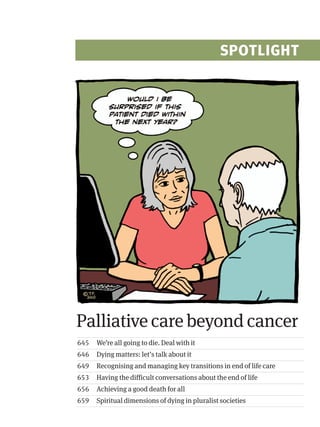
                                   A positive answer to the question: “Would I be           education, debate, commentary, and news with the
                                   surprised if this patient died within the next year?”    aim of improving supportive and palliative care for
                                   is one trigger indicating that such care should begin.   patients with many kinds of illness.
                                      After that decision come the difficult conversa-        We all have much work to do.
                                   tions. Not everyone will want to talk about the end      We are pleased to acknowledge the financial support
                                   of their life, but “the right conversations with the     of the British Heart Foundation in producing this
                                   right people at the right time can enable a patient      Spotlight. The articles were commissioned and peer
                                   and their loved ones to make the best use of the         reviewed according to the BMJ ’s usual process. We
                                   time that is left and prepare for what lies ahead.”2     benefited from discussions with Jane Maher, Scott
                                      The obstacles to plain speaking, and clear            Murray, Ruth Sack, and Teresa Tate.
                                   thinking, about death are legion. We live in a           1   Boyd K, Murray SA. Recognising and managing key
                                   culture in which people are uncomfortable with               transitions in end of life care. BMJ 2010;341:c4863.
                                                                                            2   Barclay S, Maher J. Having the difficult conversations about
                                   their own mortality.3 This needs to change, as the           the end of life. BMJ 2010;341:c4862.
                                   Dying Matters coalition argues, “so that dying, death    3   Seymour JE, French J, Richardson E. Dying matters: let’s talk
                                   and bereavement will be accepted as a natural part           about it. BMJ 2010;341:c4860.
                                                                                            4   General Medical Council. Treatment and care towards the
                                   of everybody’s life cycle.” Doctors seem to find that        end of life: good practice in decision-making. 2010. www.
                                   message harder to accept than others, with some of           gmc-uk.org/guidance/ethical_guidance/6858.asp.
                                   them regarding any death as a failure. In a doomed       5   Bell D. GMC guidelines on end of life care. BMJ
                                                                                                2010;340:c3231.
                                   attempt to stave off the inevitable, typically more      6   Ellershaw J, Dewar S, Murphy D. Achieving a good death for
                                   money is spent on health care during a patient’s last        all. BMJ 2010;341:c4861.
                                   year of life than in any other year.                     7   Grant L, Murray SA, Sheikh A. Spiritual dimensions of dying in
                                                                                                pluralist societies. BMJ 2010;341:c4859.
Ж Mike Knapton talks                  But it must be an encouraging sign that “pallia-
about the shift towards            tive care beyond cancer” topped a recent BMJ poll        Tony Delamothe deputy editor BMJ, London
palliative care for non-           of topics respondents wanted to read more about.         tdelamothe@bmj.com
cancer conditions in a             Similarly encouraging are initiatives of organisa-       Mike Knapton associate medical director
BMJ podcast coinciding             tions such as the British Heart Foundation to start      British Heart Foundation, London
with this Spotlight. Find          thinking about palliative as well as curative care.      Eve Richardson chief executive, National Council for
out more at bmj.com/                  Earlier this year, the UK’s General Medical           Palliative Care and Dying Matters coalition, London
podcasts                           Council published Treatment and Care Towards             Cite this as: BMJ 2010;341:c5028

BMJ | 25 SEPTEMBER 2010 | VOLUME 341                                                                                                                      645
SPOTLIGHT


                                      Dying matters: let’s talk about it
                                      Jane E Seymour,1 Jeff French,2 Eve Richardson3
                                                                                                          Evidence about public attitudes
    As death has become less common in our daily lives, it has                                            The review shows a preponderance of research about views
    become harder to consider our own mortality or that of                                                on euthanasia and physician assisted suicide, often funded
                                                                                                          by “right to die” movements, but also featuring in large scale
    those close to us. Lack of openness about death has negative
                                                                                                          public opinion polls.8 9 These findings suggest public support
    consequences for the quality of care provided to the dying and                                        for euthanasia has hovered between 60% and 80% since the
    bereaved. Eradicating ignorance about what can be achieved                                            mid 1970s on both sides of the Atlantic, with similar levels of
    with modern palliative care and encouraging dialogue about end                                        support emerging for physician assisted suicide. A report of
    of life care issues are important means of changing attitudes                                         the 2005 British Social Attitude Survey10 shows that people
                                                                                                          make clear distinctions between the acceptability of assisted
                                                                                                          dying in different circumstances; 80% of respondents agreed
                                      Awareness of our own mortality is a human characteristic.           that the law should allow voluntary euthanasia to be carried
                                      Arguably, life would have little meaning without our knowl-         out by a doctor for someone with a painful, incurable, and
                                      edge and experience of inevitable loss, death, and bereave-         terminal condition, but less than 50% agreed for cases where
                                      ment. But while in some ways our society is obsessed with           the illness is painful, but not terminal. Very few respondents
                                      death—with reports of violent, sudden, and unexpected death         supported family assisted suicide.9 In the United States,
                                      paraded across our media every day—it is still very difficult       differences in response rates of more than 30% have been
                                      to talk about this one shared certainty in terms that relate        reported11 dependent on how questions are framed. Such
                                      to our own deaths or those of people close to us. Across the        nuances are not visible in surveys that present respondents
                                      past century there has been a movement away from using the          with limited options for responses (such as yes or no) to short
                                      “sacred canopy” of religion1 to make sense of death and to          hypothetical scenarios.
                                      embrace its presence in life. Instead, the defence of health,          The simple and high visibility messages of support for
                                      youth, and vigour against the enemy of death has become             assisted dying could obscure the very considerable, but
                                      a “lifelong labour”2 for many. On the rare occasions when           perhaps less sexy, findings about attitudes to other issues.
                                      death and dying are discussed, the language used is most            Results of cross sectional surveys indicate that dying at
                                      often rooted in the discourse of individualism and control of       “home” is a strong preference (whether this is the person’s
                                      personal destiny. This perspective does not fit well with the       home, a retirement complex, or care home), although
                                      needs and daily experiences of people approaching the end           hedged by worries about burden on care givers12 and by
                                      of life, such as those in advanced old age, who may find they       fears of dying alone.13 At the same time, most people are
                                      wish or need to entrust their care to others. Nor does it reflect   worried about how they would cope practically with car-
                                      the finely balanced dilemmas patients, families, and clini-         ing for a close relative who was dying at home.14 A major-
                                      cians face in dealing with the physical, ethical, emotional, and    ity of people seem to welcome clinicians who are willing to
                                      existential problems of serious illness. The increasingly rare      start discussions in advance about place of care or medical
                                      designation of any illness as terminal complicates matters and      treatment at the end of life.15 Interesting and persistent
                                      perhaps explains why complaints about lack of preparation           differences according to sociodemographic characteristics
                                      and communication surrounding death are common among                are found in survey data from many different countries.
                                      the bereaved.3                                                      For example, some studies show that older people are less
                                                                                                          likely than younger ones to favour death at home, while
                                      Consequences of not talking about and planning                      women are more likely than men to prioritise quality over
                                      for death                                                           length of life.15 Other findings suggest that ethnic minor-
1
 Sue Ryder Care professor of
                                      Strategic plans for end of life care in England4 and Scotland5      ity groups in Western countries tend to be less supportive
palliative and end of life studies,   argue that a lack of public openness about death may have           of withdrawing or withholding life prolonging medical
School of Nursing, Midwifery,         negative consequences for quality of care at the end of life,       treatment at the end of life.16 These findings point to the
and Physiotherapy, University of
Nottingham, Nottingham NG7 2HA
                                      including fear of the process of dying, lack of knowledge about     effect of structural inequalities on experiences that shape
 2
   professor of social marketing      how to request and access services, lack of openness between        attitudes.
and chief executive, Strategic        close family members, and isolation of the bereaved. A new             Perhaps unsurprisingly, fairly uniform opinions are
Social Marketing, Liphook,            national coalition6 with the same name as this article aims to      found about the elements comprising quality of care at the
Guildford GU30 7QW
3
 chief executive, National Council
                                      raise public awareness and change behaviour associated with         end of life, with relief from pain and other symptoms at the
for Palliative Care, London           death, dying, and bereavement as one means of addressing            forefront, reflecting widespread concerns about the proc-
 N7 9AS                               these consequences. The work of the coalition is based in part      ess of dying.17 A 2006 survey of the UK public suggested
                                      on a comprehensive review of published research evidence,7          that a minority of people (34%) have talked to their friends
Correspondence to: Jane Seymour
                                      together with new market research about the concerns, needs,        or families about these issues or made any type of advance
jane.seymour@nottingham.ac.uk
                                      and beliefs of the general public about these issues and ways       statement to inform their own end of life care.18 A survey of
Cite this as: BMJ 2010;341:c4860      to raise public awareness.                                          a representative sample of the general public in England,

646                                                                                                                                   BMJ | 25 SEPTEMBER 2010 | VOLUME 341
PALLIATIVE CARE BEYOND CANCER
RAOUL WESAT/GETTY IMAGES


                                                              Ron Mueck “Dead Dad,” 1996-97. Mixed media; 20 x 38 x 102 cm, Stefan T Edlis Collection, Chicago


                           When death is                      Wales, and Scotland19 commissioned by the National                in end of life care projects as a matter of public health.23 In
                                                              Coalition, repeated some aspects of the 2006 survey and           the United States, the Project on Death in America, a large
                           managed badly it                   had very similar findings. Although they were not talking         scale programme to change the culture and character of
                           leaves a scar that                 about end of life care issues themselves, a substantial major-    dying, was funded by George Soros and located in the Open
                           runs deep                          ity of respondents (88%) would favour the open disclosure         Society Institute between 1994 and 2003.24 It supported
                                                              by a clinician of a terminal prognosis. The most prevalent        not only a conventional research and practice development
                                                              reason given by all respondents for not discussing issues,        programme but also arts projects to identify and convey
                                                              including a fifth of people aged over 75, was that “death         meaning in facing illness, disability, and death, and com-
                                                              seems a long way off.”                                            munity initiatives about bereavement and grief. Many of
                                                                 Qualitative research provides at least partial explanations    these involved thousands of people and have reportedly
                                                              of the trends seen in the quantitative research. For example,     had a substantial lasting value although the effect is diffi-
                                                              an interview study20 among older adults in the UK reports         cult to measure. From the outset of the project, raising public
                                                              how older men and women tend to conform to gender                 awareness was regarded as just as vital as the policy and
                                                              stereotypes when discussing the issue of caregiver burden         practice developments needed to address seemingly intrac-
                                                              in end of life care. Older women are more likely to be con-       table problems in the care of the dying in the United States.
                                                              cerned about burdening others during a final illness, while
                                                              men express more self oriented views, including the desire        Challenges for the future
                                                              to live longer. Qualitative research shows that attitudes about   For many of the 56 million people who die each year world-
                                                              death develop against a backdrop of varied cultural and his-      wide, death is associated with substantial but preventable
                                                              torical influences, are deeply affected by biographical and       suffering. When death is managed badly it leaves a scar
                                                              experiential influences, and are likely to change with time       that runs deep in our collective psyche and reinforces the
                                                              and across age groups.21                                          tendency to turn away from any reminder of death. Shift-
                                                                                                                                ing attitudinal barriers to the provision of excellent end of
                                                              Ways of raising awareness and public involvement                  life care means eradicating ignorance among clinicians,
                                                              Evidence from social marketing shows that “bottom up”             patients, and the public about what can be achieved with
                                                              approaches focusing on value to the user may provide a            modern palliative care and with careful proactive plan-
                                                              framework for designing programmes to raise public aware-         ning. Raising public knowledge of issues surrounding
                                                              ness of issues related to death and change behaviours.22          death, dying, and bereavement risks raising expectations
                                                              Another approach is to mobilise community involvement             we cannot yet meet or sending an unrealistic message that

                           BMJ | 25 SEPTEMBER 2010 | VOLUME 341                                                                                                                            647
SPOTLIGHT


            DAPHNE TODD


                                                                                                                                         “Last portrait of mother,” by Daphne Todd,
                                                                                                                                         winner of the 2010 BP Portrait Award


                          death can always be managed well. But such activity is a                                    assisted suicide and terminal palliative care. J Sci Study Religion
                                                                                                                      2005;44:79-93.
                          vital part of generating a sense of wider responsibility for                           9    O’Neill C, Feenan D, Hughes C, McAlister DA. Physician and family
                          the dying and promoting social justice for all those living                                 assisted suicide: results from a study of public attitudes in Britain. Soc
                                                                                                                      Sci Med 2003;57:721-31.
                          towards the end of their life.                                                         10   Clery E, McLean S, Phillips M. Quickening death: the euthanasia debate.
                          Part of the costs of producing the BMJ supplement in which this article appeared            In: Park A, Curtice J, Thomson K, Phillips M, Johnson M, eds. British
                          were met by the British Heart Foundation. The article was commissioned and                  social attitudes: the 23rd report—perspectives on a changing society.
                          peer reviewed according to the BMJ ’s usual process.                                        Sage for NatCen, 2007.
                                                                                                                 11   Emanuel EJ. Euthanasia and physician-assisted suicide: a review of the
                          Contributors and sources: JES wrote the first draft of this paper, drawing on               empirical data from the United States. Arch Intern Med 2002;162:142-52.
                          preliminary findings from a review of research on public attitudes to death,           12   Rietjens JAC, van der Heide A, Onwuteaka-Philipsen BD, van der Maas PJ,
                          dying, and bereavement commissioned by the National Council for Palliative                  van der Wal G. Preferences of the Dutch general public for a good death
                          Care and the National End of Life Care Programme and a survey of UK public                  and associations with attitudes towards end-of-life decision-making.
                          attitudes commissioned by the National Coalition Dying Matters: Let’s Talk                  Palliat Med 2006;20:685-92.
                                                                                                                 13   Lloyd-Williams M, Kennedy V, Sixsmith A, Sixsmith J. The end of life:
                          About It, to which all three authors belong. JF and ER provided comments on
                                                                                                                      a qualitative study of the perceptions of people over the age of 80
                          the first and subsequent drafts of this paper. All three authors agreed the final           on issues surrounding death and dying. J Pain Symptom Manage
                          version. JES is guarantor.                                                                  2007;34:60-6.
                          Competing interests: All authors have completed the Unified Competing                  14   Marie Curie Cancer Care. Views about dying at home: survey of the views
                          Interest form at www.icmje.org/coi_disclosure.pdf (available on request                     of the UK general public. Marie Curie Cancer Care, 2004. http://campaign.
                                                                                                                      mariecurie.org.uk/Scotland/press_centre/yougov_survey.htm.
                          from the corresponding author) and declare: JES had support from the
                                                                                                                 15   Catt S, Blanchard M, Addington-Hall J, Zis M, Blizard R, King M. Older
                          National Council for Palliative Care and the National End of Life Care                      adults’ attitudes to death, palliative treatment and hospice care. Palliat
                          Programme for the submitted work; JF is a consultant to the Dying Matters                   Med 2005;19:402-10.
                          coalition; no other relationships or activities that could appear to have              16   Johnson KS, Kuchibhatla M, Tulsky JA. What explains racial differences
                          influenced the submitted work.                                                              in the use of advance directives and attitudes toward hospice care? J Am
                          1    Berger PL. The social reality of religion. Penguin, 1973.                              Geriatrics Soc 2008;56:1953-8.
                                                                                                                 17   Born W, Greiner KA, Sylvia E, Butler J, Ahluwalia J. Knowledge, attitudes,
                          2    Bauman Z. Mortality, immortality and other life strategies. Polity Press,
                                                                                                                      and beliefs about end-of-life care among inner-city African Americans
                               1992.
                                                                                                                      and Latinos. J Palliat Med 2004;7:247-56.
                          3    Health Care Commission. Spotlight on complaints. A report on
                                                                                                                 18   ICM research for Endemol UK. How to have a good death: General Public
                               second stage complaints to the NHS in England. Health Care
                                                                                                                      Survey, 2006. www.icmresearch.co.uk/pdfs/2006_march_Endemol_
                               Commission, 2009. www.cqc.org.uk/_db/_documents/Spotlight_on_                          for_BBC_How_to_have_a_good_death_general_public_survey.pdf.
                               Complaints_09_200903190539.pdf .                                                  19   Dying Matters Coalition. NatCen survey on attitudes towards dying,
                          4    Department of Health. End of life care strategy. Promoting                             death and bereavement commissioned on behalf of Dying Matters, July-
                               high quality for all adults at the end of life. DH, 2008. www.                         September 2009. 2009. www.dyingmatters.org/site/dying-to-talk-report.
                               dh.gov.uk/en/Publicationsandstatistics/Publications/                              20   Arber S, Vandrevala T, Daly T, Hampson S. Understanding gender
                               PublicationsPolicyAndGuidance/DH_086277.                                               differences in older people’s attitudes towards life-prolonging medical
                          5    Scottish Government. Living and dying well: a national action plan for                 technologies. J Aging Stud 2008;22:366-75.
                               palliative and end-of-life in Scotland. Scottish Government, 2008. www.           21   Williams R. The protestant legacy: attitudes to death and illness among
                               scotland.gov.uk/Publications/2008/10/01091608/0.                                       older Aberdonians. Clarendon Press, 1990.
                          6    National Council for Palliative Care. Dying matters: let’s talk about it. 2010.   22   French J, Blair-Stevens C, McVey D, Merritt R. Social marketing and public
                               www.dyingmatters.org.                                                                  health, theory and practice. Oxford University Press, 2009.
                          7    Seymour JE, Kennedy S, Arthur A, Pollock P, Cox K, Kumar A, et el. Public         23   Kellehear A, O’Connor D. Health-promoting palliative care: a practice
                               attitudes to death, dying and bereavement: a systematic synthesis.                     example. Crit Pub Health 2008;18:111-5.
                               Executive summary. 2009. www.nottingham.ac.uk/nmp/documents/                      24   Clark D. A history of the project on death in America: programs, outputs,
                               spcrg-public-attitudes-to-death-executive-summary.pdf.                                 impacts. Abstracts of the 10th Congress of the European Association for
                          8    Burdette AM, Hill TD, Moulton BE. Religion and attitudes toward physician-             Palliative Care Budapest, 2007. Eur J Palliat Care (suppl).


648                                                                                                                                                 BMJ | 25 SEPTEMBER 2010 | VOLUME 341
PALLIATIVE CARE BEYOND CANCER


                                     Recognising and managing key
                                     transitions in end of life care
                                     Kirsty Boyd,1 Scott A Murray2

                                                                                                      patients should be included in their supportive and palli-
    Prognostic paralysis may delay a change in gear for too long. Being                               ative care registers and when. We have reviewed two types
    alert to the possibility that a patient might benefit from supportive                             of prognostic tools as the basis for a pragmatic approach
    and palliative care is central to delivering better end of life care                              to identifying candidates for palliative care needs assess-
                                                                                                      ment in primary and secondary care.
                                                                                                         Disease specific prognostic tools use statistical models
                                     Palliative care is being introduced earlier in the trajectory    to predict the risks of individuals dying from conditions
                                     of illness, often in parallel with disease modifying treat-      such as heart failure, chronic obstructive pulmonary
                                     ment. A care pathway that starts with the identification of      disease, or liver disease. These tools tend to be used in
                                     people approaching the end of life and initiating discus-        clinical trials or when selecting patients for treatments
                                     sions about their preferences is central to the end of life      like transplantation, but less often in end of life care. 8-10
                                     care strategy in England.1 The Scottish government action        Prognostic models were not found to be specific or sensi-
                                     plan also advocates a person centred approach based not          tive enough when used to estimate survival of six months
                                     on diagnosis or prognosis, but on the needs of patients          or less in older people with a range of non-cancerous ill-
                                     and carers in all care settings—home, care home, and hos-        nesses.11 Such survival data have limited meaning for
                                     pital.2 These needs include information about the illness        individual patients who are “sick enough to die.” In
                                     and prognosis, symptom control, attention to psychologi-         advanced heart failure, prognostic data suggested that an
                                     cal and spiritual concerns, continuity of care, and practi-      average patient had a 50% chance of living for six months
                                     cal support. In view of the increasing numbers of people         on the day before their death.4
                                     who could benefit, the emphasis of the UK strategies is             Performance status is strongly associated with survival
                                     on improving end of life care delivered by primary care          time in patients with advanced illness, regardless of the
                                     teams, hospital staff, and social care services. Specialist      diagnosis. This factor therefore forms the basis of the pal-
                                     palliative care should be available to people in any care        liative performance scale, which is used in several coun-
                                     setting who need additional expertise, and it serves most        tries to aid referral to hospice and specialist palliative
                                     effectively as a resource to support ongoing care by other       care services.12 A similar tool, the palliative prognostic
                                     clinical teams.3                                                 index, adds the symptoms of anorexia, breathlessness,
                                        In economically developed countries, most people              and delirium to functional status.13 Such tools will iden-
                                     now die from one or more complex long term conditions.4          tify most (though not all) patients who are likely to die
                                     End of life care encompasses three overlapping phases            within weeks, but are much less reliable for patients with
                                     of illness (figure). In this article we offer guidance about     supportive and palliative care needs who may still have
                                     recognising end of life transitions. We also consider the        6-12 months to live.12 13
                                     challenge of changing the goals of care in patients with            An alternative to prognostic tools is the use of criteria
                                     slowly progressive or fluctuating long term conditions.          based on the clinical features of different advanced ill-
                                                                                                      nesses. The National Hospice and Palliative Care Organi-
                                     Transition 1: would my patient benefit from supportive           sation tool is used to decide eligibility for hospice care in
                                     and palliative care?                                             the United States, where many services will only enrol
                                     Managing the transition to supportive and palliative care        patients with a prognosis of less than six months.4 These
                                     is arguably more of a challenge than identifying people          US clinical indicators were updated in 2001. They formed
                                     who are in the last days of life.5 Doing so earlier can affect   the basis of the prognostic indicator guidance tool that is
                                     how, and potentially where, people die, but what consti-         used in the UK Gold Standards Framework for palliative
                                     tutes “end of life care” is not uniformly understood and
1                                    opinions vary as to who is a “palliative care” patient.
 consultant in palliative medicine
2
 St Columba’s Hospice professor      Judging prognosis is particularly difficult for non-cancer                   Cancer treatment
                                                                                                                  Long term conditions care
of primary palliative care           patients.6 Identification of people with a life limiting ill-
Primary Palliative Care Research                                                                         Good                                                    Terminal
                                     ness when they are starting to need a change in their goals
Group, Centre for Population                                                                             health                                                    care
Health Sciences, University of       of care contributes to end of life care planning and can
                                                                                                                                              Supportive and
Edinburgh, Edinburgh                 aid communication with patients and families. It depends                                                  palliative care
                                     on clinical judgment and weighing up a complex mix of
Correspondence to: K Boyd
Kirsty.Boyd@luht.scot.nhs.uk         pathology, clinical findings, therapeutic response, co-                                    Transition 1
                                                                                                                                                         Transition 2
                                     morbidities, psychosocial factors, and rate of decline.7
Cite this as: BMJ 2010;341:c4863     UK primary care teams are now expected to decide which           Key phases in end of life care

BMJ | 25 SEPTEMBER 2010 | VOLUME 341                                                                                                                                    649
SPOTLIGHT


                                                                                               care in the community.14 Both tools have good face valid-
 Box 1 | Supportive and palliative care indicators tool
                                                                                               ity and are widely used, but formal validation studies have
 (1) Ask                                                                                       been limited.
 Does this patient have an advanced long term condition, a new diagnosis of a progressive
 life limiting illness, or both? (Yes)                                                         Using clinical indicators to identify patients for
 Would you be surprised if this patient died in the next 6-12 months? (No)                     supportive and palliative care assessment
 (2) Look for one or more general clinical indicators                                          Our review of the prognostic models and guidelines leads
 Performance status poor (limited self care; in bed or chair over 50% of the day) or           us to propose a small group of readily identifiable indi-
 deteriorating
                                                                                               cators that can be used by professional carers in both
 Progressive weight loss (>10%) over the past 6 months
                                                                                               primary and secondary care. Instead of seeking to refine
 Two or more unplanned admissions in the past 6 months
                                                                                               prognostic accuracy, we propose that clinical judgment
 Patient is in a nursing care home or continuing care unit, or needs more care at home
                                                                                               informed by evidence can improve care.
 (3) Now look for two or more disease related indicators
                                                                                                  Box 1 describes how to identify patients for a sup-
 HEART DISEASE                                                                                 portive and palliative care assessment. If a patient has
 NYHA class IV heart failure, severe valve disease, or extensive coronary artery disease       an advanced long term condition or a new diagnosis of
 Breathless or chest pain at rest or on minimal exertion                                       a progressive, life limiting illness, or both, then ask the
 Persistent symptoms despite optimal tolerated therapy                                         question, “Would you be surprised if this patient died in
 Renal impairment (eGFR <30 ml/min)                                                            the next 6-12 months?” If the answer is no, look for one or
 Systolic blood pressure <100 mm Hg and/or pulse rate >100                                     more general clinical indicators that suggest this patient
 Cardiac cachexia                                                                              is at risk of dying and should be assessed for unmet
 Two or more acute episodes needing intravenous treatment in past 6 months                     needs. Some people who may benefit from supportive
 KIDNEY DISEASE                                                                                and palliative care have slowly progressive or fluctuating
 Stage 5 chronic kidney disease (eGFR<15 ml/min)                                               long term conditions. Concerns about deciding which of
 Conservative kidney management due to multi-morbidity                                         these patients should have additional assessment and
 Deteriorating on renal replacement therapy; persistent symptoms and/or increasing             structured end of life care planning are common, as are
 dependency                                                                                    worries about discussing dying “too soon.” We suggest
 Not starting dialysis following failure of a renal transplant                                 that a shortlist of disease related clinical indictors drawn
 New life limiting condition or kidney failure as a complication of another condition or       from prognostic models and existing palliative prognostic
 treatment                                                                                     guides be used to support clinical decision making.
 RESPIRATORY DISEASE                                                                              Rapid decline in the last weeks or months of life is
 Severe airways obstruction (FEV1<30%) or restrictive deficit (vital capacity <60%, transfer   often associated with progressive cancer, although other
 factor <40%)                                                                                  diseases sometimes follow this course and cancer can
 Meets criteria for long term oxygen therapy (PaO2 <7.3)                                       progress more slowly. Patients receiving palliative treat-
 Breathless at rest or on minimal exertion between exacerbations                               ment for cancer may want to focus on fighting their ill-
 Persistent severe symptoms despite optimal tolerated therapy                                  ness, but supportive care, coordinated in primary care,
 Symptomatic heart failure                                                                     should run in parallel with treatment. It should come to
 Body mass index <21                                                                           the fore as the patient starts to deteriorate and treatment,
 Increased emergency admissions for infective exacerbations and/or respiratory failure         except for symptom control, is stopped.15 Advanced can-
 LIVER DISEASE                                                                                 cer at presentation or a poor performance status usually
 Advanced cirrhosis with one or more complications: intractable ascites, hepatic               means that the patient would benefit from early support-
 encephalopathy, hepatorenal syndrome, bacterial peritonitis, recurrent variceal bleeds        ive and palliative care in line with the general indicators
 Serum albumin <25 g/l, and prothrombin time raised or INR prolonged                           in box 1.
 Hepatocellular carcinoma                                                                         A patient whose illness is associated with acute exac-
 CANCER                                                                                        erbations followed by partial recovery may have been
 Performance status deteriorating due to metastatic cancer and/or comorbidities                receiving health and social care for some time with the
 Persistent symptoms despite optimal palliative oncology treatment or too frail for oncology   emphasis on optimal disease management, personal-
 treatment                                                                                     ised care planning, and supported self management
 NEUROLOGICAL DISEASE                                                                          (see Resources). This situation is typically seen in those
 Progressive deterioration in physical and/or cognitive function despite optimal therapy       with heart failure, coronary artery disease, chronic lung
 Symptoms that are complex and difficult to control                                            disease, or end stage liver disease. Too much emphasis
                                                                                               on prognostic accuracy in these fluctuating illnesses can
 Speech problems; increasing difficulty communicating; progressive dysphagia
                                                                                               hinder a positive focus on reasonable, patient centred
 Recurrent aspiration pneumonia; breathless or respiratory failure
                                                                                               goals at the end of life.16 Variables identified in disease
 DEMENTIA
                                                                                               specific prognostic models are particularly useful as addi-
 Unable to dress, walk, or eat without assistance; unable to communicate meaningfully
                                                                                               tional indicators in this group.
 Increasing eating problems; receiving pureed/soft diet or supplements or tube feeding
                                                                                                  A prolonged, slow decline, sometimes punctuated
 Recurrent febrile episodes or infections; aspiration pneumonia                                with more acute episodes, is generally associated with
 Urinary and faecal incontinence                                                               multi-morbidity, advanced dementia, and progressive
 NYHA=New York Heart Association. eGFR=estimated glomerular filtration rate. FEV1=forced       neurological diseases. Such patients comprise the larg-
 expiratory volume in 1 second. PaO2=pulmonary artery oxygen content. INR=international
                                                                                               est group in economically developed countries, and they
 normalised ratio.
                                                                                               typically need long periods of supportive and palliative

650                                                                                                                       BMJ | 25 SEPTEMBER 2010 | VOLUME 341
PALLIATIVE CARE BEYOND CANCER


                                   care.4 17 The offer of early advance care planning is impor-
The ability to                                                                                             community and in hospitals. In the community, antici-
                                   tant because many patients will lose capacity to consent                patory care planning should ensure that sufficient care
make an accurate                   or express preferences about care.18 Many patients in this              and support are in place to enable most patients who are
and timely                         group can be identified from general clinical indicators,               expected to die soon to remain at home or in their care
diagnosis of                       but additional triggers such as recurrent febrile episodes              home. However, any potentially reversible causes of dete-
                                   and eating problems suggest advanced cognitive and                      rioration must be excluded in a patient who might still ben-
dying is a core                    functional deterioration indicative of a substantial change             efit from appropriate treatment. Such treatment should be
clinical skill                     in an otherwise gradual decline.19                                      started on the basis of clear, agreed goals, including a plan
                                                                                                           for review. Patients in hospital often continue to receive
                                   Transition 2: Is my patient reaching the last days of life?             treatment of their underlying illnesses and complications
                                   Appropriate use of clinical pathways such as the UK                     until close to death. The decision to withdraw active treat-
                                   Liverpool Care Pathway for the Dying (see Resources) can                ment at the right time is important but will remain chal-
                                   help to optimise care in the last days of life, but a timely            lenging if the outcome is uncertain and if the patient has
                                   diagnosis of dying is essential. Patients on such pathways              recovered previously, particularly if earlier discussions
                                   are reviewed regularly, medication is prescribed in line                about end of life preferences have not been possible.21
                                   with good practice guidelines, and the holistic needs of
                                   the patient and family are addressed. Entry on to an end of             Using clinical indicators to identify patients in the last
                                   life care pathway depends on clinicians being alert to the              days of life
                                   possibility that the patient may be dying and is based on               To improve the transition to terminal care, the care team
                                   clinical judgment after careful assessment.20                           should ask if a patient’s deterioration was expected, find out
                                      Diagnosis of dying can be problematic for a range                    if the patient or a healthcare proxy wants further interven-
                                   of reasons including a lack of continuity of care in the                tions, and exclude all potentially reversible causes (box 2).

                                       Box 2 | Clinical indicators for terminal care                       Conclusions
                                       Q1 Could this patient be in the last days of life?                  Primary care teams are well placed to use computerised
                                       Clinical indicators of dying may include:                           disease registers and multidisciplinary review meetings
                                       Confined to bed or chair and unable to self care                    to identify patients using pragmatic clinical criteria. Many
                                       Having difficulty taking oral fluids or not tolerating artificial   more patients stand to benefit from better identification,
                                       feeding/hydration                                                   assessment, and structured end of life care planning. Such
                                       No longer able to take oral medication                              improvements will enable professionals to address mor-
                                       Increasingly drowsy                                                 bidity related to progressive disease and offer patients and
                                       Q2 Was this patient’s condition expected to deteriorate in          their families opportunities to talk about living well with
                                       this way?                                                           advanced illness.
                                                                                                              Hospital specialists see many patients in the last year of
                                       Q3 Is further life-prolonging treatment inappropriate?
                                                                                                           life, often on multiple occasions, so can make an impor-
                                       Further treatment is likely to be ineffective or too
                                       burdensome.                                                         tant contribution to identifying the need for additional
                                       Patient has refused further treatment.                              supportive care, as well as optimising disease modifying
                                                                                                           treatments that will contribute to quality of life. Specialists
                                       Patient has made a valid advance decision to refuse
                                       treatment.                                                          can suggest when these patients may be suitable for sup-
                                       A healthcare proxy has refused further treatment on the             portive and palliative care in the community in discharge
                                       patient’s behalf.                                                   and outpatient letters, and primary care teams can ensure
                                       Q4 Have potentially reversible causes of deterioration              that such patients going to hospital are clearly identified.
                                       been excluded?                                                         The ability to make an accurate and timely diagnosis of
                                       These may include:                                                  dying is a core clinical skill based on careful assessment
                                       Infection (eg, urine, chest, cholangitis, peritonitis,              that could be done better in all care settings. Education
                                       neutropenia)                                                        and training of staff are central to the success of end of life
                                       Dehydration                                                         policies in the UK.1 2
                                       Biochemical disorder (calcium, sodium, blood sugar)                 Part of the costs of producing the BMJ supplement in which this article
                                                                                                           appeared were met by the British Heart Foundation. The article was
                                       Drug toxicity (eg, opioids, sedatives, alcohol)                     commissioned and peer reviewed according to the BMJ ’s usual process.
                                       Intracranial event or head injury
                                                                                                           Contributors and sources: This review was written by KB, a consultant in
                                       Bleeding or severe anaemia                                          palliative medicine who has worked in hospital, community and hospice
                                       Hypoxia or respiratory failure                                      settings, in collaboration with SAM, leader of an international primary palliative
                                       Acute renal impairment                                              care research group. We reviewed key policy documents, prognostic tools,
                                                                                                           and papers from international experts in care planning drawn from a 10 year
                                       Delirium                                                            Medline search and sought the views of colleagues in primary and secondary
                                       Severe constipation                                                 care. We are grateful for the opinions and papers contributed by W MacNee,
                                       Depression                                                          P Reid (respiratory medicine); M Denvir (cardiology); P Cantley (geriatric
                                                                                                           medicine); M Young (general medicine); A Sheikh, E Paterson (general
                                       If the diagnosis of dying is in doubt, give treatment and           practice); F Downs, J Welsh (palliative medicine). KB is guarantor.
                                       review within 24 hours.                                             Competing interests: All authors have completed the Unified Competing
                                       If the answer to all four questions is “Yes”, plan care for a       Interest form at www.icmje.org/coi_disclosure.pdf (available on request from
                                       dying patient.                                                      the corresponding author) and declare: no support from commercial entities
                                                                                                           for the submitted work; no financial relationships with commercial entities


BMJ | 25 SEPTEMBER 2010 | VOLUME 341                                                                                                                                                     651
SPOTLIGHT


                RESOURCES
                PALLIATIVE AND END OF LIFE CARE
                NHS Department of Health. National End of Life Care Programme. www.endoflifecareforadults.nhs.uk/eolc
                Scottish Government Health Department: Living and Dying Well: A National Action Plan for Palliative and End of Life Care in Scotland.
                www.scotland.gov.uk/Topics/Health/NHS-Scotland/LivingandDyingWell
                Gold Standards Framework. www.goldstandardsframework.nhs.uk
                Gold Standards Framework Scotland.www.gsfs.scot.nhs.uk
                Liverpool Care Pathway for the Dying Patient.www.endoflifecareforadults.nhs.uk/eolc/lcp.htm
                LONG TERM CONDITIONS
                NHS Department of Health Long Term Conditions website. www.dh.gov.uk/en/Healthcare/Longtermconditions/index.htm
                CANCER
                National Institute for Clinical Excellence: Improving Supportive and Palliative Care for Adults with Cancer. 2003
                www.nice.org.uk/guidance/index.jsp?action=download&r=true&o=28800
                HEART FAILURE
                NHS Heart Improvement Programme. Supportive and Palliative Care in Heart Failure—A Resource Kit for Cardiac Networks. 2006.
                www.heart.nhs.uk/endoflifecare
                Scottish Partnership for Palliative Care. Living and Dying with Advanced Heart Failure: a Palliative Care Approach. 2008.
                www.palliativecarescotland.org.uk/publications/sppc-publications/living-and-dying-with-advanced-heart-failure
                CHRONIC LUNG DISEASE
                National Institute for Clinical Excellence. Chronic Obstructive Pulmonary Disease. National Clinical Guideline on Management of
                Chronic Obstructive Pulmonary Disease in Adults in Primary and Secondary Care. 2004
                http://guidance.nice.org.uk/CG12
                CHRONIC KIDNEY DISEASE
                NHS Department of Health. End of Life Care in Advanced Kidney Disease: A Framework for Implementation
                www.endoflifecareforadults.nhs.uk/eolc/kidney.htm.
                DEMENTIA
                NHS Department of Health. Living Well with Dementia: A National Dementia Strategy. 2009. www.endoflifecareforadults.nhs.uk/
                eolc/nds.htm
                DISCUSSING END OF LIFE TRANSITIONS
                Clayton JM, Hancock KM, Butow PN, Tattersall MHN, Currow DC. Clinical practice guidelines for communicating prognosis and end-
                of-life issues with adults and their caregivers. Med J Aust 2007;186:S77-108.


            that might have an interest in the submitted work in the past 3 years; no other        appropriate timing of palliative care for older adults with non-
            relationships or activities that could appear to have influenced the submitted         malignant life-threatening disease: a systematic review. Age Ageing
            work.                                                                                  2005;34:218-27.
                                                                                              12   Lau F, Downing M, Lesperance M, Karlson N, Kuziemsky C, Yang J.
            1  Department of Health. End of Life Care Strategy for Adults. DH, 2008.               Using the Palliative Performance Scale to provide meaningful survival
               www.endoflifecareforadults.nhs.uk/eolc.                                             estimates. J Pain Symp Manage 2009;38:134-44.
            2 Scottish Government Health Department. Living and Dying Well: A                 13   Stone CA, Tiernan E, Dooley BA. Prospective validation of the
               national action plan for palliative and end of life care in Scotland.               Palliative Prognostic Index in patients with cancer. J Pain Symp
               Scottish Government, 2008. www.scotland.gov.uk/Topics/Health/                       Manage 2008;35:617-22.
               NHS-Scotland/LivingandDyingWell.                                               14   National Gold Standards Framework Centre England. Prognostic
            3 Royal College of Physicians of London. Palliative Care Services:                     indicator guidance paper. 2008 www.goldstandardsframework.nhs.
               meeting the needs of patients. Report of a working party. Royal                     uk/Resources/Gold%20Standards%20Framework/PIG_Paper_Final_
               College of Physicians, 2007.                                                        revised_v5_Sept08.pdf.
            4 Lynn J. Serving patients who may die soon and their families: the role          15   Murray SA, Boyd K, Campbell C, Cormie P, Thomas K, Weller D, et al.
               of hospice and other services. JAMA 2001;285:925-32.                                Implementing a service users’ framework for cancer care in primary
            5 Munday D, Petrova M, Dale J. Exploring preferences for place of                      care: an action research study. Family Practice 2008;25:78-85.
               death with terminally ill patients: a qualitative study of experiences         16   Selman L, Harding R, Beynon T, Hodson F, Coady E, Hazeldine C, et
               of general practitioners and community nurses in England. BMJ                       al. Improving end-of-life care for patients with chronic heart failure:
               2009;338:b2391.
                                                                                                   “Let’s hope it’ll get better, when I know in my heart of hearts it won’t”.
            6 Shipman C, Gysels M, White P, Worth A, Murray SA, Barclay S, et al.
                                                                                                   Heart 2007;93:963-7.
               Improving generalist end of life care: national consultation with
                                                                                              17   Fortin M, Soubhi H, Hudon C, Bayliss EA, van den Akker M.
               practitioners, commissioners, academics and service user groups.
                                                                                                   Multimorbidity’s many challenges. BMJ 2007;334:1016-7.
               BMJ 2008;337:a1720.
            7 Glare P, Sinclair CT. Palliative medicine review: prognostication. J            18   Royal College of Physicians. Advance care planning: concise evidence
               Palliat Med 2008;11:84-103.                                                         based guidelines. RCP, 2008.
            8 Levy WC, Mozzaffarian D, Linker TD, Sutradhar SC, Anker SD,                     19   Mitchell SL, Teno JM, Kiely DK, Shaffer ML, Jones RN, Prigerson
               Cropp AB, et al. The Seattle Heart Failure Model. Circulation                       HG, et al. The clinical course of advanced dementia. N Engl J Med
               2006;113:1424-33.                                                                   2009;361:1529-38.
            9 Celli BR, Cote CG, Marin JM, Casanova C, Montes de Oca M, Mendez                20   Luhrs CA, Meghani S, Homel P, Drayton M, O’Toole E, Paccione M,
               RA, et al. The body-mass index, airflow obstruction, dyspnea, and                   et al. Pilot of a pathway to improve the care of imminently dying
               exercise capacity index in chronic obstructive pulmonary disease.                   oncology inpatients in a Veterans Affairs Medical Center. J Pain Symp
               N Engl J Med 2004;350:1005-12.                                                      Manage 2005;29:544-51.
            10 Larson AM, Curtis JR. Integrating palliative care for liver transplant         21   Norton SA, Hogan LA, Holloway RG, Temkin-Greener H, Buckley MJ,
               candidates “too well for transplant, too sick for life”. JAMA                       Quill TE. Proactive palliative care in the medical intensive care unit:
               2006;295:2168-76.                                                                   effects on length of stay for selected high-risk patients. Crit Care Med
            11 Coventry PA, Grande GE, Richards DA, Todd CJ. Prediction of                         2007;35:1530-5.


652                                                                                                                              BMJ | 25 SEPTEMBER 2010 | VOLUME 341
PALLIATIVE CARE BEYOND CANCER


                                       Having the difficult conversations
                                       about the end of life
                                       Stephen Barclay,1 Jane Maher2
                                                                                                            have heart failure: up to half of deaths are sudden, particularly
    Clinicians need to create repeated opportunities for patients to                                        in the less severe stages.6 Many older patients have multiple
    talk about their future and end of life care, guided by the patient                                     comorbidities, each of which is potentially life limiting.
    as to timing, pace, and content of such talks, and respecting the
    wishes of those who do not want to discuss such matters                                                 Changing illness trajectories
                                                                                                            Therapeutic and healthcare advances are changing care at
                                                                                                            the end of life. Patients with cancer are increasingly receiving
                                       More than half a million people die each year in Britain—36%         active treatment into their last weeks of life and their dying
                                       from cardiovascular disease, 27% from cancer, and 14% from           trajectories are becoming more akin to those of patients with
                                       respiratory disease; and 58% of all deaths occur in hospital,1       non-malignant chronic illnesses. In exacerbations of non-can-
                                       a proportion that has increased in recent years. While some          cer illnesses, patients and clinicians often see acute admission
                                       deaths are sudden and unpredictable, many patients go                and active treatment as appropriate: “you never know what
                                       through a period of illness when death becomes increasingly          they might be able to do in the hospital.” Public and profes-
                                       probable.                                                            sional attitudes have not kept up with this increasing medical
                                          Recent General Medical Council guidance on good practice          activism: end of life discussions are still often linked in their
                                       in decision making in treatment and care towards the end of          thinking with the stopping of active treatment and the close
                                       life states that “patients whose death from their current condi-     proximity of death. In modern health care, such cessation of
                                       tion is a foreseeable possibility are likely to want the opportu-    treatment often takes place far too late for effective end of life
                                       nity to decide what arrangements should be made to manage            care planning to happen, if it takes place at all.
                                       their final illness” but also cautions that “you must approach
                                       all such discussions sensitively, as some patients may not be        Keeping in the frame of “curative change agent”
                                       ready to think about their future care or may find the prospect      The communication of a poor prognosis is a most difficult
                                       of doing so too distressing.”                                        conversation for doctor and patient and is a source of con-
                                          Some may not wish to talk with their clinicians or their fam-     siderable physician stress.7 8 Doctors are often reluctant
                                       ily about the end of life, but others may greatly benefit from       to discuss poor prognosis and treatment options,9 10 and
                                       such conversations. The right conversations with the right           when such conversations do occur, they frequently avoid
                                       people at the right time can enable patients and their loved         the words “death” or “dying,” preferring euphemisms such
                                       ones to make the best use of the time that is left and prepare       as “time is getting short” that are intended to soften the
                                       for what lies ahead.                                                 shock but may also confuse or mislead.11 Patients with can-
                                          In this article, some of our comments arise from our experi-      cer frequently misunderstand the aim of their treatment,
                                       ence as clinicians in general practice and oncology, and others      seeing therapy aimed to palliate disease as having curative
                                       from the research evidence in this area, which is limited. We        potential.12 Patients view the option of supportive care with-
                                       seek to stimulate discussion and debate: we focus mainly on          out continued disease modifying treatment as the clinical
                                       issues that make these conversations difficult for patients and      team “giving up”: they value their doctors’ expertise in up
                                       clinicians, and invite readers to expand on our suggestions of
                                       practical ways forward.

                                       The difficulty of knowing what lies ahead
                                       Uncertainty about prognosis creates anxieties for doctors
                                       when discussing end of life care, with patients and their
1
  general practitioner and             families often expecting greater prognostic certainty than is
Macmillan Postdoctoral Research        possible. Cancer patients have traditionally been viewed as
Fellow, General Practice and
Primary Care Research Unit,            having an identifiable dying trajectory,2 but health profession-
Institute of Public Health,            als’ estimates of their prognoses are frequently inaccurate and
Cambridge CB2 2SR                      over-optimistic,3 4 with deterioration and death coming sooner
2
  consultant clinical oncologist       than expected by all concerned. In illnesses other than cancer,
and chief medical officer,
Macmillan Cancer Support               recurrent hospital admissions and interventions give rise to an
Mount Vernon Cancer Centre,            unpredictable dying trajectory and a “prognostic paralysis,”5
London                                 in which the difficulty of prognostication results in failure to
Correspondence to: S Barclay
sigb2@medschl.cam.ac.uk
                                       consider or raise end of life issues until death is very close and
                                       the patient too unwell for meaningful conversations. End of
Cite this as: BMJ 2010;341:c4862       life discussions are particularly challenging with patients who

    BMJ | 25 SEPTEMBER 2010 | VOLUME 341                                                                                                                                  653
SPOTLIGHT


Imposing open     to date active interventions and prefer them to remain in            incentives in secondary care to encourage the appropriate
                  the role of curative agent.13                                        initiation of end of life discussions. Tariffs for chemotherapy
discussions                                                                            and radiotherapy do not include auditable communication or
on all patients   Coping with uncertainty and maintaining hope                         support elements, and end of life needs are rarely addressed
may destroy       Professionals often prefer to wait for patients to approach them     in multidisciplinary team meetings. Hospitals do not routinely
                  to talk about the end of life, whereas patients often wait for the   identify patients approaching the end of life, other than when
hope and cause    doctor to broach the subject.14 Conversations are thus avoided       very close to death when the Liverpool Care Pathway for the
considerable      until disease is advanced and prognosis is more certain, and         Dying is used. Nor do they have codes for end of life assess-
harm              this delay is a common cause of late referrals to palliative care,   ment and care planning.
                  unplanned hospital admissions, and inappropriate interven-
                  tions when crises develop.15 Doctors are often uncomfortable         Possible triggers for starting the conversation
                  with the inherently uncertain nature of prognostic estimates         Many triggers have been suggested for clinicians to consider
                  and find patients’ expectations of clarity and certainty impos-      opening up conversations about the end of life: poor control
                  sible to meet.8 They struggle to bring that uncertainty into the     of symptoms, changing care needs, deteriorating function,
                  open for themselves, the clinical team, and the patient.16           withdrawal of active cancer treatment, diagnosis of incurable
                     Maintaining hope during and after difficult conversations is      advanced disease, admission to hospital, or entry into a nurs-
                  challenging. Some patients would like open communication             ing or care home, among others. Recognition is growing that
                  about their illness and its progress: others are more ambiva-        prognostic precision is rarely achievable and it may be better
                  lent, wanting to be told but not wanting to know, or having          to identify patients who are “sick enough that dying within
                  a compartmentalised awareness in which they acknowledge              the next year would not be a surprise.”21 Those identified by
                  that their illness is terminal while retaining a sense of hope.17    this “surprise question” might be sensitively approached for
                  Evidence suggests that open discussion is beneficial for those       end of life conversations and be put onto general practice pal-
                  who desire it, with less inappropriate medical treatment, lower      liative care registers. However, for many patients the proxim-
                  risk of depression, and better adjustment of care givers to          ity of death is not clear until very close to the end of life. For
                  bereavement.18 However, to impose such open discussions on           them, an approach of “hoping for the best and planning for
                  all patients, irrespective of their wishes, may destroy hope and     the worst” may be the best way forward.
                  cause considerable harm. Denial is an important ego defence
                  mechanism that must not be broken down.                              Initiating and holding the conversation
                                                                                       Hospital specialists, including oncologists, rarely initiate
                  Understanding patients and carers’ perspectives                      discussions about the end of life during active treatment,
                  Patients’ fears may underlie their reluctance to discuss the         and hospital team care rarely permits the personal continu-
                  end of life: fear of treatment withdrawal, of loss of the manag-     ity that facilitates these difficult conversations. Primary care
                  ing team, of uncontrolled symptoms, to name but a few. They          may be a better setting, where patients and families may have
                  may have cognitive impairment or low health literacy, and            established and trusting relationships with their general prac-
                  misunderstand or selectively retain information given. They          titioner, although personal continuity has declined in general
                  may be protecting their families, using coping strategies such       practice over recent years. However, general practitioners may
                  as denial, or they may simply not wish to address the issues at      feel that they lack the specialist knowledge required and wait
                  this time. Many, however, have information needs that could          for a signal from the specialist team before opening up con-
                  be addressed by sensitive, patient led conversations.                versations. Patients may expect such information to come
                                                                                       from their specialist, but disease specific specialist nurses
                  The financial impact of failure to start end of life                 often do not see these discussions as part of their role, and
                  conversations                                                        hospital palliative care teams are involved with a minority
                  Failure to discuss the end of life may have a substantial finan-     of dying patients.22 The consequence is that no professional
                  cial impact. In the UK, patients with a terminal prognosis
                  (defined as six months or less to live) are entitled to both the
                  higher rate disability living and attendance allowances, which
                  are fast tracked on completion of form DS1500: over half of
                  people who die from cancer receive neither allowance.19 In
                  the United States, Medicare funded patients have to make a
                  choice between home hospice care and hospital active treat-
                  ment: in the absence of early end of life discussions, most
                  continue with active treatment and are referred for hospice
                  care very late in their illness.15

                  What are the organisational incentives?
                  Studies of the Gold Standards Framework for Palliative Care
                  in primary care suggest that timely end of life conversations
                  can trigger the introduction of processes that are associated
                  with improvements in care.20 The current details of palliative
                  care indicators for primary care in the Quality and Outcomes
                  Framework are insufficient, and there are no organisational

654                                                                                                                 BMJ | 25 SEPTEMBER 2010 | VOLUME 341
PALLIATIVE CARE BEYOND CANCER


                                                                                                                      for Macmillan Cancer Support. Both authors are members of the Macmillan
                                                                                                                      Palliative and Cancer Care Research Collaborative (MacPaCC), a group of
                                                                                                                      clinical academics whose research has informed this paper, and whose
                                                                                                                      contribution and support is acknowledged with gratitude. SB is guarantor.
                                                                                                                      Competing interests: All authors have completed the Unified Competing
                                                                                                                      Interest form at www.icmje.org/coi_disclosure.pdf (available on request from
                                                                                                                      the corresponding author) and declare (1) no support from any company for
                                                                                                                      the submitted work; (2) no relationships with companies that might have
                                                                                                                      an interest in the submitted work in the previous 3 years; (3) no spouses,
                                                                                                                      partners, or children with financial relationships that may be relevant to the
                                                                                                                      submitted work; and (4) no non-financial interests that may be relevant to the
                                                                                                                      submitted work.
                                                                                                                      1    Office for National Statistics. Mortality Statistics 2005. HMSO, 2005.
                                                                                                                      2    Murray S, Kendall M, Boyd K, Sheikh A. Illness trajectories and palliative
                                                                                                                           care. BMJ 2005;330:1007-12.
                                                                                                                      3    Christakis N, Lamont E. Extent and determinants of error in doctors’
                                                                                                                           prognosis in terminally ill patients: prospective cohort study. BMJ
                                                                                                                           2000;320:469-73.
                                                                                                                      4    Glare P, Virik K, Jones M, Hudson M, Eychmuller S, Simes J, et al. A
                                                                                                                           systematic review of physicians’ survival predictions in terminally ill
                                                                                                                           cancer patients. BMJ 2003;327:195-8.
                                                                                                                      5    Murray S, Boyd K, Sheikh A. Palliative care in chronic illness. We need to
                                                                                                                           move from prognostic paralysis to active total care. BMJ 2005;330:611-2.
                                                                                                                      6    Cleland J, Chattopadhyay S, Houghton T, Kaye G. Prevalence and
                                   takes responsibility for starting these conversations and the                           incidence of arrythmias and sudden death in heart failure. Heart Fail Rev
                                   patient and family are left uncertain and confused about the                            2002;7:229-42.
                                                                                                                      7    Maltoni M, Amadori D. Prognosis in advanced cancer. Haematol Oncol
                                   future and their care options.                                                          Clin N Am 2002;16:715-29.
                                      Discussions about the end of life require good communi-                         8    Christakis N. Attitude and self-reported practice regarding
                                                                                                                           prognostication in a national sample of internists. Arch Intern Med
                                   cation skills and great sensitivity and respect for individual                          1998;158:2389-95.
                                   wishes.23-25 The crucial task is to ascertain which patient wants                  9    Gattellari M, Voigt K, Butow P, Tattersall M. When the treatment goal is not
                                   what information at this time—a judgment that doctors find                              cure: are cancer patients equipped to make informed decisions? J Clin
                                                                                                                           Oncol 2002;20:503-13.
                                   very difficult to make.26 27 Some patients do want their doctors                   10   Koedoot C, Oort F, de Haan R, Bakker P, de Graeff A, de Haes J. The
                                   to talk in a straightforward and sensitive way when they judge                          content and amount of information given by medical oncologists when
                                                                                                                           telling patients with advanced cancer what their treatment options
                                   the patient to be ready, listening and encouraging questions,                           are: palliative chemotherapy and watchful-waiting. Eur J Cancer
                                   and striking a balance between honesty and hope.28 Others                               2004;40:225-35.
                                   may not want to talk now, not with that particular health pro-                     11   Berry S. Just say die. J Clin Oncol 2008;26:157-9.
                                                                                                                      12   Mackillop W, Stewart W, Ginsburg A, Stewart S. Cancer patients’
                                   fessional, or not at all. Each patient’s care needs to be han-                          perceptions of their disease and its treatment. Br J Cancer
                                   dled in the way they prefer, even if to do so creates untidiness                        1998;58:355-8.
                                                                                                                      13   Todd C, Still A. Communication between general practitioners and
                                   and uncertainty for care providers. A patient’s preference for                          patients dying at home. Soc Sci Med 1984;18:667-72.
                                   silence should be respected.29                                                     14   Heffner J, Barbieri C. End of life preferences for patients enrolled in heart
                                                                                                                           failure rehabilitation programmes. Chest 2000;117:1474-81.
                                                                                                                      15   Christakis N. Predicting patient survival before and after hospice
                                   Conclusion                                                                              enrollment. Hospice Journal 1998;13:71-87.
                                   In 1769 Samuel Bard wrote that “To buoy up a dying man with                        16   Murtagh F, Preston M, Higginson I. Patterns of dying: palliative care for
                                                                                                                           non-malignant disease. Clinical Medicine 2004;4:39-44.
                                   groundless expectations of recovery is really cruel” and could                     17   Kirk P, Kirk I, Kristjanson L. What do patients receiving palliative care for
                                   lead to “overlooking the important concerns of futurity, and                            cancer and their families want to be told? A Canadian and Australian
                                                                                                                           qualitative study. BMJ 2004;328:1343-7.
                                   involve families in confusion and distress.” Such practice is still                18   Wright A, Zhang B, Ray A, Mack J, Trice E, Balboni T, et al. Associations
                                   very familiar 250 years on. In response, a conventional wis-                            between end-of-life discussions, patient mental health, medical
                                   dom is developing that open awareness and communication                                 care near death and caregiver bereavement adjustment. JAMA
                                                                                                                           2008;300:1665-73.
                                   about death and dying is the best option for everyone. Since                       19   Macmillan Cancer Support. Unclaimed millions. 2004. www.macmillan.
                                   patients’ preferences are varied and complex, such a “one size                          org.uk/Documents/GetInvolved/Campaigns/Campaigns/the_
                                                                                                                           unclaimed_millions.pdf.
                                   fits all” approach needs to be questioned: a patient’s prefer-                     20   Dale J, Petrova M, Munday D, Koistinen-Harris J, Lall J, Thomas K. A
                                   ence not to hold such conversations must be respected.                                  national facilitation project to improve primary palliative care: impact
                                      Death is not a medical failure: it comes to all of our                               of the Gold Standards Framework on process and self-ratings of quality.
                                                                                                                           Qual Saf Health Care 2009;18:174-80.
                                   patients, and to all of us. It is part of our duty as doctors to                   21   Lynn J. Serving patients who may die soon and their families. JAMA
                                   provide optimal end of life care for our patients, a key part of                        2001;285:925-32.
                                                                                                                      22   Ellershaw J, Wilkinson S. Care of the dying. A pathway to excellence.
                                   which is the offer of timely, sensitive, patient-led conversa-                          Oxford University Press, 2003.
                                   tions about the end of life.                                                       23   Buckman R. How to break bad news. Pan Books, 1992.
                                   Part of the costs of producing the BMJ supplement in which this article appeared   24   Hurwitz B, Vass A. What’s a good doctor and how do you make one? BMJ
                                                                                                                           2002;325:667-8.
                                   were met by the British Heart Foundation. The article was commissioned and peer
                                                                                                                      25   Coulter A. Patient views of the good doctor. BMJ 2002;325:668-9.
                                   reviewed according to the BMJ ’s usual process.
                                                                                                                      26   Quirt C, Mackillop W, Ginsburg A, Sheldon L, Brundage M, Dixon P, et al.
                                   Contributors and sources: SB has been a general practitioner for 25 years.              Do doctors know when their patients don’t? A survey of doctor-patient
                                   He is honorary consultant in palliative medicine at the Cambridge Hospice               communication in lung cancer. Lung Cancer 1997;18:1-20.
Ж Jane Maher talks about           and Macmillan post-doctoral research fellow in the University of Cambridge         27   Ford S, Fallowfield L, Lewis S. Can oncologists detect distress in their out-
the importance of end of           General Practice and Primary Care Research Unit. He leads the End of Life               patients and how satisfied are they with their performance during bad
                                   research team of the NIHR CLAHRC for Cambridgeshire and Peterborough                    news consultations? Br J Cancer 1994;70:767-70.
life care in a BMJ podcast         (Collaborations for Applied Health Research and Care). JM has been a               28   Wenrich M, Curtis R, Shannon S, Carline J, Ambrozy D, Ramsey P.
coinciding with this               consultant clinical oncologist at Mount Vernon Cancer Centre and Hillingdon             Communicating with dying patients within the spectrum of medical care
                                   Hospital for 20 years. She is senior clinical lecturer at University College            from terminal diagnosis to death. Arch Intern Med 2001;161:868-74.
Spotlight. Find out more           London, visiting professor in cancer and supportive care at the Centre for         29   Barclay S, Case-Upton S. Knowing patients’ preferences for place of
at bmj.com/podcasts                Complexity Management at Hertfordshire University, and chief medical officer            death: how possible or desirable? Br J Gen Pract 2009;59:642-3.


BMJ | 25 SEPTEMBER 2010 | VOLUME 341                                                                                                                                                               655
SPOTLIGHT


                                      Achieving a good death for all
                                      John Ellershaw,1 Steve Dewar,2 Deborah Murphy1

                                                                                                             across many settings.”5 The number of deaths in England
    A good death for all is now recognised as a priority at societal and                                     and Wales is set to increase by 17% between 2012 and
                                                                                                             20306 and WHO5 suggests that provision of palliative care
    political levels. To achieve this goal we need a fundamental shift of
                                                                                                             and, more specifically, services to deliver care for the dying,
    emphasis: to train and educate healthcare professionals, to ensure                                       need to be enhanced and made available in all care settings
    rigorous assessment of new end of life care services that aim to                                         to make this situation “manageable.”
    improve quality and choice, and to explore best use of resources
                                                                                                             Where do people die?
                                                                                                             Currently, the majority of deaths in England (56%) occur in
                                            “How people die remains in the memory of                         NHS hospitals and institutions.7 All healthcare profession-
                                            those who live on.”                                              als in this setting need to have the appropriate skills and
                                                                Dame Cicely Saunders1                        knowledge to provide optimum care for dying patients and
                                                                                                             their relatives and carers. Despite care of the dying being
                                      The importance of high quality care for patients in the final          a core clinical activity, many professionals do not receive
                                      hours and days of life has received national recognition               specific preparation in this area during their initial train-
                                      in recent years.2 3 Increasingly the need to establish this            ing, and few receive any ongoing training. This issue lay at
                                      element of care in the core business of hospitals and other            the heart of much of the media disquiet over the variable
                                      care settings is acknowledged. Providing high quality care             degree of care taken in the implementation of care for the
                                      for the dying is a marker of our commitment to the delivery            dying. Mike Richards remarked recently that “there are 1.3
                                      of care to all. As Mike Richards, national clinical director           million people working in the NHS and almost all of them
                                      for end of life care in the UK, remarked in the foreword of            have roles in end of life care . . . we train all clinicians in
                                      the first National Care of the Dying Audit of Hospitals in             resuscitation though relatively few will use this skill in any
                                      England in 2007,4 “How we care for the dying must surely               one year. I would like to see a similar approach so that all
                                      be an indicator of how we care for all our sick and vulner-            staff are trained in end of life care.”8
                                      able patients.” The growing proportion of elderly people in
                                      the developed world will have consequences for the econo-              Liverpool care pathway
                                      mies and healthcare systems of these countries. The eld-               One programme aimed at improving care of the imminently
                                      erly are “more likely to have highly complex problems and              dying is the Liverpool care pathway for the dying patient
                                      disabilities, and need packages of care that require part-             (LCP), led by the Marie Curie Palliative Care Institute Liver-
                                      nership and collaboration between different groups and                 pool.9 The initiative has been supported and recommended
                                                                                                             by the Department of Health2 3 as a means to translate the
                                       Best practice in the last hours and days of life                      key principles of the hospice model of care (box) into gen-
                                       •	Current drugs are assessed and non-essential ones                   eral healthcare settings, including hospitals, care homes, and
                                         discontinued                                                        patients’ own homes. The LCP is an integrated care pathway
                                       •	“As required” subcutaneous medication is prescribed                 that supports clinicians in making important decisions
                                         according to an agreed protocol to manage pain,                     about care for the dying. Importantly, use of the document
                                         agitation, nausea and vomiting and respiratory tract                is reinforced through continuous education and training
                                         secretions                                                          for doctors, nurses, and other healthcare professionals. A
                                       •	Decisions are taken to discontinue inappropriate                    systematic, ten step implementation process within a four
                                         interventions
                                                                                                             phased service improvement model underpins the pro-
                                       •	The ability of the patient, family, and carers to
                                                                                                             gramme.10 The document, like any integrated care pathway,
                                         communicate is assessed
                                                                                                             continues to evolve, taking into account developments in
                                       •	The insights of the patient, family, and carers into the
                                         patient’s condition are identified                                  evidence based medicine and clinical practice. Version 12
1
  professor of palliative medicine     •	Religious and spiritual needs of the patient, family, and           strengthens the guidance on initiating the LCP and considera-
2
  director of research and               carers are assessed                                                 tion of clinically assisted (artificial) hydration.11
innovation, Marie Curie Cancer         •	Means of informing family and carers of the patient’s                  The research evidence for improvement in care of the
Care, London SE1 7TP                                                                                         dying based on the LCP continues to emerge in the UK
1
                                         impending death are identified
  associate director
                                       •	Family and carers are given appropriate written                     and internationally. Qualitative evidence has shown
Marie Curie Palliative Care
Institute, University of Liverpool,      information                                                         that it improves the confidence of nurses and doctors in
Liverpool L69 3BX                      •	The general practitioner is made aware of the patient’s             delivering care to imminently dying patients.13 14 A before
Correspondence to:                       condition                                                           and after study in hospitals and nursing homes in the
John Ellershaw                         •	A plan of care is explained and discussed with the                  Netherlands showed a fall in the burden of symptoms and
j.e.ellershaw@liv.ac.uk
                                         patient, family, and carers                                         improvements in documentation of care.15 The results of
Cite this as: BMJ 2010;341:c4862       From National Institute for Health and Clinical Excellence, 2004.12   a questionnaire study of bereaved relatives in the hospital

656                                                                                                                                      BMJ | 25 SEPTEMBER 2010 | VOLUME 341
PALLIATIVE CARE BEYOND CANCER


                 Up to a third of                   setting showed that those relatives of patients being cared       Where do people want to die?
                                                    for on the LCP perceived a higher quality of care than the        Central to a good death is respect for the patient’s wishes
                 all people who                     relatives of those who were not cared for on the pathway.16       about their preferred place of care. In recent years the choice
                 died in hospital                   In the care home environment, Hockley and colleagues              to die at home has become a central tenet of public policy
                 could have been                    reported improved anticipatory prescribing of medication          based on the well documented preference to die at home—
                                                    for five key symptoms and an improvement in multidisci-           between 56% and 74% of the population of Great Britain
                 looked after at                    plinary team working.17                                           report such a preference.19 However between 1974 and 2003
                 home                                                                                                 the proportion of home deaths in England and Wales fell from
                                                    National care of the dying audit                                  31.1% to 18%.6 Undoubtedly, more insight is needed into the
                                                    Specifically in the hospital setting, round 2 of the National     factors that shape these expressed choices and how they may
                                                    Care of the Dying Audit of Hospitals in England has provided      alter according to illness or the imminence of death. None-
                                                    evidence of the care delivered for 155 hospitals using data       theless the gap between espoused and actual home deaths
                                                    from 3893 patients whose care was supported by the LCP            is, for many, evidence of the need to enhance support in the
                                                    at the end of life.18 The audit was led by the Marie Curie        community, to provide choice for patients and avoid inap-
                                                    Palliative Care Institute Liverpool, in collaboration with        propriate admission.
                                                    the Royal College of Physicians, supported by Marie Curie             What is the evidence that more patients could or should
                                                    Cancer Care and the Department of Health End of Life Pro-         die in the community? The National Audit Office’s case note
                                                    gramme. Significantly, the proportion of patients in the audit    review of all patients who died in a month in one UK city
                                                    with a diagnosis other than cancer increased from 55% in          identified 40% whose medical needs at the point of admis-
                                                    round 1 (2006/7) to 65% in round 2 (2008/9), which sup-           sion had not required them to be in hospital and who could
                                                    ports the use of the LCP for all patients irrespective of diag-   have been cared for elsewhere.20 These 80 patients used 1500
                                                    nosis and illustrates the multi-professional recognition of its   bed days in acute hospitals. Further evidence was provided
                                                    wider applicability. For the majority of patients, drugs were     by a systematic audit of deaths that occurred in a year in one
                                                    prescribed in anticipation of five physical symptoms known        UK hospital; its conclusion was that up to a third of all people
                                                    to be common at the end of life (pain, agitation, respiratory     who died in hospital could have been looked after at home
                                                    tract secretions, nausea and vomiting, and dyspnoea). For         if excellent end of life services had been in place.21 A recent
                                                    more than 70% of up to 16 475 assessments made at four            systematic review that assessed the effect of enhanced com-
                                                    hourly intervals in the last 24 hours of life, patients were      munity services on the use of acute inpatient services22 found
                                                    reported to be free from these symptoms, which illustrates        that “in comparison with usual services, palliative home care
                                                    that good quality care can be delivered in this environment.      reduced general health service use, inpatient mortality, and
                                                    However, the audit did identify some areas for improvement,       increased patient and family satisfaction with care.” How-
                                                    including communication, assessment of spiritual and reli-        ever, the methodological quality of the included studies was
                                                    gious needs, and care after death.                                far from robust. A descriptive analysis of the Marie Curie
                                                                                                                      Cancer Care delivering choice programme in Lincolnshire
                                                                                                                      showed an increased rate of home deaths and lower rate of
                                                                                                                      hospital admissions for those who received a rapid response
                                                                                                                      intervention.23 But this analysis was not able to assess the
                                                                                                                      effect against any comparative group or establish whether
                                                                                                                      such findings could have been caused, at least in part, by the
                                                                                                                      self selecting nature of the sample.

                                                                                                                      Resource implications
                                                                                                                      The argument for how better quality end of life care may come
                                                                                                                      cheaper is well put by the National Audit Office: “reducing hos-
                                                                                                                      pital utilisation by people at the end of life has the potential to
                                                                                                                      improve patient care by transferring patients to their preferred
                                                                                                                      care setting whilst releasing resources to be used to deliver care
                                                                                                                      outside of hospital.”21 But many commissioners may question
                                                                                                                      the ease with which saved admissions can be converted to real-
                                                                                                                      isable savings that can be invested in the necessary community
                                                                                                                      services required to deliver the shift. The apparent universality
                                                                                                                      of supply induced demand in health care means that many
                                                                                                                      trusts will remain sceptical of whether reduced admissions will
                                                                                                                      translate to savings or be replaced by other activity.
                                                                                                                         Providing care for patients in the last hours and days of life
                                                                                                                      in the care home sector is another potential mechanism for
                                                                                                                      reducing inappropriate admission to the acute hospital sec-
                                                                                                                      tor and delivering choice. Again the evidence is persuasive
LINDSEY SPINKS


                                                                                                                      without being compelling. The NAO audit work suggested the
                                                                                                                      proportion of care home residents dying in their care home
                                                                                                                      “could have been increased from 61% to 80% if alternative

                 BMJ | 25 SEPTEMBER 2010 | VOLUME 341                                                                                                                                657
SPOTLIGHT


                                                                                                         to improve care of the dying; national clinical lead for the LCP; and national
                                                                                                         deputy clinical director for end of life care for the Department of Health. SD
                                                                                                         is director of Research and Innovation for Marie Curie Cancer Care, with
                                                                                                         expertise in evaluation of service redesign and delivery. DM is associate
                                                                                                         director of Marie Curie Palliative Care Institute Liverpool and national lead
                                                                                                         nurse for the LCP.
                                                                                                         Competing interests: All authors have completed the Unified Competing
                                                                                                         Interest form at www.icmje.org/coi_disclosure.pdf (available on request
                                                                                                         from the corresponding author) and declare: no support from any
                                                                                                         organisation for the submitted work; no financial relationships with any
                                                                                                         organisations that might have an interest in the submitted work in the
                                                                                                         previous three years; and no other relationships or activities that could
                                                                                                         appear to have influenced the submitted work.
                                                                                                         1    Saunders C. Pain and impending death. In: Wall PD, Melzak R, eds.
                                                                                                              Textbook of pain. 2nd ed. Churchill Livingstone, 1989: 624-31.
                                                                                                         2    Department of Health. Our health, our care, our say: a new direction
            LINDSEY SPINKS


                                                                                                              for community services. DH, 2006.
                                                                                                         3    Department of Health. End of life care strategy: quality markers and
                                                                                                              measures for end of life care. DH, 2009.
                                                                                                         4    Marie Curie Palliative Care Institute Liverpool. National Care of the
                                                                                                              Dying Audit of Hospitals generic report round 1. 2007. www.mcpcil.
                         care pathways had been followed, thereby avoiding inappro-                           org.uk/liverpool-care-pathway/pdfs/NCDAHGENERICREPORTFINAL-
                                                                                                              Auglockedpdf.pdf.
                         priate hospital admissions.”21 Similarly, the audit of deaths                   5    Davies E, Higginson I. World Health Organization Europe: better
                         in one hospital suggested that “69% of those admitted from                           palliative care for older people. WHO, 2004.
                         nursing homes could have stayed in the nursing home to                          6    Gomes B, Higginson I. Where people die (1974–2030): past
                                                                                                              trends, future projections and implications for care. Palliat Med
                         die.”21 Regardless of the cost implications, the imperative to                       2008;22:33.
                         make a good death a reality in the patient’s own home and in                    7    Office for National Statistics. Mortality statistics: deaths registered
                                                                                                              in 2007. www.statistics.gov.uk/downloads/theme_health/
                         care homes is paramount. The LCP is currently being used by
                                                                                                              DR2007/DR_07_2007.pdf.
                         trained community healthcare professionals in some homes                        8    Smith R. More training needed following concerns about death
                         and care homes, which may be part of the answer to building                          pathway: cancer tsar. Daily Telegraph 17 October 2009.
                                                                                                         9    Roberts A, Gambles M. The Liverpool care pathway (LCP) for the
                         capacity. However, a key challenge for care homes might be                           dying patient. In: Kinghorn S, Gaines S, eds. Palliative nursing—
                         the establishment of a culture that enables achieving a “good                        improving end-of-life care. 2nd ed. Elsevier, 2007.
                         death” as a marketable and welcome characteristic. A national                   10   Gambles M, McGlinchey T, Aldridge J, Murphy D, Ellershaw JE.
                                                                                                              Continuous quality improvement in care of the dying with the
                         project is under way to implement the LCP in the care home                           Liverpool care pathway for the dying patient. Int J Care Pathways
                         environment. This implementation process is underpinned by                           2009:13:51–6
                         a model of education and training specifically created for this                 11   Marie Curie Palliative Care Institute Liverpool. LCP generic version
                                                                                                              12 Core Documentation Document. 2009. www.mcpcil.org.uk/
                         environment which is subject to ongoing review and develop-                          liverpool-care-pathway/Updated%20LCP%20pdfs/LCP_V12_Core_
                         ment as part of the process. At the end of the project, a sustain-                   Documentation_FINAL_%28Example%29.pdf.
                                                                                                         12   National Institute for Health and Clinical Excellence. Improving
                         able model of implementation, education, and training will be
                                                                                                              supportive and palliative care for adults with cancer. NICE, 2004.
                         available for wider use.                                                        13   Jack B, Gambles M, Murphy D, Ellershaw JE. Nurses’ perceptions
                                                                                                              of the Liverpool care pathway for the dying patient in the acute
                                                                                                              hospital setting. Int J Palliat Nurs 2003;9:375-81.
                         Conclusion                                                                      14   Gambles, M, Stirzaker, S, Jack B, Ellershaw JE. The Liverpool care
                         In view of the changing demographics of death, the changing                          pathway in hospices: an exploratory study of doctor and nurse
                         pattern of dying, and the policy and financial imperatives,                          perceptions. Int J Palliat Nurs 2006;12:414-21.
                                                                                                         15   Veerbeek L, van Zuylen L, Swart SJ, van der Maas PJ, de Vogel-Voogt
                         many new service configurations are likely to be tried. To                           E, van der Rijt CC, et al. The effect of the Liverpool care pathway for
                         deepen our understanding of what works and why, we will                              the dying: a multi centre study. Palliat Med 2008;22:145-51.
                         need to hone our measurements of effect and support fur-                        16   Mayland CR, Williams EMR, Addington Hall, J, Ellershaw JE. Does
                                                                                                              the Liverpool care pathway have an impact on the quality of care for
                         ther research and evaluation. However, an even more radical                          dying patients: the views of bereaved relatives. Poster presented
                         shift may be necessary. Given a future of fewer carers, fewer                        to the European Association for Palliative Care 11th congress,
                                                                                                              Vienna. 2009. www.eapcnet.org/congresses/Vienna2009/
                         resources, and a dramatic increase in chronic disease and
                                                                                                              Viena2009ScProg.html.
                         comorbidities, we may need to consider whether communi-                         17   Hockley J, Dewar B, Watson J. Promoting end-of-life care in nursing
                         ties, rather than health services, need to take on more of the                       homes using an ‘integrated care pathway for the last days of life’. J
                                                                                                              Res Nurs 2005;10:135-52.
                         burden of care at the end of life.                                              18   Marie Curie Palliative Care Institute Liverpool. National Care of the
                            In the meantime, we must strive to ensure that a good death                       Dying Audit of Hospitals generic report round 2. 2009. www.mcpcil.
                         is the expectation rather than the exception in all settings.                        org.uk/pdfs/Generic_NCDAH_2nd_Round_Final_Report%5B1%5D.
                                                                                                              pdf.
                         Mandatory training in care of the dying alongside the LCP                       19   Department of Health. The English end of life care strategy. DH,
                         programme potentially provides an effective mechanism for                            2008.
                         the delivery of high quality care to achieve a good death for all.              20   National Audit Office. End of life care. Stationery Office, 2008.
                                                                                                         21   Abel J, Rich A, Griffin T, Purdy S. End of life care in hospital: a
                         Part of the costs of producing the BMJ supplement in which this article              descriptive study of all inpatient deaths in 1 year. Palliat Med
                         appeared were met by the British Heart Foundation. The article was                   2009;23:616-22.
                         commissioned and peer reviewed according to the BMJ ’s usual process.           22   Candy B, Holman A, Davis S, Leurent B, Jones L. Non-statutory
                                                                                                              palliative care in the community: a systematic review of clinical and
                         Contributors and sources: The authors of this paper have considerable                cost effectiveness. National Cancer Research Institute Conference,
                         complementary experience in the area of improving care for dying patients            2009.
                         and support for their relatives and carers. JE (guarantor for the paper) is     23   Addicott R, Dewar S. Improving choice at end of life: a descriptive
                         professor of palliative medicine at the University of Liverpool; director of         analysis of the impact and costs of the Marie Curie delivering
                         the Marie Curie Palliative Care Institute Liverpool, the main aim of which is        choice programme in Lincolnshire. King’s Fund, 2008.


658                                                                                                                                         BMJ | 25 SEPTEMBER 2010 | VOLUME 341
PALLIATIVE CARE BEYOND CANCER


                                   Spiritual dimensions of dying
                                   in pluralist societies
                                   Liz Grant,1 Scott A Murray,2 Aziz Sheikh3

                                                                                                  and met in pluralist societies. An assumption underpin-
    Despite the decline of formal religion many people still regard                               ning our approach is that the core aspects of spiritual-
    the idea of spirituality as essential to their sense of self,                                 ity are common to all people, although the external
    especially at times of inner turbulence. We explore how the                                   manifestations of spirituality and spiritual need are many
    spiritual needs of dying patients can be understood and met in                                and varied. Where appropriate, key issues are illustrated
                                                                                                  with data from our qualitative studies investigating the
    pluralist and secular societies
                                                                                                  end of life experiences of patients and their social and
                                                                                                  professional carers in a range of populations.2-4
                                        “Man is not destroyed by suffering; he is
                                        destroyed by suffering without meaning.”                  Understanding spirituality
                                                                           VE Frankl1             Cecily Saunders proposed the concept of “total pain” to
                                                                                                  capture the complex effects of physical, emotional, and
                                   Palliative care is about helping people die well, but how      spiritual pain experienced by patients with advanced ill-
                                   do we know how to “die well”? In all cultures, sacred          nesses, thus introducing the idea of spiritual distress and
                                   stories, proverbs, and rituals around death exist to help      suffering to the palliative care discourse. Spirituality, in
                                   people prepare to die. Death and dying were keystones          the context of end of life care, is now incorporated into
                                   of the grand narrative of religion. But religions, in West-    international health policies, clinical guidelines, cultural
                                   ern cultures, are disappearing, and grand narratives           training initiatives, and quality of life measures.5 Rec-
                                   have been replaced by worldviews driven by individual          ognition is increasing among health professionals that
                                   success that are not so much death denying as blind to         spiritual issues and needs may affect the likelihood of
                                   death.                                                         achieving a good death, and should therefore be met if
                                      In this article, we reflect on the spiritual needs of the   possible. Often less clear is how these needs should be
                                   dying and on how these needs can best be understood            met and by whom.


1
  senior lecturer
2
  St Columba’s Hospice professor
of primary palliative care
3
  professor of primary care
research and development
                                                                                                                                                             DANNY LEHMAN/CORBIS


Primary Palliative Care Research
Group, Centre for Population
Health Sciences, University of
Edinburgh, Edinburgh
Correspondence to: A Sheikh
aziz.sheikh@ed.ac.uk

Cite this as: BMJ 2010;341:c4859   Purepecha woman paying homage during “Day of the Dead”

BMJ | 25 SEPTEMBER 2010 | VOLUME 341                                                                                                                      659
SPOTLIGHT


                                                                                                             Why does spirituality matter in end of life care?
 “I think I have to be punished                                       Patient recognising her own angst      A sense of wellbeing is one of the main predictor variables
 for the wrongs that I have done”                                     but feeling unable to address it or    in the will to live among patients in the last year of life.11
                                                                     access help: “I think I more or less
                                                                     said to the doctor, well if you don’t   Religious and spiritual beliefs often affect patients’ deci-
 “Fear and dread come over you,
 it’s a horrible feeling, absolute                                    come I say there’s an easier way”      sion making towards death. Those who believe that the
 total fear                                                                                                  span of their life is in the hands of a deity greater than
 because
 nobody wants
                         (2) Spiritual distress             (1) Unmet spiritual needs                        them, who knows their time and who cares for their future,
 to know when                                                                                                are often more able to accept an end to futile treatment and
 they are going to die”                                                                                      exude a sense of calm and dignity as they await death.12 As
                                                                                                             noted by Breitbart, “Palliative care informed by spiritual
                                                                                                             attentiveness allows both the patient and the provider to
                                                                                                             give up illusions of therapeutic entitlement to cure and
                                                                                                             at the same time honor the privilege of intentional and
                                                                                                             reverent caring for the dying.”13
  (3) Increase in physical and emotional symptoms             (4) Increase in use of health services             Conversely, unmet spiritual need can negatively affect a
                                                                                                             person’s sense of wellbeing and their capacity to cope with
 “I feel down, like an emptiness                                               “I’m not really depressed     pain and suffering.3 Spiritual distress has been identified
 in my stomach. I get this dead                                                 and yet the doctors gave
 feeling in my stomach”                                                            me antidepressants”       as a factor in depression, demoralisation, and end of life
                                                                                                             despair.14-16 Patients can be at their most vulnerable when
                                                                                                             expressing their spiritual needs, an experience that can
                                       Fig 1 | Unmet spiritual need cycle may result in increased
                                       demand and service use3                                               be cathartic if patients feel that they have been listened to;
                                                                                                             if they are not listened to, it can leave them feeling empty,
                                                                                                             rejected, and hopeless.17
                                          Understanding what spirituality is, especially in                      Patients often struggle to explain their spiritual needs.
                                       relation to religious beliefs, remains problematic with               In developed countries, this generation’s loss of a spir-
                                       many diverse definitions.6-9 Religions are understood as              itual language coupled with the tension of traversing two
                                       systems of belief, often relating to deities or spirits, that         different discourses—medical and spiritual—can result
                                       connect people together into communities through struc-               in increased angst about unresolved issues, uncertainty,
                                       tures, worldviews, and rituals. Spirituality, though com-             lack of self confidence, and vulnerability, which in turn
                                       monly practised within the framework of religion, can                 can further heighten spiritual distress. This distress can
                                       also be experienced outside formal religious structures.              affect patients’ ability to sleep and their capacity to cope
                                          Spirituality is multidimensional and relational,                   with pain. Figure 1 illustrates the cycle of spiritual distress.
                                       encompassing meaning and purpose, self reflection,                    Health professionals may tend to deal with the symptoms
                                       hope, faith, beliefs, and a sense of sacredness and sepa-             as presented—for example, resorting to prescribing medi-
                                       rateness. Common to all expressions of spiritual need                 cation. As a patient remarked: “I am not really depressed,
                                       among those facing end of life issues is a search for                 but the doctors gave me antidepressants.”3
                                       meaning. Spiritual needs are about the need to be valued,                 For those with religious beliefs, being able to fulfil tradi-
                                       to repent and be forgiven, to achieve self integrity, and to          tions and rituals around death is important and can have
                                       face and accept death. Spiritual resolution is frequently             a considerable effect on how a patient dies and how their
                                       about the ability to affirm and value relationships with              family copes with the bereavement. Ancient religious rites
                                       one’s self, with family, with community, and with the                 emerged in cultures and contexts very different from the
                                       “other”—whether that is a deity, unseen spirits, nature,              21st century hospital wards where 60% of people now
                                       humanity, or the unknown. Spiritual needs can be seen                 die in the UK. Although the need to facilitate rites is rec-
                                       as different from psychological needs in that they are                ognised within hospital spiritual care strategies, there
                                       embedded in a sense of the sacredness of life.10                      are still gaps in provision of the space and place for these
                                                                                                             needs to be met.18

                                         Box 1 | Common spiritual concerns                                   Identifying spiritual distress and delivering
                                         Searching for meaning: “What was the purpose of my life?”           spiritual care
                                         Searching for validation: “Was my life worth living and did I       Key time points
                                         live it well enough?”                                               Qualitative longitudinal research in people with lung
                                         Asking for forgiveness for mistakes: “Can I be forgiven and         cancer and their carers has revealed four key times
                                         absolved of the past?”                                              when people may be spiritually distressed (fig 2)4 19— at
                                         Searching for a sense of redemption, and restoration to             diagnosis; at home after their initial treatment; at disease
                                         wholeness                                                           progression or recurrence; and in the terminal phase.
                                         Searching for reconciliation of memories, and of broken             Murray and colleagues note that: “When people with
                                         relationships, for reunion and community of spirit among            life threatening illnesses and their carers ask about
                                         all relations                                                       prognosis (‘How long have I got?’), they are often doing
                                         The quest for peacefulness and searching to make peace              more than simply enquiring about life expectancy.”20
                                         with others and with self
                                                                                                             They may be asking about the probable course of events
                                         Asking for permission to leave this world                           until they die and have a number of existential issues

660                                                                                                                                       BMJ | 25 SEPTEMBER 2010 | VOLUME 341
PALLIATIVE CARE BEYOND CANCER


                                   and questions in mind (box 1). Medicine has tradi-                           “My doctor, the most important thing that he does—well
 Box 2 | Possible
                                   tionally relied on knowing the heart of the person in                        he assures me that I’m not away yet. He always listens.”3
 questions to guide
 spiritual exploration in          order to effect healing, but in busy clinical settings the                      This patient centred approach is, as with other dimen-
 people with advanced              therapeutic power of the relationship between doctor                         sions of health care, best delivered by a community of
 illnesses19                       and patient can be overlooked or subsumed by tech-                           workers. As Meador argues, “The best spiritual care for
 What’s the most                   nology. Yet as a GP explained in one of our studies,                         the dying patient is most likely to be delivered in the
 important issue in your           “Respect is a core value of general practice, it means                       same way other types of care are best provided, through
 life right now?                   valuing their soul qualities—it’s impossible to practise                     partnerships within the team of persons caring for the
 What helps you keep               appropriately without caring for the spirit.”21                              patient.”28 Supporting people within their own world-
 going?                                                                                                         views while allowing expression of fear and doubt may
 How do you see the                Challenges in offering spiritual care                                        help patients in their search for meaning and purpose
 future?                           Offering spiritual care can be challenging. As Sloan                         and prevent spiritual concerns escalating into disabling
 What is your greatest             argues, “Between the extremes of ignoring the role of                        distress. Allowing patients to raise spiritual and religious
 worry or concern?                 religion within health and actively promoting it, there                      concerns may furthermore be therapeutic; the use of a
 Are there ever times when         lies a vast uncharted territory in which guidelines for                      gentle prompt, such as, “You seem fine today, but do you
 you feel down?                    appropriate behaviour are needed urgently.”22 The cur-                       ever feel down or a bit low?” may in this respect prove
 Is religion or faith              rent General Medical Council consultation on end of life                     helpful (see box 2 for further suggested prompts). Most
 important to you?                 treatment and care states that doctors should be able to                     people with advanced illness have already “brushed
                                   diagnose spiritual distress.23 Yet fear of causing offence,                  with death” and may have competing private and public
 Box 3 | Common                    of misunderstanding, or of crossing unspoken cultural                        accounts of their illness in their minds.1
 religious traditions and          barriers, along with a lack of training and knowledge,                          But alongside a patient centred approach, which
 rites around death                can lead to freezing of action.2 24 Health professionals                     everyone can offer, lies a role that may require another
 Prayers                           also sometimes fear that they will be seen to be pros-                       sort of expertise, that of being able to help articulate the
 Confessions                       elytising. Encouragingly, however, the National Institute                    sacred. Chaplaincy teams, increasingly staffed by multi-
 Final family blessings            for Health and Clinical Excellence (NICE) has made clear                     faith members, are trained to meet the needs of people
 Washing and cleansing             that spiritual care is the responsibility of all clinicians,25               of all faiths (and none) and can provide such expertise.
 Last rites
                                   a view that is echoed in Marie Curie’s religious and spir-                   This may involve conducting a ceremony (for example,
                                   itual competency framework.26                                                a naming, a blessing, or a baptism for a baby that has
 Covering the body and
 placing it in the right                                                                                        died), listening to a final confession or testimony of faith,
 position and direction            Available resources                                                          performing a marriage, creating a safe space for family
 Funeral routines                  Key to offering spiritual care is an awareness of what                       and personal reconciliation, and providing an opportu-
 Pouring libations                 resources are available and what is required. While pro-                     nity for final cleansing rites (box 3).
                                   viders have looked to a product or a tool to give spiritual                     Patients and families who have felt that their religious
                                   care, patients frequently identify that spiritual care is                    and spiritual needs have been met often speak of the sen-
                                   more about giving a person permission to speak and be                        sitivity and understanding shown by healthcare staff in
                                   heard, and about people relating to their essential “inner                   listening to them and respecting the motivation and need
                                   self” rather than their weakening physical “outer self.”27                   of patients and families to carry out their rituals.

                                                                                                                Conclusions
                                               Trajectories
                                                     Physical         Social
                                                                                                                To meet spiritual and religious needs, healthcare work-
                                   Wellbeing                                                                    ers have to be aware that such needs might be present,
                                                                                                                differentiate such needs from other needs, and assess
                                                                                                                if they are causing distress. This awareness involves
                                                                                                                listening to patients, their carers and families, and others
                                                                                                                in the wider healthcare system with knowledge and
                                                                                                                understanding of the nuances of religious and cultural
                                                                                                   D
                                                 A              B           C                                   traditions. As Gatrad et al have noted, “Understanding
                                                                                                                each other’s narratives of what constitutes a good death
                                                                                                                offers us the possibility of improving the quality of care
                                       Distress                                                                 we deliver.”29 It also involves knowing what our health
                                              Diagnosis    Return      Recurrence         Terminal      Death
                                                           home                            stage                and referral system structures already provide and what
                                                                                                                they could provide better, such as time to listen and to
                                   A “When I was first told, that was the first thing through my head –
                                     how long? It’s been like going through hell and back”                      meet the specific spiritual and religious traditions that
                                                                                                                are important to patients and those dealing with death.30
                                   B “I’m not really depressed and yet the doctor gave me
                                     antidepressants”                                                              Expressions of religious beliefs are manifold in our
                                   C “Well I got the results back, he said ‘I’m afraid it’s terminal.’ I got    diverse society, as are expressions of secular spiritual-
                                     such a shock – we were just absolutely gobsmacked”                         ity, but underpinning all these expressions are a similar
                                   D “I’ll say, God just let me die tonight. There must be something that’s     set of questions relating to the past, the present, and the
                                     better than this”                                                          future, and fundamentally about being at peace with
                                   Fig 2 | Pattern of spiritual distress at the end of life in patients         ourselves, with our family, and with the physical and
                                   with lung cancer 4 19                                                        metaphysical world around us.

BMJ | 25 SEPTEMBER 2010 | VOLUME 341                                                                                                                                     661
SPOTLIGHT


            We thank the researchers, participants, and funders who contributed to the         9    Carpenito-Moyet L. Handbook of nursing diagnosis. 12th ed.
            projects from which data have been drawn.                                               Lippincott Williams and Wilkins, 2008: 639.
                                                                                               10   Bryson K. Spirituality, meaning and transcendence. Palliat Support
            Part of the costs of producing the BMJ supplement in which this article                 Care 2004;2:321-8.
            appeared were met by the British Heart Foundation. The article was                 11   Chochinov HM, Tataryn D, Clinch JJ, Dudgeon D. Will to live in the
            commissioned and peer reviewed according to the BMJ’s usual process.                    terminally ill. Lancet 1999;354:816-9.
            Contributors and sources: LG and SAM have together conducted a number              12   Grant E, Murray SA, Grant A, Brown J. A good death in rural Africa?
            of in-depth serial interview studies with patients with malignant and non-              Listening to patients and their families talk about care needs at the
            malignant illnesses, their families, and professional carers, and have come             end of life. J Pall Care 2003;19:3159-67.
                                                                                               13   Breitbart W. The spiritual domain of palliative care: Who should be
            to realise how important spiritual issues are to many people with advanced              “spiritual care professionals?” Palliat Support Care 2009;7:139-41.
            illnesses and their carers. AS has a longstanding interest in the interface        14   Kissane DW, Clarke DM, Street AF. Demoralization syndrome—a
            between religion, health, and healthcare provision, focused in particular on            relevant psychiatric diagnosis for palliative care. J Pall Care
            the importance of health services effectively and sensitively meeting the               2001;17:12-21.
            needs of faith communities. AS and SAM conceived the idea of this paper            15   Lloyd-Williams M. Psychosocial issues in palliative care. Oxford
            and together with LG mapped out the scope for the piece. The paper was                  University Press, 2003.
            drafted by LG, with various drafts being commented on by SAM and AS. LG            16   McClain CS, Rosenfeld B, Breitbart W. Effect of spiritual well-being
            and AS are guarantors.                                                                  on end-of-life despair in terminally-ill cancer patients. Lancet
                                                                                                    1993;361:1603-7.
            Conflict of interests: All authors have completed the Unified Competing            17   Puchalski C. Spirituality in health: the role of spirituality in critical
            Interest form at www.icmje.org/coi_disclosure.pdf (available on request                 care. Crit Care Clin 2004;20:487-504.
            from the corresponding author) and declare: no support from any                    18   Gatrad AR, Sadiq R, Sheikh A. Multifaith chaplaincy. Lancet
            organisation for the submitted work; AS and SAM are grantholders on the                 2003;362:748.
            COMPASS Collaborative, a programme grant for the development and                   19   Murray SA, Kendall M, Boyd K, Worth A, Benton TF. Exploring the
            evaluation of complex interventions in end of life care, which is supported by          spiritual needs of people dying of lung cancer or heart failure:
            the National Cancer Research Institute; LG, SAM, and AS had support from                prospective qualitative interview study. Pall Med 2004;18:39-45.
            the Chief Scientist’s Office of the Scottish Government, which has informed        20   Murray S, Kendal M, Boyd K, Sheikh A. Illness trajectories and
            the submitted work; no other relationships or activities that could appear to           palliative care. BMJ 2005;330:1007-11.
                                                                                               21   Murray SA, Kendall M, Boyd K, Worth A, Benton TF. General
            have influenced the submitted work.
                                                                                                    practitioners and their possible role in providing spiritual care: a
            1      Frankl VE. Man’s search for meaning. Simon and Schuster, 1984.                   qualitative study. BJGP 2003;53:957-9.
            2      Worth A, Irshad T, Bhopal R, Brown D, Lawton J, Grant E, et al.             22   Sloan RP, Bagiella E, Powell T. Religion, spirituality and medicine.
                   Vulnerability and access to care for South Asian Sikh and Muslim                 Lancet 1999;353:664-7.
                   patients with life-limiting illness: prospective longitudinal               23   General Medial Council. End of life treatment and care: good
                   qualitative study of patients, families and key professionals. BMJ               practice in decision-making. A draft for consultation. GMC, 2009.
                   2009;338:b183.                                                              24   Sheikh A, Gatrad R, Dhami S. Consultations for people from minority
            3      Grant E, Murray SA, Kendall M, Boyd K, Tilley S, Ryan D. Spiritual               groups. BMJ 2008;30;337:a273.
                   issues and needs: perspectives from patients with advanced cancer           25   National Institute for Health and Clinical Excellence. Improving
                   and non-malignant disease. A qualitative study. Palliat Support Care             supportive and palliative care for adults with cancer. NICE, 2004.
                   2004;2:371-8.                                                                    www.nice.org.uk/nicemedia/live/10893/28816/28816.pdf.
            4      Murray SA, Kendall M, Grant E, Boyd K, Barclay S, Sheikh A. Patterns        26   Marie Curie Cancer Care. Spiritual and religious care competencies
                   of social, psychological and spiritual decline towards the end of life in        for specialist palliative care. www.mariecurie.org.uk/NR/rdonlyres/
                   lung cancer and heart failure. J Pain Symptom Manage 2007;34:393-                FADA6245-1630-4898-980D-99205D60626B/0/spiritual_booklet.
                   402.                                                                             pdf.
            5      World Health Organization. WHO definition of palliative care. www.          27   Sweeney K, Toy L, Cornwell J. Mesothelioma. BMJ 2009;339:b2862.
                   who.int/cancer/palliative/definition/en.                                    28   Meador KG. Spiritual care at the end of life: what is it and who does
            6      Narayanasamy A, Gates B, Swinton J. Spirituality and learning                    it? N C Med J 2004;65:226-8.
                   disabilities: a qualitative study. Br J Nursing 2002;11:948-57.             29   Gatrad AR, Brown E, Notta H, Sheikh A. Palliative care needs
            7      Fowler M, Peterson BS. Spiritual themes in clinical pastoral education.          of minorities: understanding their needs is the key. BMJ
                   J Supervision Training Ministry 1997;18:46-54.                                   2003;327:176-7.
            8      Institute of Medicine. Approaching death, improving care at the end of      30   Gatrad AR, Brown E, Sheikh A, eds. Palliative care for South Asians:
                   life. National Academy Press, 1997.                                              Muslims, Hindus and Sikhs. Quay Books, 2006.


                BMJ GROUP RESOURCES

                BMJ
                Shipman C, Gysels M, White P, Worth A, Murray SA, Barclay S, et al. Improving generalist end of life care: national consultation
                with practitioners, commissioners, academics, and service user groups. BMJ 2008:337:a1720.
                Lynn J. Reliable comfort and meaningfulness. BMJ 2008;336:958-9.
                Murray SA, Sheikh A. Care for all at the end of life. BMJ 2008:336:958-9.
                Kendall M, Harris F, Boyd K, Sheikh A, Murray SA, Brown D, et al. Key challenges and ways forward in researching the “good
                death”: qualitative in-depth interview and focus group study. BMJ 2007;334:521.
                Munday D, Dale J. Palliative care in the community. BMJ 2007; 334:809.
                Murray SA, Kendall M, Boyd K, Sheikh A. Illness trajectories and palliative care. BMJ 2005;330:1007-11.
                Murray SA, Kendall M, Boyd K, Sheikh A. Palliative care in chronic illness. BMJ 2005;330:611-2.
                Ellershaw J, Ward C. Care of the dying patient: the last hours or days of life. BMJ 2003;326:30-4.
                What is a good death? (BMJ theme issue) http://www.bmj.com/content/327/7408.toc

                BMJ Learning modules
                Advance decisions http://learning.bmj.com/learning/search-result.html?moduleId=5004469
                Breaking bad news to patients and relatives http://learning.bmj.com/learning/search-result.html?moduleId=5001101
                Palliative care in the community http://learning.bmj.com/learning/search-result.html?moduleId=5004331

                Best Practice
                End-of-life care http://bestpractice.bmj.com/best-practice/monograph/1020.html


662                                                                                                                               BMJ | 25 SEPTEMBER 2010 | VOLUME 341

Spotlight.full

  • 1.
    SPOTLIGHT Palliative care beyondcancer 645 We’re all going to die. Deal with it 646 Dying matters: let’s talk about it 649 Recognising and managing key transitions in end of life care 653 Having the difficult conversations about the end of life 656 Achieving a good death for all 659 Spiritual dimensions of dying in pluralist societies
  • 2.
    SPOTLIGHT SUPPORTERS The British Heart Foundation (BHF) developing integrated models of palliative care in the has a long term commitment to Greater Glasgow and Clyde Health Board area, with the improve the quality of care available intention of providing lessons for the wider NHS. for all patients with cardiac problems. The articles in this Spotlight address some of the Since 2002, our investment in the key issues raised by the BHF and MCCC projects. The management of heart failure has natural history of heart failure is not the same as that of focused largely on funding heart cancer, so the cancer care model is inappropriate. The failure specialist nurses. Visiting prognosis for heart failure classified as New York Heart patients in the clinic and at home, the Association III and IV is poor, although in recent years nurses—who today number 269—provide a continuity of it has been improved by better drug treatments and the care that was previously lacking. use of implantable devices (such as resynchronisation But in 2004, an evaluation of this service highlighted that therapy). There is no clear transition into the end of life patients with heart failure did not have access to palliative phase of heart failure. However, our experience suggests care services, and that some specialist nurses found it that specialist and district nurses, who have developed difficult to broach and discuss end of life issues and options. a working relationship with patients, can identify those In response, the BHF joined forces with Marie Curie nearing the final months of their life. Cancer Care (MCCC). We’ve been working together since to Conversations about a patient’s choices at the end of life understand the issues facing patients at the end of life, and remain an area of anxiety for healthcare professionals, and to pilot innovative models of care to address these needs. In tackling the spiritual aspects of care is a pressing issue. our Better Together project, BHF and MCCC nurses together The BHF welcomes this first edition of Spotlight on visited heart failure patients in their homes. Patients Palliative Care Beyond Cancer. We hope that it will catalyse received valuable advice and medical support along with this vital debate among doctors and enable them to vital physical and psychological care. The evaluation respond to the recent General Medical Council guidance reported that 79% of patients who took part in the pilot died on end of life care, for the benefit of their patients. The in their place of choice. Department of Health’s end of life care strategy must Today, there are eight BHF palliative care specialist provide better services for all people at the end of life, nurses in the UK. And with MCCC and NHS, we are including those with heart failure. The National Council for Palliative dementia. NCPC undertakes the only data collection and Care (NCPC) is the umbrella analysis of specialist palliative care activity for England, charity for all those involved in Wales, and Northern Ireland. Recent trends from providing, commissioning, and these data show a slow but steady increase in access using palliative and end of life care to specialist palliative care by people with primary services in England, Wales, and conditions other than cancer. This is progress, but more Northern Ireland. Since 2004 we have been a leader still needs to be done. in the development of palliative care for people with a Extending palliative care beyond cancer means range of conditions, and we are delighted by the growing reaching people in a wider range of settings. We work recognition of the need for this work. The End of Life closely with national care home organisations to ensure Care Strategy for England (2008) was a very welcome residents receive high quality care until they die, and acknowledgement of the part palliative and end of our Care to Learn training pack provides an introductory life care can play regardless of diagnosis. Through the guide for staff working with people approaching the end strategy, NCPC has also been charged with leading the of life. A particularly exciting area for us has been our Dying Matters coalition, raising public awareness of dementia project. We have worked extensively to scope death, dying, and bereavement. the provision of palliative and end of life care for people Working in partnership is central to good palliative with dementia and to identify and disseminate solutions and end of life care. It is also fundamental to NCPC’s and best practice. Through national events and guidance priority in developing practical guidance for all who we have helped ensure that the palliative care needs of need it. We work with people who have personal people with dementia are increasingly recognised. experience of living with a terminal condition or of The Dying Matters coalition, led by NCPC, is a powerful caring for somebody approaching the end of life, as force in continuing to drive improvements to palliative well as with clinicians from a range of specialties, care for all who need it. With over 10 000 members from social care staff, housing staff, academics, and policy across the NHS and the voluntary and independent makers. Together we produce a wide range of resources health and care sectors the coalition is raising awareness to support the development of palliative care for people on dying, death, and bereavement. By encouraging and with chronic respiratory disease, heart failure, multiple supporting people to discuss and plan for the end of sclerosis, and motor neurone disease, as well as for their lives earlier in life we can equip them to help shape frail older people with multiple conditions, including services to suit their needs, regardless of their diagnosis. 644 BMJ | 25 SEPTEMBER 2010 | VOLUME 341
  • 3.
    PALLIATIVE CARE BEYONDCANCER We’re all going to die. Deal with it Eventually, In the years since Cicely Saunders opened the End of Life, recommending that death should St Christopher’s Hospice in 1967, palliative care become an explicit discussion point when patients everyone dies— has blossomed into one of the glories of British are likely to die within 12 months.4 5 Its guidance is many more of medicine. Although much has been learnt about in keeping with a raft of end of life reports and UK us after gradual caring for cancer patients at the end of their lives, national strategies. For the time being at least, all physical and these lessons have been inadequately appreciated parties seem to be on the same page. by doctors treating patients dying from causes Frank discussion of the topic throws up many mental decline other than cancer. The series of specially commis- challenges. We have room for only two of them than cancer sioned reviews in this inaugural BMJ Spotlight is here—the related issues of where patients want to intended to help remedy that. die and who should provide their palliative care,6 Eventually, everyone dies—many more of us after and a recognition of the spiritual needs of patients gradual physical and mental decline than cancer. facing death.7 But more is coming. The BMJ Group Early recognition of those patients with advancing will launch BMJ Supportive and Palliative Care next illness who would benefit from supportive and April with Bill Noble as editor. This peer reviewed palliative care is the key to good management.1 journal will publish original research as well as A positive answer to the question: “Would I be education, debate, commentary, and news with the surprised if this patient died within the next year?” aim of improving supportive and palliative care for is one trigger indicating that such care should begin. patients with many kinds of illness. After that decision come the difficult conversa- We all have much work to do. tions. Not everyone will want to talk about the end We are pleased to acknowledge the financial support of their life, but “the right conversations with the of the British Heart Foundation in producing this right people at the right time can enable a patient Spotlight. The articles were commissioned and peer and their loved ones to make the best use of the reviewed according to the BMJ ’s usual process. We time that is left and prepare for what lies ahead.”2 benefited from discussions with Jane Maher, Scott The obstacles to plain speaking, and clear Murray, Ruth Sack, and Teresa Tate. thinking, about death are legion. We live in a 1 Boyd K, Murray SA. Recognising and managing key culture in which people are uncomfortable with transitions in end of life care. BMJ 2010;341:c4863. 2 Barclay S, Maher J. Having the difficult conversations about their own mortality.3 This needs to change, as the the end of life. BMJ 2010;341:c4862. Dying Matters coalition argues, “so that dying, death 3 Seymour JE, French J, Richardson E. Dying matters: let’s talk and bereavement will be accepted as a natural part about it. BMJ 2010;341:c4860. 4 General Medical Council. Treatment and care towards the of everybody’s life cycle.” Doctors seem to find that end of life: good practice in decision-making. 2010. www. message harder to accept than others, with some of gmc-uk.org/guidance/ethical_guidance/6858.asp. them regarding any death as a failure. In a doomed 5 Bell D. GMC guidelines on end of life care. BMJ 2010;340:c3231. attempt to stave off the inevitable, typically more 6 Ellershaw J, Dewar S, Murphy D. Achieving a good death for money is spent on health care during a patient’s last all. BMJ 2010;341:c4861. year of life than in any other year. 7 Grant L, Murray SA, Sheikh A. Spiritual dimensions of dying in pluralist societies. BMJ 2010;341:c4859. Ж Mike Knapton talks But it must be an encouraging sign that “pallia- about the shift towards tive care beyond cancer” topped a recent BMJ poll Tony Delamothe deputy editor BMJ, London palliative care for non- of topics respondents wanted to read more about. tdelamothe@bmj.com cancer conditions in a Similarly encouraging are initiatives of organisa- Mike Knapton associate medical director BMJ podcast coinciding tions such as the British Heart Foundation to start British Heart Foundation, London with this Spotlight. Find thinking about palliative as well as curative care. Eve Richardson chief executive, National Council for out more at bmj.com/ Earlier this year, the UK’s General Medical Palliative Care and Dying Matters coalition, London podcasts Council published Treatment and Care Towards Cite this as: BMJ 2010;341:c5028 BMJ | 25 SEPTEMBER 2010 | VOLUME 341 645
  • 4.
    SPOTLIGHT Dying matters: let’s talk about it Jane E Seymour,1 Jeff French,2 Eve Richardson3 Evidence about public attitudes As death has become less common in our daily lives, it has The review shows a preponderance of research about views become harder to consider our own mortality or that of on euthanasia and physician assisted suicide, often funded by “right to die” movements, but also featuring in large scale those close to us. Lack of openness about death has negative public opinion polls.8 9 These findings suggest public support consequences for the quality of care provided to the dying and for euthanasia has hovered between 60% and 80% since the bereaved. Eradicating ignorance about what can be achieved mid 1970s on both sides of the Atlantic, with similar levels of with modern palliative care and encouraging dialogue about end support emerging for physician assisted suicide. A report of of life care issues are important means of changing attitudes the 2005 British Social Attitude Survey10 shows that people make clear distinctions between the acceptability of assisted dying in different circumstances; 80% of respondents agreed Awareness of our own mortality is a human characteristic. that the law should allow voluntary euthanasia to be carried Arguably, life would have little meaning without our knowl- out by a doctor for someone with a painful, incurable, and edge and experience of inevitable loss, death, and bereave- terminal condition, but less than 50% agreed for cases where ment. But while in some ways our society is obsessed with the illness is painful, but not terminal. Very few respondents death—with reports of violent, sudden, and unexpected death supported family assisted suicide.9 In the United States, paraded across our media every day—it is still very difficult differences in response rates of more than 30% have been to talk about this one shared certainty in terms that relate reported11 dependent on how questions are framed. Such to our own deaths or those of people close to us. Across the nuances are not visible in surveys that present respondents past century there has been a movement away from using the with limited options for responses (such as yes or no) to short “sacred canopy” of religion1 to make sense of death and to hypothetical scenarios. embrace its presence in life. Instead, the defence of health, The simple and high visibility messages of support for youth, and vigour against the enemy of death has become assisted dying could obscure the very considerable, but a “lifelong labour”2 for many. On the rare occasions when perhaps less sexy, findings about attitudes to other issues. death and dying are discussed, the language used is most Results of cross sectional surveys indicate that dying at often rooted in the discourse of individualism and control of “home” is a strong preference (whether this is the person’s personal destiny. This perspective does not fit well with the home, a retirement complex, or care home), although needs and daily experiences of people approaching the end hedged by worries about burden on care givers12 and by of life, such as those in advanced old age, who may find they fears of dying alone.13 At the same time, most people are wish or need to entrust their care to others. Nor does it reflect worried about how they would cope practically with car- the finely balanced dilemmas patients, families, and clini- ing for a close relative who was dying at home.14 A major- cians face in dealing with the physical, ethical, emotional, and ity of people seem to welcome clinicians who are willing to existential problems of serious illness. The increasingly rare start discussions in advance about place of care or medical designation of any illness as terminal complicates matters and treatment at the end of life.15 Interesting and persistent perhaps explains why complaints about lack of preparation differences according to sociodemographic characteristics and communication surrounding death are common among are found in survey data from many different countries. the bereaved.3 For example, some studies show that older people are less likely than younger ones to favour death at home, while Consequences of not talking about and planning women are more likely than men to prioritise quality over for death length of life.15 Other findings suggest that ethnic minor- 1 Sue Ryder Care professor of Strategic plans for end of life care in England4 and Scotland5 ity groups in Western countries tend to be less supportive palliative and end of life studies, argue that a lack of public openness about death may have of withdrawing or withholding life prolonging medical School of Nursing, Midwifery, negative consequences for quality of care at the end of life, treatment at the end of life.16 These findings point to the and Physiotherapy, University of Nottingham, Nottingham NG7 2HA including fear of the process of dying, lack of knowledge about effect of structural inequalities on experiences that shape 2 professor of social marketing how to request and access services, lack of openness between attitudes. and chief executive, Strategic close family members, and isolation of the bereaved. A new Perhaps unsurprisingly, fairly uniform opinions are Social Marketing, Liphook, national coalition6 with the same name as this article aims to found about the elements comprising quality of care at the Guildford GU30 7QW 3 chief executive, National Council raise public awareness and change behaviour associated with end of life, with relief from pain and other symptoms at the for Palliative Care, London death, dying, and bereavement as one means of addressing forefront, reflecting widespread concerns about the proc- N7 9AS these consequences. The work of the coalition is based in part ess of dying.17 A 2006 survey of the UK public suggested on a comprehensive review of published research evidence,7 that a minority of people (34%) have talked to their friends Correspondence to: Jane Seymour together with new market research about the concerns, needs, or families about these issues or made any type of advance jane.seymour@nottingham.ac.uk and beliefs of the general public about these issues and ways statement to inform their own end of life care.18 A survey of Cite this as: BMJ 2010;341:c4860 to raise public awareness. a representative sample of the general public in England, 646 BMJ | 25 SEPTEMBER 2010 | VOLUME 341
  • 5.
    PALLIATIVE CARE BEYONDCANCER RAOUL WESAT/GETTY IMAGES Ron Mueck “Dead Dad,” 1996-97. Mixed media; 20 x 38 x 102 cm, Stefan T Edlis Collection, Chicago When death is Wales, and Scotland19 commissioned by the National in end of life care projects as a matter of public health.23 In Coalition, repeated some aspects of the 2006 survey and the United States, the Project on Death in America, a large managed badly it had very similar findings. Although they were not talking scale programme to change the culture and character of leaves a scar that about end of life care issues themselves, a substantial major- dying, was funded by George Soros and located in the Open runs deep ity of respondents (88%) would favour the open disclosure Society Institute between 1994 and 2003.24 It supported by a clinician of a terminal prognosis. The most prevalent not only a conventional research and practice development reason given by all respondents for not discussing issues, programme but also arts projects to identify and convey including a fifth of people aged over 75, was that “death meaning in facing illness, disability, and death, and com- seems a long way off.” munity initiatives about bereavement and grief. Many of Qualitative research provides at least partial explanations these involved thousands of people and have reportedly of the trends seen in the quantitative research. For example, had a substantial lasting value although the effect is diffi- an interview study20 among older adults in the UK reports cult to measure. From the outset of the project, raising public how older men and women tend to conform to gender awareness was regarded as just as vital as the policy and stereotypes when discussing the issue of caregiver burden practice developments needed to address seemingly intrac- in end of life care. Older women are more likely to be con- table problems in the care of the dying in the United States. cerned about burdening others during a final illness, while men express more self oriented views, including the desire Challenges for the future to live longer. Qualitative research shows that attitudes about For many of the 56 million people who die each year world- death develop against a backdrop of varied cultural and his- wide, death is associated with substantial but preventable torical influences, are deeply affected by biographical and suffering. When death is managed badly it leaves a scar experiential influences, and are likely to change with time that runs deep in our collective psyche and reinforces the and across age groups.21 tendency to turn away from any reminder of death. Shift- ing attitudinal barriers to the provision of excellent end of Ways of raising awareness and public involvement life care means eradicating ignorance among clinicians, Evidence from social marketing shows that “bottom up” patients, and the public about what can be achieved with approaches focusing on value to the user may provide a modern palliative care and with careful proactive plan- framework for designing programmes to raise public aware- ning. Raising public knowledge of issues surrounding ness of issues related to death and change behaviours.22 death, dying, and bereavement risks raising expectations Another approach is to mobilise community involvement we cannot yet meet or sending an unrealistic message that BMJ | 25 SEPTEMBER 2010 | VOLUME 341 647
  • 6.
    SPOTLIGHT DAPHNE TODD “Last portrait of mother,” by Daphne Todd, winner of the 2010 BP Portrait Award death can always be managed well. But such activity is a assisted suicide and terminal palliative care. J Sci Study Religion 2005;44:79-93. vital part of generating a sense of wider responsibility for 9 O’Neill C, Feenan D, Hughes C, McAlister DA. Physician and family the dying and promoting social justice for all those living assisted suicide: results from a study of public attitudes in Britain. Soc Sci Med 2003;57:721-31. towards the end of their life. 10 Clery E, McLean S, Phillips M. Quickening death: the euthanasia debate. Part of the costs of producing the BMJ supplement in which this article appeared In: Park A, Curtice J, Thomson K, Phillips M, Johnson M, eds. British were met by the British Heart Foundation. The article was commissioned and social attitudes: the 23rd report—perspectives on a changing society. peer reviewed according to the BMJ ’s usual process. Sage for NatCen, 2007. 11 Emanuel EJ. Euthanasia and physician-assisted suicide: a review of the Contributors and sources: JES wrote the first draft of this paper, drawing on empirical data from the United States. Arch Intern Med 2002;162:142-52. preliminary findings from a review of research on public attitudes to death, 12 Rietjens JAC, van der Heide A, Onwuteaka-Philipsen BD, van der Maas PJ, dying, and bereavement commissioned by the National Council for Palliative van der Wal G. Preferences of the Dutch general public for a good death Care and the National End of Life Care Programme and a survey of UK public and associations with attitudes towards end-of-life decision-making. attitudes commissioned by the National Coalition Dying Matters: Let’s Talk Palliat Med 2006;20:685-92. 13 Lloyd-Williams M, Kennedy V, Sixsmith A, Sixsmith J. The end of life: About It, to which all three authors belong. JF and ER provided comments on a qualitative study of the perceptions of people over the age of 80 the first and subsequent drafts of this paper. All three authors agreed the final on issues surrounding death and dying. J Pain Symptom Manage version. JES is guarantor. 2007;34:60-6. Competing interests: All authors have completed the Unified Competing 14 Marie Curie Cancer Care. Views about dying at home: survey of the views Interest form at www.icmje.org/coi_disclosure.pdf (available on request of the UK general public. Marie Curie Cancer Care, 2004. http://campaign. mariecurie.org.uk/Scotland/press_centre/yougov_survey.htm. from the corresponding author) and declare: JES had support from the 15 Catt S, Blanchard M, Addington-Hall J, Zis M, Blizard R, King M. Older National Council for Palliative Care and the National End of Life Care adults’ attitudes to death, palliative treatment and hospice care. Palliat Programme for the submitted work; JF is a consultant to the Dying Matters Med 2005;19:402-10. coalition; no other relationships or activities that could appear to have 16 Johnson KS, Kuchibhatla M, Tulsky JA. What explains racial differences influenced the submitted work. in the use of advance directives and attitudes toward hospice care? J Am 1 Berger PL. The social reality of religion. Penguin, 1973. Geriatrics Soc 2008;56:1953-8. 17 Born W, Greiner KA, Sylvia E, Butler J, Ahluwalia J. Knowledge, attitudes, 2 Bauman Z. Mortality, immortality and other life strategies. Polity Press, and beliefs about end-of-life care among inner-city African Americans 1992. and Latinos. J Palliat Med 2004;7:247-56. 3 Health Care Commission. Spotlight on complaints. A report on 18 ICM research for Endemol UK. How to have a good death: General Public second stage complaints to the NHS in England. Health Care Survey, 2006. www.icmresearch.co.uk/pdfs/2006_march_Endemol_ Commission, 2009. www.cqc.org.uk/_db/_documents/Spotlight_on_ for_BBC_How_to_have_a_good_death_general_public_survey.pdf. Complaints_09_200903190539.pdf . 19 Dying Matters Coalition. NatCen survey on attitudes towards dying, 4 Department of Health. End of life care strategy. Promoting death and bereavement commissioned on behalf of Dying Matters, July- high quality for all adults at the end of life. DH, 2008. www. September 2009. 2009. www.dyingmatters.org/site/dying-to-talk-report. dh.gov.uk/en/Publicationsandstatistics/Publications/ 20 Arber S, Vandrevala T, Daly T, Hampson S. Understanding gender PublicationsPolicyAndGuidance/DH_086277. differences in older people’s attitudes towards life-prolonging medical 5 Scottish Government. Living and dying well: a national action plan for technologies. J Aging Stud 2008;22:366-75. palliative and end-of-life in Scotland. Scottish Government, 2008. www. 21 Williams R. The protestant legacy: attitudes to death and illness among scotland.gov.uk/Publications/2008/10/01091608/0. older Aberdonians. Clarendon Press, 1990. 6 National Council for Palliative Care. Dying matters: let’s talk about it. 2010. 22 French J, Blair-Stevens C, McVey D, Merritt R. Social marketing and public www.dyingmatters.org. health, theory and practice. Oxford University Press, 2009. 7 Seymour JE, Kennedy S, Arthur A, Pollock P, Cox K, Kumar A, et el. Public 23 Kellehear A, O’Connor D. Health-promoting palliative care: a practice attitudes to death, dying and bereavement: a systematic synthesis. example. Crit Pub Health 2008;18:111-5. Executive summary. 2009. www.nottingham.ac.uk/nmp/documents/ 24 Clark D. A history of the project on death in America: programs, outputs, spcrg-public-attitudes-to-death-executive-summary.pdf. impacts. Abstracts of the 10th Congress of the European Association for 8 Burdette AM, Hill TD, Moulton BE. Religion and attitudes toward physician- Palliative Care Budapest, 2007. Eur J Palliat Care (suppl). 648 BMJ | 25 SEPTEMBER 2010 | VOLUME 341
  • 7.
    PALLIATIVE CARE BEYONDCANCER Recognising and managing key transitions in end of life care Kirsty Boyd,1 Scott A Murray2 patients should be included in their supportive and palli- Prognostic paralysis may delay a change in gear for too long. Being ative care registers and when. We have reviewed two types alert to the possibility that a patient might benefit from supportive of prognostic tools as the basis for a pragmatic approach and palliative care is central to delivering better end of life care to identifying candidates for palliative care needs assess- ment in primary and secondary care. Disease specific prognostic tools use statistical models Palliative care is being introduced earlier in the trajectory to predict the risks of individuals dying from conditions of illness, often in parallel with disease modifying treat- such as heart failure, chronic obstructive pulmonary ment. A care pathway that starts with the identification of disease, or liver disease. These tools tend to be used in people approaching the end of life and initiating discus- clinical trials or when selecting patients for treatments sions about their preferences is central to the end of life like transplantation, but less often in end of life care. 8-10 care strategy in England.1 The Scottish government action Prognostic models were not found to be specific or sensi- plan also advocates a person centred approach based not tive enough when used to estimate survival of six months on diagnosis or prognosis, but on the needs of patients or less in older people with a range of non-cancerous ill- and carers in all care settings—home, care home, and hos- nesses.11 Such survival data have limited meaning for pital.2 These needs include information about the illness individual patients who are “sick enough to die.” In and prognosis, symptom control, attention to psychologi- advanced heart failure, prognostic data suggested that an cal and spiritual concerns, continuity of care, and practi- average patient had a 50% chance of living for six months cal support. In view of the increasing numbers of people on the day before their death.4 who could benefit, the emphasis of the UK strategies is Performance status is strongly associated with survival on improving end of life care delivered by primary care time in patients with advanced illness, regardless of the teams, hospital staff, and social care services. Specialist diagnosis. This factor therefore forms the basis of the pal- palliative care should be available to people in any care liative performance scale, which is used in several coun- setting who need additional expertise, and it serves most tries to aid referral to hospice and specialist palliative effectively as a resource to support ongoing care by other care services.12 A similar tool, the palliative prognostic clinical teams.3 index, adds the symptoms of anorexia, breathlessness, In economically developed countries, most people and delirium to functional status.13 Such tools will iden- now die from one or more complex long term conditions.4 tify most (though not all) patients who are likely to die End of life care encompasses three overlapping phases within weeks, but are much less reliable for patients with of illness (figure). In this article we offer guidance about supportive and palliative care needs who may still have recognising end of life transitions. We also consider the 6-12 months to live.12 13 challenge of changing the goals of care in patients with An alternative to prognostic tools is the use of criteria slowly progressive or fluctuating long term conditions. based on the clinical features of different advanced ill- nesses. The National Hospice and Palliative Care Organi- Transition 1: would my patient benefit from supportive sation tool is used to decide eligibility for hospice care in and palliative care? the United States, where many services will only enrol Managing the transition to supportive and palliative care patients with a prognosis of less than six months.4 These is arguably more of a challenge than identifying people US clinical indicators were updated in 2001. They formed who are in the last days of life.5 Doing so earlier can affect the basis of the prognostic indicator guidance tool that is how, and potentially where, people die, but what consti- used in the UK Gold Standards Framework for palliative tutes “end of life care” is not uniformly understood and 1 opinions vary as to who is a “palliative care” patient. consultant in palliative medicine 2 St Columba’s Hospice professor Judging prognosis is particularly difficult for non-cancer Cancer treatment Long term conditions care of primary palliative care patients.6 Identification of people with a life limiting ill- Primary Palliative Care Research Good Terminal ness when they are starting to need a change in their goals Group, Centre for Population health care Health Sciences, University of of care contributes to end of life care planning and can Supportive and Edinburgh, Edinburgh aid communication with patients and families. It depends palliative care on clinical judgment and weighing up a complex mix of Correspondence to: K Boyd Kirsty.Boyd@luht.scot.nhs.uk pathology, clinical findings, therapeutic response, co- Transition 1 Transition 2 morbidities, psychosocial factors, and rate of decline.7 Cite this as: BMJ 2010;341:c4863 UK primary care teams are now expected to decide which Key phases in end of life care BMJ | 25 SEPTEMBER 2010 | VOLUME 341 649
  • 8.
    SPOTLIGHT care in the community.14 Both tools have good face valid- Box 1 | Supportive and palliative care indicators tool ity and are widely used, but formal validation studies have (1) Ask been limited. Does this patient have an advanced long term condition, a new diagnosis of a progressive life limiting illness, or both? (Yes) Using clinical indicators to identify patients for Would you be surprised if this patient died in the next 6-12 months? (No) supportive and palliative care assessment (2) Look for one or more general clinical indicators Our review of the prognostic models and guidelines leads Performance status poor (limited self care; in bed or chair over 50% of the day) or us to propose a small group of readily identifiable indi- deteriorating cators that can be used by professional carers in both Progressive weight loss (>10%) over the past 6 months primary and secondary care. Instead of seeking to refine Two or more unplanned admissions in the past 6 months prognostic accuracy, we propose that clinical judgment Patient is in a nursing care home or continuing care unit, or needs more care at home informed by evidence can improve care. (3) Now look for two or more disease related indicators Box 1 describes how to identify patients for a sup- HEART DISEASE portive and palliative care assessment. If a patient has NYHA class IV heart failure, severe valve disease, or extensive coronary artery disease an advanced long term condition or a new diagnosis of Breathless or chest pain at rest or on minimal exertion a progressive, life limiting illness, or both, then ask the Persistent symptoms despite optimal tolerated therapy question, “Would you be surprised if this patient died in Renal impairment (eGFR <30 ml/min) the next 6-12 months?” If the answer is no, look for one or Systolic blood pressure <100 mm Hg and/or pulse rate >100 more general clinical indicators that suggest this patient Cardiac cachexia is at risk of dying and should be assessed for unmet Two or more acute episodes needing intravenous treatment in past 6 months needs. Some people who may benefit from supportive KIDNEY DISEASE and palliative care have slowly progressive or fluctuating Stage 5 chronic kidney disease (eGFR<15 ml/min) long term conditions. Concerns about deciding which of Conservative kidney management due to multi-morbidity these patients should have additional assessment and Deteriorating on renal replacement therapy; persistent symptoms and/or increasing structured end of life care planning are common, as are dependency worries about discussing dying “too soon.” We suggest Not starting dialysis following failure of a renal transplant that a shortlist of disease related clinical indictors drawn New life limiting condition or kidney failure as a complication of another condition or from prognostic models and existing palliative prognostic treatment guides be used to support clinical decision making. RESPIRATORY DISEASE Rapid decline in the last weeks or months of life is Severe airways obstruction (FEV1<30%) or restrictive deficit (vital capacity <60%, transfer often associated with progressive cancer, although other factor <40%) diseases sometimes follow this course and cancer can Meets criteria for long term oxygen therapy (PaO2 <7.3) progress more slowly. Patients receiving palliative treat- Breathless at rest or on minimal exertion between exacerbations ment for cancer may want to focus on fighting their ill- Persistent severe symptoms despite optimal tolerated therapy ness, but supportive care, coordinated in primary care, Symptomatic heart failure should run in parallel with treatment. It should come to Body mass index <21 the fore as the patient starts to deteriorate and treatment, Increased emergency admissions for infective exacerbations and/or respiratory failure except for symptom control, is stopped.15 Advanced can- LIVER DISEASE cer at presentation or a poor performance status usually Advanced cirrhosis with one or more complications: intractable ascites, hepatic means that the patient would benefit from early support- encephalopathy, hepatorenal syndrome, bacterial peritonitis, recurrent variceal bleeds ive and palliative care in line with the general indicators Serum albumin <25 g/l, and prothrombin time raised or INR prolonged in box 1. Hepatocellular carcinoma A patient whose illness is associated with acute exac- CANCER erbations followed by partial recovery may have been Performance status deteriorating due to metastatic cancer and/or comorbidities receiving health and social care for some time with the Persistent symptoms despite optimal palliative oncology treatment or too frail for oncology emphasis on optimal disease management, personal- treatment ised care planning, and supported self management NEUROLOGICAL DISEASE (see Resources). This situation is typically seen in those Progressive deterioration in physical and/or cognitive function despite optimal therapy with heart failure, coronary artery disease, chronic lung Symptoms that are complex and difficult to control disease, or end stage liver disease. Too much emphasis on prognostic accuracy in these fluctuating illnesses can Speech problems; increasing difficulty communicating; progressive dysphagia hinder a positive focus on reasonable, patient centred Recurrent aspiration pneumonia; breathless or respiratory failure goals at the end of life.16 Variables identified in disease DEMENTIA specific prognostic models are particularly useful as addi- Unable to dress, walk, or eat without assistance; unable to communicate meaningfully tional indicators in this group. Increasing eating problems; receiving pureed/soft diet or supplements or tube feeding A prolonged, slow decline, sometimes punctuated Recurrent febrile episodes or infections; aspiration pneumonia with more acute episodes, is generally associated with Urinary and faecal incontinence multi-morbidity, advanced dementia, and progressive NYHA=New York Heart Association. eGFR=estimated glomerular filtration rate. FEV1=forced neurological diseases. Such patients comprise the larg- expiratory volume in 1 second. PaO2=pulmonary artery oxygen content. INR=international est group in economically developed countries, and they normalised ratio. typically need long periods of supportive and palliative 650 BMJ | 25 SEPTEMBER 2010 | VOLUME 341
  • 9.
    PALLIATIVE CARE BEYONDCANCER care.4 17 The offer of early advance care planning is impor- The ability to community and in hospitals. In the community, antici- tant because many patients will lose capacity to consent patory care planning should ensure that sufficient care make an accurate or express preferences about care.18 Many patients in this and support are in place to enable most patients who are and timely group can be identified from general clinical indicators, expected to die soon to remain at home or in their care diagnosis of but additional triggers such as recurrent febrile episodes home. However, any potentially reversible causes of dete- and eating problems suggest advanced cognitive and rioration must be excluded in a patient who might still ben- dying is a core functional deterioration indicative of a substantial change efit from appropriate treatment. Such treatment should be clinical skill in an otherwise gradual decline.19 started on the basis of clear, agreed goals, including a plan for review. Patients in hospital often continue to receive Transition 2: Is my patient reaching the last days of life? treatment of their underlying illnesses and complications Appropriate use of clinical pathways such as the UK until close to death. The decision to withdraw active treat- Liverpool Care Pathway for the Dying (see Resources) can ment at the right time is important but will remain chal- help to optimise care in the last days of life, but a timely lenging if the outcome is uncertain and if the patient has diagnosis of dying is essential. Patients on such pathways recovered previously, particularly if earlier discussions are reviewed regularly, medication is prescribed in line about end of life preferences have not been possible.21 with good practice guidelines, and the holistic needs of the patient and family are addressed. Entry on to an end of Using clinical indicators to identify patients in the last life care pathway depends on clinicians being alert to the days of life possibility that the patient may be dying and is based on To improve the transition to terminal care, the care team clinical judgment after careful assessment.20 should ask if a patient’s deterioration was expected, find out Diagnosis of dying can be problematic for a range if the patient or a healthcare proxy wants further interven- of reasons including a lack of continuity of care in the tions, and exclude all potentially reversible causes (box 2). Box 2 | Clinical indicators for terminal care Conclusions Q1 Could this patient be in the last days of life? Primary care teams are well placed to use computerised Clinical indicators of dying may include: disease registers and multidisciplinary review meetings Confined to bed or chair and unable to self care to identify patients using pragmatic clinical criteria. Many Having difficulty taking oral fluids or not tolerating artificial more patients stand to benefit from better identification, feeding/hydration assessment, and structured end of life care planning. Such No longer able to take oral medication improvements will enable professionals to address mor- Increasingly drowsy bidity related to progressive disease and offer patients and Q2 Was this patient’s condition expected to deteriorate in their families opportunities to talk about living well with this way? advanced illness. Hospital specialists see many patients in the last year of Q3 Is further life-prolonging treatment inappropriate? life, often on multiple occasions, so can make an impor- Further treatment is likely to be ineffective or too burdensome. tant contribution to identifying the need for additional Patient has refused further treatment. supportive care, as well as optimising disease modifying treatments that will contribute to quality of life. Specialists Patient has made a valid advance decision to refuse treatment. can suggest when these patients may be suitable for sup- A healthcare proxy has refused further treatment on the portive and palliative care in the community in discharge patient’s behalf. and outpatient letters, and primary care teams can ensure Q4 Have potentially reversible causes of deterioration that such patients going to hospital are clearly identified. been excluded? The ability to make an accurate and timely diagnosis of These may include: dying is a core clinical skill based on careful assessment Infection (eg, urine, chest, cholangitis, peritonitis, that could be done better in all care settings. Education neutropenia) and training of staff are central to the success of end of life Dehydration policies in the UK.1 2 Biochemical disorder (calcium, sodium, blood sugar) Part of the costs of producing the BMJ supplement in which this article appeared were met by the British Heart Foundation. The article was Drug toxicity (eg, opioids, sedatives, alcohol) commissioned and peer reviewed according to the BMJ ’s usual process. Intracranial event or head injury Contributors and sources: This review was written by KB, a consultant in Bleeding or severe anaemia palliative medicine who has worked in hospital, community and hospice Hypoxia or respiratory failure settings, in collaboration with SAM, leader of an international primary palliative Acute renal impairment care research group. We reviewed key policy documents, prognostic tools, and papers from international experts in care planning drawn from a 10 year Delirium Medline search and sought the views of colleagues in primary and secondary Severe constipation care. We are grateful for the opinions and papers contributed by W MacNee, Depression P Reid (respiratory medicine); M Denvir (cardiology); P Cantley (geriatric medicine); M Young (general medicine); A Sheikh, E Paterson (general If the diagnosis of dying is in doubt, give treatment and practice); F Downs, J Welsh (palliative medicine). KB is guarantor. review within 24 hours. Competing interests: All authors have completed the Unified Competing If the answer to all four questions is “Yes”, plan care for a Interest form at www.icmje.org/coi_disclosure.pdf (available on request from dying patient. the corresponding author) and declare: no support from commercial entities for the submitted work; no financial relationships with commercial entities BMJ | 25 SEPTEMBER 2010 | VOLUME 341 651
  • 10.
    SPOTLIGHT RESOURCES PALLIATIVE AND END OF LIFE CARE NHS Department of Health. National End of Life Care Programme. www.endoflifecareforadults.nhs.uk/eolc Scottish Government Health Department: Living and Dying Well: A National Action Plan for Palliative and End of Life Care in Scotland. www.scotland.gov.uk/Topics/Health/NHS-Scotland/LivingandDyingWell Gold Standards Framework. www.goldstandardsframework.nhs.uk Gold Standards Framework Scotland.www.gsfs.scot.nhs.uk Liverpool Care Pathway for the Dying Patient.www.endoflifecareforadults.nhs.uk/eolc/lcp.htm LONG TERM CONDITIONS NHS Department of Health Long Term Conditions website. www.dh.gov.uk/en/Healthcare/Longtermconditions/index.htm CANCER National Institute for Clinical Excellence: Improving Supportive and Palliative Care for Adults with Cancer. 2003 www.nice.org.uk/guidance/index.jsp?action=download&r=true&o=28800 HEART FAILURE NHS Heart Improvement Programme. Supportive and Palliative Care in Heart Failure—A Resource Kit for Cardiac Networks. 2006. www.heart.nhs.uk/endoflifecare Scottish Partnership for Palliative Care. Living and Dying with Advanced Heart Failure: a Palliative Care Approach. 2008. www.palliativecarescotland.org.uk/publications/sppc-publications/living-and-dying-with-advanced-heart-failure CHRONIC LUNG DISEASE National Institute for Clinical Excellence. Chronic Obstructive Pulmonary Disease. National Clinical Guideline on Management of Chronic Obstructive Pulmonary Disease in Adults in Primary and Secondary Care. 2004 http://guidance.nice.org.uk/CG12 CHRONIC KIDNEY DISEASE NHS Department of Health. End of Life Care in Advanced Kidney Disease: A Framework for Implementation www.endoflifecareforadults.nhs.uk/eolc/kidney.htm. DEMENTIA NHS Department of Health. Living Well with Dementia: A National Dementia Strategy. 2009. www.endoflifecareforadults.nhs.uk/ eolc/nds.htm DISCUSSING END OF LIFE TRANSITIONS Clayton JM, Hancock KM, Butow PN, Tattersall MHN, Currow DC. Clinical practice guidelines for communicating prognosis and end- of-life issues with adults and their caregivers. Med J Aust 2007;186:S77-108. that might have an interest in the submitted work in the past 3 years; no other appropriate timing of palliative care for older adults with non- relationships or activities that could appear to have influenced the submitted malignant life-threatening disease: a systematic review. Age Ageing work. 2005;34:218-27. 12 Lau F, Downing M, Lesperance M, Karlson N, Kuziemsky C, Yang J. 1 Department of Health. End of Life Care Strategy for Adults. DH, 2008. Using the Palliative Performance Scale to provide meaningful survival www.endoflifecareforadults.nhs.uk/eolc. estimates. J Pain Symp Manage 2009;38:134-44. 2 Scottish Government Health Department. Living and Dying Well: A 13 Stone CA, Tiernan E, Dooley BA. Prospective validation of the national action plan for palliative and end of life care in Scotland. Palliative Prognostic Index in patients with cancer. J Pain Symp Scottish Government, 2008. www.scotland.gov.uk/Topics/Health/ Manage 2008;35:617-22. NHS-Scotland/LivingandDyingWell. 14 National Gold Standards Framework Centre England. Prognostic 3 Royal College of Physicians of London. Palliative Care Services: indicator guidance paper. 2008 www.goldstandardsframework.nhs. meeting the needs of patients. Report of a working party. Royal uk/Resources/Gold%20Standards%20Framework/PIG_Paper_Final_ College of Physicians, 2007. revised_v5_Sept08.pdf. 4 Lynn J. Serving patients who may die soon and their families: the role 15 Murray SA, Boyd K, Campbell C, Cormie P, Thomas K, Weller D, et al. of hospice and other services. JAMA 2001;285:925-32. Implementing a service users’ framework for cancer care in primary 5 Munday D, Petrova M, Dale J. Exploring preferences for place of care: an action research study. Family Practice 2008;25:78-85. death with terminally ill patients: a qualitative study of experiences 16 Selman L, Harding R, Beynon T, Hodson F, Coady E, Hazeldine C, et of general practitioners and community nurses in England. BMJ al. Improving end-of-life care for patients with chronic heart failure: 2009;338:b2391. “Let’s hope it’ll get better, when I know in my heart of hearts it won’t”. 6 Shipman C, Gysels M, White P, Worth A, Murray SA, Barclay S, et al. Heart 2007;93:963-7. Improving generalist end of life care: national consultation with 17 Fortin M, Soubhi H, Hudon C, Bayliss EA, van den Akker M. practitioners, commissioners, academics and service user groups. Multimorbidity’s many challenges. BMJ 2007;334:1016-7. BMJ 2008;337:a1720. 7 Glare P, Sinclair CT. Palliative medicine review: prognostication. J 18 Royal College of Physicians. Advance care planning: concise evidence Palliat Med 2008;11:84-103. based guidelines. RCP, 2008. 8 Levy WC, Mozzaffarian D, Linker TD, Sutradhar SC, Anker SD, 19 Mitchell SL, Teno JM, Kiely DK, Shaffer ML, Jones RN, Prigerson Cropp AB, et al. The Seattle Heart Failure Model. Circulation HG, et al. The clinical course of advanced dementia. N Engl J Med 2006;113:1424-33. 2009;361:1529-38. 9 Celli BR, Cote CG, Marin JM, Casanova C, Montes de Oca M, Mendez 20 Luhrs CA, Meghani S, Homel P, Drayton M, O’Toole E, Paccione M, RA, et al. The body-mass index, airflow obstruction, dyspnea, and et al. Pilot of a pathway to improve the care of imminently dying exercise capacity index in chronic obstructive pulmonary disease. oncology inpatients in a Veterans Affairs Medical Center. J Pain Symp N Engl J Med 2004;350:1005-12. Manage 2005;29:544-51. 10 Larson AM, Curtis JR. Integrating palliative care for liver transplant 21 Norton SA, Hogan LA, Holloway RG, Temkin-Greener H, Buckley MJ, candidates “too well for transplant, too sick for life”. JAMA Quill TE. Proactive palliative care in the medical intensive care unit: 2006;295:2168-76. effects on length of stay for selected high-risk patients. Crit Care Med 11 Coventry PA, Grande GE, Richards DA, Todd CJ. Prediction of 2007;35:1530-5. 652 BMJ | 25 SEPTEMBER 2010 | VOLUME 341
  • 11.
    PALLIATIVE CARE BEYONDCANCER Having the difficult conversations about the end of life Stephen Barclay,1 Jane Maher2 have heart failure: up to half of deaths are sudden, particularly Clinicians need to create repeated opportunities for patients to in the less severe stages.6 Many older patients have multiple talk about their future and end of life care, guided by the patient comorbidities, each of which is potentially life limiting. as to timing, pace, and content of such talks, and respecting the wishes of those who do not want to discuss such matters Changing illness trajectories Therapeutic and healthcare advances are changing care at the end of life. Patients with cancer are increasingly receiving More than half a million people die each year in Britain—36% active treatment into their last weeks of life and their dying from cardiovascular disease, 27% from cancer, and 14% from trajectories are becoming more akin to those of patients with respiratory disease; and 58% of all deaths occur in hospital,1 non-malignant chronic illnesses. In exacerbations of non-can- a proportion that has increased in recent years. While some cer illnesses, patients and clinicians often see acute admission deaths are sudden and unpredictable, many patients go and active treatment as appropriate: “you never know what through a period of illness when death becomes increasingly they might be able to do in the hospital.” Public and profes- probable. sional attitudes have not kept up with this increasing medical Recent General Medical Council guidance on good practice activism: end of life discussions are still often linked in their in decision making in treatment and care towards the end of thinking with the stopping of active treatment and the close life states that “patients whose death from their current condi- proximity of death. In modern health care, such cessation of tion is a foreseeable possibility are likely to want the opportu- treatment often takes place far too late for effective end of life nity to decide what arrangements should be made to manage care planning to happen, if it takes place at all. their final illness” but also cautions that “you must approach all such discussions sensitively, as some patients may not be Keeping in the frame of “curative change agent” ready to think about their future care or may find the prospect The communication of a poor prognosis is a most difficult of doing so too distressing.” conversation for doctor and patient and is a source of con- Some may not wish to talk with their clinicians or their fam- siderable physician stress.7 8 Doctors are often reluctant ily about the end of life, but others may greatly benefit from to discuss poor prognosis and treatment options,9 10 and such conversations. The right conversations with the right when such conversations do occur, they frequently avoid people at the right time can enable patients and their loved the words “death” or “dying,” preferring euphemisms such ones to make the best use of the time that is left and prepare as “time is getting short” that are intended to soften the for what lies ahead. shock but may also confuse or mislead.11 Patients with can- In this article, some of our comments arise from our experi- cer frequently misunderstand the aim of their treatment, ence as clinicians in general practice and oncology, and others seeing therapy aimed to palliate disease as having curative from the research evidence in this area, which is limited. We potential.12 Patients view the option of supportive care with- seek to stimulate discussion and debate: we focus mainly on out continued disease modifying treatment as the clinical issues that make these conversations difficult for patients and team “giving up”: they value their doctors’ expertise in up clinicians, and invite readers to expand on our suggestions of practical ways forward. The difficulty of knowing what lies ahead Uncertainty about prognosis creates anxieties for doctors when discussing end of life care, with patients and their 1 general practitioner and families often expecting greater prognostic certainty than is Macmillan Postdoctoral Research possible. Cancer patients have traditionally been viewed as Fellow, General Practice and Primary Care Research Unit, having an identifiable dying trajectory,2 but health profession- Institute of Public Health, als’ estimates of their prognoses are frequently inaccurate and Cambridge CB2 2SR over-optimistic,3 4 with deterioration and death coming sooner 2 consultant clinical oncologist than expected by all concerned. In illnesses other than cancer, and chief medical officer, Macmillan Cancer Support recurrent hospital admissions and interventions give rise to an Mount Vernon Cancer Centre, unpredictable dying trajectory and a “prognostic paralysis,”5 London in which the difficulty of prognostication results in failure to Correspondence to: S Barclay sigb2@medschl.cam.ac.uk consider or raise end of life issues until death is very close and the patient too unwell for meaningful conversations. End of Cite this as: BMJ 2010;341:c4862 life discussions are particularly challenging with patients who BMJ | 25 SEPTEMBER 2010 | VOLUME 341 653
  • 12.
    SPOTLIGHT Imposing open to date active interventions and prefer them to remain in incentives in secondary care to encourage the appropriate the role of curative agent.13 initiation of end of life discussions. Tariffs for chemotherapy discussions and radiotherapy do not include auditable communication or on all patients Coping with uncertainty and maintaining hope support elements, and end of life needs are rarely addressed may destroy Professionals often prefer to wait for patients to approach them in multidisciplinary team meetings. Hospitals do not routinely to talk about the end of life, whereas patients often wait for the identify patients approaching the end of life, other than when hope and cause doctor to broach the subject.14 Conversations are thus avoided very close to death when the Liverpool Care Pathway for the considerable until disease is advanced and prognosis is more certain, and Dying is used. Nor do they have codes for end of life assess- harm this delay is a common cause of late referrals to palliative care, ment and care planning. unplanned hospital admissions, and inappropriate interven- tions when crises develop.15 Doctors are often uncomfortable Possible triggers for starting the conversation with the inherently uncertain nature of prognostic estimates Many triggers have been suggested for clinicians to consider and find patients’ expectations of clarity and certainty impos- opening up conversations about the end of life: poor control sible to meet.8 They struggle to bring that uncertainty into the of symptoms, changing care needs, deteriorating function, open for themselves, the clinical team, and the patient.16 withdrawal of active cancer treatment, diagnosis of incurable Maintaining hope during and after difficult conversations is advanced disease, admission to hospital, or entry into a nurs- challenging. Some patients would like open communication ing or care home, among others. Recognition is growing that about their illness and its progress: others are more ambiva- prognostic precision is rarely achievable and it may be better lent, wanting to be told but not wanting to know, or having to identify patients who are “sick enough that dying within a compartmentalised awareness in which they acknowledge the next year would not be a surprise.”21 Those identified by that their illness is terminal while retaining a sense of hope.17 this “surprise question” might be sensitively approached for Evidence suggests that open discussion is beneficial for those end of life conversations and be put onto general practice pal- who desire it, with less inappropriate medical treatment, lower liative care registers. However, for many patients the proxim- risk of depression, and better adjustment of care givers to ity of death is not clear until very close to the end of life. For bereavement.18 However, to impose such open discussions on them, an approach of “hoping for the best and planning for all patients, irrespective of their wishes, may destroy hope and the worst” may be the best way forward. cause considerable harm. Denial is an important ego defence mechanism that must not be broken down. Initiating and holding the conversation Hospital specialists, including oncologists, rarely initiate Understanding patients and carers’ perspectives discussions about the end of life during active treatment, Patients’ fears may underlie their reluctance to discuss the and hospital team care rarely permits the personal continu- end of life: fear of treatment withdrawal, of loss of the manag- ity that facilitates these difficult conversations. Primary care ing team, of uncontrolled symptoms, to name but a few. They may be a better setting, where patients and families may have may have cognitive impairment or low health literacy, and established and trusting relationships with their general prac- misunderstand or selectively retain information given. They titioner, although personal continuity has declined in general may be protecting their families, using coping strategies such practice over recent years. However, general practitioners may as denial, or they may simply not wish to address the issues at feel that they lack the specialist knowledge required and wait this time. Many, however, have information needs that could for a signal from the specialist team before opening up con- be addressed by sensitive, patient led conversations. versations. Patients may expect such information to come from their specialist, but disease specific specialist nurses The financial impact of failure to start end of life often do not see these discussions as part of their role, and conversations hospital palliative care teams are involved with a minority Failure to discuss the end of life may have a substantial finan- of dying patients.22 The consequence is that no professional cial impact. In the UK, patients with a terminal prognosis (defined as six months or less to live) are entitled to both the higher rate disability living and attendance allowances, which are fast tracked on completion of form DS1500: over half of people who die from cancer receive neither allowance.19 In the United States, Medicare funded patients have to make a choice between home hospice care and hospital active treat- ment: in the absence of early end of life discussions, most continue with active treatment and are referred for hospice care very late in their illness.15 What are the organisational incentives? Studies of the Gold Standards Framework for Palliative Care in primary care suggest that timely end of life conversations can trigger the introduction of processes that are associated with improvements in care.20 The current details of palliative care indicators for primary care in the Quality and Outcomes Framework are insufficient, and there are no organisational 654 BMJ | 25 SEPTEMBER 2010 | VOLUME 341
  • 13.
    PALLIATIVE CARE BEYONDCANCER for Macmillan Cancer Support. Both authors are members of the Macmillan Palliative and Cancer Care Research Collaborative (MacPaCC), a group of clinical academics whose research has informed this paper, and whose contribution and support is acknowledged with gratitude. SB is guarantor. Competing interests: All authors have completed the Unified Competing Interest form at www.icmje.org/coi_disclosure.pdf (available on request from the corresponding author) and declare (1) no support from any company for the submitted work; (2) no relationships with companies that might have an interest in the submitted work in the previous 3 years; (3) no spouses, partners, or children with financial relationships that may be relevant to the submitted work; and (4) no non-financial interests that may be relevant to the submitted work. 1 Office for National Statistics. Mortality Statistics 2005. HMSO, 2005. 2 Murray S, Kendall M, Boyd K, Sheikh A. Illness trajectories and palliative care. BMJ 2005;330:1007-12. 3 Christakis N, Lamont E. Extent and determinants of error in doctors’ prognosis in terminally ill patients: prospective cohort study. BMJ 2000;320:469-73. 4 Glare P, Virik K, Jones M, Hudson M, Eychmuller S, Simes J, et al. A systematic review of physicians’ survival predictions in terminally ill cancer patients. BMJ 2003;327:195-8. 5 Murray S, Boyd K, Sheikh A. Palliative care in chronic illness. We need to move from prognostic paralysis to active total care. BMJ 2005;330:611-2. 6 Cleland J, Chattopadhyay S, Houghton T, Kaye G. Prevalence and takes responsibility for starting these conversations and the incidence of arrythmias and sudden death in heart failure. Heart Fail Rev patient and family are left uncertain and confused about the 2002;7:229-42. 7 Maltoni M, Amadori D. Prognosis in advanced cancer. Haematol Oncol future and their care options. Clin N Am 2002;16:715-29. Discussions about the end of life require good communi- 8 Christakis N. Attitude and self-reported practice regarding prognostication in a national sample of internists. Arch Intern Med cation skills and great sensitivity and respect for individual 1998;158:2389-95. wishes.23-25 The crucial task is to ascertain which patient wants 9 Gattellari M, Voigt K, Butow P, Tattersall M. When the treatment goal is not what information at this time—a judgment that doctors find cure: are cancer patients equipped to make informed decisions? J Clin Oncol 2002;20:503-13. very difficult to make.26 27 Some patients do want their doctors 10 Koedoot C, Oort F, de Haan R, Bakker P, de Graeff A, de Haes J. The to talk in a straightforward and sensitive way when they judge content and amount of information given by medical oncologists when telling patients with advanced cancer what their treatment options the patient to be ready, listening and encouraging questions, are: palliative chemotherapy and watchful-waiting. Eur J Cancer and striking a balance between honesty and hope.28 Others 2004;40:225-35. may not want to talk now, not with that particular health pro- 11 Berry S. Just say die. J Clin Oncol 2008;26:157-9. 12 Mackillop W, Stewart W, Ginsburg A, Stewart S. Cancer patients’ fessional, or not at all. Each patient’s care needs to be han- perceptions of their disease and its treatment. Br J Cancer dled in the way they prefer, even if to do so creates untidiness 1998;58:355-8. 13 Todd C, Still A. Communication between general practitioners and and uncertainty for care providers. A patient’s preference for patients dying at home. Soc Sci Med 1984;18:667-72. silence should be respected.29 14 Heffner J, Barbieri C. End of life preferences for patients enrolled in heart failure rehabilitation programmes. Chest 2000;117:1474-81. 15 Christakis N. Predicting patient survival before and after hospice Conclusion enrollment. Hospice Journal 1998;13:71-87. In 1769 Samuel Bard wrote that “To buoy up a dying man with 16 Murtagh F, Preston M, Higginson I. Patterns of dying: palliative care for non-malignant disease. Clinical Medicine 2004;4:39-44. groundless expectations of recovery is really cruel” and could 17 Kirk P, Kirk I, Kristjanson L. What do patients receiving palliative care for lead to “overlooking the important concerns of futurity, and cancer and their families want to be told? A Canadian and Australian qualitative study. BMJ 2004;328:1343-7. involve families in confusion and distress.” Such practice is still 18 Wright A, Zhang B, Ray A, Mack J, Trice E, Balboni T, et al. Associations very familiar 250 years on. In response, a conventional wis- between end-of-life discussions, patient mental health, medical dom is developing that open awareness and communication care near death and caregiver bereavement adjustment. JAMA 2008;300:1665-73. about death and dying is the best option for everyone. Since 19 Macmillan Cancer Support. Unclaimed millions. 2004. www.macmillan. patients’ preferences are varied and complex, such a “one size org.uk/Documents/GetInvolved/Campaigns/Campaigns/the_ unclaimed_millions.pdf. fits all” approach needs to be questioned: a patient’s prefer- 20 Dale J, Petrova M, Munday D, Koistinen-Harris J, Lall J, Thomas K. A ence not to hold such conversations must be respected. national facilitation project to improve primary palliative care: impact Death is not a medical failure: it comes to all of our of the Gold Standards Framework on process and self-ratings of quality. Qual Saf Health Care 2009;18:174-80. patients, and to all of us. It is part of our duty as doctors to 21 Lynn J. Serving patients who may die soon and their families. JAMA provide optimal end of life care for our patients, a key part of 2001;285:925-32. 22 Ellershaw J, Wilkinson S. Care of the dying. A pathway to excellence. which is the offer of timely, sensitive, patient-led conversa- Oxford University Press, 2003. tions about the end of life. 23 Buckman R. How to break bad news. Pan Books, 1992. Part of the costs of producing the BMJ supplement in which this article appeared 24 Hurwitz B, Vass A. What’s a good doctor and how do you make one? BMJ 2002;325:667-8. were met by the British Heart Foundation. The article was commissioned and peer 25 Coulter A. Patient views of the good doctor. BMJ 2002;325:668-9. reviewed according to the BMJ ’s usual process. 26 Quirt C, Mackillop W, Ginsburg A, Sheldon L, Brundage M, Dixon P, et al. Contributors and sources: SB has been a general practitioner for 25 years. Do doctors know when their patients don’t? A survey of doctor-patient He is honorary consultant in palliative medicine at the Cambridge Hospice communication in lung cancer. Lung Cancer 1997;18:1-20. Ж Jane Maher talks about and Macmillan post-doctoral research fellow in the University of Cambridge 27 Ford S, Fallowfield L, Lewis S. Can oncologists detect distress in their out- the importance of end of General Practice and Primary Care Research Unit. He leads the End of Life patients and how satisfied are they with their performance during bad research team of the NIHR CLAHRC for Cambridgeshire and Peterborough news consultations? Br J Cancer 1994;70:767-70. life care in a BMJ podcast (Collaborations for Applied Health Research and Care). JM has been a 28 Wenrich M, Curtis R, Shannon S, Carline J, Ambrozy D, Ramsey P. coinciding with this consultant clinical oncologist at Mount Vernon Cancer Centre and Hillingdon Communicating with dying patients within the spectrum of medical care Hospital for 20 years. She is senior clinical lecturer at University College from terminal diagnosis to death. Arch Intern Med 2001;161:868-74. Spotlight. Find out more London, visiting professor in cancer and supportive care at the Centre for 29 Barclay S, Case-Upton S. Knowing patients’ preferences for place of at bmj.com/podcasts Complexity Management at Hertfordshire University, and chief medical officer death: how possible or desirable? Br J Gen Pract 2009;59:642-3. BMJ | 25 SEPTEMBER 2010 | VOLUME 341 655
  • 14.
    SPOTLIGHT Achieving a good death for all John Ellershaw,1 Steve Dewar,2 Deborah Murphy1 across many settings.”5 The number of deaths in England A good death for all is now recognised as a priority at societal and and Wales is set to increase by 17% between 2012 and 20306 and WHO5 suggests that provision of palliative care political levels. To achieve this goal we need a fundamental shift of and, more specifically, services to deliver care for the dying, emphasis: to train and educate healthcare professionals, to ensure need to be enhanced and made available in all care settings rigorous assessment of new end of life care services that aim to to make this situation “manageable.” improve quality and choice, and to explore best use of resources Where do people die? Currently, the majority of deaths in England (56%) occur in “How people die remains in the memory of NHS hospitals and institutions.7 All healthcare profession- those who live on.” als in this setting need to have the appropriate skills and Dame Cicely Saunders1 knowledge to provide optimum care for dying patients and their relatives and carers. Despite care of the dying being The importance of high quality care for patients in the final a core clinical activity, many professionals do not receive hours and days of life has received national recognition specific preparation in this area during their initial train- in recent years.2 3 Increasingly the need to establish this ing, and few receive any ongoing training. This issue lay at element of care in the core business of hospitals and other the heart of much of the media disquiet over the variable care settings is acknowledged. Providing high quality care degree of care taken in the implementation of care for the for the dying is a marker of our commitment to the delivery dying. Mike Richards remarked recently that “there are 1.3 of care to all. As Mike Richards, national clinical director million people working in the NHS and almost all of them for end of life care in the UK, remarked in the foreword of have roles in end of life care . . . we train all clinicians in the first National Care of the Dying Audit of Hospitals in resuscitation though relatively few will use this skill in any England in 2007,4 “How we care for the dying must surely one year. I would like to see a similar approach so that all be an indicator of how we care for all our sick and vulner- staff are trained in end of life care.”8 able patients.” The growing proportion of elderly people in the developed world will have consequences for the econo- Liverpool care pathway mies and healthcare systems of these countries. The eld- One programme aimed at improving care of the imminently erly are “more likely to have highly complex problems and dying is the Liverpool care pathway for the dying patient disabilities, and need packages of care that require part- (LCP), led by the Marie Curie Palliative Care Institute Liver- nership and collaboration between different groups and pool.9 The initiative has been supported and recommended by the Department of Health2 3 as a means to translate the Best practice in the last hours and days of life key principles of the hospice model of care (box) into gen- • Current drugs are assessed and non-essential ones eral healthcare settings, including hospitals, care homes, and discontinued patients’ own homes. The LCP is an integrated care pathway • “As required” subcutaneous medication is prescribed that supports clinicians in making important decisions according to an agreed protocol to manage pain, about care for the dying. Importantly, use of the document agitation, nausea and vomiting and respiratory tract is reinforced through continuous education and training secretions for doctors, nurses, and other healthcare professionals. A • Decisions are taken to discontinue inappropriate systematic, ten step implementation process within a four interventions phased service improvement model underpins the pro- • The ability of the patient, family, and carers to gramme.10 The document, like any integrated care pathway, communicate is assessed continues to evolve, taking into account developments in • The insights of the patient, family, and carers into the patient’s condition are identified evidence based medicine and clinical practice. Version 12 1 professor of palliative medicine • Religious and spiritual needs of the patient, family, and strengthens the guidance on initiating the LCP and considera- 2 director of research and carers are assessed tion of clinically assisted (artificial) hydration.11 innovation, Marie Curie Cancer • Means of informing family and carers of the patient’s The research evidence for improvement in care of the Care, London SE1 7TP dying based on the LCP continues to emerge in the UK 1 impending death are identified associate director • Family and carers are given appropriate written and internationally. Qualitative evidence has shown Marie Curie Palliative Care Institute, University of Liverpool, information that it improves the confidence of nurses and doctors in Liverpool L69 3BX • The general practitioner is made aware of the patient’s delivering care to imminently dying patients.13 14 A before Correspondence to: condition and after study in hospitals and nursing homes in the John Ellershaw • A plan of care is explained and discussed with the Netherlands showed a fall in the burden of symptoms and j.e.ellershaw@liv.ac.uk patient, family, and carers improvements in documentation of care.15 The results of Cite this as: BMJ 2010;341:c4862 From National Institute for Health and Clinical Excellence, 2004.12 a questionnaire study of bereaved relatives in the hospital 656 BMJ | 25 SEPTEMBER 2010 | VOLUME 341
  • 15.
    PALLIATIVE CARE BEYONDCANCER Up to a third of setting showed that those relatives of patients being cared Where do people want to die? for on the LCP perceived a higher quality of care than the Central to a good death is respect for the patient’s wishes all people who relatives of those who were not cared for on the pathway.16 about their preferred place of care. In recent years the choice died in hospital In the care home environment, Hockley and colleagues to die at home has become a central tenet of public policy could have been reported improved anticipatory prescribing of medication based on the well documented preference to die at home— for five key symptoms and an improvement in multidisci- between 56% and 74% of the population of Great Britain looked after at plinary team working.17 report such a preference.19 However between 1974 and 2003 home the proportion of home deaths in England and Wales fell from National care of the dying audit 31.1% to 18%.6 Undoubtedly, more insight is needed into the Specifically in the hospital setting, round 2 of the National factors that shape these expressed choices and how they may Care of the Dying Audit of Hospitals in England has provided alter according to illness or the imminence of death. None- evidence of the care delivered for 155 hospitals using data theless the gap between espoused and actual home deaths from 3893 patients whose care was supported by the LCP is, for many, evidence of the need to enhance support in the at the end of life.18 The audit was led by the Marie Curie community, to provide choice for patients and avoid inap- Palliative Care Institute Liverpool, in collaboration with propriate admission. the Royal College of Physicians, supported by Marie Curie What is the evidence that more patients could or should Cancer Care and the Department of Health End of Life Pro- die in the community? The National Audit Office’s case note gramme. Significantly, the proportion of patients in the audit review of all patients who died in a month in one UK city with a diagnosis other than cancer increased from 55% in identified 40% whose medical needs at the point of admis- round 1 (2006/7) to 65% in round 2 (2008/9), which sup- sion had not required them to be in hospital and who could ports the use of the LCP for all patients irrespective of diag- have been cared for elsewhere.20 These 80 patients used 1500 nosis and illustrates the multi-professional recognition of its bed days in acute hospitals. Further evidence was provided wider applicability. For the majority of patients, drugs were by a systematic audit of deaths that occurred in a year in one prescribed in anticipation of five physical symptoms known UK hospital; its conclusion was that up to a third of all people to be common at the end of life (pain, agitation, respiratory who died in hospital could have been looked after at home tract secretions, nausea and vomiting, and dyspnoea). For if excellent end of life services had been in place.21 A recent more than 70% of up to 16 475 assessments made at four systematic review that assessed the effect of enhanced com- hourly intervals in the last 24 hours of life, patients were munity services on the use of acute inpatient services22 found reported to be free from these symptoms, which illustrates that “in comparison with usual services, palliative home care that good quality care can be delivered in this environment. reduced general health service use, inpatient mortality, and However, the audit did identify some areas for improvement, increased patient and family satisfaction with care.” How- including communication, assessment of spiritual and reli- ever, the methodological quality of the included studies was gious needs, and care after death. far from robust. A descriptive analysis of the Marie Curie Cancer Care delivering choice programme in Lincolnshire showed an increased rate of home deaths and lower rate of hospital admissions for those who received a rapid response intervention.23 But this analysis was not able to assess the effect against any comparative group or establish whether such findings could have been caused, at least in part, by the self selecting nature of the sample. Resource implications The argument for how better quality end of life care may come cheaper is well put by the National Audit Office: “reducing hos- pital utilisation by people at the end of life has the potential to improve patient care by transferring patients to their preferred care setting whilst releasing resources to be used to deliver care outside of hospital.”21 But many commissioners may question the ease with which saved admissions can be converted to real- isable savings that can be invested in the necessary community services required to deliver the shift. The apparent universality of supply induced demand in health care means that many trusts will remain sceptical of whether reduced admissions will translate to savings or be replaced by other activity. Providing care for patients in the last hours and days of life in the care home sector is another potential mechanism for reducing inappropriate admission to the acute hospital sec- tor and delivering choice. Again the evidence is persuasive LINDSEY SPINKS without being compelling. The NAO audit work suggested the proportion of care home residents dying in their care home “could have been increased from 61% to 80% if alternative BMJ | 25 SEPTEMBER 2010 | VOLUME 341 657
  • 16.
    SPOTLIGHT to improve care of the dying; national clinical lead for the LCP; and national deputy clinical director for end of life care for the Department of Health. SD is director of Research and Innovation for Marie Curie Cancer Care, with expertise in evaluation of service redesign and delivery. DM is associate director of Marie Curie Palliative Care Institute Liverpool and national lead nurse for the LCP. Competing interests: All authors have completed the Unified Competing Interest form at www.icmje.org/coi_disclosure.pdf (available on request from the corresponding author) and declare: no support from any organisation for the submitted work; no financial relationships with any organisations that might have an interest in the submitted work in the previous three years; and no other relationships or activities that could appear to have influenced the submitted work. 1 Saunders C. Pain and impending death. In: Wall PD, Melzak R, eds. Textbook of pain. 2nd ed. Churchill Livingstone, 1989: 624-31. 2 Department of Health. Our health, our care, our say: a new direction LINDSEY SPINKS for community services. DH, 2006. 3 Department of Health. End of life care strategy: quality markers and measures for end of life care. DH, 2009. 4 Marie Curie Palliative Care Institute Liverpool. National Care of the Dying Audit of Hospitals generic report round 1. 2007. www.mcpcil. care pathways had been followed, thereby avoiding inappro- org.uk/liverpool-care-pathway/pdfs/NCDAHGENERICREPORTFINAL- Auglockedpdf.pdf. priate hospital admissions.”21 Similarly, the audit of deaths 5 Davies E, Higginson I. World Health Organization Europe: better in one hospital suggested that “69% of those admitted from palliative care for older people. WHO, 2004. nursing homes could have stayed in the nursing home to 6 Gomes B, Higginson I. Where people die (1974–2030): past trends, future projections and implications for care. Palliat Med die.”21 Regardless of the cost implications, the imperative to 2008;22:33. make a good death a reality in the patient’s own home and in 7 Office for National Statistics. Mortality statistics: deaths registered in 2007. www.statistics.gov.uk/downloads/theme_health/ care homes is paramount. The LCP is currently being used by DR2007/DR_07_2007.pdf. trained community healthcare professionals in some homes 8 Smith R. More training needed following concerns about death and care homes, which may be part of the answer to building pathway: cancer tsar. Daily Telegraph 17 October 2009. 9 Roberts A, Gambles M. The Liverpool care pathway (LCP) for the capacity. However, a key challenge for care homes might be dying patient. In: Kinghorn S, Gaines S, eds. Palliative nursing— the establishment of a culture that enables achieving a “good improving end-of-life care. 2nd ed. Elsevier, 2007. death” as a marketable and welcome characteristic. A national 10 Gambles M, McGlinchey T, Aldridge J, Murphy D, Ellershaw JE. Continuous quality improvement in care of the dying with the project is under way to implement the LCP in the care home Liverpool care pathway for the dying patient. Int J Care Pathways environment. This implementation process is underpinned by 2009:13:51–6 a model of education and training specifically created for this 11 Marie Curie Palliative Care Institute Liverpool. LCP generic version 12 Core Documentation Document. 2009. www.mcpcil.org.uk/ environment which is subject to ongoing review and develop- liverpool-care-pathway/Updated%20LCP%20pdfs/LCP_V12_Core_ ment as part of the process. At the end of the project, a sustain- Documentation_FINAL_%28Example%29.pdf. 12 National Institute for Health and Clinical Excellence. Improving able model of implementation, education, and training will be supportive and palliative care for adults with cancer. NICE, 2004. available for wider use. 13 Jack B, Gambles M, Murphy D, Ellershaw JE. Nurses’ perceptions of the Liverpool care pathway for the dying patient in the acute hospital setting. Int J Palliat Nurs 2003;9:375-81. Conclusion 14 Gambles, M, Stirzaker, S, Jack B, Ellershaw JE. The Liverpool care In view of the changing demographics of death, the changing pathway in hospices: an exploratory study of doctor and nurse pattern of dying, and the policy and financial imperatives, perceptions. Int J Palliat Nurs 2006;12:414-21. 15 Veerbeek L, van Zuylen L, Swart SJ, van der Maas PJ, de Vogel-Voogt many new service configurations are likely to be tried. To E, van der Rijt CC, et al. The effect of the Liverpool care pathway for deepen our understanding of what works and why, we will the dying: a multi centre study. Palliat Med 2008;22:145-51. need to hone our measurements of effect and support fur- 16 Mayland CR, Williams EMR, Addington Hall, J, Ellershaw JE. Does the Liverpool care pathway have an impact on the quality of care for ther research and evaluation. However, an even more radical dying patients: the views of bereaved relatives. Poster presented shift may be necessary. Given a future of fewer carers, fewer to the European Association for Palliative Care 11th congress, Vienna. 2009. www.eapcnet.org/congresses/Vienna2009/ resources, and a dramatic increase in chronic disease and Viena2009ScProg.html. comorbidities, we may need to consider whether communi- 17 Hockley J, Dewar B, Watson J. Promoting end-of-life care in nursing ties, rather than health services, need to take on more of the homes using an ‘integrated care pathway for the last days of life’. J Res Nurs 2005;10:135-52. burden of care at the end of life. 18 Marie Curie Palliative Care Institute Liverpool. National Care of the In the meantime, we must strive to ensure that a good death Dying Audit of Hospitals generic report round 2. 2009. www.mcpcil. is the expectation rather than the exception in all settings. org.uk/pdfs/Generic_NCDAH_2nd_Round_Final_Report%5B1%5D. pdf. Mandatory training in care of the dying alongside the LCP 19 Department of Health. The English end of life care strategy. DH, programme potentially provides an effective mechanism for 2008. the delivery of high quality care to achieve a good death for all. 20 National Audit Office. End of life care. Stationery Office, 2008. 21 Abel J, Rich A, Griffin T, Purdy S. End of life care in hospital: a Part of the costs of producing the BMJ supplement in which this article descriptive study of all inpatient deaths in 1 year. Palliat Med appeared were met by the British Heart Foundation. The article was 2009;23:616-22. commissioned and peer reviewed according to the BMJ ’s usual process. 22 Candy B, Holman A, Davis S, Leurent B, Jones L. Non-statutory palliative care in the community: a systematic review of clinical and Contributors and sources: The authors of this paper have considerable cost effectiveness. National Cancer Research Institute Conference, complementary experience in the area of improving care for dying patients 2009. and support for their relatives and carers. JE (guarantor for the paper) is 23 Addicott R, Dewar S. Improving choice at end of life: a descriptive professor of palliative medicine at the University of Liverpool; director of analysis of the impact and costs of the Marie Curie delivering the Marie Curie Palliative Care Institute Liverpool, the main aim of which is choice programme in Lincolnshire. King’s Fund, 2008. 658 BMJ | 25 SEPTEMBER 2010 | VOLUME 341
  • 17.
    PALLIATIVE CARE BEYONDCANCER Spiritual dimensions of dying in pluralist societies Liz Grant,1 Scott A Murray,2 Aziz Sheikh3 and met in pluralist societies. An assumption underpin- Despite the decline of formal religion many people still regard ning our approach is that the core aspects of spiritual- the idea of spirituality as essential to their sense of self, ity are common to all people, although the external especially at times of inner turbulence. We explore how the manifestations of spirituality and spiritual need are many spiritual needs of dying patients can be understood and met in and varied. Where appropriate, key issues are illustrated with data from our qualitative studies investigating the pluralist and secular societies end of life experiences of patients and their social and professional carers in a range of populations.2-4 “Man is not destroyed by suffering; he is destroyed by suffering without meaning.” Understanding spirituality VE Frankl1 Cecily Saunders proposed the concept of “total pain” to capture the complex effects of physical, emotional, and Palliative care is about helping people die well, but how spiritual pain experienced by patients with advanced ill- do we know how to “die well”? In all cultures, sacred nesses, thus introducing the idea of spiritual distress and stories, proverbs, and rituals around death exist to help suffering to the palliative care discourse. Spirituality, in people prepare to die. Death and dying were keystones the context of end of life care, is now incorporated into of the grand narrative of religion. But religions, in West- international health policies, clinical guidelines, cultural ern cultures, are disappearing, and grand narratives training initiatives, and quality of life measures.5 Rec- have been replaced by worldviews driven by individual ognition is increasing among health professionals that success that are not so much death denying as blind to spiritual issues and needs may affect the likelihood of death. achieving a good death, and should therefore be met if In this article, we reflect on the spiritual needs of the possible. Often less clear is how these needs should be dying and on how these needs can best be understood met and by whom. 1 senior lecturer 2 St Columba’s Hospice professor of primary palliative care 3 professor of primary care research and development DANNY LEHMAN/CORBIS Primary Palliative Care Research Group, Centre for Population Health Sciences, University of Edinburgh, Edinburgh Correspondence to: A Sheikh aziz.sheikh@ed.ac.uk Cite this as: BMJ 2010;341:c4859 Purepecha woman paying homage during “Day of the Dead” BMJ | 25 SEPTEMBER 2010 | VOLUME 341 659
  • 18.
    SPOTLIGHT Why does spirituality matter in end of life care? “I think I have to be punished Patient recognising her own angst A sense of wellbeing is one of the main predictor variables for the wrongs that I have done” but feeling unable to address it or in the will to live among patients in the last year of life.11 access help: “I think I more or less said to the doctor, well if you don’t Religious and spiritual beliefs often affect patients’ deci- “Fear and dread come over you, it’s a horrible feeling, absolute come I say there’s an easier way” sion making towards death. Those who believe that the total fear span of their life is in the hands of a deity greater than because nobody wants (2) Spiritual distress (1) Unmet spiritual needs them, who knows their time and who cares for their future, to know when are often more able to accept an end to futile treatment and they are going to die” exude a sense of calm and dignity as they await death.12 As noted by Breitbart, “Palliative care informed by spiritual attentiveness allows both the patient and the provider to give up illusions of therapeutic entitlement to cure and at the same time honor the privilege of intentional and reverent caring for the dying.”13 (3) Increase in physical and emotional symptoms (4) Increase in use of health services Conversely, unmet spiritual need can negatively affect a person’s sense of wellbeing and their capacity to cope with “I feel down, like an emptiness “I’m not really depressed pain and suffering.3 Spiritual distress has been identified in my stomach. I get this dead and yet the doctors gave feeling in my stomach” me antidepressants” as a factor in depression, demoralisation, and end of life despair.14-16 Patients can be at their most vulnerable when expressing their spiritual needs, an experience that can Fig 1 | Unmet spiritual need cycle may result in increased demand and service use3 be cathartic if patients feel that they have been listened to; if they are not listened to, it can leave them feeling empty, rejected, and hopeless.17 Understanding what spirituality is, especially in Patients often struggle to explain their spiritual needs. relation to religious beliefs, remains problematic with In developed countries, this generation’s loss of a spir- many diverse definitions.6-9 Religions are understood as itual language coupled with the tension of traversing two systems of belief, often relating to deities or spirits, that different discourses—medical and spiritual—can result connect people together into communities through struc- in increased angst about unresolved issues, uncertainty, tures, worldviews, and rituals. Spirituality, though com- lack of self confidence, and vulnerability, which in turn monly practised within the framework of religion, can can further heighten spiritual distress. This distress can also be experienced outside formal religious structures. affect patients’ ability to sleep and their capacity to cope Spirituality is multidimensional and relational, with pain. Figure 1 illustrates the cycle of spiritual distress. encompassing meaning and purpose, self reflection, Health professionals may tend to deal with the symptoms hope, faith, beliefs, and a sense of sacredness and sepa- as presented—for example, resorting to prescribing medi- rateness. Common to all expressions of spiritual need cation. As a patient remarked: “I am not really depressed, among those facing end of life issues is a search for but the doctors gave me antidepressants.”3 meaning. Spiritual needs are about the need to be valued, For those with religious beliefs, being able to fulfil tradi- to repent and be forgiven, to achieve self integrity, and to tions and rituals around death is important and can have face and accept death. Spiritual resolution is frequently a considerable effect on how a patient dies and how their about the ability to affirm and value relationships with family copes with the bereavement. Ancient religious rites one’s self, with family, with community, and with the emerged in cultures and contexts very different from the “other”—whether that is a deity, unseen spirits, nature, 21st century hospital wards where 60% of people now humanity, or the unknown. Spiritual needs can be seen die in the UK. Although the need to facilitate rites is rec- as different from psychological needs in that they are ognised within hospital spiritual care strategies, there embedded in a sense of the sacredness of life.10 are still gaps in provision of the space and place for these needs to be met.18 Box 1 | Common spiritual concerns Identifying spiritual distress and delivering Searching for meaning: “What was the purpose of my life?” spiritual care Searching for validation: “Was my life worth living and did I Key time points live it well enough?” Qualitative longitudinal research in people with lung Asking for forgiveness for mistakes: “Can I be forgiven and cancer and their carers has revealed four key times absolved of the past?” when people may be spiritually distressed (fig 2)4 19— at Searching for a sense of redemption, and restoration to diagnosis; at home after their initial treatment; at disease wholeness progression or recurrence; and in the terminal phase. Searching for reconciliation of memories, and of broken Murray and colleagues note that: “When people with relationships, for reunion and community of spirit among life threatening illnesses and their carers ask about all relations prognosis (‘How long have I got?’), they are often doing The quest for peacefulness and searching to make peace more than simply enquiring about life expectancy.”20 with others and with self They may be asking about the probable course of events Asking for permission to leave this world until they die and have a number of existential issues 660 BMJ | 25 SEPTEMBER 2010 | VOLUME 341
  • 19.
    PALLIATIVE CARE BEYONDCANCER and questions in mind (box 1). Medicine has tradi- “My doctor, the most important thing that he does—well Box 2 | Possible tionally relied on knowing the heart of the person in he assures me that I’m not away yet. He always listens.”3 questions to guide spiritual exploration in order to effect healing, but in busy clinical settings the This patient centred approach is, as with other dimen- people with advanced therapeutic power of the relationship between doctor sions of health care, best delivered by a community of illnesses19 and patient can be overlooked or subsumed by tech- workers. As Meador argues, “The best spiritual care for What’s the most nology. Yet as a GP explained in one of our studies, the dying patient is most likely to be delivered in the important issue in your “Respect is a core value of general practice, it means same way other types of care are best provided, through life right now? valuing their soul qualities—it’s impossible to practise partnerships within the team of persons caring for the What helps you keep appropriately without caring for the spirit.”21 patient.”28 Supporting people within their own world- going? views while allowing expression of fear and doubt may How do you see the Challenges in offering spiritual care help patients in their search for meaning and purpose future? Offering spiritual care can be challenging. As Sloan and prevent spiritual concerns escalating into disabling What is your greatest argues, “Between the extremes of ignoring the role of distress. Allowing patients to raise spiritual and religious worry or concern? religion within health and actively promoting it, there concerns may furthermore be therapeutic; the use of a Are there ever times when lies a vast uncharted territory in which guidelines for gentle prompt, such as, “You seem fine today, but do you you feel down? appropriate behaviour are needed urgently.”22 The cur- ever feel down or a bit low?” may in this respect prove Is religion or faith rent General Medical Council consultation on end of life helpful (see box 2 for further suggested prompts). Most important to you? treatment and care states that doctors should be able to people with advanced illness have already “brushed diagnose spiritual distress.23 Yet fear of causing offence, with death” and may have competing private and public Box 3 | Common of misunderstanding, or of crossing unspoken cultural accounts of their illness in their minds.1 religious traditions and barriers, along with a lack of training and knowledge, But alongside a patient centred approach, which rites around death can lead to freezing of action.2 24 Health professionals everyone can offer, lies a role that may require another Prayers also sometimes fear that they will be seen to be pros- sort of expertise, that of being able to help articulate the Confessions elytising. Encouragingly, however, the National Institute sacred. Chaplaincy teams, increasingly staffed by multi- Final family blessings for Health and Clinical Excellence (NICE) has made clear faith members, are trained to meet the needs of people Washing and cleansing that spiritual care is the responsibility of all clinicians,25 of all faiths (and none) and can provide such expertise. Last rites a view that is echoed in Marie Curie’s religious and spir- This may involve conducting a ceremony (for example, itual competency framework.26 a naming, a blessing, or a baptism for a baby that has Covering the body and placing it in the right died), listening to a final confession or testimony of faith, position and direction Available resources performing a marriage, creating a safe space for family Funeral routines Key to offering spiritual care is an awareness of what and personal reconciliation, and providing an opportu- Pouring libations resources are available and what is required. While pro- nity for final cleansing rites (box 3). viders have looked to a product or a tool to give spiritual Patients and families who have felt that their religious care, patients frequently identify that spiritual care is and spiritual needs have been met often speak of the sen- more about giving a person permission to speak and be sitivity and understanding shown by healthcare staff in heard, and about people relating to their essential “inner listening to them and respecting the motivation and need self” rather than their weakening physical “outer self.”27 of patients and families to carry out their rituals. Conclusions Trajectories Physical Social To meet spiritual and religious needs, healthcare work- Wellbeing ers have to be aware that such needs might be present, differentiate such needs from other needs, and assess if they are causing distress. This awareness involves listening to patients, their carers and families, and others in the wider healthcare system with knowledge and understanding of the nuances of religious and cultural D A B C traditions. As Gatrad et al have noted, “Understanding each other’s narratives of what constitutes a good death offers us the possibility of improving the quality of care Distress we deliver.”29 It also involves knowing what our health Diagnosis Return Recurrence Terminal Death home stage and referral system structures already provide and what they could provide better, such as time to listen and to A “When I was first told, that was the first thing through my head – how long? It’s been like going through hell and back” meet the specific spiritual and religious traditions that are important to patients and those dealing with death.30 B “I’m not really depressed and yet the doctor gave me antidepressants” Expressions of religious beliefs are manifold in our C “Well I got the results back, he said ‘I’m afraid it’s terminal.’ I got diverse society, as are expressions of secular spiritual- such a shock – we were just absolutely gobsmacked” ity, but underpinning all these expressions are a similar D “I’ll say, God just let me die tonight. There must be something that’s set of questions relating to the past, the present, and the better than this” future, and fundamentally about being at peace with Fig 2 | Pattern of spiritual distress at the end of life in patients ourselves, with our family, and with the physical and with lung cancer 4 19 metaphysical world around us. BMJ | 25 SEPTEMBER 2010 | VOLUME 341 661
  • 20.
    SPOTLIGHT We thank the researchers, participants, and funders who contributed to the 9 Carpenito-Moyet L. Handbook of nursing diagnosis. 12th ed. projects from which data have been drawn. Lippincott Williams and Wilkins, 2008: 639. 10 Bryson K. Spirituality, meaning and transcendence. Palliat Support Part of the costs of producing the BMJ supplement in which this article Care 2004;2:321-8. appeared were met by the British Heart Foundation. The article was 11 Chochinov HM, Tataryn D, Clinch JJ, Dudgeon D. Will to live in the commissioned and peer reviewed according to the BMJ’s usual process. terminally ill. Lancet 1999;354:816-9. Contributors and sources: LG and SAM have together conducted a number 12 Grant E, Murray SA, Grant A, Brown J. A good death in rural Africa? of in-depth serial interview studies with patients with malignant and non- Listening to patients and their families talk about care needs at the malignant illnesses, their families, and professional carers, and have come end of life. J Pall Care 2003;19:3159-67. 13 Breitbart W. The spiritual domain of palliative care: Who should be to realise how important spiritual issues are to many people with advanced “spiritual care professionals?” Palliat Support Care 2009;7:139-41. illnesses and their carers. AS has a longstanding interest in the interface 14 Kissane DW, Clarke DM, Street AF. Demoralization syndrome—a between religion, health, and healthcare provision, focused in particular on relevant psychiatric diagnosis for palliative care. J Pall Care the importance of health services effectively and sensitively meeting the 2001;17:12-21. needs of faith communities. AS and SAM conceived the idea of this paper 15 Lloyd-Williams M. Psychosocial issues in palliative care. Oxford and together with LG mapped out the scope for the piece. The paper was University Press, 2003. drafted by LG, with various drafts being commented on by SAM and AS. LG 16 McClain CS, Rosenfeld B, Breitbart W. Effect of spiritual well-being and AS are guarantors. on end-of-life despair in terminally-ill cancer patients. Lancet 1993;361:1603-7. Conflict of interests: All authors have completed the Unified Competing 17 Puchalski C. Spirituality in health: the role of spirituality in critical Interest form at www.icmje.org/coi_disclosure.pdf (available on request care. Crit Care Clin 2004;20:487-504. from the corresponding author) and declare: no support from any 18 Gatrad AR, Sadiq R, Sheikh A. Multifaith chaplaincy. Lancet organisation for the submitted work; AS and SAM are grantholders on the 2003;362:748. COMPASS Collaborative, a programme grant for the development and 19 Murray SA, Kendall M, Boyd K, Worth A, Benton TF. Exploring the evaluation of complex interventions in end of life care, which is supported by spiritual needs of people dying of lung cancer or heart failure: the National Cancer Research Institute; LG, SAM, and AS had support from prospective qualitative interview study. Pall Med 2004;18:39-45. the Chief Scientist’s Office of the Scottish Government, which has informed 20 Murray S, Kendal M, Boyd K, Sheikh A. Illness trajectories and the submitted work; no other relationships or activities that could appear to palliative care. BMJ 2005;330:1007-11. 21 Murray SA, Kendall M, Boyd K, Worth A, Benton TF. General have influenced the submitted work. practitioners and their possible role in providing spiritual care: a 1 Frankl VE. Man’s search for meaning. Simon and Schuster, 1984. qualitative study. BJGP 2003;53:957-9. 2 Worth A, Irshad T, Bhopal R, Brown D, Lawton J, Grant E, et al. 22 Sloan RP, Bagiella E, Powell T. Religion, spirituality and medicine. Vulnerability and access to care for South Asian Sikh and Muslim Lancet 1999;353:664-7. patients with life-limiting illness: prospective longitudinal 23 General Medial Council. End of life treatment and care: good qualitative study of patients, families and key professionals. BMJ practice in decision-making. A draft for consultation. GMC, 2009. 2009;338:b183. 24 Sheikh A, Gatrad R, Dhami S. Consultations for people from minority 3 Grant E, Murray SA, Kendall M, Boyd K, Tilley S, Ryan D. Spiritual groups. BMJ 2008;30;337:a273. issues and needs: perspectives from patients with advanced cancer 25 National Institute for Health and Clinical Excellence. Improving and non-malignant disease. A qualitative study. Palliat Support Care supportive and palliative care for adults with cancer. NICE, 2004. 2004;2:371-8. www.nice.org.uk/nicemedia/live/10893/28816/28816.pdf. 4 Murray SA, Kendall M, Grant E, Boyd K, Barclay S, Sheikh A. Patterns 26 Marie Curie Cancer Care. Spiritual and religious care competencies of social, psychological and spiritual decline towards the end of life in for specialist palliative care. www.mariecurie.org.uk/NR/rdonlyres/ lung cancer and heart failure. J Pain Symptom Manage 2007;34:393- FADA6245-1630-4898-980D-99205D60626B/0/spiritual_booklet. 402. pdf. 5 World Health Organization. WHO definition of palliative care. www. 27 Sweeney K, Toy L, Cornwell J. Mesothelioma. BMJ 2009;339:b2862. who.int/cancer/palliative/definition/en. 28 Meador KG. Spiritual care at the end of life: what is it and who does 6 Narayanasamy A, Gates B, Swinton J. Spirituality and learning it? N C Med J 2004;65:226-8. disabilities: a qualitative study. Br J Nursing 2002;11:948-57. 29 Gatrad AR, Brown E, Notta H, Sheikh A. Palliative care needs 7 Fowler M, Peterson BS. Spiritual themes in clinical pastoral education. of minorities: understanding their needs is the key. BMJ J Supervision Training Ministry 1997;18:46-54. 2003;327:176-7. 8 Institute of Medicine. Approaching death, improving care at the end of 30 Gatrad AR, Brown E, Sheikh A, eds. Palliative care for South Asians: life. National Academy Press, 1997. Muslims, Hindus and Sikhs. Quay Books, 2006. BMJ GROUP RESOURCES BMJ Shipman C, Gysels M, White P, Worth A, Murray SA, Barclay S, et al. Improving generalist end of life care: national consultation with practitioners, commissioners, academics, and service user groups. BMJ 2008:337:a1720. Lynn J. Reliable comfort and meaningfulness. BMJ 2008;336:958-9. Murray SA, Sheikh A. Care for all at the end of life. BMJ 2008:336:958-9. Kendall M, Harris F, Boyd K, Sheikh A, Murray SA, Brown D, et al. Key challenges and ways forward in researching the “good death”: qualitative in-depth interview and focus group study. BMJ 2007;334:521. Munday D, Dale J. Palliative care in the community. BMJ 2007; 334:809. Murray SA, Kendall M, Boyd K, Sheikh A. Illness trajectories and palliative care. BMJ 2005;330:1007-11. Murray SA, Kendall M, Boyd K, Sheikh A. Palliative care in chronic illness. BMJ 2005;330:611-2. Ellershaw J, Ward C. Care of the dying patient: the last hours or days of life. BMJ 2003;326:30-4. What is a good death? (BMJ theme issue) http://www.bmj.com/content/327/7408.toc BMJ Learning modules Advance decisions http://learning.bmj.com/learning/search-result.html?moduleId=5004469 Breaking bad news to patients and relatives http://learning.bmj.com/learning/search-result.html?moduleId=5001101 Palliative care in the community http://learning.bmj.com/learning/search-result.html?moduleId=5004331 Best Practice End-of-life care http://bestpractice.bmj.com/best-practice/monograph/1020.html 662 BMJ | 25 SEPTEMBER 2010 | VOLUME 341