A TYPICAL AND
MALIGNANT CELL
The Cell
•A Cell is the basic structural, functional, and
biological unit of all known living organisms.
•A typical cell is a normal cell
•The body is made up of approximately 37.2 trillion of
normal human cells
•These ‘normal’ cells act as the body’s basic building
blocks and possess specific characteristics that enable
them to maintain correct functioning of tissues,
organs, and organ systems.
Characteristics of a normal cells
•Control their growth using external signals, to grow
and divide when required,
•Undergo programmed cell death (apoptosis) as part
of normal development, to maintain tissue
homeostasis, and response to unrepairable damage.
•‘Stick together’ by maintaining selective adhesions
that they progressively adjust which ensures they
remain in their intended location.
•Differentiate into specialized cells with specific
functions meaning they can adopt different physical
characteristics despite having the same genome.
•A malignant cell is a diseased cell e.g tumor cells or
cancer cells
•Cancer is a complex genetic disease that is caused by
specific changes to the genes in one cell or group of
cells.
•These changes disrupt normal cell function –
specifically affecting how a cell grows and divides.
•In contrast to normal cells, cancer cells undergo
uncontrolled cell growth resulting in the formation of
a tumor.
•Cancer cells undergo genetic changes refer to as
mutation when compared to normal cells,
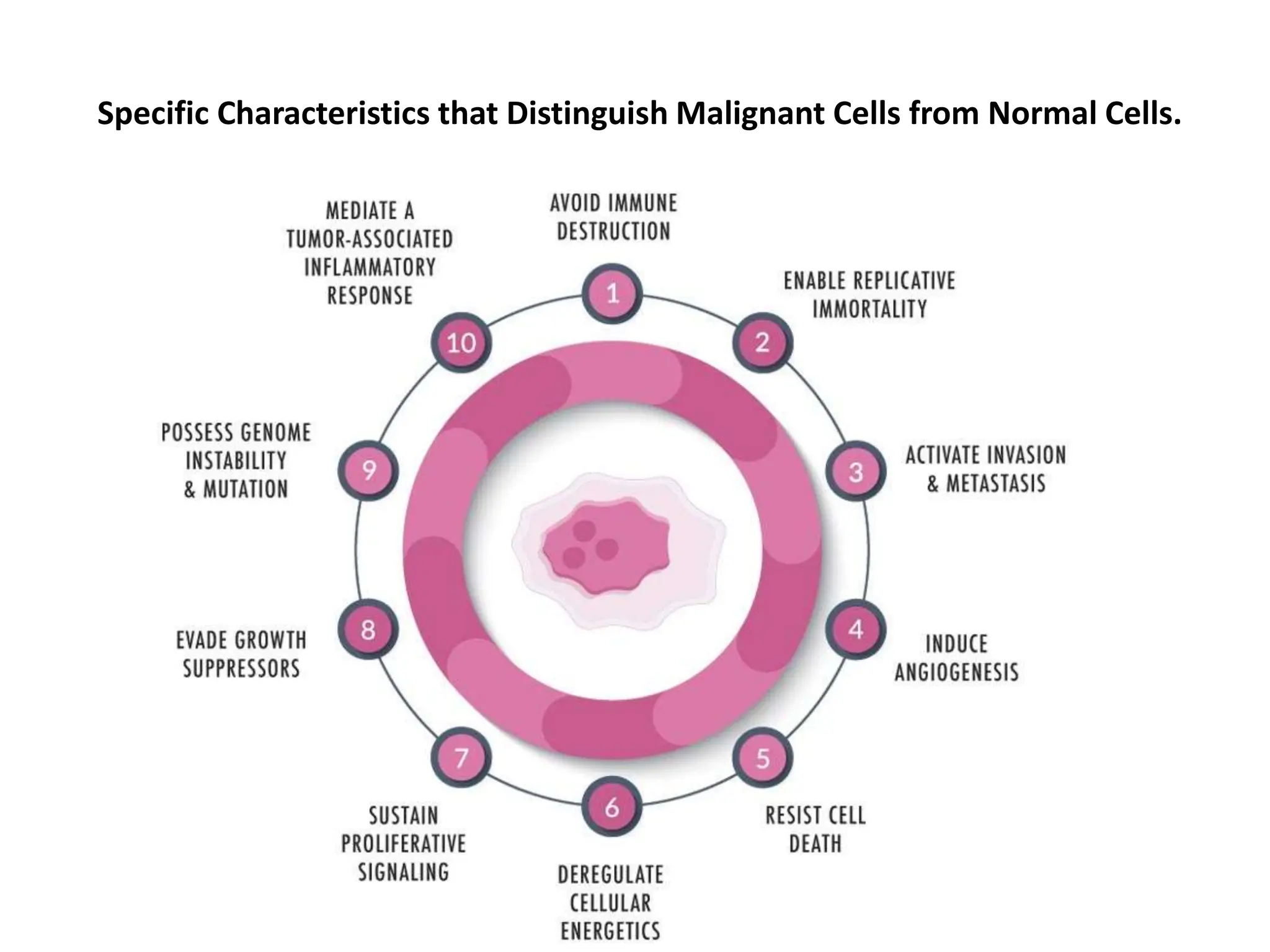
Specific Characteristics that Distinguish Malignant Cells from Normal Cells.
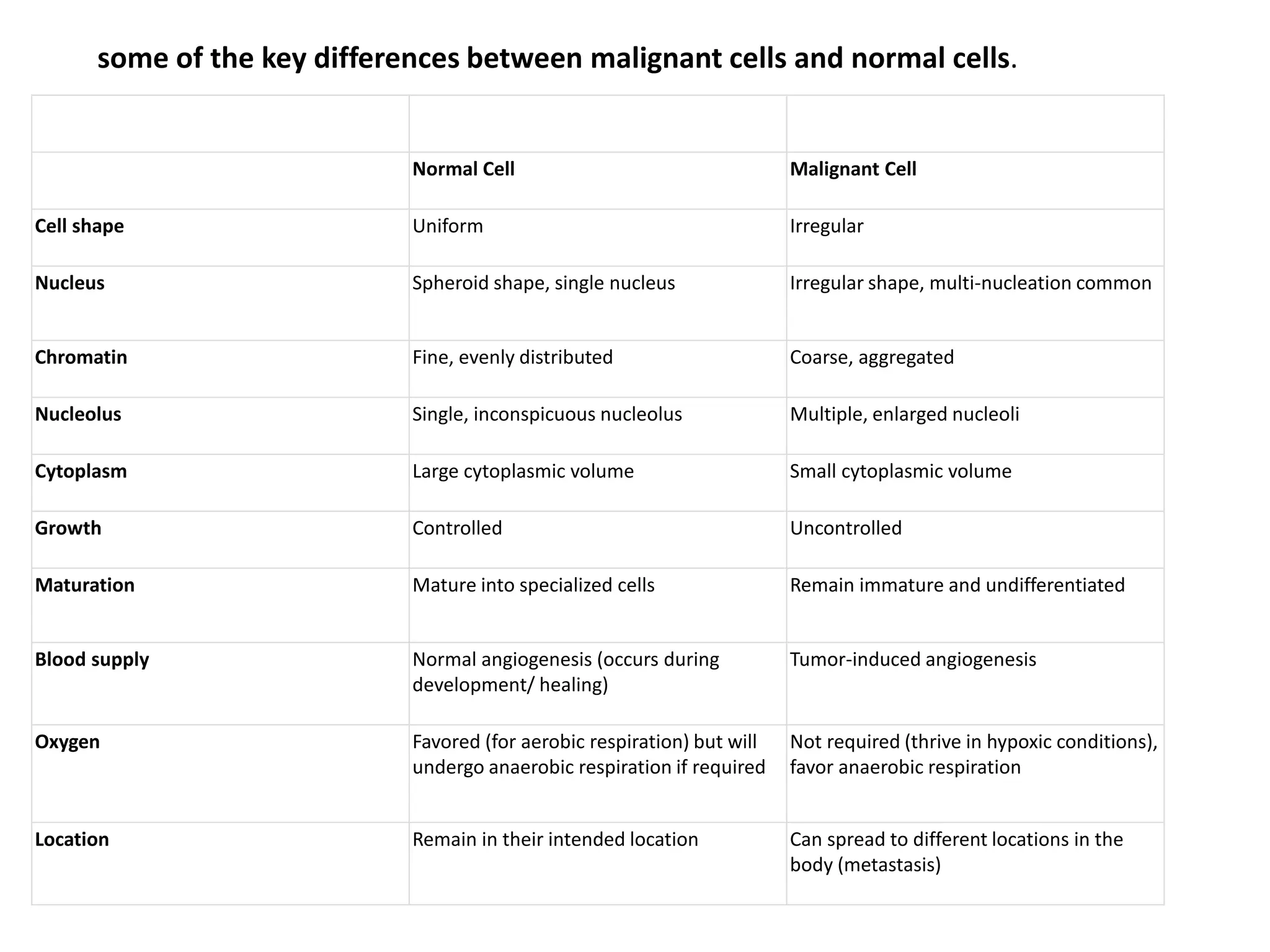
Normal Cell Malignant Cell
Cell shape Uniform Irregular
Nucleus Spheroid shape, single nucleus Irregular shape, multi-nucleation common
Chromatin Fine, evenly distributed Coarse, aggregated
Nucleolus Single, inconspicuous nucleolus Multiple, enlarged nucleoli
Cytoplasm Large cytoplasmic volume Small cytoplasmic volume
Growth Controlled Uncontrolled
Maturation Mature into specialized cells Remain immature and undifferentiated
Blood supply Normal angiogenesis (occurs during
development/ healing)
Tumor-induced angiogenesis
Oxygen Favored (for aerobic respiration) but will
undergo anaerobic respiration if required
Not required (thrive in hypoxic conditions),
favor anaerobic respiration
Location Remain in their intended location Can spread to different locations in the
body (metastasis)
some of the key differences between malignant cells and normal cells.
Tumor
MALIGNANT TUMOR
BENIGN TUMOR
CLASSIFICATION OF CANCER
NOMENCLATURE BENIGN MALIGNANT
1. EPITHELIAL GLAND ADENOMA ADENOCARCINOMA
2. SURFACE EPITHELIA PAPILLOMA E.G SQUAMOUS
PAPILLOMA e.g cervix
SQUAMOUS CELL CARCINOMA
TRANSISTIONAL PAPPILOMA
e.g bladder
TRANSISTIONAL CELL
CARCINOMA
3. CONNECTIVE TISSUE NEOPLASM
• FAT LIPOMA LIPOSARCOMA
• FIBROBLAST FIBROMA FIBROSARCOMA
• BONE OSTEOMA OSTEOSARCOMA
• CARTILAGE CHONDROMA CHONDROSARCOMA
• BLOOD VESSEL HAEMANGIOMA HAEMANGIOSARCOMA
• LYMPHATIC VESSEL LYMPHANGIOMA LYMPHANGIOSARCOMA
4. HAEMOPOETIC MALIGNANT NEOPLASM
MARROW PRECURSSOR NIL LEUKAMIA
LYMPHOID CELLS NIL LYMPHOMA
PROPERTIES OF CANCER CELLS
CANCER OR MALIGNANT TUMOR
•Oncogenesis or carcinogenesis is defined as the process of
cancer formation.
•Cancer diseases is multifactoral i.e arises as a result of the
interaction of environmental factors and the genetic or
hereditary factors
•Enviromental factors constitute to about 60% of the
incidence of cancer disease
•Environmental factors that predispose individual to cancer is
refer to as carcinogens, we have three broad groups:
1. Physical factors such as ionizing radiation e.g x-ray,γ-ray
and β-ray, ultraviolet light e.g UV spectrum
2. Chemical carcinogens
3. Biological agents
Thank you

a typical and malignant cells.power point

  • 1.
  • 2.
    The Cell •A Cellis the basic structural, functional, and biological unit of all known living organisms. •A typical cell is a normal cell •The body is made up of approximately 37.2 trillion of normal human cells •These ‘normal’ cells act as the body’s basic building blocks and possess specific characteristics that enable them to maintain correct functioning of tissues, organs, and organ systems.
  • 3.
    Characteristics of anormal cells •Control their growth using external signals, to grow and divide when required, •Undergo programmed cell death (apoptosis) as part of normal development, to maintain tissue homeostasis, and response to unrepairable damage. •‘Stick together’ by maintaining selective adhesions that they progressively adjust which ensures they remain in their intended location. •Differentiate into specialized cells with specific functions meaning they can adopt different physical characteristics despite having the same genome.
  • 4.
    •A malignant cellis a diseased cell e.g tumor cells or cancer cells •Cancer is a complex genetic disease that is caused by specific changes to the genes in one cell or group of cells. •These changes disrupt normal cell function – specifically affecting how a cell grows and divides. •In contrast to normal cells, cancer cells undergo uncontrolled cell growth resulting in the formation of a tumor. •Cancer cells undergo genetic changes refer to as mutation when compared to normal cells,
  • 5.
    Specific Characteristics thatDistinguish Malignant Cells from Normal Cells.
  • 6.
    Normal Cell MalignantCell Cell shape Uniform Irregular Nucleus Spheroid shape, single nucleus Irregular shape, multi-nucleation common Chromatin Fine, evenly distributed Coarse, aggregated Nucleolus Single, inconspicuous nucleolus Multiple, enlarged nucleoli Cytoplasm Large cytoplasmic volume Small cytoplasmic volume Growth Controlled Uncontrolled Maturation Mature into specialized cells Remain immature and undifferentiated Blood supply Normal angiogenesis (occurs during development/ healing) Tumor-induced angiogenesis Oxygen Favored (for aerobic respiration) but will undergo anaerobic respiration if required Not required (thrive in hypoxic conditions), favor anaerobic respiration Location Remain in their intended location Can spread to different locations in the body (metastasis) some of the key differences between malignant cells and normal cells.
  • 12.
  • 13.
  • 14.
  • 15.
  • 18.
    NOMENCLATURE BENIGN MALIGNANT 1.EPITHELIAL GLAND ADENOMA ADENOCARCINOMA 2. SURFACE EPITHELIA PAPILLOMA E.G SQUAMOUS PAPILLOMA e.g cervix SQUAMOUS CELL CARCINOMA TRANSISTIONAL PAPPILOMA e.g bladder TRANSISTIONAL CELL CARCINOMA 3. CONNECTIVE TISSUE NEOPLASM • FAT LIPOMA LIPOSARCOMA • FIBROBLAST FIBROMA FIBROSARCOMA • BONE OSTEOMA OSTEOSARCOMA • CARTILAGE CHONDROMA CHONDROSARCOMA • BLOOD VESSEL HAEMANGIOMA HAEMANGIOSARCOMA • LYMPHATIC VESSEL LYMPHANGIOMA LYMPHANGIOSARCOMA 4. HAEMOPOETIC MALIGNANT NEOPLASM MARROW PRECURSSOR NIL LEUKAMIA LYMPHOID CELLS NIL LYMPHOMA
  • 19.
  • 21.
    CANCER OR MALIGNANTTUMOR •Oncogenesis or carcinogenesis is defined as the process of cancer formation. •Cancer diseases is multifactoral i.e arises as a result of the interaction of environmental factors and the genetic or hereditary factors •Enviromental factors constitute to about 60% of the incidence of cancer disease •Environmental factors that predispose individual to cancer is refer to as carcinogens, we have three broad groups: 1. Physical factors such as ionizing radiation e.g x-ray,γ-ray and β-ray, ultraviolet light e.g UV spectrum 2. Chemical carcinogens 3. Biological agents
  • 22.