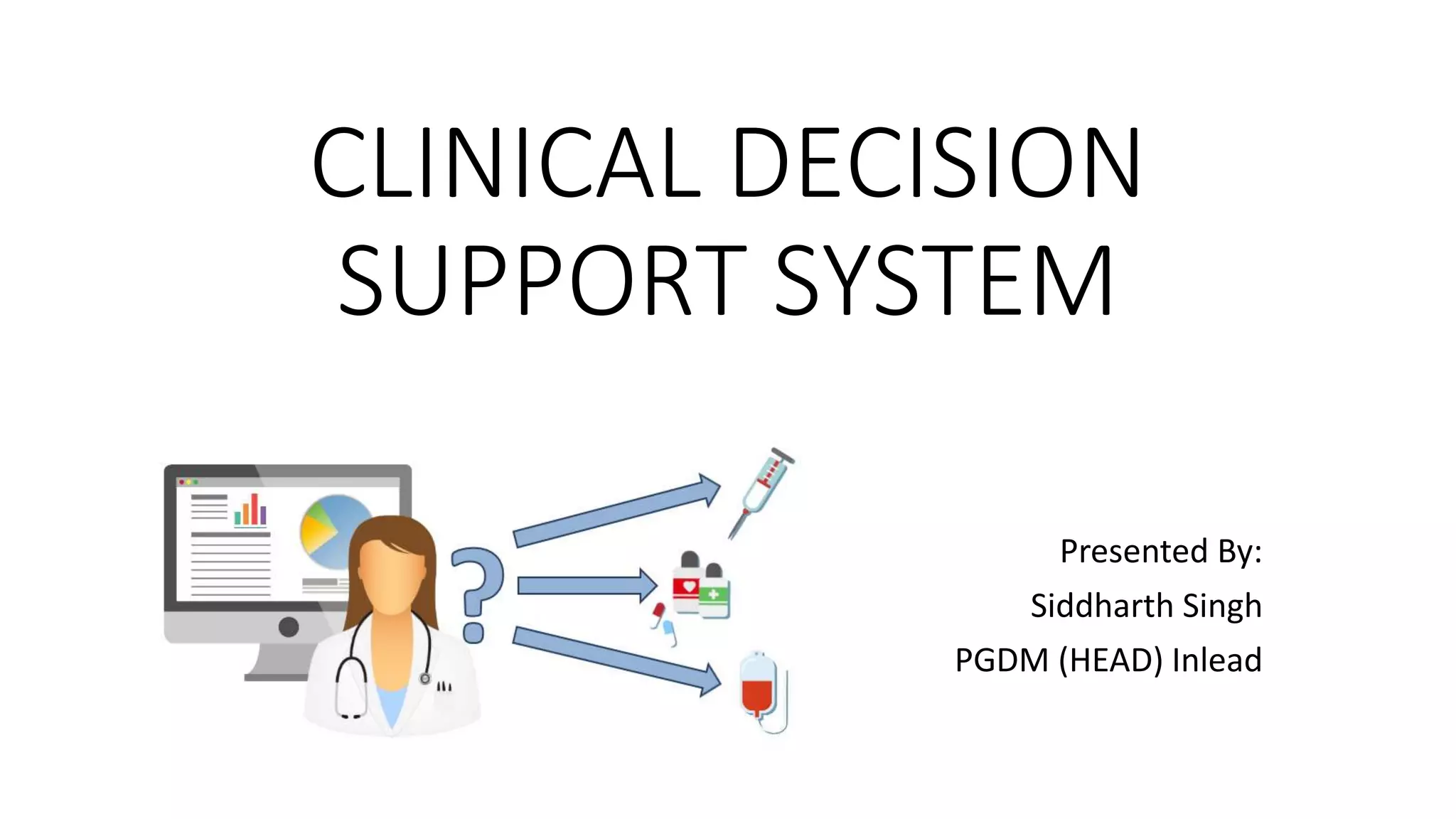
CLINICAL DECISION
SUPPORT SYSTEM
Presented By:
Siddharth Singh
PGDM (HEAD) Inlead
Decision & Decision Making
• Decision
“A choice that you make about something after thinking about it: the
result of deciding.” (Merriam-Webster Dictionary)
• Decision Making
The cognitive process resulting in the selection of a course of action
among several alternative scenarios.” (Wikipedia)
What is CDSS?
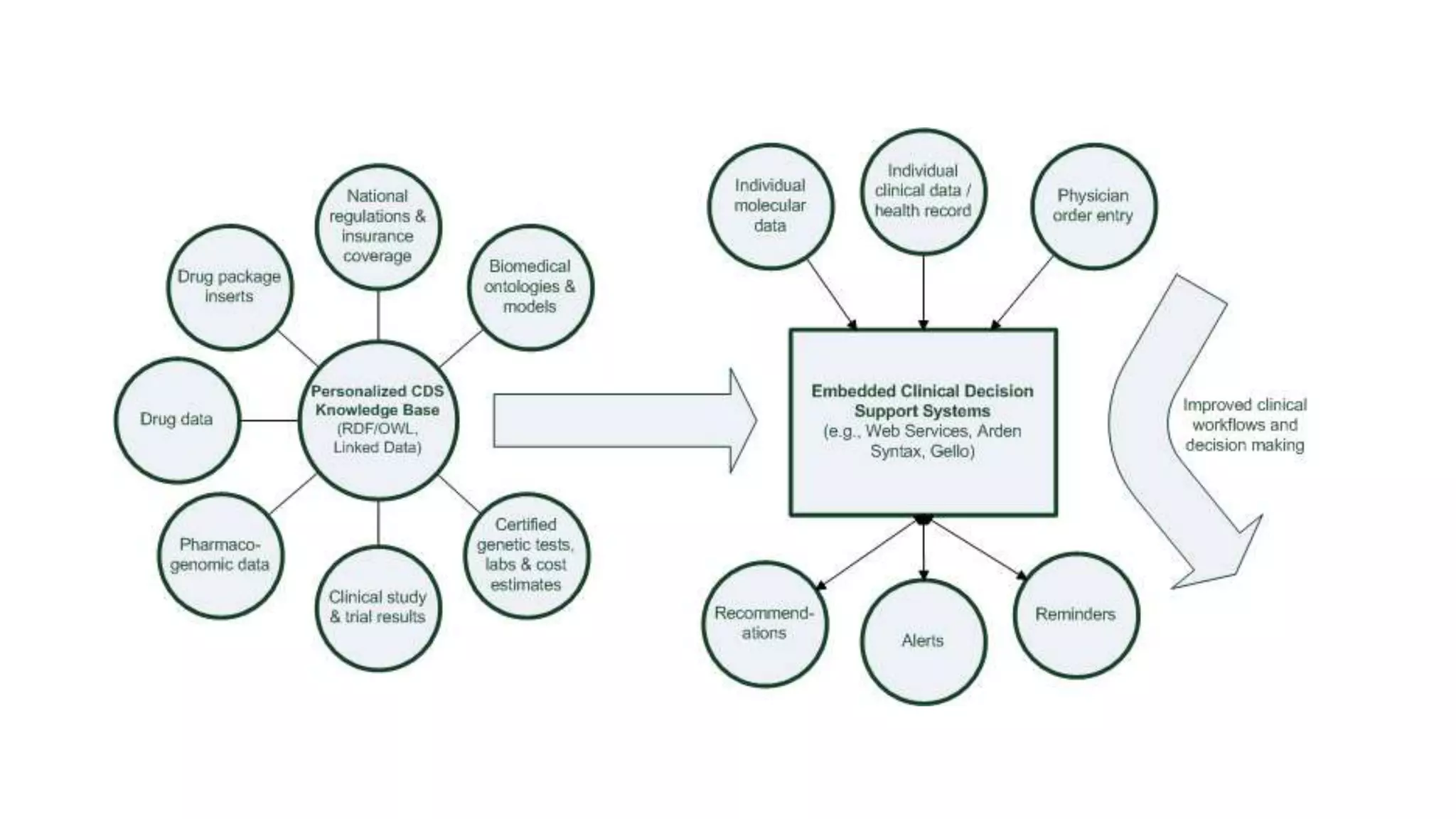
• Clinical decision support system/software (CDSS) are interactive
computer programs, which are designed to assist physicians and
other health professionals with decision making tasks. The basic
components of a CDSS include a dynamic (medical) knowledge base
and an inference mechanism (usually a set of rules derived from the
experts and evidence-based medicine) and implemented through
medical logic modules.
Characteristics
• A clinical decision support system use two or more items of patient
data to generate case-specific advice. CDSS is simply a decision
support system that is focused on using knowledge management in
such a way to achieve clinical advice for patient care based on some
number of items of patient data.
Types of CDSS
1. Knowledge based.
2. Non-knowledge based.
a. Artificial neural networks.
b. Genetic algorithms.
Purpose
• To assist clinicians at the point-of-care. This means that a clinician
would interact with a CDSS to help determine diagnosis, analysis, etc.
of patient data.
• The new methodology of using CDSS to assist forces the clinician to
interact with the CDSS utilizing both the clinician’s knowledge and the
CDSS to make a better analysis of the patients’ data than either
human or CDSS could make on their own.
• Typically the CDSS would make suggestions of outputs or a set of
outputs for the clinician to look through and the clinician officially
picks useful information and removes erroneous CDSS suggestions.
The doctor then takes the output of the CDSS and figures out which
diagnoses are relevant and which are not.
Contd..
• The doctor uses these systems at point-of-care to help them as they
are dealing with a patient, with the timing of use as either pre-
diagnoses, during diagnoses, or post diagnoses.
• Pre-diagnoses CDSS systems are used to help the physician prepare
the diagnoses. CDSS used during diagnoses are to help review and
filter the physician’s preliminary diagnostic choices to improve their
final results.
• Post-diagnoses CDSS systems are used to mine data to derive
connections between patients and their past medical history and
clinical research to predict future events
How Does It Work?
Example: Problem A
• Patient has a high blood pressure reading of 170/100 mmHg
• Data: 170/100
• Information: BP of Patient A = 170/100 mmHg
• Knowledge: Patient A has high blood pressure
• Decision (or Wisdom):
Patient A needs to be investigated for cause of HT
Patient A needs to be treated with anti hypertensive drug
Patient A needs to be referred to a cardiologist
Example: Problem B
• Patient B is allergic to penicillin. He was recently prescribed
amoxicillin for his sore throat
• Data: Penicillin, amoxicillin, sore throat
• Information:
Patient B has penicillin allergy
Patient B was prescribed amoxicillin for sore throat
• Knowledge: Patient B may/will have allergic reaction to his
prescription
• Decision (or Wisdom): Patient Should not take amoxicillin!!
Platforms
• Synergy extranet (SynEx).
• Arden
• Syntax
• Gello
Advantages
• International Classification of Diseases (ICD 10) codes are incorporated and
updated constantly to avoid nomenclature disparities which helps in data
mining and to monitor standards across health care delivery sites.
• The program is tailored to be used by health workers with minimum or no
computer expertise
• It is flexible enough to be adapted to suit the needs of different levels of
practitioners- from general practitioners to specialist.
• The differential diagnosis module is capable of generating all probable
differential diagnoses from signs and symptoms of the patient. It includes
both common and uncommon probabilities in clinical diagnosis.
Contd..
• The system helps physicians to avoid overlooking uncommon
conditions and provide decision support in difficult cases.
• E-Clinician is tailor made fundamentally focusing on Physicians who
provide clinical services in rural, semi-urban and even urban areas of
developing countries.
• E-Clinician is an aid to medical practitioners as it is simple to use, add
value to practice and provide immediate access to the most relevant
medical knowledge at the point of care.
Disadvantages
• Often these systems are stand-alone applications, requiring the
clinician to cease working on their current report system, switch to
the CDSS, input the necessary data, and receive the information.
These additional steps break the flow from the clinician’s perspective,
and cost precious time. Of additional irritation is that the data the
clinician may need to enter is already contained elsewhere in a digital
form in that hospital’s system, and some CDSSs are not equipped to
automatically pull this relevant information.
Contd..
• Clinical decision support systems face steep technical challenges in a
number of areas. Biological systems are profoundly complicated, and
a clinical decision may utilize an enormous range of potentially
relevant data. For example, an electronic evidence-based medicine
system may potentially consider a patient’s symptoms, medical
history, family history and genetics, as well as historical and
geographical trends of disease occurrence, and published clinical data
on medicinal effectiveness when recommending a patient’s course of
treatment. Furthermore, new data is constantly being published
which must be integrated into the system in order to maintain its
relevance.
References
• http://ehealth.eletsonline.com/2016/11356/
• https://en.wikipedia.org/wiki/Clinical_decision_support_system
• https://www.google.co.in/search?q=clinical+decision+support+syste
m
Thank You

Clinical decision support system

  • 1.
    CLINICAL DECISION SUPPORT SYSTEM PresentedBy: Siddharth Singh PGDM (HEAD) Inlead
  • 2.
    Decision & DecisionMaking • Decision “A choice that you make about something after thinking about it: the result of deciding.” (Merriam-Webster Dictionary) • Decision Making The cognitive process resulting in the selection of a course of action among several alternative scenarios.” (Wikipedia)
  • 3.
    What is CDSS? •Clinical decision support system/software (CDSS) are interactive computer programs, which are designed to assist physicians and other health professionals with decision making tasks. The basic components of a CDSS include a dynamic (medical) knowledge base and an inference mechanism (usually a set of rules derived from the experts and evidence-based medicine) and implemented through medical logic modules.
  • 4.
    Characteristics • A clinicaldecision support system use two or more items of patient data to generate case-specific advice. CDSS is simply a decision support system that is focused on using knowledge management in such a way to achieve clinical advice for patient care based on some number of items of patient data.
  • 5.
    Types of CDSS 1.Knowledge based. 2. Non-knowledge based. a. Artificial neural networks. b. Genetic algorithms.
  • 6.
    Purpose • To assistclinicians at the point-of-care. This means that a clinician would interact with a CDSS to help determine diagnosis, analysis, etc. of patient data. • The new methodology of using CDSS to assist forces the clinician to interact with the CDSS utilizing both the clinician’s knowledge and the CDSS to make a better analysis of the patients’ data than either human or CDSS could make on their own. • Typically the CDSS would make suggestions of outputs or a set of outputs for the clinician to look through and the clinician officially picks useful information and removes erroneous CDSS suggestions. The doctor then takes the output of the CDSS and figures out which diagnoses are relevant and which are not.
  • 7.
    Contd.. • The doctoruses these systems at point-of-care to help them as they are dealing with a patient, with the timing of use as either pre- diagnoses, during diagnoses, or post diagnoses. • Pre-diagnoses CDSS systems are used to help the physician prepare the diagnoses. CDSS used during diagnoses are to help review and filter the physician’s preliminary diagnostic choices to improve their final results. • Post-diagnoses CDSS systems are used to mine data to derive connections between patients and their past medical history and clinical research to predict future events
  • 8.
  • 10.
    Example: Problem A •Patient has a high blood pressure reading of 170/100 mmHg • Data: 170/100 • Information: BP of Patient A = 170/100 mmHg • Knowledge: Patient A has high blood pressure • Decision (or Wisdom): Patient A needs to be investigated for cause of HT Patient A needs to be treated with anti hypertensive drug Patient A needs to be referred to a cardiologist
  • 11.
    Example: Problem B •Patient B is allergic to penicillin. He was recently prescribed amoxicillin for his sore throat • Data: Penicillin, amoxicillin, sore throat • Information: Patient B has penicillin allergy Patient B was prescribed amoxicillin for sore throat • Knowledge: Patient B may/will have allergic reaction to his prescription • Decision (or Wisdom): Patient Should not take amoxicillin!!
  • 12.
    Platforms • Synergy extranet(SynEx). • Arden • Syntax • Gello
  • 13.
    Advantages • International Classificationof Diseases (ICD 10) codes are incorporated and updated constantly to avoid nomenclature disparities which helps in data mining and to monitor standards across health care delivery sites. • The program is tailored to be used by health workers with minimum or no computer expertise • It is flexible enough to be adapted to suit the needs of different levels of practitioners- from general practitioners to specialist. • The differential diagnosis module is capable of generating all probable differential diagnoses from signs and symptoms of the patient. It includes both common and uncommon probabilities in clinical diagnosis.
  • 14.
    Contd.. • The systemhelps physicians to avoid overlooking uncommon conditions and provide decision support in difficult cases. • E-Clinician is tailor made fundamentally focusing on Physicians who provide clinical services in rural, semi-urban and even urban areas of developing countries. • E-Clinician is an aid to medical practitioners as it is simple to use, add value to practice and provide immediate access to the most relevant medical knowledge at the point of care.
  • 15.
    Disadvantages • Often thesesystems are stand-alone applications, requiring the clinician to cease working on their current report system, switch to the CDSS, input the necessary data, and receive the information. These additional steps break the flow from the clinician’s perspective, and cost precious time. Of additional irritation is that the data the clinician may need to enter is already contained elsewhere in a digital form in that hospital’s system, and some CDSSs are not equipped to automatically pull this relevant information.
  • 16.
    Contd.. • Clinical decisionsupport systems face steep technical challenges in a number of areas. Biological systems are profoundly complicated, and a clinical decision may utilize an enormous range of potentially relevant data. For example, an electronic evidence-based medicine system may potentially consider a patient’s symptoms, medical history, family history and genetics, as well as historical and geographical trends of disease occurrence, and published clinical data on medicinal effectiveness when recommending a patient’s course of treatment. Furthermore, new data is constantly being published which must be integrated into the system in order to maintain its relevance.
  • 17.
  • 18.