CLINICAL DATA
ANALYTICSDr SB Bhattacharyya
MBBS, MBA, FCGP
Member, IMA Standing Committee on IT, IMA Hqrs
Member, EHR Standards Committee, MoH&FW, GoI
Hony. State Secretary (2015), IMA Haryana
President (2010 – 2011), IAMI
“If you can measure that of which you speak and can
express it by a number, you know something of your
subject; but when you cannot measure it, when you
cannot express it in numbers, your knowledge is meagre
and unsatisfactory.”
Lord Kelvin
Dr SB Bhattacharyya© 2
“You can only manage what you can
measure.”
Peter Drucker
Dr SB Bhattacharyya© 3
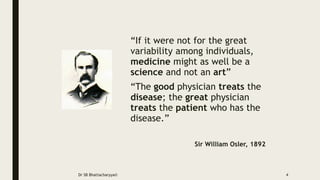
“If it were not for the great
variability among individuals,
medicine might as well be a
science and not an art”
“The good physician treats the
disease; the great physician
treats the patient who has the
disease.”
Sir William Osler, 1892
Dr SB Bhattacharyya© 4
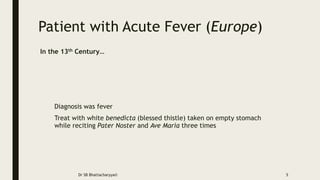
Patient with Acute Fever (Europe)
Diagnosis was fever
Treat with white benedicta (blessed thistle) taken on empty stomach
while reciting Pater Noster and Ave Maria three times
Dr SB Bhattacharyya© 5
In the 13th Century…
Patient with Acute Fever (Europe)
Dr SB Bhattacharyya© 6
In the 19th Century…
• Diagnosis was pneumonia by using the newly invented stethoscope
• Treat by blood letting, restricted diet and blistering induced by dried,
pulverized Spanish fly
Patient with Acute Fever (Europe)
In the 20th Century
• Diagnosis is pneumonia using CXR PA View
• Treat with antibiotics (penicillin) administration
• Lumbar Puncture if signs of meningitis is present or develops
Dr SB Bhattacharyya© 7
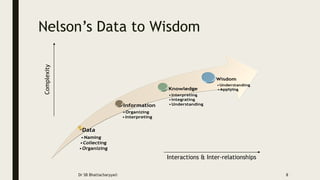
Nelson’s Data to Wisdom
Dr SB Bhattacharyya© 8
Complexity
Interactions & Inter-relationships
Hertfordshire Records :: DOHAD
■ Meticulous birth records were maintained throughout Hertfordshire
County, UK, from 1911 onwards through the efforts of a dedicated and
visionary midwife, Ethel Margaret Burnside
■ Through linking records of births with health in later life by a research
team headed by Dr David Barker led to the development of the fetal
origins hypothesis termed DOHAD (developmental origins of health and
diseases)
Dr SB Bhattacharyya© 9
Clinical Science is Empirical
■ The word empirical denotes information gained by means of
observation, experience, or experiment.
■ Empirical data is data that is produced by an experiment or
observation.
■ As opposed to theoretical that depends on hypotheses
Dr SB Bhattacharyya© 10
Medical Records
Data Volume & Costs
■ On an average, around 80 MB of data (4 MB text & 76 MB imaging) per
patient per year is generated
■ Storage costs < US$ 2.00 per patient for 7 years
– Dr John Halamka, MD, MS
CIO, Beth Israel Deaconess Medical Center
Dr SB Bhattacharyya© 11
“Statistics are like bikinis. What they reveal
is suggestive but what they conceal is vital”
- Aaron Levenstein
Dr SB Bhattacharyya© 12
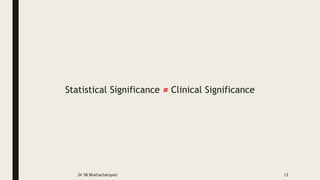
Statistical Significance ≠ Clinical Significance
Dr SB Bhattacharyya© 13
Nota Bene
■ Statistics is confusing unless one understands the numbers and what they
actually mean making them open to misinterpretation
■ There is always a chance of over-analysis leading to analysis paralysis
■ It is important to ask the right questions and re-frame them intelligently
Dr SB Bhattacharyya© 14
Nota Bene
■ Running the analytics is all science – mostly mathematics
■ Interpreting the results is all art derived from knowledge and wisdom
■ It is possible to predict with a reasonable degree of accuracy (~95%) the most
likely outcome under a given set of circumstances
Dr SB Bhattacharyya© 15
Nota Bene
■ One must continuously strive to avoid overfitting
■ Likelihood ratio is the best indicator, while
p-Value is the worst
■ Hindsight is 6/6 vision, foresight is 0/0
Dr SB Bhattacharyya© 16
Clinical data is…
■ Highly multivariate with many important predictors and response variables
■ Temporally correlated (longitudinal, survival studies)
■ Costly and difficult to obtain
■ Historical in nature
Dr SB Bhattacharyya© 17
Few Indices
■ Sensitivity
■ Specificity
■ Likelihood Ratio (+/-)
■ Predictive Value (+/-)
■ Prevalence
■ Pre-test/Post-test Odds
■ Post-test Probability (+/-)
■ Kaplan-Meier Survival Curves
/ Cox’s Hazard Ratio
■ Relative Risk
■ Relative Risk Reduction
■ Absolute Risk Reduction
■ Odds Ratio
■ Numbers Needed to Treat (or
Harm)
■ Quality of Life Year Adjusted
■ Receiver Operator Characteristic
(ROC) Curve
■ Total Cost of Treatment
Dr SB Bhattacharyya© 18
Outcomes
■ Patient better, same or worse
■ Cost less, same or more
■ Needs lesser time, same time, longer time to recover/for relief
■ Needs lesser time, same time, longer time to cure
■ Cure vs. Recover/Relief
Dr SB Bhattacharyya© 19
5 C’s of Analytics
■ Curiosity – figure out what one wishes to figure out
■ Capture – the data
■ Cure – clean and transform the data
■ Crunch – run the chosen analytical model
■ Create – reports and graphs
Dr SB Bhattacharyya© 20
Steps of Performing Analytics
1. Construct query
2. Data acquisition (70 – 80% of effort)
1. Data pre-processing and visualisation
2. ETL (extract-transform-load) : data warehousing
3. Algorithm modelling
4. Run model
5. Study results
6. Repeat from step # 3 above till the most appropriate answer is derived –
occasionally the data may have to be re-processed, which most analytical
tools are capable of performing
Dr SB Bhattacharyya© 21
The Process of Analytics
■ Several alternative models may need to be run before the “right” model is
discovered.
■ With experience, the number of alternative models required to be studied
before finding the “right” one will diminish.
Dr SB Bhattacharyya© 22
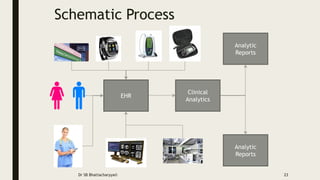
Schematic Process
Dr SB Bhattacharyya© 23
EHR
Clinical
Analytics
Analytic
Reports
Analytic
Reports
Data  Analytic Reports
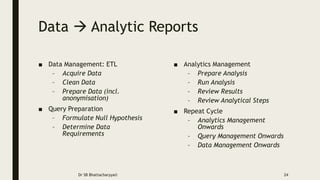
■ Data Management: ETL
– Acquire Data
– Clean Data
– Prepare Data (incl.
anonymisation)
■ Query Preparation
– Formulate Null Hypothesis
– Determine Data
Requirements
■ Analytics Management
– Prepare Analysis
– Run Analysis
– Review Results
– Review Analytical Steps
■ Repeat Cycle
– Analytics Management
Onwards
– Query Management Onwards
– Data Management Onwards
Dr SB Bhattacharyya© 24
Dr SB Bhattacharyya© 25
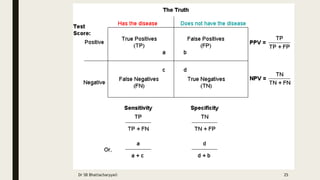
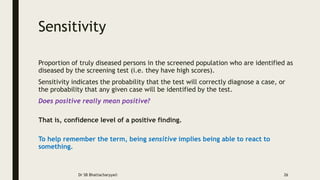
Sensitivity
Proportion of truly diseased persons in the screened population who are identified as
diseased by the screening test (i.e. they have high scores).
Sensitivity indicates the probability that the test will correctly diagnose a case, or
the probability that any given case will be identified by the test.
Does positive really mean positive?
That is, confidence level of a positive finding.
To help remember the term, being sensitive implies being able to react to
something.
Dr SB Bhattacharyya© 26
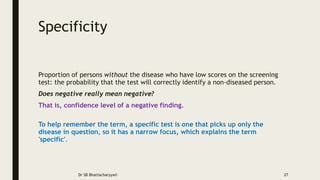
Specificity
Proportion of persons without the disease who have low scores on the screening
test: the probability that the test will correctly identify a non-diseased person.
Does negative really mean negative?
That is, confidence level of a negative finding.
To help remember the term, a specific test is one that picks up only the
disease in question, so it has a narrow focus, which explains the term
'specific'.
Dr SB Bhattacharyya© 27
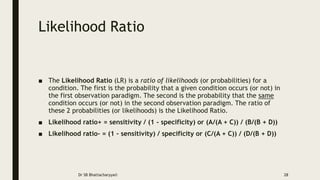
Likelihood Ratio
■ The Likelihood Ratio (LR) is a ratio of likelihoods (or probabilities) for a
condition. The first is the probability that a given condition occurs (or not) in
the first observation paradigm. The second is the probability that the same
condition occurs (or not) in the second observation paradigm. The ratio of
these 2 probabilities (or likelihoods) is the Likelihood Ratio.
■ Likelihood ratio+ = sensitivity / (1 - specificity) or (A/(A + C)) / (B/(B + D))
■ Likelihood ratio- = (1 - sensitivity) / specificity or (C/(A + C)) / (D/(B + D))
Dr SB Bhattacharyya© 28
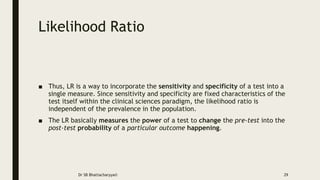
Likelihood Ratio
■ Thus, LR is a way to incorporate the sensitivity and specificity of a test into a
single measure. Since sensitivity and specificity are fixed characteristics of the
test itself within the clinical sciences paradigm, the likelihood ratio is
independent of the prevalence in the population.
■ The LR basically measures the power of a test to change the pre-test into the
post-test probability of a particular outcome happening.
Dr SB Bhattacharyya© 29
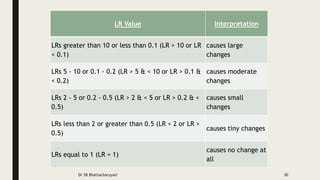
LR Value Interpretation
LRs greater than 10 or less than 0.1 (LR > 10 or LR
< 0.1)
causes large
changes
LRs 5 - 10 or 0.1 - 0.2 (LR > 5 & < 10 or LR > 0.1 &
< 0.2)
causes moderate
changes
LRs 2 - 5 or 0.2 - 0.5 (LR > 2 & < 5 or LR > 0.2 & <
0.5)
causes small
changes
LRs less than 2 or greater than 0.5 (LR < 2 or LR >
0.5)
causes tiny changes
LRs equal to 1 (LR = 1)
causes no change at
all
Dr SB Bhattacharyya© 30
Dr SB Bhattacharyya© 31
Big Data in Healthcare
■ High Volume
– Data from all sorts of sources in electronic format
■ High Velocity
– Data from devices, monitors and variety of systems
continuously streaming in 24x7
■ High Variety
– Data is in almost all types
■ High Veracity
– Data sources are dependable as they are mostly known
Dr SB Bhattacharyya© 32
Big Data in Healthcare
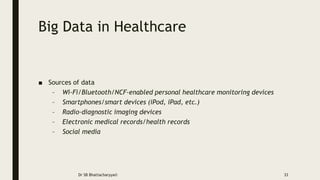
■ Sources of data
– Wi-Fi/Bluetooth/NCF-enabled personal healthcare monitoring devices
– Smartphones/smart devices (iPod, iPad, etc.)
– Radio-diagnostic imaging devices
– Electronic medical records/health records
– Social media
Dr SB Bhattacharyya© 33
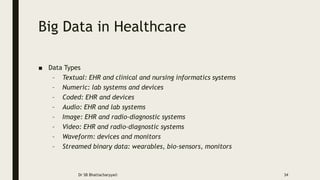
Big Data in Healthcare
■ Data Types
– Textual: EHR and clinical and nursing informatics systems
– Numeric: lab systems and devices
– Coded: EHR and devices
– Audio: EHR and lab systems
– Image: EHR and radio-diagnostic systems
– Video: EHR and radio-diagnostic systems
– Waveform: devices and monitors
– Streamed binary data: wearables, bio-sensors, monitors
Dr SB Bhattacharyya© 34
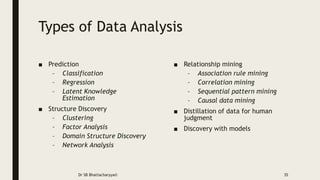
Types of Data Analysis
■ Prediction
– Classification
– Regression
– Latent Knowledge
Estimation
■ Structure Discovery
– Clustering
– Factor Analysis
– Domain Structure Discovery
– Network Analysis
■ Relationship mining
– Association rule mining
– Correlation mining
– Sequential pattern mining
– Causal data mining
■ Distillation of data for human
judgment
■ Discovery with models
Dr SB Bhattacharyya© 35
Dr SB Bhattacharyya© : Images are copyrighted by the respective vendors 36
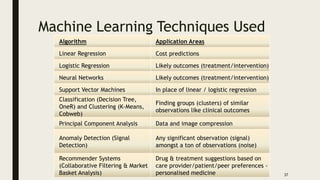
Machine Learning Techniques Used
Dr SB Bhattacharyya© 37
Algorithm Application Areas
Linear Regression Cost predictions
Logistic Regression Likely outcomes (treatment/intervention)
Neural Networks Likely outcomes (treatment/intervention)
Support Vector Machines In place of linear / logistic regression
Classification (Decision Tree,
OneR) and Clustering (K-Means,
Cobweb)
Finding groups (clusters) of similar
observations like clinical outcomes
Principal Component Analysis Data and image compression
Anomaly Detection (Signal
Detection)
Any significant observation (signal)
amongst a ton of observations (noise)
Recommender Systems
(Collaborative Filtering & Market
Basket Analysis)
Drug & treatment suggestions based on
care provider/patient/peer preferences -
personalised medicine
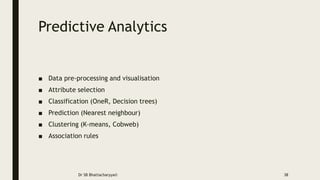
Predictive Analytics
■ Data pre-processing and visualisation
■ Attribute selection
■ Classification (OneR, Decision trees)
■ Prediction (Nearest neighbour)
■ Clustering (K-means, Cobweb)
■ Association rules
Dr SB Bhattacharyya© 38
Application Areas
■ Operational
– Administrative
– Clinical
– Nursing
■ Predictive
– Clinical decision support
– Outcomes (prognostics)
assessment
– Readmission prevention
– Adverse event avoidance
– Disease management
– Patient matching
– Personalised medicine
Dr SB Bhattacharyya© 39
THANKS!
Dr SB Bhattacharyya© 40

Clinical data analytics

  • 1.
    CLINICAL DATA ANALYTICSDr SBBhattacharyya MBBS, MBA, FCGP Member, IMA Standing Committee on IT, IMA Hqrs Member, EHR Standards Committee, MoH&FW, GoI Hony. State Secretary (2015), IMA Haryana President (2010 – 2011), IAMI
  • 2.
    “If you canmeasure that of which you speak and can express it by a number, you know something of your subject; but when you cannot measure it, when you cannot express it in numbers, your knowledge is meagre and unsatisfactory.” Lord Kelvin Dr SB Bhattacharyya© 2
  • 3.
    “You can onlymanage what you can measure.” Peter Drucker Dr SB Bhattacharyya© 3
  • 4.
    “If it werenot for the great variability among individuals, medicine might as well be a science and not an art” “The good physician treats the disease; the great physician treats the patient who has the disease.” Sir William Osler, 1892 Dr SB Bhattacharyya© 4
  • 5.
    Patient with AcuteFever (Europe) Diagnosis was fever Treat with white benedicta (blessed thistle) taken on empty stomach while reciting Pater Noster and Ave Maria three times Dr SB Bhattacharyya© 5 In the 13th Century…
  • 6.
    Patient with AcuteFever (Europe) Dr SB Bhattacharyya© 6 In the 19th Century… • Diagnosis was pneumonia by using the newly invented stethoscope • Treat by blood letting, restricted diet and blistering induced by dried, pulverized Spanish fly
  • 7.
    Patient with AcuteFever (Europe) In the 20th Century • Diagnosis is pneumonia using CXR PA View • Treat with antibiotics (penicillin) administration • Lumbar Puncture if signs of meningitis is present or develops Dr SB Bhattacharyya© 7
  • 8.
    Nelson’s Data toWisdom Dr SB Bhattacharyya© 8 Complexity Interactions & Inter-relationships
  • 9.
    Hertfordshire Records ::DOHAD ■ Meticulous birth records were maintained throughout Hertfordshire County, UK, from 1911 onwards through the efforts of a dedicated and visionary midwife, Ethel Margaret Burnside ■ Through linking records of births with health in later life by a research team headed by Dr David Barker led to the development of the fetal origins hypothesis termed DOHAD (developmental origins of health and diseases) Dr SB Bhattacharyya© 9
  • 10.
    Clinical Science isEmpirical ■ The word empirical denotes information gained by means of observation, experience, or experiment. ■ Empirical data is data that is produced by an experiment or observation. ■ As opposed to theoretical that depends on hypotheses Dr SB Bhattacharyya© 10
  • 11.
    Medical Records Data Volume& Costs ■ On an average, around 80 MB of data (4 MB text & 76 MB imaging) per patient per year is generated ■ Storage costs < US$ 2.00 per patient for 7 years – Dr John Halamka, MD, MS CIO, Beth Israel Deaconess Medical Center Dr SB Bhattacharyya© 11
  • 12.
    “Statistics are likebikinis. What they reveal is suggestive but what they conceal is vital” - Aaron Levenstein Dr SB Bhattacharyya© 12
  • 13.
    Statistical Significance ≠Clinical Significance Dr SB Bhattacharyya© 13
  • 14.
    Nota Bene ■ Statisticsis confusing unless one understands the numbers and what they actually mean making them open to misinterpretation ■ There is always a chance of over-analysis leading to analysis paralysis ■ It is important to ask the right questions and re-frame them intelligently Dr SB Bhattacharyya© 14
  • 15.
    Nota Bene ■ Runningthe analytics is all science – mostly mathematics ■ Interpreting the results is all art derived from knowledge and wisdom ■ It is possible to predict with a reasonable degree of accuracy (~95%) the most likely outcome under a given set of circumstances Dr SB Bhattacharyya© 15
  • 16.
    Nota Bene ■ Onemust continuously strive to avoid overfitting ■ Likelihood ratio is the best indicator, while p-Value is the worst ■ Hindsight is 6/6 vision, foresight is 0/0 Dr SB Bhattacharyya© 16
  • 17.
    Clinical data is… ■Highly multivariate with many important predictors and response variables ■ Temporally correlated (longitudinal, survival studies) ■ Costly and difficult to obtain ■ Historical in nature Dr SB Bhattacharyya© 17
  • 18.
    Few Indices ■ Sensitivity ■Specificity ■ Likelihood Ratio (+/-) ■ Predictive Value (+/-) ■ Prevalence ■ Pre-test/Post-test Odds ■ Post-test Probability (+/-) ■ Kaplan-Meier Survival Curves / Cox’s Hazard Ratio ■ Relative Risk ■ Relative Risk Reduction ■ Absolute Risk Reduction ■ Odds Ratio ■ Numbers Needed to Treat (or Harm) ■ Quality of Life Year Adjusted ■ Receiver Operator Characteristic (ROC) Curve ■ Total Cost of Treatment Dr SB Bhattacharyya© 18
  • 19.
    Outcomes ■ Patient better,same or worse ■ Cost less, same or more ■ Needs lesser time, same time, longer time to recover/for relief ■ Needs lesser time, same time, longer time to cure ■ Cure vs. Recover/Relief Dr SB Bhattacharyya© 19
  • 20.
    5 C’s ofAnalytics ■ Curiosity – figure out what one wishes to figure out ■ Capture – the data ■ Cure – clean and transform the data ■ Crunch – run the chosen analytical model ■ Create – reports and graphs Dr SB Bhattacharyya© 20
  • 21.
    Steps of PerformingAnalytics 1. Construct query 2. Data acquisition (70 – 80% of effort) 1. Data pre-processing and visualisation 2. ETL (extract-transform-load) : data warehousing 3. Algorithm modelling 4. Run model 5. Study results 6. Repeat from step # 3 above till the most appropriate answer is derived – occasionally the data may have to be re-processed, which most analytical tools are capable of performing Dr SB Bhattacharyya© 21
  • 22.
    The Process ofAnalytics ■ Several alternative models may need to be run before the “right” model is discovered. ■ With experience, the number of alternative models required to be studied before finding the “right” one will diminish. Dr SB Bhattacharyya© 22
  • 23.
    Schematic Process Dr SBBhattacharyya© 23 EHR Clinical Analytics Analytic Reports Analytic Reports
  • 24.
    Data  AnalyticReports ■ Data Management: ETL – Acquire Data – Clean Data – Prepare Data (incl. anonymisation) ■ Query Preparation – Formulate Null Hypothesis – Determine Data Requirements ■ Analytics Management – Prepare Analysis – Run Analysis – Review Results – Review Analytical Steps ■ Repeat Cycle – Analytics Management Onwards – Query Management Onwards – Data Management Onwards Dr SB Bhattacharyya© 24
  • 25.
  • 26.
    Sensitivity Proportion of trulydiseased persons in the screened population who are identified as diseased by the screening test (i.e. they have high scores). Sensitivity indicates the probability that the test will correctly diagnose a case, or the probability that any given case will be identified by the test. Does positive really mean positive? That is, confidence level of a positive finding. To help remember the term, being sensitive implies being able to react to something. Dr SB Bhattacharyya© 26
  • 27.
    Specificity Proportion of personswithout the disease who have low scores on the screening test: the probability that the test will correctly identify a non-diseased person. Does negative really mean negative? That is, confidence level of a negative finding. To help remember the term, a specific test is one that picks up only the disease in question, so it has a narrow focus, which explains the term 'specific'. Dr SB Bhattacharyya© 27
  • 28.
    Likelihood Ratio ■ TheLikelihood Ratio (LR) is a ratio of likelihoods (or probabilities) for a condition. The first is the probability that a given condition occurs (or not) in the first observation paradigm. The second is the probability that the same condition occurs (or not) in the second observation paradigm. The ratio of these 2 probabilities (or likelihoods) is the Likelihood Ratio. ■ Likelihood ratio+ = sensitivity / (1 - specificity) or (A/(A + C)) / (B/(B + D)) ■ Likelihood ratio- = (1 - sensitivity) / specificity or (C/(A + C)) / (D/(B + D)) Dr SB Bhattacharyya© 28
  • 29.
    Likelihood Ratio ■ Thus,LR is a way to incorporate the sensitivity and specificity of a test into a single measure. Since sensitivity and specificity are fixed characteristics of the test itself within the clinical sciences paradigm, the likelihood ratio is independent of the prevalence in the population. ■ The LR basically measures the power of a test to change the pre-test into the post-test probability of a particular outcome happening. Dr SB Bhattacharyya© 29
  • 30.
    LR Value Interpretation LRsgreater than 10 or less than 0.1 (LR > 10 or LR < 0.1) causes large changes LRs 5 - 10 or 0.1 - 0.2 (LR > 5 & < 10 or LR > 0.1 & < 0.2) causes moderate changes LRs 2 - 5 or 0.2 - 0.5 (LR > 2 & < 5 or LR > 0.2 & < 0.5) causes small changes LRs less than 2 or greater than 0.5 (LR < 2 or LR > 0.5) causes tiny changes LRs equal to 1 (LR = 1) causes no change at all Dr SB Bhattacharyya© 30
  • 31.
  • 32.
    Big Data inHealthcare ■ High Volume – Data from all sorts of sources in electronic format ■ High Velocity – Data from devices, monitors and variety of systems continuously streaming in 24x7 ■ High Variety – Data is in almost all types ■ High Veracity – Data sources are dependable as they are mostly known Dr SB Bhattacharyya© 32
  • 33.
    Big Data inHealthcare ■ Sources of data – Wi-Fi/Bluetooth/NCF-enabled personal healthcare monitoring devices – Smartphones/smart devices (iPod, iPad, etc.) – Radio-diagnostic imaging devices – Electronic medical records/health records – Social media Dr SB Bhattacharyya© 33
  • 34.
    Big Data inHealthcare ■ Data Types – Textual: EHR and clinical and nursing informatics systems – Numeric: lab systems and devices – Coded: EHR and devices – Audio: EHR and lab systems – Image: EHR and radio-diagnostic systems – Video: EHR and radio-diagnostic systems – Waveform: devices and monitors – Streamed binary data: wearables, bio-sensors, monitors Dr SB Bhattacharyya© 34
  • 35.
    Types of DataAnalysis ■ Prediction – Classification – Regression – Latent Knowledge Estimation ■ Structure Discovery – Clustering – Factor Analysis – Domain Structure Discovery – Network Analysis ■ Relationship mining – Association rule mining – Correlation mining – Sequential pattern mining – Causal data mining ■ Distillation of data for human judgment ■ Discovery with models Dr SB Bhattacharyya© 35
  • 36.
    Dr SB Bhattacharyya©: Images are copyrighted by the respective vendors 36
  • 37.
    Machine Learning TechniquesUsed Dr SB Bhattacharyya© 37 Algorithm Application Areas Linear Regression Cost predictions Logistic Regression Likely outcomes (treatment/intervention) Neural Networks Likely outcomes (treatment/intervention) Support Vector Machines In place of linear / logistic regression Classification (Decision Tree, OneR) and Clustering (K-Means, Cobweb) Finding groups (clusters) of similar observations like clinical outcomes Principal Component Analysis Data and image compression Anomaly Detection (Signal Detection) Any significant observation (signal) amongst a ton of observations (noise) Recommender Systems (Collaborative Filtering & Market Basket Analysis) Drug & treatment suggestions based on care provider/patient/peer preferences - personalised medicine
  • 38.
    Predictive Analytics ■ Datapre-processing and visualisation ■ Attribute selection ■ Classification (OneR, Decision trees) ■ Prediction (Nearest neighbour) ■ Clustering (K-means, Cobweb) ■ Association rules Dr SB Bhattacharyya© 38
  • 39.
    Application Areas ■ Operational –Administrative – Clinical – Nursing ■ Predictive – Clinical decision support – Outcomes (prognostics) assessment – Readmission prevention – Adverse event avoidance – Disease management – Patient matching – Personalised medicine Dr SB Bhattacharyya© 39
  • 40.