SNOMED CT
Overview
Dr. SB Bhattacharyya
MBBS, MBA, FCGP
Founder & CEO, BC2RI LLP
What is SNOMED CT?
BC2RILLP-Dr.SBBhattacharyya©(2020)
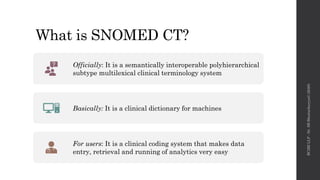
Officially: It is a semantically interoperable polyhierarchical
subtype multilexical clinical terminology system
Basically: It is a clinical dictionary for machines
For users: It is a clinical coding system that makes data
entry, retrieval and running of analytics very easy
Semantically
Interoperable
• Irrespective of the origin, any other machine should
be able to “interpret” the data that has been recorded
by someone else without any loss of meaning
• Model of Meaning
 Information Model – Syntactic Interoperability
(HL7 FHIR, OpenEHR)
 Concept Model – Semantic Interoperability
(SNOMED CT)
• Most of the useful clinical information lies in the
clinical records content
• Review and analysis helps in disease management
through treatment planning, assessment of disease
progression and outcomes assessment
• Terminology standards like SNOMED CT makes it
possible for the record contents, irrespective of their
origin, to provide a consolidated unified view of the
patient’s journey through life with respect to health
BC2RILLP-Dr.SBBhattacharyya©(2020)
Clinical
Terminology
Terminology systems code the concepts
that a term represents instead of its
meaning, which is what classification
systems code
These systems assign the same code to
all synonymous terms as they all
represent the same concept
Being synonyms, it does not matter the
language or dialect that a term is in
BC2RILLP-Dr.SBBhattacharyya©(2020)
Polyhierarchical Subtype
Root
A
B C
D
E
F
G
H I J
K
L
M
N
O
P
Q
R
S
All are subtypes of the root making it the
ancestor of all other concepts.
A, F, & L are immediate proximal
subtypes of the root, aka children.
B & C are immediate proximal subtypes
of A and immediate distal subtypes of
the root, aka descendants.
D is a subtype of B, aka child.
E is a subtype of D and a distal subtype
of B, aka descendant.
K is a child of H, I & J.
H, I & J are children of G.
G is a child of F.
BC2RILLP-Dr.SBBhattacharyya©(2020)
Polyhierarchical Subtype [Supertype]
Root
A
B C
D
E
F
G
H I J
K
L
M
N
O
P
Q
R
S
N is a subtype of M and a descendant of L.
L is the immediate proximal supertype of P.
P is the immediate proximal supertype of Q.
Q is the immediate proximal supertype of R.
R is the immediate proximal supertype of O & S.
E is a descendant of A.
K is a descendant of F.
L is an ancestor of N, O & S.
P is an ancestor of O & S, but not of N.
G is an ancestor of K.
C is a child of A.
E, K, O & S are the most granular concepts.
A, F & L are the broadest.
BC2RILLP-Dr.SBBhattacharyya©(2020)
Polyhierarchical Subtype
[Subsumption]
Root
A
B C
D
E
F
G
H I J
K
L
M
N
O
P
Q
R
S
E is subsumed by B but not by C.
K is subsumed by F.
L subsumes O & S but neither E nor K.
P subsumes Q but not N.
M subsumes N but not R.
BC2RILLP-Dr.SBBhattacharyya©(2020)
Clinical Dictionary for Machines
BC2RILLP-Dr.SBBhattacharyya©(2020)
A term maps to a concept that is unambiguously defined using
other concepts that are similarly defined
This makes the term “comprehensible”
By leveraging the concept definition, a variety of conditions can be
matched to perform required functions like trigger for alerts,
search for matches, automated ordering, data mining, etc.
SNOMED CT
Subtypes
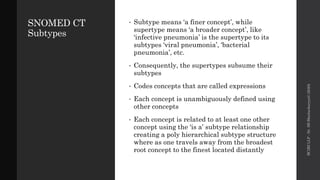
• Subtype means ‘a finer concept’, while
supertype means ‘a broader concept’, like
‘infective pneumonia’ is the supertype to its
subtypes ‘viral pneumonia’, ‘bacterial
pneumonia’, etc.
• Consequently, the supertypes subsume their
subtypes
• Codes concepts that are called expressions
• Each concept is unambiguously defined using
other concepts
• Each concept is related to at least one other
concept using the ‘is a’ subtype relationship
creating a poly hierarchical subtype structure
where as one travels away from the broadest
root concept to the finest located distantly
BC2RILLP-Dr.SBBhattacharyya©(2020)
SNOMED CT
Concepts
• A concept can be related to more than one
concept but the relationships are always
unidirectional from the finer to the broader ,
which allows concepts to be subsumed or
aggregated at a broader level without having
to individually mention every concept as
distinct values of a value set in order for
them to be included in any queries
• Concepts are defined using subtype
relationships as well as attribute
relationships
• Each concept has a unique machine-
processable identifier and one to several
synonymous human-readable terms that can
be in any language or dialect or script
BC2RILLP-Dr.SBBhattacharyya©(2020)
Viral Pneumonia “Code” (Expression)
75570004 | Viral pneumonia (disorder) |
Concept Identifier
Machine-processable
Term
Human-readable
Semantic tag
Term
Human-readable
BC2RILLP-Dr.SBBhattacharyya©(2020)
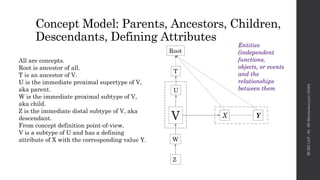
Concept Model: Parents, Ancestors, Children,
Descendants, Defining Attributes
U
V
W
X Y
Z
T
Root
All are concepts.
Root is ancestor of all.
T is an ancestor of V.
U is the immediate proximal supertype of V,
aka parent.
W is the immediate proximal subtype of V,
aka child.
Z is the immediate distal subtype of V, aka
descendant.
From concept definition point-of-view,
V is a subtype of U and has a defining
attribute of X with the corresponding value Y.
BC2RILLP-Dr.SBBhattacharyya©(2020)
Entities
(independent
functions,
objects, or events
and the
relationships
between them
Viral Pneumonia – Concept
Definition
BC2RILLP-Dr.SBBhattacharyya©(2020)
TerminologyServer
Command
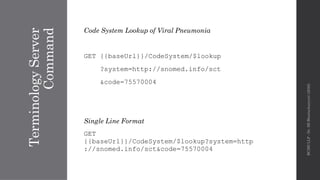
Code System Lookup of Viral Pneumonia
GET {{baseUrl}}/CodeSystem/$lookup
?system=http://snomed.info/sct
&code=75570004
Single Line Format
GET
{{baseUrl}}/CodeSystem/$lookup?system=http
://snomed.info/sct&code=75570004
SNOMEDCT
Expressions
A structured combination of one or more
clinical concepts, stated using Compositional
Grammar Syntax, may optionally contain
display terms.
=== 312134000 + 312342009 :
{
370135005 = 441862004,
116676008 = 707496003,
363698007 = 39607008,
246075003 = 49872002
}
BC2RILLP-Dr.SBBhattacharyya©(2020)
=== 312134000 |Viral lower respiratory infection (disorder)|
+ 312342009 |Infective pneumonia (disorder)| :
{
370135005 |Pathological process (attribute)| = 441862004 |Infectious process
(qualifier value)|,
116676008 |Associated morphology (attribute)| = 707496003 |Inflammation
and consolidation (morphologic abnormality)|,
363698007 |Finding site (attribute)| = 39607008 |Lung structure (body
structure)|,
246075003 |Causative agent (attribute)| = 49872002 |Virus (organism)|
}
BC2RILLP-Dr.SBBhattacharyya©(2020)
Logical Model • One concept will have one FSN (per language or
dialect or just one for all but definitely at least one)
that mustn’t be displayed to the user but helps in
identifying what the concept is as it’s the ‘official’
name and has the semantic tag appended in
parentheses at the end
• The concept will also have at least one acceptable
term
• If there’re more than one acceptable terms, then one
of them will be identified as being the preferred term
for a designated language or dialect (this information
is provided in the language refset).
• GPS is just one data file containing the concept
Identifier, US preferred term, FSN, active status,
effective time and contains all concepts that are most
commonly used in most EMR solutions.
BC2RILLP-Dr.SBBhattacharyya©(2020)
“Cholecystitis” Details
• FSN: Cholecystitis (disorder)
• ConceptId: 76581006
• Definition Status: Defined
• Active Status: Active
• Descendants Count:
 Stated: 6 concepts
 Inferred: 45 concepts
• Cholecystitis (en)
• Inflamed gallbladder (en)
• Colecistitis (es)
• Cholécystite (fr)
• Cholecystitis (nl)
• Kolecystit (da)
• Kolecystit (sv)
BC2RI LLP - Dr. SB Bhattacharyya© (2020)
Cholecystitis
• Acute and chronic cholecystitis
• Acute angiocholecystitis
• Acute cholecystitis
• Angiocholecystitis
• Calculus of bile duct with cholecystitis
• Calculus of gallbladder with
cholecystitis
• Cholecystitis without calculus
• Chronic cholecystitis
• Empyema of gallbladder
• Hyperplastic cholecystitis
• Pneumocholecystitis
• Xanthogranulomatous cholecystitis
BC2RILLP-Dr.SBBhattacharyya©(2020)
Cholecystectomy
• Cholecystectomy and exploration of bile duct
• Cholecystectomy and operative cholangiogram
• Excision of lesion of gallbladder
• Laparoscopic cholecystectomy
• Partial cholecystectomy
• Total cholecystectomy and excision of surrounding tissue
BC2RILLP-Dr.SBBhattacharyya©(2020)
SNOMED CT Filters for FHIR
• By subsumption
• By reference
• By expression constraint
• By whether post-coordination is permitted
BC2RILLP-Dr.SBBhattacharyya©(2020)

Snomed ct overview

  • 1.
    SNOMED CT Overview Dr. SBBhattacharyya MBBS, MBA, FCGP Founder & CEO, BC2RI LLP
  • 2.
    What is SNOMEDCT? BC2RILLP-Dr.SBBhattacharyya©(2020) Officially: It is a semantically interoperable polyhierarchical subtype multilexical clinical terminology system Basically: It is a clinical dictionary for machines For users: It is a clinical coding system that makes data entry, retrieval and running of analytics very easy
  • 3.
    Semantically Interoperable • Irrespective ofthe origin, any other machine should be able to “interpret” the data that has been recorded by someone else without any loss of meaning • Model of Meaning  Information Model – Syntactic Interoperability (HL7 FHIR, OpenEHR)  Concept Model – Semantic Interoperability (SNOMED CT) • Most of the useful clinical information lies in the clinical records content • Review and analysis helps in disease management through treatment planning, assessment of disease progression and outcomes assessment • Terminology standards like SNOMED CT makes it possible for the record contents, irrespective of their origin, to provide a consolidated unified view of the patient’s journey through life with respect to health BC2RILLP-Dr.SBBhattacharyya©(2020)
  • 4.
    Clinical Terminology Terminology systems codethe concepts that a term represents instead of its meaning, which is what classification systems code These systems assign the same code to all synonymous terms as they all represent the same concept Being synonyms, it does not matter the language or dialect that a term is in BC2RILLP-Dr.SBBhattacharyya©(2020)
  • 5.
    Polyhierarchical Subtype Root A B C D E F G HI J K L M N O P Q R S All are subtypes of the root making it the ancestor of all other concepts. A, F, & L are immediate proximal subtypes of the root, aka children. B & C are immediate proximal subtypes of A and immediate distal subtypes of the root, aka descendants. D is a subtype of B, aka child. E is a subtype of D and a distal subtype of B, aka descendant. K is a child of H, I & J. H, I & J are children of G. G is a child of F. BC2RILLP-Dr.SBBhattacharyya©(2020)
  • 6.
    Polyhierarchical Subtype [Supertype] Root A BC D E F G H I J K L M N O P Q R S N is a subtype of M and a descendant of L. L is the immediate proximal supertype of P. P is the immediate proximal supertype of Q. Q is the immediate proximal supertype of R. R is the immediate proximal supertype of O & S. E is a descendant of A. K is a descendant of F. L is an ancestor of N, O & S. P is an ancestor of O & S, but not of N. G is an ancestor of K. C is a child of A. E, K, O & S are the most granular concepts. A, F & L are the broadest. BC2RILLP-Dr.SBBhattacharyya©(2020)
  • 7.
    Polyhierarchical Subtype [Subsumption] Root A B C D E F G HI J K L M N O P Q R S E is subsumed by B but not by C. K is subsumed by F. L subsumes O & S but neither E nor K. P subsumes Q but not N. M subsumes N but not R. BC2RILLP-Dr.SBBhattacharyya©(2020)
  • 8.
    Clinical Dictionary forMachines BC2RILLP-Dr.SBBhattacharyya©(2020) A term maps to a concept that is unambiguously defined using other concepts that are similarly defined This makes the term “comprehensible” By leveraging the concept definition, a variety of conditions can be matched to perform required functions like trigger for alerts, search for matches, automated ordering, data mining, etc.
  • 9.
    SNOMED CT Subtypes • Subtypemeans ‘a finer concept’, while supertype means ‘a broader concept’, like ‘infective pneumonia’ is the supertype to its subtypes ‘viral pneumonia’, ‘bacterial pneumonia’, etc. • Consequently, the supertypes subsume their subtypes • Codes concepts that are called expressions • Each concept is unambiguously defined using other concepts • Each concept is related to at least one other concept using the ‘is a’ subtype relationship creating a poly hierarchical subtype structure where as one travels away from the broadest root concept to the finest located distantly BC2RILLP-Dr.SBBhattacharyya©(2020)
  • 10.
    SNOMED CT Concepts • Aconcept can be related to more than one concept but the relationships are always unidirectional from the finer to the broader , which allows concepts to be subsumed or aggregated at a broader level without having to individually mention every concept as distinct values of a value set in order for them to be included in any queries • Concepts are defined using subtype relationships as well as attribute relationships • Each concept has a unique machine- processable identifier and one to several synonymous human-readable terms that can be in any language or dialect or script BC2RILLP-Dr.SBBhattacharyya©(2020)
  • 11.
    Viral Pneumonia “Code”(Expression) 75570004 | Viral pneumonia (disorder) | Concept Identifier Machine-processable Term Human-readable Semantic tag Term Human-readable BC2RILLP-Dr.SBBhattacharyya©(2020)
  • 12.
    Concept Model: Parents,Ancestors, Children, Descendants, Defining Attributes U V W X Y Z T Root All are concepts. Root is ancestor of all. T is an ancestor of V. U is the immediate proximal supertype of V, aka parent. W is the immediate proximal subtype of V, aka child. Z is the immediate distal subtype of V, aka descendant. From concept definition point-of-view, V is a subtype of U and has a defining attribute of X with the corresponding value Y. BC2RILLP-Dr.SBBhattacharyya©(2020) Entities (independent functions, objects, or events and the relationships between them
  • 13.
    Viral Pneumonia –Concept Definition BC2RILLP-Dr.SBBhattacharyya©(2020)
  • 14.
    TerminologyServer Command Code System Lookupof Viral Pneumonia GET {{baseUrl}}/CodeSystem/$lookup ?system=http://snomed.info/sct &code=75570004 Single Line Format GET {{baseUrl}}/CodeSystem/$lookup?system=http ://snomed.info/sct&code=75570004
  • 15.
    SNOMEDCT Expressions A structured combinationof one or more clinical concepts, stated using Compositional Grammar Syntax, may optionally contain display terms.
  • 16.
    === 312134000 +312342009 : { 370135005 = 441862004, 116676008 = 707496003, 363698007 = 39607008, 246075003 = 49872002 } BC2RILLP-Dr.SBBhattacharyya©(2020)
  • 17.
    === 312134000 |Virallower respiratory infection (disorder)| + 312342009 |Infective pneumonia (disorder)| : { 370135005 |Pathological process (attribute)| = 441862004 |Infectious process (qualifier value)|, 116676008 |Associated morphology (attribute)| = 707496003 |Inflammation and consolidation (morphologic abnormality)|, 363698007 |Finding site (attribute)| = 39607008 |Lung structure (body structure)|, 246075003 |Causative agent (attribute)| = 49872002 |Virus (organism)| } BC2RILLP-Dr.SBBhattacharyya©(2020)
  • 18.
    Logical Model •One concept will have one FSN (per language or dialect or just one for all but definitely at least one) that mustn’t be displayed to the user but helps in identifying what the concept is as it’s the ‘official’ name and has the semantic tag appended in parentheses at the end • The concept will also have at least one acceptable term • If there’re more than one acceptable terms, then one of them will be identified as being the preferred term for a designated language or dialect (this information is provided in the language refset). • GPS is just one data file containing the concept Identifier, US preferred term, FSN, active status, effective time and contains all concepts that are most commonly used in most EMR solutions. BC2RILLP-Dr.SBBhattacharyya©(2020)
  • 19.
    “Cholecystitis” Details • FSN:Cholecystitis (disorder) • ConceptId: 76581006 • Definition Status: Defined • Active Status: Active • Descendants Count:  Stated: 6 concepts  Inferred: 45 concepts • Cholecystitis (en) • Inflamed gallbladder (en) • Colecistitis (es) • Cholécystite (fr) • Cholecystitis (nl) • Kolecystit (da) • Kolecystit (sv) BC2RI LLP - Dr. SB Bhattacharyya© (2020)
  • 20.
    Cholecystitis • Acute andchronic cholecystitis • Acute angiocholecystitis • Acute cholecystitis • Angiocholecystitis • Calculus of bile duct with cholecystitis • Calculus of gallbladder with cholecystitis • Cholecystitis without calculus • Chronic cholecystitis • Empyema of gallbladder • Hyperplastic cholecystitis • Pneumocholecystitis • Xanthogranulomatous cholecystitis BC2RILLP-Dr.SBBhattacharyya©(2020)
  • 21.
  • 22.
  • 23.
    Cholecystectomy • Cholecystectomy andexploration of bile duct • Cholecystectomy and operative cholangiogram • Excision of lesion of gallbladder • Laparoscopic cholecystectomy • Partial cholecystectomy • Total cholecystectomy and excision of surrounding tissue BC2RILLP-Dr.SBBhattacharyya©(2020)
  • 24.
    SNOMED CT Filtersfor FHIR • By subsumption • By reference • By expression constraint • By whether post-coordination is permitted BC2RILLP-Dr.SBBhattacharyya©(2020)
  • 25.