Sport-Climbing
Beginners sport climbing course notes
Kyriakos Rossidis
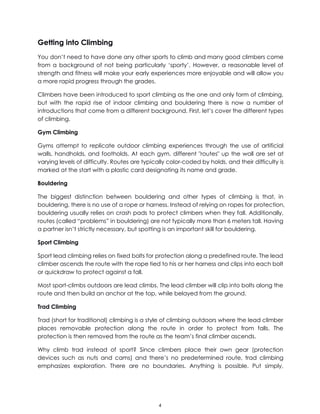
This manual describes different techniques shown and practiced during the Beginners Sport
Climbing course run by Kyriakos Rossidis and it intends to work as a reference point for after
the completion of the practical and theoretical training. The following document does not
replace any of the training taught during the course.
2
The participants should recognize that climbing, hill walking and mountaineering are
activities with a danger of personal injury or death. Participants in these activities should
be aware of and accept these risks and be responsible for their own actions. The
following document intend to work as a reference point in order to eliminate the
possibilities of an accident that may occur to a beginner climber however, the level of
security that individuals are exposed during climbing is a personal decision. The author
of the current document is not responsible for any accidents occur during the practice of
the techniques and procedures that are described below.
Kyriakos Rossidis
M: +357 99794578
E: rossideskyriakos@hotmail.com
W: www.kyriakosrossidis.com
All rights reserve. No part of this document may be reproduced, stored in a retrieval
system, or transmitted in any form or by any means, electronic, mechanical,
photocopying or otherwise without prior written permission.
3
Contents
Introduction………………………………………………………………………………………………4
Climbing styles………………………………………………….…………………………………….4-5
Gear…………………………………………………………………………………………………….7-9
Knots………………………………………………………………………………………………….10-13
How it all works…………………………………………………………………………………………14
Belaying……………………………………………………………………………………………..15-19
Abseiling…………………………………………………………………………………………….20-22
Clipping Basics for Sport Climbing……………………………………………………………..23-26
Cleaning a sport climb with close ring anchor………………………………………………26-27
Top-rope Climbing………………………………………………………………………………...28-29
Fall factor and impact force……………………………………………………………………..30-31
Reference……………………………………………………………………………………………….32
4
Getting into Climbing
You don’t need to have done any other sports to climb and many good climbers come
from a background of not being particularly ‘sporty’. However, a reasonable level of
strength and fitness will make your early experiences more enjoyable and will allow you
a more rapid progress through the grades.
Climbers have been introduced to sport climbing as the one and only form of climbing,
but with the rapid rise of indoor climbing and bouldering there is now a number of
introductions that come from a different background. First, let’s cover the different types
of climbing.
Gym Climbing
Gyms attempt to replicate outdoor climbing experiences through the use of artificial
walls, handholds, and footholds. At each gym, different "routes" up the wall are set at
varying levels of difficulty. Routes are typically color-coded by holds, and their difficulty is
marked at the start with a plastic card designating its name and grade.
Bouldering
The biggest distinction between bouldering and other types of climbing is that, in
bouldering, there is no use of a rope or harness. Instead of relying on ropes for protection,
bouldering usually relies on crash pads to protect climbers when they fall. Additionally,
routes (called “problems” in bouldering) are not typically more than 6 meters tall. Having
a partner isn’t strictly necessary, but spotting is an important skill for bouldering.
Sport Climbing
Sport lead climbing relies on fixed bolts for protection along a predefined route. The lead
climber ascends the route with the rope tied to his or her harness and clips into each bolt
or quickdraw to protect against a fall.
Most sport-climbs outdoors are lead climbs. The lead climber will clip into bolts along the
route and then build an anchor at the top, while belayed from the ground.
Trad Climbing
Trad (short for traditional) climbing is a style of climbing outdoors where the lead climber
places removable protection along the route in order to protect from falls. The
protection is then removed from the route as the team’s final climber ascends.
Why climb trad instead of sport? Since climbers place their own gear (protection
devices such as nuts and cams) and there’s no predetermined route, trad climbing
emphasizes exploration. There are no boundaries. Anything is possible. Put simply,
5
climbing trad is an adventure. Because of those same factors, however, trad climbing
has a potentially greater risk factor than sport climbing.
Another advantage of trad climbing is that when compared to sport climbing (where
routes are permanently bolted) trad climbers can better adhere to Leave No Trace
principles, because modern trad protection is removable—leaving more pristine
environments for future climbers to enjoy.
Aid Climbing
Aid climbing is a style of rock climbing where the climber attaches devices to pieces of
protection and stands on those devices to make upward progress. It is typically reserved
for climbs that are too steep, long, and difficult for free climbing.
So those are the main types of ‘summer’ climbing. Some of those climbing types
describe above are splited into different climbing disciplines. Bouldering, top roping,
and lead climbing. Each of these varies in technique, but the objectives are all the same:
get to the top.
Free Climbing vs. Free Soloing
Unlike aid climbing, free climbing is characterized by making upward progress relying
only on the natural features of the rock—using ropes and equipment only to protect a
fall and provide a belay. Most rock climbing is considered free climbing.
Free soloing occurs when the climber performs alone without using any ropes, a harness,
or other protective equipment. The climber instead relies on their ability to complete the
ascent.
Free soloing differs from bouldering in the sense that free solo climbers usually climb to
heights that would be unsafe in the event of a fall.
Top Roping
Top rope climbs are protected by a rope anchored from above and belayed (the act of
applying tension to the rope to minimize the distance in a fall) from the ground. Top
roping is usually considered less physically demanding than other types of climbing due
to the belayer’s ability to prevent the climber from taking large falls. As such, it’s
probably the most popular type of introducing people into climbing. For sport top-rope
routes, it’s possible to hike to the top of the bolted anchor, set the rope, and then return
to the bottom to climb.
Lead climbing
Lead climbing requires a much greater commitment than top roping, because there is a
greater potential for the lead climber to take a more drastic fall. As the lead climber
6
ascends, the potential fall distance will be twice the length of the rope between the last
clipped bolt and the lead climber; this distance can be exaggerated by dynamic rope
stretch. Most sport-climbs outdoors are lead climbs. The lead climber will clip into bolts
along the route and then build an anchor at the top, while belayed from the ground.
Climbing Outside
Rock climbing has some objective dangers that participants should take into
consideration when heading to the crags. These are dangers that cannot be reduced
by simply becoming a technically competent climber. Objective dangers include being
hit by falling rocks, get stuck in bad weather in remote location etc. Being aware of the
natural hazards found at climbing locations is mostly common sense born from
experience.
In Cyprus there is no state-funded rescue service that is trained for rock climbing
situations. Always try to get yourselves out of trouble and only call for help when you
have exhausted your solutions. Keep in mind that when you head into a remote climbing
area you are self-reliant.
Route Length
The length of a route will often determine its number of pitches. A pitch is a steep section
of rock that requires a rope between two belays—or between the belay and an anchor.
A pitch’s length can be determined by a number of different factors, including the
length of the rope (it must be less than half the length of the rope in order to be belayed,)
the end of good rock, visual sight, the ability to communicate, rope drag, the presence
of convenient belay stations.
For a single pitch climbs, the route can be completed in just one pitch, which is belayed
from the ground. Multi-pitch climbs however, require two or more pitches to complete
the route. On a multi-pitch route, a new belay is created in between pitches at each
new anchor; oftentimes the lead climber and follower alternate roles climbing leading or
belaying and then following and belaying at each station until the ascent is complete.
7
Gear
Rock climbing is a relatively gear-intensive sport. As your skill and interest develops, so
too will your understanding of what each piece of gear does and how it supports your
needs. These are the basics to get you started.
Shoes
Rock climbing shoes connect the climber to
the rock; as such they are one of the most
important pieces of gear. When choosing
your first pair, opt for a shoe that is designed
for comfort and all around performance. Then
as your skills become more advanced, you
can upgrade to higher performing shoes that
are best-suited to your specific climbing goals
and interests.
Rope
A climbing rope serves to protect the climber in the event of a fall. They are constructed
of two main components: a core and a sheath. The core provides most of the rope’s
strength; the sheath protects the core and makes the rope easier to handle.
They are divided into two main categories: dynamic and static. Dynamic ropes have
elasticity and are designed to absorb the energy of a falling climber. Static ropes are
used in anchoring systems, for hauling gear up a wall, or when rappelling—but never for
belaying a climber.
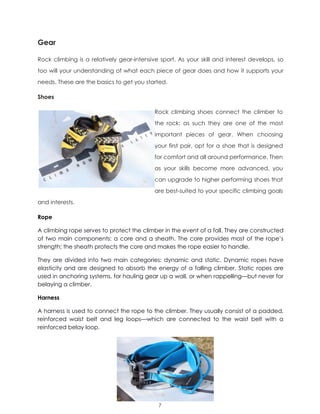
Harness
A harness is used to connect the rope to the climber. They usually consist of a padded,
reinforced waist belt and leg loops—which are connected to the waist belt with a
reinforced belay loop.
8
Belay Device
A belay device is a mechanical friction device used to control the rope while belaying.
Their main purpose is to provide an easy way to stop the rope in the event that the
climber takes a fall. However, they can also be used to control the descent on a rope
when rappelling or lowering a climber.
Tube-style belay devices (like the Black Diamond ATC or Petzl Reverso) are cheaper and
lighter—but assisted breaking devices (like the Petzl GriGri and CT ClipUP) will provide
assisted braking in the event of a fall.
Carabiners
Carabiners are metal loops with spring-loaded gates that are used as connectors. They
come in two different types: Locking and Non-locking.
Locking carabiners prevent the gate from being automatically opened when in use.
They are used for important connections, like when the rope is running through an
anchor, or attaching a climber to the middle of the rope. Locking mechanisms vary from
screw gates, to automatic twist lock, to those secured by magnets
Non-locking carabiners are used for less critical connections, like attaching the rope to
a piece of protection or in cases where there is no chance that the gat would
accidentally open.
9
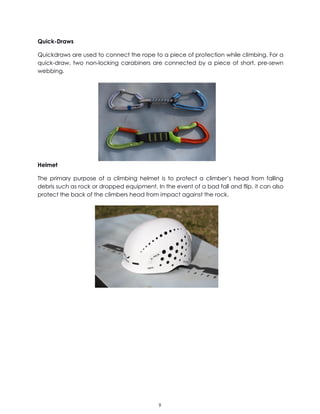
Quick-Draws
Quickdraws are used to connect the rope to a piece of protection while climbing. For a
quick-draw, two non-locking carabiners are connected by a piece of short, pre-sewn
webbing.
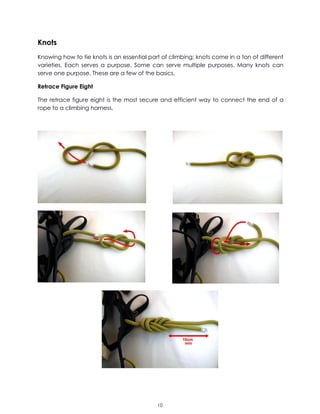
Helmet
The primary purpose of a climbing helmet is to protect a climber’s head from falling
debris such as rock or dropped equipment. In the event of a bad fall and flip, it can also
protect the back of the climbers head from impact against the rock.
10
Knots
Knowing how to tie knots is an essential part of climbing; knots come in a ton of different
varieties. Each serves a purpose. Some can serve multiple purposes. Many knots can
serve one purpose. These are a few of the basics.
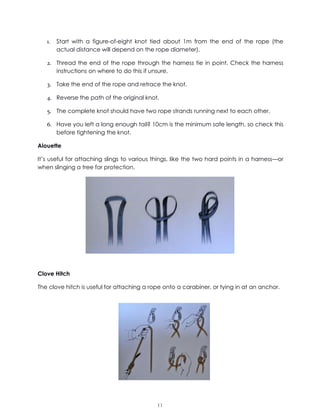
Retrace Figure Eight
The retrace figure eight is the most secure and efficient way to connect the end of a
rope to a climbing harness.
11
1. Start with a figure-of-eight knot tied about 1m from the end of the rope (the
actual distance will depend on the rope diameter).
2. Thread the end of the rope through the harness tie in point. Check the harness
instructions on where to do this if unsure.
3. Take the end of the rope and retrace the knot.
4. Reverse the path of the original knot.
5. The complete knot should have two rope strands running next to each other.
6. Have you left a long enough tail? 10cm is the minimum safe length, so check this
before tightening the knot.
Alouette
It’s useful for attaching slings to various things, like the two hard points in a harness—or
when slinging a tree for protection.
Clove Hitch
The clove hitch is useful for attaching a rope onto a carabiner, or tying in at an anchor.
12
Italian Hitch
The Italian hitch (AKA Half Hitch) is useful for bellaying the second.
Flat overhang knot
Friction Knots Grab the Rope When Loaded
All friction knots are basically just a loop of thin cord, usually called “Prusik slings,”
attached to a climbing rope.
Autoblock Knot
13
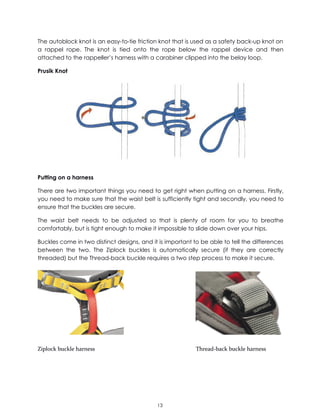
The autoblock knot is an easy-to-tie friction knot that is used as a safety back-up knot on
a rappel rope. The knot is tied onto the rope below the rappel device and then
attached to the rappeller’s harness with a carabiner clipped into the belay loop.
Prusik Knot
Putting on a harness
There are two important things you need to get right when putting on a harness. Firstly,
you need to make sure that the waist belt is sufficiently tight and secondly, you need to
ensure that the buckles are secure.
The waist belt needs to be adjusted so that is plenty of room for you to breathe
comfortably, but is tight enough to make it impossible to slide down over your hips.
Buckles come in two distinct designs, and it is important to be able to tell the differences
between the two. The Ziplock buckles is automatically secure (if they are correctly
threaded) but the Thread-back buckle requires a two step process to make it secure.
Ziplock buckle harness Thread-back buckle harness
14
How it all works
The standard method for climbing a sport climbing route involves leading and lowering
off. Leading is, as the name suggests, going first up a climb with the rope trailing below.
When the climber reach the top anchor then he clip the rope and he is lowered off from
the belayer.
After choosing a route to climb, the leader tied into one end of the rope. The belayer
then puts the leader on belay by passing the rope through their belay device. The belay
device allows the belayer to control the rope and arrest any falls should they occur.
Now the leader is on belay he can start to climb. The belayer feeds the rope out through
the belay device so as not to impede the leader’s movement. As the leader gains height,
they must clip the bolds with quickdraws to the rope to ensure their safety.
In a case of the leader took a fall his partner has to locked-off the belay device to
prevend any more rope from passing through it.
When the leader has reached the top of the route he pass the rope through the anchor.
The leader then informs the belayer that he clipped the anchor and then the belayer
starts lowering him down.
15
Partner and Equipment check before each climb
16
Belaying
Belaying is a key skill on all roped climbing and should be the first skill you learn. When
you agree to belay someone, you literally taking their life into your hands. You are also
playing a crucial role in your partner’s climb. A good belayer instills confidence and
adds to the enjoyment of the climb. A bad belayer is at best a psychological drain and
at worst a hazard.
As a belayer, we have three main responsibilities, these are to:
1. Hold your partner when they fall off.
2. Maintain a steady feed of rope to your partner. The leader should always have
enough slack to move freely and should never have to pull rope through the
belay device.
3. Give encouragement and confidence. Climbing is a team game and belaying is
more than holding your partner’s rope.
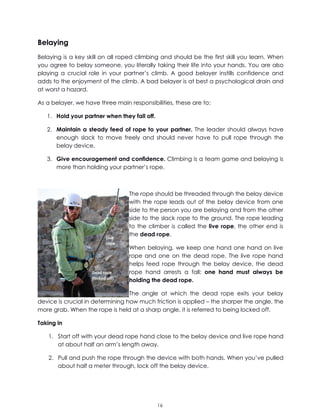
The rope should be threaded through the belay device
with the rope leads out of the belay device from one
side to the person you are belaying and from the other
side to the slack rope to the ground. The rope leading
to the climber is called the live rope, the other end is
the dead rope.
When belaying, we keep one hand one hand on live
rope and one on the dead rope. The live rope hand
helps feed rope through the belay device, the dead
rope hand arrests a fall: one hand must always be
holding the dead rope.
The angle at which the dead rope exits your belay
device is crucial in determining how much friction is applied – the sharper the angle, the
more grab. When the rope is held at a sharp angle, it is referred to being locked off.
Taking in
1. Start off with your dead rope hand close to the belay device and live rope hand
at about half an arm’s length away.
2. Pull and push the rope through the device with both hands. When you’ve pulled
about half a meter through, lock off the belay device.
17
3. Now let go of the live rope and place that hand on the dead rope, a hand’s
width away from the belay device.
4. Next, move your dead rope hand to its original position on the dead rope next to
the belay device and return your live rope hand to its starting position.
Paying out
1. Start with one hand on the dead rope about half a meter away from your belay
device and the other hand on the live rope right next to your belay device.
2. In one movement, pull out the live rope and feed in the dead rope.
3. The dead rope hand locks off the device when rope isn’t being paid out.
4. To return your hands to the starting position, first move the live rope hand back to
its position next to the belay device.
5. Now, maintaining good observation of your partner, relax your grip on the dead
rope and slide your hand down the rope.
6. Continue to slide your hand down the rope to the start position where you are
able to pay out more slack when needed.
18
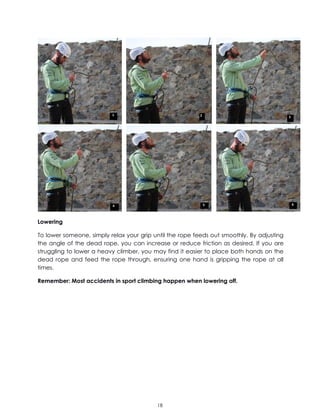
Lowering
To lower someone, simply relax your grip until the rope feeds out smoothly. By adjusting
the angle of the dead rope, you can increase or reduce friction as desired. If you are
struggling to lower a heavy climber, you may find it easier to place both hands on the
dead rope and feed the rope through, ensuring one hand is gripping the rope at all
times.
Remember: Most accidents in sport climbing happen when lowering off.
19
20
Tying off a belay device
there are many instances in which you may find the need to tie-off a belay device: your
partner may be sitting on the rope and you’re tired of holding them, or you may need to
free your hands up to sort out a tangle in the rope without taking your partner off-belay.
Abseiling
To descend single and multi-pitch routes, abseiling is an excellent option that gets you
down quickly and puts minimal wear on fixed anchors. The process of abseiling is simple
in concept, but it can seem complicated in practice, especially at first. Mistakes are
easy to make; accidents happen all the time - and they’re often fatal. Here’s the
step-by-step process of rappelling plus some tips to prevent mistakes.
Check the anchors: Anchor failure is not an option - if in any doubt always leave extra
gear behind. Check the rope is properly threaded through the anchor.
Knot the rope: The consequences of abseiling off the end of a rope are usually fatal.
Tying a big enough knot in the ends of all ropes should prevent this from happening.
21
After the ropes are safely set up through the abseiling anchor, you should be clipped
directly into the anchor with a personal anchor tether or a nylon sling.
1. Set up your auto-block so it’s wrapped around both strands of rope clipped to your
belay loop, and the biner is locked. An auto-block is a rappel backup or a “third
hand,” meaning if you get knocked unconscious or lose control of the rope, it will
tighten up and keep you from plummeting downward. (It needs to be short enough
so it can’t get caught in the belay device, which would render it useless). Because
the rope will be heavy, use the auto-block to hold the rope up to create slack so it’s
easier to clip in the rappel
device.
22
2. Clip the abseil device to the sling behind the overhang knot, in the loop towards you
with a locking biner (don’t lock it yet), and then pull up slack of both strands of rope.
3. With that slack, create two small bights in each strand and push them through the
openings in your device, keeping the brake end of the rope (the section that leads
to the ground) coming out through the friction grooves—if your device has them.
Orient the brake/friction-groove side so it’s on your dominant side. Keeping the biner
on the loop on your sling, clip it through the device and both strands of rope. Now
lock it.
4. Before letting the rope drop, pull the brake strands up and through the device as
much as possible. Stand higher or pull up on the anchor to lift your body up; keep
pulling until it’s clear that you’re fully weighting the rappel setup and not your tethers
going directly to the anchor (they should be loose, not taut). If the rappel device is
not set up correctly, it will not hold your weight, and you will have to set it up again.
5. Double-check that both strands of the rope are threaded through the device; the
biner is clipped through the device, the sling that is attached to your belay loop,
and both strands of rope; and the biner is locked. (Have your partner check, too, if
he is
around.)
6. Once you’re fully clipped in, it’s time to start moving down. With one hand firmly on
the brake strands in a locked-off position, undo the tethers - sling connecting you to
the anchor. Now put that second hand on the brake-side of the rope over the
auto-block. With the lower hand, slowly feed the rope up through the belay device.
Use the top hand to move the auto-block down the rope so it won’t tighten up.
23
Clipping Basics for Sport Climbing
Lead climbing means you tie into the rope that is connected directly to your belayer
and you clip into protection as you move up. The techniques listed here illustrate how to
clip, but knowing when to do it will differ every time. Sometimes you’ll want to reach as
high as possible to clip, while other times it might be easier to clip when the quickdraw is
even with your waist. It all depends on the holds and how stable you feel in your stance.
The thing to remember whenever you’re leading a climb is that however far above your
last bolt you are, you’ll fall twice that distance, meaning if you’re two meters above your
last bolt, you’ll fall four meters plus a bit more to account for rope stretch. Plus, if you pull
up a few centimeters of rope to clip and then you fall, you’ve only increased the
distance of your fall. Accordingly, try to clip the first three or four quickdraws off the
ground early to prevent hitting the deck in the event of a fall.
When you’re in a good clipping stance, take the appropriate hand and reach for the
rope coming from your harness. Pull up as much as you think you might need, then reach
up and clip. A common technique for high clips that require a lot of rope is to pull some
up, put it between your teeth, then reach back down to your harness and pull the rest
up. While this is an established and commonly used practice, keep in mind that falling
with the rope in your mouth could be very dangerous.
Common Mistakes
Back-clipping and Z-clipping are the two biggest mistakes you can make while leading
the latter is especially easy to do with bolts that are placed really close together.
24
Back-clipping can result in the quickdraw coming unclipped during a fall, and it
happens when you clip the rope so it’s running through the carabiner incorrectly. The
correct way is to have the rope coming up from behind (between carabiner and wall),
through the carabiner and out, away from the wall and then to your harness. A
back-clipped quickdraw has the rope running up through the carabiner from the front,
toward the wall, and then to your harness.
Z-clipping will create rope drag that makes it nearly impossible to move up, as well as
making the highest clipped bolt useless. This scenario happens when the climber grabs
the rope from below the last clipped bolt and then clips it through a higher bolt, creating
a Z-shape. Avoid this by always reaching for the rope right at your tie-in knot.
The Techniques
Same Side
Left Hand With Left-Facing Gate, Right Hand With Right-facing gate
25
Reach down and pinch the rope between your thumb and index finger, which should
be pointing down. Pull the rope up and just before you clip, loosen your grasp on the
rope so it’s draped over your pointer finger. Open your hand and wrap your thumb
around the spine of the carabiner as you position the rope in front of the gate. Then
smoothly push the rope through the gate with your pointer finger, getting a little extra
push from your other fingers if necessary. Once the rope is through the gate, quickly
remove your hand.
Opposite Side
Left Hand With Right-Facing Gate, Right Hand With Left-Facing Gate
Reach down the same as above, with rope pinched between thumb and index finger
(inside or outside hand). Pull rope up and as you get close to the carabiner, reach out
26
with your middle finger and place it in the bottom of the carabiner, aka the rope basket.
Using your middle finger to hold the draw in place, flick your wrist to push the rope
through the gate with your thumb. Remove your hand quickly.
Cleaning a sport climb with close ring anchor
Installing the rope to clean the route is one of the basic techniques first learned in rock
climbing. Even if it eventually becomes routine, it is important to keep in mind that 30 to
40 m above the ground an error can quickly have serious consequences. So remain
focused when climbing and belaying!
Technique: Lowering on a carabiner
+ Climber remains tied in during all maneuvers.
- Climber is lowered on a locking carabiner.
- Make sure that the carabiner is loaded on its major axis.
- Working the route during descent is not recommended.
27
It is essential that the belayer continues to belay the climber throughout the maneuver,
never letting go of the brake side of the rope.
28
Top-rope Climbing
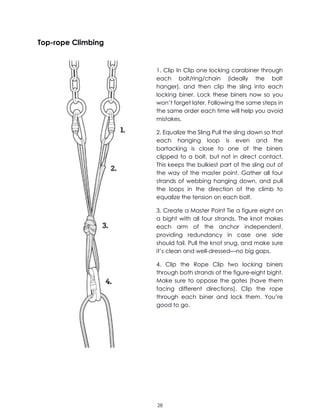
1. Clip In Clip one locking carabiner through
each bolt/ring/chain (ideally the bolt
hanger), and then clip the sling into each
locking biner. Lock these biners now so you
won’t forget later. Following the same steps in
the same order each time will help you avoid
mistakes.
2. Equalize the Sling Pull the sling down so that
each hanging loop is even and the
bartacking is close to one of the biners
clipped to a bolt, but not in direct contact.
This keeps the bulkiest part of the sling out of
the way of the master point. Gather all four
strands of webbing hanging down, and pull
the loops in the direction of the climb to
equalize the tension on each bolt.
3. Create a Master Point Tie a figure eight on
a bight with all four strands. The knot makes
each arm of the anchor independent,
providing redundancy in case one side
should fail. Pull the knot snug, and make sure
it’s clean and well-dressed—no big gaps.
4. Clip the Rope Clip two locking biners
through both strands of the figure-eight bight.
Make sure to oppose the gates (have them
facing different directions). Clip the rope
through each biner and lock them. You’re
good to go.
29
Toproping directly through the rings or the anchor carabiner is definitely a no no. Most of
the anchor carabiners in Cyprus are not locking ones and top-roping on them is really
dangerous. Moreover, it will wear out the rings or the carabiners that are hard to be
replaced. It is just as easy to put a couple of carabiners in the slings and use them. Then
the last person clips in, rethreads the rope & raps off. The whole process takes only a
couple of minutes more.
Other methods to setup a top-rope
 Use a Twist-lock carabiner in the master point of the anchor.
 Use a Screw-gate carabiner in the master point of the anchor and clip the last bolt
with a quickdraw. The quickdraw should be clipped on the rope towards the belayer
and not the climber.
 Use 2 Screw-gate carabiners in the master point with their gates opposed.
 Use 2 Quickraws in the master point or in each separete bolt with the gates opposed
and clip the last bolt with a quickdraw. The quickdraw should be clipped on the
rope towards the belayer and not the climber.
30
Fall factor and impact force - theory
Fall factor and impact force are two important concepts in the physics of climbing falls.
To understand a climbing fall, it is important to recall a basic law of physics: when an
object falls, it stores energy.
Impact force
During fall arrest, this energy is dissipated by elongation of the rope, displacement of the
belayer, the climber's body... Energy is transmitted to the belay chain in the form of force.
This is the impact force. For the climber, it's the impact experienced during fall arrest.
We are often interested in the impact force transmitted to the climber, the belayer, and
the redirect point.
This value relates to all of the important factors in energy absorption: rope elongation,
belayer displacement, the climber's body, rope sliding through the device...
Theoretical fall factor
The fall factor is often used to quantify the severity of a climbing fall.
It can have a value between 0 and 2 in climbing.
31
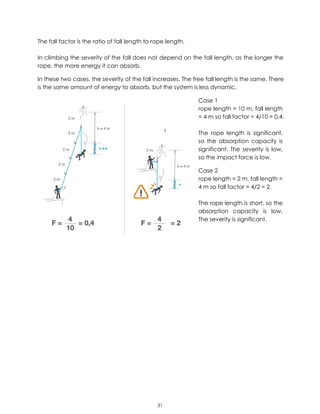
The fall factor is the ratio of fall length to rope length.
In climbing the severity of the fall does not depend on the fall length, as the longer the
rope, the more energy it can absorb.
In these two cases, the severity of the fall increases. The free fall length is the same. There
is the same amount of energy to absorb, but the system is less dynamic.
Case 1
rope length = 10 m, fall length
= 4 m so fall factor = 4/10 = 0.4.
The rope length is significant,
so the absorption capacity is
significant. The severity is low,
so the impact force is low.
Case 2
rope length = 2 m, fall length =
4 m so fall factor = 4/2 = 2.
The rope length is short, so the
absorption capacity is low.
The severity is significant.
32
Videos
How to put on a harness
https://vimeo.com/135974235
Top rope belaying
https://vimeo.com/41362967
Lead belaying
https://vimeo.com/43671004
Clipping in
https://vimeo.com/52853269
Cleaning a sport anchor
https://vimeo.com/58500111
The world’s worst belayer
https://vimeo.com/80489871
Clove Hitch
https://vimeo.com/136531972
33
34
Reference
Beal official Facebook page https://www.facebook.com/beal.official/?pnref=story
Outside Website http://www.outsideonline.com/2062326/beginners-guide-rock-climbing
Climbing Magazine
http://www.climbing.com/skills/rappelling-learn-the-basics-of-this-essential-technique/
UKClimbing https://www.ukclimbing.com/videos/?category=10
Petzl Equipment
https://www.petzl.com/GB/en/Sport/How-to-install-a-top-rope?ActivityName=Rock-cli
mbing#
Trad Climbing + (2007), Adrian Berry and John Arran, Rockfax Ltd.

Sport climbing notes

  • 1.
    Sport-Climbing Beginners sport climbingcourse notes Kyriakos Rossidis This manual describes different techniques shown and practiced during the Beginners Sport Climbing course run by Kyriakos Rossidis and it intends to work as a reference point for after the completion of the practical and theoretical training. The following document does not replace any of the training taught during the course.
  • 2.
    2 The participants shouldrecognize that climbing, hill walking and mountaineering are activities with a danger of personal injury or death. Participants in these activities should be aware of and accept these risks and be responsible for their own actions. The following document intend to work as a reference point in order to eliminate the possibilities of an accident that may occur to a beginner climber however, the level of security that individuals are exposed during climbing is a personal decision. The author of the current document is not responsible for any accidents occur during the practice of the techniques and procedures that are described below. Kyriakos Rossidis M: +357 99794578 E: rossideskyriakos@hotmail.com W: www.kyriakosrossidis.com All rights reserve. No part of this document may be reproduced, stored in a retrieval system, or transmitted in any form or by any means, electronic, mechanical, photocopying or otherwise without prior written permission.
  • 3.
    3 Contents Introduction………………………………………………………………………………………………4 Climbing styles………………………………………………….…………………………………….4-5 Gear…………………………………………………………………………………………………….7-9 Knots………………………………………………………………………………………………….10-13 How itall works…………………………………………………………………………………………14 Belaying……………………………………………………………………………………………..15-19 Abseiling…………………………………………………………………………………………….20-22 Clipping Basics for Sport Climbing……………………………………………………………..23-26 Cleaning a sport climb with close ring anchor………………………………………………26-27 Top-rope Climbing………………………………………………………………………………...28-29 Fall factor and impact force……………………………………………………………………..30-31 Reference……………………………………………………………………………………………….32
  • 4.
    4 Getting into Climbing Youdon’t need to have done any other sports to climb and many good climbers come from a background of not being particularly ‘sporty’. However, a reasonable level of strength and fitness will make your early experiences more enjoyable and will allow you a more rapid progress through the grades. Climbers have been introduced to sport climbing as the one and only form of climbing, but with the rapid rise of indoor climbing and bouldering there is now a number of introductions that come from a different background. First, let’s cover the different types of climbing. Gym Climbing Gyms attempt to replicate outdoor climbing experiences through the use of artificial walls, handholds, and footholds. At each gym, different "routes" up the wall are set at varying levels of difficulty. Routes are typically color-coded by holds, and their difficulty is marked at the start with a plastic card designating its name and grade. Bouldering The biggest distinction between bouldering and other types of climbing is that, in bouldering, there is no use of a rope or harness. Instead of relying on ropes for protection, bouldering usually relies on crash pads to protect climbers when they fall. Additionally, routes (called “problems” in bouldering) are not typically more than 6 meters tall. Having a partner isn’t strictly necessary, but spotting is an important skill for bouldering. Sport Climbing Sport lead climbing relies on fixed bolts for protection along a predefined route. The lead climber ascends the route with the rope tied to his or her harness and clips into each bolt or quickdraw to protect against a fall. Most sport-climbs outdoors are lead climbs. The lead climber will clip into bolts along the route and then build an anchor at the top, while belayed from the ground. Trad Climbing Trad (short for traditional) climbing is a style of climbing outdoors where the lead climber places removable protection along the route in order to protect from falls. The protection is then removed from the route as the team’s final climber ascends. Why climb trad instead of sport? Since climbers place their own gear (protection devices such as nuts and cams) and there’s no predetermined route, trad climbing emphasizes exploration. There are no boundaries. Anything is possible. Put simply,
  • 5.
    5 climbing trad isan adventure. Because of those same factors, however, trad climbing has a potentially greater risk factor than sport climbing. Another advantage of trad climbing is that when compared to sport climbing (where routes are permanently bolted) trad climbers can better adhere to Leave No Trace principles, because modern trad protection is removable—leaving more pristine environments for future climbers to enjoy. Aid Climbing Aid climbing is a style of rock climbing where the climber attaches devices to pieces of protection and stands on those devices to make upward progress. It is typically reserved for climbs that are too steep, long, and difficult for free climbing. So those are the main types of ‘summer’ climbing. Some of those climbing types describe above are splited into different climbing disciplines. Bouldering, top roping, and lead climbing. Each of these varies in technique, but the objectives are all the same: get to the top. Free Climbing vs. Free Soloing Unlike aid climbing, free climbing is characterized by making upward progress relying only on the natural features of the rock—using ropes and equipment only to protect a fall and provide a belay. Most rock climbing is considered free climbing. Free soloing occurs when the climber performs alone without using any ropes, a harness, or other protective equipment. The climber instead relies on their ability to complete the ascent. Free soloing differs from bouldering in the sense that free solo climbers usually climb to heights that would be unsafe in the event of a fall. Top Roping Top rope climbs are protected by a rope anchored from above and belayed (the act of applying tension to the rope to minimize the distance in a fall) from the ground. Top roping is usually considered less physically demanding than other types of climbing due to the belayer’s ability to prevent the climber from taking large falls. As such, it’s probably the most popular type of introducing people into climbing. For sport top-rope routes, it’s possible to hike to the top of the bolted anchor, set the rope, and then return to the bottom to climb. Lead climbing Lead climbing requires a much greater commitment than top roping, because there is a greater potential for the lead climber to take a more drastic fall. As the lead climber
  • 6.
    6 ascends, the potentialfall distance will be twice the length of the rope between the last clipped bolt and the lead climber; this distance can be exaggerated by dynamic rope stretch. Most sport-climbs outdoors are lead climbs. The lead climber will clip into bolts along the route and then build an anchor at the top, while belayed from the ground. Climbing Outside Rock climbing has some objective dangers that participants should take into consideration when heading to the crags. These are dangers that cannot be reduced by simply becoming a technically competent climber. Objective dangers include being hit by falling rocks, get stuck in bad weather in remote location etc. Being aware of the natural hazards found at climbing locations is mostly common sense born from experience. In Cyprus there is no state-funded rescue service that is trained for rock climbing situations. Always try to get yourselves out of trouble and only call for help when you have exhausted your solutions. Keep in mind that when you head into a remote climbing area you are self-reliant. Route Length The length of a route will often determine its number of pitches. A pitch is a steep section of rock that requires a rope between two belays—or between the belay and an anchor. A pitch’s length can be determined by a number of different factors, including the length of the rope (it must be less than half the length of the rope in order to be belayed,) the end of good rock, visual sight, the ability to communicate, rope drag, the presence of convenient belay stations. For a single pitch climbs, the route can be completed in just one pitch, which is belayed from the ground. Multi-pitch climbs however, require two or more pitches to complete the route. On a multi-pitch route, a new belay is created in between pitches at each new anchor; oftentimes the lead climber and follower alternate roles climbing leading or belaying and then following and belaying at each station until the ascent is complete.
  • 7.
    7 Gear Rock climbing isa relatively gear-intensive sport. As your skill and interest develops, so too will your understanding of what each piece of gear does and how it supports your needs. These are the basics to get you started. Shoes Rock climbing shoes connect the climber to the rock; as such they are one of the most important pieces of gear. When choosing your first pair, opt for a shoe that is designed for comfort and all around performance. Then as your skills become more advanced, you can upgrade to higher performing shoes that are best-suited to your specific climbing goals and interests. Rope A climbing rope serves to protect the climber in the event of a fall. They are constructed of two main components: a core and a sheath. The core provides most of the rope’s strength; the sheath protects the core and makes the rope easier to handle. They are divided into two main categories: dynamic and static. Dynamic ropes have elasticity and are designed to absorb the energy of a falling climber. Static ropes are used in anchoring systems, for hauling gear up a wall, or when rappelling—but never for belaying a climber. Harness A harness is used to connect the rope to the climber. They usually consist of a padded, reinforced waist belt and leg loops—which are connected to the waist belt with a reinforced belay loop.
  • 8.
    8 Belay Device A belaydevice is a mechanical friction device used to control the rope while belaying. Their main purpose is to provide an easy way to stop the rope in the event that the climber takes a fall. However, they can also be used to control the descent on a rope when rappelling or lowering a climber. Tube-style belay devices (like the Black Diamond ATC or Petzl Reverso) are cheaper and lighter—but assisted breaking devices (like the Petzl GriGri and CT ClipUP) will provide assisted braking in the event of a fall. Carabiners Carabiners are metal loops with spring-loaded gates that are used as connectors. They come in two different types: Locking and Non-locking. Locking carabiners prevent the gate from being automatically opened when in use. They are used for important connections, like when the rope is running through an anchor, or attaching a climber to the middle of the rope. Locking mechanisms vary from screw gates, to automatic twist lock, to those secured by magnets Non-locking carabiners are used for less critical connections, like attaching the rope to a piece of protection or in cases where there is no chance that the gat would accidentally open.
  • 9.
    9 Quick-Draws Quickdraws are usedto connect the rope to a piece of protection while climbing. For a quick-draw, two non-locking carabiners are connected by a piece of short, pre-sewn webbing. Helmet The primary purpose of a climbing helmet is to protect a climber’s head from falling debris such as rock or dropped equipment. In the event of a bad fall and flip, it can also protect the back of the climbers head from impact against the rock.
  • 10.
    10 Knots Knowing how totie knots is an essential part of climbing; knots come in a ton of different varieties. Each serves a purpose. Some can serve multiple purposes. Many knots can serve one purpose. These are a few of the basics. Retrace Figure Eight The retrace figure eight is the most secure and efficient way to connect the end of a rope to a climbing harness.
  • 11.
    11 1. Start witha figure-of-eight knot tied about 1m from the end of the rope (the actual distance will depend on the rope diameter). 2. Thread the end of the rope through the harness tie in point. Check the harness instructions on where to do this if unsure. 3. Take the end of the rope and retrace the knot. 4. Reverse the path of the original knot. 5. The complete knot should have two rope strands running next to each other. 6. Have you left a long enough tail? 10cm is the minimum safe length, so check this before tightening the knot. Alouette It’s useful for attaching slings to various things, like the two hard points in a harness—or when slinging a tree for protection. Clove Hitch The clove hitch is useful for attaching a rope onto a carabiner, or tying in at an anchor.
  • 12.
    12 Italian Hitch The Italianhitch (AKA Half Hitch) is useful for bellaying the second. Flat overhang knot Friction Knots Grab the Rope When Loaded All friction knots are basically just a loop of thin cord, usually called “Prusik slings,” attached to a climbing rope. Autoblock Knot
  • 13.
    13 The autoblock knotis an easy-to-tie friction knot that is used as a safety back-up knot on a rappel rope. The knot is tied onto the rope below the rappel device and then attached to the rappeller’s harness with a carabiner clipped into the belay loop. Prusik Knot Putting on a harness There are two important things you need to get right when putting on a harness. Firstly, you need to make sure that the waist belt is sufficiently tight and secondly, you need to ensure that the buckles are secure. The waist belt needs to be adjusted so that is plenty of room for you to breathe comfortably, but is tight enough to make it impossible to slide down over your hips. Buckles come in two distinct designs, and it is important to be able to tell the differences between the two. The Ziplock buckles is automatically secure (if they are correctly threaded) but the Thread-back buckle requires a two step process to make it secure. Ziplock buckle harness Thread-back buckle harness
  • 14.
    14 How it allworks The standard method for climbing a sport climbing route involves leading and lowering off. Leading is, as the name suggests, going first up a climb with the rope trailing below. When the climber reach the top anchor then he clip the rope and he is lowered off from the belayer. After choosing a route to climb, the leader tied into one end of the rope. The belayer then puts the leader on belay by passing the rope through their belay device. The belay device allows the belayer to control the rope and arrest any falls should they occur. Now the leader is on belay he can start to climb. The belayer feeds the rope out through the belay device so as not to impede the leader’s movement. As the leader gains height, they must clip the bolds with quickdraws to the rope to ensure their safety. In a case of the leader took a fall his partner has to locked-off the belay device to prevend any more rope from passing through it. When the leader has reached the top of the route he pass the rope through the anchor. The leader then informs the belayer that he clipped the anchor and then the belayer starts lowering him down.
  • 15.
    15 Partner and Equipmentcheck before each climb
  • 16.
    16 Belaying Belaying is akey skill on all roped climbing and should be the first skill you learn. When you agree to belay someone, you literally taking their life into your hands. You are also playing a crucial role in your partner’s climb. A good belayer instills confidence and adds to the enjoyment of the climb. A bad belayer is at best a psychological drain and at worst a hazard. As a belayer, we have three main responsibilities, these are to: 1. Hold your partner when they fall off. 2. Maintain a steady feed of rope to your partner. The leader should always have enough slack to move freely and should never have to pull rope through the belay device. 3. Give encouragement and confidence. Climbing is a team game and belaying is more than holding your partner’s rope. The rope should be threaded through the belay device with the rope leads out of the belay device from one side to the person you are belaying and from the other side to the slack rope to the ground. The rope leading to the climber is called the live rope, the other end is the dead rope. When belaying, we keep one hand one hand on live rope and one on the dead rope. The live rope hand helps feed rope through the belay device, the dead rope hand arrests a fall: one hand must always be holding the dead rope. The angle at which the dead rope exits your belay device is crucial in determining how much friction is applied – the sharper the angle, the more grab. When the rope is held at a sharp angle, it is referred to being locked off. Taking in 1. Start off with your dead rope hand close to the belay device and live rope hand at about half an arm’s length away. 2. Pull and push the rope through the device with both hands. When you’ve pulled about half a meter through, lock off the belay device.
  • 17.
    17 3. Now letgo of the live rope and place that hand on the dead rope, a hand’s width away from the belay device. 4. Next, move your dead rope hand to its original position on the dead rope next to the belay device and return your live rope hand to its starting position. Paying out 1. Start with one hand on the dead rope about half a meter away from your belay device and the other hand on the live rope right next to your belay device. 2. In one movement, pull out the live rope and feed in the dead rope. 3. The dead rope hand locks off the device when rope isn’t being paid out. 4. To return your hands to the starting position, first move the live rope hand back to its position next to the belay device. 5. Now, maintaining good observation of your partner, relax your grip on the dead rope and slide your hand down the rope. 6. Continue to slide your hand down the rope to the start position where you are able to pay out more slack when needed.
  • 18.
    18 Lowering To lower someone,simply relax your grip until the rope feeds out smoothly. By adjusting the angle of the dead rope, you can increase or reduce friction as desired. If you are struggling to lower a heavy climber, you may find it easier to place both hands on the dead rope and feed the rope through, ensuring one hand is gripping the rope at all times. Remember: Most accidents in sport climbing happen when lowering off.
  • 19.
  • 20.
    20 Tying off abelay device there are many instances in which you may find the need to tie-off a belay device: your partner may be sitting on the rope and you’re tired of holding them, or you may need to free your hands up to sort out a tangle in the rope without taking your partner off-belay. Abseiling To descend single and multi-pitch routes, abseiling is an excellent option that gets you down quickly and puts minimal wear on fixed anchors. The process of abseiling is simple in concept, but it can seem complicated in practice, especially at first. Mistakes are easy to make; accidents happen all the time - and they’re often fatal. Here’s the step-by-step process of rappelling plus some tips to prevent mistakes. Check the anchors: Anchor failure is not an option - if in any doubt always leave extra gear behind. Check the rope is properly threaded through the anchor. Knot the rope: The consequences of abseiling off the end of a rope are usually fatal. Tying a big enough knot in the ends of all ropes should prevent this from happening.
  • 21.
    21 After the ropesare safely set up through the abseiling anchor, you should be clipped directly into the anchor with a personal anchor tether or a nylon sling. 1. Set up your auto-block so it’s wrapped around both strands of rope clipped to your belay loop, and the biner is locked. An auto-block is a rappel backup or a “third hand,” meaning if you get knocked unconscious or lose control of the rope, it will tighten up and keep you from plummeting downward. (It needs to be short enough so it can’t get caught in the belay device, which would render it useless). Because the rope will be heavy, use the auto-block to hold the rope up to create slack so it’s easier to clip in the rappel device.
  • 22.
    22 2. Clip theabseil device to the sling behind the overhang knot, in the loop towards you with a locking biner (don’t lock it yet), and then pull up slack of both strands of rope. 3. With that slack, create two small bights in each strand and push them through the openings in your device, keeping the brake end of the rope (the section that leads to the ground) coming out through the friction grooves—if your device has them. Orient the brake/friction-groove side so it’s on your dominant side. Keeping the biner on the loop on your sling, clip it through the device and both strands of rope. Now lock it. 4. Before letting the rope drop, pull the brake strands up and through the device as much as possible. Stand higher or pull up on the anchor to lift your body up; keep pulling until it’s clear that you’re fully weighting the rappel setup and not your tethers going directly to the anchor (they should be loose, not taut). If the rappel device is not set up correctly, it will not hold your weight, and you will have to set it up again. 5. Double-check that both strands of the rope are threaded through the device; the biner is clipped through the device, the sling that is attached to your belay loop, and both strands of rope; and the biner is locked. (Have your partner check, too, if he is around.) 6. Once you’re fully clipped in, it’s time to start moving down. With one hand firmly on the brake strands in a locked-off position, undo the tethers - sling connecting you to the anchor. Now put that second hand on the brake-side of the rope over the auto-block. With the lower hand, slowly feed the rope up through the belay device. Use the top hand to move the auto-block down the rope so it won’t tighten up.
  • 23.
    23 Clipping Basics forSport Climbing Lead climbing means you tie into the rope that is connected directly to your belayer and you clip into protection as you move up. The techniques listed here illustrate how to clip, but knowing when to do it will differ every time. Sometimes you’ll want to reach as high as possible to clip, while other times it might be easier to clip when the quickdraw is even with your waist. It all depends on the holds and how stable you feel in your stance. The thing to remember whenever you’re leading a climb is that however far above your last bolt you are, you’ll fall twice that distance, meaning if you’re two meters above your last bolt, you’ll fall four meters plus a bit more to account for rope stretch. Plus, if you pull up a few centimeters of rope to clip and then you fall, you’ve only increased the distance of your fall. Accordingly, try to clip the first three or four quickdraws off the ground early to prevent hitting the deck in the event of a fall. When you’re in a good clipping stance, take the appropriate hand and reach for the rope coming from your harness. Pull up as much as you think you might need, then reach up and clip. A common technique for high clips that require a lot of rope is to pull some up, put it between your teeth, then reach back down to your harness and pull the rest up. While this is an established and commonly used practice, keep in mind that falling with the rope in your mouth could be very dangerous. Common Mistakes Back-clipping and Z-clipping are the two biggest mistakes you can make while leading the latter is especially easy to do with bolts that are placed really close together.
  • 24.
    24 Back-clipping can resultin the quickdraw coming unclipped during a fall, and it happens when you clip the rope so it’s running through the carabiner incorrectly. The correct way is to have the rope coming up from behind (between carabiner and wall), through the carabiner and out, away from the wall and then to your harness. A back-clipped quickdraw has the rope running up through the carabiner from the front, toward the wall, and then to your harness. Z-clipping will create rope drag that makes it nearly impossible to move up, as well as making the highest clipped bolt useless. This scenario happens when the climber grabs the rope from below the last clipped bolt and then clips it through a higher bolt, creating a Z-shape. Avoid this by always reaching for the rope right at your tie-in knot. The Techniques Same Side Left Hand With Left-Facing Gate, Right Hand With Right-facing gate
  • 25.
    25 Reach down andpinch the rope between your thumb and index finger, which should be pointing down. Pull the rope up and just before you clip, loosen your grasp on the rope so it’s draped over your pointer finger. Open your hand and wrap your thumb around the spine of the carabiner as you position the rope in front of the gate. Then smoothly push the rope through the gate with your pointer finger, getting a little extra push from your other fingers if necessary. Once the rope is through the gate, quickly remove your hand. Opposite Side Left Hand With Right-Facing Gate, Right Hand With Left-Facing Gate Reach down the same as above, with rope pinched between thumb and index finger (inside or outside hand). Pull rope up and as you get close to the carabiner, reach out
  • 26.
    26 with your middlefinger and place it in the bottom of the carabiner, aka the rope basket. Using your middle finger to hold the draw in place, flick your wrist to push the rope through the gate with your thumb. Remove your hand quickly. Cleaning a sport climb with close ring anchor Installing the rope to clean the route is one of the basic techniques first learned in rock climbing. Even if it eventually becomes routine, it is important to keep in mind that 30 to 40 m above the ground an error can quickly have serious consequences. So remain focused when climbing and belaying! Technique: Lowering on a carabiner + Climber remains tied in during all maneuvers. - Climber is lowered on a locking carabiner. - Make sure that the carabiner is loaded on its major axis. - Working the route during descent is not recommended.
  • 27.
    27 It is essentialthat the belayer continues to belay the climber throughout the maneuver, never letting go of the brake side of the rope.
  • 28.
    28 Top-rope Climbing 1. ClipIn Clip one locking carabiner through each bolt/ring/chain (ideally the bolt hanger), and then clip the sling into each locking biner. Lock these biners now so you won’t forget later. Following the same steps in the same order each time will help you avoid mistakes. 2. Equalize the Sling Pull the sling down so that each hanging loop is even and the bartacking is close to one of the biners clipped to a bolt, but not in direct contact. This keeps the bulkiest part of the sling out of the way of the master point. Gather all four strands of webbing hanging down, and pull the loops in the direction of the climb to equalize the tension on each bolt. 3. Create a Master Point Tie a figure eight on a bight with all four strands. The knot makes each arm of the anchor independent, providing redundancy in case one side should fail. Pull the knot snug, and make sure it’s clean and well-dressed—no big gaps. 4. Clip the Rope Clip two locking biners through both strands of the figure-eight bight. Make sure to oppose the gates (have them facing different directions). Clip the rope through each biner and lock them. You’re good to go.
  • 29.
    29 Toproping directly throughthe rings or the anchor carabiner is definitely a no no. Most of the anchor carabiners in Cyprus are not locking ones and top-roping on them is really dangerous. Moreover, it will wear out the rings or the carabiners that are hard to be replaced. It is just as easy to put a couple of carabiners in the slings and use them. Then the last person clips in, rethreads the rope & raps off. The whole process takes only a couple of minutes more. Other methods to setup a top-rope  Use a Twist-lock carabiner in the master point of the anchor.  Use a Screw-gate carabiner in the master point of the anchor and clip the last bolt with a quickdraw. The quickdraw should be clipped on the rope towards the belayer and not the climber.  Use 2 Screw-gate carabiners in the master point with their gates opposed.  Use 2 Quickraws in the master point or in each separete bolt with the gates opposed and clip the last bolt with a quickdraw. The quickdraw should be clipped on the rope towards the belayer and not the climber.
  • 30.
    30 Fall factor andimpact force - theory Fall factor and impact force are two important concepts in the physics of climbing falls. To understand a climbing fall, it is important to recall a basic law of physics: when an object falls, it stores energy. Impact force During fall arrest, this energy is dissipated by elongation of the rope, displacement of the belayer, the climber's body... Energy is transmitted to the belay chain in the form of force. This is the impact force. For the climber, it's the impact experienced during fall arrest. We are often interested in the impact force transmitted to the climber, the belayer, and the redirect point. This value relates to all of the important factors in energy absorption: rope elongation, belayer displacement, the climber's body, rope sliding through the device... Theoretical fall factor The fall factor is often used to quantify the severity of a climbing fall. It can have a value between 0 and 2 in climbing.
  • 31.
    31 The fall factoris the ratio of fall length to rope length. In climbing the severity of the fall does not depend on the fall length, as the longer the rope, the more energy it can absorb. In these two cases, the severity of the fall increases. The free fall length is the same. There is the same amount of energy to absorb, but the system is less dynamic. Case 1 rope length = 10 m, fall length = 4 m so fall factor = 4/10 = 0.4. The rope length is significant, so the absorption capacity is significant. The severity is low, so the impact force is low. Case 2 rope length = 2 m, fall length = 4 m so fall factor = 4/2 = 2. The rope length is short, so the absorption capacity is low. The severity is significant.
  • 32.
    32 Videos How to puton a harness https://vimeo.com/135974235 Top rope belaying https://vimeo.com/41362967 Lead belaying https://vimeo.com/43671004 Clipping in https://vimeo.com/52853269 Cleaning a sport anchor https://vimeo.com/58500111 The world’s worst belayer https://vimeo.com/80489871 Clove Hitch https://vimeo.com/136531972
  • 33.
  • 34.
    34 Reference Beal official Facebookpage https://www.facebook.com/beal.official/?pnref=story Outside Website http://www.outsideonline.com/2062326/beginners-guide-rock-climbing Climbing Magazine http://www.climbing.com/skills/rappelling-learn-the-basics-of-this-essential-technique/ UKClimbing https://www.ukclimbing.com/videos/?category=10 Petzl Equipment https://www.petzl.com/GB/en/Sport/How-to-install-a-top-rope?ActivityName=Rock-cli mbing# Trad Climbing + (2007), Adrian Berry and John Arran, Rockfax Ltd.