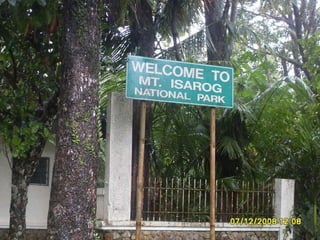
Mt. Isarog Adventure
Best Time to Visit Visitors can best hike through Mt. Isarog’s forests during the dry period occurring from January to April
* Mt. Isarog Summit. An hour hike from The Girl Scout Camp to Malabsay Falls offers an unforgettable water experience.  * Hikers follow the Panicuason trail which leads through the mossy forest. At higher elevations, trees are dwarfed and twisted by the climate and strong winds.  Note: Hikers are advised to bring their own water for this hike.
* Visiting the Park will not be complete without admiring the  Malabsay Falls  near the Park entrance, where visitors can have picnics and swim.  *  Nabuntulan Spring . Near Malabsay Falls, it can be reached by following a forested mountain trail. *  Magragobrob Waterfalls . Located inside the crater of Mt. Isarog in Barangays Aroro and San Pedro, Goa.
Entrance Fees Entrance Fees are paid at the Park entrance gate in barangay Panicuason.  * Filipinos pay P10.00  * Foreigners US$1 per day .
FLORA    Mt. Isarog is estimated to house some 3,000 species of flora, which include: Dipterocarps Epiphytes Rattans ground ferns lianas and herbs. In higher elevations, pitcher plants, palms, oaks, mosses, liverworts, ferns and lianas are abundant.
FAUNA   Mt. Isarog is regarded as a biodiversity rich area. Its inclusion in the list of priority areas is backed up by the presence of endemic rodents and other endemic mammal and bird species.


LUNCH BREAK
 
Shoes of the Month.. ;-)
RIVER TREK
 
 
Malabsay Falls
Soaking Wet!
To be Continue...
Attendance December 7, 2008 Villacrusis, Justin Dibble, Joy Lavil Chica, Darrel Bermejo, Jennifer Sjeistein Chavez, Ginelle Reyes, Diana Pahati, Frecylla
GUIDE TECHNIQUES RISKS Train the LOCALS to be a good and well-knowledge guides at the area. Sign Boards Develop the pathway
CAMP MANAGEMENT Designated campsite. Camping Gadgets for rent. Signboards for Campers
WASTE MANAGEMENT Segregation of wastes from biodegradable to non-bio. Daily pick-up of waste at the park.
HOUSEKEEPING Empowering locals to be part of the tourism development at the park. Scheduled daily housekeeping.
FOOD Making use of the local foods. Introduction of local foods to the tourist and encouraging them to try. Indulge in!
FLORA & FAUNA Ensure effective protection and management of biodiversity and natural habitats
HUMAN RESOURCE REQUIREMENT AND TRAINING
TRAININGS BEFORE ENGAGING INTO THE ACTIVITIES
Rappeling - is the controlled descent down a rope in  rock climbing ,  mountaineering ,  caving , and  canyoneering ; the technique is used when a cliff or slope is too steep and/or dangerous to descend without protection. This Activity will be trained at the Kadlagan Wall Climbing.
 
Snorkeling - is the practice of  swimming  on or through a body of water while equipped with a  diving mask , a shaped tube called a  snorkel , and usually  swim fins . In cooler waters,a  wetsuit  may also be worn. Using this equipment allows the snorkeler to observe underwater attractions for extended periods of time with relatively little effort. Trainings with the professional divers.
 
River trekking is a combination of trekking and climbing and sometimes swimming along the river. It  involves  particular techniques like  rock climbing ,  climbing  on wet surfaces, understanding the geographical features of river and valleys,  knotting , dealing with sudden bad weather and find out possible exits from the river.
 
Rafting or whitewater rafting is a challenging recreational activity utilizing a  raft  to navigate a  river  or other bodies of water.
 
MEALS Pre-heated meals Made-to-Order Meals Native foods of the locals Exotic Foods
ACCOMODATION Girls Scout Tents Cottages
GUIDES Well trained Guides
Attendance: Chavez, Ginelle Chica, Darrel Villacrusis, Justin Bermejo, Jennifer Sjeistein Dibble, Joy Lavil
RAPELLING
EQUIPMENTS
Helmets  are worn to protect the head from bumps and falling rocks. A light source may be mounted on the helmet in order to keep the hands free in unlit areas.  Gloves  protect hands from the rope and from hits with the wall. They are mainly used by recreational abseilers, industrial access practitioners, adventure racers and military as opposed to climbers or mountaineers. In fact, they can increase the risk of accident by becoming caught in the  descender  in certain situations.  Boots  or other sturdy footwear with good grips.
Knee -pads (and sometimes  elbow -pads) are popular in some applications for the protection of joints during crawls or hits.  Ropes  used for descending are typically of  Kernmantle  rope  construction, with a multi-strand core protected by an abrasion-resistant woven sheath. For most applications, low-stretch rope (typically ~2% stretch when under the load of a typical bodyweight) called static rope is used to reduce bouncing and to allow easier ascending of the rope.  A  harness  is used around the waist to secure the  descender . A comfortable harness is important for descents that may take many hours.
PROCEDURE/ TRAININGS
Rappel Devices Create Friction
A rappel device should also keep the two strands of rope from twisting in a way so that pulling them down after a descent would be impossible.  Most modern devices do this for you with a separate slot for each strand which helps keep the ropes seperated and less likely to create unusable tangles.
 
The belay loop also extends the rappel device further away from your body, helping your back-up function better and allowing you to keep both hands more easily on the brake side of the device.  Two hands on the brake strands doubles the amount of control you have versus the method of one hand above and one below the rappel device
 
Holding the rope between the legs more easily allows one to use the inside of the leg to create additional friction when necessary.  Fingerless, leather belay/rappel gloves also provide an extra element of control by reducing rope burns and adding friction.
Adding Friction
Sometimes even with a double-rope rappel, due to a climber's weight, wet or icy conditions, or the diameter of the ropes (common with today's single 9.5 mm lines), more friction is necessary to safely control one's descent.  A very simple method to create additional friction when rappelling is shown below:
 
By adding a carabiner below and above the belay device and therefore adding a few extra bends in the rappelling rope, significantly more friction is gained and therefore more control.
 
Back-ups are added protection.
The first form of back-up is to tie knots at the bottom of your rappel ropes, keeping you from sliding off the ends. For added safety, many climbers back-up their rappel on the brake hand strands with a friction hitch attached to the harness. By having this hitch on the rope, it could prevent you from zipping down to the end of your rappel in the event of an injury from rockfall,  lightning, seizure, etc, and by being able to go "hands-free", a back-up hitch allows you to stop and untangle the rope or pull it off of ledges using both hands and adding much more safety.
Traditionally, back-ups were applied with a prussik hitch that was connected from the climber's harness to the rope above the rappel device.  Although this method works adequately on lower angle terrain, it has the disadvantage of becoming fully weighted more easily and on steep terrain this can make releasing the back-up very difficult.  
The more user friendly method for putting a back-up on a rappel rope is to apply the friction hitch below the rappel device on the brake-hand side, connected short to the leg loop.   A prussik hitch made with 5 or 6 mm cord works well in this application;  pure nylon has a higher melting temperature (better) than the higher tensile strength materials.  A 24" sewn shoulder-length nylon sling also works well when girth-hitched to the leg loop then tied with an auto-block hitch (shown) which is connected back to the leg loop.  Be aware that both of these friction hitches will not engage if they come in contact with the rappel device so they must be relatively short loops.  If you are attaching your back up to your leg loop make sure that the leg loop is also full strength.
 
Extending the rappel device 
Extending the rappel device with a 24"or 48 "sewn sling or a "daisy-chain" that is girth-hitched to the harness via the belay loop has some distinct advantages.  This method puts the rappel device further from the body which lessens the risk of catching clothes or hair in the rappel device and more importantly, with more room below the rappel device both hands can more easily control the brake side of the ropes.  Be careful that the rappel rope does not burn the extension sling- the method shown with the red sewn sling creates a redundant extension .  This could also be a good reason to use a locking carabiner on your back-up:  In case it is fully supporting your weight!
 

Isarog

  • 1.
  • 2.
  • 3.
    Best Time toVisit Visitors can best hike through Mt. Isarog’s forests during the dry period occurring from January to April
  • 4.
    * Mt. IsarogSummit. An hour hike from The Girl Scout Camp to Malabsay Falls offers an unforgettable water experience. * Hikers follow the Panicuason trail which leads through the mossy forest. At higher elevations, trees are dwarfed and twisted by the climate and strong winds. Note: Hikers are advised to bring their own water for this hike.
  • 5.
    * Visiting thePark will not be complete without admiring the Malabsay Falls near the Park entrance, where visitors can have picnics and swim. * Nabuntulan Spring . Near Malabsay Falls, it can be reached by following a forested mountain trail. * Magragobrob Waterfalls . Located inside the crater of Mt. Isarog in Barangays Aroro and San Pedro, Goa.
  • 6.
    Entrance Fees EntranceFees are paid at the Park entrance gate in barangay Panicuason. * Filipinos pay P10.00 * Foreigners US$1 per day .
  • 7.
    FLORA    Mt.Isarog is estimated to house some 3,000 species of flora, which include: Dipterocarps Epiphytes Rattans ground ferns lianas and herbs. In higher elevations, pitcher plants, palms, oaks, mosses, liverworts, ferns and lianas are abundant.
  • 8.
    FAUNA Mt. Isarog is regarded as a biodiversity rich area. Its inclusion in the list of priority areas is backed up by the presence of endemic rodents and other endemic mammal and bird species.
  • 9.
  • 10.
  • 11.
  • 12.
  • 13.
  • 14.
    Shoes of theMonth.. ;-)
  • 15.
  • 16.
  • 17.
  • 18.
  • 19.
  • 20.
  • 21.
    Attendance December 7,2008 Villacrusis, Justin Dibble, Joy Lavil Chica, Darrel Bermejo, Jennifer Sjeistein Chavez, Ginelle Reyes, Diana Pahati, Frecylla
  • 22.
    GUIDE TECHNIQUES RISKSTrain the LOCALS to be a good and well-knowledge guides at the area. Sign Boards Develop the pathway
  • 23.
    CAMP MANAGEMENT Designatedcampsite. Camping Gadgets for rent. Signboards for Campers
  • 24.
    WASTE MANAGEMENT Segregationof wastes from biodegradable to non-bio. Daily pick-up of waste at the park.
  • 25.
    HOUSEKEEPING Empowering localsto be part of the tourism development at the park. Scheduled daily housekeeping.
  • 26.
    FOOD Making useof the local foods. Introduction of local foods to the tourist and encouraging them to try. Indulge in!
  • 27.
    FLORA & FAUNAEnsure effective protection and management of biodiversity and natural habitats
  • 28.
  • 29.
    TRAININGS BEFORE ENGAGINGINTO THE ACTIVITIES
  • 30.
    Rappeling - isthe controlled descent down a rope in rock climbing , mountaineering , caving , and canyoneering ; the technique is used when a cliff or slope is too steep and/or dangerous to descend without protection. This Activity will be trained at the Kadlagan Wall Climbing.
  • 31.
  • 32.
    Snorkeling - isthe practice of swimming on or through a body of water while equipped with a diving mask , a shaped tube called a snorkel , and usually swim fins . In cooler waters,a wetsuit may also be worn. Using this equipment allows the snorkeler to observe underwater attractions for extended periods of time with relatively little effort. Trainings with the professional divers.
  • 33.
  • 34.
    River trekking isa combination of trekking and climbing and sometimes swimming along the river. It involves particular techniques like rock climbing , climbing on wet surfaces, understanding the geographical features of river and valleys, knotting , dealing with sudden bad weather and find out possible exits from the river.
  • 35.
  • 36.
    Rafting or whitewaterrafting is a challenging recreational activity utilizing a raft to navigate a river or other bodies of water.
  • 37.
  • 38.
    MEALS Pre-heated mealsMade-to-Order Meals Native foods of the locals Exotic Foods
  • 39.
  • 40.
  • 41.
    Attendance: Chavez, GinelleChica, Darrel Villacrusis, Justin Bermejo, Jennifer Sjeistein Dibble, Joy Lavil
  • 42.
  • 43.
  • 44.
    Helmets areworn to protect the head from bumps and falling rocks. A light source may be mounted on the helmet in order to keep the hands free in unlit areas. Gloves protect hands from the rope and from hits with the wall. They are mainly used by recreational abseilers, industrial access practitioners, adventure racers and military as opposed to climbers or mountaineers. In fact, they can increase the risk of accident by becoming caught in the descender in certain situations. Boots or other sturdy footwear with good grips.
  • 45.
    Knee -pads (andsometimes elbow -pads) are popular in some applications for the protection of joints during crawls or hits. Ropes used for descending are typically of Kernmantle rope construction, with a multi-strand core protected by an abrasion-resistant woven sheath. For most applications, low-stretch rope (typically ~2% stretch when under the load of a typical bodyweight) called static rope is used to reduce bouncing and to allow easier ascending of the rope. A harness is used around the waist to secure the descender . A comfortable harness is important for descents that may take many hours.
  • 46.
  • 47.
  • 48.
    A rappel deviceshould also keep the two strands of rope from twisting in a way so that pulling them down after a descent would be impossible.  Most modern devices do this for you with a separate slot for each strand which helps keep the ropes seperated and less likely to create unusable tangles.
  • 49.
  • 50.
    The belay loopalso extends the rappel device further away from your body, helping your back-up function better and allowing you to keep both hands more easily on the brake side of the device.  Two hands on the brake strands doubles the amount of control you have versus the method of one hand above and one below the rappel device
  • 51.
  • 52.
    Holding the ropebetween the legs more easily allows one to use the inside of the leg to create additional friction when necessary.  Fingerless, leather belay/rappel gloves also provide an extra element of control by reducing rope burns and adding friction.
  • 53.
  • 54.
    Sometimes even witha double-rope rappel, due to a climber's weight, wet or icy conditions, or the diameter of the ropes (common with today's single 9.5 mm lines), more friction is necessary to safely control one's descent.  A very simple method to create additional friction when rappelling is shown below:
  • 55.
  • 56.
    By adding acarabiner below and above the belay device and therefore adding a few extra bends in the rappelling rope, significantly more friction is gained and therefore more control.
  • 57.
  • 58.
  • 59.
    The first formof back-up is to tie knots at the bottom of your rappel ropes, keeping you from sliding off the ends. For added safety, many climbers back-up their rappel on the brake hand strands with a friction hitch attached to the harness. By having this hitch on the rope, it could prevent you from zipping down to the end of your rappel in the event of an injury from rockfall,  lightning, seizure, etc, and by being able to go "hands-free", a back-up hitch allows you to stop and untangle the rope or pull it off of ledges using both hands and adding much more safety.
  • 60.
    Traditionally, back-ups wereapplied with a prussik hitch that was connected from the climber's harness to the rope above the rappel device.  Although this method works adequately on lower angle terrain, it has the disadvantage of becoming fully weighted more easily and on steep terrain this can make releasing the back-up very difficult.  
  • 61.
    The more userfriendly method for putting a back-up on a rappel rope is to apply the friction hitch below the rappel device on the brake-hand side, connected short to the leg loop.   A prussik hitch made with 5 or 6 mm cord works well in this application;  pure nylon has a higher melting temperature (better) than the higher tensile strength materials.  A 24" sewn shoulder-length nylon sling also works well when girth-hitched to the leg loop then tied with an auto-block hitch (shown) which is connected back to the leg loop.  Be aware that both of these friction hitches will not engage if they come in contact with the rappel device so they must be relatively short loops.  If you are attaching your back up to your leg loop make sure that the leg loop is also full strength.
  • 62.
  • 63.
  • 64.
    Extending the rappeldevice with a 24"or 48 "sewn sling or a "daisy-chain" that is girth-hitched to the harness via the belay loop has some distinct advantages.  This method puts the rappel device further from the body which lessens the risk of catching clothes or hair in the rappel device and more importantly, with more room below the rappel device both hands can more easily control the brake side of the ropes.  Be careful that the rappel rope does not burn the extension sling- the method shown with the red sewn sling creates a redundant extension .  This could also be a good reason to use a locking carabiner on your back-up:  In case it is fully supporting your weight!
  • 65.