PHYSICAL EDUCATION
PROJECT
SAKSHI MAKKAR
PALAK TANISHA
RESHAM NAGPAL
BHAVYA PRADHAN
NITYA
KAVEESH DHIMAN
A PRESENTATION BY -
Choose an ExperienceA
Trekking Surfing Rock Climbing
River Rafting
Mountaineering Paragliding
ADVENTUROUS SPORTS
TREKKING
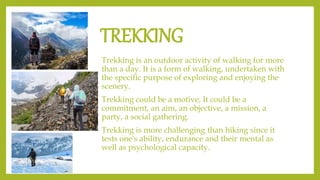
Trekking is an outdoor activity of walking for more
than a day. It is a form of walking, undertaken with
the specific purpose of exploring and enjoying the
scenery.
Trekking could be a motive, It could be a
commitment, an aim, an objective, a mission, a
party, a social gathering.
Trekking is more challenging than hiking since it
tests one's ability, endurance and their mental as
well as psychological capacity.
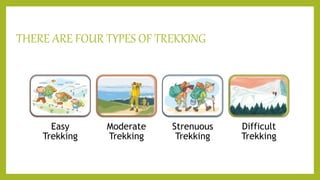
THERE ARE FOUR TYPES OF TREKKING
Easy
Trekking
Moderate
Trekking
Strenuous
Trekking
Difficult
Trekking
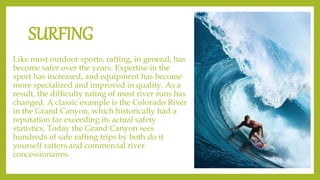
SURFING
Like most outdoor sports, rafting, in general, has
become safer over the years. Expertise in the
sport has increased, and equipment has become
more specialized and improved in quality. As a
result, the difficulty rating of most river runs has
changed. A classic example is the Colorado River
in the Grand Canyon, which historically had a
reputation far exceeding its actual safety
statistics. Today the Grand Canyon sees
hundreds of safe rafting trips by both do it
yourself rafters and commercial river
concessionaires.
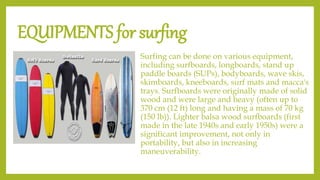
EQUIPMENTS for surfing
Surfing can be done on various equipment,
including surfboards, longboards, stand up
paddle boards (SUPs), bodyboards, wave skis,
skimboards, kneeboards, surf mats and macca's
trays. Surfboards were originally made of solid
wood and were large and heavy (often up to
370 cm (12 ft) long and having a mass of 70 kg
(150 lb)). Lighter balsa wood surfboards (first
made in the late 1940s and early 1950s) were a
significant improvement, not only in
portability, but also in increasing
maneuverability.
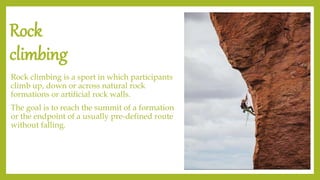
Rock
climbing
Rock climbing is a sport in which participants
climb up, down or across natural rock
formations or artificial rock walls.
The goal is to reach the summit of a formation
or the endpoint of a usually pre-defined route
without falling.
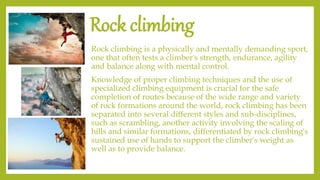
Rock climbing
Rock climbing is a physically and mentally demanding sport,
one that often tests a climber's strength, endurance, agility
and balance along with mental control.
Knowledge of proper climbing techniques and the use of
specialized climbing equipment is crucial for the safe
completion of routes because of the wide range and variety
of rock formations around the world, rock climbing has been
separated into several different styles and sub-disciplines,
such as scrambling, another activity involving the scaling of
hills and similar formations, differentiated by rock climbing's
sustained use of hands to support the climber's weight as
well as to provide balance.
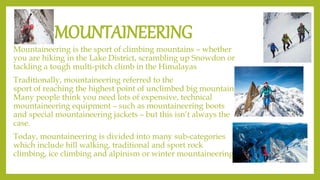
MOUNTAINEERING
Mountaineering is the sport of climbing mountains – whether
you are hiking in the Lake District, scrambling up Snowdon or
tackling a tough multi-pitch climb in the Himalayas
Traditionally, mountaineering referred to the
sport of reaching the highest point of unclimbed big mountains.
Many people think you need lots of expensive, technical
mountaineering equipment – such as mountaineering boots
and special mountaineering jackets – but this isn’t always the
case.
Today, mountaineering is divided into many sub-categories
which include hill walking, traditional and sport rock
climbing, ice climbing and alpinism or winter mountaineering.
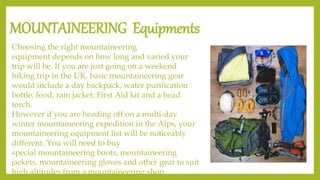
MOUNTAINEERING Equipments
Choosing the right mountaineering
equipment depends on how long and varied your
trip will be. If you are just going on a weekend
hiking trip in the UK, basic mountaineering gear
would include a day backpack, water purification
bottle, food, rain jacket, First Aid kit and a head
torch.
However if you are heading off on a multi-day
winter mountaineering expedition in the Alps, your
mountaineering equipment list will be noticeably
different. You will need to buy
special mountaineering boots, mountaineering
jackets, mountaineering gloves and other gear to suit
high altitudes from a mountaineering shop.
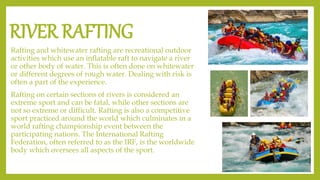
RIVER RAFTING
Rafting and whitewater rafting are recreational outdoor
activities which use an inflatable raft to navigate a river
or other body of water. This is often done on whitewater
or different degrees of rough water. Dealing with risk is
often a part of the experience.
Rafting on certain sections of rivers is considered an
extreme sport and can be fatal, while other sections are
not so extreme or difficult. Rafting is also a competitive
sport practiced around the world which culminates in a
world rafting championship event between the
participating nations. The International Rafting
Federation, often referred to as the IRF, is the worldwide
body which oversees all aspects of the sport.
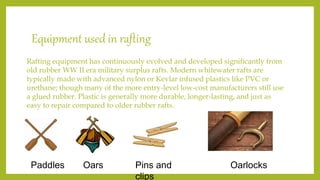
Equipment used in rafting
Rafting equipment has continuously evolved and developed significantly from
old rubber WW II era military surplus rafts. Modern whitewater rafts are
typically made with advanced nylon or Kevlar infused plastics like PVC or
urethane; though many of the more entry-level low-cost manufacturers still use
a glued rubber. Plastic is generally more durable, longer-lasting, and just as
easy to repair compared to older rubber rafts.
Paddles Oars Pins and
clips
Oarlocks
Equipments usedin rock climbing
Most climbers choose to wear specialized rubber climbing shoes which are often of
a smaller size than their normal street shoes in order to improve sensitivity
towards foot placements and use the tightness to their advantage.
Climbing chalk (MgCO3) is commonly used as a drying agent to minimize
sweating of the hands. Most other equipment is of a protective nature. Rock
climbing is inherently dangerous, so to minimize the potential consequences
resulting from a fall, climbers use protection.
The most basic protective equipment is a climbing rope. Climbing pioneers would
attach the rope to themselves; in the event of a fall, the rope would usually cause
injury to the climber in the hope that it prevented death.
With advances in technology came the development of specialized harnesses,
carabiners which are used for clipping into belay and rappel anchors.
PARAGLIDING
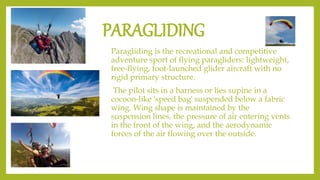
Paragliding is the recreational and competitive
adventure sport of flying paragliders: lightweight,
free-flying, foot-launched glider aircraft with no
rigid primary structure.
The pilot sits in a harness or lies supine in a
cocoon-like 'speed bag' suspended below a fabric
wing. Wing shape is maintained by the
suspension lines, the pressure of air entering vents
in the front of the wing, and the aerodynamic
forces of the air flowing over the outside.
Equipments used in paragliding
Most pilots use variometers, radios, and, increasingly, GNSS units
when they are flying.
• The main purpose of a variometer is in helping a pilot find and stay in the "core" of a thermal to
maximize height gain and, conversely, to indicate when a pilot is in sinking air and needs to find
rising air
Variometer
• Radio communications are used in training, to communicate with other pilots, and to report where
and when they intend to land.
Radio
• GNSS is a necessary accessory when flying competitions, where it has to be demonstrated that way-
points have been correctly passed.
GNSS
THANK YOU

Phy edu. ppt.pptx

  • 1.
  • 2.
    SAKSHI MAKKAR PALAK TANISHA RESHAMNAGPAL BHAVYA PRADHAN NITYA KAVEESH DHIMAN A PRESENTATION BY -
  • 3.
    Choose an ExperienceA TrekkingSurfing Rock Climbing River Rafting Mountaineering Paragliding ADVENTUROUS SPORTS
  • 4.
    TREKKING Trekking is anoutdoor activity of walking for more than a day. It is a form of walking, undertaken with the specific purpose of exploring and enjoying the scenery. Trekking could be a motive, It could be a commitment, an aim, an objective, a mission, a party, a social gathering. Trekking is more challenging than hiking since it tests one's ability, endurance and their mental as well as psychological capacity.
  • 5.
    THERE ARE FOURTYPES OF TREKKING Easy Trekking Moderate Trekking Strenuous Trekking Difficult Trekking
  • 6.
    SURFING Like most outdoorsports, rafting, in general, has become safer over the years. Expertise in the sport has increased, and equipment has become more specialized and improved in quality. As a result, the difficulty rating of most river runs has changed. A classic example is the Colorado River in the Grand Canyon, which historically had a reputation far exceeding its actual safety statistics. Today the Grand Canyon sees hundreds of safe rafting trips by both do it yourself rafters and commercial river concessionaires.
  • 7.
    EQUIPMENTS for surfing Surfingcan be done on various equipment, including surfboards, longboards, stand up paddle boards (SUPs), bodyboards, wave skis, skimboards, kneeboards, surf mats and macca's trays. Surfboards were originally made of solid wood and were large and heavy (often up to 370 cm (12 ft) long and having a mass of 70 kg (150 lb)). Lighter balsa wood surfboards (first made in the late 1940s and early 1950s) were a significant improvement, not only in portability, but also in increasing maneuverability.
  • 8.
    Rock climbing Rock climbing isa sport in which participants climb up, down or across natural rock formations or artificial rock walls. The goal is to reach the summit of a formation or the endpoint of a usually pre-defined route without falling.
  • 9.
    Rock climbing Rock climbingis a physically and mentally demanding sport, one that often tests a climber's strength, endurance, agility and balance along with mental control. Knowledge of proper climbing techniques and the use of specialized climbing equipment is crucial for the safe completion of routes because of the wide range and variety of rock formations around the world, rock climbing has been separated into several different styles and sub-disciplines, such as scrambling, another activity involving the scaling of hills and similar formations, differentiated by rock climbing's sustained use of hands to support the climber's weight as well as to provide balance.
  • 10.
    MOUNTAINEERING Mountaineering is thesport of climbing mountains – whether you are hiking in the Lake District, scrambling up Snowdon or tackling a tough multi-pitch climb in the Himalayas Traditionally, mountaineering referred to the sport of reaching the highest point of unclimbed big mountains. Many people think you need lots of expensive, technical mountaineering equipment – such as mountaineering boots and special mountaineering jackets – but this isn’t always the case. Today, mountaineering is divided into many sub-categories which include hill walking, traditional and sport rock climbing, ice climbing and alpinism or winter mountaineering.
  • 11.
    MOUNTAINEERING Equipments Choosing theright mountaineering equipment depends on how long and varied your trip will be. If you are just going on a weekend hiking trip in the UK, basic mountaineering gear would include a day backpack, water purification bottle, food, rain jacket, First Aid kit and a head torch. However if you are heading off on a multi-day winter mountaineering expedition in the Alps, your mountaineering equipment list will be noticeably different. You will need to buy special mountaineering boots, mountaineering jackets, mountaineering gloves and other gear to suit high altitudes from a mountaineering shop.
  • 12.
    RIVER RAFTING Rafting andwhitewater rafting are recreational outdoor activities which use an inflatable raft to navigate a river or other body of water. This is often done on whitewater or different degrees of rough water. Dealing with risk is often a part of the experience. Rafting on certain sections of rivers is considered an extreme sport and can be fatal, while other sections are not so extreme or difficult. Rafting is also a competitive sport practiced around the world which culminates in a world rafting championship event between the participating nations. The International Rafting Federation, often referred to as the IRF, is the worldwide body which oversees all aspects of the sport.
  • 13.
    Equipment used inrafting Rafting equipment has continuously evolved and developed significantly from old rubber WW II era military surplus rafts. Modern whitewater rafts are typically made with advanced nylon or Kevlar infused plastics like PVC or urethane; though many of the more entry-level low-cost manufacturers still use a glued rubber. Plastic is generally more durable, longer-lasting, and just as easy to repair compared to older rubber rafts. Paddles Oars Pins and clips Oarlocks
  • 14.
    Equipments usedin rockclimbing Most climbers choose to wear specialized rubber climbing shoes which are often of a smaller size than their normal street shoes in order to improve sensitivity towards foot placements and use the tightness to their advantage. Climbing chalk (MgCO3) is commonly used as a drying agent to minimize sweating of the hands. Most other equipment is of a protective nature. Rock climbing is inherently dangerous, so to minimize the potential consequences resulting from a fall, climbers use protection. The most basic protective equipment is a climbing rope. Climbing pioneers would attach the rope to themselves; in the event of a fall, the rope would usually cause injury to the climber in the hope that it prevented death. With advances in technology came the development of specialized harnesses, carabiners which are used for clipping into belay and rappel anchors.
  • 15.
    PARAGLIDING Paragliding is therecreational and competitive adventure sport of flying paragliders: lightweight, free-flying, foot-launched glider aircraft with no rigid primary structure. The pilot sits in a harness or lies supine in a cocoon-like 'speed bag' suspended below a fabric wing. Wing shape is maintained by the suspension lines, the pressure of air entering vents in the front of the wing, and the aerodynamic forces of the air flowing over the outside.
  • 16.
    Equipments used inparagliding Most pilots use variometers, radios, and, increasingly, GNSS units when they are flying. • The main purpose of a variometer is in helping a pilot find and stay in the "core" of a thermal to maximize height gain and, conversely, to indicate when a pilot is in sinking air and needs to find rising air Variometer • Radio communications are used in training, to communicate with other pilots, and to report where and when they intend to land. Radio • GNSS is a necessary accessory when flying competitions, where it has to be demonstrated that way- points have been correctly passed. GNSS
  • 17.