PhysicalEducation9
(Indoor and Outdoor Activities)
PhysicalEducation9
(Indoor and Outdoor Activities)
Define active recreation.
Differentiate indoor from outdoor recreational
activities.
Explain the importance of recreational activities
in enhancing physical fitness
Recreational activities are defined as any indoor
or outdoor physical activity, sport, team sport, or
game, whether organized or unorganized,
undertaken for the purpose of exercise, relaxation,
diversion, education or pleasure, including practice or
instruction in any such activity.
• Activities that are voluntarily participating during
free time.
• In choosing activities, you must consider the
following;
- Interest
- Free will
- Recreational satisfaction needs
• Refers to recreational activities that
do not require organized facilities like
sports fields, pavilions, and gyms.
• More formal, with particular rules
to be followed.
• Often requiring equipment and
taking place at prescribed places,
sites or fields.
• Participation in these activities influences
your lifestyle, such as;
- Improves health condition
- Use the calories better
- Sustain a desirable weight
• Engage in a regular physical activity
• Eat healthy food
• Find time to manage stress
• Follow good personal habits
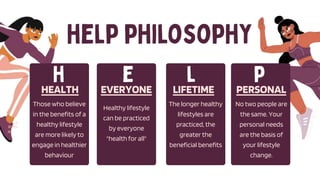
Those who believe
in the benefits of a
healthy lifestyle
are more likely to
engage in healthier
behaviour
Healthy lifestyle
can be practiced
by everyone
"health for all"
The longer healthy
lifestyles are
practiced, the
greater the
beneficial benefits
No two people are
the same. Your
personal needs
are the basis of
your lifestyle
change.
HEALTH EVERYONE LIFETIME PERSONAL
• These are inherited traits from your
parents.
• Children can inherit the chances of being
overweight or obese if born from obese
parents approximately 80% chances.
• Non-obese parents can only have a 10%
chance of bearing an obese or overweight
child.
• The rapid growth which teens undergo
causes a natural weight gain.
• However, girls in their teens have
hormonal changes that cause weight
change.
• These include behaviour and
lifestyle choices.
• When a child is raised with
overeating unhealthy foods and
under-exercising, he develops a
learned behaviour that leads to
wrong lifelong habits.
The concept of energy balance compares the amount of energy
consumed as food with the amount of energy expended through
physical activities, exercises, and resting metabolism.
(calories consumed = calories expended)
(calories consumed > energy expenditure)
(calories consumed < energy expenditure)
Badminton is
believed to have
originated from
the game "poona"
that was played by
English Army
Brought to
England in 1870's
when the Duke of
Beaufort held a
lawn party in his
country place,
Badminton.
Inclusion of the
game in the
Olympic sport in
Barcelona with
singles and
doubles events.
• Games are held inside the gym to avoid the effect of air in the flight of
the shuttle.
• Players need a racket and a shuttle cock to enjoy the game on a court.
• The game requires skills in service, strokes in hitting the shuttle such as
smash, drop, lob or clear and net shorts, and leg power in footwork.
• The game is played by either singles, doubles, and mixed doubles.
• A game is won when a player/s reaches à score of 21 points.
• In the case of a deuce (20-all), one has to gain a two-point advantage
over the other.
• But in case of a 29-all score, the first to reach 30 will win the set.
• A match is won by winning two out of three sets
• Created by William J. Morgan in 1895 at Holyoke Massachusetts.
• Initially, the game was called "mintonette" but in its first exhibition
game demonstration, Alfred Halstead suggested the name
"Volleyball" due to the volleying characteristic of the game.
• Volleyball had its first summer Olympics exposure as a medal sport.
• Brought to the Philippines by Elwood S. Brown.
• The Filipinos are credited with the changes in the game with the
addition of the skill called "spike or kill".
• Volleyball is a team sport with six players on each side of the court with a 9x18
meters dimension.
• The game aims to send the ball over the net and avoid it from entering your
court.
• A ball, net, and a court are needed to play the game.
• Scoring follows a rally point system.
• A game is won in two out of three sets.
• A set is won by reaching a score of 25.
• In case of a deuce, a team should have a two-point advantage over the other.
• Players need skills like service, volleying, setting, spiking, and blocking to
enjoy much of the game and gain its fitness benefits.
• It enhances the metabolism of the body, which in turn is a factor in losing
weight.
• It helps you to manage your weight appropriately for your age and
height. This can be achieved better when combined with a proper diet.
• Since a sport is fun, emotional well-being is improved.
• Gives way to the intellectual dimension by playing with strategies and
tactics.
• The social dimension is seen when players build good relationships.
Trusting your teammate builds camaraderie and teamwork.
• Dance is another indoor alternative recreation for those
who enjoy the beat of rhythm and movement.
• It is a fantastic and fun exercise that gradually raises the
heart rate and is considered a good cardio workout.
• Regular participation in dance activities tightens and tones
muscle groups and burns more calories.
• Alberto "Beto" Perez, a celebrity fitness trainer in Colombia,
accidentally discovered it in the mid-'90s.
• The birth of Zumba came about during one of his aerobics
classes when he realized that he had forgotten his aerobics
music.
• He grabbed whatever tape he had in his backpack. It so
happened that his tapes are those of Latin music, such as
merengue and salsa. With his improvisation skill, he created an
on-the-spot aerobics class using non-traditional music.
• It improves cardiovascular health -The combination of cardio intervals brought
about by the fast and slow rhythms makes this dance a great cardio interval
workout The fast and upbeat moves of zumba improve the delivery of blood
which carries oxygen to the different parts of the body through the veins, arteries,
and heart.
• It helps in losing weight - cardio interval effect of zumba maximizes the burning of
calories. Joining a Zumba workout for an hour burns approximately 600 calories.
• It relieves stress. It is believed that zumba dancing releases more altering
endorphins that melts away worries away.
• It improves mood. It releases feel good hormones called "endorphin" that
improves self-esteem, self-confidence and self-image.
• It tones the abdominals - the dance moves work on firmer core abdominal
muscles.
• Zumba involves a combination of latin dance steps such as salsa,
samba, raggaeton, merengue, cumbia, cha-cha-cha, mambo
rumba, flamenco.
• Many steps have been included to make the dance more exciting
such as belly dancing, hip hop and the like.
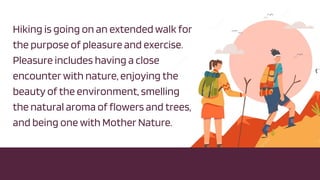
Hiking is going on an extended walk for
the purpose of pleasure and exercise.
Pleasure includes having a close
encounter with nature, enjoying the
beauty of the environment, smelling
the natural aroma of flowers and trees,
and being one with Mother Nature.
• It offers cardiovascular fitness.
• It gives the feeling of relaxation.
• It balances your daily life routine.
• It's a good option for weight
management activity.
Find a friend who is an experienced hiker or backpacker.
It's safer to travel with a friend or group of friends.
You should have ample endurance to prepare
yourself for long walks. practice carrying heavy
bags so that you will also build strength.
Do your research on your destination. Read
travel books, websites of magazines. Ask well-
travelled friends too.
Know how long and how far the trip will take you. This will
help you plan what you need to pack. This will also help
you when making a budget for the trip
Try to pack as light as possible.
Wear proper and comfortable clothes.
Bring some trail mix (nuts, chocolate, jelly, cereal, etc.) to
keep your energy up throughout the day. If going on
overnight hikes, plan your meals accordingly. If traveling
with a big group, divide the team into smaller groups and
assign a meal per small group.
Before you leave for your trip, make sure that you
have a contact person who knows all your
emergency details. Keep the contact person
informed on your whereabouts at all times (if
possible). Leave your itinerary with the contact
person.
• Pack out what you pack in. Practice the Leave
No Trace principles by picking up after your
trash and bringing them home with you.
• Modulate your noise levels.
• Be respectful and courteous to other visitors as
well as to wildlife.
• Enjoy the view and the experience!
• Navigation
• Sun Protection
• Insulation
• Illumination
• First-aid supplies
• Fire
• Repair kit and tools
• Nutrition
• Hydration
• Emergency shelter
✓ See to it that your body is in a certain fitness level for a safe and pleasant climb.
For you to enjoy the scenery more and enjoy the company of other backpackers,
you must be PHYSICALLY FIT.
✓ Attend to the following concerns:
• Your travel plan (itinerary).
• Possible transportation.
• Budget.
• Food and water to bring.
• What equipment to bring
OnGroupFormation
✓ Follow a single file formation. Overtaking should be avoided, but in case of a need to do
it, inform the hiker in front of you
✓ Maintain a certain distance between hikers.
Pacing
✓ Start with a slow pace and gradually change as the group desires
✓ Do not leave anyone behind
✓ Inform the group if there is a need to rest
✓ The group's pace should be that of the slowest member or the person with the heaviest
load.
TrailSigns
✓ Man-made/alternative
• any coloured materials such as yarn can be used, but it is known by all
members of the group
✓ Natural trail signs
• Materials found in the environment like rocks, grass, and twigs,
1.Conceptual aspects - Since it is a navigational activity, it enhances your
decision-making skills about map interpretations and using a compass. It also
requires you to constantly interpret information contained in the map.
2.PhysicalAspect - Orienteering is a running sport that develops your
cardiovascular endurance and general fitness. Speed, endurance, and strength
are essential components to participate in the game successfully. This activity
captivates the mental and physical challenge features.
3.Personal aspects - Since you are responsible in making decisions in this activity,
you develop your self-confidence and reliance. Your aims are clear that you work
hard to achieve them giving you the feeling of self-fulfillment.
4.SocialAspects - You will learn to work cohesively with one another.
5.Environmental aspect - It creates an avenue for you to appreciate your en-
vironment.
Find your approximate location on the map
Recognize the pattern of features on the ground as being the same as the
pattern on map
Always hold the map so that you are looking along the route with the map
matching the ground.
The map is said to be oriented if the features on the map are in proper relation to
the actual features in the field
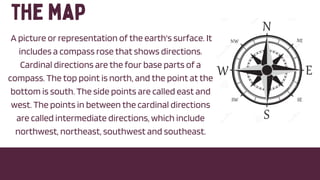
A picture or representation of the earth's surface. It
includes a compass rose that shows directions.
Cardinal directions are the four base parts of a
compass. The top point is north, and the point at the
bottom is south. The side points are called east and
west. The points in between the cardinal directions
are called intermediate directions, which include
northwest, northeast, southwest and southeast.
Maps use a key or legend to explain the meaning of
each symbol used in the map. The key usually shows
a small picture of each of the symbols used on the
map, along with a written description of the
meaning of each symbol. Maps use a key to explain
the meaning of each symbol used in the map. The
key usually shows a small picture of each of the
symbols.
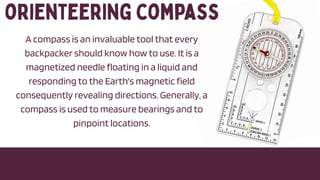
A compass is an invaluable tool that every
backpacker should know how to use. It is a
magnetized needle floating in a liquid and
responding to the Earth's magnetic field
consequently revealing directions. Generally, a
compass is used to measure bearings and to
pinpoint locations.
• Magnetic needle - the magnetic needle's north end is painted red and its
south end is white.
• Revolving compass housing - the housing is marked with the four
cardinal points of north, east, south and west and further divided into 2-
degree graduations indicating the full 360 degrees of a circle. The
bottom of the rotating housing is marked with an orienting arrow and
meridian lines.
• Transparent base plate - the base plate is marked with a ruler, an index
line, and the direction of travel arrow.
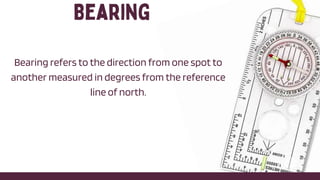
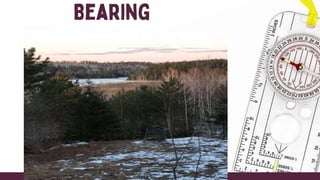
Bearing refers to the direction from one spot to
another measured in degrees from the reference
line of north.
Howdoyoutakethebearing?
• Hold the compass in front of you with the
direction of travel arrow pointing at object of
interest.
• Hold the compass level steady and rotate the
housing dial until the orienting arrow lines up with
the red end (north end) of the magnetic needle,
while keeping the direction of travel arrow pointed
at the object.
• Read the number indicated at the index line - that
is your bearing.
Write the word OUTDOOR if the
statement describes this an outdoor
recreational activity and INDOOR if
describes an indoor recreational
activity, and BOTH if it describes both
indoor and outdoor.
1. MOUNTAINEERING
2. CYCLING
3. TABLE TENNIS
4. CAMPING
5. HIKING
6. BASKETBALL
7. BADMINTON
8. ZUMBA
9. SWIMMING
10. RAFTING
How important these
recreational activities
in to your life?
1. Believed to have originated
from the game "poona" that
was played by English Army
2. This is a factor affecting
weight that are inherited traits
from your parents.
3. An extended walk for the purpose of
pleasure and exercise with close encounter
with nature, enjoying the beauty of the
environment, smelling the natural aroma of
flowers and trees, and being one with Mother
Nature.
4. A picture or representation of
the earth's surface. It includes a
compass rose that shows
directions.
5. Created by William J. Morgan in
1895 at Holyoke Massachusetts
and the game was called
"mintonette"
1. BADMINTON
2. GENES
3. HIKING
4. MAP
5. VOLLEYBALL
1. Orienteering is an extended walk for the purpose of
pleasure and exercise.
2. In order to win a match in Badminton, you should win two
out of three sets.
3. Zumba involves a combination of latin dance steps such as
salsa, samba, raggaeton, merengue, cumbia, cha-cha-cha,
mambo rumba, flamenco.
4. A compass is used to measure bearings and to pinpoint
locations.
5. Volleyball is believed to have originated from the game
"poona" that was played by English Army.
1. Orienteering is an extended walk for the purpose of
pleasure and exercise. FALSE
2. In order to win a match in Badminton, you should win two
out of three sets. TRUE
3. Zumba involves a combination of latin dance steps such as
salsa, samba, raggaeton, merengue, cumbia, cha-cha-cha,
mambo rumba, flamenco. TRUE
4. A compass is used to measure bearings and to pinpoint
locations. TRUE
5. Volleyball is believed to have originated from the game
"poona" that was played by English Army. FALSE
BODY MASS INDEX
18.5 and above UNDERWEIGHT
18.5 to 24.9 NORMAL
25.0 – 29.9 OVERWEIGHT
30 above OBESE
Stand with feet shoulder width, stretch both arms up with the fingers interlocking with
one another. With that position, bend to the right without bending the knees for eight
seconds. Do it again to the left side. Do not over stretch! Stretch on your flexibility level.
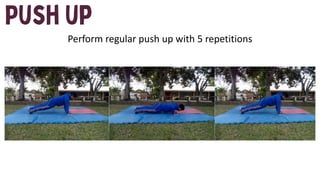
Perform regular push up with 5 repetitions
Jog around the gym/area for 60 seconds.
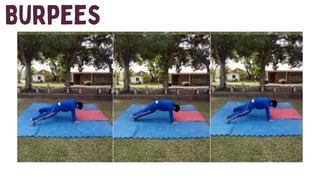
Stand with your feet shoulder-width apart. Go to squat position with the
hands on the floor in front of you. Kick your feet back moving in a push-
up position. With that position, open your legs in a straddle position
then close. Kick your feet forward back to the original position. Stand up
and jump in the air. Repeat five times
Stand with your feet shoulder width apart. Slightly bend your knees with both hands at
the back of your neck. Jump forward, backward, sideward Right and left as fast as u can
keeping your weight on the balls of your feet. One count for every cycle (forward,
backward, sideward R and Left). Make 8 cycles.
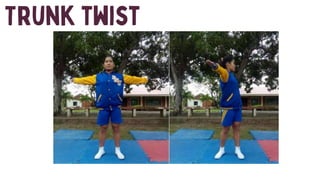
Standing with feet open in shoulder width, raise arms sideward at shoulder level with
palms up. Gradually twist your trunk to the right for eight counts. Do it again to the left.
In a push-up position, make your forearm as the base of support together with your
toes. Keep a steady position and work on your abdominals and arms. Do this in eight
seconds.
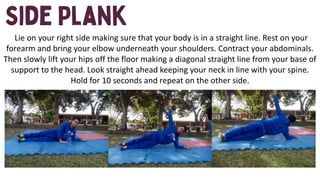
Lie on your right side making sure that your body is in a straight line. Rest on your
forearm and bring your elbow underneath your shoulders. Contract your abdominals.
Then slowly lift your hips off the floor making a diagonal straight line from your base of
support to the head. Look straight ahead keeping your neck in line with your spine.
Hold for 10 seconds and repeat on the other side.
Stand with your back in
front of the chair. Sit on the
edge of the Chair and place
your hands behind your
hips along the sides of the
chair
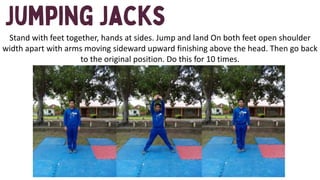
Stand with feet together, hands at sides. Jump and land On both feet open shoulder
width apart with arms moving sideward upward finishing above the head. Then go back
to the original position. Do this for 10 times.
ACTIVE RECREATION.pptx

ACTIVE RECREATION.pptx

  • 1.
  • 2.
  • 5.
    Define active recreation. Differentiateindoor from outdoor recreational activities. Explain the importance of recreational activities in enhancing physical fitness
  • 6.
    Recreational activities aredefined as any indoor or outdoor physical activity, sport, team sport, or game, whether organized or unorganized, undertaken for the purpose of exercise, relaxation, diversion, education or pleasure, including practice or instruction in any such activity.
  • 7.
    • Activities thatare voluntarily participating during free time. • In choosing activities, you must consider the following; - Interest - Free will - Recreational satisfaction needs
  • 10.
    • Refers torecreational activities that do not require organized facilities like sports fields, pavilions, and gyms.
  • 11.
    • More formal,with particular rules to be followed. • Often requiring equipment and taking place at prescribed places, sites or fields.
  • 12.
    • Participation inthese activities influences your lifestyle, such as; - Improves health condition - Use the calories better - Sustain a desirable weight
  • 13.
    • Engage ina regular physical activity • Eat healthy food • Find time to manage stress • Follow good personal habits
  • 14.
    Those who believe inthe benefits of a healthy lifestyle are more likely to engage in healthier behaviour Healthy lifestyle can be practiced by everyone "health for all" The longer healthy lifestyles are practiced, the greater the beneficial benefits No two people are the same. Your personal needs are the basis of your lifestyle change. HEALTH EVERYONE LIFETIME PERSONAL
  • 16.
    • These areinherited traits from your parents. • Children can inherit the chances of being overweight or obese if born from obese parents approximately 80% chances. • Non-obese parents can only have a 10% chance of bearing an obese or overweight child. • The rapid growth which teens undergo causes a natural weight gain. • However, girls in their teens have hormonal changes that cause weight change. • These include behaviour and lifestyle choices. • When a child is raised with overeating unhealthy foods and under-exercising, he develops a learned behaviour that leads to wrong lifelong habits.
  • 17.
    The concept ofenergy balance compares the amount of energy consumed as food with the amount of energy expended through physical activities, exercises, and resting metabolism.
  • 18.
    (calories consumed =calories expended) (calories consumed > energy expenditure) (calories consumed < energy expenditure)
  • 21.
    Badminton is believed tohave originated from the game "poona" that was played by English Army Brought to England in 1870's when the Duke of Beaufort held a lawn party in his country place, Badminton. Inclusion of the game in the Olympic sport in Barcelona with singles and doubles events.
  • 22.
    • Games areheld inside the gym to avoid the effect of air in the flight of the shuttle. • Players need a racket and a shuttle cock to enjoy the game on a court. • The game requires skills in service, strokes in hitting the shuttle such as smash, drop, lob or clear and net shorts, and leg power in footwork. • The game is played by either singles, doubles, and mixed doubles. • A game is won when a player/s reaches à score of 21 points. • In the case of a deuce (20-all), one has to gain a two-point advantage over the other. • But in case of a 29-all score, the first to reach 30 will win the set. • A match is won by winning two out of three sets
  • 25.
    • Created byWilliam J. Morgan in 1895 at Holyoke Massachusetts. • Initially, the game was called "mintonette" but in its first exhibition game demonstration, Alfred Halstead suggested the name "Volleyball" due to the volleying characteristic of the game. • Volleyball had its first summer Olympics exposure as a medal sport. • Brought to the Philippines by Elwood S. Brown. • The Filipinos are credited with the changes in the game with the addition of the skill called "spike or kill".
  • 26.
    • Volleyball isa team sport with six players on each side of the court with a 9x18 meters dimension. • The game aims to send the ball over the net and avoid it from entering your court. • A ball, net, and a court are needed to play the game. • Scoring follows a rally point system. • A game is won in two out of three sets. • A set is won by reaching a score of 25. • In case of a deuce, a team should have a two-point advantage over the other. • Players need skills like service, volleying, setting, spiking, and blocking to enjoy much of the game and gain its fitness benefits.
  • 28.
    • It enhancesthe metabolism of the body, which in turn is a factor in losing weight. • It helps you to manage your weight appropriately for your age and height. This can be achieved better when combined with a proper diet. • Since a sport is fun, emotional well-being is improved. • Gives way to the intellectual dimension by playing with strategies and tactics. • The social dimension is seen when players build good relationships. Trusting your teammate builds camaraderie and teamwork.
  • 30.
    • Dance isanother indoor alternative recreation for those who enjoy the beat of rhythm and movement. • It is a fantastic and fun exercise that gradually raises the heart rate and is considered a good cardio workout. • Regular participation in dance activities tightens and tones muscle groups and burns more calories.
  • 32.
    • Alberto "Beto"Perez, a celebrity fitness trainer in Colombia, accidentally discovered it in the mid-'90s. • The birth of Zumba came about during one of his aerobics classes when he realized that he had forgotten his aerobics music. • He grabbed whatever tape he had in his backpack. It so happened that his tapes are those of Latin music, such as merengue and salsa. With his improvisation skill, he created an on-the-spot aerobics class using non-traditional music.
  • 33.
    • It improvescardiovascular health -The combination of cardio intervals brought about by the fast and slow rhythms makes this dance a great cardio interval workout The fast and upbeat moves of zumba improve the delivery of blood which carries oxygen to the different parts of the body through the veins, arteries, and heart. • It helps in losing weight - cardio interval effect of zumba maximizes the burning of calories. Joining a Zumba workout for an hour burns approximately 600 calories. • It relieves stress. It is believed that zumba dancing releases more altering endorphins that melts away worries away. • It improves mood. It releases feel good hormones called "endorphin" that improves self-esteem, self-confidence and self-image. • It tones the abdominals - the dance moves work on firmer core abdominal muscles.
  • 34.
    • Zumba involvesa combination of latin dance steps such as salsa, samba, raggaeton, merengue, cumbia, cha-cha-cha, mambo rumba, flamenco. • Many steps have been included to make the dance more exciting such as belly dancing, hip hop and the like.
  • 37.
    Hiking is goingon an extended walk for the purpose of pleasure and exercise. Pleasure includes having a close encounter with nature, enjoying the beauty of the environment, smelling the natural aroma of flowers and trees, and being one with Mother Nature.
  • 38.
    • It offerscardiovascular fitness. • It gives the feeling of relaxation. • It balances your daily life routine. • It's a good option for weight management activity.
  • 39.
    Find a friendwho is an experienced hiker or backpacker. It's safer to travel with a friend or group of friends. You should have ample endurance to prepare yourself for long walks. practice carrying heavy bags so that you will also build strength. Do your research on your destination. Read travel books, websites of magazines. Ask well- travelled friends too. Know how long and how far the trip will take you. This will help you plan what you need to pack. This will also help you when making a budget for the trip
  • 40.
    Try to packas light as possible. Wear proper and comfortable clothes. Bring some trail mix (nuts, chocolate, jelly, cereal, etc.) to keep your energy up throughout the day. If going on overnight hikes, plan your meals accordingly. If traveling with a big group, divide the team into smaller groups and assign a meal per small group.
  • 41.
    Before you leavefor your trip, make sure that you have a contact person who knows all your emergency details. Keep the contact person informed on your whereabouts at all times (if possible). Leave your itinerary with the contact person. • Pack out what you pack in. Practice the Leave No Trace principles by picking up after your trash and bringing them home with you. • Modulate your noise levels. • Be respectful and courteous to other visitors as well as to wildlife. • Enjoy the view and the experience!
  • 42.
    • Navigation • SunProtection • Insulation • Illumination • First-aid supplies • Fire • Repair kit and tools • Nutrition • Hydration • Emergency shelter
  • 44.
    ✓ See toit that your body is in a certain fitness level for a safe and pleasant climb. For you to enjoy the scenery more and enjoy the company of other backpackers, you must be PHYSICALLY FIT. ✓ Attend to the following concerns: • Your travel plan (itinerary). • Possible transportation. • Budget. • Food and water to bring. • What equipment to bring
  • 45.
    OnGroupFormation ✓ Follow asingle file formation. Overtaking should be avoided, but in case of a need to do it, inform the hiker in front of you ✓ Maintain a certain distance between hikers. Pacing ✓ Start with a slow pace and gradually change as the group desires ✓ Do not leave anyone behind ✓ Inform the group if there is a need to rest ✓ The group's pace should be that of the slowest member or the person with the heaviest load.
  • 46.
    TrailSigns ✓ Man-made/alternative • anycoloured materials such as yarn can be used, but it is known by all members of the group ✓ Natural trail signs • Materials found in the environment like rocks, grass, and twigs,
  • 49.
    1.Conceptual aspects -Since it is a navigational activity, it enhances your decision-making skills about map interpretations and using a compass. It also requires you to constantly interpret information contained in the map. 2.PhysicalAspect - Orienteering is a running sport that develops your cardiovascular endurance and general fitness. Speed, endurance, and strength are essential components to participate in the game successfully. This activity captivates the mental and physical challenge features. 3.Personal aspects - Since you are responsible in making decisions in this activity, you develop your self-confidence and reliance. Your aims are clear that you work hard to achieve them giving you the feeling of self-fulfillment.
  • 50.
    4.SocialAspects - Youwill learn to work cohesively with one another. 5.Environmental aspect - It creates an avenue for you to appreciate your en- vironment.
  • 51.
    Find your approximatelocation on the map Recognize the pattern of features on the ground as being the same as the pattern on map Always hold the map so that you are looking along the route with the map matching the ground. The map is said to be oriented if the features on the map are in proper relation to the actual features in the field
  • 52.
    A picture orrepresentation of the earth's surface. It includes a compass rose that shows directions. Cardinal directions are the four base parts of a compass. The top point is north, and the point at the bottom is south. The side points are called east and west. The points in between the cardinal directions are called intermediate directions, which include northwest, northeast, southwest and southeast.
  • 53.
    Maps use akey or legend to explain the meaning of each symbol used in the map. The key usually shows a small picture of each of the symbols used on the map, along with a written description of the meaning of each symbol. Maps use a key to explain the meaning of each symbol used in the map. The key usually shows a small picture of each of the symbols.
  • 54.
    A compass isan invaluable tool that every backpacker should know how to use. It is a magnetized needle floating in a liquid and responding to the Earth's magnetic field consequently revealing directions. Generally, a compass is used to measure bearings and to pinpoint locations.
  • 55.
    • Magnetic needle- the magnetic needle's north end is painted red and its south end is white. • Revolving compass housing - the housing is marked with the four cardinal points of north, east, south and west and further divided into 2- degree graduations indicating the full 360 degrees of a circle. The bottom of the rotating housing is marked with an orienting arrow and meridian lines. • Transparent base plate - the base plate is marked with a ruler, an index line, and the direction of travel arrow.
  • 57.
    Bearing refers tothe direction from one spot to another measured in degrees from the reference line of north.
  • 58.
    Howdoyoutakethebearing? • Hold thecompass in front of you with the direction of travel arrow pointing at object of interest. • Hold the compass level steady and rotate the housing dial until the orienting arrow lines up with the red end (north end) of the magnetic needle, while keeping the direction of travel arrow pointed at the object. • Read the number indicated at the index line - that is your bearing.
  • 60.
    Write the wordOUTDOOR if the statement describes this an outdoor recreational activity and INDOOR if describes an indoor recreational activity, and BOTH if it describes both indoor and outdoor.
  • 61.
    1. MOUNTAINEERING 2. CYCLING 3.TABLE TENNIS 4. CAMPING 5. HIKING
  • 62.
    6. BASKETBALL 7. BADMINTON 8.ZUMBA 9. SWIMMING 10. RAFTING
  • 63.
    How important these recreationalactivities in to your life?
  • 65.
    1. Believed tohave originated from the game "poona" that was played by English Army
  • 66.
    2. This isa factor affecting weight that are inherited traits from your parents.
  • 67.
    3. An extendedwalk for the purpose of pleasure and exercise with close encounter with nature, enjoying the beauty of the environment, smelling the natural aroma of flowers and trees, and being one with Mother Nature.
  • 68.
    4. A pictureor representation of the earth's surface. It includes a compass rose that shows directions.
  • 69.
    5. Created byWilliam J. Morgan in 1895 at Holyoke Massachusetts and the game was called "mintonette"
  • 70.
    1. BADMINTON 2. GENES 3.HIKING 4. MAP 5. VOLLEYBALL
  • 72.
    1. Orienteering isan extended walk for the purpose of pleasure and exercise. 2. In order to win a match in Badminton, you should win two out of three sets. 3. Zumba involves a combination of latin dance steps such as salsa, samba, raggaeton, merengue, cumbia, cha-cha-cha, mambo rumba, flamenco. 4. A compass is used to measure bearings and to pinpoint locations. 5. Volleyball is believed to have originated from the game "poona" that was played by English Army.
  • 73.
    1. Orienteering isan extended walk for the purpose of pleasure and exercise. FALSE 2. In order to win a match in Badminton, you should win two out of three sets. TRUE 3. Zumba involves a combination of latin dance steps such as salsa, samba, raggaeton, merengue, cumbia, cha-cha-cha, mambo rumba, flamenco. TRUE 4. A compass is used to measure bearings and to pinpoint locations. TRUE 5. Volleyball is believed to have originated from the game "poona" that was played by English Army. FALSE
  • 74.
  • 76.
    18.5 and aboveUNDERWEIGHT 18.5 to 24.9 NORMAL 25.0 – 29.9 OVERWEIGHT 30 above OBESE
  • 78.
    Stand with feetshoulder width, stretch both arms up with the fingers interlocking with one another. With that position, bend to the right without bending the knees for eight seconds. Do it again to the left side. Do not over stretch! Stretch on your flexibility level.
  • 79.
    Perform regular pushup with 5 repetitions
  • 80.
    Jog around thegym/area for 60 seconds.
  • 81.
    Stand with yourfeet shoulder-width apart. Go to squat position with the hands on the floor in front of you. Kick your feet back moving in a push- up position. With that position, open your legs in a straddle position then close. Kick your feet forward back to the original position. Stand up and jump in the air. Repeat five times
  • 85.
    Stand with yourfeet shoulder width apart. Slightly bend your knees with both hands at the back of your neck. Jump forward, backward, sideward Right and left as fast as u can keeping your weight on the balls of your feet. One count for every cycle (forward, backward, sideward R and Left). Make 8 cycles.
  • 86.
    Standing with feetopen in shoulder width, raise arms sideward at shoulder level with palms up. Gradually twist your trunk to the right for eight counts. Do it again to the left.
  • 88.
    In a push-upposition, make your forearm as the base of support together with your toes. Keep a steady position and work on your abdominals and arms. Do this in eight seconds.
  • 89.
    Lie on yourright side making sure that your body is in a straight line. Rest on your forearm and bring your elbow underneath your shoulders. Contract your abdominals. Then slowly lift your hips off the floor making a diagonal straight line from your base of support to the head. Look straight ahead keeping your neck in line with your spine. Hold for 10 seconds and repeat on the other side.
  • 90.
    Stand with yourback in front of the chair. Sit on the edge of the Chair and place your hands behind your hips along the sides of the chair
  • 91.
    Stand with feettogether, hands at sides. Jump and land On both feet open shoulder width apart with arms moving sideward upward finishing above the head. Then go back to the original position. Do this for 10 times.