Climate-Informed Forest Inventory
Jon Fosgitt, Compass Land Consultants,
jon@compasslandconsultants.com
Maria Janowiak, Northern Institute of Applied Climate
Science & US Forest Service mjanowiak02@fs.fed.us
Louis Iverson, USDA Forest Service; Matt Dallman, Christine
Hall, Kimberly Hall, The Nature Conservancy; Chris Swanston,
Stephen Handler, Northern Institute of Applied Climate
Science & USDA Forest Service
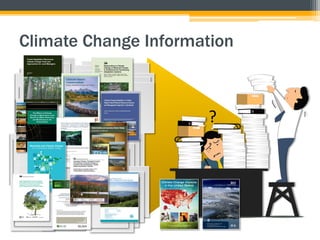
Climate Change Information
?
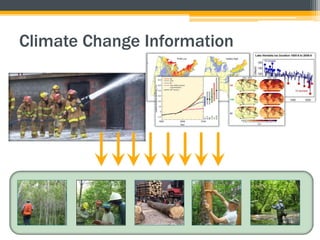
Climate Change Information
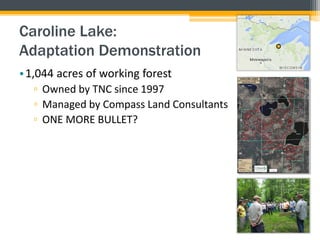
Caroline Lake:
Adaptation Demonstration
•1,044 acres of working forest
▫ Owned by TNC since 1997
▫ Managed by Compass Land Consultants
▫ ONE MORE BULLET?
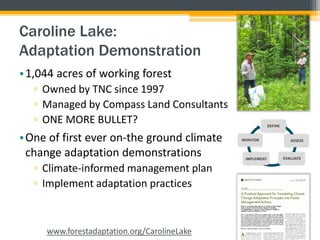
Caroline Lake:
Adaptation Demonstration
•1,044 acres of working forest
▫ Owned by TNC since 1997
▫ Managed by Compass Land Consultants
▫ ONE MORE BULLET?
•One of first ever on-the ground climate
change adaptation demonstrations
▫ Climate-informed management plan
▫ Implement adaptation practices
www.forestadaptation.org/CarolineLake
Leveraging Forest Inventory Data
How can we better use forest inventory data to tell us:
1) Are forests are at risk from climate change?
2) Are management actions reducing risk?
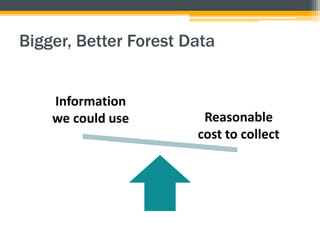
Bigger, Better Forest Data
Information
we could use Reasonable
cost to collect
Rethinking Existing Inventory Metrics
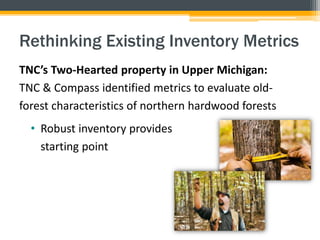
TNC’s Two-Hearted property in Upper Michigan:
TNC & Compass identified metrics to evaluate old-
forest characteristics of northern hardwood forests
• Robust inventory provides
starting point
Rethinking Existing Inventory Metrics
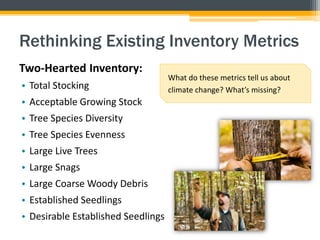
Two-Hearted Inventory:
• Total Stocking
• Acceptable Growing Stock
• Tree Species Diversity
• Tree Species Evenness
• Large Live Trees
• Large Snags
• Large Coarse Woody Debris
• Established Seedlings
• Desirable Established Seedlings
What do these metrics tell us about
climate change? What’s missing?
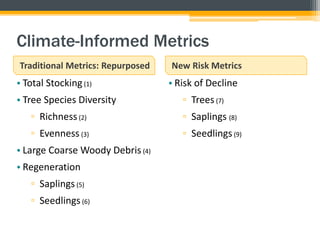
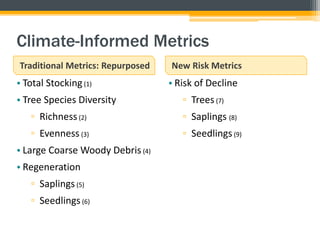
Climate-Informed Metrics
Traditional Metrics: Repurposed New Risk Metrics
• Total Stocking(1)
• Tree Species Diversity
▫ Richness(2)
▫ Evenness (3)
• Large Coarse Woody Debris (4)
• Regeneration
▫ Saplings(5)
▫ Seedlings(6)
• Risk of Decline
▫ Trees (7)
▫ Saplings (8)
▫ Seedlings(9)
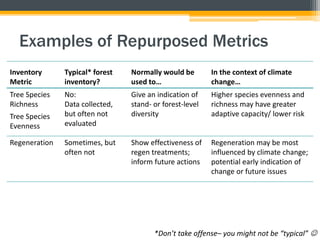
Examples of Repurposed Metrics
Inventory
Metric
Typical* forest
inventory?
Normally would be
used to…
In the context of climate
change…
Tree Species
Richness
Tree Species
Evenness
No:
Data collected,
but often not
evaluated
Give an indication of
stand- or forest-level
diversity
Higher species evenness and
richness may have greater
adaptive capacity/ lower risk
Regeneration Sometimes, but
often not
Show effectiveness of
regen treatments;
inform future actions
Regeneration may be most
influenced by climate change;
potential early indication of
change or future issues
*Don’t take offense– you might not be “typical” 
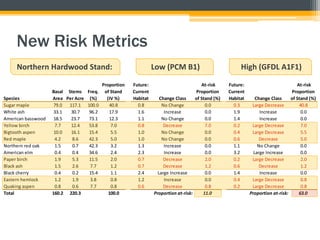
New Risk Metrics
Are the trees in this stand/forest/area at
risk from climate change?
•Integrates Climate Change Tree Atlas projections, which
are part of published vulnerability assessments
•“At risk” species identified for an ecoregion
▫ Suitable habitat reduced >20% by 2100
•IMPORTANT: Metric signals that species is at risk of
decline across a general region, but it is up to manager
to evaluate that information given local knowledge
New Risk Metrics
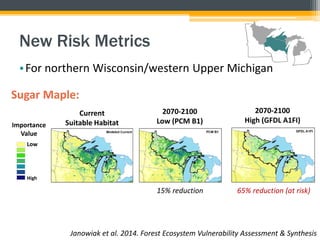
•For northern Wisconsin/western Upper Michigan
Importance
Value
Low
High
2070-2100
Low (PCM B1)
2070-2100
High (GFDL A1FI)
Current
Suitable Habitat
Sugar Maple:
15% reduction 65% reduction (at risk)
Janowiak et al. 2014. Forest Ecosystem Vulnerability Assessment & Synthesis
Species
Basal
Area
Stems
Per Acre
Freq.
(%)
Proportion
of Stand
(IV %)
Future:
Current
Habitat Change Class
At-risk
Proportion
of Stand (%)
Future:
Current
Habitat Change Class
At-risk
Proportion
of Stand (%)
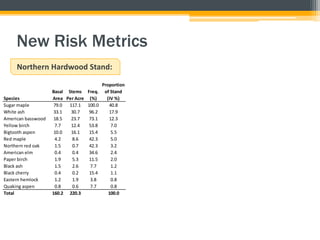
Sugar maple 79.0 117.1 100.0 40.8 0.8 No Change 0.0 0.3 Large Decrease 40.8
White ash 33.1 30.7 96.2 17.9 1.6 Increase 0.0 1.9 Increase 0.0
American basswood 18.5 23.7 73.1 12.3 1.1 No Change 0.0 1.4 Increase 0.0
Yellow birch 7.7 12.4 53.8 7.0 0.8 Decrease 7.0 0.2 Large Decrease 7.0
Bigtooth aspen 10.0 16.1 15.4 5.5 1.0 No Change 0.0 0.4 Large Decrease 5.5
Red maple 4.2 8.6 42.3 5.0 1.0 No Change 0.0 0.6 Decrease 5.0
Northern red oak 1.5 0.7 42.3 3.2 1.3 Increase 0.0 1.1 No Change 0.0
American elm 0.4 0.4 34.6 2.4 2.3 Increase 0.0 3.2 Large Increase 0.0
Paper birch 1.9 5.3 11.5 2.0 0.7 Decrease 2.0 0.2 Large Decrease 2.0
Black ash 1.5 2.6 7.7 1.2 0.7 Decrease 1.2 0.6 Decrease 1.2
Black cherry 0.4 0.2 15.4 1.1 2.4 Large Increase 0.0 1.4 Increase 0.0
Eastern hemlock 1.2 1.9 3.8 0.8 1.2 Increase 0.0 0.4 Large Decrease 0.8
Quaking aspen 0.8 0.6 7.7 0.8 0.6 Decrease 0.8 0.2 Large Decrease 0.8
Total 160.2 220.3 100.0 Proportion at-risk: 11.0 Proportion at-risk: 63.0
New Risk Metrics
Northern Hardwood Stand: Low (PCM B1) High (GFDL A1F1)
Species
Basal
Area
Stems
Per Acre
Freq.
(%)
Proportion
of Stand
(IV %)
Future:
Current
Habitat Change Class
At-risk
Proportion
of Stand (%)
Future:
Current
Habitat Change Class
At-risk
Proportion
of Stand (%)
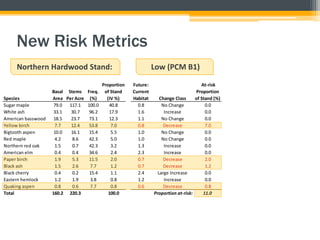
Sugar maple 79.0 117.1 100.0 40.8 0.8 No Change 0.0 0.3 Large Decrease 40.8
White ash 33.1 30.7 96.2 17.9 1.6 Increase 0.0 1.9 Increase 0.0
American basswood 18.5 23.7 73.1 12.3 1.1 No Change 0.0 1.4 Increase 0.0
Yellow birch 7.7 12.4 53.8 7.0 0.8 Decrease 7.0 0.2 Large Decrease 7.0
Bigtooth aspen 10.0 16.1 15.4 5.5 1.0 No Change 0.0 0.4 Large Decrease 5.5
Red maple 4.2 8.6 42.3 5.0 1.0 No Change 0.0 0.6 Decrease 5.0
Northern red oak 1.5 0.7 42.3 3.2 1.3 Increase 0.0 1.1 No Change 0.0
American elm 0.4 0.4 34.6 2.4 2.3 Increase 0.0 3.2 Large Increase 0.0
Paper birch 1.9 5.3 11.5 2.0 0.7 Decrease 2.0 0.2 Large Decrease 2.0
Black ash 1.5 2.6 7.7 1.2 0.7 Decrease 1.2 0.6 Decrease 1.2
Black cherry 0.4 0.2 15.4 1.1 2.4 Large Increase 0.0 1.4 Increase 0.0
Eastern hemlock 1.2 1.9 3.8 0.8 1.2 Increase 0.0 0.4 Large Decrease 0.8
Quaking aspen 0.8 0.6 7.7 0.8 0.6 Decrease 0.8 0.2 Large Decrease 0.8
Total 160.2 220.3 100.0 Proportion at-risk: 11.0 Proportion at-risk: 63.0
New Risk Metrics
Northern Hardwood Stand: Low (PCM B1) High (GFDL A1F1)
Species
Basal
Area
Stems
Per Acre
Freq.
(%)
Proportion
of Stand
(IV %)
Future:
Current
Habitat Change Class
At-risk
Proportion
of Stand (%)
Future:
Current
Habitat Change Class
At-risk
Proportion
of Stand (%)
Sugar maple 79.0 117.1 100.0 40.8 0.8 No Change 0.0 0.3 Large Decrease 40.8
White ash 33.1 30.7 96.2 17.9 1.6 Increase 0.0 1.9 Increase 0.0
American basswood 18.5 23.7 73.1 12.3 1.1 No Change 0.0 1.4 Increase 0.0
Yellow birch 7.7 12.4 53.8 7.0 0.8 Decrease 7.0 0.2 Large Decrease 7.0
Bigtooth aspen 10.0 16.1 15.4 5.5 1.0 No Change 0.0 0.4 Large Decrease 5.5
Red maple 4.2 8.6 42.3 5.0 1.0 No Change 0.0 0.6 Decrease 5.0
Northern red oak 1.5 0.7 42.3 3.2 1.3 Increase 0.0 1.1 No Change 0.0
American elm 0.4 0.4 34.6 2.4 2.3 Increase 0.0 3.2 Large Increase 0.0
Paper birch 1.9 5.3 11.5 2.0 0.7 Decrease 2.0 0.2 Large Decrease 2.0
Black ash 1.5 2.6 7.7 1.2 0.7 Decrease 1.2 0.6 Decrease 1.2
Black cherry 0.4 0.2 15.4 1.1 2.4 Large Increase 0.0 1.4 Increase 0.0
Eastern hemlock 1.2 1.9 3.8 0.8 1.2 Increase 0.0 0.4 Large Decrease 0.8
Quaking aspen 0.8 0.6 7.7 0.8 0.6 Decrease 0.8 0.2 Large Decrease 0.8
Total 160.2 220.3 100.0 Proportion at-risk: 11.0 Proportion at-risk: 63.0
New Risk Metrics
Northern Hardwood Stand: Low (PCM B1) High (GFDL A1F1)
Climate-Informed Metrics
Traditional Metrics: Repurposed New Risk Metrics
• Total Stocking(1)
• Tree Species Diversity
▫ Richness(2)
▫ Evenness (3)
• Large Coarse Woody Debris (4)
• Regeneration
▫ Saplings(5)
▫ Seedlings(6)
• Risk of Decline
▫ Trees (7)
▫ Saplings (8)
▫ Seedlings(9)
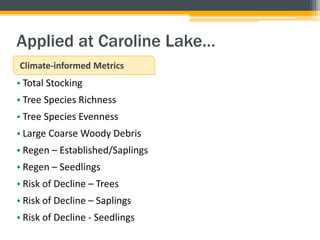
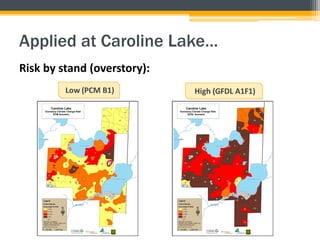
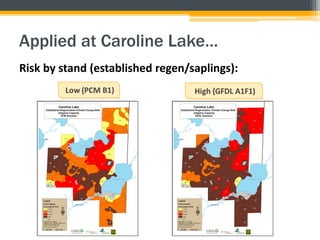
Applied at Caroline Lake…
Climate-informed Metrics
• Total Stocking
• Tree Species Richness
• Tree Species Evenness
• Large Coarse Woody Debris
• Regen – Established/Saplings
• Regen – Seedlings
• Risk of Decline – Trees
• Risk of Decline – Saplings
• Risk of Decline - Seedlings
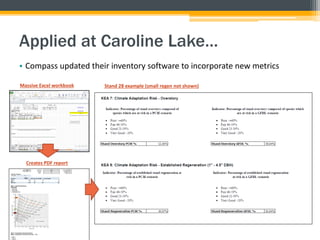
Applied at Caroline Lake…
• Compass updated their inventory software to incorporate new metrics
Stand 28 example (small regen not shown)Massive Excel workbook
Creates PDF report
Applied at Caroline Lake…
Risk by stand (overstory):
Applied at Caroline Lake…
Risk by stand (established regen/saplings):
Applied at Caroline Lake…
Next Steps
Questions?
Acknowledgements:
•List people here…
Extra slides
Intro slide here
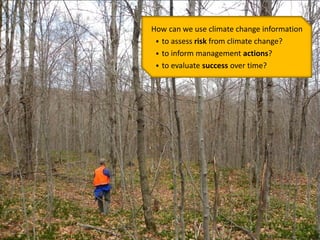
How can we use climate change information
 to assess risk from climate change?
 to inform management actions?
 to evaluate success over time?
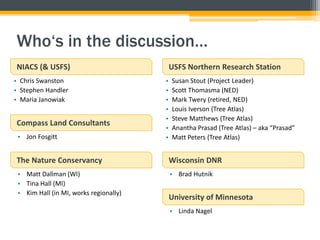
Who‘s in the discussion…
NIACS (& USFS) USFS Northern Research Station
• Chris Swanston
• Stephen Handler
• Maria Janowiak
• Susan Stout (Project Leader)
• Scott Thomasma (NED)
• Mark Twery (retired, NED)
• Louis Iverson (Tree Atlas)
• Steve Matthews (Tree Atlas)
• Anantha Prasad (Tree Atlas) – aka “Prasad”
• Matt Peters (Tree Atlas)
Compass Land Consultants
• Jon Fosgitt
The Nature Conservancy
• Matt Dallman (WI)
• Tina Hall (MI)
• Kim Hall (in MI, works regionally)
Wisconsin DNR
• Brad Hutnik
University of Minnesota
• Linda Nagel
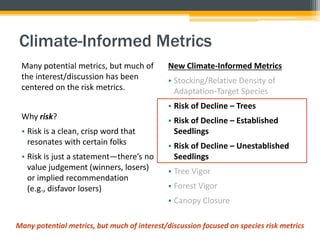
Climate-Informed Metrics
Many potential metrics, but much of
the interest/discussion has been
centered on the risk metrics.
Why risk?
• Risk is a clean, crisp word that
resonates with certain folks
• Risk is just a statement―there’s no
value judgement (winners, losers)
or implied recommendation
(e.g., disfavor losers)
New Climate-Informed Metrics
• Stocking/Relative Density of
Adaptation-Target Species
• Risk of Decline – Trees
• Risk of Decline – Established
Seedlings
• Risk of Decline – Unestablished
Seedlings
• Tree Vigor
• Forest Vigor
• Canopy Closure
Many potential metrics, but much of interest/discussion focused on species risk metrics

Climate-Informed Forest Inventory

  • 1.
    Climate-Informed Forest Inventory JonFosgitt, Compass Land Consultants, jon@compasslandconsultants.com Maria Janowiak, Northern Institute of Applied Climate Science & US Forest Service mjanowiak02@fs.fed.us Louis Iverson, USDA Forest Service; Matt Dallman, Christine Hall, Kimberly Hall, The Nature Conservancy; Chris Swanston, Stephen Handler, Northern Institute of Applied Climate Science & USDA Forest Service
  • 2.
  • 3.
  • 4.
    Caroline Lake: Adaptation Demonstration •1,044acres of working forest ▫ Owned by TNC since 1997 ▫ Managed by Compass Land Consultants ▫ ONE MORE BULLET?
  • 5.
    Caroline Lake: Adaptation Demonstration •1,044acres of working forest ▫ Owned by TNC since 1997 ▫ Managed by Compass Land Consultants ▫ ONE MORE BULLET? •One of first ever on-the ground climate change adaptation demonstrations ▫ Climate-informed management plan ▫ Implement adaptation practices www.forestadaptation.org/CarolineLake
  • 6.
    Leveraging Forest InventoryData How can we better use forest inventory data to tell us: 1) Are forests are at risk from climate change? 2) Are management actions reducing risk?
  • 7.
    Bigger, Better ForestData Information we could use Reasonable cost to collect
  • 8.
    Rethinking Existing InventoryMetrics TNC’s Two-Hearted property in Upper Michigan: TNC & Compass identified metrics to evaluate old- forest characteristics of northern hardwood forests • Robust inventory provides starting point
  • 9.
    Rethinking Existing InventoryMetrics Two-Hearted Inventory: • Total Stocking • Acceptable Growing Stock • Tree Species Diversity • Tree Species Evenness • Large Live Trees • Large Snags • Large Coarse Woody Debris • Established Seedlings • Desirable Established Seedlings What do these metrics tell us about climate change? What’s missing?
  • 10.
    Climate-Informed Metrics Traditional Metrics:Repurposed New Risk Metrics • Total Stocking(1) • Tree Species Diversity ▫ Richness(2) ▫ Evenness (3) • Large Coarse Woody Debris (4) • Regeneration ▫ Saplings(5) ▫ Seedlings(6) • Risk of Decline ▫ Trees (7) ▫ Saplings (8) ▫ Seedlings(9)
  • 11.
    Examples of RepurposedMetrics Inventory Metric Typical* forest inventory? Normally would be used to… In the context of climate change… Tree Species Richness Tree Species Evenness No: Data collected, but often not evaluated Give an indication of stand- or forest-level diversity Higher species evenness and richness may have greater adaptive capacity/ lower risk Regeneration Sometimes, but often not Show effectiveness of regen treatments; inform future actions Regeneration may be most influenced by climate change; potential early indication of change or future issues *Don’t take offense– you might not be “typical” 
  • 12.
    New Risk Metrics Arethe trees in this stand/forest/area at risk from climate change? •Integrates Climate Change Tree Atlas projections, which are part of published vulnerability assessments •“At risk” species identified for an ecoregion ▫ Suitable habitat reduced >20% by 2100 •IMPORTANT: Metric signals that species is at risk of decline across a general region, but it is up to manager to evaluate that information given local knowledge
  • 13.
    New Risk Metrics •Fornorthern Wisconsin/western Upper Michigan Importance Value Low High 2070-2100 Low (PCM B1) 2070-2100 High (GFDL A1FI) Current Suitable Habitat Sugar Maple: 15% reduction 65% reduction (at risk) Janowiak et al. 2014. Forest Ecosystem Vulnerability Assessment & Synthesis
  • 14.
    Species Basal Area Stems Per Acre Freq. (%) Proportion of Stand (IV%) Future: Current Habitat Change Class At-risk Proportion of Stand (%) Future: Current Habitat Change Class At-risk Proportion of Stand (%) Sugar maple 79.0 117.1 100.0 40.8 0.8 No Change 0.0 0.3 Large Decrease 40.8 White ash 33.1 30.7 96.2 17.9 1.6 Increase 0.0 1.9 Increase 0.0 American basswood 18.5 23.7 73.1 12.3 1.1 No Change 0.0 1.4 Increase 0.0 Yellow birch 7.7 12.4 53.8 7.0 0.8 Decrease 7.0 0.2 Large Decrease 7.0 Bigtooth aspen 10.0 16.1 15.4 5.5 1.0 No Change 0.0 0.4 Large Decrease 5.5 Red maple 4.2 8.6 42.3 5.0 1.0 No Change 0.0 0.6 Decrease 5.0 Northern red oak 1.5 0.7 42.3 3.2 1.3 Increase 0.0 1.1 No Change 0.0 American elm 0.4 0.4 34.6 2.4 2.3 Increase 0.0 3.2 Large Increase 0.0 Paper birch 1.9 5.3 11.5 2.0 0.7 Decrease 2.0 0.2 Large Decrease 2.0 Black ash 1.5 2.6 7.7 1.2 0.7 Decrease 1.2 0.6 Decrease 1.2 Black cherry 0.4 0.2 15.4 1.1 2.4 Large Increase 0.0 1.4 Increase 0.0 Eastern hemlock 1.2 1.9 3.8 0.8 1.2 Increase 0.0 0.4 Large Decrease 0.8 Quaking aspen 0.8 0.6 7.7 0.8 0.6 Decrease 0.8 0.2 Large Decrease 0.8 Total 160.2 220.3 100.0 Proportion at-risk: 11.0 Proportion at-risk: 63.0 New Risk Metrics Northern Hardwood Stand: Low (PCM B1) High (GFDL A1F1)
  • 15.
    Species Basal Area Stems Per Acre Freq. (%) Proportion of Stand (IV%) Future: Current Habitat Change Class At-risk Proportion of Stand (%) Future: Current Habitat Change Class At-risk Proportion of Stand (%) Sugar maple 79.0 117.1 100.0 40.8 0.8 No Change 0.0 0.3 Large Decrease 40.8 White ash 33.1 30.7 96.2 17.9 1.6 Increase 0.0 1.9 Increase 0.0 American basswood 18.5 23.7 73.1 12.3 1.1 No Change 0.0 1.4 Increase 0.0 Yellow birch 7.7 12.4 53.8 7.0 0.8 Decrease 7.0 0.2 Large Decrease 7.0 Bigtooth aspen 10.0 16.1 15.4 5.5 1.0 No Change 0.0 0.4 Large Decrease 5.5 Red maple 4.2 8.6 42.3 5.0 1.0 No Change 0.0 0.6 Decrease 5.0 Northern red oak 1.5 0.7 42.3 3.2 1.3 Increase 0.0 1.1 No Change 0.0 American elm 0.4 0.4 34.6 2.4 2.3 Increase 0.0 3.2 Large Increase 0.0 Paper birch 1.9 5.3 11.5 2.0 0.7 Decrease 2.0 0.2 Large Decrease 2.0 Black ash 1.5 2.6 7.7 1.2 0.7 Decrease 1.2 0.6 Decrease 1.2 Black cherry 0.4 0.2 15.4 1.1 2.4 Large Increase 0.0 1.4 Increase 0.0 Eastern hemlock 1.2 1.9 3.8 0.8 1.2 Increase 0.0 0.4 Large Decrease 0.8 Quaking aspen 0.8 0.6 7.7 0.8 0.6 Decrease 0.8 0.2 Large Decrease 0.8 Total 160.2 220.3 100.0 Proportion at-risk: 11.0 Proportion at-risk: 63.0 New Risk Metrics Northern Hardwood Stand: Low (PCM B1) High (GFDL A1F1)
  • 16.
    Species Basal Area Stems Per Acre Freq. (%) Proportion of Stand (IV%) Future: Current Habitat Change Class At-risk Proportion of Stand (%) Future: Current Habitat Change Class At-risk Proportion of Stand (%) Sugar maple 79.0 117.1 100.0 40.8 0.8 No Change 0.0 0.3 Large Decrease 40.8 White ash 33.1 30.7 96.2 17.9 1.6 Increase 0.0 1.9 Increase 0.0 American basswood 18.5 23.7 73.1 12.3 1.1 No Change 0.0 1.4 Increase 0.0 Yellow birch 7.7 12.4 53.8 7.0 0.8 Decrease 7.0 0.2 Large Decrease 7.0 Bigtooth aspen 10.0 16.1 15.4 5.5 1.0 No Change 0.0 0.4 Large Decrease 5.5 Red maple 4.2 8.6 42.3 5.0 1.0 No Change 0.0 0.6 Decrease 5.0 Northern red oak 1.5 0.7 42.3 3.2 1.3 Increase 0.0 1.1 No Change 0.0 American elm 0.4 0.4 34.6 2.4 2.3 Increase 0.0 3.2 Large Increase 0.0 Paper birch 1.9 5.3 11.5 2.0 0.7 Decrease 2.0 0.2 Large Decrease 2.0 Black ash 1.5 2.6 7.7 1.2 0.7 Decrease 1.2 0.6 Decrease 1.2 Black cherry 0.4 0.2 15.4 1.1 2.4 Large Increase 0.0 1.4 Increase 0.0 Eastern hemlock 1.2 1.9 3.8 0.8 1.2 Increase 0.0 0.4 Large Decrease 0.8 Quaking aspen 0.8 0.6 7.7 0.8 0.6 Decrease 0.8 0.2 Large Decrease 0.8 Total 160.2 220.3 100.0 Proportion at-risk: 11.0 Proportion at-risk: 63.0 New Risk Metrics Northern Hardwood Stand: Low (PCM B1) High (GFDL A1F1)
  • 17.
    Climate-Informed Metrics Traditional Metrics:Repurposed New Risk Metrics • Total Stocking(1) • Tree Species Diversity ▫ Richness(2) ▫ Evenness (3) • Large Coarse Woody Debris (4) • Regeneration ▫ Saplings(5) ▫ Seedlings(6) • Risk of Decline ▫ Trees (7) ▫ Saplings (8) ▫ Seedlings(9)
  • 18.
    Applied at CarolineLake… Climate-informed Metrics • Total Stocking • Tree Species Richness • Tree Species Evenness • Large Coarse Woody Debris • Regen – Established/Saplings • Regen – Seedlings • Risk of Decline – Trees • Risk of Decline – Saplings • Risk of Decline - Seedlings
  • 19.
    Applied at CarolineLake… • Compass updated their inventory software to incorporate new metrics Stand 28 example (small regen not shown)Massive Excel workbook Creates PDF report
  • 20.
    Applied at CarolineLake… Risk by stand (overstory):
  • 21.
    Applied at CarolineLake… Risk by stand (established regen/saplings):
  • 22.
  • 23.
  • 24.
  • 25.
  • 26.
    Intro slide here Howcan we use climate change information  to assess risk from climate change?  to inform management actions?  to evaluate success over time?
  • 27.
    Who‘s in thediscussion… NIACS (& USFS) USFS Northern Research Station • Chris Swanston • Stephen Handler • Maria Janowiak • Susan Stout (Project Leader) • Scott Thomasma (NED) • Mark Twery (retired, NED) • Louis Iverson (Tree Atlas) • Steve Matthews (Tree Atlas) • Anantha Prasad (Tree Atlas) – aka “Prasad” • Matt Peters (Tree Atlas) Compass Land Consultants • Jon Fosgitt The Nature Conservancy • Matt Dallman (WI) • Tina Hall (MI) • Kim Hall (in MI, works regionally) Wisconsin DNR • Brad Hutnik University of Minnesota • Linda Nagel
  • 28.
    Climate-Informed Metrics Many potentialmetrics, but much of the interest/discussion has been centered on the risk metrics. Why risk? • Risk is a clean, crisp word that resonates with certain folks • Risk is just a statement―there’s no value judgement (winners, losers) or implied recommendation (e.g., disfavor losers) New Climate-Informed Metrics • Stocking/Relative Density of Adaptation-Target Species • Risk of Decline – Trees • Risk of Decline – Established Seedlings • Risk of Decline – Unestablished Seedlings • Tree Vigor • Forest Vigor • Canopy Closure Many potential metrics, but much of interest/discussion focused on species risk metrics