The Concept Gender
Asocial and cultural construct, which distinguishes differences in
the attributes of men and women, girls and boys, and accordingly
refers to the roles and responsibilities of men and women.
Gender-based roles and other attributes, therefore, change over
time and vary with different cultural contexts. Gender refers to a
social and cultural construct, which distinguishes differences in
the attributes of men and women, girls and boys, and accordingly
refers to the roles and responsibilities of men and women.
Gender-based roles and other attributes, therefore, change over
time and vary with different cultural contexts (UNICEF)
5.
Gender
-socially and culturallyconstructed differences between
men and women, boys and girls, which give them
unequal value, opportunities and life chances. Gender
refers to typically masculine and feminine
characteristics, abilities and expectations about how
women and men should behave in society (Kabeer,2003)
-The concept of gender includes the expectations held
about the characteristics, aptitudes and likely behaviors
of both women and men (femininity and masculinity).
This concept is useful in analyzing how commonly
shared practices legitimize discrepancies between
sexes(Christmann, 2009)
6.
Gender
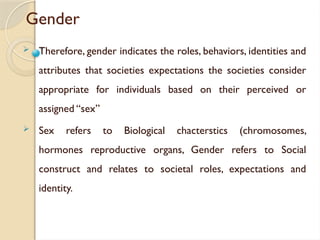
Therefore, genderindicates the roles, behaviors, identities and
attributes that societies expectations the societies consider
appropriate for individuals based on their perceived or
assigned “sex”
Sex refers to Biological chacterstics (chromosomes,
hormones reproductive organs, Gender refers to Social
construct and relates to societal roles, expectations and
identity.
7.
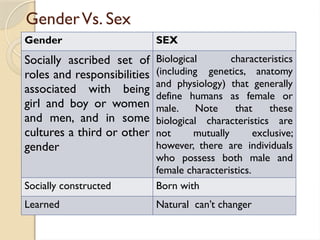
GenderVs. Sex
Gender SEX
Sociallyascribed set of
roles and responsibilities
associated with being
girl and boy or women
and men, and in some
cultures a third or other
gender
Biological characteristics
(including genetics, anatomy
and physiology) that generally
define humans as female or
male. Note that these
biological characteristics are
not mutually exclusive;
however, there are individuals
who possess both male and
female characteristics.
Socially constructed Born with
Learned Natural can’t changer
8.
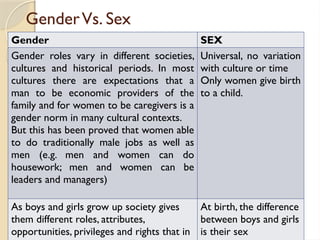
GenderVs. Sex
Gender SEX
Genderroles vary in different societies,
cultures and historical periods. In most
cultures there are expectations that a
man to be economic providers of the
family and for women to be caregivers is a
gender norm in many cultural contexts.
But this has been proved that women able
to do traditionally male jobs as well as
men (e.g. men and women can do
housework; men and women can be
leaders and managers)
Universal, no variation
with culture or time
Only women give birth
to a child.
As boys and girls grow up society gives
them different roles, attributes,
opportunities, privileges and rights that in
At birth, the difference
between boys and girls
is their sex
9.
Gender
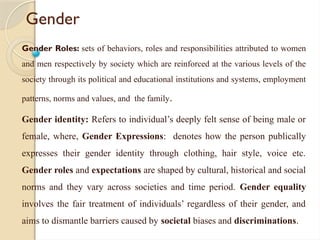
Gender Roles: setsof behaviors, roles and responsibilities attributed to women
and men respectively by society which are reinforced at the various levels of the
society through its political and educational institutions and systems, employment
patterns, norms and values, and the family.
Gender identity: Refers to individual’s deeply felt sense of being male or
female, where, Gender Expressions: denotes how the person publically
expresses their gender identity through clothing, hair style, voice etc.
Gender roles and expectations are shaped by cultural, historical and social
norms and they vary across societies and time period. Gender equality
involves the fair treatment of individuals’ regardless of their gender, and
aims to dismantle barriers caused by societal biases and discriminations.
10.
Gender
Gender Mainstreaming: isa comprehensive approach that involves the
integration of a gender perspective into the preparation, design,
implementation, monitoring and evaluation of policies and programs
with a view to promoting equality between women and men, girls and
boys, and combating discrimination. It is a cornerstone of good
development practice that all development program/ project staff has, a
role to play in facilitating across programs/ projects and activities
11.
Gender Responsive Approach
Consideration of particular needs, priorities, power structures,
status and relationships between men and women are recognized
and adequately addressed in the design, implementation and
evaluation of development projects and activities.
ensuring that women and men are given equal opportunities to
participate in and benefit from an intervention, and promotes
targeted measures to address inequalities and promote the
empowerment of women. It discusses to the process of
understanding and addressing the specific needs, challenges and
experiences of different gender in policies programs and practices
12.
Gender Responsive approach….
Acknowledging the influences of gender norms, roles and
inequalities and aims to create equitable opportunities and outcomes
for all gender
Gender is a critical factor that determines an individual’s role and
status. Because women and men have different roles and utilize the
resources of their environment differently, development and
environmental programs affect women and men differently.
Denotes the process of employing measures that proactively
identifies, understands, and implements interventions to
address gender gaps and overcome historical gender biases in
policies and interventions.
Gender-responsive programs/[projects attempt to re-define
gender roles and relations and contribute proactively and
intentionally to the advancement of gender equality.
13.
Gender Responsive Approach
plans or actions recognizes that women, men, girls and boys
experience life differently due to societal roles and expectations
and accounts for all these differences as they affect access to
resources, opportunities and decision making power
Gender responsive action attempts to reduce gender
disparities by addressing structural barriers,
discriminations and biases that perpetuate gender
inequality, and ensures equal participation and benefit from
development programs, projects, policies, and initiatives.
14.
Gender Actions
Intersectional outlook:Gender responsive actions always takes into
concerns how gender interrelates with other factors such as age, race,
ethnicity, socioeconomic status, disability, and sexual orientations to
create unique challenges
Gender analysis: Gender responsiveness uses gender analysis, to
identify and address gaps in access to education, health care,
employment and other areas. Moreover, ensures that interventions are
informed by the realities of all gender.
Inclusive participation: Gender responsiveness participates
individuals of all genders in the design, implementation and evaluation
of programs to ensures their voices are heard and respected
15.
Why Gender
Promotesocial justice and equality
Enhance the effectiveness and sustainability of
policies and programs
Builds inclusive society where all individuals can
achieve their potential
16.
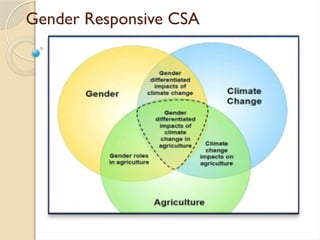
Gender Responsive CSA
Climate-smart agriculture has a significant role to play in reducing the
gender gap in labor burden for women in agriculture that exists in
developing countries where climate risk is high as part of developing a
women-responsive climatic risk management (Khatri-Chhetri et al.,
2020).
Agriculture contributes to GHG emission in direct and indirect ways.
Crop production, which is vital to global food security, is being
affected by climate change all over the world. However, the impact is
being felt more severely in the more impoverished communities (FAO,
2013).
17.
Gender Responsive CSA
an approach that addresses food security and climate
challenges jointly and social justice.
Pillars of CSA
Sustainable increase agricultural productivity and
incomes,
Adapt and build resilience to climate change, and
Reduce and/or remove greenhouse gas emissions where
possible
Ensure Social justice
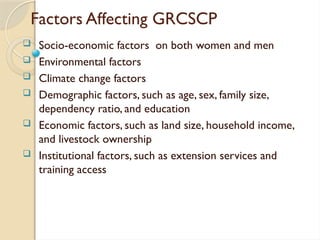
Factors Affecting GRCSCP
Socio-economic factors on both women and men
Environmental factors
Climate change factors
Demographic factors, such as age, sex, family size,
dependency ratio, and education
Economic factors, such as land size, household income,
and livestock ownership
Institutional factors, such as extension services and
training access
20.
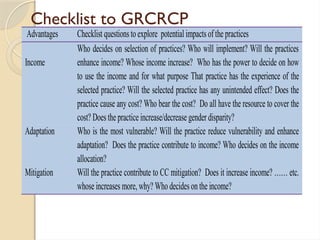
Checklist to GRCRCP
AdvantagesChecklist questions to explore potential impactsof the practices
Income
Who decides on selection of practices? Who will implement? Will the practices
enhance income? Whose income increase? Who has the power to decide on how
to use the income and for what purpose That practice has the experience of the
selected practice? Will the selected practice has any unintended effect? Does the
practice cause any cost? Who bear the cost? Do all have the resource to cover the
cost? Does the practiceincrease/decrease gender disparity?
Adaptation Who is the most vulnerable? Will the practice reduce vulnerability and enhance
adaptation? Does the practice contribute to income? Who decides on the income
allocation?
Mitigation Will the practice contribute to CC mitigation? Does it increase income? …… etc.
whose increases more, why? Who decides on the income?
21.
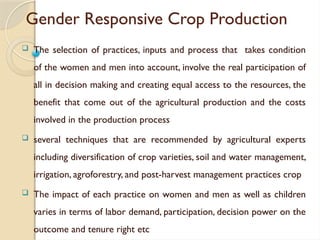
Gender Responsive CropProduction
The selection of practices, inputs and process that takes condition
of the women and men into account, involve the real participation of
all in decision making and creating equal access to the resources, the
benefit that come out of the agricultural production and the costs
involved in the production process
several techniques that are recommended by agricultural experts
including diversification of crop varieties, soil and water management,
irrigation, agroforestry, and post-harvest management practices crop
The impact of each practice on women and men as well as children
varies in terms of labor demand, participation, decision power on the
outcome and tenure right etc
22.
Gender Responsive CSLP
refers to the integration of gender consideration into
livestock management practices that address climate
challenges while promoting sustainable and resilient
livestock system
The approach ensures that both women and men have
equitable opportunities, responsibilities and benefits in
livestock production while mitigating and adapting to
climate change.
Consideration of GRCSLP
o Equity in Access
o Inclusion/ participation
o Workload management
o Capacity Building
23.
Gender Responsive CSLPpractices
Adaptation: Implement livestock systems and breeds
and systems resilient to climate change such as using
heat tolerant breeds or improved pasture management
Mitigation: Gender responsive-climate smart livestock
production encourage practices that reduce GHG
emission such as improved manure management, feed
efficiency and agroforestry practices
Sustainablity: Supporting grazing management, water
conservation and pasture rehabilitation to ensure long-
term productivity.
Enhancing Income the practices support and enhance
farmers’ income
24.
Challenges to GRCSLP
Cultural Norms: traditional roles and stereotypes can
limit women’s involvement in livestock activities
Knowledge gap: limited access to information on
climate policies smart practices livestock for women
Policy Gaps: insufficient integration of gender
considerations in livestock and climate policies
25.
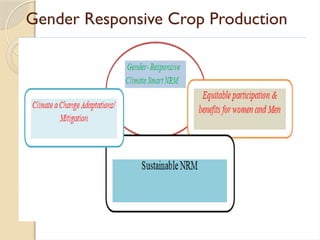
Gender Responsive CSNRM
Focuses on sustainably managing natural resources
( land, water, forests and biodiversity) while addressing
climate change and ensuring equitable participation and
benefits of women and men
Acknowledging, men and women have different roles
knowledge and responsibilities in managing natural
resources and that climate change impacts/affects them
differently
Gender Responsive CropProduction
Why is It for
Emphasis on the social (Gender) and Environmental (NR) and
sustainability dimensions
Account the gender roles, decision making power over the natural
resource and the right to access the resources and Prioritizing long
term resource availability through conservation, afforestation, and
equitable resource allocation.
enhances Understanding on Gender roles
Integrating Climate smart Practices (Adaptation, Mitigation Income
and social Inclusion)
28.
Gender Responsive CSNRM
Benefits:Considerations of
Equitable access and control
Capacity building and inclusiveness
Participation in Decision Making
Gender analysis and inclusion
Empowerment
Knowledge Integration
Help to enhance policy advocacy
29.
Gender Responsiveness inPCM
Gender-responsive planning : enable to identify the different
needs, priorities, and challenges faced by men , women boys, girls
and other marginalized groups of the communities
Gender responsive budgeting :Budgeting is an indicator of
and reflects how resources are allocated to program/projects
themes and activities. in this regard, gender responsive budgeting
helps to improve resource efficiency by prioritizing investments
that reduce gender disparity, such as education, health care and
girls’ and women’s economic empowerment
30.
Gender Responsiveness inPCM
Gender Responsive Implementation : Even with good plan
and budget, gender-responsive implementation must ensure that
program/ project activities are executed in a way that benefits all
genders and other groups
Gender responsive monitoring : enables to track progress
of the program/project and ensure interventions progress in the
intended course to achieve its gender related objectives
provides data to assess whether the program/ project is addressing
gender inequalities and gives the management an opportunity for
adjustment in case discrepancies and disparities are being identified
31.
Gender Responsiveness inPCM
Gender responsive reporting : Helps to highlight
the successes and challenges in addressing gender issues
ensuring that lessons learned can help to make better
decisions that can be applied to improve future projects
and policies
32.
Gender Responsive inPCM
Why considering GR in PCM
Reduce Gender Inequalities
Enhanced Social Inclusion
Improve Effectiveness and sustainability
Alignment with National and International standards





![CLIMATE CHANGE ready .pptx [Autosaved].pptx](https://cdn.slidesharecdn.com/ss_thumbnails/climatechangeready-250328202202-a1b6acf9-thumbnail.jpg?width=640&height=640&fit=bounds)


