
The Risk of
Global Climate Change,
Development Goals,
and Strategies
Presented by:
Tatiana Ivanova
Ashley Jerome
Thien Do
Climate Change Context
• Climate change is a result of global
warming
• Includes:
o Temperature
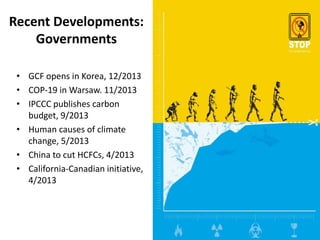
o Humidity
o Rainfall
o Wind
o Storms
• Climate Change is seldom listed among
the stressors that might influence
sustainability.
Climate Change:
How Did We
Get Here?
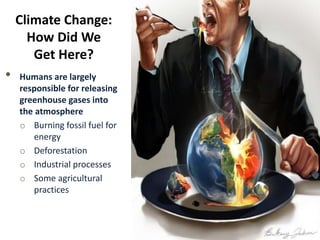
• Humans are largely
responsible for releasing
greenhouse gases into
the atmosphere
o Burning fossil fuel for
energy
o Deforestation
o Industrial processes
o Some agricultural
practices
Climate Change Example:
Asian Air Pollution
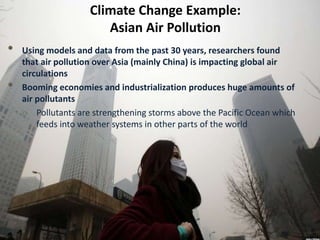
• Using models and data from the past 30 years, researchers found
that air pollution over Asia (mainly China) is impacting global air
circulations
• Booming economies and industrialization produces huge amounts of
air pollutants
o Pollutants are strengthening storms above the Pacific Ocean which
feeds into weather systems in other parts of the world
Climate Change Issues Today:
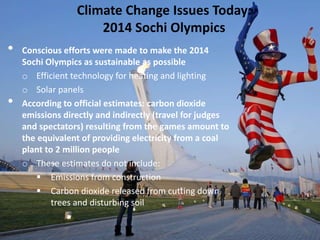
2014 Sochi Olympics
• Conscious efforts were made to make the 2014
Sochi Olympics as sustainable as possible
o Efficient technology for heating and lighting
o Solar panels
• According to official estimates: carbon dioxide
emissions directly and indirectly (travel for judges
and spectators) resulting from the games amount to
the equivalent of providing electricity from a coal
plant to 2 million people
o These estimates do not include:
 Emissions from construction
 Carbon dioxide released from cutting down
trees and disturbing soil
Climate Change
Adaptation Failure:
Chernobyl Nuclear Explosion
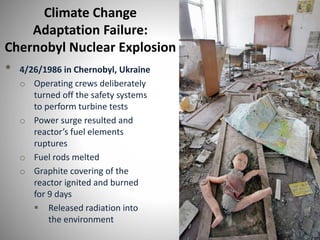
• 4/26/1986 in Chernobyl, Ukraine
o Operating crews deliberately
turned off the safety systems
to perform turbine tests
o Power surge resulted and
reactor’s fuel elements
ruptures
o Fuel rods melted
o Graphite covering of the
reactor ignited and burned
for 9 days
 Released radiation into
the environment
Climate Change
Adaptation Failure:
Chernobyl Nuclear Explosion
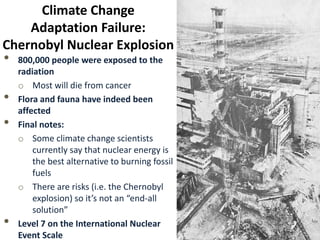
• 800,000 people were exposed to the
radiation
o Most will die from cancer
• Flora and fauna have indeed been
affected
• Final notes:
o Some climate change scientists
currently say that nuclear energy is
the best alternative to burning fossil
fuels
o There are risks (i.e. the Chernobyl
explosion) so it’s not an “end-all
solution”
• Level 7 on the International Nuclear
Event Scale
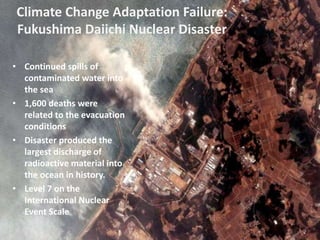
Climate Change Adaptation Failure:
Fukushima Daiichi Nuclear Disaster
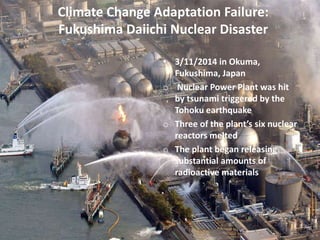
• 3/11/2014 in Okuma,
Fukushima, Japan
o Nuclear Power Plant was hit
by tsunami triggered by the
Tohoku earthquake
o Three of the plant’s six nuclear
reactors melted
o The plant began releasing
substantial amounts of
radioactive materials
Climate Change Adaptation Failure:
Fukushima Daiichi Nuclear Disaster
• Continued spills of
contaminated water into
the sea
• 1,600 deaths were
related to the evacuation
conditions
• Disaster produced the
largest discharge of
radioactive material into
the ocean in history.
• Level 7 on the
International Nuclear
Event Scale
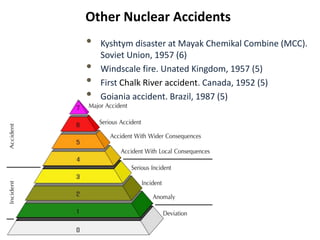
Other Nuclear Accidents
• Kyshtym disaster at Mayak Chemikal Combine (MCC).
Soviet Union, 1957 (6)
• Windscale fire. Unated Kingdom, 1957 (5)
• First Chalk River accident. Canada, 1952 (5)
• Goiania accident. Brazil, 1987 (5)
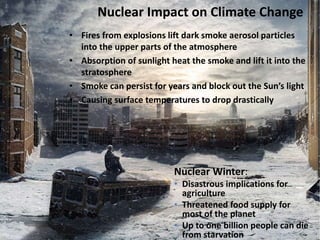
Nuclear Impact on Climate Change
• Fires from explosions lift dark smoke aerosol particles
into the upper parts of the atmosphere
• Absorption of sunlight heat the smoke and lift it into the
stratosphere
• Smoke can persist for years and block out the Sun’s light
• Causing surface temperatures to drop drastically
Nuclear Winter:
• Disastrous implications for
agriculture
• Threatened food supply for
most of the planet
• Up to one billion people can die
from starvation
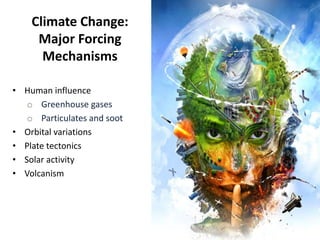
Climate Change:
Major Forcing
Mechanisms
• Human influence
o Greenhouse gases
o Particulates and soot
• Orbital variations
• Plate tectonics
• Solar activity
• Volcanism
Recent Developments:
Governments
• GCF opens in Korea, 12/2013
• COP-19 in Warsaw. 11/2013
• IPCCC publishes carbon
budget, 9/2013
• Human causes of climate
change, 5/2013
• China to cut HCFCs, 4/2013
• California-Canadian initiative,
4/2013
Recent Developments: Businesses
• Climate Counts rated 136 companies in 16
industries based on their "corporate climate
responsibility.“
• Their 22-criteria assessment divides into four sub-
sections, which they define as follows:
o Review: Is the company taking inventory of their greenhouse gas
(GHG) emissions using an industry accepted accounting protocol?
(22 possible points)
o Reduce: Has the company articulated a strategy for reducing GHG
emissions and have they succeeded in achieving actual reductions?
(56 possible points)
o Policy Stance: Does the company explicitly support the need
for comprehensive energy and climate policy or is there evidence
they oppose such measures? (10 possible points)
o Report: Is the company publicly disclosing information about
their sustainability efforts and their progress toward carbon
neutrality? (12 possible points)
Recent Developments:
Big Data
• Emissions Savings
o Moving business applications to the cloud could cut the
associated per-user carbon footprint by 30 percent for
large, already-efficient companies
o As much as 90 percent for the smallest and least
efficient businesses
o Customers of fast-growing cloud computing giant
Salesforce’s services produced 95 percent less carbon,
on average
o The Salesforce community saved an estimated 170,900
tones of carbon in 2010
• Energy Efficiency
o Greenpeace estimate that cloud computing worldwide
demanded 662 TWh of electricity in 2007, more than the power
consumed by India or Germany.
o The cloud has certain advantages over on-site servers as these
must be equipped for peak data usage
• Environmentally Friendly?
Greenest U.S. Companies
Ranked By Newsweek
1. IBM
2. Hewlett-Packard
3. Sprint Nextel
4. Baxter
5. Dell
6. Johnson & Johnson
7. Accenture
8. Office Depot
9. CA Technologies
10. NVIDIA
11. Agilent Technologies
12. Hartford Financials
13. EMC Corporation
14. Adobe
15. Intel Corporation
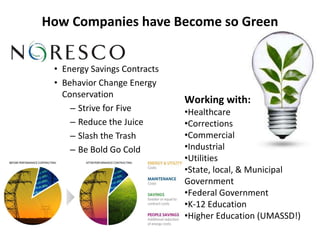
How Companies have Become so Green
• Energy Savings Contracts
• Behavior Change Energy
Conservation
– Strive for Five
– Reduce the Juice
– Slash the Trash
– Be Bold Go Cold
Working with:
•Healthcare
•Corrections
•Commercial
•Industrial
•Utilities
•State, local, & Municipal
Government
•Federal Government
•K-12 Education
•Higher Education (UMASSD!)
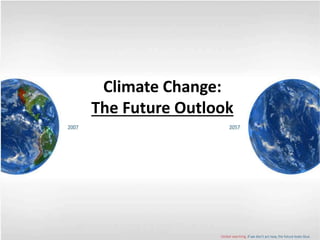
Climate Change:
The Future Outlook
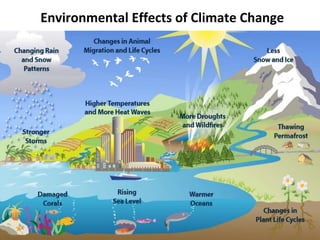
Environmental Effects of Climate Change
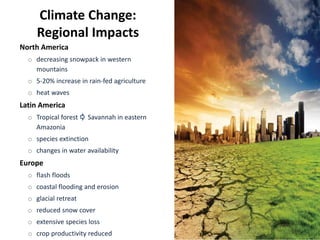
Climate Change:
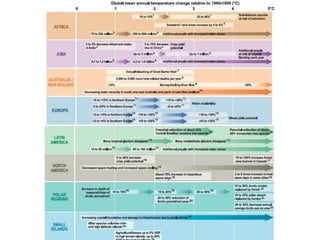
Regional Impacts
North America
o decreasing snowpack in western
mountains
o 5-20% increase in rain-fed agriculture
o heat waves
Latin America
o Tropical forest Savannah in eastern
Amazonia
o species extinction
o changes in water availability
Europe
o flash floods
o coastal flooding and erosion
o glacial retreat
o reduced snow cover
o extensive species loss
o crop productivity reduced
Climate Change:
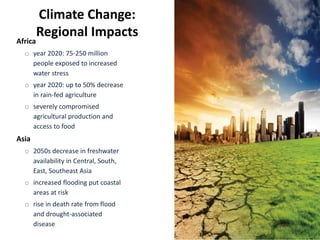
Regional Impacts
Africa
o year 2020: 75-250 million
people exposed to increased
water stress
o year 2020: up to 50% decrease
in rain-fed agriculture
o severely compromised
agricultural production and
access to food
Asia
o 2050s decrease in freshwater
availability in Central, South,
East, Southeast Asia
o increased flooding put coastal
areas at risk
o rise in death rate from flood
and drought-associated
disease
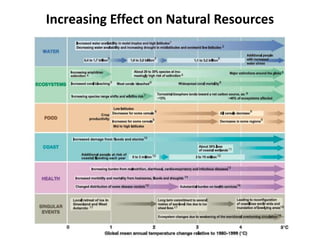
Increasing Effect on Natural Resources
Climate Change:
Goals & Strategies
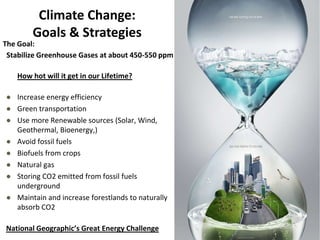
The Goal:
Stabilize Greenhouse Gases at about 450-550 ppm
How hot will it get in our Lifetime?
● Increase energy efficiency
● Green transportation
● Use more Renewable sources (Solar, Wind,
Geothermal, Bioenergy,)
● Avoid fossil fuels
● Biofuels from crops
● Natural gas
● Storing CO2 emitted from fossil fuels
underground
● Maintain and increase forestlands to naturally
absorb CO2
National Geographic’s Great Energy Challenge
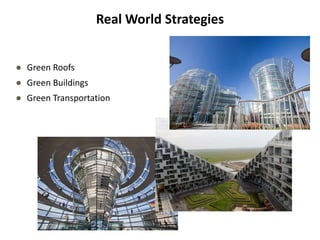
Real World Strategies
● Green Roofs
● Green Buildings
● Green Transportation
Works Cited
http://www.climatehotmap.org/global-warming-solutions/
http://www.environmentabout.com/1502/difference-between-climate-change-global-warming
http://environment.nationalgeographic.com/environment/
http://www.theguardian.com/environment/interactive/2013/sep/27/climate-change-how-hot-lifetime-interactive
http://climate.nasa.gov/index
http://www.epa.gov/climatechange/basics/
http://www.bbc.com/news/science-environment-27027876
http://www.technologyreview.com/news/524391/the-sochi-olympics-arent-as-green-as-advertised/
http://www.greenpeace.org/international/en/campaigns/nuclear/nomorechernobyls/what-happened-in-chernobyl/
http://www.nytimes.com/2013/11/20/business/economy/unavoidable-answer-to-problem-of-climate-change.html
http://www.ipcc-wg2.gov/AR4/website/20.pdf
https://www.youtube.com/watch?feature=player_embedded&v=Bry-Flk2S2c
http://www.noresco.com/index.html
Thank You!
Any Questions?

Climate change presentation

  • 1.
    The Risk of GlobalClimate Change, Development Goals, and Strategies Presented by: Tatiana Ivanova Ashley Jerome Thien Do
  • 2.
    Climate Change Context •Climate change is a result of global warming • Includes: o Temperature o Humidity o Rainfall o Wind o Storms • Climate Change is seldom listed among the stressors that might influence sustainability.
  • 3.
    Climate Change: How DidWe Get Here? • Humans are largely responsible for releasing greenhouse gases into the atmosphere o Burning fossil fuel for energy o Deforestation o Industrial processes o Some agricultural practices
  • 4.
    Climate Change Example: AsianAir Pollution • Using models and data from the past 30 years, researchers found that air pollution over Asia (mainly China) is impacting global air circulations • Booming economies and industrialization produces huge amounts of air pollutants o Pollutants are strengthening storms above the Pacific Ocean which feeds into weather systems in other parts of the world
  • 5.
    Climate Change IssuesToday: 2014 Sochi Olympics • Conscious efforts were made to make the 2014 Sochi Olympics as sustainable as possible o Efficient technology for heating and lighting o Solar panels • According to official estimates: carbon dioxide emissions directly and indirectly (travel for judges and spectators) resulting from the games amount to the equivalent of providing electricity from a coal plant to 2 million people o These estimates do not include:  Emissions from construction  Carbon dioxide released from cutting down trees and disturbing soil
  • 6.
    Climate Change Adaptation Failure: ChernobylNuclear Explosion • 4/26/1986 in Chernobyl, Ukraine o Operating crews deliberately turned off the safety systems to perform turbine tests o Power surge resulted and reactor’s fuel elements ruptures o Fuel rods melted o Graphite covering of the reactor ignited and burned for 9 days  Released radiation into the environment
  • 7.
    Climate Change Adaptation Failure: ChernobylNuclear Explosion • 800,000 people were exposed to the radiation o Most will die from cancer • Flora and fauna have indeed been affected • Final notes: o Some climate change scientists currently say that nuclear energy is the best alternative to burning fossil fuels o There are risks (i.e. the Chernobyl explosion) so it’s not an “end-all solution” • Level 7 on the International Nuclear Event Scale
  • 8.
    Climate Change AdaptationFailure: Fukushima Daiichi Nuclear Disaster • 3/11/2014 in Okuma, Fukushima, Japan o Nuclear Power Plant was hit by tsunami triggered by the Tohoku earthquake o Three of the plant’s six nuclear reactors melted o The plant began releasing substantial amounts of radioactive materials
  • 9.
    Climate Change AdaptationFailure: Fukushima Daiichi Nuclear Disaster • Continued spills of contaminated water into the sea • 1,600 deaths were related to the evacuation conditions • Disaster produced the largest discharge of radioactive material into the ocean in history. • Level 7 on the International Nuclear Event Scale
  • 10.
    Other Nuclear Accidents •Kyshtym disaster at Mayak Chemikal Combine (MCC). Soviet Union, 1957 (6) • Windscale fire. Unated Kingdom, 1957 (5) • First Chalk River accident. Canada, 1952 (5) • Goiania accident. Brazil, 1987 (5)
  • 11.
    Nuclear Impact onClimate Change • Fires from explosions lift dark smoke aerosol particles into the upper parts of the atmosphere • Absorption of sunlight heat the smoke and lift it into the stratosphere • Smoke can persist for years and block out the Sun’s light • Causing surface temperatures to drop drastically Nuclear Winter: • Disastrous implications for agriculture • Threatened food supply for most of the planet • Up to one billion people can die from starvation
  • 12.
    Climate Change: Major Forcing Mechanisms •Human influence o Greenhouse gases o Particulates and soot • Orbital variations • Plate tectonics • Solar activity • Volcanism
  • 13.
    Recent Developments: Governments • GCFopens in Korea, 12/2013 • COP-19 in Warsaw. 11/2013 • IPCCC publishes carbon budget, 9/2013 • Human causes of climate change, 5/2013 • China to cut HCFCs, 4/2013 • California-Canadian initiative, 4/2013
  • 14.
    Recent Developments: Businesses •Climate Counts rated 136 companies in 16 industries based on their "corporate climate responsibility.“ • Their 22-criteria assessment divides into four sub- sections, which they define as follows: o Review: Is the company taking inventory of their greenhouse gas (GHG) emissions using an industry accepted accounting protocol? (22 possible points) o Reduce: Has the company articulated a strategy for reducing GHG emissions and have they succeeded in achieving actual reductions? (56 possible points) o Policy Stance: Does the company explicitly support the need for comprehensive energy and climate policy or is there evidence they oppose such measures? (10 possible points) o Report: Is the company publicly disclosing information about their sustainability efforts and their progress toward carbon neutrality? (12 possible points)
  • 15.
    Recent Developments: Big Data •Emissions Savings o Moving business applications to the cloud could cut the associated per-user carbon footprint by 30 percent for large, already-efficient companies o As much as 90 percent for the smallest and least efficient businesses o Customers of fast-growing cloud computing giant Salesforce’s services produced 95 percent less carbon, on average o The Salesforce community saved an estimated 170,900 tones of carbon in 2010 • Energy Efficiency o Greenpeace estimate that cloud computing worldwide demanded 662 TWh of electricity in 2007, more than the power consumed by India or Germany. o The cloud has certain advantages over on-site servers as these must be equipped for peak data usage • Environmentally Friendly?
  • 16.
    Greenest U.S. Companies RankedBy Newsweek 1. IBM 2. Hewlett-Packard 3. Sprint Nextel 4. Baxter 5. Dell 6. Johnson & Johnson 7. Accenture 8. Office Depot 9. CA Technologies 10. NVIDIA 11. Agilent Technologies 12. Hartford Financials 13. EMC Corporation 14. Adobe 15. Intel Corporation
  • 17.
    How Companies haveBecome so Green • Energy Savings Contracts • Behavior Change Energy Conservation – Strive for Five – Reduce the Juice – Slash the Trash – Be Bold Go Cold Working with: •Healthcare •Corrections •Commercial •Industrial •Utilities •State, local, & Municipal Government •Federal Government •K-12 Education •Higher Education (UMASSD!)
  • 18.
  • 19.
  • 20.
    Climate Change: Regional Impacts NorthAmerica o decreasing snowpack in western mountains o 5-20% increase in rain-fed agriculture o heat waves Latin America o Tropical forest Savannah in eastern Amazonia o species extinction o changes in water availability Europe o flash floods o coastal flooding and erosion o glacial retreat o reduced snow cover o extensive species loss o crop productivity reduced
  • 21.
    Climate Change: Regional Impacts Africa oyear 2020: 75-250 million people exposed to increased water stress o year 2020: up to 50% decrease in rain-fed agriculture o severely compromised agricultural production and access to food Asia o 2050s decrease in freshwater availability in Central, South, East, Southeast Asia o increased flooding put coastal areas at risk o rise in death rate from flood and drought-associated disease
  • 23.
    Increasing Effect onNatural Resources
  • 24.
    Climate Change: Goals &Strategies The Goal: Stabilize Greenhouse Gases at about 450-550 ppm How hot will it get in our Lifetime? ● Increase energy efficiency ● Green transportation ● Use more Renewable sources (Solar, Wind, Geothermal, Bioenergy,) ● Avoid fossil fuels ● Biofuels from crops ● Natural gas ● Storing CO2 emitted from fossil fuels underground ● Maintain and increase forestlands to naturally absorb CO2 National Geographic’s Great Energy Challenge
  • 25.
    Real World Strategies ●Green Roofs ● Green Buildings ● Green Transportation
  • 26.
    Works Cited http://www.climatehotmap.org/global-warming-solutions/ http://www.environmentabout.com/1502/difference-between-climate-change-global-warming http://environment.nationalgeographic.com/environment/ http://www.theguardian.com/environment/interactive/2013/sep/27/climate-change-how-hot-lifetime-interactive http://climate.nasa.gov/index http://www.epa.gov/climatechange/basics/ http://www.bbc.com/news/science-environment-27027876 http://www.technologyreview.com/news/524391/the-sochi-olympics-arent-as-green-as-advertised/ http://www.greenpeace.org/international/en/campaigns/nuclear/nomorechernobyls/what-happened-in-chernobyl/ http://www.nytimes.com/2013/11/20/business/economy/unavoidable-answer-to-problem-of-climate-change.html http://www.ipcc-wg2.gov/AR4/website/20.pdf https://www.youtube.com/watch?feature=player_embedded&v=Bry-Flk2S2c http://www.noresco.com/index.html
  • 27.

Editor's Notes

  • #18 Identiffy cost savings, infrastructure modernization, sustainability and revenue enhancement opportunities. Implements a package of efficiency and technology improvements to be funded by project savings. Guarantee the savings Energy Savings Performance Contracting allows UMass Dartmouth to purchase energy efficiencies with little or no up-front capital, which reduces costs and increases building performance with little risk, all with desirable social, financial, community, and environmental benefits. Performance Contracting is a practical and extremely effective way to finance and install proven energy-efficient technologies and upgrade energy infrastructure.
  • #20 Later this century Sea levels rise 7-23 inches (additional 4-8 due to melting at the poles) Stronger storms Plants and animals out of synch Floods and droughts Wildfires Less fresh water availability Spread of diseases (mosquitoes carrying malaria) Species migrating, becoming extinct Temperature increase 2.5-10°F over the next century Even the smallest changes in temperature can correlate to huge environmental changes *During the last ice age (3,000 feet of ice covered the Northeast United States) average temperatures were only between 5 and 9 degrees cooler than today. *Some areas may be more affected than others. Some areas may even experience benefits, while others suffer. -rise in sea levels -stronger and more frequent hurricanes and other storms -plants and animals out of synch-plants bloom earlier, while pollinating insects not yet active -floods and droughts are more common, and more severe -more frequent wildfires -less availability of fresh water -increase in global temperature -certain diseases may be more commonly spread -ecosystems will change through migrating species or some species becoming extinct
  • #21  North America -decrease snowpack -increase in rain-fed agriculture -increase in frequency, intensity, duration of heat waves in some cities Latin America -some areas of tropical rainforest may turn into savannah -some species extinction -changes in water availability Europe -increase in flash floods -coastal flooding and erosion more common -increase in glacial retreat -reduced snow cover -extensive species loss -reduced crop productivity
  • #22  Africa -increased water stress -decrease in agriculture (so while North America sees an increase in agriculture, Africa will see a decrease) -decrease in access to food Asia -decreased fresh water availability -increase flooding Increase in death rate associated with flood or drought-disease
  • #23 Future generations will be exposed to: Increased water stress Increase in coastal flood victims Increased risk of hunger
  • #25  (currently at 380 ppm) ie. we must reduce by 50-80% -increase energy efficiency-use less energy to get the same or more -use more efficient transportation modes, using low-carbon fuels and lower miles per gallon -renewable sources ie. solar, wind, geothermal, bioenergy, much more cost effective, reduce pollution, and also create jobs -reduce or eliminate using fossil fuels -deforestation counters global warming as emissions that could be absorbed by trees are unable to since forests are being destroyed Great Energy Challenge-Calculate your energy use, with tips on how to improve your energy consumption
  • #26 Green roof-deflect harsh rays, keep grounds cool Images Top-United Kingdom Northumbria University City Campus East section-houses 9,000 students (33,000 total students-that’s 27%) 2011-Low Carbon New Build Project of the Year middle-sustainable government buildings in Berlin-uses glass and mirrors to reflect daylight, also collect rainwater via the central funnel, dome ceiling draws out warm air, makes its own electricity from refined vegetable oil, and stores excess heat underground—this building has a 94% reduction in CO2 emissions bottom-sustainable housing in Denmark-includes 500 apartments, and has access to commercial district-residents don’t need to burn fossil fuels for travel, capture maximum daylight, includes a green roof