John P. Holdren
Assistant to the President for Science and Technology
Director, White House Office of Science and Technology Policy
Co-Chair, President’s Council of Advisors on Science & Technology
Remarks Launching a Conversation With the
Packard Foundation Board of Trustees
Los Altos • June 19, 2014
Philanthropy for the
Climate-Change Challenge
The essence of the challenge
A vast scientific literature makes clear that…
• Earth’s climate is changing in ways inconsistent
with natural variability and forcings.
• The principal cause is the buildup of atmospheric
CO2 and other heat-trapping substances emitted
mainly by fossil-fuel use and land-use change.
• Harmful impacts are already being experienced
around the world and across the United States.
• The impacts will continue to grow unless and until
the offending emissions are drastically reduced.
The essence of the challenge
There are only three options:
• Mitigation, i.e., taking action to reduce the pace
and magnitude of the changes in global climate
being caused by human activities.
• Adaptation, i.e., taking action measures to reduce
the adverse impacts on human well-being resulting
from the changes in climate that do occur.
• Suffering and societal disruption from the adverse
impacts that are not avoided by either mitigation or
adaptation.
Concerning the three options…
• We’re already doing some of each.
• What’s in question is the future mix.
• Minimizing the amount of suffering will require a
lot of mitigation and a lot of adaptation.
– Mitigation alone won’t work because climate change is
already occurring & can’t be stopped quickly.
– Adaptation alone won’t work because adaptation gets
costlier & less effective as climate change grows.
– We need enough mitigation to avoid the unmanage-
able, enough adaptation to manage the unavoidable.
• Mitigation must be global, adaptation mostly local.
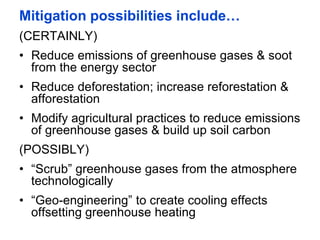
Mitigation possibilities include…
(CERTAINLY)
• Reduce emissions of greenhouse gases & soot
from the energy sector
• Reduce deforestation; increase reforestation &
afforestation
• Modify agricultural practices to reduce emissions
of greenhouse gases & build up soil carbon
(POSSIBLY)
• “Scrub” greenhouse gases from the atmosphere
technologically
• “Geo-engineering” to create cooling effects
offsetting greenhouse heating
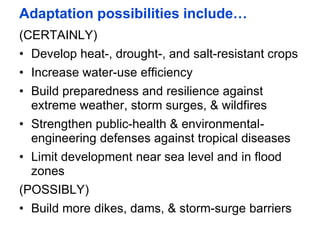
Adaptation possibilities include…
(CERTAINLY)
• Develop heat-, drought-, and salt-resistant crops
• Increase water-use efficiency
• Build preparedness and resilience against
extreme weather, storm surges, & wildfires
• Strengthen public-health & environmental-
engineering defenses against tropical diseases
• Limit development near sea level and in flood
zones
(POSSIBLY)
• Build more dikes, dams, & storm-surge barriers
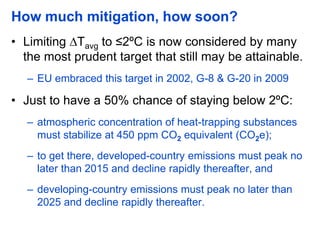
How much mitigation, how soon?
• Limiting ∆Tavg to ≤2ºC is now considered by many
the most prudent target that still may be attainable.
– EU embraced this target in 2002, G-8 & G-20 in 2009
• Just to have a 50% chance of staying below 2ºC:
– atmospheric concentration of heat-trapping substances
must stabilize at 450 ppm CO2 equivalent (CO2e);
– to get there, developed-country emissions must peak no
later than 2015 and decline rapidly thereafter, and
– developing-country emissions must peak no later than
2025 and decline rapidly thereafter.
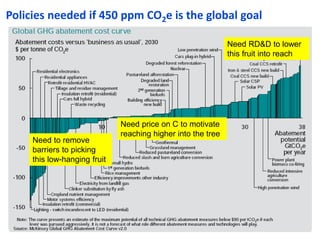
Mitigation supply curve for 2030: aiming for 450 ppm CO2e
Height of bars indicates cost of
measure; width indicates annual
avoided CO2e emissions by 2030.
Policies needed if 450 ppm CO2e is the global goal
Need to remove
barriers to picking
this low-hanging fruit
Need price on C to motivate
reaching higher into the tree
Need RD&D to lower
this fruit into reach
The President’s Climate Action Plan (June 2013)
• Cutting carbon pollution in America
cutting CO2 from power plants; promoting renewable energy &
other cleaner energy options; increasing fuel-economy standards;
cutting energy waste in buildings & industry; reducing emissions of
HFCs and methane; managing forests for C sequestration
• Preparing the USA for the impacts of climate change
directing agencies to support climate-resilient investment;
establishing task force of state, local, & tribal leaders on climate
preparedness; managing flood, drought, & wildfire risks;
mobilizing science & data for climate resilience/preparedness
• Leading international efforts on global climate change
enhancing bilateral & multilateral engagement on mitigation &
adaptation; mobilizing clean-energy & preparedness finance
The niche for philanthropic funding
Criteria
• High potential impact
• Plausible path to success
• Inadequate funding by gov’t and others
• $10-100M/yr can make a dent
• Possible leverage through partnerships
• Availability of relevant talent & leadership
• Symbioses with other Foundation programs
The niche for philanthropic funding (continued)
Some candidate foci
• Adaptation: tools, training, best practices
• Mitigation+adaptation: smart cities, natural capital
• Underpinnings of policy: social cost of carbon
• Motivating the public: climate communication
• Environmental monitoring: innovative approaches
• International: building capacity, measuring
effectiveness, scaling success
• Ocean science: ecosystem impacts of combined
stresses—acidification, warming, dead zones…
The niche for philanthropic funding (concluded)
Modes of foundation engagement
• Prizes for individuals, teams, and organizations
• Project grants to same
• Pass-through support to trusted intermediaries
• Institutional support to effective actors
• Program-related investments
• Program-inspired portfolio management
http://www.ostp.gov

Philanthropy for the Climate-Change Challenge with John P. Holdren

  • 1.
    John P. Holdren Assistantto the President for Science and Technology Director, White House Office of Science and Technology Policy Co-Chair, President’s Council of Advisors on Science & Technology Remarks Launching a Conversation With the Packard Foundation Board of Trustees Los Altos • June 19, 2014 Philanthropy for the Climate-Change Challenge
  • 2.
    The essence ofthe challenge A vast scientific literature makes clear that… • Earth’s climate is changing in ways inconsistent with natural variability and forcings. • The principal cause is the buildup of atmospheric CO2 and other heat-trapping substances emitted mainly by fossil-fuel use and land-use change. • Harmful impacts are already being experienced around the world and across the United States. • The impacts will continue to grow unless and until the offending emissions are drastically reduced.
  • 3.
    The essence ofthe challenge There are only three options: • Mitigation, i.e., taking action to reduce the pace and magnitude of the changes in global climate being caused by human activities. • Adaptation, i.e., taking action measures to reduce the adverse impacts on human well-being resulting from the changes in climate that do occur. • Suffering and societal disruption from the adverse impacts that are not avoided by either mitigation or adaptation.
  • 4.
    Concerning the threeoptions… • We’re already doing some of each. • What’s in question is the future mix. • Minimizing the amount of suffering will require a lot of mitigation and a lot of adaptation. – Mitigation alone won’t work because climate change is already occurring & can’t be stopped quickly. – Adaptation alone won’t work because adaptation gets costlier & less effective as climate change grows. – We need enough mitigation to avoid the unmanage- able, enough adaptation to manage the unavoidable. • Mitigation must be global, adaptation mostly local.
  • 5.
    Mitigation possibilities include… (CERTAINLY) •Reduce emissions of greenhouse gases & soot from the energy sector • Reduce deforestation; increase reforestation & afforestation • Modify agricultural practices to reduce emissions of greenhouse gases & build up soil carbon (POSSIBLY) • “Scrub” greenhouse gases from the atmosphere technologically • “Geo-engineering” to create cooling effects offsetting greenhouse heating
  • 6.
    Adaptation possibilities include… (CERTAINLY) •Develop heat-, drought-, and salt-resistant crops • Increase water-use efficiency • Build preparedness and resilience against extreme weather, storm surges, & wildfires • Strengthen public-health & environmental- engineering defenses against tropical diseases • Limit development near sea level and in flood zones (POSSIBLY) • Build more dikes, dams, & storm-surge barriers
  • 7.
    How much mitigation,how soon? • Limiting ∆Tavg to ≤2ºC is now considered by many the most prudent target that still may be attainable. – EU embraced this target in 2002, G-8 & G-20 in 2009 • Just to have a 50% chance of staying below 2ºC: – atmospheric concentration of heat-trapping substances must stabilize at 450 ppm CO2 equivalent (CO2e); – to get there, developed-country emissions must peak no later than 2015 and decline rapidly thereafter, and – developing-country emissions must peak no later than 2025 and decline rapidly thereafter.
  • 8.
    Mitigation supply curvefor 2030: aiming for 450 ppm CO2e Height of bars indicates cost of measure; width indicates annual avoided CO2e emissions by 2030.
  • 9.
    Policies needed if450 ppm CO2e is the global goal Need to remove barriers to picking this low-hanging fruit Need price on C to motivate reaching higher into the tree Need RD&D to lower this fruit into reach
  • 10.
    The President’s ClimateAction Plan (June 2013) • Cutting carbon pollution in America cutting CO2 from power plants; promoting renewable energy & other cleaner energy options; increasing fuel-economy standards; cutting energy waste in buildings & industry; reducing emissions of HFCs and methane; managing forests for C sequestration • Preparing the USA for the impacts of climate change directing agencies to support climate-resilient investment; establishing task force of state, local, & tribal leaders on climate preparedness; managing flood, drought, & wildfire risks; mobilizing science & data for climate resilience/preparedness • Leading international efforts on global climate change enhancing bilateral & multilateral engagement on mitigation & adaptation; mobilizing clean-energy & preparedness finance
  • 11.
    The niche forphilanthropic funding Criteria • High potential impact • Plausible path to success • Inadequate funding by gov’t and others • $10-100M/yr can make a dent • Possible leverage through partnerships • Availability of relevant talent & leadership • Symbioses with other Foundation programs
  • 12.
    The niche forphilanthropic funding (continued) Some candidate foci • Adaptation: tools, training, best practices • Mitigation+adaptation: smart cities, natural capital • Underpinnings of policy: social cost of carbon • Motivating the public: climate communication • Environmental monitoring: innovative approaches • International: building capacity, measuring effectiveness, scaling success • Ocean science: ecosystem impacts of combined stresses—acidification, warming, dead zones…
  • 13.
    The niche forphilanthropic funding (concluded) Modes of foundation engagement • Prizes for individuals, teams, and organizations • Project grants to same • Pass-through support to trusted intermediaries • Institutional support to effective actors • Program-related investments • Program-inspired portfolio management
  • 14.