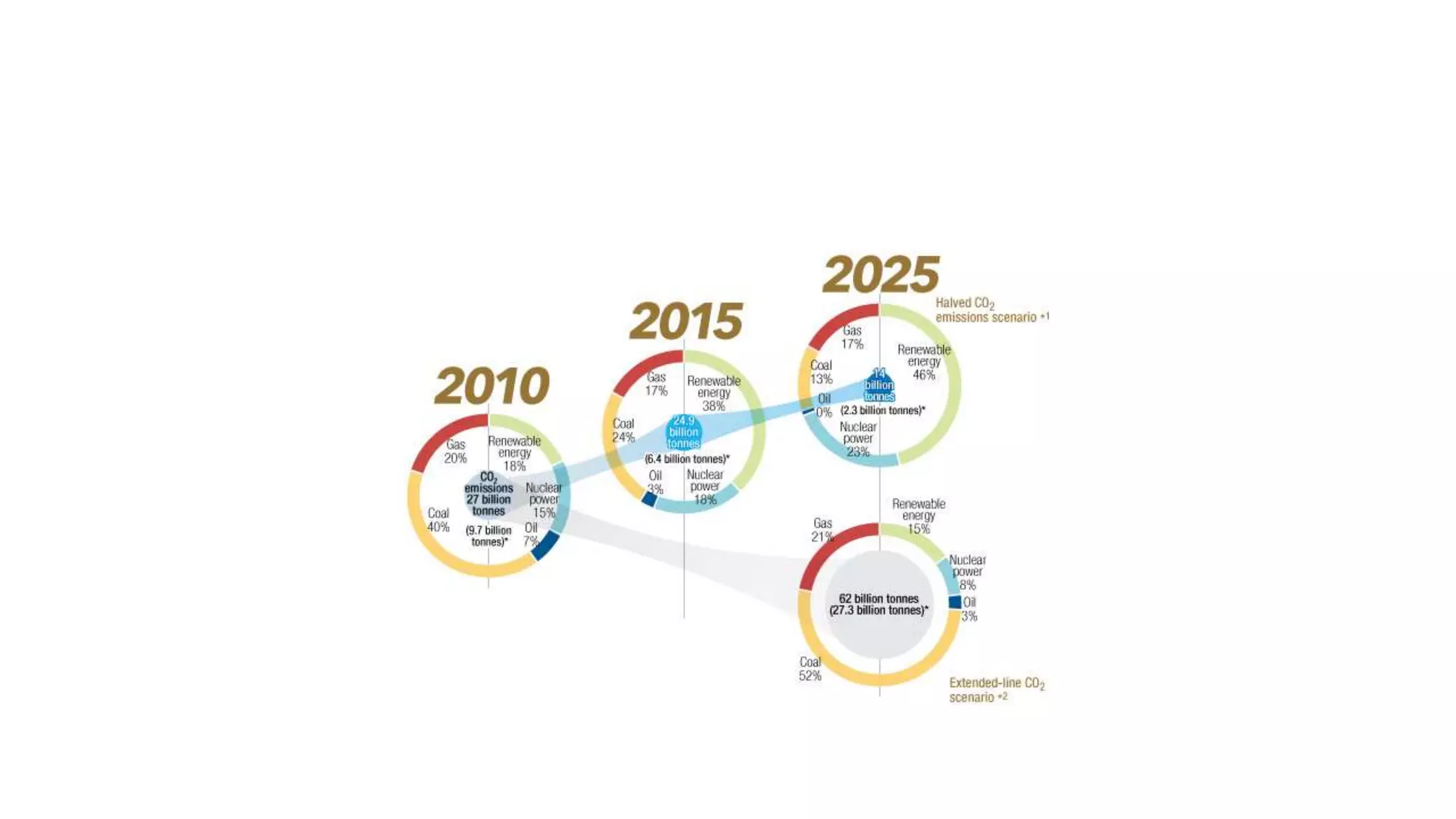
Global
Warming
Global Warming
Prepared by Kiersten Lippmann 2017
Start with a
song: Climate
change songs
• https://www.youtube.com/w
atch?v=HHP9Rh-ooh0
(Symphony of Science)
• Al Gore Sings Grease Summer
Nights about Global Warming
• Waiting on the World to
Change
More suggestions?
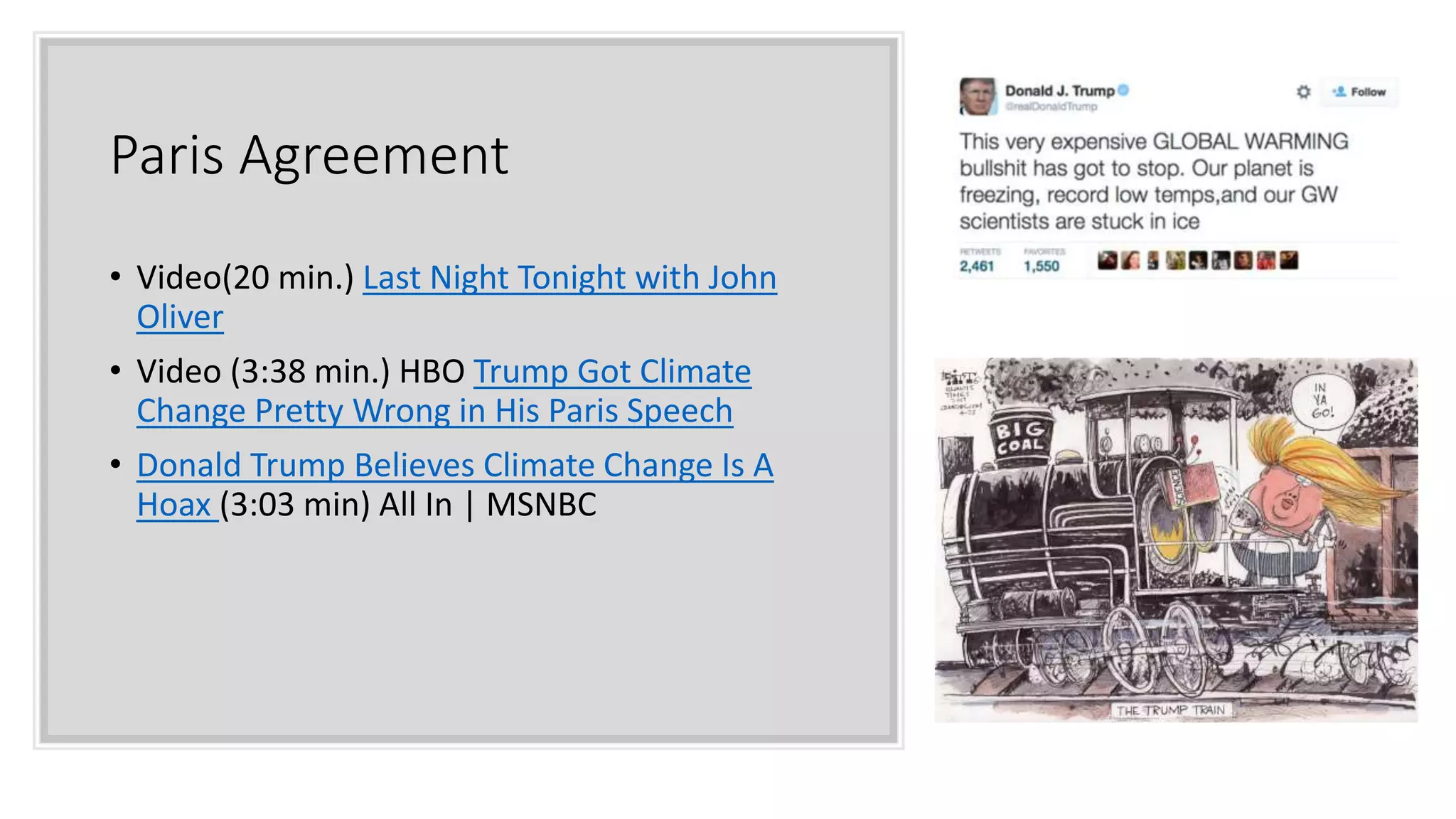
Paris Agreement
• Video(20 min.) Last Night Tonight with John
Oliver
• Video (3:38 min.) HBO Trump Got Climate
Change Pretty Wrong in His Paris Speech
• Donald Trump Believes Climate Change Is A
Hoax (3:03 min) All In | MSNBC
Yes the climate has always
changed… but
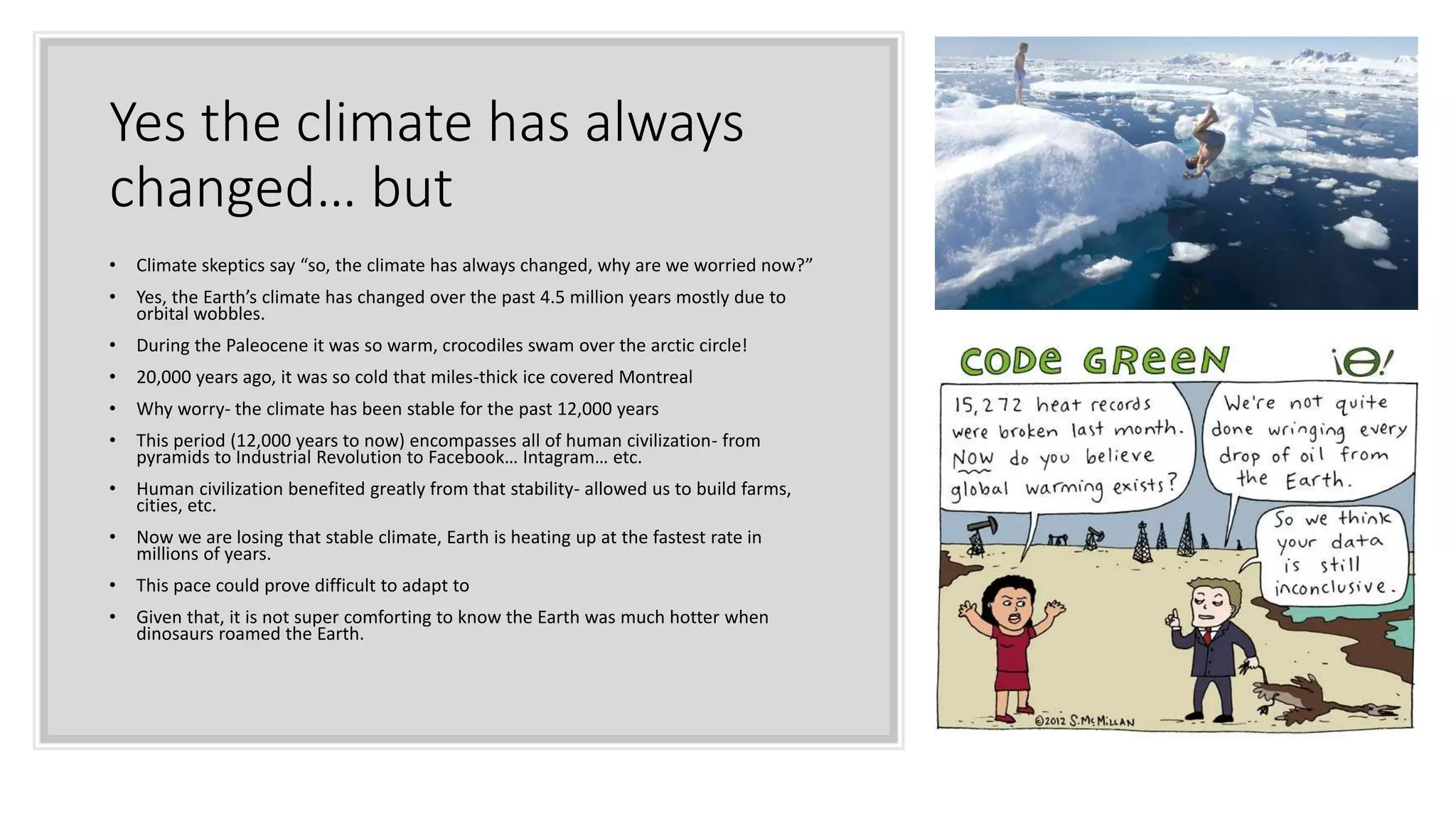
• Climate skeptics say “so, the climate has always changed, why are we worried now?”
• Yes, the Earth’s climate has changed over the past 4.5 million years mostly due to
orbital wobbles.
• During the Paleocene it was so warm, crocodiles swam over the arctic circle!
• 20,000 years ago, it was so cold that miles-thick ice covered Montreal
• Why worry- the climate has been stable for the past 12,000 years
• This period (12,000 years to now) encompasses all of human civilization- from
pyramids to Industrial Revolution to Facebook… Intagram… etc.
• Human civilization benefited greatly from that stability- allowed us to build farms,
cities, etc.
• Now we are losing that stable climate, Earth is heating up at the fastest rate in
millions of years.
• This pace could prove difficult to adapt to
• Given that, it is not super comforting to know the Earth was much hotter when
dinosaurs roamed the Earth.
Rate of Climate Change- a history
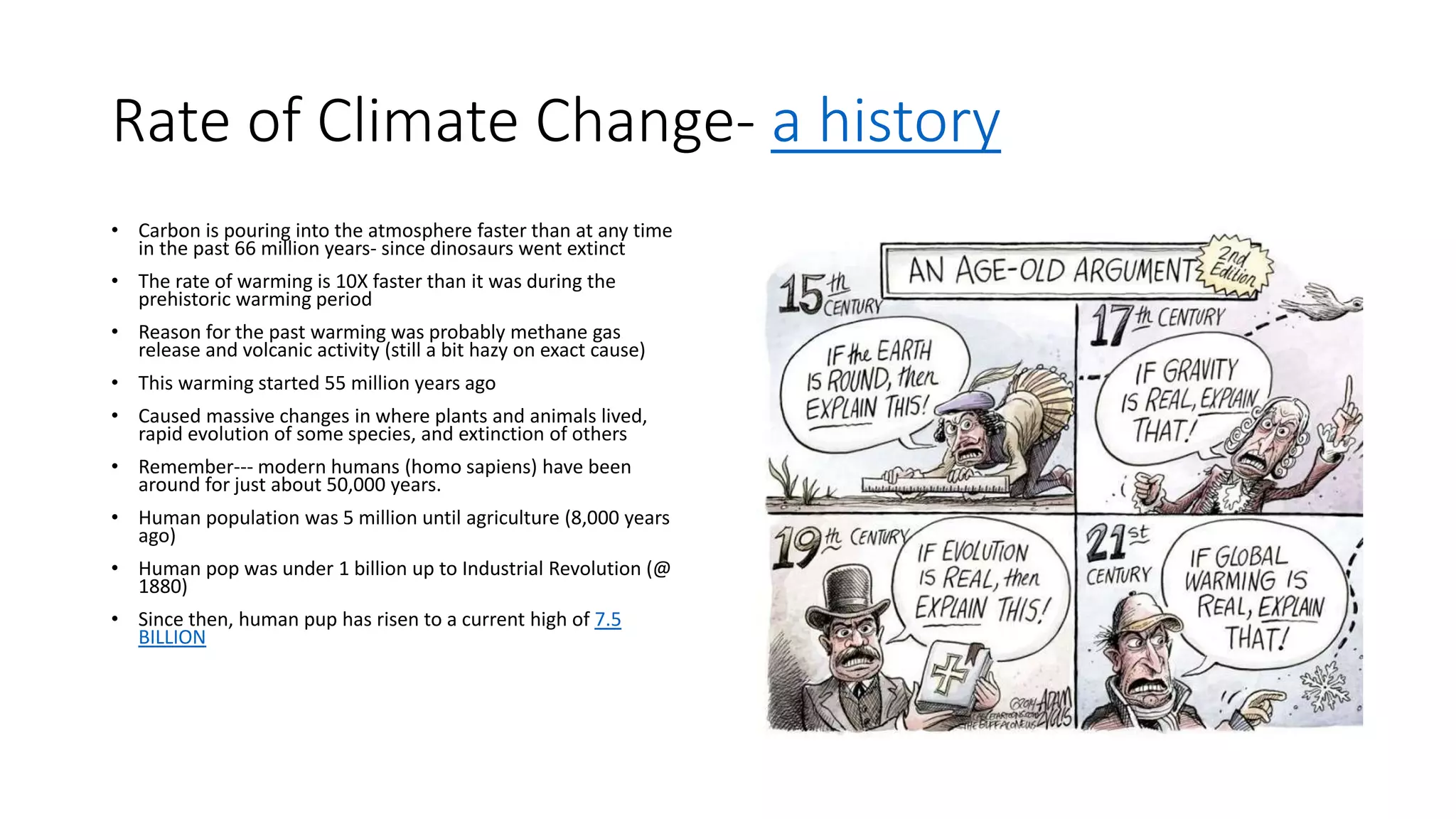
• Carbon is pouring into the atmosphere faster than at any time
in the past 66 million years- since dinosaurs went extinct
• The rate of warming is 10X faster than it was during the
prehistoric warming period
• Reason for the past warming was probably methane gas
release and volcanic activity (still a bit hazy on exact cause)
• This warming started 55 million years ago
• Caused massive changes in where plants and animals lived,
rapid evolution of some species, and extinction of others
• Remember--- modern humans (homo sapiens) have been
around for just about 50,000 years.
• Human population was 5 million until agriculture (8,000 years
ago)
• Human pop was under 1 billion up to Industrial Revolution (@
1880)
• Since then, human pup has risen to a current high of 7.5
BILLION
Rising Seas and Alaska Village relocation
• https://www.youtube.com/watc
h?v=u7i9LBeZ1UU
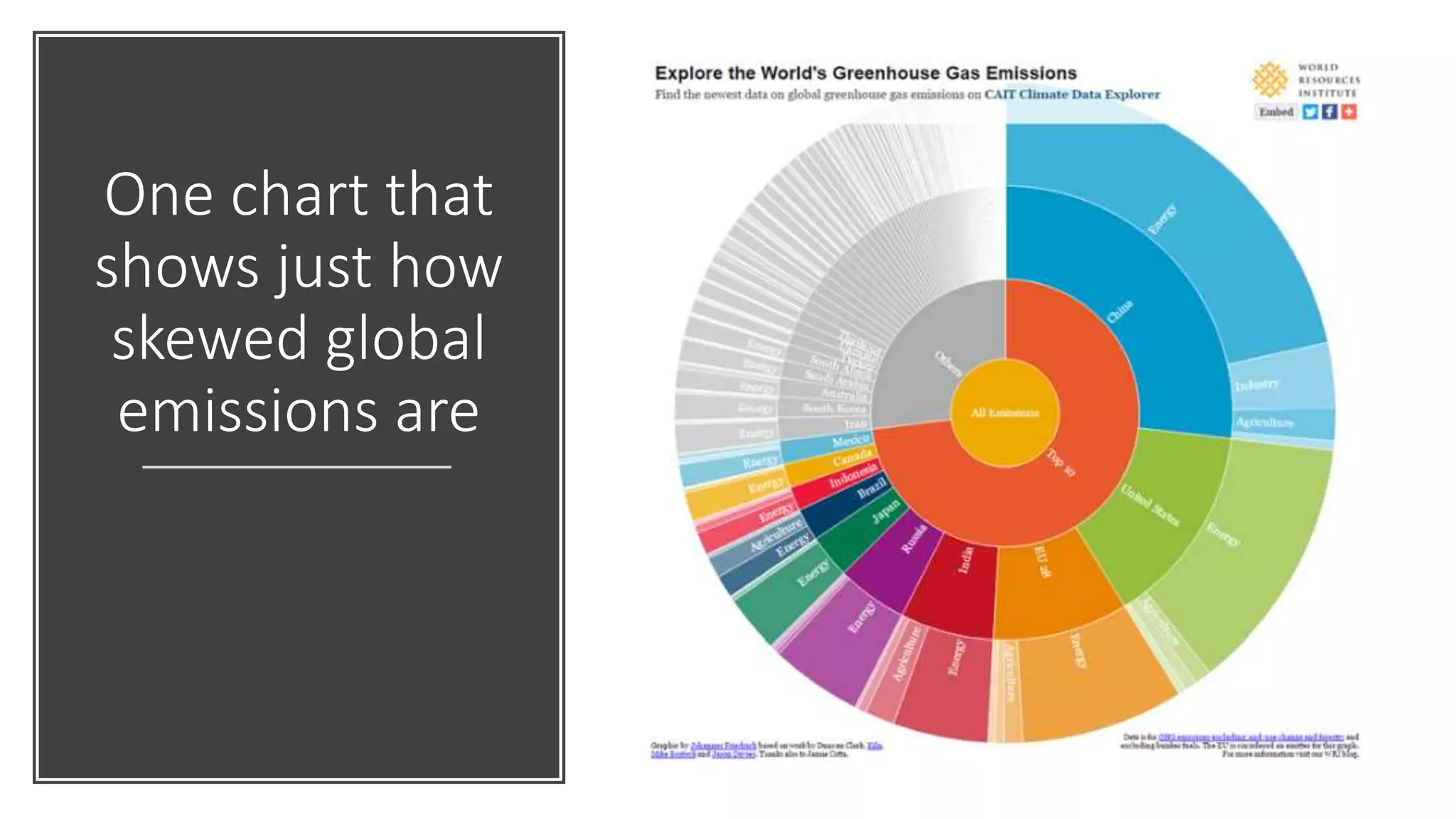
One chart that
shows just how
skewed global
emissions are
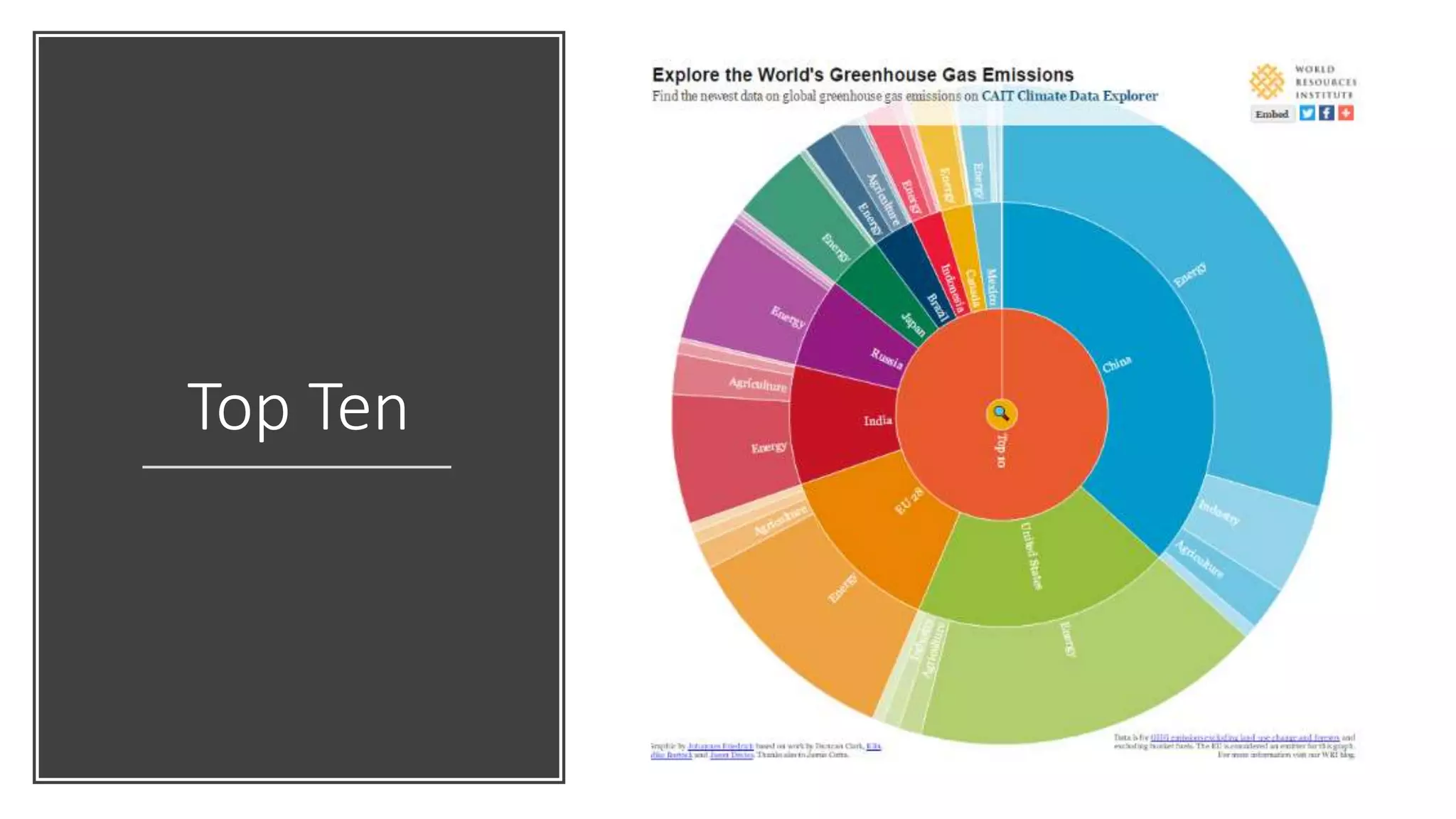
Top Ten
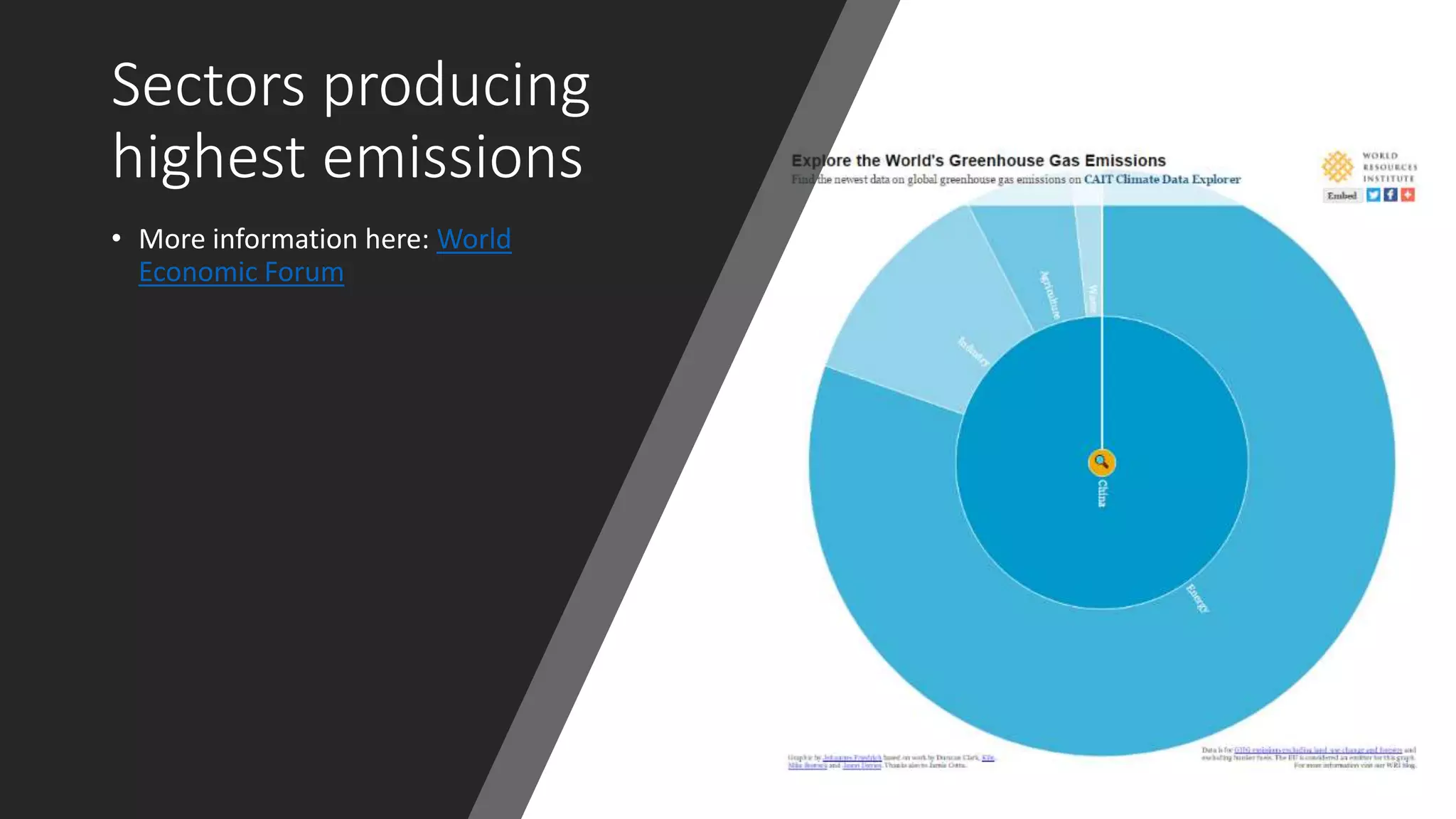
Sectors producing
highest emissions
• More information here: World
Economic Forum
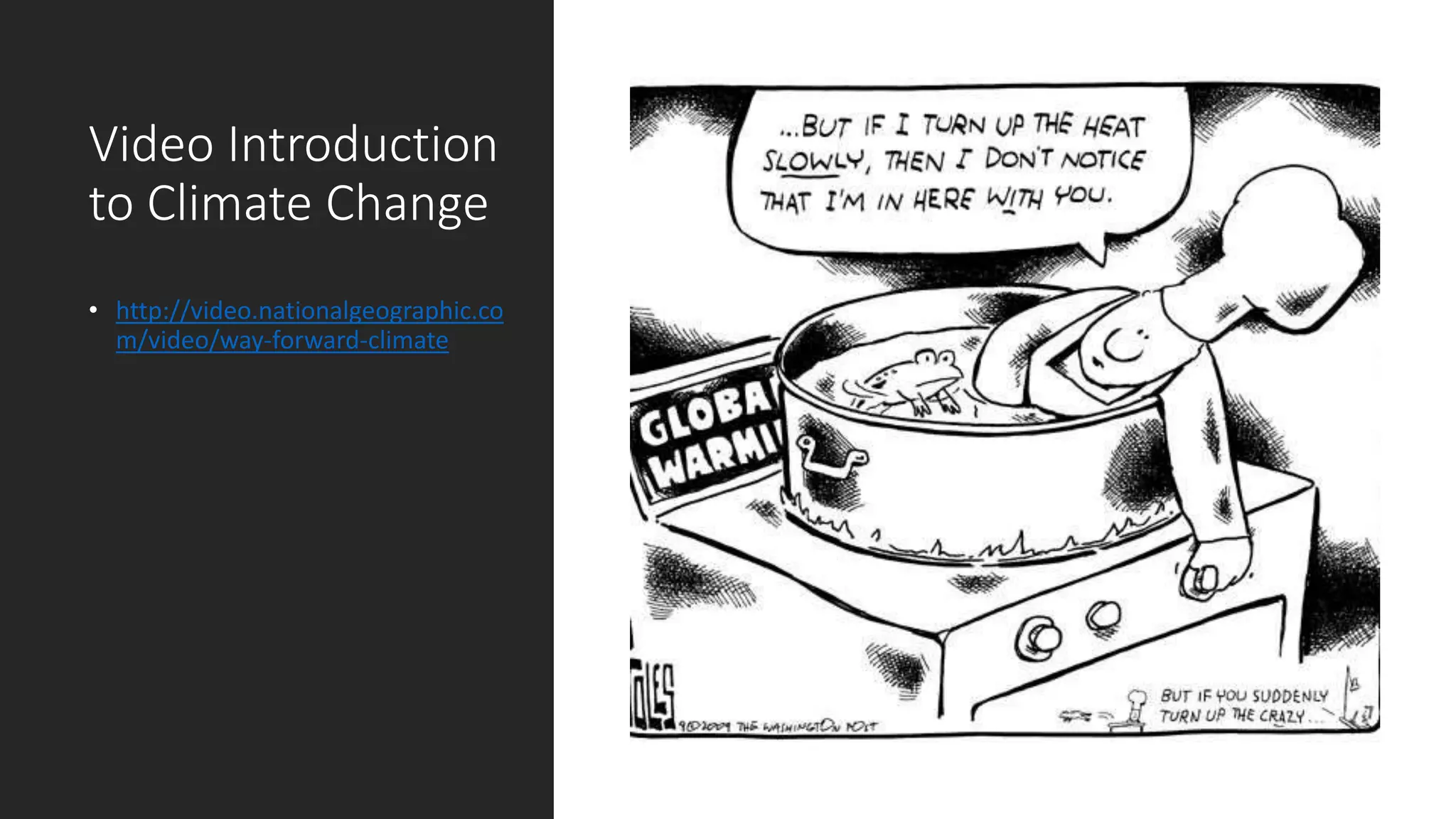
Video Introduction
to Climate Change
• http://video.nationalgeographic.co
m/video/way-forward-climate
What is climate
change? And why
not call it global
warming?
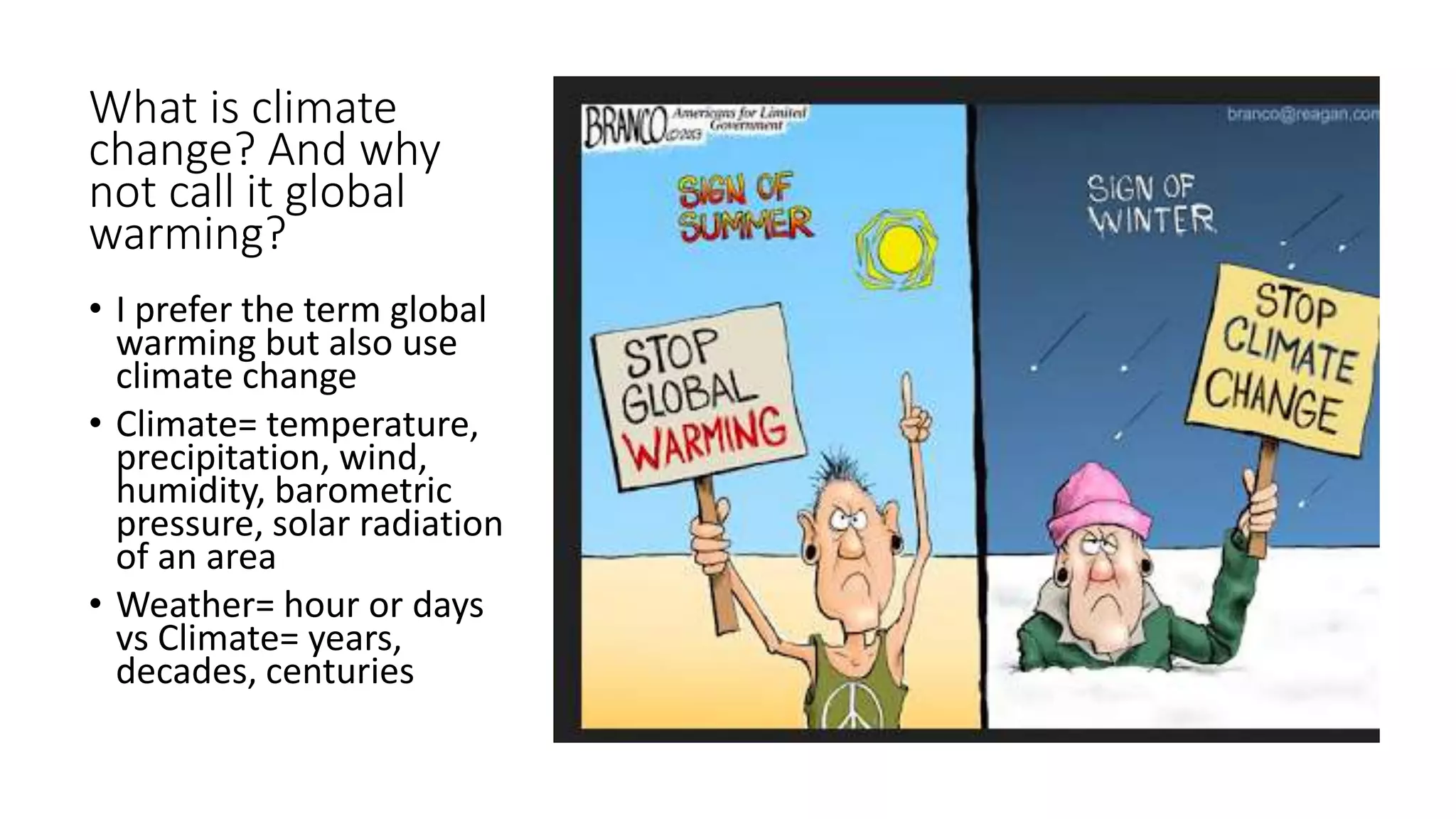
• I prefer the term global
warming but also use
climate change
• Climate= temperature,
precipitation, wind,
humidity, barometric
pressure, solar radiation
of an area
• Weather= hour or days
vs Climate= years,
decades, centuries
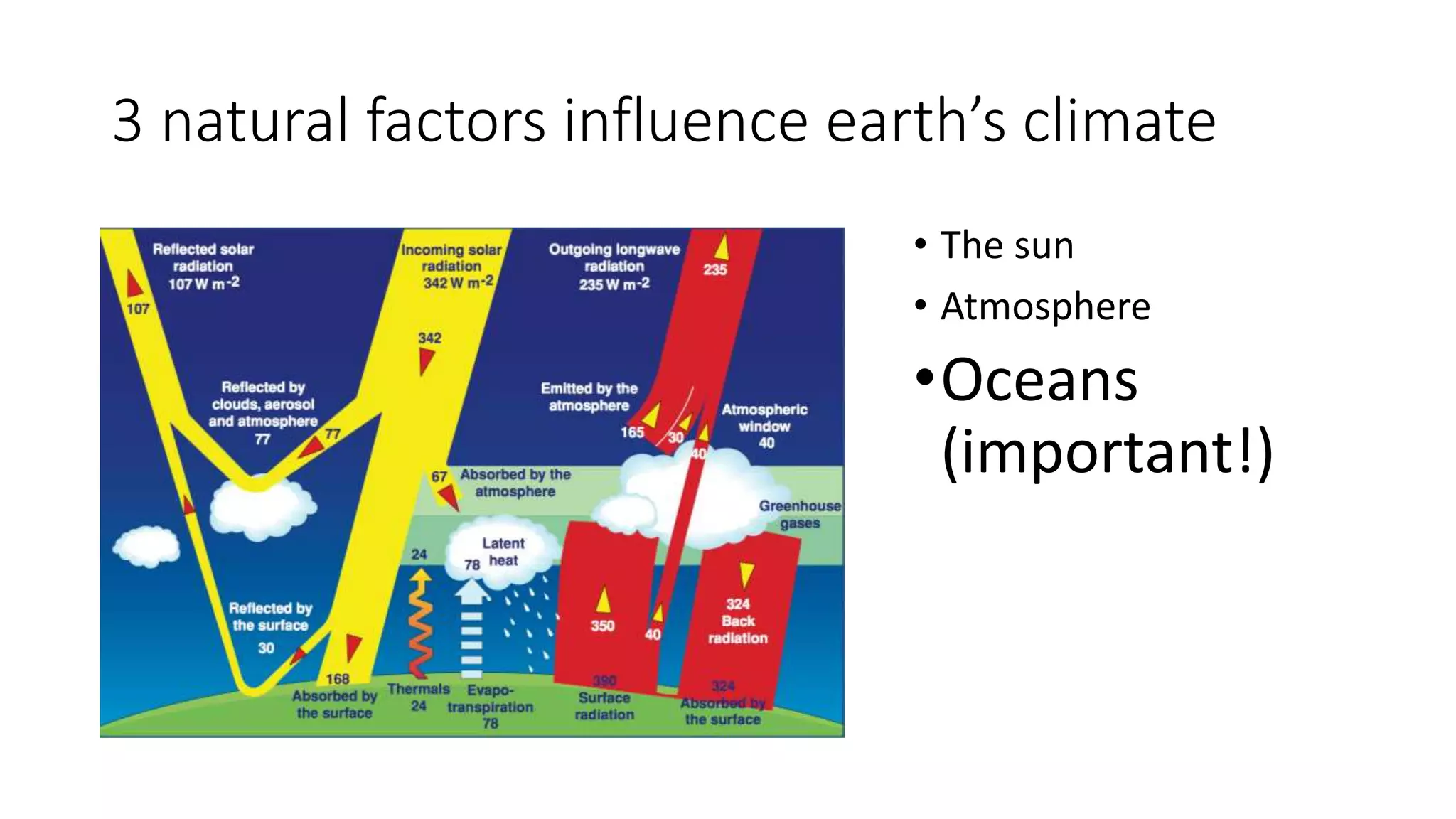
3 natural factors influence earth’s climate
• The sun
• Atmosphere
•Oceans
(important!)
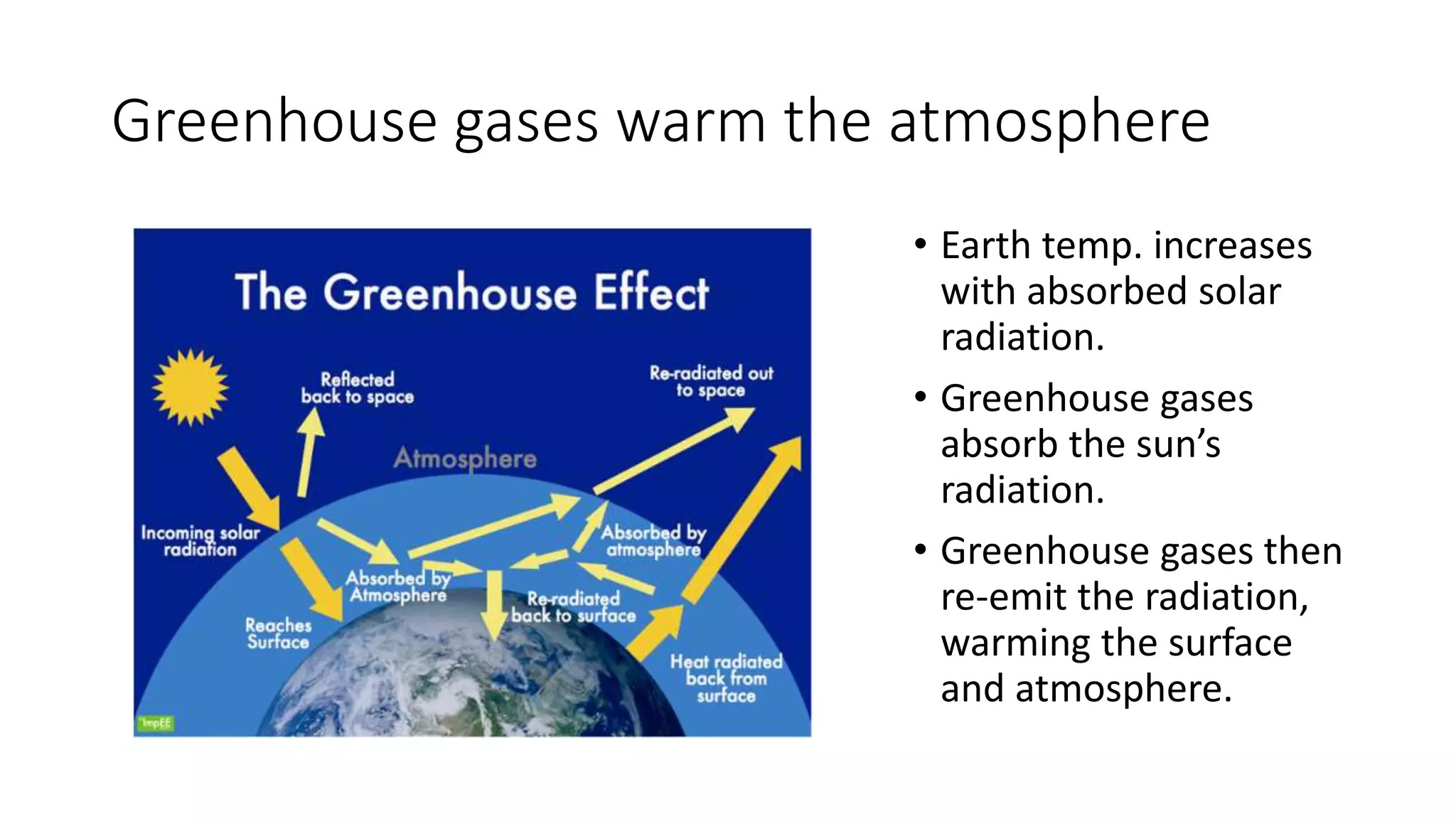
Greenhouse gases warm the atmosphere
• Earth temp. increases
with absorbed solar
radiation.
• Greenhouse gases
absorb the sun’s
radiation.
• Greenhouse gases then
re-emit the radiation,
warming the surface
and atmosphere.
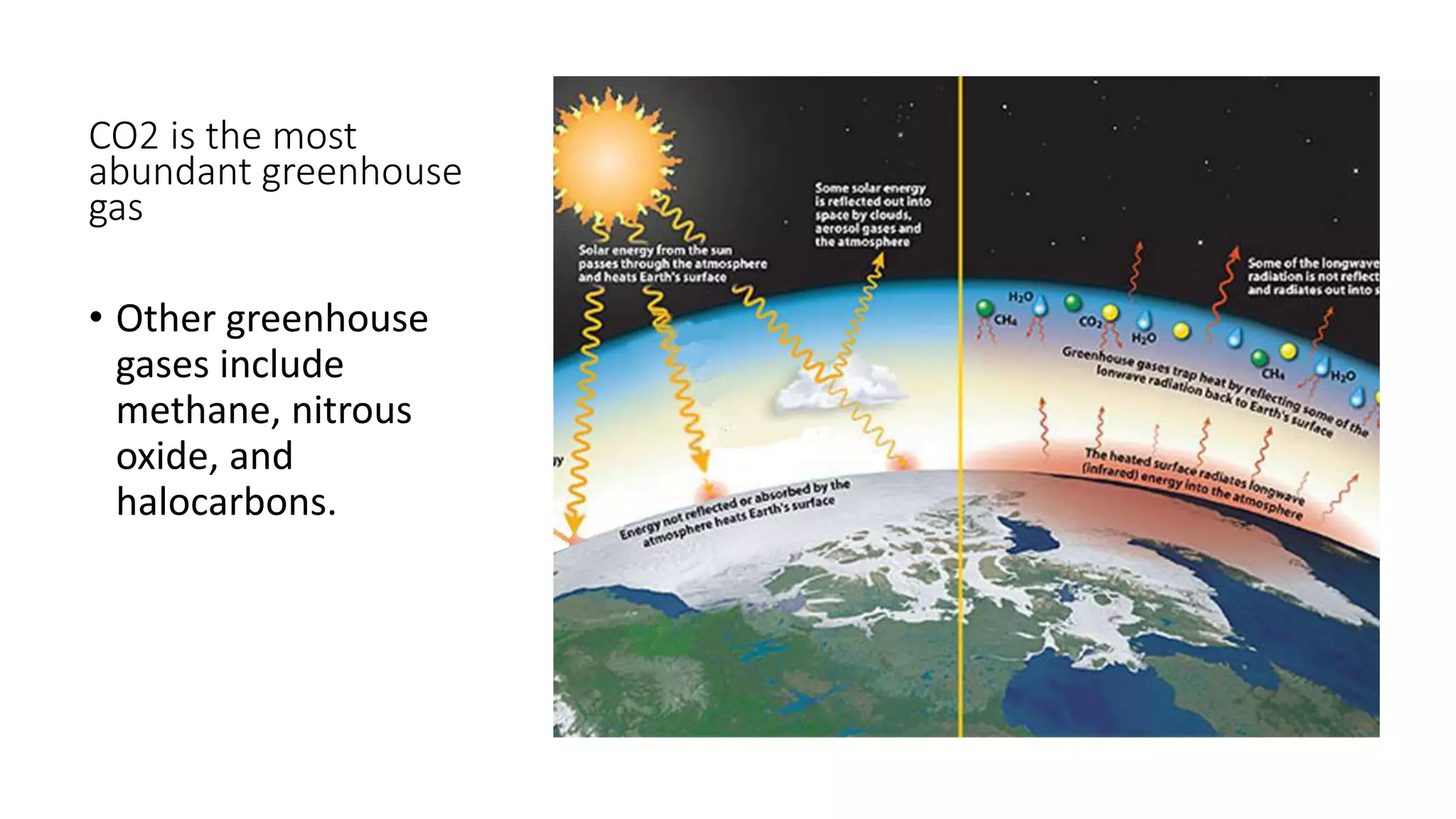
CO2 is the most
abundant greenhouse
gas
• Other greenhouse
gases include
methane, nitrous
oxide, and
halocarbons.
Greenhouse Gases
warming potential
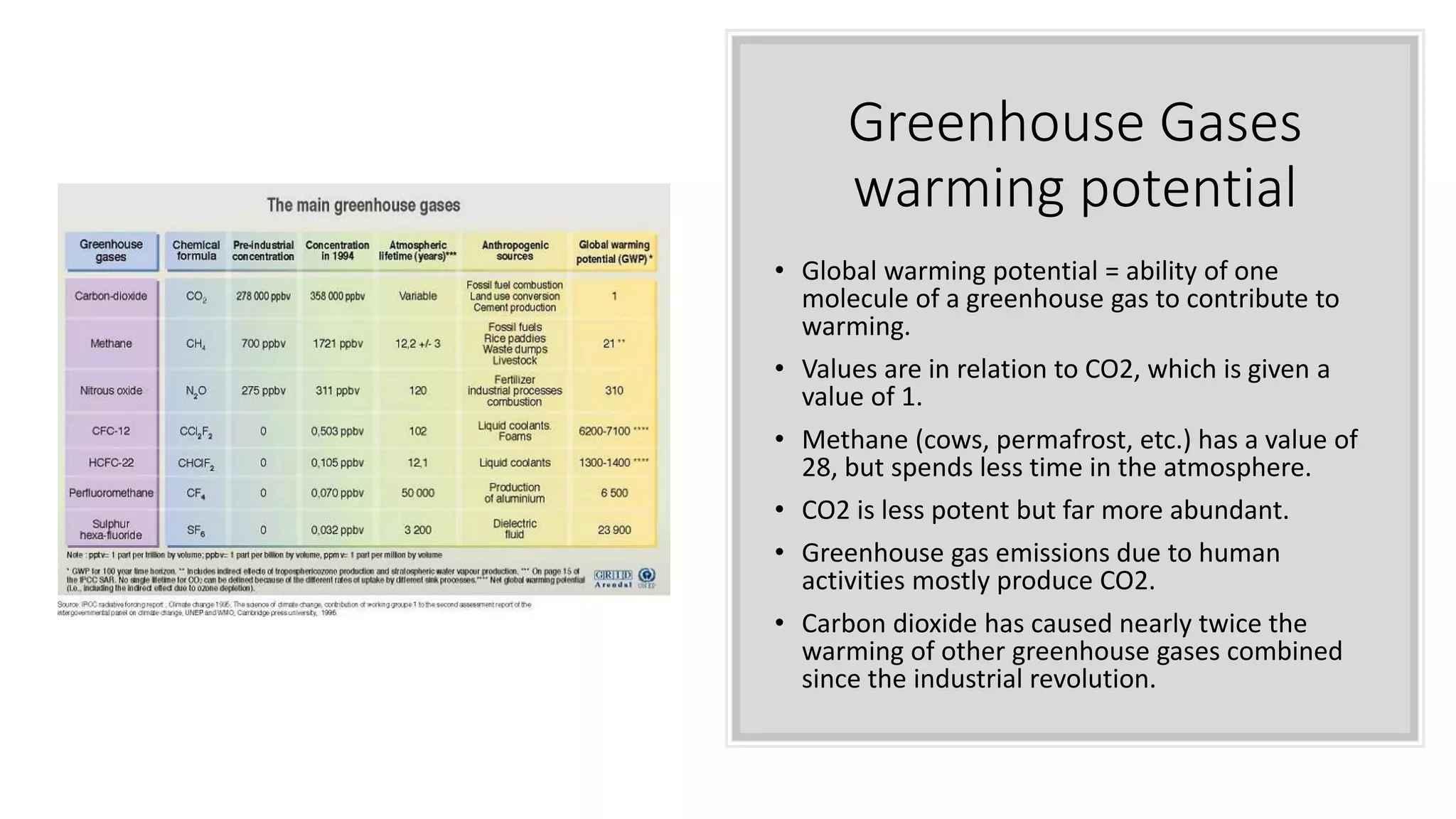
• Global warming potential = ability of one
molecule of a greenhouse gas to contribute to
warming.
• Values are in relation to CO2, which is given a
value of 1.
• Methane (cows, permafrost, etc.) has a value of
28, but spends less time in the atmosphere.
• CO2 is less potent but far more abundant.
• Greenhouse gas emissions due to human
activities mostly produce CO2.
• Carbon dioxide has caused nearly twice the
warming of other greenhouse gases combined
since the industrial revolution.
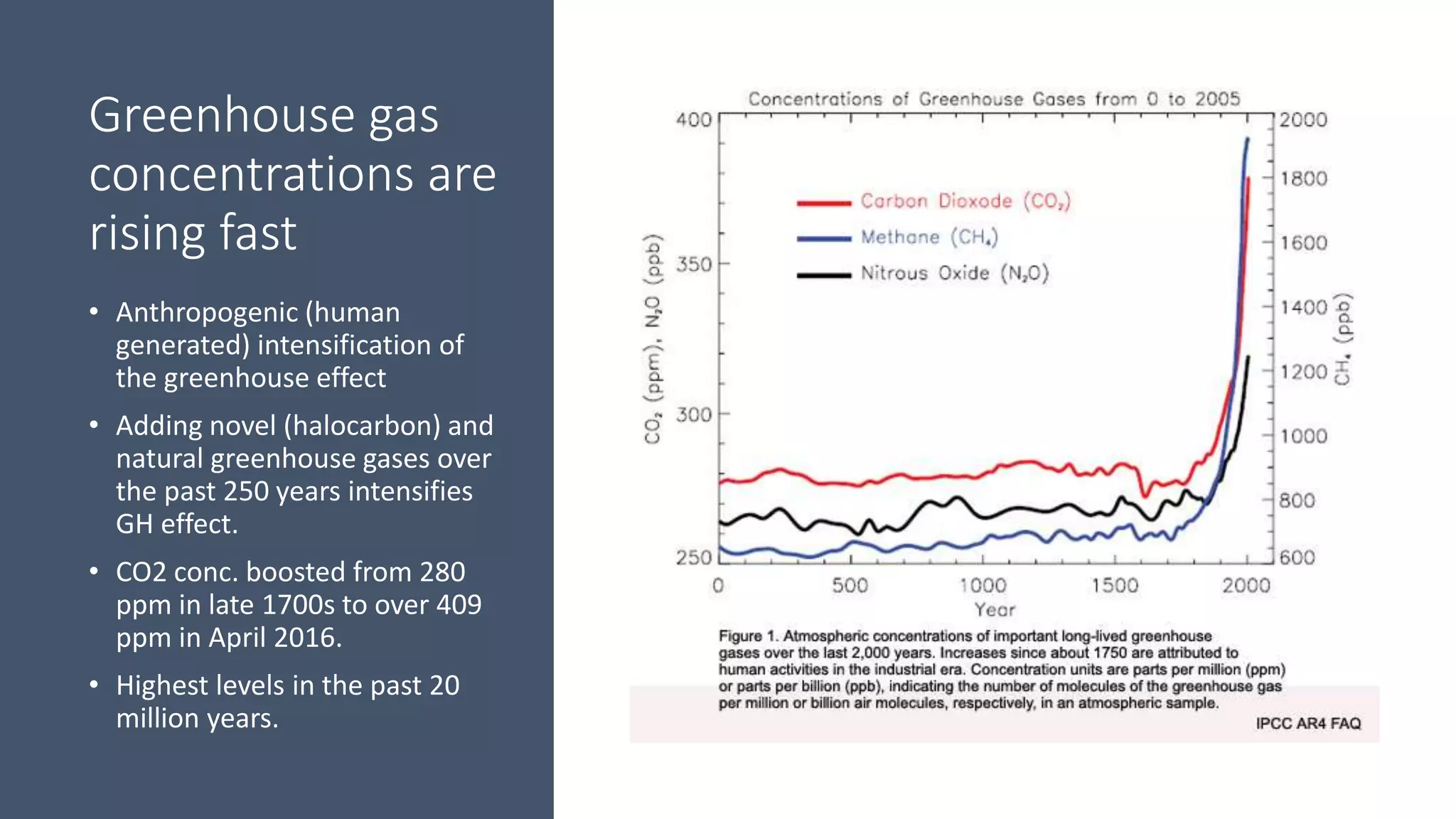
Greenhouse gas
concentrations are
rising fast
• Anthropogenic (human
generated) intensification of
the greenhouse effect
• Adding novel (halocarbon) and
natural greenhouse gases over
the past 250 years intensifies
GH effect.
• CO2 conc. boosted from 280
ppm in late 1700s to over 409
ppm in April 2016.
• Highest levels in the past 20
million years.
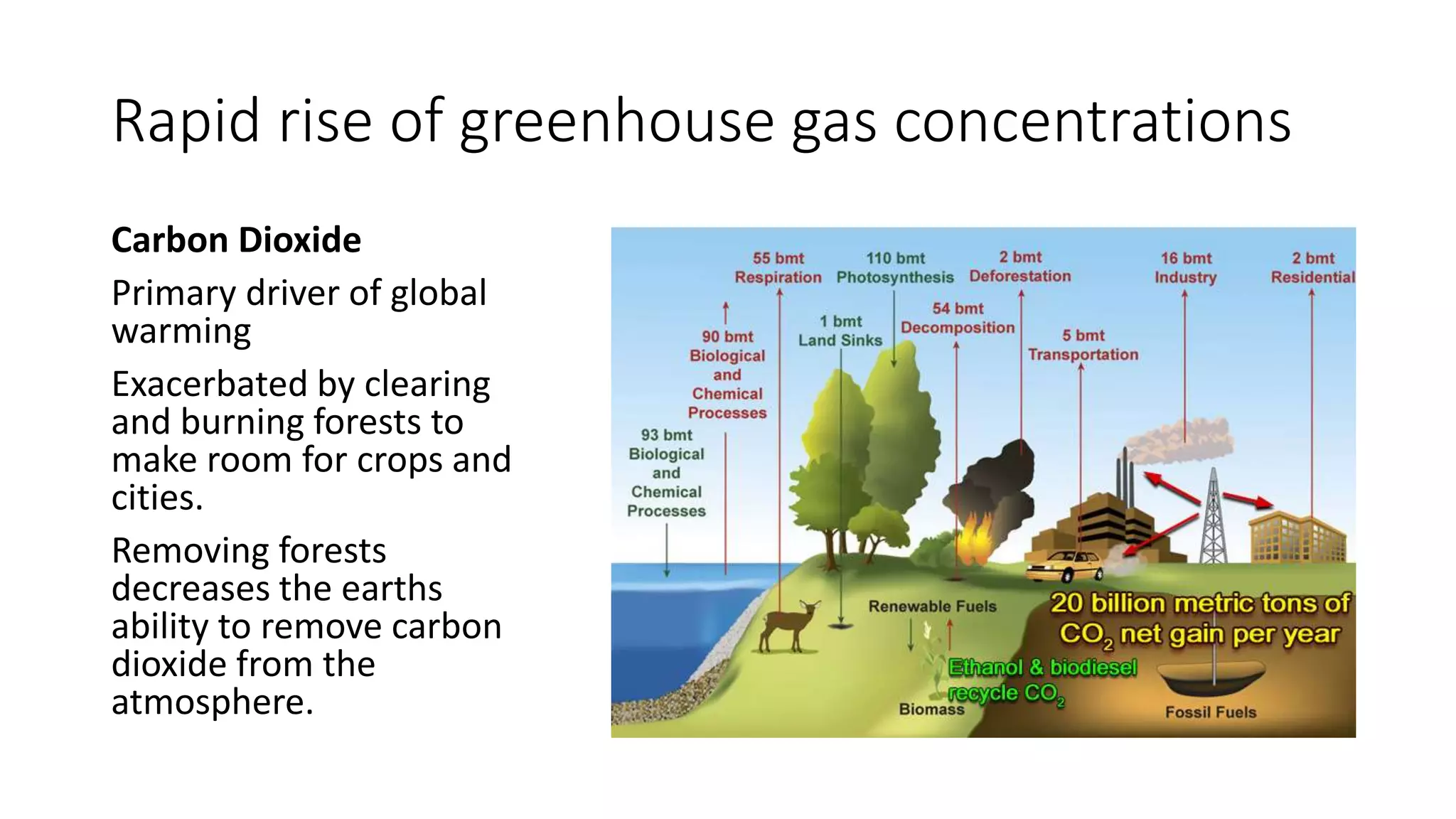
Rapid rise of greenhouse gas concentrations
Carbon Dioxide
Primary driver of global
warming
Exacerbated by clearing
and burning forests to
make room for crops and
cities.
Removing forests
decreases the earths
ability to remove carbon
dioxide from the
atmosphere.
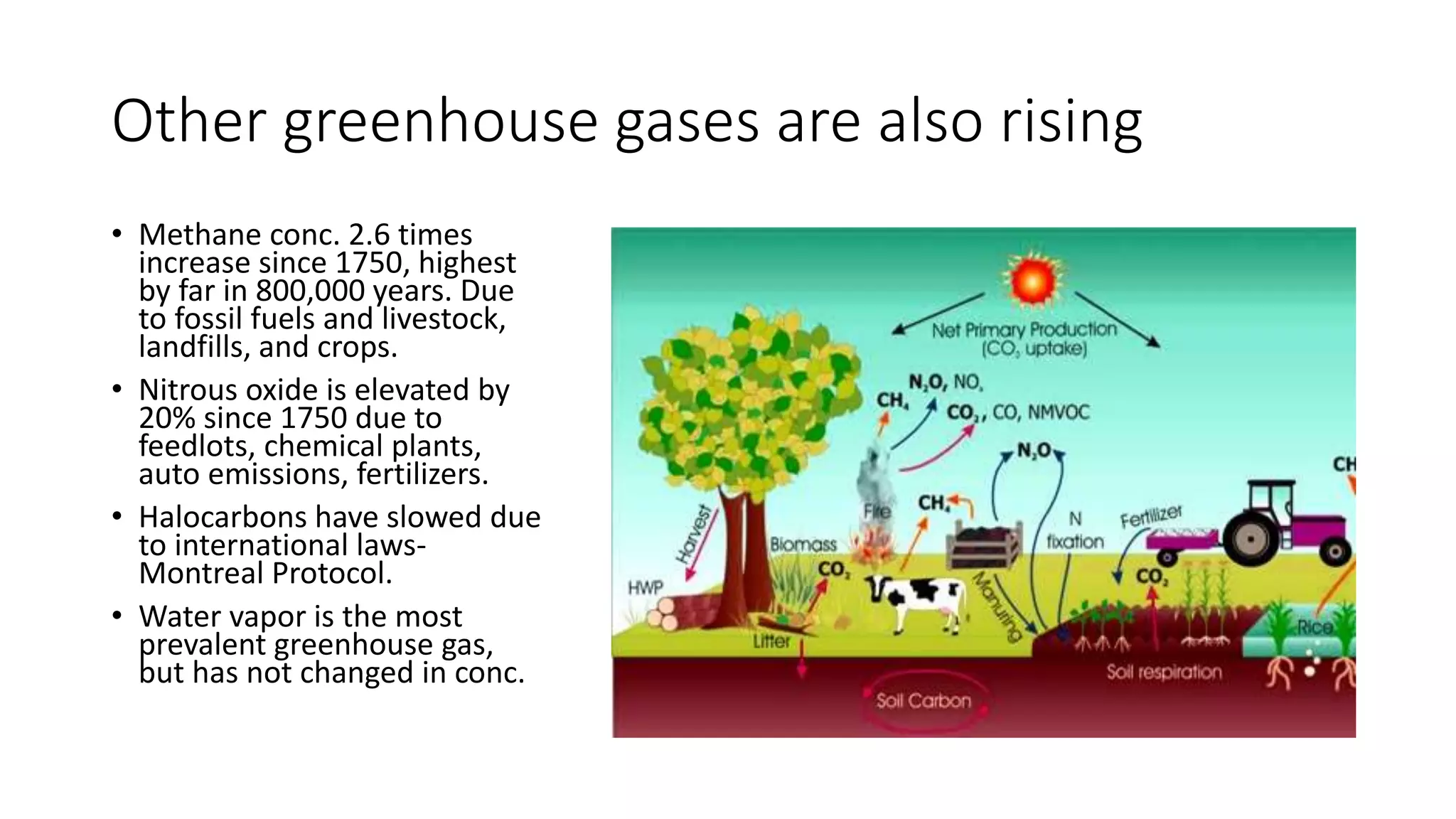
Other greenhouse gases are also rising
• Methane conc. 2.6 times
increase since 1750, highest
by far in 800,000 years. Due
to fossil fuels and livestock,
landfills, and crops.
• Nitrous oxide is elevated by
20% since 1750 due to
feedlots, chemical plants,
auto emissions, fertilizers.
• Halocarbons have slowed due
to international laws-
Montreal Protocol.
• Water vapor is the most
prevalent greenhouse gas,
but has not changed in conc.
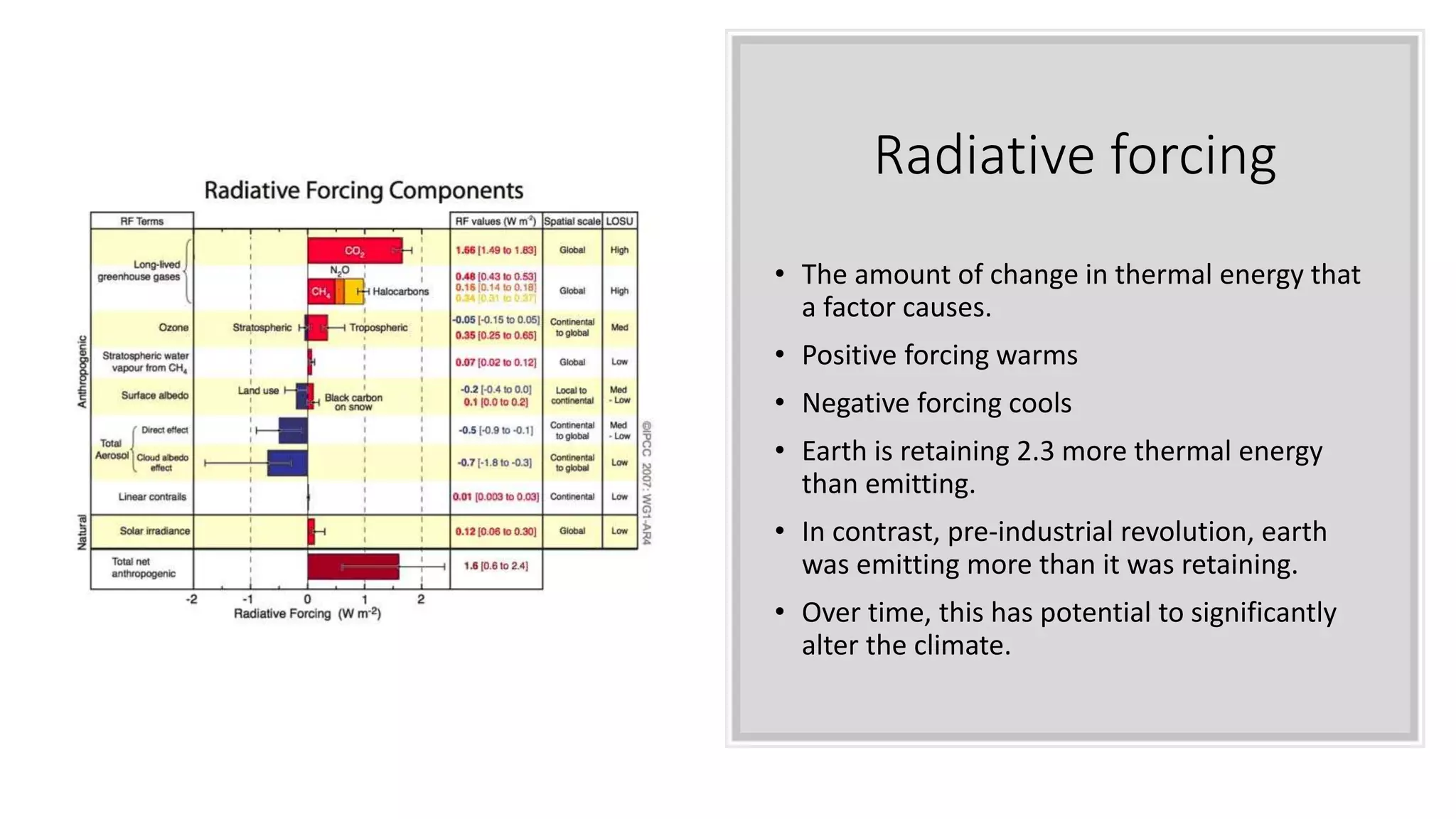
Radiative forcing
• The amount of change in thermal energy that
a factor causes.
• Positive forcing warms
• Negative forcing cools
• Earth is retaining 2.3 more thermal energy
than emitting.
• In contrast, pre-industrial revolution, earth
was emitting more than it was retaining.
• Over time, this has potential to significantly
alter the climate.
Natural variation in climate- 4 factors
• Solar output- variation is normal but
does not account for the rapid changes.
Net radiative forcing is just 0.05, less
than any factor in the previous slide.
• Ocean absorption- absorb 50X more
carbon than atmosphere but less as
conc. rise. Slowing but not preventing
warming. Warmer water reduces CO2
absorption and accelerates warming.
• Ocean circulation- melting sea ice could
alter and make Europe much colder
and also cause El Nino cycles
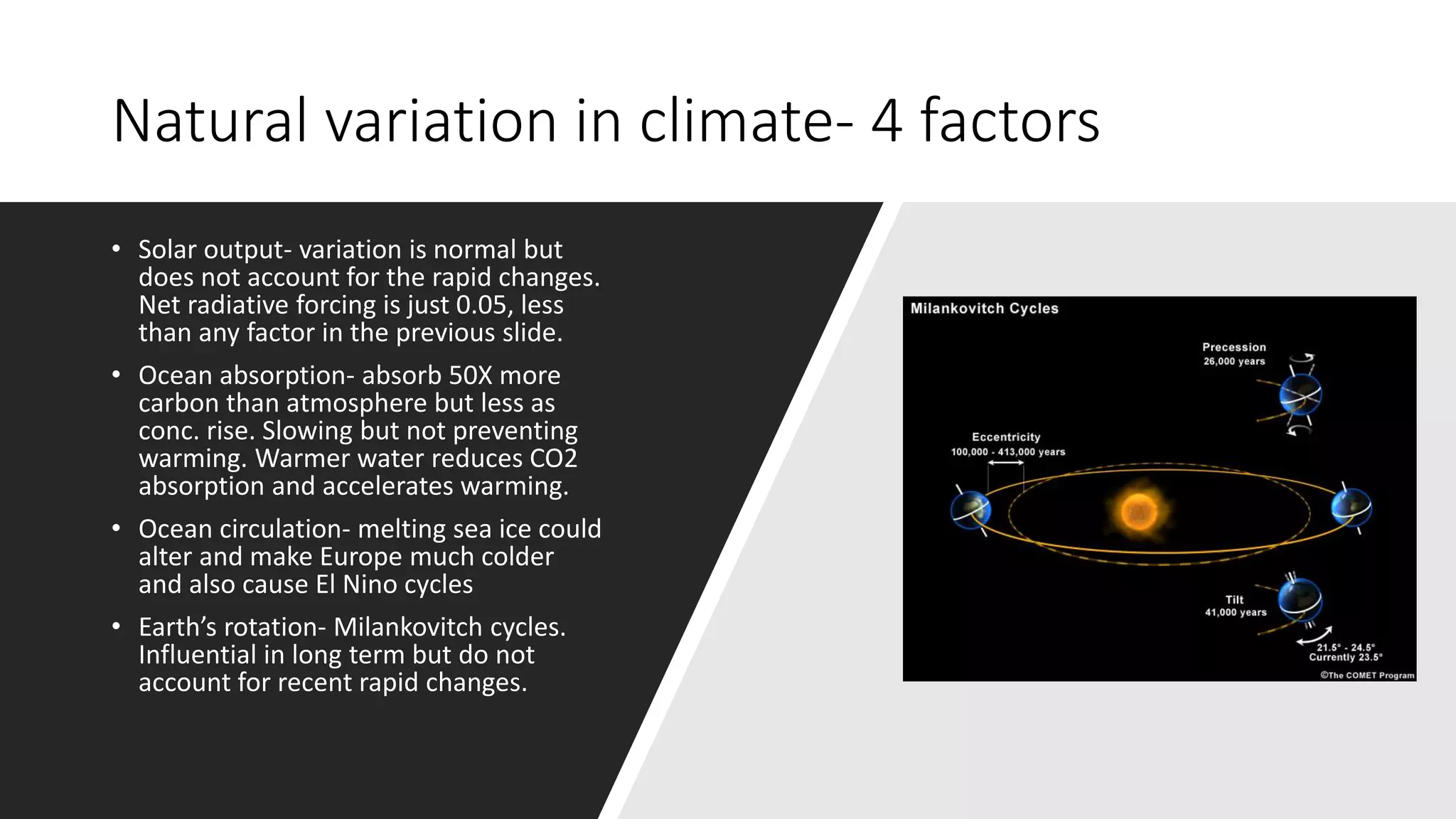
• Earth’s rotation- Milankovitch cycles.
Influential in long term but do not
account for recent rapid changes.
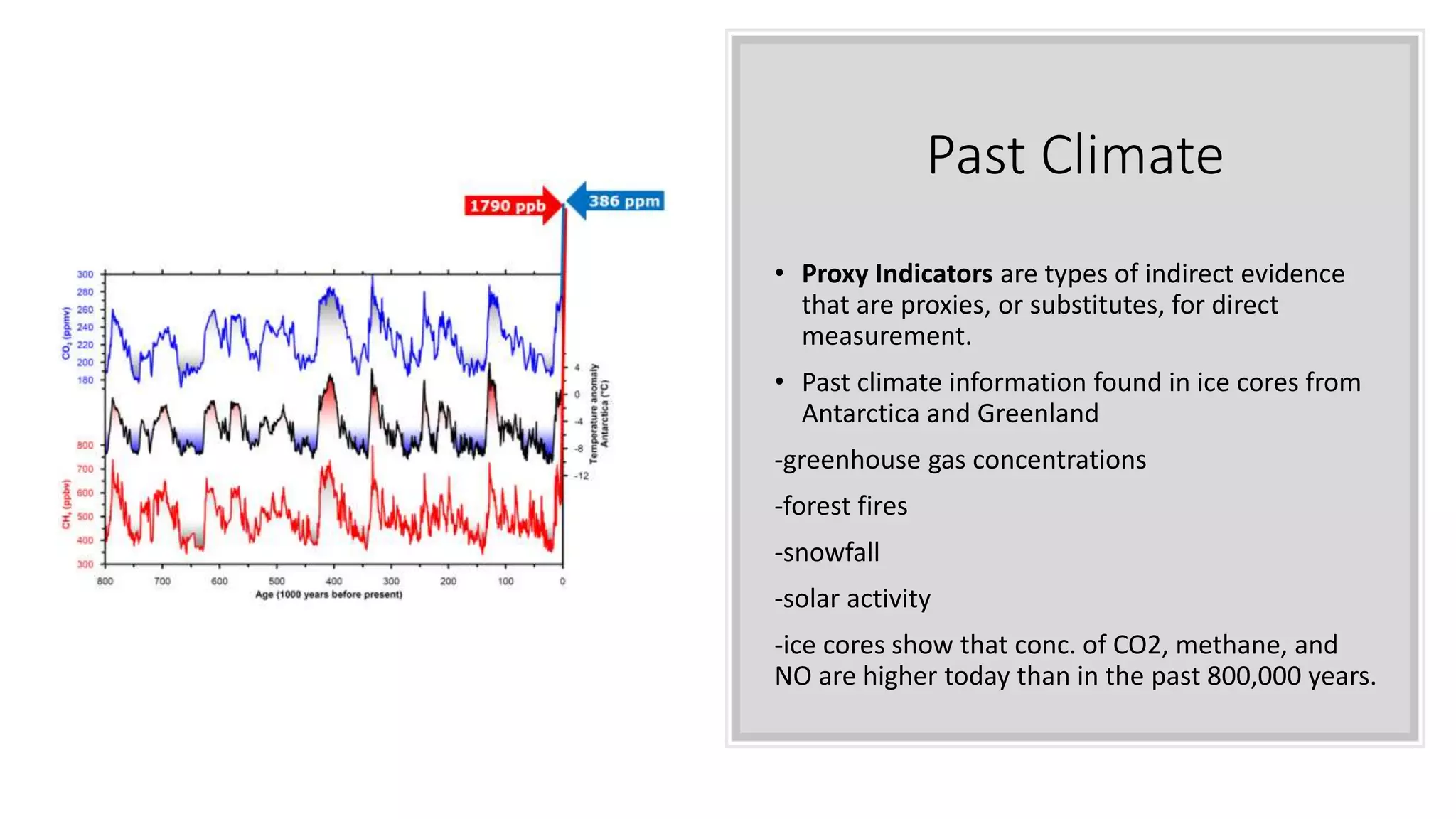
Past Climate
• Proxy Indicators are types of indirect evidence
that are proxies, or substitutes, for direct
measurement.
• Past climate information found in ice cores from
Antarctica and Greenland
-greenhouse gas concentrations
-forest fires
-snowfall
-solar activity
-ice cores show that conc. of CO2, methane, and
NO are higher today than in the past 800,000 years.
Ice Cores Explained
• https://www.youtube.com/watch?v=fjGxYDLEXP0
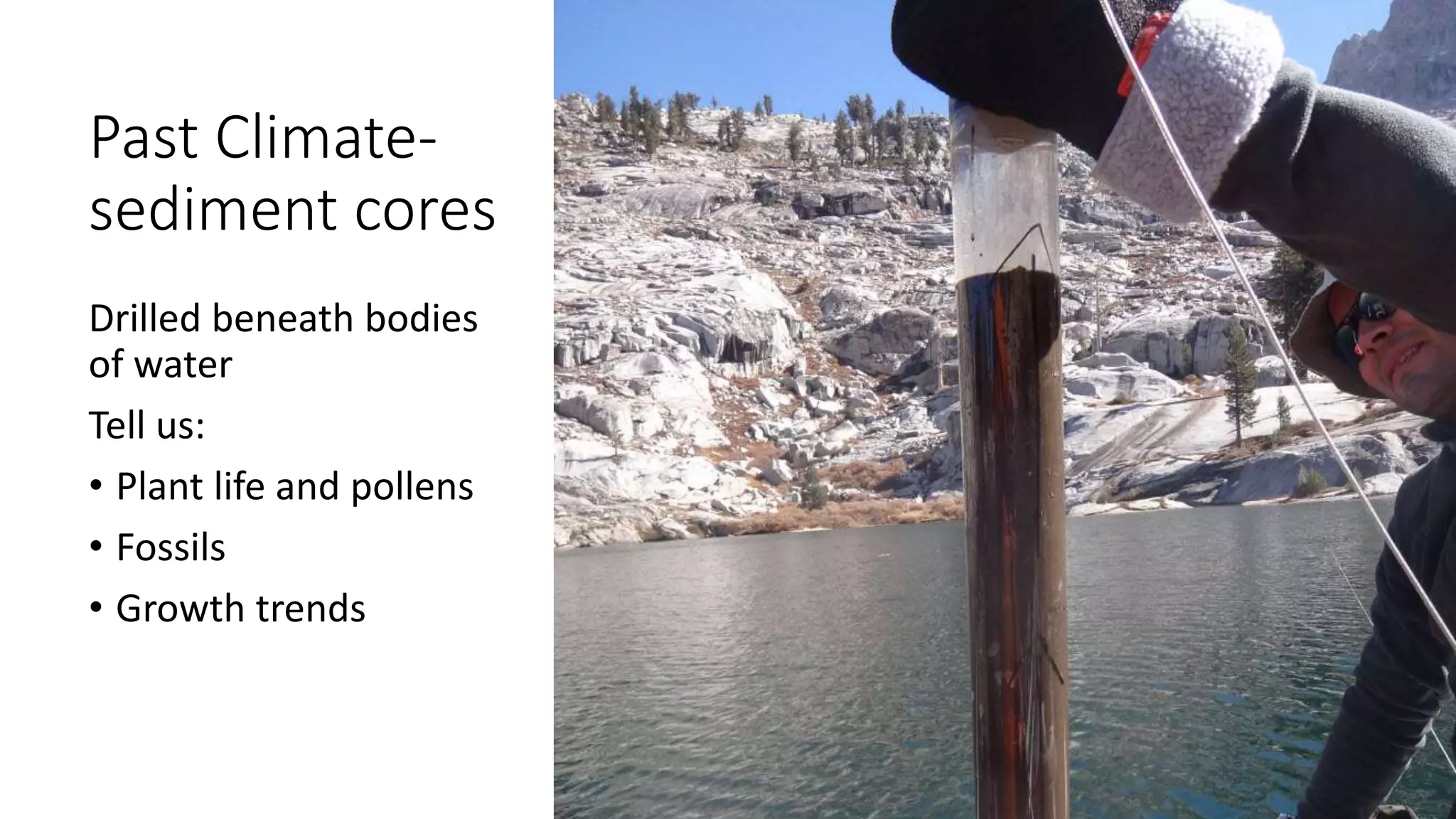
Past Climate-
sediment cores
Drilled beneath bodies
of water
Tell us:
• Plant life and pollens
• Fossils
• Growth trends
Climate
Models
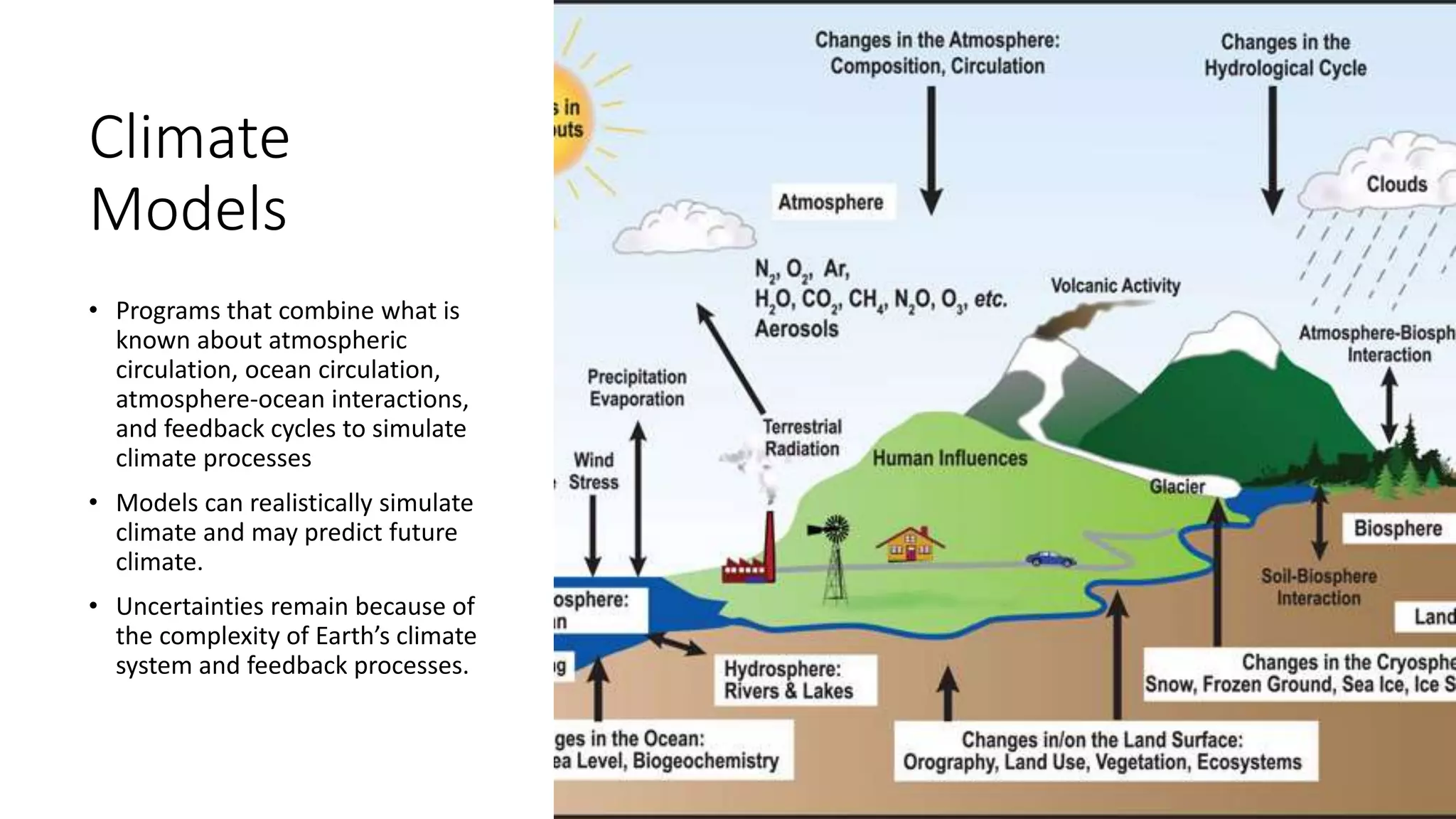
• Programs that combine what is
known about atmospheric
circulation, ocean circulation,
atmosphere-ocean interactions,
and feedback cycles to simulate
climate processes
• Models can realistically simulate
climate and may predict future
climate.
• Uncertainties remain because of
the complexity of Earth’s climate
system and feedback processes.
Current and
Future Climate
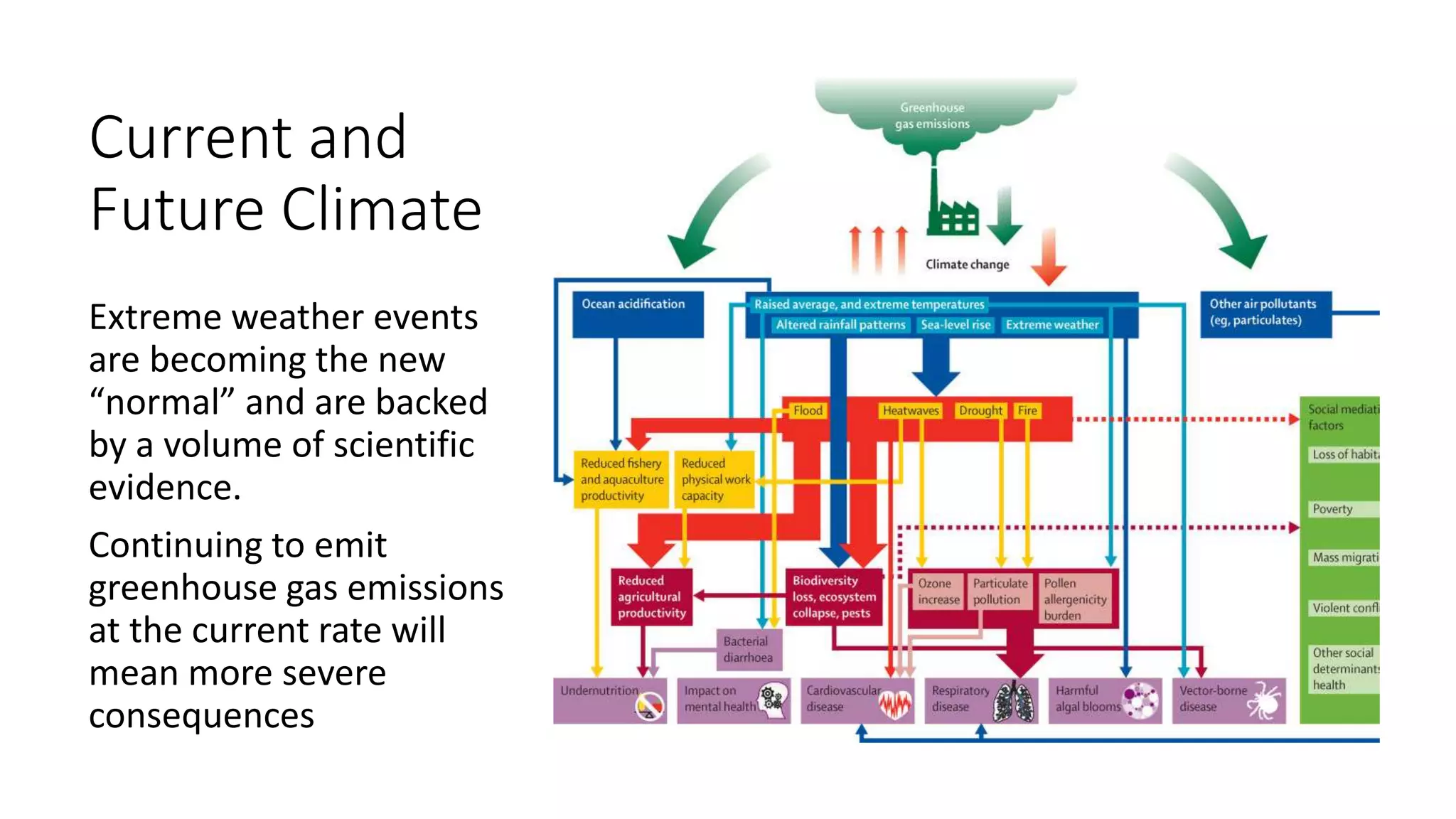
Extreme weather events
are becoming the new
“normal” and are backed
by a volume of scientific
evidence.
Continuing to emit
greenhouse gas emissions
at the current rate will
mean more severe
consequences
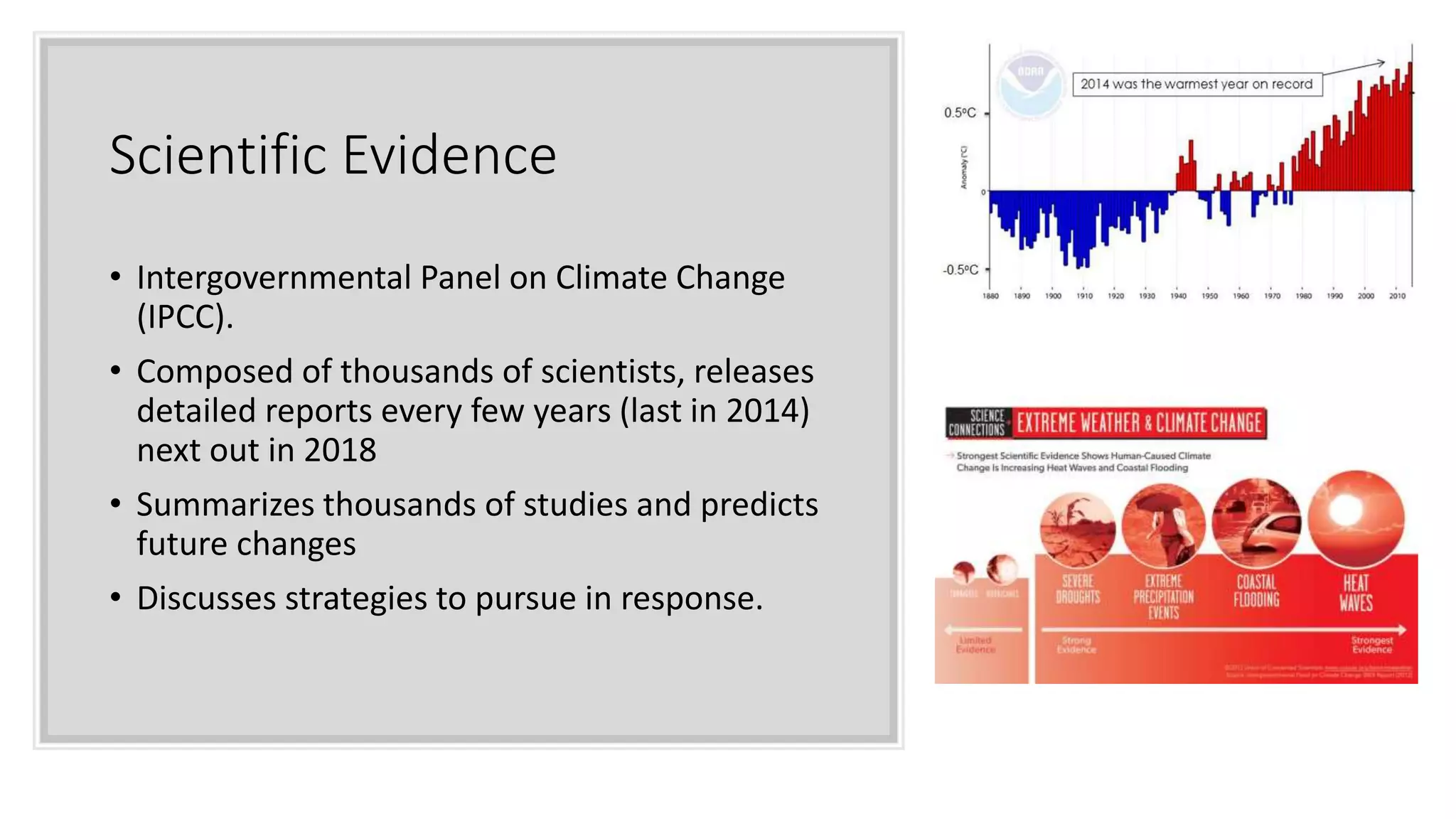
Scientific Evidence
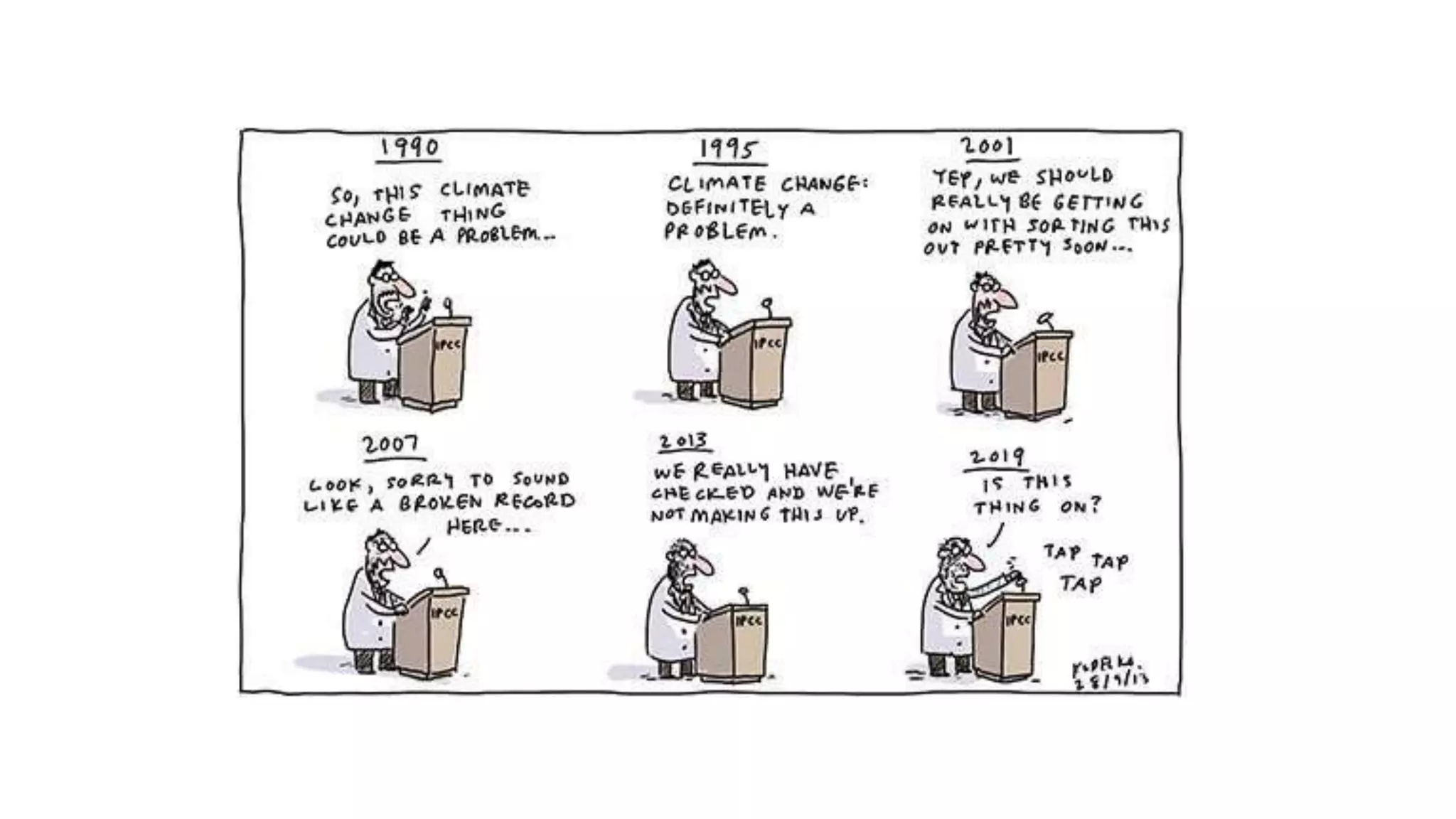
• Intergovernmental Panel on Climate Change
(IPCC).
• Composed of thousands of scientists, releases
detailed reports every few years (last in 2014)
next out in 2018
• Summarizes thousands of studies and predicts
future changes
• Discusses strategies to pursue in response.
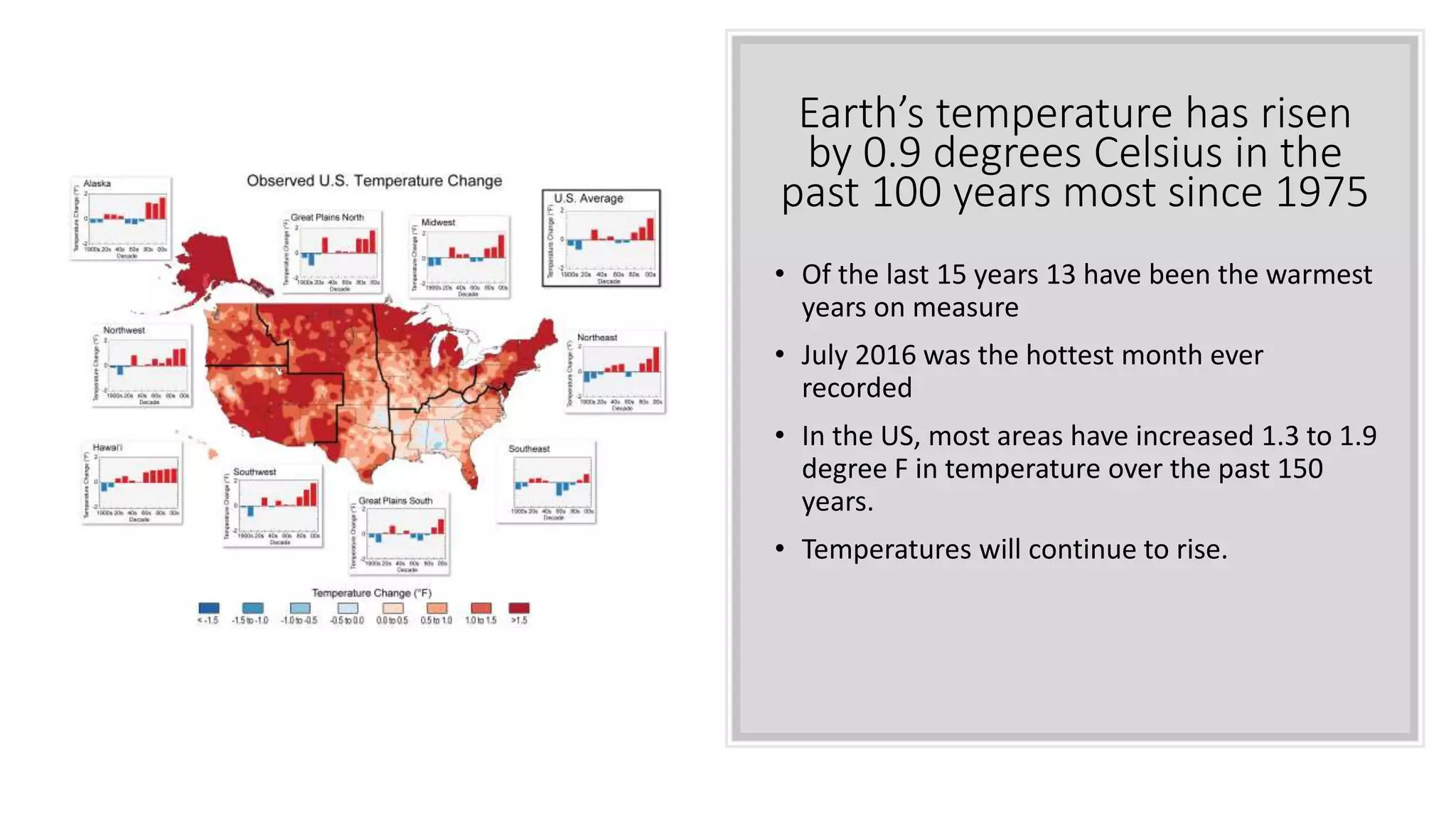
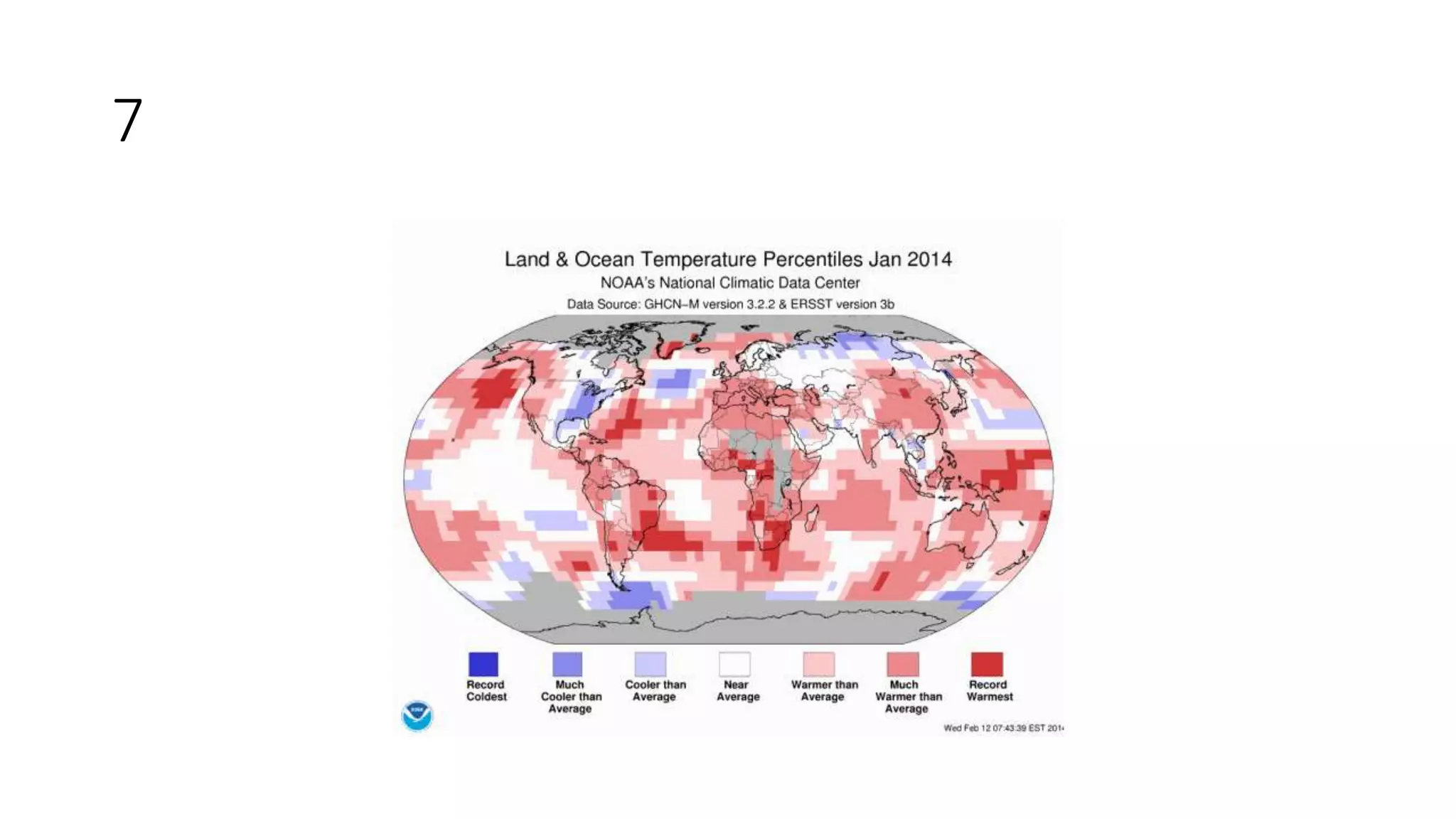
Earth’s temperature has risen
by 0.9 degrees Celsius in the
past 100 years most since 1975
• Of the last 15 years 13 have been the warmest
years on measure
• July 2016 was the hottest month ever
recorded
• In the US, most areas have increased 1.3 to 1.9
degree F in temperature over the past 150
years.
• Temperatures will continue to rise.
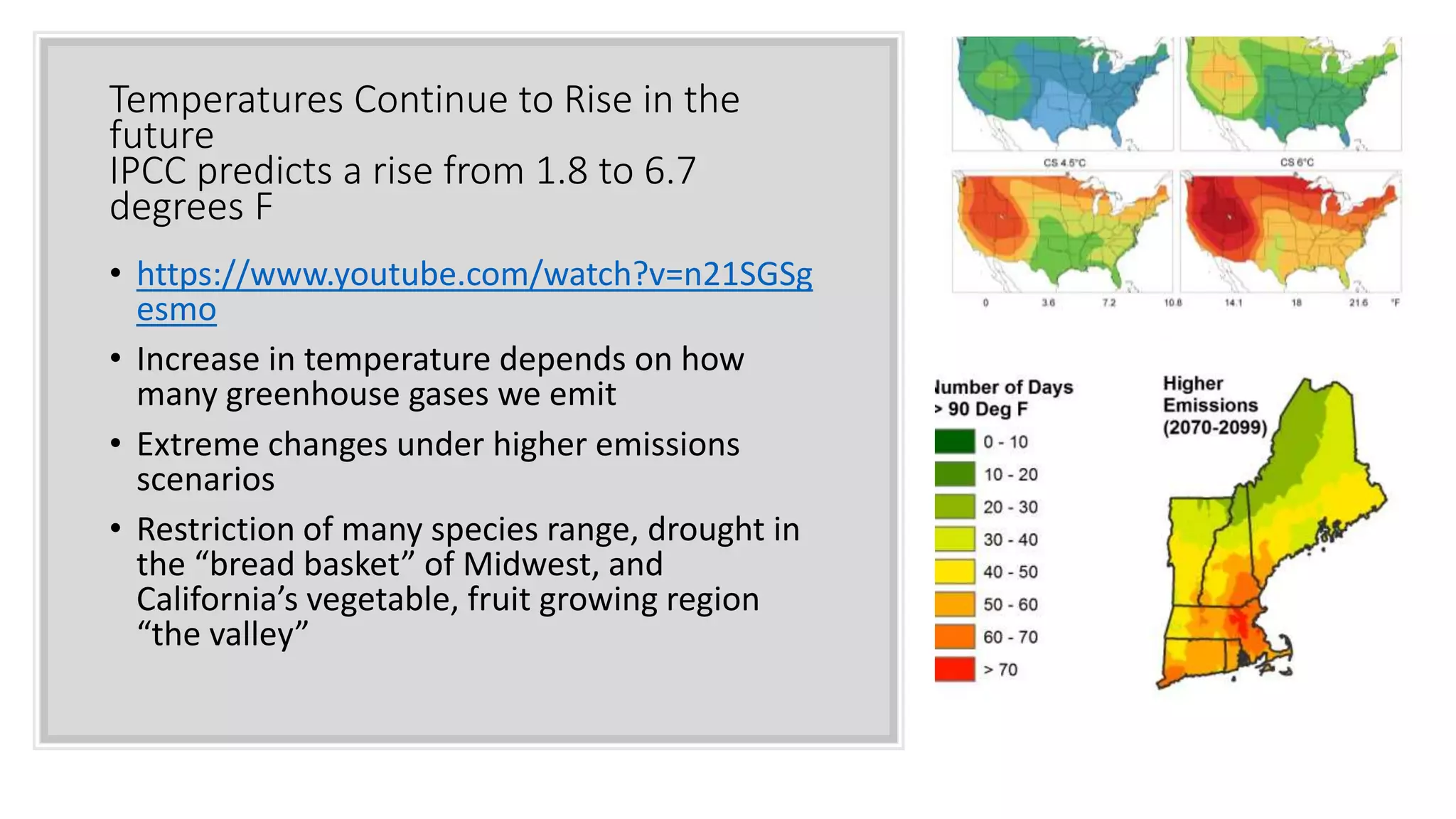
Temperatures Continue to Rise in the
future
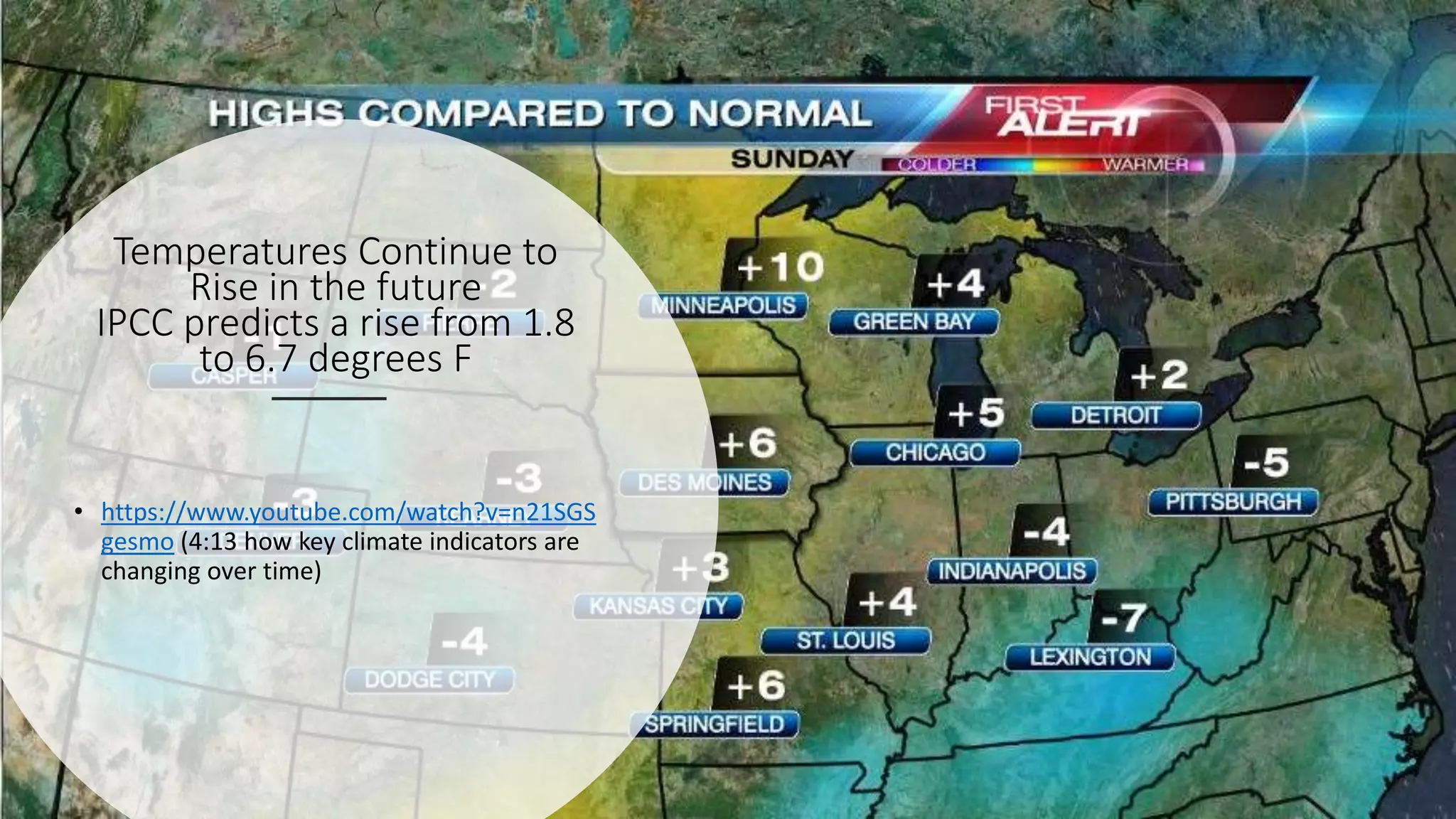
IPCC predicts a rise from 1.8 to 6.7
degrees F
• https://www.youtube.com/watch?v=n21SGSg
esmo
• Increase in temperature depends on how
many greenhouse gases we emit
• Extreme changes under higher emissions
scenarios
• Restriction of many species range, drought in
the “bread basket” of Midwest, and
California’s vegetable, fruit growing region
“the valley”
Temperatures Continue to
Rise in the future
IPCC predicts a rise from 1.8
to 6.7 degrees F
• https://www.youtube.com/watch?v=n21SGS
gesmo (4:13 how key climate indicators are
changing over time)
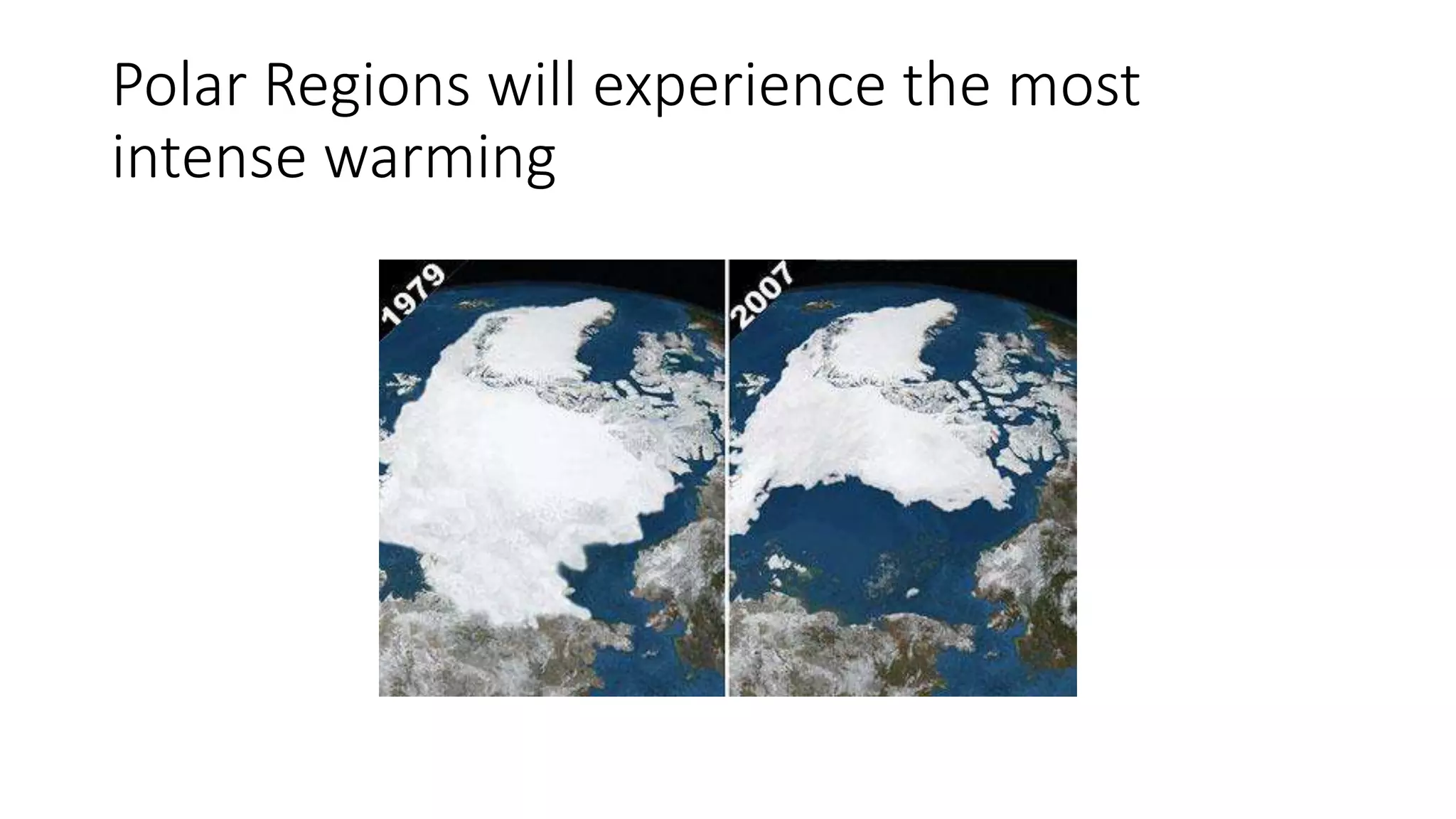
Polar Regions will experience
the most intense warming
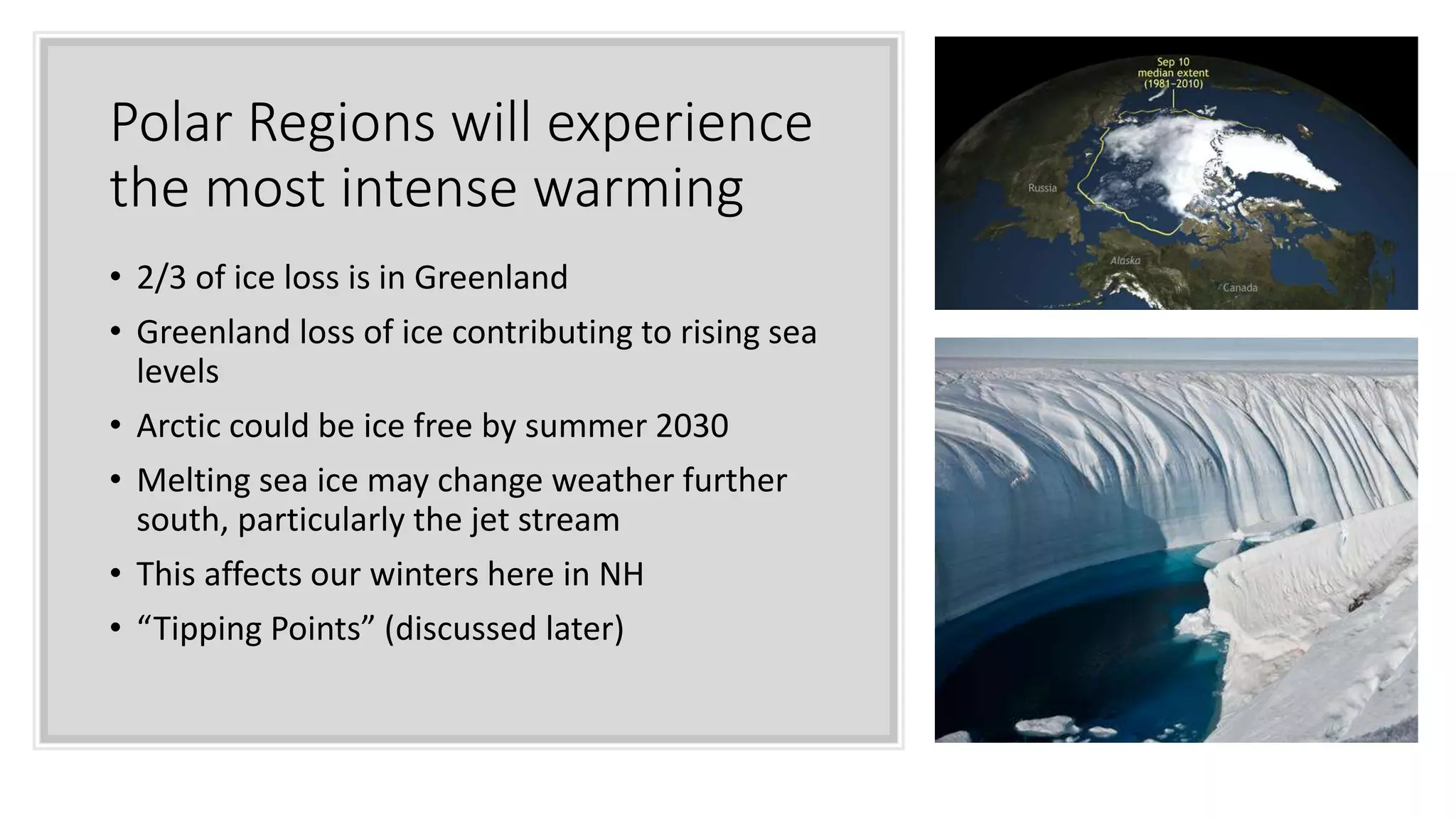
• 2/3 of ice loss is in Greenland
• Greenland loss of ice contributing to rising sea
levels
• Arctic could be ice free by summer 2030
• Melting sea ice may change weather further
south, particularly the jet stream
• This affects our winters here in NH
• “Tipping Points” (discussed later)
Polar Regions will experience the most
intense warming
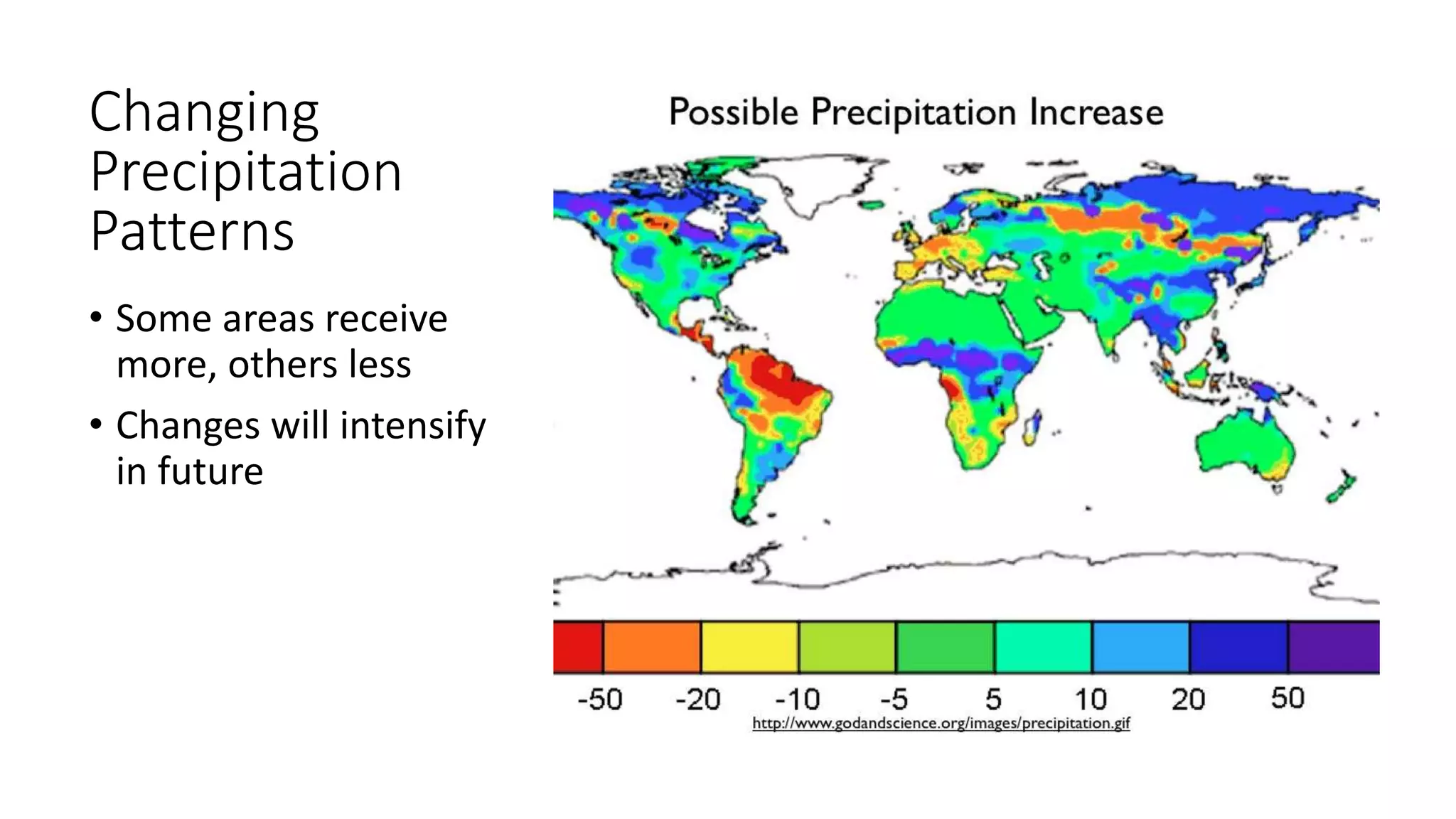
Changing
Precipitation
Patterns
• Some areas receive
more, others less
• Changes will intensify
in future
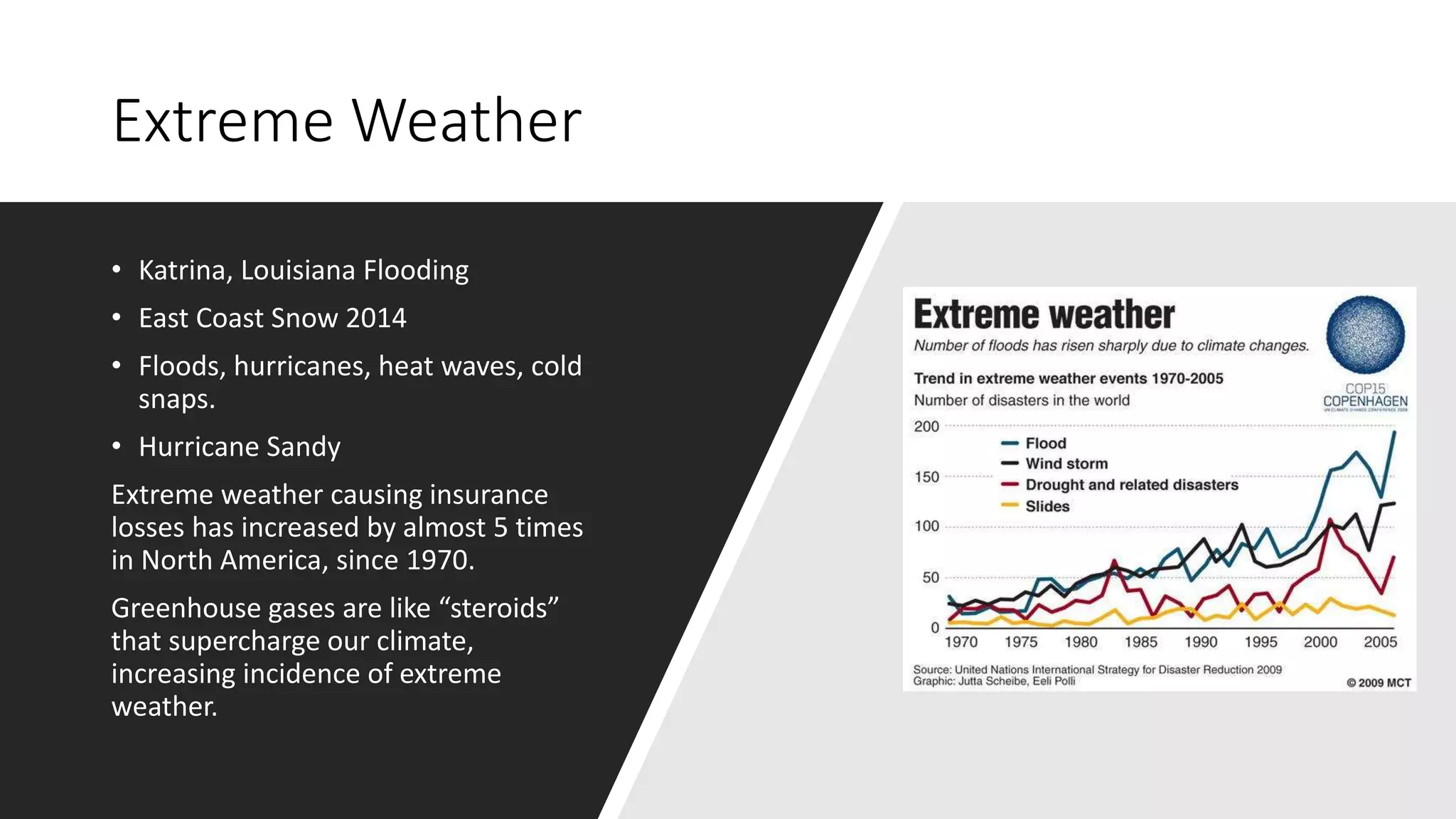
Extreme Weather
• Katrina, Louisiana Flooding
• East Coast Snow 2014
• Floods, hurricanes, heat waves, cold
snaps.
• Hurricane Sandy
Extreme weather causing insurance
losses has increased by almost 5 times
in North America, since 1970.
Greenhouse gases are like “steroids”
that supercharge our climate,
increasing incidence of extreme
weather.
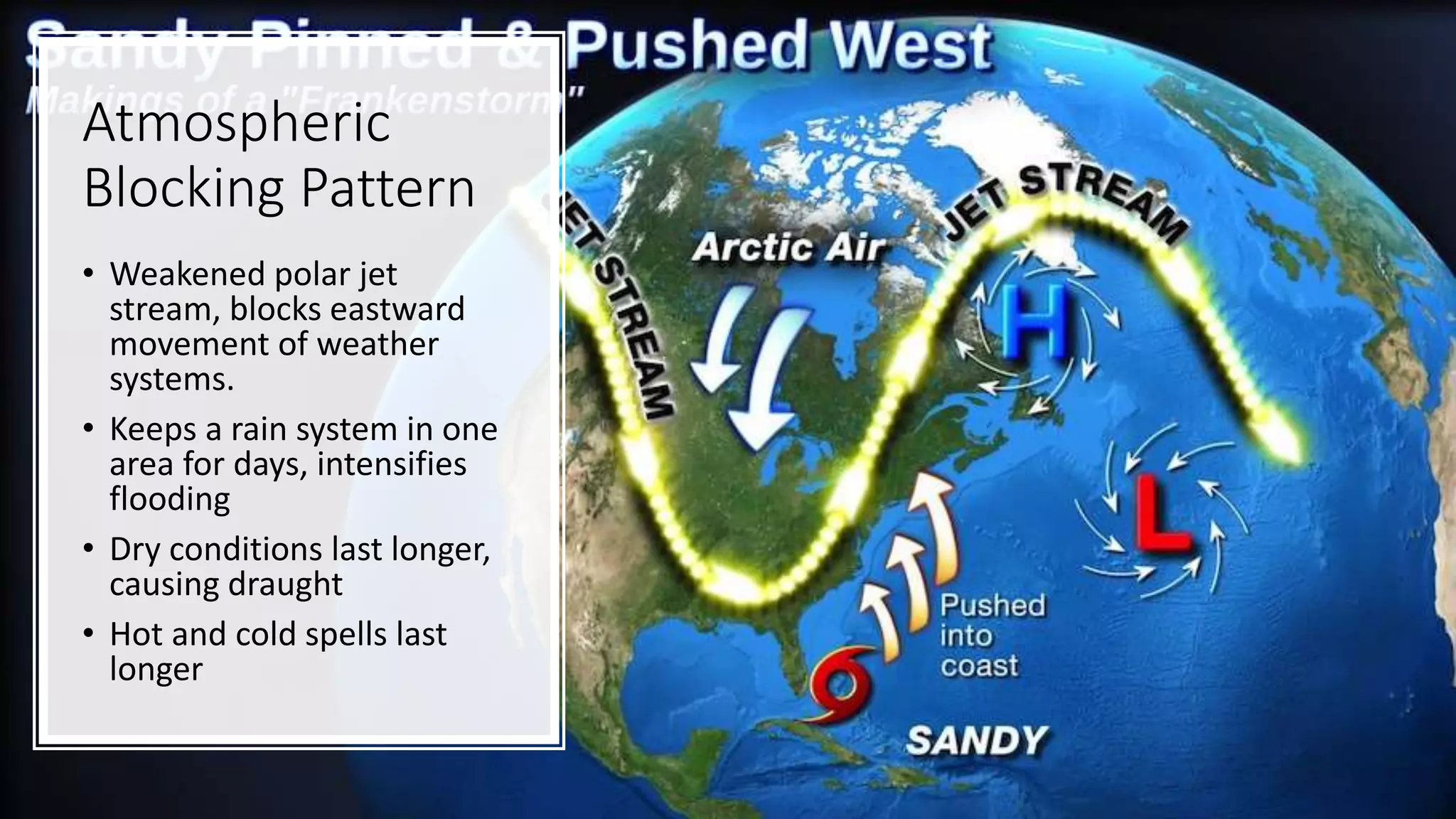
Atmospheric
Blocking Pattern
• Weakened polar jet
stream, blocks eastward
movement of weather
systems.
• Keeps a rain system in one
area for days, intensifies
flooding
• Dry conditions last longer,
causing draught
• Hot and cold spells last
longer
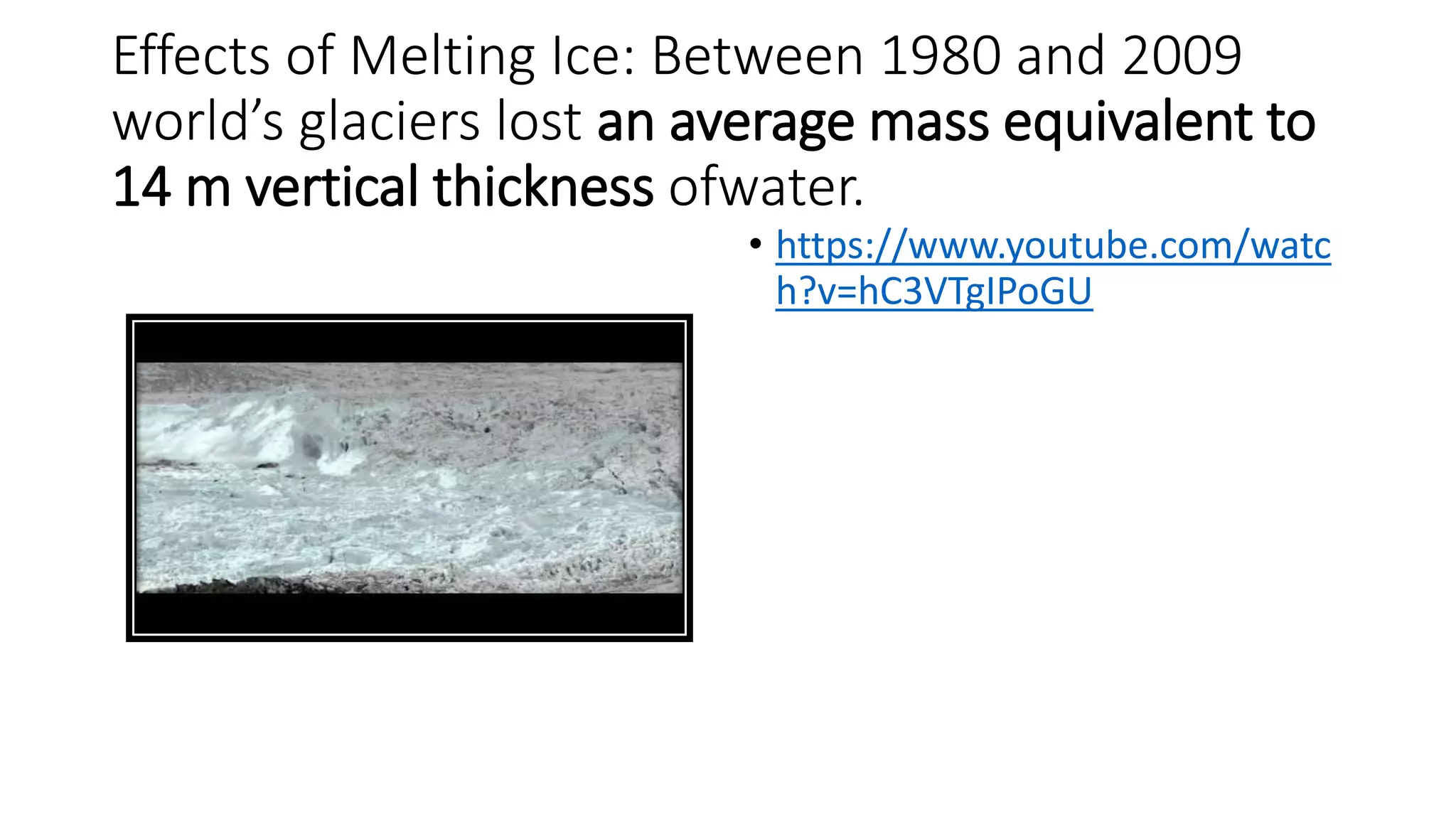
Effects of Melting Ice: Between 1980 and 2009
world’s glaciers lost an average mass equivalent to
14 m vertical thickness ofwater.
• https://www.youtube.com/watc
h?v=hC3VTgIPoGU
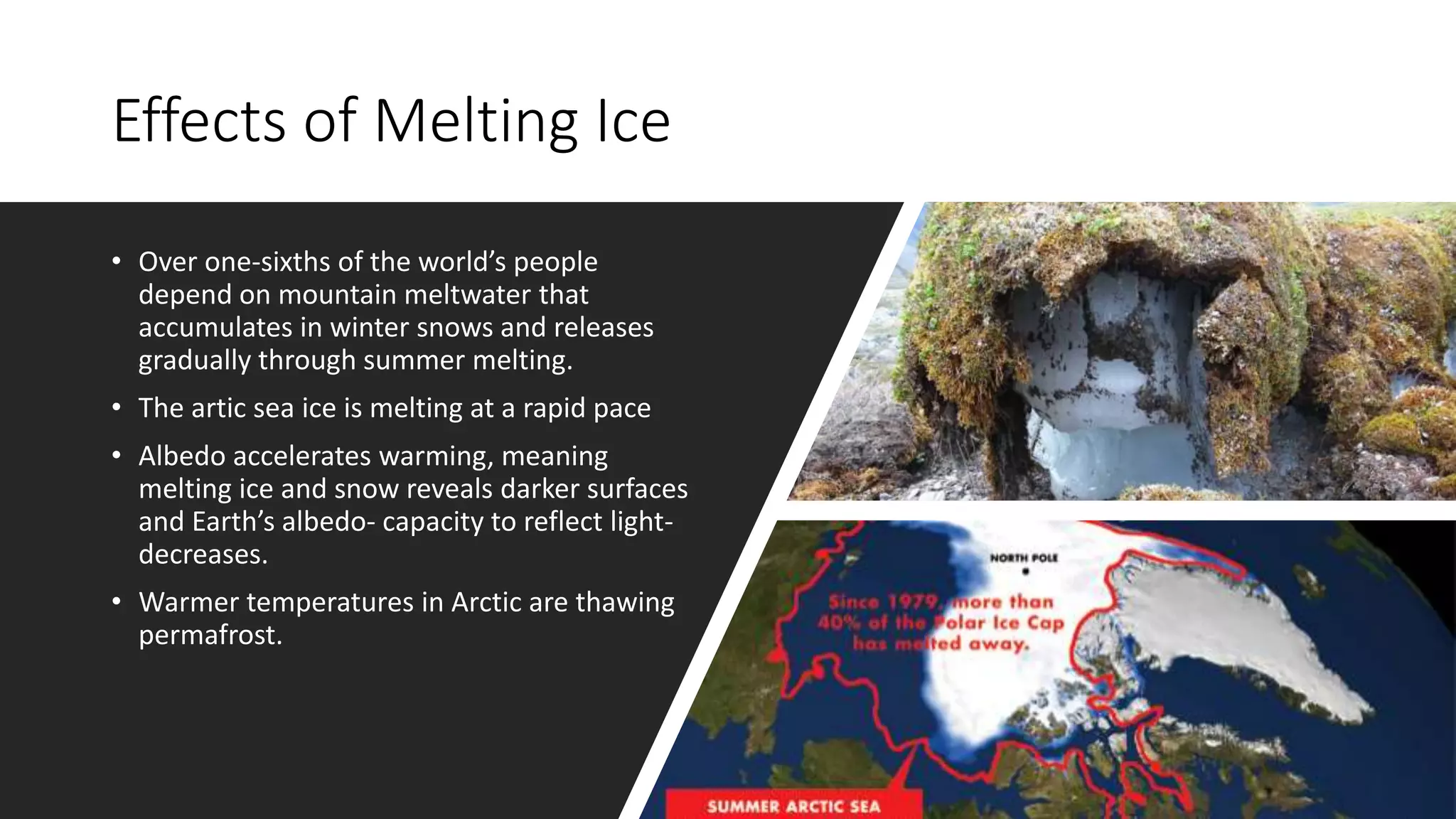
Effects of Melting Ice
• Over one-sixths of the world’s people
depend on mountain meltwater that
accumulates in winter snows and releases
gradually through summer melting.
• The artic sea ice is melting at a rapid pace
• Albedo accelerates warming, meaning
melting ice and snow reveals darker surfaces
and Earth’s albedo- capacity to reflect light-
decreases.
• Warmer temperatures in Arctic are thawing
permafrost.
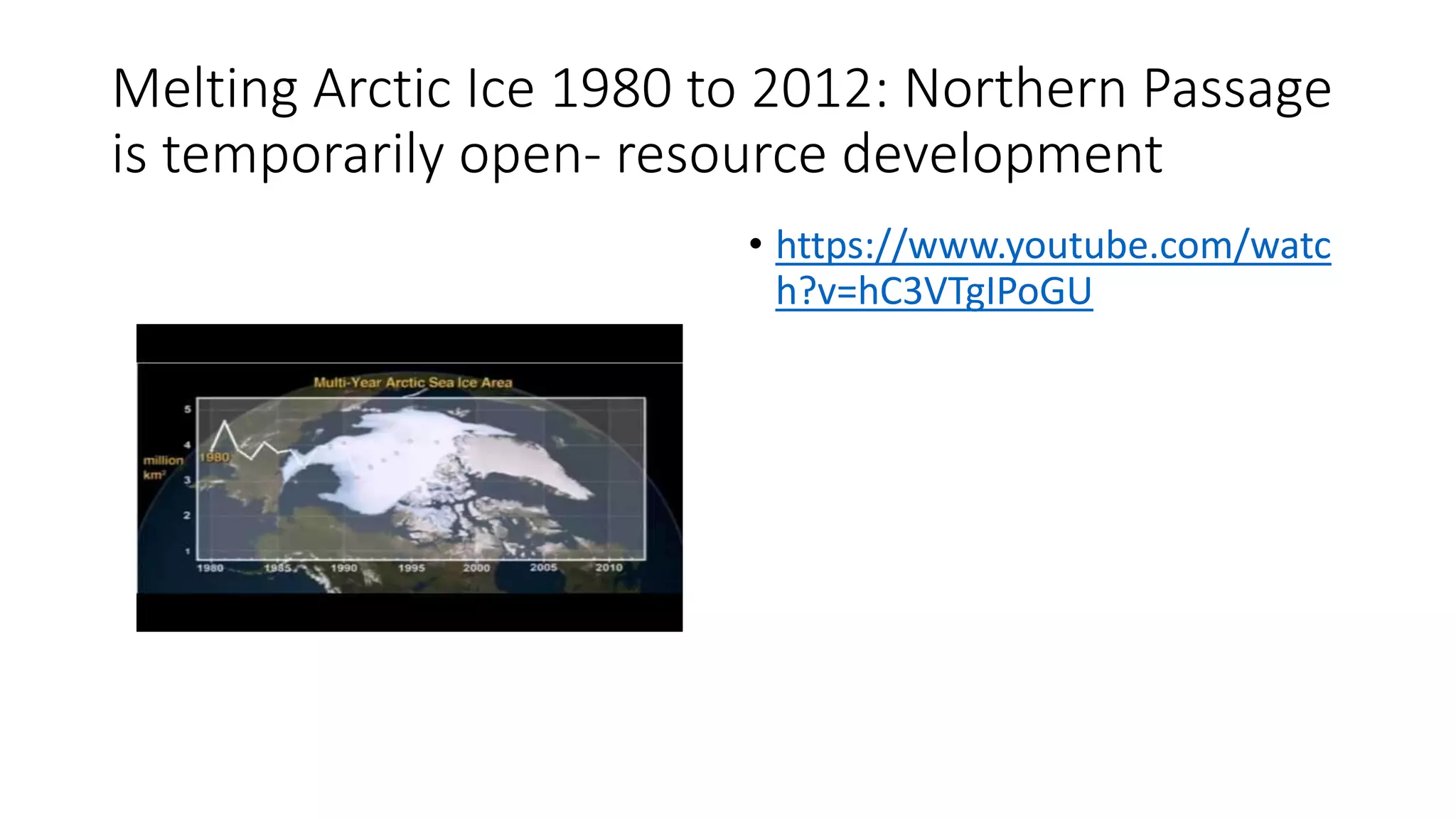
Melting Arctic Ice 1980 to 2012: Northern Passage
is temporarily open- resource development
• https://www.youtube.com/watc
h?v=hC3VTgIPoGU
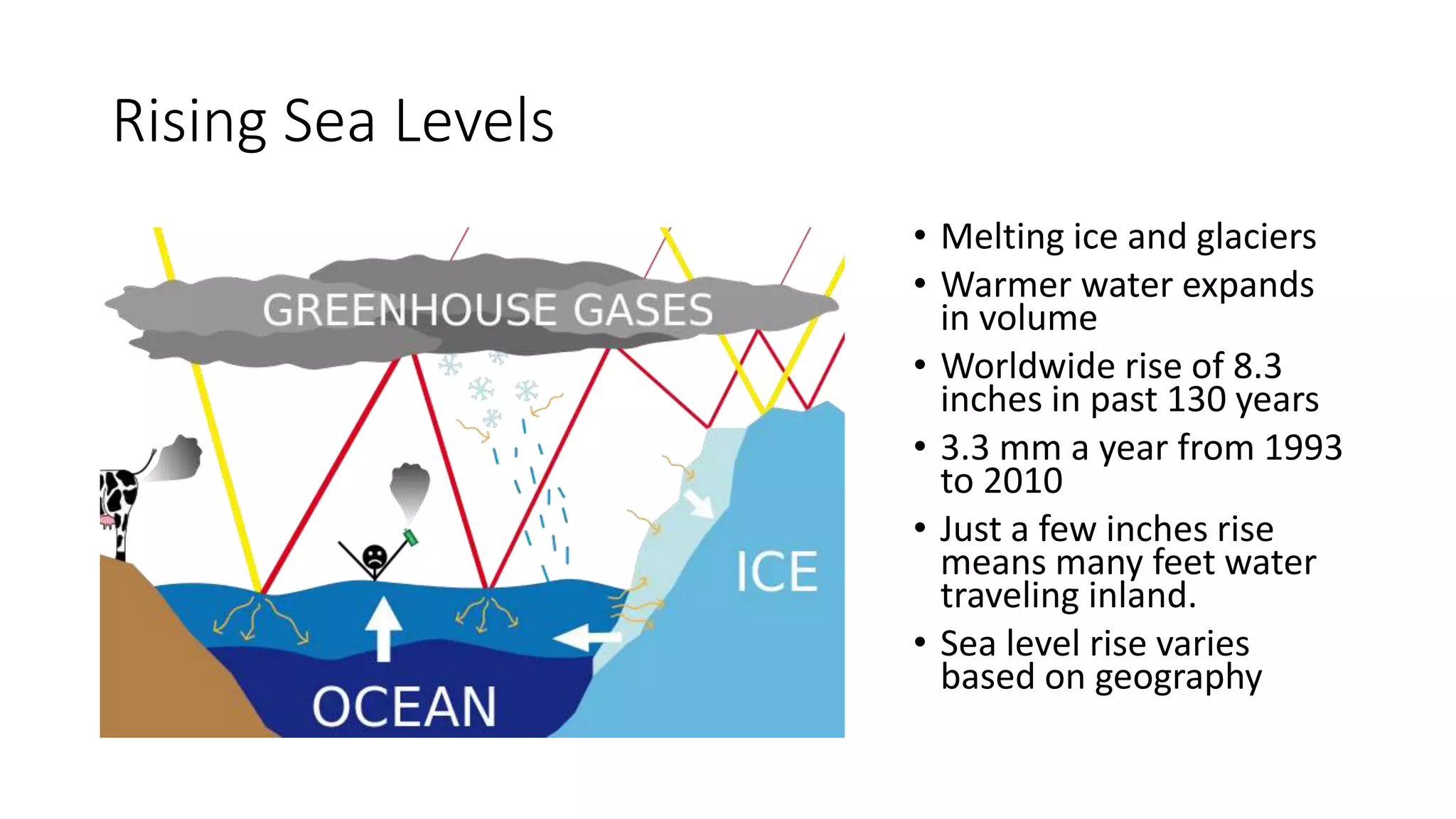
Rising Sea Levels
• Melting ice and glaciers
• Warmer water expands
in volume
• Worldwide rise of 8.3
inches in past 130 years
• 3.3 mm a year from 1993
to 2010
• Just a few inches rise
means many feet water
traveling inland.
• Sea level rise varies
based on geography
Rising Sea Levels
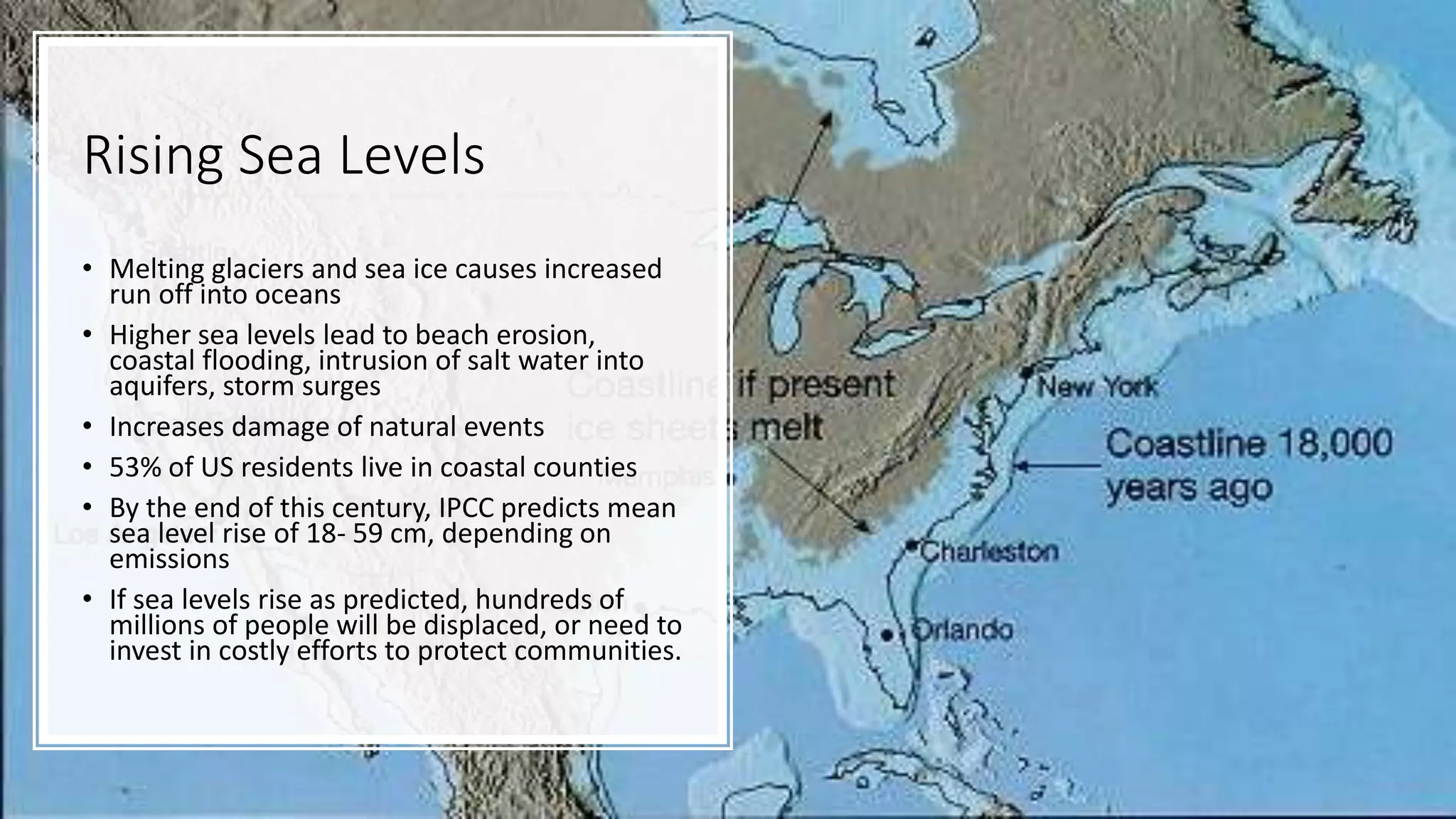
• Melting glaciers and sea ice causes increased
run off into oceans
• Higher sea levels lead to beach erosion,
coastal flooding, intrusion of salt water into
aquifers, storm surges
• Increases damage of natural events
• 53% of US residents live in coastal counties
• By the end of this century, IPCC predicts mean
sea level rise of 18- 59 cm, depending on
emissions
• If sea levels rise as predicted, hundreds of
millions of people will be displaced, or need to
invest in costly efforts to protect communities.
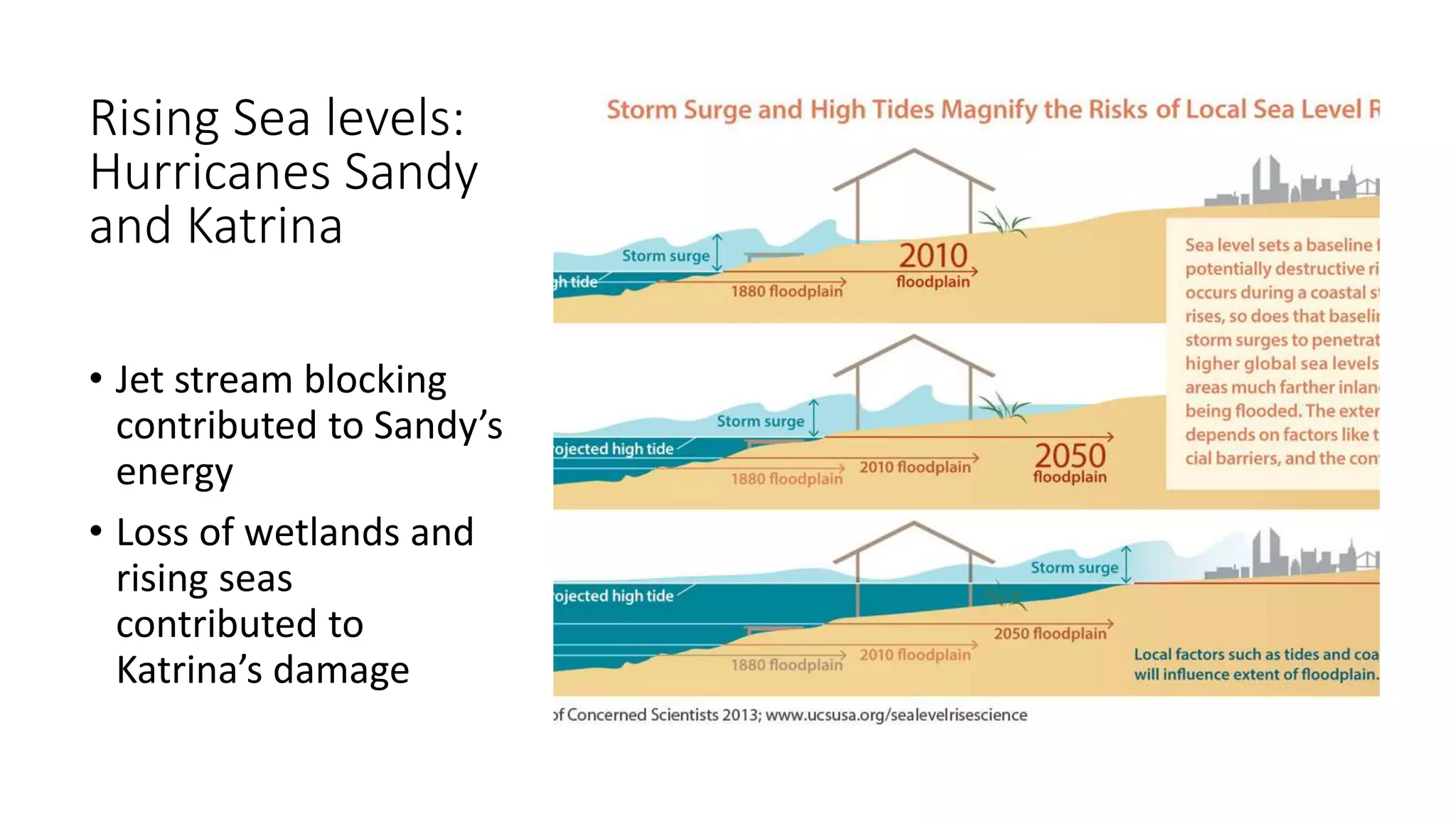
Rising Sea levels:
Hurricanes Sandy
and Katrina
• Jet stream blocking
contributed to Sandy’s
energy
• Loss of wetlands and
rising seas
contributed to
Katrina’s damage
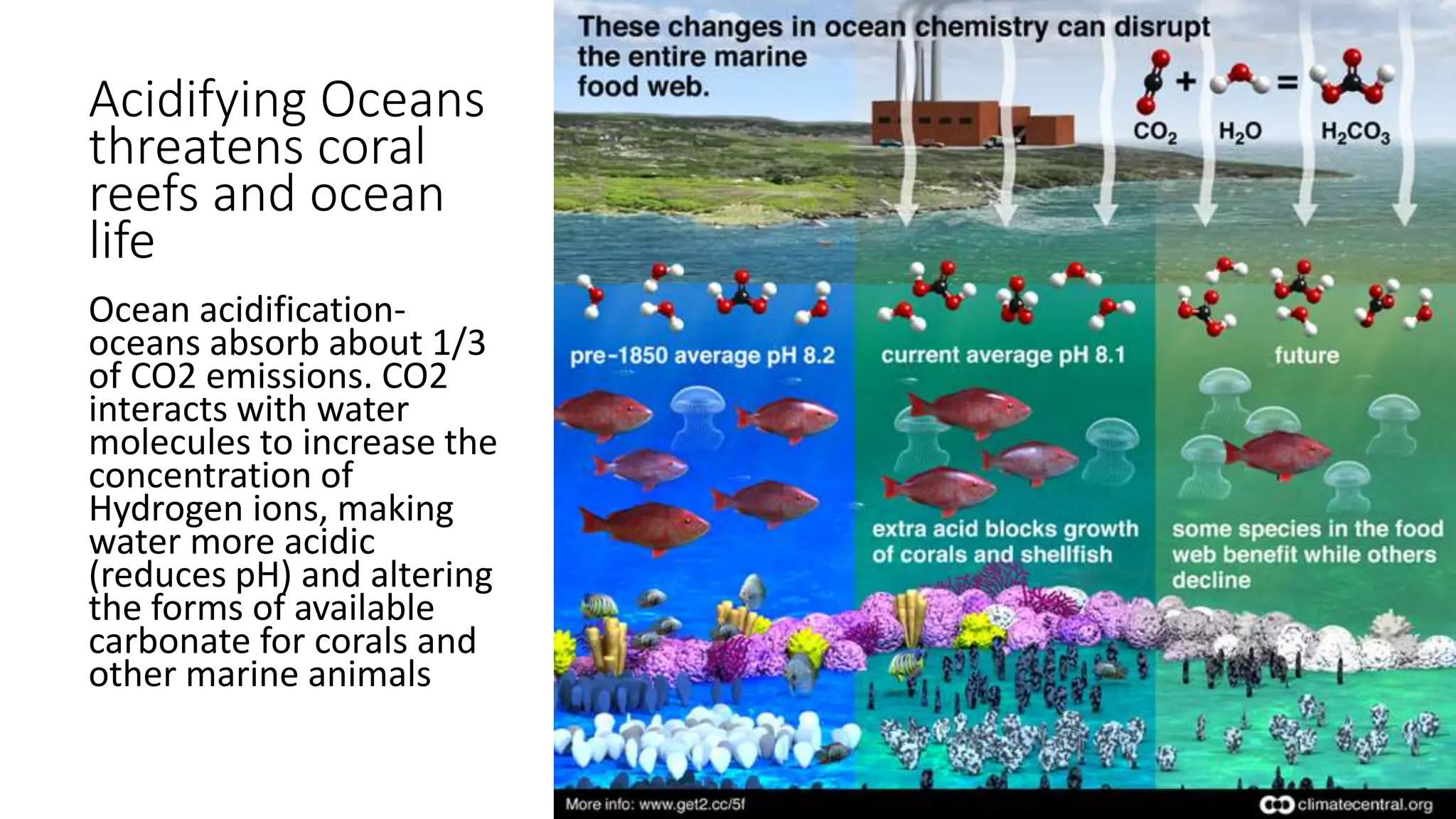
Acidifying Oceans
threatens coral
reefs and ocean
life
Ocean acidification-
oceans absorb about 1/3
of CO2 emissions. CO2
interacts with water
molecules to increase the
concentration of
Hydrogen ions, making
water more acidic
(reduces pH) and altering
the forms of available
carbonate for corals and
other marine animals
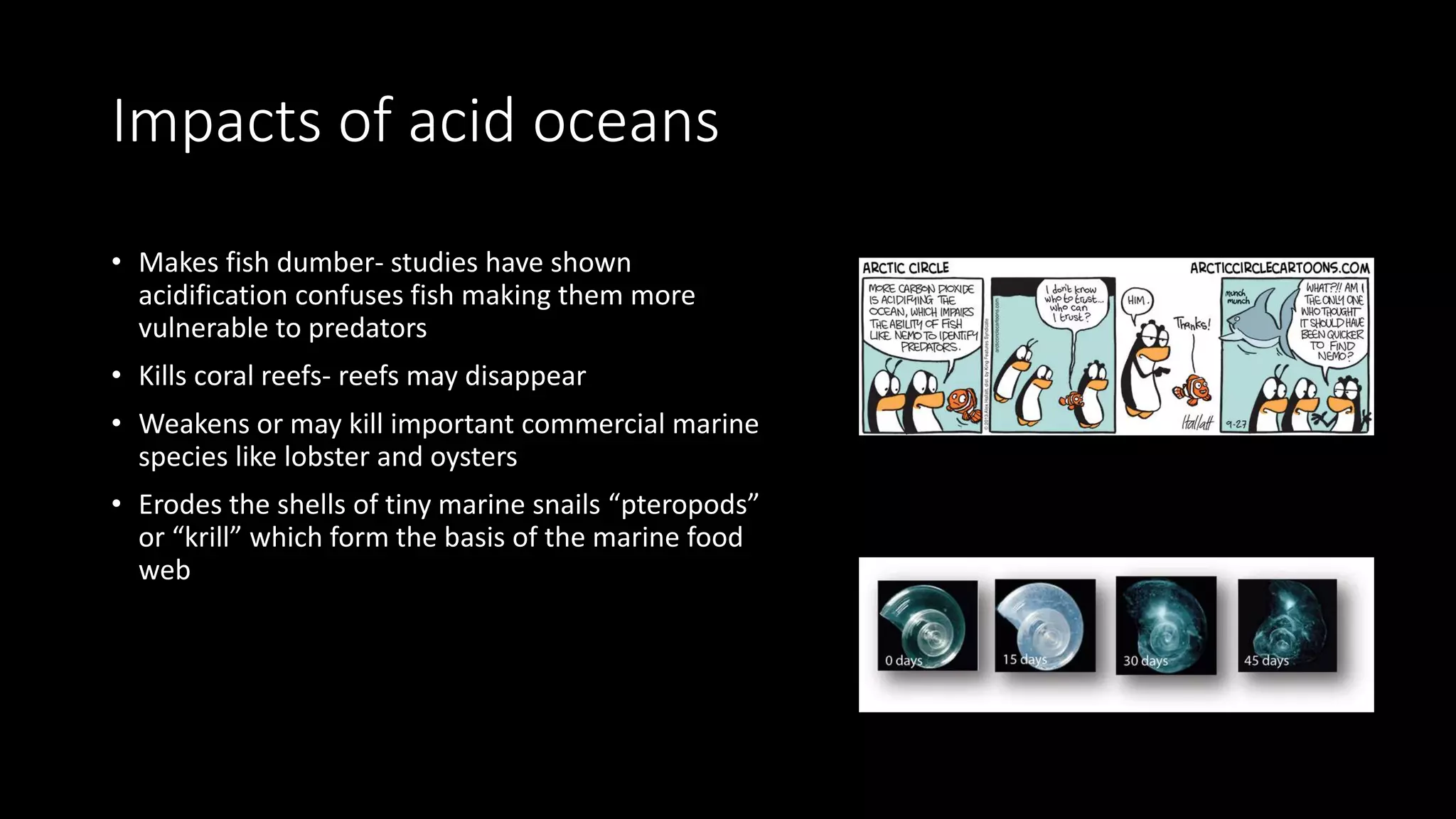
Impacts of acid oceans
• Makes fish dumber- studies have shown
acidification confuses fish making them more
vulnerable to predators
• Kills coral reefs- reefs may disappear
• Weakens or may kill important commercial marine
species like lobster and oysters
• Erodes the shells of tiny marine snails “pteropods”
or “krill” which form the basis of the marine food
web
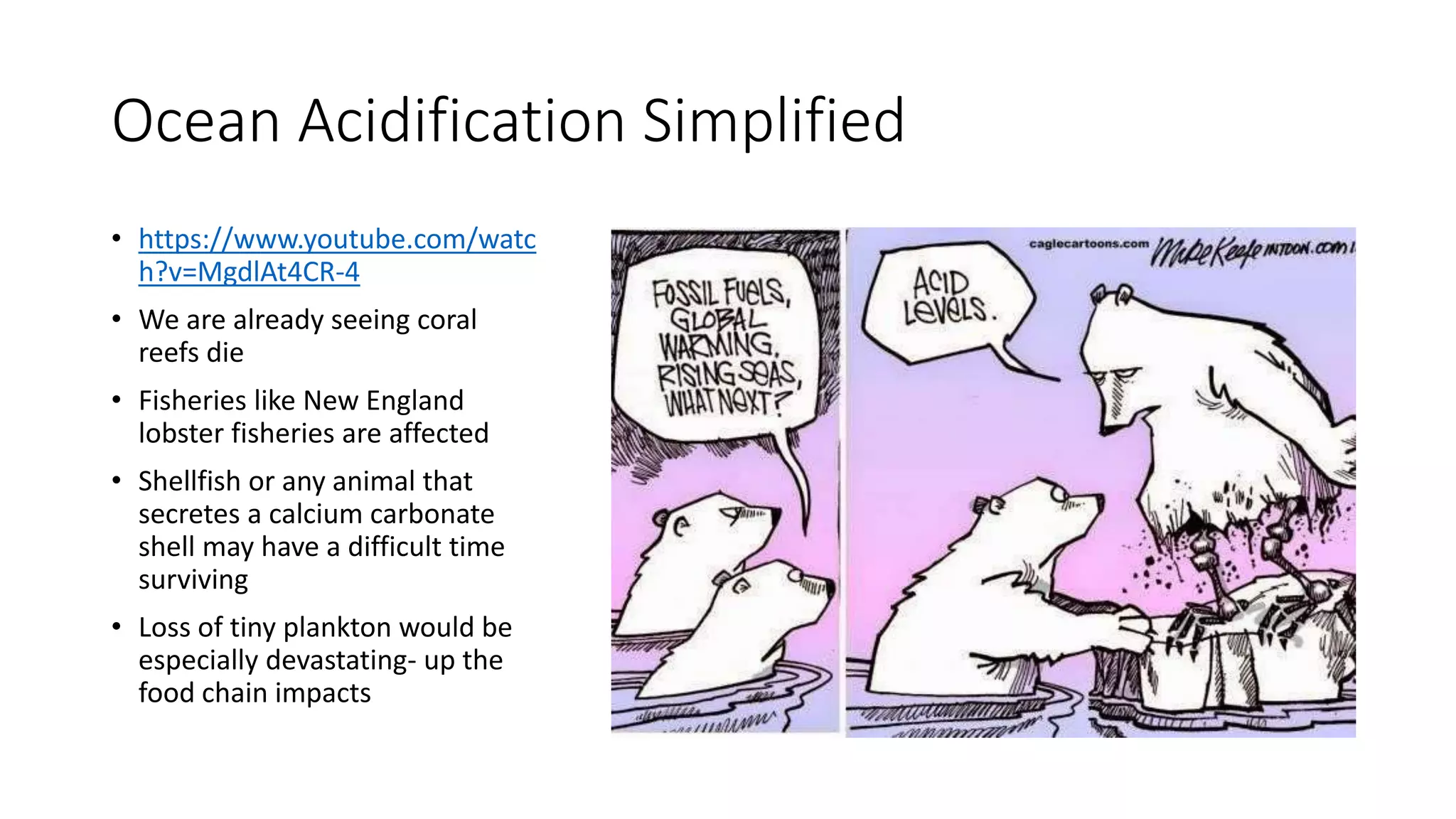
Ocean Acidification Simplified
• https://www.youtube.com/watc
h?v=MgdlAt4CR-4
• We are already seeing coral
reefs die
• Fisheries like New England
lobster fisheries are affected
• Shellfish or any animal that
secretes a calcium carbonate
shell may have a difficult time
surviving
• Loss of tiny plankton would be
especially devastating- up the
food chain impacts
Global warming
impacts on
ecosystems and
organisms
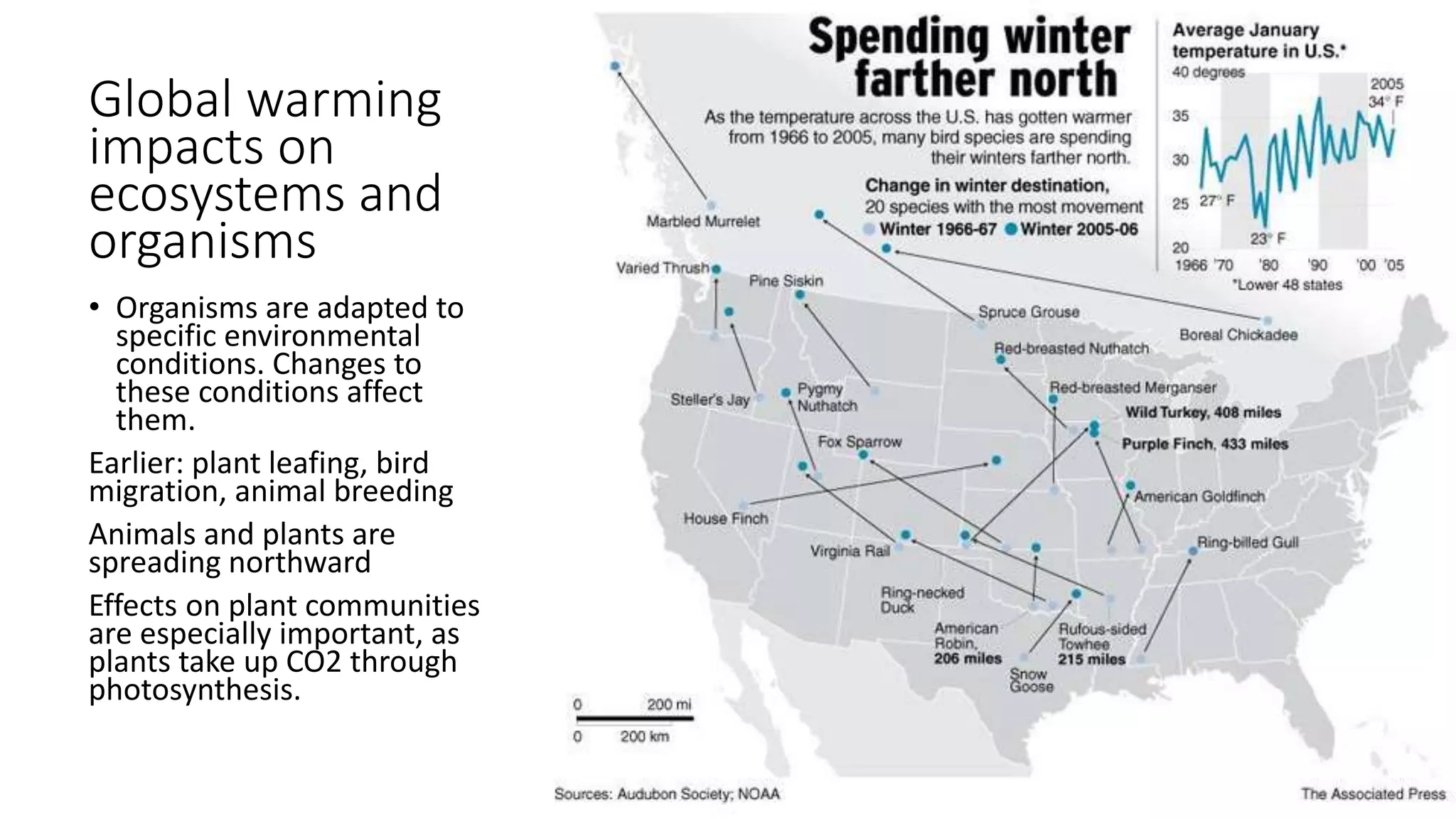
• Organisms are adapted to
specific environmental
conditions. Changes to
these conditions affect
them.
Earlier: plant leafing, bird
migration, animal breeding
Animals and plants are
spreading northward
Effects on plant communities
are especially important, as
plants take up CO2 through
photosynthesis.
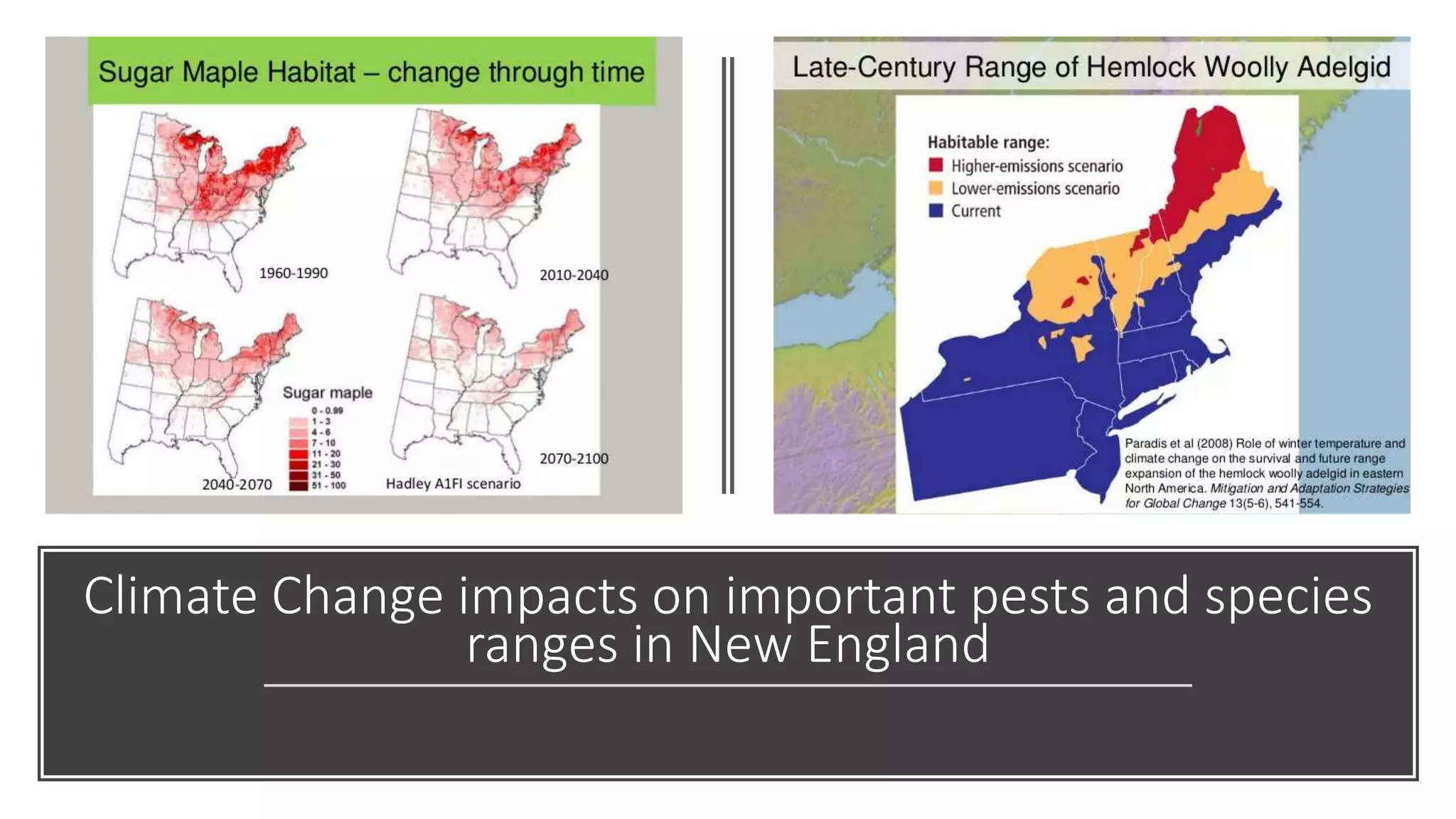
Climate Change impacts on important pests and species
ranges in New England
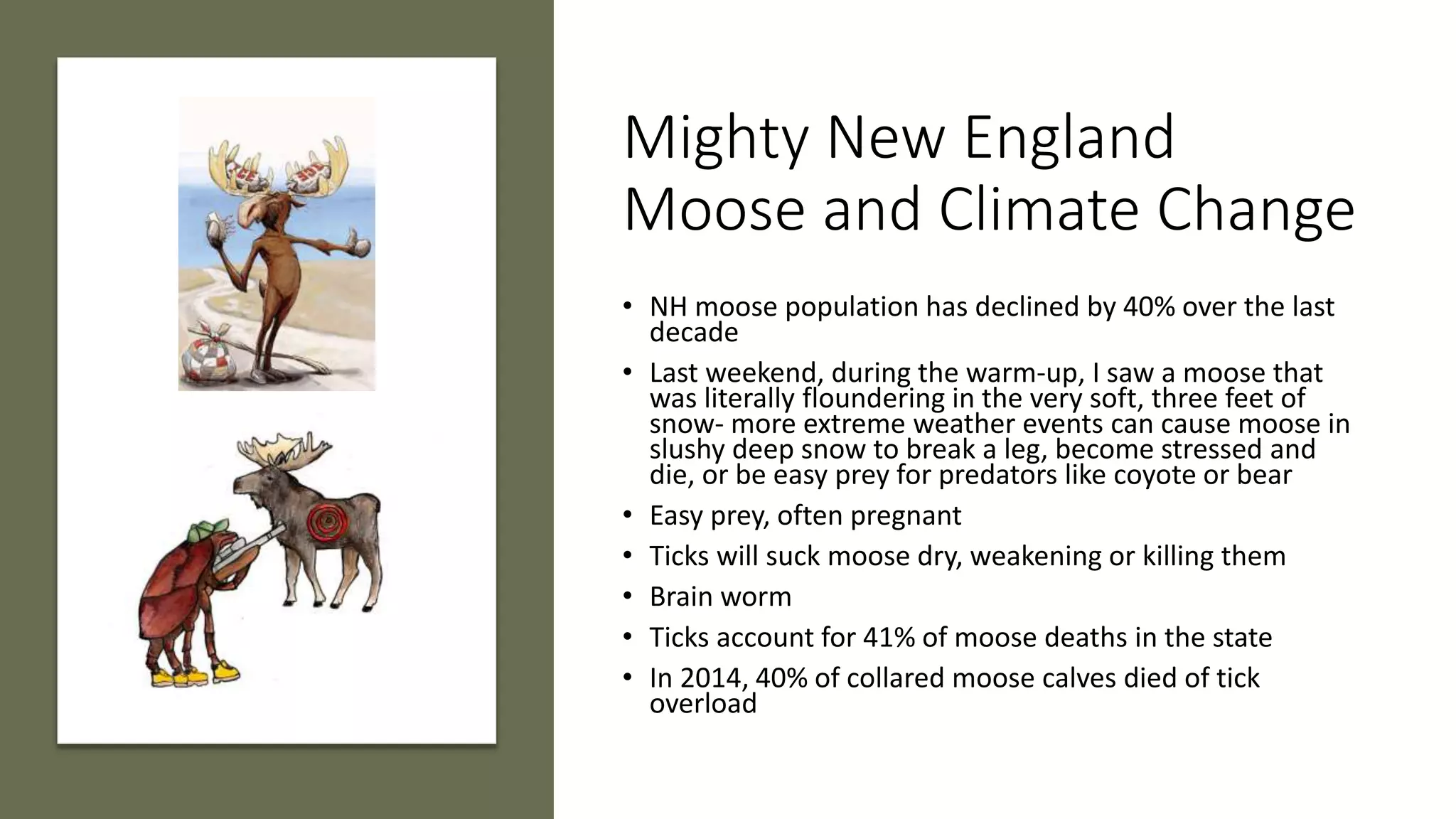
Mighty New England
Moose and Climate Change
• NH moose population has declined by 40% over the last
decade
• Last weekend, during the warm-up, I saw a moose that
was literally floundering in the very soft, three feet of
snow- more extreme weather events can cause moose in
slushy deep snow to break a leg, become stressed and
die, or be easy prey for predators like coyote or bear
• Easy prey, often pregnant
• Ticks will suck moose dry, weakening or killing them
• Brain worm
• Ticks account for 41% of moose deaths in the state
• In 2014, 40% of collared moose calves died of tick
overload
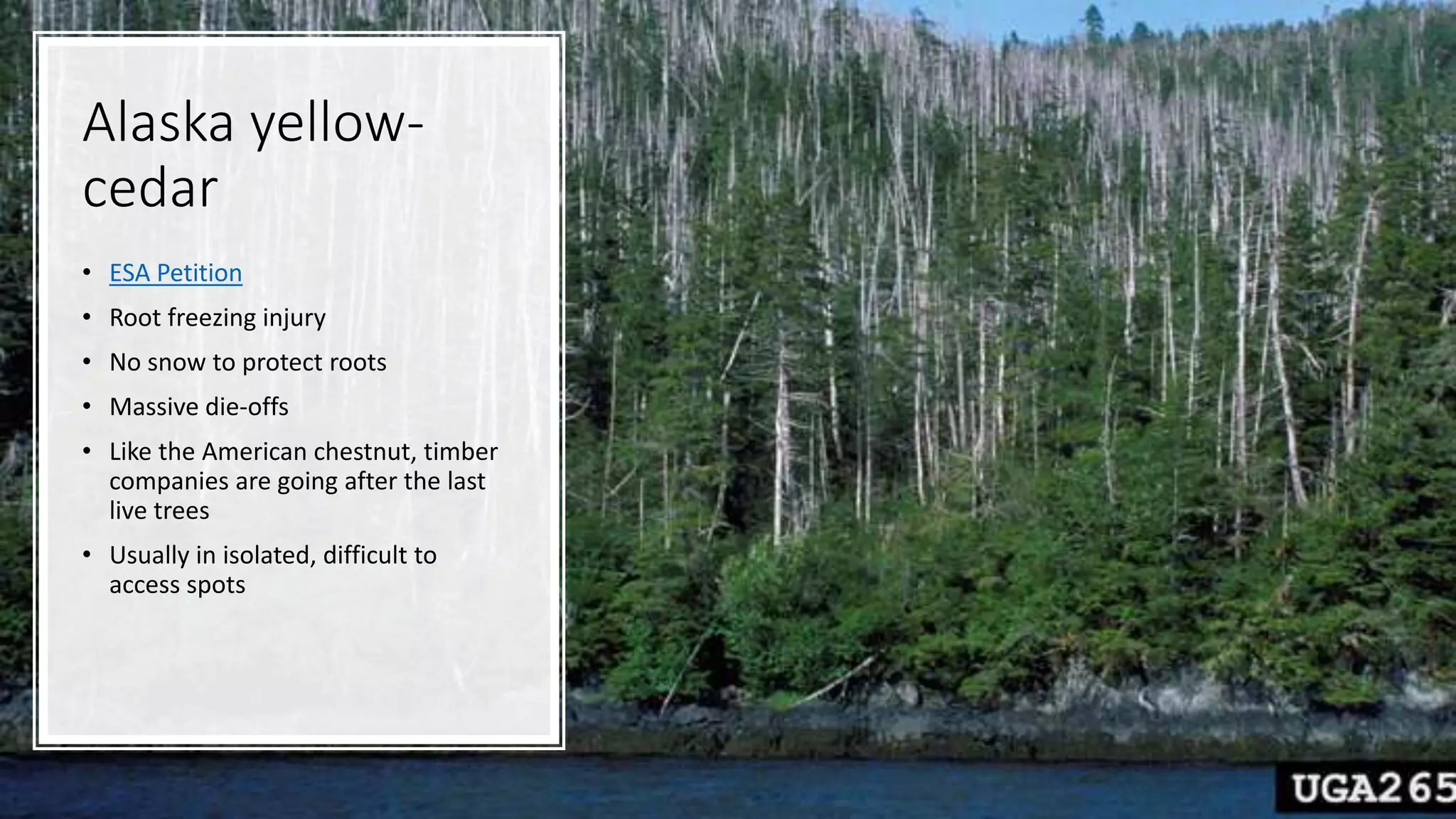
Alaska yellow-
cedar
• ESA Petition
• Root freezing injury
• No snow to protect roots
• Massive die-offs
• Like the American chestnut, timber
companies are going after the last
live trees
• Usually in isolated, difficult to
access spots
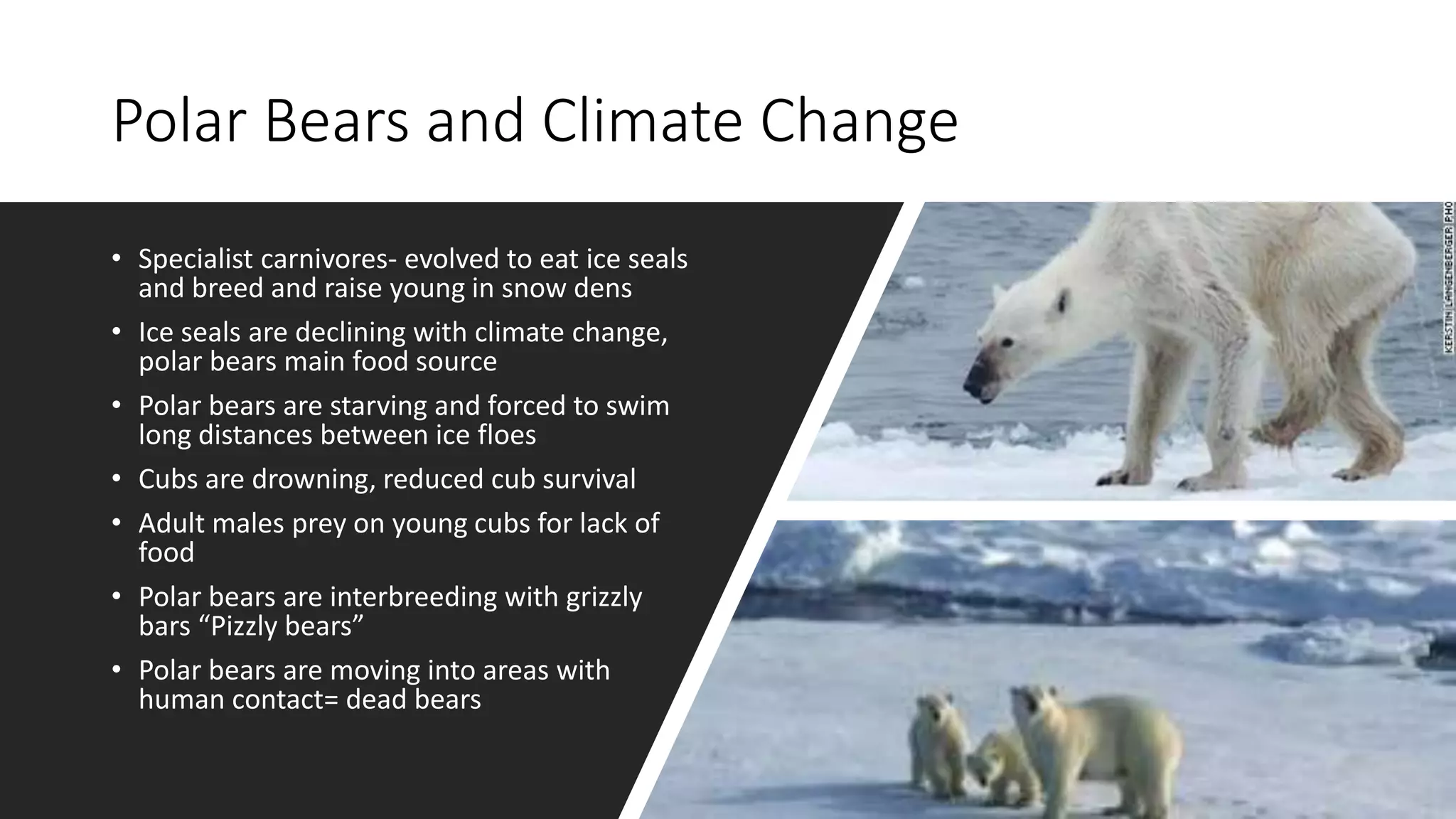
Polar Bears and Climate Change
• Specialist carnivores- evolved to eat ice seals
and breed and raise young in snow dens
• Ice seals are declining with climate change,
polar bears main food source
• Polar bears are starving and forced to swim
long distances between ice floes
• Cubs are drowning, reduced cub survival
• Adult males prey on young cubs for lack of
food
• Polar bears are interbreeding with grizzly
bars “Pizzly bears”
• Polar bears are moving into areas with
human contact= dead bears
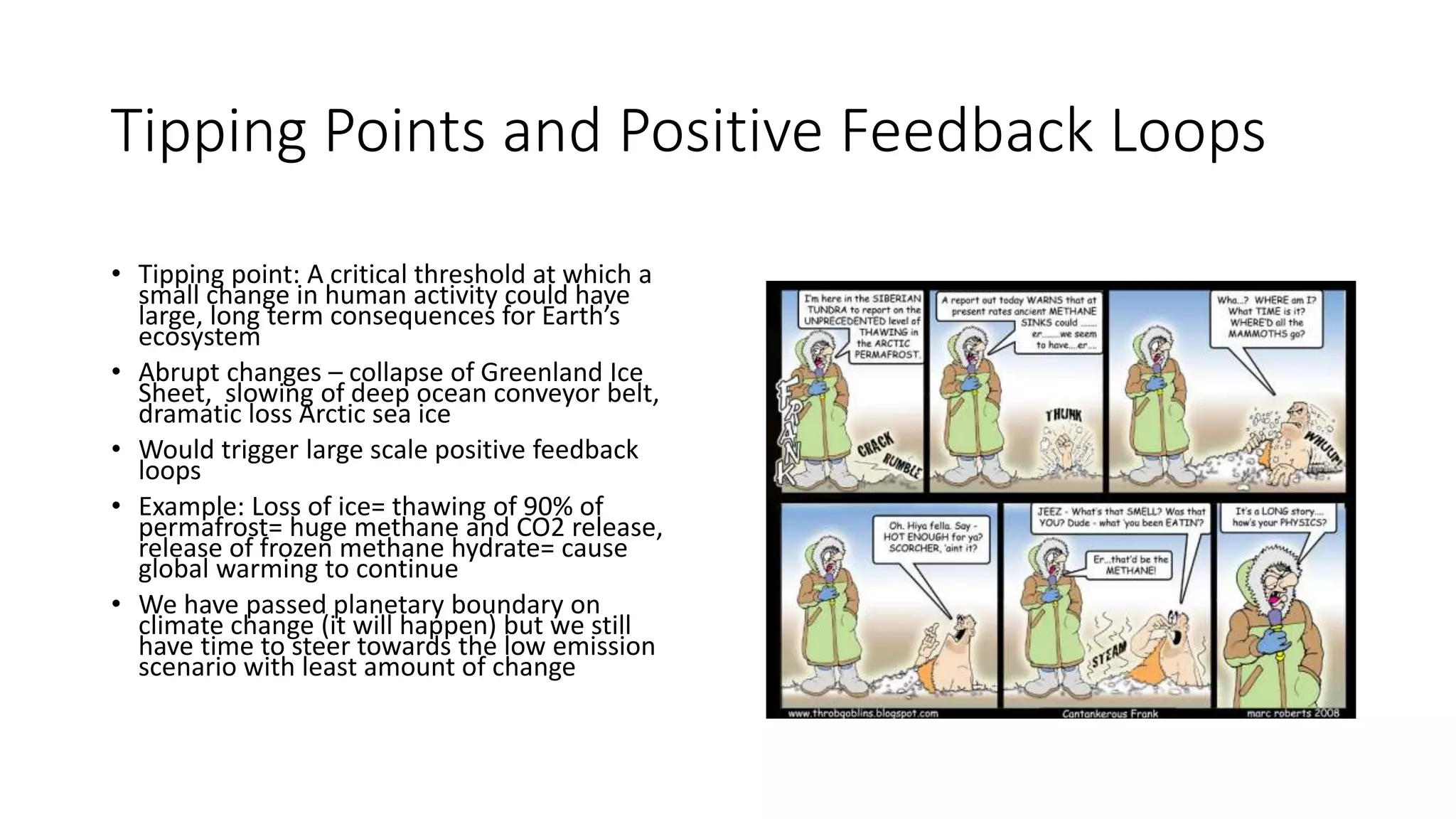
Tipping Points and Positive Feedback Loops
• Tipping point: A critical threshold at which a
small change in human activity could have
large, long term consequences for Earth’s
ecosystem
• Abrupt changes – collapse of Greenland Ice
Sheet, slowing of deep ocean conveyor belt,
dramatic loss Arctic sea ice
• Would trigger large scale positive feedback
loops
• Example: Loss of ice= thawing of 90% of
permafrost= huge methane and CO2 release,
release of frozen methane hydrate= cause
global warming to continue
• We have passed planetary boundary on
climate change (it will happen) but we still
have time to steer towards the low emission
scenario with least amount of change
Polar Bear Video
Polar Bears & Climate Change: Dr.
Andrew Derocher
Climate Change
and Society:
agriculture
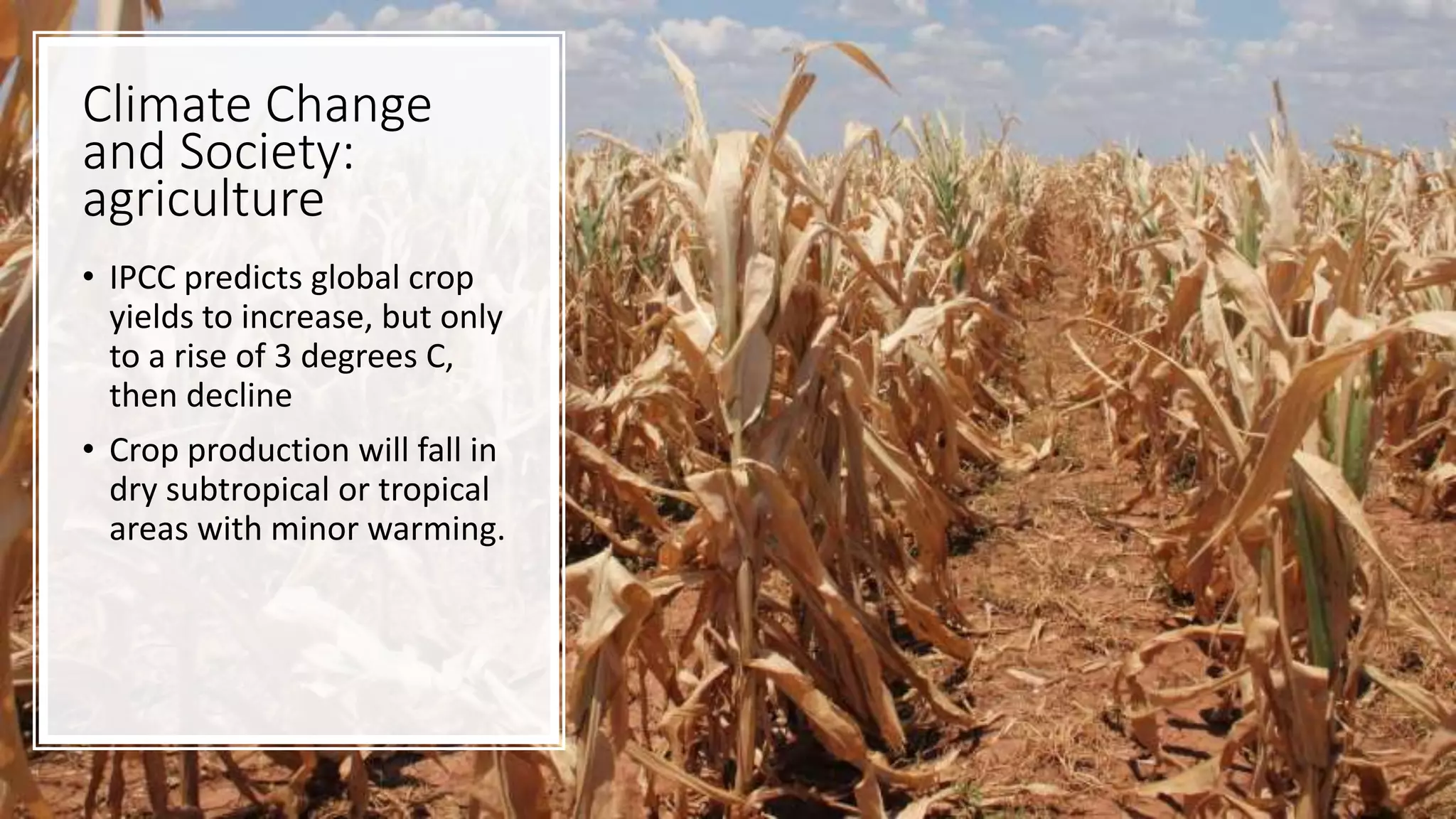
• IPCC predicts global crop
yields to increase, but only
to a rise of 3 degrees C,
then decline
• Crop production will fall in
dry subtropical or tropical
areas with minor warming.
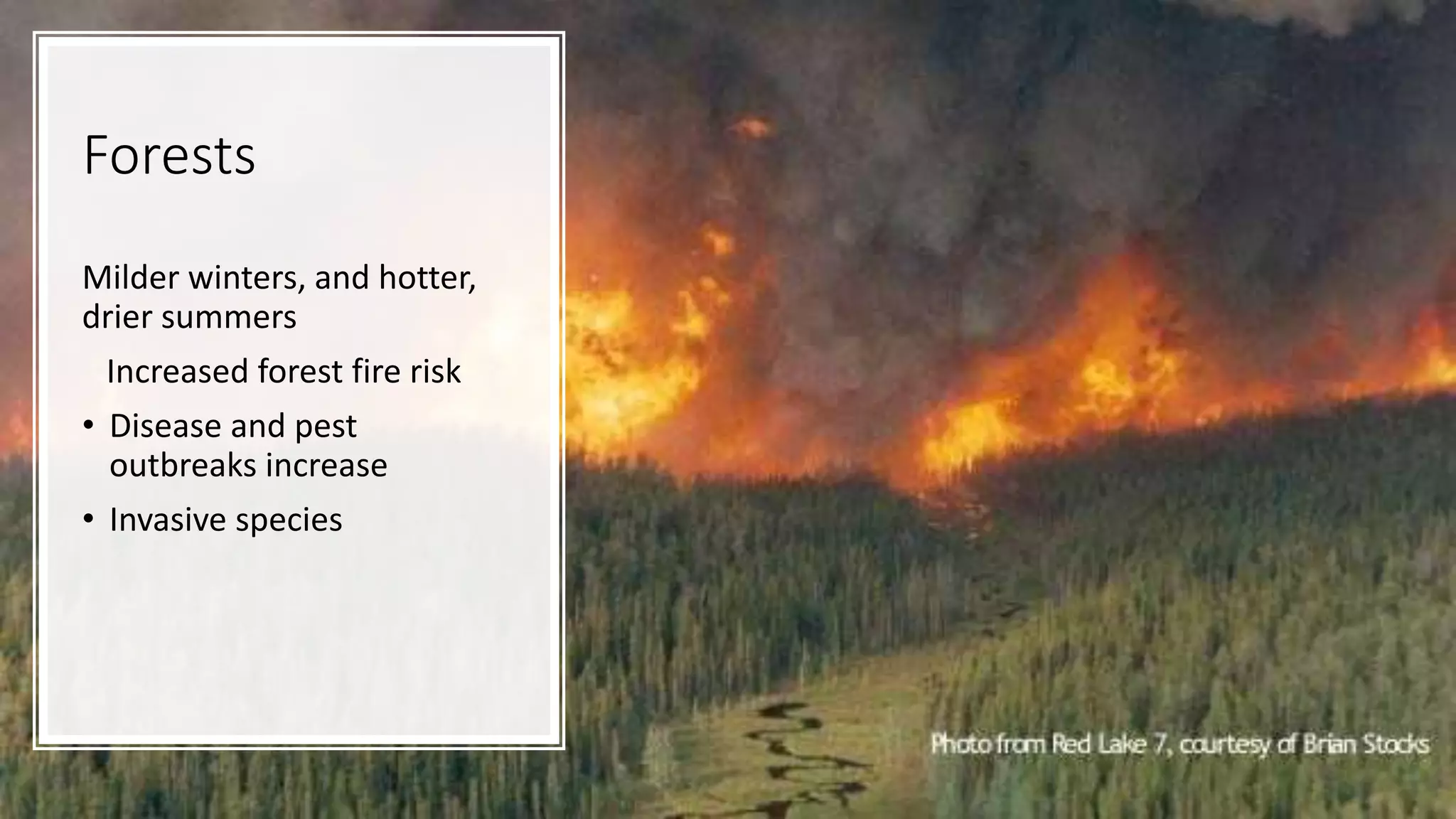
Forests
Milder winters, and hotter,
drier summers
Increased forest fire risk
• Disease and pest
outbreaks increase
• Invasive species
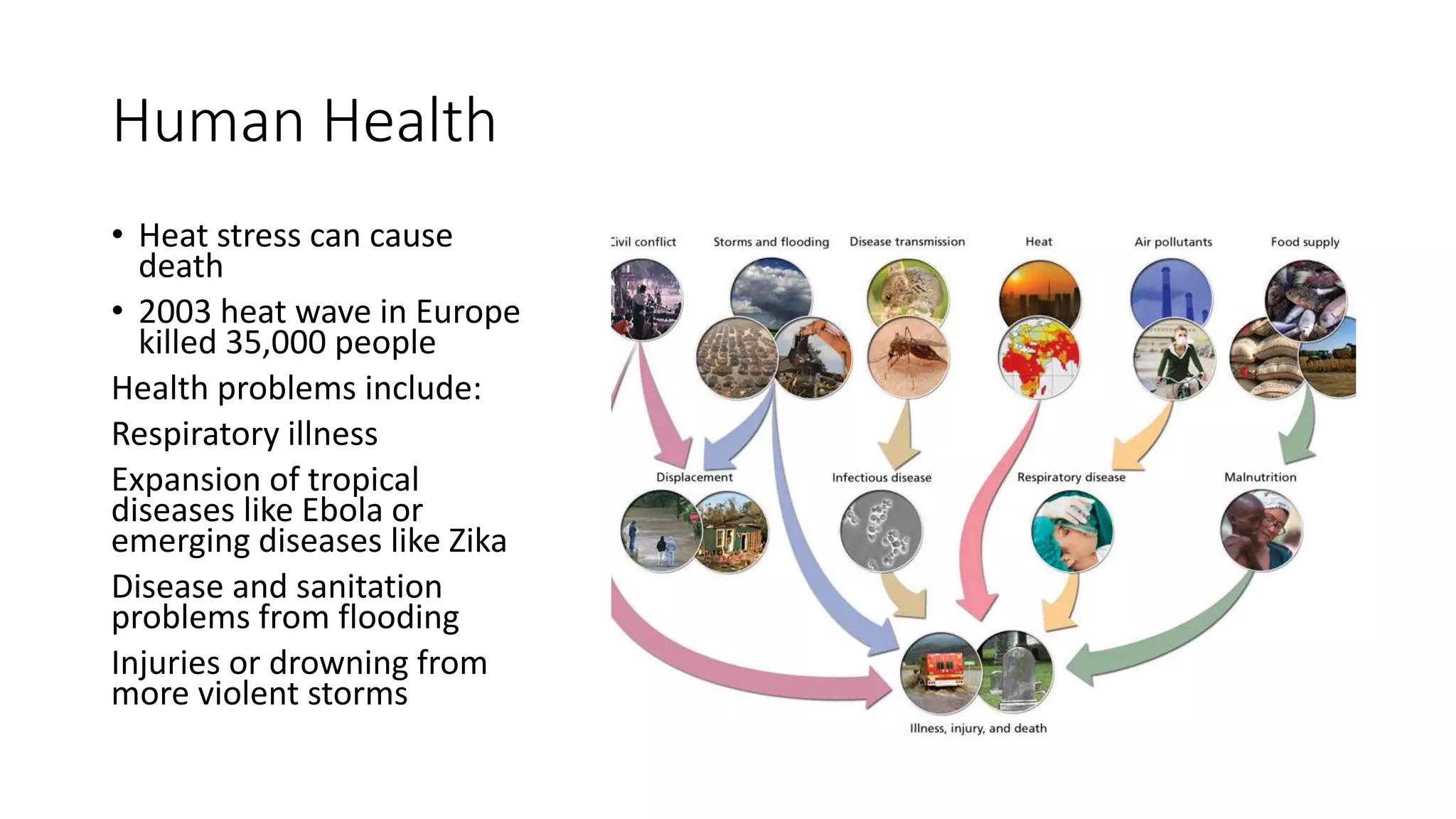
Human Health
• Heat stress can cause
death
• 2003 heat wave in Europe
killed 35,000 people
Health problems include:
Respiratory illness
Expansion of tropical
diseases like Ebola or
emerging diseases like Zika
Disease and sanitation
problems from flooding
Injuries or drowning from
more violent storms
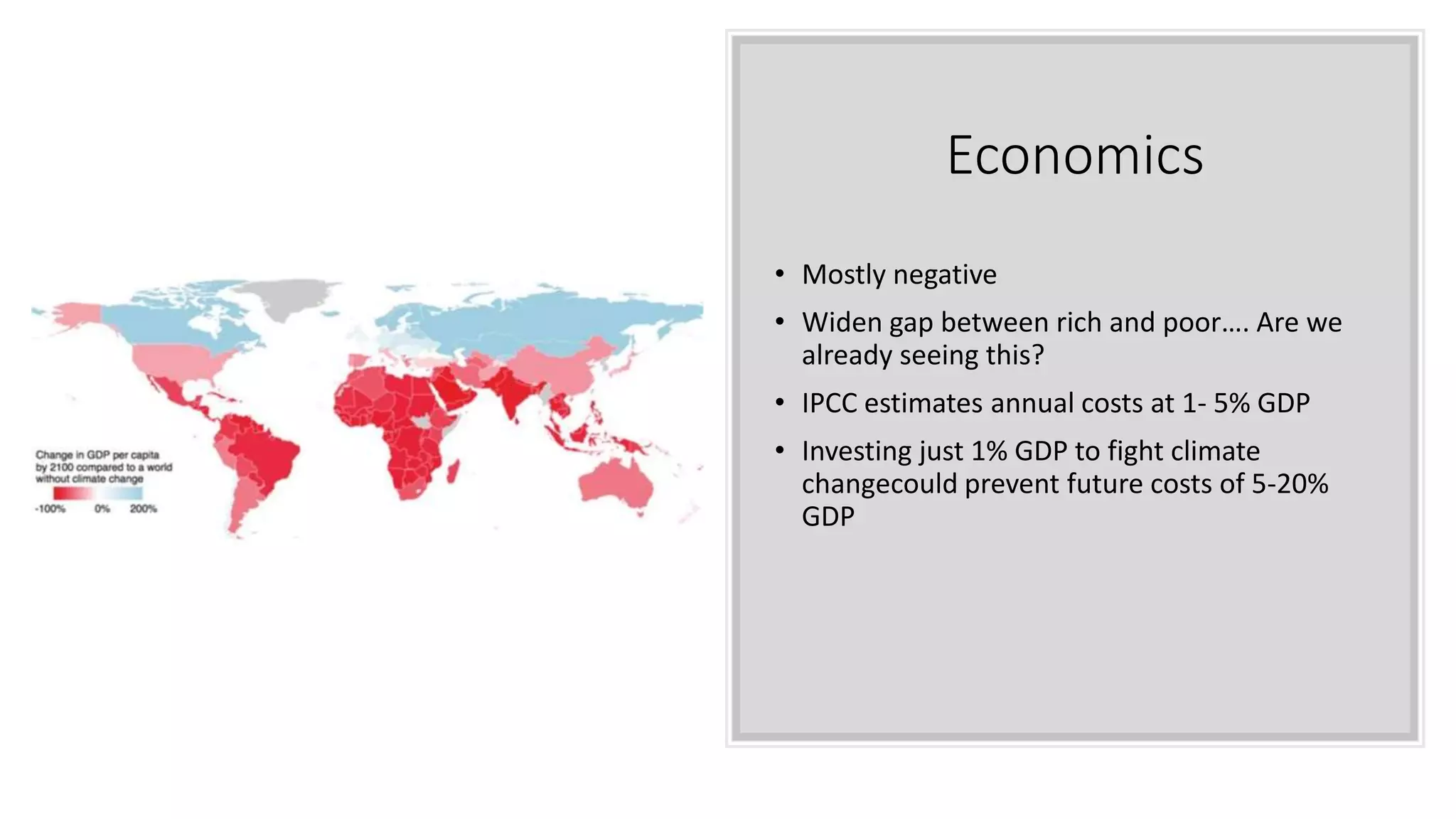
Economics
• Mostly negative
• Widen gap between rich and poor…. Are we
already seeing this?
• IPCC estimates annual costs at 1- 5% GDP
• Investing just 1% GDP to fight climate
changecould prevent future costs of 5-20%
GDP
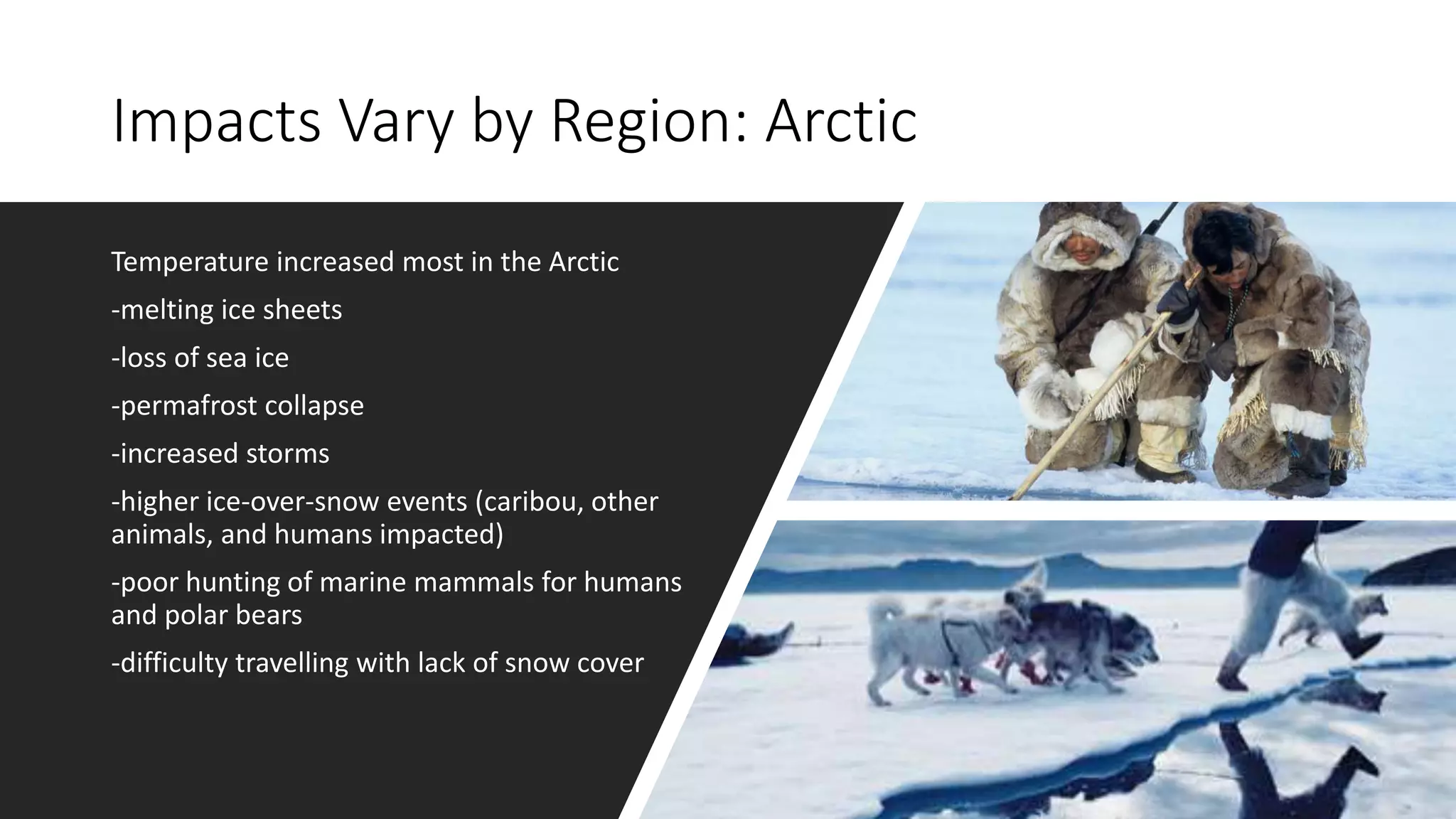
Impacts Vary by Region: Arctic
Temperature increased most in the Arctic
-melting ice sheets
-loss of sea ice
-permafrost collapse
-increased storms
-higher ice-over-snow events (caribou, other
animals, and humans impacted)
-poor hunting of marine mammals for humans
and polar bears
-difficulty travelling with lack of snow cover
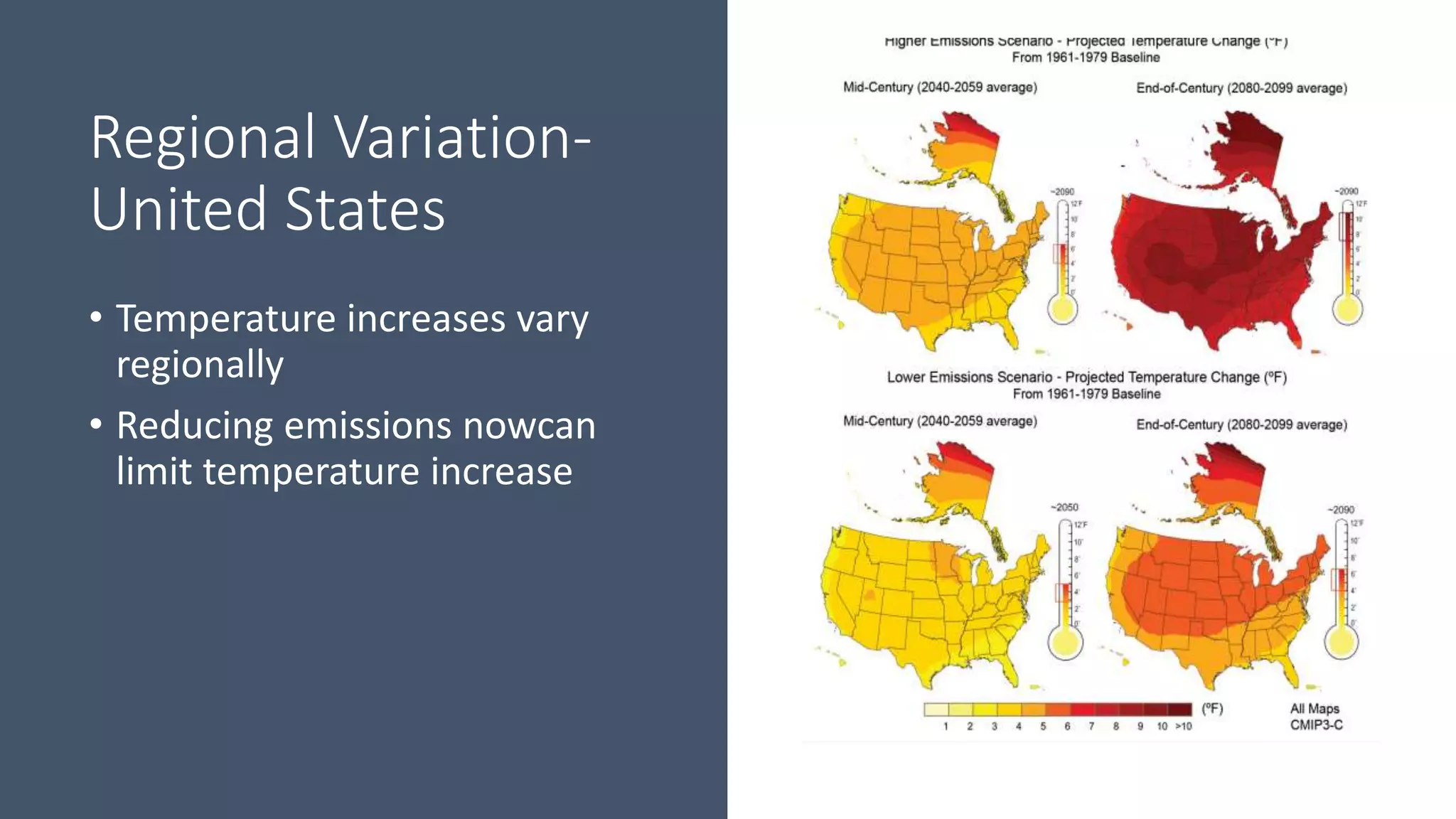
Regional Variation-
United States
• Temperature increases vary
regionally
• Reducing emissions nowcan
limit temperature increase
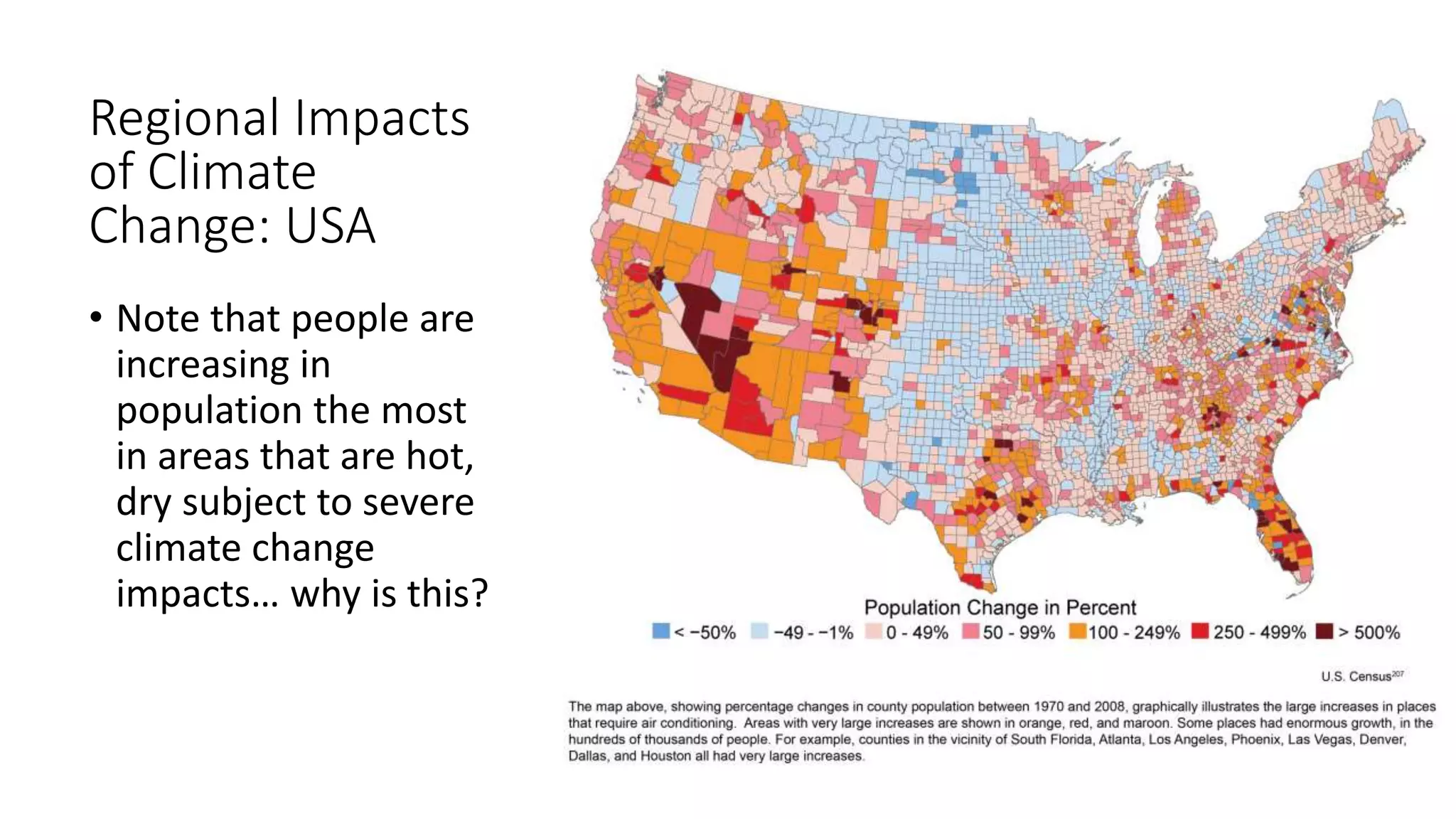
Regional Impacts
of Climate
Change: USA
• Note that people are
increasing in
population the most
in areas that are hot,
dry subject to severe
climate change
impacts… why is this?
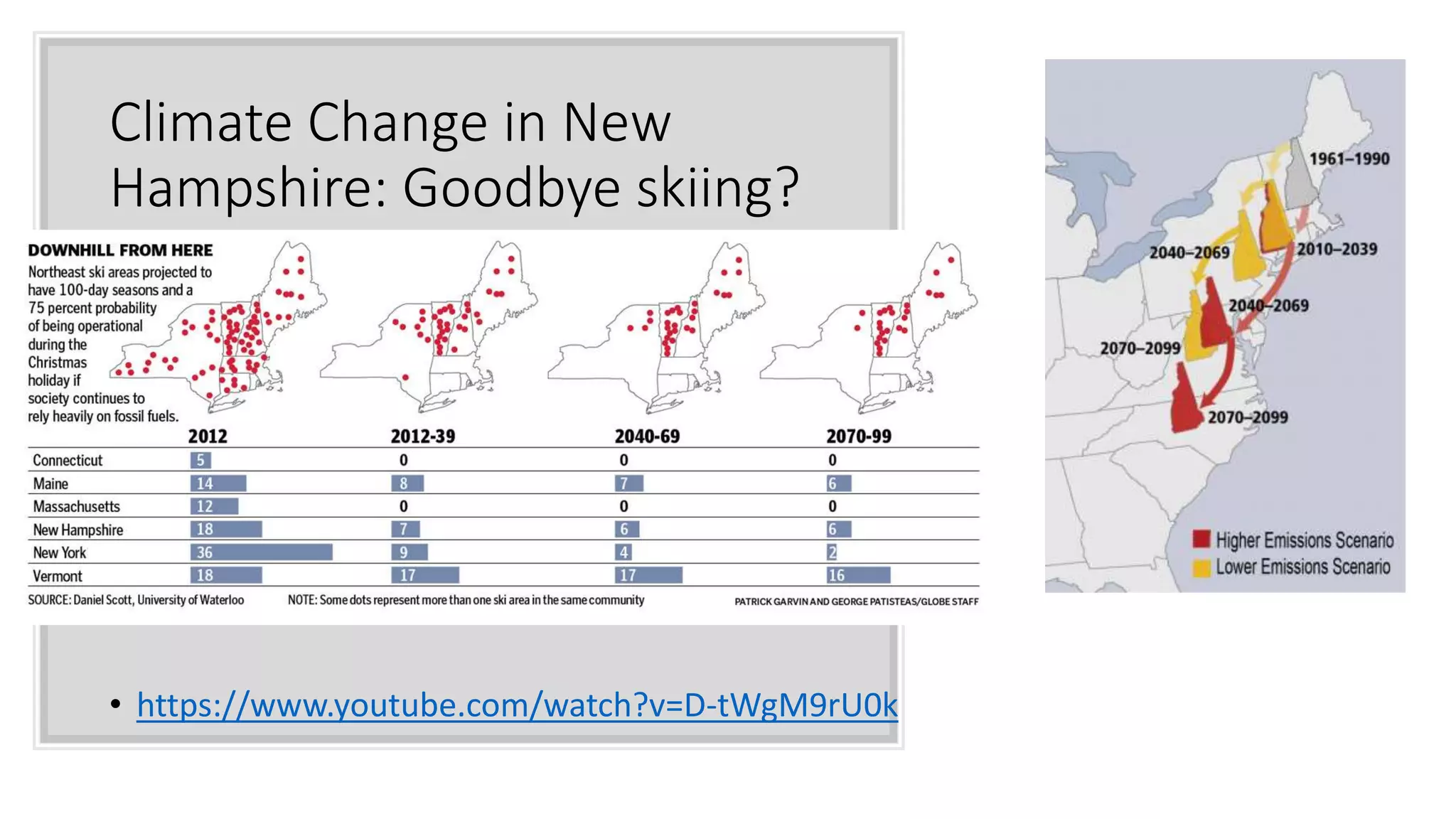
Climate Change in New
Hampshire: Goodbye skiing?
• https://www.youtube.com/watch?v=D-tWgM9rU0k
We did start the fire…
who is responsible?
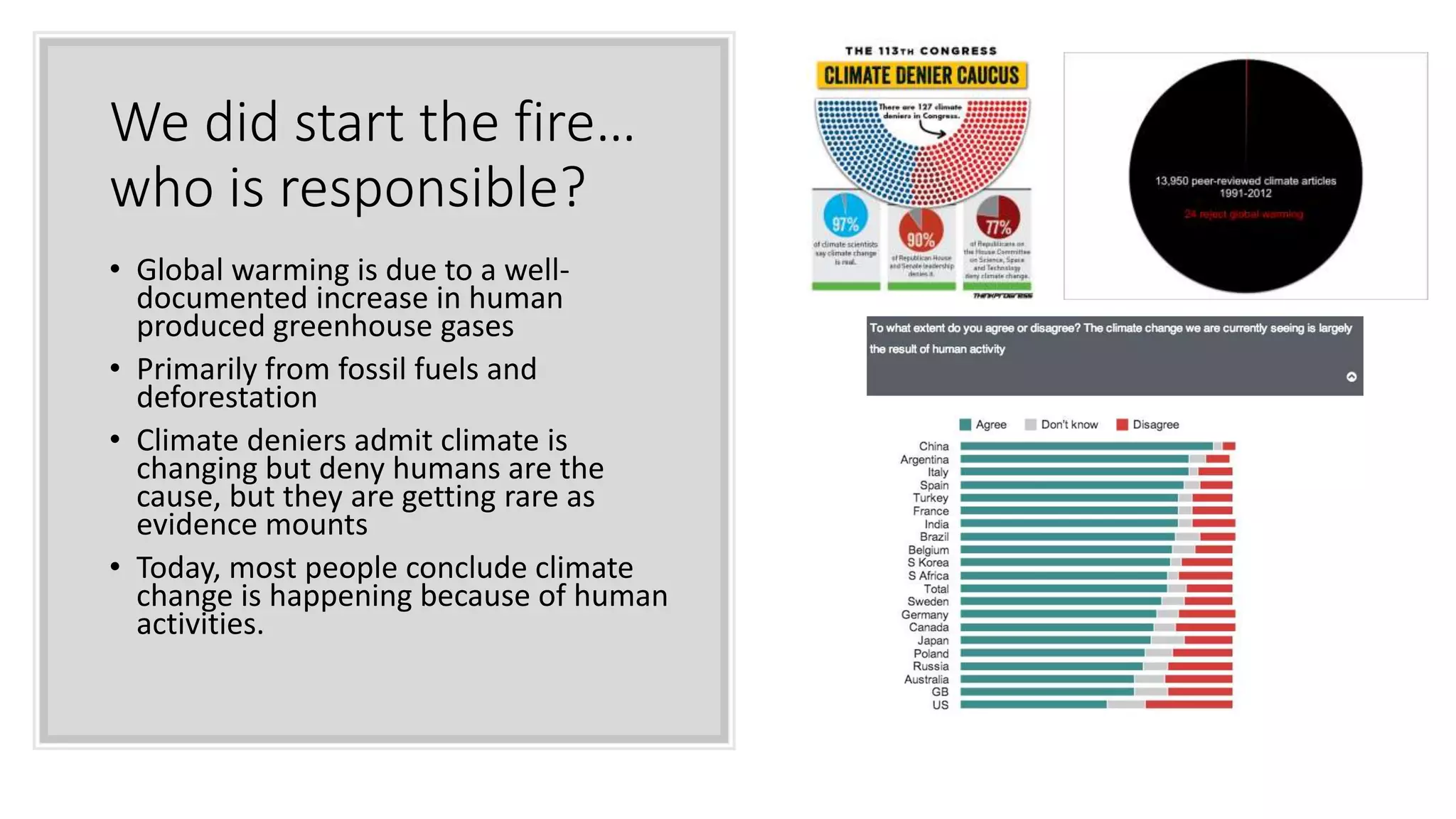
• Global warming is due to a well-
documented increase in human
produced greenhouse gases
• Primarily from fossil fuels and
deforestation
• Climate deniers admit climate is
changing but deny humans are the
cause, but they are getting rare as
evidence mounts
• Today, most people conclude climate
change is happening because of human
activities.
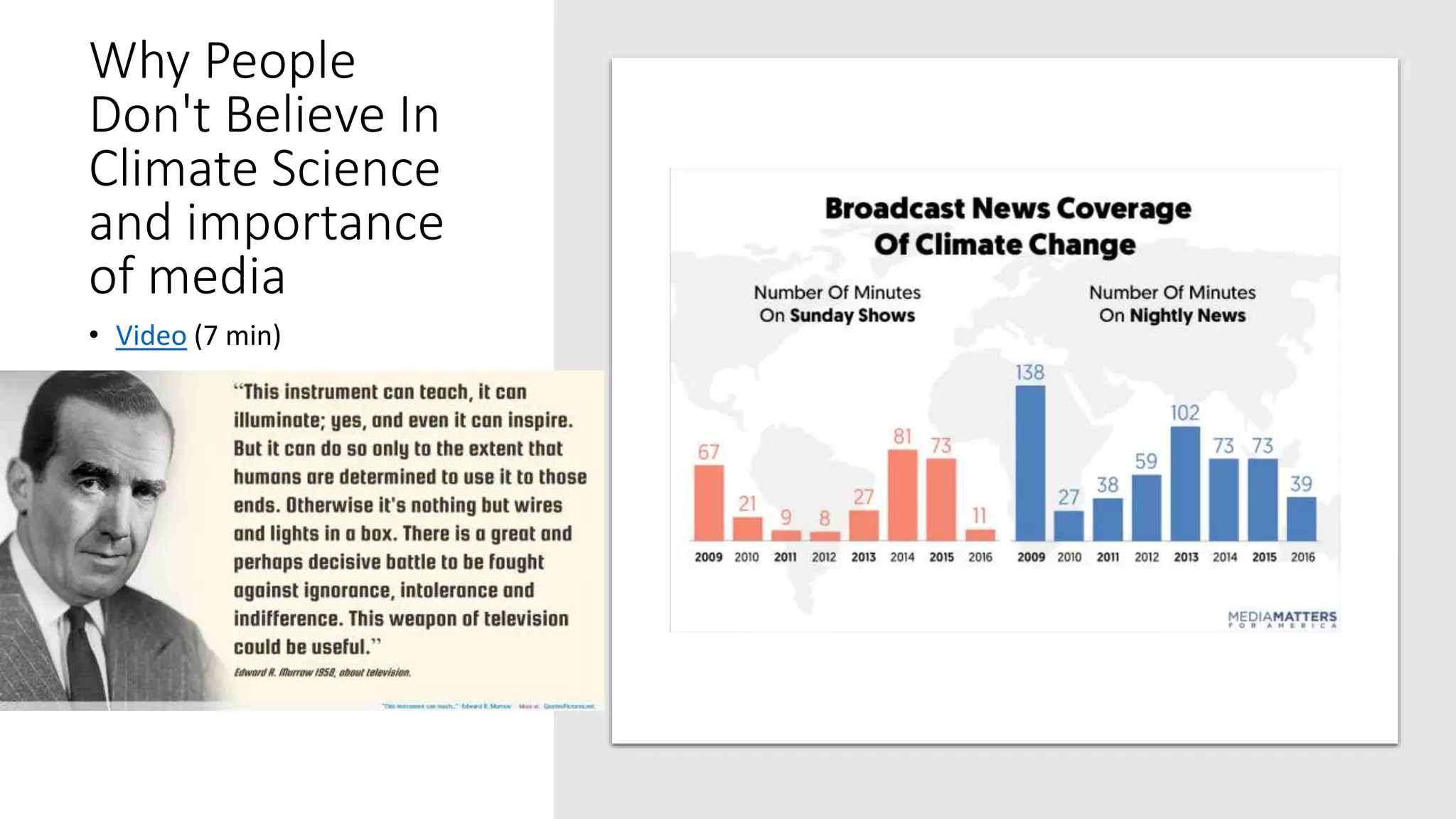
Why People
Don't Believe In
Climate Science
and importance
of media
• Video (7 min)
•
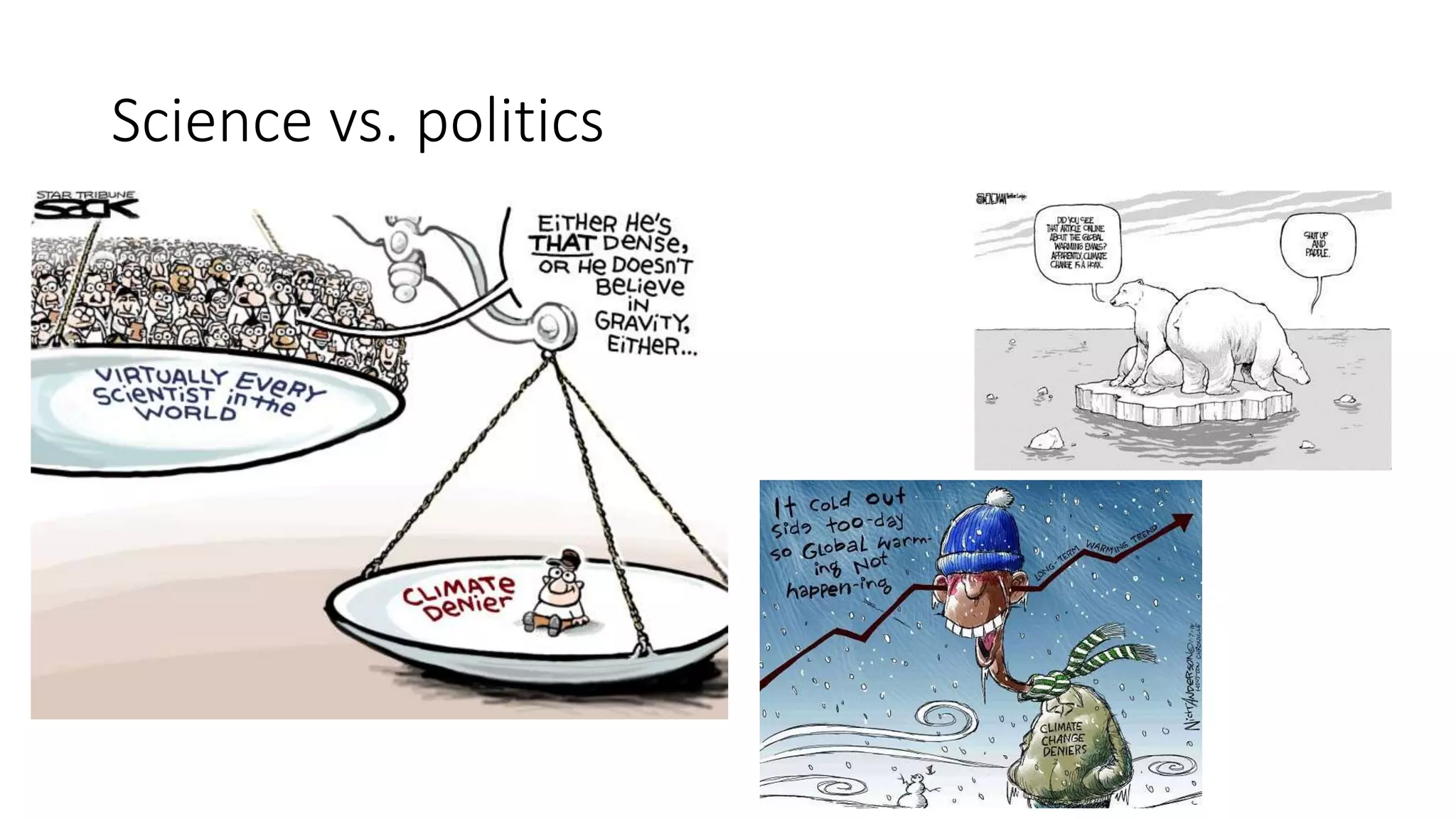
Science vs. politics
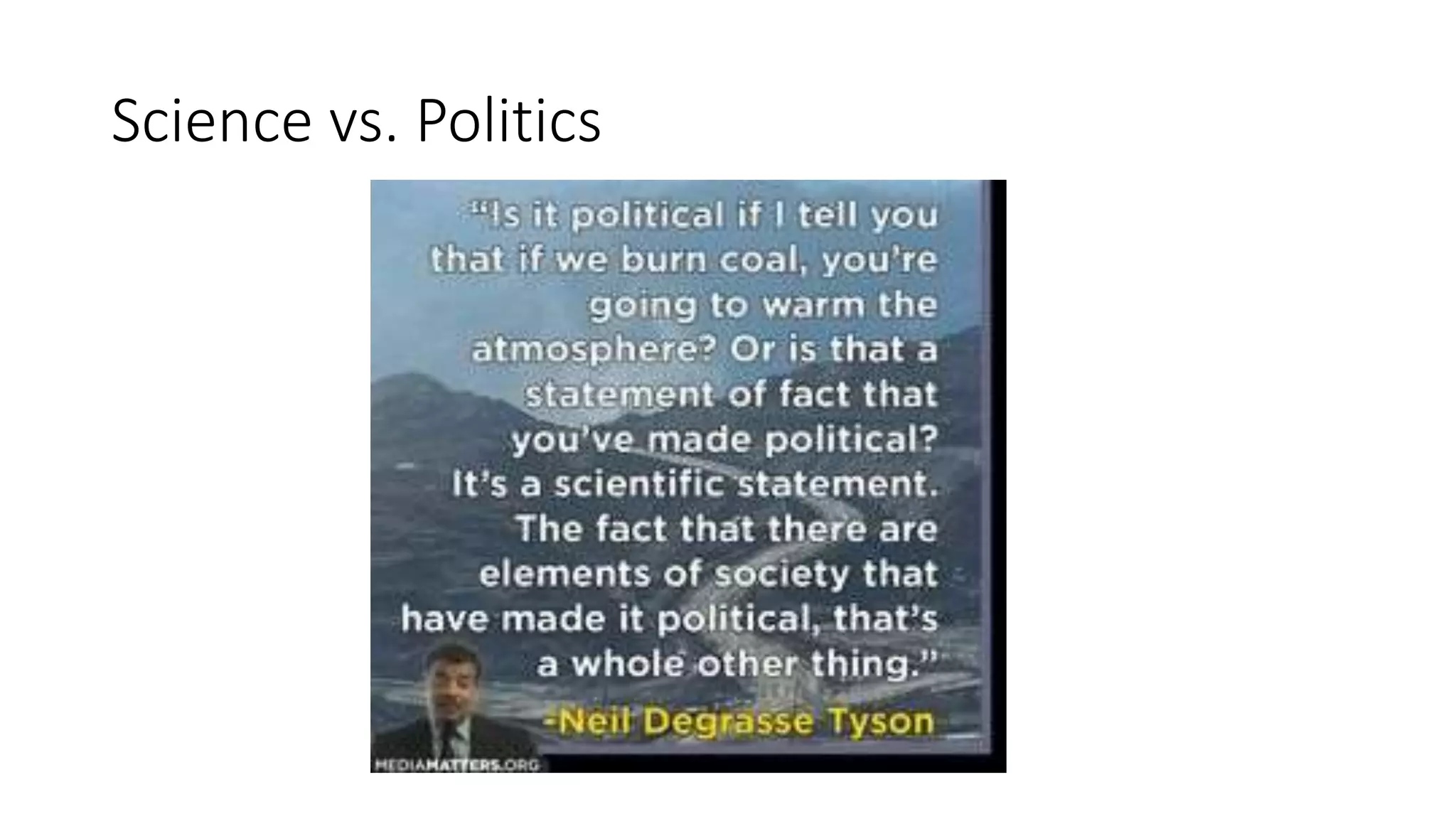
Science vs. Politics
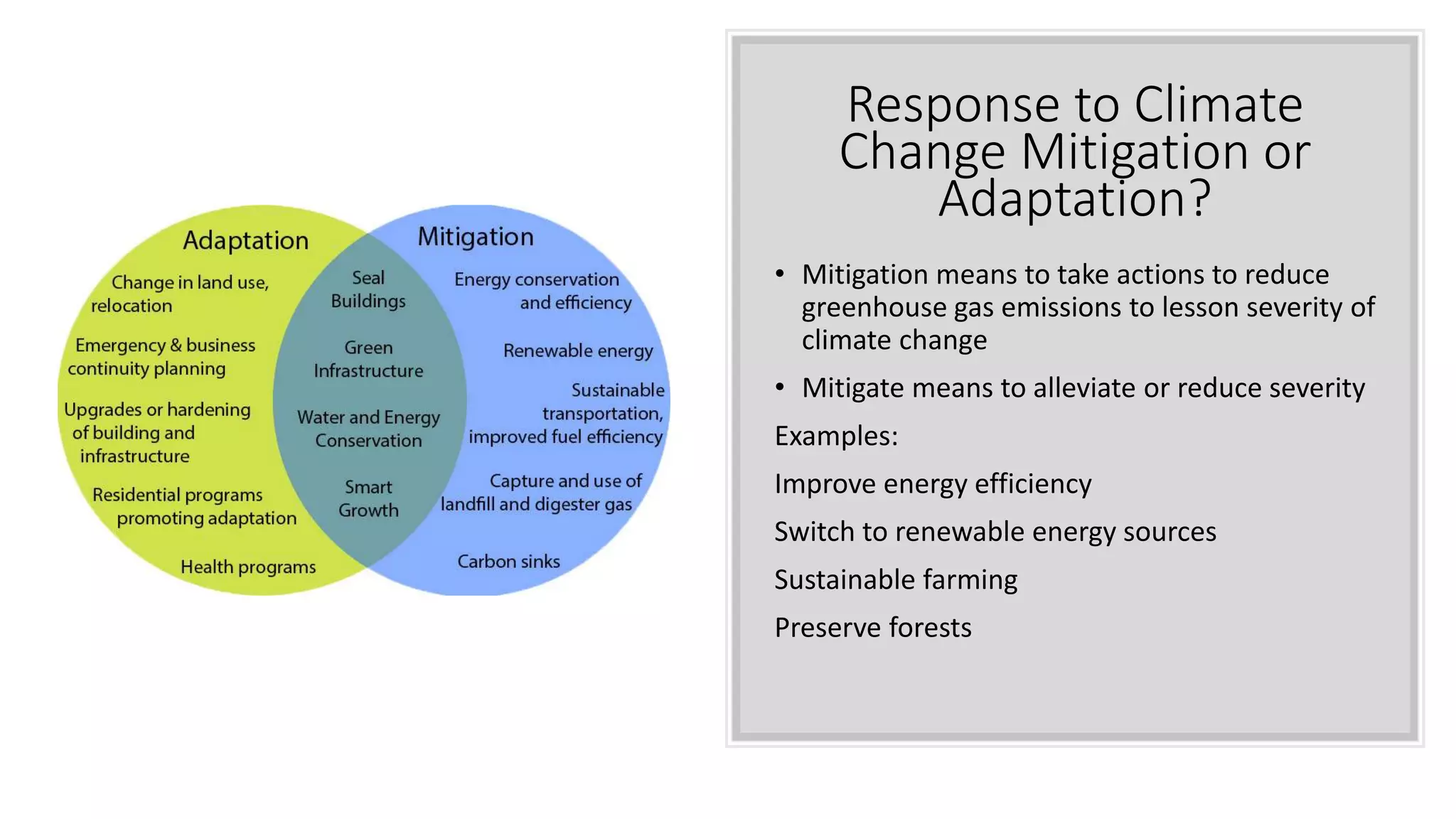
Response to Climate
Change Mitigation or
Adaptation?
• Mitigation means to take actions to reduce
greenhouse gas emissions to lesson severity of
climate change
• Mitigate means to alleviate or reduce severity
Examples:
Improve energy efficiency
Switch to renewable energy sources
Sustainable farming
Preserve forests
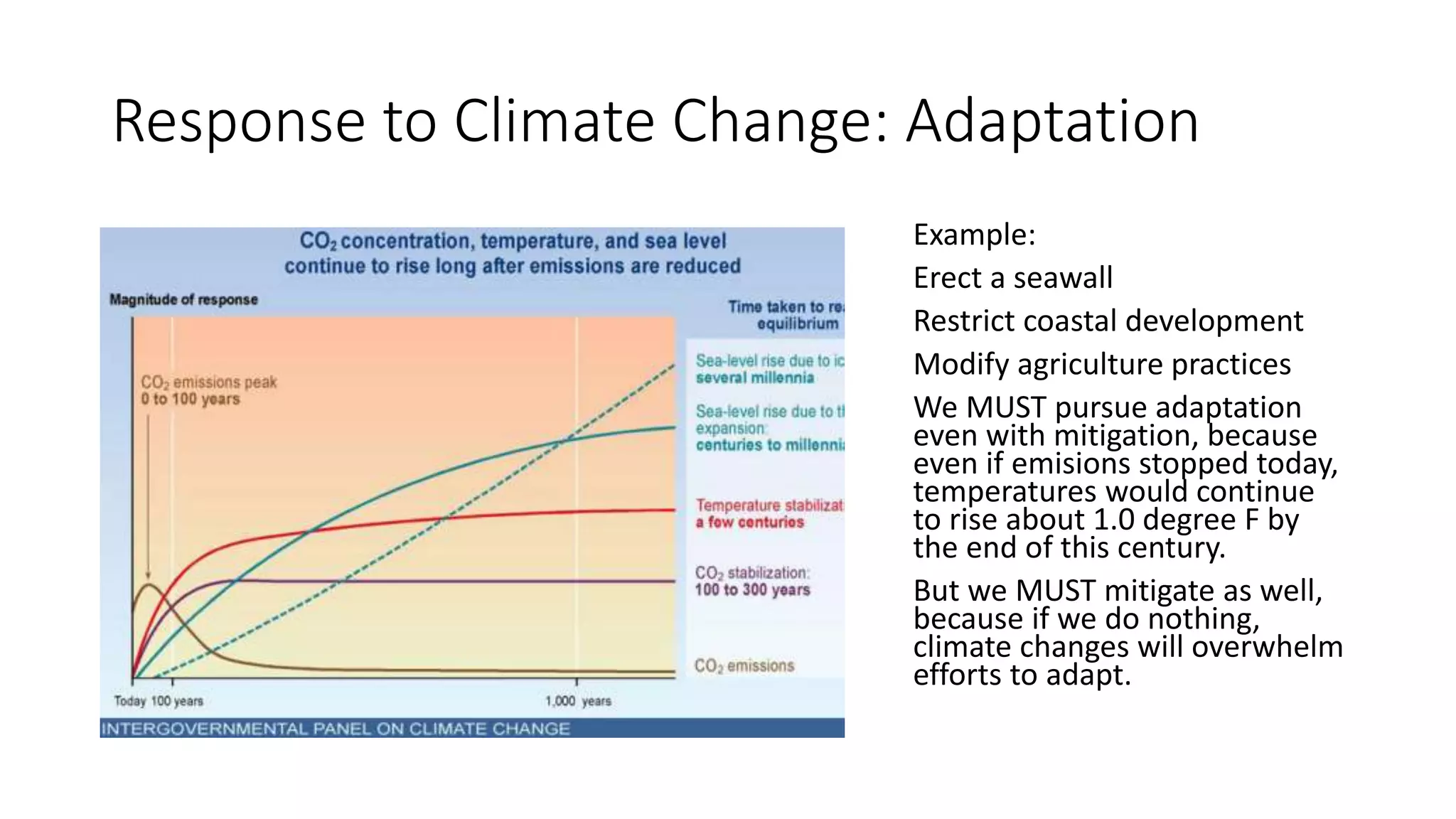
Response to Climate Change: Adaptation
Example:
Erect a seawall
Restrict coastal development
Modify agriculture practices
We MUST pursue adaptation
even with mitigation, because
even if emisions stopped today,
temperatures would continue
to rise about 1.0 degree F by
the end of this century.
But we MUST mitigate as well,
because if we do nothing,
climate changes will overwhelm
efforts to adapt.
Solutions??
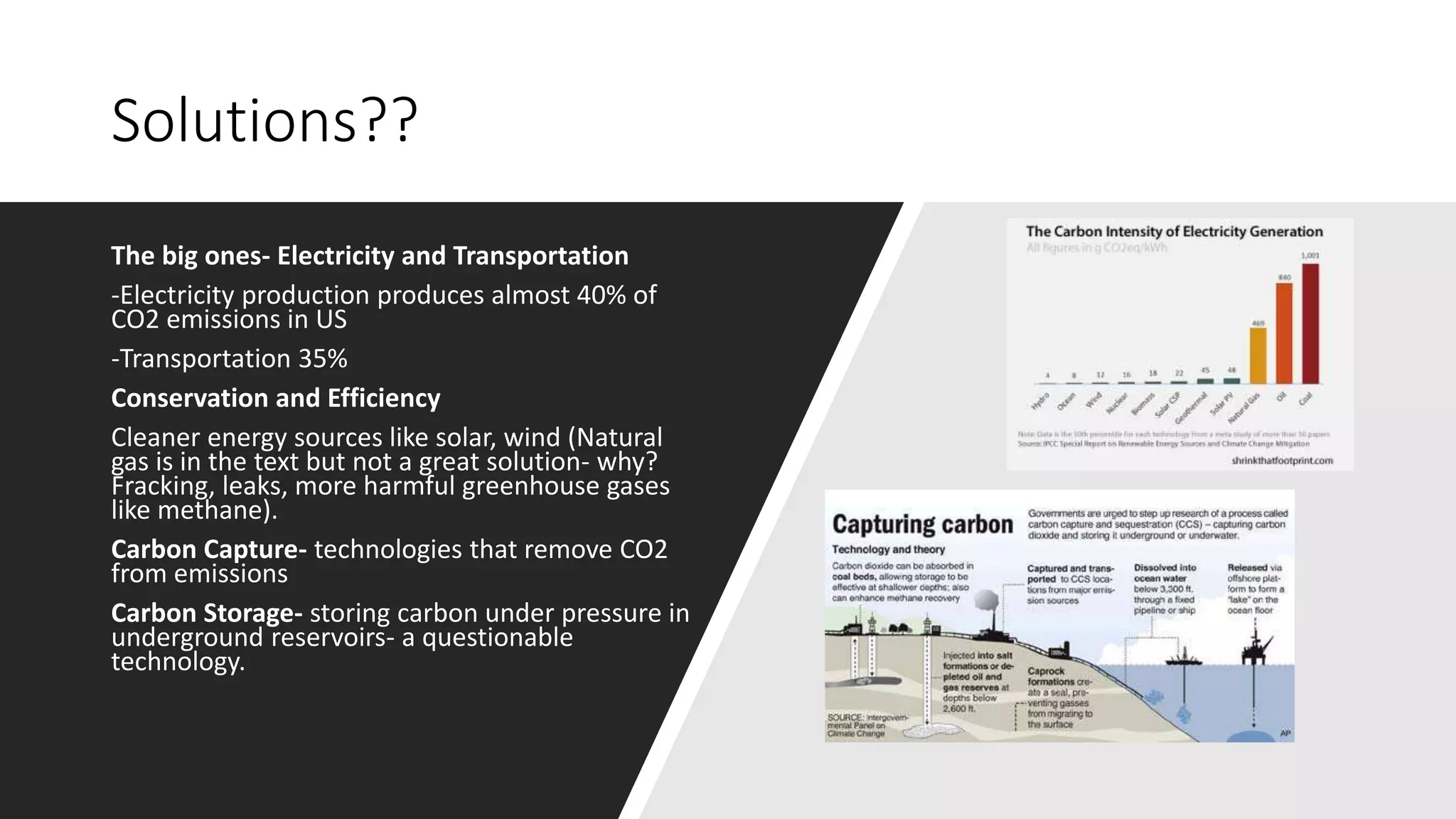
The big ones- Electricity and Transportation
-Electricity production produces almost 40% of
CO2 emissions in US
-Transportation 35%
Conservation and Efficiency
Cleaner energy sources like solar, wind (Natural
gas is in the text but not a great solution- why?
Fracking, leaks, more harmful greenhouse gases
like methane).
Carbon Capture- technologies that remove CO2
from emissions
Carbon Storage- storing carbon under pressure in
underground reservoirs- a questionable
technology.
Transportation
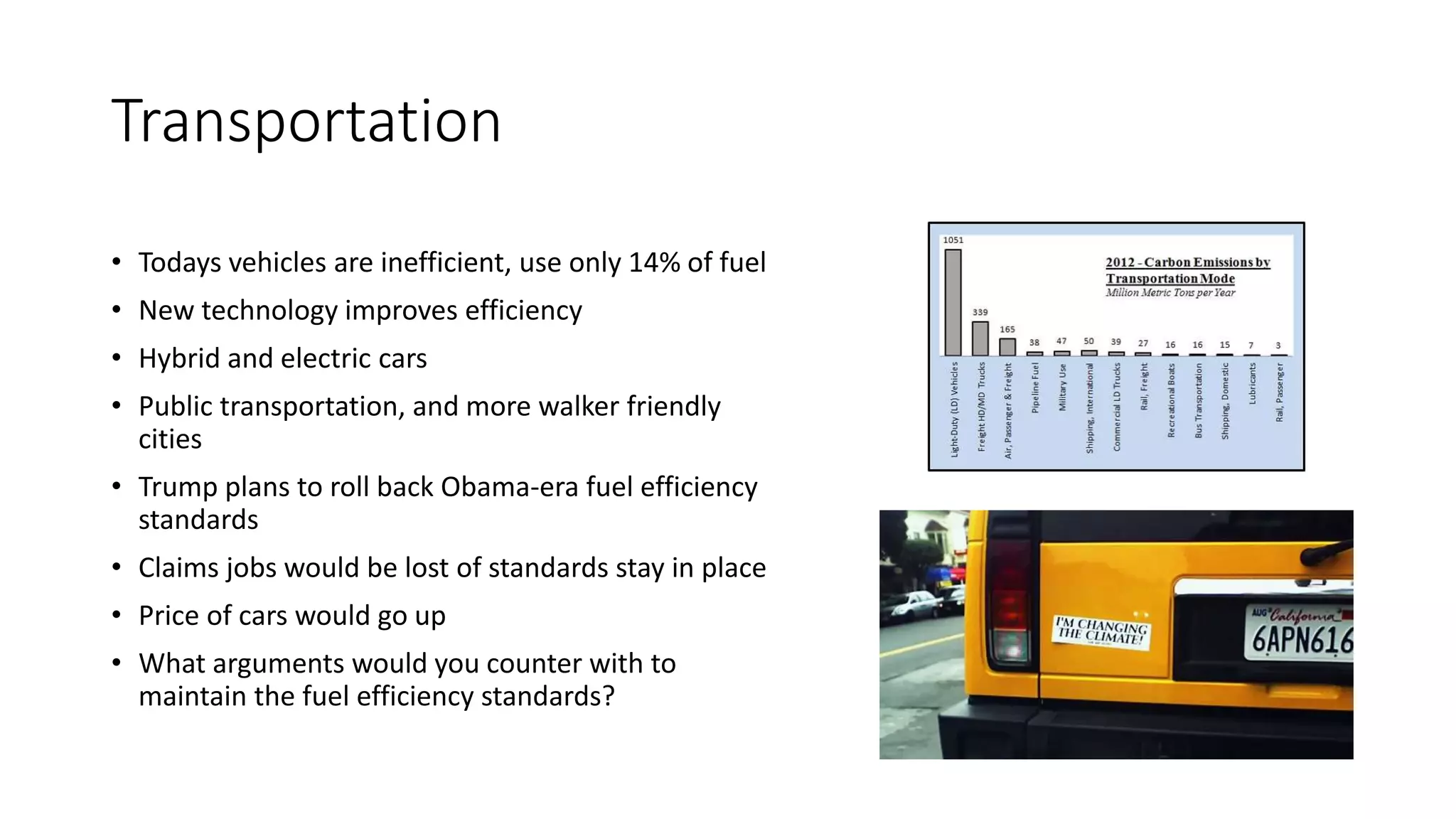
• Todays vehicles are inefficient, use only 14% of fuel
• New technology improves efficiency
• Hybrid and electric cars
• Public transportation, and more walker friendly
cities
• Trump plans to roll back Obama-era fuel efficiency
standards
• Claims jobs would be lost of standards stay in place
• Price of cars would go up
• What arguments would you counter with to
maintain the fuel efficiency standards?
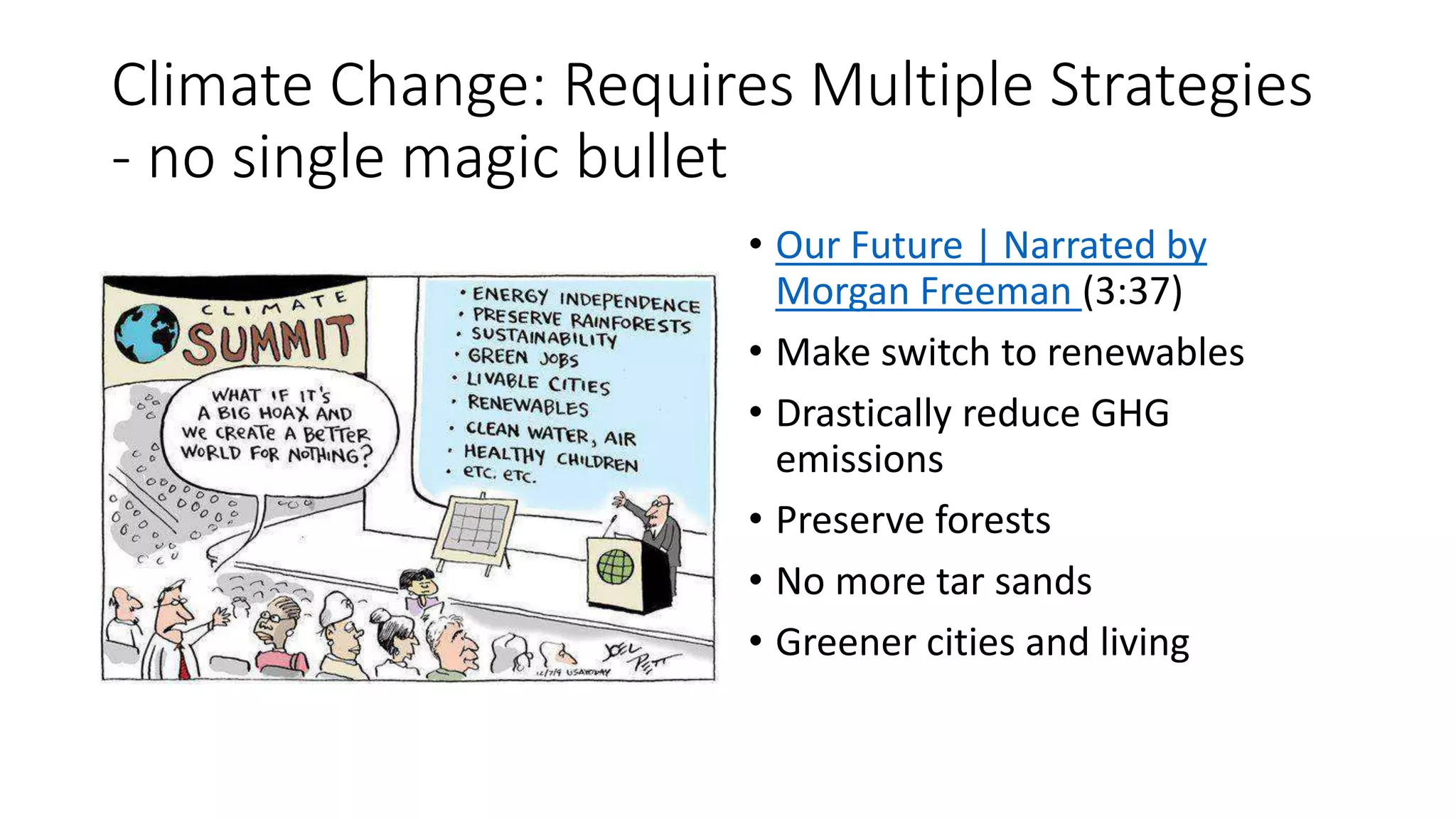
Climate Change: Requires Multiple Strategies
- no single magic bullet
• Our Future | Narrated by
Morgan Freeman (3:37)
• Make switch to renewables
• Drastically reduce GHG
emissions
• Preserve forests
• No more tar sands
• Greener cities and living
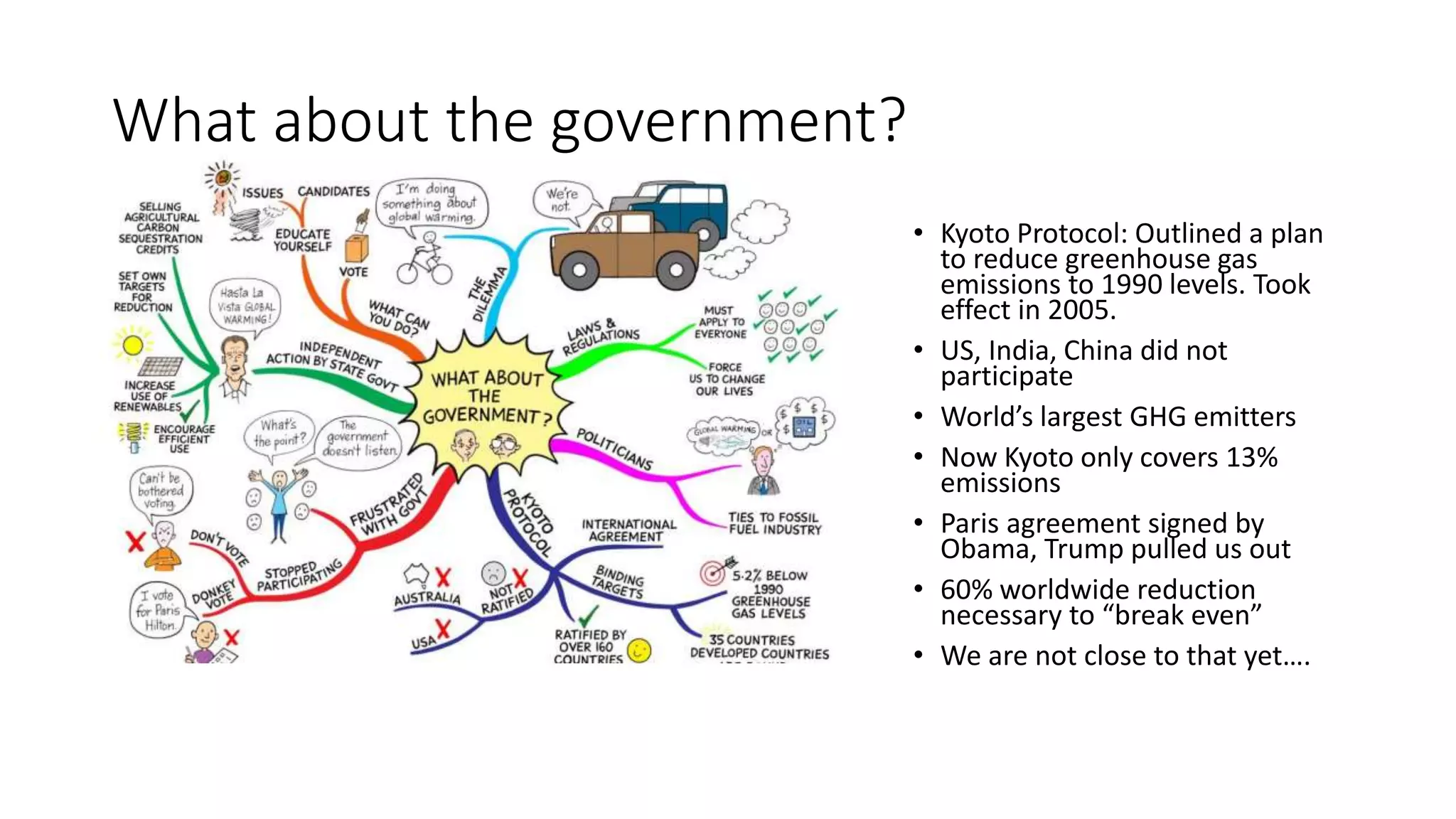
What about the government?
• Kyoto Protocol: Outlined a plan
to reduce greenhouse gas
emissions to 1990 levels. Took
effect in 2005.
• US, India, China did not
participate
• World’s largest GHG emitters
• Now Kyoto only covers 13%
emissions
• Paris agreement signed by
Obama, Trump pulled us out
• 60% worldwide reduction
necessary to “break even”
• We are not close to that yet….
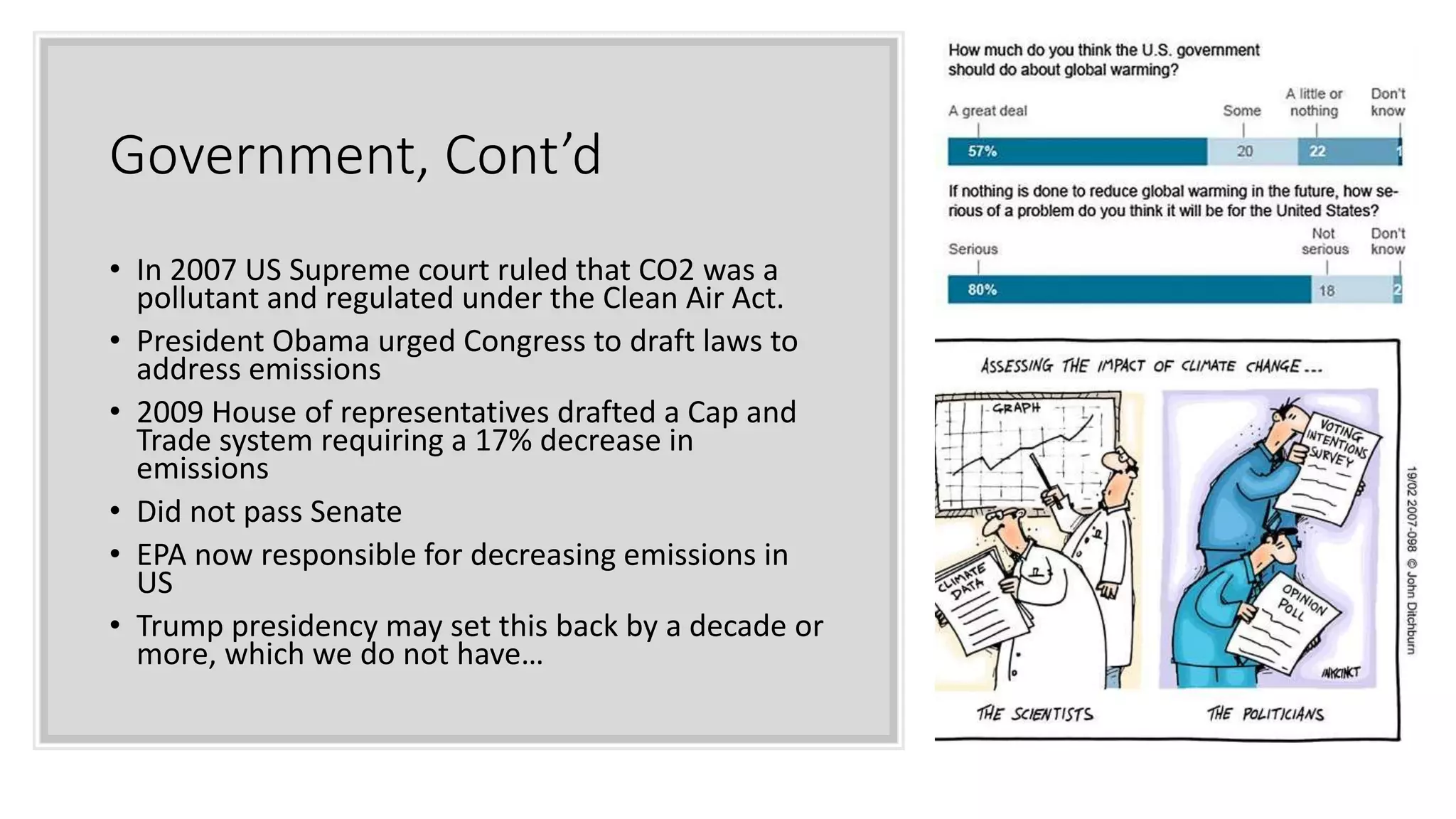
Government, Cont’d
• In 2007 US Supreme court ruled that CO2 was a
pollutant and regulated under the Clean Air Act.
• President Obama urged Congress to draft laws to
address emissions
• 2009 House of representatives drafted a Cap and
Trade system requiring a 17% decrease in
emissions
• Did not pass Senate
• EPA now responsible for decreasing emissions in
US
• Trump presidency may set this back by a decade or
more, which we do not have…
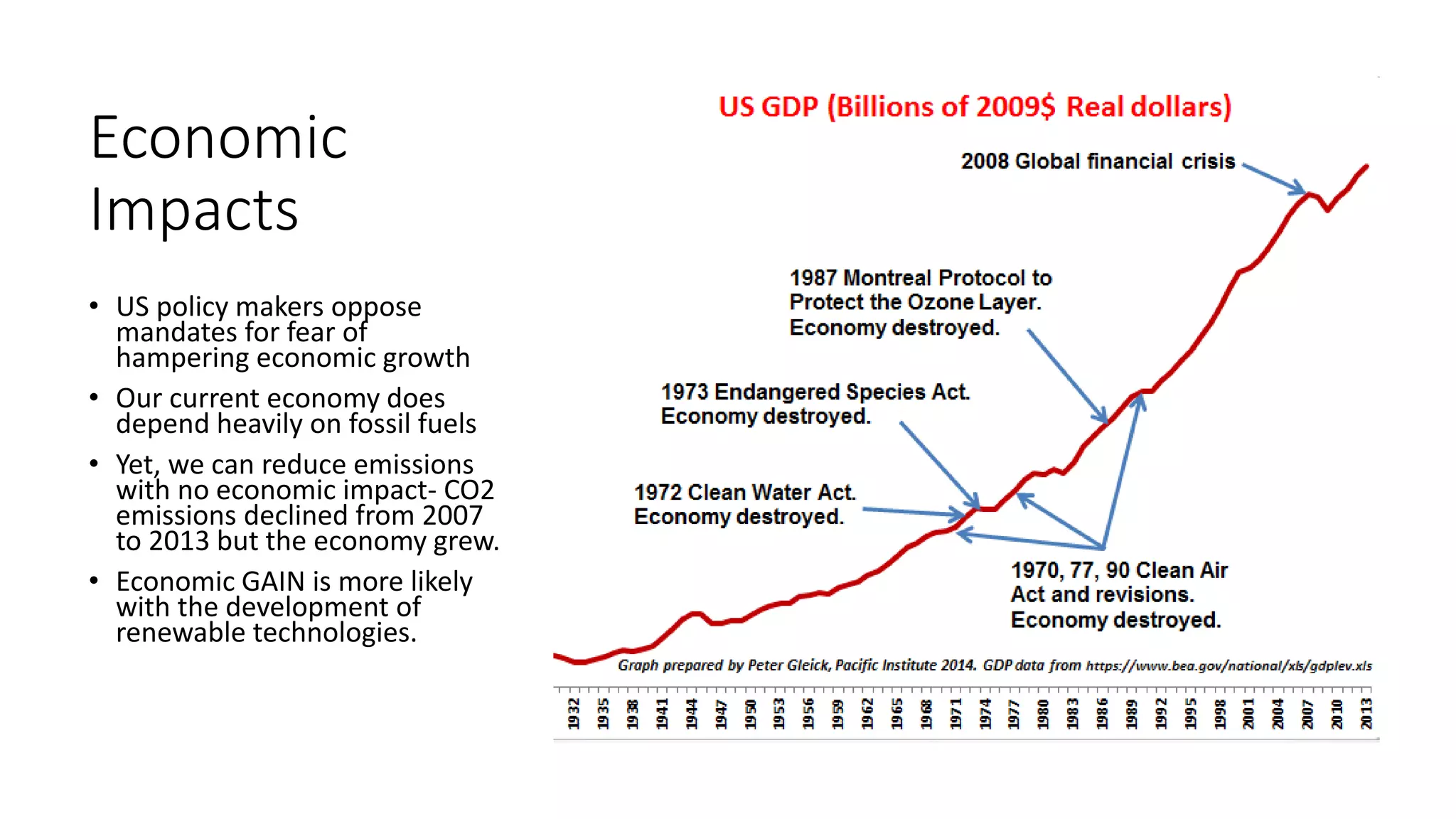
Economic
Impacts
• US policy makers oppose
mandates for fear of
hampering economic growth
• Our current economy does
depend heavily on fossil fuels
• Yet, we can reduce emissions
with no economic impact- CO2
emissions declined from 2007
to 2013 but the economy grew.
• Economic GAIN is more likely
with the development of
renewable technologies.
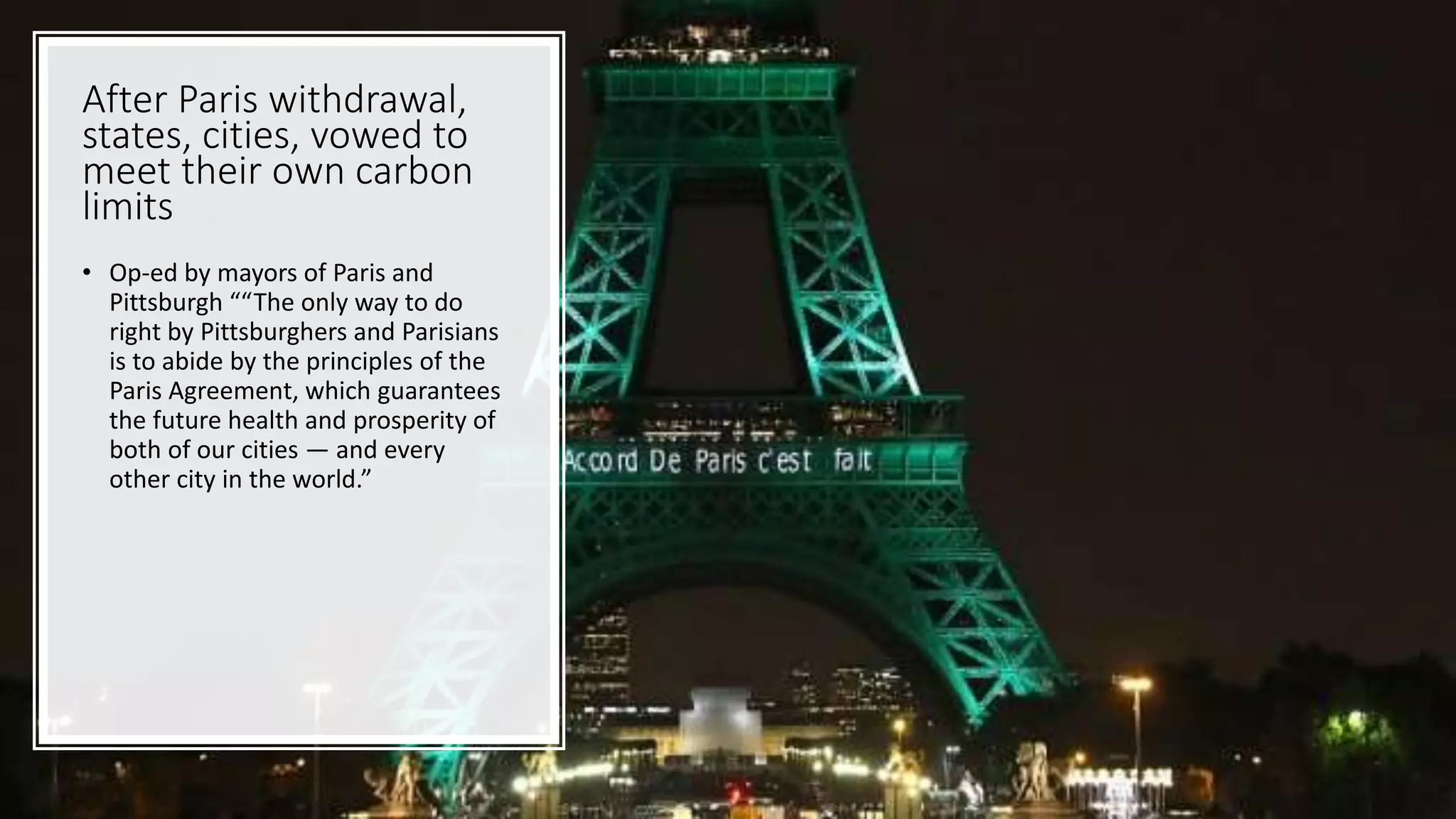
After Paris withdrawal,
states, cities, vowed to
meet their own carbon
limits
• Op-ed by mayors of Paris and
Pittsburgh ““The only way to do
right by Pittsburghers and Parisians
is to abide by the principles of the
Paris Agreement, which guarantees
the future health and prosperity of
both of our cities — and every
other city in the world.”
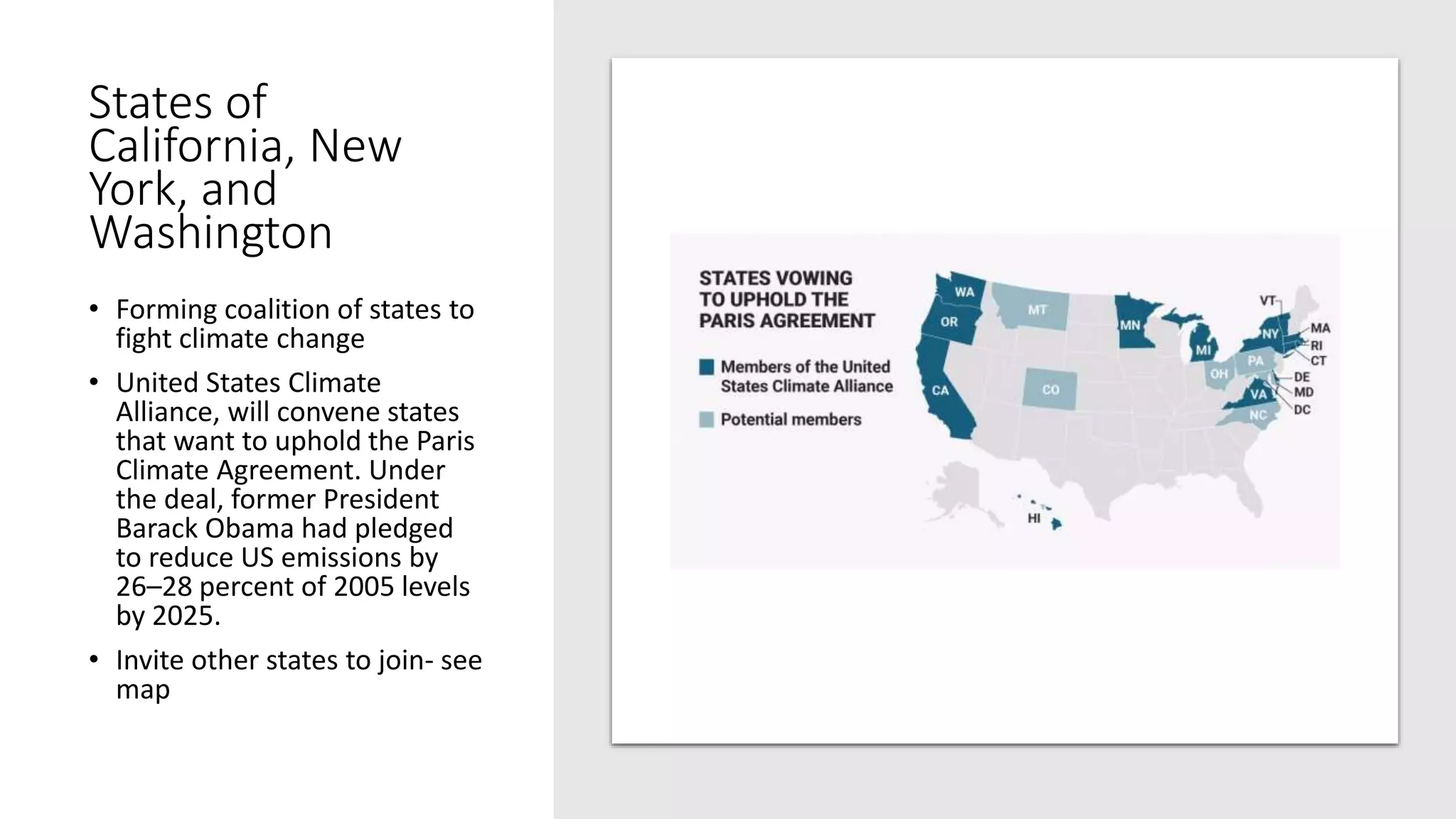
States of
California, New
York, and
Washington
• Forming coalition of states to
fight climate change
• United States Climate
Alliance, will convene states
that want to uphold the Paris
Climate Agreement. Under
the deal, former President
Barack Obama had pledged
to reduce US emissions by
26–28 percent of 2005 levels
by 2025.
• Invite other states to join- see
map
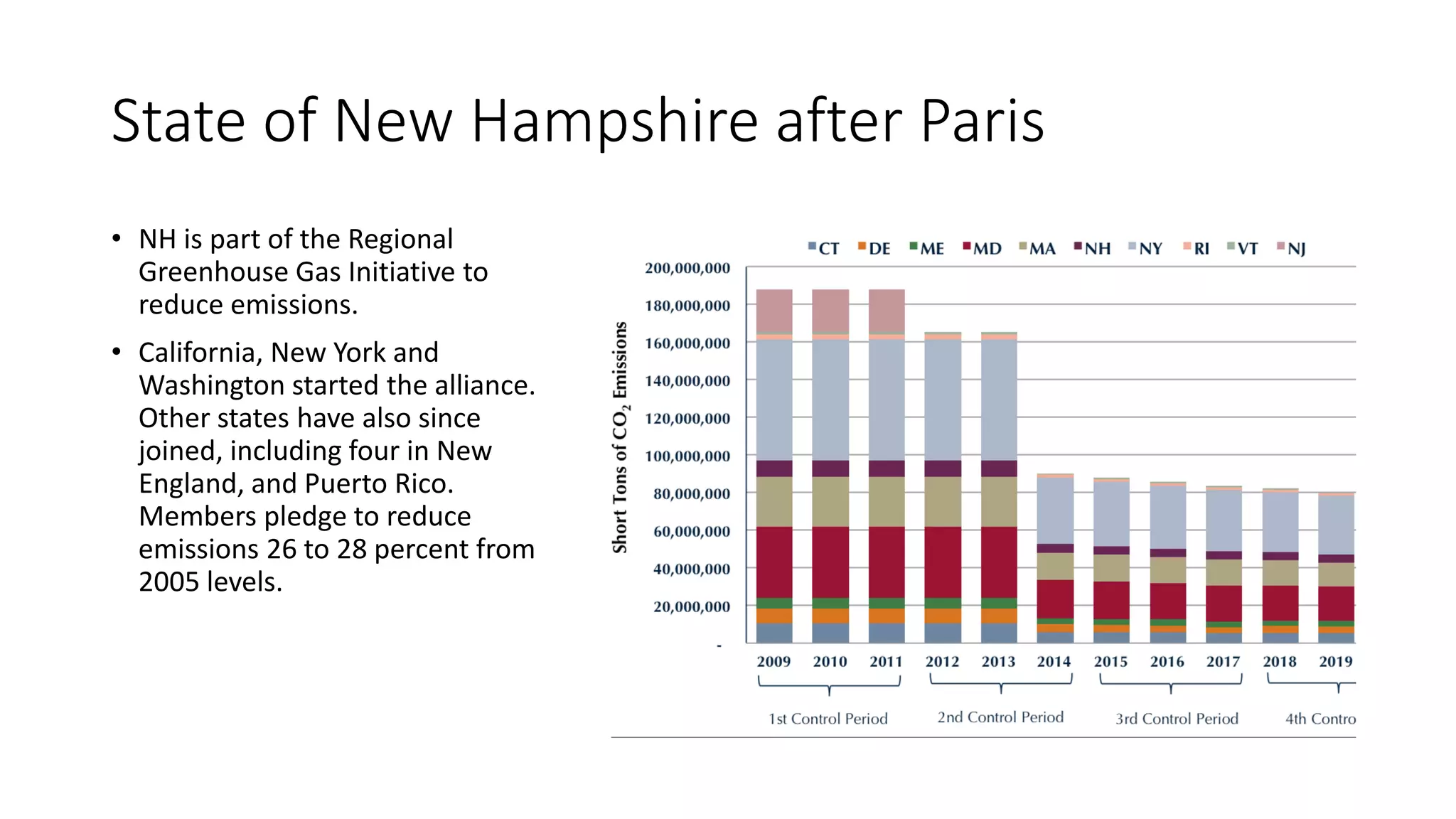
State of New Hampshire after Paris
• NH is part of the Regional
Greenhouse Gas Initiative to
reduce emissions.
• California, New York and
Washington started the alliance.
Other states have also since
joined, including four in New
England, and Puerto Rico.
Members pledge to reduce
emissions 26 to 28 percent from
2005 levels.
NH after Paris
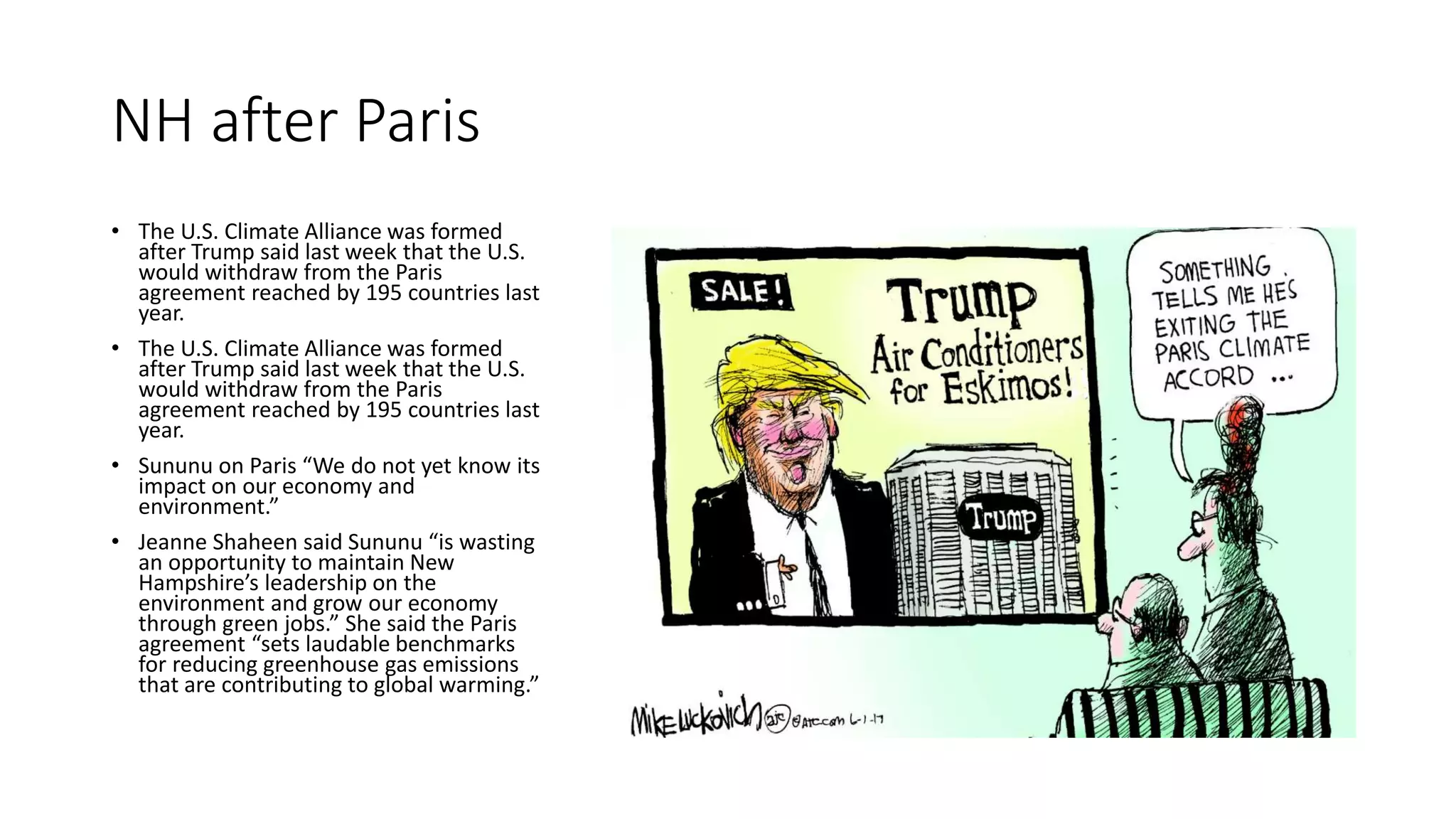
• The U.S. Climate Alliance was formed
after Trump said last week that the U.S.
would withdraw from the Paris
agreement reached by 195 countries last
year.
• The U.S. Climate Alliance was formed
after Trump said last week that the U.S.
would withdraw from the Paris
agreement reached by 195 countries last
year.
• Sununu on Paris “We do not yet know its
impact on our economy and
environment.”
• Jeanne Shaheen said Sununu “is wasting
an opportunity to maintain New
Hampshire’s leadership on the
environment and grow our economy
through green jobs.” She said the Paris
agreement “sets laudable benchmarks
for reducing greenhouse gas emissions
that are contributing to global warming.”
Market Mechanisms
to Address Climate
Change
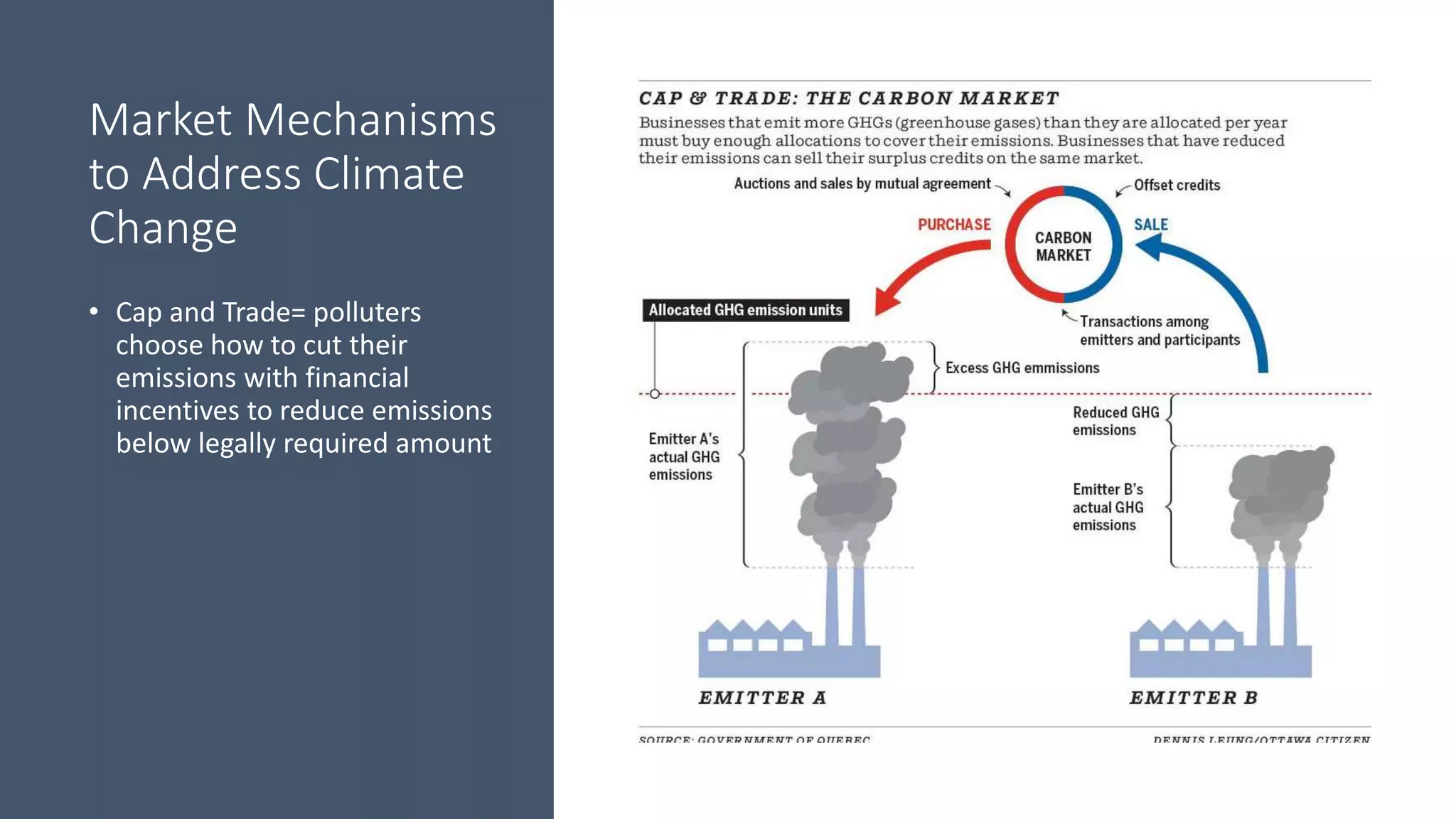
• Cap and Trade= polluters
choose how to cut their
emissions with financial
incentives to reduce emissions
below legally required amount
Carbon Taxes
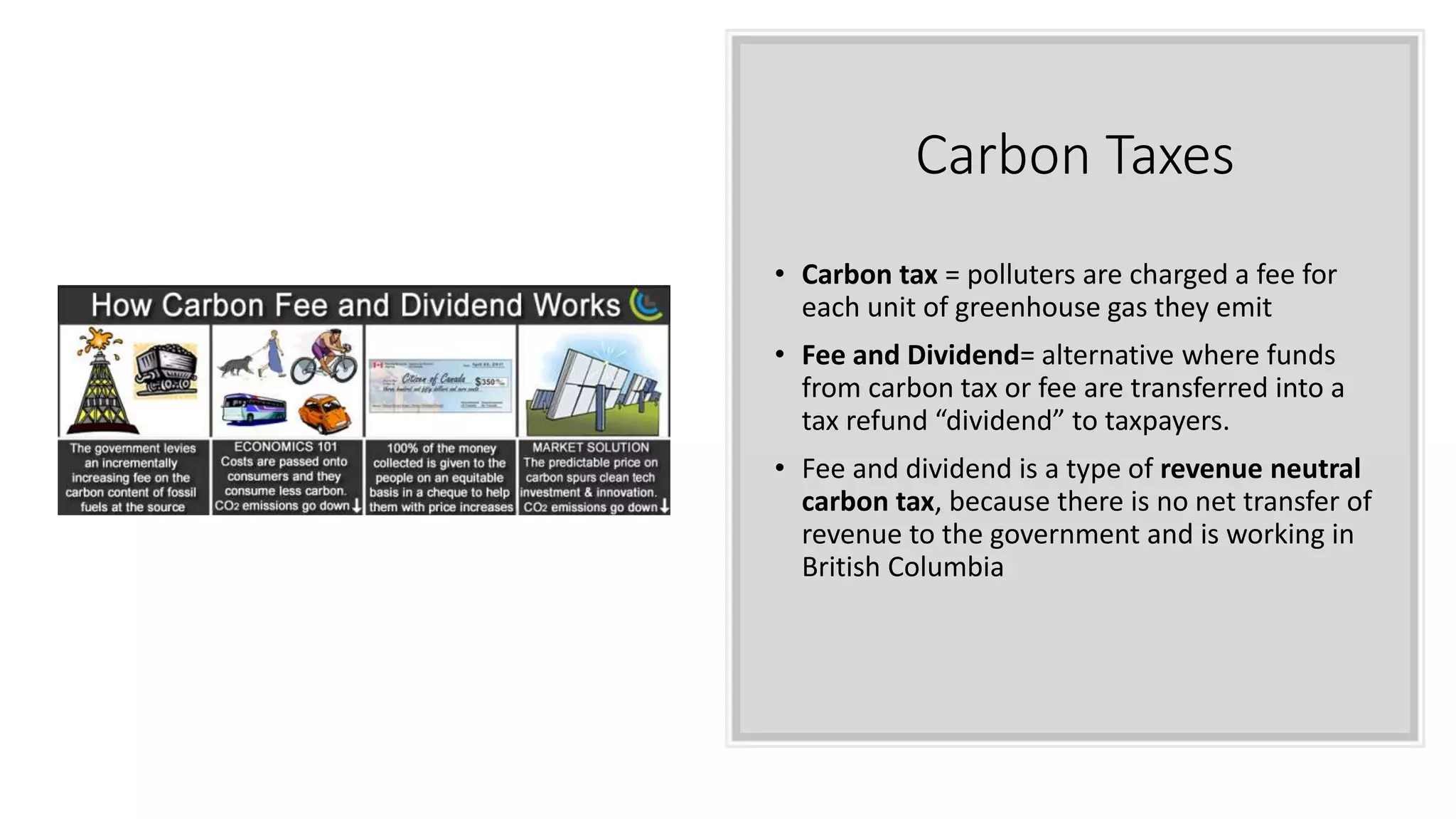
• Carbon tax = polluters are charged a fee for
each unit of greenhouse gas they emit
• Fee and Dividend= alternative where funds
from carbon tax or fee are transferred into a
tax refund “dividend” to taxpayers.
• Fee and dividend is a type of revenue neutral
carbon tax, because there is no net transfer of
revenue to the government and is working in
British Columbia
Carbon Offsets
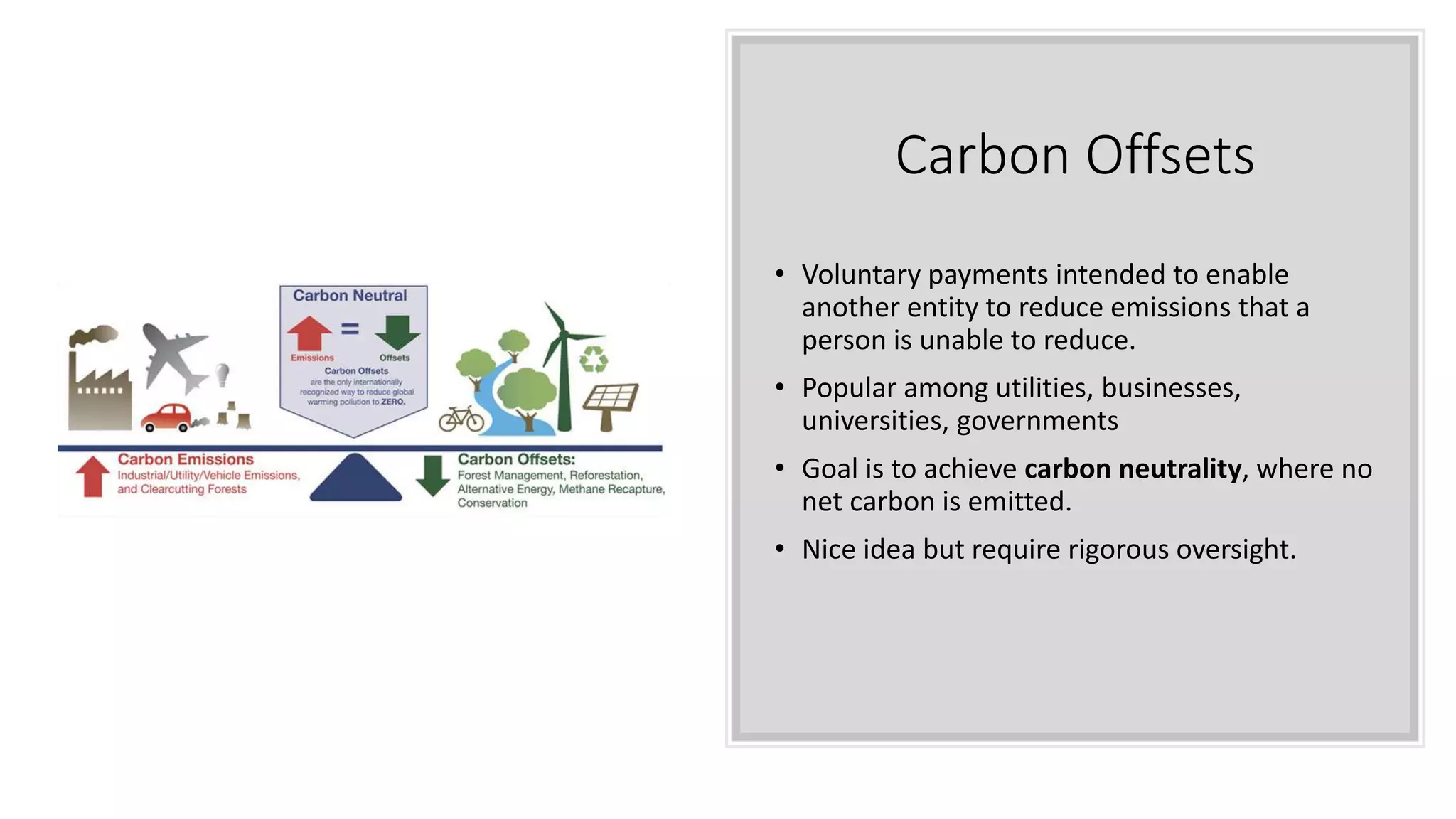
• Voluntary payments intended to enable
another entity to reduce emissions that a
person is unable to reduce.
• Popular among utilities, businesses,
universities, governments
• Goal is to achieve carbon neutrality, where no
net carbon is emitted.
• Nice idea but require rigorous oversight.
Should we engineer the climate?
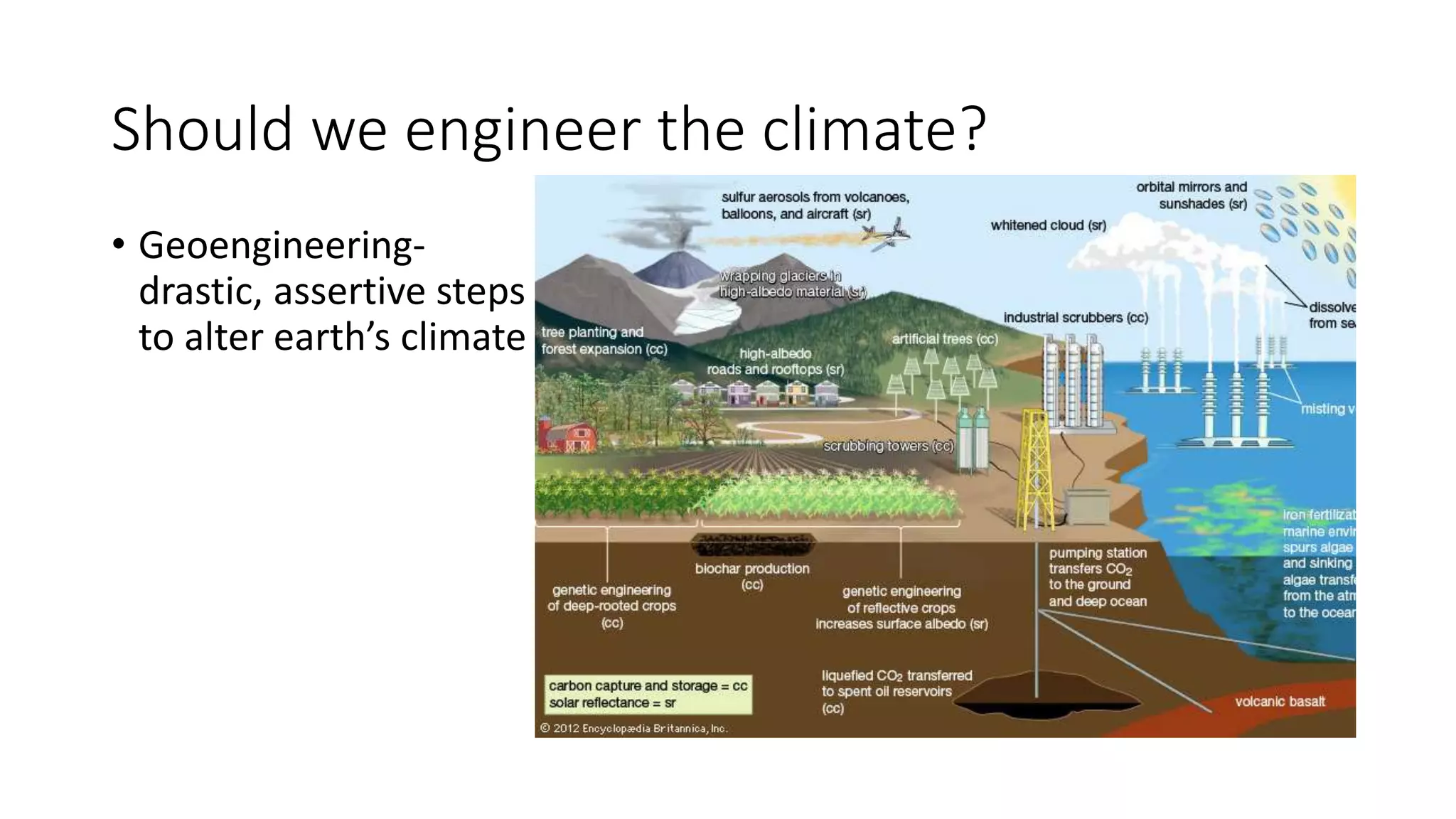
• Geoengineering-
drastic, assertive steps
to alter earth’s climate
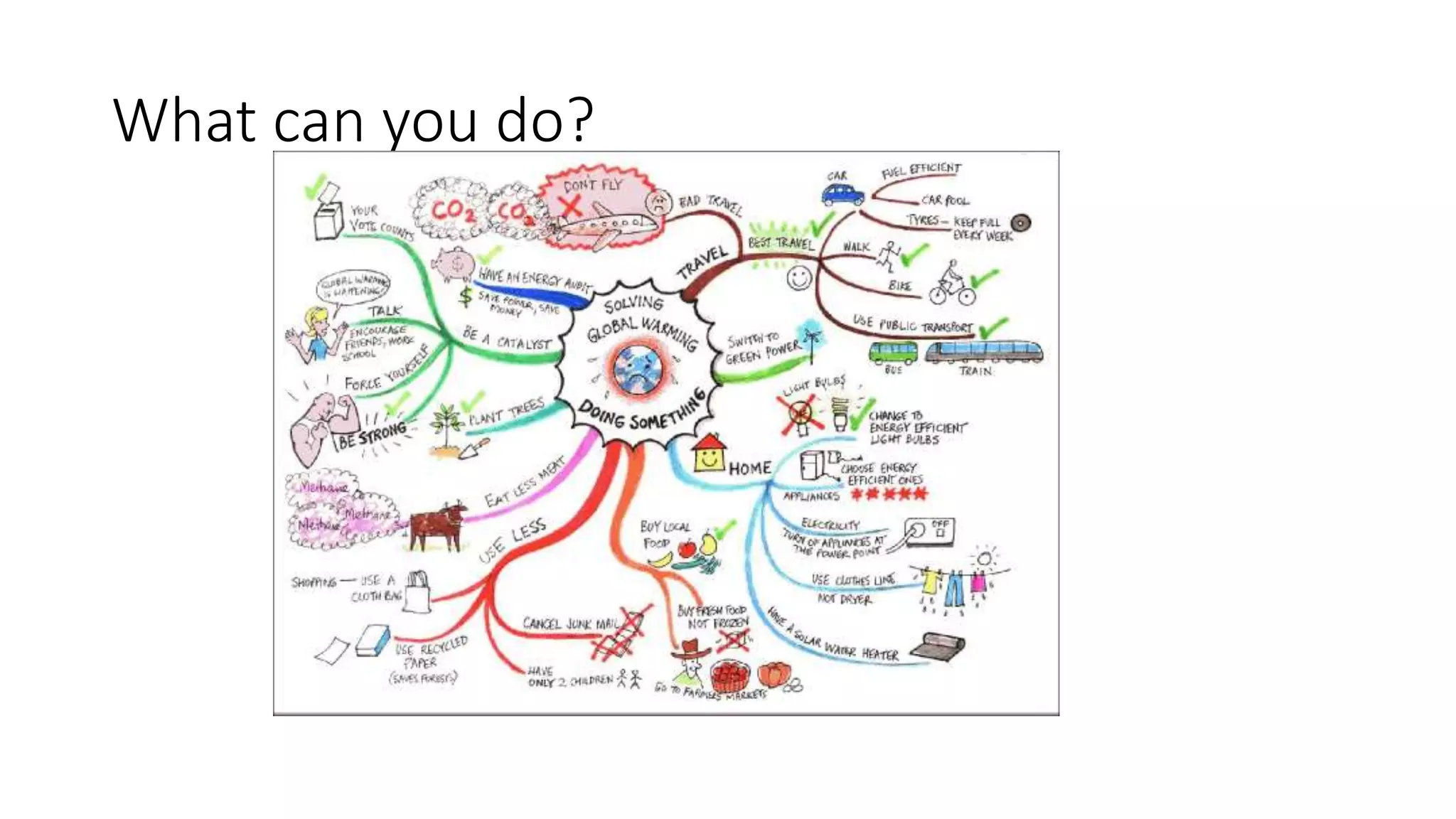
What can you do?
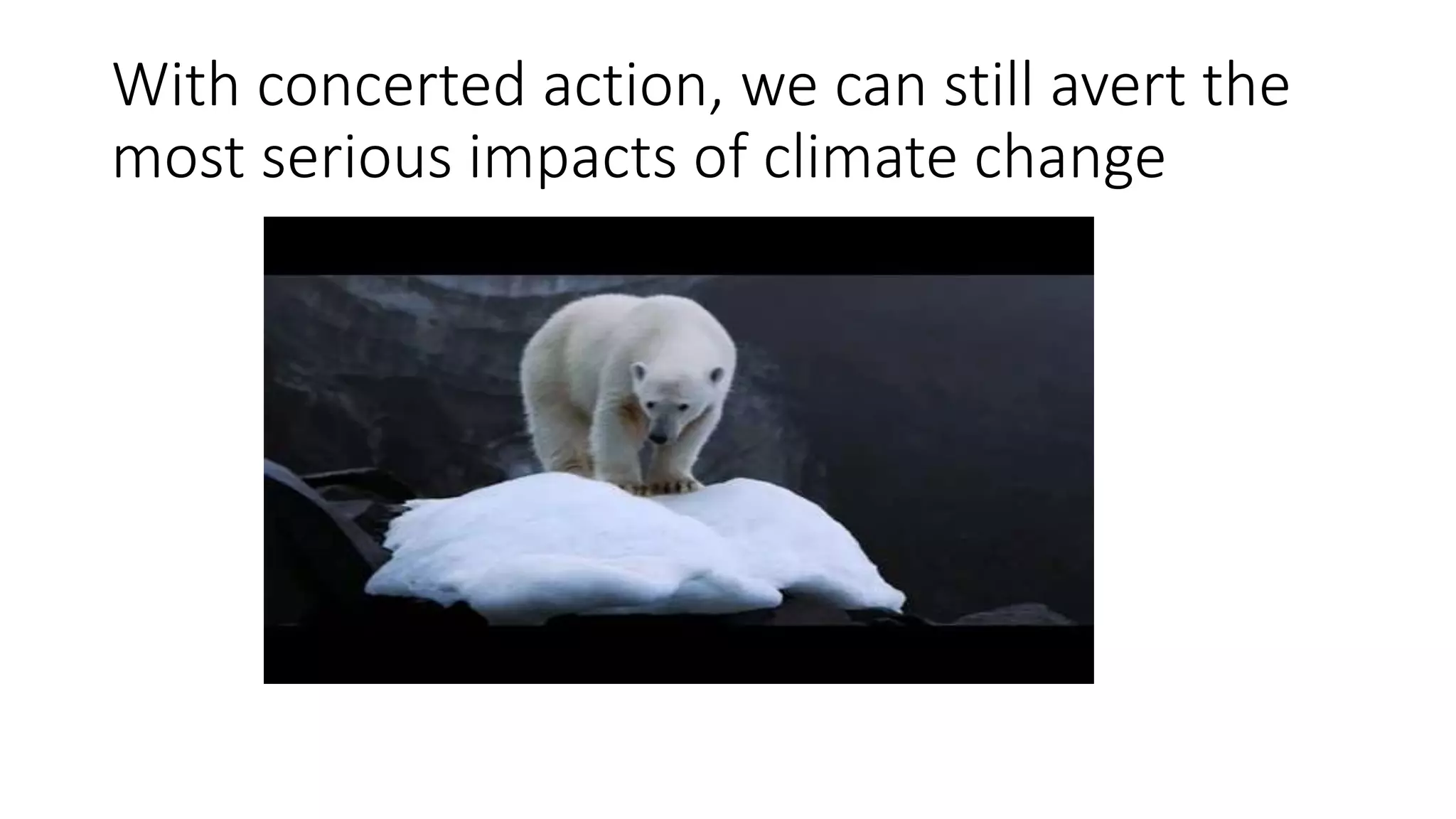
With concerted action, we can still avert the
most serious impacts of climate change
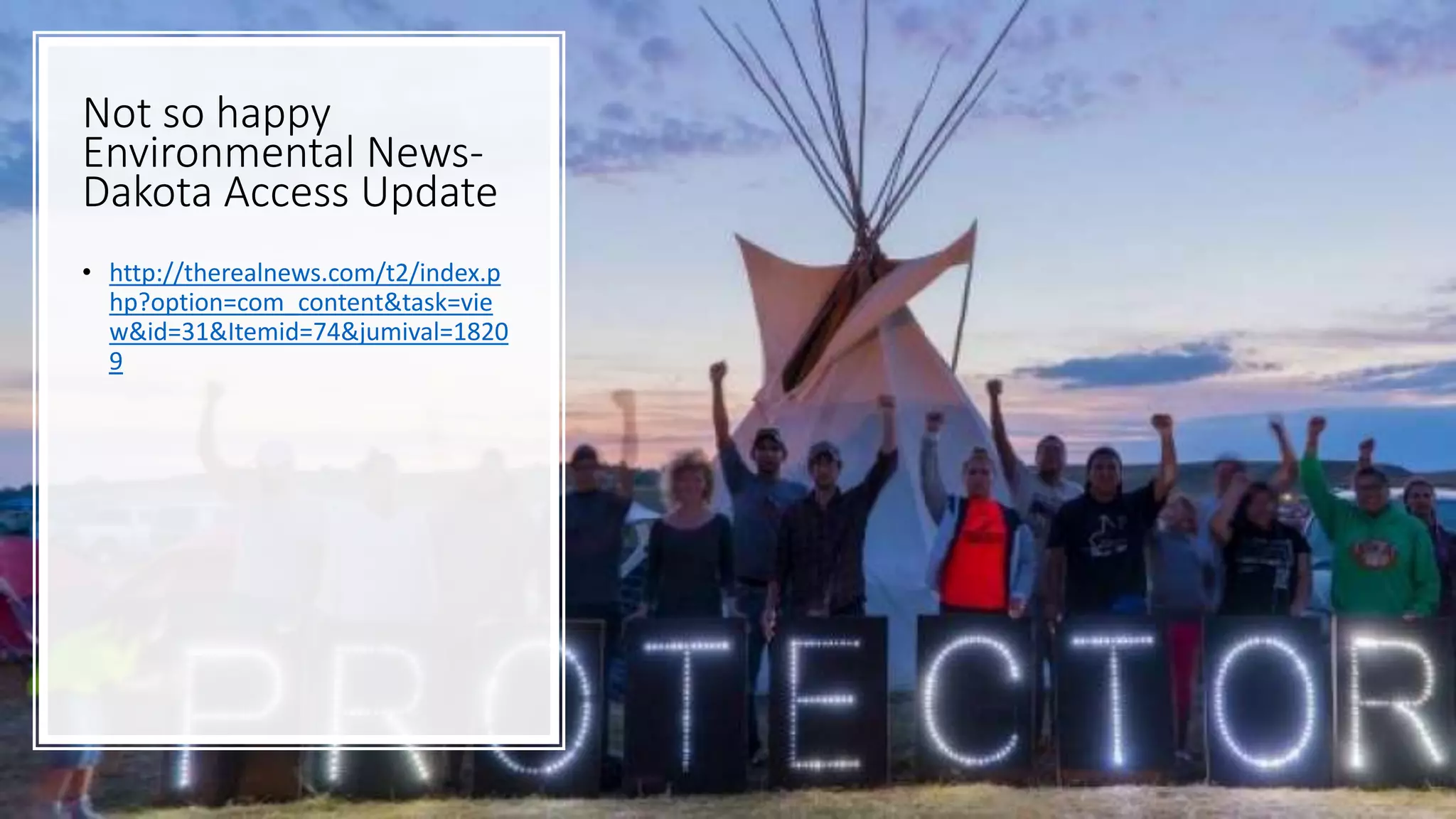
Not so happy
Environmental News-
Dakota Access Update
• http://therealnews.com/t2/index.p
hp?option=com_content&task=vie
w&id=31&Itemid=74&jumival=1820
9
7

Climate change and Global Warming by Kiersten Lippmann

  • 1.
  • 2.
    Start with a song:Climate change songs • https://www.youtube.com/w atch?v=HHP9Rh-ooh0 (Symphony of Science) • Al Gore Sings Grease Summer Nights about Global Warming • Waiting on the World to Change More suggestions?
  • 5.
    Paris Agreement • Video(20min.) Last Night Tonight with John Oliver • Video (3:38 min.) HBO Trump Got Climate Change Pretty Wrong in His Paris Speech • Donald Trump Believes Climate Change Is A Hoax (3:03 min) All In | MSNBC
  • 6.
    Yes the climatehas always changed… but • Climate skeptics say “so, the climate has always changed, why are we worried now?” • Yes, the Earth’s climate has changed over the past 4.5 million years mostly due to orbital wobbles. • During the Paleocene it was so warm, crocodiles swam over the arctic circle! • 20,000 years ago, it was so cold that miles-thick ice covered Montreal • Why worry- the climate has been stable for the past 12,000 years • This period (12,000 years to now) encompasses all of human civilization- from pyramids to Industrial Revolution to Facebook… Intagram… etc. • Human civilization benefited greatly from that stability- allowed us to build farms, cities, etc. • Now we are losing that stable climate, Earth is heating up at the fastest rate in millions of years. • This pace could prove difficult to adapt to • Given that, it is not super comforting to know the Earth was much hotter when dinosaurs roamed the Earth.
  • 7.
    Rate of ClimateChange- a history • Carbon is pouring into the atmosphere faster than at any time in the past 66 million years- since dinosaurs went extinct • The rate of warming is 10X faster than it was during the prehistoric warming period • Reason for the past warming was probably methane gas release and volcanic activity (still a bit hazy on exact cause) • This warming started 55 million years ago • Caused massive changes in where plants and animals lived, rapid evolution of some species, and extinction of others • Remember--- modern humans (homo sapiens) have been around for just about 50,000 years. • Human population was 5 million until agriculture (8,000 years ago) • Human pop was under 1 billion up to Industrial Revolution (@ 1880) • Since then, human pup has risen to a current high of 7.5 BILLION
  • 8.
    Rising Seas andAlaska Village relocation • https://www.youtube.com/watc h?v=u7i9LBeZ1UU
  • 9.
    One chart that showsjust how skewed global emissions are
  • 10.
  • 11.
    Sectors producing highest emissions •More information here: World Economic Forum
  • 12.
    Video Introduction to ClimateChange • http://video.nationalgeographic.co m/video/way-forward-climate
  • 13.
    What is climate change?And why not call it global warming? • I prefer the term global warming but also use climate change • Climate= temperature, precipitation, wind, humidity, barometric pressure, solar radiation of an area • Weather= hour or days vs Climate= years, decades, centuries
  • 14.
    3 natural factorsinfluence earth’s climate • The sun • Atmosphere •Oceans (important!)
  • 15.
    Greenhouse gases warmthe atmosphere • Earth temp. increases with absorbed solar radiation. • Greenhouse gases absorb the sun’s radiation. • Greenhouse gases then re-emit the radiation, warming the surface and atmosphere.
  • 16.
    CO2 is themost abundant greenhouse gas • Other greenhouse gases include methane, nitrous oxide, and halocarbons.
  • 17.
    Greenhouse Gases warming potential •Global warming potential = ability of one molecule of a greenhouse gas to contribute to warming. • Values are in relation to CO2, which is given a value of 1. • Methane (cows, permafrost, etc.) has a value of 28, but spends less time in the atmosphere. • CO2 is less potent but far more abundant. • Greenhouse gas emissions due to human activities mostly produce CO2. • Carbon dioxide has caused nearly twice the warming of other greenhouse gases combined since the industrial revolution.
  • 18.
    Greenhouse gas concentrations are risingfast • Anthropogenic (human generated) intensification of the greenhouse effect • Adding novel (halocarbon) and natural greenhouse gases over the past 250 years intensifies GH effect. • CO2 conc. boosted from 280 ppm in late 1700s to over 409 ppm in April 2016. • Highest levels in the past 20 million years.
  • 19.
    Rapid rise ofgreenhouse gas concentrations Carbon Dioxide Primary driver of global warming Exacerbated by clearing and burning forests to make room for crops and cities. Removing forests decreases the earths ability to remove carbon dioxide from the atmosphere.
  • 20.
    Other greenhouse gasesare also rising • Methane conc. 2.6 times increase since 1750, highest by far in 800,000 years. Due to fossil fuels and livestock, landfills, and crops. • Nitrous oxide is elevated by 20% since 1750 due to feedlots, chemical plants, auto emissions, fertilizers. • Halocarbons have slowed due to international laws- Montreal Protocol. • Water vapor is the most prevalent greenhouse gas, but has not changed in conc.
  • 21.
    Radiative forcing • Theamount of change in thermal energy that a factor causes. • Positive forcing warms • Negative forcing cools • Earth is retaining 2.3 more thermal energy than emitting. • In contrast, pre-industrial revolution, earth was emitting more than it was retaining. • Over time, this has potential to significantly alter the climate.
  • 22.
    Natural variation inclimate- 4 factors • Solar output- variation is normal but does not account for the rapid changes. Net radiative forcing is just 0.05, less than any factor in the previous slide. • Ocean absorption- absorb 50X more carbon than atmosphere but less as conc. rise. Slowing but not preventing warming. Warmer water reduces CO2 absorption and accelerates warming. • Ocean circulation- melting sea ice could alter and make Europe much colder and also cause El Nino cycles • Earth’s rotation- Milankovitch cycles. Influential in long term but do not account for recent rapid changes.
  • 23.
    Past Climate • ProxyIndicators are types of indirect evidence that are proxies, or substitutes, for direct measurement. • Past climate information found in ice cores from Antarctica and Greenland -greenhouse gas concentrations -forest fires -snowfall -solar activity -ice cores show that conc. of CO2, methane, and NO are higher today than in the past 800,000 years.
  • 24.
    Ice Cores Explained •https://www.youtube.com/watch?v=fjGxYDLEXP0
  • 25.
    Past Climate- sediment cores Drilledbeneath bodies of water Tell us: • Plant life and pollens • Fossils • Growth trends
  • 26.
    Climate Models • Programs thatcombine what is known about atmospheric circulation, ocean circulation, atmosphere-ocean interactions, and feedback cycles to simulate climate processes • Models can realistically simulate climate and may predict future climate. • Uncertainties remain because of the complexity of Earth’s climate system and feedback processes.
  • 27.
    Current and Future Climate Extremeweather events are becoming the new “normal” and are backed by a volume of scientific evidence. Continuing to emit greenhouse gas emissions at the current rate will mean more severe consequences
  • 28.
    Scientific Evidence • IntergovernmentalPanel on Climate Change (IPCC). • Composed of thousands of scientists, releases detailed reports every few years (last in 2014) next out in 2018 • Summarizes thousands of studies and predicts future changes • Discusses strategies to pursue in response.
  • 29.
    Earth’s temperature hasrisen by 0.9 degrees Celsius in the past 100 years most since 1975 • Of the last 15 years 13 have been the warmest years on measure • July 2016 was the hottest month ever recorded • In the US, most areas have increased 1.3 to 1.9 degree F in temperature over the past 150 years. • Temperatures will continue to rise.
  • 30.
    Temperatures Continue toRise in the future IPCC predicts a rise from 1.8 to 6.7 degrees F • https://www.youtube.com/watch?v=n21SGSg esmo • Increase in temperature depends on how many greenhouse gases we emit • Extreme changes under higher emissions scenarios • Restriction of many species range, drought in the “bread basket” of Midwest, and California’s vegetable, fruit growing region “the valley”
  • 31.
    Temperatures Continue to Risein the future IPCC predicts a rise from 1.8 to 6.7 degrees F • https://www.youtube.com/watch?v=n21SGS gesmo (4:13 how key climate indicators are changing over time)
  • 32.
    Polar Regions willexperience the most intense warming • 2/3 of ice loss is in Greenland • Greenland loss of ice contributing to rising sea levels • Arctic could be ice free by summer 2030 • Melting sea ice may change weather further south, particularly the jet stream • This affects our winters here in NH • “Tipping Points” (discussed later)
  • 33.
    Polar Regions willexperience the most intense warming
  • 34.
    Changing Precipitation Patterns • Some areasreceive more, others less • Changes will intensify in future
  • 35.
    Extreme Weather • Katrina,Louisiana Flooding • East Coast Snow 2014 • Floods, hurricanes, heat waves, cold snaps. • Hurricane Sandy Extreme weather causing insurance losses has increased by almost 5 times in North America, since 1970. Greenhouse gases are like “steroids” that supercharge our climate, increasing incidence of extreme weather.
  • 36.
    Atmospheric Blocking Pattern • Weakenedpolar jet stream, blocks eastward movement of weather systems. • Keeps a rain system in one area for days, intensifies flooding • Dry conditions last longer, causing draught • Hot and cold spells last longer
  • 37.
    Effects of MeltingIce: Between 1980 and 2009 world’s glaciers lost an average mass equivalent to 14 m vertical thickness ofwater. • https://www.youtube.com/watc h?v=hC3VTgIPoGU
  • 38.
    Effects of MeltingIce • Over one-sixths of the world’s people depend on mountain meltwater that accumulates in winter snows and releases gradually through summer melting. • The artic sea ice is melting at a rapid pace • Albedo accelerates warming, meaning melting ice and snow reveals darker surfaces and Earth’s albedo- capacity to reflect light- decreases. • Warmer temperatures in Arctic are thawing permafrost.
  • 39.
    Melting Arctic Ice1980 to 2012: Northern Passage is temporarily open- resource development • https://www.youtube.com/watc h?v=hC3VTgIPoGU
  • 40.
    Rising Sea Levels •Melting ice and glaciers • Warmer water expands in volume • Worldwide rise of 8.3 inches in past 130 years • 3.3 mm a year from 1993 to 2010 • Just a few inches rise means many feet water traveling inland. • Sea level rise varies based on geography
  • 41.
    Rising Sea Levels •Melting glaciers and sea ice causes increased run off into oceans • Higher sea levels lead to beach erosion, coastal flooding, intrusion of salt water into aquifers, storm surges • Increases damage of natural events • 53% of US residents live in coastal counties • By the end of this century, IPCC predicts mean sea level rise of 18- 59 cm, depending on emissions • If sea levels rise as predicted, hundreds of millions of people will be displaced, or need to invest in costly efforts to protect communities.
  • 42.
    Rising Sea levels: HurricanesSandy and Katrina • Jet stream blocking contributed to Sandy’s energy • Loss of wetlands and rising seas contributed to Katrina’s damage
  • 43.
    Acidifying Oceans threatens coral reefsand ocean life Ocean acidification- oceans absorb about 1/3 of CO2 emissions. CO2 interacts with water molecules to increase the concentration of Hydrogen ions, making water more acidic (reduces pH) and altering the forms of available carbonate for corals and other marine animals
  • 44.
    Impacts of acidoceans • Makes fish dumber- studies have shown acidification confuses fish making them more vulnerable to predators • Kills coral reefs- reefs may disappear • Weakens or may kill important commercial marine species like lobster and oysters • Erodes the shells of tiny marine snails “pteropods” or “krill” which form the basis of the marine food web
  • 45.
    Ocean Acidification Simplified •https://www.youtube.com/watc h?v=MgdlAt4CR-4 • We are already seeing coral reefs die • Fisheries like New England lobster fisheries are affected • Shellfish or any animal that secretes a calcium carbonate shell may have a difficult time surviving • Loss of tiny plankton would be especially devastating- up the food chain impacts
  • 46.
    Global warming impacts on ecosystemsand organisms • Organisms are adapted to specific environmental conditions. Changes to these conditions affect them. Earlier: plant leafing, bird migration, animal breeding Animals and plants are spreading northward Effects on plant communities are especially important, as plants take up CO2 through photosynthesis.
  • 47.
    Climate Change impactson important pests and species ranges in New England
  • 48.
    Mighty New England Mooseand Climate Change • NH moose population has declined by 40% over the last decade • Last weekend, during the warm-up, I saw a moose that was literally floundering in the very soft, three feet of snow- more extreme weather events can cause moose in slushy deep snow to break a leg, become stressed and die, or be easy prey for predators like coyote or bear • Easy prey, often pregnant • Ticks will suck moose dry, weakening or killing them • Brain worm • Ticks account for 41% of moose deaths in the state • In 2014, 40% of collared moose calves died of tick overload
  • 49.
    Alaska yellow- cedar • ESAPetition • Root freezing injury • No snow to protect roots • Massive die-offs • Like the American chestnut, timber companies are going after the last live trees • Usually in isolated, difficult to access spots
  • 50.
    Polar Bears andClimate Change • Specialist carnivores- evolved to eat ice seals and breed and raise young in snow dens • Ice seals are declining with climate change, polar bears main food source • Polar bears are starving and forced to swim long distances between ice floes • Cubs are drowning, reduced cub survival • Adult males prey on young cubs for lack of food • Polar bears are interbreeding with grizzly bars “Pizzly bears” • Polar bears are moving into areas with human contact= dead bears
  • 51.
    Tipping Points andPositive Feedback Loops • Tipping point: A critical threshold at which a small change in human activity could have large, long term consequences for Earth’s ecosystem • Abrupt changes – collapse of Greenland Ice Sheet, slowing of deep ocean conveyor belt, dramatic loss Arctic sea ice • Would trigger large scale positive feedback loops • Example: Loss of ice= thawing of 90% of permafrost= huge methane and CO2 release, release of frozen methane hydrate= cause global warming to continue • We have passed planetary boundary on climate change (it will happen) but we still have time to steer towards the low emission scenario with least amount of change
  • 52.
    Polar Bear Video PolarBears & Climate Change: Dr. Andrew Derocher
  • 53.
    Climate Change and Society: agriculture •IPCC predicts global crop yields to increase, but only to a rise of 3 degrees C, then decline • Crop production will fall in dry subtropical or tropical areas with minor warming.
  • 54.
    Forests Milder winters, andhotter, drier summers Increased forest fire risk • Disease and pest outbreaks increase • Invasive species
  • 55.
    Human Health • Heatstress can cause death • 2003 heat wave in Europe killed 35,000 people Health problems include: Respiratory illness Expansion of tropical diseases like Ebola or emerging diseases like Zika Disease and sanitation problems from flooding Injuries or drowning from more violent storms
  • 56.
    Economics • Mostly negative •Widen gap between rich and poor…. Are we already seeing this? • IPCC estimates annual costs at 1- 5% GDP • Investing just 1% GDP to fight climate changecould prevent future costs of 5-20% GDP
  • 57.
    Impacts Vary byRegion: Arctic Temperature increased most in the Arctic -melting ice sheets -loss of sea ice -permafrost collapse -increased storms -higher ice-over-snow events (caribou, other animals, and humans impacted) -poor hunting of marine mammals for humans and polar bears -difficulty travelling with lack of snow cover
  • 58.
    Regional Variation- United States •Temperature increases vary regionally • Reducing emissions nowcan limit temperature increase
  • 59.
    Regional Impacts of Climate Change:USA • Note that people are increasing in population the most in areas that are hot, dry subject to severe climate change impacts… why is this?
  • 60.
    Climate Change inNew Hampshire: Goodbye skiing? • https://www.youtube.com/watch?v=D-tWgM9rU0k
  • 61.
    We did startthe fire… who is responsible? • Global warming is due to a well- documented increase in human produced greenhouse gases • Primarily from fossil fuels and deforestation • Climate deniers admit climate is changing but deny humans are the cause, but they are getting rare as evidence mounts • Today, most people conclude climate change is happening because of human activities.
  • 62.
    Why People Don't BelieveIn Climate Science and importance of media • Video (7 min) •
  • 63.
  • 64.
  • 65.
    Response to Climate ChangeMitigation or Adaptation? • Mitigation means to take actions to reduce greenhouse gas emissions to lesson severity of climate change • Mitigate means to alleviate or reduce severity Examples: Improve energy efficiency Switch to renewable energy sources Sustainable farming Preserve forests
  • 66.
    Response to ClimateChange: Adaptation Example: Erect a seawall Restrict coastal development Modify agriculture practices We MUST pursue adaptation even with mitigation, because even if emisions stopped today, temperatures would continue to rise about 1.0 degree F by the end of this century. But we MUST mitigate as well, because if we do nothing, climate changes will overwhelm efforts to adapt.
  • 67.
    Solutions?? The big ones-Electricity and Transportation -Electricity production produces almost 40% of CO2 emissions in US -Transportation 35% Conservation and Efficiency Cleaner energy sources like solar, wind (Natural gas is in the text but not a great solution- why? Fracking, leaks, more harmful greenhouse gases like methane). Carbon Capture- technologies that remove CO2 from emissions Carbon Storage- storing carbon under pressure in underground reservoirs- a questionable technology.
  • 68.
    Transportation • Todays vehiclesare inefficient, use only 14% of fuel • New technology improves efficiency • Hybrid and electric cars • Public transportation, and more walker friendly cities • Trump plans to roll back Obama-era fuel efficiency standards • Claims jobs would be lost of standards stay in place • Price of cars would go up • What arguments would you counter with to maintain the fuel efficiency standards?
  • 69.
    Climate Change: RequiresMultiple Strategies - no single magic bullet • Our Future | Narrated by Morgan Freeman (3:37) • Make switch to renewables • Drastically reduce GHG emissions • Preserve forests • No more tar sands • Greener cities and living
  • 70.
    What about thegovernment? • Kyoto Protocol: Outlined a plan to reduce greenhouse gas emissions to 1990 levels. Took effect in 2005. • US, India, China did not participate • World’s largest GHG emitters • Now Kyoto only covers 13% emissions • Paris agreement signed by Obama, Trump pulled us out • 60% worldwide reduction necessary to “break even” • We are not close to that yet….
  • 71.
    Government, Cont’d • In2007 US Supreme court ruled that CO2 was a pollutant and regulated under the Clean Air Act. • President Obama urged Congress to draft laws to address emissions • 2009 House of representatives drafted a Cap and Trade system requiring a 17% decrease in emissions • Did not pass Senate • EPA now responsible for decreasing emissions in US • Trump presidency may set this back by a decade or more, which we do not have…
  • 72.
    Economic Impacts • US policymakers oppose mandates for fear of hampering economic growth • Our current economy does depend heavily on fossil fuels • Yet, we can reduce emissions with no economic impact- CO2 emissions declined from 2007 to 2013 but the economy grew. • Economic GAIN is more likely with the development of renewable technologies.
  • 73.
    After Paris withdrawal, states,cities, vowed to meet their own carbon limits • Op-ed by mayors of Paris and Pittsburgh ““The only way to do right by Pittsburghers and Parisians is to abide by the principles of the Paris Agreement, which guarantees the future health and prosperity of both of our cities — and every other city in the world.”
  • 74.
    States of California, New York,and Washington • Forming coalition of states to fight climate change • United States Climate Alliance, will convene states that want to uphold the Paris Climate Agreement. Under the deal, former President Barack Obama had pledged to reduce US emissions by 26–28 percent of 2005 levels by 2025. • Invite other states to join- see map
  • 75.
    State of NewHampshire after Paris • NH is part of the Regional Greenhouse Gas Initiative to reduce emissions. • California, New York and Washington started the alliance. Other states have also since joined, including four in New England, and Puerto Rico. Members pledge to reduce emissions 26 to 28 percent from 2005 levels.
  • 76.
    NH after Paris •The U.S. Climate Alliance was formed after Trump said last week that the U.S. would withdraw from the Paris agreement reached by 195 countries last year. • The U.S. Climate Alliance was formed after Trump said last week that the U.S. would withdraw from the Paris agreement reached by 195 countries last year. • Sununu on Paris “We do not yet know its impact on our economy and environment.” • Jeanne Shaheen said Sununu “is wasting an opportunity to maintain New Hampshire’s leadership on the environment and grow our economy through green jobs.” She said the Paris agreement “sets laudable benchmarks for reducing greenhouse gas emissions that are contributing to global warming.”
  • 77.
    Market Mechanisms to AddressClimate Change • Cap and Trade= polluters choose how to cut their emissions with financial incentives to reduce emissions below legally required amount
  • 78.
    Carbon Taxes • Carbontax = polluters are charged a fee for each unit of greenhouse gas they emit • Fee and Dividend= alternative where funds from carbon tax or fee are transferred into a tax refund “dividend” to taxpayers. • Fee and dividend is a type of revenue neutral carbon tax, because there is no net transfer of revenue to the government and is working in British Columbia
  • 79.
    Carbon Offsets • Voluntarypayments intended to enable another entity to reduce emissions that a person is unable to reduce. • Popular among utilities, businesses, universities, governments • Goal is to achieve carbon neutrality, where no net carbon is emitted. • Nice idea but require rigorous oversight.
  • 80.
    Should we engineerthe climate? • Geoengineering- drastic, assertive steps to alter earth’s climate
  • 81.
  • 83.
    With concerted action,we can still avert the most serious impacts of climate change
  • 84.
    Not so happy EnvironmentalNews- Dakota Access Update • http://therealnews.com/t2/index.p hp?option=com_content&task=vie w&id=31&Itemid=74&jumival=1820 9
  • 86.

Editor's Notes

  • #9 Book used the Maldives for an example of an affected community, here is another.
  • #14 Over the long term, our climate varies naturally. However, today’ climatic changes are happening far more rapidly that in the past, and are creating conditions which humans as a species never experienced. Global warming was dropped over the past ten years or so because it is considered limited to just increasing temperatures. I like it, though. I think climate change sound politically nuanced and means nothing, while global warming refers to what is actually happening as a trend, which is an increase in average global temperatures.
  • #15 Without the sun, earth would be dark and frozen. The sun supplies most of earth’s energy. Combined, earth’s atmosphere, clouds, land, ice and water absorb about 70% of incoming solar radiation, and reflect the remain 30% back into space. Atmosphere is a layer of gases that buffers and protects the earth. Without the atmoshpere, earth would be as much as 59 F colder on average, with great night and day time temperature differences. As we talked about earlier, water has a lot of very important properties, the biggest of which is to store and transport heat and moisture.
  • #17 Other more “potent” greenhouse gases that are simply found in smaller quantities are metane, nitrous oxide, and halocarbons. But carbon dioxide is having the biggest impact when it comes to the earth’s warming trend.
  • #19 The greenhouse effect is natural, and a good thing. Without it, we would not be here, earth would be too cold for life as we know it. So the natural ghe is a good thing, but human generated amplification of the greenhouse effect is the issue at hand.
  • #20 The greenhouse effect is a natural phenomenom, and greenhouse gases have been present throughout earth’s history. Thus, the natural greenhouse effect is not a concern, rather the anthropogenic intensification of the greenhouse effect. The sudden flux of carbon is the main reason atmospheric carbon dioxide levels have increased so dramatically. Sudden flux of carbon from deposits that are million of years old including oil and coal.
  • #23 Atmospheric composition is one of several factors that influence climate. Others include energy released by sun variations, absorption of co2 by oceans, ocean circulation, and earth rotation and orbit. None of these fully explain the rapid climate change we are experiencing today.
  • #24 He
  • #31 Greenhouse gas emissions continue, and current gases will have impacts for years to come
  • #32 Greenhouse gas emissions continue, and current gases will have impacts for years to come
  • #57 In