The NAP process &
South-South peer
learning
Orville Grey, NAP Global Network
May 1, 2024
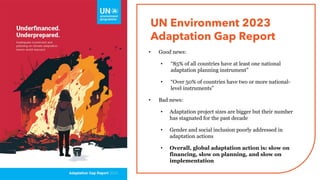
UN Environment 2023
Adaptation Gap Report
• Good news:
• “85% of all countries have at least one national
adaptation planning instrument”
• “Over 50% of countries have two or more national-
level instruments”
• Bad news:
• Adaptation project sizes are bigger but their number
has stagnated for the past decade
• Gender and social inclusion poorly addressed in
adaptation actions
• Overall, global adaptation action is: slow on
financing, slow on planning, and slow on
implementation
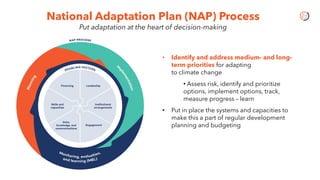
National Adaptation Plan (NAP) Process
Put adaptation at the heart of decision-making
• Identify and address medium- and long-
term priorities for adapting
to climate change
• Assess risk, identify and prioritize
options, implement options, track,
measure progress – learn
• Put in place the systems and capacities to
make this a part of regular development
planning and budgeting
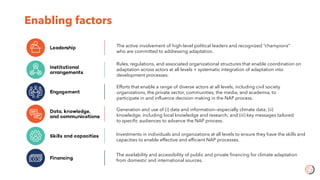
Enabling factors
The active involvement of high-level political leaders and recognized “champions”
who are committed to addressing adaptation.
Rules, regulations, and associated organizational structures that enable coordination on
adaptation across actors at all levels + systematic integration of adaptation into
development processes.
Efforts that enable a range of diverse actors at all levels, including civil society
organizations, the private sector, communities, the media, and academia, to
participate in and influence decision making in the NAP process.
Generation and use of (i) data and information—especially climate data; (ii)
knowledge, including local knowledge and research; and (iii) key messages tailored
to specific audiences to advance the NAP process.
Investments in individuals and organizations at all levels to ensure they have the skills and
capacities to enable effective and efficient NAP processes.
The availability and accessibility of public and private financing for climate adaptation
from domestic and international sources.
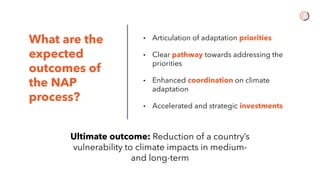
What are the
expected
outcomes of
the NAP
process?
• Articulation of adaptation priorities
• Clear pathway towards addressing the
priorities
• Enhanced coordination on climate
adaptation
• Accelerated and strategic investments
Ultimate outcome: Reduction of a country’s
vulnerability to climate impacts in medium-
and long-term
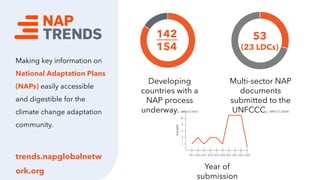
Making key information on
National Adaptation Plans
(NAPs) easily accessible
and digestible for the
climate change adaptation
community.
trends.napglobalnetw
ork.org
Developing
countries with a
NAP process
underway. UNFCCC (2023)
Multi-sector NAP
documents
submitted to the
UNFCCC. UNFCCC (2024)
142
154
53
(23 LDCs)
Year of
submission
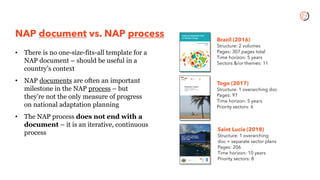
NAP document vs. NAP process
• There is no one-size-fits-all template for a
NAP document – should be useful in a
country’s context
• NAP documents are often an important
milestone in the NAP process – but
they’re not the only measure of progress
on national adaptation planning
• The NAP process does not end with a
document – it is an iterative, continuous
process
Brazil (2016)
Structure: 2 volumes
Pages: 307 pages total
Time horizon: 5 years
Sectors &/or themes: 11
Togo (2017)
Structure: 1 overarching doc
Pages: 97
Time horizon: 5 years
Priority sectors: 6
Saint Lucia (2018)
Structure: 1 overarching
doc + separate sector plans
Pages: 206
Time horizon: 10 years
Priority sectors: 8
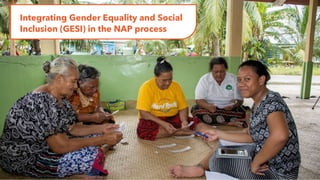
Integrating Gender Equality and Social
Inclusion (GESI) in the NAP process
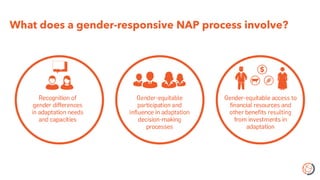
What does a gender-responsive NAP process involve?
Key messages on GESI
in NAP processes
• There are opportunities throughout the NAP process
to adopt a gender-responsive approach – you can
start where you are.
• As gender-responsiveness is largely about process,
the enabling activities are particularly important for
applying a gender-responsive approach.
• Gender expertise exists in all countries – it is a
matter of leveraging this expertise for the NAP
process.
• Gender analysis is an essential foundation for
planning, but should also be applied during
implementation and monitoring, evaluation and
learning (MEL).
• Equitable decision-making processes at all levels are
central to a gender-responsive approach.
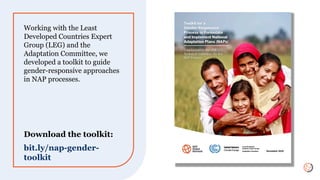
Working with the Least
Developed Countries Expert
Group (LEG) and the
Adaptation Committee, we
developed a toolkit to guide
gender-responsive approaches
in NAP processes.
Download the toolkit:
bit.ly/nap-gender-
toolkit
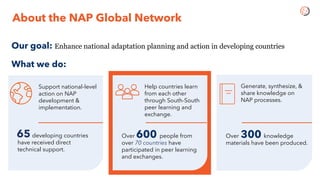
About the NAP Global Network
What we do:
Our goal: Enhance national adaptation planning and action in developing countries
Support national-level
action on NAP
development &
implementation.
Help countries learn
from each other
through South-South
peer learning and
exchange.
developing countries
have received direct
technical support.
65 Over people from
over 70 countries have
participated in peer learning
and exchanges.
600
Generate, synthesize, &
share knowledge on
NAP processes.
Over knowledge
materials have been produced.
300
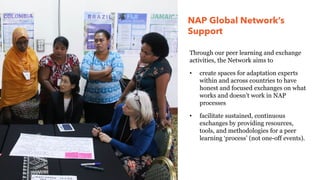
NAP Global Network’s
Support
Through our peer learning and exchange
activities, the Network aims to
• create spaces for adaptation experts
within and across countries to have
honest and focused exchanges on what
works and doesn’t work in NAP
processes
• facilitate sustained, continuous
exchanges by providing resources,
tools, and methodologies for a peer
learning ‘process’ (not one-off events).
Thank you!
Email:
info@napglobalnetwork.org
Website:
www.napglobalnetwork.org
@NAP_Network NAP Global Network

The NAP process & South-South peer learning

  • 1.
    The NAP process& South-South peer learning Orville Grey, NAP Global Network May 1, 2024
  • 2.
    UN Environment 2023 AdaptationGap Report • Good news: • “85% of all countries have at least one national adaptation planning instrument” • “Over 50% of countries have two or more national- level instruments” • Bad news: • Adaptation project sizes are bigger but their number has stagnated for the past decade • Gender and social inclusion poorly addressed in adaptation actions • Overall, global adaptation action is: slow on financing, slow on planning, and slow on implementation
  • 3.
    National Adaptation Plan(NAP) Process Put adaptation at the heart of decision-making • Identify and address medium- and long- term priorities for adapting to climate change • Assess risk, identify and prioritize options, implement options, track, measure progress – learn • Put in place the systems and capacities to make this a part of regular development planning and budgeting
  • 4.
    Enabling factors The activeinvolvement of high-level political leaders and recognized “champions” who are committed to addressing adaptation. Rules, regulations, and associated organizational structures that enable coordination on adaptation across actors at all levels + systematic integration of adaptation into development processes. Efforts that enable a range of diverse actors at all levels, including civil society organizations, the private sector, communities, the media, and academia, to participate in and influence decision making in the NAP process. Generation and use of (i) data and information—especially climate data; (ii) knowledge, including local knowledge and research; and (iii) key messages tailored to specific audiences to advance the NAP process. Investments in individuals and organizations at all levels to ensure they have the skills and capacities to enable effective and efficient NAP processes. The availability and accessibility of public and private financing for climate adaptation from domestic and international sources.
  • 5.
    What are the expected outcomesof the NAP process? • Articulation of adaptation priorities • Clear pathway towards addressing the priorities • Enhanced coordination on climate adaptation • Accelerated and strategic investments Ultimate outcome: Reduction of a country’s vulnerability to climate impacts in medium- and long-term
  • 6.
    Making key informationon National Adaptation Plans (NAPs) easily accessible and digestible for the climate change adaptation community. trends.napglobalnetw ork.org Developing countries with a NAP process underway. UNFCCC (2023) Multi-sector NAP documents submitted to the UNFCCC. UNFCCC (2024) 142 154 53 (23 LDCs) Year of submission
  • 7.
    NAP document vs.NAP process • There is no one-size-fits-all template for a NAP document – should be useful in a country’s context • NAP documents are often an important milestone in the NAP process – but they’re not the only measure of progress on national adaptation planning • The NAP process does not end with a document – it is an iterative, continuous process Brazil (2016) Structure: 2 volumes Pages: 307 pages total Time horizon: 5 years Sectors &/or themes: 11 Togo (2017) Structure: 1 overarching doc Pages: 97 Time horizon: 5 years Priority sectors: 6 Saint Lucia (2018) Structure: 1 overarching doc + separate sector plans Pages: 206 Time horizon: 10 years Priority sectors: 8
  • 8.
    Integrating Gender Equalityand Social Inclusion (GESI) in the NAP process
  • 9.
    What does agender-responsive NAP process involve?
  • 10.
    Key messages onGESI in NAP processes • There are opportunities throughout the NAP process to adopt a gender-responsive approach – you can start where you are. • As gender-responsiveness is largely about process, the enabling activities are particularly important for applying a gender-responsive approach. • Gender expertise exists in all countries – it is a matter of leveraging this expertise for the NAP process. • Gender analysis is an essential foundation for planning, but should also be applied during implementation and monitoring, evaluation and learning (MEL). • Equitable decision-making processes at all levels are central to a gender-responsive approach.
  • 11.
    Working with theLeast Developed Countries Expert Group (LEG) and the Adaptation Committee, we developed a toolkit to guide gender-responsive approaches in NAP processes. Download the toolkit: bit.ly/nap-gender- toolkit
  • 12.
    About the NAPGlobal Network What we do: Our goal: Enhance national adaptation planning and action in developing countries Support national-level action on NAP development & implementation. Help countries learn from each other through South-South peer learning and exchange. developing countries have received direct technical support. 65 Over people from over 70 countries have participated in peer learning and exchanges. 600 Generate, synthesize, & share knowledge on NAP processes. Over knowledge materials have been produced. 300
  • 13.
    NAP Global Network’s Support Throughour peer learning and exchange activities, the Network aims to • create spaces for adaptation experts within and across countries to have honest and focused exchanges on what works and doesn’t work in NAP processes • facilitate sustained, continuous exchanges by providing resources, tools, and methodologies for a peer learning ‘process’ (not one-off events).
  • 14.