DESY Factsheet November 2012

DESY Program Manager:
Kari Sipilä,  L.Sc
Phone: + 358 20 722 6550
kari.sipila@vtt.fi
CLEEN Ltd, Helsinki, c/o VTT
Tekniikantie 2, Espoo,
P.O. Box 1000, 02044 VTT
FINLAND

Distributed Energy Systems Program
There is a clear need for reliable information on the performance of hybrid renewable
energy systems, reliable dimensioning methods, and optimal solutions for small
municipalities/buildings, which can aid in the assessment of the suitability and feasibility of
new distributed energy systems.
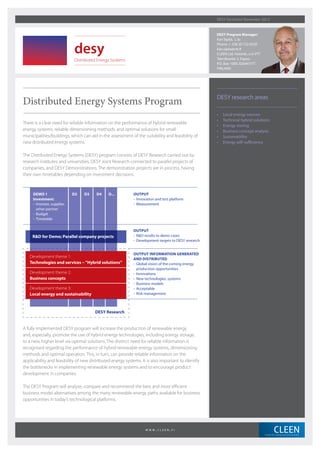
The Distributed Energy Systems (DESY) program consists of DESY Research carried out by
research institutes and universities, DESY Joint Research connected to parallel projects of
companies, and DESY Demonstrations. The demonstration projects are in process, having
their own timetables depending on investment decisions.

Demo 1
Investment:
-	 Investor, supplier,
	 other partner
-	 Budget
-	 Timetable

D2

D3

D4

D...

R&D for Demo; Parallel company projects

Development theme 1:
Technologies and services – ”Hybrid solutions”
Development theme 2:
Business concepts
Development theme 3:
Local energy and sustainability

Output
-	 Innovation and test platform
-	 Measurement

Output
-	 R&D results to demo cases
-	 Development targets to DESY research
Output information generated
and distributed
-	 Global vision of the coming energy
	 production opportunities
-	 Innovations
-	 New technologies, systems
-	 Business models
-	 Acceptable
-	 Risk management

DESY Research

A fully implemented DESY program will increase the production of renewable energy
and, especially, promote the use of hybrid energy technologies, including energy storage,
to a new, higher level via optimal solutions. The distinct need for reliable information is
recognised regarding the performance of hybrid renewable energy systems, dimensioning
methods and optimal operation. This, in turn, can provide reliable information on the
applicability and feasibility of new distributed energy systems. It is also important to identify
the bottlenecks in implementing renewable energy systems and to encourage product
development in companies.
The DESY Program will analyse, compare and recommend the best and most efficient
business model alternatives among the many renewable energy paths available for business
opportunities in today’s technological platforms.

www.cleen.fi

DESY research areas
•	
•	
•	
•	
•	
•	

Local energy sources
Technical hybrid solutions
Energy storing
Business concept analysis
Sustainability
Energy self-sufficiency
DESY Factsheet November 2012

The methods will be developed for designing and sizing hybrid energy components and
optimizing the entire system. The goal is to optimise hybrid energy systems, using the best
available components and optimal dimensioning to fulfil the environmental criteria set for
the energy systems of the future.
Each research partner will develop their own component models for hybrid energy systems,
and they will be coupled to operate together as a hybrid calculation model. The final model
could be used as a design and operation model for hybrid energy systems using renewable
energy sources.

DESY Program volume:
1,0 M€ for 2012 - 2014
DESY consortium members
•	 13 industrial partners
•	 6 research partners

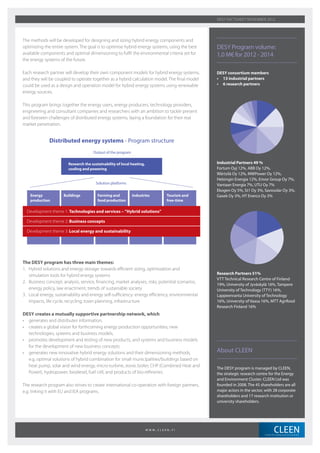
This program brings together the energy users, energy producers, technology providers,
engineering and consultant companies and researchers with an ambition to tackle present
and foreseen challenges of distributed energy systems, laying a foundation for their real
market penetration.

Distributed energy systems - Program structure
Output of the program
Research the sustainability of local heating,
cooling and powering
Solution platforms
Energy
production

Buildings

Farming and
food production

Industries

Tourism and
free-time

Industrial Partners 49 %
Fortum Oyj 12%, ABB Oy 12%,
Wärtsilä Oy 12%, MWPower Oy 12%,
Helsingin Energia 12%, Envor Group Oy 7%,
Vantaan Energia 7%, UTU Oy 7%
Ekogen Oy 5%, St1 Oy 3%, Savosolar Oy 3%,
Gasek Oy 3%, HT Enerco Oy 3%

Development theme 1: Technologies and services – ”Hybrid solutions”
Development theme 2: Business concepts
Development theme 3: Local energy and sustainability

The DESY program has three main themes:
1.	 Hybrid solutions and energy storage: towards efficient sizing, optimization and
simulation tools for hybrid energy systems
2.	 Business concept: analysis, service, financing, market analyses, risks, potential scenarios,
energy policy, law enactment, trends of sustainable society
3.	 Local energy, sustainability and energy self-sufficiency: energy efficiency, environmental
impacts, life cycle, recycling, town planning, infrastructure
DESY creates a mutually supportive partnership network, which
•	 generates and distributes information,
•	 creates a global vision for forthcoming energy production opportunities, new
technologies, systems and business models,
•	 promotes development and testing of new products, and systems and business models
for the development of new business concepts
•	 generates new innovative hybrid energy solutions and their dimensioning methods,
e.g. optimal solutions of hybrid combination for small municipalities/buildings based on
heat pump, solar and wind energy, micro-turbine, stove, boiler, CHP (Combined Heat and
Power), hydropower, biodiesel, fuel cell, and products of bio-refineries.
The research program also strives to create international co-operation with foreign partners,
e.g. linking it with EU and IEA programs.

www.cleen.fi

Research Partners 51%
VTT Technical Research Centre of Finland
19%, University of Jyväskylä 16%, Tampere
University of Technology (TTY) 16%,
Lappeenranta University of Technology
16%, University of Vaasa 16%, MTT Agrifood
Research Finland 16%

About CLEEN
The DESY program is managed by CLEEN,
the strategic research centre for the Energy
and Environment Cluster. CLEEN Ltd was
founded in 2008. The 45 shareholders are all
major actors in the sector, with 28 corporate
shareholders and 17 research institution or
university shareholders.

Distributed Energy Systems Program

  • 1.
    DESY Factsheet November2012 DESY Program Manager: Kari Sipilä, L.Sc Phone: + 358 20 722 6550 kari.sipila@vtt.fi CLEEN Ltd, Helsinki, c/o VTT Tekniikantie 2, Espoo, P.O. Box 1000, 02044 VTT FINLAND Distributed Energy Systems Program There is a clear need for reliable information on the performance of hybrid renewable energy systems, reliable dimensioning methods, and optimal solutions for small municipalities/buildings, which can aid in the assessment of the suitability and feasibility of new distributed energy systems. The Distributed Energy Systems (DESY) program consists of DESY Research carried out by research institutes and universities, DESY Joint Research connected to parallel projects of companies, and DESY Demonstrations. The demonstration projects are in process, having their own timetables depending on investment decisions. Demo 1 Investment: - Investor, supplier, other partner - Budget - Timetable D2 D3 D4 D... R&D for Demo; Parallel company projects Development theme 1: Technologies and services – ”Hybrid solutions” Development theme 2: Business concepts Development theme 3: Local energy and sustainability Output - Innovation and test platform - Measurement Output - R&D results to demo cases - Development targets to DESY research Output information generated and distributed - Global vision of the coming energy production opportunities - Innovations - New technologies, systems - Business models - Acceptable - Risk management DESY Research A fully implemented DESY program will increase the production of renewable energy and, especially, promote the use of hybrid energy technologies, including energy storage, to a new, higher level via optimal solutions. The distinct need for reliable information is recognised regarding the performance of hybrid renewable energy systems, dimensioning methods and optimal operation. This, in turn, can provide reliable information on the applicability and feasibility of new distributed energy systems. It is also important to identify the bottlenecks in implementing renewable energy systems and to encourage product development in companies. The DESY Program will analyse, compare and recommend the best and most efficient business model alternatives among the many renewable energy paths available for business opportunities in today’s technological platforms. www.cleen.fi DESY research areas • • • • • • Local energy sources Technical hybrid solutions Energy storing Business concept analysis Sustainability Energy self-sufficiency
  • 2.
    DESY Factsheet November2012 The methods will be developed for designing and sizing hybrid energy components and optimizing the entire system. The goal is to optimise hybrid energy systems, using the best available components and optimal dimensioning to fulfil the environmental criteria set for the energy systems of the future. Each research partner will develop their own component models for hybrid energy systems, and they will be coupled to operate together as a hybrid calculation model. The final model could be used as a design and operation model for hybrid energy systems using renewable energy sources. DESY Program volume: 1,0 M€ for 2012 - 2014 DESY consortium members • 13 industrial partners • 6 research partners This program brings together the energy users, energy producers, technology providers, engineering and consultant companies and researchers with an ambition to tackle present and foreseen challenges of distributed energy systems, laying a foundation for their real market penetration. Distributed energy systems - Program structure Output of the program Research the sustainability of local heating, cooling and powering Solution platforms Energy production Buildings Farming and food production Industries Tourism and free-time Industrial Partners 49 % Fortum Oyj 12%, ABB Oy 12%, Wärtsilä Oy 12%, MWPower Oy 12%, Helsingin Energia 12%, Envor Group Oy 7%, Vantaan Energia 7%, UTU Oy 7% Ekogen Oy 5%, St1 Oy 3%, Savosolar Oy 3%, Gasek Oy 3%, HT Enerco Oy 3% Development theme 1: Technologies and services – ”Hybrid solutions” Development theme 2: Business concepts Development theme 3: Local energy and sustainability The DESY program has three main themes: 1. Hybrid solutions and energy storage: towards efficient sizing, optimization and simulation tools for hybrid energy systems 2. Business concept: analysis, service, financing, market analyses, risks, potential scenarios, energy policy, law enactment, trends of sustainable society 3. Local energy, sustainability and energy self-sufficiency: energy efficiency, environmental impacts, life cycle, recycling, town planning, infrastructure DESY creates a mutually supportive partnership network, which • generates and distributes information, • creates a global vision for forthcoming energy production opportunities, new technologies, systems and business models, • promotes development and testing of new products, and systems and business models for the development of new business concepts • generates new innovative hybrid energy solutions and their dimensioning methods, e.g. optimal solutions of hybrid combination for small municipalities/buildings based on heat pump, solar and wind energy, micro-turbine, stove, boiler, CHP (Combined Heat and Power), hydropower, biodiesel, fuel cell, and products of bio-refineries. The research program also strives to create international co-operation with foreign partners, e.g. linking it with EU and IEA programs. www.cleen.fi Research Partners 51% VTT Technical Research Centre of Finland 19%, University of Jyväskylä 16%, Tampere University of Technology (TTY) 16%, Lappeenranta University of Technology 16%, University of Vaasa 16%, MTT Agrifood Research Finland 16% About CLEEN The DESY program is managed by CLEEN, the strategic research centre for the Energy and Environment Cluster. CLEEN Ltd was founded in 2008. The 45 shareholders are all major actors in the sector, with 28 corporate shareholders and 17 research institution or university shareholders.