Janice Lin | CESA Executive Director and Managing Partner of Strategen Consulting Heiko Stutzinger| BVES Executive Director, Head of Renewable Energy Fairs Messe Dusseldorf GmbH Rahul Walawalkar | IESA Executive Director and Vice President, Customized Energy Solutions Johnson Yu| Chairman, China Energy Storage Alliance Marcus Wiemann| General Secretary, Alliance for Renewable Energy March 2014 
Global Energy Storage Alliance (GESA) 
Advancing education, collaboration, knowledge and proven frameworks about the benefits of energy storage globally
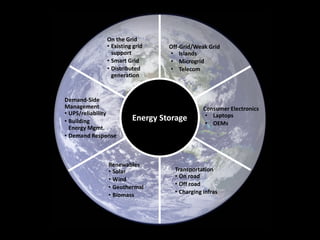
Energy Storage 
On the Grid 
• 
Existing grid support 
• 
Smart Grid 
• 
Distributed generation 
Demand-Side Management 
• 
UPS/reliability 
• 
Building Energy Mgmt. 
• 
Demand Response 
Renewables 
• 
Solar 
• 
Wind 
• 
Geothermal 
• 
Biomass 
Transportation 
• 
On road 
• 
Off road 
• 
Charging infras 
Consumer Electronics 
• 
Laptops 
• 
OEMs 
Off-Grid/Weak Grid 
• 
Islands 
• 
Microgrid 
• 
Telecom
4 
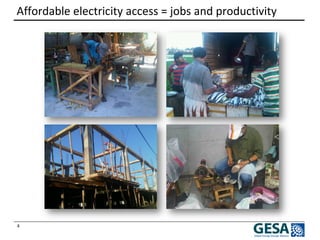
Affordable electricity access = jobs and productivity
5 
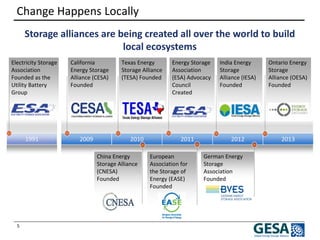
Change Happens Locally 
Storage alliances are being created all over the world to build local ecosystems 
European Association for the Storage of Energy (EASE) Founded 
German Energy Storage Association Founded 
California Energy Storage Alliance (CESA) Founded 
Electricity Storage Association Founded as the Utility Battery Group 
Texas Energy Storage Alliance (TESA) Founded 
Energy Storage Association (ESA) Advocacy Council Created 
India Energy Storage Alliance (IESA) Founded 
China Energy Storage Alliance (CNESA) Founded 
2011 
2012 
2009 
2010 
2013 
Ontario Energy Storage Alliance (OESA) Founded 
1991
How do we achieve market transformation faster?
8 
GESA Mission 
“Advance education, collaboration, knowledge and proven frameworks about the benefits of energy storage and how it can be used to achieve a more efficient, cleaner, reliable, affordable and secure electric power system globally”
9 
Introducing the Global Energy Storage Alliance (GESA) 
Formation and Structure will be Collaborative by Design 
»501c(3) structure to enable charitable donations by foundations 
»Co-Founded by existing storage alliances and key partner organizations 
»Leadership/management – 7 person Executive Committee 
–As funding expands, hire dedicated executive director 
–Executive Committee members are unpaid volunteers, appointed/elected by Board 
–In person meetings co located with energy storage conferences 
»Board Directors – up to 25 members 
–1 seat for each co-founder 
–Additional board members to be invited based on their involvement and contributions to GESA’s mission 
–Newly created storage alliances can be added, provide they agree to fundamental principles and goals 
»Board of Advisors (appointed, up to 15) 
–Utility representatives 
–Environmental group representatives 
–Policy/economics/technical advisors
GESA: Core Purpose 
» 
Advance global education, collaboration, knowledge and proven frameworks about the benefits of energy storage and how to incorporate it into the electric power system in a cost effective way 
» 
Increase ecosystem development funding pool: target foundations, NGOs and governments who share GESA’s mission 
» 
Empower local ESA’s and other key stakeholders, not compete with them for funding 
» 
Learn from local market development efforts, help proliferate best practices 
» 
Foster collaboration among key stakeholders including policy makers, utilities, renewable energy community, financial institutions and environmental organizations 
» 
Help establish standards and protocols to advance energy storage acceptance worldwide 
GESA will be more than the sum of its members 10
11 
GESA Vision 
By 2015 all major international environmental, utility, and social justice organizations will be aware of, and actively considering energy storage and its potential for transforming the electric power system.
12 
GESA Vision 
By 2015 all major international environmental, utility and social justice organizations will be aware of, and actively considering energy storage and its potential for transforming the electric power system. 
By 2020 energy storage will be a mainstream resource routinely used for electric power system planning and operation in at least three major markets.
13 
GESA Vision 
By 2015 all major international environmental, utility and social justice organizations will be aware of, and actively considering energy storage and its potential for transforming the electric power system. 
By 2020 energy storage will be a mainstream resource routinely used for electric power system planning and operation in at least three major markets. 
By 2025, energy storage will have made a significant and measurable contribution in helping to achieve much higher penetrations of renewable energy and access to electricity for millions of people globally.
14 
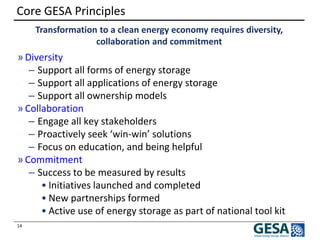
Core GESA Principles 
Transformation to a clean energy economy requires diversity, collaboration and commitment 
»Diversity 
–Support all forms of energy storage 
–Support all applications of energy storage 
–Support all ownership models 
»Collaboration 
–Engage all key stakeholders 
–Proactively seek ‘win-win’ solutions 
–Focus on education, and being helpful 
»Commitment 
–Success to be measured by results 
•Initiatives launched and completed 
•New partnerships formed 
•Active use of energy storage as part of national tool kit
15 
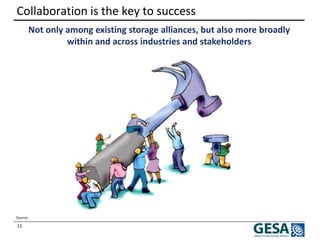
Collaboration is the key to success 
Not only among existing storage alliances, but also more broadly within and across industries and stakeholders 
Source:
16 
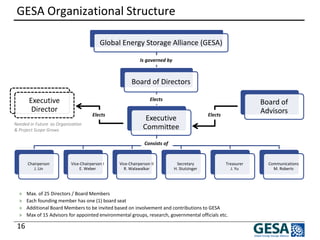
GESA Organizational Structure 
Global Energy Storage Alliance (GESA) 
Board of Directors 
Executive Director 
Executive Committee 
Chairperson J. Lin 
Vice-Chairperson I E. Weber 
Vice-Chairperson II R. Walawalkar 
Secretary H. Stutzinger 
Treasurer J. Yu 
Communications M. Roberts 
Board of Advisors 
» 
Max. of 25 Directors / Board Members 
» 
Each founding member has one (1) board seat 
» 
Additional Board Members to be invited based on involvement and contributions to GESA 
» 
Max of 15 Advisors for appointed environmental groups, research, governmental officials etc. 
Needed in Future as Organization & Project Scope Grows 
Is governed by 
Elects 
Elects 
Consists of 
Elects
17 
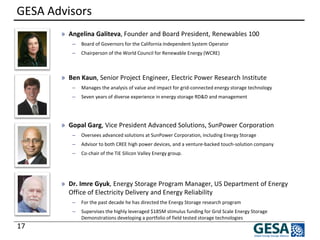
GESA Advisors 
»Angelina Galiteva, Founder and Board President, Renewables 100 
–Board of Governors for the California Independent System Operator 
–Chairperson of the World Council for Renewable Energy (WCRE) 
»Ben Kaun, Senior Project Engineer, Electric Power Research Institute 
–Manages the analysis of value and impact for grid-connected energy storage technology 
–Seven years of diverse experience in energy storage RD&D and management 
»Gopal Garg, Vice President Advanced Solutions, SunPower Corporation 
–Oversees advanced solutions at SunPower Corporation, including Energy Storage 
–Advisor to both CREE high power devices, and a venture-backed touch-solution company 
–Co-chair of the TiE Silicon Valley Energy group. 
»Dr. Imre Gyuk, Energy Storage Program Manager, US Department of Energy Office of Electricity Delivery and Energy Reliability 
–For the past decade he has directed the Energy Storage research program 
–Supervises the highly leveraged $185M stimulus funding for Grid Scale Energy Storage Demonstrations developing a portfolio of field tested storage technologies
Examples of GESA Special Initiatives 
» 
Facilitating international collaboration between California and Germany at Energy Storage Europe, Dusseldorf 2014 
» 
Developing International Energy Storage Application Framework and Cost Effectiveness Methodology 
»Developing the Business Case for Integrating Energy Storage with Renewable Energy to displace diesel generation and increase access to affordable electricity 
»Modeling System Impacts and Possibilities of Stationary and Mobile (EV) Energy Storage to achieve 50% and 80% renewable penetration in CA 
»Role of Energy Storage in Zero Energy Buildings 
18
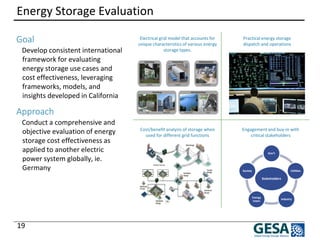
Energy Storage Evaluation 19 
Conduct a comprehensive and objective evaluation of energy storage cost effectiveness as applied to another electric power system globally, ie. Germany 
Approach 
Stakeholders 
Gov’t 
Utilities 
Industry 
Energy Users 
Society 
Electrical grid model that accounts for unique characteristics of various energy storage types. 
Practical energy storage dispatch and operations 
Cost/benefit analysis of storage when used for different grid functions 
Engagement and buy-in with critical stakeholders 
Develop consistent international framework for evaluating energy storage use cases and cost effectiveness, leveraging frameworks, models, and insights developed in California 
Goal
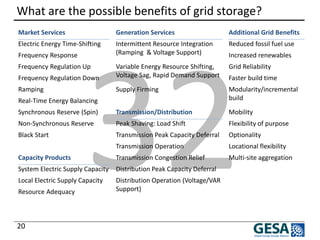
What are the possible benefits of grid storage? 20 
Market Services 
Electric Energy Time-Shifting 
Frequency Response 
Frequency Regulation Up 
Frequency Regulation Down 
Ramping 
Real-Time Energy Balancing 
Synchronous Reserve (Spin) 
Non-Synchronous Reserve 
Black Start 
Capacity Products 
System Electric Supply Capacity 
Local Electric Supply Capacity 
Resource Adequacy 
Generation Services 
Intermittent Resource Integration (Ramping & Voltage Support) 
Variable Energy Resource Shifting, Voltage Sag, Rapid Demand Support 
Supply Firming 
Transmission/Distribution 
Peak Shaving: Load Shift 
Transmission Peak Capacity Deferral 
Transmission Operation 
Transmission Congestion Relief 
Distribution Peak Capacity Deferral 
Distribution Operation (Voltage/VAR Support) 
Additional Grid Benefits 
Reduced fossil fuel use 
Increased renewables 
Grid Reliability 
Faster build time 
Modularity/incremental build 
Mobility 
Flexibility of purpose 
Optionality 
Locational flexibility 
Multi-site aggregation
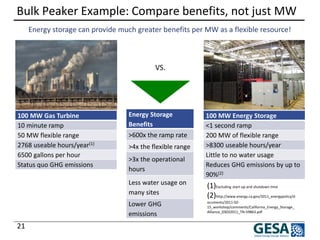
Bulk Peaker Example: Compare benefits, not just MW 21 
(1)Excluding start-up and shutdown time (2)http://www.energy.ca.gov/2011_energypolicy/documents/2011-02- 15_workshop/comments/California_Energy_Storage_ Alliance_03032011_TN-59863.pdf 
100 MW Gas Turbine 
10 minute ramp 
50 MW flexible range 
2768 useable hours/year(1) 
6500 gallons per hour 
Status quo GHG emissions 
Energy storage can provide much greater benefits per MW as a flexible resource! 
Energy Storage Benefits 
>600x the ramp rate 
>4x the flexible range 
>3x the operational hours 
Less water usage on many sites 
Lower GHG emissions 
100 MW Energy Storage 
<1 second ramp 
200 MW of flexible range 
>8300 useable hours/year 
Little to no water usage 
Reduces GHG emissions by up to 90%(2) 
VS.
California Bulk Peaker Replacement Cost Effectiveness Results 22 
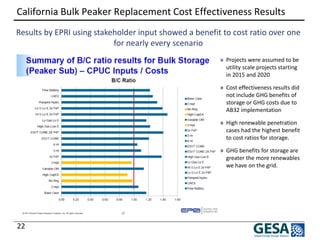
Results by EPRI using stakeholder input showed a benefit to cost ratio over one for nearly every scenario 
» 
Projects were assumed to be utility scale projects starting in 2015 and 2020 
» 
Cost effectiveness results did not include GHG benefits of storage or GHG costs due to AB32 implementation 
» 
High renewable penetration cases had the highest benefit to cost ratios for storage. 
» 
GHG benefits for storage are greater the more renewables we have on the grid.
Replacing Diesel with Solar & Advanced Energy Storage 23 
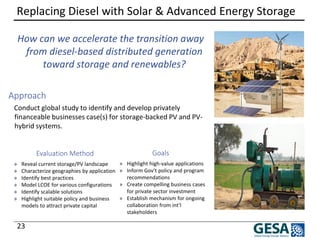
Conduct global study to identify and develop privately financeable businesses case(s) for storage-backed PV and PV- hybrid systems. 
How can we accelerate the transition away from diesel-based distributed generation toward storage and renewables? 
Approach 
» 
Reveal current storage/PV landscape 
» 
Characterize geographies by application 
» 
Identify best practices 
» 
Model LCOE for various configurations 
» 
Identify scalable solutions 
» 
Highlight suitable policy and business models to attract private capital 
» 
Highlight high-value applications 
» 
Inform Gov’t policy and program recommendations 
» 
Create compelling business cases for private sector investment 
» 
Establish mechanism for ongoing collaboration from int’l stakeholders 
Goals 
Evaluation Method
Example: Solar-powered Dairy and Fish Refrigeration 
» 
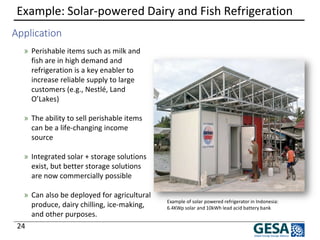
Perishable items such as milk and fish are in high demand and refrigeration is a key enabler to increase reliable supply to large customers (e.g., Nestlé, Land O’Lakes) 
» 
The ability to sell perishable items can be a life-changing income source 
» 
Integrated solar + storage solutions exist, but better storage solutions are now commercially possible 
» 
Can also be deployed for agricultural produce, dairy chilling, ice-making, and other purposes. 24 
Application 
Example of solar powered refrigerator in Indonesia: 6.4KWp solar and 10kWh lead acid battery bank
Example: Solar-powered Dairy and Fish Refrigeration 
» 
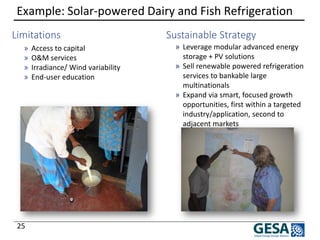
Access to capital 
» 
O&M services 
» 
Irradiance/ Wind variability 
» 
End-user education 25 
Limitations 
» 
Leverage modular advanced energy storage + PV solutions 
» 
Sell renewable powered refrigeration services to bankable large multinationals 
» 
Expand via smart, focused growth opportunities, first within a targeted industry/application, second to adjacent markets 
Sustainable Strategy
26 
Next steps 
GESA is ready to begin its work! 
»Secure partners and funding for first GESA initiative(s) 
»Develop detailed scope of work with key milestones and metrics for success

Global Energy Storage Alliance Overview

  • 1.
    Janice Lin |CESA Executive Director and Managing Partner of Strategen Consulting Heiko Stutzinger| BVES Executive Director, Head of Renewable Energy Fairs Messe Dusseldorf GmbH Rahul Walawalkar | IESA Executive Director and Vice President, Customized Energy Solutions Johnson Yu| Chairman, China Energy Storage Alliance Marcus Wiemann| General Secretary, Alliance for Renewable Energy March 2014 Global Energy Storage Alliance (GESA) Advancing education, collaboration, knowledge and proven frameworks about the benefits of energy storage globally
  • 3.
    Energy Storage Onthe Grid • Existing grid support • Smart Grid • Distributed generation Demand-Side Management • UPS/reliability • Building Energy Mgmt. • Demand Response Renewables • Solar • Wind • Geothermal • Biomass Transportation • On road • Off road • Charging infras Consumer Electronics • Laptops • OEMs Off-Grid/Weak Grid • Islands • Microgrid • Telecom
  • 4.
    4 Affordable electricityaccess = jobs and productivity
  • 5.
    5 Change HappensLocally Storage alliances are being created all over the world to build local ecosystems European Association for the Storage of Energy (EASE) Founded German Energy Storage Association Founded California Energy Storage Alliance (CESA) Founded Electricity Storage Association Founded as the Utility Battery Group Texas Energy Storage Alliance (TESA) Founded Energy Storage Association (ESA) Advocacy Council Created India Energy Storage Alliance (IESA) Founded China Energy Storage Alliance (CNESA) Founded 2011 2012 2009 2010 2013 Ontario Energy Storage Alliance (OESA) Founded 1991
  • 7.
    How do weachieve market transformation faster?
  • 8.
    8 GESA Mission “Advance education, collaboration, knowledge and proven frameworks about the benefits of energy storage and how it can be used to achieve a more efficient, cleaner, reliable, affordable and secure electric power system globally”
  • 9.
    9 Introducing theGlobal Energy Storage Alliance (GESA) Formation and Structure will be Collaborative by Design »501c(3) structure to enable charitable donations by foundations »Co-Founded by existing storage alliances and key partner organizations »Leadership/management – 7 person Executive Committee –As funding expands, hire dedicated executive director –Executive Committee members are unpaid volunteers, appointed/elected by Board –In person meetings co located with energy storage conferences »Board Directors – up to 25 members –1 seat for each co-founder –Additional board members to be invited based on their involvement and contributions to GESA’s mission –Newly created storage alliances can be added, provide they agree to fundamental principles and goals »Board of Advisors (appointed, up to 15) –Utility representatives –Environmental group representatives –Policy/economics/technical advisors
  • 10.
    GESA: Core Purpose » Advance global education, collaboration, knowledge and proven frameworks about the benefits of energy storage and how to incorporate it into the electric power system in a cost effective way » Increase ecosystem development funding pool: target foundations, NGOs and governments who share GESA’s mission » Empower local ESA’s and other key stakeholders, not compete with them for funding » Learn from local market development efforts, help proliferate best practices » Foster collaboration among key stakeholders including policy makers, utilities, renewable energy community, financial institutions and environmental organizations » Help establish standards and protocols to advance energy storage acceptance worldwide GESA will be more than the sum of its members 10
  • 11.
    11 GESA Vision By 2015 all major international environmental, utility, and social justice organizations will be aware of, and actively considering energy storage and its potential for transforming the electric power system.
  • 12.
    12 GESA Vision By 2015 all major international environmental, utility and social justice organizations will be aware of, and actively considering energy storage and its potential for transforming the electric power system. By 2020 energy storage will be a mainstream resource routinely used for electric power system planning and operation in at least three major markets.
  • 13.
    13 GESA Vision By 2015 all major international environmental, utility and social justice organizations will be aware of, and actively considering energy storage and its potential for transforming the electric power system. By 2020 energy storage will be a mainstream resource routinely used for electric power system planning and operation in at least three major markets. By 2025, energy storage will have made a significant and measurable contribution in helping to achieve much higher penetrations of renewable energy and access to electricity for millions of people globally.
  • 14.
    14 Core GESAPrinciples Transformation to a clean energy economy requires diversity, collaboration and commitment »Diversity –Support all forms of energy storage –Support all applications of energy storage –Support all ownership models »Collaboration –Engage all key stakeholders –Proactively seek ‘win-win’ solutions –Focus on education, and being helpful »Commitment –Success to be measured by results •Initiatives launched and completed •New partnerships formed •Active use of energy storage as part of national tool kit
  • 15.
    15 Collaboration isthe key to success Not only among existing storage alliances, but also more broadly within and across industries and stakeholders Source:
  • 16.
    16 GESA OrganizationalStructure Global Energy Storage Alliance (GESA) Board of Directors Executive Director Executive Committee Chairperson J. Lin Vice-Chairperson I E. Weber Vice-Chairperson II R. Walawalkar Secretary H. Stutzinger Treasurer J. Yu Communications M. Roberts Board of Advisors » Max. of 25 Directors / Board Members » Each founding member has one (1) board seat » Additional Board Members to be invited based on involvement and contributions to GESA » Max of 15 Advisors for appointed environmental groups, research, governmental officials etc. Needed in Future as Organization & Project Scope Grows Is governed by Elects Elects Consists of Elects
  • 17.
    17 GESA Advisors »Angelina Galiteva, Founder and Board President, Renewables 100 –Board of Governors for the California Independent System Operator –Chairperson of the World Council for Renewable Energy (WCRE) »Ben Kaun, Senior Project Engineer, Electric Power Research Institute –Manages the analysis of value and impact for grid-connected energy storage technology –Seven years of diverse experience in energy storage RD&D and management »Gopal Garg, Vice President Advanced Solutions, SunPower Corporation –Oversees advanced solutions at SunPower Corporation, including Energy Storage –Advisor to both CREE high power devices, and a venture-backed touch-solution company –Co-chair of the TiE Silicon Valley Energy group. »Dr. Imre Gyuk, Energy Storage Program Manager, US Department of Energy Office of Electricity Delivery and Energy Reliability –For the past decade he has directed the Energy Storage research program –Supervises the highly leveraged $185M stimulus funding for Grid Scale Energy Storage Demonstrations developing a portfolio of field tested storage technologies
  • 18.
    Examples of GESASpecial Initiatives » Facilitating international collaboration between California and Germany at Energy Storage Europe, Dusseldorf 2014 » Developing International Energy Storage Application Framework and Cost Effectiveness Methodology »Developing the Business Case for Integrating Energy Storage with Renewable Energy to displace diesel generation and increase access to affordable electricity »Modeling System Impacts and Possibilities of Stationary and Mobile (EV) Energy Storage to achieve 50% and 80% renewable penetration in CA »Role of Energy Storage in Zero Energy Buildings 18
  • 19.
    Energy Storage Evaluation19 Conduct a comprehensive and objective evaluation of energy storage cost effectiveness as applied to another electric power system globally, ie. Germany Approach Stakeholders Gov’t Utilities Industry Energy Users Society Electrical grid model that accounts for unique characteristics of various energy storage types. Practical energy storage dispatch and operations Cost/benefit analysis of storage when used for different grid functions Engagement and buy-in with critical stakeholders Develop consistent international framework for evaluating energy storage use cases and cost effectiveness, leveraging frameworks, models, and insights developed in California Goal
  • 20.
    What are thepossible benefits of grid storage? 20 Market Services Electric Energy Time-Shifting Frequency Response Frequency Regulation Up Frequency Regulation Down Ramping Real-Time Energy Balancing Synchronous Reserve (Spin) Non-Synchronous Reserve Black Start Capacity Products System Electric Supply Capacity Local Electric Supply Capacity Resource Adequacy Generation Services Intermittent Resource Integration (Ramping & Voltage Support) Variable Energy Resource Shifting, Voltage Sag, Rapid Demand Support Supply Firming Transmission/Distribution Peak Shaving: Load Shift Transmission Peak Capacity Deferral Transmission Operation Transmission Congestion Relief Distribution Peak Capacity Deferral Distribution Operation (Voltage/VAR Support) Additional Grid Benefits Reduced fossil fuel use Increased renewables Grid Reliability Faster build time Modularity/incremental build Mobility Flexibility of purpose Optionality Locational flexibility Multi-site aggregation
  • 21.
    Bulk Peaker Example:Compare benefits, not just MW 21 (1)Excluding start-up and shutdown time (2)http://www.energy.ca.gov/2011_energypolicy/documents/2011-02- 15_workshop/comments/California_Energy_Storage_ Alliance_03032011_TN-59863.pdf 100 MW Gas Turbine 10 minute ramp 50 MW flexible range 2768 useable hours/year(1) 6500 gallons per hour Status quo GHG emissions Energy storage can provide much greater benefits per MW as a flexible resource! Energy Storage Benefits >600x the ramp rate >4x the flexible range >3x the operational hours Less water usage on many sites Lower GHG emissions 100 MW Energy Storage <1 second ramp 200 MW of flexible range >8300 useable hours/year Little to no water usage Reduces GHG emissions by up to 90%(2) VS.
  • 22.
    California Bulk PeakerReplacement Cost Effectiveness Results 22 Results by EPRI using stakeholder input showed a benefit to cost ratio over one for nearly every scenario » Projects were assumed to be utility scale projects starting in 2015 and 2020 » Cost effectiveness results did not include GHG benefits of storage or GHG costs due to AB32 implementation » High renewable penetration cases had the highest benefit to cost ratios for storage. » GHG benefits for storage are greater the more renewables we have on the grid.
  • 23.
    Replacing Diesel withSolar & Advanced Energy Storage 23 Conduct global study to identify and develop privately financeable businesses case(s) for storage-backed PV and PV- hybrid systems. How can we accelerate the transition away from diesel-based distributed generation toward storage and renewables? Approach » Reveal current storage/PV landscape » Characterize geographies by application » Identify best practices » Model LCOE for various configurations » Identify scalable solutions » Highlight suitable policy and business models to attract private capital » Highlight high-value applications » Inform Gov’t policy and program recommendations » Create compelling business cases for private sector investment » Establish mechanism for ongoing collaboration from int’l stakeholders Goals Evaluation Method
  • 24.
    Example: Solar-powered Dairyand Fish Refrigeration » Perishable items such as milk and fish are in high demand and refrigeration is a key enabler to increase reliable supply to large customers (e.g., Nestlé, Land O’Lakes) » The ability to sell perishable items can be a life-changing income source » Integrated solar + storage solutions exist, but better storage solutions are now commercially possible » Can also be deployed for agricultural produce, dairy chilling, ice-making, and other purposes. 24 Application Example of solar powered refrigerator in Indonesia: 6.4KWp solar and 10kWh lead acid battery bank
  • 25.
    Example: Solar-powered Dairyand Fish Refrigeration » Access to capital » O&M services » Irradiance/ Wind variability » End-user education 25 Limitations » Leverage modular advanced energy storage + PV solutions » Sell renewable powered refrigeration services to bankable large multinationals » Expand via smart, focused growth opportunities, first within a targeted industry/application, second to adjacent markets Sustainable Strategy
  • 26.
    26 Next steps GESA is ready to begin its work! »Secure partners and funding for first GESA initiative(s) »Develop detailed scope of work with key milestones and metrics for success