EERE is at the center of the clean energy economy. The organization leads a
network of researchers and other partners to deliver innovative technologies that
accelerate development and deployment of energy efficiency and renewable energy
solutions. These advances strengthen U.S. energy security, environmental quality,
and economic vitality. Its priorities include:
	 Advanced Manufacturing: EERE’s goal is to reduce by 50% in 10 years
the life-cycle energy consumption of manufactured goods through the use
of advanced manufacturing technologies.
	 Biofuels: Development of advanced biofuels has significant potential
to address U.S. energy competitive advantage, transportation-related
greenhouse gas emissions and U.S. job growth.
	 Grid Modernization: EERE has undertaken an aggressive five-year
strategy to modernize the national power grid through targeted cost
reductions and a coordinated grid and analytics platform.
	 Sustainable Transportation: EERE investments have helped speed
deployment of fuel cell electric vehicles to the market and cut the cost of
fuel cells by 50% since 2006.
	 Solar Power: The SunShot Initiative’s goal is to drive technology
innovation to make solar cost-competitive with conventional energy
sources before the end of the decade.
	 Wind: EERE-funded research is helping to lower the costs and
accelerate the deployment of wind energy technologies—both on land and
offshore. Today’s wind industry supports thousands of U.S. jobs, including
workers at more than 400 manufacturing plants in 44 states.
EERE AT A GLANCE
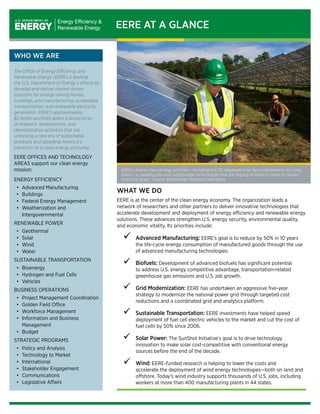
EERE’s diverse clean energy portfolio – including this 32 megawatt solar farm collaboration on Long
Island – is yielding jobs and cutting edge technologies that are helping America to meet its carbon
reduction goals . Source: Brookhaven National Laboratory
WHAT WE DO
WHO WE ARE
The Office of Energy Efficiency and
Renewable Energy (EERE) is leading
the U.S. Department of Energy’s efforts to
develop and deliver market-driven
solutions for energy-saving homes,
buildings, and manufacturing; sustainable
transportation; and renewable electricity
generation. EERE’s approximately
$2 billion portfolio spans a broad array
of research, development, and
demonstration activities that are
unlocking a new era of sustainable
products and speeding America’s
transition to a clean energy economy.
EERE OFFICES AND TECHNOLOGY
AREAS support our clean energy
mission:
ENERGY EFFICIENCY
• Advanced Manufacturing
• Buildings
• Federal Energy Management
• Weatherization and	
Intergovernmental
RENEWABLE POWER
• Geothermal
• Solar
• Wind
• Water
SUSTAINABLE TRANSPORTATION
• Bioenergy
• Hydrogen and Fuel Cells
• Vehicles
BUSINESS OPERATIONS
• Project Management Coordination
• Golden Field Office
• Workforce Management
• Information and Business
Management
• Budget
STRATEGIC PROGRAMS
• Policy and Analysis
• Technology to Market
• International
• Stakeholder Engagement
• Communications
• Legislative Affairs
Learn more about the Office of Energy Efficiency and Renewable Energy
at our website: energy.gov/eere.
Stevens Institute of Technology took home
first place in the US Department of Energy
Solar Decathlon 2015. Team members
(above) undertake construction onsite in
preparation for a 9-day stretch of contests
and public tours. This award-winning biennial
competition challenges collegiate students
to design, build and operate solar-powered
houses that are affordable, attractive, and
easy to live in. The event also demonstrates
to consumers how to save money, water and
energy with affordable clean energy products
that are available today. (below) Wind power
has grown exponentially in the United States
because of Energy Department investments
in innovative technologies. Source: National
Renewable Energy Laboratory
n With help from the Energy Department’s SuperTruck Initiative,
Class 8 long-haul trucks recently hit a record of 12 miles per gallon freight
efficiency. This milestone is actually a 115% increase in freight efficiency
(which includes both fuel used and weight hauled) over typical Class 8
trucks, which normally average 5.8 miles to the gallon. With Class 8 trucks
hauling as much as 80% of the nation’s goods, improving their efficiency is
essential to increasing energy security and reducing carbon pollution.
n The Clean Energy Manufacturing Initiative (CEMI) team recently
marked the 	official opening of the Institute for Advanced Composites
Manufacturing Innovation, led by the University of Tennessee–Knoxville
and housed at Oak Ridge National Lab. This hub will connect the world's
leading manufacturers across the supply chain with universities and
national labs, while continuing our efforts to foster a clean energy
manufacturing renaissance.
n Research supported by the Building Technologies Office could spell big
energy savings for supermarkets across the nation. Energy Department
funding for the Oak Ridge National Laboratory’s cooperative research
and development agreement with Honeywell produced the advanced
refrigeration technology. Sold under the trade name Solstice N40, the
new refrigerant offers an energy-saving replacement for R-404A.
n Through a cooperative research and development project with
the Vehicle Technologies Office, UQM Technologies, a company develop-
ing propulsion systems for electric, hybrid electric, plug-in hybrid electric
and fuel cell electric vehicles, recently patented a new design
for electric vehicle motors that use non-rare earth magnets.
n Better Buildings Challenge partners have cut energy waste by 94 TBTUs
since President Obama launched the challenge in 2011. Their progress
produced total savings of $840 million in energy costs and avoided 6 mil-
lion tons of harmful carbon emissions—equivalent to cutting the emissions
of 1 million cars. The Better Buildings Challenge now has more than 250
partners spanning 3.5 billion square feet, 650 manufacturing plants, 50
cities and states, and $5.5 billion in financing investments. Nationwide,
partners have shared energy data for more than 32,000 properties and are
reporting energy savings of 20 percent or more at 4,500 properties, and
10 percent or more at 12,000 properties.
EERE SUCCESSES
Office OF ENERGY EFFICIENCY AND RENEWABLE ENERGY
DOE/EE-1284	•	November 2015
Printed	with	a	renewable-source	ink	on	paper	containing	at	least	50%
wastepaper, including 10% post consumer waste.

Cosgrove-Fact-sheet-EERE

  • 1.
    EERE is atthe center of the clean energy economy. The organization leads a network of researchers and other partners to deliver innovative technologies that accelerate development and deployment of energy efficiency and renewable energy solutions. These advances strengthen U.S. energy security, environmental quality, and economic vitality. Its priorities include:  Advanced Manufacturing: EERE’s goal is to reduce by 50% in 10 years the life-cycle energy consumption of manufactured goods through the use of advanced manufacturing technologies.  Biofuels: Development of advanced biofuels has significant potential to address U.S. energy competitive advantage, transportation-related greenhouse gas emissions and U.S. job growth.  Grid Modernization: EERE has undertaken an aggressive five-year strategy to modernize the national power grid through targeted cost reductions and a coordinated grid and analytics platform.  Sustainable Transportation: EERE investments have helped speed deployment of fuel cell electric vehicles to the market and cut the cost of fuel cells by 50% since 2006.  Solar Power: The SunShot Initiative’s goal is to drive technology innovation to make solar cost-competitive with conventional energy sources before the end of the decade.  Wind: EERE-funded research is helping to lower the costs and accelerate the deployment of wind energy technologies—both on land and offshore. Today’s wind industry supports thousands of U.S. jobs, including workers at more than 400 manufacturing plants in 44 states. EERE AT A GLANCE EERE’s diverse clean energy portfolio – including this 32 megawatt solar farm collaboration on Long Island – is yielding jobs and cutting edge technologies that are helping America to meet its carbon reduction goals . Source: Brookhaven National Laboratory WHAT WE DO WHO WE ARE The Office of Energy Efficiency and Renewable Energy (EERE) is leading the U.S. Department of Energy’s efforts to develop and deliver market-driven solutions for energy-saving homes, buildings, and manufacturing; sustainable transportation; and renewable electricity generation. EERE’s approximately $2 billion portfolio spans a broad array of research, development, and demonstration activities that are unlocking a new era of sustainable products and speeding America’s transition to a clean energy economy. EERE OFFICES AND TECHNOLOGY AREAS support our clean energy mission: ENERGY EFFICIENCY • Advanced Manufacturing • Buildings • Federal Energy Management • Weatherization and Intergovernmental RENEWABLE POWER • Geothermal • Solar • Wind • Water SUSTAINABLE TRANSPORTATION • Bioenergy • Hydrogen and Fuel Cells • Vehicles BUSINESS OPERATIONS • Project Management Coordination • Golden Field Office • Workforce Management • Information and Business Management • Budget STRATEGIC PROGRAMS • Policy and Analysis • Technology to Market • International • Stakeholder Engagement • Communications • Legislative Affairs
  • 2.
    Learn more aboutthe Office of Energy Efficiency and Renewable Energy at our website: energy.gov/eere. Stevens Institute of Technology took home first place in the US Department of Energy Solar Decathlon 2015. Team members (above) undertake construction onsite in preparation for a 9-day stretch of contests and public tours. This award-winning biennial competition challenges collegiate students to design, build and operate solar-powered houses that are affordable, attractive, and easy to live in. The event also demonstrates to consumers how to save money, water and energy with affordable clean energy products that are available today. (below) Wind power has grown exponentially in the United States because of Energy Department investments in innovative technologies. Source: National Renewable Energy Laboratory n With help from the Energy Department’s SuperTruck Initiative, Class 8 long-haul trucks recently hit a record of 12 miles per gallon freight efficiency. This milestone is actually a 115% increase in freight efficiency (which includes both fuel used and weight hauled) over typical Class 8 trucks, which normally average 5.8 miles to the gallon. With Class 8 trucks hauling as much as 80% of the nation’s goods, improving their efficiency is essential to increasing energy security and reducing carbon pollution. n The Clean Energy Manufacturing Initiative (CEMI) team recently marked the official opening of the Institute for Advanced Composites Manufacturing Innovation, led by the University of Tennessee–Knoxville and housed at Oak Ridge National Lab. This hub will connect the world's leading manufacturers across the supply chain with universities and national labs, while continuing our efforts to foster a clean energy manufacturing renaissance. n Research supported by the Building Technologies Office could spell big energy savings for supermarkets across the nation. Energy Department funding for the Oak Ridge National Laboratory’s cooperative research and development agreement with Honeywell produced the advanced refrigeration technology. Sold under the trade name Solstice N40, the new refrigerant offers an energy-saving replacement for R-404A. n Through a cooperative research and development project with the Vehicle Technologies Office, UQM Technologies, a company develop- ing propulsion systems for electric, hybrid electric, plug-in hybrid electric and fuel cell electric vehicles, recently patented a new design for electric vehicle motors that use non-rare earth magnets. n Better Buildings Challenge partners have cut energy waste by 94 TBTUs since President Obama launched the challenge in 2011. Their progress produced total savings of $840 million in energy costs and avoided 6 mil- lion tons of harmful carbon emissions—equivalent to cutting the emissions of 1 million cars. The Better Buildings Challenge now has more than 250 partners spanning 3.5 billion square feet, 650 manufacturing plants, 50 cities and states, and $5.5 billion in financing investments. Nationwide, partners have shared energy data for more than 32,000 properties and are reporting energy savings of 20 percent or more at 4,500 properties, and 10 percent or more at 12,000 properties. EERE SUCCESSES Office OF ENERGY EFFICIENCY AND RENEWABLE ENERGY DOE/EE-1284 • November 2015 Printed with a renewable-source ink on paper containing at least 50% wastepaper, including 10% post consumer waste.