The weakening of the ‘energy
efficiency revolution’
And what is needed to strengthen it.
Prof. Frank Geels (CIED)
APPCCG, London, 12th June 2014
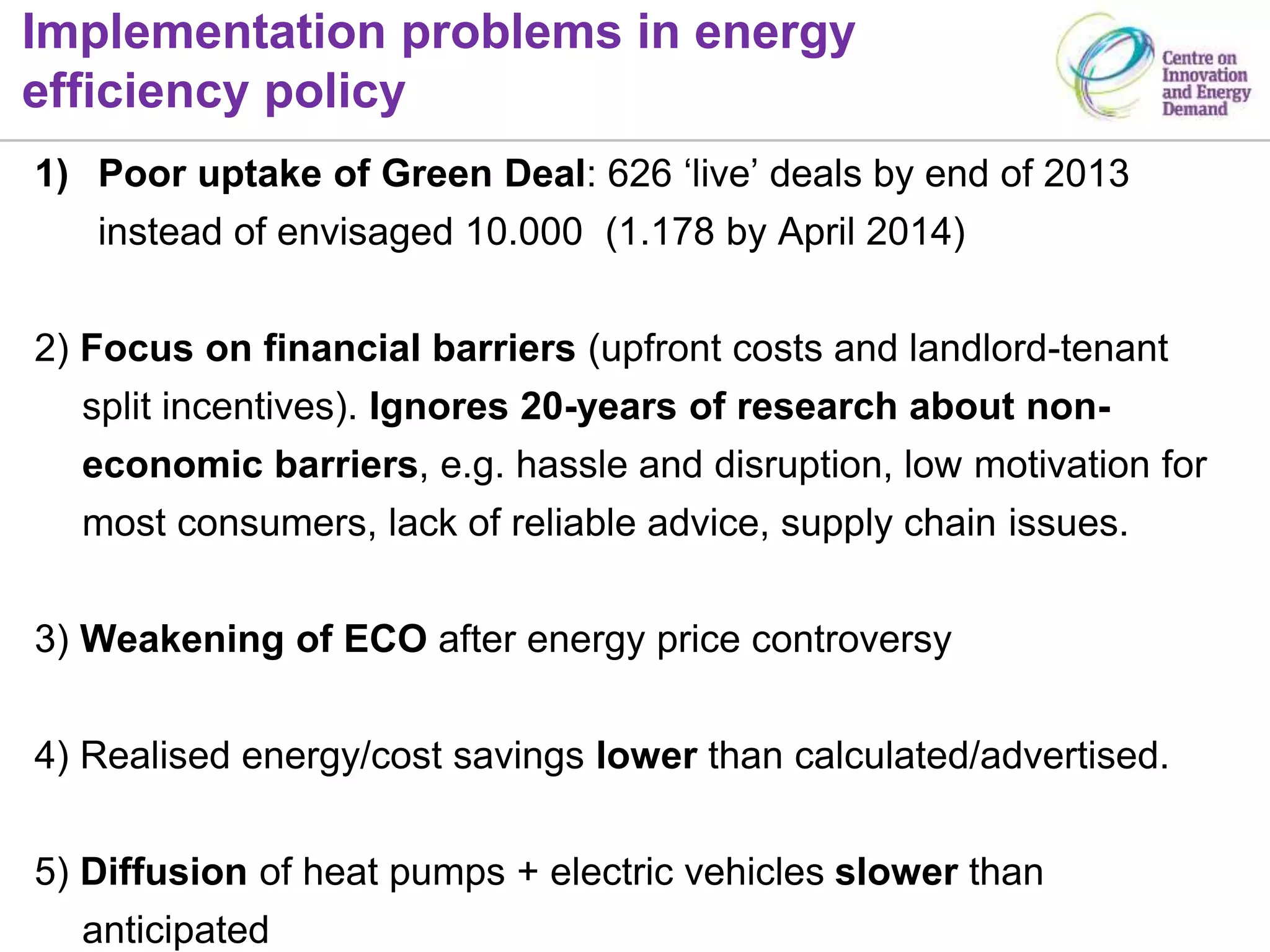
Implementation problems in energy
efficiency policy
1) Poor uptake of Green Deal: 626 ‘live’ deals by end of 2013
instead of envisaged 10.000 (1.178 by April 2014)
2) Focus on financial barriers (upfront costs and landlord-tenant
split incentives). Ignores 20-years of research about non-
economic barriers, e.g. hassle and disruption, low motivation for
most consumers, lack of reliable advice, supply chain issues.
3) Weakening of ECO after energy price controversy
4) Realised energy/cost savings lower than calculated/advertised.
5) Diffusion of heat pumps + electric vehicles slower than
anticipated
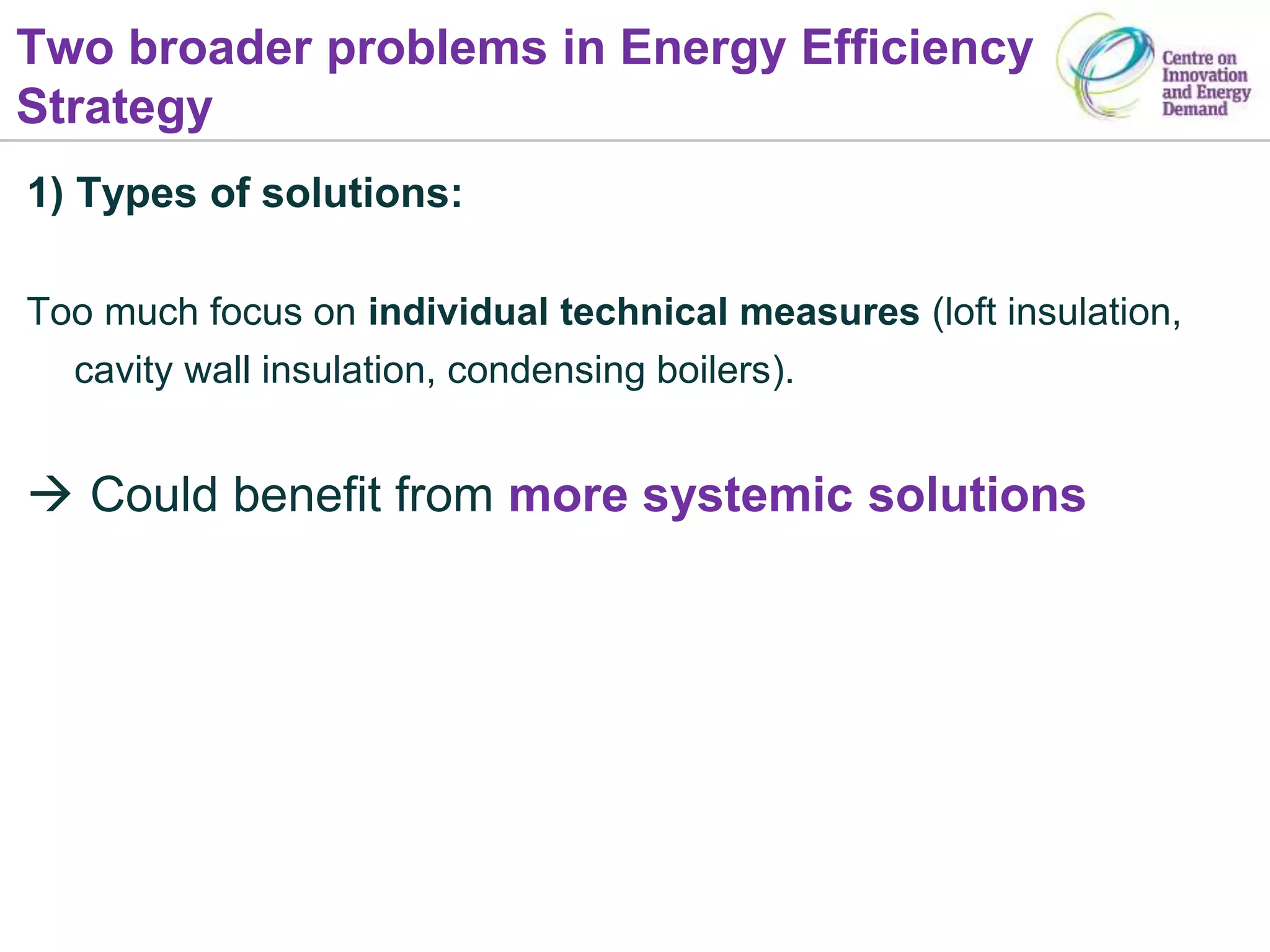
Two broader problems in Energy Efficiency
Strategy
1) Types of solutions:
Too much focus on individual technical measures (loft insulation,
cavity wall insulation, condensing boilers).
 Could benefit from more systemic solutions
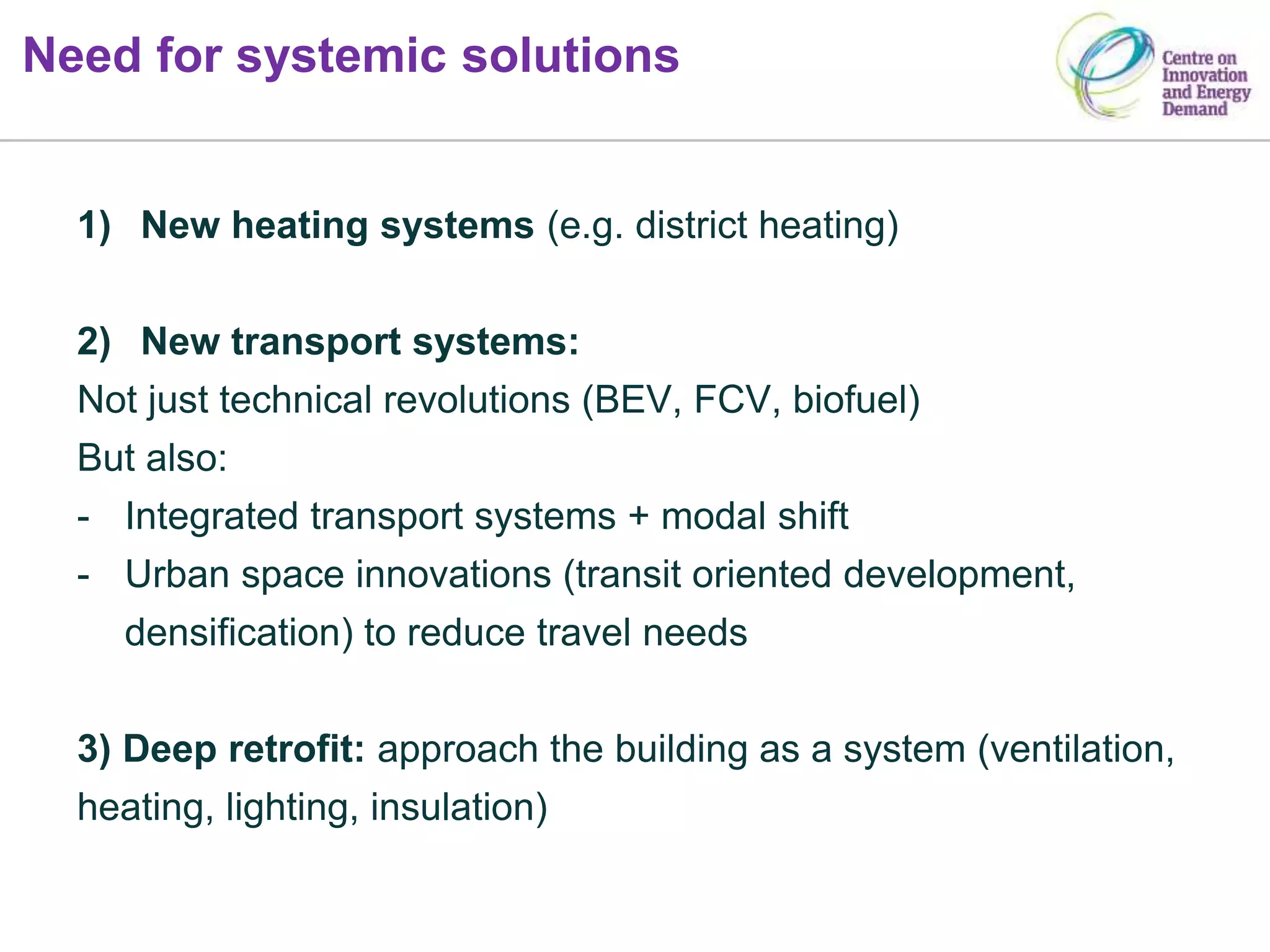
Need for systemic solutions
1) New heating systems (e.g. district heating)
2) New transport systems:
Not just technical revolutions (BEV, FCV, biofuel)
But also:
- Integrated transport systems + modal shift
- Urban space innovations (transit oriented development,
densification) to reduce travel needs
3) Deep retrofit: approach the building as a system (ventilation,
heating, lighting, insulation)
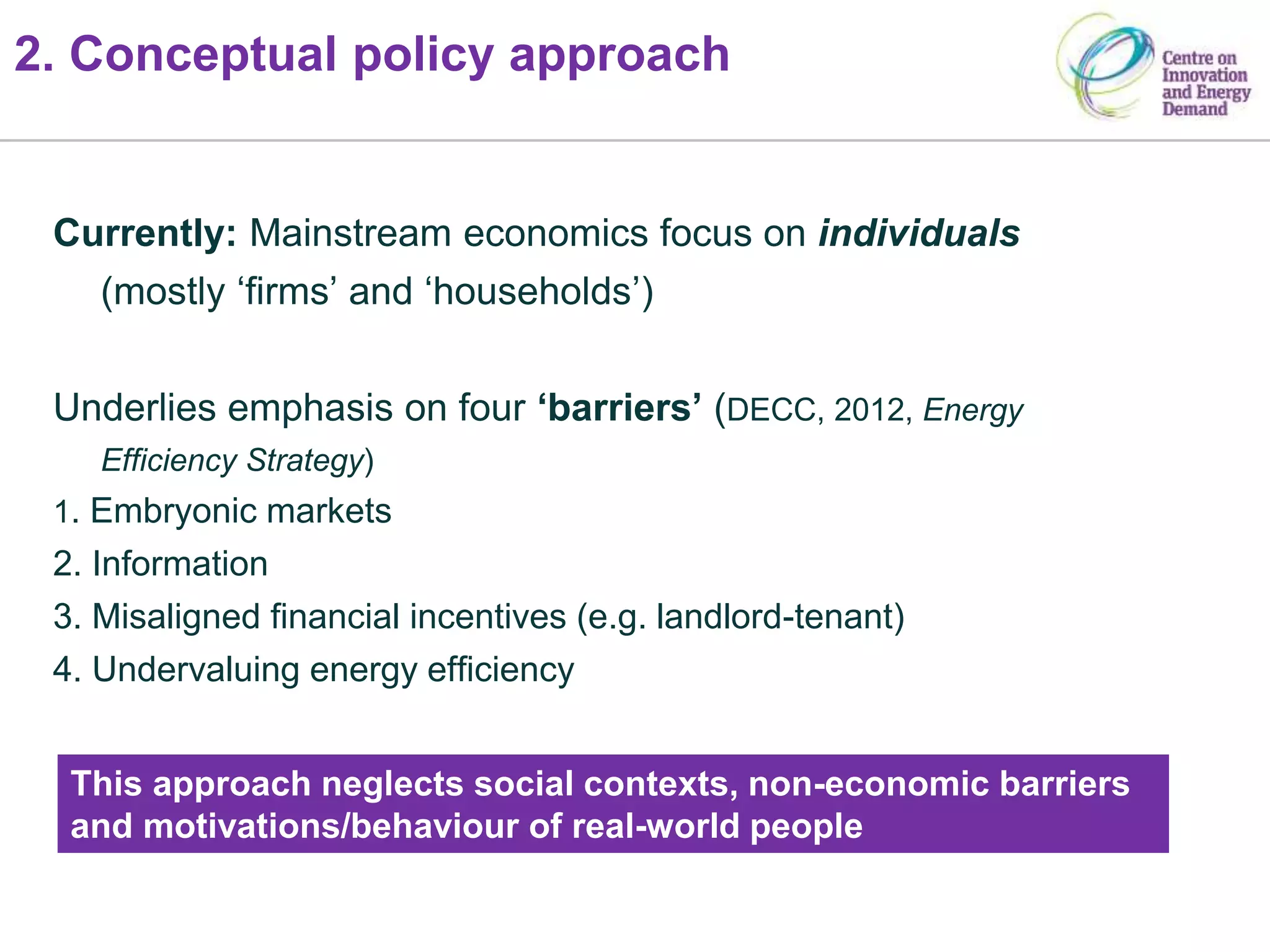
2. Conceptual policy approach
Currently: Mainstream economics focus on individuals
(mostly ‘firms’ and ‘households’)
Underlies emphasis on four ‘barriers’ (DECC, 2012, Energy
Efficiency Strategy)
1. Embryonic markets
2. Information
3. Misaligned financial incentives (e.g. landlord-tenant)
4. Undervaluing energy efficiency
This approach neglects social contexts, non-economic barriers
and motivations/behaviour of real-world people
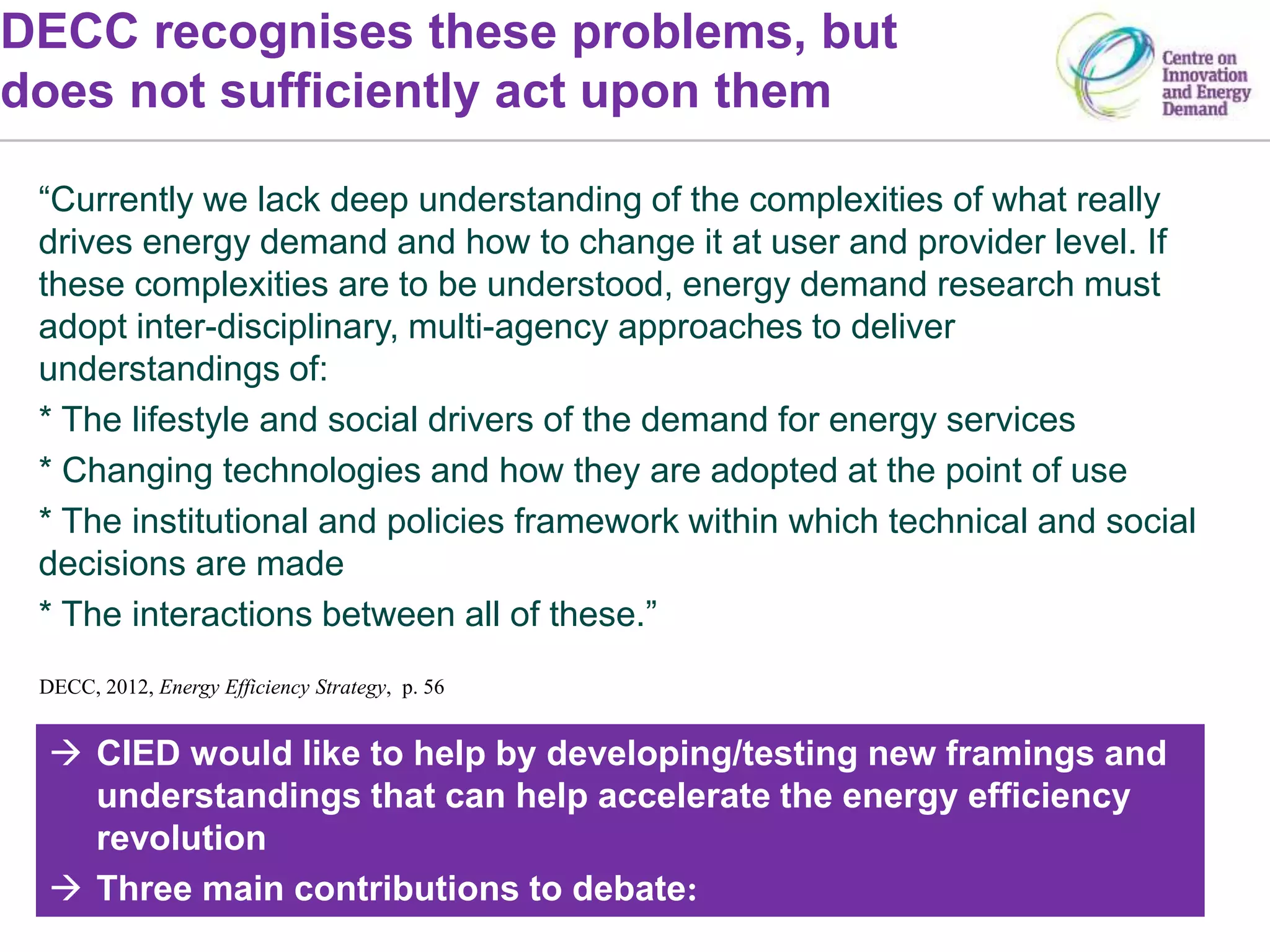
DECC recognises these problems, but
does not sufficiently act upon them
DECC, 2012, Energy Efficiency Strategy, p. 56
 CIED would like to help by developing/testing new framings and
understandings that can help accelerate the energy efficiency
revolution
 Three main contributions to debate:
“Currently we lack deep understanding of the complexities of what really
drives energy demand and how to change it at user and provider level. If
these complexities are to be understood, energy demand research must
adopt inter-disciplinary, multi-agency approaches to deliver
understandings of:
* The lifestyle and social drivers of the demand for energy services
* Changing technologies and how they are adopted at the point of use
* The institutional and policies framework within which technical and social
decisions are made
* The interactions between all of these.”
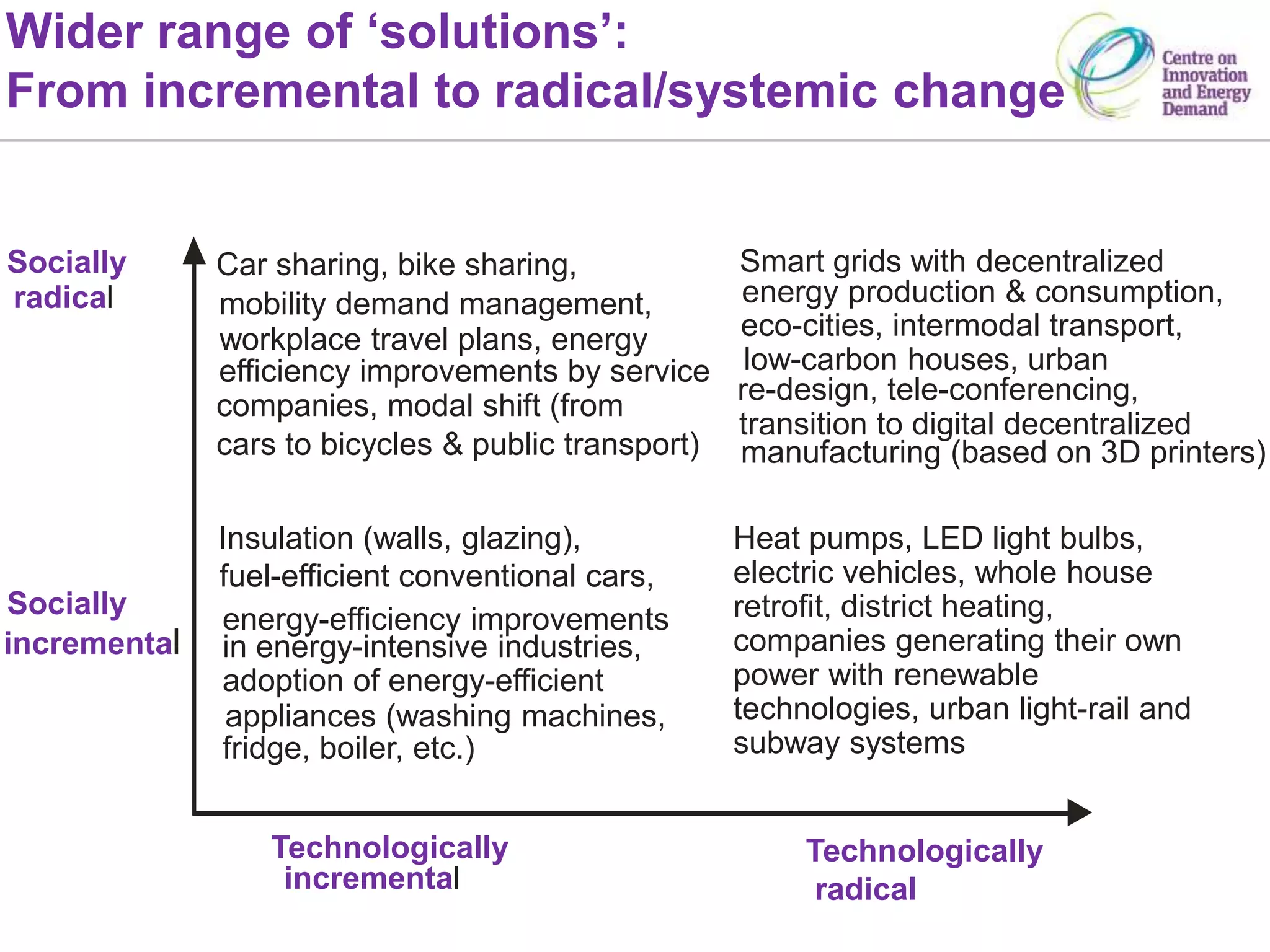
Wider range of ‘solutions’:
From incremental to radical/systemic change
Technologically
radical
Socially
incremental
Technologically
incremental
Socially
radical
Insulation (walls, glazing),
fuel-efficient conventional cars,
energy-efficiency improvements
in energy-intensive industries,
adoption of energy-efficient
appliances (washing machines,
fridge, boiler, etc.)
Car sharing, bike sharing,
mobility demand management,
workplace travel plans, energy
efficiency improvements by service
companies, modal shift (from
cars to bicycles & public transport)
Heat pumps, LED light bulbs,
electric vehicles, whole house
retrofit, district heating,
companies generating their own
power with renewable
technologies, urban light-rail and
subway systems
Smart grids with decentralized
energy production & consumption,
eco-cities, intermodal transport,
low-carbon houses, urban
re-design, tele-conferencing,
transition to digital decentralized
manufacturing (based on 3D printers)
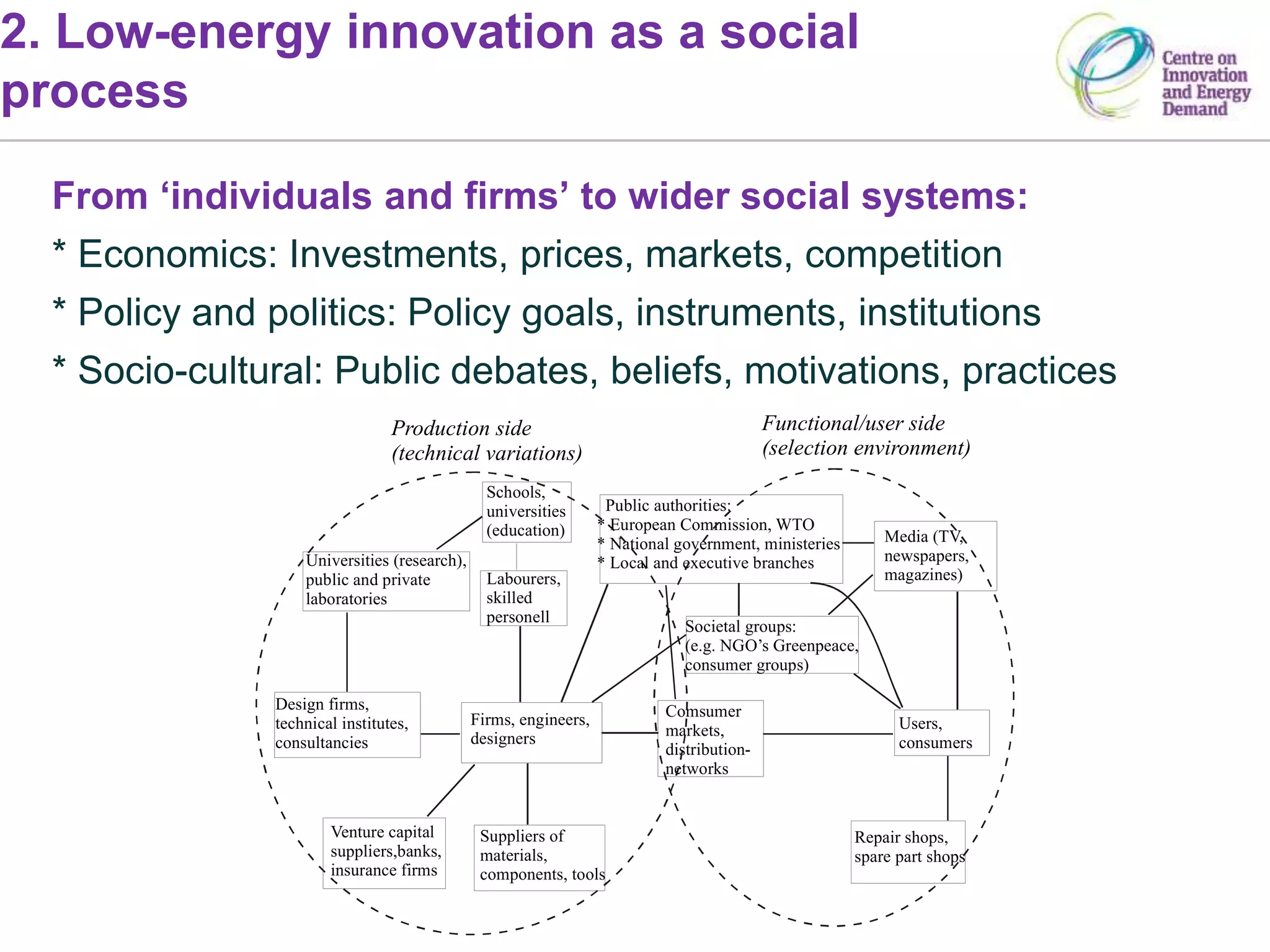
2. Low-energy innovation as a social
process
From ‘individuals and firms’ to wider social systems:
* Economics: Investments, prices, markets, competition
* Policy and politics: Policy goals, instruments, institutions
* Socio-cultural: Public debates, beliefs, motivations, practices
Universities (research),
public and private
laboratories
Firms, engineers,
designers
Venture capital
suppliers,banks,
insurance firms
Suppliers of
materials,
components, tools
Repair shops,
spare part shops
Users,
consumers
Societal groups:
(e.g. NGO’s Greenpeace,
consumer groups)
Public authorities:
* European Commission, WTO
* National government, ministeries
* Local and executive branches
Comsumer
markets,
distribution-
networks
Labourers,
skilled
personell
Schools,
universities
(education) Media (TV,
newspapers,
magazines)
Design firms,
technical institutes,
consultancies
Production side
(technical variations)
Functional/user side
(selection environment)
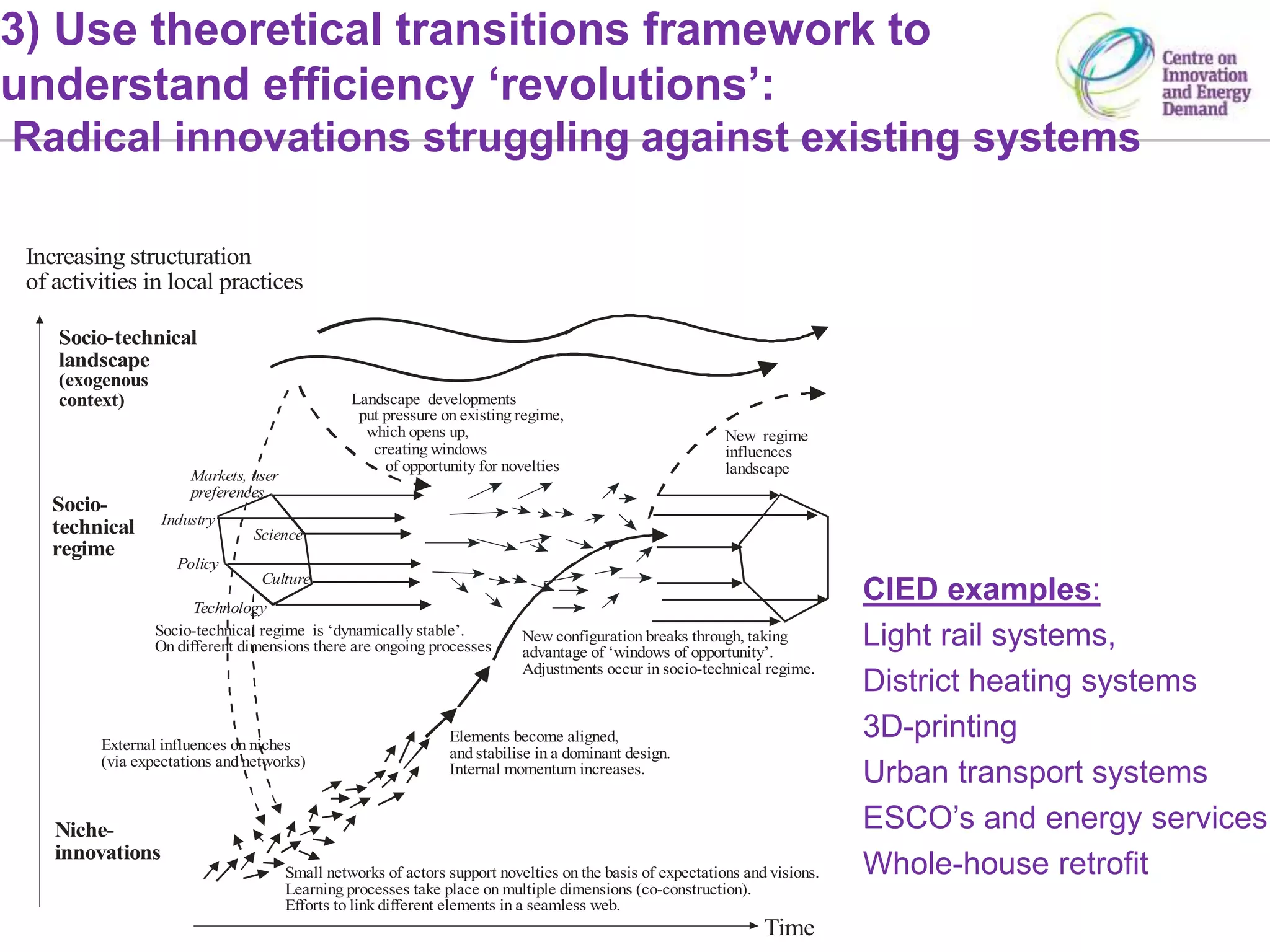
3) Use theoretical transitions framework to
understand efficiency ‘revolutions’:
Radical innovations struggling against existing systems
Landscape developments
put pressure on existing regime,
which opens up,
creating windows
of opportunity for novelties
Socio-technical regime is ‘dynamically stable’.
On different dimensions there are ongoing processes
New configuration breaks through, taking
advantage of ‘windows of opportunity’.
Adjustments occur in socio-technical regime.
Elements become aligned,
and stabilise in a dominant design.
Internal momentum increases.
Small networks of actors support novelties on the basis of expectations and visions.
Learning processes take place on multiple dimensions (co-construction).
Efforts to link different elements in a seamless web.
New regime
influences
landscape
Niche-
innovations
Socio-technical
landscape
(exogenous
context)
Socio-
technical
regime
Technology
Markets, user
preferences
Culture
Policy
Science
Industry
External influences on niches
(via expectations and networks)
Increasing structuration
of activities in local practices
Time
CIED examples:
Light rail systems,
District heating systems
3D-printing
Urban transport systems
ESCO’s and energy services
Whole-house retrofit
TimeTime
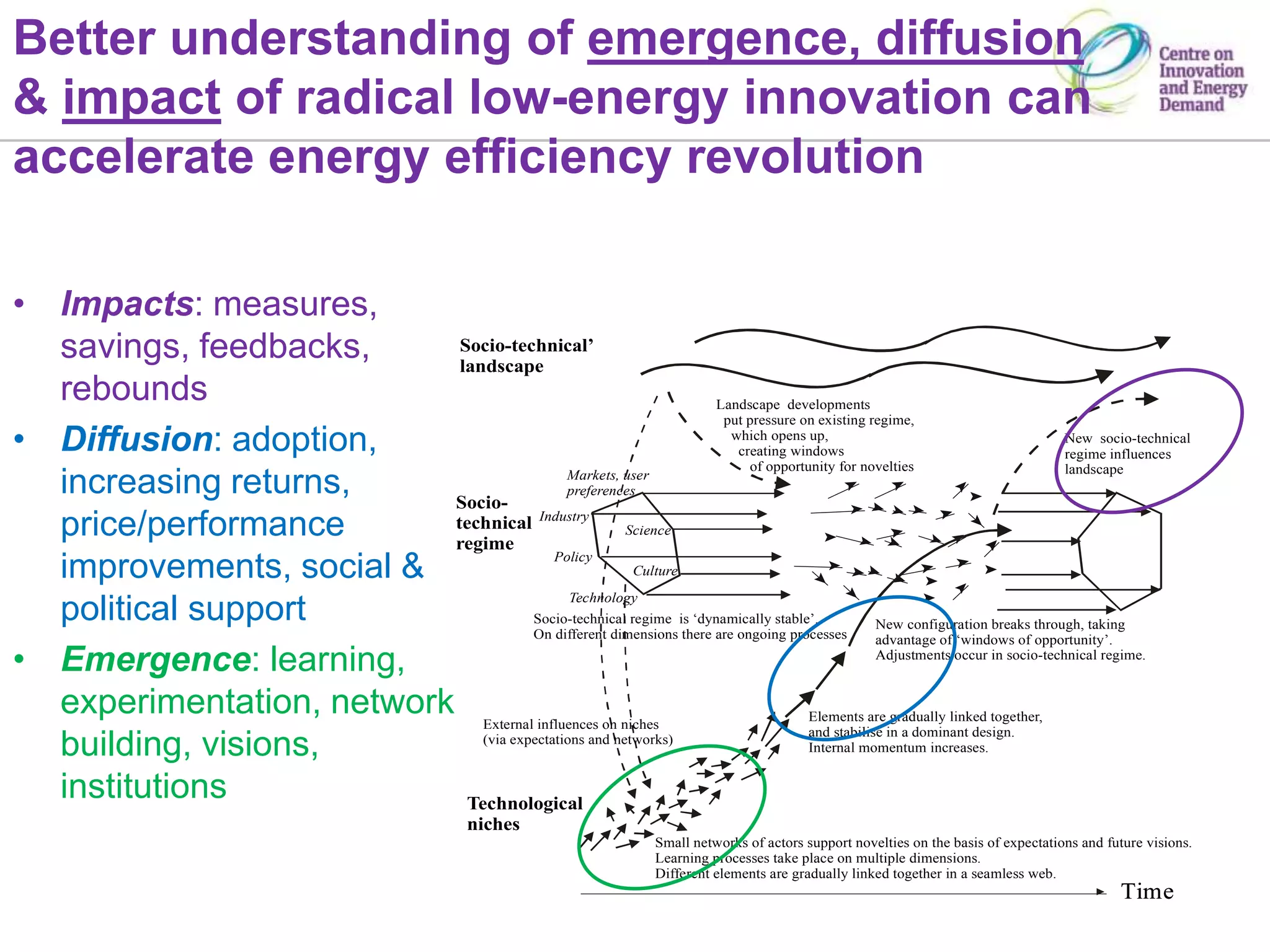
Landscape developments
put pressure on existing regime,
which opens up,
creating windows
of opportunity for novelties
Socio-technical regime is ‘dynamically stable’.
On different dimensions there are ongoing processes
New configuration breaks through, taking
advantage of ‘windows of opportunity’.
Adjustments occur in socio-technical regime.
Elements are gradually linked together,
and stabilise in a dominant design.
Internal momentum increases.
Small networks of actors support novelties on the basis of expectations and future visions.
Learning processes take place on multiple dimensions.
Different elements are gradually linked together in a seamless web.
New socio-technical
regime influences
landscape
Technological
niches
Socio-technical’
landscape
Socio-
technical
regime
Technology
Markets, user
preferences
Culture
Policy
Science
Industry
External influences on niches
(via expectations and networks)
• Impacts: measures,
savings, feedbacks,
rebounds
• Diffusion: adoption,
increasing returns,
price/performance
improvements, social &
political support
• Emergence: learning,
experimentation, network
building, visions,
institutions
Better understanding of emergence, diffusion
& impact of radical low-energy innovation can
accelerate energy efficiency revolution

Cied launch event 12 june frank geels

  • 1.
    The weakening ofthe ‘energy efficiency revolution’ And what is needed to strengthen it. Prof. Frank Geels (CIED) APPCCG, London, 12th June 2014
  • 2.
    Implementation problems inenergy efficiency policy 1) Poor uptake of Green Deal: 626 ‘live’ deals by end of 2013 instead of envisaged 10.000 (1.178 by April 2014) 2) Focus on financial barriers (upfront costs and landlord-tenant split incentives). Ignores 20-years of research about non- economic barriers, e.g. hassle and disruption, low motivation for most consumers, lack of reliable advice, supply chain issues. 3) Weakening of ECO after energy price controversy 4) Realised energy/cost savings lower than calculated/advertised. 5) Diffusion of heat pumps + electric vehicles slower than anticipated
  • 3.
    Two broader problemsin Energy Efficiency Strategy 1) Types of solutions: Too much focus on individual technical measures (loft insulation, cavity wall insulation, condensing boilers).  Could benefit from more systemic solutions
  • 4.
    Need for systemicsolutions 1) New heating systems (e.g. district heating) 2) New transport systems: Not just technical revolutions (BEV, FCV, biofuel) But also: - Integrated transport systems + modal shift - Urban space innovations (transit oriented development, densification) to reduce travel needs 3) Deep retrofit: approach the building as a system (ventilation, heating, lighting, insulation)
  • 5.
    2. Conceptual policyapproach Currently: Mainstream economics focus on individuals (mostly ‘firms’ and ‘households’) Underlies emphasis on four ‘barriers’ (DECC, 2012, Energy Efficiency Strategy) 1. Embryonic markets 2. Information 3. Misaligned financial incentives (e.g. landlord-tenant) 4. Undervaluing energy efficiency This approach neglects social contexts, non-economic barriers and motivations/behaviour of real-world people
  • 6.
    DECC recognises theseproblems, but does not sufficiently act upon them DECC, 2012, Energy Efficiency Strategy, p. 56  CIED would like to help by developing/testing new framings and understandings that can help accelerate the energy efficiency revolution  Three main contributions to debate: “Currently we lack deep understanding of the complexities of what really drives energy demand and how to change it at user and provider level. If these complexities are to be understood, energy demand research must adopt inter-disciplinary, multi-agency approaches to deliver understandings of: * The lifestyle and social drivers of the demand for energy services * Changing technologies and how they are adopted at the point of use * The institutional and policies framework within which technical and social decisions are made * The interactions between all of these.”
  • 7.
    Wider range of‘solutions’: From incremental to radical/systemic change Technologically radical Socially incremental Technologically incremental Socially radical Insulation (walls, glazing), fuel-efficient conventional cars, energy-efficiency improvements in energy-intensive industries, adoption of energy-efficient appliances (washing machines, fridge, boiler, etc.) Car sharing, bike sharing, mobility demand management, workplace travel plans, energy efficiency improvements by service companies, modal shift (from cars to bicycles & public transport) Heat pumps, LED light bulbs, electric vehicles, whole house retrofit, district heating, companies generating their own power with renewable technologies, urban light-rail and subway systems Smart grids with decentralized energy production & consumption, eco-cities, intermodal transport, low-carbon houses, urban re-design, tele-conferencing, transition to digital decentralized manufacturing (based on 3D printers)
  • 8.
    2. Low-energy innovationas a social process From ‘individuals and firms’ to wider social systems: * Economics: Investments, prices, markets, competition * Policy and politics: Policy goals, instruments, institutions * Socio-cultural: Public debates, beliefs, motivations, practices Universities (research), public and private laboratories Firms, engineers, designers Venture capital suppliers,banks, insurance firms Suppliers of materials, components, tools Repair shops, spare part shops Users, consumers Societal groups: (e.g. NGO’s Greenpeace, consumer groups) Public authorities: * European Commission, WTO * National government, ministeries * Local and executive branches Comsumer markets, distribution- networks Labourers, skilled personell Schools, universities (education) Media (TV, newspapers, magazines) Design firms, technical institutes, consultancies Production side (technical variations) Functional/user side (selection environment)
  • 9.
    3) Use theoreticaltransitions framework to understand efficiency ‘revolutions’: Radical innovations struggling against existing systems Landscape developments put pressure on existing regime, which opens up, creating windows of opportunity for novelties Socio-technical regime is ‘dynamically stable’. On different dimensions there are ongoing processes New configuration breaks through, taking advantage of ‘windows of opportunity’. Adjustments occur in socio-technical regime. Elements become aligned, and stabilise in a dominant design. Internal momentum increases. Small networks of actors support novelties on the basis of expectations and visions. Learning processes take place on multiple dimensions (co-construction). Efforts to link different elements in a seamless web. New regime influences landscape Niche- innovations Socio-technical landscape (exogenous context) Socio- technical regime Technology Markets, user preferences Culture Policy Science Industry External influences on niches (via expectations and networks) Increasing structuration of activities in local practices Time CIED examples: Light rail systems, District heating systems 3D-printing Urban transport systems ESCO’s and energy services Whole-house retrofit
  • 10.
    TimeTime Landscape developments put pressureon existing regime, which opens up, creating windows of opportunity for novelties Socio-technical regime is ‘dynamically stable’. On different dimensions there are ongoing processes New configuration breaks through, taking advantage of ‘windows of opportunity’. Adjustments occur in socio-technical regime. Elements are gradually linked together, and stabilise in a dominant design. Internal momentum increases. Small networks of actors support novelties on the basis of expectations and future visions. Learning processes take place on multiple dimensions. Different elements are gradually linked together in a seamless web. New socio-technical regime influences landscape Technological niches Socio-technical’ landscape Socio- technical regime Technology Markets, user preferences Culture Policy Science Industry External influences on niches (via expectations and networks) • Impacts: measures, savings, feedbacks, rebounds • Diffusion: adoption, increasing returns, price/performance improvements, social & political support • Emergence: learning, experimentation, network building, visions, institutions Better understanding of emergence, diffusion & impact of radical low-energy innovation can accelerate energy efficiency revolution