37
The NHS Healthcare Cleaning Manual
This section of the Manual contains detailed Method Statements for the most
‘common’ cleaning tasks carried out by cleaning service departments. The section
should be read, and applied, in conjunction with the notes shown below.
Important Notes for the Correct Implementation of the NHS
Healthcare Cleaning Manual
• Refer to Trust policy and Standards of Cleanliness in the NHS for
guidance on all cleaning processes, cleaning frequencies, colour-
coding, equipment, protective clothing, fluids and methods
• For all cleaning materials, fluids, electrical and mechanical machinery,
always refer to manufacturers’ instructions
• Cleaning equipment used, must be safe and appropriate for each
application
• Ensure all equipment is clean and dry before starting procedure
• Plan work route and when necessary, remove furniture and
equipment
• Always use clean hazard-warning signs and position at the start of the
task where they are most effective and people will know cleaning is in
progress. Remove, clean and return to the storage area when the task
is completed and the floor is dry.
• When cleaning or using cleaning equipment, items must be checked
for damage or wear which would impair future use or endanger the
safety of any individual. If damaged do not use, report to supervisor,
label as faulty and remove from use.
• Ensure that portable appliance testing (PAT) has been undertaken in
the last 12 months. If not, do not use, remove and report to
supervisor/manager
Introduction to SECTION 5.0
Cleaning Method Statements
NHS cleaning manualv2 Amend 14/4/04 10:45 am Page 53
38
The NHS Healthcare Cleaning Manual
Cleaning Method Statements
The Method Statements have been designed to meet current Health and Safety,
and infection control requirements and dovetail with recommendations from
the British Institute of Cleaning Science and National Vocational Qualifications
regulations.
• On completion of machine safety checks briefly test each machine to
check it is in working order.
• When using electrical equipment a circuit breaker should be used.
Most organisations have in-built systems, check with Facilities and
obtain written confirmation that independent circuit breakers are/are
not required.
• When operating electrical machinery, always keep the cable behind
the machine
• When plugging a machine into an electric socket, make sure the
switch is in the off position
• Do not adjust or change the fittings on the machine when it is
plugged in
• Wear goggles when preparing cleaning solutions. Goggles should be
worn during processes when there is a likelihood of splashing for
example, when kneeling down scouring the floor
• A general rule of cleaning it to start cleaning at the highest point and
work towards the lowest; and from outside to the inside. Also to
work from the cleanest to the dirtiest.
• Never mix cleaning agents, as poisonous gases could result (refer to
manufacturers’ instructions and safety data sheets)
• Always ventilate any area where chemicals are used
• For Health and Safety reasons, always add the cleaning agent to
water, preventing the possibility of the cleaning agent being splashed
into the eyes.
NHS cleaning manualv2 TXT V6 14/4/04 10:36 am Page 54
39
The NHS Healthcare Cleaning Manual
Cleaning Method Statements
The Method Statements have been trialled in three hospitals and reviewed
by the Association of Domestic Management and British Institute of
Cleaning Science.
Each Method Statements comprise of four sections:
• Task
• Equipment Required
• Health and Safety
• Method
NHS cleaning manualv2 TXT V6 14/4/04 10:36 am Page 55
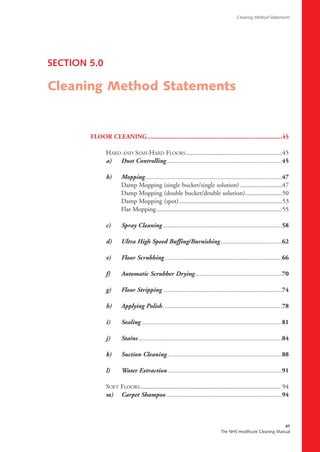
FLOOR CLEANING ................................................................................45
HARD AND SEMI-HARD FLOORS............................................................45
a) Dust Controlling........................................................................45
b) Mopping.....................................................................................47
Damp Mopping (single bucket/single solution) ..........................47
Damp Mopping (double bucket/double solution).......................50
Damp Mopping (spot)................................................................53
Flat Mopping..............................................................................55
c) Spray Cleaning ..........................................................................58
d) Ultra High Speed Buffing/Burnishing ......................................62
e) Floor Scrubbing.........................................................................66
f) Automatic Scrubber Drying......................................................70
g) Floor Stripping ..........................................................................74
h) Applying Polish..........................................................................78
i) Sealing .......................................................................................81
j) Stains .........................................................................................84
k) Suction Cleaning .......................................................................88
l) Water Extraction.......................................................................91
SOFT FLOORS....................................................................................... 94
m) Carpet Shampoo........................................................................94
41
The NHS Healthcare Cleaning Manual
Cleaning Method Statements
SECTION 5.0
Cleaning Method Statements
NHS cleaning manualv2 Amend 14/4/04 10:45 am Page 57
GENERAL CLEANING............................................................................98
a) Damp Dusting...........................................................................98
Horizontal and Vertical Surfaces .................................................98
Lamp ........................................................................................101
Chair/Settee ..............................................................................103
Radiator....................................................................................106
Beds ........................................................................................108
b) Glass ........................................................................................110
Internal Glass and Mirrors ........................................................110
External Glass ...........................................................................112
c) High Dusting ...........................................................................114
d) Furniture Polishing .................................................................116
e) Walls ........................................................................................118
Wall Washing............................................................................118
Spot cleaning ............................................................................121
KITCHEN CLEANING..........................................................................122
a) Ice-Making Machine................................................................122
b) Manual Washing Up ...............................................................125
c) Mechanical Waste Disposal Unit ..........................................127
d) Microwave ............................................................................130
e) Ovens....................................................................................133
f) Refrigerator...........................................................................136
g) Sinks ....................................................................................139
42
The NHS Healthcare Cleaning Manual
Cleaning Method Statements
NHS cleaning manualv2 Amend 14/4/04 10:45 am Page 58
WASHROOM CLEANING ....................................................................141
a) Bath ....................................................................................141
b) Hand Wash Basin.................................................................144
c) Replenishing Consumables ....................................................147
Soap Dispenser..........................................................................147
Paper Towel Holder...................................................................149
Toilet Roll/Tissue......................................................................151
d) Shower .....................................................................................153
SANITARY CLEANING .........................................................................156
a) Toilet Area ............................................................................156
Bidet ........................................................................................156
Sluice ........................................................................................159
Toilet ........................................................................................162
Urinal........................................................................................165
SPECIALIST CLEANING......................................................................168
a) Curtain Changing.................................................................168
b) Isolation Clean......................................................................171
c) Steam Cleaning.....................................................................175
d) Terminal Clean of Vacated Room .........................................178
43
The NHS Healthcare Cleaning Manual
Cleaning Method Statements
NHS cleaning manualv2 TXT V6 14/4/04 10:36 am Page 59
Floor Cleaning
Hard and Semi-Hard Floors
a) Dust Controlling
Task
Equipment Required
Health and Safety
• Refer to Trust policy for guidance on all cleaning processes, colour-
coding, equipment, protective clothing, fluids and methods
• Several floor cloth should be used for the ward, a clean cloth for each
bed area
• Do not ever use a sweeping brush in a patient area
• All equipment should be left clean, dry and tidy in storage area after use
• Colour-Coded Dustpan and Brush
• Colour-Coded Dust Control System Floor Cloth/Mop
• Colour-Coded Gloves
• Colour-Coded Scraper
• Dust Control System Applicator Tool for example, Colour-Coded
Static Mop/Impregnated Mop
• Warning Signs
Dust Controlling
45
The NHS Healthcare Cleaning Manual
Cleaning Method Statements
FloorCleaning–HardandSemi-HardFloors
NHS cleaning manualv2 TXT V6 14/4/04 10:36 am Page 61
Method
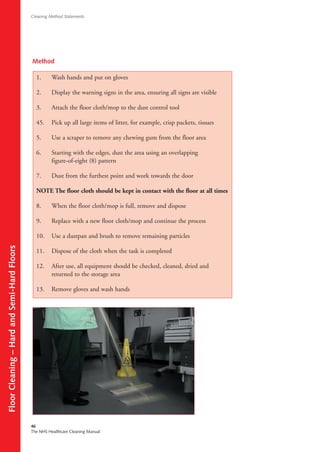
1. Wash hands and put on gloves
2. Display the warning signs in the area, ensuring all signs are visible
3. Attach the floor cloth/mop to the dust control tool
45. Pick up all large items of litter, for example, crisp packets, tissues
5. Use a scraper to remove any chewing gum from the floor area
6. Starting with the edges, dust the area using an overlapping
figure-of-eight (8) pattern
7. Dust from the furthest point and work towards the door
NOTE The floor cloth should be kept in contact with the floor at all times
8. When the floor cloth/mop is full, remove and dispose
9. Replace with a new floor cloth/mop and continue the process
10. Use a dustpan and brush to remove remaining particles
11. Dispose of the cloth when the task is completed
12. After use, all equipment should be checked, cleaned, dried and
returned to the storage area
13. Remove gloves and wash hands
46
The NHS Healthcare Cleaning Manual
Cleaning Method Statements
FloorCleaning–HardandSemi-HardFloors
NHS cleaning manualv2 TXT V6 14/4/04 10:36 am Page 62
b) Mopping
Task
Equipment Required
• Colour-Coded Bucket with Compatible Wringer
• Colour-Coded Gloves
• Colour-Coded Mop Handle
• Colour-Coded Mop Head
• Cleaning Trolley
• Dust Control System (refer to the Dust Controlling Method
Statement)
• Laundry Bag
• Suction Cleaner (refer to Suction Cleaning Method Statement)
• Warning Signs
• Floor Cleaner
or General Purpose Detergent
Damp Mopping (single bucket/single solution)
47
The NHS Healthcare Cleaning Manual
Cleaning Method Statements
FloorCleaning–HardandSemi-HardFloors
NHS cleaning manualv2 TXT V6 14/4/04 10:36 am Page 63
Health and Safety
Method
1. Wash hands and put on gloves
2. Display the warning signs in the area, ensuring all signs are visible
3. Dust control the floor (refer to the Dust Controlling method
statement) or suction clean (refer to the Suction Cleaning method
statement).
4. Prepare the cleaning solution in a well-ventilated area (refer to
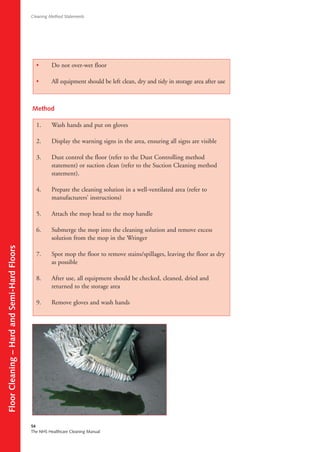
manufacturers’ instructions).
5. Attach the mop head to the mop handle
6. Submerge the mop into the cleaning solution and remove excess
solution from the mop in the Wringer
7. Mop the floor in 1-2 metre square sections
8. Mop edges of the floor with a straight stroke, use a figure-of-eight (8)
pattern, turning the mop frequently, leaving the floor as dry as
possible after cleaning the rest of the section.
• Refer to Trust policy for guidance on all cleaning processes, colour-
coding, equipment, protective clothing, fluids and methods
• Work in small square sections to prevent over stretching
• Ensure the area is first Dust Controlled or Suction Cleaned
• When mopping a corridor, mop half first leaving a clearly identified
dry area for patients/ visitors to walk on
• Do not over-wet floor
• If mopping stairs, ensure area is cordoned-off and warning signs are
displayed
• All equipment should be left clean, dry and tidy in storage area after
use
48
The NHS Healthcare Cleaning Manual
Cleaning Method Statements
FloorCleaning–HardandSemi-HardFloors
NHS cleaning manualv2 TXT V6 14/4/04 10:36 am Page 64
9. Avoid splashing other surfaces and remove any splashes that do occur
NOTE Regularly replace the mop head and water
10. On completion, remove mop head and place in a laundry bag
11. After use, all equipment should be checked, cleaned, dried and
returned to the storage area
12. Remove gloves and wash hands
49
The NHS Healthcare Cleaning Manual
Cleaning Method Statements
FloorCleaning–HardandSemi-HardFloors
NHS cleaning manualv2 TXT V6 14/4/04 10:36 am Page 65
Task
Equipment Required
• Colour-Coded Bucket x 2 with Compatible Wringer
• Colour-Coded Gloves
• Colour-Coded Mop Handle
• Colour-Coded Mop Head
• Cleaning Trolley
• Dust Control System (refer to the Dust Controlling Method
Statement)
• Laundry Bag
• Suction Cleaner (refer to Suction Cleaning Method Statement)
• Warning Signs
• Floor Cleaner
or General Purpose Detergent
Damp Mopping (double bucket/double solution)
50
The NHS Healthcare Cleaning Manual
Cleaning Method Statements
FloorCleaning–HardandSemi-HardFloors
NHS cleaning manualv2 TXT V6 14/4/04 10:36 am Page 66
Health and Safety
Method
1. Wash hands and put on gloves
2. Display the warning signs in the area, ensuring all signs are visible
3. Dust control the floor (refer to the Dust Controlling method
statement) or suction clean (refer to the Suction Cleaning method
statement).
4. Prepare the cleaning solution in a well-ventilated area (refer to
manufacturers’ instructions), adding solution to one bucket and
filling the other bucket with water
5. Attach the mop head to the mop handle
6. Submerge the mop into the cleaning solution and remove excess
solution from the mop in the Wringer
7. Mop the floor in 1-2 metre square sections
• Refer to Trust policy for guidance on all cleaning processes, colour-
coding, equipment, protective clothing, fluids and methods
• Work in small square sections to prevent over-stretching
• Ensure the area is first Dust Controlled or Suction Cleaned
• When mopping a corridor, mop half first leaving a clearly identified
dry area for patients/ visitors to walk on
• Do not over-wet floor
• If mopping stairs, ensure area is cordoned-off and warning signs are
displayed
• All equipment should be left clean, dry and tidy in storage area after use
51
The NHS Healthcare Cleaning Manual
Cleaning Method Statements
FloorCleaning–HardandSemi-HardFloors
NHS cleaning manualv2 TXT V6 14/4/04 10:36 am Page 67
8. Mop edges of the floor with a straight stroke, use a figure-of-eight (8)
pattern, turning the mop frequently, leaving the floor as dry as
possible after cleaning the rest of the section.
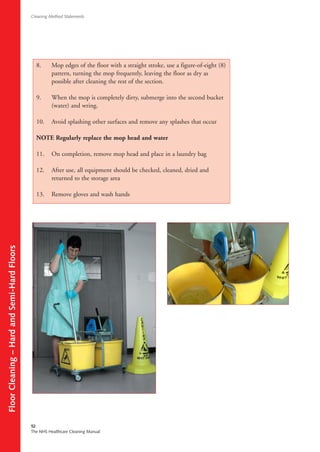
9. When the mop is completely dirty, submerge into the second bucket
(water) and wring.
10. Avoid splashing other surfaces and remove any splashes that occur
NOTE Regularly replace the mop head and water
11. On completion, remove mop head and place in a laundry bag
12. After use, all equipment should be checked, cleaned, dried and
returned to the storage area
13. Remove gloves and wash hands
52
The NHS Healthcare Cleaning Manual
Cleaning Method Statements
FloorCleaning–HardandSemi-HardFloors
NHS cleaning manualv2 TXT V6 14/4/04 10:36 am Page 68
Task
Equipment Required
Health and Safety
• Refer to Trust policy for guidance on all cleaning processes, colour-
coding, equipment, protective clothing, fluids and methods
• Work in small square sections to prevent over stretching
• Ensure the area is first Dust Controlled or Suction Cleaned
• Always use a warning sign ‘cleaning in progress’, position to be effective
• When mopping a corridor, mop half first leaving a clearly identified
dry area for patients/ visitors to walk on
• Colour-Coded Bucket with Compatible Wringer
• Colour-Coded Gloves
• Colour-Coded Mop Handle
• Colour-Coded Mop Head
• Cleaning Trolley
• Dust Control System (refer to the Dust Controlling Method Statement)
• Laundry Bag
• Suction Cleaner (refer to Suction Cleaning Method Statement)
• Warning Signs
• Floor Cleaner
or General Purpose Detergent
Damp Mopping (spot)
53
The NHS Healthcare Cleaning Manual
Cleaning Method Statements
FloorCleaning–HardandSemi-HardFloors
NHS cleaning manualv2 TXT V6 14/4/04 10:36 am Page 69
Method
1. Wash hands and put on gloves
2. Display the warning signs in the area, ensuring all signs are visible
3. Dust control the floor (refer to the Dust Controlling method
statement) or suction clean (refer to the Suction Cleaning method
statement).
4. Prepare the cleaning solution in a well-ventilated area (refer to
manufacturers’ instructions)
5. Attach the mop head to the mop handle
6. Submerge the mop into the cleaning solution and remove excess
solution from the mop in the Wringer
7. Spot mop the floor to remove stains/spillages, leaving the floor as dry
as possible
8. After use, all equipment should be checked, cleaned, dried and
returned to the storage area
9. Remove gloves and wash hands
• Do not over-wet floor
• All equipment should be left clean, dry and tidy in storage area after use
54
The NHS Healthcare Cleaning Manual
Cleaning Method Statements
FloorCleaning–HardandSemi-HardFloors
NHS cleaning manualv2 TXT V6 14/4/04 10:36 am Page 70
Flat Mopping
Task
Equipment Required
Health and Safety
• Refer to Trust policy for guidance on all cleaning processes, colour-
coding, equipment, protective clothing, fluids and methods
• Work in small square sections to prevent over stretching
• Ensure the area is first Dust Controlled or Suction Cleaned
• When mopping a corridor, mop half first leaving a clearly identified
dry area for patients/ visitors to walk on.
• Do not over wet floor
• Colour-Coded Bucket with Compatible Wringer
• Colour-Coded Gloves
• Colour-Coded Mop Handle
• Colour-Coded Mop Head
• Cleaning Trolley
• Dust Control System (refer to the Dust Controlling Method Statement)
• Laundry Bag
• Suction Cleaner (refer to Suction Cleaning Method Statement)
• Warning Signs
• Floor Cleaner
Flat Mopping
55
The NHS Healthcare Cleaning Manual
Cleaning Method Statements
FloorCleaning–HardandSemi-HardFloors
NHS cleaning manualv2 TXT V6 14/4/04 10:36 am Page 71
Method
1. Wash hands and put on gloves
2. Display the warning signs in the area, ensuring all signs are visible
3. Dust control the floor (refer to the Dust Controlling method
statement) or suction clean (refer to the Suction Cleaning method
statement).
4. Prepare the cleaning solution in a well-ventilated area (refer to
manufacturers’ instructions).
5. Attach the flat mop head to the mop handle
6. Submerge the mop into the cleaning solution and remove excess
solution from the mop in the Wringer
7. Mop the floor in 1-2 metre square sections
8. Mop edges of the floor with a straight stroke, use a figure-of-eight (8)
pattern, turning the mop frequently leaving the floor as dry as
possible
9. Avoid splashing other surfaces and remove any splashes that do occur
NOTE Regularly replace the mop head
10. On completion, remove mop head and place in a laundry bag
11. After use, all equipment should be checked, cleaned, dried and
returned to the storage area
12. Remove gloves and wash hands
• If mopping stairs, ensure area is cordoned-off and warning signs are
displayed
• All equipment should be left clean, dry and tidy in storage area after use
56
The NHS Healthcare Cleaning Manual
Cleaning Method Statements
FloorCleaning–HardandSemi-HardFloors
NHS cleaning manualv2 TXT V6 14/4/04 10:36 am Page 72
57
The NHS Healthcare Cleaning Manual
Cleaning Method Statements
FloorCleaning–HardandSemi-HardFloors
NHS cleaning manualv2 TXT V6 14/4/04 10:36 am Page 73
c) Spray Cleaning
Task
Equipment Required
Health and Safety
• Refer to Trust policy for guidance on all cleaning processes, colour-
coding, equipment, protective clothing, fluids and methods
• Do not attempt this procedure unless you have been trained and
competently assessed
• Ensure hands are dry when plugging or unplugging electrical
machinery.
• When plugging a machine into an electric socket, make sure the
switch is in the off position
• Colour-Coded Gloves
• Colour-Coded Labelled Spray Bottle
• Damp Mop System (Refer to the Damp Mopping Method Statement)
• Dust Control System (Refer to the Dust Controlling Method Statement)
• Floor Pad and Drive Disk/Board
• High Speed Machine
• Laundry Bag
• Warning Signs
• Floor Cleaner
or General Purpose Detergent
Spray Cleaning
58
The NHS Healthcare Cleaning Manual
Cleaning Method Statements
FloorCleaning–HardandSemi-HardFloors
NHS cleaning manualv2 TXT V6 14/4/04 10:36 am Page 74
Health and Safety
• When using electrical equipment, a circuit breaker should be used if
appropriate
• Always make sure to plug the machine into a free plug socket. If non-
available, ask a supervisor before unplugging any other machines
• Do not adjust or change the fittings on the machine when it is
plugged in
• When changing or turning a floor pad, make sure the machine is
switched off, the handle raised and the machine laid down.
• Beware of an initial ‘slight kick’ in the High Speed Machine when it is
switched on.
• Always keep cable behind the High Speed Machine when operating.
• Check the power supply cables and plug for damage, report and label
if necessary, remove and do not use
• Do not use a dirty pad, the pad should be turned and washed when it
becomes dirty.
• Ensure the spray bottle is appropriately labelled.
• Always use a warning sign ‘cleaning in progress’, position to be effective,
• Ensure High Speed Machine is clean prior to use.
• Ensure that portable appliance testing (PAT) has been undertaken in
the last 12 months. If not, do not use, remove and report to supervisor
• Should the machine switch off automatically, refer to supervisor
• Do not store or transport the High Speed Machine with the floor pad
folded in the water tank.
• If the High Speed Machine vibrates or miss-handles, check equipment.
• All equipment should be left clean, dry and tidy in storage area after use.
59
The NHS Healthcare Cleaning Manual
Cleaning Method Statements
FloorCleaning–HardandSemi-HardFloors
NHS cleaning manualv2 TXT V6 14/4/04 10:36 am Page 75
Method
1. Plan work route and when necessary, remove furniture and
equipment
2. Wash hands and put on gloves
3. Display the warning signs in the area, ensuring all signs are visible
4. Dust Control the area (refer to the Dust Controlling method
statement)
5. Damp mop if necessary (refer to Damp Mopping Method
Satatement) ensuring the floor is dry before spray cleaning.
6. Attach the floor pad to the High Speed Machine (refer to
manufacturers’ instructions)
7. Prepare the cleaning solution in a well-ventilated area (refer to
manufacturers’ instructions)
8. Unwind cable and plug into a mains socket and a circuit breaker if
appropriate
9. Adjust handle to a suitable/comfortable height making sure arms are
straight.
10. Ensure the High Speed Machine is held firmly in contact with the
body and the cable is behind.
11. Switch the machine on (beware of initial “kick”)
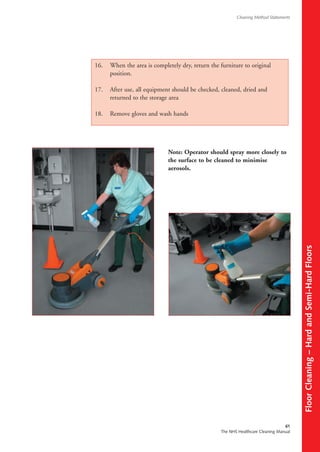
12. Spray a fine mist of the cleaning solution over the floor area to be
cleaned, (one spray covers approximately 2-3 square metres of floor).
NOTE Do not over-spray the area as this can result in slippery floors.
13. Spray clean the floor area by moving the High Speed Machine in
continuous, small side to side movements.
14. On completion or if the floor pad is dirty, remove the floor pad and
place in a laundry bag.
15. With dry hands, remove the plug from the mains socket and re-wind
the electricity cable.
60
The NHS Healthcare Cleaning Manual
Cleaning Method Statements
FloorCleaning–HardandSemi-HardFloors
NHS cleaning manualv2 TXT V6 14/4/04 10:36 am Page 76
16. When the area is completely dry, return the furniture to original
position.
17. After use, all equipment should be checked, cleaned, dried and
returned to the storage area
18. Remove gloves and wash hands
61
The NHS Healthcare Cleaning Manual
Cleaning Method Statements
Note: Operator should spray more closely to
the surface to be cleaned to minimise
aerosols.
FloorCleaning–HardandSemi-HardFloors
NHS cleaning manualv2 TXT V6 14/4/04 10:36 am Page 77
d) Ultra High Speed Buffing/Burnishing
Task
Equipment Required
Health and Safety
• Refer to Trust policy for guidance on all cleaning processes, colour-
coding, equipment, protective clothing, fluids and methods
• Do not attempt this procedure unless you have been trained and
competently assessed
• Ensure hands are dry when plugging or unplugging electrical
machinery
• When plugging a machine into an electric socket, make sure the
switch is in the off position
• When using electrical equipment, a circuit breaker should be used if
appropriate
• Always make sure to plug the machine into a free plug socket. If non-
available, ask a supervisor before unplugging any other machines
• Colour-Coded Gloves
• Damp Mopping (Refer to the Damp Mopping Method Statement)
• Dust Control System (Refer to the Dust Controlling Method Statement)
• Floor Pad and Drive Disk/Board
• Laundry Bag
• Ultra High Speed Machine (with or without Suction Unit)
• Warning Signs
Ultra High Speed Buffing/Burnishing
62
The NHS Healthcare Cleaning Manual
Cleaning Method Statements
FloorCleaning–HardandSemi-HardFloors
NHS cleaning manualv2 TXT V6 14/4/04 10:36 am Page 78
• Do not adjust or change the fittings on the machine when it is
plugged in
• When changing or turning a floor pad, make sure the machine is
switched off, the handle raised and the machine laid down.
• Beware of initial ‘slight kick’ in Ultra High Speed Machine when it is
switched on
• Always keep cable behind the machines when scrubbing.
• Check the power supply cables and plug for damage, report and label
if necessary, remove and do not use
• If the Ultra High Speed machine has a suction unit, check the filter
and bag, replace if necessary
• Do not use a dirty floor pad, the pad should be washed when it
becomes dirty.
• Always use a warning sign ‘cleaning in progress’, position to be effective
• Ensure Ultra High Speed Machine is clean prior use
• Ensure that portable appliance testing (PAT) has been undertaken in
the last 12 months. If not, report to supervisor
• Should the machine switch off automatically, refer to supervisor
• Do not store or transport the machine with the floor pad folded in
the water tank.
• If the Ultra High Speed Machine vibrates or mis-handles, check
equipment
• .If you doubt that it is the correct floor for buffing/burnishing please
see your supervisor
• All equipment should be left clean, dry and tidy in storage area after use
63
The NHS Healthcare Cleaning Manual
Cleaning Method Statements
FloorCleaning–HardandSemi-HardFloors
NHS cleaning manualv2 TXT V6 14/4/04 10:36 am Page 79
Method
1. Plan work route and when necessary, remove furniture and equipment
2. Wash hands and put on gloves
3. Display the warning signs in the area, ensuring all signs are visible
4. Dust control the floor (refer to the Dust Controlling method statement).
5. Damp mop if there is light soiling (refer to Damp Mopping Statement)
6. Ensure the floor is dry before buffing/burnishing.
7. Attach the drive disk/board and floor pad to the Ultra High Speed
Machine (refer to manufacturers’ instructions)
8. Unwind cable (if present) and plug into a mains socket and a circuit
breaker if appropriate.
9. Adjust handle to a suitable/comfortable height making sure arms are
straight
10. Ensure the Ultra High Speed machine is held firmly in contact with
the body and the cable is behind.
11. Switch the machine and suction unit on (beware of initial “kick”)
12. Start buffing/burnishing the floor by continuously moving the
machine side-to-side without over stretching, in a straight line
13. Buff/Burnish the edges first and fill in with overlapping passes
NOTE If Ultra High Speed Machine remains over one area, it may burn
the floor
14. On completion, remove the floor pad and place in a laundry bag
15. If the machine does not have a combined suction unit, Dust Control
mop the area (refer to the Dust Controlling method statement)
16. With dry hands, remove the plug from the mains socket and re-wind
the electricity cable.
64
The NHS Healthcare Cleaning Manual
Cleaning Method Statements
FloorCleaning–HardandSemi-HardFloors
NHS cleaning manualv2 TXT V6 14/4/04 10:36 am Page 80
17. When the area is completely dry, return the furniture to original
position.
18. After use, all equipment should be checked, cleaned, dried and
returned to the storage area.
19. Remove gloves and wash hands.
65
The NHS Healthcare Cleaning Manual
Cleaning Method Statements
FloorCleaning–HardandSemi-HardFloors
NHS cleaning manualv2 TXT V6 14/4/04 10:36 am Page 81
e) Floor Scrubbing
Task
Equipment Required
• Colour-Coded Bucket
• Colour-Coded Gloves
• Colour-Coded Mop Handle
• Colour-Coded Mop Head
• Dust Control System (refer to the Dust Controlling Method
Statement)
• Edge Cleaning Tool and pad
• Floor Pad and Drive Disk/Board (Or Polypropylene Brush)
• Laundry Bag
• Scouring Pad
• Standard Speed Rotary Machine including Tank
• Suction Cleaner (refer to Suction Cleaning Method Statement)
• Warning Signs
• Floor Cleaner
or General Purpose Detergent
Floor Scrubbing
(to be used in conjunction with Water Extraction Method Statement)
66
The NHS Healthcare Cleaning Manual
Cleaning Method Statements
FloorCleaning–HardandSemi-HardFloors
NHS cleaning manualv2 TXT V6 14/4/04 10:36 am Page 82
Health and Safety
• Refer to Trust policy for guidance on all cleaning processes, colour-
coding, equipment, protective clothing, fluids and methods
• Do not attempt this procedure unless you have been trained and
competently assessed
• Ensure hands are dry when plugging or unplugging electrical
machinery.
• When plugging a machine into an electric socket, make sure the
switch is in the off position
• When using electrical equipment, a circuit breaker should be used if
appropriate
• Always make sure to plug the machine into a free plug socket. If
non-available, ask a supervisor before unplugging any other machines
• When changing or turning a floor pad, make sure the machine is
switched off, the handle raised and the machine laid down.
• Do not adjust or change the fittings on the machine when it is
plugged in
• Beware of initial ‘slight kick’ when the Rotary Scrubbing Machine is
switched on.
• Always keep cable behind the Rotary Scrubbing Machine when
scrubbing.
• Check the power supply cables and plug for damage, report and label
if necessary, remove and do not use
• Always use a warning sign ‘cleaning in progress’, position to be
effective
• Ensure the Rotary Scrubbing Machine is clean prior use
• Ensure that portable appliance testing (PAT) has been undertaken in
the last 12 months. If not, do not use, remove and report to
supervisor
• Should the machine switch off automatically, refer to supervisor
67
The NHS Healthcare Cleaning Manual
Cleaning Method Statements
FloorCleaning–HardandSemi-HardFloors
NHS cleaning manualv2 TXT V6 14/4/04 10:36 am Page 83
Method
1. Plan work route and when necessary, remove furniture and
equipment
2. Wash hands and put on gloves
3. Display the warning signs in the area, ensuring all signs are visible
4. Dust control the floor (refer to the Dust Controlling method
statement) or suction clean (refer to the Suction Cleaning method
statement).
5. Clean and prepare the floor edges using the Edge Cleaning Tool and
pad, if necessary
6. Attach the floor pad or polypropylene brush to the Rotary Scrubbing
Machine (refer to manufacturers’ instructions)
7. Prepare the cleaning solution in a well-ventilated area (refer to
manufacturers’ instructions) and add to the Scrubbing Machine tank
8. Unwind cable and plug into a mains socket and a circuit breaker if
appropriate
9. Adjust handle to a suitable/comfortable height making sure arms are
straight.
10. Ensure the Standard Speed Rotary Machine is held firmly in contact
with the body and the cable is behind.
11. Switch the machine on (beware of initial “kick”)
• Do not store or transport the Rotary Scrubbing Machine with a floor
pad folded in the water tank.
• If the Rotary Scrubbing Machine vibrates or mis-handles, check
equipment.
• Do not store the Rotary Scrubbing Machine on the base
• All equipment should be left clean, dry and tidy in storage area after use
68
The NHS Healthcare Cleaning Manual
Cleaning Method Statements
FloorCleaning–HardandSemi-HardFloors
NHS cleaning manualv2 TXT V6 14/4/04 10:36 am Page 84
12. Start scrubbing the floor at a point furthest from the door in 5-metre
square sections, by releasing a small amount of the Floor Cleaner
solution.
13. Remove any excess water residue (refer to the Water Extraction
Method Statement) and splashes from skirting boards and walls
14. When cleaning a large area, always check floor pad regularly
NOTE Regularly replace the floor pad. For stubborn stains use a
scouring pad/abrasive pad
15. On completion, remove the floor pad and place in a laundry bag.
16. With dry hands, remove the plug from the mains socket and re-wind
the electricity cable.
17. Empty the water tank (refer to manufacturers’ instructions)
18. If necessary, mop the floor with clean water.
19. When the area is completely dry, return the furniture to original
position.
20. After use, all equipment should be checked, cleaned, dried and
returned to the storage area
21. Remove gloves and wash hands
69
The NHS Healthcare Cleaning Manual
Cleaning Method Statements
FloorCleaning–HardandSemi-HardFloors
NHS cleaning manualv2 TXT V6 14/4/04 10:36 am Page 85
f) Automatic Scrubber Drying
Task –Hard Floors
Equipment Required
Health and Safety
• Refer to Trust policy for guidance on all cleaning processes, colour-
coding, equipment, protective clothing, fluids and methods
• Check battery level before use
• Automatic Scrubber Dryer
• Colour-Coded Bucket
• Colour-Coded Cloth Colour-Coded Gloves
• Colour-Coded Mop Handle
• Colour-Coded Mop Head
• Dust Control System (refer to the Dust Controlling Method Statement)
• Edge Cleaning Tool and Pad
• Floor Pad and Drive Disc/Board Board (Or Polypropylene Brush)
• Laundry Bag
• Scrubber Drier
• Warning Signs
• Floor Cleaner
or General Purpose Detergent
Automatic Scrubber Drying
70
The NHS Healthcare Cleaning Manual
Cleaning Method Statements
FloorCleaning–HardandSemi-HardFloors
NHS cleaning manualv2 TXT V6 14/4/04 10:36 am Page 86
• Ensure hands are dry when plugging or unplugging electrical
machinery
• When plugging a machine into an electric socket, make sure the
switch is in the off position
• When using electrical equipment, a circuit breaker should be used if
appropriate
• Always make sure to plug the machine into a free plug socket. If non-
available, ask a supervisor before unplugging any other machines
• Do not adjust or change the fittings on the machine when it is
plugged in
• When changing or turning a floor pad, make sure the machine is
switched off, the handle raised and the machine laid down.
• Always use a warning sign ‘cleaning in progress’, position to be effective
• Ensure all parts of the machines are clean and dry before use
• Ensure that portable appliance testing (PAT) has been undertaken in
the last 12 months. If not, do not use, remove and report to
supervisor
• Ensure squeegee blade is free from debris and the overflow or float
valve is in place
• Periodically flush through clean water tank to remove stagnant water
• Ensure all water has been collected when machine is in action
• Should the machine switch off automatically, refer to supervisor
• Remove any excess water (with mop or cloth if required)
• Ensure warning signs/lights are operating and functional
• Remove any excess water (with mop or cloth if required)
• All equipment should be left clean, dry and tidy in storage area after use
71
The NHS Healthcare Cleaning Manual
Cleaning Method Statements
FloorCleaning–HardandSemi-HardFloors
NHS cleaning manualv2 TXT V6 14/4/04 10:36 am Page 87
Method
1. Plan work route and when necessary, remove furniture and equipment
2. Wash hands and put on gloves
3. Display the warning signs in the area, ensuring all signs are visible
4. Dust control the area (refer to the Dust Controlling method statement)
5. Clean and prepare the floor edges using the Edge Cleaning Tool and
pad if necessary
6. Attach the floor pad or polypropylene brush to the Automatic
Scrubber Drier machine (refer to manufacturers’ instructions)
7. Prepare the cleaning solution in a well-ventilated area ( refer to
manufacturers’ instructions) and add to the Scrubber Drier tank
8. Start scrubbing the floor at a point furthest from the door in 5-metre
square sections, by releasing a small amount of the cleaning solution,
ensure any extraction system is set correctly and switched on (refer to
manufacturers’ instructions). Do not under or over wet the floor
9. Move the machine forward and scrub the floor
NOTE Regularly check the clean water level in the Scrubber Drier to
ensure there is sufficient water in the tank and replenish as necessary
10. Regularly empty and replace the dirty water tank
11. Wipe any splashes from the skirting boards as required
12. On completion, remove the floor pad and place in a laundry bag
13. Empty the water tank (refer to manufacturers’ instructions)
14. When the area is completely dry, return the furniture to original position.
15. After use, all equipment should be checked, cleaned, dried and
returned to the storage area
16. Remove gloves and wash hands
72
The NHS Healthcare Cleaning Manual
Cleaning Method Statements
FloorCleaning–HardandSemi-HardFloors
NHS cleaning manualv2 TXT V6 14/4/04 10:36 am Page 88
73
The NHS Healthcare Cleaning Manual
Cleaning Method Statements
FloorCleaning–HardandSemi-HardFloors
NHS cleaning manualv2 TXT V6 14/4/04 10:36 am Page 89
g) Floor Stripping
Task
Equipment Required
• Colour-Coded Bucket
• Colour-Coded Gloves
• Colour-Coded Mop Handle
• Colour-Coded Mop Head
• Colour-Coded Scraper
• Damp Mop System (Refer to the Damp Mopping Method
Statement)
• Dust Control System (Refer to the Dust Controlling Method
Statement)
• Edge Cleaning Tool and Pad
• Floor Pad and Disk Drive/Board
• Floor Stripper
• Goggles
• Knee Pads
• Standard Speed Rotary Floor Machine
• Suction Cleaner (refer to Suction Cleaning Method Statement)
• Warning Signs
• Wet Pick-Up Machine
Floor Stripping
74
The NHS Healthcare Cleaning Manual
Cleaning Method Statements
FloorCleaning–HardandSemi-HardFloors
NHS cleaning manualv2 TXT V6 14/4/04 10:36 am Page 90
Health and Safety
• Refer to Trust policy for guidance on all cleaning processes, colour-
coding, equipment, protective clothing, fluids and methods
• Do not attempt this procedure unless you have been trained and
competently assessed
• Ensure hands are dry when plugging or unplugging electrical machinery.
• When plugging a machine into an electric socket, make sure the
switch is in the off position
• When using electrical equipment, a circuit breaker should be used if
appropriate
• Always make sure to plug the machine into a free plug socket. If non-
available, ask a supervisor before unplugging any other machines
• Do not adjust or change the fittings on the machine when it is
plugged in
• When changing or turning a floor pad, make sure the machine is
switched off, the handle raised and the machine laid down.
• Always keep cable behind the Rotary Floor Machine when operating.
• Check the power supply cables and plug for damage, report and label
if necessary, remove and do not use
• Always use a warning sign ‘cleaning in progress’, position to be effective
• Ensure the Rotary Floor Machine is clean prior to use.
• Ensure that portable appliance testing (PAT) has been undertaken in
the last 12 months. If not, do not use, remove and report to supervisor
• Should the machine switch off automatically, refer to supervisor
• If the Rotary Floor Machine vibrates or mis-handles, check equipment
• Wear goggles when preparing cleaning solutions
• If there is a polish build up around the edges use a stronger stripper
solution and increase contact time
• All equipment should be left clean, dry and tidy in storage area after use
75
The NHS Healthcare Cleaning Manual
Cleaning Method Statements
FloorCleaning–HardandSemi-HardFloors
NHS cleaning manualv2 TXT V6 14/4/04 10:36 am Page 91
Method
1. Plan work route and when necessary, remove furniture and equipment.
2. Wash hands and put on gloves
3. Display the warning signs in the area, ensuring all signs are visible
4. Dust control the floor (refer to the Dust Controlling method
statement) or suction clean (refer to the Suction Cleaning method
statement).
5. Remove old polish from floor edges and chewing gum using an Edge
Cleaning Tool/Scraper
6. Attach the floor pad to the Rotary Floor machine (refer to
manufacturers’ instructions)
7. Put on goggles
8. Prepare the Floor Stripper solution in a well-ventilated area (refer to
manufacturers’ instructions) and add to the Rotary Machine tank
9. Remove goggles
10. Unwind cable and plug into a mains socket and a circuit breaker if
appropriate.
11. Adjust handle to a suitable/comfortable height making sure arms are
straight
12. Switch the machine on
13. Start stripping the floor at a point furthest from the door in 5-metre
square sections by moving the Rotary Floor machine in small side-to-
side, overlapping movements.
NOTE Regularly change the Floor Pad. Hard and semi-hard floors can
be damaged if the floor stripping solution is too strong and has a long a
contact time (refer to manufacturers’ instructions). Do not let the floor
dry while carrying out stripping
14. Use a Wet Pick Up Machine to remove the additional ‘slurry’.
76
The NHS Healthcare Cleaning Manual
Cleaning Method Statements
FloorCleaning–HardandSemi-HardFloors
NHS cleaning manualv2 TXT V6 14/4/04 10:36 am Page 92
15. Ensure all polish has been removed and if there is any polish
remaining, re-apply the process.
16. On completion of stripping, allow the area to dry
17. With dry hands, remove the plug from the mains socket and re-wind
the electricity cable
18. Damp Mop the floor with clean water to rinse and neutralise (refer to
the Damp Mopping Method Statement). Check the pH of the floor
covering with Universal Indicator Paper. The floor must be clean, dry
and neutral pH 7.
19. Dust Control the floor to remove any additional dust (refer to the
Dust Controlling Method Statement)
20. When the area is completely dry, return the furniture to original position.
21. After use, all equipment should be checked, cleaned, dried and
returned to the storage area
22. Remove gloves and wash hands.
77
The NHS Healthcare Cleaning Manual
Cleaning Method Statements
FloorCleaning–HardandSemi-HardFloors
NHS cleaning manualv2 TXT V6 14/4/04 10:37 am Page 93
h) Applying Polish
Task
Equipment Required
Health and Safety
• Refer to Trust policy for guidance on all cleaning processes, colour-
coding, equipment, protective clothing, fluids and methods
• Ensure that different floor polish products are not mixed together in
the bucket or on the mop.
• Do not spray clean for approximately 24 hours
• Be aware of a possible waxy effect following a seal being laid.
• All equipment should be left clean, dry and tidy in storage area after use
• Colour-Coded Bucket
• Colour-Coded Flat Mop Head (Polish Applicator)
• Colour Coded Mop Handle
• Colour-Coded Gloves
• Floor Stripping System (refer to the Floor Stripping Method
Statement)
• Laundry Bag
• Floor Polish
• Warning Signs
Floor Polishing – Vinyl Floor
78
The NHS Healthcare Cleaning Manual
Cleaning Method Statements
FloorCleaning–HardandSemi-HardFloors
NHS cleaning manualv2 TXT V6 14/4/04 10:37 am Page 94
Method
1. Wash hands and put on gloves
2. Display the warning signs in the area, ensuring all signs are visible
3. Remove all furniture and equipment from the room (if possible).
4. Prepare the floor for polishing (refer to the Floor Stripping method
statement)
5. Pour a small amount of floor polish into the bucket
6. Attach the mop head to the mop handle
7. Place the mop head into the bucket, so that the floor polish is
absorbed onto the mop; do not submerge the mop.
8. When taking the mop out of the bucket it should not be dripping
9. The first stroke on the floor should be 15cm (6 inches) from and in
line with the wall, leaving a substantial line of polish, (the 6 inch -
15cm gap should be left around all the edges).
10. Work from the furthest point of the room to the door. Keep the mop
in contact with the floor at all times (lift only to re-apply polish).
11. Using the mop, draw floor polish across the room ensuring a uniform
amount is spread across the floor area, with no bare patches, streaks or
bubbles. Re-working of polish can be done with the mop up to 30-60
seconds after application to the floor to cover areas missed or ensure a
uniform coat. After this period do not touch
12. When the area is completed, allow it to dry. Do not walk on the area
until it is dry.
13. The second coat should then be applied (in the same manner as 8, 9
and 10) except the floor polish should be laid in the opposite direction
to the first coat using a clean bucket and mop head.
NOTE Ensure that different floor polish products are not mixed
together in the bucket or on the mop. Some polishes may require
buffing between coats (refer to manufacturers’ instructions)
79
The NHS Healthcare Cleaning Manual
Cleaning Method Statements
FloorCleaning–HardandSemi-HardFloors
NHS cleaning manualv2 TXT V6 14/4/04 10:37 am Page 95
14. If a third coat is required, apply in the same manner as 8, 9 and 10, in
the direction of the first coat
15. On completion, remove the mop head and place in a laundry bag
16. When the area is completely dry, return the furniture to original
position
17. After use, all equipment should be checked, cleaned, dried and
returned to the storage area
18. Remove gloves and wash hands
80
The NHS Healthcare Cleaning Manual
Cleaning Method Statements
FloorCleaning–HardandSemi-HardFloors
NHS cleaning manualv2 TXT V6 14/4/04 10:37 am Page 96
81
The NHS Healthcare Cleaning Manual
Cleaning Method Statements
i) Sealing
Task
Equipment Required
Health and Safety
• Refer to Trust policy for guidance on all cleaning processes, colour-
coding, equipment, protective clothing, fluids and methods
• Ensure that different floor seal products are not mixed together in the
bucket or on the mop
• If floor is worn / porous, discuss with supervisor the use of two coats
of floor seal first (refer to manufacturers’ instructions)
• Do not spray clean for approximately 24 hours
• Be aware of a possible waxy effect following a seal being laid.
• All equipment should be left clean, dry and tidy in storage area after use
• Colour-Coded Bucket
• Colour-Coded Gloves
• Colour-Coded Mop Handle
• Colour-Coded Mop Head
• Dust Control System (Refer to the Dust Controlling Method
Statement)
• Floor Seal
• Floor Stripping System (refer to the Floor Stripping Method Statement)
• Laundry Bag
• Warning Signs
Sealing
FloorCleaning–HardandSemi-HardFloors
NHS cleaning manualv2 TXT V6 14/4/04 10:37 am Page 97
Method
1. Wash hands and put on gloves
2. Display the warning signs in the area, ensuring all signs are visible
3. Remove all furniture and equipment from the room (if possible).
4. Prepare the floor for sealing (refer to the Floor Stripping method
statement)
5. Pour a small amount of floor seal into the bucket.
6. Attach the mop head to the mop handle
7. Place the mop head into the bucket, so that the floor seal is absorbed
onto the mop; do not submerge the mop.
8. When taking the mop out of the bucket it should not be dripping.
9. The first stroke on floor should be 15cm (6 inches) from; and inline
with the wall, leaving a substantial line of floor polish.
10. Work from the furthest point of the room to the door. Keep the mop
in contact with the floor at all times (lift only to re-apply seal).
11. Using the mop, draw floor seal across the room ensuring a uniform
amount is spread across the floor area. Ensure that all of the is floor
covered with no bare patches, streaks or bubbles. Re-working of floor
seal can be done with the mop up to 30-60 seconds after application
to the floor to cover areas missed or ensure a uniform coat. After this
period do not touch.
12. When the area is completed, allow it to dry. Do not walk on the area
until it is dry.
13. The second coat should then be applied (in the same manner as 8, 9
and 10) except the floor seal should be laid in the opposite direction to
the first coat using a clean bucket and mop head.
NOTE Ensure that different floor seal products are not mixed together
in the bucket or on the mop. Some polishes may require buffing
between coats (refer to manufacturers’ instructions)
82
The NHS Healthcare Cleaning Manual
Cleaning Method Statements
FloorCleaning–HardandSemi-HardFloors
NHS cleaning manualv2 TXT V6 14/4/04 10:37 am Page 98
14. The third coat of floor seal should be applied (in the same manner as
8, 9 and 10). However, this coat should be up to the edge and applied
in the direction of first coat.
15. On completion, remove the mop head and dispose in a laundry bag.
16. When the area is completely dry, return the furniture to original
position.
17. After use, all equipment should be checked, cleaned, dried and
returned to the storage area
18. Remove gloves and wash hands.
83
The NHS Healthcare Cleaning Manual
Cleaning Method Statements
FloorCleaning–HardandSemi-HardFloors
NHS cleaning manualv2 TXT V6 14/4/04 10:37 am Page 99
j) Stains
Task
Equipment Required
Health and Safety
• Refer to Trust policy for guidance on all cleaning processes, colour-
coding, equipment, protective clothing, fluids and methods
• Never mix cleaning agents, as poisonous gases could result (refer to
manufacturers’ instructions)
• Always use a warning sign ‘cleaning in progress’, position to be
effective
• Try to remove stain before cleaning takes place.
• Check fabric for colour fastness, test in a less obvious patch
• Always use the mildest treatment first
• All equipment should be left clean, dry and tidy in storage area after use
• Colour-Coded Cloth/ Paper
• Colour-Coded Gloves
• Colour-Coded Scraper
• Laundry Bag
• Warning Signs
• General Surface Cleaner
or Chewing Gum/Graffiti/Adhesive Remover
Stain Removal
84
The NHS Healthcare Cleaning Manual
Cleaning Method Statements
FloorCleaning–HardandSemi-HardFloors
NHS cleaning manualv2 TXT V6 14/4/04 10:37 am Page 100
Method
Types of stains include:
• Chewing gum
• Oil and water based stains
There are two types of stain removal:
a) Physical method
b) Chemical method
a) Physical method
Absorption water based stains
1. Wash hands and put on gloves
2. Use a cloth or paper towel to absorb the liquid.
3. Display the warning sign over the stained area, until area has dried
4. Always start from the outer edge of the stain and work towards the
middle. This prevents the spreading of the stain.
5. Dispose of the cloth or paper towel when the task is completed
6. After use, all equipment should be checked, cleaned, dried and
returned to the storage area
7. Remove gloves and wash hands
Friction removal water staining
1. Wash hands and put on gloves
2. This involves scraping, brushing, rubbing or scrubbing to remove
dried-on stains.
3. It is important to rub gently to avoid damage to the surface.
85
The NHS Healthcare Cleaning Manual
Cleaning Method Statements
FloorCleaning–HardandSemi-HardFloors
NHS cleaning manualv2 TXT V6 14/4/04 10:37 am Page 101
4. Always start from the outer edge of the stain and work towards the
middle.
5. Display the warning sign over the stained area, until area has dried
6. After use, all equipment should be checked, cleaned, dried and
returned to the storage area
7. Remove gloves and wash hands.
NOTE never rub the stain into the carpet/fabric
Should the friction method not work use the chemical method:
b) Chemical method
1. Wash hands and put on gloves
2. Display the warning sign over the stained area, until the area has dried
3. Prepare the cleaning solution in a well-ventilated area (refer to
manufacturers’ instructions).
4. Pour a small amount of the chosen cleaning solution onto the stain
5. Allow the cleaning solution to have contact time with the stain.
6. Using a scraper and cloth, start from the outer edge of the stain and
work towards the middle until stain is removed
7. Dispose of the cloth when the task is completed
8. After use, all equipment should be checked, cleaned, dried and
returned to the storage area
9. Remove gloves and wash hands
86
The NHS Healthcare Cleaning Manual
Cleaning Method Statements
FloorCleaning–HardandSemi-HardFloors
NHS cleaning manualv2 TXT V6 14/4/04 10:37 am Page 102
87
The NHS Healthcare Cleaning Manual
Cleaning Method Statements
FloorCleaning–HardandSemi-HardFloors
NHS cleaning manualv2 TXT V6 14/4/04 10:37 am Page 103
k) Suction Cleaning
Task
Equipment Required
Health and Safety
• Refer to Trust policy for guidance on all cleaning processes, colour-
coding, equipment, protective clothing, fluids and methods
• Check the power supply cables and plug for damage, report and label
if necessary, remove and do not use
• Ensure hands are dry when plugging or unplugging electrical machinery.
• When plugging a machine into an electric socket, make sure the
switch is in the off position
• Always make sure to plug the machine into a free plug socket. If
non-available, ask a supervisor before unplugging any other machines
• Ensure that portable appliance testing (PAT) has been undertaken in
the last 12 months. If not, do not use, remove and report to
supervisor/manager, do not use, label as faulty and remove from use.
• Do not adjust or change the fittings on the machine when it is
plugged in
• Before starting, carefully check the internal dust bag is not full and
does not contain potentially dangerous items, for example sharps. If
it is full, replace it with a new dust bag and check the internal filters
are clean and free from debris.
• Colour-Coded Gloves
• Suction Cleaner (Cylinder or Upright)
• Suction Cleaner Attachment for example, Crevis Tool, Floor Tool
• Warning Signs
Suction Cleaning
88
The NHS Healthcare Cleaning Manual
Cleaning Method Statements
FloorCleaning–HardandSemi-HardFloors
NHS cleaning manualv2 TXT V6 14/4/04 10:37 am Page 104
Method
1. Wash hands and put on gloves
2. Display the warning signs in the area, ensuring all signs are visible.
3. Move furniture so the area to be cleaned is freely available. Manually
pick up all large items for example, crisp packets, tissues
4. Attach the appropriate tool onto the vacuum cleaner (refer to
manufacturers’ instructions)
5. Unwind cable and plug into a mains socket and a circuit breaker if
appropriate
6. For floor cleaning, adjust the floor tool so that the bristles are:
a. Hard floor – Bristles down
b. Soft floor – Bristles up
7. Switch the vacuum cleaner on.
8. Start vacuuming the floor at a point furthest from the door, paying
particular attention to edges and corners in busy areas
9. Suction clean the floor in parallel, overlapping lanes all the floor area.
Several passes may be needed
• Always keep cable behind the machines when suction cleaning.
• Do not place cable over shoulder at any time.
• Place a safety sign over the lead/cable
• Report any issues with work area and/or equipment
• All equipment should be left clean, dry and tidy in storage area after use.
89
The NHS Healthcare Cleaning Manual
Cleaning Method Statements
FloorCleaning–HardandSemi-HardFloors
NHS cleaning manualv2 TXT V6 14/4/04 10:37 am Page 105
10. Always finish in the same direction that the carpet pile runs.
11. On completion, re-wind the electricity cable
12. After use, all equipment should be checked, cleaned, dried and
returned to the storage area
13. Remove gloves and wash hands
90
The NHS Healthcare Cleaning Manual
Cleaning Method Statements
FloorCleaning–HardandSemi-HardFloors
NHS cleaning manualv2 TXT V6 14/4/04 10:37 am Page 106
l) Water Extraction
Task
Equipment Required
Health and Safety
• Refer to Trust policy for guidance on all cleaning processes, colour-
coding, equipment, protective clothing, fluids and methods
• Check the power supply cables and plug for damage, report and label
if necessary, remove and do not use
• Ensure hands are dry when plugging or unplugging electrical
machinery
• When plugging a machine into an electric socket, make sure the
switch is in the off position
• When using electrical equipment, a circuit breaker should be used if
appropriate
• Always make sure to plug the machine into a free plug socket. If non-
available, ask a supervisor before unplugging any other machines
• Colour-Coded Bucket
• Colour-Coded Gloves
• Colour-Coded Mop Handle
• Colour-Coded Mop Head
• Attachment for example, Hose Wand
• Warning Signs
• Wet Pick Up Machine With Circuit Breaker
Water Extraction
(normally used in conjunction with scrubbing and stripping procedures or
if flooding occurs)
91
The NHS Healthcare Cleaning Manual
Cleaning Method Statements
FloorCleaning–HardandSemi-HardFloors
NHS cleaning manualv2 TXT V6 14/4/04 10:37 am Page 107
Method
1. Plan work route, when necessary, remove furniture and equipment.
2. Wash hands and put on gloves
3. Display the warning signs in the area, ensuring all signs are visible
4. Unwind cable and plug into a mains socket and a circuit breaker if
appropriate.
5. Switch the machine on and ensure the cable is behind
6. Move the Wet Pick Up machine slowly over the liquid to remove it
from the floor
7. Use the attachment hose to pick up liquid under restricted areas.
8. On completion, or if the machine is full, switch the Wet Pick Up
machine off and empty the water in an identified disposal area.
9. With dry hands, remove the plug from the mains socket and re-wind
the electricity cable
• Ensure that portable appliance testing (PAT) has been undertaken in
the last 12 months. If not, do not use, remove and report to
supervisor/manager, do not use, label as faulty and remove from use.
• Do not adjust or change the fittings on the machine when it is
plugged in
• Check motor cut-out flow valve is free and movable.
• Ensure the Wet Pick Up machine is clean before use.
• Identify area and method of disposal of dirty water prior to starting
• Always stand on dry floor areas if possible, great care must be taken if
the floor is wet
• All equipment should be left clean, dry and tidy in storage area after use.
92
The NHS Healthcare Cleaning Manual
Cleaning Method Statements
FloorCleaning–HardandSemi-HardFloors
NHS cleaning manualv2 TXT V6 14/4/04 10:37 am Page 108
10. Mop all small liquid patches remaining (refer to Spot Mop Method
Statement)
11. When the area is completely dry, return the furniture to original
position.
12. After use, all equipment should be checked, cleaned, dried and
returned to the storage area. Make sure the lid of the Water
Extraction machine is left open or taken off as appropriate to allow air
to circulate and avoid smells.
13. Remove gloves and wash hands
93
The NHS Healthcare Cleaning Manual
Cleaning Method Statements
FloorCleaning–HardandSemi-HardFloors
NHS cleaning manualv2 TXT V6 14/4/04 10:37 am Page 109
Soft Floors
m) Carpet Shampoo
Task
Equipment Required
Health and Safety
• Refer to Trust policy for guidance on all cleaning processes, colour-
coding, equipment, protective clothing, fluids and methods
• Never mix cleaning agents, as poisonous gases could result (refer to
manufacturers’ instructions)
• Always keep cable behind the machine when carpet shampooing.
• Ensure hands are dry when plugging or unplugging electrical
machinery.
• Colour-Coded Cloth
• Colour-Coded Gloves
• Colour-Coded Labelled Spray Bottle
• Carpet Shampoo Machine
• Carpet Stain Remover
• Suction Cleaner with Crevis Tool (refer to Suction Cleaning Method
Statement)
• Warning Signs
• Carpet Deoderisor
• Carpet Shampoo
or Chewing Gum/Graffiti/Adhesive Remover
Carpet Shampoo
94
The NHS Healthcare Cleaning Manual
Cleaning Method Statements
FloorCleaning–SoftFloors
NHS cleaning manualv2 TXT V6 14/4/04 10:37 am Page 110
Method
1. Plan work route, when necessary, remove furniture and equipment.
2. Wash hands and put on gloves
3. Display the warning signs in the area, ensuring all signs are visible
4. Suction clean the floor (refer to the Suction Cleaning method statement).
5. Test an area of carpet first for colour fastness, by spraying a small
amount of Carpet Stain Remover in an area not usually visible, then
wiping over with a cloth to see if colour comes out of the carpet (refer
to the Stain Removal method statement)
• When plugging a machine into an electric socket, make sure the
switch is in the off position
• When using electrical equipment, a circuit breaker should be used if
appropriate
• Always make sure to plug the machine into a free plug socket. If non-
available, ask a supervisor before unplugging any other machines
• Do not adjust or change the fittings on the machine when it is
plugged in
• Check the power supply cables and plug for damage, report and label
if necessary, remove and do not use
• Always use a warning sign ‘cleaning in progress’, position to be
effective
• Ensure that portable appliance testing (PAT) has been undertaken in
the last 12 months. If not, report to supervisor/manager
• Should the machine switch off automatically, refer to supervisor
• Ensure the Carpet Shampoo machine is clean before use
• Protect any furniture which cannot be removed
• All equipment should be left clean, dry and tidy in storage area after use
95
The NHS Healthcare Cleaning Manual
Cleaning Method Statements
FloorCleaning–SoftFloors
NHS cleaning manualv2 TXT V6 14/4/04 10:37 am Page 111
6. Prepare the carpet shampoo solution (refer to manufacturers’
instructions) in a well-ventilated area and add to the Carpet
Shampooing machine tank.
Note If there is an odour in the carpet, Carpet Deodoriser can be added
to the carpet shampoo solution. Pre-spray traffic lanes or heavy traffic
areas
7. Unwind cable and plug into a mains socket and a circuit breaker if
appropriate.
8. Turn on the water and extraction switches of the Carpet Shampooing
machine
9. Start shampooing the carpet from the furthest edge, moving the
Carpet Shampooing machine slowly forwards and backwards in a
straight line on the area to be cleaned
10. Move the Carpet Shampooing machine across the carpet in parallel
overlapping movements.
11. Carry out 1 or 2 further passes over the same section using suction
only
12. For areas inaccessible to the carpet machine, use the crevice tool
attachment
13. When the area has been shampooed or if the dirty water tank of the
Carpet Shampooing machine is full, empty the dirty water tank in to a
sluice (refer to the manufacturers’ instructions)
14. On completion of shampooing, allow the area to dry
15. With dry hands, remove the plug from the mains socket and re-wind
the electricity cable.
16. Suction clean the carpet (refer to the Suction Cleaning method
statement)
17. When the area is completely dry, return the furniture to original
96
The NHS Healthcare Cleaning Manual
Cleaning Method Statements
FloorCleaning–SoftFloors
NHS cleaning manualv2 TXT V6 14/4/04 10:37 am Page 112
18. After use, all equipment should be checked, cleaned, dried and
returned to the storage area
19. Remove gloves and wash hands
97
The NHS Healthcare Cleaning Manual
Cleaning Method Statements
FloorCleaning–SoftFloors
NHS cleaning manualv2 TXT V6 14/4/04 10:37 am Page 113
General Cleaning
a) Damp Dusting
Task
Equipment Required
Health and Safety
• Refer to Trust policy for guidance on all cleaning processes, colour-
coding, equipment, protective clothing, fluids and methods
• Never mix cleaning agents, as poisonous gases could result (refer to
manufacturers’ instructions)
• Do not climb on furniture or overreach
• All equipment should be left clean, dry and tidy in storage area after
use.
• Colour-Coded Bucket
• Colour-Coded Cloth
• Colour-Coded Gloves
• Cleaning Trolley
• General Purpose Detergent
or General Surface Cleaner
Horizontal and Vertical Surfaces
98
The NHS Healthcare Cleaning Manual
Cleaning Method Statements
GeneralCleaning
NHS cleaning manualv2 TXT V6 14/4/04 10:37 am Page 114
Method
1. Wash hands and put on gloves
2. Prepare the cleaning solution in a well-ventilated area (refer to
manufacturers’ instructions).
3. Place the bucket onto a cleaning trolley
4. Dampen or rinse a cloth in the cleaning solution
5. Remove items from the surface to be cleaned
6. To Damp Dust flat surfaces, wipe in straight lines cleaning the edges
first
7. If cleaning a bedside table, extend it and wipe underneath
8. Wipe the main surfaces in a figures of eight (8) pattern
NOTE Frequently turn the cloth and rinse in the cleaning solution.
Change the cleaning solution when it becomes soiled.
9. Use the chosen cleaning solution to remove any grease marks or
stubborn stains
10. Replace items on to the clean surface After use, all equipment should
be checked, cleaned, dried and returned to the storage area. Dispose
of cloth.
11. Remove gloves and wash hands
99
The NHS Healthcare Cleaning Manual
Cleaning Method Statements
GeneralCleaning
NHS cleaning manualv2 TXT V6 14/4/04 10:37 am Page 115
100
The NHS Healthcare Cleaning Manual
Cleaning Method Statements
GeneralCleaning
NHS cleaning manualv2 TXT V6 14/4/04 10:37 am Page 116
TASK
Equipment Required
Health and Safety
• Refer to Trust policy for guidance on all cleaning processes, colour-
coding, equipment, protective clothing, fluids and methods
• Never mix cleaning agents, as poisonous gases could result (refer to
manufacturers’ instructions)
• Beware of a hot bulb when handling the lamp
• Do not climb on furniture or overreach
• All equipment should be left clean, dry and tidy in storage area after
use.
• Colour-Coded Bucket
• Colour-Coded Cloth
• Colour-Coded Gloves
• Cleaning Trolley
• General Purpose Detergent
or General Surface Cleaner
Lamp
101
The NHS Healthcare Cleaning Manual
Cleaning Method Statements
GeneralCleaning
NHS cleaning manualv2 TXT V6 14/4/04 10:37 am Page 117
Method
1. Wash hands and put on gloves
2. Prepare the cleaning solution in a well-ventilated area (refer to
manufacturers’ instructions)
3. Place the bucket onto a cleaning trolley
4. Turn off the lamp.
5. Extend the lamp to full length.
6. Dampen or rinse a cloth in the cleaning solution
7. Starting at the base, wipe all lamp surfaces excluding the bulb and
bulb fitting
NOTE Frequently turn the cloth and rinse in the cleaning solution.
Change the cleaning solution when necessary
8. Use the chosen cleaning solution to remove any grease marks or
stubborn stains
9. Leave the lamp to dry
10. Replace the lamp to original position.
11. Dispose of the cloth (refer to Trust policy) when the task is completed
12. After use, all equipment should be checked, cleaned, dried and
returned to the storage area
13. Remove gloves and wash hands
102
The NHS Healthcare Cleaning Manual
Cleaning Method Statements
GeneralCleaning
NHS cleaning manualv2 TXT V6 14/4/04 10:37 am Page 118
Task
Equipment Required
Health and Safety
• Refer to Trust policy for guidance on all cleaning processes, colour-
coding, equipment, protective clothing, fluids and methods
• Never mix cleaning agents, as poisonous gases could result (refer to
manufacturers’ instructions)
• Beware of manual handling techniques when moving chair/settee
• All equipment should be left clean, dry and tidy in storage area after
use.
• Colour-Coded Bucket
• Colour-Coded Cloth
• Colour-Coded Gloves
• Cleaning Trolley
• Suction Cleaner with Crevis tool (refer to Suction Cleaning Method
Statement)
• General Purpose Detergent
or General Surface Cleaner
Chair/Settee
103
The NHS Healthcare Cleaning Manual
Cleaning Method Statements
GeneralCleaning
NHS cleaning manualv2 TXT V6 14/4/04 10:37 am Page 119
Method
1. Wash hands and put on gloves
2. Prepare the cleaning solution in a well-ventilated area (refer to
manufacturers’ instructions)
3. Place the bucket onto a cleaning trolley
4. Use a crevis tool attachment to clean debris between cushions refer to
Suction Cleaning method statement)
5. Dampen or rinse a cloth in the cleaning solution
6. To Damp Dust flat surfaces, wipe in straight lines cleaning the edges
first. Start from the top of the chair working towards the base.
7. Wipe the main surfaces in a figures of eight (8) pattern
NOTE Frequently turn the cloth and rinse in the cleaning solution.
Change the cleaning solution when it becomes soiled.
8. Use the chosen cleaning solution to remove any grease marks or
stubborn stains
9. Dispose of the cloth (refer to Trust policy) when the task is completed
10. After use, all equipment should be checked, cleaned, dried and
returned to the storage area
11. Remove gloves and wash hands
104
The NHS Healthcare Cleaning Manual
Cleaning Method Statements
GeneralCleaning
NHS cleaning manualv2 TXT V6 14/4/04 10:37 am Page 120
105
The NHS Healthcare Cleaning Manual
Cleaning Method Statements
GeneralCleaning
NHS cleaning manualv2 TXT V6 14/4/04 10:37 am Page 121
Task
Equipment Required
Health and Safety
• Refer to Trust policy for guidance on all cleaning processes, colour-
coding, equipment, protective clothing, fluids and methods
• Never mix cleaning agents, as poisonous gases could result (refer to
manufacturers’ instructions)
• Radiator covers should be removed prior to cleaning as required
• All equipment should be left clean, dry and tidy in storage area after
use.
• Colour-Coded Bucket
• Colour-Coded Cloth
• Colour-Coded Gloves
• Cleaning Trolley
• Radiator Tool
• General Purpose Detergent
or General Surface Cleaner
Radiator
106
The NHS Healthcare Cleaning Manual
Cleaning Method Statements
GeneralCleaning
NHS cleaning manualv2 TXT V6 14/4/04 10:37 am Page 122
Method
1. Wash hands and put on gloves
2. Prepare the cleaning solution in a well-ventilated area (refer to
manufacturers’ instructions)
3. Place the bucket onto a cleaning trolley
4. Dampen or rinse a cloth in the cleaning solution.
5. To Damp Dust flat surfaces wipe in straight lines cleaning edges first
6. Wipe main surfaces in a figures of eight (8) pattern.
7. Use a Radiator Tool to clean behind the radiator
NOTE Frequently turn the cloth and rinse in the cleaning solution.
Change the cleaning solution when it becomes soiled.
8. Use the chosen cleaning solution to remove any grease marks or
stubborn stains
9. Dispose of the cloth (refer to Trust policy) when the task is completed
10. After use, all equipment should be checked, cleaned, dried and
returned to the storage area
11. Remove gloves and wash hands
107
The NHS Healthcare Cleaning Manual
Cleaning Method Statements
GeneralCleaning
NHS cleaning manualv2 TXT V6 14/4/04 10:37 am Page 123
Task
Equipment Required
Health and Safety
• Refer to Trust policy for guidance on all cleaning processes, colour-
coding, equipment, protective clothing, fluids and methods
• Never mix cleaning agents, as poisonous gases could result (refer to
manufacturers’ instructions)
• If patient on bed seek permission from nurse in charge to pump up
bed, always ensure cot side up and explain to patient what you are
doing.
• Use Knee Pads if required to kneel on the floor when cleaning under
the bed
• All equipment should be left clean, dry and tidy in storage area after
use.
• Colour-Coded Bucket
• Colour-Coded Cloth
• Colour-Coded Gloves
• Cleaning Trolley
• Knee Pads
• General Purpose Detergent
or General Surface Cleaner
Beds
108
The NHS Healthcare Cleaning Manual
Cleaning Method Statements
GeneralCleaning
NHS cleaning manualv2 TXT V6 14/4/04 10:37 am Page 124
Method
1. Wash hands and put on gloves
2. Prepare the cleaning solution in a well-ventilated area (refer to
manufacturers’ instructions)
3. Place the bucket onto a cleaning trolley.
4. Raise/ lower the bed to a convenient cleaning height
5. Dampen or rinse a cloth in the cleaning solution
6. Wipe the bed framework, starting from the top working downwards to
the base and to the castor/ wheels
NOTE Frequently turn the cloth and rinse in the cleaning solution.
Change the cleaning solution when it becomes soiled.
7. Use the chosen cleaning solution to remove any grease marks or
stubborn stains
8. Leave to dry
9. Lower/ raise the bed to the original position
10. Dispose of the cloth (refer to Trust policy) when the task is completed
11. After use, all equipment should be checked, cleaned, dried and
returned to the storage area
12. Remove gloves and wash hands
109
The NHS Healthcare Cleaning Manual
Cleaning Method Statements
GeneralCleaning
NHS cleaning manualv2 TXT V6 14/4/04 10:37 am Page 125
b) Glass
Task
Equipment Required
Health and Safety
• Refer to Trust policy for guidance on all cleaning processes, colour-
coding, equipment, protective clothing, fluids and methods
• Never mix cleaning agents, as poisonous gases could result (refer to
manufacturers’ instructions)
• External window cleaning procedure can be used for internal glass
• Report any defects to your supervisor
• If cleaning an electric-movable door, then switch it off
• All equipment should be left clean/dry and tidy in storage area after
use
• Colour-Coded Cloths x 2
• Colour-Coded Gloves
• Colour-Coded Labelled Spray Bottle
• Glass Cleaner
• General Purpose Detergent
or General Surface Cleaner
Internal Glass and Mirrors
110
The NHS Healthcare Cleaning Manual
Cleaning Method Statements
GeneralCleaning
NHS cleaning manualv2 TXT V6 14/4/04 10:37 am Page 126
Method
1. Wash hands and put on gloves
2. Prepare the cleaning solution in a well ventilated area (refer to
manufacturers’ instructions)
3. Spray the Glass Cleaner or cleaning solution onto the cloth.
4. Wipe the glass surface, starting from the top and working down in a
figure-of-eight (8) pattern covering all of the surface.
5. Buff to a shine with a second cloth to remove smears
6. Dispose of the cloth (refer to Trust policy) when the task is completed
7. After use, all equipment should be checked, cleaned, dried and
returned to the storage area
8. Remove gloves and wash hands.
111
The NHS Healthcare Cleaning Manual
Cleaning Method Statements
GeneralCleaning
NHS cleaning manualv2 TXT V6 14/4/04 10:37 am Page 127
Task
Equipment Required
Health and Safety
• Refer to Trust policy for guidance on all cleaning processes, colour-
coding, equipment, protective clothing, fluids and methods
• Never mix cleaning agents, as poisonous gases could result (refer to
manufacturers’ instructions)
• Refer to Trust step ladder Health and Safety policy
• All equipment should be left clean/dry and tidy in storage area after
use.
• Colour-Coded Bucket
• Colour-Coded Cloth or Applicator
• Colour-Coded Gloves
• Colour-Coded Scraper/Non-Abrasive Pad
• Extension Pole
• Squeegee Blade
• Step Ladder
• Warning Signs
• Glass Cleaner
or General Purpose Cleaner
External Glass
112
The NHS Healthcare Cleaning Manual
Cleaning Method Statements
GeneralCleaning
NHS cleaning manualv2 TXT V6 14/4/04 10:37 am Page 128
Method
1. Plan work route
2. Wash hands and put on gloves
3. Display the warning signs in the area, ensuring all signs are visible.
4. Assemble the equipment and check for safety
5. Prepare the cleaning solution in a well-ventilated area (refer to
manufacturers’ instructions).
6. Using the cloth or applicator apply the cleaning solution.
7. Using a Squeegee Blade, wipe the glass surface, starting from the top
and working down in a figure-of-eight (8) pattern. Use an extension
pole for windows beyond reach.
NOTE The Squeegee Blade should be wiped after each completed
stroke or if it is lifted from the surface
8. Use a scraper or non abrasive pad to remove stubborn stains.
9. Wipe the window frames with a clean colour-coded cloth.
10. Dispose of the cloth (refer to Trust policy) when the task is completed
11. After use, all equipment should be checked, cleaned, dried and
returned to the storage area
12. Remove gloves and wash hands.
113
The NHS Healthcare Cleaning Manual
Cleaning Method Statements
GeneralCleaning
NHS cleaning manualv2 TXT V6 14/4/04 10:37 am Page 129
Dusting
c) High Dusting
Task
Equipment Required
Health and Safety
• Refer to Trust policy for guidance on all cleaning processes, colour-
coding, equipment, protective clothing, fluids and methods
• Check pictures, hangings and clocks are secure
• Do not over-stretch when using the telescopic facility
• Do not climb on chairs
• All equipment should be left clean, dry and tidy in storage area after
use.
• Colour-Coded Cloth Roll/Static Head
• Colour-Coded Gloves
• Laundry Bag
• Telescopic Tool
High Dusting
114
The NHS Healthcare Cleaning Manual
Cleaning Method Statements
GeneralCleaning
NHS cleaning manualv2 TXT V6 14/4/04 10:37 am Page 130
Method
1. Wash hands and put on gloves
2. Place the cloth or static head on the High Dusting tool and adjust to
the correct height
3. Hold the telescopic tool and draw the cloth roll/static head along top
surfaces; pipes, ledges around light fittings and window ledges
ensuring no dust falls down.
4. Replace the cloths/static heads when they become dirty
5. Dispose of the cloths (refer to Trust policy) when the task is completed
or if re-usable heads, place in a laundry bag
6. After use, all equipment should be checked, cleaned, dried and
returned to the storage area
7. Remove gloves and wash hands
115
The NHS Healthcare Cleaning Manual
Cleaning Method Statements
GeneralCleaning
NHS cleaning manualv2 TXT V6 14/4/04 10:37 am Page 131
d) Furniture Polishing
Task
Equipment Required
Health and Safety
• Refer to Trust policy for guidance on all cleaning processes, colour-
coding, equipment, protective clothing, fluids and methods
• Report any defects to your supervisor
• All equipment should be clean and dry and tidy before use.
• Colour-Coded Cloths x 2
• Colour-Coded Gloves
• Damp Dust System (refer to the Damp Dusting Method Statement)
• Furniture Polish
Furniture Polishing
116
The NHS Healthcare Cleaning Manual
Cleaning Method Statements
GeneralCleaning
NHS cleaning manualv2 TXT V6 14/4/04 10:37 am Page 132
Method
1. Plan work route, when necessary, remove furniture and equipment.
2. Wash hands and put on gloves
3. Remove items from the surface to be cleaned
4. Damp dust all surfaces (refer to the Damp Dusting method statement)
5. Apply the furniture polish on to the cloth
6. Polish the furniture, wiping in overlapping straight lines
7. Buff to a shine with a second cloth
8. Dispose of the cloth (refer to Trust policy) when the task is completed
9. Replace items on to the clean surface
10. When the area is completely dry, return the furniture to original
position.
11. After use, all equipment should be checked, cleaned, dried and
returned to the storage area
12. Remove gloves and wash hands
117
The NHS Healthcare Cleaning Manual
Cleaning Method Statements
GeneralCleaning
NHS cleaning manualv2 TXT V6 14/4/04 10:37 am Page 133
e) Walls
Task
Equipment Required
Health and Safety
• Refer to Trust policy for guidance on all cleaning processes, colour-
coding, equipment, protective clothing, fluids and methods
• Ensure hands are dry when plugging or unplugging electrical
machinery.
• Colour-Coded Bucket
• Colour-Coded Cloth
• Colour-Coded Gloves
• Colour-Coded Goggles
• Colour-Coded Labelled Spray Bottle
• Abrasive Pad
• Access Equipment for example, Platform Steps
• High Dusting Equipment (Refer to the High Dusting Method
Statement)
• Masking Tape (To Cover Electrical Sockets)
• Plastic Sheeting (if required)
• Wall Washing Machine with Circuit Breaker
• Warning Signs
• General Surface Cleaner
or General Purpose Detergent
Wall Washing
118
The NHS Healthcare Cleaning Manual
Cleaning Method Statements
GeneralCleaning
NHS cleaning manualv2 TXT V6 14/4/04 10:37 am Page 134
• When plugging a machine into an electric socket, make sure the
switch is in the off position
• When using electrical equipment, a circuit breaker should be used if
appropriate
• Always make sure to plug the machine into a free plug socket. If non-
available, ask a supervisor before unplugging any other machines
• Do not adjust or change the fittings on the machine when it is
plugged in
• Check the power supply cables and plug for damage, report and label
if necessary, remove and do not use
• Ensure circuit breaker is in power socket before inserting a machine plug
• Always keep cable behind the Wall Washing Machine
• Always use a warning sign ‘cleaning in progress’, position to be
effective
• Ensure that portable appliance testing (PAT) has been undertaken in
the last 12 months. If not, do not use, remove and report to
supervisor
• If possible, work from ground level rather than use access equipment
• Check access equipment carefully before use and when moving from
one area to another
• Cover electric sockets with masking tape
• Check the condition of the wall, paint or finish to ensure suitability of
cleaning agent
• Avoid splashes of General Surface Cleaner on furniture, curtains or floor.
• Report any damage to surfaces to your supervisor.
• Do not over stretch.
• All equipment should be left clean, dry and tidy in storage area after use
119
The NHS Healthcare Cleaning Manual
Cleaning Method Statements
GeneralCleaning
NHS cleaning manualv2 TXT V6 14/4/04 10:37 am Page 135
Method
1. Wash hands and put on gloves
2. Put on goggles
3. Display the warning signs in the area, ensuring all signs are visible.
4. Assemble the equipment and check for safety.
5. Cover the electric sockets with masking tape
6. Place dust sheets or plastic sheeting on floors, to protect from spillages
7. Remove furniture or cover with dust sheets
8. Prepare the cleaning solution in a well-ventilated area (refer to
manufacturers’ instructions).
9. Ventilate the area
10. High dust to remove loose dust and dirt (refer to the High Dusting
method statement)
Clean the wall by: either
• apply the cleaning solution to the wall wiping from bottom to top,
allowing a short time for the cleaning agent to work. Then rinse-wipe
the wall from top to bottom, to leave the wall as dry as possible.
Or
• insert a circuit breaker into a power socket keeping the cable behind,
plug in a Wall Washing machine, then apply cleaning solution to the
wall working from bottom to top. Allow a short time for the cleaning
agent to work. Then rinse- wipe the wall from top to bottom, to leave
the wall as dry as possible.
11. Remove drips and runs as they occur.
12. With dry hands, remove the plug from the mains socket and re-wind
the electricity cable when task is completed
13. After use, all equipment should be checked, cleaned, dried and
returned to the storage area
14. Remove gloves and wash hands.
120
The NHS Healthcare Cleaning Manual
Cleaning Method Statements
GeneralCleaning
NHS cleaning manualv2 TXT V6 14/4/04 10:37 am Page 136
Spot cleaning
15. Rinse and wring out a cloth in the cleaning solution.
16. Wipe the soiled area from the outside of the mark towards the centre
17. Rinse with water
18. Remove drips and runs as they occur.
19. Dispose of the cloth (refer to Trust policy) when the task is completed
20. When the area is completely dry, return the furniture to original
position.
21. After use, all equipment should be checked, cleaned, dried and
returned to the storage area
22. Remove gloves and wash hands
121
The NHS Healthcare Cleaning Manual
Cleaning Method Statements
GeneralCleaning
NHS cleaning manualv2 TXT V6 14/4/04 10:37 am Page 137
Kitchen Cleaning
a) Ice-Making Machine
Task
Equipment Required
Health and Safety
• Refer to Trust policy for guidance on all cleaning processes, colour-
coding, equipment, protective clothing, fluids and methods
• Ensure hands are dry when plugging or unplugging electrical
machinery
• Clean areas contaminated by your cleaning
• Report any malfunction or damage of equipment to
supervisor/manager
• Mop up any spillages on floor
• All equipment should be left clean, dry and tidy in storage area after
use.
• Colour-Coded Bucket
• Colour-Coded Cloths
• Colour-Coded Gloves
• Non-Abrasive Pad
• General Purpose Detergent
Ice-Making Machine
122
The NHS Healthcare Cleaning Manual
Cleaning Method Statements
KitchenCleaning
NHS cleaning manualv2 TXT V6 14/4/04 10:37 am Page 138
Method
1. Wash hands and put on gloves
2. Disconnect the Ice-Making machine from the mains socket
3. Empty the ice bin and dispose of the ice
4. Transfer the ice to a freezer if necessary
5. Remove all detachable parts
6. Prepare the cleaning solution in a well-ventilated area (refer to
manufacturers’ instructions)
7. Dampen or rinse a cloth in the cleaning solution and wring out well
8. Clean all surfaces of the bin including the dispensing area and
drainage area
NOTE Frequently rinse the cloth in the cleaning solution. Change the
cleaning solution when it becomes soiled.
9. Rinse with clear water
10. Pour some of the cleaning solution down the drain of the Ice-Making
machine to clean
11. Clean the overflow of the Ice-Making machine
12. Re-assemble the detachable parts correctly
13. Plug the Ice-Making machine into the mains socket and test for
correct operation
14. After use, all equipment should be checked, cleaned, dried and
returned to the storage area. Dispose of the cloth (refer to Trust policy)
when the task is completed
15. Remove gloves and wash hands
123
The NHS Healthcare Cleaning Manual
Cleaning Method Statements
KitchenCleaning
NHS cleaning manualv2 TXT V6 14/4/04 10:37 am Page 139
124
The NHS Healthcare Cleaning Manual
Cleaning Method Statements
KitchenCleaning
NHS cleaning manualv2 TXT V6 14/4/04 10:37 am Page 140
b) Manual Washing Up
Task
Equipment Required
Health and Safety
• Refer to Trust policy for guidance on all cleaning processes, colour-
coding, equipment, protective clothing, fluids and methods
• Report any damage/breakages
• All equipment should be left clean, dry and tidy in storage area after
use
• Colour-Coded Cloth/Paper
• Colour-Coded Gloves
• Colour-Coded Scraper
• Abrasive Pad
• Polypropylene Scrubbing Brush
• General Purpose Detergent
Manual Washing Up
125
The NHS Healthcare Cleaning Manual
Cleaning Method Statements
KitchenCleaning
NHS cleaning manualv2 TXT V6 14/4/04 10:37 am Page 141
Method
1. Wash hands and put on gloves
2. Remove all residual waste from crockery and place in a waste container
3. Empty the sink of any utensils
4. Sort the items for washing into soil categories, (cleanest to dirtiest).
5. Pre-wash heavily soiled items first
6. Fill the sink with hot water, adding recommended General Purpose
Detergent (refer to manufacturers’ instructions)
7. Immerse soiled items into the hot cleaning solution water,
8. Transfer clean items to a rinsing sink and disinfect if necessary.
9. Rinse all items thoroughly and wipe with cloth/paper or leave to dry.
10. Clean sink, drainers, splashbacks, taps and plugs thoroughly, (refer to
the sink cleaning method).
11. Ensure all surrounding areas are clean and uncontaminated
12. Dispose of the cloth (refer to Trust policy) when the task is completed
13. After use, all equipment should be checked, cleaned, dried and
returned to the storage area
14. Remove gloves and wash hands
126
The NHS Healthcare Cleaning Manual
Cleaning Method Statements
KitchenCleaning
NHS cleaning manualv2 TXT V6 14/4/04 10:37 am Page 142
c) Mechanical Waste Disposal Unit
Task
Equipment Required
Health and Safety
• Refer to Trust policy for guidance on all cleaning processes, colour-
coding, equipment, protective clothing, fluids and methods
• Ensure hands are dry when plugging or unplugging electrical machinery.
• When plugging a machine into an electric socket, make sure the
switch is in the off position
• Do not adjust or change the fittings on the machine when it is
plugged in
• Check the power supply cables and plug for damage, report and label
if necessary, remove and do not use
• Always use a warning sign ‘cleaning in progress’, position to be effective
• Ensure the Floor Cleaning Machine is clean prior use
• Colour-Coded Bucket
• Colour-Coded Cloths
• Colour-Coded Gloves
• Non-Abrasive Pad
• Warning Signs
• General Purpose Detergent
General Surface Cleaner
or Degreaser
Mechanical Waste Disposal Unit
127
The NHS Healthcare Cleaning Manual
Cleaning Method Statements
KitchenCleaning
NHS cleaning manualv2 TXT V6 14/4/04 10:37 am Page 143
Method
1. Wash hands and put on gloves
2. Operate the waste unit to dispose of any residual waste.
3. Disconnect equipment from the mains socket.
4. Dismantle the waste disposal unit, (follow manufacturers’ instructions
or supervisors instructions)
5. Prepare the cleaning solution in a well-ventilated area (refer to
manufacturers’ instructions).
6. Dampen or rinse a cloth in the cleaning solution and wring out well
7. Thoroughly wipe clean all detachable parts, rinse and dry.
8. Clean all the outer casing, pipes and cable thoroughly.
9. Clean the surrounding area and avoid further contamination.
NOTE Frequently rinse the cloth in the cleaning solution. Change the
cleaning solution when it becomes soiled.
10. Re-assemble the Waste Unit
11. Plug the Waste Unit into the mains socket and test for correct
operation.
12. After use, all equipment should be checked, cleaned, dried and
returned to the storage area.
13. Dispose of the cloth (refer to Trust policy) when the task is completed
14. Remove gloves and wash hands.
• Ensure the Floor Cleaning Machine is clean prior use
• Ensure that portable appliance testing (PAT) has been undertaken in
the last 12 months. If not, do not use, remove and report to supervisor
• All equipment should be left clean, dry and tidy in storage area after use.
128
The NHS Healthcare Cleaning Manual
Cleaning Method Statements
KitchenCleaning
NHS cleaning manualv2 TXT V6 14/4/04 10:37 am Page 144
129
The NHS Healthcare Cleaning Manual
Cleaning Method Statements
KitchenCleaning
NHS cleaning manualv2 TXT V6 14/4/04 10:37 am Page 145
d) Microwave
Task
Equipment Required
Health and Safety
• Refer to Trust policy for guidance on all cleaning processes, colour-
coding, equipment, protective clothing, fluids and methods
• Never mix cleaning agents, as poisonous gases could result (refer to
manufacturers’ instructions)
• Ensure hands are dry when plugging or unplugging electrical
machinery.
• Ensure all areas contaminated by cleaning are thoroughly cleaned
• Report any malfunction or damage of equipment to
supervisor/manager
• All equipment should be left clean, dry and tidy in storage area after use
• Colour-Coded Bucket
• Colour-Coded Cloth
• Colour-Coded Gloves
• Paper Towel Roll
• General Purpose Detergent
General Surface Cleaner
or Degreaser
Microwave
130
The NHS Healthcare Cleaning Manual
Cleaning Method Statements
KitchenCleaning
NHS cleaning manualv2 TXT V6 14/4/04 10:37 am Page 146
Method
1. Wash hands and put on gloves
2. Disconnect the microwave from the mains socket
3. Remove all detachable parts to a safe cleaning area
4. Prepare the cleaning solution in a well-ventilated area (refer to
manufacturers’ instructions).
5. Thoroughly clean all detachable parts, rinse and dry.
6. Remove excess soil and food debris from the interior of the microwave
7. Dampen or rinse a cloth in the cleaning solution and wring out well
8. Clean all internal and external surfaces of the microwave, paying
particular attention to the corners and top
NOTE Frequently rinse the cloth in the cleaning solution. Change the
cleaning solution when it becomes soiled.
9. Rinse with clear water and dry with a paper towel roll.
10. Re-assemble the detachable parts correctly
11. Plug the microwave into the mains socket
12. After use, all equipment should be checked, cleaned, dried and
returned to the storage area.
13. Dispose of the cloth (refer to Trust policy) when the task is completed.
14. Remove gloves and wash hands
131
The NHS Healthcare Cleaning Manual
Cleaning Method Statements
KitchenCleaning
NHS cleaning manualv2 TXT V6 14/4/04 10:37 am Page 147
132
The NHS Healthcare Cleaning Manual
Cleaning Method Statements
KitchenCleaning
NHS cleaning manualv2 TXT V6 14/4/04 10:37 am Page 148
e) Ovens
Task
Equipment Required
Health and Safety
• Refer to Trust policy for guidance on all cleaning processes, colour-
coding, equipment, protective clothing, fluids and methods
• When removing items beware parts of the oven could be hot
• Never mix cleaning agents, as poisonous gases could result (refer to
manufacturers’ instructions)
• Ensure hands are dry when plugging or unplugging electrical
machinery
• Colour-Coded Cloths
• Colour-Coded Gauntlet Gloves or Safety Gloves
• Colour-Coded Labelled Spray Bottle
• Colour-Coded Scraper
• Goggles
• Mask
• Non-Abrasive Pads
• Plastic Sheeting (if required)
• Warning Signs
• General Purpose Detergent
Degreaser
or Oven Cleaner
Ovens
133
The NHS Healthcare Cleaning Manual
Cleaning Method Statements
KitchenCleaning
NHS cleaning manualv2 TXT V6 14/4/04 10:37 am Page 149
Method
1. Wash hands and put on gloves
2. Put on goggles and mask
3. Display the warning signs in the area, ensuring all signs are visible.
4. Place plastic sheeting on to the floor, to protect from spillages
5. Switch the gas/electricity off
6. Ensure the equipment is at the correct temperature for the task
7. Remove all detachable parts to a safe cleaning area (or soak tank).
8. Remove internal shelves and panels
9. Remove excess soil
10. Prepare the cleaning solution in a well-ventilated area (refer to
manufacturers’ instructions).
11. Dampen or rinse a cloth in the cleaning solution and wring out well
12. Thoroughly wipe clean all detachable parts, rinse and dry.
13. For stubborn stains/soil use oven cleaner/degreaser, (refer to
manufacturers’ instructions)
NOTE Frequently rinse the cloth in the cleaning solution. Change the
cleaning solution when it becomes soiled.
14. Pay particular attention cleaning inside of the oven, especially where a
hot oven is required.
• Ensure all areas contaminated by cleaning are thoroughly cleaned
• Report any malfunction or damage of equipment to
supervisor/manager
• All equipment should be left clean, dry and tidy in storage area after use.
134
The NHS Healthcare Cleaning Manual
Cleaning Method Statements
KitchenCleaning
NHS cleaning manualv2 TXT V6 14/4/04 10:37 am Page 150
15. Allow sufficient contact time for the cleaning solution to soften soil.
16. Remove all cleaning solution from the surface, rinse and leave to dry.
17. Clean inside and outside of the oven and its immediate environment.
18. Re-assemble the detachable parts correctly
19. Re-connect the gas/electricity. Test for correct operation. Re-ignite,
pilot lights where necessary.
20. After use, all equipment should be checked, cleaned, dried and
returned to the storage area.
21. Dispose of the cloth (refer to Trust policy) when the task is completed.
22. Remove gloves and wash hands.
135
The NHS Healthcare Cleaning Manual
Cleaning Method Statements
KitchenCleaning
NHS cleaning manualv2 Amend 14/4/04 10:45 am Page 151
f) Refrigerator
Task
Equipment Required
Health and Safety
• Refer to Trust policy for guidance on all cleaning processes, colour-
coding, equipment, protective clothing, fluids and methods
• Report any items of damage, heavy soiling and disrepair
• Report any signs of infestation
• Clean areas contaminated by your cleaning
• Mop up any spillages on floor
• All equipment should be left clean, dry and tidy in storage area after
use.
• Colour-Coded Bucket
• Colour-Coded Cloths
• Colour-Coded Gloves
• Non-Abrasive Pad
• General Purpose Detergent
Refrigerator
136
The NHS Healthcare Cleaning Manual
Cleaning Method Statements
KitchenCleaning
NHS cleaning manualv2 TXT V6 14/4/04 10:37 am Page 152
Method
1. Wash hands and put on gloves
2. Remove food to another suitable storage area
NOTE Discard any out-of-date or unlabelled food
3. Remove all loose debris and excess soiling
4. Prepare the cleaning solution in a well-ventilated area (refer to
manufacturers’ instructions).
5. Dampen or rinse a cloth in the cleaning solution and wring out well
6. Remove and clean all shelves, hanging rails and drip trays and take to a
cleaning area to dry.
7. Clean accessible fan parts, door seals and handles
NOTE Frequently rinse the cloth in the cleaning solution. Change the
cleaning solution when it becomes soiled.
8. Return the shelves, hanging rails and drip trays to the correct position
9. Replace food in the correct order (but only when the correct
refrigerator temperature has been reached)
10. Check the refrigerator temperature is correct. If it is not report to a
supervisor.
11. After use, all equipment should be checked, cleaned, dried and
returned to the storage area.
12. Dispose of the cloth (refer to Trust policy) when the task is completed.
13. Remove gloves and wash hands
137
The NHS Healthcare Cleaning Manual
Cleaning Method Statements
KitchenCleaning
NHS cleaning manualv2 TXT V6 14/4/04 10:37 am Page 153
138
The NHS Healthcare Cleaning Manual
Cleaning Method Statements
KitchenCleaning
NHS cleaning manualv2 TXT V6 14/4/04 10:37 am Page 154
g) Sinks
Task
Equipment Required
Health and Safety
• Refer to Trust policy for guidance on all cleaning processes, colour-
coding, equipment, protective clothing, fluids and methods
• Mop up any spillages on floor
• All equipment should be left clean, dry and tidy in storage area after
use
• Colour-Coded Cloths
• Colour-Coded Gloves
• Colour-Coded Scraper
• Abrasive Pads
• General Purpose Detergent
Sinks
139
The NHS Healthcare Cleaning Manual
Cleaning Method Statements
KitchenCleaning
NHS cleaning manualv2 TXT V6 14/4/04 10:37 am Page 155
Method
1. Wash hands and put on gloves
2. Empty the sink and remove debris.
3. Thoroughly rinse the sink and drainer before cleaning.
4. Prepare the cleaning solution in a well-ventilated area (refer to
manufacturers’ instructions).
5. Dampen or rinse a cloth in the cleaning solution and wring out well
6. Wipe clean the framework of the sink and pipework.
7. Clean the sink, drainer and taps.
NOTE Frequently rinse the cloth in the cleaning solution. Change the
cleaning solution when it becomes soiled.
8. Replenish soap dispenser (refer to the Soap Dispenser method statement)
9. Clean any splash back and surrounding areas.
10. Rinse the sink and drainer with clean water.
11. After use, all equipment should be checked, cleaned, dried and
returned to the storage area.
12. Dispose of the cloth (refer to Trust policy) when the task is completed.
13. Remove gloves and wash hands.
140
The NHS Healthcare Cleaning Manual
Cleaning Method Statements
KitchenCleaning
NHS cleaning manualv2 TXT V6 14/4/04 10:37 am Page 156
Washroom Cleaning
a) Bathroom
Task
Equipment Required
• Colour-Coded Bucket or Colour-Coded Labelled Spray Bottle
• Colour-Coded Cloth
• Colour-Coded Gloves
• Bottle Brush
• Non-Abrasive Pad/Cloth
• Pair of Tweezers
• Supply of Soaps/Paper Towels and Waste Bags (to replenish stock)
• Warning Signs
• General Purpose Detergent
General Surface Cleaner
or Bath/Washbasin/Shower/Bidet
Cleaner
Bath
141
The NHS Healthcare Cleaning Manual
Cleaning Method Statements
WashroomCleaning
NHS cleaning manualv2 TXT V6 14/4/04 10:37 am Page 157
Health and Safety
Method
1. Wash hands and put on gloves
2. Display the warning signs in the area, ensuring all signs are visible
3. Ventilate the area (for example, open a window)
4. Prepare the cleaning solution in a well-ventilated area (refer to
manufacturers’ instructions).
5. Remove any objects from the bath (for example, soap)
6. Remove any hair or other items from the plug, plug-hole and plug
chain with the tweezers.
7. Dampen or rinse a cloth in the cleaning solution and wring out well
NOTE Start cleaning from outside and work towards the inside
8. Wipe the surrounding surfaces of the bath, including wall tiles, ledges,
pipes, underneath the bath, paper towel dispenser, soap dispenser
• Refer to Trust policy for guidance on all cleaning processes, colour-
coding, equipment, protective clothing, fluids and methods
• Never mix cleaning agents, as poisonous gases could result (refer to
manufacturers’ instructions).
• Throughout the cleaning, regularly clean the cloth and rinse in
cleaning solution.
• Do not scratch with abrasive items as scratches may harbour harmful
bacteria.
• Report faults for example, cracked or broken items or any build up of
scale to your supervisor.
• Display warning signs and ensure they are clearly visible.
• All equipment should be left clean, dry and tidy in storage area after use
142
The NHS Healthcare Cleaning Manual
Cleaning Method Statements
WashroomCleaning
NHS cleaning manualv2 TXT V6 14/4/04 10:37 am Page 158
9. Polish stainless steel or chrome with the cloth
10. Wipe the inside of the bath, including the plug, plug chain, taps and
overflow.
11. With running tap water, rinse the bath thoroughly, directing water
into the overflow. Clean the overflow with a bottlebrush.
12. To remove any build-up of soap and grease, repeat steps 10 and 11
applying the cleaning solution and using a non abrasive pad.
NOTE Frequently rinse the cloth in the cleaning solution. Change the
cleaning solution when it becomes soiled.
13. Remove any splashes or marks from the walls and wipe door handles.
14. Dispose of the cloth (refer to Trust policy) when the task is completed
15. After use, all equipment should be checked, cleaned, dried and
returned to the storage area
16. Remove gloves and wash hands
143
The NHS Healthcare Cleaning Manual
Cleaning Method Statements
WashroomCleaning
NHS cleaning manualv2 TXT V6 14/4/04 10:37 am Page 159
b) Hand Wash Basin
Task
Equipment Required
Health and Safety
• Refer to Trust policy for guidance on all cleaning processes, colour-
coding, equipment, protective clothing, fluids and methods
• Never mix cleaning agents, as poisonous gases could result (refer to
manufacturers’ instructions)
• Throughout the cleaning, regularly clean the cloth and rinse in
cleaning solution.
• Do not scratch with abrasive items as scratches may harbour harmful
bacteria.
• Colour-Coded Bucket or Colour-Coded Labelled Spray Bottle
• Colour-Coded Cloth
• Colour-Coded Gloves
• Bottle Brush
• Non-Abrasive Pad
• Pair of Tweezers
• Supply of Soaps/Paper Towels and Waste Bags (to replenish stock)
• Warning Signs
• General Purpose Detergent
General Surface Cleaner
or Bath/Washbasin/Shower/Bidet
Cleaner
Hand Wash Basin
144
The NHS Healthcare Cleaning Manual
Cleaning Method Statements
WashroomCleaning
NHS cleaning manualv2 TXT V6 14/4/04 10:37 am Page 160
Method
1. Wash hands and put on gloves
2. Display the warning signs in the area, ensuring all signs are visible
3. Ventilate the area (for example, open a window)
4. Prepare the cleaning solution in a well-ventilated area (refer to
manufacturers’ instructions).
5. Remove any objects from the basin, (for example, patient personal
items)
6. Remove any hair or other items from the plug, plug-hole and plug
chain with the tweezers.
7. Dampen or rinse a cloth in the cleaning solution and wring out well
NOTE Start cleaning from outside and work towards the inside.
8. Wipe the surrounding surfaces of the bowl, including wall tiles, ledges,
pipes, underneath the basin, paper towel dispenser, soap dispenser
9. Wipe the inside of the bowl, including the plug, plug chain, taps and
overflow with a cloth rinsed and wrung out in the cleaning solution..
10. With running tap water, rinse the basin thoroughly, directing water
into the overflow. Clean the overflow with a bottlebrush.
11. To remove any build-up of soap and grease, repeat steps 10 and 11
applying the cleaning solution and using a non abrasive pad.
• Report faults for example, cracked or broken items or any build up of
scale to your supervisor.
• Display warning signs and ensure they are clearly visible
• All equipment should be left clean, dry and tidy in storage area after use
145
The NHS Healthcare Cleaning Manual
Cleaning Method Statements
WashroomCleaning
NHS cleaning manualv2 TXT V6 14/4/04 10:37 am Page 161
NOTE Frequently rinse the cloth in the cleaning solution. Change the
cleaning solution when it becomes soiled.
12. Polish stainless steel or chrome
13. Replace items removed to original position, replenish soap and paper
towels (refer to the Replenishing Consumables method statements)
14. Dispose of the cloth (refer to Trust policy) when the task is completed
15. After use, all equipment should be checked, cleaned, dried and
returned to the storage area
16. Remove gloves and wash hands
146
The NHS Healthcare Cleaning Manual
Cleaning Method Statements
WashroomCleaning
NHS cleaning manualv2 TXT V6 14/4/04 10:37 am Page 162
c) Replenishing Consumables
Task
Equipment Required
Health and Safety
• Refer to Trust policy for guidance on all cleaning processes, colour-
coding, equipment, protective clothing, fluids and methods
• Never mix cleaning agents, as poisonous gases could result (refer to
manufacturers’ instructions)
• Do not overfill or supply may not dispense correctly
• Beware of foreign objects inside units
• All equipment should be left clean, dry and tidy in storage area after use.
• Colour-Coded Bucket
• Colour-Coded Cloth
• Colour-Coded Gloves
• Damp Dusting (refer to the Damp Dusting Method Statement)
• Dispenser Key (if required)
• Hand Soap Refills
• General Purpose Detergent
or General Surface Cleaner
Soap Dispenser
147
The NHS Healthcare Cleaning Manual
Cleaning Method Statements
WashroomCleaning
NHS cleaning manualv2 TXT V6 14/4/04 10:37 am Page 163
Method
1. Wash hands and put on gloves
2. Check if the soap dispenser is empty
3. If the soap dispenser needs refilling, open the dispenser and remove
the contents (refer to manufacturers’ instructions)
4. Damp Dust and clean all surfaces of the soap dispenser to remove any
grease marks or stubborn stains (refer to the Damp Dusting method
statement)
5. Dispose of the cloth (refer to Trust policy) when the task is completed
6. Refill, then close the dispenser
7. After use, all equipment should be checked, cleaned, dried and
returned to the storage area
8. Remove gloves and wash hands
148
The NHS Healthcare Cleaning Manual
Cleaning Method Statements
WashroomCleaning
NHS cleaning manualv2 TXT V6 14/4/04 10:37 am Page 164
Task
Equipment Required
Health and Safety
• Refer to Trust policy for guidance on all cleaning processes, colour-
coding, equipment, protective clothing, fluids and methods
• Never mix cleaning agents, as poisonous gases could result (refer to
manufacturers’ instructions)
• Do not overfill or supply may not dispense correctly
• Do not open new pockets of paper towels until required and do not
place on the floor or on the shelf
• Beware of foreign objects inside units
• All equipment should be left clean, dry and tidy in storage area after use
• Colour-Coded Bucket
• Colour-Coded Cloth
• Colour-Coded Gloves
• Damp Dusting (refer to the Damp Dusting Method Statement)
• Dispenser Key (if required)
• Hand Towels
• General Purpose Detergent
or General Surface Cleaner
Paper Towel Holder
149
The NHS Healthcare Cleaning Manual
Cleaning Method Statements
WashroomCleaning
NHS cleaning manualv2 TXT V6 14/4/04 10:37 am Page 165
Method
1. Wash hands and put on gloves
2. Check if the hand towel dispenser is empty
3. If the hand towel dispenser needs refilling, open the dispenser and
remove the contents (refer to manufacturers’ instructions)
4. Damp Dust and clean all surfaces of the hand towel dispenser to
remove any grease marks or stubborn stains (refer to the Damp
Dusting method statement)
5. Dispose of the cloth (refer to Trust policy) when the task is completed
6. Refill, then close the dispenser
7. After use, all equipment should be checked, cleaned, dried and
returned to the storage area
8. Remove gloves and wash hands
150
The NHS Healthcare Cleaning Manual
Cleaning Method Statements
WashroomCleaning
NHS cleaning manualv2 TXT V6 14/4/04 10:37 am Page 166
Task
Equipment Required
Health and Safety
• Refer to Trust policy for guidance on all cleaning processes, colour-
coding, equipment, protective clothing, fluids and methods
• Never mix cleaning agents, as poisonous gases could result (refer to
manufacturers’ instructions)
• Do not overfill dispenser or supply may not dispense correctly
• Do not open new pockets of toilet roll until required and do not place
on the floor or on the shelf
• Beware of foreign objects inside units
• All equipment should be left clean dry and tidy in storage area after use
• Colour-Coded Bucket
• Colour-Coded Cloth
• Colour-Coded Gloves
• Damp Dusting (refer to the Damp Dusting Method Statement)
• Dispenser Key (if required)
• Toilet Roll/Tissue
• General Purpose Detergent
or General Surface Cleaner
Toilet Roll/Tissue
151
The NHS Healthcare Cleaning Manual
Cleaning Method Statements
WashroomCleaning
NHS cleaning manualv2 TXT V6 14/4/04 10:37 am Page 167
Method
1. Wash hands and put on gloves
2. Check if the toilet tissue/roll dispenser is empty.
3. If toilet tissue/roll dispenser needs refilling, open the dispenser and
remove the contents (refer to manufacturers’ instructions)
4. Damp Dust and clean all surfaces of the toilet tissue/roll dispenser to
remove any grease marks or stubborn stains (refer to the Damp
Dusting method statement)
5. Dispose of the cloth (refer to Trust policy) when the task is completed
6. Refill, then close the dispenser
7. After use, all equipment should be checked, cleaned, dried and
returned to the storage area
8. Remove gloves and wash hands
Note: would recommend use of disposable plastic aprons for sanitary
cleaning because of the risk of splashing uniform.
152
The NHS Healthcare Cleaning Manual
Cleaning Method Statements
WashroomCleaning
NHS cleaning manualv2 TXT V6 14/4/04 10:37 am Page 168
d) Shower Room
Task
Equipment Required
Health and Safety
• Refer to Trust policy for guidance on all cleaning processes, colour-
coding, equipment, protective clothing, fluids and methods
• Never mix cleaning agents, as poisonous gases could result (refer to
manufacturers’ instructions).
• Throughout cleaning operation regularly clean cloth and rinse in
cleaning solution.
• Do not scratch with abrasive items as scratches may harbour harmful
bacteria.
• Colour-Coded Buckets or Colour-Coded Labelled Spray Bottle
• Colour-Coded Cloth
• Colour-Coded Gloves
• Bottle Brush
• Non-Abrasive Pad
• Pair of Tweezers
• Warning Signs
• General Purpose Detergent
General Surface Cleaner
or Bath/Washbasin/Shower/Bidet Cleaner
Shower
153
The NHS Healthcare Cleaning Manual
Cleaning Method Statements
WashroomCleaning
NHS cleaning manualv2 TXT V6 14/4/04 10:37 am Page 169
Method
1. Wash hands and put on gloves
2. Display the warning signs in the area, ensuring all signs are visible
3. Ventilate the area (for example, open a window)
4. Prepare the cleaning solution in a well-ventilated area (refer to
manufacturers’ instructions).
5. Empty waste bins
6. Remove any objects from the bath, bowl and shower (for example,
soap and rubber mats)
7. Remove any hair or other items from the plug, plug-hole and plug
chain with the tweezers.
8. Dampen or rinse a cloth in the cleaning solution and wring out well
NOTE Start cleaning at the highest point and work towards the lowest,
from outside to the inside and from clean to dirty
9. Clean the curtain rail, then starting at the highest point of the shower,
wipe the wall tiles from clean to dirty areas.
10. Check the shower curtain; wipe clean and dry; change if necessary.
11. Wipe the showerhead, hose, taps and soap tray.
12. If a shower tray is present, clean the inside and outside with a wrung
out cloth.
13. Wipe around the inside of the shower cubicle
• Report faults for example, cracked or broken items or any build up of
scale to your supervisor.
• Display warning signs and ensure they are clearly visible.
• All equipment should be left clean, dry and tidy in storage area after use.
154
The NHS Healthcare Cleaning Manual
Cleaning Method Statements
WashroomCleaning
NHS cleaning manualv2 TXT V6 14/4/04 10:37 am Page 170
14. Clean the overflow with a bottlebrush.
15. To remove any build-up of soap and grease, repeat steps 13 and 14
applying the cleaning solution and using a non abrasive pad.
NOTE Frequently rinse the cloth in the cleaning solution. Change the
cleaning solution when it becomes soiled.
16. Rinse the shower cubicle thoroughly with clean water, swilling the
water into the overflow
17. Where rubber mats are present, thoroughly clean and dry (for
example, by airing)
18. Polish stainless steel or chrome
19. Dispose of the cloth (refer to Trust policy) when the task is completed
20. After use, all equipment should be checked, cleaned, dried and
returned to the storage area
21. Remove gloves and wash hands
155
The NHS Healthcare Cleaning Manual
Cleaning Method Statements
WashroomCleaning
NHS cleaning manualv2 TXT V6 14/4/04 10:37 am Page 171
Sanitary Cleaning
a) Toilet Area
Task
Equipment Required
• Colour-Coded Buckets
• Colour-Coded Cloths
• Colour-Coded Gloves
• Colour-Coded Labelled Spray Bottle
• Bottle Brush
• Non Abrasive Pad
• Warning Signs
• Replacement Waste Bags
• Supply of Toilet Paper (to replenish stock)
• Toilet Brush
• Tweezers
• General Purpose Detergent
General Surface Cleaner
or Bath/Washbasin/Shower/Bidet Cleaner
Bidet
156
The NHS Healthcare Cleaning Manual
Cleaning Method Statements
SanitaryCleaning
NHS cleaning manualv2 TXT V6 14/4/04 10:37 am Page 172
Health and Safety
Method
1. Wash hands and put on gloves
2. Assemble the equipment and check for safety.
3. Display the warning signs in the area, ensuring all signs are visible
4. Ventilate the area (for example, open a window)
5. Prepare the cleaning solution in a well-ventilated area (refer to
manufacturers’ instructions)
6. Fill a spray bottle with the cleaning solution and spray internal
surfaces.
7. Remove any hair or other items from the plug, plug hole and plug
chain with the tweezers
8. Dampen or rinse a cloth in the cleaning solution and wring out well
NOTE Start cleaning at the highest point and work towards the lowest,
from outside to the inside and from clean to dirty
• Refer to Trust policy for guidance on all cleaning processes, colour-
coding, equipment, protective clothing, fluids and methods
• Never mix cleaning agents, as poisonous gases could result (refer to
manufacturers’ instructions)
• Do not splash walls and fixtures
• Do not scratch with abrasive items as scratches may harbour harmful
bacteria
• Report faults and damages to your supervisor immediately
• Display warning signs and ensure they are clearly visible.
• All equipment should be left clean, dry and tidy in storage area after use.
157
The NHS Healthcare Cleaning Manual
Cleaning Method Statements
SanitaryCleaning
NHS cleaning manualv2 TXT V6 14/4/04 10:37 am Page 173
9. Wipe the surrounding areas including external surfaces and pipe work
10. Rinse the cloth in the cleaning solution and wipe internal surfaces, pay
particular attention to water marks and drains.
11. To remove any build-up of soap and grease, repeat steps 8 and 9
applying further cleaning solution and use a non abrasive pad.
NOTE Frequently rinse the cloth in the cleaning solution. Change the
cleaning solution when it becomes soiled.
12. Rinse the bidet with clear water.
13. Channelled urinal splash backs should be carefully sprayed with the
cleaning solution and wiped clean with clear water.
14. If required, replenish toilet blocks with toilet paper (refer to the
Replenishing Consumables method statement)
15. Dispose of the cloth (refer to Trust policy) when the task is completed
16. After use, all equipment should be checked, cleaned, dried and
returned to the storage area
17. Remove gloves and wash hands
158
The NHS Healthcare Cleaning Manual
Cleaning Method Statements
SanitaryCleaning
NHS cleaning manualv2 TXT V6 14/4/04 10:37 am Page 174
Task
Equipment Required
• Colour-Coded Bucket
•
Colour-Coded Cloths
• Colour-Coded Gloves
• Colour-Coded Labelled Spray Bottle
• Abrasive Pad
• Warning Signs
• Bottle Brush
• Toilet Brush
• Tweezers
• General Purpose Detergent
General Surface Cleaner
or Bath/Washbasin/Shower/Bidet Cleaner
Sluice
159
The NHS Healthcare Cleaning Manual
Cleaning Method Statements
SanitaryCleaning
NHS cleaning manualv2 TXT V6 14/4/04 10:37 am Page 175
Health and Safety
Method
1. Wash hands and put on gloves
2. Assemble the equipment and check for safety.
3. Display the warning signs in the area, ensuring all signs are visible
4. Ventilate the area (for example, open a window)
5. Prepare the cleaning solution in a well-ventilated area (refer to
manufacturers’ instructions).
6. Fill a spray bottle with the cleaning solution and spray internal
surfaces.
7. Remove any hair or other items from the plug, plug hole and plug
chain with the tweezers
8. Dampen or rinse a cloth in the cleaning solution and wring out well
NOTE Start cleaning at the highest point and work towards the lowest,
from outside to the inside and from clean to dirty
• Refer to Trust policy for guidance on all cleaning processes, colour-
coding, equipment, protective clothing, fluids and methods
• Never mix cleaning agents, as poisonous gases could result (refer to
manufacturers’ instructions)
• Do not splash walls and fixtures
• Do not scratch with abrasive items as scratches may harbour harmful
bacteria
• Report faults and damages to your supervisor immediately
• Display warning signs and ensure they are clearly visible.
• All equipment should be left clean, dry and tidy in storage area after use.
160
The NHS Healthcare Cleaning Manual
Cleaning Method Statements
SanitaryCleaning
NHS cleaning manualv2 TXT V6 14/4/04 10:37 am Page 176
9. Wipe the surrounding areas including external surfaces and pipe work
10. Rinse the cloth in the cleaning solution and wipe internal surfaces, pay
particular attention to water marks and drains.
NOTE Frequently rinse the cloth in the cleaning solution. Change the
cleaning solution when it becomes soiled.
11. Rinse the sluice with clear water.
12. Channelled Urinal splash backs should be sprayed with the cleaning
solution and wiped clean with clear water.
13. Dispose of the cloth (refer to Trust policy) when the task is completed
14. After use, all equipment should be checked, cleaned, dried and
returned to the storage area
15. Remove gloves and wash hands
161
The NHS Healthcare Cleaning Manual
Cleaning Method Statements
SanitaryCleaning
NHS cleaning manualv2 TXT V6 14/4/04 10:37 am Page 177
Task
Equipment Required
Health and Safety
• Refer to Trust policy for guidance on all cleaning processes, colour-
coding, equipment, protective clothing, fluids and methods
• Never mix cleaning agents, as poisonous gases could result (refer to
manufacturers’ instructions)
• Do not splash walls and fixtures
• Take care when cleaning behind the toilet and underneath pipes and
beware of foreign objects
• Do not scratch with abrasive items as scratches may harbour harmful
bacteria
• Colour-Coded Bucket
• Colour-Coded Cloths
• Colour-Coded Gloves
• Colour-Coded Labelled Spray Bottle
• Non-Abrasive Pad
• Supply of Toilet Paper (to replace used items) General Purpose
Detergent
• Toilet Brush
• Warning Signs
• General Surface Cleaner
or Toilet Bowl Cleaner
Toilet
162
The NHS Healthcare Cleaning Manual
Cleaning Method Statements
SanitaryCleaning
NHS cleaning manualv2 TXT V6 14/4/04 10:37 am Page 178
Method
1. Wash hands and put on gloves
2. Assemble the equipment and check for safety.
3. Display the warning signs in the area, ensuring all signs are visible
4. Ventilate the area (for example, open a window)
5. Prepare the cleaning solution in a well-ventilated area (refer to
manufacturers’ instructions).
6. Flush the toilet with the seat lid down
7. Lower the water level using the toilet brush by pushing the water back
down the U-bend to expose the water line
8. Apply the cleaning agent to the inside of bowl, including under the
rims and allow to soak (leave the toilet brush in the bowl)
9. Remove any splashes or marks from the wall
10. Dampen or rinse a cloth in the cleaning solution and wring out well
NOTE Start cleaning at the highest point and work towards the lowest,
from outside to the inside and from clean to dirty
11. Wipe outside and around the toilet bowl, including the toilet roll
holder, pipework, sanitary bins, cistern, toilet seat lid, top and
underneath and hinges, (including sanitary bins).
NOTE Frequently rinse the cloth in the cleaning solution. Change the
cleaning solution when it becomes soiled.
• Report faults and damages to your supervisor immediately
• Ensure warning signs are displayed
• All equipment should be left clean, dry and tidy in storage area after use.
163
The NHS Healthcare Cleaning Manual
Cleaning Method Statements
SanitaryCleaning
NHS cleaning manualv2 TXT V6 14/4/04 10:37 am Page 179
12. Scrub the toilet bowl with a toilet brush, particularly any stains, water
lines and under rims.
13. Flush the toilet, rinsing the brush in flushing water.
14. Wipe the brush holder and replace the brush
15. Wipe the toilet seat and flush handle with the cloth, then close the lid.
16. Check and replenish toilet paper, if necessary.
17. Dispose of the cloth (refer to Trust policy) when the task is completed
18. After use, all equipment should be checked, cleaned, dried and
returned to the storage area
19. Remove gloves and wash hands
164
The NHS Healthcare Cleaning Manual
Cleaning Method Statements
SanitaryCleaning
NHS cleaning manualv2 TXT V6 14/4/04 10:37 am Page 180
Task
Equipment Required
Health and Safety
• Refer to Trust policy for guidance on all cleaning processes, colour-
coding, equipment, protective clothing, fluids and methods
• Do not splash walls and fixtures
• Never mix cleaning agents, as poisonous gases could result (refer to
manufacturers’ instructions)
• Do not scratch with abrasive items as scratches may harbour harmful
bacteria
• Report faults and damages to your supervisor immediately
• Colour-Coded Bucket
• Colour-Coded Cloths
• Colour-Coded Gloves
• Colour-Coded Labelled Spray Bottle
• Bottle Brush
• Non Abrasive Pad
• Supply of Toilet Paper (to replace used items)
• Toilet Brush
• Tweezers
• Warning Signs
• General Purpose Detergent
Urinal
165
The NHS Healthcare Cleaning Manual
Cleaning Method Statements
SanitaryCleaning
NHS cleaning manualv2 Amend 14/4/04 10:45 am Page 181
Method
1. Wash hands and put on gloves
2. Assemble the equipment and check for safety.
3. Display the warning signs in the area, ensuring all signs are visible
4. Ventilate the area (for example, open a window)
5. Prepare the cleaning solution in a well-ventilated area (refer to
manufacturers’ instructions).
6. Fill a spray bottle with the cleaning solution and spray internal
surfaces.
7. Remove any hair or other items from the plug, plug hole and plug
chain with the tweezers
8. Dampen or rinse a cloth in the cleaning solution and wring out well
NOTE Start cleaning at the highest point and work towards the lowest,
from outside to the inside and from clean to dirty
9. Wipe the surrounding areas including external surfaces and pipe work
10. Rinse the cloth and wipe internal surfaces, pay particular attention to
water marks and drains.
11. To remove any build-up of soap and grease, repeat steps 8 and 9
applying the cleaning solution and using a non abrasive pad.
NOTE Frequently rinse the cloth in the cleaning solution. Change the
cleaning solution when it becomes soiled.
12. Rinse the urinal with clear water.
• Ensure warning signs are displayed
• All equipment should be left clean, dry and tidy in storage area after use.
166
The NHS Healthcare Cleaning Manual
Cleaning Method Statements
SanitaryCleaning
NHS cleaning manualv2 TXT V6 14/4/04 10:37 am Page 182
13. Channelled Urinal splash backs should be carefully sprayed with the
cleaning solution and wiped clean with clear water.
14. Dispose of the cloth (refer to Trust policy) when the task is completed
15. After use, all equipment should be checked, cleaned, dried and
returned to the storage area
16. Remove gloves and wash hands
167
The NHS Healthcare Cleaning Manual
Cleaning Method Statements
SanitaryCleaning
NHS cleaning manualv2 TXT V6 14/4/04 10:37 am Page 183
Specialist Cleaning
a) Curtain Changing
Task
Frequency
Equipment Required
• Colour-Coded Bucket
• Colour-Coded Cloths
• Colour-Coded Gloves
• Apron (disposable)
• Damp Dust System (Refer to the Damp Dusting Method Statement)
• Laundry Bags
• Spare Curtain Hooks
• Step Ladder
• General Purpose Detergent
or General Surface Cleaner
Curtains should be cleaned at least six monthly or when there is visible
contamination. Infection control teams should be consulted following
discharge/death of a patient with infection.
Curtain Changing
168
The NHS Healthcare Cleaning Manual
Cleaning Method Statements
SpecialistCleaning
NHS cleaning manualv2 TXT V6 14/4/04 10:37 am Page 184
Health and Safety
Method
1. Wash hands and put on gloves
2. Prepare cleaning solution (refer to manufacturers’ instructions)
3. Assemble the equipment and check for safety
4. Remove curtain hooks from the curtain
5. Fold and place the curtains in a laundry bag
6. Damp Dust curtain rails (refer to the Damp Dusting method
statement)
• Refer to Trust policy for guidance on all cleaning processes, colour-
coding, equipment, protective clothing, fluids and methods
• Wear flat, firm, soled shoes
• Check that the step ladder is locked in the correct position
• Always have both feet on the ladder
• Never stand on the top handrail to gain extra height
• Do not lean step ladder against window
• Do not over stretch.
• Make sure the correct curtains are hung in the right ward
• For Health and Safety reasons, when climbing ladders ensure another
person is at the foot of the ladder
• Display the warning signs in the area, ensuring all signs are visible
• Beware of very hot water
• All equipment should be left clean, dry and tidy in storage area after use
169
The NHS Healthcare Cleaning Manual
Cleaning Method Statements
SpecialistCleaning
NHS cleaning manualv2 TXT V6 14/4/04 10:37 am Page 185
7. Remove gloves and wash hands
8. Replace the curtain hooks onto a clean curtain, space evenly (for
example, 3” - 4” for a window, 4” - 6” for a bed curtain)
9. Place the curtain over shoulder when ascending the step ladder.
10. Re-hang the curtains starting from one end, ensuring the curtain is on
the correct way round.
11. Wash hands
170
The NHS Healthcare Cleaning Manual
Cleaning Method Statements
SpecialistCleaning
NHS cleaning manualv2 TXT V6 14/4/04 10:37 am Page 186
b) Isolation Clean
Report daily to the Nurse in Charge BEFORE entering the room/area to
ensure that it is convenient for cleaning to be carried out and to receive any
special additional instructions; checklist in Appendix 3 should be completed
by the Nurse in Charge to indicate precautions required.
Task
Equipment Required
• Colour-Coded Bucket
• Colour-Coded Cloth (Disposable)
• Colour-Coded Mop Handle
• Colour-Coded Mop Head
• Colour-Coded Mop Roll
• Cleaning Trolley
• Damp Dust System (Refer to the Damp Dusting Method Statement)
• Damp Mop System (Refer to the Damp Mopping Method Statement)
• Disposable Apron
• Disposable Gloves
• Dust Control System Applicator Tool (refer to the Dust Controlling
Method Statement)
• Facial Protection/Mask
• High Dusting Mop
Isolation Clean
(during and after occupancy by an infected individual)
CLEANING CHECKLIST FOR ISOLATION ROOMS
171
The NHS Healthcare Cleaning Manual
Cleaning Method Statements
SpecialistCleaning
NHS cleaning manualv2 TXT V6 14/4/04 10:37 am Page 187
Health and Safety
• Refer to Trust policy for guidance on all cleaning processes, colour-
coding, equipment, protective clothing, fluids and methods
• All equipment used for Isolation Cleans should be stored in a suitable,
secure area separate from any other equipment and not in the
isolation room.
• Never mix cleaning agents, as poisonous gases could result (refer to
manufacturers’ instructions)
• Work in small square sections to prevent over stretching when
mopping
• Always use a warning sign ‘cleaning in progress’, position to be
effective
• All equipment should be left clean, dry and tidy in storage area after use.
• Check with a supervisor before commencing cleaning in an isolation
room.
• High Dusting Tool
• Ladder
• Safety Goggles
• Warning Signs
• General Purpose Detergent
or General Surface Cleaner
172
The NHS Healthcare Cleaning Manual
Cleaning Method Statements
SpecialistCleaning
NHS cleaning manualv2 TXT V6 14/4/04 10:37 am Page 188
Method
1. Wash hands and put on disposable gloves and apron
2. Display the warning signs in the area, ensuring all signs are visible.
3. High Dust the area (refer to the High Dusting method statement)
4. Prepare the cleaning solution in a well-ventilated area (refer to
manufacturers’ instructions)
5. Place the bucket onto the cleaning trolley
6. Dampen or rinse a cloth in the cleaning solution and wring out well
NOTE Frequently rinse the cloth in the cleaning solution. Change the
cleaning solution when it becomes soiled.
7. Damp Dust all ledges, surfaces and fixed equipment ; lamps, chairs,
lockers, bedside table / desk, radiator (refer to the Damp Dust method
statement)
8. If visibly soiled, hand wash the wall to hand height (refer to the Wall
Washing method statement)
9. Clean the basin
10. Dust Control the floor area (refer to the Dust Controlling method
statement)
11. Damp mop the floor area (refer to the Damp Mopping method
statement)
12. Dispose of the cloth (refer to Trust policy) when the task is completed
13. After use, all equipment should be checked, cleaned, dried and
returned to the storage area
14. Remove and dispose disposable gloves and apron.
15. Wash hands
173
The NHS Healthcare Cleaning Manual
Cleaning Method Statements
SpecialistCleaning
NHS cleaning manualv2 TXT V6 14/4/04 10:37 am Page 189
NOTE Disposable Single Use Gloves
174
The NHS Healthcare Cleaning Manual
Cleaning Method Statements
SpecialistCleaning
NHS cleaning manualv2 TXT V6 14/4/04 10:37 am Page 190
c) Steam Cleaning
Task
Equipment Required
Health and Safety
• Refer to Trust policy for guidance on all cleaning processes, colour-
coding, equipment, protective clothing, fluids and methods
• This procedure should not be attempted until training is completed
and competency is tested.
• Ensure hands are dry when plugging or unplugging electrical
machinery
• When plugging a machine into an electric socket, make sure the
switch is in the off position
• Do not adjust or change the fittings on the machine when it is
plugged in
• Check the power supply cables and plug for damage, report and label
if necessary, remove and do not use
• Ensure that portable appliance testing (PAT) has been undertaken in
the last 12 months. If not, report to supervisor
• When using the Steam Cleaner, safety glasses and safety gloves must
be worn.
• Colour-Coded Cloths
• Colour-Coded Gauntlet Gloves or Safety Gloves
• Safety Glasses
• Steam Cleaner with Accessories
• Warning Signs
Steam Cleaning
175
The NHS Healthcare Cleaning Manual
Cleaning Method Statements
SpecialistCleaning
NHS cleaning manualv2 TXT V6 14/4/04 10:37 am Page 191
Method
1. Plan work route, when necessary, remove furniture and equipment
2. Wash hands and put on gloves and safety glasses
3. Display the warning signs in the area, ensuring all signs are visible.
4. Fill the Steam Cleaner with water (refer to manufacturers’
instructions).
5. Attach the appropriate accessories onto the Steam Cleaner, dependent
on the item to be cleaned.
6. Unwind cable and plug into a mains socket and a circuit breaker if
appropriate and switch on. (refer to manufacturers’ instructions)
7. Wait for the water to warm up (refer to manufacturers’ instructions)
8. The Steam Cleaner is now ready for use.
9. To operate the Steam Cleaner, refer to manufacturers’ instructions
10. If necessary, use maximum steam power
11. Use the suction cleaner accessory to remove water if necessary
• Avoid placing open skin near the steam pressure nozzle.
• All equipment should be clean and dry before use.
• Always use a warning sign ‘cleaning in progress’, position to be
effective
• Be aware that excess steam may activate fire/smoke detectors
• Avoid steam cleaning any electrical equipment.
• If wall cleaning, cover electrical plug sockets
• All equipment should be left clean dry and tidy in storage area after use
176
The NHS Healthcare Cleaning Manual
Cleaning Method Statements
SpecialistCleaning
NHS cleaning manualv2 TXT V6 14/4/04 10:37 am Page 192
12. Empty and clean the dirty water tank
13. Wipe and clean all surfaces of the Steam Cleaner, remove and wash all
accessories
14. Collect all accessories and place them back on the trolley
15. Re-wind electricity cable around the connector on the handle.
16. When the area is completely dry, return the furniture to original
position.
17. After use, all equipment should be checked, cleaned, dried and
returned to the storage area
18. Wash hands and remove gloves
177
The NHS Healthcare Cleaning Manual
Cleaning Method Statements
SpecialistCleaning
NHS cleaning manualv2 TXT V6 14/4/04 10:37 am Page 193
d) Terminal Clean of Vacated Room
Task
Equipment Required
• Colour-Coded Bucket
• Colour-Coded Mop Handle
• Colour-Coded Mop Head
• Colour-Coded Mop Roll
• Cleaning Trolley
• Damp Mop System (Refer to the Damp Mopping Method
Statement)
• Disposable Apron
• Disposable Cloth
• Disposable Gloves
• Dust Control System Applicator Tool (refer to the Dust Controlling
Method Statement)
• Facial Protection/Mask
• High Dusting Tool
• High Dusting Mop Head
• Safety Goggles
• Warning Signs
• General Purpose Detergent
Terminal Clean of Vacated Room
178
The NHS Healthcare Cleaning Manual
Cleaning Method Statements
SpecialistCleaning
NHS cleaning manualv2 TXT V6 14/4/04 10:37 am Page 194
Health and Safety
Method
1. Wash hands and put on gloves
2. Display the warning signs in the area, ensuring all signs are visible.
3. High Dust the area (refer to the High Dust method statement)
4. Prepare the cleaning solution in a well-ventilated area (refer to
manufacturers’ instructions).
5. Place the bucket onto the cleaning trolley
6. Strip the beds
7. Dispose of waste correctly
8. Dampen or rinse a cloth in the cleaning solution and wring out well
9. Damp Dust the beds, tables/desks, chairs, lockers lamps, radiator ,
bedside lockers (inside, outside and base) and any other furniture,
fixtures and fittings (refer to the Damp Dusting method statement)
10. Clean all clinical equipment for example, monitors and suction
apparatus (use Damp Dusting method statement)
• Refer to Trust policy for guidance on all cleaning processes, colour-
coding, equipment, protective clothing, fluids and methods
• Never mix cleaning agents, as poisonous gases could result (refer to
manufacturers’ instructions)
• Work in small square sections to prevent over stretching when
mopping
• Always use a warning sign ‘cleaning in progress’, position to be
effective
• All equipment should be left clean, dry and tidy in storage area after use.
179
The NHS Healthcare Cleaning Manual
Cleaning Method Statements
SpecialistCleaning
NHS cleaning manualv2 TXT V6 14/4/04 10:37 am Page 195
11. Damp Dust all ledges, surfaces and fixed equipment (refer to the
Damp Dusting method statement)
12. Remove furniture and equipment from the room
13. Clean the basin
14. Dust Control the area (refer to the Dust Controlling method
statement)
15. Damp mop the floor area, (refer to the Damp Mopping method
statement) take the opportunity to scrub and spray clean if instructed
by a Supervisor.
16. Replace all furniture and inform ward staff that the room is ready for
occupation.
17. Dispose of the cloth (refer to Trust policy) when the task is completed
18. When the area is completely dry, return the furniture to original
position.
19. After use, all equipment should be checked, cleaned, dried and
returned to the storage area
20. Remove gloves and wash hands
180
The NHS Healthcare Cleaning Manual
Cleaning Method Statements
SpecialistCleaning
NOTE Disposable Single Use Gloves
NHS cleaning manualv2 TXT V6 14/4/04 10:37 am Page 196

Cleaning method statements 2004 uk

  • 1.
    37 The NHS HealthcareCleaning Manual This section of the Manual contains detailed Method Statements for the most ‘common’ cleaning tasks carried out by cleaning service departments. The section should be read, and applied, in conjunction with the notes shown below. Important Notes for the Correct Implementation of the NHS Healthcare Cleaning Manual • Refer to Trust policy and Standards of Cleanliness in the NHS for guidance on all cleaning processes, cleaning frequencies, colour- coding, equipment, protective clothing, fluids and methods • For all cleaning materials, fluids, electrical and mechanical machinery, always refer to manufacturers’ instructions • Cleaning equipment used, must be safe and appropriate for each application • Ensure all equipment is clean and dry before starting procedure • Plan work route and when necessary, remove furniture and equipment • Always use clean hazard-warning signs and position at the start of the task where they are most effective and people will know cleaning is in progress. Remove, clean and return to the storage area when the task is completed and the floor is dry. • When cleaning or using cleaning equipment, items must be checked for damage or wear which would impair future use or endanger the safety of any individual. If damaged do not use, report to supervisor, label as faulty and remove from use. • Ensure that portable appliance testing (PAT) has been undertaken in the last 12 months. If not, do not use, remove and report to supervisor/manager Introduction to SECTION 5.0 Cleaning Method Statements NHS cleaning manualv2 Amend 14/4/04 10:45 am Page 53
  • 2.
    38 The NHS HealthcareCleaning Manual Cleaning Method Statements The Method Statements have been designed to meet current Health and Safety, and infection control requirements and dovetail with recommendations from the British Institute of Cleaning Science and National Vocational Qualifications regulations. • On completion of machine safety checks briefly test each machine to check it is in working order. • When using electrical equipment a circuit breaker should be used. Most organisations have in-built systems, check with Facilities and obtain written confirmation that independent circuit breakers are/are not required. • When operating electrical machinery, always keep the cable behind the machine • When plugging a machine into an electric socket, make sure the switch is in the off position • Do not adjust or change the fittings on the machine when it is plugged in • Wear goggles when preparing cleaning solutions. Goggles should be worn during processes when there is a likelihood of splashing for example, when kneeling down scouring the floor • A general rule of cleaning it to start cleaning at the highest point and work towards the lowest; and from outside to the inside. Also to work from the cleanest to the dirtiest. • Never mix cleaning agents, as poisonous gases could result (refer to manufacturers’ instructions and safety data sheets) • Always ventilate any area where chemicals are used • For Health and Safety reasons, always add the cleaning agent to water, preventing the possibility of the cleaning agent being splashed into the eyes. NHS cleaning manualv2 TXT V6 14/4/04 10:36 am Page 54
  • 3.
    39 The NHS HealthcareCleaning Manual Cleaning Method Statements The Method Statements have been trialled in three hospitals and reviewed by the Association of Domestic Management and British Institute of Cleaning Science. Each Method Statements comprise of four sections: • Task • Equipment Required • Health and Safety • Method NHS cleaning manualv2 TXT V6 14/4/04 10:36 am Page 55
  • 4.
    FLOOR CLEANING ................................................................................45 HARDAND SEMI-HARD FLOORS............................................................45 a) Dust Controlling........................................................................45 b) Mopping.....................................................................................47 Damp Mopping (single bucket/single solution) ..........................47 Damp Mopping (double bucket/double solution).......................50 Damp Mopping (spot)................................................................53 Flat Mopping..............................................................................55 c) Spray Cleaning ..........................................................................58 d) Ultra High Speed Buffing/Burnishing ......................................62 e) Floor Scrubbing.........................................................................66 f) Automatic Scrubber Drying......................................................70 g) Floor Stripping ..........................................................................74 h) Applying Polish..........................................................................78 i) Sealing .......................................................................................81 j) Stains .........................................................................................84 k) Suction Cleaning .......................................................................88 l) Water Extraction.......................................................................91 SOFT FLOORS....................................................................................... 94 m) Carpet Shampoo........................................................................94 41 The NHS Healthcare Cleaning Manual Cleaning Method Statements SECTION 5.0 Cleaning Method Statements NHS cleaning manualv2 Amend 14/4/04 10:45 am Page 57
  • 5.
    GENERAL CLEANING............................................................................98 a) DampDusting...........................................................................98 Horizontal and Vertical Surfaces .................................................98 Lamp ........................................................................................101 Chair/Settee ..............................................................................103 Radiator....................................................................................106 Beds ........................................................................................108 b) Glass ........................................................................................110 Internal Glass and Mirrors ........................................................110 External Glass ...........................................................................112 c) High Dusting ...........................................................................114 d) Furniture Polishing .................................................................116 e) Walls ........................................................................................118 Wall Washing............................................................................118 Spot cleaning ............................................................................121 KITCHEN CLEANING..........................................................................122 a) Ice-Making Machine................................................................122 b) Manual Washing Up ...............................................................125 c) Mechanical Waste Disposal Unit ..........................................127 d) Microwave ............................................................................130 e) Ovens....................................................................................133 f) Refrigerator...........................................................................136 g) Sinks ....................................................................................139 42 The NHS Healthcare Cleaning Manual Cleaning Method Statements NHS cleaning manualv2 Amend 14/4/04 10:45 am Page 58
  • 6.
    WASHROOM CLEANING ....................................................................141 a)Bath ....................................................................................141 b) Hand Wash Basin.................................................................144 c) Replenishing Consumables ....................................................147 Soap Dispenser..........................................................................147 Paper Towel Holder...................................................................149 Toilet Roll/Tissue......................................................................151 d) Shower .....................................................................................153 SANITARY CLEANING .........................................................................156 a) Toilet Area ............................................................................156 Bidet ........................................................................................156 Sluice ........................................................................................159 Toilet ........................................................................................162 Urinal........................................................................................165 SPECIALIST CLEANING......................................................................168 a) Curtain Changing.................................................................168 b) Isolation Clean......................................................................171 c) Steam Cleaning.....................................................................175 d) Terminal Clean of Vacated Room .........................................178 43 The NHS Healthcare Cleaning Manual Cleaning Method Statements NHS cleaning manualv2 TXT V6 14/4/04 10:36 am Page 59
  • 7.
    Floor Cleaning Hard andSemi-Hard Floors a) Dust Controlling Task Equipment Required Health and Safety • Refer to Trust policy for guidance on all cleaning processes, colour- coding, equipment, protective clothing, fluids and methods • Several floor cloth should be used for the ward, a clean cloth for each bed area • Do not ever use a sweeping brush in a patient area • All equipment should be left clean, dry and tidy in storage area after use • Colour-Coded Dustpan and Brush • Colour-Coded Dust Control System Floor Cloth/Mop • Colour-Coded Gloves • Colour-Coded Scraper • Dust Control System Applicator Tool for example, Colour-Coded Static Mop/Impregnated Mop • Warning Signs Dust Controlling 45 The NHS Healthcare Cleaning Manual Cleaning Method Statements FloorCleaning–HardandSemi-HardFloors NHS cleaning manualv2 TXT V6 14/4/04 10:36 am Page 61
  • 8.
    Method 1. Wash handsand put on gloves 2. Display the warning signs in the area, ensuring all signs are visible 3. Attach the floor cloth/mop to the dust control tool 45. Pick up all large items of litter, for example, crisp packets, tissues 5. Use a scraper to remove any chewing gum from the floor area 6. Starting with the edges, dust the area using an overlapping figure-of-eight (8) pattern 7. Dust from the furthest point and work towards the door NOTE The floor cloth should be kept in contact with the floor at all times 8. When the floor cloth/mop is full, remove and dispose 9. Replace with a new floor cloth/mop and continue the process 10. Use a dustpan and brush to remove remaining particles 11. Dispose of the cloth when the task is completed 12. After use, all equipment should be checked, cleaned, dried and returned to the storage area 13. Remove gloves and wash hands 46 The NHS Healthcare Cleaning Manual Cleaning Method Statements FloorCleaning–HardandSemi-HardFloors NHS cleaning manualv2 TXT V6 14/4/04 10:36 am Page 62
  • 9.
    b) Mopping Task Equipment Required •Colour-Coded Bucket with Compatible Wringer • Colour-Coded Gloves • Colour-Coded Mop Handle • Colour-Coded Mop Head • Cleaning Trolley • Dust Control System (refer to the Dust Controlling Method Statement) • Laundry Bag • Suction Cleaner (refer to Suction Cleaning Method Statement) • Warning Signs • Floor Cleaner or General Purpose Detergent Damp Mopping (single bucket/single solution) 47 The NHS Healthcare Cleaning Manual Cleaning Method Statements FloorCleaning–HardandSemi-HardFloors NHS cleaning manualv2 TXT V6 14/4/04 10:36 am Page 63
  • 10.
    Health and Safety Method 1.Wash hands and put on gloves 2. Display the warning signs in the area, ensuring all signs are visible 3. Dust control the floor (refer to the Dust Controlling method statement) or suction clean (refer to the Suction Cleaning method statement). 4. Prepare the cleaning solution in a well-ventilated area (refer to manufacturers’ instructions). 5. Attach the mop head to the mop handle 6. Submerge the mop into the cleaning solution and remove excess solution from the mop in the Wringer 7. Mop the floor in 1-2 metre square sections 8. Mop edges of the floor with a straight stroke, use a figure-of-eight (8) pattern, turning the mop frequently, leaving the floor as dry as possible after cleaning the rest of the section. • Refer to Trust policy for guidance on all cleaning processes, colour- coding, equipment, protective clothing, fluids and methods • Work in small square sections to prevent over stretching • Ensure the area is first Dust Controlled or Suction Cleaned • When mopping a corridor, mop half first leaving a clearly identified dry area for patients/ visitors to walk on • Do not over-wet floor • If mopping stairs, ensure area is cordoned-off and warning signs are displayed • All equipment should be left clean, dry and tidy in storage area after use 48 The NHS Healthcare Cleaning Manual Cleaning Method Statements FloorCleaning–HardandSemi-HardFloors NHS cleaning manualv2 TXT V6 14/4/04 10:36 am Page 64
  • 11.
    9. Avoid splashingother surfaces and remove any splashes that do occur NOTE Regularly replace the mop head and water 10. On completion, remove mop head and place in a laundry bag 11. After use, all equipment should be checked, cleaned, dried and returned to the storage area 12. Remove gloves and wash hands 49 The NHS Healthcare Cleaning Manual Cleaning Method Statements FloorCleaning–HardandSemi-HardFloors NHS cleaning manualv2 TXT V6 14/4/04 10:36 am Page 65
  • 12.
    Task Equipment Required • Colour-CodedBucket x 2 with Compatible Wringer • Colour-Coded Gloves • Colour-Coded Mop Handle • Colour-Coded Mop Head • Cleaning Trolley • Dust Control System (refer to the Dust Controlling Method Statement) • Laundry Bag • Suction Cleaner (refer to Suction Cleaning Method Statement) • Warning Signs • Floor Cleaner or General Purpose Detergent Damp Mopping (double bucket/double solution) 50 The NHS Healthcare Cleaning Manual Cleaning Method Statements FloorCleaning–HardandSemi-HardFloors NHS cleaning manualv2 TXT V6 14/4/04 10:36 am Page 66
  • 13.
    Health and Safety Method 1.Wash hands and put on gloves 2. Display the warning signs in the area, ensuring all signs are visible 3. Dust control the floor (refer to the Dust Controlling method statement) or suction clean (refer to the Suction Cleaning method statement). 4. Prepare the cleaning solution in a well-ventilated area (refer to manufacturers’ instructions), adding solution to one bucket and filling the other bucket with water 5. Attach the mop head to the mop handle 6. Submerge the mop into the cleaning solution and remove excess solution from the mop in the Wringer 7. Mop the floor in 1-2 metre square sections • Refer to Trust policy for guidance on all cleaning processes, colour- coding, equipment, protective clothing, fluids and methods • Work in small square sections to prevent over-stretching • Ensure the area is first Dust Controlled or Suction Cleaned • When mopping a corridor, mop half first leaving a clearly identified dry area for patients/ visitors to walk on • Do not over-wet floor • If mopping stairs, ensure area is cordoned-off and warning signs are displayed • All equipment should be left clean, dry and tidy in storage area after use 51 The NHS Healthcare Cleaning Manual Cleaning Method Statements FloorCleaning–HardandSemi-HardFloors NHS cleaning manualv2 TXT V6 14/4/04 10:36 am Page 67
  • 14.
    8. Mop edgesof the floor with a straight stroke, use a figure-of-eight (8) pattern, turning the mop frequently, leaving the floor as dry as possible after cleaning the rest of the section. 9. When the mop is completely dirty, submerge into the second bucket (water) and wring. 10. Avoid splashing other surfaces and remove any splashes that occur NOTE Regularly replace the mop head and water 11. On completion, remove mop head and place in a laundry bag 12. After use, all equipment should be checked, cleaned, dried and returned to the storage area 13. Remove gloves and wash hands 52 The NHS Healthcare Cleaning Manual Cleaning Method Statements FloorCleaning–HardandSemi-HardFloors NHS cleaning manualv2 TXT V6 14/4/04 10:36 am Page 68
  • 15.
    Task Equipment Required Health andSafety • Refer to Trust policy for guidance on all cleaning processes, colour- coding, equipment, protective clothing, fluids and methods • Work in small square sections to prevent over stretching • Ensure the area is first Dust Controlled or Suction Cleaned • Always use a warning sign ‘cleaning in progress’, position to be effective • When mopping a corridor, mop half first leaving a clearly identified dry area for patients/ visitors to walk on • Colour-Coded Bucket with Compatible Wringer • Colour-Coded Gloves • Colour-Coded Mop Handle • Colour-Coded Mop Head • Cleaning Trolley • Dust Control System (refer to the Dust Controlling Method Statement) • Laundry Bag • Suction Cleaner (refer to Suction Cleaning Method Statement) • Warning Signs • Floor Cleaner or General Purpose Detergent Damp Mopping (spot) 53 The NHS Healthcare Cleaning Manual Cleaning Method Statements FloorCleaning–HardandSemi-HardFloors NHS cleaning manualv2 TXT V6 14/4/04 10:36 am Page 69
  • 16.
    Method 1. Wash handsand put on gloves 2. Display the warning signs in the area, ensuring all signs are visible 3. Dust control the floor (refer to the Dust Controlling method statement) or suction clean (refer to the Suction Cleaning method statement). 4. Prepare the cleaning solution in a well-ventilated area (refer to manufacturers’ instructions) 5. Attach the mop head to the mop handle 6. Submerge the mop into the cleaning solution and remove excess solution from the mop in the Wringer 7. Spot mop the floor to remove stains/spillages, leaving the floor as dry as possible 8. After use, all equipment should be checked, cleaned, dried and returned to the storage area 9. Remove gloves and wash hands • Do not over-wet floor • All equipment should be left clean, dry and tidy in storage area after use 54 The NHS Healthcare Cleaning Manual Cleaning Method Statements FloorCleaning–HardandSemi-HardFloors NHS cleaning manualv2 TXT V6 14/4/04 10:36 am Page 70
  • 17.
    Flat Mopping Task Equipment Required Healthand Safety • Refer to Trust policy for guidance on all cleaning processes, colour- coding, equipment, protective clothing, fluids and methods • Work in small square sections to prevent over stretching • Ensure the area is first Dust Controlled or Suction Cleaned • When mopping a corridor, mop half first leaving a clearly identified dry area for patients/ visitors to walk on. • Do not over wet floor • Colour-Coded Bucket with Compatible Wringer • Colour-Coded Gloves • Colour-Coded Mop Handle • Colour-Coded Mop Head • Cleaning Trolley • Dust Control System (refer to the Dust Controlling Method Statement) • Laundry Bag • Suction Cleaner (refer to Suction Cleaning Method Statement) • Warning Signs • Floor Cleaner Flat Mopping 55 The NHS Healthcare Cleaning Manual Cleaning Method Statements FloorCleaning–HardandSemi-HardFloors NHS cleaning manualv2 TXT V6 14/4/04 10:36 am Page 71
  • 18.
    Method 1. Wash handsand put on gloves 2. Display the warning signs in the area, ensuring all signs are visible 3. Dust control the floor (refer to the Dust Controlling method statement) or suction clean (refer to the Suction Cleaning method statement). 4. Prepare the cleaning solution in a well-ventilated area (refer to manufacturers’ instructions). 5. Attach the flat mop head to the mop handle 6. Submerge the mop into the cleaning solution and remove excess solution from the mop in the Wringer 7. Mop the floor in 1-2 metre square sections 8. Mop edges of the floor with a straight stroke, use a figure-of-eight (8) pattern, turning the mop frequently leaving the floor as dry as possible 9. Avoid splashing other surfaces and remove any splashes that do occur NOTE Regularly replace the mop head 10. On completion, remove mop head and place in a laundry bag 11. After use, all equipment should be checked, cleaned, dried and returned to the storage area 12. Remove gloves and wash hands • If mopping stairs, ensure area is cordoned-off and warning signs are displayed • All equipment should be left clean, dry and tidy in storage area after use 56 The NHS Healthcare Cleaning Manual Cleaning Method Statements FloorCleaning–HardandSemi-HardFloors NHS cleaning manualv2 TXT V6 14/4/04 10:36 am Page 72
  • 19.
    57 The NHS HealthcareCleaning Manual Cleaning Method Statements FloorCleaning–HardandSemi-HardFloors NHS cleaning manualv2 TXT V6 14/4/04 10:36 am Page 73
  • 20.
    c) Spray Cleaning Task EquipmentRequired Health and Safety • Refer to Trust policy for guidance on all cleaning processes, colour- coding, equipment, protective clothing, fluids and methods • Do not attempt this procedure unless you have been trained and competently assessed • Ensure hands are dry when plugging or unplugging electrical machinery. • When plugging a machine into an electric socket, make sure the switch is in the off position • Colour-Coded Gloves • Colour-Coded Labelled Spray Bottle • Damp Mop System (Refer to the Damp Mopping Method Statement) • Dust Control System (Refer to the Dust Controlling Method Statement) • Floor Pad and Drive Disk/Board • High Speed Machine • Laundry Bag • Warning Signs • Floor Cleaner or General Purpose Detergent Spray Cleaning 58 The NHS Healthcare Cleaning Manual Cleaning Method Statements FloorCleaning–HardandSemi-HardFloors NHS cleaning manualv2 TXT V6 14/4/04 10:36 am Page 74
  • 21.
    Health and Safety •When using electrical equipment, a circuit breaker should be used if appropriate • Always make sure to plug the machine into a free plug socket. If non- available, ask a supervisor before unplugging any other machines • Do not adjust or change the fittings on the machine when it is plugged in • When changing or turning a floor pad, make sure the machine is switched off, the handle raised and the machine laid down. • Beware of an initial ‘slight kick’ in the High Speed Machine when it is switched on. • Always keep cable behind the High Speed Machine when operating. • Check the power supply cables and plug for damage, report and label if necessary, remove and do not use • Do not use a dirty pad, the pad should be turned and washed when it becomes dirty. • Ensure the spray bottle is appropriately labelled. • Always use a warning sign ‘cleaning in progress’, position to be effective, • Ensure High Speed Machine is clean prior to use. • Ensure that portable appliance testing (PAT) has been undertaken in the last 12 months. If not, do not use, remove and report to supervisor • Should the machine switch off automatically, refer to supervisor • Do not store or transport the High Speed Machine with the floor pad folded in the water tank. • If the High Speed Machine vibrates or miss-handles, check equipment. • All equipment should be left clean, dry and tidy in storage area after use. 59 The NHS Healthcare Cleaning Manual Cleaning Method Statements FloorCleaning–HardandSemi-HardFloors NHS cleaning manualv2 TXT V6 14/4/04 10:36 am Page 75
  • 22.
    Method 1. Plan workroute and when necessary, remove furniture and equipment 2. Wash hands and put on gloves 3. Display the warning signs in the area, ensuring all signs are visible 4. Dust Control the area (refer to the Dust Controlling method statement) 5. Damp mop if necessary (refer to Damp Mopping Method Satatement) ensuring the floor is dry before spray cleaning. 6. Attach the floor pad to the High Speed Machine (refer to manufacturers’ instructions) 7. Prepare the cleaning solution in a well-ventilated area (refer to manufacturers’ instructions) 8. Unwind cable and plug into a mains socket and a circuit breaker if appropriate 9. Adjust handle to a suitable/comfortable height making sure arms are straight. 10. Ensure the High Speed Machine is held firmly in contact with the body and the cable is behind. 11. Switch the machine on (beware of initial “kick”) 12. Spray a fine mist of the cleaning solution over the floor area to be cleaned, (one spray covers approximately 2-3 square metres of floor). NOTE Do not over-spray the area as this can result in slippery floors. 13. Spray clean the floor area by moving the High Speed Machine in continuous, small side to side movements. 14. On completion or if the floor pad is dirty, remove the floor pad and place in a laundry bag. 15. With dry hands, remove the plug from the mains socket and re-wind the electricity cable. 60 The NHS Healthcare Cleaning Manual Cleaning Method Statements FloorCleaning–HardandSemi-HardFloors NHS cleaning manualv2 TXT V6 14/4/04 10:36 am Page 76
  • 23.
    16. When thearea is completely dry, return the furniture to original position. 17. After use, all equipment should be checked, cleaned, dried and returned to the storage area 18. Remove gloves and wash hands 61 The NHS Healthcare Cleaning Manual Cleaning Method Statements Note: Operator should spray more closely to the surface to be cleaned to minimise aerosols. FloorCleaning–HardandSemi-HardFloors NHS cleaning manualv2 TXT V6 14/4/04 10:36 am Page 77
  • 24.
    d) Ultra HighSpeed Buffing/Burnishing Task Equipment Required Health and Safety • Refer to Trust policy for guidance on all cleaning processes, colour- coding, equipment, protective clothing, fluids and methods • Do not attempt this procedure unless you have been trained and competently assessed • Ensure hands are dry when plugging or unplugging electrical machinery • When plugging a machine into an electric socket, make sure the switch is in the off position • When using electrical equipment, a circuit breaker should be used if appropriate • Always make sure to plug the machine into a free plug socket. If non- available, ask a supervisor before unplugging any other machines • Colour-Coded Gloves • Damp Mopping (Refer to the Damp Mopping Method Statement) • Dust Control System (Refer to the Dust Controlling Method Statement) • Floor Pad and Drive Disk/Board • Laundry Bag • Ultra High Speed Machine (with or without Suction Unit) • Warning Signs Ultra High Speed Buffing/Burnishing 62 The NHS Healthcare Cleaning Manual Cleaning Method Statements FloorCleaning–HardandSemi-HardFloors NHS cleaning manualv2 TXT V6 14/4/04 10:36 am Page 78
  • 25.
    • Do notadjust or change the fittings on the machine when it is plugged in • When changing or turning a floor pad, make sure the machine is switched off, the handle raised and the machine laid down. • Beware of initial ‘slight kick’ in Ultra High Speed Machine when it is switched on • Always keep cable behind the machines when scrubbing. • Check the power supply cables and plug for damage, report and label if necessary, remove and do not use • If the Ultra High Speed machine has a suction unit, check the filter and bag, replace if necessary • Do not use a dirty floor pad, the pad should be washed when it becomes dirty. • Always use a warning sign ‘cleaning in progress’, position to be effective • Ensure Ultra High Speed Machine is clean prior use • Ensure that portable appliance testing (PAT) has been undertaken in the last 12 months. If not, report to supervisor • Should the machine switch off automatically, refer to supervisor • Do not store or transport the machine with the floor pad folded in the water tank. • If the Ultra High Speed Machine vibrates or mis-handles, check equipment • .If you doubt that it is the correct floor for buffing/burnishing please see your supervisor • All equipment should be left clean, dry and tidy in storage area after use 63 The NHS Healthcare Cleaning Manual Cleaning Method Statements FloorCleaning–HardandSemi-HardFloors NHS cleaning manualv2 TXT V6 14/4/04 10:36 am Page 79
  • 26.
    Method 1. Plan workroute and when necessary, remove furniture and equipment 2. Wash hands and put on gloves 3. Display the warning signs in the area, ensuring all signs are visible 4. Dust control the floor (refer to the Dust Controlling method statement). 5. Damp mop if there is light soiling (refer to Damp Mopping Statement) 6. Ensure the floor is dry before buffing/burnishing. 7. Attach the drive disk/board and floor pad to the Ultra High Speed Machine (refer to manufacturers’ instructions) 8. Unwind cable (if present) and plug into a mains socket and a circuit breaker if appropriate. 9. Adjust handle to a suitable/comfortable height making sure arms are straight 10. Ensure the Ultra High Speed machine is held firmly in contact with the body and the cable is behind. 11. Switch the machine and suction unit on (beware of initial “kick”) 12. Start buffing/burnishing the floor by continuously moving the machine side-to-side without over stretching, in a straight line 13. Buff/Burnish the edges first and fill in with overlapping passes NOTE If Ultra High Speed Machine remains over one area, it may burn the floor 14. On completion, remove the floor pad and place in a laundry bag 15. If the machine does not have a combined suction unit, Dust Control mop the area (refer to the Dust Controlling method statement) 16. With dry hands, remove the plug from the mains socket and re-wind the electricity cable. 64 The NHS Healthcare Cleaning Manual Cleaning Method Statements FloorCleaning–HardandSemi-HardFloors NHS cleaning manualv2 TXT V6 14/4/04 10:36 am Page 80
  • 27.
    17. When thearea is completely dry, return the furniture to original position. 18. After use, all equipment should be checked, cleaned, dried and returned to the storage area. 19. Remove gloves and wash hands. 65 The NHS Healthcare Cleaning Manual Cleaning Method Statements FloorCleaning–HardandSemi-HardFloors NHS cleaning manualv2 TXT V6 14/4/04 10:36 am Page 81
  • 28.
    e) Floor Scrubbing Task EquipmentRequired • Colour-Coded Bucket • Colour-Coded Gloves • Colour-Coded Mop Handle • Colour-Coded Mop Head • Dust Control System (refer to the Dust Controlling Method Statement) • Edge Cleaning Tool and pad • Floor Pad and Drive Disk/Board (Or Polypropylene Brush) • Laundry Bag • Scouring Pad • Standard Speed Rotary Machine including Tank • Suction Cleaner (refer to Suction Cleaning Method Statement) • Warning Signs • Floor Cleaner or General Purpose Detergent Floor Scrubbing (to be used in conjunction with Water Extraction Method Statement) 66 The NHS Healthcare Cleaning Manual Cleaning Method Statements FloorCleaning–HardandSemi-HardFloors NHS cleaning manualv2 TXT V6 14/4/04 10:36 am Page 82
  • 29.
    Health and Safety •Refer to Trust policy for guidance on all cleaning processes, colour- coding, equipment, protective clothing, fluids and methods • Do not attempt this procedure unless you have been trained and competently assessed • Ensure hands are dry when plugging or unplugging electrical machinery. • When plugging a machine into an electric socket, make sure the switch is in the off position • When using electrical equipment, a circuit breaker should be used if appropriate • Always make sure to plug the machine into a free plug socket. If non-available, ask a supervisor before unplugging any other machines • When changing or turning a floor pad, make sure the machine is switched off, the handle raised and the machine laid down. • Do not adjust or change the fittings on the machine when it is plugged in • Beware of initial ‘slight kick’ when the Rotary Scrubbing Machine is switched on. • Always keep cable behind the Rotary Scrubbing Machine when scrubbing. • Check the power supply cables and plug for damage, report and label if necessary, remove and do not use • Always use a warning sign ‘cleaning in progress’, position to be effective • Ensure the Rotary Scrubbing Machine is clean prior use • Ensure that portable appliance testing (PAT) has been undertaken in the last 12 months. If not, do not use, remove and report to supervisor • Should the machine switch off automatically, refer to supervisor 67 The NHS Healthcare Cleaning Manual Cleaning Method Statements FloorCleaning–HardandSemi-HardFloors NHS cleaning manualv2 TXT V6 14/4/04 10:36 am Page 83
  • 30.
    Method 1. Plan workroute and when necessary, remove furniture and equipment 2. Wash hands and put on gloves 3. Display the warning signs in the area, ensuring all signs are visible 4. Dust control the floor (refer to the Dust Controlling method statement) or suction clean (refer to the Suction Cleaning method statement). 5. Clean and prepare the floor edges using the Edge Cleaning Tool and pad, if necessary 6. Attach the floor pad or polypropylene brush to the Rotary Scrubbing Machine (refer to manufacturers’ instructions) 7. Prepare the cleaning solution in a well-ventilated area (refer to manufacturers’ instructions) and add to the Scrubbing Machine tank 8. Unwind cable and plug into a mains socket and a circuit breaker if appropriate 9. Adjust handle to a suitable/comfortable height making sure arms are straight. 10. Ensure the Standard Speed Rotary Machine is held firmly in contact with the body and the cable is behind. 11. Switch the machine on (beware of initial “kick”) • Do not store or transport the Rotary Scrubbing Machine with a floor pad folded in the water tank. • If the Rotary Scrubbing Machine vibrates or mis-handles, check equipment. • Do not store the Rotary Scrubbing Machine on the base • All equipment should be left clean, dry and tidy in storage area after use 68 The NHS Healthcare Cleaning Manual Cleaning Method Statements FloorCleaning–HardandSemi-HardFloors NHS cleaning manualv2 TXT V6 14/4/04 10:36 am Page 84
  • 31.
    12. Start scrubbingthe floor at a point furthest from the door in 5-metre square sections, by releasing a small amount of the Floor Cleaner solution. 13. Remove any excess water residue (refer to the Water Extraction Method Statement) and splashes from skirting boards and walls 14. When cleaning a large area, always check floor pad regularly NOTE Regularly replace the floor pad. For stubborn stains use a scouring pad/abrasive pad 15. On completion, remove the floor pad and place in a laundry bag. 16. With dry hands, remove the plug from the mains socket and re-wind the electricity cable. 17. Empty the water tank (refer to manufacturers’ instructions) 18. If necessary, mop the floor with clean water. 19. When the area is completely dry, return the furniture to original position. 20. After use, all equipment should be checked, cleaned, dried and returned to the storage area 21. Remove gloves and wash hands 69 The NHS Healthcare Cleaning Manual Cleaning Method Statements FloorCleaning–HardandSemi-HardFloors NHS cleaning manualv2 TXT V6 14/4/04 10:36 am Page 85
  • 32.
    f) Automatic ScrubberDrying Task –Hard Floors Equipment Required Health and Safety • Refer to Trust policy for guidance on all cleaning processes, colour- coding, equipment, protective clothing, fluids and methods • Check battery level before use • Automatic Scrubber Dryer • Colour-Coded Bucket • Colour-Coded Cloth Colour-Coded Gloves • Colour-Coded Mop Handle • Colour-Coded Mop Head • Dust Control System (refer to the Dust Controlling Method Statement) • Edge Cleaning Tool and Pad • Floor Pad and Drive Disc/Board Board (Or Polypropylene Brush) • Laundry Bag • Scrubber Drier • Warning Signs • Floor Cleaner or General Purpose Detergent Automatic Scrubber Drying 70 The NHS Healthcare Cleaning Manual Cleaning Method Statements FloorCleaning–HardandSemi-HardFloors NHS cleaning manualv2 TXT V6 14/4/04 10:36 am Page 86
  • 33.
    • Ensure handsare dry when plugging or unplugging electrical machinery • When plugging a machine into an electric socket, make sure the switch is in the off position • When using electrical equipment, a circuit breaker should be used if appropriate • Always make sure to plug the machine into a free plug socket. If non- available, ask a supervisor before unplugging any other machines • Do not adjust or change the fittings on the machine when it is plugged in • When changing or turning a floor pad, make sure the machine is switched off, the handle raised and the machine laid down. • Always use a warning sign ‘cleaning in progress’, position to be effective • Ensure all parts of the machines are clean and dry before use • Ensure that portable appliance testing (PAT) has been undertaken in the last 12 months. If not, do not use, remove and report to supervisor • Ensure squeegee blade is free from debris and the overflow or float valve is in place • Periodically flush through clean water tank to remove stagnant water • Ensure all water has been collected when machine is in action • Should the machine switch off automatically, refer to supervisor • Remove any excess water (with mop or cloth if required) • Ensure warning signs/lights are operating and functional • Remove any excess water (with mop or cloth if required) • All equipment should be left clean, dry and tidy in storage area after use 71 The NHS Healthcare Cleaning Manual Cleaning Method Statements FloorCleaning–HardandSemi-HardFloors NHS cleaning manualv2 TXT V6 14/4/04 10:36 am Page 87
  • 34.
    Method 1. Plan workroute and when necessary, remove furniture and equipment 2. Wash hands and put on gloves 3. Display the warning signs in the area, ensuring all signs are visible 4. Dust control the area (refer to the Dust Controlling method statement) 5. Clean and prepare the floor edges using the Edge Cleaning Tool and pad if necessary 6. Attach the floor pad or polypropylene brush to the Automatic Scrubber Drier machine (refer to manufacturers’ instructions) 7. Prepare the cleaning solution in a well-ventilated area ( refer to manufacturers’ instructions) and add to the Scrubber Drier tank 8. Start scrubbing the floor at a point furthest from the door in 5-metre square sections, by releasing a small amount of the cleaning solution, ensure any extraction system is set correctly and switched on (refer to manufacturers’ instructions). Do not under or over wet the floor 9. Move the machine forward and scrub the floor NOTE Regularly check the clean water level in the Scrubber Drier to ensure there is sufficient water in the tank and replenish as necessary 10. Regularly empty and replace the dirty water tank 11. Wipe any splashes from the skirting boards as required 12. On completion, remove the floor pad and place in a laundry bag 13. Empty the water tank (refer to manufacturers’ instructions) 14. When the area is completely dry, return the furniture to original position. 15. After use, all equipment should be checked, cleaned, dried and returned to the storage area 16. Remove gloves and wash hands 72 The NHS Healthcare Cleaning Manual Cleaning Method Statements FloorCleaning–HardandSemi-HardFloors NHS cleaning manualv2 TXT V6 14/4/04 10:36 am Page 88
  • 35.
    73 The NHS HealthcareCleaning Manual Cleaning Method Statements FloorCleaning–HardandSemi-HardFloors NHS cleaning manualv2 TXT V6 14/4/04 10:36 am Page 89
  • 36.
    g) Floor Stripping Task EquipmentRequired • Colour-Coded Bucket • Colour-Coded Gloves • Colour-Coded Mop Handle • Colour-Coded Mop Head • Colour-Coded Scraper • Damp Mop System (Refer to the Damp Mopping Method Statement) • Dust Control System (Refer to the Dust Controlling Method Statement) • Edge Cleaning Tool and Pad • Floor Pad and Disk Drive/Board • Floor Stripper • Goggles • Knee Pads • Standard Speed Rotary Floor Machine • Suction Cleaner (refer to Suction Cleaning Method Statement) • Warning Signs • Wet Pick-Up Machine Floor Stripping 74 The NHS Healthcare Cleaning Manual Cleaning Method Statements FloorCleaning–HardandSemi-HardFloors NHS cleaning manualv2 TXT V6 14/4/04 10:36 am Page 90
  • 37.
    Health and Safety •Refer to Trust policy for guidance on all cleaning processes, colour- coding, equipment, protective clothing, fluids and methods • Do not attempt this procedure unless you have been trained and competently assessed • Ensure hands are dry when plugging or unplugging electrical machinery. • When plugging a machine into an electric socket, make sure the switch is in the off position • When using electrical equipment, a circuit breaker should be used if appropriate • Always make sure to plug the machine into a free plug socket. If non- available, ask a supervisor before unplugging any other machines • Do not adjust or change the fittings on the machine when it is plugged in • When changing or turning a floor pad, make sure the machine is switched off, the handle raised and the machine laid down. • Always keep cable behind the Rotary Floor Machine when operating. • Check the power supply cables and plug for damage, report and label if necessary, remove and do not use • Always use a warning sign ‘cleaning in progress’, position to be effective • Ensure the Rotary Floor Machine is clean prior to use. • Ensure that portable appliance testing (PAT) has been undertaken in the last 12 months. If not, do not use, remove and report to supervisor • Should the machine switch off automatically, refer to supervisor • If the Rotary Floor Machine vibrates or mis-handles, check equipment • Wear goggles when preparing cleaning solutions • If there is a polish build up around the edges use a stronger stripper solution and increase contact time • All equipment should be left clean, dry and tidy in storage area after use 75 The NHS Healthcare Cleaning Manual Cleaning Method Statements FloorCleaning–HardandSemi-HardFloors NHS cleaning manualv2 TXT V6 14/4/04 10:36 am Page 91
  • 38.
    Method 1. Plan workroute and when necessary, remove furniture and equipment. 2. Wash hands and put on gloves 3. Display the warning signs in the area, ensuring all signs are visible 4. Dust control the floor (refer to the Dust Controlling method statement) or suction clean (refer to the Suction Cleaning method statement). 5. Remove old polish from floor edges and chewing gum using an Edge Cleaning Tool/Scraper 6. Attach the floor pad to the Rotary Floor machine (refer to manufacturers’ instructions) 7. Put on goggles 8. Prepare the Floor Stripper solution in a well-ventilated area (refer to manufacturers’ instructions) and add to the Rotary Machine tank 9. Remove goggles 10. Unwind cable and plug into a mains socket and a circuit breaker if appropriate. 11. Adjust handle to a suitable/comfortable height making sure arms are straight 12. Switch the machine on 13. Start stripping the floor at a point furthest from the door in 5-metre square sections by moving the Rotary Floor machine in small side-to- side, overlapping movements. NOTE Regularly change the Floor Pad. Hard and semi-hard floors can be damaged if the floor stripping solution is too strong and has a long a contact time (refer to manufacturers’ instructions). Do not let the floor dry while carrying out stripping 14. Use a Wet Pick Up Machine to remove the additional ‘slurry’. 76 The NHS Healthcare Cleaning Manual Cleaning Method Statements FloorCleaning–HardandSemi-HardFloors NHS cleaning manualv2 TXT V6 14/4/04 10:36 am Page 92
  • 39.
    15. Ensure allpolish has been removed and if there is any polish remaining, re-apply the process. 16. On completion of stripping, allow the area to dry 17. With dry hands, remove the plug from the mains socket and re-wind the electricity cable 18. Damp Mop the floor with clean water to rinse and neutralise (refer to the Damp Mopping Method Statement). Check the pH of the floor covering with Universal Indicator Paper. The floor must be clean, dry and neutral pH 7. 19. Dust Control the floor to remove any additional dust (refer to the Dust Controlling Method Statement) 20. When the area is completely dry, return the furniture to original position. 21. After use, all equipment should be checked, cleaned, dried and returned to the storage area 22. Remove gloves and wash hands. 77 The NHS Healthcare Cleaning Manual Cleaning Method Statements FloorCleaning–HardandSemi-HardFloors NHS cleaning manualv2 TXT V6 14/4/04 10:37 am Page 93
  • 40.
    h) Applying Polish Task EquipmentRequired Health and Safety • Refer to Trust policy for guidance on all cleaning processes, colour- coding, equipment, protective clothing, fluids and methods • Ensure that different floor polish products are not mixed together in the bucket or on the mop. • Do not spray clean for approximately 24 hours • Be aware of a possible waxy effect following a seal being laid. • All equipment should be left clean, dry and tidy in storage area after use • Colour-Coded Bucket • Colour-Coded Flat Mop Head (Polish Applicator) • Colour Coded Mop Handle • Colour-Coded Gloves • Floor Stripping System (refer to the Floor Stripping Method Statement) • Laundry Bag • Floor Polish • Warning Signs Floor Polishing – Vinyl Floor 78 The NHS Healthcare Cleaning Manual Cleaning Method Statements FloorCleaning–HardandSemi-HardFloors NHS cleaning manualv2 TXT V6 14/4/04 10:37 am Page 94
  • 41.
    Method 1. Wash handsand put on gloves 2. Display the warning signs in the area, ensuring all signs are visible 3. Remove all furniture and equipment from the room (if possible). 4. Prepare the floor for polishing (refer to the Floor Stripping method statement) 5. Pour a small amount of floor polish into the bucket 6. Attach the mop head to the mop handle 7. Place the mop head into the bucket, so that the floor polish is absorbed onto the mop; do not submerge the mop. 8. When taking the mop out of the bucket it should not be dripping 9. The first stroke on the floor should be 15cm (6 inches) from and in line with the wall, leaving a substantial line of polish, (the 6 inch - 15cm gap should be left around all the edges). 10. Work from the furthest point of the room to the door. Keep the mop in contact with the floor at all times (lift only to re-apply polish). 11. Using the mop, draw floor polish across the room ensuring a uniform amount is spread across the floor area, with no bare patches, streaks or bubbles. Re-working of polish can be done with the mop up to 30-60 seconds after application to the floor to cover areas missed or ensure a uniform coat. After this period do not touch 12. When the area is completed, allow it to dry. Do not walk on the area until it is dry. 13. The second coat should then be applied (in the same manner as 8, 9 and 10) except the floor polish should be laid in the opposite direction to the first coat using a clean bucket and mop head. NOTE Ensure that different floor polish products are not mixed together in the bucket or on the mop. Some polishes may require buffing between coats (refer to manufacturers’ instructions) 79 The NHS Healthcare Cleaning Manual Cleaning Method Statements FloorCleaning–HardandSemi-HardFloors NHS cleaning manualv2 TXT V6 14/4/04 10:37 am Page 95
  • 42.
    14. If athird coat is required, apply in the same manner as 8, 9 and 10, in the direction of the first coat 15. On completion, remove the mop head and place in a laundry bag 16. When the area is completely dry, return the furniture to original position 17. After use, all equipment should be checked, cleaned, dried and returned to the storage area 18. Remove gloves and wash hands 80 The NHS Healthcare Cleaning Manual Cleaning Method Statements FloorCleaning–HardandSemi-HardFloors NHS cleaning manualv2 TXT V6 14/4/04 10:37 am Page 96
  • 43.
    81 The NHS HealthcareCleaning Manual Cleaning Method Statements i) Sealing Task Equipment Required Health and Safety • Refer to Trust policy for guidance on all cleaning processes, colour- coding, equipment, protective clothing, fluids and methods • Ensure that different floor seal products are not mixed together in the bucket or on the mop • If floor is worn / porous, discuss with supervisor the use of two coats of floor seal first (refer to manufacturers’ instructions) • Do not spray clean for approximately 24 hours • Be aware of a possible waxy effect following a seal being laid. • All equipment should be left clean, dry and tidy in storage area after use • Colour-Coded Bucket • Colour-Coded Gloves • Colour-Coded Mop Handle • Colour-Coded Mop Head • Dust Control System (Refer to the Dust Controlling Method Statement) • Floor Seal • Floor Stripping System (refer to the Floor Stripping Method Statement) • Laundry Bag • Warning Signs Sealing FloorCleaning–HardandSemi-HardFloors NHS cleaning manualv2 TXT V6 14/4/04 10:37 am Page 97
  • 44.
    Method 1. Wash handsand put on gloves 2. Display the warning signs in the area, ensuring all signs are visible 3. Remove all furniture and equipment from the room (if possible). 4. Prepare the floor for sealing (refer to the Floor Stripping method statement) 5. Pour a small amount of floor seal into the bucket. 6. Attach the mop head to the mop handle 7. Place the mop head into the bucket, so that the floor seal is absorbed onto the mop; do not submerge the mop. 8. When taking the mop out of the bucket it should not be dripping. 9. The first stroke on floor should be 15cm (6 inches) from; and inline with the wall, leaving a substantial line of floor polish. 10. Work from the furthest point of the room to the door. Keep the mop in contact with the floor at all times (lift only to re-apply seal). 11. Using the mop, draw floor seal across the room ensuring a uniform amount is spread across the floor area. Ensure that all of the is floor covered with no bare patches, streaks or bubbles. Re-working of floor seal can be done with the mop up to 30-60 seconds after application to the floor to cover areas missed or ensure a uniform coat. After this period do not touch. 12. When the area is completed, allow it to dry. Do not walk on the area until it is dry. 13. The second coat should then be applied (in the same manner as 8, 9 and 10) except the floor seal should be laid in the opposite direction to the first coat using a clean bucket and mop head. NOTE Ensure that different floor seal products are not mixed together in the bucket or on the mop. Some polishes may require buffing between coats (refer to manufacturers’ instructions) 82 The NHS Healthcare Cleaning Manual Cleaning Method Statements FloorCleaning–HardandSemi-HardFloors NHS cleaning manualv2 TXT V6 14/4/04 10:37 am Page 98
  • 45.
    14. The thirdcoat of floor seal should be applied (in the same manner as 8, 9 and 10). However, this coat should be up to the edge and applied in the direction of first coat. 15. On completion, remove the mop head and dispose in a laundry bag. 16. When the area is completely dry, return the furniture to original position. 17. After use, all equipment should be checked, cleaned, dried and returned to the storage area 18. Remove gloves and wash hands. 83 The NHS Healthcare Cleaning Manual Cleaning Method Statements FloorCleaning–HardandSemi-HardFloors NHS cleaning manualv2 TXT V6 14/4/04 10:37 am Page 99
  • 46.
    j) Stains Task Equipment Required Healthand Safety • Refer to Trust policy for guidance on all cleaning processes, colour- coding, equipment, protective clothing, fluids and methods • Never mix cleaning agents, as poisonous gases could result (refer to manufacturers’ instructions) • Always use a warning sign ‘cleaning in progress’, position to be effective • Try to remove stain before cleaning takes place. • Check fabric for colour fastness, test in a less obvious patch • Always use the mildest treatment first • All equipment should be left clean, dry and tidy in storage area after use • Colour-Coded Cloth/ Paper • Colour-Coded Gloves • Colour-Coded Scraper • Laundry Bag • Warning Signs • General Surface Cleaner or Chewing Gum/Graffiti/Adhesive Remover Stain Removal 84 The NHS Healthcare Cleaning Manual Cleaning Method Statements FloorCleaning–HardandSemi-HardFloors NHS cleaning manualv2 TXT V6 14/4/04 10:37 am Page 100
  • 47.
    Method Types of stainsinclude: • Chewing gum • Oil and water based stains There are two types of stain removal: a) Physical method b) Chemical method a) Physical method Absorption water based stains 1. Wash hands and put on gloves 2. Use a cloth or paper towel to absorb the liquid. 3. Display the warning sign over the stained area, until area has dried 4. Always start from the outer edge of the stain and work towards the middle. This prevents the spreading of the stain. 5. Dispose of the cloth or paper towel when the task is completed 6. After use, all equipment should be checked, cleaned, dried and returned to the storage area 7. Remove gloves and wash hands Friction removal water staining 1. Wash hands and put on gloves 2. This involves scraping, brushing, rubbing or scrubbing to remove dried-on stains. 3. It is important to rub gently to avoid damage to the surface. 85 The NHS Healthcare Cleaning Manual Cleaning Method Statements FloorCleaning–HardandSemi-HardFloors NHS cleaning manualv2 TXT V6 14/4/04 10:37 am Page 101
  • 48.
    4. Always startfrom the outer edge of the stain and work towards the middle. 5. Display the warning sign over the stained area, until area has dried 6. After use, all equipment should be checked, cleaned, dried and returned to the storage area 7. Remove gloves and wash hands. NOTE never rub the stain into the carpet/fabric Should the friction method not work use the chemical method: b) Chemical method 1. Wash hands and put on gloves 2. Display the warning sign over the stained area, until the area has dried 3. Prepare the cleaning solution in a well-ventilated area (refer to manufacturers’ instructions). 4. Pour a small amount of the chosen cleaning solution onto the stain 5. Allow the cleaning solution to have contact time with the stain. 6. Using a scraper and cloth, start from the outer edge of the stain and work towards the middle until stain is removed 7. Dispose of the cloth when the task is completed 8. After use, all equipment should be checked, cleaned, dried and returned to the storage area 9. Remove gloves and wash hands 86 The NHS Healthcare Cleaning Manual Cleaning Method Statements FloorCleaning–HardandSemi-HardFloors NHS cleaning manualv2 TXT V6 14/4/04 10:37 am Page 102
  • 49.
    87 The NHS HealthcareCleaning Manual Cleaning Method Statements FloorCleaning–HardandSemi-HardFloors NHS cleaning manualv2 TXT V6 14/4/04 10:37 am Page 103
  • 50.
    k) Suction Cleaning Task EquipmentRequired Health and Safety • Refer to Trust policy for guidance on all cleaning processes, colour- coding, equipment, protective clothing, fluids and methods • Check the power supply cables and plug for damage, report and label if necessary, remove and do not use • Ensure hands are dry when plugging or unplugging electrical machinery. • When plugging a machine into an electric socket, make sure the switch is in the off position • Always make sure to plug the machine into a free plug socket. If non-available, ask a supervisor before unplugging any other machines • Ensure that portable appliance testing (PAT) has been undertaken in the last 12 months. If not, do not use, remove and report to supervisor/manager, do not use, label as faulty and remove from use. • Do not adjust or change the fittings on the machine when it is plugged in • Before starting, carefully check the internal dust bag is not full and does not contain potentially dangerous items, for example sharps. If it is full, replace it with a new dust bag and check the internal filters are clean and free from debris. • Colour-Coded Gloves • Suction Cleaner (Cylinder or Upright) • Suction Cleaner Attachment for example, Crevis Tool, Floor Tool • Warning Signs Suction Cleaning 88 The NHS Healthcare Cleaning Manual Cleaning Method Statements FloorCleaning–HardandSemi-HardFloors NHS cleaning manualv2 TXT V6 14/4/04 10:37 am Page 104
  • 51.
    Method 1. Wash handsand put on gloves 2. Display the warning signs in the area, ensuring all signs are visible. 3. Move furniture so the area to be cleaned is freely available. Manually pick up all large items for example, crisp packets, tissues 4. Attach the appropriate tool onto the vacuum cleaner (refer to manufacturers’ instructions) 5. Unwind cable and plug into a mains socket and a circuit breaker if appropriate 6. For floor cleaning, adjust the floor tool so that the bristles are: a. Hard floor – Bristles down b. Soft floor – Bristles up 7. Switch the vacuum cleaner on. 8. Start vacuuming the floor at a point furthest from the door, paying particular attention to edges and corners in busy areas 9. Suction clean the floor in parallel, overlapping lanes all the floor area. Several passes may be needed • Always keep cable behind the machines when suction cleaning. • Do not place cable over shoulder at any time. • Place a safety sign over the lead/cable • Report any issues with work area and/or equipment • All equipment should be left clean, dry and tidy in storage area after use. 89 The NHS Healthcare Cleaning Manual Cleaning Method Statements FloorCleaning–HardandSemi-HardFloors NHS cleaning manualv2 TXT V6 14/4/04 10:37 am Page 105
  • 52.
    10. Always finishin the same direction that the carpet pile runs. 11. On completion, re-wind the electricity cable 12. After use, all equipment should be checked, cleaned, dried and returned to the storage area 13. Remove gloves and wash hands 90 The NHS Healthcare Cleaning Manual Cleaning Method Statements FloorCleaning–HardandSemi-HardFloors NHS cleaning manualv2 TXT V6 14/4/04 10:37 am Page 106
  • 53.
    l) Water Extraction Task EquipmentRequired Health and Safety • Refer to Trust policy for guidance on all cleaning processes, colour- coding, equipment, protective clothing, fluids and methods • Check the power supply cables and plug for damage, report and label if necessary, remove and do not use • Ensure hands are dry when plugging or unplugging electrical machinery • When plugging a machine into an electric socket, make sure the switch is in the off position • When using electrical equipment, a circuit breaker should be used if appropriate • Always make sure to plug the machine into a free plug socket. If non- available, ask a supervisor before unplugging any other machines • Colour-Coded Bucket • Colour-Coded Gloves • Colour-Coded Mop Handle • Colour-Coded Mop Head • Attachment for example, Hose Wand • Warning Signs • Wet Pick Up Machine With Circuit Breaker Water Extraction (normally used in conjunction with scrubbing and stripping procedures or if flooding occurs) 91 The NHS Healthcare Cleaning Manual Cleaning Method Statements FloorCleaning–HardandSemi-HardFloors NHS cleaning manualv2 TXT V6 14/4/04 10:37 am Page 107
  • 54.
    Method 1. Plan workroute, when necessary, remove furniture and equipment. 2. Wash hands and put on gloves 3. Display the warning signs in the area, ensuring all signs are visible 4. Unwind cable and plug into a mains socket and a circuit breaker if appropriate. 5. Switch the machine on and ensure the cable is behind 6. Move the Wet Pick Up machine slowly over the liquid to remove it from the floor 7. Use the attachment hose to pick up liquid under restricted areas. 8. On completion, or if the machine is full, switch the Wet Pick Up machine off and empty the water in an identified disposal area. 9. With dry hands, remove the plug from the mains socket and re-wind the electricity cable • Ensure that portable appliance testing (PAT) has been undertaken in the last 12 months. If not, do not use, remove and report to supervisor/manager, do not use, label as faulty and remove from use. • Do not adjust or change the fittings on the machine when it is plugged in • Check motor cut-out flow valve is free and movable. • Ensure the Wet Pick Up machine is clean before use. • Identify area and method of disposal of dirty water prior to starting • Always stand on dry floor areas if possible, great care must be taken if the floor is wet • All equipment should be left clean, dry and tidy in storage area after use. 92 The NHS Healthcare Cleaning Manual Cleaning Method Statements FloorCleaning–HardandSemi-HardFloors NHS cleaning manualv2 TXT V6 14/4/04 10:37 am Page 108
  • 55.
    10. Mop allsmall liquid patches remaining (refer to Spot Mop Method Statement) 11. When the area is completely dry, return the furniture to original position. 12. After use, all equipment should be checked, cleaned, dried and returned to the storage area. Make sure the lid of the Water Extraction machine is left open or taken off as appropriate to allow air to circulate and avoid smells. 13. Remove gloves and wash hands 93 The NHS Healthcare Cleaning Manual Cleaning Method Statements FloorCleaning–HardandSemi-HardFloors NHS cleaning manualv2 TXT V6 14/4/04 10:37 am Page 109
  • 56.
    Soft Floors m) CarpetShampoo Task Equipment Required Health and Safety • Refer to Trust policy for guidance on all cleaning processes, colour- coding, equipment, protective clothing, fluids and methods • Never mix cleaning agents, as poisonous gases could result (refer to manufacturers’ instructions) • Always keep cable behind the machine when carpet shampooing. • Ensure hands are dry when plugging or unplugging electrical machinery. • Colour-Coded Cloth • Colour-Coded Gloves • Colour-Coded Labelled Spray Bottle • Carpet Shampoo Machine • Carpet Stain Remover • Suction Cleaner with Crevis Tool (refer to Suction Cleaning Method Statement) • Warning Signs • Carpet Deoderisor • Carpet Shampoo or Chewing Gum/Graffiti/Adhesive Remover Carpet Shampoo 94 The NHS Healthcare Cleaning Manual Cleaning Method Statements FloorCleaning–SoftFloors NHS cleaning manualv2 TXT V6 14/4/04 10:37 am Page 110
  • 57.
    Method 1. Plan workroute, when necessary, remove furniture and equipment. 2. Wash hands and put on gloves 3. Display the warning signs in the area, ensuring all signs are visible 4. Suction clean the floor (refer to the Suction Cleaning method statement). 5. Test an area of carpet first for colour fastness, by spraying a small amount of Carpet Stain Remover in an area not usually visible, then wiping over with a cloth to see if colour comes out of the carpet (refer to the Stain Removal method statement) • When plugging a machine into an electric socket, make sure the switch is in the off position • When using electrical equipment, a circuit breaker should be used if appropriate • Always make sure to plug the machine into a free plug socket. If non- available, ask a supervisor before unplugging any other machines • Do not adjust or change the fittings on the machine when it is plugged in • Check the power supply cables and plug for damage, report and label if necessary, remove and do not use • Always use a warning sign ‘cleaning in progress’, position to be effective • Ensure that portable appliance testing (PAT) has been undertaken in the last 12 months. If not, report to supervisor/manager • Should the machine switch off automatically, refer to supervisor • Ensure the Carpet Shampoo machine is clean before use • Protect any furniture which cannot be removed • All equipment should be left clean, dry and tidy in storage area after use 95 The NHS Healthcare Cleaning Manual Cleaning Method Statements FloorCleaning–SoftFloors NHS cleaning manualv2 TXT V6 14/4/04 10:37 am Page 111
  • 58.
    6. Prepare thecarpet shampoo solution (refer to manufacturers’ instructions) in a well-ventilated area and add to the Carpet Shampooing machine tank. Note If there is an odour in the carpet, Carpet Deodoriser can be added to the carpet shampoo solution. Pre-spray traffic lanes or heavy traffic areas 7. Unwind cable and plug into a mains socket and a circuit breaker if appropriate. 8. Turn on the water and extraction switches of the Carpet Shampooing machine 9. Start shampooing the carpet from the furthest edge, moving the Carpet Shampooing machine slowly forwards and backwards in a straight line on the area to be cleaned 10. Move the Carpet Shampooing machine across the carpet in parallel overlapping movements. 11. Carry out 1 or 2 further passes over the same section using suction only 12. For areas inaccessible to the carpet machine, use the crevice tool attachment 13. When the area has been shampooed or if the dirty water tank of the Carpet Shampooing machine is full, empty the dirty water tank in to a sluice (refer to the manufacturers’ instructions) 14. On completion of shampooing, allow the area to dry 15. With dry hands, remove the plug from the mains socket and re-wind the electricity cable. 16. Suction clean the carpet (refer to the Suction Cleaning method statement) 17. When the area is completely dry, return the furniture to original 96 The NHS Healthcare Cleaning Manual Cleaning Method Statements FloorCleaning–SoftFloors NHS cleaning manualv2 TXT V6 14/4/04 10:37 am Page 112
  • 59.
    18. After use,all equipment should be checked, cleaned, dried and returned to the storage area 19. Remove gloves and wash hands 97 The NHS Healthcare Cleaning Manual Cleaning Method Statements FloorCleaning–SoftFloors NHS cleaning manualv2 TXT V6 14/4/04 10:37 am Page 113
  • 60.
    General Cleaning a) DampDusting Task Equipment Required Health and Safety • Refer to Trust policy for guidance on all cleaning processes, colour- coding, equipment, protective clothing, fluids and methods • Never mix cleaning agents, as poisonous gases could result (refer to manufacturers’ instructions) • Do not climb on furniture or overreach • All equipment should be left clean, dry and tidy in storage area after use. • Colour-Coded Bucket • Colour-Coded Cloth • Colour-Coded Gloves • Cleaning Trolley • General Purpose Detergent or General Surface Cleaner Horizontal and Vertical Surfaces 98 The NHS Healthcare Cleaning Manual Cleaning Method Statements GeneralCleaning NHS cleaning manualv2 TXT V6 14/4/04 10:37 am Page 114
  • 61.
    Method 1. Wash handsand put on gloves 2. Prepare the cleaning solution in a well-ventilated area (refer to manufacturers’ instructions). 3. Place the bucket onto a cleaning trolley 4. Dampen or rinse a cloth in the cleaning solution 5. Remove items from the surface to be cleaned 6. To Damp Dust flat surfaces, wipe in straight lines cleaning the edges first 7. If cleaning a bedside table, extend it and wipe underneath 8. Wipe the main surfaces in a figures of eight (8) pattern NOTE Frequently turn the cloth and rinse in the cleaning solution. Change the cleaning solution when it becomes soiled. 9. Use the chosen cleaning solution to remove any grease marks or stubborn stains 10. Replace items on to the clean surface After use, all equipment should be checked, cleaned, dried and returned to the storage area. Dispose of cloth. 11. Remove gloves and wash hands 99 The NHS Healthcare Cleaning Manual Cleaning Method Statements GeneralCleaning NHS cleaning manualv2 TXT V6 14/4/04 10:37 am Page 115
  • 62.
    100 The NHS HealthcareCleaning Manual Cleaning Method Statements GeneralCleaning NHS cleaning manualv2 TXT V6 14/4/04 10:37 am Page 116
  • 63.
    TASK Equipment Required Health andSafety • Refer to Trust policy for guidance on all cleaning processes, colour- coding, equipment, protective clothing, fluids and methods • Never mix cleaning agents, as poisonous gases could result (refer to manufacturers’ instructions) • Beware of a hot bulb when handling the lamp • Do not climb on furniture or overreach • All equipment should be left clean, dry and tidy in storage area after use. • Colour-Coded Bucket • Colour-Coded Cloth • Colour-Coded Gloves • Cleaning Trolley • General Purpose Detergent or General Surface Cleaner Lamp 101 The NHS Healthcare Cleaning Manual Cleaning Method Statements GeneralCleaning NHS cleaning manualv2 TXT V6 14/4/04 10:37 am Page 117
  • 64.
    Method 1. Wash handsand put on gloves 2. Prepare the cleaning solution in a well-ventilated area (refer to manufacturers’ instructions) 3. Place the bucket onto a cleaning trolley 4. Turn off the lamp. 5. Extend the lamp to full length. 6. Dampen or rinse a cloth in the cleaning solution 7. Starting at the base, wipe all lamp surfaces excluding the bulb and bulb fitting NOTE Frequently turn the cloth and rinse in the cleaning solution. Change the cleaning solution when necessary 8. Use the chosen cleaning solution to remove any grease marks or stubborn stains 9. Leave the lamp to dry 10. Replace the lamp to original position. 11. Dispose of the cloth (refer to Trust policy) when the task is completed 12. After use, all equipment should be checked, cleaned, dried and returned to the storage area 13. Remove gloves and wash hands 102 The NHS Healthcare Cleaning Manual Cleaning Method Statements GeneralCleaning NHS cleaning manualv2 TXT V6 14/4/04 10:37 am Page 118
  • 65.
    Task Equipment Required Health andSafety • Refer to Trust policy for guidance on all cleaning processes, colour- coding, equipment, protective clothing, fluids and methods • Never mix cleaning agents, as poisonous gases could result (refer to manufacturers’ instructions) • Beware of manual handling techniques when moving chair/settee • All equipment should be left clean, dry and tidy in storage area after use. • Colour-Coded Bucket • Colour-Coded Cloth • Colour-Coded Gloves • Cleaning Trolley • Suction Cleaner with Crevis tool (refer to Suction Cleaning Method Statement) • General Purpose Detergent or General Surface Cleaner Chair/Settee 103 The NHS Healthcare Cleaning Manual Cleaning Method Statements GeneralCleaning NHS cleaning manualv2 TXT V6 14/4/04 10:37 am Page 119
  • 66.
    Method 1. Wash handsand put on gloves 2. Prepare the cleaning solution in a well-ventilated area (refer to manufacturers’ instructions) 3. Place the bucket onto a cleaning trolley 4. Use a crevis tool attachment to clean debris between cushions refer to Suction Cleaning method statement) 5. Dampen or rinse a cloth in the cleaning solution 6. To Damp Dust flat surfaces, wipe in straight lines cleaning the edges first. Start from the top of the chair working towards the base. 7. Wipe the main surfaces in a figures of eight (8) pattern NOTE Frequently turn the cloth and rinse in the cleaning solution. Change the cleaning solution when it becomes soiled. 8. Use the chosen cleaning solution to remove any grease marks or stubborn stains 9. Dispose of the cloth (refer to Trust policy) when the task is completed 10. After use, all equipment should be checked, cleaned, dried and returned to the storage area 11. Remove gloves and wash hands 104 The NHS Healthcare Cleaning Manual Cleaning Method Statements GeneralCleaning NHS cleaning manualv2 TXT V6 14/4/04 10:37 am Page 120
  • 67.
    105 The NHS HealthcareCleaning Manual Cleaning Method Statements GeneralCleaning NHS cleaning manualv2 TXT V6 14/4/04 10:37 am Page 121
  • 68.
    Task Equipment Required Health andSafety • Refer to Trust policy for guidance on all cleaning processes, colour- coding, equipment, protective clothing, fluids and methods • Never mix cleaning agents, as poisonous gases could result (refer to manufacturers’ instructions) • Radiator covers should be removed prior to cleaning as required • All equipment should be left clean, dry and tidy in storage area after use. • Colour-Coded Bucket • Colour-Coded Cloth • Colour-Coded Gloves • Cleaning Trolley • Radiator Tool • General Purpose Detergent or General Surface Cleaner Radiator 106 The NHS Healthcare Cleaning Manual Cleaning Method Statements GeneralCleaning NHS cleaning manualv2 TXT V6 14/4/04 10:37 am Page 122
  • 69.
    Method 1. Wash handsand put on gloves 2. Prepare the cleaning solution in a well-ventilated area (refer to manufacturers’ instructions) 3. Place the bucket onto a cleaning trolley 4. Dampen or rinse a cloth in the cleaning solution. 5. To Damp Dust flat surfaces wipe in straight lines cleaning edges first 6. Wipe main surfaces in a figures of eight (8) pattern. 7. Use a Radiator Tool to clean behind the radiator NOTE Frequently turn the cloth and rinse in the cleaning solution. Change the cleaning solution when it becomes soiled. 8. Use the chosen cleaning solution to remove any grease marks or stubborn stains 9. Dispose of the cloth (refer to Trust policy) when the task is completed 10. After use, all equipment should be checked, cleaned, dried and returned to the storage area 11. Remove gloves and wash hands 107 The NHS Healthcare Cleaning Manual Cleaning Method Statements GeneralCleaning NHS cleaning manualv2 TXT V6 14/4/04 10:37 am Page 123
  • 70.
    Task Equipment Required Health andSafety • Refer to Trust policy for guidance on all cleaning processes, colour- coding, equipment, protective clothing, fluids and methods • Never mix cleaning agents, as poisonous gases could result (refer to manufacturers’ instructions) • If patient on bed seek permission from nurse in charge to pump up bed, always ensure cot side up and explain to patient what you are doing. • Use Knee Pads if required to kneel on the floor when cleaning under the bed • All equipment should be left clean, dry and tidy in storage area after use. • Colour-Coded Bucket • Colour-Coded Cloth • Colour-Coded Gloves • Cleaning Trolley • Knee Pads • General Purpose Detergent or General Surface Cleaner Beds 108 The NHS Healthcare Cleaning Manual Cleaning Method Statements GeneralCleaning NHS cleaning manualv2 TXT V6 14/4/04 10:37 am Page 124
  • 71.
    Method 1. Wash handsand put on gloves 2. Prepare the cleaning solution in a well-ventilated area (refer to manufacturers’ instructions) 3. Place the bucket onto a cleaning trolley. 4. Raise/ lower the bed to a convenient cleaning height 5. Dampen or rinse a cloth in the cleaning solution 6. Wipe the bed framework, starting from the top working downwards to the base and to the castor/ wheels NOTE Frequently turn the cloth and rinse in the cleaning solution. Change the cleaning solution when it becomes soiled. 7. Use the chosen cleaning solution to remove any grease marks or stubborn stains 8. Leave to dry 9. Lower/ raise the bed to the original position 10. Dispose of the cloth (refer to Trust policy) when the task is completed 11. After use, all equipment should be checked, cleaned, dried and returned to the storage area 12. Remove gloves and wash hands 109 The NHS Healthcare Cleaning Manual Cleaning Method Statements GeneralCleaning NHS cleaning manualv2 TXT V6 14/4/04 10:37 am Page 125
  • 72.
    b) Glass Task Equipment Required Healthand Safety • Refer to Trust policy for guidance on all cleaning processes, colour- coding, equipment, protective clothing, fluids and methods • Never mix cleaning agents, as poisonous gases could result (refer to manufacturers’ instructions) • External window cleaning procedure can be used for internal glass • Report any defects to your supervisor • If cleaning an electric-movable door, then switch it off • All equipment should be left clean/dry and tidy in storage area after use • Colour-Coded Cloths x 2 • Colour-Coded Gloves • Colour-Coded Labelled Spray Bottle • Glass Cleaner • General Purpose Detergent or General Surface Cleaner Internal Glass and Mirrors 110 The NHS Healthcare Cleaning Manual Cleaning Method Statements GeneralCleaning NHS cleaning manualv2 TXT V6 14/4/04 10:37 am Page 126
  • 73.
    Method 1. Wash handsand put on gloves 2. Prepare the cleaning solution in a well ventilated area (refer to manufacturers’ instructions) 3. Spray the Glass Cleaner or cleaning solution onto the cloth. 4. Wipe the glass surface, starting from the top and working down in a figure-of-eight (8) pattern covering all of the surface. 5. Buff to a shine with a second cloth to remove smears 6. Dispose of the cloth (refer to Trust policy) when the task is completed 7. After use, all equipment should be checked, cleaned, dried and returned to the storage area 8. Remove gloves and wash hands. 111 The NHS Healthcare Cleaning Manual Cleaning Method Statements GeneralCleaning NHS cleaning manualv2 TXT V6 14/4/04 10:37 am Page 127
  • 74.
    Task Equipment Required Health andSafety • Refer to Trust policy for guidance on all cleaning processes, colour- coding, equipment, protective clothing, fluids and methods • Never mix cleaning agents, as poisonous gases could result (refer to manufacturers’ instructions) • Refer to Trust step ladder Health and Safety policy • All equipment should be left clean/dry and tidy in storage area after use. • Colour-Coded Bucket • Colour-Coded Cloth or Applicator • Colour-Coded Gloves • Colour-Coded Scraper/Non-Abrasive Pad • Extension Pole • Squeegee Blade • Step Ladder • Warning Signs • Glass Cleaner or General Purpose Cleaner External Glass 112 The NHS Healthcare Cleaning Manual Cleaning Method Statements GeneralCleaning NHS cleaning manualv2 TXT V6 14/4/04 10:37 am Page 128
  • 75.
    Method 1. Plan workroute 2. Wash hands and put on gloves 3. Display the warning signs in the area, ensuring all signs are visible. 4. Assemble the equipment and check for safety 5. Prepare the cleaning solution in a well-ventilated area (refer to manufacturers’ instructions). 6. Using the cloth or applicator apply the cleaning solution. 7. Using a Squeegee Blade, wipe the glass surface, starting from the top and working down in a figure-of-eight (8) pattern. Use an extension pole for windows beyond reach. NOTE The Squeegee Blade should be wiped after each completed stroke or if it is lifted from the surface 8. Use a scraper or non abrasive pad to remove stubborn stains. 9. Wipe the window frames with a clean colour-coded cloth. 10. Dispose of the cloth (refer to Trust policy) when the task is completed 11. After use, all equipment should be checked, cleaned, dried and returned to the storage area 12. Remove gloves and wash hands. 113 The NHS Healthcare Cleaning Manual Cleaning Method Statements GeneralCleaning NHS cleaning manualv2 TXT V6 14/4/04 10:37 am Page 129
  • 76.
    Dusting c) High Dusting Task EquipmentRequired Health and Safety • Refer to Trust policy for guidance on all cleaning processes, colour- coding, equipment, protective clothing, fluids and methods • Check pictures, hangings and clocks are secure • Do not over-stretch when using the telescopic facility • Do not climb on chairs • All equipment should be left clean, dry and tidy in storage area after use. • Colour-Coded Cloth Roll/Static Head • Colour-Coded Gloves • Laundry Bag • Telescopic Tool High Dusting 114 The NHS Healthcare Cleaning Manual Cleaning Method Statements GeneralCleaning NHS cleaning manualv2 TXT V6 14/4/04 10:37 am Page 130
  • 77.
    Method 1. Wash handsand put on gloves 2. Place the cloth or static head on the High Dusting tool and adjust to the correct height 3. Hold the telescopic tool and draw the cloth roll/static head along top surfaces; pipes, ledges around light fittings and window ledges ensuring no dust falls down. 4. Replace the cloths/static heads when they become dirty 5. Dispose of the cloths (refer to Trust policy) when the task is completed or if re-usable heads, place in a laundry bag 6. After use, all equipment should be checked, cleaned, dried and returned to the storage area 7. Remove gloves and wash hands 115 The NHS Healthcare Cleaning Manual Cleaning Method Statements GeneralCleaning NHS cleaning manualv2 TXT V6 14/4/04 10:37 am Page 131
  • 78.
    d) Furniture Polishing Task EquipmentRequired Health and Safety • Refer to Trust policy for guidance on all cleaning processes, colour- coding, equipment, protective clothing, fluids and methods • Report any defects to your supervisor • All equipment should be clean and dry and tidy before use. • Colour-Coded Cloths x 2 • Colour-Coded Gloves • Damp Dust System (refer to the Damp Dusting Method Statement) • Furniture Polish Furniture Polishing 116 The NHS Healthcare Cleaning Manual Cleaning Method Statements GeneralCleaning NHS cleaning manualv2 TXT V6 14/4/04 10:37 am Page 132
  • 79.
    Method 1. Plan workroute, when necessary, remove furniture and equipment. 2. Wash hands and put on gloves 3. Remove items from the surface to be cleaned 4. Damp dust all surfaces (refer to the Damp Dusting method statement) 5. Apply the furniture polish on to the cloth 6. Polish the furniture, wiping in overlapping straight lines 7. Buff to a shine with a second cloth 8. Dispose of the cloth (refer to Trust policy) when the task is completed 9. Replace items on to the clean surface 10. When the area is completely dry, return the furniture to original position. 11. After use, all equipment should be checked, cleaned, dried and returned to the storage area 12. Remove gloves and wash hands 117 The NHS Healthcare Cleaning Manual Cleaning Method Statements GeneralCleaning NHS cleaning manualv2 TXT V6 14/4/04 10:37 am Page 133
  • 80.
    e) Walls Task Equipment Required Healthand Safety • Refer to Trust policy for guidance on all cleaning processes, colour- coding, equipment, protective clothing, fluids and methods • Ensure hands are dry when plugging or unplugging electrical machinery. • Colour-Coded Bucket • Colour-Coded Cloth • Colour-Coded Gloves • Colour-Coded Goggles • Colour-Coded Labelled Spray Bottle • Abrasive Pad • Access Equipment for example, Platform Steps • High Dusting Equipment (Refer to the High Dusting Method Statement) • Masking Tape (To Cover Electrical Sockets) • Plastic Sheeting (if required) • Wall Washing Machine with Circuit Breaker • Warning Signs • General Surface Cleaner or General Purpose Detergent Wall Washing 118 The NHS Healthcare Cleaning Manual Cleaning Method Statements GeneralCleaning NHS cleaning manualv2 TXT V6 14/4/04 10:37 am Page 134
  • 81.
    • When plugginga machine into an electric socket, make sure the switch is in the off position • When using electrical equipment, a circuit breaker should be used if appropriate • Always make sure to plug the machine into a free plug socket. If non- available, ask a supervisor before unplugging any other machines • Do not adjust or change the fittings on the machine when it is plugged in • Check the power supply cables and plug for damage, report and label if necessary, remove and do not use • Ensure circuit breaker is in power socket before inserting a machine plug • Always keep cable behind the Wall Washing Machine • Always use a warning sign ‘cleaning in progress’, position to be effective • Ensure that portable appliance testing (PAT) has been undertaken in the last 12 months. If not, do not use, remove and report to supervisor • If possible, work from ground level rather than use access equipment • Check access equipment carefully before use and when moving from one area to another • Cover electric sockets with masking tape • Check the condition of the wall, paint or finish to ensure suitability of cleaning agent • Avoid splashes of General Surface Cleaner on furniture, curtains or floor. • Report any damage to surfaces to your supervisor. • Do not over stretch. • All equipment should be left clean, dry and tidy in storage area after use 119 The NHS Healthcare Cleaning Manual Cleaning Method Statements GeneralCleaning NHS cleaning manualv2 TXT V6 14/4/04 10:37 am Page 135
  • 82.
    Method 1. Wash handsand put on gloves 2. Put on goggles 3. Display the warning signs in the area, ensuring all signs are visible. 4. Assemble the equipment and check for safety. 5. Cover the electric sockets with masking tape 6. Place dust sheets or plastic sheeting on floors, to protect from spillages 7. Remove furniture or cover with dust sheets 8. Prepare the cleaning solution in a well-ventilated area (refer to manufacturers’ instructions). 9. Ventilate the area 10. High dust to remove loose dust and dirt (refer to the High Dusting method statement) Clean the wall by: either • apply the cleaning solution to the wall wiping from bottom to top, allowing a short time for the cleaning agent to work. Then rinse-wipe the wall from top to bottom, to leave the wall as dry as possible. Or • insert a circuit breaker into a power socket keeping the cable behind, plug in a Wall Washing machine, then apply cleaning solution to the wall working from bottom to top. Allow a short time for the cleaning agent to work. Then rinse- wipe the wall from top to bottom, to leave the wall as dry as possible. 11. Remove drips and runs as they occur. 12. With dry hands, remove the plug from the mains socket and re-wind the electricity cable when task is completed 13. After use, all equipment should be checked, cleaned, dried and returned to the storage area 14. Remove gloves and wash hands. 120 The NHS Healthcare Cleaning Manual Cleaning Method Statements GeneralCleaning NHS cleaning manualv2 TXT V6 14/4/04 10:37 am Page 136
  • 83.
    Spot cleaning 15. Rinseand wring out a cloth in the cleaning solution. 16. Wipe the soiled area from the outside of the mark towards the centre 17. Rinse with water 18. Remove drips and runs as they occur. 19. Dispose of the cloth (refer to Trust policy) when the task is completed 20. When the area is completely dry, return the furniture to original position. 21. After use, all equipment should be checked, cleaned, dried and returned to the storage area 22. Remove gloves and wash hands 121 The NHS Healthcare Cleaning Manual Cleaning Method Statements GeneralCleaning NHS cleaning manualv2 TXT V6 14/4/04 10:37 am Page 137
  • 84.
    Kitchen Cleaning a) Ice-MakingMachine Task Equipment Required Health and Safety • Refer to Trust policy for guidance on all cleaning processes, colour- coding, equipment, protective clothing, fluids and methods • Ensure hands are dry when plugging or unplugging electrical machinery • Clean areas contaminated by your cleaning • Report any malfunction or damage of equipment to supervisor/manager • Mop up any spillages on floor • All equipment should be left clean, dry and tidy in storage area after use. • Colour-Coded Bucket • Colour-Coded Cloths • Colour-Coded Gloves • Non-Abrasive Pad • General Purpose Detergent Ice-Making Machine 122 The NHS Healthcare Cleaning Manual Cleaning Method Statements KitchenCleaning NHS cleaning manualv2 TXT V6 14/4/04 10:37 am Page 138
  • 85.
    Method 1. Wash handsand put on gloves 2. Disconnect the Ice-Making machine from the mains socket 3. Empty the ice bin and dispose of the ice 4. Transfer the ice to a freezer if necessary 5. Remove all detachable parts 6. Prepare the cleaning solution in a well-ventilated area (refer to manufacturers’ instructions) 7. Dampen or rinse a cloth in the cleaning solution and wring out well 8. Clean all surfaces of the bin including the dispensing area and drainage area NOTE Frequently rinse the cloth in the cleaning solution. Change the cleaning solution when it becomes soiled. 9. Rinse with clear water 10. Pour some of the cleaning solution down the drain of the Ice-Making machine to clean 11. Clean the overflow of the Ice-Making machine 12. Re-assemble the detachable parts correctly 13. Plug the Ice-Making machine into the mains socket and test for correct operation 14. After use, all equipment should be checked, cleaned, dried and returned to the storage area. Dispose of the cloth (refer to Trust policy) when the task is completed 15. Remove gloves and wash hands 123 The NHS Healthcare Cleaning Manual Cleaning Method Statements KitchenCleaning NHS cleaning manualv2 TXT V6 14/4/04 10:37 am Page 139
  • 86.
    124 The NHS HealthcareCleaning Manual Cleaning Method Statements KitchenCleaning NHS cleaning manualv2 TXT V6 14/4/04 10:37 am Page 140
  • 87.
    b) Manual WashingUp Task Equipment Required Health and Safety • Refer to Trust policy for guidance on all cleaning processes, colour- coding, equipment, protective clothing, fluids and methods • Report any damage/breakages • All equipment should be left clean, dry and tidy in storage area after use • Colour-Coded Cloth/Paper • Colour-Coded Gloves • Colour-Coded Scraper • Abrasive Pad • Polypropylene Scrubbing Brush • General Purpose Detergent Manual Washing Up 125 The NHS Healthcare Cleaning Manual Cleaning Method Statements KitchenCleaning NHS cleaning manualv2 TXT V6 14/4/04 10:37 am Page 141
  • 88.
    Method 1. Wash handsand put on gloves 2. Remove all residual waste from crockery and place in a waste container 3. Empty the sink of any utensils 4. Sort the items for washing into soil categories, (cleanest to dirtiest). 5. Pre-wash heavily soiled items first 6. Fill the sink with hot water, adding recommended General Purpose Detergent (refer to manufacturers’ instructions) 7. Immerse soiled items into the hot cleaning solution water, 8. Transfer clean items to a rinsing sink and disinfect if necessary. 9. Rinse all items thoroughly and wipe with cloth/paper or leave to dry. 10. Clean sink, drainers, splashbacks, taps and plugs thoroughly, (refer to the sink cleaning method). 11. Ensure all surrounding areas are clean and uncontaminated 12. Dispose of the cloth (refer to Trust policy) when the task is completed 13. After use, all equipment should be checked, cleaned, dried and returned to the storage area 14. Remove gloves and wash hands 126 The NHS Healthcare Cleaning Manual Cleaning Method Statements KitchenCleaning NHS cleaning manualv2 TXT V6 14/4/04 10:37 am Page 142
  • 89.
    c) Mechanical WasteDisposal Unit Task Equipment Required Health and Safety • Refer to Trust policy for guidance on all cleaning processes, colour- coding, equipment, protective clothing, fluids and methods • Ensure hands are dry when plugging or unplugging electrical machinery. • When plugging a machine into an electric socket, make sure the switch is in the off position • Do not adjust or change the fittings on the machine when it is plugged in • Check the power supply cables and plug for damage, report and label if necessary, remove and do not use • Always use a warning sign ‘cleaning in progress’, position to be effective • Ensure the Floor Cleaning Machine is clean prior use • Colour-Coded Bucket • Colour-Coded Cloths • Colour-Coded Gloves • Non-Abrasive Pad • Warning Signs • General Purpose Detergent General Surface Cleaner or Degreaser Mechanical Waste Disposal Unit 127 The NHS Healthcare Cleaning Manual Cleaning Method Statements KitchenCleaning NHS cleaning manualv2 TXT V6 14/4/04 10:37 am Page 143
  • 90.
    Method 1. Wash handsand put on gloves 2. Operate the waste unit to dispose of any residual waste. 3. Disconnect equipment from the mains socket. 4. Dismantle the waste disposal unit, (follow manufacturers’ instructions or supervisors instructions) 5. Prepare the cleaning solution in a well-ventilated area (refer to manufacturers’ instructions). 6. Dampen or rinse a cloth in the cleaning solution and wring out well 7. Thoroughly wipe clean all detachable parts, rinse and dry. 8. Clean all the outer casing, pipes and cable thoroughly. 9. Clean the surrounding area and avoid further contamination. NOTE Frequently rinse the cloth in the cleaning solution. Change the cleaning solution when it becomes soiled. 10. Re-assemble the Waste Unit 11. Plug the Waste Unit into the mains socket and test for correct operation. 12. After use, all equipment should be checked, cleaned, dried and returned to the storage area. 13. Dispose of the cloth (refer to Trust policy) when the task is completed 14. Remove gloves and wash hands. • Ensure the Floor Cleaning Machine is clean prior use • Ensure that portable appliance testing (PAT) has been undertaken in the last 12 months. If not, do not use, remove and report to supervisor • All equipment should be left clean, dry and tidy in storage area after use. 128 The NHS Healthcare Cleaning Manual Cleaning Method Statements KitchenCleaning NHS cleaning manualv2 TXT V6 14/4/04 10:37 am Page 144
  • 91.
    129 The NHS HealthcareCleaning Manual Cleaning Method Statements KitchenCleaning NHS cleaning manualv2 TXT V6 14/4/04 10:37 am Page 145
  • 92.
    d) Microwave Task Equipment Required Healthand Safety • Refer to Trust policy for guidance on all cleaning processes, colour- coding, equipment, protective clothing, fluids and methods • Never mix cleaning agents, as poisonous gases could result (refer to manufacturers’ instructions) • Ensure hands are dry when plugging or unplugging electrical machinery. • Ensure all areas contaminated by cleaning are thoroughly cleaned • Report any malfunction or damage of equipment to supervisor/manager • All equipment should be left clean, dry and tidy in storage area after use • Colour-Coded Bucket • Colour-Coded Cloth • Colour-Coded Gloves • Paper Towel Roll • General Purpose Detergent General Surface Cleaner or Degreaser Microwave 130 The NHS Healthcare Cleaning Manual Cleaning Method Statements KitchenCleaning NHS cleaning manualv2 TXT V6 14/4/04 10:37 am Page 146
  • 93.
    Method 1. Wash handsand put on gloves 2. Disconnect the microwave from the mains socket 3. Remove all detachable parts to a safe cleaning area 4. Prepare the cleaning solution in a well-ventilated area (refer to manufacturers’ instructions). 5. Thoroughly clean all detachable parts, rinse and dry. 6. Remove excess soil and food debris from the interior of the microwave 7. Dampen or rinse a cloth in the cleaning solution and wring out well 8. Clean all internal and external surfaces of the microwave, paying particular attention to the corners and top NOTE Frequently rinse the cloth in the cleaning solution. Change the cleaning solution when it becomes soiled. 9. Rinse with clear water and dry with a paper towel roll. 10. Re-assemble the detachable parts correctly 11. Plug the microwave into the mains socket 12. After use, all equipment should be checked, cleaned, dried and returned to the storage area. 13. Dispose of the cloth (refer to Trust policy) when the task is completed. 14. Remove gloves and wash hands 131 The NHS Healthcare Cleaning Manual Cleaning Method Statements KitchenCleaning NHS cleaning manualv2 TXT V6 14/4/04 10:37 am Page 147
  • 94.
    132 The NHS HealthcareCleaning Manual Cleaning Method Statements KitchenCleaning NHS cleaning manualv2 TXT V6 14/4/04 10:37 am Page 148
  • 95.
    e) Ovens Task Equipment Required Healthand Safety • Refer to Trust policy for guidance on all cleaning processes, colour- coding, equipment, protective clothing, fluids and methods • When removing items beware parts of the oven could be hot • Never mix cleaning agents, as poisonous gases could result (refer to manufacturers’ instructions) • Ensure hands are dry when plugging or unplugging electrical machinery • Colour-Coded Cloths • Colour-Coded Gauntlet Gloves or Safety Gloves • Colour-Coded Labelled Spray Bottle • Colour-Coded Scraper • Goggles • Mask • Non-Abrasive Pads • Plastic Sheeting (if required) • Warning Signs • General Purpose Detergent Degreaser or Oven Cleaner Ovens 133 The NHS Healthcare Cleaning Manual Cleaning Method Statements KitchenCleaning NHS cleaning manualv2 TXT V6 14/4/04 10:37 am Page 149
  • 96.
    Method 1. Wash handsand put on gloves 2. Put on goggles and mask 3. Display the warning signs in the area, ensuring all signs are visible. 4. Place plastic sheeting on to the floor, to protect from spillages 5. Switch the gas/electricity off 6. Ensure the equipment is at the correct temperature for the task 7. Remove all detachable parts to a safe cleaning area (or soak tank). 8. Remove internal shelves and panels 9. Remove excess soil 10. Prepare the cleaning solution in a well-ventilated area (refer to manufacturers’ instructions). 11. Dampen or rinse a cloth in the cleaning solution and wring out well 12. Thoroughly wipe clean all detachable parts, rinse and dry. 13. For stubborn stains/soil use oven cleaner/degreaser, (refer to manufacturers’ instructions) NOTE Frequently rinse the cloth in the cleaning solution. Change the cleaning solution when it becomes soiled. 14. Pay particular attention cleaning inside of the oven, especially where a hot oven is required. • Ensure all areas contaminated by cleaning are thoroughly cleaned • Report any malfunction or damage of equipment to supervisor/manager • All equipment should be left clean, dry and tidy in storage area after use. 134 The NHS Healthcare Cleaning Manual Cleaning Method Statements KitchenCleaning NHS cleaning manualv2 TXT V6 14/4/04 10:37 am Page 150
  • 97.
    15. Allow sufficientcontact time for the cleaning solution to soften soil. 16. Remove all cleaning solution from the surface, rinse and leave to dry. 17. Clean inside and outside of the oven and its immediate environment. 18. Re-assemble the detachable parts correctly 19. Re-connect the gas/electricity. Test for correct operation. Re-ignite, pilot lights where necessary. 20. After use, all equipment should be checked, cleaned, dried and returned to the storage area. 21. Dispose of the cloth (refer to Trust policy) when the task is completed. 22. Remove gloves and wash hands. 135 The NHS Healthcare Cleaning Manual Cleaning Method Statements KitchenCleaning NHS cleaning manualv2 Amend 14/4/04 10:45 am Page 151
  • 98.
    f) Refrigerator Task Equipment Required Healthand Safety • Refer to Trust policy for guidance on all cleaning processes, colour- coding, equipment, protective clothing, fluids and methods • Report any items of damage, heavy soiling and disrepair • Report any signs of infestation • Clean areas contaminated by your cleaning • Mop up any spillages on floor • All equipment should be left clean, dry and tidy in storage area after use. • Colour-Coded Bucket • Colour-Coded Cloths • Colour-Coded Gloves • Non-Abrasive Pad • General Purpose Detergent Refrigerator 136 The NHS Healthcare Cleaning Manual Cleaning Method Statements KitchenCleaning NHS cleaning manualv2 TXT V6 14/4/04 10:37 am Page 152
  • 99.
    Method 1. Wash handsand put on gloves 2. Remove food to another suitable storage area NOTE Discard any out-of-date or unlabelled food 3. Remove all loose debris and excess soiling 4. Prepare the cleaning solution in a well-ventilated area (refer to manufacturers’ instructions). 5. Dampen or rinse a cloth in the cleaning solution and wring out well 6. Remove and clean all shelves, hanging rails and drip trays and take to a cleaning area to dry. 7. Clean accessible fan parts, door seals and handles NOTE Frequently rinse the cloth in the cleaning solution. Change the cleaning solution when it becomes soiled. 8. Return the shelves, hanging rails and drip trays to the correct position 9. Replace food in the correct order (but only when the correct refrigerator temperature has been reached) 10. Check the refrigerator temperature is correct. If it is not report to a supervisor. 11. After use, all equipment should be checked, cleaned, dried and returned to the storage area. 12. Dispose of the cloth (refer to Trust policy) when the task is completed. 13. Remove gloves and wash hands 137 The NHS Healthcare Cleaning Manual Cleaning Method Statements KitchenCleaning NHS cleaning manualv2 TXT V6 14/4/04 10:37 am Page 153
  • 100.
    138 The NHS HealthcareCleaning Manual Cleaning Method Statements KitchenCleaning NHS cleaning manualv2 TXT V6 14/4/04 10:37 am Page 154
  • 101.
    g) Sinks Task Equipment Required Healthand Safety • Refer to Trust policy for guidance on all cleaning processes, colour- coding, equipment, protective clothing, fluids and methods • Mop up any spillages on floor • All equipment should be left clean, dry and tidy in storage area after use • Colour-Coded Cloths • Colour-Coded Gloves • Colour-Coded Scraper • Abrasive Pads • General Purpose Detergent Sinks 139 The NHS Healthcare Cleaning Manual Cleaning Method Statements KitchenCleaning NHS cleaning manualv2 TXT V6 14/4/04 10:37 am Page 155
  • 102.
    Method 1. Wash handsand put on gloves 2. Empty the sink and remove debris. 3. Thoroughly rinse the sink and drainer before cleaning. 4. Prepare the cleaning solution in a well-ventilated area (refer to manufacturers’ instructions). 5. Dampen or rinse a cloth in the cleaning solution and wring out well 6. Wipe clean the framework of the sink and pipework. 7. Clean the sink, drainer and taps. NOTE Frequently rinse the cloth in the cleaning solution. Change the cleaning solution when it becomes soiled. 8. Replenish soap dispenser (refer to the Soap Dispenser method statement) 9. Clean any splash back and surrounding areas. 10. Rinse the sink and drainer with clean water. 11. After use, all equipment should be checked, cleaned, dried and returned to the storage area. 12. Dispose of the cloth (refer to Trust policy) when the task is completed. 13. Remove gloves and wash hands. 140 The NHS Healthcare Cleaning Manual Cleaning Method Statements KitchenCleaning NHS cleaning manualv2 TXT V6 14/4/04 10:37 am Page 156
  • 103.
    Washroom Cleaning a) Bathroom Task EquipmentRequired • Colour-Coded Bucket or Colour-Coded Labelled Spray Bottle • Colour-Coded Cloth • Colour-Coded Gloves • Bottle Brush • Non-Abrasive Pad/Cloth • Pair of Tweezers • Supply of Soaps/Paper Towels and Waste Bags (to replenish stock) • Warning Signs • General Purpose Detergent General Surface Cleaner or Bath/Washbasin/Shower/Bidet Cleaner Bath 141 The NHS Healthcare Cleaning Manual Cleaning Method Statements WashroomCleaning NHS cleaning manualv2 TXT V6 14/4/04 10:37 am Page 157
  • 104.
    Health and Safety Method 1.Wash hands and put on gloves 2. Display the warning signs in the area, ensuring all signs are visible 3. Ventilate the area (for example, open a window) 4. Prepare the cleaning solution in a well-ventilated area (refer to manufacturers’ instructions). 5. Remove any objects from the bath (for example, soap) 6. Remove any hair or other items from the plug, plug-hole and plug chain with the tweezers. 7. Dampen or rinse a cloth in the cleaning solution and wring out well NOTE Start cleaning from outside and work towards the inside 8. Wipe the surrounding surfaces of the bath, including wall tiles, ledges, pipes, underneath the bath, paper towel dispenser, soap dispenser • Refer to Trust policy for guidance on all cleaning processes, colour- coding, equipment, protective clothing, fluids and methods • Never mix cleaning agents, as poisonous gases could result (refer to manufacturers’ instructions). • Throughout the cleaning, regularly clean the cloth and rinse in cleaning solution. • Do not scratch with abrasive items as scratches may harbour harmful bacteria. • Report faults for example, cracked or broken items or any build up of scale to your supervisor. • Display warning signs and ensure they are clearly visible. • All equipment should be left clean, dry and tidy in storage area after use 142 The NHS Healthcare Cleaning Manual Cleaning Method Statements WashroomCleaning NHS cleaning manualv2 TXT V6 14/4/04 10:37 am Page 158
  • 105.
    9. Polish stainlesssteel or chrome with the cloth 10. Wipe the inside of the bath, including the plug, plug chain, taps and overflow. 11. With running tap water, rinse the bath thoroughly, directing water into the overflow. Clean the overflow with a bottlebrush. 12. To remove any build-up of soap and grease, repeat steps 10 and 11 applying the cleaning solution and using a non abrasive pad. NOTE Frequently rinse the cloth in the cleaning solution. Change the cleaning solution when it becomes soiled. 13. Remove any splashes or marks from the walls and wipe door handles. 14. Dispose of the cloth (refer to Trust policy) when the task is completed 15. After use, all equipment should be checked, cleaned, dried and returned to the storage area 16. Remove gloves and wash hands 143 The NHS Healthcare Cleaning Manual Cleaning Method Statements WashroomCleaning NHS cleaning manualv2 TXT V6 14/4/04 10:37 am Page 159
  • 106.
    b) Hand WashBasin Task Equipment Required Health and Safety • Refer to Trust policy for guidance on all cleaning processes, colour- coding, equipment, protective clothing, fluids and methods • Never mix cleaning agents, as poisonous gases could result (refer to manufacturers’ instructions) • Throughout the cleaning, regularly clean the cloth and rinse in cleaning solution. • Do not scratch with abrasive items as scratches may harbour harmful bacteria. • Colour-Coded Bucket or Colour-Coded Labelled Spray Bottle • Colour-Coded Cloth • Colour-Coded Gloves • Bottle Brush • Non-Abrasive Pad • Pair of Tweezers • Supply of Soaps/Paper Towels and Waste Bags (to replenish stock) • Warning Signs • General Purpose Detergent General Surface Cleaner or Bath/Washbasin/Shower/Bidet Cleaner Hand Wash Basin 144 The NHS Healthcare Cleaning Manual Cleaning Method Statements WashroomCleaning NHS cleaning manualv2 TXT V6 14/4/04 10:37 am Page 160
  • 107.
    Method 1. Wash handsand put on gloves 2. Display the warning signs in the area, ensuring all signs are visible 3. Ventilate the area (for example, open a window) 4. Prepare the cleaning solution in a well-ventilated area (refer to manufacturers’ instructions). 5. Remove any objects from the basin, (for example, patient personal items) 6. Remove any hair or other items from the plug, plug-hole and plug chain with the tweezers. 7. Dampen or rinse a cloth in the cleaning solution and wring out well NOTE Start cleaning from outside and work towards the inside. 8. Wipe the surrounding surfaces of the bowl, including wall tiles, ledges, pipes, underneath the basin, paper towel dispenser, soap dispenser 9. Wipe the inside of the bowl, including the plug, plug chain, taps and overflow with a cloth rinsed and wrung out in the cleaning solution.. 10. With running tap water, rinse the basin thoroughly, directing water into the overflow. Clean the overflow with a bottlebrush. 11. To remove any build-up of soap and grease, repeat steps 10 and 11 applying the cleaning solution and using a non abrasive pad. • Report faults for example, cracked or broken items or any build up of scale to your supervisor. • Display warning signs and ensure they are clearly visible • All equipment should be left clean, dry and tidy in storage area after use 145 The NHS Healthcare Cleaning Manual Cleaning Method Statements WashroomCleaning NHS cleaning manualv2 TXT V6 14/4/04 10:37 am Page 161
  • 108.
    NOTE Frequently rinsethe cloth in the cleaning solution. Change the cleaning solution when it becomes soiled. 12. Polish stainless steel or chrome 13. Replace items removed to original position, replenish soap and paper towels (refer to the Replenishing Consumables method statements) 14. Dispose of the cloth (refer to Trust policy) when the task is completed 15. After use, all equipment should be checked, cleaned, dried and returned to the storage area 16. Remove gloves and wash hands 146 The NHS Healthcare Cleaning Manual Cleaning Method Statements WashroomCleaning NHS cleaning manualv2 TXT V6 14/4/04 10:37 am Page 162
  • 109.
    c) Replenishing Consumables Task EquipmentRequired Health and Safety • Refer to Trust policy for guidance on all cleaning processes, colour- coding, equipment, protective clothing, fluids and methods • Never mix cleaning agents, as poisonous gases could result (refer to manufacturers’ instructions) • Do not overfill or supply may not dispense correctly • Beware of foreign objects inside units • All equipment should be left clean, dry and tidy in storage area after use. • Colour-Coded Bucket • Colour-Coded Cloth • Colour-Coded Gloves • Damp Dusting (refer to the Damp Dusting Method Statement) • Dispenser Key (if required) • Hand Soap Refills • General Purpose Detergent or General Surface Cleaner Soap Dispenser 147 The NHS Healthcare Cleaning Manual Cleaning Method Statements WashroomCleaning NHS cleaning manualv2 TXT V6 14/4/04 10:37 am Page 163
  • 110.
    Method 1. Wash handsand put on gloves 2. Check if the soap dispenser is empty 3. If the soap dispenser needs refilling, open the dispenser and remove the contents (refer to manufacturers’ instructions) 4. Damp Dust and clean all surfaces of the soap dispenser to remove any grease marks or stubborn stains (refer to the Damp Dusting method statement) 5. Dispose of the cloth (refer to Trust policy) when the task is completed 6. Refill, then close the dispenser 7. After use, all equipment should be checked, cleaned, dried and returned to the storage area 8. Remove gloves and wash hands 148 The NHS Healthcare Cleaning Manual Cleaning Method Statements WashroomCleaning NHS cleaning manualv2 TXT V6 14/4/04 10:37 am Page 164
  • 111.
    Task Equipment Required Health andSafety • Refer to Trust policy for guidance on all cleaning processes, colour- coding, equipment, protective clothing, fluids and methods • Never mix cleaning agents, as poisonous gases could result (refer to manufacturers’ instructions) • Do not overfill or supply may not dispense correctly • Do not open new pockets of paper towels until required and do not place on the floor or on the shelf • Beware of foreign objects inside units • All equipment should be left clean, dry and tidy in storage area after use • Colour-Coded Bucket • Colour-Coded Cloth • Colour-Coded Gloves • Damp Dusting (refer to the Damp Dusting Method Statement) • Dispenser Key (if required) • Hand Towels • General Purpose Detergent or General Surface Cleaner Paper Towel Holder 149 The NHS Healthcare Cleaning Manual Cleaning Method Statements WashroomCleaning NHS cleaning manualv2 TXT V6 14/4/04 10:37 am Page 165
  • 112.
    Method 1. Wash handsand put on gloves 2. Check if the hand towel dispenser is empty 3. If the hand towel dispenser needs refilling, open the dispenser and remove the contents (refer to manufacturers’ instructions) 4. Damp Dust and clean all surfaces of the hand towel dispenser to remove any grease marks or stubborn stains (refer to the Damp Dusting method statement) 5. Dispose of the cloth (refer to Trust policy) when the task is completed 6. Refill, then close the dispenser 7. After use, all equipment should be checked, cleaned, dried and returned to the storage area 8. Remove gloves and wash hands 150 The NHS Healthcare Cleaning Manual Cleaning Method Statements WashroomCleaning NHS cleaning manualv2 TXT V6 14/4/04 10:37 am Page 166
  • 113.
    Task Equipment Required Health andSafety • Refer to Trust policy for guidance on all cleaning processes, colour- coding, equipment, protective clothing, fluids and methods • Never mix cleaning agents, as poisonous gases could result (refer to manufacturers’ instructions) • Do not overfill dispenser or supply may not dispense correctly • Do not open new pockets of toilet roll until required and do not place on the floor or on the shelf • Beware of foreign objects inside units • All equipment should be left clean dry and tidy in storage area after use • Colour-Coded Bucket • Colour-Coded Cloth • Colour-Coded Gloves • Damp Dusting (refer to the Damp Dusting Method Statement) • Dispenser Key (if required) • Toilet Roll/Tissue • General Purpose Detergent or General Surface Cleaner Toilet Roll/Tissue 151 The NHS Healthcare Cleaning Manual Cleaning Method Statements WashroomCleaning NHS cleaning manualv2 TXT V6 14/4/04 10:37 am Page 167
  • 114.
    Method 1. Wash handsand put on gloves 2. Check if the toilet tissue/roll dispenser is empty. 3. If toilet tissue/roll dispenser needs refilling, open the dispenser and remove the contents (refer to manufacturers’ instructions) 4. Damp Dust and clean all surfaces of the toilet tissue/roll dispenser to remove any grease marks or stubborn stains (refer to the Damp Dusting method statement) 5. Dispose of the cloth (refer to Trust policy) when the task is completed 6. Refill, then close the dispenser 7. After use, all equipment should be checked, cleaned, dried and returned to the storage area 8. Remove gloves and wash hands Note: would recommend use of disposable plastic aprons for sanitary cleaning because of the risk of splashing uniform. 152 The NHS Healthcare Cleaning Manual Cleaning Method Statements WashroomCleaning NHS cleaning manualv2 TXT V6 14/4/04 10:37 am Page 168
  • 115.
    d) Shower Room Task EquipmentRequired Health and Safety • Refer to Trust policy for guidance on all cleaning processes, colour- coding, equipment, protective clothing, fluids and methods • Never mix cleaning agents, as poisonous gases could result (refer to manufacturers’ instructions). • Throughout cleaning operation regularly clean cloth and rinse in cleaning solution. • Do not scratch with abrasive items as scratches may harbour harmful bacteria. • Colour-Coded Buckets or Colour-Coded Labelled Spray Bottle • Colour-Coded Cloth • Colour-Coded Gloves • Bottle Brush • Non-Abrasive Pad • Pair of Tweezers • Warning Signs • General Purpose Detergent General Surface Cleaner or Bath/Washbasin/Shower/Bidet Cleaner Shower 153 The NHS Healthcare Cleaning Manual Cleaning Method Statements WashroomCleaning NHS cleaning manualv2 TXT V6 14/4/04 10:37 am Page 169
  • 116.
    Method 1. Wash handsand put on gloves 2. Display the warning signs in the area, ensuring all signs are visible 3. Ventilate the area (for example, open a window) 4. Prepare the cleaning solution in a well-ventilated area (refer to manufacturers’ instructions). 5. Empty waste bins 6. Remove any objects from the bath, bowl and shower (for example, soap and rubber mats) 7. Remove any hair or other items from the plug, plug-hole and plug chain with the tweezers. 8. Dampen or rinse a cloth in the cleaning solution and wring out well NOTE Start cleaning at the highest point and work towards the lowest, from outside to the inside and from clean to dirty 9. Clean the curtain rail, then starting at the highest point of the shower, wipe the wall tiles from clean to dirty areas. 10. Check the shower curtain; wipe clean and dry; change if necessary. 11. Wipe the showerhead, hose, taps and soap tray. 12. If a shower tray is present, clean the inside and outside with a wrung out cloth. 13. Wipe around the inside of the shower cubicle • Report faults for example, cracked or broken items or any build up of scale to your supervisor. • Display warning signs and ensure they are clearly visible. • All equipment should be left clean, dry and tidy in storage area after use. 154 The NHS Healthcare Cleaning Manual Cleaning Method Statements WashroomCleaning NHS cleaning manualv2 TXT V6 14/4/04 10:37 am Page 170
  • 117.
    14. Clean theoverflow with a bottlebrush. 15. To remove any build-up of soap and grease, repeat steps 13 and 14 applying the cleaning solution and using a non abrasive pad. NOTE Frequently rinse the cloth in the cleaning solution. Change the cleaning solution when it becomes soiled. 16. Rinse the shower cubicle thoroughly with clean water, swilling the water into the overflow 17. Where rubber mats are present, thoroughly clean and dry (for example, by airing) 18. Polish stainless steel or chrome 19. Dispose of the cloth (refer to Trust policy) when the task is completed 20. After use, all equipment should be checked, cleaned, dried and returned to the storage area 21. Remove gloves and wash hands 155 The NHS Healthcare Cleaning Manual Cleaning Method Statements WashroomCleaning NHS cleaning manualv2 TXT V6 14/4/04 10:37 am Page 171
  • 118.
    Sanitary Cleaning a) ToiletArea Task Equipment Required • Colour-Coded Buckets • Colour-Coded Cloths • Colour-Coded Gloves • Colour-Coded Labelled Spray Bottle • Bottle Brush • Non Abrasive Pad • Warning Signs • Replacement Waste Bags • Supply of Toilet Paper (to replenish stock) • Toilet Brush • Tweezers • General Purpose Detergent General Surface Cleaner or Bath/Washbasin/Shower/Bidet Cleaner Bidet 156 The NHS Healthcare Cleaning Manual Cleaning Method Statements SanitaryCleaning NHS cleaning manualv2 TXT V6 14/4/04 10:37 am Page 172
  • 119.
    Health and Safety Method 1.Wash hands and put on gloves 2. Assemble the equipment and check for safety. 3. Display the warning signs in the area, ensuring all signs are visible 4. Ventilate the area (for example, open a window) 5. Prepare the cleaning solution in a well-ventilated area (refer to manufacturers’ instructions) 6. Fill a spray bottle with the cleaning solution and spray internal surfaces. 7. Remove any hair or other items from the plug, plug hole and plug chain with the tweezers 8. Dampen or rinse a cloth in the cleaning solution and wring out well NOTE Start cleaning at the highest point and work towards the lowest, from outside to the inside and from clean to dirty • Refer to Trust policy for guidance on all cleaning processes, colour- coding, equipment, protective clothing, fluids and methods • Never mix cleaning agents, as poisonous gases could result (refer to manufacturers’ instructions) • Do not splash walls and fixtures • Do not scratch with abrasive items as scratches may harbour harmful bacteria • Report faults and damages to your supervisor immediately • Display warning signs and ensure they are clearly visible. • All equipment should be left clean, dry and tidy in storage area after use. 157 The NHS Healthcare Cleaning Manual Cleaning Method Statements SanitaryCleaning NHS cleaning manualv2 TXT V6 14/4/04 10:37 am Page 173
  • 120.
    9. Wipe thesurrounding areas including external surfaces and pipe work 10. Rinse the cloth in the cleaning solution and wipe internal surfaces, pay particular attention to water marks and drains. 11. To remove any build-up of soap and grease, repeat steps 8 and 9 applying further cleaning solution and use a non abrasive pad. NOTE Frequently rinse the cloth in the cleaning solution. Change the cleaning solution when it becomes soiled. 12. Rinse the bidet with clear water. 13. Channelled urinal splash backs should be carefully sprayed with the cleaning solution and wiped clean with clear water. 14. If required, replenish toilet blocks with toilet paper (refer to the Replenishing Consumables method statement) 15. Dispose of the cloth (refer to Trust policy) when the task is completed 16. After use, all equipment should be checked, cleaned, dried and returned to the storage area 17. Remove gloves and wash hands 158 The NHS Healthcare Cleaning Manual Cleaning Method Statements SanitaryCleaning NHS cleaning manualv2 TXT V6 14/4/04 10:37 am Page 174
  • 121.
    Task Equipment Required • Colour-CodedBucket • Colour-Coded Cloths • Colour-Coded Gloves • Colour-Coded Labelled Spray Bottle • Abrasive Pad • Warning Signs • Bottle Brush • Toilet Brush • Tweezers • General Purpose Detergent General Surface Cleaner or Bath/Washbasin/Shower/Bidet Cleaner Sluice 159 The NHS Healthcare Cleaning Manual Cleaning Method Statements SanitaryCleaning NHS cleaning manualv2 TXT V6 14/4/04 10:37 am Page 175
  • 122.
    Health and Safety Method 1.Wash hands and put on gloves 2. Assemble the equipment and check for safety. 3. Display the warning signs in the area, ensuring all signs are visible 4. Ventilate the area (for example, open a window) 5. Prepare the cleaning solution in a well-ventilated area (refer to manufacturers’ instructions). 6. Fill a spray bottle with the cleaning solution and spray internal surfaces. 7. Remove any hair or other items from the plug, plug hole and plug chain with the tweezers 8. Dampen or rinse a cloth in the cleaning solution and wring out well NOTE Start cleaning at the highest point and work towards the lowest, from outside to the inside and from clean to dirty • Refer to Trust policy for guidance on all cleaning processes, colour- coding, equipment, protective clothing, fluids and methods • Never mix cleaning agents, as poisonous gases could result (refer to manufacturers’ instructions) • Do not splash walls and fixtures • Do not scratch with abrasive items as scratches may harbour harmful bacteria • Report faults and damages to your supervisor immediately • Display warning signs and ensure they are clearly visible. • All equipment should be left clean, dry and tidy in storage area after use. 160 The NHS Healthcare Cleaning Manual Cleaning Method Statements SanitaryCleaning NHS cleaning manualv2 TXT V6 14/4/04 10:37 am Page 176
  • 123.
    9. Wipe thesurrounding areas including external surfaces and pipe work 10. Rinse the cloth in the cleaning solution and wipe internal surfaces, pay particular attention to water marks and drains. NOTE Frequently rinse the cloth in the cleaning solution. Change the cleaning solution when it becomes soiled. 11. Rinse the sluice with clear water. 12. Channelled Urinal splash backs should be sprayed with the cleaning solution and wiped clean with clear water. 13. Dispose of the cloth (refer to Trust policy) when the task is completed 14. After use, all equipment should be checked, cleaned, dried and returned to the storage area 15. Remove gloves and wash hands 161 The NHS Healthcare Cleaning Manual Cleaning Method Statements SanitaryCleaning NHS cleaning manualv2 TXT V6 14/4/04 10:37 am Page 177
  • 124.
    Task Equipment Required Health andSafety • Refer to Trust policy for guidance on all cleaning processes, colour- coding, equipment, protective clothing, fluids and methods • Never mix cleaning agents, as poisonous gases could result (refer to manufacturers’ instructions) • Do not splash walls and fixtures • Take care when cleaning behind the toilet and underneath pipes and beware of foreign objects • Do not scratch with abrasive items as scratches may harbour harmful bacteria • Colour-Coded Bucket • Colour-Coded Cloths • Colour-Coded Gloves • Colour-Coded Labelled Spray Bottle • Non-Abrasive Pad • Supply of Toilet Paper (to replace used items) General Purpose Detergent • Toilet Brush • Warning Signs • General Surface Cleaner or Toilet Bowl Cleaner Toilet 162 The NHS Healthcare Cleaning Manual Cleaning Method Statements SanitaryCleaning NHS cleaning manualv2 TXT V6 14/4/04 10:37 am Page 178
  • 125.
    Method 1. Wash handsand put on gloves 2. Assemble the equipment and check for safety. 3. Display the warning signs in the area, ensuring all signs are visible 4. Ventilate the area (for example, open a window) 5. Prepare the cleaning solution in a well-ventilated area (refer to manufacturers’ instructions). 6. Flush the toilet with the seat lid down 7. Lower the water level using the toilet brush by pushing the water back down the U-bend to expose the water line 8. Apply the cleaning agent to the inside of bowl, including under the rims and allow to soak (leave the toilet brush in the bowl) 9. Remove any splashes or marks from the wall 10. Dampen or rinse a cloth in the cleaning solution and wring out well NOTE Start cleaning at the highest point and work towards the lowest, from outside to the inside and from clean to dirty 11. Wipe outside and around the toilet bowl, including the toilet roll holder, pipework, sanitary bins, cistern, toilet seat lid, top and underneath and hinges, (including sanitary bins). NOTE Frequently rinse the cloth in the cleaning solution. Change the cleaning solution when it becomes soiled. • Report faults and damages to your supervisor immediately • Ensure warning signs are displayed • All equipment should be left clean, dry and tidy in storage area after use. 163 The NHS Healthcare Cleaning Manual Cleaning Method Statements SanitaryCleaning NHS cleaning manualv2 TXT V6 14/4/04 10:37 am Page 179
  • 126.
    12. Scrub thetoilet bowl with a toilet brush, particularly any stains, water lines and under rims. 13. Flush the toilet, rinsing the brush in flushing water. 14. Wipe the brush holder and replace the brush 15. Wipe the toilet seat and flush handle with the cloth, then close the lid. 16. Check and replenish toilet paper, if necessary. 17. Dispose of the cloth (refer to Trust policy) when the task is completed 18. After use, all equipment should be checked, cleaned, dried and returned to the storage area 19. Remove gloves and wash hands 164 The NHS Healthcare Cleaning Manual Cleaning Method Statements SanitaryCleaning NHS cleaning manualv2 TXT V6 14/4/04 10:37 am Page 180
  • 127.
    Task Equipment Required Health andSafety • Refer to Trust policy for guidance on all cleaning processes, colour- coding, equipment, protective clothing, fluids and methods • Do not splash walls and fixtures • Never mix cleaning agents, as poisonous gases could result (refer to manufacturers’ instructions) • Do not scratch with abrasive items as scratches may harbour harmful bacteria • Report faults and damages to your supervisor immediately • Colour-Coded Bucket • Colour-Coded Cloths • Colour-Coded Gloves • Colour-Coded Labelled Spray Bottle • Bottle Brush • Non Abrasive Pad • Supply of Toilet Paper (to replace used items) • Toilet Brush • Tweezers • Warning Signs • General Purpose Detergent Urinal 165 The NHS Healthcare Cleaning Manual Cleaning Method Statements SanitaryCleaning NHS cleaning manualv2 Amend 14/4/04 10:45 am Page 181
  • 128.
    Method 1. Wash handsand put on gloves 2. Assemble the equipment and check for safety. 3. Display the warning signs in the area, ensuring all signs are visible 4. Ventilate the area (for example, open a window) 5. Prepare the cleaning solution in a well-ventilated area (refer to manufacturers’ instructions). 6. Fill a spray bottle with the cleaning solution and spray internal surfaces. 7. Remove any hair or other items from the plug, plug hole and plug chain with the tweezers 8. Dampen or rinse a cloth in the cleaning solution and wring out well NOTE Start cleaning at the highest point and work towards the lowest, from outside to the inside and from clean to dirty 9. Wipe the surrounding areas including external surfaces and pipe work 10. Rinse the cloth and wipe internal surfaces, pay particular attention to water marks and drains. 11. To remove any build-up of soap and grease, repeat steps 8 and 9 applying the cleaning solution and using a non abrasive pad. NOTE Frequently rinse the cloth in the cleaning solution. Change the cleaning solution when it becomes soiled. 12. Rinse the urinal with clear water. • Ensure warning signs are displayed • All equipment should be left clean, dry and tidy in storage area after use. 166 The NHS Healthcare Cleaning Manual Cleaning Method Statements SanitaryCleaning NHS cleaning manualv2 TXT V6 14/4/04 10:37 am Page 182
  • 129.
    13. Channelled Urinalsplash backs should be carefully sprayed with the cleaning solution and wiped clean with clear water. 14. Dispose of the cloth (refer to Trust policy) when the task is completed 15. After use, all equipment should be checked, cleaned, dried and returned to the storage area 16. Remove gloves and wash hands 167 The NHS Healthcare Cleaning Manual Cleaning Method Statements SanitaryCleaning NHS cleaning manualv2 TXT V6 14/4/04 10:37 am Page 183
  • 130.
    Specialist Cleaning a) CurtainChanging Task Frequency Equipment Required • Colour-Coded Bucket • Colour-Coded Cloths • Colour-Coded Gloves • Apron (disposable) • Damp Dust System (Refer to the Damp Dusting Method Statement) • Laundry Bags • Spare Curtain Hooks • Step Ladder • General Purpose Detergent or General Surface Cleaner Curtains should be cleaned at least six monthly or when there is visible contamination. Infection control teams should be consulted following discharge/death of a patient with infection. Curtain Changing 168 The NHS Healthcare Cleaning Manual Cleaning Method Statements SpecialistCleaning NHS cleaning manualv2 TXT V6 14/4/04 10:37 am Page 184
  • 131.
    Health and Safety Method 1.Wash hands and put on gloves 2. Prepare cleaning solution (refer to manufacturers’ instructions) 3. Assemble the equipment and check for safety 4. Remove curtain hooks from the curtain 5. Fold and place the curtains in a laundry bag 6. Damp Dust curtain rails (refer to the Damp Dusting method statement) • Refer to Trust policy for guidance on all cleaning processes, colour- coding, equipment, protective clothing, fluids and methods • Wear flat, firm, soled shoes • Check that the step ladder is locked in the correct position • Always have both feet on the ladder • Never stand on the top handrail to gain extra height • Do not lean step ladder against window • Do not over stretch. • Make sure the correct curtains are hung in the right ward • For Health and Safety reasons, when climbing ladders ensure another person is at the foot of the ladder • Display the warning signs in the area, ensuring all signs are visible • Beware of very hot water • All equipment should be left clean, dry and tidy in storage area after use 169 The NHS Healthcare Cleaning Manual Cleaning Method Statements SpecialistCleaning NHS cleaning manualv2 TXT V6 14/4/04 10:37 am Page 185
  • 132.
    7. Remove glovesand wash hands 8. Replace the curtain hooks onto a clean curtain, space evenly (for example, 3” - 4” for a window, 4” - 6” for a bed curtain) 9. Place the curtain over shoulder when ascending the step ladder. 10. Re-hang the curtains starting from one end, ensuring the curtain is on the correct way round. 11. Wash hands 170 The NHS Healthcare Cleaning Manual Cleaning Method Statements SpecialistCleaning NHS cleaning manualv2 TXT V6 14/4/04 10:37 am Page 186
  • 133.
    b) Isolation Clean Reportdaily to the Nurse in Charge BEFORE entering the room/area to ensure that it is convenient for cleaning to be carried out and to receive any special additional instructions; checklist in Appendix 3 should be completed by the Nurse in Charge to indicate precautions required. Task Equipment Required • Colour-Coded Bucket • Colour-Coded Cloth (Disposable) • Colour-Coded Mop Handle • Colour-Coded Mop Head • Colour-Coded Mop Roll • Cleaning Trolley • Damp Dust System (Refer to the Damp Dusting Method Statement) • Damp Mop System (Refer to the Damp Mopping Method Statement) • Disposable Apron • Disposable Gloves • Dust Control System Applicator Tool (refer to the Dust Controlling Method Statement) • Facial Protection/Mask • High Dusting Mop Isolation Clean (during and after occupancy by an infected individual) CLEANING CHECKLIST FOR ISOLATION ROOMS 171 The NHS Healthcare Cleaning Manual Cleaning Method Statements SpecialistCleaning NHS cleaning manualv2 TXT V6 14/4/04 10:37 am Page 187
  • 134.
    Health and Safety •Refer to Trust policy for guidance on all cleaning processes, colour- coding, equipment, protective clothing, fluids and methods • All equipment used for Isolation Cleans should be stored in a suitable, secure area separate from any other equipment and not in the isolation room. • Never mix cleaning agents, as poisonous gases could result (refer to manufacturers’ instructions) • Work in small square sections to prevent over stretching when mopping • Always use a warning sign ‘cleaning in progress’, position to be effective • All equipment should be left clean, dry and tidy in storage area after use. • Check with a supervisor before commencing cleaning in an isolation room. • High Dusting Tool • Ladder • Safety Goggles • Warning Signs • General Purpose Detergent or General Surface Cleaner 172 The NHS Healthcare Cleaning Manual Cleaning Method Statements SpecialistCleaning NHS cleaning manualv2 TXT V6 14/4/04 10:37 am Page 188
  • 135.
    Method 1. Wash handsand put on disposable gloves and apron 2. Display the warning signs in the area, ensuring all signs are visible. 3. High Dust the area (refer to the High Dusting method statement) 4. Prepare the cleaning solution in a well-ventilated area (refer to manufacturers’ instructions) 5. Place the bucket onto the cleaning trolley 6. Dampen or rinse a cloth in the cleaning solution and wring out well NOTE Frequently rinse the cloth in the cleaning solution. Change the cleaning solution when it becomes soiled. 7. Damp Dust all ledges, surfaces and fixed equipment ; lamps, chairs, lockers, bedside table / desk, radiator (refer to the Damp Dust method statement) 8. If visibly soiled, hand wash the wall to hand height (refer to the Wall Washing method statement) 9. Clean the basin 10. Dust Control the floor area (refer to the Dust Controlling method statement) 11. Damp mop the floor area (refer to the Damp Mopping method statement) 12. Dispose of the cloth (refer to Trust policy) when the task is completed 13. After use, all equipment should be checked, cleaned, dried and returned to the storage area 14. Remove and dispose disposable gloves and apron. 15. Wash hands 173 The NHS Healthcare Cleaning Manual Cleaning Method Statements SpecialistCleaning NHS cleaning manualv2 TXT V6 14/4/04 10:37 am Page 189
  • 136.
    NOTE Disposable SingleUse Gloves 174 The NHS Healthcare Cleaning Manual Cleaning Method Statements SpecialistCleaning NHS cleaning manualv2 TXT V6 14/4/04 10:37 am Page 190
  • 137.
    c) Steam Cleaning Task EquipmentRequired Health and Safety • Refer to Trust policy for guidance on all cleaning processes, colour- coding, equipment, protective clothing, fluids and methods • This procedure should not be attempted until training is completed and competency is tested. • Ensure hands are dry when plugging or unplugging electrical machinery • When plugging a machine into an electric socket, make sure the switch is in the off position • Do not adjust or change the fittings on the machine when it is plugged in • Check the power supply cables and plug for damage, report and label if necessary, remove and do not use • Ensure that portable appliance testing (PAT) has been undertaken in the last 12 months. If not, report to supervisor • When using the Steam Cleaner, safety glasses and safety gloves must be worn. • Colour-Coded Cloths • Colour-Coded Gauntlet Gloves or Safety Gloves • Safety Glasses • Steam Cleaner with Accessories • Warning Signs Steam Cleaning 175 The NHS Healthcare Cleaning Manual Cleaning Method Statements SpecialistCleaning NHS cleaning manualv2 TXT V6 14/4/04 10:37 am Page 191
  • 138.
    Method 1. Plan workroute, when necessary, remove furniture and equipment 2. Wash hands and put on gloves and safety glasses 3. Display the warning signs in the area, ensuring all signs are visible. 4. Fill the Steam Cleaner with water (refer to manufacturers’ instructions). 5. Attach the appropriate accessories onto the Steam Cleaner, dependent on the item to be cleaned. 6. Unwind cable and plug into a mains socket and a circuit breaker if appropriate and switch on. (refer to manufacturers’ instructions) 7. Wait for the water to warm up (refer to manufacturers’ instructions) 8. The Steam Cleaner is now ready for use. 9. To operate the Steam Cleaner, refer to manufacturers’ instructions 10. If necessary, use maximum steam power 11. Use the suction cleaner accessory to remove water if necessary • Avoid placing open skin near the steam pressure nozzle. • All equipment should be clean and dry before use. • Always use a warning sign ‘cleaning in progress’, position to be effective • Be aware that excess steam may activate fire/smoke detectors • Avoid steam cleaning any electrical equipment. • If wall cleaning, cover electrical plug sockets • All equipment should be left clean dry and tidy in storage area after use 176 The NHS Healthcare Cleaning Manual Cleaning Method Statements SpecialistCleaning NHS cleaning manualv2 TXT V6 14/4/04 10:37 am Page 192
  • 139.
    12. Empty andclean the dirty water tank 13. Wipe and clean all surfaces of the Steam Cleaner, remove and wash all accessories 14. Collect all accessories and place them back on the trolley 15. Re-wind electricity cable around the connector on the handle. 16. When the area is completely dry, return the furniture to original position. 17. After use, all equipment should be checked, cleaned, dried and returned to the storage area 18. Wash hands and remove gloves 177 The NHS Healthcare Cleaning Manual Cleaning Method Statements SpecialistCleaning NHS cleaning manualv2 TXT V6 14/4/04 10:37 am Page 193
  • 140.
    d) Terminal Cleanof Vacated Room Task Equipment Required • Colour-Coded Bucket • Colour-Coded Mop Handle • Colour-Coded Mop Head • Colour-Coded Mop Roll • Cleaning Trolley • Damp Mop System (Refer to the Damp Mopping Method Statement) • Disposable Apron • Disposable Cloth • Disposable Gloves • Dust Control System Applicator Tool (refer to the Dust Controlling Method Statement) • Facial Protection/Mask • High Dusting Tool • High Dusting Mop Head • Safety Goggles • Warning Signs • General Purpose Detergent Terminal Clean of Vacated Room 178 The NHS Healthcare Cleaning Manual Cleaning Method Statements SpecialistCleaning NHS cleaning manualv2 TXT V6 14/4/04 10:37 am Page 194
  • 141.
    Health and Safety Method 1.Wash hands and put on gloves 2. Display the warning signs in the area, ensuring all signs are visible. 3. High Dust the area (refer to the High Dust method statement) 4. Prepare the cleaning solution in a well-ventilated area (refer to manufacturers’ instructions). 5. Place the bucket onto the cleaning trolley 6. Strip the beds 7. Dispose of waste correctly 8. Dampen or rinse a cloth in the cleaning solution and wring out well 9. Damp Dust the beds, tables/desks, chairs, lockers lamps, radiator , bedside lockers (inside, outside and base) and any other furniture, fixtures and fittings (refer to the Damp Dusting method statement) 10. Clean all clinical equipment for example, monitors and suction apparatus (use Damp Dusting method statement) • Refer to Trust policy for guidance on all cleaning processes, colour- coding, equipment, protective clothing, fluids and methods • Never mix cleaning agents, as poisonous gases could result (refer to manufacturers’ instructions) • Work in small square sections to prevent over stretching when mopping • Always use a warning sign ‘cleaning in progress’, position to be effective • All equipment should be left clean, dry and tidy in storage area after use. 179 The NHS Healthcare Cleaning Manual Cleaning Method Statements SpecialistCleaning NHS cleaning manualv2 TXT V6 14/4/04 10:37 am Page 195
  • 142.
    11. Damp Dustall ledges, surfaces and fixed equipment (refer to the Damp Dusting method statement) 12. Remove furniture and equipment from the room 13. Clean the basin 14. Dust Control the area (refer to the Dust Controlling method statement) 15. Damp mop the floor area, (refer to the Damp Mopping method statement) take the opportunity to scrub and spray clean if instructed by a Supervisor. 16. Replace all furniture and inform ward staff that the room is ready for occupation. 17. Dispose of the cloth (refer to Trust policy) when the task is completed 18. When the area is completely dry, return the furniture to original position. 19. After use, all equipment should be checked, cleaned, dried and returned to the storage area 20. Remove gloves and wash hands 180 The NHS Healthcare Cleaning Manual Cleaning Method Statements SpecialistCleaning NOTE Disposable Single Use Gloves NHS cleaning manualv2 TXT V6 14/4/04 10:37 am Page 196