inventory levels effectively. Individually
coded garments can be trended in terms of
usage. A number of suppliers offer ‘usage
data’ in the form of over- and under-
processing. With this data, garments that
are being over-processed may indicate a
shortage and companies may want to add
more, whereas garments that are under-
processed may indicate that there are
more garments than required and some
inventory could be removed. This data
may be delivered as a formal report that
can be reviewed routinely (quarterly) in
conjunction with the supplier to adjust
stock levels.
Routine analysis of the data is
important to confirm garments are being
14 April 2015
ASEPTIC GOWNING
MANAGING ASEPTIC
GOWNING WITHIN
CLASSIFIED
ENVIRONMENTS
Aseptic gowning is key to contamination control in aseptic
processes. Brian Hayes*, Ipsen Biopharm, outlines some best
practices used in the routine gowning management process for
successful aseptic processing
Contamination control is of great
importance to healthcare facilities and to
pharmaceutical cleanrooms.1
Specifically,
the control of non-viable particulates and
viable micro-organisms within
pharmaceutical cleanrooms is necessary to
minimise risk to product quality during
routine manufacturing.
Typically 80–90% of normal micro flora
identified within a cleanroom
environment is affiliated to humans.2
Therefore, strictly controlled change
procedures and the use of appropriate
cleanroom quality garments, among other
controls, are required to help reduce this
route of contamination ingress.
Regulatory guidelines advising on the
suitability of garments for the various
cleanroom classifications include:
G EudraLex, Volume 43
G International Standard ISO 14644-
4:2001(E) Annex A4
G Rules and Guidance for Pharmaceutical
Manufacturers and Distributors, Annex 15
G 21 CFR 211 (b)6
When a cleanroom operator is due to
start any aseptic gowning process, it is
paramount that the correct size garment
(coverall, hood and overboot) is available
on each occasion. This removes any
potential for the user to take a poorly
fitting garment that could increase the
risk of contaminating the clean
environment. The management and
control of all aseptic gowning inventories,
therefore, must commence well before the
operator dons a cleanroom garment.
Among the aspects to be considered and
managed are:
G The supply, storage and rotation of stock
G The availability of the correct size and
type of gowns at all times, at all storage
locations
G Effective and ‘in date’ operator training,
i.e. operatives must be assessed regularly
G A defined process of how to handle
damaged garments and a documented
maximum number of washing cycles and
repairs.
Gowning philosophy
Prior to commencing a new garment
contract with a supplier, companies should
generate and approve their own Garment
Philosophy document. The
recommendations for gowning contained
in the document are based upon the
following information:
1. Regulatory guidelines
2. The risk of microbial and/or particulate
contamination from the process stream
3. The classification of the cleanroom area
4. The operations conducted within the
cleanroom area
5. The level of risk to personnel.
As part of the philosophy, a detailed
entry profile can be built up to calculate
accurately the required number of
garments needed to support routine
processing. It is important not to
overestimate the required amount and to
focus on having lean inventory levels
supported by frequent delivery/collections
in place. This will ensure garments do not
lie idle in used laundry bins post-use. A
sizing exercise should also be performed at
this stage to ensure the correct
distribution of sizes is delivered.
Supplier relationship and support is key
at the start and throughout the contract,
so as to be able to manage and control
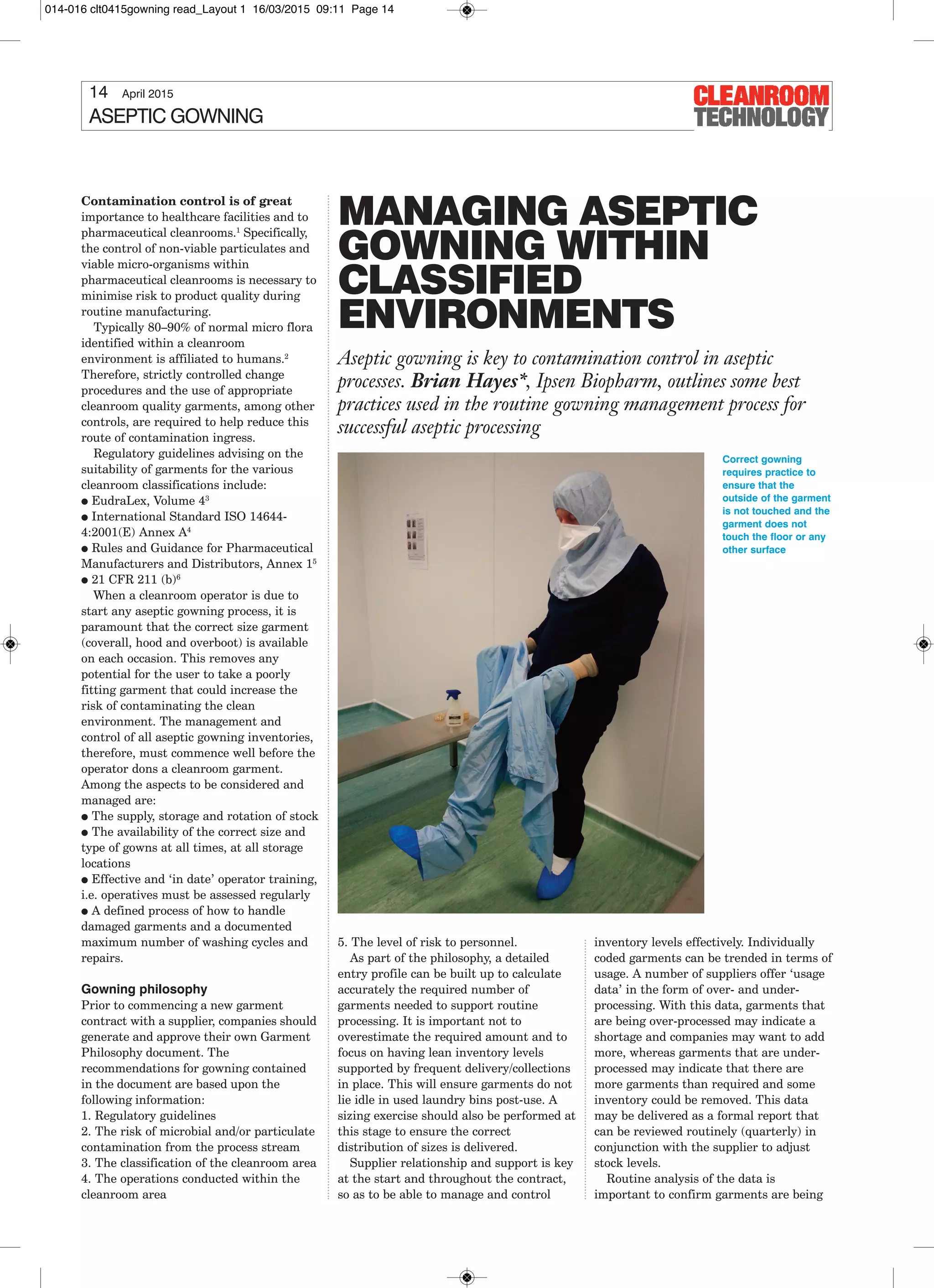
Correct gowning
requires practice to
ensure that the
outside of the garment
is not touched and the
garment does not
touch the floor or any
other surface
014-016 clt0415gowning read_Layout 1 16/03/2015 09:11 Page 14
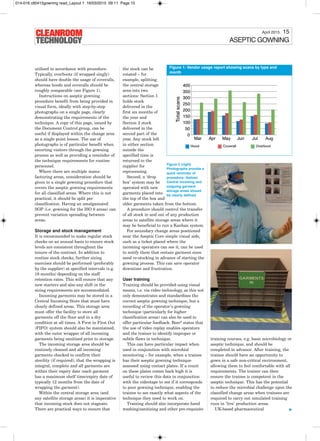
utilised in accordance with procedure.
Typically, overboots (if wrapped singly)
should have double the usage of coveralls,
whereas hoods and coveralls should be
roughly comparable (see Figure 1).
Instructions on aseptic gowning
procedure benefit from being provided in
visual form, ideally with step-by-step
photographs on a single page, clearly
demonstrating the requirements of the
technique. A copy of this page, issued by
the Document Control group, can be
useful if displayed within the change area
as a single point lesson. The use of
photographs is of particular benefit when
escorting visitors through the gowning
process as well as providing a reminder of
the technique requirements for routine
personnel.
Where there are multiple manu-
facturing areas, consideration should be
given to a single gowning procedure that
covers the aseptic gowning requirements
for all classified areas. Where this is not
practical, it should be split per
classification. Having an amalgamated
SOP (i.e. gowning for the ISO 8 areas) can
prevent variation spreading between
areas.
Storage and stock management
It is recommended to make regular stock
checks on an annual basis to ensure stock
levels are consistent throughout the
tenure of the contract. In addition to
routine stock checks, further sizing
exercises should be performed (preferably
by the supplier) at specified intervals (e.g.
18 months) depending on the staff
retention rates. This will ensure that any
new starters and also any shift in the
sizing requirements are accommodated.
Incoming garments may be stored in a
Central Incoming Store that must have
clearly defined areas. This storage area
must offer the facility to store all
garments off the floor and in a dry
condition at all times. A First in First Out
(FIFO) system should also be maintained,
with the outer wrapper of all incoming
garments being sanitised prior to storage.
The incoming storage area should be
routinely cleaned and all incoming
garments checked to confirm their
sterility (if required), that the wrapping is
integral, complete and all garments are
within their expiry date (each garment
has a maximum shelf time/expiry date of
typically 12 months from the date of
wrapping the garment).
Within the central storage area (and
any satellite storage areas) it is imperative
that incoming stock does not stagnate.
There are practical ways to ensure that
the stock can be
rotated – for
example, splitting
the central storage
area into two
sections: Section 1
holds stock
delivered in the
first six months of
the year and
Section 2 stock
delivered in the
second part of the
year. Any stock left
in either section
outside the
specified time is
returned to the
supplier for
reprocessing.
Second, a ‘drop
box’ system may be
operated with new
garments placed into
the top of the box and
older garments taken from the bottom.
A procedure should control the transfer
of all stock in and out of any production
areas to satellite storage areas where it
may be beneficial to run a Kanban system.
For secondary change areas positioned
near the Aseptic Core simple visual aids,
such as a ticket placed where the
incoming operators can see it, can be used
to notify them that certain garment sizes
need re-stocking in advance of starting the
gowning process. This can save operator
downtime and frustration.
User training
Training should be provided using visual
means, i.e. via video technology, as this not
only demonstrates and standardises the
correct aseptic gowning technique, but a
recording of the operator’s gowning
technique (particularly for higher
classification areas) can also be used to
offer particular feedback. Beer6
states that
the use of video replay enables operators
and the trainer to identify improper or
subtle flaws in technique.
This can have particular impact when
used in conjunction with microbial
monitoring – for example, when a trainee
has their aseptic gowning technique
assessed using contact plates. If a count
on these plates comes back high it is
useful to review this data in conjunction
with the videotape to see if it corresponds
to poor gowning technique, enabling the
trainee to see exactly what aspects of the
technique they need to work on.
Training should also incorporate hand
washing/sanitising and other pre-requisite
training courses, e.g. basic microbiology or
aseptic technique, and should be
completed in advance. After training, the
trainee should have an opportunity to
gown in a safe non-critical environment,
allowing them to feel comfortable with all
requirements. The trainer can then
ensure the trainee is competent in the
aseptic technique. This has the potential
to reduce the microbial challenge upon the
classified change areas when trainees are
required to carry out simulated training
runs in ‘live’ production areas.
UK-based pharmaceutical
April 2015 15
ASEPTIC GOWNING
Figure 2 (right)
Photographs provide a
quick reminder of
procedure. (below)
Central incoming and
outgoing garment
storage areas should
be clearly defined
Totalscans
Figure 1: Vendor usage report showing scans by type and
month
ᮣ
Hood Coverall Overboot
014-016 clt0415gowning read_Layout 1 16/03/2015 09:11 Page 15
16 April 2015
ASEPTIC GOWNING
company, Ipsen Biopharm, has taken
this approach one step further and has
designed and built a purpose-built Aseptic
Training Suite. The concept of this suite is
similar to a trainee pilot using a flight
simulator; it allows personnel to master
critical techniques in a risk-free, off-line
environment, while being exposed to the
unique challenges a cleanroom may offer.
The suite also offers the benefit of being
able to assess the technique and
capabilities of those applying to join the
company. It is important that training is
not a discrete event but an ongoing
occurrence, within a culture where
coaching and feedback is given routinely
by experienced personnel.
Garment damage and washing
A Service Level/Technical Agreement
between the garment supplier and the
customer is recommended, which
documents the specifics of the control of
each garment: for example, maximum
permissible numbers of washes, repairs
(what and where damage or wear is
allowable on the garment and also the
maximum number of repairs), as well as
transport and bagging requirements.
Certain suppliers may also offer the
ability to fold garments in a specific way
to help aid the aseptic gowning process;
again this detail would be documented in
the Service Level/Technical Agreement.
Last, if any branding of the cleanroom
garment stock is required, it should be
ensured that this is achieved using a
suitable grade print and that logos are not
stitched onto garments, as this itself may
damage the integrity of the fabric.
In summary, management of the aseptic
garment process commences well before
the operator dons a gown for cleanroom
entry. The process must be lean, but
practical in terms of the required
availability of garments at all times and
should be supported by strong, effective
ongoing training. Following these
protocols should also have a positive effect
on product quality assurance.
References
1. Sandle, T (2012) A Guide to Cleaning and
Disinfecting Cleanrooms, Grosvenor House
Publishing, Surrey, UK.
2. J. Fredirick, J. Carleton & P. Agalloco, (1999)
Validation of pharmaceutical processes: sterile
products, 3rd Edition, Marcel Dekker, New York.
3. EudraLex, Volume 4 – The rules governing
medicinal products in the European Union
4. Rules and Guidance for Pharmaceutical
Manufacturers and Distributors (Revision to
Annex 1 of Orange Guide, effective March 2014)
5. 21 CFR Part 211 – Current Good Manufac-
turing Practice for Finished Pharmaceuticals -
Subpart B – Organisation and Personnel
6. C. L. Beer, PDA J. Pharmaceutical Science and
Technology May–June 1991 45:128–131
*Brian Hayes is Chairman of the Cleanroom
Action Group (CAG) of Pharmig and in charge of
Aseptic Manufacturing at Ipsen Biopharm.
Brian.Hayes@Ipsen.com
The author would like to acknowledge the input
of CAG in the compilation of this article. Pharmig
aims to publish these and other concepts in a
‘best practice’ guide on gowning in the future.
CONTACT
Pharmig
T+44 1920 871999
www.pharmig.org.uk
ᮣ
014-016 clt0415gowning read_Layout 1 16/03/2015 09:11 Page 16

Clean

  • 1.
    inventory levels effectively.Individually coded garments can be trended in terms of usage. A number of suppliers offer ‘usage data’ in the form of over- and under- processing. With this data, garments that are being over-processed may indicate a shortage and companies may want to add more, whereas garments that are under- processed may indicate that there are more garments than required and some inventory could be removed. This data may be delivered as a formal report that can be reviewed routinely (quarterly) in conjunction with the supplier to adjust stock levels. Routine analysis of the data is important to confirm garments are being 14 April 2015 ASEPTIC GOWNING MANAGING ASEPTIC GOWNING WITHIN CLASSIFIED ENVIRONMENTS Aseptic gowning is key to contamination control in aseptic processes. Brian Hayes*, Ipsen Biopharm, outlines some best practices used in the routine gowning management process for successful aseptic processing Contamination control is of great importance to healthcare facilities and to pharmaceutical cleanrooms.1 Specifically, the control of non-viable particulates and viable micro-organisms within pharmaceutical cleanrooms is necessary to minimise risk to product quality during routine manufacturing. Typically 80–90% of normal micro flora identified within a cleanroom environment is affiliated to humans.2 Therefore, strictly controlled change procedures and the use of appropriate cleanroom quality garments, among other controls, are required to help reduce this route of contamination ingress. Regulatory guidelines advising on the suitability of garments for the various cleanroom classifications include: G EudraLex, Volume 43 G International Standard ISO 14644- 4:2001(E) Annex A4 G Rules and Guidance for Pharmaceutical Manufacturers and Distributors, Annex 15 G 21 CFR 211 (b)6 When a cleanroom operator is due to start any aseptic gowning process, it is paramount that the correct size garment (coverall, hood and overboot) is available on each occasion. This removes any potential for the user to take a poorly fitting garment that could increase the risk of contaminating the clean environment. The management and control of all aseptic gowning inventories, therefore, must commence well before the operator dons a cleanroom garment. Among the aspects to be considered and managed are: G The supply, storage and rotation of stock G The availability of the correct size and type of gowns at all times, at all storage locations G Effective and ‘in date’ operator training, i.e. operatives must be assessed regularly G A defined process of how to handle damaged garments and a documented maximum number of washing cycles and repairs. Gowning philosophy Prior to commencing a new garment contract with a supplier, companies should generate and approve their own Garment Philosophy document. The recommendations for gowning contained in the document are based upon the following information: 1. Regulatory guidelines 2. The risk of microbial and/or particulate contamination from the process stream 3. The classification of the cleanroom area 4. The operations conducted within the cleanroom area 5. The level of risk to personnel. As part of the philosophy, a detailed entry profile can be built up to calculate accurately the required number of garments needed to support routine processing. It is important not to overestimate the required amount and to focus on having lean inventory levels supported by frequent delivery/collections in place. This will ensure garments do not lie idle in used laundry bins post-use. A sizing exercise should also be performed at this stage to ensure the correct distribution of sizes is delivered. Supplier relationship and support is key at the start and throughout the contract, so as to be able to manage and control Correct gowning requires practice to ensure that the outside of the garment is not touched and the garment does not touch the floor or any other surface 014-016 clt0415gowning read_Layout 1 16/03/2015 09:11 Page 14
  • 2.
    utilised in accordancewith procedure. Typically, overboots (if wrapped singly) should have double the usage of coveralls, whereas hoods and coveralls should be roughly comparable (see Figure 1). Instructions on aseptic gowning procedure benefit from being provided in visual form, ideally with step-by-step photographs on a single page, clearly demonstrating the requirements of the technique. A copy of this page, issued by the Document Control group, can be useful if displayed within the change area as a single point lesson. The use of photographs is of particular benefit when escorting visitors through the gowning process as well as providing a reminder of the technique requirements for routine personnel. Where there are multiple manu- facturing areas, consideration should be given to a single gowning procedure that covers the aseptic gowning requirements for all classified areas. Where this is not practical, it should be split per classification. Having an amalgamated SOP (i.e. gowning for the ISO 8 areas) can prevent variation spreading between areas. Storage and stock management It is recommended to make regular stock checks on an annual basis to ensure stock levels are consistent throughout the tenure of the contract. In addition to routine stock checks, further sizing exercises should be performed (preferably by the supplier) at specified intervals (e.g. 18 months) depending on the staff retention rates. This will ensure that any new starters and also any shift in the sizing requirements are accommodated. Incoming garments may be stored in a Central Incoming Store that must have clearly defined areas. This storage area must offer the facility to store all garments off the floor and in a dry condition at all times. A First in First Out (FIFO) system should also be maintained, with the outer wrapper of all incoming garments being sanitised prior to storage. The incoming storage area should be routinely cleaned and all incoming garments checked to confirm their sterility (if required), that the wrapping is integral, complete and all garments are within their expiry date (each garment has a maximum shelf time/expiry date of typically 12 months from the date of wrapping the garment). Within the central storage area (and any satellite storage areas) it is imperative that incoming stock does not stagnate. There are practical ways to ensure that the stock can be rotated – for example, splitting the central storage area into two sections: Section 1 holds stock delivered in the first six months of the year and Section 2 stock delivered in the second part of the year. Any stock left in either section outside the specified time is returned to the supplier for reprocessing. Second, a ‘drop box’ system may be operated with new garments placed into the top of the box and older garments taken from the bottom. A procedure should control the transfer of all stock in and out of any production areas to satellite storage areas where it may be beneficial to run a Kanban system. For secondary change areas positioned near the Aseptic Core simple visual aids, such as a ticket placed where the incoming operators can see it, can be used to notify them that certain garment sizes need re-stocking in advance of starting the gowning process. This can save operator downtime and frustration. User training Training should be provided using visual means, i.e. via video technology, as this not only demonstrates and standardises the correct aseptic gowning technique, but a recording of the operator’s gowning technique (particularly for higher classification areas) can also be used to offer particular feedback. Beer6 states that the use of video replay enables operators and the trainer to identify improper or subtle flaws in technique. This can have particular impact when used in conjunction with microbial monitoring – for example, when a trainee has their aseptic gowning technique assessed using contact plates. If a count on these plates comes back high it is useful to review this data in conjunction with the videotape to see if it corresponds to poor gowning technique, enabling the trainee to see exactly what aspects of the technique they need to work on. Training should also incorporate hand washing/sanitising and other pre-requisite training courses, e.g. basic microbiology or aseptic technique, and should be completed in advance. After training, the trainee should have an opportunity to gown in a safe non-critical environment, allowing them to feel comfortable with all requirements. The trainer can then ensure the trainee is competent in the aseptic technique. This has the potential to reduce the microbial challenge upon the classified change areas when trainees are required to carry out simulated training runs in ‘live’ production areas. UK-based pharmaceutical April 2015 15 ASEPTIC GOWNING Figure 2 (right) Photographs provide a quick reminder of procedure. (below) Central incoming and outgoing garment storage areas should be clearly defined Totalscans Figure 1: Vendor usage report showing scans by type and month ᮣ Hood Coverall Overboot 014-016 clt0415gowning read_Layout 1 16/03/2015 09:11 Page 15
  • 3.
    16 April 2015 ASEPTICGOWNING company, Ipsen Biopharm, has taken this approach one step further and has designed and built a purpose-built Aseptic Training Suite. The concept of this suite is similar to a trainee pilot using a flight simulator; it allows personnel to master critical techniques in a risk-free, off-line environment, while being exposed to the unique challenges a cleanroom may offer. The suite also offers the benefit of being able to assess the technique and capabilities of those applying to join the company. It is important that training is not a discrete event but an ongoing occurrence, within a culture where coaching and feedback is given routinely by experienced personnel. Garment damage and washing A Service Level/Technical Agreement between the garment supplier and the customer is recommended, which documents the specifics of the control of each garment: for example, maximum permissible numbers of washes, repairs (what and where damage or wear is allowable on the garment and also the maximum number of repairs), as well as transport and bagging requirements. Certain suppliers may also offer the ability to fold garments in a specific way to help aid the aseptic gowning process; again this detail would be documented in the Service Level/Technical Agreement. Last, if any branding of the cleanroom garment stock is required, it should be ensured that this is achieved using a suitable grade print and that logos are not stitched onto garments, as this itself may damage the integrity of the fabric. In summary, management of the aseptic garment process commences well before the operator dons a gown for cleanroom entry. The process must be lean, but practical in terms of the required availability of garments at all times and should be supported by strong, effective ongoing training. Following these protocols should also have a positive effect on product quality assurance. References 1. Sandle, T (2012) A Guide to Cleaning and Disinfecting Cleanrooms, Grosvenor House Publishing, Surrey, UK. 2. J. Fredirick, J. Carleton & P. Agalloco, (1999) Validation of pharmaceutical processes: sterile products, 3rd Edition, Marcel Dekker, New York. 3. EudraLex, Volume 4 – The rules governing medicinal products in the European Union 4. Rules and Guidance for Pharmaceutical Manufacturers and Distributors (Revision to Annex 1 of Orange Guide, effective March 2014) 5. 21 CFR Part 211 – Current Good Manufac- turing Practice for Finished Pharmaceuticals - Subpart B – Organisation and Personnel 6. C. L. Beer, PDA J. Pharmaceutical Science and Technology May–June 1991 45:128–131 *Brian Hayes is Chairman of the Cleanroom Action Group (CAG) of Pharmig and in charge of Aseptic Manufacturing at Ipsen Biopharm. Brian.Hayes@Ipsen.com The author would like to acknowledge the input of CAG in the compilation of this article. Pharmig aims to publish these and other concepts in a ‘best practice’ guide on gowning in the future. CONTACT Pharmig T+44 1920 871999 www.pharmig.org.uk ᮣ 014-016 clt0415gowning read_Layout 1 16/03/2015 09:11 Page 16