1
Presentation Outline
 Introduction
 Epidemiology
 Etiology
 pathophysiology
 Risk Factor
 Complications
 Sign And Symptoms
 Clinical presentation
 Investigations-lab and imaging
 Treatment
 Reference
2
Contt…
3
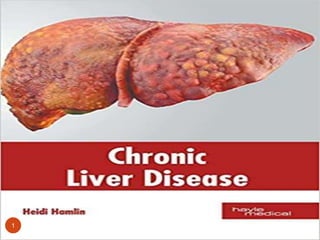
Introduction
What Is Chronic Liver Disease?
Chronic liver disease is marked by the gradual
destruction of liver tissue overtime Liver diseases
in this category include: Cirrhosis and Fibrosis of
the liver.
Chronic liver disease" refers to disease of the
liver which lasts over a period of six months. It
consists of a wide range of liver pathologies
which include inflammation (chronic hepatitis),
liver cirrhosis, and hepatocellul carcinoma. The
entire spectrum need not be experienced.
4
What causes different types of liver
disease ?
Different types of liver disease result from different
causes.
 Viral infections: Hepatitis A, hepatitis B and hepatitis
C are diseases caused by a viral infection.
 Problems with your immune system: , cause
autoimmune liver diseases. include primary biliary
cholangitis and autoimmune hepatitis
 Inherited diseases: a genetic condition (one you inherit
from your parents). include Wilson
disease and hemochromatosis
 Cancer: abnormal cells multiply in your liver, you may
develop tumors. (noncancerous) or malignant (liver
cancer).
 Consuming too many toxins: Alcohol-related fatty liver
disease . Non-alcohol related fatty liver disease
5
Epidemiology
 Estimate is that 1% of populations have
histologically
diagnosable cirrhosis
• Acute variceal bleeding and spontaneous
bacterial
peritonitis (SBP) …
– life-threatening complications of cirrhosis.
• Approximately 50% of patients with cirrhosis
develop
ascites during 10 years and, within 2 years,
nearly
half of patients who develop ascites will die
6
Etiology
 Result of chronic, long-term insult to liver
• Most common causes
– Chronic alcohol abuse
• Ethanol and metabolites are direct hepato toxins
– Hepatitis
• Hep C and Hep B
• Other causes
– Immunological disease[autoimmune hepatitis]
– Drugs: isoniazid, methotrexate, methyldopa,
Tamoxifen, propylthiouracil
7
Pathophysiology
 The pathological hallmark of cirrhosis is the
development of scar tissue that replaces normal
parenchyma(hepatocytes), blocking the portal
flow
of blood through the organ and disturbing
normal
function.
• Fatty liver or steatosis from chronic ethanol
abuse…followed by liver inflammation
(steatohepatitis), hepatocyte death, and collagen
deposition leads to fibrosis resulting increased
intrahepatic resistance.
8
contt…..
portal hypertension and cirrhosis
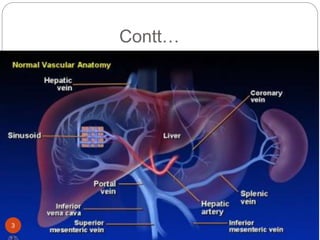
The portal vein comes from the splenic, superior
mesenteric, inferior mesenteric, and gastric veins,
and
ends in the sinusoids of the liver.
• Blood in the portal vein contains substances
absorbed
from the intestine, and delivers these substances to
the
liver to be metabolized before entering the systemic
circulation.
• Once the portal blood reaches the liver, it crosses
through a high-resistance capillary system
within the
hepatic sinusoids
9
Contt…
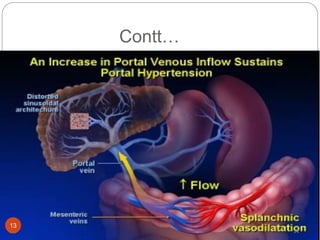
 The increased intra-hepatic resistance is an
initial
process leading to portal hypertension.
• Intra-hepatic resistance is not only structural but
also
functional …increase in blood flow to the
splanchnic
vasculature.irrhosis results in changes in
• Both the rise in resistance and the enhanced
portal
inflow play an important role in the development
of
10
Contt……..
 Portal pressure is a function of flow and
resistance
to that flow across the hepatic vasculature
• Resistance to blood flow secondary to hepatic
fibrosis. Increasing portal vein pressure.
• Nitric oxide released to counter elevated
pressure -
systemic vasodilation and decreasing blood
pressure ..Increasing renin, aldosterone,
antidiuretic hormone to maintain renal perfusion,
leads to sodium and water
retention
11
Contt….
 Normal portal pressure is generally below 6 mm
Hg,
and in cirrhotic patients may increase to 7 to 9
mmHg.
• Clinically significant…10 to 12 mm Hg, the
threshold
for complications of portal hypertension, such as
esophageal varices and ascites
• Persistent portal hypertension---
– lead to ascites formation
– Lead to the formation of esophageal varices
12
Contt…
13
Risk factors
 Excessive alcohol use
 Obesity
 Metabolic syndrome including raised blood lipids
 Health care professionals who are exposed
to body fluids and infected blood
 Sharing infected needle and syringes
 Having unprotected sex and multiple sex partners
 Working with toxic chemicals without wearing
safety clothes
 Certain prescription medications
14
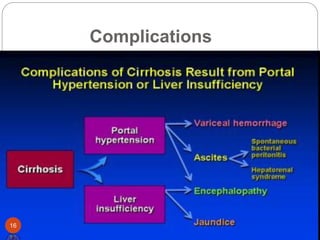
Complications
 Portal hypertension
 Ascites
 Hypersplenism (with or without splenomegaly)
 Lower esophageal avarices and rectal avarices
 Synthetic dysfunction
 Hypoalbuminaemia
 Coagulopathy
 Hepatopulmonary syndrome
 Hepatorenal syndrome
 Encephalopathy
 Hepatocellular carcinoma
15
Complications
16
sign and Symptoms
 Fluid buildup in the belly (ascites)
 Vomiting blood,
 Itching, Spider-like veins in the skin
 Yellowing of the skin and eyes (jaundice)
 Kidney failure, Gallstones
 Muscle loss, Low energy and weakness (fatigue)
 Loss of appetite, Weight loss
 Easy bruising
 Confusion as toxins build up in the blood
17
Clinical pretesatsion
 Asymptomatic
• Jaundice, scleral icterus, tea-colored urine
• Decreased libido, gynecomastia, testicular
atrophy
• Spider angiomata and hyperpigmentation
• Splenomegaly
• Ascites, edema, pleural effusion, and respiratory
difficulties
• Malaise, anorexia, and weight loss
• Encephalopathy
18
Investigations –lab and
imaging
 Liver function tests ( AST, ALT, PT, Alb, Bili)
– Elevated aspartate transaminase (AST),
alanine transaminase (ALT)
• Hypoalbuminemia
• Elevated prothrombin time (PT)
• Thrombocytopenia
 Cholangiography: A specialized X-ray of your
bile ducts
 ENDOSCOPY AND COLONSCOPY
19
Contt..
• Ultrasound
 CT scan (computed tomography)
 MRI (magnetic resonance imaging)
 Liver biopsy
– Ascetic fluid analysis: total protein, bacterial
culture, albumin (SA-AG(serum-ascites albumin
gradient) differentiates cause of ascites with 97%
accuracy)
– SAAG >1.1 g/dL… Presence of low albumin in
ascites fluid ….is indicative of ascites secondary to
portal hypertension
20
Scoring systems for chronic liver disease (CLD)
 MELD (model of end-stage liver disease)
 Bilirubin
 Creatinine
 INR
 UKELD (UK model of end-stage liver disease)
 Bilirubin
 Creatinine
 INR
 Sodium
 Childs-Pugh
 Ascites
 Bilirubin
 Albumin
 PT
 Encephalopathy
21
MANAGEMENT AND TREATMENT
How is liver disease managed or treated?
depends on the type of liver disease :
 Medications: take medicine for viral infections
like hepatitis or inherited conditions like Wilson
disease.
 Lifestyle changes: If you have fatty liver
disease, avoiding alcohol, limiting fat and calories
and increasing fiber intake can help.
 Liver transplant: .
22
Treatments
 General approaches;
• Identify and eliminate, where possible, the
causes of cirrhosis (e.g., alcohol abuse).
• Assess the risk for variceal bleeding and begin
pharmacologic prophylaxis when indicated.
• Evaluate the patient for clinical signs of ascites
and
manage with pharmacologic therapy and
paracentesis.
• Careful monitoring for SBP in patients with
ascites.
• HE dietary restriction, elimination of CNS
depressants,
and therapy to lower ammonia levels
23
I. Varices and management
• Veins in the esophagus, stomach, and rectum
enlarge
to accommodate blocked blood flow through the
liver.
• The presence of enlarged veins (varices) usually
causes no symptoms…. But as the disease
progress…
there will be further enlargement and bleeding
24
Contt…
 It is one of most severe complications of cirrhosis
• Approximately one-third of all cirrhotic
patients….
– with varices will develop a variceal bleed
• Incidence of bleeding…25-35%
• Mortality rate…30-50% per bleeding
• Recurrence rates…70% within the first 6
months after initial bleed
25
Contt…
 Treatment goals:
– volume resuscitation,
– acute treatment of bleeding,
– prevention of recurrence of variceal bleeding.
• Treatment for variceal bleeding is challenging
and
include medicines as well as endoscopic therapy
(endoscopic banding or sclerotherapy).
• Treatment includes; primary tx, acute bleeding
management and secondary tx.
26
ACUTE VARICEAL BLEEDING TREATMENT
Goal of medical therapy is to
– Decrease portal HTN by decreasing spanchnic blood
flow
• Steps in Treatment
– Fluid resuscitation
– Medical management, endoscopic
• Hypovolemia should be immediately managed to
maintain mean arterial pressure at 80 mm Hg and the
hemoglobin at approximately 8 g/dL.
• Fresh frozen plasma or platelets for ... patients with
Prolongation of the PT
27
 Vasopressin…0.2-0.4 U/min plus Nitroglycerine
40-400 mcg/min for 3-5 days
• Octreotide is a …………
– parenteral synthetic analog of the naturally
occurring hormone somatostatin
– Preferred agent in combination with
…endoscopy
– 50 mcg IV bolus, then 50 mcg/hr IV x 3-5 days
• ADR..Hyperglycemia and abdominal cramping
28
Contt…
 Endoscopy
– Sclerotherapy (80%-90%) …effective …..Sclerosing
agents includes ethanolamine or sodium tetradecyl
sulfate
• Non-drug therapy
– Balloon compression directly to bleeding varices to stop
the bleeding
– Tran jugular intrahepatic port systemic
shunt….Shunting away blood from portal circulation
• Antibiotics…….decrease mortality(prevent rebreeding
and SBP)
– Fluoroquinolone (cipro 500MGor norfloxacin 400MG)
BID for 7 days
29
II, VARICES BLEEDING PRIMARY TREATMENT
• Prophlaxis….is not needed for cirrhosis unless
varices identified.
• Use non-selective beta blockers(propranolol and
nadolol)…. Life long
– Decrease cardiac output and spanchnic blood
flow
– Usual starting dosages of propranolol are 10 mg
three times a day, or nadolol 20 mg daily.
• Goal of HR………> 55 beats/min or 25%
reduction in
blood flow to splanchnic area
30
ASCITES AND MANAGEMENTS
• Excess free fluid in the abdomen…. more than 3 L
of fluid…occur over a few weeks.
• Hypoalbuminemia from decrease protein synthesis,
and increase capillary permeability and volume
overload allow
fluid to escape the vascular space & accumulate in
peritoneal space …leading to ascites
• Clinical features
– protuberant abdomen
– shifting dullness
– fluid wave, abdominal pain
31
Contt…
32
Contt…
 Goal is ……..
– weight loss of no more than 1.0 kg/day for
patients with both ascites and peripheral edema
and ……no more than 0.5 kg/day for patients with
ascites alone
• In those with severe ascites causing a tense
abdomen……. hospitalization is generally
necessary
for paracentesis
33
Contt….
 Salt restriction…….
– is the initial treatment, which allows diuresis since
the patient has more fluid than salt concentration.
– Salt restriction is effective in about 15% of
patients
• Diuretics……
– Since salt restriction is the basic concept in
treatment, and aldosterone is one of the
hormones that acts to increase salt retention, a
medication that counteracts aldosterone should
be sought.
34
Contt….
 Spironolactone is the drug of choice since -they
block the aldosterone receptor in the collecting
tubule.
• Generally, the starting dose is …
– oral spironolactone 100 mg/day (max 400
mg/day).
– 40% of patients will respond to spironolactone
• For non-responders…
– a loop diuretic may also be added and
generally….furosemide is added at a dose of
40 mg/day (max 160 mg/day)
35
Contt…
 Diuretic resistance can be predicted when……..
– 80 mg IV furosemide after 3 days without
diuresis.
• Paracentesis……..is for those severe (tense)
ascites,
– therapeutic paracentesis may be needed in
addition to medical treatments.
36
III, SPONTANEOUS BACTERIAL PERITONITIS (SBP)
• SBP is an acute bacterial infection of ascitic fluid.
– Incidence--10-30% of hospitalized patients with
cirrhosis
and ascites
• Mortality…………20-40% of in-hospital
• Pathophysiology
– Increased gut permeability secondary to portal
hypertension or translocation of the gut wall
• Enteric gram-negative most common and
usually
only a single organism is involved. e.g
E.coli,Klebsiella
37
Contt…
 Clinical and Laboratory Features
• Common symptoms….
– Fever, abdominal pain, nausea, vomiting,
diarrhea,
– Peritoneal signs (eg, abdominal tenderness and
rebound)
• Laboratory
– Blood culture positive in 50-70% of cases
– Ascetics cultures positive in 67% of cases
38
(SBP) Treatments
• Antibiotic therapy
– Empiric therapy for gram-negative organisms
– Third generation cephalosporin's…..studied the
most
• Cefotaxime 2 gm q8-12 hrs or Ceftriaxone 2
g/day, fluoroquinolones for 5 days
39
(SBP) PROPHYLAXIS
 All patients who have survived an episode of SBP
should receive long-term antibiotic prophylaxis.
• Oral antibiotics can be used as prophylaxis to
reduce
bacterial translocation
– Norfloxacin 400 mg/day or ciprofloxacin 750 mg
• The prophylaxis might be indicated to those with
a
history of SBP, those presenting with an upper GI
hemorrhage.
40
IV, HEPATIC ENCEPHALOPATHY (HE)
Hepatic coma or encephalopathy is a metabolic
disorder of the central nervous system (CNS),
which
occurs in patients with advanced cirrhosis.
• Ammonia(NH3) ..neurotoxic metabolic
manufactured by gut bacteria and by product of
protein catabolism.
– Decreased conversion of NH3 to urea
accumulates
encephalopathy
• Also aggravated by other substances that are
formed
or accumulate because of decreasing hepatic
metabolism.
41
(HE) TREATMENT
 Therapeutic management is aimed primarily at
reducing the amount of ammonia or nitrogenous
products in the circulatory system
Lactulose: non-absorbable disaccharide; decrease
colonic
pH allows conversion of NH3 (ammonia) to
ammonium (NH4+), trapping it in GI lumen &
leading
to excretion.
42
Contt…
 Acute HE treatment: 45 mL PO Q1-2h until
loose bowel
Moment(2-3 times /day) …….if unable to take
PO, retention enema 300 mL in 700 mL water
retained for 1 hr, repeated Q2h until mental
function improves
• Maintenance: 15-30 mL PO BID-TID….
Adverse Effect : flatulence, diarrhea, abdominal
cramping
43
Contt…
 Antibiotics – 2nd line
– decreasing number of intestinal urease-producing bacteria
associated with excess NH3 production
• Rifaximin 400 mg TID
– Very expensive; better tolerated than lactulose
• Metronidazole 250 BID
– Not FDA approved for use
• Neomycin 3-6 g/d divided Q6-8H x 1-2 weeks, then 1-2
g/d maintenance
– Last line therapy, poorly tolerated and many
AEs
(renal toxicity, ototoxicity)
44
Reference
 ^ "NHS Choices". Cirrhosis. Retrieved 6 October 2015.
 ^ Zetterman, Rowen. "Evaluating the Patient With Abnormal Liver
Tests". Medscape. Retrieved 6 October 2015.
 ^ Jump up to:a b Chronic Liver Disease Causes, Symptoms And
Treatment - 27/01/2007
 ^ Liver Disease Archived 2010-01-31 at the Wayback
Machine Gastro.com - 2007-01-27
 ^ Liu ZL, Xie LZ, Zhu J, Li GQ, Grant SJ, Liu JP (2013). "Herbal
medicines for fatty liver diseases". Cochrane Database Syst Rev. 8 (8):
CD009059. doi:10.1002/14651858.CD009059.pub2. PMID 23975682.
 ^ Montanini, S; Sinardi, D; Praticò, C; Sinardi, AU; Trimarchi, G (1999).
"Use of acetylcysteine as the life-saving antidote in Amanita phalloides
(death cap) poisoning". Arzneimittel-Forschung. National Institutes of
Health. 49 (12): 1044–7. doi:10.1055/s-0031-1300549. PMID 10635453.
 ^ Rainone, Francine (2005). "Milk Thistle". American Family
Physician. 72 (7): 1285–8. PMID 16225032
 ^ Most liver damage from kava has been shown to be due to
contamination or an inappropriate source. A 2016 paper concludes: there
is no evidence that occasional use of kava beverage is associated with
any long-term adverse effects, including effects on the liver. See Kava-
Effects on the liver for an extensive review.
 ^ Liver problems Alternative medicine - 27/01/2007/
45
THANKE YOU
THANK YOU !!
46

cld.pptx

  • 1.
  • 2.
    Presentation Outline  Introduction Epidemiology  Etiology  pathophysiology  Risk Factor  Complications  Sign And Symptoms  Clinical presentation  Investigations-lab and imaging  Treatment  Reference 2
  • 3.
  • 4.
    Introduction What Is ChronicLiver Disease? Chronic liver disease is marked by the gradual destruction of liver tissue overtime Liver diseases in this category include: Cirrhosis and Fibrosis of the liver. Chronic liver disease" refers to disease of the liver which lasts over a period of six months. It consists of a wide range of liver pathologies which include inflammation (chronic hepatitis), liver cirrhosis, and hepatocellul carcinoma. The entire spectrum need not be experienced. 4
  • 5.
    What causes differenttypes of liver disease ? Different types of liver disease result from different causes.  Viral infections: Hepatitis A, hepatitis B and hepatitis C are diseases caused by a viral infection.  Problems with your immune system: , cause autoimmune liver diseases. include primary biliary cholangitis and autoimmune hepatitis  Inherited diseases: a genetic condition (one you inherit from your parents). include Wilson disease and hemochromatosis  Cancer: abnormal cells multiply in your liver, you may develop tumors. (noncancerous) or malignant (liver cancer).  Consuming too many toxins: Alcohol-related fatty liver disease . Non-alcohol related fatty liver disease 5
  • 6.
    Epidemiology  Estimate isthat 1% of populations have histologically diagnosable cirrhosis • Acute variceal bleeding and spontaneous bacterial peritonitis (SBP) … – life-threatening complications of cirrhosis. • Approximately 50% of patients with cirrhosis develop ascites during 10 years and, within 2 years, nearly half of patients who develop ascites will die 6
  • 7.
    Etiology  Result ofchronic, long-term insult to liver • Most common causes – Chronic alcohol abuse • Ethanol and metabolites are direct hepato toxins – Hepatitis • Hep C and Hep B • Other causes – Immunological disease[autoimmune hepatitis] – Drugs: isoniazid, methotrexate, methyldopa, Tamoxifen, propylthiouracil 7
  • 8.
    Pathophysiology  The pathologicalhallmark of cirrhosis is the development of scar tissue that replaces normal parenchyma(hepatocytes), blocking the portal flow of blood through the organ and disturbing normal function. • Fatty liver or steatosis from chronic ethanol abuse…followed by liver inflammation (steatohepatitis), hepatocyte death, and collagen deposition leads to fibrosis resulting increased intrahepatic resistance. 8
  • 9.
    contt….. portal hypertension andcirrhosis The portal vein comes from the splenic, superior mesenteric, inferior mesenteric, and gastric veins, and ends in the sinusoids of the liver. • Blood in the portal vein contains substances absorbed from the intestine, and delivers these substances to the liver to be metabolized before entering the systemic circulation. • Once the portal blood reaches the liver, it crosses through a high-resistance capillary system within the hepatic sinusoids 9
  • 10.
    Contt…  The increasedintra-hepatic resistance is an initial process leading to portal hypertension. • Intra-hepatic resistance is not only structural but also functional …increase in blood flow to the splanchnic vasculature.irrhosis results in changes in • Both the rise in resistance and the enhanced portal inflow play an important role in the development of 10
  • 11.
    Contt……..  Portal pressureis a function of flow and resistance to that flow across the hepatic vasculature • Resistance to blood flow secondary to hepatic fibrosis. Increasing portal vein pressure. • Nitric oxide released to counter elevated pressure - systemic vasodilation and decreasing blood pressure ..Increasing renin, aldosterone, antidiuretic hormone to maintain renal perfusion, leads to sodium and water retention 11
  • 12.
    Contt….  Normal portalpressure is generally below 6 mm Hg, and in cirrhotic patients may increase to 7 to 9 mmHg. • Clinically significant…10 to 12 mm Hg, the threshold for complications of portal hypertension, such as esophageal varices and ascites • Persistent portal hypertension--- – lead to ascites formation – Lead to the formation of esophageal varices 12
  • 13.
  • 14.
    Risk factors  Excessivealcohol use  Obesity  Metabolic syndrome including raised blood lipids  Health care professionals who are exposed to body fluids and infected blood  Sharing infected needle and syringes  Having unprotected sex and multiple sex partners  Working with toxic chemicals without wearing safety clothes  Certain prescription medications 14
  • 15.
    Complications  Portal hypertension Ascites  Hypersplenism (with or without splenomegaly)  Lower esophageal avarices and rectal avarices  Synthetic dysfunction  Hypoalbuminaemia  Coagulopathy  Hepatopulmonary syndrome  Hepatorenal syndrome  Encephalopathy  Hepatocellular carcinoma 15
  • 16.
  • 17.
    sign and Symptoms Fluid buildup in the belly (ascites)  Vomiting blood,  Itching, Spider-like veins in the skin  Yellowing of the skin and eyes (jaundice)  Kidney failure, Gallstones  Muscle loss, Low energy and weakness (fatigue)  Loss of appetite, Weight loss  Easy bruising  Confusion as toxins build up in the blood 17
  • 18.
    Clinical pretesatsion  Asymptomatic •Jaundice, scleral icterus, tea-colored urine • Decreased libido, gynecomastia, testicular atrophy • Spider angiomata and hyperpigmentation • Splenomegaly • Ascites, edema, pleural effusion, and respiratory difficulties • Malaise, anorexia, and weight loss • Encephalopathy 18
  • 19.
    Investigations –lab and imaging Liver function tests ( AST, ALT, PT, Alb, Bili) – Elevated aspartate transaminase (AST), alanine transaminase (ALT) • Hypoalbuminemia • Elevated prothrombin time (PT) • Thrombocytopenia  Cholangiography: A specialized X-ray of your bile ducts  ENDOSCOPY AND COLONSCOPY 19
  • 20.
    Contt.. • Ultrasound  CTscan (computed tomography)  MRI (magnetic resonance imaging)  Liver biopsy – Ascetic fluid analysis: total protein, bacterial culture, albumin (SA-AG(serum-ascites albumin gradient) differentiates cause of ascites with 97% accuracy) – SAAG >1.1 g/dL… Presence of low albumin in ascites fluid ….is indicative of ascites secondary to portal hypertension 20
  • 21.
    Scoring systems forchronic liver disease (CLD)  MELD (model of end-stage liver disease)  Bilirubin  Creatinine  INR  UKELD (UK model of end-stage liver disease)  Bilirubin  Creatinine  INR  Sodium  Childs-Pugh  Ascites  Bilirubin  Albumin  PT  Encephalopathy 21
  • 22.
    MANAGEMENT AND TREATMENT Howis liver disease managed or treated? depends on the type of liver disease :  Medications: take medicine for viral infections like hepatitis or inherited conditions like Wilson disease.  Lifestyle changes: If you have fatty liver disease, avoiding alcohol, limiting fat and calories and increasing fiber intake can help.  Liver transplant: . 22
  • 23.
    Treatments  General approaches; •Identify and eliminate, where possible, the causes of cirrhosis (e.g., alcohol abuse). • Assess the risk for variceal bleeding and begin pharmacologic prophylaxis when indicated. • Evaluate the patient for clinical signs of ascites and manage with pharmacologic therapy and paracentesis. • Careful monitoring for SBP in patients with ascites. • HE dietary restriction, elimination of CNS depressants, and therapy to lower ammonia levels 23
  • 24.
    I. Varices andmanagement • Veins in the esophagus, stomach, and rectum enlarge to accommodate blocked blood flow through the liver. • The presence of enlarged veins (varices) usually causes no symptoms…. But as the disease progress… there will be further enlargement and bleeding 24
  • 25.
    Contt…  It isone of most severe complications of cirrhosis • Approximately one-third of all cirrhotic patients…. – with varices will develop a variceal bleed • Incidence of bleeding…25-35% • Mortality rate…30-50% per bleeding • Recurrence rates…70% within the first 6 months after initial bleed 25
  • 26.
    Contt…  Treatment goals: –volume resuscitation, – acute treatment of bleeding, – prevention of recurrence of variceal bleeding. • Treatment for variceal bleeding is challenging and include medicines as well as endoscopic therapy (endoscopic banding or sclerotherapy). • Treatment includes; primary tx, acute bleeding management and secondary tx. 26
  • 27.
    ACUTE VARICEAL BLEEDINGTREATMENT Goal of medical therapy is to – Decrease portal HTN by decreasing spanchnic blood flow • Steps in Treatment – Fluid resuscitation – Medical management, endoscopic • Hypovolemia should be immediately managed to maintain mean arterial pressure at 80 mm Hg and the hemoglobin at approximately 8 g/dL. • Fresh frozen plasma or platelets for ... patients with Prolongation of the PT 27
  • 28.
     Vasopressin…0.2-0.4 U/minplus Nitroglycerine 40-400 mcg/min for 3-5 days • Octreotide is a ………… – parenteral synthetic analog of the naturally occurring hormone somatostatin – Preferred agent in combination with …endoscopy – 50 mcg IV bolus, then 50 mcg/hr IV x 3-5 days • ADR..Hyperglycemia and abdominal cramping 28
  • 29.
    Contt…  Endoscopy – Sclerotherapy(80%-90%) …effective …..Sclerosing agents includes ethanolamine or sodium tetradecyl sulfate • Non-drug therapy – Balloon compression directly to bleeding varices to stop the bleeding – Tran jugular intrahepatic port systemic shunt….Shunting away blood from portal circulation • Antibiotics…….decrease mortality(prevent rebreeding and SBP) – Fluoroquinolone (cipro 500MGor norfloxacin 400MG) BID for 7 days 29
  • 30.
    II, VARICES BLEEDINGPRIMARY TREATMENT • Prophlaxis….is not needed for cirrhosis unless varices identified. • Use non-selective beta blockers(propranolol and nadolol)…. Life long – Decrease cardiac output and spanchnic blood flow – Usual starting dosages of propranolol are 10 mg three times a day, or nadolol 20 mg daily. • Goal of HR………> 55 beats/min or 25% reduction in blood flow to splanchnic area 30
  • 31.
    ASCITES AND MANAGEMENTS •Excess free fluid in the abdomen…. more than 3 L of fluid…occur over a few weeks. • Hypoalbuminemia from decrease protein synthesis, and increase capillary permeability and volume overload allow fluid to escape the vascular space & accumulate in peritoneal space …leading to ascites • Clinical features – protuberant abdomen – shifting dullness – fluid wave, abdominal pain 31
  • 32.
  • 33.
    Contt…  Goal is…….. – weight loss of no more than 1.0 kg/day for patients with both ascites and peripheral edema and ……no more than 0.5 kg/day for patients with ascites alone • In those with severe ascites causing a tense abdomen……. hospitalization is generally necessary for paracentesis 33
  • 34.
    Contt….  Salt restriction……. –is the initial treatment, which allows diuresis since the patient has more fluid than salt concentration. – Salt restriction is effective in about 15% of patients • Diuretics…… – Since salt restriction is the basic concept in treatment, and aldosterone is one of the hormones that acts to increase salt retention, a medication that counteracts aldosterone should be sought. 34
  • 35.
    Contt….  Spironolactone isthe drug of choice since -they block the aldosterone receptor in the collecting tubule. • Generally, the starting dose is … – oral spironolactone 100 mg/day (max 400 mg/day). – 40% of patients will respond to spironolactone • For non-responders… – a loop diuretic may also be added and generally….furosemide is added at a dose of 40 mg/day (max 160 mg/day) 35
  • 36.
    Contt…  Diuretic resistancecan be predicted when…….. – 80 mg IV furosemide after 3 days without diuresis. • Paracentesis……..is for those severe (tense) ascites, – therapeutic paracentesis may be needed in addition to medical treatments. 36
  • 37.
    III, SPONTANEOUS BACTERIALPERITONITIS (SBP) • SBP is an acute bacterial infection of ascitic fluid. – Incidence--10-30% of hospitalized patients with cirrhosis and ascites • Mortality…………20-40% of in-hospital • Pathophysiology – Increased gut permeability secondary to portal hypertension or translocation of the gut wall • Enteric gram-negative most common and usually only a single organism is involved. e.g E.coli,Klebsiella 37
  • 38.
    Contt…  Clinical andLaboratory Features • Common symptoms…. – Fever, abdominal pain, nausea, vomiting, diarrhea, – Peritoneal signs (eg, abdominal tenderness and rebound) • Laboratory – Blood culture positive in 50-70% of cases – Ascetics cultures positive in 67% of cases 38
  • 39.
    (SBP) Treatments • Antibiotictherapy – Empiric therapy for gram-negative organisms – Third generation cephalosporin's…..studied the most • Cefotaxime 2 gm q8-12 hrs or Ceftriaxone 2 g/day, fluoroquinolones for 5 days 39
  • 40.
    (SBP) PROPHYLAXIS  Allpatients who have survived an episode of SBP should receive long-term antibiotic prophylaxis. • Oral antibiotics can be used as prophylaxis to reduce bacterial translocation – Norfloxacin 400 mg/day or ciprofloxacin 750 mg • The prophylaxis might be indicated to those with a history of SBP, those presenting with an upper GI hemorrhage. 40
  • 41.
    IV, HEPATIC ENCEPHALOPATHY(HE) Hepatic coma or encephalopathy is a metabolic disorder of the central nervous system (CNS), which occurs in patients with advanced cirrhosis. • Ammonia(NH3) ..neurotoxic metabolic manufactured by gut bacteria and by product of protein catabolism. – Decreased conversion of NH3 to urea accumulates encephalopathy • Also aggravated by other substances that are formed or accumulate because of decreasing hepatic metabolism. 41
  • 42.
    (HE) TREATMENT  Therapeuticmanagement is aimed primarily at reducing the amount of ammonia or nitrogenous products in the circulatory system Lactulose: non-absorbable disaccharide; decrease colonic pH allows conversion of NH3 (ammonia) to ammonium (NH4+), trapping it in GI lumen & leading to excretion. 42
  • 43.
    Contt…  Acute HEtreatment: 45 mL PO Q1-2h until loose bowel Moment(2-3 times /day) …….if unable to take PO, retention enema 300 mL in 700 mL water retained for 1 hr, repeated Q2h until mental function improves • Maintenance: 15-30 mL PO BID-TID…. Adverse Effect : flatulence, diarrhea, abdominal cramping 43
  • 44.
    Contt…  Antibiotics –2nd line – decreasing number of intestinal urease-producing bacteria associated with excess NH3 production • Rifaximin 400 mg TID – Very expensive; better tolerated than lactulose • Metronidazole 250 BID – Not FDA approved for use • Neomycin 3-6 g/d divided Q6-8H x 1-2 weeks, then 1-2 g/d maintenance – Last line therapy, poorly tolerated and many AEs (renal toxicity, ototoxicity) 44
  • 45.
    Reference  ^ "NHSChoices". Cirrhosis. Retrieved 6 October 2015.  ^ Zetterman, Rowen. "Evaluating the Patient With Abnormal Liver Tests". Medscape. Retrieved 6 October 2015.  ^ Jump up to:a b Chronic Liver Disease Causes, Symptoms And Treatment - 27/01/2007  ^ Liver Disease Archived 2010-01-31 at the Wayback Machine Gastro.com - 2007-01-27  ^ Liu ZL, Xie LZ, Zhu J, Li GQ, Grant SJ, Liu JP (2013). "Herbal medicines for fatty liver diseases". Cochrane Database Syst Rev. 8 (8): CD009059. doi:10.1002/14651858.CD009059.pub2. PMID 23975682.  ^ Montanini, S; Sinardi, D; Praticò, C; Sinardi, AU; Trimarchi, G (1999). "Use of acetylcysteine as the life-saving antidote in Amanita phalloides (death cap) poisoning". Arzneimittel-Forschung. National Institutes of Health. 49 (12): 1044–7. doi:10.1055/s-0031-1300549. PMID 10635453.  ^ Rainone, Francine (2005). "Milk Thistle". American Family Physician. 72 (7): 1285–8. PMID 16225032  ^ Most liver damage from kava has been shown to be due to contamination or an inappropriate source. A 2016 paper concludes: there is no evidence that occasional use of kava beverage is associated with any long-term adverse effects, including effects on the liver. See Kava- Effects on the liver for an extensive review.  ^ Liver problems Alternative medicine - 27/01/2007/ 45
  • 46.